Watch: David Fincher’s Eternal Return in ‘Gone Girl’: A Video Essay

Watch: David Fincher’s Eternal Return in ‘Gone Girl’: A Video Essay

Ah, the eternal return. History repeats itself. We think we change, but we don’t. You think someone may surprise you with unpredictable behavior–and then they don’t. Gone Girl is a perfect film to demonstrate this historical and, at bottom, psychological tendency; the most consistent thing about both Nick Dunne and Amy Dunne is their duplicitousness, and we keep seeing it over, and over, and over again throughout the film. And, as Jop Leuven points out in this brief but pointed video essay, the film’s visual structure mirrors this repetition; we see the same shots, with slight variations, repeated from the beginning to the end of the film. Amy lying on a pillow. Nick standing in front of a picture of his wife. Amy opening a door with mock innocence. And onwards. David Fincher is a master explorer of the works he adapts; he gets under the hood, assesses their potential, and, after a little bit of tinkering, takes us through them with such brio that the work he is adapting is utterly transformed. His adaptation of Gillian Flynn’s brilliant novel is no exception, as this video proves.

WATCH: Alejandro González Iñárritu’s Cinema of Self-Awareness: A Video Tour

WATCH: Alejandro González Iñárritu’s Cinema of Self-Awareness: A Video Tour

In Shakespeare studies, the term anagnorisis means a moment of self-recognition, when a character becomes blazingly aware of his or her place in the world, and of his or her relationship with other characters, after a long period of denial. Hamlet, Macbeth, King Lear, and Othello are practically bursting with anagnorisis; the central figures of these plays cannot withstand the truth about themselves and, watching them, we cannot withstand it either. The films of Alejandro González Iñárritu have anagnorisis to spare, as well. It does not always have to be tragic: Riggan Thompson’s (Michael Keaton) flight in Birdman is an example. However, in the films of this director, more often than not, anagnorisis signifies the shouldering of a weight one did not think one could bear: see Richard’s (Brad Pitt) moment of reckoning with his wife’s injury in Babel, or Jack Jordan’s (Benicio del Toro) tragic glance within himself in 21 Grams. Edgar Martinez’s beautiful video flight through Iñárritu’s work calls up these moments and thrusts them out for our attention. When presented in such an open manner, it is hard not to recognize Iñárritu’s strength as a storyteller, whatever what one might think of him as an overall filmmaker.

WATCH: A Video Essay on Shadows Through Cinema History

WATCH: A Video Essay on Shadows Through Cinema History

Shadows are a natural part of any given scene in a film–when the subject or an object interrupts a light source, an area of darkness is created.  But what happens when the shadow itself becomes the subject?  What happens when the darkness on the face of a character is something more than just the absence of direct light?  These types of shadows can communicate a variety of different tones and ideas. 

In ‘No Country for Old Men,’ Sheriff Ed Tom Bell opens the motel door to engage in what would be the climactic final shootout in a more traditional western.  The door slowly swings open, revealing the shadow of an iconic cowboy on the opposite wall. We see what Bell needs to be–something he simply cannot.  In ‘Raging Bull,’ the weight of Jake LaMotta’s imprisonment is expressed through the exaggerated, intruding shadows in his cell. His mental imprisonment becomes as apparent as his physical captivity.  In ‘There Will be Blood,’ a train moves across the sunset, creating a ripple of shadows on the face of the observing Daniel Plainview.  A train, the vehicle that both brought his son home and took him away, obstructs the direction of his progress. 
While many shadows in cinema are simply a complement of lighting, the very deliberate and thoughtful shadows in this video convey everything from fear to empowerment–from the empty to the iconic. 

Films used:
Nosferatu
Frankenstein (1931)
The Cabinet of Dr. Caligari
Raging Bull
Psycho (1960)
The Big Combo
Scarface (1932)
Rumble Fish
Sin City
Sin City: A Dame to Kill For
No Country for Old Men
Django Unchained
Raiders of the Lost Ark
Lawrence of Arabia
Punch-Drunk Love
Unbroken
The Thin Red Line
The Tree of Life
To the Wonder
The Assassination of Jesse James by the Coward Robert Ford
Forrest Gump
Drive
The Girl with the Dragon Tattoo
Jennifer’s Body
Unforgiven
The Big Lebowski
Skyfall
Apocalypse Now
Batman (1989)
The Dark Knight
Under the Skin
Inglourious Basterds
Only God Forgives
Strait-Jacket
Batman Returns
Man of Steel
Blade Runner
Pulp Fiction
Dallas Buyers Club
There Will be Blood
12 Years a Slave
Black Swan
V for Vendetta
Memento
Inside Llewyn Davis
Kill Bill Vol. 1
True Romance
The Departed
Panic Room
The Aviator
The Hurt Locker
Double Indemnity
The Man Who Wasn’t There
Shutter Island
The Godfather Part II
Lincoln
Batman Begins
Magnolia

Jacob T. Swinney is an industrious film editor and filmmaker, as well as a recent graduate of Salisbury University.

WATCH: Why DOES Quentin Tarantino Do Close-Ups in ‘Pulp Fiction’? A Video Study

WATCH: Why DOES Quentin Tarantino Do Close-Ups in ‘Pulp Fiction’? A Video Study

To say that Quentin Tarantino revels in exploitation is not an insult. One can exploit for one’s own gain as well as for the sake of a work. In ‘Pulp Fiction,’ Tarantino exploits everything there is to exploit. He exploits a wallet. He exploits a briefcase. He exploits running shorts. He even exploits John Travolta! He takes these images and figures–which aren’t real by the film’s end, having become refigured by his crazed imagination–and milks them for whatever he thinks their particular power might be. And afterwards, the images, people, actions acquire a rare charge, possibly symbolic, possibly merely electric–the kind of electricity generated when a director reaches out and touches the surface of the viewer’s imagination. And for this purpose he uses… the
close-up shot. Mark Fraser’s video montage shows us these close-ups in detail and, seen this way, their purpose becomes abundantly clear and immanent.

WATCH: A Video Essay on Wes Anderson’s Use of Red and Yellow

WATCH: A Video Essay on Wes Anderson’s Use of Red and Yellow

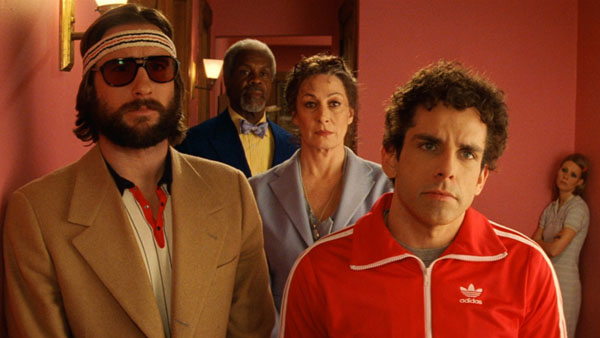
One can say that Wes Anderson is a master creator without implying that he is superior to other filmmakers. He is masterful in showing us that he is creating something, actively, onscreen–and moreover that we are creating it with him, in our reactions to it. He does this without seeming pretentious, overall. This video by Rishi Kaneria whips us through a cavalcade of Anderson’s films, showing off Anderson’s fascination with the colors red and yellow throughout the director’s work. Trying to assign a significance to the deep red of the carpet in the halls of the Grand Budapest Hotel, or the yellow of the Tenenbaum siblings’ tent, or the red of the curtain behind the awkward but confident Max Fischer is absurd. The deepest signficance is in the color itself–that Anderson has chosen it, and that he has left his mark on viewers’ retinas; the fact that it has personal significance for him should be all the "meaning" we need. Frustrated by this explanation? Don’t be. Watch this ever-so-brief but highly dense supercut, and enjoy.

METAMERICANA: James Franco’s ‘Let Me Get What I Want’ Proves Once and For All That the Kid’s All Right

METAMERICANA: James Franco’s ‘Let Me Get What I Want’ Proves That the Kid’s All Right

Later
this year, Hollywood superstar James Franco will come out with a new film whose
animating concept is so confusing it takes an entire article to explain and
contextualize it. 

Here’s
what happened: a few years ago, Franco listened to some songs by The Smiths to
help him write poems that he later compiled into a poetry collection entitled Directing Herbert White. He then turned
those Smiths-influenced poems back into Smiths- and poetry-influenced songs. He
then gave those songs to high school students in Palo Alto and asked them to
translate the songs into a third creative genre—cinematic screenplay—and based
on the resulting screenplays, he and his band Daddy (yes, he has a band) wrote an
album’s worth of new Smiths-, poetry-, and screenplay-inspired songs. The
student screenplays have now been produced, and, with the aid of songs by
Daddy, comprise a film called Let Me Get
What I Want
.

You can watch the first music video to emerge from this project here.

The
upshot here is that Franco has engineered a compositional process that mirrors the
way culture moves in the Internet Age: from one genre to another, with each
successive genre translating (and also mistranslating) the same source material
in its own way. The best part is that not only is Franco letting us see the
results at each stage in the process, but his “final” product—a film and its accompanying
soundtrack—offers us both listenable music and watchable film, making it not
only a suitably complex concept-driven artwork but also a likely entertaining
one. If avant-garde literary artists and filmmakers are pissed at Franco, as
they usually and currently are, they have a right to be—but only because Franco
has a (to them) unimaginable budget, not because the ideas Franco is working
with are subpar. They’re not subpar; frankly, they’re pretty great. It’s not a
popular thing to say, but it’s not a difficult position to defend. If the late
novelist David Foster Wallace once criticized the American postmodernism of the
1980s and 1990s as “hellaciously un-fun,” and in doing so prophesied the
imminent demise of postmodernism (and its poster-child irony) as a generative
cultural paradigm, young artists like Franco have taken the hint and begun
producing avant-garde art that’s at once cerebral and a visceral delight.

In
lauding Franco as I do here, don’t misunderstand me: plenty of writers and
filmmakers are coming up with ideas just as good as Franco’s, they’re just not
coming up with as many of them all at once, and in so many different genres,
and all while living a life in the public eye that’s equal parts “hounded
celebrity” and “pariah for every disappointed artiste-cum-barista from Seattle
to D.C.” Those who hate Franco’s art, and the (to them) obscure motivations
that drive its production in such copious volume, are the sort of artists who have
always hated those who step outside anticipated roles. These artists often find
ways to double down on the status quo without seeming to be doing so—they
maintain their bohemian street cred even as they strangle in its crib any
audacious innovations in art. In the end, though, Franco’s critics are
profoundly misunderstanding what they’re critiquing. They believe themselves
superior to Franco as artists if they can (variously) write a better screenplay
than Franco, write a better poem than Franco, and so on—when in fact Franco’s
creative persona has nothing to do with quality per se, and everything to do with the new byword in the arts:
interdisciplinarity.

Franco
masterfully
coordinates multiple genres, discrete disciplines, and disparate
resources in a way the
rest of us can’t, not only because we’re poorer but because, generally,
we’re
not as smart or creative as Franco is within his own context—that
context being
a life of limitless resources, staggering visibility, and a restlessness
that
many celebrities deal with through moral sloth or gestural
charity work. While it’s true that much of Franco’s smarts and
creativity are
attributable to him being wealthy and famous enough to know and
collaborate with some very smart and talented people, even here we must
say
that the ability to aggregate talent is both rare generally and
vanishingly
rare among the Hollywood elite—even as it’s perhaps the most critical
skill an
artist can possess in our present age of collaboration and
intertextuality. Postmodern dialectics have given way to metamodern
dialogue, and Franco knows it.

In
other words, given his local and cultural contexts, Franco is, conceptually
speaking, hitting the ball out of the ballpark nine times out of ten. His
projects, both Let Me Get What I Want
and its immediate predecessors,
are conceptually astute even when (sometimes particularly when) they fail as
individual artworks. Is Directing Herbert
White
a particularly good book of poetry? No. Is it any good at all? Not
really, at least if we judge it using conventional standards of craft, form,
and imagination. But the concept behind the book, that being to have a famous
person unabashedly write earnest poems about what a celebrity’s life is
like—which, judging from American culture, is all anyone wants to know about
celebrities anyway—is ingenious in its way. We didn’t get that kind of fan
service from Jewel, or Billy Corgan, or Leonard Nimoy, or any of the other
Hollywood darlings who’ve decided to try their hand at poetry. Franco writes
poems entirely responsive to who he is to us as well as who he is to himself,
and in making that difficult and perhaps unintentionally selfless decision he’s
exhibited a sensitivity to context which, surprisingly, even today’s most
multi-generic artists seem to lack. Indeed, American poetry—by way of
example—has repeatedly made national headlines over the past couple years for
its brazen commitment to giving exactly no one in America what they want, for doing
almost nothing to write verse that reflects the culture in which it’s being
written, and meanwhile—on top of that—for arguing loudly about how it’s
preposterous to expect it to do otherwise. Franco has made a different
decision, and in the context of his cross-generic career it’s clear that that
decision was motivated by the actor’s artistic vision rather than financial
gain. Franco doesn’t need the cash, after all.

It’s
time
for the Franco hate to stop. Viewed at the level of a career rather
than
on the level of individual artworks, Franco is Hollywood’s most
interesting,
daring, and multi-faceted artist. Hating on him is not only easy to do
but also
easy to justify as coming from a protective instinct—that is, the idea
that the
arts must be protected from the intrusion of dilettantes like Franco. In
fact,
the anti-Franco madness is as retrograde, conservative, and reactionary
as any
inclination we find in the arts today. It says that not only should we
all stay
within our generic and subcultural boxes, but that delivering
anticipated
results is always preferable to displaying uncommon (even if only
intermittently winning) daring. In fact, the reverse is true, a premise
for
which Franco is the poster-child. In light of the age we live in, and
the
explorations of genre and how artists live and interconnect that should
be
happening right now across all genres, the truth is that James Franco is
as intelligent and creative as any of his peers, and perhaps much more
so.

Seth Abramson is the author of five poetry collections, including two, Metamericana and DATA,
forthcoming in 2015 and 2016. Currently a doctoral candidate at
University of Wisconsin-Madison, he is also Series Co-Editor for
Best American Experimental Writing, whose next edition will be published by Wesleyan University Press in 2015.

WATCH: A Montage of the Sensuous Close-Ups in Paul Thomas Anderson’s ‘Boogie Nights’

WATCH: A Montage of the Sensuous Close-Ups in Paul Thomas Anderson’s ‘Boogie Nights’

The first time I saw Paul Thomas Anderson’s Boogie Nights, and the second, the sexuality which gives the film its essential underpinning didn’t make much of an impression on me. I was aware that vaguely lewd things were going on onscreen, and I suppose I should have been more interested in–if that’s the right way to phrase it–Roller Girl’s proud nudity, in Amber Waves’s sad sexuality, in Dirk’s Diggler, but really, I wasn’t. In all honesty, the appearance of the film was more interesting to me–its flash, its swagger, its Scorsese-esque movement–than its insight into the porn world, or its sexual excesses. That may have been the point, but it’s a little hard to say, in Anderson’s case, because so often his films revel in the depths to which they penetrate, and sexual over-indulgence is certainly one color in his palette, as Press Play has indicated previously. Nevertheless, given that, the close-up shot is an effective tool for Anderson–perhaps just as effective as the long shot. What’s interesting is what Anderson does with the technique: rather than using it for suspense, or to drive narrative, he’s trying to force us to look at something, really look at it, and perhaps get lost in its strangeness for a while. The object could be a camera lens, a cup of coffee being poured, a zipper: regardless, Anderson drives us inward. And we find, as this excellent, if spontaneously executed, montage by Justin Barham shows, that the journey can be very exciting indeed.  

Watch: The 2015 Oscar Nominees in Their Early Roles: A Video Homage

Watch: The 2015 Oscar Nominees in Their Early Roles: A Video Homage

We are, at times, blissfully naive about our favorite actors. It’s easy, when watching someone perform brilliantly onscreen, to imagine that they sprang forth fully formed, talents intact. And yet… this new Flavorwire video on the 2015 Oscar nominees by Jason Bailey indicates otherwise. Exhibit A: Julianne Moore in Tales from the Darkside: The Movie (1990). Exhibit B: Michael Keaton, on the show Mary Hartman, Mary Hartman (1977). Exhibit C: Patricia Arquette on the show thirtysomething (1990). And the list goes on. Robert Duvall, Mark Ruffalo, Ethan Hawke, Eddie Redmayne, Keira Knightley… All of these actors had to start somewhere–and it’s fascinating to watch the transformation-in-reverse in this video.

ARIELLE BERNSTEIN: ‘Transparent’ and the Drive for More Progressive Media

ARIELLE BERNSTEIN: ‘Transparent’ and the Drive for More Progressive Media

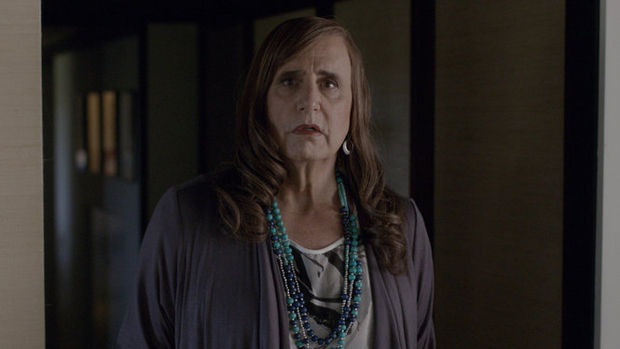
nullIn the first season of Transparent,
Maura (Jeffrey Tambor), the central protagonist of the series, is in the process of coming out
as transgender to her adult children. In an effort to claim an identity she has
long tried to hide from public view, Maura packs a few things and moves from
her comfortable, beautiful house to a small LGBT friendly apartment complex
called the Shangri-La. In one episode, Maura comes home to find a huge party
going on next door. After trying to politely request that they turn their music
down several times, Maura is exasperated. Using her shoe to bang on the wall
separating their apartments, she calls them “motherfuckers” and “faggots.”

What to make of Maura’s use of this homophobic slur, as a
testament of exhaustion and frustration? This scene occurs shortly after Maura
is insulted and humiliated by a woman who yells at her, calls her a pervert,
and demands that she leave the ladies room.

Maura’s use of the term “faggot” in this scene is deeply
affecting—it’s thoughtless, a knee-jerk response to dealing with a situation
beyond her control. The term is not used a way to reclaim its power; she’s
furious and she wants to hit her neighbors where it hurts. The fact that
someone for whom LGBT rights are deeply personal errs in how she uses language
at a moment of exhaustion and pain is not meant to portray Maura as a
hypocrite, but as someone who is human. In a culture where racism, sexism, and
homophobia are rampant, it’s easy to fuck up.

One of the things I love most about Transparent is the tenderness with which Jill Soloway treats her
incredibly flawed characters. Often, the ease with which characters say cruel,
dismissive, or disrespectful things to one another is downright shocking. Each
of Maura’s children is portrayed as self-absorbed, and the manner in which
Sarah, Josh, and Ali come to terms with their father’s transition is deeply
flawed. All three children make jokes about how “weird” the situation is. Josh
tries to learn about the trans community from a porn site and Ali attempts to
learn about what it means to be transgendered from pursuing sex with a trans
man she meets at a gender studies class.

In his now famous article for New York Magazine, “Not a Very PC Thing to
Say
,” Jonathan Chait argues that the emphasis on being politically correct is
hindering free thought and expression. A lot of very intelligent articles have
been written discussing the ways that Chait ignores how PC language functions
as a way to protect the most marginalized members of our society. But I also
think it’s important to consider how PC language also doesn’t always achieve
its immediate goals. People can parrot any number of PC terms while still
having perfectly lamentable ideas; genuinely sensitive thinkers may, as
Benedict Cumberbatch recently did when he used the term “colored” to refer to
black actors, make deeply regrettable mistakes.  Language can be deliberately wielded as a
weapon. It can also be unintentionally hurtful. The fact that celebrities,
writers and actors are pressured to think critically about their word choice in
today’s world doesn’t mean that we are being censored. It demonstrates that we
as a society are moving in the direction of empathy. 

Nonetheless, while today’s Internet landscape is obsessed
with words, our insistence on shaming others online as the primary means to
correct mistakes doesn’t necessarily encourage sensitive thinking. The age of
Twitter is an age of slogans, of a politics predicated on being “with us” or
“against us.” You don’t have to know very much about a cause or social issue to
use a hashtag. Real change won’t come from socially ostracizing allies who make
mistakes. It comes from cultivating empathy, from showing people just why
certain terms are dehumanizing.

Online progressive spaces spend a lot of time dissecting the
many problems in the media representation of marginalized groups. Recently, The
Representation Project released a video entitled “Demand Better Media in 2015”
which shows an assorted medley of media wins for women, as well as a variety of
examples of places where media failed women. The clip ends with a cry for us to
demand better media, as well as a list of helpful links that we can click on to
support media that “got it right,” or complain about the media that “got it
wrong.”

Indeed, women make up a tiny percentage of artists, writers
and producers. We need to hear more diverse stories, to tap into women’s
potential, as Emma Watson recently called for in one of her “He for She”
speeches.

But some tenets within this call for justice do seem
problematic. Who is the arbiter of what types of violence on screen and in
games are harmful or not harmful? The notion that video games cause violence
has been disproven in countless studies at this juncture, and many of the
scenes of violence that The Representation Project pins down as bad for gender
relations, like Grand Theft Auto, could certainly be viewed as satire
intended to get us thinking about the media we are consuming. Others also seem
a bit unfairly cherry-picked. Sons of
Anarchy
, which was picked apart for reinforcing harmful ideas about
masculinity, has featured one of my favorite characters, Gemma, a complex
female protagonist, who turns what it means to be an older woman going through
menopause on its head. And, of course, there are constant debates about whether
or not Game of Thrones is “good” or
“bad” for women. The series has presented varied depictions of female power,
while also depicting what would have been very real concerns for female
characters in this particularly violent fantasy world—the threat of sexual
assault.

I don’t think we can achieve parity by getting rid of media
that doesn’t neatly fit into a neat, progressive checklist, especially since
art may present racist, sexist and homophobic language in order to deconstruct
it. It’s important for us to make a distinction between language that condones
hate, and art that uses this kind of language deliberately in order to
interrogate the status quo. 

It’s also important for us to remember that learning to be
conscious of our choices is a process that takes time, energy, and, often,
involves making mistakes. In Jon Ronson’s aricle, “How One Stupid Tweet Blew Up
Justine Sacco’s Life,” Ronson describes how today’s shame culture has both
positive and negative ramifications. Our ability to expose and denounce racist
and sexist beliefs helps to hold people accountable for saying terrible,
dangerous things. But it has also contributed to a culture where shaming is
considered perfectly acceptable. In his article, “The Anti-Vaccine Movement
Should Be Ridiculed, Because Shame Works
,” Matt Novak claims that shaming can
be a quite effective means to promote social change, as long as we shame
movements, rather than humiliate individual people. This distinction seems to
me to be an important one. In today’s world individuals who are caught saying
terribly offensive things are often publically crucified and while humiliation
can certainly frighten some individuals into using more appropriate language,
it doesn’t dissolve hate. One only has to look at the endless barrage of
harassment, including rape and death threats, that many online feminist writers
receive, in order to see hate speech online is thriving.

Transparent
triumphs in part because it highlights how gaining empathy is in itself a
process. Maura is gentle, dignified and strong, but earlier episodes show her
making complicated decisions and various mistakes. Maura’s children are
portrayed as selfish, but also genuinely caring. Ali objectifies the men she is
dating and uses them for sex, but she also deeply cares about her stepfather
Ed. Sarah is completely self-involved and impulsive, but she is also the
sibling most genuinely empathetic with her father’s transition, rallying her siblings
to be supportive as well. Josh is temperamental and a womanizer, but you can
also see glimpses of how he wants to be a better man.

Soloway has faced scrutiny for making certain choices, like
hiring Jeffrey Tambor, rather than a trans woman, to play Maura. Soloway has also
been criticized for sharing a photo on social media, which combined images of the
Kardashian family and an advertisement for Transparent,
in reference to speculations about Bruce Jenner’s gender identity. Her
apologies fell on deaf ears to some, while others view her acknowledging her
mistakes as genuine. This type of real-life dialogue mimics the content of the
show itself, which emphasizes that individuals have the potential to change,
evolve, grow, and learn. Transparent
shows us a world where people are often not getting empathy right, but also
shows us a world where we have the power to learn from our mistakes and become
better, more empathetic people.

Transparent
succeeds because it goes beyond today’s hashtag activism to show us a nuanced
portrait of one trans woman’s experience of coming out, and one family’s
experience adapting to that change. The show’s depiction of today’s world is
fraught with contradictions: Maura has the freedom to be herself in a way she
never could have in the past. She explains to her daughter, “People led secret
lives. And people led very lonely lives. And then, of course, the Internet was
invented.” But, of course, the world has changed a lot, and also very little,
as Maura faces everything from awkward stares to outright discrimination. Her
children love her, but are also confused and are often incredibly insensitive.

Transparent shows
how the cultivation of empathy is in itself a process, a societal one, and also
an individual one. Unlike a show like Mad
Men
, where stylized scenes often give in to nostalgia, while still
criticizing the world of the 60s, Transparent
pushes back against any sense of wistfulness. In the opening montage,
images from the past dissolve into scenes from the present.

When discussing their father’s new gender identity, Josh
wonders, “What does this mean? That everything Dad has said or done before this
moment is a sham? Like he was just acting the whole time?”

“It just means we all have to start over,” Ali replies.

In my favorite scene of the series, Maura lights Shabbat
candles for the first time, a Jewish tradition reserved for the mother of the
house. I love this scene because it highlights the wonderful juxtapositions
that characterize the entire series—the desire for tradition, stability and
wisdom leads each character back to a faith that is literally thousands of
years old, but each character is also constantly reconciling this drive with
the recognition that these traditions need to evolve in order for them, and for
us, to truly thrive.

Arielle Bernstein
is
a writer living in Washington, DC. She teaches writing at American
University and also freelances. Her work has been published in
The
Millions, The Rumpus, St. Petersburg Review and The Ilanot Review. She
has been listed four times as a finalist in
Glimmer Train short story
contests
. She is currently writing her first book.

WATCH: A New Sleater-Kinney Music Video Featuring the ‘Bob’s Burgers’ Cast!

WATCH: A New Sleater-Kinney Music Video Featuring the ‘Bob’s Burgers’ Cast!

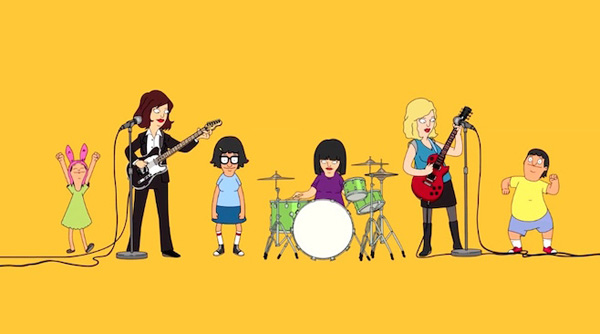
It’s entirely conceivable that you’re a Sleater-Kinney fan. The band’s fan-base has expanded considerably since Carrie Brownstein’s star turn on hit TV show Portlandia.  It’s also conceivable that you’re a fan of Bob’s Burgers, the show we raved about here not so long ago. If both these things are true, you’ll love this new music video for the song "A New Wave," from their newest album No Cities to Love. The video brings these two pillars of our culture together in Tina Belcher’s bedroom–which makes sense if you know anything about Tina, or about growing up. So: why not take a minute, put on some flannel, and press play?