TRUE BLOOD RECAP 1: TURN! TURN! TURN!

TRUE BLOOD RECAP 1: TURN! TURN! TURN!

I love True Blood, and I pray this is the end of it. The tea leaves all read "buh-bye," but in this first episode, we’re mainly talking mop-up from last season’s remarkably messy—even by Blood  standards—finale. But before we get into the particulars, some thoughts from this devoted Trubie.

I know there are people who feel the show was great when it was an elegant, fleet, and witty anti-intolerance fable. And feel that, as early as Season Two, when Maryanne the cannibalistic Maenad (Michelle Forbes) started having psychedelic Southern-style Burning Man-ish parties on Sookie's impeccably well-maintained lawn, the chronicles of everyone’s favorite fairy telepath—Sookie Stackhouse (Anna Paquin)—had already fallen into their shark-jumping phase.

Me? I always said that, like that lawn or the improbably ever-fresh pitcher of lemonade in Sookie’s fridge, there were things about True Blood you just accepted. I said, “Cannibalistic Burning Man run by a Mad Maenad? I’ve waited my whole life for this!”

And then when Seasons Three and Four gave us the batty-beyond-belief Russell Edgington (Denis O'Hare), Vampire King of Mississippi, a white trash were-panther named Crystal Beth, the lounging vampire Queen Sophie-Anne Leclerq (Evan Rachel Wood), who loved nothing more than to play Yahtzee (!), the revelation that Sookie was a fairy, that Jesus (Kevin Alejandro), the love of darling Lafayette (Nelsan Ellis), was in fact a powerful Mexican bruja, and a curse caused Pam (Kristin Bauer) to embark on the holy grail of finding the right foundation—Smashbox? MAC? Maybelline?—to cover her rotting face, some called foul.

But me, I was in seventh heaven as the show gave up even the slightest lip service to realism on the road to becoming the most faux Southern fried nü-Hammer, blood-Romantic, were-vamp gore-show, splat-palooza of all time,and it became clear that Blood creator Alan Ball would not drive 55, and the only way he’d stop was if he were six feet under.

And now it must end. It must not be allowed to become an undead parody of a parody of itself, like Dexter.

My sense of Season Five, from its tagline—“Everything is at Stake”—onwards points towards end games from which the show will not be able to renew itself without becoming a faint Xerox of past bloody wonders.

So with the prayer of “I love you—now die,” some highlights:

The episode opens one minute before the very end of last season’s finale, whipsawing from Sookie accidentally shooting Tara—whose fate will have to remain a secret for a spell, sorry—to a hilarious frenzy of tidying as, a few miles away, Bill (Stephen Moyer) and Eric (Alexander Skarsgård) clean up the sticky remains of Nan Flanagan (Jessica Tuck) who’d just outed herself as anti-Authority before meeting the True Death at Bill’s hands when he learned she desired some of Sookie’s fairy power.  

Alas, a pack of ninjas (or is that a flock, a murder or a bushel?) bag them in silver netting and stick them in a limo trunk. Eric’s shout of “That’s the Authority we’re up against!” not only IDs their attackers, it suggests a more epic storyline that would render any little tales from humble Bon Temps, LA passé.

Meanwhile, the Rev. Steve Newlin (Michael McMillian), ex-head of the Fellowship of the Sun, shows up gay and glamouring himself into Jason’s apartment, availing himself of that law of physics that says for every standing body of flesh there is a correlative moment when that body WILL fuck Jason Stackhouse (Ryan Kwanten).

But then the door slams open, Jessica (Deborah Ann Woll) declares herself “the progeny of the king of Louisiana!” and Newlin’s old news for now, as Jessica mounts Jason.

Shock cut to: A spy-movie-style male and female pair listening to Paul McCartney’s “Silly Love Songs” in a limousine. In the trunk, Bill and Eric are bound in silver netting (take note, slash fiction folks—this will be a good year for you).

One of the show’s more casually ridiculous escapes transpires: Bill finds an umbrella and stabs the car’s gas tank, which, after he asks Eric for some fire, blows up. Seriously. Bite this, believable solutions!

Crawling from the wreckage, the McCartney fan, whose name is Nora (Lucy Griffiths) finds Eric, and the two embrace and smooch deeply.

Nora is Eric’s sister and yeah—more TV incest. Boardwalk Empire, Game of Thrones, Bored to Death, Dexter, Supernatural, WTF?

At first I had no idea. But then a seeming cop-out, Eric’s revelation to Bill that he and Nora are “only connected through our maker” had me thinking. Because their “maker” is Godric (Allan Hyde), who died, or ascended heavenwards in a swirl of light and ecstatic disintegration season two’s “I Will Rise Up”.

With “everything at stake,” why would the show bring on someone who is Eric’s only living connection to the person he loved more than anyone or anything in his life, Godric?

Okay, before I mull myself into a coma, back to what Nora was actually doing. She’d planned to save Bill and Nora before their umbrella-gas-tank maneuver because, hot taboo sex aside, she’s a ruling member of the Authority working to tear the damned thing down from the inside.

So, Vive la révolution! Except Nora, Bill and Eric get caught by more Authority ninjas and there’s something about the way one of them bullhorns “Do not fucking move!” that makes me think Bill and Eric are screwed for quite a while.

Otherwise, here are the updates you need:

Captain Andy. An APD to all you Wire fans desirous of Chris Bauer nudity—your prayers are answered. Captain Andy is seen consorting with witch Holly (Lauren Bowles). Nice butt, Chris—who knew?

Terry. Terry (Todd Lowe) is now playing guest to his old Iraq war pal Patrick (Scott Foley). Flashbacks, fistfights, hallucinations occur—within, like, five minutes of screen time. How do you ratchet things up from there? A: Terry has kids, a wife, a life, oh dear.

Lafayette. Is this horrible? I want him to die so he can be with Jesus (boyfriend Jesus). Of everyone on True Blood, nobody has suffered more and gained less than Lafayette. So when he and Sook look for Jesus’ body and it’s not there, I’m thinking that if my end game theorem is true, maybe there’s a way Lafayette can peaceably slip this mortal coil and be forever with his beloved Jesus.

Right.

Jason. This whole episode is like a Stations of the Cross redemption trip for Sookie's older brother.

He tries to apologize to Hoyt (Jim Parrack), but Hoyt just calls him a girlfriend-fucker, accurate but hardly sporting.

He goes to Bill’s house, where Jessica is having a party with college kids her own age in a kind of adorable/pitiful simulation of what her life would have been like if the whole vampire thing hadn’t happened. After Rock Banding The Runaway’s “Cherry Bomb” (one of those True Blood moments sure to become a viral animated GIF), Jason leaves with some hottie but gives her an impassioned speech on how he wants be a better man instead of having sex with her, and still the space/time continuum did not collapse. Which leaves . . .

Alcide (Joe Manganiello). Who saves Sam (Sam Trammell)—whose problems with Luna (Janina Gavankar) are just confusing at this point—from becoming puppy chow for the werewolf pack that thinks he killed Marcus (Dan Buran). Alcide tells the pack that he’s a lone wolf now, and then he hightails it to Sookie’s to offer his protection from Russell, who, despite being buried under a few thousand tons of concrete the last time we saw him, is somehow back!

Russell. The only American vampire willing and able to punch his fist through someone’s chest on national TV and gloat about it. Russell (Denis O'Hare)—the one-vamp/one-man guarantor of True Blood quality!

Me, I’m going out on a limb here and predicting a terrific, apocalyptically satisfying season of over-the-topper-most True Blood. May it be its last.

Ian Grey has written, co-written or been a contributor to books on cinema, fine art, fashion, identity politics, music and tragedy. Magazines and newspapers that have his articles include Detroit Metro Times, gothic.net, Icon Magazine, International Musician and Recording World, Lacanian Ink, MusicFilmWeb, New York Post, The Perfect Sound, Salon, Smart Money Magazine, Teeth of the Divine, Venuszine, and Time Out/New York.

GREY MATTERS: ALIEN VS. PREDATOR VS. ALIEN VS. PROMETHEUS

GREY MATTERS: ALIEN VS. PREDATOR VS. ALIEN VS. PROMETHEUS

null

For months Twentieth Century Fox has been frothing us up over Sir Ridley Scott’s return to the Alien business with Prometheus. But for me, this is an occasion to not only celebrate the uncelebrated—Paul W.S. Anderson’s fantastic Alien vs. Predator—but to see through Scott’s contributions and mourn their horrible legacy.

First: Scott didn’t think up Alien’s feminist hero angle. All reports indicate that just sort of happened at the behest of producers David Giler and Walter Hill. Nor did he think up the paradigm-shifting H.G. Giger bio-mechanical alien design. Nor the story.

What he deserves credit for is saying yes to those elements.

But above and beyond that, what Scott—an ace adman whose Chanel #5 ads fused wealth, sex and property to almost pornographic levels—really brought to Alien (1979) was class. And Class.

Writing about Prometheus recently in Box Office, James Rocchi, after trashing the unimportant Alien vs. Predator (2004), just up and said it’s “nice to have Sir Ridley classing the neighborhood back up.”

Yes, ‘Sir”. As in knighted by The Queen. And “classing” things up, one assumes, like he classed up Hannibal with those splendidly art-directed, scrumptiously-lit scenes of Ray Liotta eating his own brains.

But why would you need "class" in a films about chest-bursting phallus monsters? Knowingly or not, Rocchi had used the correct verb.

Back in the late 70s, there’s no way that Scott could help but understand the discomfort we colonials felt around art and the class struggles we’re not supposed to suffer from. Watching Alien, you can see how he capitalized on that discomfort, on the way many Americans were still not quite sure how to process, say, a Bergman film. Did you act as if you got the long pauses, unfamiliar allusions, and the beauty for its own sake? Or should you just walk out, and fear being judged an idiot?

Doing what worked so well in the Chanel ads, he slathered Alien with style and class, and with the glacial pace, mood lighting, anti-hero casting, and doleful music he guessed we’d associate with "serious films." By the time the first finished print rolled through a projector with a really long, 2001-looking spaceship named after Joseph Conrad’s Nostromo and Howard Hanson's august Symphony No. 2 ("Romantic") rolling over the end credits, Scott may have imagined Americans who wouldn’t be caught dead seeing low-class fare like Friday the 13th feeling downright continental about watching what Scott himself called “the Texas Chain Saw Massacre of science fiction."

A Chain Saw, that is, about working-class stiffs deceived by an upper-class android, in which a blue-collar girl (Sigourney Weaver) kills the Giger menace.

British critics like the indispensible Kim Newman (author of Nightmare Movies) saw through the class story, seeing a pose that hid a monster/gore/Ten Little Indians hybrid whose plot required its characters to seek out dark places where they might get killed. But for Americans, that cold, humorless seriousness was the key to what made Alien so damned scary.

James Cameron understood that "serious" was a one trick pony: his war movie remix sequel, Aliens (1986), went for creature battle and feminism, blowing Scott’s pretense and future grunge chic out the air locker: the film was a huge success.

Alas, both Alien 3 (1992), wrought by the future king of high faux seriousness, David Fincher, and Alien: Resurrection (1997) both behaved as if somber, existential gloom—the Sir Ridley touch currently being pimped in the Prometheus teasers like the “Happy, Birthday, David” viral videos, which are basically ruling-class Danish modern architecture porn disguised as futurism—were the key to Alien riches. This proved incorrect.

But then came Paul W.S. Anderson, egalitarian king of deep focus mayhem and why-the-hell-not, ripping any shred of swank out of both the Alien franchise and its déclassé Predator brother, an 80s rasta hunter-monster that was either all developing-world anger-subtext or just a super bad-ass space demon, in a film that pitted one against the other to the death! Finally, some fun, for fuck’s sake!

Anderson is the creator of the terrifyingly strange Event Horizon (1997), the neo-grindhouse exploitationer Death Race (2008), and Resident Evil: Afterlife (2010), which proved that he demonstrably owns the most visionary sense of spatial geometry in modern cinema. He loves mixing, matching, and fusing ideas, conveys a palpable sense of sheer cinema-making glee, and most critics despise him as an aesthetically base-born, second-rate creator of vulgar garbage. 

But beyond these inaccurate judgments lie deeper, troubling, truly dispiriting things that go far beyond anything in any Alien film. I’ll get to that in a minute.

In Anderson’s alternately inspired and nutso screenplay for Alien vs. Predator (or AvP), an African American environmental scientist Alexa (Sanaa Lathan) leads a crew of experts to the Antarctic, where they discover a vast sub-glacier pyramid in which the titular Reagan-era monster icons are about to do battle.

But first, a whopper of a casually sacrilegious backstory posits humanity as just another race, made intelligent enough by predators to farm and worship predator gods, sacrifice themselves, and unknowingly become impregnated with aliens, assuring predators of awesome hunts. And if that doesn’t work out, they can blow up the city and start all over again a millennia later.

And then, back to the present day, amid the pyramid’s Aztec, Cambodian and Egyptian wall carvings, Alexa teams up with Predator to battle the alien queen mother, whose twice the size of either of them.

Anderson stages the main event like some Aztec SF Götterdämmerung, but it’s spiritually the original Kong v. Dinosaur with 21st century technology.

For anyone who’s loved the wonders of Willis O'Brien, Jan Švankmajer, Ray Harryhausen, the men-in-suits of Toho, or other toilers in the strange discipline of bringing the inanimate to life, AvP is like a screaming memorial to gods and monsters made of dead materials.  If Neil Gaiman had relayed this, or if Guillermo Del Toro had filmed the same story, there would be worship.

But Anderson? Too low class, honey. But like I mentioned, it’s more than director issues.

I worry that our always-coded class agita and blind reverence for high seriousness over all considerations has so mangled our appreciation of genre values that people might walk out of Mario Bava’s transcendentally gorgeous Hercules in the Haunted World (1961) or Gareth Edwards’ Lovecraft-in-the-jungle Monsters (2010), because the effects are so “unrealistic” (code-phrase for “not enough money”) and the dialogue “not good enough” (code-phrase for “not ironic, hiply detached, or displaying another luxury commodity trait prized by entitled classes”).

No doubt, Prometheus will offer the usual Scott attributes—as with Blade Runner (1982) and Alien, the out-sourcing of designs to the most exclusive and expensive creators on Earth; the ice-blood mise-en-scene; and gold standard blood and guts effects.

But Anderson? He does what only he can do: His unique mental mad lab, cutting and pasting an endless fountain of pop art, geographic, child-dream, King Kong, multi-culti-architectural, exploitation, Chariots of the Gods, and Lord knows what other fantasies. I imagine him laughing, maybe a little crazily, while the sparks fly.

Ian Grey has written, co-written or been a contributor to books on cinema, fine art, fashion, identity politics, music and tragedy. Magazines and newspapers that have his articles include Detroit Metro Times, gothic.net, Icon Magazine, International Musician and Recording World, Lacanian Ink, MusicFilmWeb, New York Post, The Perfect Sound, Salon, Smart Money Magazine, Teeth of the Divine, Venuszine, and Time Out New York.

GREY MATTERS: What Is Sherlock Holmes Afraid Of?

GREY MATTERS: What Is Sherlock Holmes Afraid Of?

null

Sherlock, Steven Moffat and Mark Gatiss’s present-day adaptation of Sir Arthur Conan Doyle’s century-old sleuthing stories, gives us two heroic figures struggling with, well, not much. But you wouldn’t know it to watch them, as the creators of the most recent version of Doctor Who conjure up one of this year’s best rides.

It’s a show that lacks not one bit of wit, pace, and all-around smarts. It gives you everything you could reasonably want from a Sherlock Holmes movie—and not one iota more. It sidles right up to greatness—but stops right before it gets there.

The splendidly named Benedict Cumberbatch and his magnificent cheekbones play Sherlock as a zero-patience dandy with a mainframe for a brain. This Sherlock, using deductive reasoning, can suss out your life story from a scratch on your watch and a murder from a smear on a wall. He shares the storied 221B Baker Street flat with Afghanistan war veteran Doctor John Watson (the UK Office’s Martin Freeman), the only person he can tolerate for more than sixty seconds. Watson, in turn, is enthralled by Holmes’ brilliance. Thus, a bromance blooms, as arcane cases are engaged at light speed.

And aside from a consistent subplot in which Watson hopes to bring out the human side in Sherlock that may not exist, that is that. Never has a cigar so strenuously insisted it is just a cigar.  Or, in Sherlock’s case, a nicotine patch. Once the dust settles, the most remarkable thing about Moffat and Gatiss’ smashing new Sherlock is how little there is to say about it, on the surface.

It should be said that there are some fun updates. Dr. Watson posts Holmes’ adventures in a blog. High tech replaces creaky Victorian science. And Moriarty is now a master computer coder/madman with a Bee Gees infatuation, a playful riff on Doyle’s vision of Sherlock’s arch enemy, who was a master criminal utilizing the day’s highest technology to wreak havoc (Watson would call him “the famous scientific criminal”).

In addition, Doctor Who fans can, of course, point out the traits The Doctor and Sherlock share: uncontrollable braininess, love of long coats and fascinated companions, the threat of boredom, and arch enemies. But where Doctor Who has turned out to be the stuff of university courses, Sherlock displays a flashy insubstantiality. Which is, again, fine. Or is it?

After the end of the second season broadcast two weeks ago, the image I have trapped in my mind is that of Sherlock and Watson in a long dark corridor, running, from a scene on the show. By now I wonder, however, what from?

SEX.

Doyle was a man of his time. He disapproved of women’s right to vote and created in Sherlock the ultimate logical man, one who believed that “women are never to be entirely trusted—not the best of them” and “ "the motives of women . . . so inscrutable . . . . How can you build on such quicksand?”

Moffat and Gatiss, meanwhile, who brought to Who not one but two main female characters as integral as the Doctor, along with some of TV's most ceaseless casting of female secondary characters, are the most feminist showrunners this side of Joss Whedon. They’ve gone beyond mere surface changes, pissing off the traditionalists to make their show really work in the 21st century.

Already their Sherlock doesn’t dislike women any more than men. But then it gets complicated.

I’ll take Watson’s word that he and Sherlock are not gay. But what are we to make of Sherlock, cutting an almost ridiculously Romantic figure, running across the hills and moors of the Baskervilles with his scarf and Saville Row coat unfurling in the whipping wind?

I’d say the game is afoot.

In "A Scandal in Belgravia," the show hits its low point, because it tries to reconcile Doyle’s female aversion with a semi-female-interest story for Sherlock, courtesy of a contemptuous dominatrix named Irene Adler (Lara Pulver) whose client list and sexual allure could topple nations. (Literally.)

Aside from the absurdity of Adler as a character—in 90 minutes she goes from S & M top to intellectual peer to Bond-style girl of international mystery to terrorist victim—there’s the dissonance of any of these female types fitting into any Sherlock-esque story. (Yes, I know an Irene Adler exists in the Canon, but she was nothing like this, and that was another Sherlock, a long time ago.)

The Holmes stories have nothing to do with love. When Sherlock makes it clear to Watson that he doesn’t have friends in the plural sense, you realize there is even less room for a lover, and the obligations love entails. And that’s why the story rings so hollowly.

One assumes that, if Sherlock ever felt the slightest erotic stirring, he would deduce its chemical origins and construct an elixir to neutralize the sensation. And that’s what Sherlock Holmes is all about.

He lives in an intrinsically adolescent, sex-negative safe zone—which also describes the official club for Holmes enthusiasts, The Baker Street Irregulars, who did not allow female members until 1991, when the appearance of ASH (The Adventuresses of Sherlock Holmes) leveled the non-erotic playing field.

At the moment, we’re at the exact point in the show’s existence where Watson can’t continue to look satisfied with his exclusive relationship with Sherlock without wanting something more. (My limited understanding of the books is that he gets a bit more, but that this happens largely off-stage, which wouldn’t be adequate for modern drama.)

The point is—who are these guys? For two short seasons the show has floated on appearances, in a very Victorian fashion. And I suppose it could keep doing that, in a very "series TV" fashion.

And I know, for a show that doesn’t give you much to talk about, I certainly talked a great deal, but that’s what I’m talking about—the empty spaces, the things the show hasn’t yet addressed.

Earlier, in “The Hound of the Baskervilles,” drugs cause Sherlock to think he’s seen a monster, which leads to doubt, which he suffers badly.  Add this to his usual arrogance and tiny cruelties, and you wonder why other characters insist that Sherlock could be a great man.  Not a good one, a great man.  And yet it’s Moriarty, a mad genius, a sociopathic criminal and mass murderer who sees in Holmes a fellow traveler in boredom and compulsive puzzle playing, who’s more accurate.

Watson too has his own dark bipolarity.  When we first meet him, he seems to be suffering from PTSD. But as he says himself, what was wrong was that he missed war. The thrill of being with Sherlock—the crime, death and violence—was curing him.

If Moffat and Gatiss want, they can tell the traditionalists this: Hey, we stayed true to the original model for two seasons. But Sherlock is gaining an international audience. If you could take Russell T. Davis’ version of Doctor Who and make it your own, can’t we add some dark shadows to this Victorian black and white?

Ian Grey has written, co-written or been a contributor to books on cinema, fine art, fashion, identity politics, music and tragedy. Magazines and newspapers that have his articles include Detroit Metro Times, gothic.net, Icon Magazine, International Musician and Recording World, Lacanian Ink, MusicFilmWeb, New York Post, The Perfect Sound, Salon, Smart Money Magazine, Teeth of the Divine, Venuszine, and Time Out New York.

GREY MATTERS: The Way the World Ends

GREY MATTERS: The Way the World Ends

null

In 2001, Steven Spielberg went apocalypse crazy and he never recovered.  2001 was when he froze the world in in A.I.: Artificial Intelligence, followed by War of the Worlds, followed by the legacy-soiling Transformer toy-apocalypse line, more alien end times in Falling Skies, and the failed eco-Holocaust/Jurassic Park mash-up of Terra Nova—and was he done? No, he was not.

He will soon be destroying the world again in a remake of the original SF Armageddon, 1951’s When Worlds Collide, and an adaptation of Daniel H. Wilson’s robot apocalypse, Robopocalypse.

Still, the question isn’t “Why?” so much as, “What took him so long?”

One can only guess, so I will. One thing that rose from the debris of 9/11 was a need to process ambient terrors, of which there were suddenly so many. A new genre created itself from bits and pieces of other genres, in true Doctor Frankenstein fashion. And there’s always big money in salving inarticulated jitters—just ask Spielberg.

And so, by my rough count, over seventy-five films and TV shows have congealed over the last decade to form an actual new subgenre, or series of interconnected subgenres, complete with shared repeating narrative patterns and modes of obliteration.

How does the world end? By nuclear means (28 Days Later), by plagues (Contagion), vampires (Stake Land), zombies (The Horde), aliens (Returner), natural threats (The Happening), and sundry Biblical agita  (Jerusalem Countdown).

The subgenre has developed certain stylistic defaults: for example, heavy gray murk and raining ash, as in the indie post apocalypse road picture, The Road, and populist films like Terminator: Salvation and Book of Eli. We also have apocalypse-film go-to actors: Willem Dafoe moves effortlessly from Michael and Peter Spierig’s populist vamp actioner Daybreakers to Abel Ferrara’s self explanatory art house effort, 4:44: Last Day on Earth, while Sarah Polley, eternally wan, affectless and snarky, stared in 1998’s seminal indie end timer, Last Night, which added dot.com-style yawns to the Armageddon reactive syntax, and the remake of Romero’s pre-apocalypse classic, Dawn of the Dead.

Most fascinatingly, this new subgenre has split into what I’ll call indie and populist apocalypse films, each with radically differing sensibilities, aesthetics, and values.

First, the indie apocalypses. The indies are largely by, about, and for upscale, highly educated, older white people fortunate enough to enjoy the luxury of feeling a weary, ambient disappointment, born of under-appreciated entitlement. Inevitably, this leads to the valuing of the canon over the new, the ‘introspective’ over the vibrant, and, to bring us back to where we started, to what Spielberg is up to: staying lively, even if that means blowing up the world.

In the populist apocalypse films, anyone, of any class or any gender, can be a hero. She can be a genetically modified lab experiment turned anti-corporate leader, (see Paul Anderson’s Resident Evil: Afterlife). She can be a boy survivor of Earth’s decimation with a second chance on another planet (see Titan, A.E.).  Or, possibly, in a few years from now, while the world is falling apart, a starving, ruined slip of a girl taking down a fascist government, one arrow at a time, in the last of the Hunger Games films.

Anyway, while she may not make it to the end credits, the pop-apocalyptic hero’s efforts will not be for naught, and our entertainment budget will not be blown on a solipsistic nihilism fantasy.

And so, for your approval—or not—five films from the indie and populist sides of the Armageddon divide. Although I clearly have my issues with the indie cause, I’ve tried to include the best—or most interesting—of the subgenre.

INDIE ARMAGEDDON!

4:44: Last Day on Earth (2012)

nullSo nobody listened to Al Gore, and now some unspecified, global—but prompt!—atmospheric disaster will destroy the world at exactly 4:44 EST, in Abel Ferrara's new film.

As if continuing the role of the drug dealer he played in Paul Schrader’s Light Sleeper, Willem Dafoe is Cisco, a recovering addict with a super younger painter girlfriend named Skye. She’s played by Shanyn Leigh, the director’s real-life GF, which adds a layer of hermetic creepiness. Her paintings, big splashes of bold organized color are a true relief from the drab, mauve-ish digital video tones that give the movie a vanity project emptiness broken only by stock footage of riots, the Dalai Lama and other random elements.

In true boomer fashion, the End is really all about Cisco. So after bedding Skye, he mumbles to the heavens, wanders around Essex Street on the Lower East Side to see if—like the wild Ferraro of Ms. 45, Bad Lieutenant, and The Addiction—he will be able to stay literally/figuratively sober long enough to find some friends with whom he can talk about himself. Then he comes home, and the world ends.

Thing about these movies, you don’t have to worry much about spoilers.

They Came Back (2004)

nullThey Came Back takes the flesh-eating out of the zombie film model; what's left is a nightmarish allegory of elderly hospice care that never ends.

In a French village, the dead return. They seem the same. Almost. Sort of. But then they start gathering at night, silently, doing . . . what?

Robin Campillo’s unnerving film bounces real world fears into a fog of classic, Val Lewton-style quiet horror. The camerawork is stealthy, but like many indie apocs you wonder why color is such a villain in the director’s mind.

Still, the atmosphere and implication stabs home some cold questions: How long before the dead use up too many jobs, resources and space rightfully allotted to the young or healthy? How much care is too much care?

They Came Back also entertains a spiritual dimension that’s truly scary. It’s also revealing in the sense that it reminds us how self-limiting left-leaning indie film has chosen to be.

Melancholia (2011)

nullBoth a balm and a reveal of a classic Romantic sensibility at work behind Lars von Trier's mad Dane image, Melancholia limns depression as an elemental power that rips the planets out of line and threatens to sever the connection between two sisters. There's Justine (Kirsten Dunst), a major depressive getting married in the grand style, and Claire (Charlotte Gainsbourg), slender and always frightened.

And then there’s a planet—called “Melancholia”, no less—hurtling, When Worlds Collide-style, towards Earth, and Claire has no choice but to do the most terrifying thing: to ask for what she needs from a sister who delights in cruelty.

Most of all, this is rapturously beautiful, the natural universe as a cruel, loving, and insane mother-tormentor figure. Obliterated in the first and last images by Melancholia’s impact, but united by Wagner’s “Tristan und Isolde” and the sisters’ recurrent hand-holding, this is von Trier filming his way out of malady back to our world—and at 56, just starting a whole new peak of his career.

The Road (2009)

nullSo, something destroyed all life on Earth. The skies are grey, trees black and spindly, buildings in advanced decay. The world, in John Hillcoat's vision, looks like a 90s black metal album cover.

Filthy, wretched, starving, fifty-something Poppa (Viggo Mortensen) and his filthy, wretched, starving Boy (Kodi Smit-McPhee) are wandering South, and that’s what you’re going to be seeing for 111 minutes. The only reprise comes in the form of 30-second sunny dreams of Man's wife (Chalize Theron).

Aside from starvation and the elements, the biggest threat is from cannibal attack. As luck would have it, Man and Boy stumble upon an old southern mansion with a basement full of naked, crazed people . . . who are being warehoused as food.

Excuse my flippancy, but The Road’s cloying high seriousness, its saccharine Nick Cave score, and its studied miserablism can't hide the fact that The Road is one genre step away from being a zombie movie, which is why I suppose they eliminated the famed baby-roasted-on-a-campfire-spit scene which appeared in Cormac McCarthy's original book.

The Last Days of the World (2011)

nullThanks to Japan's manga culture, we finally got an indie end time film with young people in it. Based on Naoki Yamamoto’s cult manga, The Last Days of the World tells of Kanou (Jyonmon Pe), a seventeen-ish schoolboy busy hating life when a half-foot high God in a top hat shows up to tell him the world will be ending soon.

And so Kanou kidnaps his crush, Yumi (Chieko Imaizumi), steals a car, tries to sexually attack Yumi with mayonnaise (don’t ask), finds a cult devoted to cos-play (dressing up in manga costumes), as a life-hating cop kills people while in pursuit of the pair. And sometimes a talking dog, or their car, might remind Kanoe that The End is Nigh.

Eiji Uchida’s sometimes funny nihilist travelogue wants to be Donnie Darko, suggesting Miike’s Gozu, but it lacks the latter’s passionate nuttiness. It’s also bereft of any music beyond a stumbling two-chord guitar flourish, or any color beyond a dull palette of liver-lavenders, greys and spoiled mauves. Uchida’s film is already dead: the end of the world is a mere formality.

POPULIST ARMAGEDDON!

Pandorum (2009)

nullAt the start of the film, the crew of a huge starship wakes from hyper-sleep with severely compromised memories.

The ship—apparently designed by a firm headed by Philippe Starck, H.R. Giger and H.P. Lovecraft—slowly reveals itself to be infested by shadow-dwelling monstrosities, but this is blamed on a mind-malady called "pandorum."

As more sleepers awake and promptly die horribly, we realize that the starship has been at the bottom of another planet’s ocean for hundreds of years after Earth’s destruction, and that Christian Alvart’s relentlessly nerve-wracking film is, like Carpenter’s The Thing, about trust among the working class. Unlike Carpenter’s film, it ends with a very tentatively hopeful gesture.

Dollhouse, “Epitaph Two: Return” (2009)

nullJoss Whedon’s Dollhouse starred Eliza Dusku as Echo, a ‘doll’ implanted with an endless array of personalities with as many skills who are hired by the rich, corrupt and despicable for various purposes. After a dumbed-down first season that felt like a surreal, sub-par Alias with muted anti-objectification subtext, Fox left Whedon alone. The result: the bleakest show in network history.

Men ‘nested’ inside women's memories like cancers. ‘Dolls’ blew their brains out to stop becoming what men wanted, or were brain-wiped and stored in an ‘Attic’ like, well, broken dolls.

“Epitaph” suggests where Whedon would have gone with a third season. It’s 2020. Corporate misuse of Dollhouse technology has turned the world into a wasteland. Clutches of people know who they are; others have built agrarian lives built on false memories.

Echo and a small group of survivors believe that a pulse weapon can destroy all imprinting and return humanity to their real selves.The Onion’s Noel Murray compared Dollhouse’s artistic growth to “MacGyver [who] gradually morphed into Battlestar Galactica."  Yep.

I Am Legend (2007)

nullFor all Robert Neville knows, he’s the last man in Manhattan after an attempted cancer cure decimated most of the city’s population, save nocturnal “Daykseekers” that feed on those immune to the virus.

Neville—played with grace and gravity by Will Smith in what will be remembered as his greatest role—is an Army doctor who doesn’t give in to despair even as it tears at him.

Director Francis Lawrence takes shots of almost Malick-ian stillness in long shots of a strangely sylvan dead city, rendered in computer-assisted views of Manhattan landmarks overgrown with Nature softly amuck. There’s the tiny alien effect of being able to hear Neville’s German Shepard sniffle where once crowds would dwarf his loudest bark. Smith portrays the alienation, fear, and loneliness of his situation beautifully, while never going for pitiful. And that ending—what’s wrong with nobility again?

Priest (2011)

nullSomewhere in an unspecified post-apocalypse wasteland, The Church is led by a corrupt monsignor (Christopher Plummer) who rules with an iron Christian fist in the middle of a war between vampires and humans.

When a lovely young girl (Lily Collins) is kidnapped by rogue vampires, led by an uber-vamp Black Hat (Karl Urban), who doesn’t know the girl is the niece of a vamp-hunter named Priest (Paul Bettany), all hell breaks loose.

Before you know it, our rockin’ man of the cloth with the upside down crucifix face tattoo (!) is on his ultrasonic nitrocycle to save Lucy and teach Plummer a thing or two, eventually teaming with a priestess badass (Maggie Q).

Directed by Scott Stewart as if he lost his mind after watching The Searchers, Priest is the real successor to the Mad Max films, with about twenty gallons of sizzling sacrilegious transgression thrown in just because they could, and also the alien luster in Don Burgess’ purposefully monocolor images, as a gorgeous bonus feature.

Terminator: The Sarah Connor Chronicles (2008-9)

nullTerminator: The Sarah Connor Chronicles was the most conceptually daring television entry in the canon since the first film in 1984. Predictably, Fox axed it after a paltry thirty-one episodes.

Lena Headey took the titular role as the badass mother of John Connor, aka the man who will save us all from the world-destroying Terminators. Connor, meanwhile, is played by Thomas Dekker.

Guaranteeing the show its eternal place in Queer Media Studies is the other "woman" of the Conner household–a "good" Terminator dedicated to John’s survival. Her name is Cameron, and she's played by Joss Whedon regular Summer Glau in a hilariously discombobulated performance.

Showrunner Josh Friedman deftly ran this odd alt.family through plot lines that juggled Fugitive tropes, bits of bizarro-world domestic comedy, SF time paradoxes and action film storytelling—but what’s compelling now is the way its anti-corporate storylines mirror the general exhaustion of the Cheney era’s end.

Ian Grey has written, co-written or been a contributor to books on cinema, fine art, fashion, identity politics, music and tragedy. Magazines and newspapers that have his articles include Detroit Metro Times, gothic.net, Icon Magazine, International Musician and Recording World, Lacanian Ink, MusicFilmWeb, New York Post, The Perfect Sound, Salon, Smart Money Magazine, Teeth of the Divine, Venuszine, and Time Out/New York.

GREY MATTERS: Black Widow Spins Webs Around THE AVENGERS

Black Widow Spins Webs Around THE AVENGERS

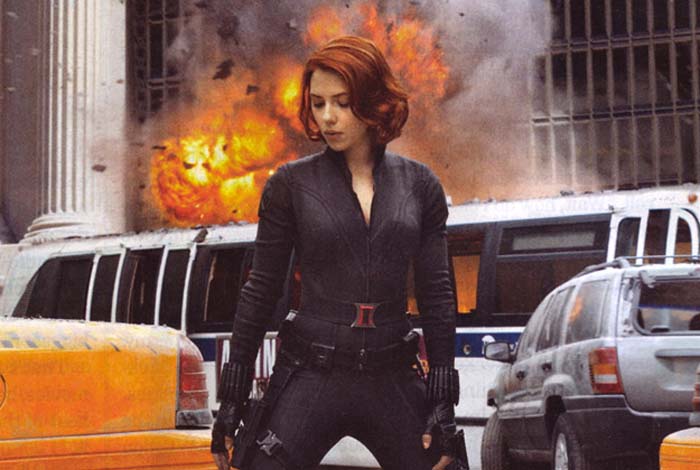
nullBlack Widow is the first hero seen in The Avengers, the latest entry in Joss Whedon's career-long feminist project. She does not immediately display the super powers enjoyed by the other Avengers—Captain America’s unnatural super-strength, The Hulk gamma-ray rage giant, Iron Man’s wearable rock ‘em, sock ‘em robot suit, or Thor’s hammer of the demi-gods. The only visibly super things about Black Widow are the latest in cat suit couture and a striking asymmetrical crimson bob. And yet she’s still able to trash a clutch of Russian scumbags with her hands tied behind her back. With a chair tied to her rear. While talking on her cell phone.

She’s also the sole Avenger that S.H.I.E.L.D. leader Nick Fury (Samuel Jackson) trusts to convince Bruce Banner (Mark Ruffalo) to join Thor (Chris Hemsworth), Iron Man (Robert Downey, Jr.), and Captain America (Chris Evans) in the fight against Thor’s psychotic brother Loki (Tom Hiddleston) who, having stolen the ultimate source of power in the universe, the Tesseract, plans to use an alien army to devastate the Earth. (The plot ends there.)

As egos collide, Black Widow—street name, Natasha Romanova—is the only character who does not throw a monstrous hissyfit.  The only character to gather actionable intelligence against Loki from Loki. The character who not only literally kicks sense back into the brainwashed Hawkeye, but then absolves him of any sins performed while under the loony god’s spell.

You want fearless? When midtown Manhattan is swarming with thousands of robo-aliens, the dreaded Chitauri, Black Widow commandeers one of their slippery aero-sleds and flies it to steal Loki’s glowing phallic scimitar so as to save the world so Iron Man can blow up the aliens.

Oh—and the Tesseract? It’s female. I know this because everyone calls it by female pronouns—respectfully. How does that work? Well, the way all Whedon works: second viewings reveal not only layer after layer of multiple meanings, jokes piled on jokes, but seemingly random elements that are actual thematic glue. Nothing is never there without a reason.

Anyway, Black Widow! A worthy addition to Whedon’s female action bloodline, right? The flame-haired heir to Buffy, Faith, Kendra, River, Echo, Zoe, Fred, and Illyria, right?

No.

Writing in The Guardian, Henry Barnes noticed Black Widow but could not be bothered to isolate just what she did in the film. The New York Post’s Kyle Smith dreamed of a Black Widow who would perform one errand and and then be gone.

The New York Daily News’ Joe Neimaier admitted that Black Widow “kickstarts” things, but by deleting her from the rest of his coverage, implied that was that. Still, that was a lavishment compared with the treatment by A.O. Scott, who in his New York Times review found it beneath himself to even give Black Widow a job description, while The Globe and Mail went with “token sexy female,” clearly hoping only young boys and people who hadn’t seen the film were reading.

Meanwhile, in The Wall Street Journal, Joe Morgenstern claimed Black Widow “spends lots of time looking puzzled or confused,” while Steven Rea's Philadelphia Inquirer review dispensed with Black Widow’s name, suggesting we “watch Scarlett Johansson clench her brow” while in “Ninja garb.” The Miami Herald’s Rene Rodriguez wasn’t as generous—his single sentence also accused Johansson of playing dress-up, but, perhaps mercifully, did not specify what in.

Meanwhile, as if transported from another dimension, Kim Voynar’s Movie City News review both acknowledged Black Widow and lavished almost two paragraphs on Johansson’s terrific performance.

Over at Think Progress, Alyssa Rosenberg took for granted what the aforementioned critics could or would not see. “The two characters least-well served by their previous incarnations in Marvel movies,” she wrote, “the Hulk and Black Widow, are the ones best served by Whedon’s greatest gifts and strongest tendencies.”

Rosenberg hit key reasons why Black Widow matters:

She never becomes a victim or a lesser member of the team. Her pain and exhaustion after a CG Marvel battles triggers our empathy, and centers us. And while all this superhero battling may look fun, without superhero augmentation, it must be terrifying. Johansson offers a true career-best turn here, easily negotiating splinter-thin spaces separating old pains and a chilly professionalism that hides we’re not sure what—regret? Denial? Lingering rage over the childhood abuse that turned her into Black Widow? It’s all hinted at as the actor works Whedon’s many shades of dark grey beautifully. In short, and despite all the Wagnerian bam-boom-pow, Whedon and his star never lose sight of the fact that Natasha is profoundly vulnerable, with nothing but smarts, heart and a .45 for protection.

Finally, AlterNet’s Julianne Escobedo Shepherd cut to the chase and celebrated The Avengers’ “stark feminist perspective” and what she saw as fact: that “Johansson’s Black Widow is just as front-and-center as the rest of the cast.”

To which I can only say—exactly! And: isn’t this remarkable? Two parallel realities! Men who see nobody at all and women who see the next Faith (without the crazy, I mean). Don’t tell Disney, or they’ll be marketing the film as 4-D.

Jokes aside, how to explain this blanket amnesia?

If I were to be optimistic, I’d say this brand of blindness is about change happening too fast. Change is weird, scary and disorienting. And TV’s a great place for incremental change because it shows slow transformations occurring over time.

At first, Buffy, the Vampire Slayer was, literally, a joke. A cheerleader fighting the undead! Hilarious! And she’s so unthreateningly cute! But over time, people came to believe in the take-charge slayer, until someone in Season Four’s “A New Man” [sic] episode could remark to Buffy that “You're, like, make the plan, execute the plan, no one giving you orders,” and instead of intimidation, there was a shrug. Because it was true.

And so over time people weren't alarmed when Alias’ Sydney Bristow nicked bits of the 007 crown. Or when a female Starbuck showed Han Solo-level energy in the new Battlestar Galactica.

But The Avengers moves so fast, with so many zingers, tiffs, explosions, turnarounds and implications that I’d like to think reviewers simply didn’t have time to process just how radically and playfully Whedon (whose mother co-founded Equality Now) cedes yards of traditionally male genre property and space to Black Widow. 

Some part of the male unconscious, down there where The Hulk lives, just didn't go for it.

How is there not at least one guy who can figure out how to fly Chitauricraft? Why is Captain America looking to Black Widow for strategic ideas in midtown Manhattan? And the greatest power of the universe is a She? How does that work?

Answer: It works so easily that The Avengers is well on its way to becoming one of the most popular films in human history. Maybe a mess of male critics can’t see a triumphant Black Widow in the malange of superheroes crowding the film. But in this election year defined by demeaning treatment of women, it’s encouraging to know that a whole lot of America can.

Ian Grey has written, co-written or been a contributor to books on cinema, fine art, fashion, identity politics, music and tragedy. Magazines and newspapers that have his articles include Detroit Metro Times, gothic.net, Icon Magazine, International Musician and Recording World, Lacanian Ink, MusicFilmWeb, New York Post, The Perfect Sound, Salon, Smart Money Magazine, Teeth of the Divine, Venuszine, and Time Out/New York.

GREY MATTERS: The Decline and Fall of April Ludgate

GREY MATTERS: The Decline and Fall of April Ludgate

null

I guess it was inevitable, especially when you think about the place of women in TV and the size of the NBC machine. But the worst has come to pass, and April Ludgate, the beyond-deadpan carrier of careless anarchic energies, the one-woman friction element who’s kept Parks and Recreation from being an Office clone from the unsteady git-go, has been muffled into a millennial-generation version of a wacky neighbor from a sitcom.

This, well, sucks. Because April Ludgate, it’s not a stretch to say, is the most extreme, most uncompromisingly strange, noncompliant female character in the history of broadcast TV. There is no mold for April Ludgate to break. When she ends up sunning herself in a South American dictator’s pool in one episode, the joke is that she fits there as well as she fits in small town America. Meaning she doesn’t, to her amusement.

Because of April, Parks and Recreation was an utterly unique situation comedy, set in a binary universe.

On the one hand we had Amy Poehler, playing Leslie Knope, a passionate bureaucrat in an Indiana small town’s Parks and Rec department, and her hugely adorable co-workers.

And on the other hand, as if reporting in from a parallel universe lorded over by deadpan semi-surrealist Steven Wright, there was April Ludgate (Aubrey Plaza), permanently hunched over, with huge, give-me-a-break rolling eyes, snark, and all-around Dada-esque hostility.

April’s acid grin gave the Libertarian outbursts of Ron Swanson (Nick Offerman) their exclamation points. Her eye-rolling threw water onto Leslie’s eternal happy hour of optimism. She showed proper disgust when one-joke wannabe playa Tom (Aziz Ansari) said something, well, disgusting. Let’s put it baldly: April Ludgate was Parks and Recreation’s stealth weapon.

But now? Now the girl who used to answer the phone with impossible dates and times, glower at the horizon for fun, and hang up on people for sport—all to the endless delight of her boss, no-government Ron, it should be mentioned—has been shorn of her playful, perverse and puckish identity.

She now prefers conservative work force clothing to better integrate into the office. She also shares hugs with anyone when needed, and when her cutely thick musician husband Andy (Chris Pratt) does something really dumb, she will throw her arms up and cry “Andy!” like a million other flustered wives before her. All that’s missing is a laugh track.

How far the mighty fall. I mean, sure, she’ll say something surly every now and then: I bet they have five or six 18 year old interns at NBC tasked with the job of coining her devilish rejoinders.

Anyway. Back in the day (before this season), I loved the way that April and Ron had bonded as peers in their mutual disgust over institutions, government, groups and, hell, everything but rare steaks, whiskey and causing more problems.

Not anymore! Now that Ron has committed an actual act of governance and promoted April to a job with more responsibilities, he has also become a father figure for April, because all girls, the subtext logic goes, especially uppity ones like April Ludgate, are really looking for the right substitute father.

Maybe here you can see why The Girl with the Dragon Tattoo was so remarkable. When Rooney Mara’s punk hacker was dragged into another dubious Girl Domestication scenario with another Oedipal-freighted father replacement, she soundly rejected it: that just doesn’t happen that much. That is breaking the law, after all.

Meanwhile, as I mourn April Ludgate’s spiky soul—I can see, in indelible ink, the writing on her face, saying “Don’t worry folks! She’s normal! Really!”—the show itself trundles to an ignoble season’s end.

Knope has run for city council. Since this is NBC and actual political parties cannot be named, the show instead goes for the Maureen Dowd school of politics, where there are no issues or ideologies, only personalities.

Knope should win, the show argues, because she’s wanted it longer. Me, I could use less of my favorite comic actor getting shitfaced and falling into hot tubs, failing career-making interviews and becoming the buffoon she never was.

Meanwhile, over in the kingdom of bad decisions of which April is queen, we find a high princess in Ann Perkins (Rashida Jones). Like April, Ann has been shorn of delightful prickliness and is now so needy that she pairs up with Tom, because he is now an adorable man-child. Or child-man.

Look. I revel in the promise of serialized TV’s ability to let people change. But there has never been any fine print about devolving them. And the other promise and pleasure is that they also stay essentially the same. I just don’t buy a Knope who’s recently so often a dope, or an Ann willing to forget everything she knows about romance so that Tom can annoy her into having sex—or as Tom described it, “The four sweetest words: you wore me down.”

Maybe I’m spoiled by girls doing whatever they want. Maybe I’m paranoid about endless notes and tweakings by suits after terrible ratings because lord knows Parks & Rec had those last year, but when all your female characters have been blunted and your male characters left the same or improved, it's just weird. Add on characters name-dropping the feminist critic Laura Mulvey and making knowing reference to “the male gaze” in time for Ron to have hot monkey sex with an actual female feminist, and I can’t help but feel as if the showrunners are not only winking at us, but at least partially aware that they knew exactly what they were doing with, say, April,
and probably knew we'd be at least somewhat put off by it, and hence the un-Parks and Rec-like avalanche of Community-style referencing meant to ensure we don’t get actually mad at them about doing any of it, because, like, see, we get the whole discourse, so we’re cool, right?

This irks me.

Still, the anarchy-in-the-USA energies have been passed to a male body now: that of real-life Republican Rob Lowe, here playing state auditor Chris Traeger.  (Yes, that is irony.)

At first a running joke of narcissism and mortality fear, Chris’s encroaching middle age anxieties have turned him into the show’s new wildcard of strange/insightful behavior (playing terrifying Gregorian chants at a Valentine’s Day DJ gig for example). Chris, it seems, is the new April.

With HBO’s Girls zeitgeist on the one hand and FOX’s retrogressive indie pixie gold mine The New Girl on the other, next season will tell whether April and the other women on Parks and Rec are allowed to rediscover their spiky roots. I hate to say it, but my hopes are not high. And maybe if I don’t watch any more demoted Aprils, I can think of this impossible character more as some incredibly rare, unstable mineral that let off this amazing, crazy light that was never meant to shine more than a few years before exploding beautifully into nothing. Yeah—I can think about it that way without getting cranky.

Ian Grey has written, co-written or been a contributor to books on cinema, fine art, fashion, identity politics, music and tragedy. Magazines and newspapers that have his articles include Detroit Metro Times, gothic.net, Icon Magazine, International Musician and Recording World, Lacanian Ink, MusicFilmWeb, New York Post, The Perfect Sound, Salon, Smart Money Magazine, Teeth of the Divine, Venuszine, and Time Out New York.

GREY MATTERS: PERSON OF INTEREST: A Noir for the New Depression

GREY MATTERS: PERSON OF INTEREST A Noir for the New Depression

null

Person of Interest isn’t the sole new scripted television show in the Top Five because it’s a gold standard procedural mystery. Or because it’s a terrific grown-up look at living with regret that also finds time to explore post 9-11 hot topics of class and morality in the New Depression.

No. Person of Interest is a Top Five show with 13.5 million viewers because it’s figured out a way to use classic noir style while seeming to do something completely of this moment.

Person stars Michael Emerson, much loved for his work in Lost, as Finch, a Manhattan genius billionaire, and creator of a post 9-11 computer system, “a machine that spies on you very hour of every day,” originally designed to predict terrorist attacks.

When Finch became obsessed with the idea that The Machine should predict regular crimes, the government nixed the idea, and so Finch (somehow) took matters—and The Machine—in his own hands, but then realized he needed a partner in pre-crime enforcement.

He settled on an emotionally cauterized ex-CIA operative: "John Reese" (Jim Caviezel, best known as Jesus Christ in Mel Gibson’s gore porn movie about the Gospels). 

Not much is known about Reese aside from his remarkable military skills, detached affect, and preference for $2,000 Hugo Boss-style high couture suits worn, one assumes, out of habit from his spy days at the height of the Cheney years, killing whomever his CIA superiors order for incomprehensible reasons. The result: Reese is a hollow man, he enjoys nothing, indulges no pleasures, and is without family or friends. Caviezel works his three shades of ever-pained grey with aching, Emmy-worthy precision.

Finch favors suits as well, but more stylish numbers that made me think of recent Gucci, all business but with flair and actual color in them, suggesting a past liveliness long extinguished by . . . we don’t know what.

Like the bird whose species he suggests, Finch is wide-eyed and watchful, but thanks to an unspecified past injury, he cannot turn his head, limps, and lives in his library, alone with The Machine. It’s the most curious of pleasures, watching these true two pros feint and parry as their characters test each others’ boundaries. We all know Emerson’s skill with studied strangeness, but Caviezel has the heavier load: he has to both ‘do’ detachment with a dash of rage and occasionally freight it with the driest of drollery, without compromising Reese’s basic deadpan. Kids, don't try this at home.

Anyway, each week The Machine spits out names. They may be victims or they may be perps. Reese does whatever it takes to save or stop that person: surveillance, fighting, killing if necessary.

Eventually, an NYPD Detective named Joss Carter (Taraji P. Henson) joins Finch and Reese in their pre-crime fighting, and voila—it’s the first post-9-11 non-biological family. It takes a while, but as Carter realizes the depths of corruption in her department, she also comes to accept that the man in the striking suits and his friend with the more striking technology are the more effective crime stoppers. The process took time, but Person is all about time.

But so what? Gloomy weirdoes, ex-CIA, mopey cop. How is this really that noir? And why should I care?

The reasons that Person works as noir are intertwined with the reasons you should care. Person limns a version of our world where the shadows are a little deeper, and the debasement of institutions and the people running them are more prevalent.

Another twist is the show’s look, which hop-skips past classic Expressionist chiaroscuro and lands in a New York City Sidney Lumet would recognize, the New York only natives know, which ironically adds a certain exotica to the show. We visit the Queens of kitsch Greek diners, the East Village of fusty Alphabet City coffee shops, of deep Brooklyn storage facilities where you could shoot ten people and nobody would notice for as many days. It’s the opposite of Taxi Driver’s intoxicating filth noir. It’s what's come after Manhattan’s Disney-fication—it’s blah noir.

And corruption festers in the warrens of blah. Corrupt builders, politicians, technocrats, bankers, foster care workers, Wall Street players. An entire section of the NYPD, “the HQ,” is dedicated to facilitating more corruption.

You want mobsters? Person gives you Russian, Hungarian, Polish and Italian post-NAFTA, no-rule-or-regulation mobsters. Arguably worse than them all are the strange, horrible men seen in flashbacks, the monstrous CIA of the Cheney years, who are the source of Reese’s self-loathing and who we see ordering him to commit war crimes like they were going out of business. Which I guess they were. Anyway, the casual, decade-long density of human vileness suggests something James Ellroy would have cooked up.

Even as the show insists on noir’s golden rule—there is no way out—it argues that people have choices, however limited or hard.

In the episode "Cura Te Ipsum," a drug cartel narrative carries us through the soul crisis of a good doctor (Linda Cardellini) going bad. In “Legacy,” a Latina from the projects (April Hernandez-Castillo) trying to escape a lousy past becomes a lawyer representing the wrongfully imprisoned and almost dies for her efforts. Meanwhile, a Ludlum-style spy story powers “Foe,” where a Stasi agent (Alan Dale) who cannot forget ancient slights forces Reese to confront his own bad times. 

Repeatedly, relentlessly, as per noir tradition, episodes hinge as much on the memory of bad things as they do on actual crimes. And it comes as no surprise that the show is the creation of Jonathan Nolan, whose short story "Memento Mori" was adapted by his brother Christopher into the surprise reverse-memory noir hit, Memento (2000).

For me, this memory stuff is pure catnip. As I’ve written here at Press Play, the collision of my face with a bus in 1986 caused sufficient brain damage for me to lose memory of a goodly portion of the 90s.

But seeing as we all exist in the rush of time with only memory on our side, Person has as universal a hook as you could want. And as frenzied as Person’s stories may be, the progress of its protagonists is something best engaged with in the long form offered by television, where a twenty-three episode network order allows vastly more observed and organic character growth.

Reese, on occasion, will now share the ghost of a smile. Finch, on the other hand, is processing something—but what?

We still don’t know the real deal about Finch and his relation to Ingram (Brett Cullen), the close friend with whom he created The Machine. We don’t know if Ingram was killed by the government, by one of the people he tried to save, or any number of scenarios argued about with great relish on Person of Interest fan sites.

What we dread is that Finch killed Ingram and picked Reese because he could relate to his guilt. What we hope is that Finch gained his injuries in an explosion that killed Ingram and is in a process of healing a compromised brain.

Meanwhile, Carter’s been saying she trusts Finch. But she hits that note so hard that one wonders if she’s trying to convince herself more than anyone else. Remember: this is still noir, and trust usually comes with a body count.

At its core, Person of Interest is a noir drama that tries to go beyond noir’s limiting darkness while admitting every week the difficulty of healing and redemption, and how almost anything can screw it up. And how you never know when your number’s up. Nowadays, that’s what will have to pass for optimism.

Maybe people tune in because Person is the rare show they can trust not to lie to them.

Ian Grey has written, co-written or been a contributor to books on cinema, fine art, fashion, identity politics, music and tragedy. Magazines and newspapers that have printed his articles include Detroit Metro Times, gothic.net, Icon Magazine, International Musician and Recording World, Lacanian Ink, MusicFilmWeb, New York Post, The Perfect Sound, Salon, Smart Money Magazine, Teeth of the Divine, Venuszine, and Time Out New York.

GREY MATTERS: Cabin in the Woods, Horror in the Dumps

GREY MATTERS: Cabin in the Woods, Horror in the Dumps

null

***SPOILER ALERT: The following piece is one huge spoiler. So, if you haven’t seen this movie yet, consider yourself forewarned.***

If we’re lucky, The Cabin in the Woods will shut down the debased American horror movie machine for a good long while. God knows the damned thing has been creatively moribund for decades and hasn’t had a new idea since Scream, unless you count turning cinemas into torture porn abattoirs as new.

And actually, that was a main reason Joss Whedon co-wrote Cabin with friend and Buffy the Vampire Slayer writer Drew Goddard a few years back: as a protest of Hostel and movies of its ilk.

But Cabin—directed by Goddard—got stalled during MGM’s bankruptcy, and here it is, a dark echo of The Hunger Games, another film about kids trapped in psychotically violent arenas. This one, though, gives equal time to the people behind those funny games.

We know this because, right off, the words “CABIN IN THE WOODS” are hilariously stamped over a freeze frame of said masterminds, a bunch of middle management types in lab coats played by Richard Jenkins (delightfully worn out), Bradley Whitford, and Whedon regular Amy Acker. They joke, place bets, and work as surrogates for anyone grinding another massacre movie out during this period of the genre’s debasement.

Meanwhile, five teens get ready to vacation at the eponymous cabin. There’s Jules (Anna Hutchison), the blond who’s only dumb, it turns out, because her Clairol was secretly doped by agents of the lab (!). And Dana (Kristen Connolly), the “mostly virgin” redhead. And Curt (Chris Hemsworth), the hunk, and Holden (Jesse Williams), who’s the nice guy. And stealing the movie like he stole Whedon’s Dollhouse is Fran Kranz, as Marty the stoner.

As the teens drive “off the grid,” the stations of the Craven/Raimi cross are dully ticked off: road to nowhere. Creepy in-bred dude at gas station. And, finally, the saggy-roof cabin itself, courtesy of Evil Dead.

Once inside, Weird Shit happens. Freaky mirrors. Creepy toys. A text written in Latin is read aloud. Zombies rise. And then the violence begins, and we realize that this “cabin” and “woods” were controlled by the lab from the start of the movie, part of a vast underground installation that makes everyone do stupid horror movie stuff ending in sacrificial deaths meant to appease an Entity older than Time, blah blah blah….

Goddard/Whedon stage the first kill with savage efficiency. Three shots: girl gets aroused. Girl shows breasts. Girl gets bloodily skewered. Hip male critics love to excuse this in other films—well, Cabin says, excuse this. (Would the apologists be so enthused if films routinely showed penises being violently, bloodily liberated from their original owners? I know, I know: “Ian, you’re, like, so literal.”)

Generic zombies terrorize and kill in an efficient parody of the prototypical zombie story, which unfortunately drags the film until Marty and Dana break into the installation and find hundreds of Plexiglas cube-cages housing as many monsters for every possible teen kill scenario.

As a black opps cadre confronts Marty and Dana, the latter locates a Staples-style red button that, when pushed, handily opens the cube-cages, and . . . cowabunga! It’s the greatest monster mash in movie history!

It’s as if these beasts flew, crawled and slithered straight out of the last time American horror seethed with invention, due to a cultural cauldron boil of Thriller, the anxieties of Mutually Assured Destruction and AIDS, heavy metal, MTV, MIDI, perms, and a general global urge to out-crazy the next guy. The 80s.

The 80s could cough up an allegory for identity existentialism in the ever-shifting surrealist monster of John Carpenter’s The Thing, or the sexed-up, Lovecraftian latex abstractions from From Beyond, and still have time to create a monster metaphor for AIDS in The Fly. (And because Joss is such an Anglophile, Hellraiser and its Pinhead, the poster boy for S&M perversity in the plague years, are directly riffed on here in the form of another leather/razor creature, named “Fornicus, Lord of Bondage and Pain” in the credits.)

Speaking of politics—and you could—George Romero practically screamed his zombie-metaphor leftism in Day of the Dead while Wes Craven reported Haiti’s long suffering under dictator “Papa Doc” Duvalier in The Serpent and the Rainbow.

All of those movies, plus Gremlins, An American Werewolf in London, A Nightmare on Elm Street, Poltergeist, and dozens more comprise what turned out to be the final flowering of America’s dark imagination, and that’s what’s celebrated in Cabin’s monster mash.

And when all that’s left is a vast pool of blood, it’s like a sanguine sigh, because we all know there’s no room for such lunatic invention in American cinema, not any more.

But I digress.

Cabin ends with a trans-supernatural “Director” urging the campers to use their "free will" to die the way she tells them to. Marty and Dana choose to smoke one last doobie and let the world go to hell. What Whedon asks is: is a species that enjoys watching the graphic rape of a decapitated girl's head and worse in movies like, say, the French High Tension really worth the bother?

Cabin can’t help but be the most slight of Whedon’s efforts, mostly because even a mood master can’t quite negotiate the switches from slaughter to light comedy needed—he’s just not heartless enough. We’re just getting used to the idea that our pitiful heroes might escape, for instance, when one of them motorbikes into what turns out to be a force field that fries him like a gnat in a bug zapper. Cool effect. Which is kind of hilarious. Except then you’re like, "Wait, wasn’t I starting to like this guy?" And yeah, everyone knows Whedon is hoisting us on the petards of our affections—except we never had enough time to really like the zapped biker, so we’re in emotional limbo.

Still, what works is often funny. Goddard directs his first feature with impressive élan, and damned if that monster melee doesn’t inspire: it’s made by people who know that horror cinema can be great art or even awesome trash, carrying out a holy war against what it’s turned into. Plus—if you miss the evil white unicorn, you have nobody to blame but yourself.

But Whedon just can’t hew to the mission statement of creating teen kill archetypes: unable to resist the urge to create characters, he lands somewhere in between sometimes. He can’t even hate the engineers before starting to understand what it would be like having such a soul-killing job. He’s just too humane.

Cabin could, of course, actually fail in its intentions, as it inspires the industry to issue idiot look-alikes about entrapment scenarios that reference other movies, leading us to find, yet again, that nothing can drive a stake in the postmodern monster, because it lives freely on past dreams of the dead, no matter how much you scream.

Ian Grey has written, co-written or been a contributor to books on cinema, fine art, fashion, identity politics, music and tragedy. Magazines and newspapers that have his articles include Detroit Metro Times, gothic.net, Icon Magazine, International Musician and Recording World, Lacanian Ink, MusicFilmWeb, New York Post, The Perfect Sound, Salon, Smart Money Magazine, Teeth of the Divine, Venuszine, and Time Out New York.

GREY MATTERS: One Soul Separated: THE BALLAD OF GENESIS P-ORRIDGE AND LADY JAYE

GREY MATTERS: One Soul Separated: THE BALLAD OF GENESIS P-ORRIDGE AND LADY JAYE

null

Like high romantics everywhere, the lovebirds named Genesis P-Orridge and Lady Jaye felt as if they were really one soul separated into two bodies. Unlike everyone else, they did something about it. After meeting in New York in 1993, the two set about becoming mirror images of one another, first with small things like matching bleached bobs, matching pop and fetish inspired fashion and slashed red anime make-up, before moving on to the hard stuff in 2004: radical, transformative cosmetic surgeries meant to make them look two matching halves of a single "pandrogynous being,"  

And that is how we meet musician/artist P-Orridge (born Neil Megson, 1950) and Lady Jaye (born Jacqueline Breyer, 1969) in Marie Losier’s remarkable new film, with matching hair and fashion styles, breast implants, plumped Restalyne lips, and enhanced cheekbones.

A total break with any music-doc form, The Ballad of Genesis P-Orridge and Lady Jaye also drops any semblance of linear narrative. It opts instead for a jangly non-stop montage of associative images, ideas and sounds to navigate P-Orridge’s five-odd decades of working subcultural fringes—from being an early performance art and industrial music pioneer, to becoming a modern primitive provocateur—and makes it all seem like falling off a log.

But the illusion of effortlessness is just that. Cinema like this, that makes poetic connections entirely on symbolic, suggestive, or subconscious levels, requires a degree of aesthetic focus and rigor you find once every few years, if that.

Losier—a 2006 Whitney Biennialist and collaborator with Guy Maddin on the short film Manuelle Labor (2007)—is up to the task. Like the artist being uncovered, her film is all about a charmingly knockabout faith in strange connections—aesthetic, interdisciplinary and maybe even spiritual.

And so it’s playful and ironically perverse that Losier starts off by disconnecting P-Orridge from his/her exotic strain of fame (damn these pronouns!), limning the artist as just another eccentric expat Brit living in Brooklyn, an arty, eccentric fifty-something guy making dinner in formal drag wear.

But Losier knows she has a secret weapon that will stop audiences fromdismissing P-Orridge as a Quentin Crisp wannabe: his adorable, reserve-melting, total adoration of Lady Jaye.

She’s an ice-blond contradiction, a fetish-styling glam girl who’s also a nurse specializing in the care of kids with incurable disabilities.

P-Orridge recalls staying at a dominatrix friend’s dungeon in the East Village when a door opened, and into the light stepped Jaye, a vision in groovy 60’s style clothes and fetish accoutrements (“my two favorites!”).

Smitten, P-Orridge prayed, “Dear Universe—If you find a way for me to be with this woman, I will sleep with her forever.”

The universe would give one of the worst conditional “yes” answers ever. But P-Orridge didn’t know that, of course.

And then, only after the Genesis/Jaye origins story, does Losier make room for biography, as hercameras roam P-Orridge’s basement. Hundreds of boxes and crates hold thousands of files of newspapers, magazines and ‘zines, while more boxes hold thousands more home, network, pirate and internet video, all of it documenting and critiquing over thirty years worth of performance, music and art-making at the interstices of international fetish, BDSM, industrial, and body modification cultures.

In this blizzard of outlier arts history—post punk, Beat and UK history bits in multiple formats mix and match to becomes mini music videos accompanying P-Orridge’s stream-of-memory narration—but two elements are especially fascinating and essential: a video of P-Orridgein the ‘80s, dressed in hyper-masculine military mufti and practically attacking an admiring crowd. Where, one wonders, did this manned-up Genesis go?

And there is a lot about P-Orridge’s mentor, William S. Burroughs, who in the late 60s went out of his way to land the young and struggling P-Orridge arts funding grants and also introduced Genesis to the cut-up method, wherein linear texts are sliced into impossible-to-predict ‘new’ works.

The cut-up defined P-Orridge’s ‘70s band, Psychic TV, and his ‘80s band, Throbbing Gristle, both way-ahead-of-their-time groups that co-created the industrial genre that led to groups like Nine Inch Nails and provided basic DNA for all electronic dance music genres. But the ultimate cut-up, of course, was the form Genesis and Lady Jaye’s partnership took.

Which most people would think the act of two very disturbed people. And so, in the spirit of cutting folks off at the corner of Freud and Rosebud, Losier and P-Orridge (it’s unclear how closely the two worked on this project for the eight years of production) offer up a video recreation.

A cute sad boy of about twelve years, dressed in British school clothes stands, in front of an institutional edifice, as P-Orridge recalls years of daily bullying, in which he was almost beaten to death.

Cut to:  The real P-Orridge wearing a cacophony of contradictory fashion semiotics—Fascist S&M chic. Red lipstick. A Hitler moustache. Warhol hair. He screams, “I am so sick and tired of being told what I’m supposed to look like! This is not my body!  This is not my name! This is not my personality!

It’s an almost shockingly bare declaration of independence. But what of Lady Jaye?

During the film there’s a sense of mystery about her. She always seems to be finishing something, or leaving somewhere, of in the middle of laughing about something we don’t know about. The film has no special effects, clever editing, or odd framing, but she still seems . . it’s hard to explain . . . spectral in some way.

During a Psychic TV reunion, P-Orridge tells us she’s upset about something, but all I could see was a blur of her moving and, yes, looking pissed, but then we were on to something else.

Then the hammer fell and I wondered about that:

Lady Jaye died in 2007. Cancer. Next to her beloved after making love, or so goes the ballad.

First off, I was glad Losier didn’t cheapen Lady Jaye’s story with talking head treacle that would "explain" her. And P-Orridge, who speaks glowingly about how “we made love” or how “she looked so beautiful,”  wants to keep details about Lady Jaye private and cherished at the same time that he offers her legend as a lasting image and archetype for everything he might consider pure and beautiful.

That some of Losier’s film can be read as myth-creation does not devaluate the far greater parts that are inarguable acts of music history and culturally integrated biography. But the film doesn’t forget to remain true to its title as it evokes another ballad, another musical couple walking in another park, as P-Orridge and Lady Jaye, dressed all in white, stroll through Brooklyn’s Prospect Park.

 “I love you,” says one voice. “I know,” says the other.

Ian Grey has written, co-written or been a contributor to books on cinema, fine art, fashion, identity politics, music and tragedy. Magazines and newspapers that have his articles include Detroit Metro Times, gothic.net, Icon Magazine, International Musician and Recording World, Lacanian Ink, MusicFilmWeb, New York Post, The Perfect Sound, Salon, Smart Money Magazine, Teeth of the Divine, Venuszine, and Time Out/New York.

GREY MATTERS: More Room for Rockstars!

GREY MATTERS: More Room for Rockstars!

null

Sometimes a terrible music movie isn’t such a bad thing.

Good films made by interesting people are mediated creations, in which elements are deleted, themes considered, emphasized, or shaded. From Kevin McAlester’s deft contextualization of the relationship of Roky Erickson's madness to his sublime music in You’re Gonna Miss Me to the balancing act of accomplishment to pitifulness leveled on eternal L.A scenester/DJ Rodney Bingenheimer in The Major of Sunset Strip, there’s all this palpable thinking going on.

No Room for Rockstars (Cinedigm, 2012) isn't hindered by any of that. Whatever it observes about the 2010 Van’s Warped Tour—currently in its 17th year of existence—is just another shiny part of something slick, not terribly stylistically different from, say, an Audi commercial. Touted in the PR as the product of “the team that brought you the highly acclaimed Dogtown and Z-Boys," director Parris Patton’s No Room comes to us with plenty of sheen and literally no idea behind it.

But it’s that very thoughtlessness that allows all manner of cultural stuff to drift to the surface unfiltered, starting with what seems like (and probably is) the Tour’s devolution into absolute, possibly contemptuous, multi-quadrant cynicism, and teetering into issues of class, hyper-capitalism, and the endless, American Idol-style entitlement craze and pathology.

What is Warped? It’s a combination extreme music/sports roadshow started 17 years ago by entrepreneur Kevin Lyman with the sponsorship of skateboard and shoe manufacturer Van’s.

Bikers, skaters, indie labels and zine culture were complemented by left-ish non-profits. From 1993 to 2009, Warped hosted the rocking likes of Andrew W.K., Bring Me the Horizon, Dropkick Murphys, Green Day, NO FX, Parkway Drive, Pennywise and tons more.

The archetypal Warped band was punk and hardcore, but moved on to include metalcore bands like As I Lay Dying, The Devil Wears Prada and the inexplicably ginormous, Warped-playing Asking Alexandria, the rare extreme metal record to reach Billboard’s Top 200 at #9.

But as chronicled in No Room, Lyman—presented here as an distracted enigma wrapped in chinos and a polo shirt—decided in 2010 to expand his tour’s demographic reach to include folkie-emo tweens and R&B-pop teens, and in the process, gladly risk blowing 17 years of alt-culture history for reasons known only to Lyman’s priest, shrink, or accountant. None of Lyman’s many detractors—and they are legion–are represented in the film. Instead we get a guy worshipped by his crew and glimpsed making an apparently legendary bar-B-que. One assumes he signed off on everything in this film. Which means he’s okay with . . . well, let’s look.

The first nu-Warped act we meet is Never Shout Never, the band name of wee Christofer Drew, an adorable 20-year-old acoustic emo troubadour. With his quiff of tousled Bieber-hair and earnest Cat Stevens-esque tunes sure to set tween hearts a-flutter, he’s the film’s artist who falls from innocence.

At first Drew seems too young to buy Gatorade without adult supervision, but a rock star dive from a speaker stack breaks his leg. Immobility leads him to re-think the endless merchandise stands and corporate tie-ins of Warped. He comes to despise how everything—the corporate tie-ins, band tee shirt, belt buckles, jean jacket patches, the endless merch stalls selling boards, drinks, nipple rings, Van’s stuff, Spotify subscriptions, personal style accouterments, and other information and assistance regarding how to officially become an individual—how it’s all become a meaningless, hyper-capitalist shitstorm (I paraphrase). He declares that, after this tour, Warped is dead for him. 

null

Meanwhile, pop/R&B crooner Mike Posner is Drew’s opposite. Posner is . . . well, how to put this?

The arrogant 24 year-old Duke University business grad can’t even thank his fans without smirking. His music is sub-Timberlake Cheez-Whiz performed alone with taped backing tracks to screaming teen girls. His biggest hit is called “Cooler Than Me,” but you know he doesn’t believe such a thing would be possible.

Posner is here to drag an entirely new demographic onto the Warped Tour fairgrounds to buy Monster energy drinks. Posner uses Warped to pimp his record, find new airports from which to jet to LA, guest on The Ellen DeGeneres Show and Live! with Regis and Kelly, and otherwise chill in his luxury bus while ignoring other bands tripled up in stinky buses. Hello, first 1-percent pop star. What a . . . dick.

If Posner and Warped are the film’s Great White sharks, the suckerfish living off their dregs is Forever Came Calling.

A three-piece pop-punk group from Palms, California, Forever follows Warped in a beat-up van, and nags people into buying their demo-CD at every stop. The band has no charisma, and we hear none of their music; all we know about them is their absolute belief that they deserve a slot on the tour because they believe in it, like any other reality show contestant, except this is actually reality. The sad mix of desperation and ego here is often hard to watch.

As children of American Idol culture, Forever is using Warped to leapfrog from obscurity to fame without all the tiresome business of work and music-making. Even as The Team locates the baseless U.S. entitlement hysteria that makes Idol and its variants possible, it decides to turn the Forever story into a mini-Idol narrative itself, compete with a highly dubious finale intended for uplift. The ironies are, of course, lost in the shuffle.

When Suicide Silence actually plays its pummeling "deathcore"—death metal and hardcore mixed—the liveliness of it is almost shocking.

Suicide’s lead screamer is the charming, tatt-covered Mitch Lurker. Lurker has an anxiety disorder that only leaves him when he performs. He’s also got kids and a wife.

In the economic post-apocalypse called the music industry, where big box stores do the Darwin and legal organized crime steals his work (think Spotify, Mog, Pandora), where the only companies who reliably pay you—iTunes and Amazon—do so by the track, as the idea of the album becomes an ancient concept, endless touring is the sole means to solvency.

So I’m glad there’s a Warped for Lurker’s band and family. But at the same time it feels like strivers like Lurker are in the inexorable process of being devalued from stars in the making to something like itinerant day workers.

What Lurker does is singular, special. The Posner type will come and go; Suicide will still be here. Maybe Lyman understood that once, maybe he’s forgotten, clearly this film has no idea. Me, I want more room for rockstars: more is the whole idea, the whole dream.

null

Ian Grey has written, co-written or been a contributor to books on cinema, fine art, fashion, identity politics, music and tragedy. Magazines and newspapers that have his articles include Detroit Metro Times, gothic.net, Icon Magazine, International Musician and Recording World, Lacanian Ink, MusicFilmWeb, New York Post, The Perfect Sound, Salon, Smart Money Magazine, Teeth of the Divine, Venuszine, and Time Out/New York.