VIDEO ESSAY: THE AVENGERS: Marvel’s Redemption?

THE AVENGERS: Marvel’s Redemption?

Amazingly, the Marvel movie brand has been able to survive with an enthusiastic audience—even in the midst of artistic failure. To explain: Marvel’s track record at the box office is basically critic-proof. No matter how bad or silly a Marvel movie may be (e.g. Thor), the bottom line box office numbers speak to a broader truth (e.g. Thor eventually grossed $449 million in ticket sales). And now with The Avengers, the already highly successful Marvel economic phenomenon should increase exponentially. Regardless of whether or not you’re sick to death of superhero movies, this upcoming release of The Avengers deserves some close examination—if not optimistic thinking. You see, unlike the cavalcade of superhero movies that preceded it, Avengers is attempting to do something that no feature film has ever done; it will cinematically bring to life all of Marvel Comic’s core superheroes in one movie, a feat that should excite a wide spectrum of fan boys. The top tier cast is unmatched: Robert Downey Jr. (Iron Man), Mark Ruffalo (Hulk), Scarlett Johansson (Black Widow), Chris Hemsworth (Thor), Jeremy Renner (Hawkeye) and Chris Evans (Captain America). So the real question is this: Is The Avengers the light at the end of the tunnel for a nation of loyal Marvel fans?

Perhaps the best way to tackle this question is to go back to what captured fans’ hearts in the first place—the Marvel comic books. Consider: The heroes that were created under the Marvel umbrella transcended the quick-fix throwaway ethos found in traditional comic strips (e.g. brief standalone scenes) by maturing through long prose narratives. For example, a comic book hero like “Captain America,” birthed onto ink and paper at the start of World War II, sprouted brimming nationalism. On the other hand, the “X-Men” comic books (1963) took their crucial twist, the existence of mutant heroes, and illustrated a parallel narrative evoking the anxieties of the African-American Civil Rights Movement. Each of these Marvel superheroes was able to tell a never-ending American saga in comic book form. His or her iconic superhero outfits could always be updated, but the heart of each hero was linked to its cultural reference in the national timeline.

Underlying their messages, of course, was the immediate draw of the Marvel comics: pure unadulterated escapism. A billionaire who builds his own iron suit to fight world terror! A brilliant scientist who can morph into a giant green beast when he’s angry! A demigod who wields a hammer with the force of thunder! They’re all sky-reaching wonders. On top of all this, the syntax of a comic book—with its varying panel sizes and meshing of word balloons against vibrant images—projected these flights of fancy onto the imaginations of generations of readers.

So what went wrong with the Marvel movies?

To be fair, using the phrase “lost in translation” would be unjust. After all, the motion picture medium works with different gears (sight and sound); plus the Hollywood system was never one to choose artistic purity over dollar signs. Yes, these Marvel movies are telling the literal comic book stories of each superhero—but not without diluting the purity of each hero with laughable screen dialogue (as when the titular hero of Captain America asks if he has time to pee before undergoing his explosive transformation) and distracting product placement (Robert Downey Jr. sure does love his Burger King in Iron Man). In fact, nothing is really “lost” in the translation from page to screen: it’s as if the filmmakers mistook the comic book ads as pages to the main narrative. These Marvel movies are super sized to please the most aloof of moviegoers; throw in some A-list movie stars, an innumerable amount of CGI explosions and you got yourself a box office hit.

Which brings us back to The Avengers. Over the last few years, Marvel has been hinting at an eventual all-barrels-blazing motion picture adaptation: The comic book character of Nick Fury (aptly embodied by Samuel L. Jackson) appears after the end credits of recent Marvel movies, recruiting each titular superhero to join the Avengers team. Now we are literally days away from seeing this cinematic event hit screens across the nation. The sheer anticipation from hordes of loyal fans will surely churn out staggering box office figures come opening weekend (possibly giving the film legs to ride out the early summer). Though, the real challenge for The Avengers won’t be to save the world onscreen or to etch its place in box office history. The real challenge will be in the film’s ability—or inability—to redeem the historical iconography of its heroes, which would in turn reaffirm Marvel as a vital cultural phenomenon (and not just an economic phenomenon). Fortunately, writer-director Joss Whedon reveres the mythology behind the characters he brings to the screen (look no further than his highly-celebrated Buffy The Vampire Slayer TV series). Couple that with his knack for gleefully deconstructing cliché movie vehicles (like his witty and ingenious screenplay for the horror-comedy The Cabin In The Woods) and The Avengers seems destined to be that one-in-a-million blockbuster that actually has the brains to match its box office brawn. It just might be the miracle fan boys, as well as commercial moviegoers, have been waiting for.

Nelson Carvajal is an independent digital filmmaker, writer and content creator based out of Chicago, Illinois. His digital short films usually contain appropriated content and have screened at such venues as the London Underground Film Festival. Carvajal runs a blog called FREE CINEMA NOW which boasts the tagline: "Liberating Independent Film And Video From A Prehistoric Value System."
You can follow Nelson on Twitter here.

Trainwreck Rising, or Jeff, Who Is One with the Universe

Trainwreck Rising, Or Jeff, Who Is One with the Universe

null

A problem—if not the problem—with stoner comedies is that they tend to lack ambition.  That is not simply, ha ha, that content follows topic, though it may be that the target audience is undemanding and easily entertained.  So there is no great mystery as to why potheads are happy to see themselves caricatured as good-natured goobers.  That's not inherently a bad thing.  There is comedic potential aplenty in watching the zonked try to cope with basic tasks, and/or gawping at outlandish situations that would test even the straight of brain.  Jeff, Who Lives At Home, the most recent effort from writer-directors Mark and Jay Duplass, does not entirely break with this tradition.  The shape of what Netflix terms "late night comedies" is to set potheads on a basic task or vague mission and let it spiral out of control as wooly perception and altered cognition yank them through strings of cartoonish absurdities. Now, some of these stories meander more than others, some films have more on their minds than munchies and giggles, but that's the drill, from Up In Smoke (1978) to Dazed and Confused (1993) to Friday (1995) to Smiley Face (2007) to Harold and Kumar Do a Thing (2004/08/11).  For Jeff, Who Lives At Home that means sending its thirty-year-old pothead protagonist out of his mother's basement, ostensibly on an errand  to buy wood glue for a broken shutterbut really in search of something like the meaning of life.  It is in this concern with spiritual yearning that Jeff diverges from the pack: Jeff sees a world beset by mystical signals, and Jason Segel plays him as a big-hearted and hazy-headed Apatosaurus plodding through Baton Rouge on a vision quest.  The illuminated trail of bread crumbs will brush against Jeff's brother, Pat (Ed Helms, in rabid asshole mode), whose shambolic marriage is in mid-collapse, and their mother, Sharon (Susan Sarandon, giving good put-upon), who is feeling, of late, that life has passed her by.

Before we get too far afield, an assessment.  Jeff, Who Lives At Home is fairly begging to be called "sweet," and tends toward pandering, cornball Apatow-esque Within-Every-Slob-a-Heart-of-Gold reassurances.  Whether or not one has use for the Duplass brothers' wobbly, zero-discipline technique, they have stood their ground, trademark unmotivated micro-zooms intact, as they moved from backyard productions The Puffy Chair (2005) and Baghead (2008) to larger-scale pictures boasting bona fide comedy stars and studio distribution.  Appreciate it or find it nauseating, the style, such as it is, sort of works to convey the POV of a blurred mind snapping into occasional focus, particularly in early scenes as Jeff blazes up, and that's not supposed to be a backhanded compliment.  If we indulge in some fuzzy, speculative thinking of our own, consider that, as the independent film boom of the early '90s bloated into the corporate-backed pseudo-indie debauch of the late millennium, the Sundance Picture became the indie equivalent of White Telephone cinema—award-magnetic, pre-sold, and bourgeoisie-approved.  That might make early-'00s mumblecore a scruffy, apolitical analog to Italian neorealism.  If mumblecore might be considered a "movement," it is a one without organization or manifestos in French cinejournals, but one striving for a de-glammed mopey slice-of-life naturalism in subject and form.  What we have here and now, then, is not unlike the encroaching froth and bosomy movie stars that marked the shift to Neorealismo Rosa: the presence of Susan Sarandon heralds the emergence of Pink Mumblecore. (That’s an idea for a Trends In Early 21st Century Cinema paper that you can have for free!)

While the stoner comedy tends towards pointless shaggy dog tales, aesthetic indifference, and, most criminally, frequent un-funniness, they can provide a nice counterpoint to goal-driven Hollywood storytelling.  Cases in point: The Big Lebowski (1998) and Signs (2002). A stoner comedy by default, but so much more, The Big Lebowski does The Long Goodbye (1973) one better or maybe backwards, as Joel and Ethan Coen lovingly satirize Raymond Chandler by ramping up the writer's excessive plot convolutions, widening the menagerie of eccentrics, and suggesting that the ideal detective for such a carnival would be as freewheeling and open-minded as possible: enter The Dude.  As the plot twists, misfortunes and desperate motives of hardboiled fiction pile up, The Dude (another Jeff) shuffles through the maze with a head clouded by mother's-milky vodka, Good Shit, and sunshine.  By the climax, the central kidnapping plot doesn't burn out so much as fade away.  There was no kidnapping, no real ransom, and everyone was faking it but The Dude, whose tumbleweed approach to detective work indeed makes him the man for his time and place.  He tries to focus on the clues, but they go up in smoke.

There is no central mystery in Jeff, Who Lives At Home, either—or there are mysteries, but they are small-scaled and life-sized: Is My Wife Having an Affair? (Pat), Who Is My Secret Admirer? (Sharon), What Is My Purpose In the Cosmic Plan? (Jeff).  Still, Jeff is about clues.  The manner in which these conflicts unfold and entwine depends on how characters divine meaning from the signals they are/aren't picking up.  Thus, Pat spends the day stalking his wife, Linda (Judy Greer, fuming throughout, topped off with a showcase meltdown), with Jeff in tow, tracking her and following leads, and he confronts her pre-tryst, rather than trying to open healthier channels of communication.  Sharon sits in her cubicle at work, feeling lonely, unfulfilled and, in a desperate moment, will say she "hates" her sons.  Sharon is indeed being sent messages—anonymous Instant Messages and sailing paper airplanes containing flirty notes—and tries to sniff out the culprit.  Jeff, meanwhile, sees every object, action and word as laden with portent.  Blame M. Night Shyamalan.

When we meet Jeff, he is alone and giving a reverent monologue about the subtle beauties and comforting philosophy of Shyamalan's alien invasion/family drama/Twilight Zone thriller, Signs.  A problem—if not the problem—with Signs is that it scoops together a mountain of frayed genre clichés and plot contrivances so lazy that they become outrageous, then expects surprise and blown minds from the audience when everything plays out exactly as expected.  Will a priest who has lost his faith manage to find it again when he is splattered with a barrage of miracles?  Gee, I dunno, man.  If everything snaps into place, people are always where they need to be, everything is foreshadowed and no props go unused, is that evidence of God's Plan or does it simply show that God is a hack screenwriter? Signs is reverse-engineered in a way that is either disingenuous or dumb.  As a primo example of how he reads the film, Jeff says his favorite character is the daughter, played by Abigail Breslin, who cannot manage to drink a whole glass of water, thus littering the house with half-full glasses, thus providing the means of destroying the hydrophobic aliens at the end.  Another way to read this might be that a clumsy attempt at characterization by way of cutesy quirk leads to a nonsensical plot point that does not hold up under scrutiny.  Anyhow, Spoiler Alert: Jeff, Who Lives At Home starts by spoiling the end of Signs.

As our hero hits the bong, an infomercial tells him to "pick up the phone" just as it rings.  In Signs-land there are no wrong numbers, so when the belligerent caller asks for Kevin, Jeff follows a trail of Kevins—a basketball jersey, a candy truck—in search of destiny.  Weed is particularly good at fostering this kind of augury-rich vision, at scrubbing the texturing from the Matrix avatars to show the code running the show.  The problem is that weed is not good at spurring one to action, and tends to strip away necessary coping filters (psychedelics, of course, are even better for popping the top off the universe, the cons also magnified in force).  The world's Jeffs might well receive revelation through spliff, television and Pop-Tart, but it has to be carried off the couch, out of Mom's basement, and into the world.

It's like the birds, you see?  Jeff keeps looking at birds flying overhead, squinting serenely at those airborne souls that also rhyme, visually, with the paper plane aimed at his mother's heart, and with a helicopter he will see later.  The film does not directly address the ultimate cheat of Signs, but provides a sort of balance to Shyamalan's sleight-of-hand.  Jeff moves through a chain of coincidence with increasingly dramatic consequences, and in the climax achieves some traditional screen-ready heroism.  His personal motivation may be in sign-hunting, but sometimes causality is completely mundane, and the most important sign read is simply that when there are rescue aircraft in the sky, someone is in trouble.  Regardless of what one has just smoked, or opinions of mumbled-jumbled mysticism, what goes on in a good Tarot reading, dream analysis, or therapy session is not so different.  When the characters in Jeff, Who Lives At Home open themselves to the Signs, their most important work is in making themselves receptive to signals given off by other people, and contemplating an open-ended set of symbols that reflect back on themselves.  When one throws some light on the path, it becomes much easier to stay on track or choose to plot a new course.  Where Shyamalan rubs his characters' faces in incontrovertible predestination, the Duplasses give their cast the freedom to act on such signals as they see fit, and soar or fail based on those choices.

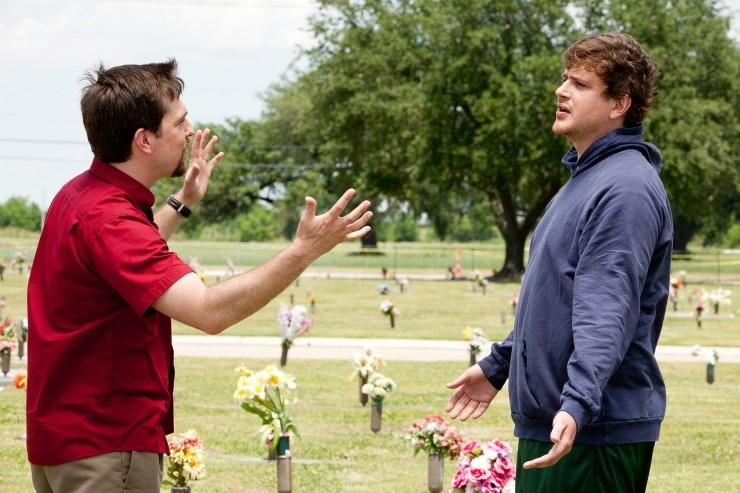
Jeff is looking for a mission, but he seems to be missing the biggest sign.  He already has a mission.  His mother wants him to go to the hardware store.  In a way, his mission is even smaller than Pat's quest to save his marriage, or Sharon's midlife sorta-crisis.  In a scene at the heart of the film, Jeff and Pat stand in the cemetery where their father is buried.  The brothers have had terrible days by any standard.  Pat has crashed the new Porsche that he can't afford; Jeff has been beaten up and mugged.  Both recall dreams in which their dad asks, "What is the greatest day in the history of the world?"  Pat sees this as evidence of a forgotten, shared memory.  Jeff sees synchronicity.  Mysterious either way, no?  They both have an opportunity here to remember the Invisible Father's message: today is the greatest day in the history of the world.

On this greatest of days, Jeff, who lives at home, will haul his ass out of the house, inadvertently heal his family relationships, and more.  But what of the wood glue?  Whether you can—or even want to—read the Signs or not, the Signs don't get any gluing done, no matter how high you are.  The gentle joke of the title itself is that we do, indeed, all live at home.  It's just that sometimes it takes a Jeff to recognize that.  Do not wonder where your place is in the universe.  You are in it right now.

Chris Stangl lives, writes, paints, draws comics, and drinks coffee in Los Angeles. Besides designing the Press Play logo, he has done sundry artwork for Meltdown Comics, The Steve Allen Theater, the Upright Citizen's Brigade Theatre, musician Old Man Charlie, and illustrated the humor book The Explosexuawesome Career Guide. He blogs on film and television at The Exploding Kinetoscope. Like all native Californians, he comes from Iowa.

The Androgyny of Artists: An Interview with Mary Harron

The Androgyny of Artists: An Interview with Mary Harron

null

In the short span of four feature films, director Mary Harron has created an intense body of work, in which deeply conflicted characters work through identity crises. Harron’s most famous protagonist is probably the psychotic Patrick Bateman in American Psycho (2000). But just like Patrick, both Valerie Solanas in I Shot Andy Warhol (1996) and Bettie Page in The Notorious Bettie Page (2005), Harron's two other films, find themselves trying to strike poses that don’t quite fit them.

So goes Harron’s new movie, The Moth Diaries (2011), a vampire melodrama set at an all-girls' boarding school. Rebecca (Sarah Bolger), a young but lonely adolescent, unconsciously reshapes her life as a gothic novel. This makes Ernessa (Lily Cole), a pale and mysterious new girl, Dracula to Rebecca’s Mina Harker. I talked with Harron via email last week about the effect of conflating ourselves with our public personas.

Many of your movies revolve around the disparity between modes of representation (journals, plays and pornography) and the essence of what they're portraying. Having been an arts critic, I'm curious how you feel the gothic novel has grown, and how that's reflected in The Moth Diaries' use of the gothic novel as a false source of comfort for our heroine. Her narrative is, after all, phrased as a dysfunctional gothic novel (as Ernessa says at the end, nothing can save Rebecca, not even the gothic novel narrative she's created for herself).

Mary Harron (MH): I can't really speak to the present day gothic novel, because I haven't read many of them.  When I was working on The Moth Diaries, I did read a lot of the classic gothic, Bram Stoker, and Sheridan Le Fanu, and some later British horror like M.R. James.

In the film, when Rebecca reads Le Fanu's Carmilla, is the book giving her clues to understanding who Ernessa really is, or is it fueling her paranoia?  You have to draw your own conclusions.  However, I don't think it's true that nothing can save Rebecca.  I think she saves herself—because she's created so much havoc, she's taken away from the school. To me it's quite a hopeful ending. She's left the school (adolescence), and now she's out in the world. She's going to face her adult life, whatever that will be.

The teacher, Mr. Davies, who is conducting the class in 'literature and the supernatural,' is the 'expert' you always find in gothic literature.  The early vampire stories always have a professor or academic or doctor who comes in and explains everything, but sometimes he gives the wrong explanation, or can't see what's in front of his eyes.  I love how you can't trust the experts in those books.  Anyway Mr. Davies thinks that his discussions with Rebecca are about Gothic literature, about metaphor, and she thinks they are about something absolutely real.  Just as when she comes to talk to him about Lucy, he thinks they're talking about anorexia but she's trying to tell him about a vampire.  Neither one is listening to the other.

I also find it striking that almost all of your feature films contain characters that are just as much victims as they are active creators of their own self-images, which often come across as schizoid personas. Bettie Page is a good girl that can't stop herself from being bad. Patrick Bateman can barely hide his blood thirst beneath a sheen of yuppy respectability. Valerie Solanas grew to resent that her pointedly vulgar and revolutionary rhetoric was misunderstood. And now The Moth Diaries' Rebecca is a victim of the traditional gothic story she's created for herself. Is it necessarily perilous for someone to reinvent themselves?

MH: Oh no, it can be very good to reinvent yourself. Bettie Page got a lot out of her reinvention of herself, until the censors came down hard on her.  And so did Valerie, until madness took over.  I don't know that Bateman actually re-invented himself —  he's more of a monster hiding behind a mask.  I have to say that I don't really see Rebecca as a victim, because in the end she goes down into the basement, she faces her fears — and she gets herself thrown out of that school, which is a good thing!

Speaking of being image-conscious, you directed an episode of Fear Itself recently. I imagine this is because of American Psycho, so I have to ask: do you feel like you've been pigeonholed as a horror filmmaker?

MH: I'm kind of flattered when that happens, because I don't consider myself a real horror filmmaker.  It always seemed funny to me that American Psycho was in the horror section of video stores. It's more like a satire with horror elements.  It's ironic, because when I try to get television work in comedy I'm told that people think I can't do comedy! But my first three films have a lot of comedy in them, I think. Not Moth Diaries, that's more teen melodrama.  

I just read Midnight Movies and saw that there's a note about your portrayal of Solanas in there. Having been a critic, I wonder how much you pay attention to criticism of your films and whether or not you're concerned with the way your films seem to be rather literally critiqued for not being period-specific or exaggerating details to elicit a specific effect.

MH: Hmm, I haven't read Midnight Movies.  Because I was a critic, I probably take reviews more seriously than other filmmakers. However, there is just so much to read now, with all the blogs and all the comments added in, it can become overwhelming and destructive. Maybe it's better to wait five years, until the dust has settled, and then read your reviews!

My first movie was very well received, but American Psycho and The Notorious Bettie Page both got mixed reviews and were understood better a few years after release. That makes me question the immediate reaction. Also, when I was a critic I sometimes gave bad reviews to things that I later found I liked.

Tell me about the way you film the past in your films' flashbacks: it seems your representations of past events is reliant on an understanding of nostalgia as being associated with dated technology, as in the flashbacks in The Notorious Bettie PageI Shot Andy Warhol and now the black-and-white flashbacks in The Moth Diaries.

MH: I think that comes from all my early experience in documentary film.   I was a researcher in British television and worked on a lot of biographies of artists, which involved looking at loads of archive film in many different formats—black and white, color, 35mm, 16mm, super 8, video.  I think that's where I get my love of mixing different film stocks and formats together, and using them to evoke a particular era.

Do you think representations of LGBT characters in films have changed since you made I Shot Andy Warhol? I know you directed an episode of The L Word, and the notion of having an uncomfortable sororal bond is in both The Notorious Bettie Page and The Moth Diaries.

MH: Yes, LGBT representations have changed hugely in the last fifteen years.  Being transgender wasn't even part of a mainstream discussion.  The 'sororal' bonds in The Moth Diaries are quite complicated. Teenage girls pour all their emotion into their female friendships, which are very intense and quite romantic.  They fantasize about boys, and have relationships with them, but their strongest bond is with their friend. Those intense girls friendships can be very beautiful, and also very destructive when they go wrong. The relationship between Lucy and Ernessa goes farther than that romantic/platonic girl friendship, though… 

I'm particularly struck by the contrast of strong femininity projected both by Page and by Solanas: the dominatrix and the man-hater. Given that Bateman is the most macho man in your movies and is a psychopath for it, it stands to reason that the independent women in your films are marginalized or still finding their voices. But I'm also reminded of how Solanas is asked what she will do for money and how she can get by without money. Trying to be revolutionary or even just different seems to mean you have to be misunderstood. By contrast, Bateman is misunderstood but accepted because he's a paragon of caricatured manliness, no?  

MH: Well, as Bateman says, he's just trying to fit in! He's so insecure, and so obsessed with getting all the surface details right, that no one notices what's going on underneath.

Then again, one of the things that struck me about I Shot Andy Warhol is how Solanas comes to irrationally despise these two effete men of power, Andy Warhol and Maurice Girodias. Androgyny, in both that film and in The Moth Diaries, specifically with Ernessa, seems to be an indicator of a conflicted kind of enlightenment. Is woman the future of man?

MH: It's sad, because Valerie turned her aggression on the only people who encouraged her, Warhol and Girodias. They had their failings but they weren't the enemy as she laid it out in the SCUM manifesto.  Gay men like Warhol were supposed to be women's allies.  I don't know if woman is the future of man, but I do think artists tend to be androgynous, in sensibility at least…

Who are the filmmakers and storytellers that you feel influence and inspire you the most?

MH: Polanski, Hitchcock, Kubrick, Bunuel.  Also I love Howard Hawks, in all his different genres,  and thirties comedy for its wonderful lack of sentimentality and its brilliant pacing.  I love David Cronenberg and David Lynch, and admire the careers they have, in which they never stopped making interesting films. Gus Van Sant was another inspiration for me. Drugstore Cowboy caused a big revelation, that you could actually make a movie like that.

What are you working on next?

MH: I'm attached to a film called Wicked/Lovely that is based on a young adult novel.  It has a lot of visual effects and is expensive, so the producers are still working on putting the money together. Then I have a couple of other projects I'm working on, but it's too early to talk about those!  

Simon Abrams is a New York-based freelance arts critic. His film reviews and features have been featured in The Village Voice, Time Out New York, Slant Magazine, the L Magazine, the New York Press and Time Out Chicago. He currently writes TV criticism for The Onion AV Club and is a contributing writer at the Comics Journal. His writings on film are collected at the blog, Extended Cut.

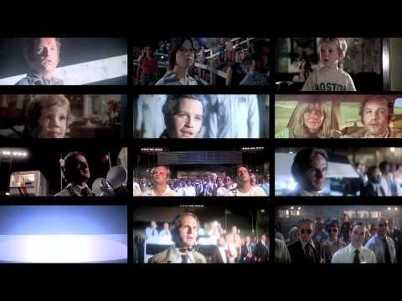
VIDEO – Motion Studies #25: A.I.: A Visual Study

VIDEO – Motion Studies #25: A.I.: A Visual Study

From now through April, the Oberhausen International Short Film Festival will present "Film Studies in Motion", a Web Series curated by Volker Pantenburg and Kevin B. Lee. This series, available on the festival's website and Facebook page, presents weekly selections of analytical video essays on the web, in preparation for Pantenberg and Lee's presentation  "Whatever happened to Bildungsauftrag? – Teaching cinema on TV and the Web", scheduled for April 28 at the festival.

Week Five: Auteur Studies

As auteur theory remains a central component of film studies, the medium of online video generates new perspectives and approaches to understanding the director’s vision and process. One remarkable aspect that can be found in this selection of videos is the extent to which the format allows the video creators to personalize their appreciation of a director’s work. These videos convey the creator’s individualized perspective through their narration or editing techniques, as well as the act of appearing on screen, even as they consciously incorporate or mimic the style of the director. This interplay between the creator and their subject gives video auteur studies a unique quality of its own.

Today's selection:

A.I.: A Visual Study
Ben Sampson (2009)

The first part of Benjamin Sampson's video essay which he edited in 2009 while studying cinema and media studies at UCLA. Read his introduction and watch part two.

View all Motion Studies video selections.

Volker Pantenburg is assistant professor for moving images at the media faculty of the Bauhaus-Universität Weimar. 

Kevin B. Lee is Editor in Chief of IndieWire’s PressPlay Video Blog and contributor to Roger Ebert.com. Follow him on Twitter.

A Top Ten Dilemma: Previewing the Sight and Sound Greatest Films Poll, Part II

A Top Ten Dilemma: Previewing the Sight and Sound Greatest Films Poll, Part II

nullEDITOR'S NOTE: This summer Sight and Sound, the magazine of the British Film Institute, will issue the seventh edition of their international poll of critics and directors on the greatest films of all time. While there have been plenty of lists and polls of this kind conducted over the years by innumerable publications, websites and other outlets, the Sight and Sound poll occupies a special place among them. It polls a select number of participants that rank among the most respected authorities on film (the 2002 edition polled 145 critics and 108 directors). To my knowledge it is the longest-running poll of its kind, having first been conducted in 1952, and conducted only once every ten years.

To discuss the poll, its history and relevance to film culture, and possibly indulge in a bit of prognosticating, I’ve organized an online discussion with David Jenkins, UK-based film critic for the website Little White Lies, Vadim Rizov, US-based film critic for Sight and Sound and other publications, and Bill Georgaris, Australian-based creator of the website They Shoot Pictures, Don’t They and keeper of the massive list of 1000 greatest films, compiled from over 2100 such lists, including each edition of the Sight and Sound poll. (His list was what inspired me to start my own blog Shooting Down Pictures, in which I watched and researched all 1000 films on the list, a project that did as much towards expanding my film knowledge as anything I’ve done.) – KBL

Read Part One: NOT Simply the Best 

Read Part Three: Predictions You Can't Refuse

DAVID JENKINS: In terms of what the list means to me, I entirely concur with the notion that it operates best as a tool to help prospective cinephiles broaden their horizons. Like a giant cinema tip sheet, or something? That has certainly been my experience with it. The 2002 poll probably remains the most important one to me – possibly a result of it being so easy/fun/addictive to navigate online? – and while never rigidly committing to watch all the films selected or every title in the top 100, I did (and still do!) carry around a dog-eared slip of paper in my wallet with scrawled lists of prospective purchases and films to look out for in the schedules.

For the 2012 poll, I'm most excited to see how the era of DVD and film downloads has an effect on the results. It's hard to predict whether easy access to famously obscure titles (eg, Jacques Rivette's long-lost Out 1 recently surfaced on Italian television(!) and came out on German DVD) would serve in calcifying the status of the untouchable classics of yore, or force poll participants into adopting a broader view of film history based on the diversity of their viewing.

nullAnd on that note, would celebrated revivals and restorations serve to nudge under-loved films into the limelight? Will 2012 be the year of Charles Burnett's Killer of Sheep? Will the new, extended cut of Fritz Lang's Metropolis make it more of a contender than it has been in past polls?

In attempting to formulate my personal top ten, various issues have inevitably arisen regarding what makes a "great film" just that. The Sight & Sound brief leaves the term "greatest" tantalisingly open to interpretation, leaving each participant to choose what kind of statement they want to make with their own list. Here are some questions that I wrestled with while trying in vain to whittle down my own choices:

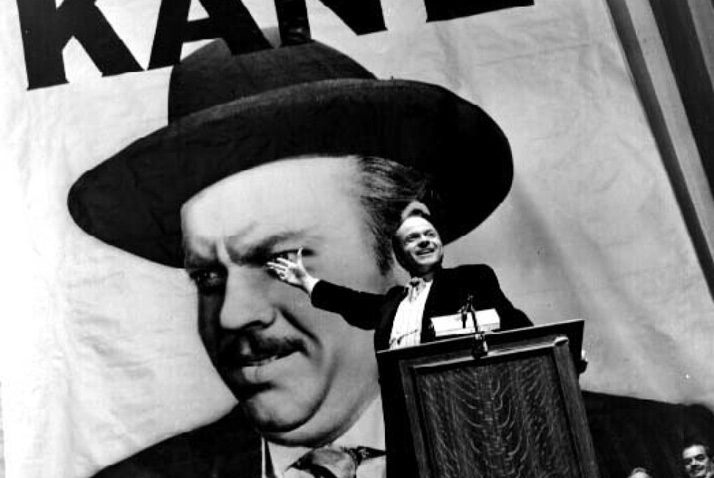
1. How much do you want your list to be a reaction to past polls as well as to the notion of an established canon? Or, put another way, how much do you feel Citizen Kane deserves another poll victory?

2. What preparation is required prior to formulating your list? Will you re-watch your proposed top ten before filing? What supplementary books, lists, websites will you use for reference?

3. Is there an unofficial period of maturation required for a film to be eligible for selection? In the 2002 list, Robin Wood noted that it was “too soon to be sure” whether Haneke's The Piano Teacher would be worthy for inclusion. Should, say, at least ten years have passed before a film can attain classic status?

4. Should every list acknowledge the importance of certain areas of cinema (historical, geographic, gender of director, sound, silent, etc…)? Should each participant be obliged to include at least one silent film or a film by a female director? Or if your specialist field of knowledge is African film or American film, is it OK to remain within your comfort zone and select the films which best represent your interests?

5. Should you create a list in terms of directors rather than films? And if so, is there a need to rally around a consensus title so that your favorite director gets a high ranking? Is it worth playing the long game? Eg, selecting 'Tokyo Story' over a lesser-known Ozu to represent the director's entire oeuvre knowing that you'd probably be boosting the film's overall rankings even if you din't see it as the director's most representative work. Or, should one always attempt to justify a personal favourite, whatever its current status? This question would probably be where the proliferation of home video and downloads rears its head.

6. Should subjective favourites always trump objective, universally recognized canonical titles? The big one.

Now Vadim is going to tackle some of these questions…

VADIM RIZOV: David asks: "How much do you want your list to be a reaction to past polls as well as to the notion of an established canon?"

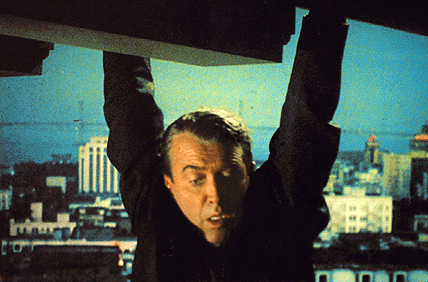
nullI have no plans to put Citizen Kane on my top 10 list; I watch it every 5 years or so and try to come around, but it's still not working out. (Welles was right: The Trial really is his best film. Anyway.) I'm also not planning for the only film I think has a reasonable chance of replacing it (Vertigo), so from the outset my interest in contributing to any kind of top 10 surge or shift is minimal. (Should I feel guilty about these relatively underwhelmed responses? I'll let the internet tell me!)

Let me skip to David's question on representation, which truly troubles me. I have a lot of trouble with the idea of a meaningful top 10 list stating what I truly believe to be the all-time greats, even subjectively. My goal is to select 10 films that actively represent a cross-section of my viewing patterns. No matter how hard I try, though, I'm not going to be able to come up with a list that is truly representative not just of my viewing patterns but any political values I have. There will be, I fear, no non-fiction films, no representatives of the avant-garde, and — distressingly — probably no films directed by women. (For some people, any one of those absences would be enough to prompt scorn.) Moreover, I'm straining hard to make a list that represents my time-period-indifferent viewing in aggregate. A late-night subway ride during which I tried to casually jot down the first candidates that sprung to mind was overwhelmingly slanted towards recent stunning films, many of them American. This won't do — so I'm tamping down the emphasis on my immediate recent favorites a bit. This is my modified version of Robin Wood's rule.

Let me be clear about why I feel no guilt about making a list that's more than a little self-consciously designed to be a little punchy. First of all, my eyes glaze over like anyone else's when I pass over lists of unimpeccable but standardized choices; that's what the aggregate numbers are for. But secondly: I read, every day, bold criticism in which people make categorical declarations without remotely trying to back them up, and these are considered some of the most valuable writers working now. I may not be as good as some of these writers (no names), but for some reason gauntlet-throwing is considered an acceptable mode of discourse. When it comes time to make this list, for once I'm going to indulge my urge to make categorical declarations with minimal explanation. I'm summarizing my viewing values, not trying to start a fight about Which Films Truly Matter.

BILL GEORGARIS: My perspective on the Sight & Sound poll will be from the point-of-view of a punter, because that is what I am, in film terms. That is, a long-time film lover who is subscribed to Sight & Sound, and who also, as you know, assembles (via many sources, including Sight & Sound) his own list of greatest films for the website They Shoot Pictures Don't They? I have been collecting film lists in one form or another since 1988. John Kobal's book "John Kobal Presents the Top 100 Movies" was where it all started. I love these bloody polls, although at the same time, I can see why they are often frowned upon.

nullFirstly, I'd like to comment on the process, and express my minor disappointment at the fact that S&S have decided not to increase the ballot from 10 films. It would have been nice to break with tradition and call for 20-25 films from each critic/filmmaker. The consensus at the top may have remained very much the same but the variety of films at the bottom would probably have intrigued more. That's not to say, that there won't be intriguing selections, just less than there might have been.

Alright then, in no particular order, I have a few remarks and further questions relating to the poll and to a critic's perceived responsibility when it comes to penning their selections.

Should a critic/filmmaker slave over their selections (the studied approach), or should they just jot down the first 10 great films that come to mind (the off-the-cuff approach)? I sense that most critics and scholars steer towards the studied approach, whereas filmmakers probably generate their lists more spontaneously. This has been my perception with the previous polls.

I enjoy seeing the filmmaker selections as much, and in many cases, more than the critics' selections, but I am sceptical as to the time and effort that goes into their selections. I acknowledge that I am generalising here. It would be fair to suggest that most filmmakers spend far more time planning and making their own films, than watching films by others (past and present). For example, I heard an interview with Werner Herzog a few weeks back where he stated he has only watched a handful of films over the last few years. There are some obvious exceptions, the most famous being Martin Scorsese, whose appetite and care for film history is seemingly as insatiable as that of the most dedicated film critics and scholars. Maybe Marty could have a double-vote?

Generally-speaking, I agree with Robin Wood's 'test-of-time' rule. I, personally, wouldn't select a film from the past 10 years, but at the same time critics/filmmakers should go with their gut feeling. If they honestly believe that a film from this year or last year is worthy to be in their top 10, then so be it. Just do it.

The selection dilemmas, as Vadim touched on, when limited to just ten films are immense. Does the voter restrict themselves to 1 film per director, 1 film per decade, a maximum of two comedies, not too many American films, a handful of Asian films, etc, etc. And, gosh, how do I squeeze in my favourite film noir? This is the quandary that you will all possibly be having. How can ten films possibly represent the overall taste of a critic/filmmaker? And, does it matter? Probably not.

In terms of trends over the last 10 years, I envisage that the 2012 poll, more than any other, will include more selections that have been viewed in the comfort of the voters' own homes, than in a film theatre. The increase in availability of hard-to-find films from all parts of the globe over the last ten years has been breathtaking. Criterion and others have enabled us to explore films and filmmakers that were previously tough to track down. Also, the Blu-Ray revolution has given us the opportunity to watch films at their best, something we weren't able to do in the past. Seeing a classic film in Blu-Ray could see it shoot up into contention for your top-10. If I had a penny for every Blu-Ray that has made me reassess the overall quality of a film, then I would be…

Also, let's not forget the advances in television technology over the last 10 years that has made viewing films in a domestic environment a far more rewarding experience. I'm not 100% sure where I'm going with this, but I guess what I am alluding to is the fact that viewing habits since the last poll have changed markedly, and hence, may influence choices.

Continue to Part Three: Predictions You Can't Refuse

Read Part One: NOT Simply the Best 

VIDEO: Take the “COLOR REEL” film quiz with Evan Seitz

VIDEO: Take the “COLOR REEL” quiz with Evan Seitz

Editor's Note: We at Press Play had never seen animator Evan Seitz's remarkable work up until today. Our first encounter with his kaleidoscopic visions came when our publisher Matt Zoller Seitz (no relation) sent out an e-mail blast to everyone stating unequivocally that "we should post this immediately." In the most elegant way possible Evan Seitz blends known cinema soundtracks — some of the most famous sounds in all of history —with colorful, animated likenesses from those same films, all of them interpreted through the prism of his imagination. Make no mistake about it. This is a quiz worth engaging and admiring. If you would like to pour over Mr. Seitz's other work, go here.  — Ken Cancelosi

Not Simply the Best: Previewing the Sight and Sound Greatest Films Poll, Part I

Not Simply the Best: Previewing the Sight and Sound Greatest Films Poll, Part I

nullEDITOR'S NOTE: This summer Sight and Sound, the magazine of the British Film Institute, will issue the seventh edition of their international poll of critics and directors on the greatest films of all time. While there have been plenty of lists and polls of this kind conducted over the years by innumerable publications, websites and other outlets, the Sight and Sound poll occupies a special place among them. It polls a select number of participants that rank among the most respected authorities on film (the 2002 edition polled 145 critics and 108 directors). To my knowledge it is the longest-running poll of its kind, having first been conducted in 1952, and conducted only once every ten years.

To discuss the poll, its history and relevance to film culture, and possibly indulge in a bit of prognosticating, I’ve organized an online discussion with David Jenkins, UK-based film critic for the website Little White Lies, Vadim Rizov, US-based film critic for Sight and Sound and other publications, and Bill Georgaris, Australian-based creator of the website They Shoot Pictures, Don’t They and keeper of the massive list of 1000 greatest films, compiled from over 2100 such lists, including each edition of the Sight and Sound poll. (His list was what inspired me to start my own blog Shooting Down Pictures, in which I watched and researched all 1000 films on the list, a project that did as much towards expanding my film knowledge as anything I’ve done.) This is the first in a series of posts on the poll, and examines the poll's significance; part two looks more closely at how critics create their top ten lists. – KBL

Read Part Two: A Top Ten Dilemma

Read Part Three: Predictions You Can't Refuse

KEVIN B. LEE: Speaking personally, the Sight and Sound poll played a seminal role in my movie love. I first learned of it in the 1980s as a teenager when Roger Ebert shared his top ten list for the 1982 edition of the poll in his Movie Home Companion, composing one eloquent paragraph for each film. To read a critic at the top of his craft write about the films he loved the most really imprinted a deep regard for film and film writing in me. Films both from the ’82 poll results (Citizen Kane, Seven Samurai, Vertigo) and Ebert’s list (Taxi Driver, The Third Man) occupied my personal top ten for years to follow. Ebert's respect for the poll hasn't abated: just the other week he blogged about it as "The best damn film list of them all" and surmised which titles will make his ballot for this year's edition.

nullAnother critic I admire, Jonathan Rosenbaum gives his personal account of the list’s influence in Essential Cinema: on the Necessity of Film Canons. Rosenbaum recalls how, as a college freshman, he encountered the 1962 edition of the list in Sight and Sound Magazine on the heels of writing a paper for his NYU film class arguing for the greatness of Citizen Kane, a film his professor dismissed as “uncinematic” (according to Rosenbaum, this was a prevailing assessment of Welles’ film at the time). For Rosenbaum, the S&S list affirmed his own values in regard to Citizen Kane, and pointed towards discoveries beyond what the ideological confines of his film class could offer:

Citizen Kane, I was happy to discover, placed first, and I was astonished to discover in second place L’avventura – a film by Michelangelo Antonioni that preceded La notte and that I had only just discovered and was still trying to process… I vowed to see as many films on the list as I could, and for the next several years proceeded like a butterfly collector, dutifully underlining each title in that issue of Sight and Sound as soon as I’d seen the film… Some critical favorites on the list proved to be disappointments, others were greater than I had even hoped for, but in both cases these responses represented not so much end points as the beginnings of evaluations and reevaluations that would continue over decades and that are still taking place.”

These examples should suffice in accounting for the impact the Sight and Sound list can potentially have on a young person interested in cinema. Rosenbaum links the list’s relevance to an underlying need for a canon that people can explore to develop their appreciation of film. The necessity of a film canon (as well as the complications and considerations that arise from this assertion) is something I’ve discussed with him following the release of Essential Cinema in 2004 and that he goes to some length in examining in the book. One point worth noting from our exchange is his expressed disappointment with the most recent edition of the list from 2002:

“Sight and Sound knew how to get a representative sample of international critical thought in the 50s, 60s, and 70s; more recently, I think the same magazine has shown a less certain grasp of what’s going on in criticism.”

The statement hints at the politics of canon formation: how the quality of the list of films depends on those involved in selecting them. When he wrote this back in 2004, I wasn’t as aware as I am now of the vast totality of contemporary film criticism as it exists around the globe. I still can’t confidently declare my familiarity with it all; who really can? There's been such an explosion of worthwhile criticism over the past decade thanks to the internet and blog culture. If it was challenging enough for Sight and Sound to assemble an authoritative critical mass for their poll back in 2002, one can only imagine the Quixotic dimensions of such an endeavor now. The internet, web 2.0 and social media have marked a radically new era in film culture, specifically in the proliferation and dissemination of reviews, opinions and theories on cinema. It will be fascinating to see how all of this will register shifts in the new poll (both in its participants and results), or to what extent it will echo the status quo and stagnation characterized by the 2002 poll results.

nullIndeed, the 2002 results were a letdown, at least for me. I had seen nearly every film in the top 100, so it had little in the way of discoveries or surprises, other than how unsurprising it was. For that reason my relationship to the list changed; I no longer took the perspective of list consumer but that of a curator, looking for ways to make the list more meaningful.

My chief complaint is its overwhelming orientation towards films from the US and Europe and lack of recognition of films from the remaining 80% of the world. If this list was meant to be a canonical introduction to cinema, its cultural disposition was alarming to say the least. Given the thriving international festival and archival culture that’s emerged in the last 20 years, it’s not like there’s a lack of worthy films from Latin America, Africa and Asia to consider; more likely there’s a lack of awareness of them. This was when I began to realize the self-perpetuating mythical importance of lists like these: they entrench certain films, and all the aesthetic and cultural baggage that come with them, at the expense of granting access to new films with new values and perspectives. I think a shakeup is in order.

Scholar Kristin Thompson says as much in a recent blog post where she diagnosed the problem with the Sight and Sound list and canonical cinema in general: “With so many smaller countries starting to make movies and so many festivals making them widely available, it becomes impossible to anoint new classics in the way critics used to.” One possible solution might be to expand the top ten list to a top twenty, allowing for critics to account for more diversity in their selections. But who’s to say to what extent that would alter the consensus choices at the top.

Thompson offers an intriguing alternative to the Sight and Sound poll as it is currently conducted:

“I think this business of polls and lists for the greatest films of all times would be much more interesting if each film could only appear once. Having gained the honor of being on the list, each title could be retired, and a whole new set concocted ten years later. The point of such lists, if there is one, is presumably to introduce people who are interested in good films to new ones they may not have seen or even known about.”

Out of curiosity, I decided to simulate Thompson’s proposal by running through all the previous Sight and Sound film polls and “retiring” any film that had already placed in the previous edition, thus ensuring a fresh set of films each time. The results are below, and can be compared with the actual historical results as found on Thompson’s blog and on Wikipedia. (Many thanks to Bill Georgaris for supplying the data.)

As obsessed as I’ve been with lists for most of my life, the Shooting Down Pictures project convinced me that the world of great cinema is far too vast and multifaceted for a single list to do it justice. (These days I’m less interested in a list of great films than a list of ways to watch and think about films.) But young prospective filmmakers and cinephiles will continue to embrace these lists as a guide to their viewing and development. Therein lies the importance of this poll and what's on it.

Sight and Sound has its work cut out for it. Judging from past poll results, it seems that for the last 40 years canonical film culture has largely been stuck in the 50s and 60s, and overwhelmingly in Hollywood and Europe. Can and will this hegemony be altered? And if so, what will it take?

I hand the discussion over to David, Vadim and Bill who may have their own take on these and other questions. I know David has several questions that he feels every participant in the poll should ask themselves…

CONTINUE TO PART TWO: How the Sausage Is Made

READ PART THREE: Predictions You Can't Refuse

An alternative history of the Sight and Sound Poll (a "Hall of Fame" approach)

Following Kristin Thompson's suggestion, I ran through the results of each edition of the Sight and Sound Greatest Films poll, “retiring” any film that had already placed in the previous edition, thus ensuring a fresh set of top-voted films each time. How surprising are the results? See for yourself.

(Note some years have more than 10 entries in the event of ties)

1952 (same as actual results)
nullBicycle Thieves (1948, De Sica)
City Lights (1930, Chaplin)
The Gold Rush (1925, Chaplin)
Battleship Potemkin (1925, Eisenstein)
Intolerance (1916, Griffith)
Louisiana Story (1949, Flaherty)
Greed (1925, Stroheim)
Le Jour se leve (1939, Carne)
The Passion of Joan of Arc (1928, Dreyer)
Brief Encounter (1946, Lean)
La Regle du jeu (1939, Renoir)

1962
Citizen Kane (1941, Welles)
L’avventura (1960, Antonioni)
Ugetsu Monogatari (1953, Mizoguchi)
Ivan the Terrible, Parts I and II (1944, 1958, Eisenstein)
La terra trema (1948, Visconti)
L’Atalante (1934, Vigo)
Earth / Zemlya (1930, Dovzhenko)
Hiroshima Mon Amour (1959, Resnais)
Sunrise (1927, Murnau)
Zero for Conduct (1930, Vigo)
Pickpocket (1959, Bresson)
Nazarin (1959, Bunuel)

1972
8 ½ (1963, Fellini)
Persona (1967, Bergman)
The General (1927, Keaton and Bruckman)
The Magnificent Ambersons (1942, Welles)
Wild Strawberries (1957, Bergman)
Vertigo (1958, Hitchcock)
Pierrot le fou (1965, Godard)
La Grande Illusion (1937, Renoir)
Ikiru (1952, Kurosawa)
The Searchers (1956, Ford)

1982
nullSingin’ in the Rain (1952, Donen and Kelly)
2001: A Space Odyssey (1968, Kubrick)
Andrei Rublev (1969, Tarkovsky)
Jules et Jim (1961, Truffaut)
The Third Man (1949, Reed)
Tokyo Story (1953, Ozu)
Touch of Evil (1958, Welles)
Les Enfants du paradis (1943, Carne)
Modern Times (1936, Chaplin)
Madame de… (1953, Ophuls)
Contempt (1963, Godard)
The Discreet Charm of the Bourgeoisie (1972, Bunuel)

1992*
Raging Bull (1980, Scorsese)
The Godfather and the Godfather Part II (1972, 1974, Coppola)
Pather Panchali (1955, Ray)
La Strada (1956, Fellini)
La Dolce vita (1961, Fellini)
Rashomon (1950, Kurosawa)
Breathless (1960, Godard)
Letter from an Unknown Woman (1948, Ophuls)
Apocalypse Now (1979, Coppola)
Paisan (1945, Rossellini)
The Mirror (1976, Tarkovsky)
Fanny and Alexander (1982, Bergman)

2002*
Lawrence of Arabia (1962, Lean)
Dr. Strangelove or: How I Learned to Stop Worrying and Love the Bomb (1964, Kubrick)
Psycho (1960, Hitchcock)
Sunset Blvd. (1950, Wilder)
Some Like It Hot (1959, Wilder)
The Seventh Seal (1957, Bergman)
Au hazard Balthazar (1966, Bresson)
Taxi Driver (1976, Scorsese)
The Apartment (1960, Wilder)
Casablanca (1943, Curtiz)
Chinatown (1974, Polanski)

Some initial observations on this approach (which somewhat resembles a Hall of Fame induction process):

– *The ’92 and ’02 polls incorporate votes by directors – wasn’t able to separate the two with the data set I had.
– While in 1972 nearly half of the list consisted of new titles, in 1982 there was only one, and none in 1992 and 2002.
– The cinema of the 50s and 60s dominate as much here as they do in the official poll. I had assumed that this approach would surface more newer films, but looking at the last three editions, 50s and 60s films outnumber films from subsequent decades by a 3-to-1 ratio. While the results of this exercise still aren’t fully satisfying, at least they put different films in play and offer a list that’s continually expanding rather than stagnating. (One critic who is participating in the poll for the fourth time told me that he is using a similar approach, and will not include any films he selected in his previous ballots.)

10/40/70: KAIRO (PULSE)

10/40/70: KAIRO (PULSE)

Context:

Kiyoshi Kurosawa (no relation to Akira Kurosawa) is perhaps best known for Bright Future (2003) and Tokyo Sonata (2008) and although these films bear his visual watermarks—very long takes, slow tracking shots, naturalistic settings, frame compositions that often leave large, impersonal spaces between characters—it is on his metaphysical detective/ghost films that his reputation rests. The most distinctive of these are Cure (1997), Charisma (1999), Pulse, and Doppelganger (2003), all of which, with the exception of Pulse, feature the remarkable, Peter Falk-like Kôji Yakusho as the lead actor. The pacing of these films produces an oddly perverse effect: the slower they are (and they are slow) the more anxiety they produce, as if the executioner’s bullet fired at the prisoner against the wall took two terrible hours to reach her.

Pulse begins with a man and a woman alone on an enormous ship on a dark sea. It becomes clear that they are survivors of some sort of massive, perhaps global, catastrophe. We flash back to Tokyo and the events that lead up to the epidemic of suicides, events that are presented elliptically and without the usual narrative exposition that we expect in apocalyptic films. Details emerge, but they are sketchy and difficult to piece together: it seems that some sort of ghostly presence haunts the Web, a sort of virus that causes people simply kill themselves when exposed to it. The protagonists address this obliquely, through philosophical conversations that center on topics such as loneliness, the possibility of love, and whether we become ghosts in the afterlife. The ending of the movie loops back to the beginning, on the ship.

null

10 minutes:

Michi and Junko are at work at a Tokyo plant wholesaler, still in shock over the death of their friend Taguchi, who recently hung himself. That bare sentence doesn’t convey the cold horror of the scene, for it’s not just that Taguchi hangs himself, but that he does so in a completely unexpected and casual way, moments after the most typical banter imaginable with Michi, who asks him where a disc is, as he casually takes a phone cord out of a box of junk on the floor. When Michi goes over to his desk for the disk, he steps into another room with the cord and hangs himself, off camera. He may have well just stepped into the next room to put some bread in a toaster.

And now, at the 10-minute mark, Michi and her friend find themselves, on the roof of the plant company, surrounded by green, by life. This shot comes during one of the many long takes characterizing Kurosawa’s style, takes in which the sparse but soul-killing violence in his films come at us from the edges and margins of the frame. For all the formal, rigorous, distancing strategy of the film—also evident in Cure and Charisma—there is a healthy dose of quiet and sly humor, as in the fact that these women who work with dirt and plants and water also happen to dress like this. This visual contradiction—a naturalistic, washed-out setting featuring characters whose dress seems out of place—is just one example of how Kurosawa slightly de-familiarizes commonplace settings, rendering them just off-kilter enough to make us uneasy.

null

40 minutes:

Michi, concerned about friend and co-worker Yabe (who has seen what’s on the disk that Taguchi was working on and will also kill himself soon), asks her boss if she can go check on him. This is just one of many shots where characters are framed and reframed on the screen, their bodies appearing behind or in front of a proliferation of rectangles—in this case indicated by the fence frame Michi stands before and the Mondrian-like structure in front of her boss–which only reinforce the film’s relentlessly deterministic sense of alienation. For no matter how these characters try to cope with whatever it is that’s causing the growing plague of suicides, they remain trapped, both individually and collectively, by certain patterns of thinking. Kurosawa uses the mystery/detective genre as a trope to suggest that the criminal is not an individual, or even a human being, but rather a force that is an expression of the collective unconscious of an entire society.

Frame details:

1. The plants, in their sad plastic pots and buckets, straining toward the dim sun.

2. The green water hose the boss is about to wrap into a coil.

3. And also: the fleeting thought that the boss might hang himself with that hose, as Taguchi did with the phone cord.

4. The barbed wire fence, like a cage.

5. Michi’s gaze, as if she has realized something, perhaps the dark knowledge that those plants, incapable of suicide, will outlast her and all the other humans.

In the context of the entire film, this frame from minute 40 constitutes a form of visual terror. Because violence in Pulse, more often than not, occurs unexpectedly and without visual or musical cues, the audience is conditioned to expect it at any moment. Although there’s not real tension between Michi and her boss at this moment, we ourselves bring tension to the scene, noticing for instance, the grip of the boss’s hands on the hose, and the gloves he wears, and the way that the slight tilt of his body and his hat obscure his expression, and the way that Michi keeps her distance from him. The coiling of the hose and the possible uncoiling of his violence. These are possibilities the frame permits.

null

70 minutes:

In an interview regarding Pulse, Kurosawa has said:

Ultimately, the Other—anyone who is not us—remains incomprehensible no matter how much we try to communicate. And we should try to communicate with the Other. This concept is valid because we are surrounded by the Other: the incomprehensible humans and incomprehensible actions human beings take.

Ryosuke (wearing a tee-shirt from Gilley’s bar in Texas, where Urban Cowboy [1980] was filmed) and Harue, university students, are becoming aware that the suicides are not isolated, but something that threatens to wipe out all humankind. The space inside the frame is itself disorienting, as there appears to be a mirror behind the bookshelves to the right of the gray chair. A white curtain hangs on the wall, obscuring what? Ryosuke’s posture is defeated. Harue refuses to look at him.

The frame is from one of many scenes in Pulse where the narrative comes to a nearly complete stop, offering us a chance to experience the reality of what’s happening in much the same way as the characters experience it. What they—and we—gradually come to understand is that, as Kurosawa suggests, the monstrous Other is not outside, but inside. Ryosuke, Harue, and the other characters carry it within themselves. As do we.

Nicholas Rombes can be found here. For more entries from the 10/40/70 series, check here.

VIDEO – Motion Studies #24: The Spielberg Face

VIDEO – Motion Studies #24: The Spielberg Face

From now through April, the Oberhausen International Short Film Festival will present "Film Studies in Motion", a Web Series curated by Volker Pantenburg and Kevin B. Lee. This series, available on the festival's website and Facebook page, presents weekly selections of analytical video essays on the web, in preparation for Pantenberg and Lee's presentation  "Whatever happened to Bildungsauftrag? – Teaching cinema on TV and the Web", scheduled for April 28 at the festival.

Week Five: Auteur Studies

As auteur theory remains a central component of film studies, the medium of online video generates new perspectives and approaches to understanding the director’s vision and process. One remarkable aspect that can be found in this selection of videos is the extent to which the format allows the video creators to personalize their appreciation of a director’s work. These videos convey the creator’s individualized perspective through their narration or editing techniques, as well as the act of appearing on screen, even as they consciously incorporate or mimic the style of the director. This interplay between the creator and their subject gives video auteur studies a unique quality of its own.

Today's selection:

The Spielberg Face
Kevin B. Lee (2011)

Read a French translation of this video by Rachid Oudad.

View all Motion Studies video selections.

Volker Pantenburg is assistant professor for moving images at the media faculty of the Bauhaus-Universität Weimar. 

Kevin B. Lee is Editor in Chief of IndieWire’s PressPlay Video Blog and contributor to Roger Ebert.com. Follow him on Twitter.

TRAILER MIX: LOOPER

TRAILER MIX: LOOPER

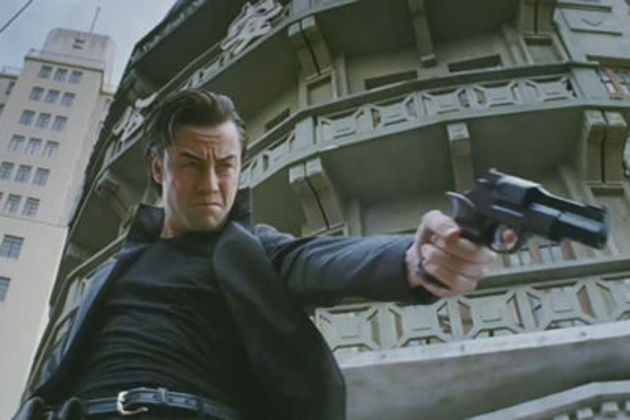
Sometimes a trailer's ability to sell a novel concept can make you forget its otherwise ordinary construction. Such is the case with the trailer for Rian Johnson's Looper, a clip whose pervasive stylish “whoa” factor offsets the reality that, formally, it's all quite familiar. A time-travel actioner, Looper reunites Johnson with Joseph Gordon-Levitt, star of the writer-director's breakthrough cult fave, Brick.  The trailer suggests that the collaborators are steering toward the mainstream and moving away from the impenetrability of Brick's talky mystery, but an interest in noir remains firmly intact, and it yields aesthetic bonuses that also trump the requisite trailer beats.

In voiceover, Gordon-Levitt's assassin (or “Looper”) dishes the dirt about his job: whacking mob casualties from 30 years in the future, where the invention of time travel has allowed gangsters to get rid of bodies by beaming them into the past. It's occasions like these when exposition is given a major pass, and viewer hand-holding is forgiven thanks to heady plot details. Amid the rest of the film's enticing elements (the makeup effects add much to the appeal), hearing Gordon-Levitt's character explain that he's suddenly tasked to off his older self (Bruce Willis) recalls Ellen Page's wide-eyed play-by-play in Inception, which was criticized by many but enthralling nonetheless. Fascination makes explanation go down easy—this is why The Hunger Games plays so well despite an overall lack of nuance.

One might accuse Johnson of taking a page from Christopher Nolan's book if not for the noir-ish blood coursing through this comparatively modest director's work. From the start, this preview doesn't look like it’s touting a film that takes place in the present, but rather in a slick and smoky 1940s milieu, where men grease their hair, eat in diners, and close deals in shady, nonspecific city apartments (in Johnson's view, what is old is continuously new again, as the gangsters of “the future” are shown in Dick Tracy fedoras, and captured in grainy film stock evoking old photos). Aside from fast new cars and live nude girls that promote contempo sex appeal, there's precious little in the trailer to mark events as being in present-day. Gordon-Levitt's Anton-Chigurh-style blaster could be from decades back, and even the Loopers' payments, evidently strapped to the backs of their targets, are good, old-fashioned gold bars.

The trailer closes with a rather unremarkable montage, which is a perfect foil for its parting shot of adrenaline. Houses explode, guns go off, characters fall from great heights, and recognizable side players are given smidgeons of screen time (there's Emily Blunt wielding a shotgun as a presumable love interest, and scruffy clown Jeff Daniels warning of the obligatory quantum-leap side effects). Scored to an upbeat techno track, the nimbly-edited coda is dishearteningly generic, right down to Gordon-Levitt's final point-and-shoot hand gesture. Fortunately, by then the trailer has already cast an arresting spell.

R. Kurt Osenlund is the Managing Editor of Slant Magazine's The House Next Door, as well as a film critic & contributor for Slant, South Philly Review, Film Experience, Cineaste, Fandor, ICON, and many other publications.