The Unknown Unknowns: Just How “Ambiguous” is David Fincher’s ZODIAC?

The Unknown Unknowns: Just How “Ambiguous” is David Fincher’s ZODIAC?

Editor’s note: The following is a conversation about David Fincher's 2007 film Zodiac. It was inspired by Twitter conversation about whether it is, in fact, an ambiguous movie, as many have claimed, or if it only seems that way; if it's open, closed, or somewhere in between.

The participants are Sarah D. Bunting, publisher of TomatoNation and the true-crime blog The Blotter; Mike D’Angelo, film critic for the Las Vegas Weekly and a regular contributor to The A.V. Club, among other outlets; and Matt Zoller Seitz, TV critic of New York and co-founder of Press Play.

DARKNESS VISIBLE

Matt Zoller Seitz: Zodiac is very much an open-ended, in some ways deliberately frustrating movie. David Fincher directed the script by James Vanderbilt, which was based mainly on the writings of the film’s main character, the cartoonist turned amateur detective Robert Graysmith (Jake Gyllenhaal). One of the things that makes the movie stand out from other thrillers is how it sticks with a pretty conventional structure, and yet in the end, we don't know who did it. The frustration of knowing that we don’t know is at the heart of the film’s power.

nullSarah D. Bunting: It is and it isn't ambiguous. It's ambiguous about whodunnit, certainly, and has no choice in that regard; the case is unsolved, and it's not one of those "technically open" cases (op. cit. Lizzie Borden) where everyone's basically in agreement as to who did it but no charges were filed. Even the casting is ambiguous. The IMDb entry for the film lists four Zodiacs, played by three different dudes, none of whom is John Carroll Lynch’s character Arthur Lee Allen, or that creeper film archivist played by Bob Vaughn. So there's that.

But where I think the film is unambiguous is in its understanding that everyone involved with the case needs to have it solved, or to believe something; that until something final is arrived at, it's going to torture the cops and the columnists and Graysmith.

Mike D’Angelo: I lean more much toward isn’t than is.

Zodiac was based on two books by Graysmith, both of which attempt to make the case that Arthur Leigh Allen was the killer. Indeed, the second book is called Zodiac Unmasked, and clearly means to accomplish precisely that.  And the film, to its slight detriment (I do like it overall), follows Graysmith closely. In particular, the last 10 minutes make what I consider a pretty unequivocal case that Allen was the perp, and I just don't see the maddening uncertainty claimed by the movie's most rabid fans.

But I'm willing to be convinced!

Matt: I see Graysmith becoming increasingly convinced that he knows who did it, and increasingly frustrated that he can't definitively prove it. But I feel like the movie draws a clear line between what Graysmith believes, or wants to believe, and what the script is telling that we can believe.

It kind of goes back to what Sarah was saying: that so much of the film's energy comes from tapping that incredibly fierce desire to believe something, to have a definite answer. One of my favorite sayings is that I like ambiguity in art and certainty in life. Zodiac gets that, and I think to some degree, it's about that. The story is ambiguous even though certain characters feel certain.

And here I want to share a fragment of a piece I wrote for my first blog, The House Next Door, back when Zodiac came out:

null"It's conventionally structured but unconventionally conceived and shot—a long, deliberately repetitious movie with an inconclusive ending about people whose obsession with justice bore no fruit. Its three central characters—[Detective Dave] Toschi, San Francisco Chronicle reporter Paul Avery (Robert Downey, Jr.) and editorial cartoonist Robert Graysmith believe, like all driven movie heroes, that they can succeed where others failed; obsession gives them delusions of grandeur, alienates them from their colleagues and families and leads them to the edge of madness, but never to the truth.

Zodiac's 158-minute running time contains scenes that repeat as the story unfolds; the versions have different, often frustrating outcomes. About a dozen years after the killer's first appearance, Toschi's original partner (Anthony Edwards) retires, and Toschi lamely tries to repeat the shtick with his new partner, who isn't having it; likewise, after Avery flames out from paranoia and substance abuse, his acolyte Graysmith tries to re-create their unlikely newsroom friendship with Avery's replacement (Adam Goldberg) who can't be bothered. Time changes everything but the narrative's forgone conclusion (or non-conclusion). Nearly four decades after Zodiac's first kill, his identity is still shrouded in darkness."

Sarah: Yeah, I think you have three belief systems here: what the viewer believes; what Graysmith believes; and what the film believes.

It's clear Graysmith believes that Allen is the guy; viewers will believe . . . that, maybe, or will look at the chyron postscript about Allen's DNA (and the refusal of various jurisdictions to rule him out based on that) and think it's not him.

I have to say, I don't think the film "believes" anything one way or the other. It's not as interested in the answer as it is in why these people have become so obsessed with the question.

Mike's comment about the inconclusive ending being "maddening" to fans is interesting, though. Who would be a fan of this movie if they couldn't tolerate not getting a definitive ruling at the end? (Unless you just really like Downey's performance, which, fair enough.)

Mike: See, I feel like all three of the belief systems Sarah enumerates converge at the end. (Prior to that, I'm in complete agreement with both of you.) What Graysmith believes is clear. But in the last few minutes, we see him persuade Toschi; everything about Ruffalo's performance in that scene conveys dawning respect.

And the final scene, which I think was a huge mistake, doesn't involve Graysmith at all—it depicts one of the Zodiac's surviving victims positively identifying Allen from a photo lineup. Then every single sentence of the chyron scrawl at the end implicates Allen, apart from a couple of details they had to mention like the DNA mismatch (which gets undermined in the very same sentence). It's not just Graysmith. The film buys into it too.

“THE PROBLEM IS CONTENT, NOT FORM”

Matt: It fascinates me, Mike, this take you've got going here. It's almost like you're saying the film is pretending to be something it really isn't, and I just don't get that at all.

Mike: I don't think it's pretending to be something it's not. I think it loses its way at the end because it's sticking so closely to Graysmith's book (which ends exactly the same way the film does).

Sarah: For the record, I love that ending. I like that the investigator (James LeGros and his awesome/awful hair) is trying, and kind of failing, not to prompt Mike Mageau into sticking with that first ID of Allen.

I also think if we'd gone out on that staredown between Graysmith and Allen in the hardware store, that would have felt pat and unsatisfying in a different way.

But I don't think Mike and I are that far apart. I'm just interpreting certain moments as having more "but on the other hand…" in them than he is. I also think that if the movie were more accurate in its characterization of Graysmith as an obsessive-compulsive know-it-all, vs. a cute pest who looks like Jake Gyllenhaal, we might see it differently.

Matt: Mike, can you elaborate a little on how you think the movie "loses its way" at the end? I mean, in terms of form and content, I guess. What's it doing, or doing wrong?

Mike: The problem is content, not form. If the film means to leave us with the idea that the Zodiac case made obsessive near-madmen out of the people struggling to solve it, or just come to terms with it, there's way too much in the way of a closing argument and not nearly enough undermining of said argument.

nullThat's what I'd like to hear from you especially, Matt. What's happening on the surface is pretty plain: Graysmith lays out all the evidence against Allen, a victim IDs Allen, etc. How is Fincher (and/or Vanderbilt) complicating that? What are we seeing/hearing that should make us doubt the certitude of the characters?

Matt: The look of the film, for one thing. The style. The whole vibe of it.

What cinches the ambiguous take for me is Fincher's emphasis on revealing darkness. That's partly a function of how he shot the film, in very low light with an HD camera, and also the use of screen space: lots of acreage, lots of shots that diminish the character or shroud people in shadow. That sets up a fascinating contrast between what the film is telling us about these investigators—right up to and including the ending—and what the characters are feeling.

Mike: There’s not a lot of darkness in the end stretch I'm talking about, though. The diner, the hardware store, the airport room where the photo lineup happens—all well, conventionally lit. I'm talking specifically about the last ten minutes. As I say, I do think that prior to that, your interpretation is on the money.

Matt: See, I think it's important, and that it works, that we see less darkness at the end. It's an ironic and appropriate way to shoot that final stretch, because we think we're getting closer to The Answer, but we stop short of it.

It's this movie's version of the horror movie strategy, gradually revealing more and more of the monster. Only here, we really don't see the monster. The movie denies us that clear look, even as it's making us crave it.

THE LAND OF TINFOIL HATS

Sarah: Graysmith undermines his own argument, frequently. Not in the last ten minutes. But some of the connections he draws in his research (and the film actually minimizes the miasma of bonko that attends some of his writings in real life) are from the land of tinfoil hats.

Mike: Sarah, I think Graysmith is dead wrong, for the record. Having spent a lot of time researching the case (from long, long before the movie was made—starting in 1981), I'm convinced Allen was not the Zodiac. Just a sidenote.

Sarah: I don't think it's him either. He has the most circumstantial evidence arrayed against him; it wouldn't have gotten him convicted. I do think the movie wants us to think that it's probably Allen…despite Graysmith, not because of Graysmith.

Matt: It's kind of funny in retrospect to see Zero Dark Thirty, knowing about its production history. It went into preproduction before they caught Bin Laden, and it was supposed to be more like Zodiac, as I understand it: a movie about living with not knowing, or without justice, whatever that means to you. Then they killed Bin Laden, and there was closure! History intervened with notes instead of the studio. And yet the two movies still have a lot in common, including a kind of mysterious, the-ground-is-shifting-under-our-feet vibe, coupled with a definite outcome and a lone wolf protagonist that we root for, and believe might be right.

nullI'm fascinated by movies like Zodiac — movies that adopt what seem to be very conventional approaches and then frustrate the hell out of us. Our moviegoing DNA is encoded with particular expectations, which Zodiac refuses to satisfy. We get a few inches from the finish line, but we don't go over. In some ways I think that’s more radical than if it had taken a more "art film" approach, a Blow-Up or The Conversation kind of approach.

Sarah: I wonder if that says more about the subject than the directorial approach?

Matt: Maybe it says more about the audience!

Sarah: It does in my case. Heh. “Lindbergh baby? I hope you bitches packed a lunch.”

Mike: See, in the end, for me, it kind of boils down to this: If your goal is to reveal more and more and more but ultimately leave the viewer hanging in the way you describe, why in heaven's name would you have the last thing in the movie be a victim saying, very forthrightly, "Last time I saw this face was July 4, 1969. I'm very sure that's the man who shot me." CUT TO BLACK. (Followed by a bunch of chyrons further implicating Allen.) It just doesn't make sense to me.

Matt: Well, I think you're making the ending sound more definite than it actually feels — or more definite than it felt to me, anyway. We know they never caught the Zodiac. All they had were hunches.

THE WORLD ACCORDING TO GRAYSMITH

Sarah: I didn't find the ending bothersome, or have those expectations for it, but I have read so much about unsolved cases that that's no longer an issue for me. There's a quote from John Douglas, the FBI profiler sensei, with regard to JonBenet Ramsay, where he says that every case has a bunch of misleading/irrelevant "evidence" that doesn't fit, and you have to learn to live with that. I always think of that quote when I watch the end of Zodiac.

But I disagree with Mike that the ending is that forthright"It could also be this guy…he had a face like this. No, sorry, it's the first guy I pointed at." Followed by a chyron saying Allen was not indicated by the DNA sample.

Mike: Ah, but he doesn't say "it could also be this guy." He's very clear at all times that it's Allen. He uses one of the other photos as a way of noting how Allen's face at the time of the incident differs from his driver's license photo. But he doesn't waver about the ID. At all.

Sarah: I don't see it that way. I think he was being influenced somewhat by Det. LeGros's eagerness for a firm ID. (I don't recall whether Mageau was this definitive in real life.)

What the film seems to want us to see in that moment is how badly the investigators, and by extension we, need a solid answer, something they can move on, whether that answer is "correct" or not. LeGros is practically vibrating. 

But your argument is solid. I'm not mad at it.

Mike: We see that very differently. (I just watched it again, twice, earlier today.) LeGros seems to me very concerned that Mageau will make a false positive ID. Tells him twice before they start that just because he's showing him a bunch of photos doesn't mean the killer is necessarily one of them.

nullAnd then when Mageau points to another photo (again, just by way of comparing faces—saying "his face was fatter then" would have conveyed the same information and been less confusing), LeGros asks "are you changing your identification to this person?"

I don't see him striving to steer Mageau back, or to necessarily get an ID at all. (Which is in keeping with the book, where the cop in question says he had no expectations at all and was just doing it to be thorough, which is why it happens in a freakin' airport.)

Sarah: I don't think he's steering him either, quite, but Mageau is not unaware of his importance as the only living person who saw the guy's face and how important this makes him to the investigation. 

“I’M VERY SURE THAT’S THE MAN WHO SHOT ME”

Matt: There's a quote in Graysmith's book The Zodiac that jumped out at me: "Of the 2500 Zodiac suspects, only one remains that excites the investigators' interest and my own. Bob Hall Starr, the ‘gut-feeling choice’ of most detectives. Nobody knows who Zodiac is, but based on the evidence I have seen, Starr is the best choice by far."

I think that last sentence sums up the film's approach for me. The part before the first comma is Fincher. The rest of the sentence is the film's hero, Graysmith.

Those two parts can coexist in a work of art. But I think the first part—the fact that we just don't know who the Zodiac was — takes precedence onscreen.

That's what I was left with.

Mike: By definition, then, Matt, there's no way any film about the Zodiac could be anything but ambiguous.

Matt: Not if it's being honest, no. Otherwise you end up with something like that second How-Truman-Capote-wrote-In Cold Blood movie, where Capote is having an affair with Perry Smith behind bars, or that horrible Hitchcock, where the director is hallucinating encounters with Ed Gein. And I think Zodiac is honest.

Sarah: Do we know much about the film’s investigation of various witnesses etc.? Graysmith refers to it in an interview, that Fincher had his own P.I. team trying to find Mageau, I think?

Matt: Fincher did invest a lot into sort of re-investigating the case. Supposedly he spent a year and a half in the lead-up.

Mike: I feel like they dug something up, because "at least an eight" (Mageau's answer about how sure he feels on a scale of one to 10) isn't in Graysmith’s follow-up to Zodiac, Zodiac Unmasked. I thought it was, but upon checking found that I was wrong. And I doubt they would make that up. So they talked to somebody.

I'd be curious to know if anyone asked Fincher for his opinion about whether Allen was the Zodiac, if he has one. The end of the film really makes me feel like he wound up buying into Graysmith's argument.

I just feel like there are an infinite number of ways Fincher could have ended the film on a note of uncertainty that would be more effective than "I'm very sure that's the man who shot me."

Matt: I feel like the ending says that Fincher wanted to buy it — any artist empathizing with his subject would want that! — but he stopped just short.

Sarah: Or that the movie was already nearly three hours long, and trying to explain why another suspect is a better bet is going to push the shit into Shoah territory.

Matt: A nine-hour version of Zodiac. Some people would really dig that, I bet.

Sarah: I'd watch it. Zodiacholas Zodiackleby.
VIDEO ESSAY SERIES: Who Really Should Win the Oscars

VIDEO ESSAY SERIES: Who Really Should Win the Oscars

null

Press Play presents "Who Should Win," a series of videos that evaluates the nominees of each major Oscar category to decide who really deserves to win the Academy Awards. This is the second year that Press Play has applied its video essay power to make its Oscar determinations (see last year's video series). This year's video series is co-presented by Indiewire Press Play and Fandor

In case you haven’t noticed from all the TV commercials, full-page ads, talk show appearances, news articles and blog posts, the annual Oscar game is in full swing. Academy Awards voters have until February 4 to cast their ballots, basing their decisions on any number of factors, namely all of the aforementioned campaigning plus any word-of-mouth buzzing through Hollywood.

We aren’t fully privy to insider knowledge, but we do have access to the one thing that, in a perfect world, really should matter the most: the movies themselves. And so, with the purpose of centering the Oscar conversation back to where it really belongs, we present “Who Should Win,” a video series co-presented by the Press Play video blog at Indiewire and Fandor.

For the benefit of your Oscar pool ballot, inside each video you’ll also find our predictions for who is expected to win. But the web is cluttered with so many of these prognostications that we lose sight of could be the most fulfilling aspect of this exercise: discussing the merits of each of these nominated artists. Let the debate begin.

Who Should Win: Best Lead Actor

Who Should Win: Best Supporting Actor

Who Should Win: Best Supporting Actress

Other categories to come soon. Keep checking back and weighing in!

Kevin B. Lee is Editor in Chief of IndieWire’s PressPlay Video Blog, Video Essayist for Fandor’s Keyframe, and a contributor to Roger Ebert.com. Follow him on Twitter.

VIDEO ESSAY: Who Should Win the Oscar for Best Supporting Actor

VIDEO ESSAY: Who Should Win the Oscar for Best Supporting Actor

Part of "Who Should Win," a series of video essays co-presented by Indiewire Press Play and Fandor.

This year’s Best Supporting Actor nominees are all previous Oscar winners, which eliminates some of the career achievement concerns that can affect these awards. Let’s hope that puts more emphasis on the quality of the performances, which are all worthy of consideration.

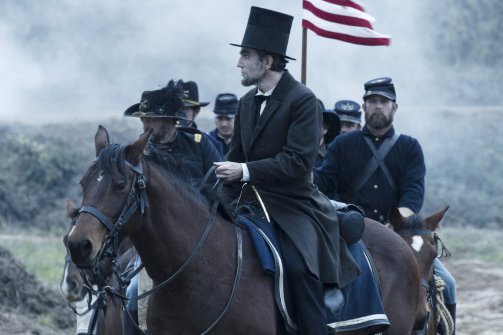
As a wisecracking, world-weary Hollywood producer, Alan Arkin gives a light-hearted lift to Argo’s political thriller proceedings. In Lincoln, Tommy Lee Jones plays the salty senator Thaddeus Stevens. Jones’ performance lives in his eyes. It shows the mental activity of an old man challenged to rethink his politics in order to achieve his lifelong dream of abolishing slavery. Jones is currently the narrow favorite to win the Oscar, but I think there are three performances better than his.

In Django Unchained, Christoph Waltz is a ruthless bounty hunter whose conscience awakens when he helps a freed slave on his quest. Waltz is a master of playing surface-level civility. But in this film, he peels away those layers ever so gradually to reveal his moral outrage seething underneath.

Robert De Niro gives his best performance in years in The Silver Linings Playbook. He plays a football-fixated father, whose attempts to help his son are undermined by his own manic temperament. It’s a display of late-career virtuosity, showing the emotional range he’s mastered over a lifetime: from explosive menace to wisecracking warmth. In this film, he adds an extra dimension through a sense of advanced age and frailty, which he uses to disarming pathos in this scene. But as it turns out, this emotional display is a put-on, as he just wants to loop his son into a crazy scheme. De Niro’s character is an inspired creation of demented obsession, charged with startling vitality.

But I have to give the top prize to Philip Seymour Hoffman for his work as the self-help guru Lancaster Dodd in The Master. It surprises me to say this because I’m not even sure if it’s a complete performance—by the end, his character seems to disappear into the movie’s unresolved clouds of ambiguity. But for the first 90 minutes of The Master, Hoffman is key to making this film work. He’s a pillar of authoritative self-control, a counterbalance to Joaquin Phoenix’s utterly unhinged lead performance.

But Hoffman is doing more than just playing the straight man. There’s an unforgettable scene where Hoffman’s Dodd first processes Phoenix. From Dodd’s face and his line of questioning, we see a refined man fascinated by a wild beast of a human, but we catch a glimpse of that same wildness lurking in him as well. That wildness explodes in a later scene when Hoffman is ambushed, and his lack of self-mastery is exposed. In just these two scenes, Hoffman is able to chart out the entire three-dimensional psychic landscape of a character. It’s this richness that keeps us watching even as the film takes us to increasingly difficult territory.

Kevin B. Lee is Editor in Chief of IndieWire’s PressPlay Video Blog, Video Essayist for Fandor’s Keyframe, and a contributor to Roger Ebert.com. Follow him on Twitter.

VIDEO ESSAY: Who Should Win the Oscar for Best Supporting Actress

VIDEO ESSAY: Who Should Win the Oscar for Best Supporting Actress

For

Part of "Who Should Win," a series of video essays co-presented by Indiewire Press Play and Fandor.

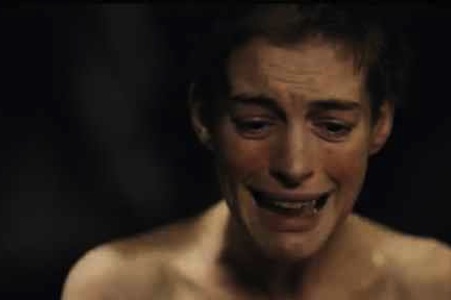
Anne Hathaway is the favorite to win Best Supporting Actress as Fantine in Les Miserables, and that’s just wrong for three reasons. First, she gave a much richer performance as the sly Selina Kyle in The Dark Knight Rises. Second, she’s not even the best supporting performance in Les Miz—that honor goes to Samantha Barks, who’s more nuanced as Éponine—but of course, Éponine always gets overlooked. I think Anne Hathaway is a great actress, but this is the worst performance in this category. It’s a sad puppy act pitched at shrieking full volume, while ripping off Sinead O’Connor and Falconetti’s Joan of Arc. This performance doesn’t just beg for an Oscar, it grovels for it.

Sally Field has won two Oscars, and she’s nominated again as Mary Todd Lincoln in Lincoln, playing an unstrung, emotional foil to the constantly composed president. Field brings an intelligence and dignity that gives an edge to her character’s moments of hysteria. She’s able to convey a mind that’s alert and articulate even when it spins in sadness.

Jackie Weaver is the surprise nominee for Silver Linings Playbook as a mother trying to deal with her son’s bipolar disorder. She has only a handful of lines, mostly appearing in cutaway reaction shots; it’s practically a silent movie-type performance, and not a bad one at that. Expressive even in her silence, she’s a graceful, accepting presence amidst a cast of crazies.

Amy Adams has roughly 20 minutes of screen time in The Master, and boy does she make the most of it. She gives a hand job, turns her eyes black and gives the stare of death while naked and pregnant. Her unnerving intensity casts a spectre over The Master—it’s a pity that she wasn’t utilized more. She practically deserves her own movie.

Another character who deserves her own movie is Cheryl Cohen-Greene, the sex surrogate played by Helen Hunt in The Sessions. Hunt has nearly twice as much screen time as any of the other nominees, which may give her an unfair advantage. But this is the most full-bodied performance of the five. Not just because Hunt appears fully nude, but because she conveys a generosity that gives the film intimacy, as well as intrigue. Hunt’s character helps a disabled man experience the joy of sex. Her confident voice and reassuring gestures make a bizarre situation seem perfectly normal. And just like her character, Hunt manages to give so much of herself while not giving herself away. It’s a performance within a performance, one that explores the personal boundaries of a very unique profession, whether it be sex therapy or screen acting.

Kevin B. Lee is Editor in Chief of IndieWire’s PressPlay Video Blog, Video Essayist for Fandor’s Keyframe, and a contributor to Roger Ebert.com. Follow him on Twitter @alsolikelife

VIDEO ESSAY: LIFE OF PI and the CGI Animal Kingdom of Rhythm & Hues

VIDEO ESSAY: LIFE OF PI and the CGI Animal Kingdom of Rhythm & Hues

I made this video essay last month for Sight & Sound magazine upon the release of Life of Pi in the UK. Going into the making of this video, I wanted to address one criticism that was made upon my previous contribution to Sight & Sound, the video essay on Paul Thomas Anderson's camera movements. The criticism was that the piece was too narrowly focused on exploring Anderson's auteurial vision and did not sufficiently acknowledge the contributions of the cinematographer in devising the shots. That made me think more about focusing on the work of non-directors and in what way they contribute to the overall artistic vision of a film.

I found a perfect case study with the work of Rhythm & Hues, a CGI effects company that has won two Oscars and made a fortune creating computer generated animals for Hollywood movies, specifically those that can talk. They practically enabled a new subgenre of "Talking Animals" children's films that have made billions of dollars and turned the company into an internatonal operation of animators and computer engineers. But they're not nearly as household a name as Pixar, since they mostly don't produce their own fllms and work behind the scenes as technicians enabling the visions of other directors and producers to come to fruition. However, I argue that, in the specific nature of their work, one can trace a highly focused creative throughline, one that has major ramifications for how we are and will experience reality and living beings on screen.  In this context, Life of Pi can be seen as their masterpiece, one that was 20 years in the making. 

Just watch the first two minutes of this video and see where it takes you. 

You can read the full article accompanying the video, as well as some snazzy infographics illustrating the impact of CGI animals in Hollywood movies, at Sight & Sound.

The Grimm Possibilities of MAMA

The Grimm Possibilities of MAMA

null

Note: This piece contains spoilers.

My wife and I arrived late to Andres Muschietti’s Mama, but not late enough.  A series of trailers even more inane and noisy than usual reached its nadir with one for a film called Hansel and Gretel: Witch Hunters, which endows the brother and sister of fairy tale fame with a vast armory of swords and gatling guns and sends them out on a loud and gory witch hunt filled with blood, explosions, and general mayhem. Nothing could have been further in tone and style from the film we were about to see, and yet Mama shares a number of key elements with the Grimms’ story from which Hansel and Gretel takes its name. Mama begins with the fairy tale formula, “Once upon a time…,” and then it tells the story of a pair of children abandoned in the woods and fed by a monstrous mother figure. From this premise the film diverges from the fairy tale’s plot, but not from its spirit, as the children go on to contend with the horrors of growing up in a world haunted by adults.

Though Mama does not ultimately succeed as a film, it does offer a set of rich possibilities for the creation of a modern fairy tale, one that, like those told once upon a time, faces the horrors of everyday life head on, also recognizing the power of fantasy to make imaginative sense of those horrors.  In the Grimm Brothers' tale, Hansel and Gretel are abandoned by their parents because they can’t afford to feed them.  Muschietti’s story begins with an overheard radio broadcast announcing a killing spree launched by a man whose fortunes were devastated by a stock market plunge.  The man turns out to be the children’s father. After he flees with his two girls, Victoria (Megan Charpentier) and Lilly (Isabelle Nelisse), the family hides out in an abandoned, snow-covered cabin. There, a surrogate mother—who is as much a grotesque parody of the clinging bourgeois parent as she is a perverse childhood fantasy made flesh—adopts the children. Mama announces her adoption in classic fairy-tale fashion, by rolling a ripe, red cherry to the children. This symbolic offering is as red as blood, yet sweet, tempting, like the apple offered to Snow White by the Witch.

nullPhilip Pullman has said “your life begins when you are born” but that “your life story begins at that moment when you discover that you are in the wrong family.”  This is the premise of all good children’s stories: once the parents are out of the way, fantasy begins. What makes Mama so rich in potential is its complex understanding of how inescapable the parental presence is, and how fantasies often end up giving more substantial form to the anxieties we had thought to escape. Once the girls are found and adopted by their uncle and his reluctant girlfriend (played by Nikolaj Coster-Waldau and Jessica Chastain), they are exposed to parental forces more messy and complicated than the ghostly figure they’ve grown up with. Mama continues to assert her presence in their new home, and she seems to be a lot more fun than the adoptive parents: the children are heard laughing and singing behind closed doors, and the younger girl, Lilly, often giggles when she catches a glimpse of Mama's ghostly movements. This mother has conformed to the desires of her children, rather than the other way around, though the children will soon find that, in fantasy as in reality, love is haunted by possession.

The children’s early development is brilliantly portrayed in the film’s title sequence through a series of pictures drawn by the girls. In them, we see the children learning to survive, becoming more animal-like as they age. One striking image shows them attempting to eat a rat: the younger girl throws it up, and the older girl cries. Later, the girls themselves become four-legged creatures, as they gradually stop walking upright. This sequence shows the evolution of humans in reverse, and offers a rich commentary on the strange world of children.  Like Lewis Carroll’s Alice, who goes down a rabbit hole to discover herself, these children are of the earth, driven by primal needs and desires.  When they are found by humans, they scuttle around like four-limbed spiders, hiding in corners and under beds. Although the film is largely about childhood fears concerning parents, it is also about parental fears regarding children, and asks the question pondered by many parents at one point or another: who are these strange creatures living in my house?

Like other folklorists, the Grimms collected their tales from families in small villages. Their work was spurred by concerns that urbanization would destroy the rural culture from which such stories sprang. The best fairy tales retain the presence of the wild woods that separated such families from modernity and change. Forests are depicted as a source of danger in the tales, but also as places of mystery and magic. Though most of the forests that fostered the original fairy tales have been cut down and sold for timber, their spirit survives in the tales themselves. In a sense, they are a metaphor for the imagination itself: wild, untamed, and haunted.  

Mama is at its best when it lets the story brood on such elements. The most effective visual effects are those half-seen, barely glimpsed, and shadowy. Mama’s presence is signaled by moths, sometimes singly, other times in ominous swarms. She travels by way of mold and mildew, which spreads from dark corners into the center of walls.  These dark spots congeal and darken to become wound-like holes from which slimy claws emerge. The domestic becomes wild, and the children are at once the victims and the bearers of this dark forest magic. Their would-be adopted mother jokes at one point that the girls are “outdoorsy.” Their faces are always dirty, marked by the rot and filth of their earthy mother. Mama is real because she is dirty.

Once the character of Mama takes more of a visible, human-like role in the story, she begins to lose her magic, largely due to the besetting sin of modern film: CGI. It may be my age, but I have never been able to suspend my disbelief when digital animation intrudes on live action. Even at its most accomplished, such moments are no more convincing to me than Dick Van Dyke dancing with cartoon penguins in Mary Poppins. This is most glaringly seen in the film’s conclusion, which is unfortunate, as the ending is so daring in other respects. Suffice to say that we do not get an entirely happy ending, and this shows more of the true spirit of the stories of “once upon a time” than of Hollywood. Like a fairy tale, the story acknowledges that death happens, but also like a fairy tale, it offers a rich and strange image to help us make sense of it: the spirit of the departed is movingly transformed into a colorful moth who flies into the night.

Mama was originally due to come out in 2012.  If it had, it would have been the third of the year’s most intelligent takes on the fairy tale tradition. The most orthodox of these was Snow White and the Huntsman, a film that exceeded my (admittedly very low) expectations as much as The Hobbit disappointed them. Snow White's success largely derives from its clear respect for the source material. Unlike Hansel and Gretel: Witch Hunters, it endows the Grimms’ story with a fast-paced action narrative that retains the fairy tale’s complex narrative logic, and it doesn’t compromise the traditional moral fabric or the original. It also breaks from Hollywood convention by offering a truly compelling female protagonist, one who is heroic, but not simply because she adopts traditionally masculine attributes.  These qualities are also shown by the year’s other compelling update on the fairy tale, Brave. Though marred by extended moments of broad humor entirely out of spirit with its main narrative, this animated epic succeeds when it's at its most Grimm, as in the scene depicting the film’s heroine playing in the woods with her mother, who has been transformed into a bear. When the bear-mother becomes too involved in their play, her animal side suddenly takes over, and she nearly attacks her daughter. Such moments capture the strange and sinister qualities of parent-child relationships. Like Brave, films like Mama are not afraid of exploring these dark places, and they show the enduring power of the fairy tale to give form to the deepest fears shared by children and their parents.

Jed Mayer is an Associate Professor of English at the State University of New York, New Paltz.

GIRLS on Film: Secrets, Seduction and Reclaiming the Body on Camera

GIRLS on Film: Secrets, Seduction and Reclaiming the Body on Camera

null

Hannah Horvath’s constant nudity in Girls has been a point of discussion since the start of the first season; one of the reasons Girls has been successful has to do with the way it tackles our own attitudes regarding female overexposure. Recently, Howard Stern caused a minor stir when he called Dunham “a little fat chick” and likened her sex scenes to “rape.” Throughout the media, Lena Dunham is both heralded and criticized for filming her own naked body, in all its soft, unphotoshopped glory. In many ways, despite how ubiquitous it has become, female nudity on screen is directly linked to shame. It doesn’t matter what we look like. The most beautiful women in the world are subjected to criticism of their bodies, as well as their sexuality, when they take off their clothes.

The female body in photographs and film is still, at some level, considered to be public property, something that is intended to provoke, entertain, inspire or arouse the audience. We don’t often see women having agency over their own bodies and, indeed, much of the focus surrounding Dunham’s nudity has been on her insistence on placing her characters in a range of strange, unfulfilling, and sometimes humiliating sexual situations. But the scene I love most in Girls is the one of Hannah naked and happy, eating cupcakes in a bathtub. This simple image is strangely radical: a private moment where we see a woman enjoying her body just as it is, a naked woman who exists for no one else.

In many ways, 2012 has been the year of the female confession; great media attention has been given to women who are willing to tell all, unequivocally, all the time. We see this in the rise of female reality TV stars who share everything, ranging from their diet tips to their sex lives. We see this, also, in the burst of female success that has come from baring all, confessing painful past histories that include incest, eating disorders, drug use, depression, sexual liaisons, and all sorts and staples of traditionally “bad” female behavior. Perhaps there is nothing new about our constant and unwavering fascination with good girls gone bad, with hearing female sexual confessions, especially those that bear the marks of humiliation or risk. What is new is the attitude that confession, in all its messy and strange incarnations, will give women a true voice by highlighting the person behind the feminine façade, the creature who can see the outer objectified self with painful precision.

In many ways, talking about the sex on Girls leaves us in a double bind. On the one hand it makes sense to praise Dunham’s tenacity, her willingness to be nude on camera despite her “imperfections,” her determination to put her own experiences on public view for the sake of her art. On the other, it is arguable that the attention surrounding Girls is born from a kind of sensationalism that male artists, writers, and directors never have to struggle with. No one looks at Boogie Nights and considers the extent to which Paul Thomas Anderson’s own sense of sexuality helped influence his film. We assume that male auteurs are able to separate themselves from their projects in the same way that we assume the deep male voiceover, which is a mainstay in so many feature films, is the voice of “God,” omnipotent and all-knowing. Kanye West and any number of male recording artists can describe their sexual preferences and predilections, while artists like Rihanna are consistently stigmatized for doing the same.

Sometimes, as in the case of Rihanna, we conceptualize our tongue clucking as if it were borne out of concern, but the reality is a bit more sinister than that. Film, in particular, has a legacy of overt objectification of women; it is impossible to watch the camera linger on Hannah Horvath’s body, in any number of scenes in Girls, without considering the extent to which female bodies are looked at and the extent to which we still imbue the female body with meaning. The literary female confessor is still in some ways hidden—there is a separation between page and person. In her book, How Should a Person Be?, Sheila Heti can describe sexual situations and fantasies without provoking the same exact combination of excitement and ire that erupts when a female artist produces nude photographs to go alongside an artistic project. When Miranda July and Lena Dunham get naked on camera, the audience is often more obsessed with what this propensity for nudity says about them as individuals than with its contribution to their art.

While self-exposure is often intended to expose the male gaze, to illustrate how there is no blank slate that we can cast desire onto, that there is something unique and fundamentally human about being a woman and being a girl, exposure is not, in reality, always an empowered act. Nakedness, of course, can be freeing, but only if we are fully in charge of when, where, and how we are taking off our clothes. We are used to seeing young girls coerced into taking their clothes off for other people, whether in the fashion industry or in any number of films and music videos. Indeed, for many women in literature, film, and the arts, nakedness is the price we pay for attention and acclaim; for many, nakedness is the only pale shadow of acclaim we may ever really get. The female artist or writer who chooses to get naked is always seen as a naked woman first and as an artist second. The image of the naked woman, regardless of how SHE is using that image, is read into the fabric of our culture as an object we can pick apart, distribute, decimate, worship, or destroy.

The dialogue surrounding Lena Dunham’s naked body illustrates the ways that disentangling one’s self from one’s own history is still a struggle for the female artist, one for which there isn’t a single answer. The obsession with female confession is about the shapes and shades of female sadness, the ways the female body has betrayed us, the fear that our still strangely misogynistic culture has broken our collective hearts. Fifty Shades of Grey is marketable because the text ruptures nothing sacred in our culture; women are allowed to be sexual as long as they are an empty vessel waiting to be filled. We still view the connection between female sexuality and individual agency as incredibly tenuous.

Perhaps this is why, in many ways, I yearn for the partial exposure of the femme fatale to the overexposure of the ingénue. While the camera lingers on the body of vamps and vixens, their façade still seems one of power, rather than powerlessness. The femme fatale, unlike other kinds of sex bombs, is dangerous not because she is desirable, but because she has secrets. Her desires are wild and untamed, and her motives are private and unclear. The femme fatale is threatening because she is a free agent who operates according to her own moral code. Not giggly and coy like a Marilyn, not bouncy and bold like a Britney, not regal or refined like Grace Kelly, the femme fatale is blood and ice and grit. She is a hot throb of sex, naked but never exposed. Her drive is insatiable. She gives away nothing. She takes and takes and takes.

I have felt drawn to these types of female characters since I was a little girl. The minute I saw Jessica Rabbit walk onstage in "Who Framed Roger Rabbit?", all slinky red dress and deep-throated whisper, I thought, “This is what it means to be a woman.” Since then I’ve loved every femme fatale I’ve seen on screen. Marlene Dietrich. Greta Garbo. Barbara Stanwyck. Rita Hayworth. Lauren Bacall. Sharon Stone. Angelina Jolie. Dangerous, powerful, sexual women.  

In contrast, scenes of women exposed horrify and sadden me. I can’t watch Hannah Horvath lean over the couch and get told to “play the quiet game” while her obnoxious boyfriend may or may not be unwrapping a condom in preparation for anal sex without getting incredibly upset. The modern woman on film has been presented as a warrior (Katniss from The Hunger Games, The Bride from Kill Bill) or an ingénue (Bella from Twilight, any number of romantic comedies which fail the Bechdel test time and time again). Neither of these presentations of femininity gets us any closer to true personhood. Perhaps this is why my love for the femme fatale figure remains: if my only choice is to be a symbol then let me keep my secrets rather than confess them all away. Let me be fire and ice and blood.

The qualities I admire most about Lena Dunham are the ways in which she is pure steel. I love how she refuses to capitulate to the criticisms leveraged against her body, even though I feel this focus detracts from other important aspects of the show. Our fixation on female bodies highlights just how much we still need to be shocked into paying attention to young women’s wants and needs. Many times the bodies we are presented with are static—photo spreads, billboards, scenes of women posing, rather than actually doing anything purposeful at all. Images that illustrate the female body in motion, whether it's Jessica Rabbit sauntering on stage, or Hannah Horvath dancing around her room, are empowering precisely because they are about claiming ownership over one’s own body, about not being a metaphor or symbol or fantasy for anyone else.  They are about being a person in the world.

Arielle Bernstein is a writer living in Washington, DC. She teaches writing at George Washington University and American University and also freelances. Her work has been published in The Millions, The Rumpus, St. Petersburg Review, and South Loop Review, and she has twice been listed as a finalist in Glimmertrain's Family Matters Short Story Contests. She is Associate Book Reviews Editor at The Nervous Breakdown.

VIDEO ESSAY: Who Would Have Won the Oscars 90 Years Ago?

VIDEO ESSAY: Who Would Have Won the Oscars 90 Years Ago?

The Oscar race for the films of 2012 is officially in high gear, with the nominations announced just yesterday. Now the onslaught commences for prognostications of who will win and pitches over who should win. But before we look ahead, why not resolve some long unfinished Oscar business? With the Academy Awards initiated in 1927, there’s a good decade-plus of feature filmmaking left without with the coveted golden statues to designate their finest achievements. Let’s turn the clock back a good 90 years and hand out some Oscars to the best filmmaking of 1922.

Lending a big hand in this enterprise are the ever-invaluable film scholar tandem of David Bordwell and Kristin Thompson. Each December for the past several years, they’ve channeled all the year-end best-of hoopla into creating their own top ten lists for films made 90 years earlier. This past New Year’s Eve, they came through once again with their top ten of 1922, a list loaded with remarkable canonical titles. As a companion piece to their annotated list, I’ve made a short video (above) highlighting clips from their list, set to one of that year’s top hits (I suppose it was the “Gangnam Style” of its time?).

With all those films in mind, plus a few others of note, I’ve come up with my own personal ballot for which films and talents should have won Oscars in 1922.  Looking at the field of contenders, there were no obvious choices, especially for Best Picture, Actor or Director. I could have easily gone for Foolish Wives, Dr. Mabuse the Gambleror Nosferatu in any of those categories. Through the mirror of hindsight, Nosferatu would appear the towering choice given its stature and tremendous impact on atmospheric filmmaking, especially horror. But Mabuse is possibly the most contemporary film of the lot, virtually projecting its multi-faceted, sinister worldview upon the likes of David Fincher and other systemic storytellers. And Foolish Wives, reportedly the first million-dollar movie, is a staggering vision of opulence and corruption, with an observational subtlety offsetting its visual splendor that a film like Baz Luhrmann’s upcoming Gatsby is almost assured of lacking.

But there’s plenty of room for debate (I admit I don’t have the freshest memory of some of these films) as well as discovery (there are many other films not mentioned that I haven’t seen). Please chime in with your own ballot and winners in the comments, and let’s see if a consensus emerges for these categories. And this won’t be our only Oscar coverage: starting next week we’ll return to 2013 to weigh in on who should win this year’s Oscar races.

And now… the nominations and winners (in bold) of the 1922 Academy Awards.

Best Picture
Dr. Mabuse, the Gambler
Foolish Wives
Nosferatu
Orphans of the Storm
La Roue

A super tough call between the extraordinarily complex Mabuse and the haunting, dreamy Nosferatu, but I have to go with the latter. It’s a testament to Murnau’s artistry that his images can still chill the blood.

Best Actor
Douglas Fairbanks, Robin Hood
Maurice de Féraudy, Crainquebille
Rudolf Klein-Rogge, Dr. Mabuse the Gambler
Max Schreck, Nosferatu
Rudolph Valentino, Blood and Sand

Valentino or Fairbanks probably would have won in real life, as they stood at the very top of Hollywood royalty at the time. But Klein-Rogge was arguably the most talented actor in Weimar Germany and his personification of a larger-than-life villain is much more complex than even Schreck’s iconic turn as cinema’s first vampire.

Best Actress
Leatrice Joy, Manslaughter
Aud Egede Nissen, Dr. Mabuse the Gambler
Dorothy Gish, Orphans of the Storm
Lillian Gish, Orphans of the Storm
Anna Mae Wong, The Toll of the Sea

This may be wishful thinking on my part, but Wong’s fresh-faced, from out of nowhere performance deserves it – transforming a slight colonialist fairy tale into an experience as lyrical as Madame Butterfly.

Best Director
Germaine Dulac, La Souriante Madame Beudet
Robert Flaherty, Nanook of the North
Fritz Lang, Dr. Mabuse, the Gambler
F.W. Murnau, Nosferatu
Erich von Stroheim, Foolish Wives

Murnau announced himself as a major director with the perfect fusion of technical innovation and poetic vision. His lighting, staging and editing effects in this film took a great leap forward in the state of the art and still hold sway over horror and experimental filmmaking today.

Best Supporting Actor
Bernhard Goetzke, Dr. Mabuse the Gambler
Cesare Gravina, Foolish Wives
Joseph Schildkraut, Orphans of the Storm
Gustav von Wangenheim, Nosferatu
Morgan Wallace, Orphans of the Storm

Best Supporting Actress
Clara Bow, Down to the Sea in Ships
Mae Busch, Foolish Wives
Maude George, Foolish Wives
Greta Schröder, Nosferatu
Anna Townsend, Grandma’s Boy

Best Original Screenplay
Fritz Lang, Norbert Jacques, Thea von Harbou, Dr. Mabuse, the Gambler

Best Adapted Screenplay
Henrik Galeen, Nosferatu

Best Documentary
Nanook of the North

Best Cinematography
William H. Daniels, Ben F. Reynolds, Foolish Wives

Best Editing
Marguerite Beauge, La roue

Originally published on Fandor.

Kevin B. Lee is Chief Video Essayist for Fandor’s Keyframe, Editor in Chief of IndieWire’s PressPlay Video Blog, and a contributor to Roger Ebert.com. Follow him on Twitter @alsolikelife.

Raised in Fear: Horror Films as Schoolyard Lore

Raised in Fear: Horror Films as Schoolyard Lore

null

All I really need to know about fear I learned in elementary school. Before I ever saw a horror film, I had acquired an extensive knowledge of the genre’s main visual icons.  More vital than any knowledge instilled in our classroom was the information we exchanged at recess, or on the bus.  Besides highly confused descriptions of sexual reproduction, the bits of knowledge most eagerly exchanged were meticulously detailed descriptions of horror films.  These movies took on legendary status in inverse proportion to the number of kids who had actually seen them.  The kid whose irresponsible parents unwisely took him to see The Exorcist might have been psychologically scarred for life, but among third graders he could become, for a time, a kind of schoolyard prophet.  When strict parents intervened, someone’s older brother or sister would always be eager to terrify their younger siblings with lurid retellings of the most horrific moments from The Texas Chainsaw Massacre or I Spit on Your Grave.  The bearers of this precious knowledge provided me with a rich vocabulary of terror that has stood me well over time.   

Horror is a genre founded on suspense, and much of this suspense begins outside the theater.  From the commercial end, film studios have created a virtual subgenre of promotional material—from salacious posters to sensationalistic radio and television spots to tautly edited trailers—that is often more satisfying than the films it promotes. Such promotional tools, as much as they might serve the interests of capitalism, are in fact the most recent manifestation of a far older cultural tradition. In earlier centuries, before a circus, freak show, or menagerie came to town, heralds carrying broadsides and placards describing or illustrating the chief attractions would march through town, building anticipation which then spread by word of mouth. More than any other genre, the horror film is the true heir of this carnivalesque tradition, since the sense of anticipation and suspense is so clearly part of horror’s narrative structure. The tension we feel as we wait for a protagonist to find out what’s behind the door is all the more intense when the waiting begins with a trailer or poster image. 

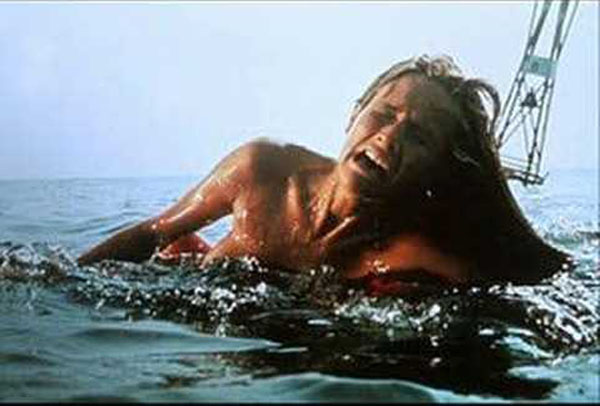
nullBy the time I actually came to see Jaws, I was well acquainted with all of the film’s main events, told with a series of images that rivaled the most lurid frames of a 1950s horror comic. “Oh, man, how about when the woman’s skinny dipping at night! She’s all naked, right, only you can’t really see much ’cause it’s so dark; but anyway, she’s swimming and she sticks one leg up in the air and then it sinks into the water. Then that music starts, you know, da-duh, da-duh, and they show what it looks like underwater and you’re looking up, you know like you’re the shark looking up at her swimming and then you can see a little bit more of her nakedness but then they show her face, and she, like, disappears for a second, like she’s pulled under. Then it happens again and she starts screamin’. Then, oh man, she starts jerkin’ around, this way and that way, and then she slides way over until she smacks into this buoy, and then you’re like, oh man she made it, but then, no, she gets pulled off again and dragged around and then she’s, like, totally dead.” To an eager audience of children, this is not a spoiler: it’s an appetizer.

When I finally got to see the film for myself, my enjoyment of these and other foretold moments was actually enhanced by the verbal previews. Although I was an avid and attentive viewer, I have to admit there were things I might have missed had I not been fully prepared to appreciate them. My classmates astutely noted, for instance, not just that the sailing coach’s leg sinks to the bottom, but that it is cut off just above the knee, that a cloud of blood seeps from the ragged flesh where it was cut off, and, most importantly, that “it still had its sneaker on, can you believe that?” Another classmate took time to notice that, shortly before the Kittner boy is devoured, accompanied by “a huge, like, air bubble of blood,” a boy throwing sticks into the water for his dog suddenly notices that the dog is missing. Once I became a supposedly more sophisticated filmgoer, I marveled at the virtuoso dolly zoom effect that accompanies Chief Brody’s horrified realization of the shark’s attack. But without the guidance of a perceptive schoolyard critic, I might have overlooked that poignant detail of a boy calling into the sea for his lost dog.

Over the years our visual vocabulary grew. Piece by piece, our anatomy lessons added “spinning heads,” “still-beating hearts,” “guts spilling out,” “guts being eaten,” “guts on the floor,” “guts hanging from a hook,” “green puke,” “face melting off,” “eyes popping out,” “drill going into his forehead,” “arms reaching out of the grave,” “head on a stick,” and the one that confused me as much as it horrified me, “masturbating with a crucifix.” Every slight variation on the general theme of dismemberment and penetration was told in meticulous detail. Linda Blair’s head didn’t just spin around in The Exorcist, it turned slowly to the right, like she was looking away from the priest, and then turned slowly around to the sound of bones cracking and then completed the turn and snapped into place. Her puke wasn’t just green, it was green like the color of Apple Jolly Ranchers. What is most remarkable about such descriptions is how little exaggeration was involved. Children are generally known as tellers of tall tales, but when recounting scenes from horror films, they were as anatomically precise as forensic pathologists, as closely attuned to performative nuances as anthropologists in the field, and as keenly attentive to subtle variations of color, light, and shadow as art collectors. 

Those who experienced such schoolyard exchanges know that there was nothing especially cruel or violent about them.  Scenes of graphic violence were recounted not with sadism but with a sense of wonder. By describing such images, we were bearing witness to how strange and awful the world could be: not awful in its contemporary sense, but in the more archaic sense of awe-inspiring.  By telling one another about these things, we strengthened our sense of community and kinship. Iona and Peter Opie have gathered an extensive record of what they call “The Lore and Language of Schoolchildren,” noting the infinitely rich continuities and variations between the kinds of songs, rhymes, chants, and stories children have told across generations.  From them we learn that, long before children were describing grotesque scenes from horror films, they were chanting lines like “Tell tale tit, / Your tongue shall be slit, / And all the dogs in the town / Shall have a little bit.” Invoking such violent imagery doesn’t beget violence: it’s when we lose the sense of community and camaraderie such imagery fosters that we become sad, angry, and, sadly, sometimes terribly violent. Behind most school shootings is a story of alienation and loneliness.

nullMy classmates weren’t simply discussing films when they described them at recess: they were engaging in a form of storytelling as old as oral culture itself. Like the folk tales recorded by the Brothers Grimm and others, these narratives were structured around horrifically vivid images.  Folklorists have recorded infinite cultural and ethnic variations on the meme we know as “Little Red Riding Hood,” but they all have one element in common: a catechism between a child and a disguised monster that progresses from innocent “big eyes” to suspiciously “big ears” to terribly “big teeth” that threaten to “eat you up.” The protagonist might be a little boy in one version, a girl in another; the victim might be eaten and then cut out of the wolf by a huntsman, or she might outwit the wolf and escape; the moral of the story might be that we shouldn’t stray from the path or talk to strangers, or there might not be any moral at all. Every element of the story can be changed but not the progression from eyes to ears to teeth that can eat you: these words distill what is perhaps the most fundamental experience of horror any of us ever have.

Jed Mayer is an Associate Professor of English at the State University of New York, New Paltz.

VIDEO ESSAY: When Movies Meet Video Games

VIDEO ESSAY: When Movies Meet Video Games

One of Press Play's favorite video essayists, film scholar Matthias "Chaos Cinema" Stork, recently unveiled an exciting new video on UCLA's film studies website Mediascape. The video, "Transmedia Synergies: Remediating Films and Video Games," is an eye-opening look at the evolving relationship between movies and video games, and how each is influencing the other to create what Stork terms a "transmedia aesthetic." As popular and pervasive as "Chaos Cinema" is, I think this is an even better video in terms of what it explores as well as how. 

Stork's video gets into pretty brainy territory by touching on numerous concepts circulating in contemporary visual media culture, but the observations and theories are made coherent, palpable, and yes, even fun, through his brilliant use of the video essay form. We get to dive through an arresting array of images from cinematic video games like Resident Evil and Grand Theft Auto, as well as video game-like movies such as Scott Pilgrim vs. the World, The Matrix and The Amazing Spiderman. Stork makes inspired use of this rich image bank: split-screens to compare similar elements between video games and movies, and a playful, game-like progression through each phase of his thesis. The clever use of gaming icons, video game fonts and sound effects suggest a video essay version of Super Mario Brothers

This is essential viewing for anyone who wants to see what elements are driving the evolution of our entertainment. Just press play!

– Kevin B. Lee

Stork's own introduction to his video can be found at Mediascape.

Matthias Stork is currently an M.A. student in the Cinema and Media Studies program at UCLA. He is interested in the intersections of cinema and digital media, especially the synergies between films and video games, the aesthetics of neo-spectacle, and video essays as emergent forms of film criticism and scholarship. You can see his video essay experiments at http://vimeo.com/cineessais.