VIDEO – MOTION STUDIES #22: Apichatpong Weerasethakul: Reverse Shot Talkies

VIDEO – MOTION STUDIES #22: Apichatpong Weerasethakul: Reverse Shot Talkies

From now through April, the Oberhausen International Short Film Festival will present "Film Studies in Motion", a Web Series curated by Volker Pantenburg and Kevin B. Lee. This series, available on the festival's website and Facebook page, presents weekly selections of analytical video essays on the web, in preparation for Pantenberg and Lee's presentation  "Whatever happened to Bildungsauftrag? – Teaching cinema on TV and the Web", scheduled for April 28 at the festival.

Week Five: Auteur Studies

As auteur theory remains a central component of film studies, the medium of online video generates new perspectives and approaches to understanding the director’s vision and process. One remarkable aspect that can be found in this selection of videos is the extent to which the format allows the video creators to personalize their appreciation of a director’s work. These videos convey the creator’s individualized perspective through their narration or editing techniques, as well as the act of appearing on screen, even as they consciously incorporate or mimic the style of the director. This interplay between the creator and their subject gives video auteur studies a unique quality of its own.

Today's selection:

Apichatpong Weerasethakul: Reverse Shot Talkies #27 

Eric Hynes talks to Palme d'Or–winning filmmaker Apichatpong Weerasethakul (UNCLE BOONMEE WHO CAN RECALL HIS PAST LIVES) about the Thai jungle, time and duration, and the transformative qualities of life and cinema. Part of a series of videos produced by the website Reverse Shot that take playful, innovative approaches to the video interview format.

View all Motion Studies video selections.

Volker Pantenburg is assistant professor for moving images at the media faculty of the Bauhaus-Universität Weimar. 

Kevin B. Lee is Editor in Chief of IndieWire’s PressPlay Video Blog and contributor to Roger Ebert.com. Follow him on Twitter.

MAD MEN RECAP 4: SIGNAL 30

MAD MEN RECAP FOUR: SIGNAL 30

“I’m through with all that fantasy stuff.”

nullIn Signal 30, everyone is struggling with their identity, with fantasies about who they are and how that might conflict with reality. People are pathetic or they are Superman, they are heroes or failures in their own minds, and they struggle mightily when the world disproves their theories about themselves.

This wasn't a great episode, but it's a breather after the intensity of Mystery Date, and there's plenty of symbolic material to dig into. I'm a little disappointed because the fifth episodes are generally among each season's best, and I don't think Signal 30 can really stand up to 5G, The New Girl, or Guy Walks Into an Advertising Agency.* Nonetheless, let's dive into the juicy bits: There are plenty.

We all know "Don Draper" is a false identity for Dick Whitman. This season we've seen Don's growing disinterest in hiding himself. He is willing to share with the Campbells and Cosgroves the fact that he grew up on a farm—something he wouldn't have dreamed of doing back in 1960. Yet, his dual identity is alluded to twice in Signal 30, first, when he winces at the shared last name of Charles Whitman, the Texas Tower killer whose August 1, 1966 shooting spree took eighteen lives. The second time is when the sink explodes: Don whips off his shirt and starts fixing the sink as one of the women says, "Look, it's Superman!" 

The point of the episode, though, isn't Dick Whitman and Don's secret past, but the second identity we all have—walking through life as Clark Kent and imagining we're Superman. Over various meals, everyone has a chance to discuss their fantasy selves—writer, actress . . . even hog farmer.

Lane imagines he's an account man. Ken has an established "secret identity" as Ben Hargrove; when outed, he goes back into hiding as Dave Algonquin (no wonder Salvatore had a crush on him, Ken is all about being adeptly in the closet). Roger had an identity as a master account man, and Pete has, bit by bit, taken that away from him.

Ah, Pete. We really have to talk about Pete, but allow me to dwell on Roger for a moment. Check out this video of Roger explaining to Lane how to schmooze a client. This is literally the first time this season, maybe the first time in two seasons, when we've seen that Roger actually has skill and value:

In Season 4's Waldorf Stories, Roger, in a "morose" mood, complains that there are no Clio awards for what he does, and Joan asks what that is exactly (well, she doesn't so much ask as slap him across the face with the question). We've built an understanding of Roger as spoiled and incompetent for five seasons now, but it turns out he does do something, and he does it well: He knows how to turn clients into friends, how to get them to be allies in the cause of winning their own account. In a way, "account man" is the ultimate secret identity: Roger has the gift of turning himself into whatever the client needs him to be in that moment.

I've had it up to here with Roger's whining and self-pity, but this week was different: He not only showed competence, but wistfulness. When he calls himself "Professor Emeritus of Accounts," and when he tells Ken he "remembers" that the account job can be satisfying, he is being realistic about the pasture to which he's been relegated, even while he longs for more. This week, I kind of don't blame him for poaching Pete's meetings in A Little Kiss, especially since Pete has been such a shit.

Okay, let's get to it. Pete is a shit.

Wait, you wanted more?

Fine. To my eyes, Pete was the villain of Season 1, but he gradually redeemed himself, being on the right side of a lot of issues, becoming a much better husband to Trudy, developing tenderness towards fatherhood, and being exactly the right kind of prick in negotiations with his father-in-law. (That last instance may not seem exactly heroic, but he was right, dammit, and Tom Vogel needed putting in his place.)  Now, he's back to being a thorn in everyone's side.

This week's Pete debacle has been foreshadowed out the whazoo. Let's start with the very first episode, Smoke Gets In Your Eyes, when Don tells Pete in the cruelest possible terms that he'll never get very far in business because no one likes him. Then there was Pete punching himself in the nose in A Little Kiss, walking straight into his pillar, and then Roger offering to "take it outside" with Pete in the same episode. So, yes, the bizarre and strangely awesome fight (check out the video if you can't get enough) was set up well in advance.

Pete is just a boiling pool of dissatisfaction. His wife wears curlers to bed! And she's not a teenage girl! And the faucet drips! And he hates the suburbs!  It all seems really petty when laid out like that, because it is petty. What we've seen, over and over this season, is that nothing can make Pete happy. He's even nasty when a car account comes in the door (and remember, Ken told him quite recently that a car was the prize they were all hoping for). He's just spewing misery everywhere.

In A Little Kiss, Trudy told Pete, "Dissatisfaction is a symptom of ambition," but Pete is happy when he's ambitious. It's now, that he has what he thought he wanted, that he's miserable. In the past, we've seen Pete longing for Peggy while married to Trudy, we've seen him vying for recognition, competing with Ken, fighting with his father-in-law, and he just got happier and more pleasant to be around. But now that he's a partner in a growing company, with a nice house and a gorgeous daughter, he's a sour, frowning, pimple of a guy who is determined to belittle everyone within earshot. He's nasty to Roger, rude to Lane, and deserved the punch in the face.

How galling it must be to be the Pete Campbell version of Clark Kent and have Don Draper put on the cape, fix the sink, and get the women hot. How galling to have Don Draper, of all people, throw your adultery in your face by abstaining. How absolutely humiliating to be unable to successfully land a teenage girl because you're not "Handsome" enough (and the casting of that teenage boy was no coincidence: He's a young Don Draper in every particular). Finally, Pete's only pleasure—insulting his supposed "friends"—backfires on him when Lane fights back.

In the cab, Pete bitterly says to Don, "I have everything," and Don agrees. But after the fight, Pete is near tears as he says to Don, "I have nothing." I don't believe there's anything that Pete can have that will make him feel good, because what he wants is to be Superman, to be "king." What he imagines he wants is to be Don Draper. Let's keep going with that: What Lane imagines he wants is Joan, or to be an account man, or both. What Roger imagines he wants is to be Roger about five years ago. What Ken imagines he wants is to be Ben Hargrove or Dave Algonquin, and since he is, Ken (as usual) is the only one who ends up happy.

What Don imagines he wants is exactly what he has. It makes the entire audience sit on the edge of our seats, though, because we all know how good he is at screwing things up for himself. Placing him in the context of this episode practically demands that we wonder when the other shoe will drop.

Some additional thoughts:

  • Notice we didn't see Harry this episode? He'd be redundant: Like Pete, he just wants youth. Notice also that Trudy is wearing a very old-fashioned dress for the party—that poofy skirt is so over in 1966; she's no longer fashionable.
  • Ken and Peggy have a pact—if either leaves, they take the other. Interesting. I've always loved their friendship, but I'm surprised Peggy has an ear to the ground.
  • Signal 30 is the name of the gruesome driver's ed film that Pete is watching as the episode opens. This episode is filled with wrecks, from Pete's bloody nose to Roger's career.
  • Quote of the week: “He was caught with chewing gum on his pubis.” Ha!
  • Megan exercises a lot of control over Don, and we see more and more of that each week. This week, she refuses to do the dirty work of turning down Trudy's invitation, then she makes him change into a sport coat that she bought him (and WOW, what a sport coat it is).

* Oops, that was episode 3.06. The fifth episode of Season 3 was The Fog.

Deborah Lipp is the co-owner of Basket of Kisses, whose motto is "smart discussion about smart television." She is the author of six books, including "The Ultimate James Bond Fan Book."

Watch Mad Men Moments, a series of videos on Mad Men, produced by Indiewire Press Play.

GIRLS RECAP 1: PILOT: ONE FINAL PUSH

GIRLS RECAP 1: PILOT: ONE FINAL PUSH

I liked creator/star Lena Dunham's Tiny Furniture, but Jesus H. with the royal-wedding-level coverage of the lead-up to the Girls premiere: how it's totally not like Sex & the City at all, except when it is, and only portrays the quark-width Caucasian-Ovarian-Oberlinian-American slice of the New York City experience, except when it's jumping into the universal. It's brilliant, and it's tl:dr, and Dunham has done every interview from here to the auto circular, and enough already, so thank God it's finally underway. Short verzh: yeah, it's niche and occasionally obnoxious. It's also super-watchable and good (in that "extractions portion of a facial" way at times, but still). Give it a chance. Now let's get to it.

Fade up on Hannah (Dunham) shoveling pasta into her mouth at a fancy restaurant. Cut to her parents on the other side of the table, her father (Peter Scolari) also chowing like he rows heavyweight crew, her mother (Becky Ann Baker) watching them with amusement. Girls got me on board two seconds in with that casting; I can't swear the meta-commentary is intended, but Baker is likely best known as the benign, clueless mom from exec producer Judd Apatow's alienated-youth dramedy Freaks & Geeks, while Scolari starred in the pioneer gender-fuck sitcom Bosom Buddies, which traced the increasingly blurry edges of what it means to be fema— HA HA HA, no, it didn't do that at all. BB is best and rightly known today as "that thing Tom Hanks did to pay rent," but the concept, of course, is that Hanks's and Scolari's characters would do whatever they had to do to make rent in big bad Gotham—including dress up like ladies for a spot in a women's residence hotel.

This is about to become relevant. Hannah brings her parents up to date on work—it's going well, and her boss has agreed to look at her book "when it's done." It's a series of essays; she's only finished four, but the larger work is a memoir, so she has to "live them first." Ahhhh yes, the old "hard work is no substitute for experience" mistake so many writers make at that age, usually halfway down the fourth pint, and Hannah's fakely chuckly tone suggests she's spun that line dozens of times. At a prompt from Mom, Dad hems and haws from "you're doing so great at work" to "it may be time for one final push," and eventually to the bomb they've come to drop, where he hands off to Mom: "We're not going to be supporting you any longer." "See, I wasn't gonna phrase it like that," Dad mutters, stricken. Hannah promptly objects: her "job" is an internship and may never turn into a paying gig. Mom counters: Hannah graduated from college two years ago; she and Dad are professors; they "can't keep bankrolling your groovy lifestyle." Hannah's counter-counter re: the shitty economy and how she could be a drug addict—"Do you realize how lucky you are?"—doesn't play with Mom, despite a super-anxious Dad undercutting her in the conversation. Neither does Hannah's snotty monologue about insidious pill addiction, or the next one about how close she is to the life they want for her. "No. More. Money," Mom snaps, adding that they can discuss the details tomorrow. Hannah doesn't want to see them tomorrow: "I have work, and then I have a dinner thing, and then I am busy, trying to become who I am." The line clanks, but Dunham's rendition of Hannah's misery as she stares into her plate, stuck pre-check at a table with people she feels betrayed by and trying not to cry in front of them, almost saves it.

Title card.

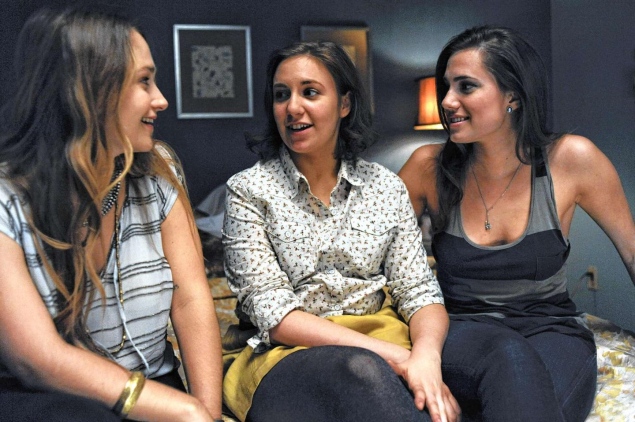
Hannah's bed, where she's spooning with roommate/BFF Marnie (Allison Williams). Marnie is wearing a bite guard and grinding her teeth. Someone's cell rings, and the girls groggily rifle through the covers looking for it.


Cab. Jessa (Jemima Kirke of Tiny Furniture) is snoozing on a pile of Louis Vuitton luggage. "Miss. We are here." Jessa looks out at a Chinatown storefront. "Already?
" 


Hannah/Marniehaus. Marnie's boyfriend Charlie (Christopher Abbott of Martha Marcy Marky Mark and the Funky Bunch) is pouring coffee in the kitchen. Marnie asks why he didn't wake her—she didn't mean to sleep with Hannah—but he says they looked too angelic to disturb. "Victoria's Secret Angel," Hannah says, hiking a thumb at Marnie, "fat-lady angel." Pro-forma protests from Marnie and Charlie; Hannah whatevers, "Please avert your eyes," while absconding from the kitchen with a cupcake for breakfast. Atta girl. Marnie hands Charlie her bite guard in exchange for a cup of coffee. Charlie asks if they fell asleep "to Mary Tyler Moore again"; Marnie admits it, but seems like she's lying. "Comin' atcha; here it comes," Charlie croons, leaning very slowly and gently in for a kiss on the cheek. Marnie barely moves, her smile slowly melting off.

Bathroom. Marnie shaves her legs on the edge of the tub; Hannah sits in the tub, eating her cupcake. Badinage about whether Marnie's going to take her towel off, and she jokes that she only shows her boobs to people she's having sex with. Hannah real-talks, "You literally slept in my bed to avoid him," and Marnie cringes, then says she's "turned a corner," and Charlie's touch now feels like "a weird uncle." Marnie thinks she needs to end it; Hannah believes that that will make Charlie either "stand outside [their] window with a boom box," or kill himself. Charlie then bursts in, is all awkward about seeing Hannah naked, and is way too nice about saying goodbye and offering to get wine for later. Marnie cringes again. Hannah asks what it's like to be loved that much. Marnie can't feel it anymore, and then she nails it with this line: "It makes me feel like such a bitch, because I feel him being so nice to me and yet it makes me so angry." Yep. Exactly. Gives you hand massages; actually likes Tori Amos, possibly more than you do; you feel like screaming all the time. Flawless, "makes no sense"/"makes all the sense" encapsulation of the frustrations of dating that particular type of guy—who, as Hannah then notes, "has a vagina."

Jessa hauls her crap up a flight of stairs to a red door, out of which bursts her pink-sweatsuited cousin, Shoshanna (Zosia Mamet, Mad Men's Joyce Ramsay), with a very intense "bonjour, roomie." Jessa parries with a "ça va?" but Shoshanna kind of doesn't even hear her, murmuring about Jessa's chic hat, how she's the only one of her girlfriends to have a British cousin, Jessa's skin is so beautiful, etc. Jessa's all, "So, about putting my bags down?"

Walking to work. Marnie orders Hannah to ask to get paid at her job; if Hannah can't make her half of the rent, Charlie will have to move in. "You're dumping Charlie," Hannah reminds her. "I didn't say that," Marnie snorts. Hannah then relates that she texted Adam "about tonight" but he didn't text back. Marnie tells her impatiently that Adam "never, ever" texts her back, so Hannah bargains that maybe she should call him: "Didn't you say texting is like the lowest form of communication on the pillar of chat?" "The totem of chat," Marnie corrects her, and Facebook is the lowest, "followed by Gchat, then texting, then email, then phone; face-to-face is of course ideal, but it's not of this time." Agreed on the merits, but the "it's not of this time" takes me out of the episode a little bit; the "totem" is clearly a pet harangue of Dunham's, and sticks out as such. Hannah asks how she's supposed to get Adam face-to-face if he won't text her back. Well, you accept that he's a horse's ass and don't bother, but we'll get back to that. Repeatedly, because that's how that goes.

In a deli, exposition on Jessa; Hannah thinks Jessa will appreciate the welcome-home dinner, but Marnie is pre-annoyed by Jessa's inevitable tardiness and out-hip-wardrobing of the rest of them, plus Hannah goes on benders when Jessa's in town, and then Jessa leaves and Marnie has to deal with the fallout. Jessa also apparently sleeps with other people's boyfriends. Not Marnie's, Hannah points out. Only because he was in Prague that semester, Marnie points out in return.

Shoshanna's. Shoshanna rambles about her rent, and then we get the specific callout to Sex & the City via the S&TC movie poster Shoshanna has on her wall. Jessa never saw the film and didn't know it was a show; nor is she on Facebook. Shoshanna's response to this is a dreamy "You're so fucking classy." Hee. Shoshanna proceeds to analyze Jessa and herself re: which S&TC character each of them represents. We also learn that, before France, Jessa was in Amsterdam, and before that in Bali, where she was "shucking pearls." Oh. [eye-roll]


Hannah's internship. She gathers up her eggs and walks the three feet over to her boss's desk. Alistair is played by Chris Eigeman (of, among other things, the non-Will-Farrell Kicking and Screaming), and I get very psyched about this, then disappointed when Hannah's announcement that she needs to start drawing a paycheck is more or less met with, "Well, you don't know Photoshop, and I get 50 internship requests a day, so . . . good luck at your next job, Sassy," which means he's not a recurring character. And Alistair totally isn't going to read her book, either, because it would go in the slush pile . . . and Hannah is the slush-pile reader. Well, "was." As she's leaving, the other intern who recently got a paid gig asks her to pick up a Luna Bar, a Smart Water, and a Vitamin Water. Love that—the joke's a little too cheap until that detail about both kinds of water.

Hannah uses the bad news as an excuse to call Adam (Adam Driver), lying that she happens to be in his neighborhood. He answers the door shirtless. She's angling for sympathy by relating that she got fired, but he's doing that thing guys sometimes do, where they're giving you solutions when you just want to bitch for a while and then be told you're pretty. Adam's an actor, apparently, but shrugs that he's "doing this woodworking thing right now—it's just more honest," and as a Brooklyn resident who works with young musicians, I have heard many variations on that line uttered in seriousness, and it did have the desired effect of making me think he's an asshole. But it's a bit played and a bit "inside," and the script does go to that well pretty often. It's very effective here overall, though, in creating a quick but deep sketch of Adam as that particular breed of douchecanoe—thinks working with his hands makes him better than other people, seeming so evolved and sophisticated in his "simple needs" when he's actually just arrogant and tactless.

Hannah invites herself to sit down and confesses that, prior to yesterday, she'd gotten all her money from her parents. Adam remarks that he wouldn't take anything from his parents, "they're buffoons," but of course he's fine with taking eight hundo a month from his grandmother (who is, presumably, not a buffoon, but rather "retro"). After some more unconsidered rhetoric about not having to be anyone's slave, they start making out, and he pulls a move he obviously thinks is super-hot, biting Hannah's lower lip and stretching it like four inches off her face; Hannah's expression in response is equal parts "henh?" and "I guess I have to pretend I like this so that he'll like me back." And that is how guys can keep getting away with doing and saying goofy shit they saw in pornos: because girls who really like them will play along and not mention how Smurfy it is, and hope they get boyfriends for their trouble. And they never do. You, reading this: he's not different. He'll keep not caring about you until you get fed up (or he turns 30). Then he'll marry a 21-year-old who doesn't need a bra or call him on his shit. Save yourself months of energy and neg him now.

Adam flips Hannah onto her back on the couch. "I like you so much; I don't know where you disappear to," Hannah says, and it sounded great in her head, but naturally he doesn't connect with the attempt at lyricism: "What are you talking about, I'm right here." But Hannah has a wicked case of nervous/psyched pre-sex logorrhea, blathering about how it's still light out and the special-skills section on her résumé. Adam grunts while yanking her boots off that he hasn't applied for a job in a really long time (of course he hasn't), then says he has something she can put down as a special skill (of course he does), but he'll have to see if she "fulfills all the requirements," which apparently is going to involve her letting him put it in her butt. He's also trying to porn-talk her all, "I know what you modern career women really want," and Hannah's all, "O . . . kay?" He tells her to get on her stomach and grab her legs; he's going to get some lube, and when he gets back, he wants everything off her bottom half. He will "consider" getting a condom also.  . . . Yep, totally had a folie a duh with this exact type of asshat back in the day.

It just goes on like this, Hannah asking too many times if she's doing it right, Hannah overanalyzing her overreaction to his almost putting it in her poop chute, Adam dickily saying "let's play the quiet game," yours truly both laughing in recognition and muttering at her to kick him in the slats and leave.

In the kitchen before the dinner party. Charlie shyly proposes just getting freaky right there in the kitchen; Marnie seems into it, in theory, and Charlie asks what would turn her on the most. She asks what would turn him on the most. Predictably, turning her on is what would turn him on. She's starting to stumble through a "what if you acted like a stranger" scenario—i.e., stop being an Ani DiFranco fan and pop some fuckin' buttons already—but the buzzer rings. He mentions that he invited his friend Ray, but even though Marnie wants Charlie to do things of his own volition and not check in with her constantly, she's immediately pissed that he didn't ask her first.

Adam's, postcoital. Adam is asking about Hannah's tattoos. He kind of shoves her to and fro to look at them like she's a piece of furniture. They're mostly illustrations from children's books, which Adam isn't impressed with; when he asks why she got them, she explains that it was "this riot-grrl idea" of taking control of her shape after she'd gained a lot of weight, and he isn't impressed with that either. He gained a lot of weight in high school but he "didn't go drawing all over [himself]," he snots, adding that she's "not that fat anymore" so she should have them lasered off. Hannah finds this cute instead of tone-deaf at best, and I'm pretty sure it's not a post-orgasm haze, because: that guy. When she realizes she's late for the Jessa dinner, there's an awkward leave-taking where she's trying to prompt Adam with "this was really nice," it was just what she needed, and so on. No bet. "So I'll see you soon?" she says hopefully. "Yeah, just text me." Yeah. That.

Dinner thing. Ray (Alex Karpovsky) is hilariously expounding on his "rules," which include no women under 25 and no women who have "been penetrated by a drummer." I also have A Rule About Drummers (to wit: "no") and it's amazing to hear that a man has the same rule, even if it's 1) by transference and 2) a fictional man. He's also raving about his girlfriend's lashes, and they play-fight, and Marnie and Charlie, seated at opposite ends of the table from each other, look unhappy and uncomfortable. Marnie complains that Hannah didn't show up; Charlie wonders if they should call someone, but Marnie's like, no, I know exactly where she is: "She's having gross sex with that animal." Ray cracks that Charlie would like to at least hear about some sex. Marnie is busted, and not happy about it.

Jessa finally shows up. Cut to her spreading a peacock fan of pretention before the assembled: Francophilia, calling herself a "live-in educator," on and on. Ray, my new favorite character, wonders if her account of her travels isn't actually "the plot to The Sound of Music." Hannah arrives, full of apologies; big hugs with Jessa; Jessa sniffs Hannah and announces to the room that "she smells like sex." Cut to Hannah in group therapy with the room about her financial situation. Jessa promises to get her a job "worthy of her talents," but Hannah will run out of money in a week. She sighs that she'll have to work at McDonald's, and Ray launches into another one of the script's semi-unfortunate pet-subject dorm-dialectics monologues, this one about how McDonald's isn't that bad: they feed millions every day, they make a consistently taste and affordable product, and all Ray's college education got him was 50K in student loans. Ray's stir-'n'-rant on McNuggets in Nigeria is below:

Well, that's not all; he also garnered some practical knowledge re: brewing opium pods as a tea. He assures everyone it's legal, but Charlie has to ask Marnie sotto voce if it's okay for him to try it. Jessa blares that she hates opium, and every time she does coke she shits her pants, but Hannah is intrigued by the tea. "What does it taste like?" "Twigs," she's told. Marnie doesn't think it's a great idea, as Hannah is "super-sensitive to drugs," but Hannah's not hearing it. She also didn't hear "twigs" correctly — she thought Ray said "Twix" and gets a nasty surprise when she sips it, but chugs the rest.

Bedroom. Marnie moms that Hannah can't disappear like that, and advises her to ask her parents to support her for a little longer, until she finds a job. Enter Jessa to ask if Charlie has a girlfriend. "Yes," Marnie snaps. Jessa doesn't understand why Hannah can't "just tell them you're an artist." "Just . . . tell them you'll get a job, that's much more convincing," Marnie says. Jessa: But Flaubert! Marnie: Please don't "help." Jessa: Rappers who sold their tapes in the street! Hannah: I need to go. Marnie: You're high. Hannah: Love you both, mean it, "when I look at both of you a Coldplay song plays in my heart," but I'm outtie. She leaves. 

Hannah goes to her parents' hotel. "Mom? Papa?" Dad: "Did she just call me 'Papa'?" An out-of-breath Hannah has brought them her book to read (it's like ten printed pages). She hands it over and asks if they're "boiling" in there, and her mom's like, great, we'll . . . read it on the plane, and Hannah says they have to read it now, and starts doing that thing drunk people do where they focus very hard on one point so the room doesn't start spinning.

Bathroom. Marnie comes in while Jessa's peeing, and let me take a second to mention that I love the show's approach to personal-space boundaries between the female characters — namely that they're really porous, where they exist at all. I went to all-girls' school until college, and to see that sense of being almost littermates with your female friends, kind of living in a puppy pile with them, stepping on each other's faces, sleeping in each other's armpits, and having almost no locked-door activities or smells or whatever, is really interesting. The puppy pile isn't a universal, and I do have close friends who flee the room when I'm changing because OMG BOOBS PRIVATE, but I also had a high-school friend who wrote up most of her junior-year bio labs using my ass as a desk because it was "so nice and flat."

So anyway, the show. Marnie is not having it with Jessa's speech to Hannah. Jessa thought Hannah "seemed ready," and Marnie points out again that Hannah had just gotten high. Jessa: "I'd like you to see a real high person." She tells Marnie she shouldn't mother Hannah; Marnie edits that to say she's "literally preventing a disaster from happening," while maternally and unconsciously handing Jessa toilet paper. "Have you even read her novel?" Jessa asks, wiping, and Marnie's thrilled to correct her that it's a memoir, and of course she's read it, Hannah is her best friend. Jessa is all over that in a mocking tone; Marnie shoots back that Jessa doesn't stay in one place long enough to commit to best friendship, then cuts off Jessa's condescending response to bitch at her for showing up to her own dinner party two hours late, and then there's the predictable "who eats at seven o'clock"/"this isn't Barcelona, sorry" back-and-forth. Marnie is pissed that Jessa acts like she's uptight, because that makes her uptight, and oh my God how many times have I had a version of that discussion with chronically late friends. I mean, I am legit uptight, but still. Don't aggravate the sitch by not owning a watch, God. Jessa Godwin's-Laws the criticism by announcing that she's pregnant. "On purpose?" Marnie asks. "What do you think?" Jessa mutters. So, I guess not. Charlie comes in and tells them they're both "so beautiful." Marnie shoos him out. Jessa: "That's a high person." Rimshot!

Hotel. Hannah's parents, put on the spot, enthuse that it's "very funny stuff." Hannah makes her pitch: "to finish this book," eleven hundred a month for the next two years. Her mother deems that insane, and Hannah interprets "insane" as referring to trying to live in NYC on $1100 a month.  "Why don't you get a job, and start a blog—you are so spoiled!" Mom shouts. Hee! Starting a blog fixes everything, totes. "Yeah, well whose fault is that, Mom?" "Your father's!" "Papa" is freaking out with the fighting, but Hannah swoons to the floor before they can basically cut her off a second time. She explains the opium-pod tea, and Dad is yelling about ordering coffee, and Mom is yelling that he's getting played, Dad hates watching Hannah struggle, Mom works hard and wants to sit "by a fucking lake." Hannah: Flaubert, garret, "don't look at me."

The next morning. Hannah wakes up alone in their bed. She calls out for them, then immediately grabs the phone to get room service, which makes me side with her parents—and they're one step ahead of her, checking out and closing their account so she can't charge anything. She gathers her things, and finds two envelopes on the desk: one addressed to her, which contains $20, and the other addressed to Housekeeping, ditto. (Also left on the desk, which I found very sad: the pages of Hannah's memoir.) She snags both twenties and leaves. Down on the sidewalk, a panhandler tells her to smile—a city peeve that's a little on-the-nose here—and we pan up over Hannah disappearing into the midtown hugger-mugger as an even more on-the-nose music cue sings, "Everyone's got a mother and a father / everyone's sure they'll go far."

So that's our pilot — a strong outing that doesn't get bogged down in the usual "hey, this is how everyone knows each other and feels about things" dialogue dumps, and dispensed with the S&TC comparisons ASAP. I'm looking forward to seeing how Hannah deals with her financial and Adam situations; how Marnie deals (or doesn't) with the Charlie situation; and how everyone else deals with Shoshanna, a nationally-ranked up-talker whose character is even more fascinating once you notice how many of Lindsay Crouse's facial features she passed to Zosia Mamet intact. …Dang, now I want to see Shoshanna in a subplot about a card-game short con like House of Games. Just me, then? Okay. 


Sarah D. Bunting co-founded Television Without Pity.com, and has written for Seventeen, New York Magazine, MSNBC.com, Salon, Yahoo!, and others. She's the chief cook and bottle-washer at TomatoNation.com.

GAME OF THRONES RECAP 3: WHAT IS DEAD MAY NEVER DIE

GAME OF THRONES RECAP 3: WHAT IS DEAD MAY NEVER DIE

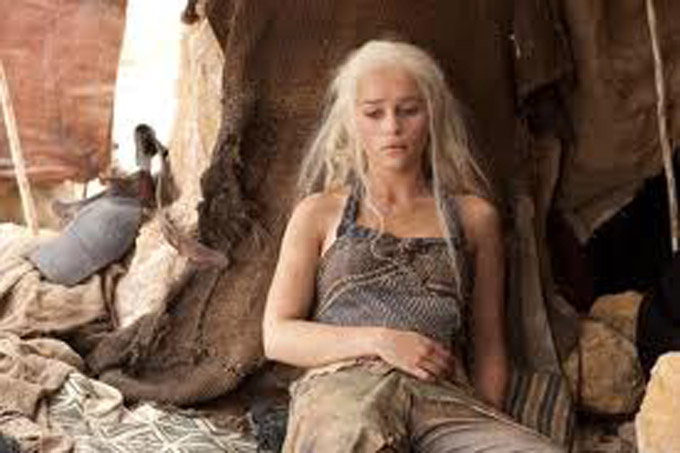
Back when Game Of Thrones debuted a year ago, one of the stranger criticisms was that it was made about men, for men. Perhaps in those first few episodes, when it looked like the story of Ned Stark, Viserys Targaryen, Khal Drogo, King Robert, and Jaime Lannister, you could make that argument. Of course, those of us who had read the book knew that it wasn’t about them, not really. Indeed, the characters with the most agency in the first season are women: Danaerys, Cersei, and Catelyn, whose capture of Tyrion triggered the violent confrontation between Lannister and Stark.

nullIn fact, Game Of Thrones deliberately subverts the patriarchal system its characters are stuck in, with a set of strong female characters. In “What Is Dead May Never Die," we meet Brienne Of Tarth, a new member of Renly’s Kingsguard, and Renly’s new wife, Margaery Tyrell. They’ve been joined by Melisandre, the Red Priestess, and Yara Greyjoy. Combine that with the surviving strong women, and the increasingly excellent Arya Stark, and the idea that Game Of Thrones is anti-woman becomes increasingly ridiculous.
Its setting, however, is anti-woman. Westeros is literally built on patriarchy, thanks to its use of agnatic-cognatic primogeniture, in which the oldest male inherits everything, but a female can inherit if no male is in the line—Danaerys Targaryen is the most obvious example here. Therefore these women are officially powerless. But power, as Varys says, resides where men believe it resides, making it entirely possible for women to hold power.

Brienne of Tarth, for instance, introduced as the winner of King Renly’s tournament melee, appropriates the symbols of masculine power—a sword, armor, and so on. Cat tries to call her a “Lady” but Brienne objects, and there’s no feminine form of “Ser.” She appears to be a knight, and has the skills to be a knight, defeating Ser Loras one-on-one (Loras, if you’ll recall, would have won the Hand’s Tourney in the first season). But despite her clear ability, she’ll never be fully accepted, as Loras makes clear when he pushes Renly away for reminding him of his defeat. Brienne will always be fighting on two fronts: one for victory, another for acceptance.This episode did a fine job of introducing her character without making her the entire focus.

If she’d been born ten years earlier, Arya Stark might have been just like Brienne. A younger daughter of a lord, and one far more gifted in martial arts than marital ones. But the patriarchal system sees daughters as wives for alliances, or when things go wrong, as hostages for good behavior. Arya never wanted the former, and used her physical skills to escape from the latter. But that didn’t save her. She’s on the run with a ragtag bunch of Night’s Watch recruits, and the memory of her father’s execution haunts her. When she and the Watch recruiter, Yoren, discuss their dreams of revenge, Yoren talks to her as an equal, albeit a much younger one. But that brief moment of bonding is interrupted by a Lannister attack, leaving Yoren dead and Arya captured:

Princess Myrcella, Joffrey’s rarely-seen younger sister, is a tool of the patriarchy. Beset by enemies in the capital, Tyrion seeks to use her to form an alliance—and use that alliance to figure out who, on the council, is a traitor. He proposes wedding Myrcella to, in order, the neutral and remote House Martell of Dorne (which we’ve never seen), Theon Greyjoy, to sow discontent with the northerners, and Robin Arryn. Myrcella is just a pawn, both for the alliance and for Maester Pycelle to demonstrate that he is the queen’s mole in the Small Council.

Queen Cersei, the biggest villain of the series, takes on new depth when viewed through this lens.Cersei struggles against the sexism of the patriarchal system of the Seven Kingdoms, yes, but she also wants to maintain its power for entirely selfish reasons when she’s on top. She wants to rule like a king (saying that she should be the one “to wear the armor” in the first season), and also be free to keep and protect her children, like Myrcella. Viewed in this fashion, Cersei is less a stereotypical villain than a complex, ambitious, short-sighted woman. Lena Headey was my least favorite actor in the first season, relying far too much on scrunching her face/tilting her up in order to demonstrate every emotion, but given the chance to go bigger with her acting, yelling at and shoving Tyrion, she does well.

But the star turn in the episode comes from Natalie Dormer as Margaery Tyrell. Margaery is, like Myrcella, a pawn in an alliance by marriage between Renly Baratheon and her father, Mace Tyrell, Lord of The Reach (with Dorne, the other of the Seven Kingdoms we’ve seen nothing of). Margaery knows the rules of the game: she exists to make an alliance with the strongest of the kings in the civil war, and that’s an alliance that will only be settled once Renly impregnates her.

This leads to my favorite scene in the episode, where Margaery attempt to seduce the gay King Renly:

He’s unable to perform, so she offers to bring her brother Loras, Renly’s lover, in to help. It’s a statement that could be uncomfortable, much like Theon and Yara’s interlude last week, but Dormer makes the audaciousness of it seem innocent, and makes her ambition seem perfectly reasonable. “Whatever you need to do. You are a king.”

The sprawling cast of characters is one of Game Of Thrones’ biggest potential weaknesses. Keeping track of events in four or five different locations proved one of the bigger barriers to entry for new viewers. Introducing Renly’s court could have been another problem. But, as with the Greyjoys in Pyke, and Stannis’ court at Dragonstone, the important characters are introduced with confidence and style.

Adaptation:

Margaery’s portrayal in the show is, in a single scene, deeper than her portrayal in the books, where she’s primarily a cipher. I expected this to happen given how much weight her casting was given in the show’s media between seasons, but it turned out even better than I expected. Yet again, the show does some of its best work when it diverges from the text on the page. Both the Margaery/Renly scene and the Arya/Yoren scene were new.

I’m less certain about accelerating Shae’s storyline to make her Sansa’s maid. The bigger issue is that their dynamic immediately makes Sansa look bad for talking down to her help, even as we should be building sympathy for the Stark hostage. Likewise, Yara/Asha continues to feel more like an extension of Balon Greyjoy than her own character, as she was in the novel.

Finally, no sign of Dany or Robb this week, which may be surprising to viewers, but won’t be to readers. I understand some things have been added or shifted around in order to give these characters more to do this season than they had in the books. Since most of the show’s changes to the text have been more beneficial than detrimental, I’m looking forward to these alterations.

Rowan Kaiser is a freelance writer currently living in the Bay Area, who also writes for The A.V. Club and has been published at Salon, Gamasutra, Kotaku, and more. Follow him on Twitter @rowankaiser.

VIDEO – Motion Studies #21: Outer Space

VIDEO – Motion Studies #21: Outer Space

From now through April, the Oberhausen International Short Film Festival will present "Film Studies in Motion", a Web Series curated by Volker Pantenburg and Kevin B. Lee. This series, available on the festival's website and Facebook page, presents weekly selections of analytical video essays on the web, in preparation for Pantenberg and Lee's presentation  "Whatever happened to Bildungsauftrag? – Teaching cinema on TV and the Web", scheduled for April 28 at the festival.

Week Four: Precursors: TV, Cinema, Contemporary Art

There is a a tradition of “Videographic Film Studies” that existed before the Internet. Some TV channels, like the West-German WDR, but also TV programmers in other countries, initiated an impressive variety of programmes on cinema that combined thorough analytical observations with an inventiveness of visual forms and techniques. Found footage has also been used in experimental cinema and contemporary art. Most examples of this audiovisual legacy remain either overlooked or invisible as they are stacked away in archives or private catalogues. For this reason, this episode mostly gathers fragments and snippets instead of entire essays.

Today's selection:

Outer Space 

Peter Tscherkassky (1999)

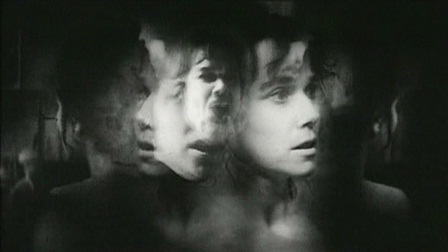
"Cannibalizing Sidney J Furie's 1982 Barbara Hershey horror film The Entity, the story of a woman who is continually assaulted and raped either by real ghosts or by awfully adept repressed traumas… The screen literally explodes with a tumult of Hershey faces, shattering Steve Burum's original cinematography into shards of frightened eyes, trembling hands, and violent outbursts of self-defense, presented in multiple exposures too layered to count, too arresting to ignore. Each frame is further entangled with details revealed by a jittery effect (a primitive traveling matte?) which spills fluttering ectoplasmic lightpools from one cubist aspect of the woman to another. The filmmaker mimics the action of nightmares by condensing the original imagery of the feature and displacing it into a new narrative — as in dreams, a narrative not explicitly linked to actual events, but emotionally more true than any rational explanation. Tscherkassky's shorts are actually considerably more terrifying than the original material."
– Guy Maddin

View all Motion Studies video selections.

Volker Pantenburg is assistant professor for moving images at the media faculty of the Bauhaus-Universität Weimar. 

Kevin B. Lee is Editor in Chief of IndieWire’s PressPlay Video Blog and contributor to Roger Ebert.com. Follow him on Twitter.

VIDEO ESSAY: Ceylan’s Faces – A Portrait Gallery of Three Films

VIDEO ESSAY: Ceylan’s Faces – A Portrait Gallery of Three Films

Who are the greatest directors of faces in movie history? When you think of great films that could double as portrait art, there’s Carl Dreyer’s The Passion of Joan of Arc, Ingmar Bergman’s Persona, and just about any film by Federico Fellini or Robert Bresson, to name a few. Of course there are countless movies graced by memorable faces, enabled by expressive performers and highly talented cameramen and crew. But what sets the films listed above apart from the glamourous pack is a specific, individualized way of looking at a face. It’s a vision that does more than express beauty, but conveys an idea of people and how to look not just at them, but into them. All of those aforementioned directors have passed on, so who today carries this torch?

Although I’ve previously paid tribute to the unmistakable portrait art talents of Steven Spielberg, here I bring attention to the recent work of Nuri Bilge Ceylan, arguably the most accomplished filmmaker to ever emerge from Turkey. His last four films have all won prizes at the Cannes Film Festival, with the most recent, Once Upon a Time in Anatolia, sure to make many top ten lists this year. (Ceylan will be receiving Cannes Directors’ Fortnight Carrosse d’Or prize in 2012.)

Much has been written about his films’ masterful explorations into the dark mysteries of human behavior, set against a canvas of stunningly composed visuals. For me, the anchor point that joins together his world of shadowy emotions and precise visuals are the many gorgeous shots of human faces. This video essay assembles several of these shots into a kind of moving portrait gallery, exploring this motif through his last three films, Climates, Three Monkeys and Once Upon a Time in Anatolia (the first two titles are available on Fandor). Of course the images wouldn’t be possible without the consistently stunning work of cinematographer Gökhan Tiryaki, as well as a revolving ensemble of professionals and non-professionals alike, each graced with their own distinct visage.

Originally published on Fandor. Read the full essay companion to the video.

VIDEO – Motion Studies #19 and #20: “Telephones” and “Home Stories”

VIDEO – Motion Studies #19 and #20: “Telephones” and “Home Stories”

From now through April, the Oberhausen International Short Film Festival will present "Film Studies in Motion", a Web Series curated by Volker Pantenburg and Kevin B. Lee. This series, available on the festival's website and Facebook page, presents weekly selections of analytical video essays on the web, in preparation for Pantenberg and Lee's presentation  "Whatever happened to Bildungsauftrag? – Teaching cinema on TV and the Web", scheduled for April 28 at the festival.

Week Four: Precursors: TV, Cinema, Contemporary Art

There is a a tradition of “Videographic Film Studies” that existed before the Internet. Some TV channels, like the West-German WDR, but also TV programmers in other countries, initiated an impressive variety of programmes on cinema that combined thorough analytical observations with an inventiveness of visual forms and techniques. Found footage has also been used in experimental cinema and contemporary art. Most examples of this audiovisual legacy remain either overlooked or invisible as they are stacked away in archives or private catalogues. For this reason, this episode mostly gathers fragments and snippets instead of entire essays.

Today's selections:

Home Stories 
Matthias Muller (1990)
The most unmistakable forerunners of the supercut come from the end of the 20th and start of the 21st century. For Home Stories (1990), Matthias Müller fashioned an elliptical narrative out of a host of very similar scenes from Hollywood melodramas. Pastel-decked women linger in large, well-ornamented rooms, all lying down, throwing their heads back and forth, hearing something, turning on a lamp, looking shocked, slamming doors. Funny in their sameness, the women also unearth a disturbed core to the gilded dreams of ‘50s America. 
– Tom McCormack, Moving Image Source

Telephones
Christian Marclay (1995)
Christian Marclay's "Telephones" (1995), a 7 1/2-minute compilation of brief Hollywood film clips that creates a narrative of its own. These linked-together snippets of scenes involve innumerable well-known actors such as Cary Grant, Tippi Hedren, Ray Milland, Humphrey Bogart and Meg Ryan, who dial, pick up the receiver, converse, react, say good-bye and hang up. In doing so, they express a multitude of emotions–surprise, desire, anger, disbelief, excitement, boredom–ultimately leaving the impression that they are all part of one big conversation. The piece moves easily back and forth in time, as well as between color and black-and-white, aided by Marclay's whimsical notions of continuity.
– From description on YouTube 

View all Motion Studies video selections.

Volker Pantenburg is assistant professor for moving images at the media faculty of the Bauhaus-Universität Weimar. 

Kevin B. Lee is Editor in Chief of IndieWire’s PressPlay Video Blog and contributor to Roger Ebert.com. Follow him on Twitter.

VIDEO: The Hardcore History Lessons of Koji Wakamatsu

VIDEO: The Hardcore History Lessons of Koji Wakamatsu

WARNING: This video contains explicit sexual and violent content and is intended for mature audiences. Parental discretion is advised.

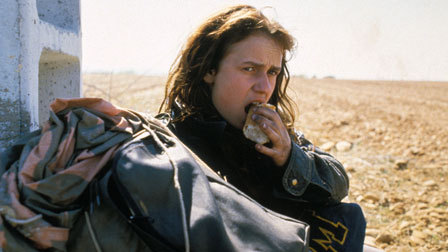
Koji Wakamatsu—known as the Godfather of the pink movie, a genre of Japanese softcore exploitation films that started in the 1960s—has made over 100 movies, and is enjoying the most acclaimed period of his career thanks to two recent films that have much more on their mind than sex. Both films, United Red Army (2007) and Caterpillar (2010), are available on Fandor. This video essay explores how these films amount to hardcore history lessons: Wakamatsu uses low-budget exploitation filmmaking techniques to cast a critical eye on Japanese history during periods of prevailing militant ideology, as well as a brutally honest assessment of human nature.

Originally published on Fandor. Read a transcript of this video.

Kevin B. Lee is Editor in Chief of IndieWire’s PressPlay Video Blog and contributor to Roger Ebert.com. Follow him on Twitter.

VIDEO – Motion Studies #17: Harun Farocki and WDR

VIDEO – Motion Studies #17: Harun Farocki and WDR

From now through April, the Oberhausen International Short Film Festival will present "Film Studies in Motion", a Web Series curated by Volker Pantenburg and Kevin B. Lee. This series, available on the festival's website and Facebook page, presents weekly selections of analytical video essays on the web, in preparation for Pantenberg and Lee's presentation  "Whatever happened to Bildungsauftrag? – Teaching cinema on TV and the Web", scheduled for April 28 at the festival.

Week Four: Precursors: TV, Cinema, Contemporary Art

There is a a tradition of “Videographic Film Studies” that existed before the Internet. Some TV channels, like the West-German WDR, but also TV programmers in other countries, initiated an impressive variety of programmes on cinema that combined thorough analytical observations with an inventiveness of visual forms and techniques. Found footage has also been used in experimental cinema and contemporary art. Most examples of this audiovisual legacy remain either overlooked or invisible as they are stacked away in archives or private catalogues. For this reason, this episode mostly gathers fragments and snippets instead of entire essays.

Today's selection:

Cinéma Cinémas (1982-1991, Antenne 2) 
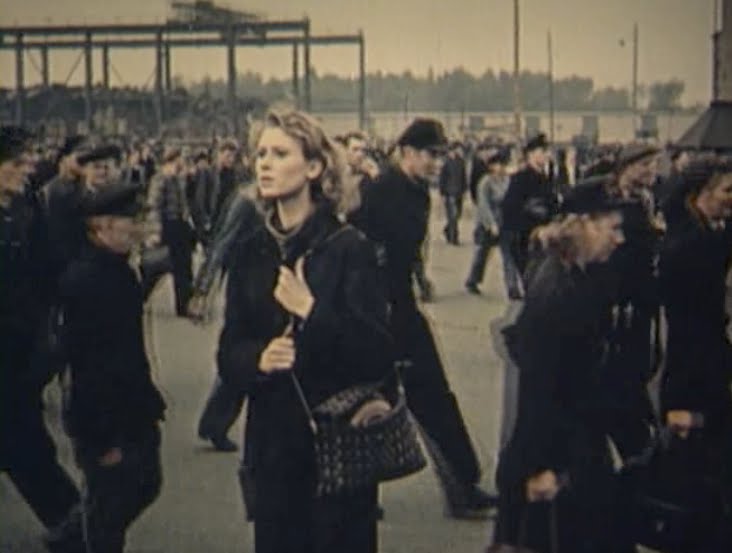
Harun Farocki: Workers Leaving the Factory (1995, excerpt)

A major figure in the genre of essay film and video, Harun Farocki combines a precise formalist analysis of images with exhaustive research into the history behind those images. Farocki does not merely use archival images to tell stories of modern society, but shows how images convey unexpected stories and meanings, often unintentionally by their creators. In this clip from Workers Leaving the Factory, he uses the first film ever shown on screen to launch into a visual exploration of how factories have been depicted throughout the 20th century, and what those images say about our relationship to industrial labor. 

View all Motion Studies video selections.

Volker Pantenburg is assistant professor for moving images at the media faculty of the Bauhaus-Universität Weimar. 

Kevin B. Lee is Editor in Chief of IndieWire’s PressPlay Video Blog and contributor to Roger Ebert.com. Follow him on Twitter.

VIDEO ESSAY: The #1 Textbook on Film, Now with Video

VIDEO ESSAY: The #1 Textbook on Film, Now with Video

Walk into just about any introductory film studies class in the United States and you are bound to find students holding a copy of David Bordwell and Kristin Thompson's Film Art: An Introduction as part of the syllabus. Since it first came out in 1979, the film has been an essential film studies resource, as well as an innovative one: it was the first intro level film textbook to use actual frames from movies rather than publicity stills in order to give an accurate illustration of film technique on screen. For the new tenth edition, Bordwell and Thompson have taken the book into the new dimension of online video.

Through a partnership with the Criterion Collection, Bordwell and Thompson, with the help of filmmaker Erik Gunneson, have produced an hour-long series of twenty online videos called Connect Film. The videos, meant as companions to the Film Art textbook, explore major concepts of mise-en-scene, cinematography, editing and sound, through films mostly from the Criterion Collection: Breathless, Seven Samurai, Shaun of the Dead, M. Hulot's Holiday, M and several others. They also explore concepts in computer animation through a couple of independently produced animated films, My Dog Tulip and Sita Sings the Blues. A full list of the videos can be found on Bordwell and Thompson's blog

The complete set of videos will be released this summer along with the publication of the new edition of Film Art. They have made one video available, an analysis of eliptical editing in Agnes Varda's Vagabond, embedded at the top of this entry.

It's worth noting how they adopt a simple, modular approach to the video. It opens with a brief synopsis of the story illustrated with still images instead of moving film footage. As a video essayist who generally prefers to use moving rather than still images, I was struck by this decision to go the opposite direction. It's notable how the montage of still images moves briskly alongside Thompson's narration, with specific images accompanying the points being made in her voiceover. To do this with moving footage would have required more length and spacing out of the narration, in order to let the moments play out. 

But this introduction is really intended to set up the central section in which eliptical editing is featured and analyzed in a sequence lasting a little over two minutes. It's worth noting how the sequence is left intact without editing, commentary or annotation, a contrast to most online video essays I've seen. The commentary on the sequence is saved for the final third of the video, where Thompson's commentary is again accompanied by still images, this time from the sequence. Here it's particularly interesting that stills are used in place of footage as Thompson describes actions rather than having the footage illustrate them. This approach benefits Thompson's analysis as some of her obsrevations are underscored by the expressive qualities of a freeze frame: the quality of Mona's smile while in the tent, the "No Tresspassing" sign, the friendly expression of the supposedly vicious dog. This approach also seems carried over from Bordwell and Thompson's extensive use of still images in textbooks; in this sense, longstanding techniques are made anew in the video medium.  

To see how differently one can approach the format, watch the video essays I produced with Thompson on La Roue and Variety back in 2009 as part of my Shooting Down Pictures project. In these videos her voiceover runs through footage of the films. In those instances the technique I used, which one could term "interwoven", "immersive" or "invasive" (depending on how positive or negative a connotation you want to append to it). could be more justified as the commentary is directed more towards the film in general rather than focusing on a specific sequence. The approach used in the Vagabond video has an admirable cleanness and precision that preserves the audiovisual integrity of the scene and also establishes an observational distance between the narrator and the work.

The exciting subtext that lies beneath the analysis above, and beneath the very fact that two leading film scholars have produced a formidable body of video work, is that the line dividing filmmaking and film analysis is collapsed and the areas of theory and practice are integrated as never before. This perspective, that film students and enthusiasts are filmmakers and vice versa, is espoused in vivid terms by Bordwell and Thompson themselves, in the first chapter of the new edition of Film Art, as quoted from their blog:

Films are designed to create experiences for viewers. To gain an understanding of film as an art, we should ask why a film is designed the way it is. When a scene frightens or excites us, when an ending makes us laugh or cry, we can ask how the filmmakers have achieved those effects.

It helps to imagine that we’re filmmakers too. Throughout this book, we’ll be asking you to put yourself in the filmmaker’s shoes. This shouldn’t be a great stretch. You’ve taken still photos with a camera or a mobile phone. Very likely you’ve made some videos, perhaps just to record a moment in your life—a party, a wedding, your cat creeping into a paper bag. And central to filmmaking is the act of choice. You may not have realized it at the moment, but every time you framed a shot, shifted your position, told people not to blink, or tried to keep up with a dog chasing a Frisbee, you were making choices.

If you take the next step and make a more ambitious, more controlled film, you’re doing the same thing. You might compile clips into a YouTube video, or document your friend’s musical performance. Again, at every stage you make design decisions, based on how you think this image or that sound will affect your viewers’ experience. What if you start your music video with a black screen that gradually brightens as the music fades in? That will have a different effect than starting it with a sudden cut to a bright screen and a blast of music.

At each instant, the filmmaker can’t avoid making creative decisions about how viewers will respond. Every moviemaker is also a movie viewer, and the choices are considered from the standpoint of the end user. Filmmakers constantly ask themselves: If I do this, as opposed to that, how will viewers react?

These are words well keeping in mind for all the video essayists, film scholars and movie fans out there.

In addition to the videos I made with Kristin Thompson, you can also watch a video essay I produced based on David Bordwell's review of Oxhide II.

Kevin B. Lee is Editor in Chief of IndieWire’s PressPlay Video Blog and contributor to Roger Ebert.com. Follow him on Twitter.

.