VIDEO ESSAY: From the Panel to the Frame: Style and Scott Pilgrim

VIDEO ESSAY: From the Panel to the Frame: Style and Scott Pilgrim

Why do the same concepts get recycled and reinterpreted in so many different media, and what does that do to storytelling? Filmmaker Drew Morton poses that question in his video essay “From the Panel to the Frame: Style and Scott Pilgrim.” The piece, which was originally produced as a part of a doctoral dissertation, uses the 2010 Edgar Wright film Scott Pilgrim vs. the World as a springboard to talk about how videogames, movies and comic books influence each other—and how you can often see the aesthetic roots of one medium represented in another, in a way that feels increasingly relaxed and organic. (Press Play contributor Matthias Stork has also dealt with this issue in this piece.)

Morton isn’t talking about adaptation here—turning a book into a movie, for instance, or a movie into a TV series. This is something else. As he puts it in his video essay, it’s more about reproducing or reimagining one medium’s aesthetic within the context of another medium: not just adapting Bryan Lee O’Malley’s original Scott Pilgrim comics, but making the film look and move and somehow feel like those books, to the point of quoting specific panels.

There’s a specific academic term for this phenomenon: “transmediation.” Morton explores that, too. He uses examples from Scott Pilgrim, the Matrix universe, Sin City, and other stories, or “properties,” that unfold across different media to prove that the boundaries that supposedly separate those media are more porous than we may have thought. The “bullet time” scene in the original Matrix movie, for instance, was a great cinematic moment, but it wouldn’t have existed without the aesthetic of mid-‘90s videogames that tried, in their ostentatious yet primitive way, to look three-dimensional. And when Time-Warner, the company that released The Matrix, decided it had another Star Wars on its hands, it commissioned videogames that fans found disappointing because they wanted something that felt like the movies, only game-like, and the games didn’t deliver.

These are slippery subjects to analyze, but Morton never loses his grip here, and the final section—a detailed analysis of the style of Wright’s film—is dazzling. He talks about how Wright folds representations of comics, videogames and music into a movie based on a comic book that was itself strongly inspired by videogames, and in so doing, creates a “re-remediation.” If you tried to represent that on a page, it might look like a bunch of parentheses inside one big parenthetical, or maybe a line drawing of a Russian nesting doll, animated, with each layer’s shell cracking to reveal the layer beneath, each pop commemorated by a point value materializing in space and hanging there. Fifty points! A hundred! Next level!

Click and watch.

Matt Zoller Seitz

Drew Morton is a Ph.D. student in Cinema and Media Studies at UCLA. He has written about film and television for such publications as the Milwaukee Journal Sentinel, UWM Post, and Flow. He is currently researching the aesthetic convergence between comics and film.

Matt Zoller Seitz is the co-founder of Press Play.

VIDEO ESSAY: Beautiful Nightmares: David Lynch’s Collective Dream

VIDEO ESSAY: Beautiful Nightmares: David Lynch’s Collective Dream

David Lynch could be a wonderful stage director.

Crazy to say, perhaps, but perhaps not. Despite his relentless visual craftsmanship and tests of the limits of that craftsmanship, parading images in front of us that are luscious even when you can barely tell what’s being filmed, there is always an aspect of the staged to every film he makes. Part of it is his privileging of the naked, screaming utterance, from Lula’s “Sailor Ripley, you get me some music on that radio this instant, I mean it!” in Wild at Heart to Frank’s “I’ll fuck anything that MOOOOOOOOOOVES!” in Blue Velvet. These statements always have an ersatz quality to them, as if they were plucked out of another conversation and dropped into the movie at hand. It’s hard to link them, directly, to their contexts—and that incongruity is what makes them memorable. But, ultimately, they come to express truths about the people saying them, as if he, she, or it simply couldn’t wait any longer, just had to burst out with a plume of vulgar, unrestrained self-expression. We laugh, a little, when Sailor Ripley asks, “Did I ever tell ya this here jacket represents a symbol of my individuality, and my belief in personal freedoms?”—but we also don’t. Though Lynch is, in a sense, a truly joyous filmmaker–in that he’s able to transcend scenes of tremendous violence and energy that would pretty much eat up any other filmmaker’s intentions from the inside out, instead making them part of a grand and coldly perfect scheme–he is also, to state the wholly obvious, someone who thrills in catching us off guard, a crucial trick of theater. Why does Robert Blake’s white-faced, ghoulish menace laugh like that in Lost Highway? What’s he laughing at? What could possibly be that funny? Where’s the laugh coming from? No one knows. What’s important, though, is that he’s laughing. The laugh itself has significance beyond what precedes or follows it, and it doesn’t leave you.

And then there’s the matter of the act of performance in his films. In how many of his movies does someone perform, in some sense, so that we watch them doing something they would not normally do, often in a virtuosic fashion? Well, let’s see. There’s Isabella Rossellini's Dorothy Vallens, singing the title song in Blue Velvet (not to mention Dean Stockwell’s brilliant Roy Orbison lip-synching, by now a milestone in the cinematic education of anyone my age, though the scene itself has no purpose within the film’s storyline), there’s Agent Cooper’s talk-show-esque conference, in a room lined with red curtains, with Laura Palmer and the Man from Another Place in Twin Peaks; there’s Betty Elms' (Naomi Watts) orgasmic and career-making audition in Mulholland Drive, and, later in the same film, Rebekah Del Rio’s performance of “Llorando” in an old theater, to name but a few examples. These scenes occupy an inherently elevated position, as if Lynch were saying: This is what the film can really do for you—all the rest of this stuff is just work. This film will never be any better, or these characters any more exalted, than at this moment. And the scenes always have a hypnotic effect; as we watch, we suspend whatever we might be feeling—horror, revulsion, elbow-deep irony—and simply observe, excited at the thought of what Lynch might be about to offer us. Once the moment has passed, we don’t analyze it or question it. We know the scene is indispensable, but we have no idea why.

And what about Lynch’s characters themselves? There are very few of his major figures that can be said to be simply “getting through the story” in a utilitarian fashion—almost all of them have exaggerated traits that make the arcs they move through larger than life. Think of Willem Dafoe’s hit man Bobby Peru in Wild at Heart, whose rotting, dilapidated teeth alone describe an entire life story; or Kyle MacLachlan's Jeffrey Beaumont, his untouched face ravaged by the end of Blue Velvet. Nicolas Cage’s Sailor Ripley is, himself, a walking metaphor for the redeeming power of performance. On the point of being beaten up by a group of thugs at the end of Wild at Heart, Sailor’s last recourse is, like a good performer, to put a good face on things, maintain his Elvis-esque persona, and take his beating. And the moment when Jeffrey Beaumont does the duck walk while courting Sandy Williams in Blue Velvet has the vaguely rhapsodic, pastoral quality of a scene from Eugene O’Neill, something from Ah, Wilderness, say. It’s not a real moment, since the gesture is neither a declaration of love or a shoving away of reality—and yet we have the sense it’s as real as these characters ever get.

A writing teacher, a poet and sometime playwright, once told me and the other students in his poetry class, after he’d asked us to write plays and we responded that we signed up to write poems: Close your eyes, imagine an empty stage, and then think of something you’d like to happen there. That’s your play. Oversimple as this advice might have been, as Lynch’s career has progressed, one might easily imagine he’s making a similar leap into creative desire to fashion films, as his seemingly random, aggressively disorienting and confusing work increasingly resembles the happenings staged by Allan Kaprow or the Fluxus artists who followed him, more than the more traditional "art films" his earlier works resembled. Even in his life outside his work, Lynch has a flair for the theatrical, as when, prior to the release of Inland Empire, he sat with a billboard at the corner of Hollywood and LaBrea Boulevards, his only companion at the time a large cow. Whether this was a publicity stunt, a satire of Hollywood film marketing, or both, its performative aspect was practically its entire content. The events that take place in Inland Empire, Mulholland Drive, or Lost Highway are not necessarily parse-able—who could explain the figures with rabbits’ heads wandering through Inland Empire? Who would want to try? You could, though, depending on your degree of sympathy with Lynch, say they made visual sense within the director’s larger body of work. And they are, beyond that, figures that hold your attention on screen while also encouraging a prilferation of interpretations. Can we say that of a majority of big-budget films? When was the last time you felt mystified at a multiplex?

It is, as suggested earlier, silly to say, of a filmmaker or an artist in another medium, He could have been X, as if X were the ultimate destination, the artist’s current accomplishment only a way station. However, in Lynch’s case, what I want to suggest is that the source of his power is less the ability to shock than the ability to shout. It is through this ability that Lynch’s characters gain their great gravitas, his movies their substance. It seems entirely conceivable that, thousands of years ago, when actors were screaming into the depths of Greek amphitheaters, their statements, far from being the golden-tongued outcries of rage we’ve come to expect, might have been, in the context of their time, closer to this:

“Heineken? Fuck that shit! Paaaaaabst Bluuuuuuue Riiiiiiibbon!”

–Max Winter

Nelson Carvajal is an independent digital filmmaker, writer and content creator based out of Chicago, Illinois. His digital short films usually contain appropriated content and have screened at such venues as the London Underground Film Festival. Carvajal runs a blog called FREE CINEMA NOW which boasts the tagline: "Liberating Independent Film And Video From A Prehistoric Value System."
You can follow Nelson on Twitter here.

Max Winter is the Managing Editor of Press Play.

VIDEO ESSAY: Who Should Win the Oscar for Best Supporting Actress

VIDEO ESSAY: Who Should Win the Oscar for Best Supporting Actress

For

Part of "Who Should Win," a series of video essays co-presented by Indiewire Press Play and Fandor.

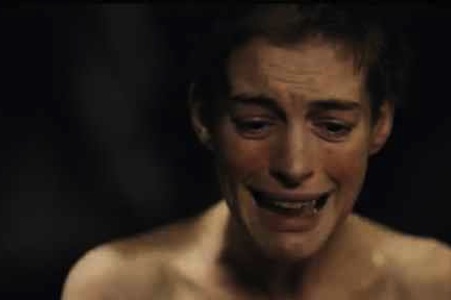
Anne Hathaway is the favorite to win Best Supporting Actress as Fantine in Les Miserables, and that’s just wrong for three reasons. First, she gave a much richer performance as the sly Selina Kyle in The Dark Knight Rises. Second, she’s not even the best supporting performance in Les Miz—that honor goes to Samantha Barks, who’s more nuanced as Éponine—but of course, Éponine always gets overlooked. I think Anne Hathaway is a great actress, but this is the worst performance in this category. It’s a sad puppy act pitched at shrieking full volume, while ripping off Sinead O’Connor and Falconetti’s Joan of Arc. This performance doesn’t just beg for an Oscar, it grovels for it.

Sally Field has won two Oscars, and she’s nominated again as Mary Todd Lincoln in Lincoln, playing an unstrung, emotional foil to the constantly composed president. Field brings an intelligence and dignity that gives an edge to her character’s moments of hysteria. She’s able to convey a mind that’s alert and articulate even when it spins in sadness.

Jackie Weaver is the surprise nominee for Silver Linings Playbook as a mother trying to deal with her son’s bipolar disorder. She has only a handful of lines, mostly appearing in cutaway reaction shots; it’s practically a silent movie-type performance, and not a bad one at that. Expressive even in her silence, she’s a graceful, accepting presence amidst a cast of crazies.

Amy Adams has roughly 20 minutes of screen time in The Master, and boy does she make the most of it. She gives a hand job, turns her eyes black and gives the stare of death while naked and pregnant. Her unnerving intensity casts a spectre over The Master—it’s a pity that she wasn’t utilized more. She practically deserves her own movie.

Another character who deserves her own movie is Cheryl Cohen-Greene, the sex surrogate played by Helen Hunt in The Sessions. Hunt has nearly twice as much screen time as any of the other nominees, which may give her an unfair advantage. But this is the most full-bodied performance of the five. Not just because Hunt appears fully nude, but because she conveys a generosity that gives the film intimacy, as well as intrigue. Hunt’s character helps a disabled man experience the joy of sex. Her confident voice and reassuring gestures make a bizarre situation seem perfectly normal. And just like her character, Hunt manages to give so much of herself while not giving herself away. It’s a performance within a performance, one that explores the personal boundaries of a very unique profession, whether it be sex therapy or screen acting.

Kevin B. Lee is Editor in Chief of IndieWire’s PressPlay Video Blog, Video Essayist for Fandor’s Keyframe, and a contributor to Roger Ebert.com. Follow him on Twitter @alsolikelife

VIDEO ESSAY: Gangster Culture in the Movies

VIDEO ESSAY: Gangster Culture in the Movies

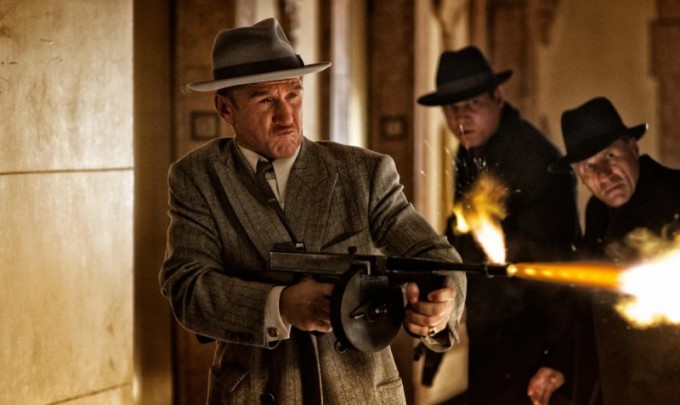
"He used to be a big shot." That's how a gangster's girlfriend describes him as she cradles his corpse at the end of The Roaring Twenties. But the line could be plugged into any gangster film that ends with a tough-talking, two-fisted, hot-tempered alpha male cooling his heels in prison, frying in an electric chair or bleeding out in an alley. In these films, death comes to kingpins and flunkies alike. If you're part of the underworld, you have to accept this as a given: one minute you're swaggering down the street with a curvy dame on your arm, thinking about your next big score and tipping bartenders $100 just for keeping the ice cubes cold, and the next minute you're being led into a room you thought would contain an open bar and a card game, only to find it empty save for two big guys with handcuffs and a couple of crowbars.

nullBut isn't it always thus, even for yeggs what's been to college? Death falls on the just and the unjust alike, on big shots and little fish. No genre save horror is as comfortable with the possibility, nay, certainty, of sudden, horrendously violent extinction. Gangster pictures are populated almost exclusively by characters who've made peace with that scary reality; deep down, everyone knows life could end at any moment, but the gangster feels it more acutely, living like there's no tomorrow because as far as he knows, there isn't one. What's the threat of prison to somebody whose line of work guarantees they might get plugged, stuck, beaten to a bloody pulp or run over with a shiny new car for the sin of being on the wrong side of the law, or a turf war, or history? And who wouldn't find a character like that appealing, especially if the story ends, as it invariably does, with the gangster getting ventilated like a Cagney character, checkmated into witness protection a la GoodFellas's Henry Hill, or pinched for tax evasion like Capone in The Untouchables? When we watch gangster films, we get to indulge the fantasy of living life without rules, plus a reminder of why people shouldn't do that: party on Saturday, church on Sunday, with a bit of the old ultraviolence tossed into the mix. No genre balances attraction and repulsion more deftly, or manages to be so immoral, amoral, and moralistic all at once. 

The gangster picture is as ritualized as the Western, and is in some ways the pessimistic antithesis of the western, a genre that was all about the future, about possibilities, about the likelihood of exerting will on the universe and remaking your life so that it resembles your fantasies. There's a reason why critics keep quoting Robert Warshow's piece "The Gangster as Tragic Hero" in essays like this one: because he sensed this link and elucidated it so beautifully. "Those European moviegoers who think there is a gangster on every corner in New York are certainly deceived," he wrote, "but defenders of the 'positive' side of American culture are equally deceived if they think it relevant to point out that most Americans have never seen a gangster. What matters is that the experience of the gangster as an experience of art is universal to Americans. There is almost nothing we understand better or react to more readily or with quicker intelligence. The Western film, though it seems never to diminish in popularity, is for most of us no more than the folklore of the past, familiar and understandable only because it has been repeated so often. The gangster film comes much closer. In ways that we do not easily or willingly define, the gangster speaks for us, expressing that part of the American psyche which rejects the qualities and the demands of modern life, which rejects 'Americanism' itself." Or as Henry Hill puts it, "To us, those goody-goody people who worked shitty jobs for bum paychecks and took the subway to work every day, and worried about their bills, were dead. I mean they were suckers. They had no balls." Henry, sweetheart, half-Mick, half-Guinea: wherever you are, on behalf of the silent majority of ball-less suckers who'll be queuing up for Gangster Squad this weekend no matter what the critics say, I salute you.–Matt Zoller Seitz

Nelson Carvajal is an independent digital filmmaker, writer and content creator based out of Chicago, Illinois. His digital short films usually contain appropriated content and have screened at such venues as the London Underground Film Festival. Carvajal runs a blog called FREE CINEMA NOW which boasts the tagline: "Liberating Independent Film And Video From A Prehistoric Value System."
You can follow Nelson on Twitter here.

Matt Zoller Seitz is the co-founder of Press Play.

VIDEO ESSAY: ON THE Q.T., CHAPTER 4: KILL BILL: The Female Archetype vs. The Goddess

VIDEO ESSAY: ON THE Q.T., CHAPTER 4: KILL BILL: The Female Archetype vs. The Goddess

Volume 1:

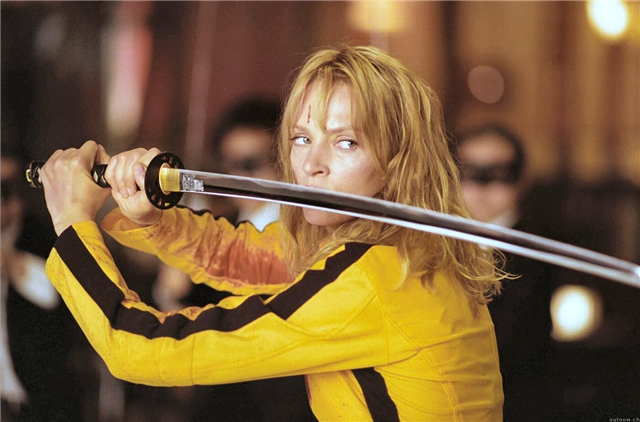
Withhold information, then release it. Set up expectations, then subvert them. Tease, then gratify. This is how you construct an epic. This is how Quentin Tarantino, block by block, builds up Kill Bill. It's disorienting at first. The story starts in medias res, and you have to stop and ask yourself, "Who is this woman? How did she get here?" Then you wait a long time for any real answers. But that's Tarantino's game. That's how he draws audiences into his vision, makes us crave more detail, makes us really feel the size of the story. He wields information like the Bride swings her Hanzo sword: aggressively but precisely, every expository word dropped just where it needs to be. Because as Tarantino is well aware, few moviegoing phenomena are as pleasure-inducing, as viscerally satisfying, as the one we call a surprise. Confusion, then clarity. That two-step process is the key to Kill Bill's thrills.

The most obvious technique by which Tarantino sets and springs these traps is also the one most closely identified with his name: nonlinear narrative. Reservoir Dogs, Jackie Brown, and Pulp Fiction each employed those loops and curlicues from present to past and back again to an extent, but here it's magnified. Volume 1 alone jumps with wild abandon across a span of four and a half years, and even travels back decades for "The Origin of O-Ren." So we get a series of revenge narratives—O-Ren's, the rape-revenge tale of Buck and the Bride, the vengeance she extracts from Vernita Green—nested inside one another like Matryoshka dolls, illustrating Hattori Hanzo's adage that "revenge is never a straight line. It's a forest." The Bride's lost there, and so are we, wandering from one intertwining cycle of violence to another, trying to pick up clues and context as we go along.

Let's zero in on that fight with Vernita, the suburban homemaker. First and most obviously, it's a fight. It's audience-sating spectacle. But it also undercuts expectations by ending abruptly just after Vernita suggests that "we have ourselves a knife fight." It throws us off balance. Then it uses Vernita's daughter to suggest that although this particular fight may be over, the Bride's vendetta is starting a wildfire. Finally, it flashes two unexplained details across the screen: the name "O-Ren Ishii," scrawled in pen but crossed out, and the words "Pussy Wagon" emblazoned on the back of our heroine's flamboyant yellow truck. Their respective meanings are as yet unknown to us, but they imply a recent, bloody past. This, all of this, is what critic Jim Emerson describes as the movie "teach[ing] you how to watch it." In this short vignette, we learn that although Kill Bill may be action-packed, its action will be morally and structurally complicated. And we learn that, as the saga grows more and more textured by detail, we won't necessarily understand how all those details fit together. Explanations lie buried in the Bride's past, as well as in her future.

Another device Tarantino uses to tease us while easing us into each new portion of Kill Bill is perhaps his most traditional: the title card. Both movies are punctuated by them, demarcating narrative borders with their suitably oblique chapter headings. "The Blood-Splattered Bride," for example, or my personal favorite, "The Man from Okinawa." So suggestive, so tantalizing, telling us just enough about Hattori Hanzo without telling us anything at all. It reminds me of Tarantino's own short "The Man from Hollywood," or one of his major inspirations, Leone's "Man with No Name." Or farther afield, the film Vivre sa vie by Tarantino's idol, Jean-Luc Godard, which employs similar intertitles but to more overtly Brechtian ends. The phrase "The Man from Okinawa" is so taciturn that it sets a stage without spoiling any of Sonny Chiba's surprise, revealing that he isn't just a man—he's the man.

This strategy pays off heavily when we actually meet Hattori Hanzo. Although he's posing as a buffoonish sushi chef (like the Bride, who's posing as a clueless tourist), that title card has primed us to see Hanzo as a crucial, enigmatic figure. And sure enough, their mutual ruse wraps up the second she starts speaking fluent Japanese. No matter how thoroughly they change their appearance or lifestyle, every one of Kill Bill's warriors remains a function of their messy, blood-soaked past, a past now embodied by the resurrected Bride. So for the viewer, the story becomes a daisy chain of revelation and revenge; a 4-hour epistemic quest tackling questions like "who?" and "why?": Who was this person in a past life? Why did they hurt the Bride? How, in the end, will she kill them?

As each of these mysteries is stripped away, we get closer and closer to the absolute truth, which lies deep inside the Bride's relationship with Bill.

Volume 2:

The climax of Kill Bill Volume 1, "The Showdown at the House of Blue Leaves," is as gargantuan as melees get. Dozens of bodies lie dismembered; O-Ren Ishii lies dead. It's all so huge, so satisfying, that even if Volume 2 were wall-to-wall carnage, there'd be no hope of topping it. So instead of trying to one-up all this swashbuckling and spilled blood, Tarantino delivers a pay-off that goes beyond action. He doesn't go bigger; he goes deeper, down into the relationship that prompted all this grisly revenge in the first place. Because the longer secrets go untold, the more potential energy they gather. For two hours now, we've been wondering: Who are these people, really? What's the Bride's real name? What does Bill look like? Our sustained curiosity supplies Volume 2 with its power.

Normally, seeing an actor's face is no big deal. But the pains that Tarantino takes to shoot around David Carradine in Volume 1 give his performance as Bill a halo, an aura of mystery. They turn him into what film sound theorist Michel Chion describes as an "acousmêtre": a being who derives power from being heard but not seen. And they root him in the tradition of other such masterminds: Bond archnemesis Blofeld, Inspector Gadget's Dr. Claw, and Charlie from Charlie's Angels. So we're forced to judge Bill from Carradine's soft, silken drawl alone—until, that is, he's introduced in the flesh through a visual nod to John Ford's The Searchers. Now, seeing the history etched into Carradine's weather-beaten face, we know we're getting close to the heart of the story; we can sense our proximity to Kill Bill's real, deep truth. After being hidden for so long, that face has an impact.

Contrast this with our introduction to Tommy Plympton, the Bride's fiancé. No fanfare, no impact, he's just there, played by makeup artist Christopher Allen Nelson in one of the saga's least stylized, least memorable performances. He has a few lines, but the only one that really stands out is "I guess I just believe in living dangerously" because it's so thick with unknowing irony. While alive, he's only defined through his relationship to the Bride, and after his death she doesn't mourn him. His only real significance is that he's so absolutely normal. He's never killed anyone and has no connection to the Bride's past. This alone, this lack of mythical back story, makes Tommy the ideal husband for the Bride and father to her child. He's her ticket to a stable, conventional life, the same kind pursued by Vernita Green, the same kind derided by Bill. Onscreen, he's a cipher. But symbolically, he's the opposite of Bill and a representation of this hypothetical future.

But no matter how fast and far you run, the past will always catch up with you. This is the moral of Kill Bill, the thematic basis for its labyrinthine chronology. Every act of violence, we learn, has a cause somewhere in the past and an effect somewhere in the future. Nothing is isolated. By killing Vernita, O-Ren, Buck, Elle, and Bill, the Bride thinks she can tie up all of her loose ends. But she never anticipates the loosest end of all: her daughter. B.B. is Volume 2's last-act bombshell, and her presence turns the Bride's last, titular objective into a complex, emotionally fraught showdown. If her grudge against Bill was about hate, no matter how intense, it would be much easier to deal with, but here Tarantino pulls a heartbreaking reversal: it's actually about love. It's about the Bride's moral obligation to kill the love of her life for the sake of her daughter. She has to sever all ties, cut herself and her daughter free, because that's the cost of a terminally impossible relationship.

Now all questions have been resolved. All these layers of mystery and secrecy have culminated in the Bride's single, poignant point: "She deserved to be born with a clean slate." That one desire, to bring B.B. into a world away from Bill, triggered all this plotting and bloodshed. This is the real pay-off Tarantino gives us, bubbling up from beneath the sheen of "cool," of fight choreography and stylization and homage. This is the real catharsis of Kill Bill. I don't often think of Tarantino's movies as being especially wise or profound, but I do think he gets relationships. Whether we're talking about Mr. White and Mr. Orange, Max Cherry and Jackie Brown, or Bill and the Bride, I think he understands how we invest ourselves in the people who are worst for us. The people who will hurt us. The people, metaphorically or otherwise, we may someday have to kill.

Nelson Carvajal is an independent digital filmmaker, writer and content creator based out of Chicago, Illinois. His digital short films usually contain appropriated content and have screened at such venues as the London Underground Film Festival. Carvajal runs a blog called FREE CINEMA NOW which boasts the tagline: "Liberating Independent Film And Video From A Prehistoric Value System."
You can follow Nelson on Twitter here.

Andreas Stoehr was born inside the Arctic Circle, has a BA in Cinema and Media Studies, and has written about film somewhere or other (especially on Pussy Goes Grrr and Twitter) since 2008. Passions include comics, dessert, and Marlene Dietrich.

ON THE Q.T., CHAPTER 3: JACKIE BROWN: Quentin and Pam’s Big Score

ON THE Q.T., CHAPTER 3: JACKIE BROWN: Quentin and Pam’s Big Score

[A script of the video essay follows:]

Quentin and Pam’s Big Score, Part 1

Things don’t look good for Beaumont Livingston. His self-proclaimed benefactor, Ordell Robbie, has just posted $10,000 to bail bondsman Max Cherry in exchange for Beaumont’s release. Armed with a pump shotgun and way too much information about Ordell’s gun-running business, Beaumont faces not only the inside of a trunk, but a potential 10 year rap unless he cooperates with the Feds. Ordell bails him out because he believes “Beaumont’s going to do anything Beaumont can to keep from doing them ten years, including telling the Federal gov’ment any, and every motherfucking thing about my Black ass.” Beaumont already has, and ATF agent Ray Nicolet is laying in wait for yet another of Ordell’s “employees,” a flight attendant with $50,000, an unbeknownst 42 grams of blow and no intention of declaring either at customs.

Mr. Livingston, I presume, expects Ordell to deliver on his promise of a late night chowdown at Roscoe’s Chicken and Waffles. That Los Angeles institution is tasty enough to make a brother spoon with a spare tire in a vintage American automobile. But in his haste and hunger, Beaumont Livingston forgot two things: One, all that greasy, fried shit’ll kill you. And two, if you’re a character in a Quentin Tarantino movie, and Samuel L. Jackson shows up looking like the Crypt Keeper and offering you a ride,

Don’t get in the car.

The Beaumont sequence is pure Tarantino—comic dialogue, loopy situations, sudden violence. But this scene is lifted from Elmore Leonard’s 1992 novel Rum Punch. And as much as Jackie Brown feels like a Tarantino film, the plot is faithfully Leonard’s. Tarantino wisely pulls entire sequences verbatim from Leonard’s pen, adding his own dialogue as stand-in for the novel’s expert descriptions of action and detail.   Leonard is a master of character creation, gritty conversation, and delightfully convoluted situation. A perfect match for Tarantino’s first, and thus far only, according-to-Hoyle adaptation, and the director is respectful to his source.

But like all great directors, Tarantino is a compulsive who must pay tribute to his obsessions. Obsessions like:

That last thing got him in some pretty hot water with Spike Lee.

With a love of Blaxploitation etched in his DNA, Tarantino had to notice that Rum Punch has elements of the genre. There’s a tough main character dame who’s strong enough to fend for herself, a hood criminal with a bevy of women and minions to do his business, and one final, big score designed to extricate the criminal from the ghetto for good. Blaxploitation movies rarely had all three of those things at once—a perfect opportunity for Tarantino’s brand of genre homage and transcendence.

The only minor issue was that Leonard’s heroine, Jackie Burke, was White. Tarantino needed Foxy Brown. The solution was obvious.

This, for the uninitiated, is Pam Grier. It takes Rum Punch 39 pages to introduce Jackie to us. Jackie Brown takes maybe   39 seconds.

Quentin Tarantino was 10 years old when Pam Grier starred in Foxy Brown, a film whose most unsavory plot aspect (and its resulting vengeance) he lifted for Kill Bill: Volume One.

Here, he lifts Foxy’s last name, her movie’s title font and her portrayer. Grier was the queen of Blaxploitation, wielding a shotgun, razors in her ‘fro and a take no prisoners attitude that was simultaneously terrifying and sensual. Jack Hill, who directed her in Foxy Brown, Coffy and two other films, said that Pam Grier had “that something special that only she has. She has ‘it’.” Hill could get a witness from any fan, for we knew: Not only did Pam Grier have “it,” she could whip your ass with “it” as well.

It’s obvious Tarantino wants to show the Grier toughness he loves, but he has deeper intentions. He wants to bring out her softer side as well. In her 70’s output, her vulnerability is physical. She is always abused yet always avenged. Outside of movies like Bucktown or Greased Lightning, she was rarely afforded a typical love story. We’ll talk about Tarantino fixes that next time. For now, flight attendant and money carrier Jackie Brown has to think quick and plan that big score fast. Ordell has bailed her out for the same reason he sprung Beaumont. Michael Keaton’s Ray Nicolet is breathing down her neck to squeal on Ordell, and Ordell has other intentions for her neck. Robert Forster’s Max Cherry, Jackie’s soon-to-be love interest, plays an unwitting part in the scene that got fans of Pam out of their seats in the theater. Herewith, the tough side of Pam Grier.

DAMN!

Quentin and Pam’s Big Score, Part 2

Welcome to the seduction of Max Cherry, writer of 15,000 bonds, survivor of 57 years on the Earth, newcomer to 70’s soul music. Male. Obviously not blind. Bearing witness to Jackie Brown, looking refreshingly like a normal human being and pressing a different kind of gun to his bone. She renders him helpless with the clarion call of her partners in crime,

“The Delfonics.”

Quentin Tarantino relishes putting a gun in Pam Grier’s hands, throwing us back to the good old days of Nurse Coffy, Sheba Shayne and Friday Foster. Her genre reputation precedes her, and one can almost hear QT cackle as he merges Brian DePalma’s split-screen, Jack Hill’s dialogue and an overzealous sound man’s rendition of that “CLICK” that accompanies that gun aimed at Ordell Robbie’s favorite toy. But this commandeering of DePalma and Hill serves the drama—Elmore Leonard crafted the Ordell-Jackie pas de deux in his novel, Rum Punch, to get us here. It’s Max’s gun Jackie’s stolen, and its retrieval leads not only to Max’s seduction but also to some of the most poignant dialogue Tarantino has scripted. Notice how delicately the camera moves in on Grier’s profile. It’s almost as if we’re eavesdropping on Pam and Robert, not Jackie and Max.

Jackie needs an ally like Max because The Big Score, that Blaxploitation staple designed to get one out of the hustle, involves Jackie smuggling half a million dollars of Ordell’s money from Cabo San Lucas.  She’ll do it under the nose of ATF agent Ray Nicolet, tricking him with a visible $50,000 that distracts Ray from a hidden $500,000. Max decides to help because he too wants to get out of his hustle. That, and because the Delfonics–pretty fucking persuasive.

Whom you trust is essential in any heist, and Ordell trusts his right hand man Louis. He and Louis were in the hoosegow together, and Ordell believes in honor amongst thieves, a common mistake amongst thieves. Additionally, Ordell has his bevy of women primed to do his bidding and, true to Blaxploitation form, ready to assist on The Big Score.

There’s aging Motown wannabe Simone, whose impressions of Diana Ross and Mary Wells hint that, though this pussy may be old, it’s real and it’s spectacular.

There’s Sheronda, country as a chicken coop, naïve as hell, and recipient of Ordell’s most hilarious putdown.

Then there’s Melanie, his “little Surfer Girl” whose excessive drug use disguises a truly cunning and vindictive mind. Of the dope use, Ordell tells her “that shit will rob you of your ambitions.” Melanie’s ambition is to rob Ordell of his money. So maybe the dope use is a good thing.

Ordell thinks this is his game, but “The Money Exchange,” the codename for The Big Score, is designed to favor Jackie Brown. He let her create it, he’s entrusting her to screw over the Feds, and he’s unaware of how deep her alliance with Max Cherry runs. It’s going to work, though, because Ordell thinks his scary disposition will keep his bitches in line and they will not—repeat will NOT—betray him.

The logistics of The Money Exchange are faithfully recreated from Dutch’s novel. But its execution is pure Tarantino. Cutting loose and succumbing to his love of time manipulation, QT presents the money swap from three characters’ perspectives: Jackie’s, Max’s, and the comic duo of DeNiro and Fonda’s Louis and Melanie. Each depiction focuses on its protagonist’s traits. Jackie is in control in hers, with a great little dialogue about an even greater little pantsuit. Louis and Melanie are antagonistic in theirs, culminating in a very violent Abbott and Costello routine involving a lost car. And Max’s version is cool, suspenseful and exciting, because he’s the one left holding the bag.  

When Ordell and Max drive to the final showdown with Jackie, the film uses The Delfonics’ 1971 classic, “Didn’t I Blow Your Mind,” as an almost subliminal reassurance that our heroes will succeed.  Jackson uses silence to great ominous effect here, a visual terror undercut by the lovely musical accompaniment from the car stereo. This is Jackie and Max’s song, and Jackie Brown is a romance, or as close to a romance as its director has ever been.

Rum Punch leaves its final scene ambiguous. Jackie Brown puts a bittersweet, old-fashioned finality to the proceedings, with the duo finally doing what we’ve been waiting all film for them to do.

As the final scene mirrors the first, we Blaxploitation fans revel in seeing our heroine once again prevail. We’ve been amused by Tarantino’s shorthand. And we’ve confirmed what we’ve known all along: A woman can only be tough 23 hours out of the day. That last hour, even the toughest chick needs to power down and meditate on her emotions.

Damn.

A globetrotting computer programmer by trade and movie lover by hobby, Odie Henderson has contributed to Slant Magazine's The House Next Door since 2006. Additionally, his work has appeared at Movies Without Pity (2008) and numerous other sites. He currently runs the blog Tales of Odienary Madness.

Jason Bellamy ruminates on cinema at The Cooler and is a regular contributor to Slant Magazine's The House Next Door, coauthoring The Conversations series with Ed Howard. Follow him on Twitter.

VIDEO ESSAY: BEAVER’S LODGE: THE BAD AND THE BEAUTIFUL (1952)

VIDEO ESSAY: BEAVER’S LODGE: THE BAD AND THE BEAUTIFUL (1952)

This is the sixth installment of BEAVER'S LODGE, a series of video essays narrated by actor Jim Beaver which will offer critical takes on some of Beaver's favorite films. Jim Beaver is an actor, playwright, and film historian. Best known as Ellsworth on HBO’s Emmy-award winning series DEADWOOD and as Bobby Singer on SUPERNATURAL, he has also starred in such series as HARPER'S ISLAND, JOHN FROM CINCINNATI, and THUNDER ALLEY and appeared in nearly forty motion pictures. You can follow Jim on Twitter.

Reckoned by many to be one of the best films about Hollywood, The Bad and the Beautiful is pungent and occasionally acidic, and at the time of its release a clear sign that things were changing in the movie capital. Even one or two years previously it would have been unimaginable for a major studio to release a film quite as disparaging of the people at the top of the heap in movie making.

Of course, sixty years have passed since this film, and much, much more biting and bitter films have been made about the way movies are created. But within the context of its time, and for the quality of its writing and much of its acting, The Bad and the Beautiful is a notable film. I don't find it as compelling as some do, but it's a very entertaining film. In many details it does not match how films are made (at least today), but in essence, in spirit, much of what is at play in this film is still a ripe part of Hollywood today.

Kirk Douglas is Jonathan Shields, a charismatic but unscrupulous producer who has burned every bridge he ever crossed. He asks three former colleagues/friends to put aside their spite for him and help him launch a new film. As the three consider the proposition, we are presented the stories of their individual pasts with Douglas's character. Barry Sullivan is a writer-director whose dream project was taken away from him by his friend Shields. Lana Turner is the alcoholic daughter of a famed actor (read Diana Barrymore and John Barrymore), who is romanced by Shields only in order to get from her what he wants to advance his career. Dick Powell is a novelist whom Shields drags to Hollywood and tragedy. Douglas and Powell, in particular, are good, giving broad and quiet performances, respectively, that are quite true to the types they embody. Gloria Grahame, an actress I like a lot, won an Oscar as Powell's southern-belle wife, though this is scarcely her best performance and her "southern" accent is almost more bull than belle.

Director Vincent Minnelli and Oscar-winning screenwriter Charles Schnee do a very good job with this drama, and the score and photography are rich. The Bad and the Beautiful has lost some of its steel over the years, but it's a very good movie that suggests that there are a lot of people in Hollywood who are either bad or beautiful, or both. That's an over-simple generalization, but it makes for an effective movie.
 

VIDEO ESSAY: Growing up a Bond Girl

VIDEO ESSAY: Growing up a Bond Girl

Introduction:

I am a woman, a feminist, and a hardcore James Bond fan; I've even written a book on the Bond movies. But when I meet fellow fans, they are often startled that a woman is among them. When I tell feminists that I am a Bond fan, their shock is as great, and often accompanied by disgust. In either case, I'm subtly, or not-so-subtly, being told that James Bond is not meant for me.

But Bond, and the sexy, wild Bond girls that populate his movies, are for me. My video essay speaks for the influence of Bond movies; their women and their world, on me as I was growing up and developing my identity, my values and my sexuality. They were, without qualification, a positive influence as I grew up female, feminist, and queer. I am forever proud to be a Bond girl.

[The following is a transcript of the video essay Growing Up a Bond Girl.]

I was 18 months old when the first James Bond movie, Dr. No, was released. I grew up in the 60s. The TV shows I watched showed women almost exclusively as housewives, secretaries, or nurses. No matter how exotic the situation was, the women always seemed to be servants to their husbands, trapped in secretarial roles, or even slaves. But I loved "I Dream of Jeannie!" At 8 or 9 years old, I didn't have magic feminist glasses. I didn't know what it meant to call a man "Master." I just liked the outfit and the bottle. I had no thought that being "exotic" could be more satisfying than that.

Then I saw a Bond movie. 

In late 1970 and '71, my father was impaired by bronchial asthma. He had difficulty walking more than a few steps. We went to a lot of movies, since he could be with his kids while sitting. One day we saw a triple-feature of Thunderball, You Only Live Twice, and Goldfinger at the Queen Anne Theater in Bogota, New Jersey. We came in partway through Thunderball, watched the next two, and then stayed to see the beginning of Thunderball again. Six hours in a dark theater, awash in the world of James Bond.

I saw women who were pilots, spies, and powerful villains. All three movies blurred together. I had no understanding of plot or character. just pictures and feelings. My initiation into the world of Bond was shaped by this onslaught of imagery. It was beyond my understanding, yet somehow I picked up on it.

Bond women were sexy in a whole new way. 

At that age, I may not have known what "sexy" really meant. I just knew that when a Bond girl did something, it felt grown-up and powerful. In Bond movies, women were strong, assertive, and exciting, while on TV, single women were always virgins, and usually coy. When I thought about "sexy," it was like that: passive, pretty, and weak. The movies of those years were full of Doris Day and Jane Fonda defending their virginity at all costs. 

As late as 1977, Looking for Mr. Goodbar told us exactly what a woman could expect if she dared to sleep around. 

Into that world walked the very first Bond girl, Sylvia Trench. She was assertive, attacking Bond as a competitor, and then flirting with him. She strolled through the world in an evening gown like she owned the place. Then she showed up at Bond's apartment and changed into his pajamas! You'd think a woman of that era might be punished for such blatant sexual aggression, but no. She was back for the next movie!

Was there sexism in the Bond movies? Absolutely. But I grew up in a sexist world. There were many sexist things I rejected, and many others I never even noticed, because they seemed so normal. Feminism isn't just a self-conscious rejection of sexism. It's also about showing girls options; letting them see a world they can look forward to, where the person they might want to be is up there, larger than life, on-screen. Even today, girls don't get a lot of that.

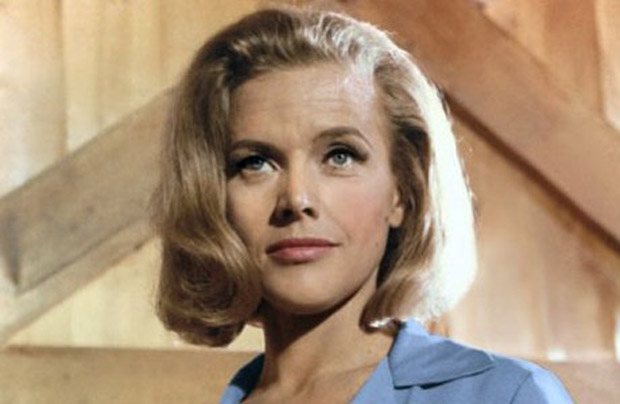
Women in Bond movies outsmarted Bond, fought him, and slept with him. What I saw in the Bond girls was adventure, power, and a sexuality that was bold – and maybe a little bit bent. In Goldfinger I saw something I'd never seen on TV. Somehow, at age nine, I realized something that still escapes most people today. Pussy Galore was gay.  And it thrilled me. That blond pilot she's talking to? I wanted to be her when I grew up.

In 1971 I saw Diamonds Are Forever, my first "new" Bond. It was just as exciting, just as sexy—and even gayer! Two women, Bambi and Thumper, lived in this amazing house, romping with James Bond and each other. They were bodyguards; beautiful, strong, and wild. My fate was sealed. 

When Connery walks down the beach at the beginning of Diamonds are Forever, telling a soon-to-be topless sunbather his name is “Bond, James Bond,” he is still, somehow, always talking to me. I am still responding to the seduction of Bond, of Bond girls, and of the exotic world of 007. Bond girls gave me sexual possibilities: Seductive men like Bond himself; seductive women like Pussy Galore. They can seduce or be seduced by a gorgeous man, or woman, and wear gorgeous clothes, but they don't have to live in a bottle. 

Bond girls speak to the part of me that is both feminist AND femme. The Bond girl became my archetype of an independent and exciting woman; a vision of who I could become that was purely fantasy, but still spoke to the real me. As I grew up, she remained my role model and my fantasy self. 

The woman I am today: writer, Mom, feminist, and professional, is still, deep down, a Bond girl.–Deborah Lipp

Deborah Lipp is the co-owner of Basket of Kisses, whose motto is "smart discussion about smart television." She is the author of six books, including The Ultimate James Bond Fan Book.

Kevin B. Lee is the Editor-in-Chief of Press Play.

VIDEO ESSAY: Gliding Over All: The Cinematography of Breaking Bad, Season 4

VIDEO ESSAY: Gliding Over All: The Cinematography of Breaking Bad, Season 4

Hollywood can keep its 3D, its CGI and whatever Dolby Surround version they’re up to now. For a contemporary cinematic experience as visceral and visually arresting as Breaking Bad, audiences must look abroad, to Gaspar Noé’s Enter the Void, or further, to films coming out of Thailand, Japan, and South Korea. As Dave Bunting and Derek Hill point out in their video essay and commentary on season 5.1, Vince Gilligan’s series puts U.S. cinema to shame, not just in terms of story, but in its execution: The direction, the dialogue, the acting, and—as is evident from the video essay above—the cinematography are, quite simply, of a higher order of intelligence. An intelligence that is extremely, at times obsessively, self-aware.

Regarding the cinematography: We all agree that Michael Slovis has as many visual tricks up his sleeve as Penn & Teller and that his palette is as rich and saturated as that of Henri Matisse. And few will argue with the assertion that the series’ visuals feel not like excess or icing, but integrally connected with the psychological states of the characters. But for me, the kick is about how the kind of semantic moves being made in episode after episode—in the cinematography, as in everything else—effortlessly reverberate meaning out in a number of directions all at once. Slovis is not just emphasizing mere character states. By constantly, at times relentlessly, making the audience aware of the camerawork—does a camera on the end of a shovel really underscore anyone’s character state?—he’s giving us clues to a whole layer of meta-meaning. Like the incendiary and morally conscious German playwright Bertolt Brecht (who shares initials with Breaking Bad), Slovis works to absorb and entertain us, even as he pushes us an arm’s length away.

Breaking Bad is a well-crafted, hyper-visceral Brechtian tragicomedy about the slow but sure descent into amorality of high school chemistry teacher-turned meth cook Walter White (Bryan Cranston) and the lives and relationships that are forever spavined, torn asunder or vanquished in his wake. Metaphorically speaking, it’s a relentless commentary on capitalism and capitalism’s life-blood, addiction.

But there are other, more poetic, at times troubling layers. Consider Walter White’s relationship with his product. Like the late Steve Jobs, White sees himself not simply as an entrepreneur, but as an innovator, an artist. His exquisitely cool blue meth (has anything so toxic ever looked quite so delicious?) is, laugh if you will, artisanal. He even has worshipful followers, most notably his temporary lab partner Gale Boetticher (David Costabile). White, in fact, is an artist, or at least has the temperament of one when he’s cooking. He is, to meth, what Breaking Bad’s creative team is to television.

That last connection is not something that I pulled out of my hat, but a connection the creators have made again and again, the longer this show has run. In the fourth episode of season four (“Bullet Points,” by writer Moira Walley-Beckett and director Colin Bucksey), they practically hand the connection to you in the most meta-rich installment to date. At the precise midpoint of this 44:30-long episode, White’s brother-in-law, Hank Schrader (Dean Norris), shares Gale’s lab notebook with White, pausing to mull over the dedication: “TO W.W. MY STAR, MY PERFECT SILENCE.” Tension develops as we understand that “W.W.” refers to Walter White, who deflects suspicion by telling Schrader that it refers instead to Walt Whitman, whose poem “When I Heard the Learned Astronomer” is quoted several pages earlier.

It’s a brilliant moment on several levels, in part because of the almost sick symmetry of it (you’ve basically got four Ws pivoting on the dead center midpoint of the episode), in part for the gently aggressive camera, which cuts from the notebook to White’s face, seemingly looming over the viewer, half in a subtle but clearly bluish shadow, half too dark to fully see.

Whitman and his poetry figure significantly in this television series, though no single poem is fully quoted—consider how differently Mad Men handled another American poet, Frank O’Hara, whose poem “Mayakovsky” Don Draper read the whole fourth section of, just before the closing credits of the first episode of Season 2. There, O’Hara briefly took center stage, though his poem had little to do with the whole series, other than to help underscore the emptiness of Draper’s soul.

In Breaking Bad, Whitman’s poem gets only a passing reference, but Whitman is integral to the mix, and not just because Schrader will finally, in the last episode of the first half of Season 5, make the connection between White and the blue meth via a copy of Leaves of Grass in the Whites’ bathroom. That episode, not coincidentally, shares its title, “Gliding Over All,” with another Whitman poem from Leaves of Grass, which ends “Death, many deaths I’ll sing.”

There is a reason Breaking Bad’s creative team has Walter White graduating from a moustache to a goatee, and it’s not just because cartoon images of Satan often have him sporting one. It’s because Vince Gilligan, the show’s creator, wears one. (What is a W, visually, if not a double V?) I don’t mean to suggest that White is a stand-in for Gilligan, but that a connection is being made, however subtle, however subconsciously. Is it merely coincidence that every main character charged with the oversight, production, and/or distribution of meth has a first or last name that begins with either a G (Gale and Gus, played by Giancarlo Esposito) or some residue of V? Even Gus’s right hand man, Mike Ehrmantraut (Jonathan Banks), whose initials spell “ME” and whose first name initial, M, is an inverted W, fits into this odd semantic play. The only person whose name does not prominently feature a G or a V (nesting in the form of a W or M), is Jesse Pinkman (Aaron Paul), the closest thing to an “innocent” in the whole crew, and a character that Gilligan has said was originally slated to be killed off by the close of season one.

This isn't to conspiratorially imply that this was necessarily planned, or that we’re meant to parse this all out. I’m simply saying that, in the creative process, there are many things that just “feel right” when one hits on them—and that intelligent creators tend to include those things in their work. I’m also saying that there is a poetic quality to the way meaning is accrued and resonates throughout the series, much of which was planned, and some of which simply fell into place as the creators cooked.

The character Walter White's poetic linking to the creative process couldn’t be made more clear than it is in Episode 4.4. After an opening scene involving a shootout that causes the liquid ingredients for meth to be spewed out all over a delivery truck’s floor, White’s wife, Skyler (Anna Gunn), is seen in bed, jotting down notes, trying to fall asleep, then sitting back up to jot down some more notes. She looks as if she is suddenly inspired. Poetically, subconsciously, we connect the image of the blue liquid pouring out of the plastic tubs to the creative juices now flowing through Skyler as she begins to construct an elaborate fiction about her meth-cooking husband being a gambling addict. The amount of research she has done on this, we see a few minutes later, appears to be extensive and no doubt resembles the research Gilligan and team did on meth and its production and distribution.

Another freaky bit of semantic symmetry: While prepping Walter on his story, Skyler makes a big deal about whether or not he’s going to “split the 8s”—which means one thing in the immediate context of blackjack, but consider it poetically: Splitting an 8 would result in two 4s, and here we are in Season 4, Episode 4, with a running time of exactly 44 and-a-half minutes from opening scene to blackout prior to credits.

When an exasperated Walter tells Skyler that he doesn’t need to know what he’s doing, as he’s in recovery and shouldn’t be called upon to talk extensively about his gambling system, Skyler brings out what appears to be a script, or what she describes as “bullet points.” For the next 10 minutes or so, the couple goes over the points—which include scripted dialog, blocking and suggestions for physical gestures—like actors familiarizing themselves with a script. The cinematography during this scene is practically invisible: the viewer simply has the sense of being there in the room with the couple. At one point, Skyler says something that could have been lifted right out of a development meeting for Breaking Bad: “We need this story to be solid, sympathetic and most of all completely believable.”

Armed with their story of Walter as successful gambler, the White family, with Walter, Jr. (R.J. Mitte) in tow, visits Hank and Marie (Betsy Brandt) Schrader. Early in the evening, Hank pulls out a DVD to show Walter and Walter, Jr.: It’s Gale, singing Peter Schilling’s English-language version of “Major Tom” in a Thai karaoke lounge. Though brief, there’s a ridiculous amount of semantic information packed in to this scene: Not only do we see, via the horrified reaction shot of Walter, the levels of remorse and fear he has in the wake of his having ordered Jesse to kill Gale, but the circumstances of Schilling’s song mesh nicely into the general meaning-universe of the show.

The relationship of Peter Schilling and “Major Tom” to David Bowie and Space Oddity foreshadows the later revelation of Gale’s homage to his creative superior, Walter. Further, its interstellar theme resonates with the Whitman poem Gale references as part of his homage. But, creepily, ghostly resonances of meaning go beyond even than that. Originally recorded in German (it made #1 on both the German and Austrian charts), “Major Tom” was rerecorded in English, where it went on to chart in Canada, Australia, the U.K., and the U.S. The Thai subtitles beneath Gale’s rendition hearken back to the song’s English status as translation. And, whether or not they were aware of it, Breaking Bad’s creators would certainly appreciate the original German version’s running time: 4:33. Not just because it slant-rhymes with the episode’s 44:30 running time, but because it shares an exact running time with the most notorious American composition of the late 20th century: John Cage’s 4’33”, which could easily be described as a kind of answer song, in its interrogation of silence, to Whitman’s “When I Heard the Learned Astronomer” and that poem’s last line, “Look’d up in perfect silence at the stars.”

Is Breaking Bad, like Leaves of Grass, the great epic poem of our time? If not, it’s the closest thing television has ever given us.

Dave Bunting is the co-owner (with his sister and fellow Press Play contributor, Sarah D. Bunting) of King Killer Studios, a popular music rehearsal and performance space in Gowanus, Brooklyn.  He plays guitar and sings in his band, The Stink, and dabbles in photography, video editing, french press coffee, and real estate.  Dave lives in Brooklyn with his wife, son, and sister.

Gary Sullivan’s poetry and comics have been widely published and anthologized, in everything from Poetry Magazine and The Wall Street Journal to The Norton Anthology of Postmodern Poetry (2nd Edition, forthcoming). Everyone Has a Mouth, a selection of his translations of poetry by the Austrian schizophrenic Ernst Herbeck, was recently published by Ugly Duckling Presse. He lives in Astoria, Queens, where he maintains bodegapop.com, a music blog devoted to treasures found in immigrant-run bodegas in New York City.

PRESS PLAY THEATER: Preston Miller’s GOD’S LAND (2010)

PRESS PLAY THEATER: Preston Miller’s GOD’S LAND (2010)

null

PRESS PLAY THEATER, OCT. 19-25: GOD’S LAND, WRITTEN AND DIRECTED BY PRESTON MILLER

By Matt Zoller Seitz

This is Press Play Theater, a streaming video feature that showcases notable work by independent filmmakers in one-week exclusive runs.

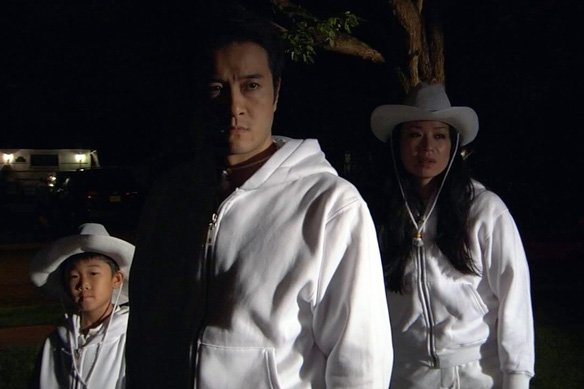
Our debut offering is God’s Land (2010), the second feature by Long Island-based director Preston Miller. It’s a drama about a family that joins an apocalyptic religious cult in Texas. It fictionalizes the true story of the Chinese Soul Light Association, or “True Way,” a Christian group from Taiwan that settled in 1997 in Garland, Texas. The group’s faith mixed aspects of Taoism, Buddhism and belief in UFOs, and a conviction that so-called civilization, which had lasted thousands of years, was just temporary, a way station en route to something more profound. The group’s members dressed in white sweats with white cowboy hats. In 1998, followers readied for the end of the world, which they believed would be signaled by the appearance of God on TV.  

Miller’s film retells a version of the story through the eyes of one family: a true-believer husband named Hou (Shing Ka), his innocent son Ollie (Matthew Chiu), and his wife Xiu (Jodi Lin). Xiu is the closest thing to an audience surrogate in God’s Land: she’s a sophisticated woman from a rich family who doesn’t really buy into the prophecy but has followed the family to Garland to protect her son and support her beloved husband’s faith in the group’s leader, Teacher Chen (Jackson Ning).

Taking his cues from meditative European Art Cinema, Miller stages the tale in unbroken, often static long takes that make us think about these spiritually-driven characters in relation to their mundane, somewhat impersonal environments: motel rooms, malls, supermarkets, nondescript suburban streets. As we watch the family struggle to commit to Teacher Chen’s otherworldly vision, we think about how the modern world makes faith (or mysticism) difficult. The cult’s members are surrounded by symbols of the modern “fallen” world that will theoretically be wiped out, one by one, by God’s judgment. It’s an eerie yet unexpectedly warm movie, one that observes the passion of its characters with empathy but no harsh judgment.

God’s Land is presented in its entirety at Press Play; click the Vimeo link above to watch it. The movie will be available on the site Oct 19–25.

Miller has also been kind enough to upload two supplemental clips: a sequence showing reporters besieging the group’s headquarters, featuring voice-over commentary by Miller and yours truly; and an interview with Richard Liu, who served as Teacher Chen’s interpreter. (A complete transcript of the March 15, 1998 press conference wherein Chen announced the end of the world can be read here.)  

Analysis of helicopter scene, featuring commentary by Preston Miller and Matt Zoller Seitz.

Preston Miller’s audio interview with Richard Liu, interpreter for Teacher Chen.

God's Land will be available for purchase on DVD in November, check www.vindaloophilmwallah.com for more details regarding the release date and information on the film.–Matt Zoller Seitz

Preston Miller was born and raised in Raleigh, North Carolina. He attended Appalachian State University for three years before transferring to City-College of New York. There he graduated in 1995 with a Bachelors of Fine Arts with honors in the Communications, Film & Video Department. He currently resides in the New York City area with his wife and their two sons. Miller's first film was Jones (2007).

Matt Zoller Seitz is a co-founder of Press Play.