GAME OF THRONES RECAP 7: A MAN WITHOUT HONOR

GAME OF THRONES RECAP 7: A MAN WITHOUT HONOR

What makes for a great Game Of Thrones episode? What stories can it tell that could put it on the rarefied level of, say, HBO’s holy trinity of The Sopranos, Deadwood, and The Wire? I’m not sure how I would have answered this question before seeing “A Man Without Honor.” I would not have expected to say that arguably the show’s best episode would have only one major event combined with a series of dialogues. This isn’t a surprise, given that the dialogue and characters are some of the strongest components of the show, but it is somewhat odd, given how many different storylines are going on at once, that so few move directly forward.

Instead, in scene after scene, we’re shown reasons why these characters are important, and why the stakes are so high. Not many of the metaphorical poker hands are fully played out, but watching them progress gives us insight into most every major character as well as a few minor ones.

Take, for example, the centerpiece of the episode, Jaime Lannister, in his cage, talking to a cousin he barely remembers. The cousin squired for Jaime once, and clearly worships Jaime as a hero. They reminisce. They bond. Jaime supplies us with a bit of exposition, a reminder of the currently missing Barristan Selmy. They discuss their current situation. “I’m not well-suited for imprisonment.” Jaime has a plan of escape. The cousin wants to know what he can do. Jaime says “die” and then kills the man he just charmed.

There are two good reasons this scene shouldn’t work. First, it’s been done before. In the middle of the first season, Jaime talked with Ned Stark’s guard, Jory Cassel. After initially dismissing Jory, the two men ended up bonding over past war stories. Shortly afterwards, Jaime killed Jory with no regrets. For this reason, and because of the slow buildup of danger via the blocking, lighting, and music cues, Jaime’s violent turn isn’t a surprise. It's still a great scene, though.

Nikolaj Coster-Waldau’s performance as Jaime Lannister deserves the credit here. From the beginning, he has imbued Jaime with the charisma and power that the novels tell but don’t show until much later. He’s been largely off-screen this season—there's only so much you can do when chained in a cage—but Coster-Waldau’s cheerful cynicism dominates anytime Jaime is on-screen.

Only writing this now do I realize that Jaime didn’t say much to the poor boy he promptly murdered, beyond generic platitudes. Perhaps he did remember the boy, and spoke to him as a friend because he wanted some pleasant human interaction even as Jaime planned his cousin’s murder. Perhaps he didn’t remember the lad, and simply told him what he wanted to hear in order to get him within arm’s reach. Jaime was built up as the primary villain in the first season, but here, imprisoned for months and covered in his own shit, plotting a desperate, doomed escape, he seems even more dangerous.

This may have been the standout scene of the episode, but “A Man Without Honor” is filled with one-on-one interactions, most of them good, some of them brilliant. Arya Stark’s dangerous sparring with Tywin Lannister is dramatically improved this week, after the too-farcical physical comedy last week. Instead, tonight it’s a game of wits. Seeing both Charles Dance and Maisie Williams take each other on is a joy, and further confirmation that Williams is a potential star. This is one of the show’s funniest-ever scenes, with Dance’s slight facial expressions showing how impressed he is with the girl’s audacity, and Arya just barely staying ahead of Tywin’s probing questions.

Almost every major character gets a scene where the tension of their surroundings is built and detailed. Sansa Stark continues her awkward, tense relationship with The Hound, who seems to have adopted her as a pet of his own, saying “You’ll be glad of the hateful things I do when you’re queen, and I’m all that stands between you and your beloved king.” This may be Sophie Turner’s best episode as Sansa, and it’s also the one where she’s had the most to do, as Sansa’s first period shows up, making her betrothal to Joffrey much more likely to be completed. With this known, she meets with Queen Cersei, whose odd mentoring of Sansa is even more explicit than The Hound's, thanks to Tywin’s parallel relationship with Arya Stark.

Cersei then meets with Tyrion Lannister, and finally shows vulnerability, admitting that her children were born of incest and how troubled she is by Joffrey. During the first season, I thought Lena Headey was the weakest actor in the ensemble, constantly relying on her “scrunchyface” to convey any emotion, genuine or manipulative. With a bit of vulnerability on display, Headey manages to make a scene where Tyrion and Cersei bond a bit seem honest and even sympathetic. It also serves as a reminder that Stannis, with his huge fleet and new army, is less than a week away from the capital, and close to the climax of the season.

Some of the most fun comes from the romantic comedy Beyond the Wall, where Jon Snow continues to hold the wildling Ygritte prisoner. Much like Jaime Lannister’s scene, there are lots of reasons to dislike this storyline: Ygritte’s sexual manipulations are so transparent as to be downright wacky, and the part where she argues about who owns the land struck me as overly-modern, with its anti-colonial discourse (“You lot just came along and put up a big wall and said it was yours!”). The acting, once again, helps—Rose Leslie sells both the sexuality and the wildlings’ different norms—but I think the real work is done by the location. The scenes north of the Wall were shot in Iceland, and the craggy hills, tundra, and cold, cold snow and rain imbue the apparently comic scenes with seriousness and even danger.

Also, impressively enough, several episodes in, Jon’s half-brother Robb Stark and his infatuation with the nurse Talisa has finally gotten to the point where it doesn’t stand out as the worst part of the episode. That, surprisingly, goes to Dany’s adventures in Qarth, where her pursuit of her dragons’ kidnappers leads her deeper and deeper into a storyline where she lacks agency, which she attempts to make up for by screaming, in increasingly petulant and shrill fashion. (She sounds like Mel Gibson in the commercials for Ransom, yelling “GIVE ME BACK MY DRAGONS.”) It’s disappointing given the depth Emilia Clarke brought to Danaerys in the first season.

And then Game Of Thrones tosses in a sucker punch. After an hour of scenes consisting almost exclusively of two people talking to one another, the action returns to Winterfell and Theon Greyjoy’s pursuit of the younger Stark boys. After a day of fruitless searching, Theon returns to Winterfell, claiming to have found the boys, and offers proof: two charred, dismembered children’s corpses. The grim music rises as we see that a character who began the season as a sidekick to one of the heroes is now a child-murderer. That doesn’t relieve the tension built up over the course of the episode—it hammers it in. That’s what will make Game Of Thrones worthy of inclusion in the tevevision pantheon.

Adaptation:

As far as I can tell, every single scene in this episode was significantly altered, or simply invented, compared with the novel. Robb’s, Arya’s, Dany’s, Jorah’s, and Jaime’s scenes with the cousin are totally new. Jon and Cat have had their scenes altered chronologically, and their motivations have also been changed due to alterations in previous episodes: Qhorin didn’t leave Jon with Ygritte for days in the novel, instead disappearing for a while, then returning.

Missing characters change the structure and meaning of Bran’s main scene in the episode—a friend with a premonition of the dead bodies has been deleted and has had his character merged with Osha, who doesn’t have that gift. Meanwhile, Theon’s worst impulses are being exacerbated by one of his crew, instead of by another major character (who will apparently be introduced later). Sansa’s scene with Cersei may be the only one to be relatively unchanged from the novel.

I would quibble with some of these decisions—in fact, I almost certainly will next week when we see the fallout from Cat’s confrontation of Jaime—but overall, I think this marks a turning point for Game Of Thrones as an adaptation. It has fully detached itself from the source material. It still uses the books' themes, characters, and overall story, but it now has the confidence to be tell that story in its own fashion.

Rowan Kaiser is a freelance pop culture critic currently living in the Bay Area. He is a staff writer at The A.V. Club, covering television and literature. He also writes about video games for several different publications, including Joystiq and Paste Magazine. Follow him on Twitter @rowankaiser for unimportant musings on media and extremely important kitten photographs.

MAD MEN RECAP 8: DARK SHADOWS

MAD MEN RECAP 8: DARK SHADOWS

"I’m thankful that I have everything I want, and that no one else has anything better."

nullBetty can't just be happy. She can't just have what she wants. Having what she wants doesn't feel good. Instead, what feels good is having what she wants at the expense of others. It's a mean-spirited way to live, and no amount of window-dressing can make it sound nicer. "Selfish" would be an improvement. She lacks self-awareness to such an extent that she can say the above as a sincere expression of gratitude at Thanksgiving. The Internet is full of Betty haters, and I don't consider myself one of their number, but this aspect of her character cannot be explained away, softened, or justified. It's just nasty.
I know what you're thinking. You thought I'd open with the "Every man for himself" quote. Clearly, that's the, or a, theme of Mad Men Episode 5.09: Dark Shadows, and it's also something that Matt Weiner has been talking about in the media. Because Weiner is so secretive about what's to come on the show, when he releases a quote or a theme, it spreads like wildfire in the blogosphere.

Yet "Every man for himself" only takes us halfway on our journey. Don could have pushed hard for himself without ditching Ginsberg's work in the cab. Betty could work to lose weight and be a supportive wife without trying to destroy Don's new marriage. Pete could pursue Beth Dawes without taking a shot at her husband. (Check out Pete's delightful Beth fantasy in the video below, and don't fail to notice that Pete can't fantasize about sex without fantasizing about power and recognition as well.)

So, it's every man for himself, sure, but it's also about crushing the other guy in the process, and the notion that success just isn't as much fun unless someone is under your bootheel. I don't think many fans love Jane Sterling, but her plaintive realization that she's been defeated by Roger touched me: "You get everything you want, and you still had to do this." That, as much as Betty's Thanksgiving gratitude, is the real point: Winning in this show's world is hollow unless someone else loses.

What are the major plot lines this episode? First is Betty: Her weight struggle, and her competitiveness with Megan. Then comes Don and his competitiveness with Ginsberg. Then there's Roger, who is competing with Pete for business and with Jane for a sense of ownership. Others are swept up into various competitions: Peggy versus Ginsberg, Pete versus Howard, Julia versus Megan. These people compete not only for themselves, but because they specifically and pointedly resent what others have.

I doubt fans will love this episode. There is, first of all, the Betty backlash to contend with. I think her character was absolutely compelling this week, but she usually sets off an Internet Comment Shitstorm. You heard it here first. It was also kind of a difficult episode. It didn't have a lot of BANG WOW moments: I mean, sure, Megan in a bra, Beth in nothing at all, but no hand jobs or blow jobs or fisticuffs in sight, so maybe people will feel shortchanged. I also think seeing this kind of nastiness can be wearing; it feels petty and so you come away from it like Sally at the end of last episode; "Dirty." The "killer smog" at the end of the episode really happened, and it also serves as a symbol for the creeping toxicity of these cutthroat shenanigans. It makes it hard to breathe for all of us, and I suspect some portion of the audience might react negatively. [Click through to the next page for more…]

A second, connected theme is secrecy, and people being outed. This is threaded throughout Dark Shadows: Secrets and the ability to expose secrets represent power, and power is what our characters compete for. Nothing is more insidious than Betty's "sweetly" mentioning Anna Draper to Sally (watch it below):

In Betty's version of self-revelation at her Weight Watchers' meeting, she's so vague as to border on meaningless: She says merely that she experienced something that upset her. What upset her was another person's happiness. Don and Megan have a magnificent apartment, and Megan has a young, beautiful body. Betty can barely contain how awful this makes her feel. Inadvertently finding a love note from Don to Megan puts her over the edge: It's simply not okay for them to be in love, for Don to be sweet to Megan, for the Draper apartment to be more beautiful than the Francis house. (By the way, Megan is wrong about the distance; it's 25 miles from Rye to 73rd and Park.)

Betty setting up Sally to ask just the right question to create havoc reminds me so much of Betty setting up Sara Beth in the Season 2 episode Six Month Leave (Betty has an Episode 9 pattern, I guess). She manages her feelings by making others suffer, this time in an episode where the Weight Watchers leader talks about stuffing the feelings you can't express using food. Betty wants to feel differently; swallowing the mouthful of canned whipped cream and then spitting it out is a perfect encapsulation of that YES NO YES NO feeling; wanting and not wanting, stuffing and letting it out. She offers just the right kind of support and wisdom to Henry even while spreading her poison.

So, Betty tries to use outing someone's secret as a weapon, and we get a sense of that with Jane and Ginsberg, too: Jewishness is a secret you have to keep in Roger's social circles, a secret Roger required Jane to keep. Now he expresses power over her by pushing that secret out of the shadows. Roger wants Ginsberg to keep a secret and he says no; Peggy kept a secret for Roger, and each was paid for it (although Peggy was paid a lot more). Whoever holds the reins to a secret is ahead in this "doggy dog world."

Some additional thoughts:

  • Henry wonders if he "bet on the wrong horse" for nothing. It seems like Betty is wondering the same, and Henry is that horse.
  • It looks like a senility plot might be in Bert Cooper's future. Correcting "hip" for "hep" makes him seem amusingly out of touch, but not knowing that Roger and Jane are divorcing could be a bad sign.
  • Betty really enjoys food this episode: Whether it's her meager breakfast, or a bit of steak, or a tiny bit of Thanksgiving dinner, she chews with gusto. In past seasons, when thin, she barely ate at all. Allowing herself or not allowing herself to experience pleasure is a whole motif with this character. At least chewing is some kind of start.
  • On the other hand, I feel like the chin appliance gets in the way of January Jones's ability to use her face expressively.
  • Okay, fine, I said I wouldn't, but I'll give quote of the week to this: Peggy: "You are not loyal. You only think about yourself." Roger: "Were we married? Because you’re thinking about yourself too. That’s the way it is, it’s every man for himself."

Deborah Lipp is the co-owner of Basket of Kisses, whose motto is "smart discussion about smart television." She is the author of six books, including "The Ultimate James Bond Fan Book."

Watch Mad Men Moments, a series of videos on Mad Men, produced by Indiewire Press Play.

GIRLS RECAP 5: HARD BEING EASY

GIRLS RECAP 5: HARD BEING EASY

More like "Hard Writing Consistently." What was that?
 

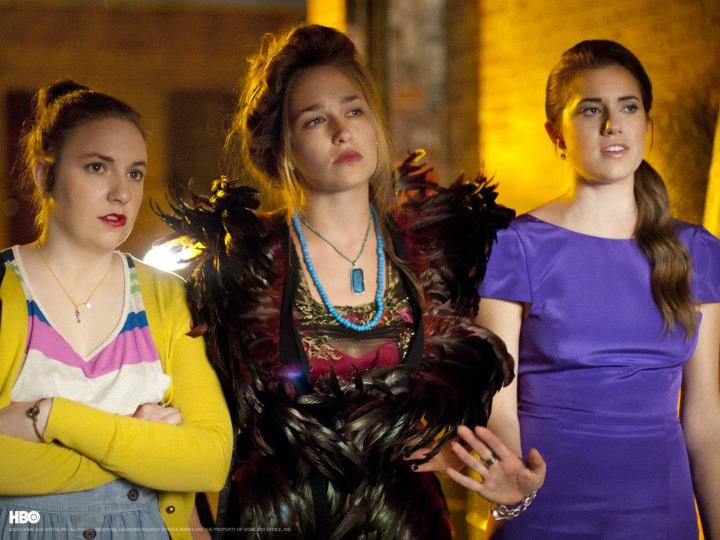
nullFor four episodes, Girls has stayed on the right side of believable. Not likeable or admirable, necessarily, when it came to the three leads and their behavior (I'll excuse Shoshanna from the discussion for the time being), but we don't have to like characters, or find them attractive physically or emotionally, to see something familiar in them and in the situations they move through. Our interest in a narrative isn't always about comfort, or escape. Sometimes, it's about recognition. I wouldn't characterize Girls as holding a pitiless mirror up to a generation or anything, but I think it gets at certain truths that lie underneath (and/or in) the pretension and self-absorption and unprofessional bumbling, or at least it tries to.
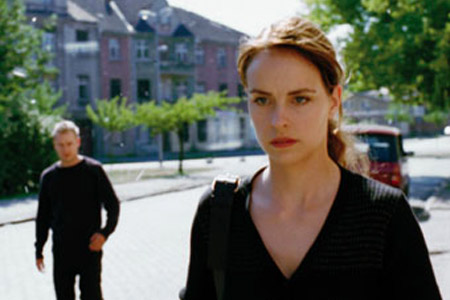
I don't know what "Hard Being Easy" was trying to do, besides annoy/baffle the audience. (Mission accomplished.) The episode has a handful of neatly observed moments, and the usual complement of too-awkward-to-watch bits . . . but the awkwardness didn't come from the characters this week. It came from Lena Dunham losing control of the material.

The Marnie/Charlie storyline picks up shortly after the end of the last episode, and it's well done—but it has to climb uphill from a ridonkulous beginning in which Charlie forces Hannah to read aloud from the journal in front of him and Marnie. Hannah goes along with this, despite the fact that 1) Charlie (well, mostly Ray, but whatever) violated her privacy, 2) Marnie threw a drink on her and called her a bitch, 3) neither of them apologized, and 4) whatever Hannah's involvement, the only credible action for any character would be to hole up elsewhere until the couple's storm blew over. And Hannah not only goes along with it, she corrects them, saying it's "notes for a book," not a journal, and asks for feedback on the writing. Yes, Hannah lives in her own bellybutton, but this isn't believable behavior from anyone.

The rest of Marnie's subplot resonates, though, from Ray overplaying the loyal-best-bud card, to the revelation that Marnie has never gone to Charlie's apartment (once there, she admiringly notes that it looks like "a Target ad"), to the flashback to college in which Marnie and Charlie meet. Marnie has taken an unknown drug at a party and is disappearing down a paranoia-hole. Hannah tends to her for a while, then heads off to dance with Elijah (to the Scissor Sisters, after Elijah "curates" Marnie's bangs with a flick of his forefinger. . . . Hannah really thought that guy was straight? For two years?), leaving Charlie to mind Marnie. The narrative pun on "high maintenance" aside, it makes perfect sense that this is how they met, that Charlie ministered to her from the beginning. (Charlie's wig, however, is inexplicable. I get why the actor is wearing one, but—that one? Did Charlie just come from an '80s-Stamos-impersonator contest?)

Their break-up/make-up/break-up talk the next day is dead-on. Marnie turns up in "my party dress and my sorry face," sure that she can change his mind. Charlie points out repeatedly that she isn't in love with him anymore; she asks repeatedly that he not break up with her. We've all had that convo, fumbling and protracted, desperate not to rip the Band-Aid off because "better the devil you know" and all that. This is where Marnie's at with it, refusing to admit the facts (and probably thinking she'd have been the one to do the dumping). Charlie purposely wounds her by saying he thought he recognized her at the party from a porn flick, Sophomore Sluts; she's shocked that he watches porn. (Ladies: they alllll watch porn. Even the Charlies. It's usually nothing pathological; please stop taking this personally. Thanks.) After she offers him the blowjobs she should be giving him anyway, they end up in his low-ceilinged bed nook, having sex, and he orders her to be nice to his friends and "act like [his] life is real." She agrees. He asks her to keep her face close to his. She does. Then he says either "say 'I love you'" or "stay; I love you"; either way, Marnie physically recoils, saying she can't, and whangs her head on the roof of the bed-nook. Immediately Charlie sits up to make sure she's okay: "I'm right here. I'm riiiight here." That's the problem, of course, and she whispers that she wants to break up.

And this is the least awkward sex in the episode.

Jessa gets it on with an ex-boyfriend, a subplot that seems to exist solely so the two of them can burst into Jessa and Shoshanna's apartment, pawing each other, before Shoshanna can announce herself or vacate. Shosh has to hide behind an Ikea curtain for the duration. The ex gets a high-dudgeon line about "a very tumultuous relationship in which one's Vespa gets destroyed for no reason" that I chuckled at; everything else flopped. Jessa finally notices Shoshanna and teases her for being a creeper, and Shoshanna, always talking at a high rate of speed prior to this point, doesn't say a word to contradict her. . . . What? We got the "virgin is both attracted and repelled" note last week, and we don't watch the show for slapstick—fortunately, since slapstick is demonstrably not its strength. What is this story doing?

Perhaps it's an effort to postpone the inevitable boinkfest between Jessa and Jeff Lavoyt—and that part of Jessa's story this week is sharp. Jessa's in the Lavoyts' bathroom, getting ready to meet the ex; Lavoyt's leaning boyfriendily in the doorway. Mrs. Lavoyt comes upon them there, chatting, and Kathryn Hahn is excellent in the scene, holding the awkward silence exactly the right amount of time, lying that it's okay that Jessa is using her lipstick ( . . . of course she is) because she doesn't want to come off like an unhip harridan.

It's also not really okay that Jessa, hearing about Hannah's boss's handsiness, suggests that Hannah "should hump" Richard "for the story." It's a hundred percent something Jessa would do, and most likely get away with, because she's a confident beauty who wears a kimono to her babysitting job. It's a hundred percent not something Hannah, as written to this point, would do, but, for reasons I can't fathom, she does it. Yeah, yeah, "for the story"—I don't see it. And based on the too-long, all-over-the-place scene that results, Dunham didn't either. Richard asks Hannah for a turkey sandwich; she tells him to cut the crap, because she knows he wants to fuck her. I write in my notebook, "Oh, this is a dream sequence." It isn't, and it's interminable, Hannah insisting that it's what Richard wants, Richard asking if she's high, Hannah switching gears and threatening to sue, Richard snorting that "there's no suing app on your iPhone" but adding that he's not going to fire her because she's "great," Hannah offering to forget about suing for one thousand dollars . . . it just. Keeps. Going. Richard is still trying to convince her to calm down and go back to work when Hannah whines, "I just tried to fuck you, sue you, and extort you! I'm fuckin' nuts, why would you want me in your office?" Perhaps that's Dunham signaling that she knows the twist is ridiculous, but the plot doesn't work, as farce or as commentary. (Hannah's big kiss-off line—"Someday I'm gonna write an essay about you? And I am not gonna change your name. And then you can sue me"—is just weak.)

Alas, the script isn't finished taking an idea over the top and then not knowing how to get back—but like others in the ep, this week's Hannah/Adam sequence starts from an interesting premise about the things we choose to hear. Hannah goes over to Adam's house to find him wearing a shirt. . . .  Just kidding. He never, ever wears a shirt. At this point, I know that guy's nips better than I know my own. When Hannah tells him what went down at work (sort of; she says "there was a sex scandal"), he grunts, "Sometimes you say shit that sounds made up"—an on-point comment, since she's also "made up" the idea that her straight talk in the prior episode (and their ensuing intercourse) has bonded them into a couple. "Surprise": Adam didn't hear it that way. What he heard is her saying they shouldn't have sex anymore. But then you kissed me, Hannah points out. "Because you were sad," Adam shrugs. And then we had sex, she points out. "Because we were kissing," Adam duhs, before telling her, "These things have an expiration date—six months or until you stop having fun," and Hannah isn't.

That 100-monkeys-typing brand of observation, simultaneously precise and insensitive, is one of the things that makes the Adam character ring true for me. Hannah, trying to make Adam jealous by over-sharing that she "almost" fucked Richard, buys time with a trip to the bathroom, and as she sits on the toilet, her eyes well up. She's wearing another dress that doesn't suit her—she looks like a hacky-sack with bad posture—and all of that rings true for me too.

But then she comes out to find Adam in his bedroom, jerking it. That he's doing it while Hannah's still there, after turning her down for sex, is galling, as she notes, but it's still in character for both of them—and it's still in character that she can't make herself get angry and/or leave. But then Adam prompts her to verbally abuse him as a turn-on, and she goes along with it, and the scene is once again too long and too aimless, and Dunham’s direction doesn’t illuminate why Hannah is doing this or what she's feeling about it, and when Hannah demands cab fare as part of the "you're a bad boy" stroke-fest, it loses me completely. I don't buy Adam as the masochist when he's gotten off on degrading dirty talk in the past, I don't buy Hannah taking control in this fashion, and the editing is a hash, but the primary problem is a flatness. The scene feels calculated to provoke, theoretical.

That's the ep as a whole. The plots begin with recognizable situations, but veer into almost academic explorations: what if we said this, what if we made her do that, wouldn't it be funny if the other thing. It's not the lack of "realism" (realism isn't always good storytelling, vis. the sixth season of Buffy the Vampire Slayer and the accurate but repetitive downward spiral of its heroine). It's that I can't relate to these situations, or these characters in them, and based on the faltering humor and tempo of the episode, I'm not sure Dunham could relate to them either.

Sarah D. Bunting co-founded TelevisionWithoutPity.com, and has written for Seventeen, New York Magazine, MSNBC.com, Salon, Yahoo!, and others. She's the chief cook and bottle-washer at TomatoNation.com.

VIDEO ESSAY – Deceptive Surfaces: The Films of Christian Petzold

VIDEO ESSAY – Deceptive Surfaces: The Films of Christian Petzold

If one wants to call Christian Petzold the most important German filmmaker of the last decade, it’s because his films operate on multiple levels whose complexities lie just beneath a deceptively simple surface.

nullOn a basic level, his recent films, like Yella, Jerichow, and Dreileben: Beats Being Dead, work as entertaining dramas centered on themes of sex, greed, and loyalty. The major characters are all driven by the desire for a better life, and they give each film a restless, seeking energy. But they find themselves caught between different worlds. In Yella, a woman from economically depressed eastern Germany seeks a promising career in western venture capital, but the past catches up with her in the form of her estranged, down-on-his-luck husband. In Jerichow, an unemployed ex-soldier finds work with a Turkish businessman, only to fall for his German wife. In Beats Being Dead, an ambitious medical intern with falls in love with a working class Bosnian refugee.

Read the rest of the transcript at Fandor.

Kevin B. Lee is Editor in Chief of IndieWire’s PressPlay Video Blog, Video Essayist for Fandor Keyframe, and contributor to Roger Ebert.com. Follow him on Twitter.

VIDEO ESSAY – In Praise of Maya Deren

VIDEO ESSAY – In Praise of Maya Deren

Sunday, April 29, 2012 was the 95th birthday of Maya Deren, the undisputed matron of avant-garde cinema. To commemorate the event, this video looks at Maya Deren’s magnum opus, Meshes of the Afternoon, with commentary by film programmer and scholar Livia Bloom.

Originally published on Fandor.

Livia Bloom curates cinema retrospectives. Her writing and interviews regularly appear in the film journals Cinema Scope; Filmmaker Magazine, and Film Comment, and she is the editor of the book Errol Morris: Interviews. Ms. Bloom is also Director of Exhibition and Broadcast for Icarus Films.

Kevin B. Lee is Editor in Chief of IndieWire’s PressPlay Video Blog, Video Essayist for Fandor Keyframe, and contributor to Roger Ebert.com. Follow him on Twitter.

null

VIDEO ESSAY: Super: A Brief History of Superhero Films

VIDEO ESSAY: Super: A Brief History of Superhero Films

With the unparalleled box office success of The Avengers, superheroes are back in the spotlight. Most comic book aficionados are delighted with the recognition. But believe it or not, there are those such as myself who are dismayed at how superhero films, though more popular than ever, seem to be losing their luster.

When I was in grade school, nothing seemed more interesting than comic books, with their amazing feats, super powers, hyper masculine (sexist) images and monumental battles. Their visual flair and storytelling style proved more vivid and effective than any textbook. But they also engrossed me in their attempts to personify concepts both political and abstract. I learned about discrimination from the X-Men, about eternity and death from the Secret Wars, about the trauma of war from Sgt. Rock. If anything, comic book heroes complemented my school education more than I could have imagined.

When I had finished the Secret Wars II series, there was nothing I wanted more than to see it as a film. I first imagined it in animation with Jim Lee (my favorite illustrator at the time) illustrating it to the minutest detail. Later I would envision it in live action, with Arnold Schwarzenegger playing Colossus, Jack Nicholson playing Wolverine, and Jean-Claude Van Damme playing Gambit.

The last decade or so was a phenomenal time for the superhero movie genre, both thematically and financially. It wasn't uncommon to have four such films a year, grossing over a billion dollars annually. This period saw some of the most profitable film franchises of all time, as well as a few of the most ambitious and creative takes on our most memorable costumed crime fighters.

But as the decade came to a close, the genre started to have less lofty goals. Since 2008, when the great pairing of Iron Man and The Dark Knight bookended that year's Summer Blockbuster season, there hasn't been a single worthy successor mentioned in the same breath. Some might argue that Watchmen fits that bill, but depending on who you speak to, no superhero movie has captured the same kind of critical and commercial acceptance comic book fans have been searching for (that includes The Avengers, which I'll get to in a minute).

This sentiment was encapsulated by A.O. Scott in his essay "How Many Superheroes Does It Take to Tire a Genre?" In it, Scott surmised that 2008 may have been the peak of the genre's powers, noting the rules by which its films have to live by.

"The climax must be a fight with the villain, during which the symbiosis of good guy and bad guy, implicit throughout, must be articulated. The end must point forward to a sequel, and an aura of moral consequence must be sustained even as the killings, explosions and chases multiply. The allegorical stakes in a superhero are raised—it's not just good guys fighting bad guys, but Righteousness against Evil, Order against Chaos—precisely to authorize a more intense level of violence."

It's these predictable conventions in Scott's claims that ultimately restrict the genre. The over-reliance on elaborate special effects. The insistence on spelling things out.

The problem I see is not so much in the genre's conventions, as they harken back to youthful and more innocent notions in all of us. My issue lies, especially with most superhero films of the last few years, in the lack of resonance and ambition. This ultimately leads to a question we fans have to ask ourselves: what do we want superhero films to be?

The Birth of the Genre

Such films entered the collective consciousness as Saturday Movie Serials in the 1940s. Some of their earliest protagonists were Captain Marvel, Batman, the Phantom, Captain America, and Superman. Find these films on YouTube and you'll discover how the heroes look anything but super in retrospect. Yet in their time, these movies provided an escape for millions of children during World War 2. They served their purpose well.

Politics, in the form of the Comics Code Authority, momentarily torpedoed the comic book industry, and with it went the serials that were inspired by them. Superheroes were only to be found on TV, most notably in Adam West's Batman, which remained securely in the corners of camp comedy and children's entertainment. But by the 70s, the children watching these shows had all grown up, and so did special effects. Richard Donner surely must have seen what Steven Spielberg and George Lucas did with summer blockbusters in Jaws and Star Wars. Thus arrived the Godfather of all superhero films, Superman.

What made Superman so great, aside from casting Christopher Reeve and utilizing John Williams's immortal score, was that it evoked the almost mythological reverie young fans hold for their heroes. The first shot of a young hand turning a comic book page, while a child's voice narrates the exploits of the Daily Planet, is arduous and perfect. The film's ambitions were so grand that they couldn't be contained, eventually spilling over to its equally majestic sequel (Richard Donner's version).

It was also a product of great creativity, utilizing shots and techniques that maximized the capabilities of special effects despite the limitations of their time. So much so that no other contemporary of its genre in the following decade came close to it. That is until Tim Burton revolutionized the feel of the superhero film with his gothic vision of Batman (1989). Until then, superheroes had to live up to Kal-El's sunlit glory. But Burton upended this notion with his dedication to darkness and shadow, reveling in the caped crusader's menacing intimidation.

Both of these heroes set the bar well into the 80s and 90s, becoming the genre's yin and yang, determining the stylistic paths their heirs would take. Superman's children would be Condorman, Supergirl, Captain America (1990) and The Phantom. Batman's would be The Punisher, Darkman, The Crow, The Shadow, Spawn, and Blade.

Post 9/11: The Cinematic Golden Age

Just as World War 2 ushered in the age of the comic book superhero, 9/11 ushered in the genre's cinematic golden age. From then on, it wasn't enough to herald a great champion or premise. The conflicts had to involve soul-searching. The stakes had to be grave.

Christopher Nolan's Batman Begins (2005) revealed the true nature of Batman's dark notion of justice, digging deep behind Bruce Wayne's trauma and patiently building the legend. Miraculously, The Dark Knight (2008) raised the stakes by presenting an equally determined anarchist who embodied our all-too grounded anxiety of complete chaos.

Ang Lee's introspective Hulk (2003) contemplated immeasurable power as more of a curse than a blessing. It is also the most daring and artistic interpretation of any superhero adaptation, choosing very human conflicts (Bruce and Betty with their unreliable fathers) at the heart of the story, as well as depicting the green goliath not simply as a monstrous beast, but as a child.

Brad Bird's The Incredibles (2004) never felt as grave as others from this era, yet it presented itself as a lighthearted ode to the fading ideal of the nuclear family. It was also the best "Superhero Team" movie ever made, with the ultimate team: mommy, daddy, brother and sister. The real fantastic four.

The X-Men films have always focused on discrimination, with their demigod cast-outs; Brett Ratner's The Last Stand (2006) and Matthew Vaughn's First Class (2011) also juxtapose the political and historical (respectively) more intimately than any other in the genre.

Many saw Jon Favreau's Iron Man (2008) as a showcase of Robert Downey Jr.'s immense gifts, but it was also (unintentionally or not) a surprising and satisfying ode to America's wish to finally use its unmatched corporate, technological and military might to do actual good.

Guillermo Del Toro's Hellboy (2004) was amazing in its portrayal of a demon's touching desire to do well by man. Of all the superheroes in film, this horned red-hided monstrosity is the most fun, relatable and humane. He wisecracks without malice, and has a soft spot for kittens. Hellboy II: The Golden Army (2008) continued this sentiment, and added to it by ruminating on man's distancing from myth, in a manner reminiscent of Hayao Miyazaki's films.

Of all superhero films, Spider-Man 2 (2004) is the genre's conscience. Though Peter Parker wasn't ordinary, his not so extraordinary abilities made him a more empathetic character compared to someone who can fly. Sam Raimi used a hero who wasn't super-intelligent, wealthy or powerful to somehow convey the awesome responsibility and sacrifice of doing the right thing.

The Throwaways Return

As with any celebrated era, there is always an inevitable decline. Just as in the 90s, throwaways are coming back. Let's face it, would anyone consider the personal dilemmas of The Green Hornet (spoiled brat), Thor (big dumb alcoholic blonde) andGreen Lantern (a pilot afraid of admitting fear) worthy of heroism? Captain America (2011) might have brought back fuzzy nostalgia for the good ole' days, but did it have to be fuzzy in hindsight, overlooking something like racism? Not only were these examples devoid of aspiration, they were also utterly predictable.

The same can be said about The Avengers, whose main claim to satisfaction is catering to known comic book lore. There is nothing interesting about Cap's boring nobility, Thor's one-dimensionality, or Loki's whining theatricality. The film wants to meet our expectations, but not surpass them. It hits its targets, but aims low.

Yes, superheroes by their very nature are fantasies, originally conceived to make us feel good and have us suspend logic for the short time we have with them. But even we fanboys want our genre to be taken seriously too, don't we? At what point do we stop sacrificing the aesthetics of interpretation, storytelling and characterization, at the altar of our often inflexible passion for youthful folklore? If fairy tales can be re-imagined, why not comic book characters?

And for those of us who are seeking that Superman or Batman moment, of seeing an awesome sight for the first time, those moments are going the way of the dodo. CGI has made the incredible familiar. The time has come for the genre to tantalize us not just with outlandish imagery, but new ideas.

Fertile ground is there for the taking. Look where James Bond went in Casino Royale (2006) exploring how he came to be and the roots behind his sexism. Take a look at Chronicle, which explored how teenagers deal with superhuman abilities with all their angst and insecurity. Recent Westerns grew out of their predictability, as they were able, "to find ambiguities and tensions buried in their own rigid paradigms," as A.O. Scott noted.

Superhero films have grown and must continue to grow rather than simply being about simple themes or fanciful images. It wouldn't hurt if they actually had something to say. In Superman Returns (2006), Kal-El flies into the highest reaches of the stratosphere, listening in on how to help mankind. It's an inspiring scene followed by madness. Does he help resolve Middle Eastern conflicts? Help stop ethnic cleansing in Sudan? Rid North Korea of nukes? No. He stops a bank robbery.

Do we want the familiar? Or the new?

Michael Mirasol is a Filipino independent film critic who has been writing about films for the past eleven years. He briefly served as film critic for the Manila Times and now writes occasionally for Uno Magazine and his blog The Flipcritic. Last year he was named by Roger Ebert as one of his "Far Flung Correspondents", and continues to contribute written and video essays on film.

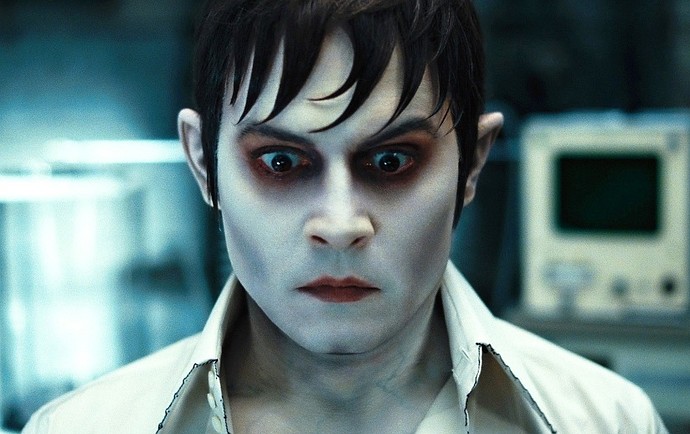
VIDEO ESSAY: Depp Shadows: Tim Burton’s Cinema

VIDEO ESSAY: Depp Shadows: Tim Burton’s Cinema

“Basically Johnny Depp is playing Tim Burton in all his movies.” – Scott Rudin (Producer of Sleepy Hollow)

This ubiquitous quote by Rudin is often the throwaway summation found in most writings on, and dissections of, the cinematic works of Tim Burton with Johnny Depp. Which is a shame, really. The quote is not only too broad—it’s blazingly deceptive. Unlike other repeated director-actor pairings (from Martin Scorsese-Robert De Niro to Pedro Almodovar-Penelope Cruz), each succeeding film in the Burton-Depp canon actually becomes less about “digging” into an unknown abyss (e.g. as Scorsese faced male insecurity in Raging Bull and Almodovar celebrated female power over male dominance in Volver) than about the overall art direction of each film. Even though Burton’s prolific filmography boasts its share of critically (Big Fish) and financial successful (Planet of the Apes) non-Depp-starring movies, it’s worth studying the pattern behind those eight Burton-Depp projects. All together, those eight films have broken numerous box office records and have catapulted Burton into a tier of top-dollar directors. Currently, Burton is one of the few directors who could harness a towering financial investment from a studio in order to bring to any stylized, eye-pleasing idea he has to life.  In fact, if one were to examine the Burton-Depp filmography from top to bottom, it’s quite easy to see the shift from the personal to the pizzazz-filled.

Burton’s first two films with Depp are still his strongest and best works because each film subtly emoted shades of its creator: the shy, social outcast in Edward Scissorhands and the ambitious young filmmaker in Ed Wood. Even with impressive set pieces and dazzling costume design, both films were dominated by Johnny Depp’s carefully nuanced performances. It was the perfect marriage between Burton’s striking, visual storytelling and Depp’s risk-taking performance-art-style acting. Even though most films employ such marriages of talents, Scissorhands and Wood are unique in that they operate on two levels: the surface level looks and sounds like big budget Hollywood but (after repeated viewings) the pulse and internal workings of those films speak to more personal truths (i.e. the anxieties of the outcast), largely because Depp and Burton channeled one another’s sensibilities toward the material, thus giving those films a palpable vitality.

But then something happened. On their third collaboration, Sleepy Hollow, signs of a new Burton cinema began to emerge. This new Tim Burton cinema canon was more concerned with pushing the boundaries of its production design. In Sleepy Hollow, Depp’s (oft-underappreciated) turn as a morbidly grossed-out Ichabod Crane takes a backseat to the moody set pieces and strong work by the FX team. Gone were the quirky tableside manners of Scissorhands or cross-dressing revelations of Wood; in their place were the technically accomplished renderings of ghouls and the gothic. And Burton’s next two live-action films, Charlie and the Chocolate Factory and Sweeney Todd (both remakes), pushed the eye-candy envelope even further. Chocolate Factory basically forced Depp to become a peripheral player in the Burton blueprint of euphoric, candy-centric visualizations. Although Depp scored a Best Actor nomination for Sweeney Todd, his performance—which largely depended on Depp’s ability to always look sullen—is hardly a return to his intimate, versatile turns in Burton’s earlier works. Todd was based on a revered musical, and Depp rose to the occasion with singing chops; Burton turned in some strong visionary work once again (the bloody and bestial barbershop is a beaut), winning Burton the Best Director prize from the National Board of Review. So there’s that.

The real abomination came after the pair’s animated stint in Corpse Bride (which rehashed the stop-motion gothic fare of the Burton-produced Nightmare Before Christmas) and ironically enough became their biggest commercial success: Alice In Wonderland. A mammoth at the box office but overall critical dud, what Wonderland proved was that the new Burton-Depp formula had reached an apex. Early Burton films like Scissorhands had embedded themselves in pop culture to the point where audiences were simply content with knowing that Johnny Depp would be playing an unusual Burton-esque character in an unusual Burton-esque universe (a world somewhere between a Halloween-themed prom and alternate dimension “Saturn” from Beetlejuice). And it’s not that Burton doesn’t know how to make a surefire blockbuster that is also his own singular work of art (see Batman). In the end, the massively financially successful groove that Burton and Depp are in is probably the natural progression that some artists can make after churning out those intimate stories about dying (Beetlejuice), isolation (Edward Scissorhands) and finding your bicycle (Pee-wee’s Big Adventure). So if the latest Burton-Depp vehicle, Dark Shadows, is not a return to earlier form for the pair, at least it will deliver unmatched art direction and unrivaled commercial success. And if that’s the case, maybe Depp really is playing Burton in all of his movies; only now Burton isn’t the isolated, hungry filmmaker he once was.

Nelson Carvajal is an independent digital filmmaker, writer and content creator based out of Chicago, Illinois. His digital short films usually contain appropriated content and have screened at such venues as the London Underground Film Festival. Carvajal runs a blog called FREE CINEMA NOW which boasts the tagline: "Liberating Independent Film And Video From A Prehistoric Value System."

GREY MATTERS: Black Widow Spins Webs Around THE AVENGERS

Black Widow Spins Webs Around THE AVENGERS

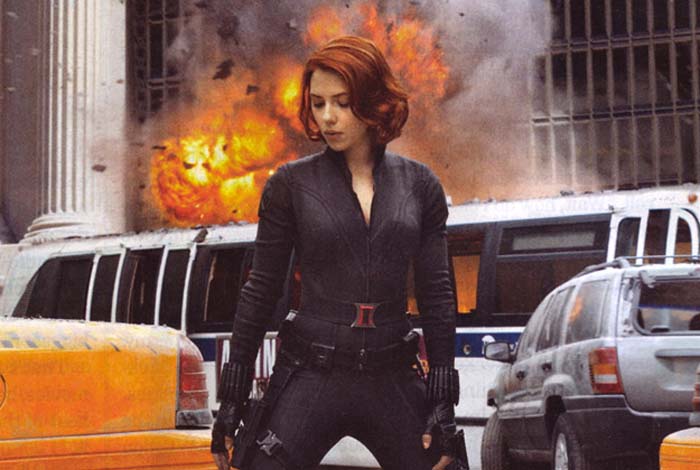
nullBlack Widow is the first hero seen in The Avengers, the latest entry in Joss Whedon's career-long feminist project. She does not immediately display the super powers enjoyed by the other Avengers—Captain America’s unnatural super-strength, The Hulk gamma-ray rage giant, Iron Man’s wearable rock ‘em, sock ‘em robot suit, or Thor’s hammer of the demi-gods. The only visibly super things about Black Widow are the latest in cat suit couture and a striking asymmetrical crimson bob. And yet she’s still able to trash a clutch of Russian scumbags with her hands tied behind her back. With a chair tied to her rear. While talking on her cell phone.

She’s also the sole Avenger that S.H.I.E.L.D. leader Nick Fury (Samuel Jackson) trusts to convince Bruce Banner (Mark Ruffalo) to join Thor (Chris Hemsworth), Iron Man (Robert Downey, Jr.), and Captain America (Chris Evans) in the fight against Thor’s psychotic brother Loki (Tom Hiddleston) who, having stolen the ultimate source of power in the universe, the Tesseract, plans to use an alien army to devastate the Earth. (The plot ends there.)

As egos collide, Black Widow—street name, Natasha Romanova—is the only character who does not throw a monstrous hissyfit.  The only character to gather actionable intelligence against Loki from Loki. The character who not only literally kicks sense back into the brainwashed Hawkeye, but then absolves him of any sins performed while under the loony god’s spell.

You want fearless? When midtown Manhattan is swarming with thousands of robo-aliens, the dreaded Chitauri, Black Widow commandeers one of their slippery aero-sleds and flies it to steal Loki’s glowing phallic scimitar so as to save the world so Iron Man can blow up the aliens.

Oh—and the Tesseract? It’s female. I know this because everyone calls it by female pronouns—respectfully. How does that work? Well, the way all Whedon works: second viewings reveal not only layer after layer of multiple meanings, jokes piled on jokes, but seemingly random elements that are actual thematic glue. Nothing is never there without a reason.

Anyway, Black Widow! A worthy addition to Whedon’s female action bloodline, right? The flame-haired heir to Buffy, Faith, Kendra, River, Echo, Zoe, Fred, and Illyria, right?

No.

Writing in The Guardian, Henry Barnes noticed Black Widow but could not be bothered to isolate just what she did in the film. The New York Post’s Kyle Smith dreamed of a Black Widow who would perform one errand and and then be gone.

The New York Daily News’ Joe Neimaier admitted that Black Widow “kickstarts” things, but by deleting her from the rest of his coverage, implied that was that. Still, that was a lavishment compared with the treatment by A.O. Scott, who in his New York Times review found it beneath himself to even give Black Widow a job description, while The Globe and Mail went with “token sexy female,” clearly hoping only young boys and people who hadn’t seen the film were reading.

Meanwhile, in The Wall Street Journal, Joe Morgenstern claimed Black Widow “spends lots of time looking puzzled or confused,” while Steven Rea's Philadelphia Inquirer review dispensed with Black Widow’s name, suggesting we “watch Scarlett Johansson clench her brow” while in “Ninja garb.” The Miami Herald’s Rene Rodriguez wasn’t as generous—his single sentence also accused Johansson of playing dress-up, but, perhaps mercifully, did not specify what in.

Meanwhile, as if transported from another dimension, Kim Voynar’s Movie City News review both acknowledged Black Widow and lavished almost two paragraphs on Johansson’s terrific performance.

Over at Think Progress, Alyssa Rosenberg took for granted what the aforementioned critics could or would not see. “The two characters least-well served by their previous incarnations in Marvel movies,” she wrote, “the Hulk and Black Widow, are the ones best served by Whedon’s greatest gifts and strongest tendencies.”

Rosenberg hit key reasons why Black Widow matters:

She never becomes a victim or a lesser member of the team. Her pain and exhaustion after a CG Marvel battles triggers our empathy, and centers us. And while all this superhero battling may look fun, without superhero augmentation, it must be terrifying. Johansson offers a true career-best turn here, easily negotiating splinter-thin spaces separating old pains and a chilly professionalism that hides we’re not sure what—regret? Denial? Lingering rage over the childhood abuse that turned her into Black Widow? It’s all hinted at as the actor works Whedon’s many shades of dark grey beautifully. In short, and despite all the Wagnerian bam-boom-pow, Whedon and his star never lose sight of the fact that Natasha is profoundly vulnerable, with nothing but smarts, heart and a .45 for protection.

Finally, AlterNet’s Julianne Escobedo Shepherd cut to the chase and celebrated The Avengers’ “stark feminist perspective” and what she saw as fact: that “Johansson’s Black Widow is just as front-and-center as the rest of the cast.”

To which I can only say—exactly! And: isn’t this remarkable? Two parallel realities! Men who see nobody at all and women who see the next Faith (without the crazy, I mean). Don’t tell Disney, or they’ll be marketing the film as 4-D.

Jokes aside, how to explain this blanket amnesia?

If I were to be optimistic, I’d say this brand of blindness is about change happening too fast. Change is weird, scary and disorienting. And TV’s a great place for incremental change because it shows slow transformations occurring over time.

At first, Buffy, the Vampire Slayer was, literally, a joke. A cheerleader fighting the undead! Hilarious! And she’s so unthreateningly cute! But over time, people came to believe in the take-charge slayer, until someone in Season Four’s “A New Man” [sic] episode could remark to Buffy that “You're, like, make the plan, execute the plan, no one giving you orders,” and instead of intimidation, there was a shrug. Because it was true.

And so over time people weren't alarmed when Alias’ Sydney Bristow nicked bits of the 007 crown. Or when a female Starbuck showed Han Solo-level energy in the new Battlestar Galactica.

But The Avengers moves so fast, with so many zingers, tiffs, explosions, turnarounds and implications that I’d like to think reviewers simply didn’t have time to process just how radically and playfully Whedon (whose mother co-founded Equality Now) cedes yards of traditionally male genre property and space to Black Widow. 

Some part of the male unconscious, down there where The Hulk lives, just didn't go for it.

How is there not at least one guy who can figure out how to fly Chitauricraft? Why is Captain America looking to Black Widow for strategic ideas in midtown Manhattan? And the greatest power of the universe is a She? How does that work?

Answer: It works so easily that The Avengers is well on its way to becoming one of the most popular films in human history. Maybe a mess of male critics can’t see a triumphant Black Widow in the malange of superheroes crowding the film. But in this election year defined by demeaning treatment of women, it’s encouraging to know that a whole lot of America can.

Ian Grey has written, co-written or been a contributor to books on cinema, fine art, fashion, identity politics, music and tragedy. Magazines and newspapers that have his articles include Detroit Metro Times, gothic.net, Icon Magazine, International Musician and Recording World, Lacanian Ink, MusicFilmWeb, New York Post, The Perfect Sound, Salon, Smart Money Magazine, Teeth of the Divine, Venuszine, and Time Out/New York.

VIDEO ESSAY – Utopia Online?

VIDEO ESSAY – Utopia Online?

Director Sam Green knows a few things about utopia. His Oscar-nominated 2002 film The Weather Underground chronicled the film’s titular radical group’s violent path towards creating an ideal society; his new film The Love Song of R. Buckminster Fuller, which screened at the San Francisco International Film Festival, revisits the futurist designer’s attempts to transform the landscape of the San Francisco Bay.

nullGreen’s utopian impulses not only affect the subjects he chooses to film, but also how he presents them to his audience. In 2009, Green and Dave Cerf went on a world tour of live screenings of four short films all dealing with Utopia, presented with live narration by Green and a live musical accompaniment performed by the band The Quavers. The touring show, known as Utopia in Four Movements, brought a fresh gust of innovation and energy to the theatrical experience of cinema, at a time when movie theaters are trying to reinvent themselves in the age of online movies. Green will continue his “live documentary” work by offering an in-person cinematic narration with live accompaniment by the band Yo La Tengo at his SFIFF screening of The Love Song of Buckminster Fuller

What does it mean, then, that some of the short films from Green’s innovative Utopia performances are now available to watch online? The occasion makes one pause to reflect on the qualitative differences between the theatrical and online experiences of movies. The point is raised by an essay by Rebecca Solnit, in which she posits the movie theater experience as a utopia in danger of fading out as online, small screen modes of viewing threaten to replace them:

A lot of us now look back at the golden age of cinema as a bygone paradise, a minor but sublime coexistence of strangers in the dark drawn together to see a flicker of projected light come to life onscreen. Television chopped up movies with commercials and put them in the middle of domestic distraction, but that was nothing compared to this moment when films are on your iPhone and your laptop and in fuzzy tiny windows on YouTube. The worst thing about these new modes of viewing isn’t that they diminish cinema as visual and imaginative spectacle. The worst thing is that they’re watched furtively and alone. Cinema, which was once a great banquet in a dream palace is now often a snack devoured absentmindedly in isolation. And only in society, only together, do we have the power to live out those old dreams, or new ones. Is watching movies online a solitary, un-social experience that smacks of absent-minded consumption and a diminished appreciation of what’s being watched?

The following video is offered as a counterpoint to show what special qualities can be gotten from watching a movie online, in a way that demonstrates interactivity, sociability and an enhanced appreciation of the movies. It is also filmed in real time, as a way to pay tribute to the live, in-the-moment experience experienced in Green’s Utopia performances. Perhaps the real point of this video is that, whether you’re in a movie theater or in front of a computer, the experience of being “live,” like utopia itself, may not be tied to a place, but to a state of mind.

Originally published on Fandor.

Kevin B. Lee is Editor in Chief of IndieWire’s PressPlay Video Blog, Video Essayist for Fandor Keyframe, and contributor to Roger Ebert.com. Follow him on Twitter.

AUDIOVISUALCY: How to “Perform” the Video Essay

AUDIOVISUALCY: How to “Perform” the Video Essay

In “La caméra-stylo: Notes on Video Criticism and Cinephilia” , Christian Keathley argues persuasively that the current landscape of video essays, including commercial DVD supplements and web-embedded features, is defined by a continuum of explanatory and poetical works. Explanatory video essays follow a thesis and are language-based: “Images and sounds – even when carefully and creatively manipulated in support of an argument – are subordinated to explanatory language.” Essays that lean more towards the poetical register, by contrast, are driven by the basic language of cinema: “These videos resist a commitment to the explanatory mode, allowing it to surface only intermittently, and they employ language sparingly, and even then as only one, unprivileged component.”

Keathley’s text provides a useful framework to assess the video essay as an emerging form of criticism. And it emphasizes that it is more than just an explanation or a poetic meditation. It is a performance piece. The critic uses the film’s very own properties to write cinematically (hence the reference to Alexandre Astruc’s pioneering concept of the caméra-stylo). But, more than that, the critic also uses her voice, her actual voice, in addition to prose, both written and cinematic. Voice-over commentary, the way an essay is narrated, has a profound effect on its impact.

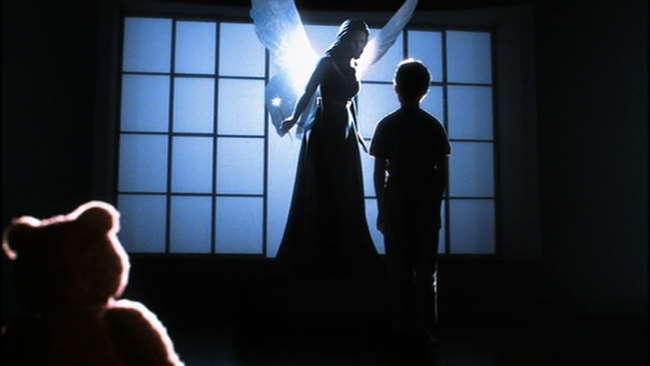
The essay that we are highlighting today is one of the most beautiful examples of the form, and not simply because it remediates a film by Steven Spielberg (and a longtime project by Stanley Kubrick). A.I. Artificial Intelligence – A Visual Study, produced by Benjamin Sampson, a doctoral candidate in the cinema and media studies department at UCLA, is an exploration of some of the titular film’s essential themes and aesthetics. It projects a lucid and cohesive argument with captivating imagery. Sampson uses minimal voice-over. He chooses his words carefully and the deliberate pace and soft pitch with which he narrates the essay lend the presentation a nostalgic, almost magical note.

The essay is, overall, driven by an aesthetically judicious style. The themes are broached verbally, but the full communication occurs via the film’s scenes and Sampson’s own editorial work. Except for chapter breaks and the credits, the essay uses no textual inserts and instead relies on elegantly rendered dissolves, split screen effects, and superimpositions. Sampson manages to create an aesthetic space where the film comments upon itself. The essay seems so natural, so organic, it could be mistaken for a poetic, explanatory epilogue. This is probably why it prompted me to revisit Spielberg’s film, to find new appreciation for it. Is this not the best kind of criticism? Beautiful, stimulating, impactful, all the while in sync with the work it critiques. A.I. Artificial Intelligence – A Visual Study inspires new or awakens old curiosity about the film. And it does so by virtue of an exceptional performance.

Matthias Stork is a film scholar and filmmaker from Germany who is studying film and television at UCLA. He has an M.A. in Education with an emphasis on American and French literature and film from Goethe University, Frankfurt. He has attended the Cannes film festival twice (2010/2011) as a representative of Goethe University's film school. You can read his blog here.