Clint Abides: TROUBLE WITH THE CURVE

Clint Abides: TROUBLE WITH THE CURVE

null

In one of his great essays about baseball, the late A. Bartlett Giamatti famously called the game “our best invention to stay change.” Giamatti (who, besides being president of Yale University, was briefly commissioner of Major League Baseball) added, “I need to think something lasts forever, and it might as well be that state of being that is a game; it might as well be that, in a green field, in the sun.”

The ragtag group of has-beens and hopefuls in Trouble with the Curve would likely share Giamatti’s sentiment. No matter what illnesses or impediments come their way, they cannot let go of the sound of the bat hitting the ball. Seventy-something Atlanta Braves scout Gus Lobel (Clint Eastwood) is going blind, relying on his wits and a magnifying glass to hang onto his job, while former MLB pitcher Johnny Flanagan (Justin Timberlake) seeks to rebrand himself as a broadcaster for the Boston Red Sox after an injury. It is hard to dislike a movie that makes an odd couple out of stars as disparate as Eastwood and Timberlake—Dirty Harry and Sean Parker—and the incongruous pairing is one of the freshest touches in the debut of director Robert Lorenz (a longtime producer for Eastwood).

In Randy Brown’s so-so script, characters of all ages are scrambling for security and status, including Gus’s ambitious lawyer daughter Mickey (Amy Adams), who is hoping to be made a junior partner at her firm. One of the film’s strengths is its willingness to let Gus, Johnny, and Mickey appear weak or desperate. In the Braves’ front office, peopled largely by callow jocks who lean on computer programs rather than firsthand observation to evaluate talent, Gus is mocked as outmoded. Even his old friend Pete (an amiable, mustachioed John Goodman) wonders if something is wrong when he stops by Gus’s house one morning and observes him mistakenly paying the pizza delivery boy with a $50 bill instead of a $20. The look on Goodman’s face suggests he fears something far worse than failing vision: is Gus going senile? When Pete recruits Mickey to look out for her father out on an important scouting trip in North Carolina, his request has all of the subtlety of an intervention.

The pleasure of Trouble with the Curve is not only that Gus will prove the doubters wrong but that he does not care how he is perceived. If he really is not as far gone as Pete and Mickey suspect, what is the harm in their thinking he is? He will get the last laugh, but in the meantime he has no patience for keeping up appearances, unashamed even when he wrecks his car. (Asked the next morning why he has a conspicuous bandage on his cheek, he says with a straight face that he cut himself shaving.) Eastwood’s remarkably open performance (one scene features him tenderly singing “You Are My Sunshine” a capella) suggests that he shares Gus’s wily indifference to others’ opinions, as does his shrug of a response to the humorless criticism he received following his charming, personal speech at the Republican National Convention.

In fact, Trouble with the Curve reflects its star’s gently libertarian disposition. When Mickey tries to mother Gus—helping him with the keys to his motel room or throwing out a hamburger patty he has overcooked—he recoils, all but saying, “Don’t tread on me.” Gus is affronted, too, when the Braves, having learned of his vision problem, suggest he retire and begin drawing a pension. Such gestures are meant to be helpful, but they are bathed in condescension. At the same time, Gus accepts Mickey’s assistance in scouting the presumptive top draft pick because she acts like she’s just . . . chipping in. The film’s politics, such as they are, are not doctrinaire.

Lorenz inherited most of his boss’s usual crew, including cinematographer Tom Stern and editors Joel Cox and Gary Roach, and the result is an unusually well-produced first film. Lorenz has a sure sense of comedy, too, eliciting amusing supporting performances from the reptilian Matthew Lillard (as a go-getting Braves scout) and Joe Massingill (as the draft pick, a misogynistic, self-regarding oaf who calls to mind the wrestler Gorgeous George).

As with several recent Eastwood projects, the biggest liability is the screenplay. Novice screenwriter Randy Brown is simply no James Bridges or William Goldman (authors of two of Eastwood’s best films of the nineties, White Hunter Black Heart and Absolute Power, respectively). His characters lack consistency. Mickey moans about Gus’s uncommunicative manner, implausibly claiming that his emotional distance has driven her to therapy, yet she seems pert and well-adjusted for the most part. What’s more, she has inherited many of her father’s best traits—not just his eye for the game, but his go-it-alone stubbornness and prickly attitude toward co-workers. Was Gus really such a bad dad, to produce such a nice kid? She is not the only one who vacillates. One minute Johnny gladly risks his new career with the Red Sox by taking a counterintuitive piece of advice from Gus and the next he is furious at him for doing just that.

Through it all, though, Eastwood stands firm. Gus gets what he wants, winning a new contract with the Braves with his methods unchanged. He even orchestrates the romance between Mickey and Johnny, like a craggy, cigar-chewing matchmaker. Ever stalwart, Eastwood is, like baseball itself, proof that there is “something abiding,” as A. Bartlett Giamatti would say. 

Peter Tonguette is the author of Orson Welles Remembered and The Films of James Bridges. He is currently writing a critical study of the films of Peter Bogdanovich for the University Press of Kentucky and editing a collection of interviews with Bogdanovich for the University Press of Mississippi.

Animating the Classics

Animating the Classics

This is the first of six essays based on the list of “250 Great Animated Short Films,” recently published here at Press Play.  These six essays will celebrate the inspiration behind some of these films; a complementary series of 20 essays on my cultural history blog, 21 Essays, will focus on common themes.

The inimitable American humorist James Thurber once proposed that Walt Disney should animate Homer’s Odyssey. “(Disney’s) Odyssey can be, I am sure, a far, far greater thing than even his epic of the three little pigs,” Thurber wrote in 1934.

The list of 250 animated great short films that my friends and I recently compiled contains a number of ambitious adaptations in the vein that Thurber proposed above. They transform the world’s great literature into something new—an animated vision. Our list has works adapted from such respected literary stylists as Lewis Carroll, Nikolai Gogol, Charles Dickens, Franz Kafka, Edgar Allen Poe, Ernest Hemingway, the New Testament Gospel writer Luke, James Thurber, and, yes, even Homer.

There’s no easy formula for adapting material from one medium to another. To do justice to a short story like Rudyard Kipling’s “The Man Who Would Be King,” director John Huston felt he needed 129 minutes—and that was without any significant padding. Nevertheless, animation directors have accepted the challenge of flipping literature into animated short film on many occasions, turning to short stories, poems, novels, and even ancient Greek epics for inspiration. The trick is to get the tone right.

With nearly all of the literature-adapted films on our list, the style of the artwork becomes more important than the script itself in capturing the flavor of the source material. There’s the uncanny pinscreen animation used by Alexander Alexeieff and Claire Parker in 1963 to tell Nikolai Gogol’s weird story The Nose, a black comedy nightmare about a nose that deserts its owner’s face. To adapt Ernest Hemingway’s short novel The Old Man and the Sea, Russian animator Aleksandr Petrov drew upon his mastery of the evocative paint-on-glass style. Elaborating upon Luke’s biblical story of Jesus’ nativity, Russian animator Mikhail Aldashin created charming scenes that look like old woodcuts come to life in Rozhdestvo (1997). With each of these films, the visual style adds a new layer of meaning to the original narrative.

null

Although James Thurber was impressed by the realistic fantasy of the Disney Studio, it was the UPA (United Productions of America) animation studio that succeeded in translating the Thurber style to film. In retrospect, this makes sense. Thurber’s witty, almost Matisse-like sketches have very little in common with Disney’s pursuit of verisimilitude. Thurber’s drawings look a lot more like the spare, minimalist UPA style, first popularized in the early Mr. Magoo films and Gerald McBoing-Boing (1951). In fact, there’s a good chance that Thurber’s work may have influenced the emerging style of UPA. Stephen Bosustow, one of the three founders of UPA, wanted to tackle a Thurber film right from the start. In 1946, before UPA had even released its first short, Bosustow announced that The Thurber Carnival (a theatrical revue of some of the most popular Thurber stories) would be a possibility for a UPA feature film. 

The Thurber Carnival proposal languished unfunded for years, during which time Thurber watched his most famous story, “The Secret Life of Walter Mitty,” get the Hollywood big-budget treatment in 1947 courtesy of producer Samuel Goldwyn and star Danny Kaye. Thurber loathed the result. “It began to be bad with the first git-gat-gittle,” Thurber was quoted as saying in Life magazine. “If they spent one tenth of the money, it would have been ten times as good.”

UPA never succeeded in raising the money to make a full-length feature of The Thurber Carnival, but they did eventually film the sly Thurber fable “The Unicorn in the Garden” in 1953. “The Unicorn in the Garden” is a short short story, first published by The New Yorker in 1939 and subsequently appearing in Thurber’s book Fables for Our Time and Famous Poems Illustrated (1940). Accompanying the story, there was a typical Thurber illustration showing a meek-looking man offering a lily to a unicorn. Like the acclaimed UPA work of a decade later, the drawing captured action and character with the barest minimum of lines.

null

I haven’t found any record of Thurber’s opinion of the charming movie that William T. Hurtz directed of The Unicorn in the Garden. It would be nice to think that Thurber liked it from the first git-gat-gittle—and that he realized that here was a movie ten times as good as Walter Mitty, at one tenth the cost.

Thurber didn’t live to see that he was prescient about the potential for the Homeric epic as animated short film, too. In 1995, British animator Barry Purves created Achilles, his puppet spin on the life of Homer’s champion warrior. Purves daringly centered his short film on the love between Achilles and Patroclus, presenting it as a full-throttle gay love story. The Iliad portion only covers five minutes of an 11-minute film, but Purves manages to swiftly and effectively re-imagine many of Homer’s key scenes in the short time allotted.

Thurber may have been surprised by Purves’ treatment of Homer—it sure isn’t Mickey Mouse!—but his basic point was on the mark.  Great literature can be well served by the cartoon medium. Sometimes animation can bring the classic stories to life in ways that simply aren’t available to the cinema of live action.

Here’s a list of 24 literary adaptations drawn from our list of 250 great animated short films. It covers an impressive range of moods, from Hans Christian Andersen’s poignant tales to the strong propaganda of Education for Death (1943) to the surreal horror of Franz Kafka’s A Country Doctor (2007).

The Little Match Girl (Arthur Davis, USA, 1937) 

Ferdinand the Bull (Dick Rickard, USA, 1938) 

Porky in Wackyland (Bob Clampett, USA, 1938) 

Education For Death (Clyde Geronimi, USA, 1943) 

The Little Soldier / Le petit soldat (Paul Grimault, France, 1947) 

The Tell-Tale Heart (Ted Parmelee, USA, 1953) 

The Unicorn in the Garden (William T. Hurtz, USA, 1953)

What’s Opera, Doc? (Chuck Jones, USA, 1957)

Le nez / The Nose (Alexander Alexeieff & Claire Parker, France, 1963)

The Hangman (Paul Julian & Les Goldman, USA, 1964) 

The Dot and the Line: A Romance in Lower Mathematics (Chuck Jones, USA, 1965)

null

A Christmas Carol (Richard Williams, USA, 1971) 

The Selfish Giant (Peter Sander, Canada, 1971) 

The Street (Caroline Leaf, Canada, 1976) 

The Metamorphosis of Mr. Samsa (Caroline Leaf, Canada, 1977) 

There Will Come Soft Rains / Budet laskovyy dozhd (Nozim To'laho'jayev, USSR, 1984) 

The Man Who Planted Trees / L’homme qui plantait des arbres (Frédéric Back, Canada, 1987) 

Death and the Mother (Ruth Lingford, UK, 1988) 

The Restaurant of Many Orders / Chumon no ooi ryori-ten (Tadanari Okamoto, Japan, 1993) 

Achilles (Barry Purves, UK, 1995) 

null

Christmas / Rozhdestvo (Mikhail Aldashin, Russia, 1997) 

The Old Man and the Sea (Aleksandr Petrov, Russia, 1999) 

My Love / Moya lyubov (Aleksandr Petrov, Russia, 2006) 

Kafuka: Inaka isha / Franz Kafka's A Country Doctor (Koji Yamamura, Japan, 2007) 

null

Lee Price is the Director of Development at the Conservation Center for Art and Historic Artifacts (Philadelphia, PA). In addition, he writes a popular fundraising column for Public Libraries, writes a tourism/history blog called "Tour America's Treasures," and recently concluded two limited-duration blogs, "June and Art" and "Preserving a Family Collection."

RAISED IN FEAR: Midnight Movie Revivals and DAWN OF THE DEAD

RAISED IN FEAR: Midnight Movie Revivals and DAWN OF THE DEAD

It's midnight. A horde of glassy-eyed teenagers descends upon the brightly lit multiplex. They look almost like normal film-goers but their gait is shuffling, awkward. “What are they doing? Why do they come here?” “Some kind of instinct. Memory . . . of what they’ve seen before and crave again.”  

null

The Maplewood Mall Theater, in a suburb east of Minneapolis, featured a Midnight Movie series showing a half-dozen revived films each weekend during the early 1980s, their cheap admission fees providing a refuge for bored and alienated youth, and an accessible and affordable introduction to the art of film analysis for burgeoning aficionados. The chance to see a cult film you might have missed in its original, brief run, like The Warriors, Rock and Roll High School, or Wizards, was itself something of a thrill, but to be able to watch one over and over again was a real gift in the era before VCRs. Sometimes these unassuming B pictures would turn out to be works of cinematic art as complex as anything produced in the classic studio era of Hollywood or the European New Wave, turning jaded repeat viewings into reverent close reading.

This is not to say that my friends and I would have thought of our developing viewing habits in this way. If someone had asked us how in the world we could watch George Romero’s Dawn of the Dead (1978) so damn many times we probably would have shrugged and said we liked the gory special effects, or because it was scary and funny at the same time. In retrospect I can now say that this was the first film I’d ever seen that made its gruesomeness so relentlessly visible, and in which I was fascinated by the experience of seeing a horror movie, as it were, with the lights on. Even the most innovative and iconoclastic films I’d seen before showed the lingering influence of German expressionism in their addiction to shadows and darkness. As its title makes clear, Romero’s film offers an entirely different aesthetic, taking a step beyond its predecessor, Night of the Living Dead, in its stark rendering of the emergence of nightmare into the cold light of dawn.

null

The effect was particularly striking when viewed through blood-shot, sleep-starved eyes, jazzed up on caffeine or something stronger. Watching Dawn of the Dead became a ritual, and we were increasingly committed members of a filmic cult. Although we were cool with people who dressed in women’s clothing and wore make-up, we never really got into the whole Rocky Horror Picture Show thing, which seemed to us more like a refuge for frustrated thespians than an expression of countercultural identity. The DIY aesthetic of independent horror films, and their disturbing commentary on the ills of society, seemed much closer to the punk records we were listening to than “Let’s Do the Time Warp Again.” And thanks to cheap midnight showings, we discovered that Dawn of the Dead was every bit as worthy of repeated plays as London Calling or Unknown Pleasures

Initiation to a cult horror film has at least one thing in common with being initiated into a cult: the induction ceremony is likely to be painful. The first image of Romero’s film is of a blood-red, deep-shag carpet, which is gradually revealed as soundproofing on the wall of a studio from which the zombie revolution is being televised. Accompanied by library music composer Paul Lemel’s stark orchestral groans, this opening shot perfectly encapsulates the film’s ability to imbue the mundane with an uncanny sense of unease. It is as much the distasteful shagginess of the carpet as its sanguinary color that gives the film its mood of distinctly postmodern and suburban grotesquerie. 

null

Aesthetically, it is a surprisingly short journey to the tenement building where the undead burst from the decaying walls. One never forgets one’s first sight of human flesh being eaten by glassy-eyed, decayed humanoids, particularly when that flesh is eaten at a leisurely pace, under lurid lights leaving little to the imagination. It was only on repeated viewings that my friends and I came to notice that all of the zombies were Black or Latino and their victims were predominantly white members of the National Guard. As my initial shock gave way to understanding, I learnt one of the basic rules of good macabre filmmaking: effective social commentary emerges out of horror, not the other way around.

null

After the Guard’s botched ethno-zombie eviction attempt, two of the soldiers decide to join forces with a friend at the television studio who has access to a helicopter. As with Night of the Living Dead, the only consistently sensible member of this group is an African-American man, Peter (Ken Foree), who does not suffer fools gladly but has little choice in the new world order. The most foolish of this group of four is the helicopter pilot, Stephen (Kenneth Emge), who nearly kills Peter in an ill-advised rescue attempt during a refueling stop at a rural filling station. The most complex character is Fran (Gaylen Ross), the unfortunate bearer of Stephen’s child, who holds her own against the rising testosterone levels that seem an inevitable part of most apocalyptic scenarios. Their escape route takes them over a hellish tableau made of equal parts Hieronymous Bosch and James Dickey (of Deliverance fame), as bib-overalled, bearded militia groups drink beer and take potshots at the undead. As middle-class suburban kids, my friends and I particularly enjoyed this sequence, as we laughed at the stupid rednecks while train-spotting make-up artist Tom Savini’s seemingly infinite variations on the theme of fleshly decay.

null

The film’s satirical edge sharpens when the group decides to hole up in a giant shopping mall, and Romero’s portrayal of undead-consumerism has become a central component of the now-ubiquitous zombie-apocalypse mythos. Explanations for the current popularity of such narratives are, of course, as abundant as the narratives themselves, but few have much to add to the meta-commentary offered by Romero’s film. My friends and I grew up in the Land of Malls, and while this is in some sense true of all Americans, it was literally true for Minnesotans, who escaped frigid winters by holing up in the first enclosed shopping mall, Victor Gruen’s Southdale, later migrating through its endless architectural and marketing variations. As with the rednecks shooting zombies, we laughed at the zombie-shoppers, so driven by consumerism that they shopped even after they dropped.

null

Looking back, I can now see the irony of laughing at mindless mall-goers from inside a mall theater. I can also see that many of the most important events of my early life took place in that mall theater: I cried when Pinocchio became a real boy, I took my first date to see Monty Python’s Meaning of Life, and later put my arm around her and had my first kiss during The Hunger. And in looking back on these air-conditioned experiences, I realize how susceptible I am to Peter’s observation late in the film while watching the zombies trying to get in: “They’re after the place. They don’t know why, they just . . . remember.”

Jed Mayer is an Associate Professor of English at the State University of New York, New Paltz.

THE GAME (1997): Fincher Flips MISSION: IMPOSSIBLE on Its Head

THE GAME (1997): Fincher Flips MISSION: IMPOSSIBLE on Its Head

null

Long unavailable (domestically) in a proper home edition, David Fincher's unsung puzzle thriller The Game finally gets its due this week thanks to Criterion's shiny new Blu-ray upgrade of their own 1998 laserdisc release. The new Criterion release confirms that Fincher's film—and its hokey premise of a 1-percenter put through his paces in a punishing experiential game—plays as well if not better than it did when I first saw it theatrically fifteen years ago. After all, is there any way to watch Michael Douglas' shallow, well bespoke Nicholas Van Orton—a lonely investment tycoon with a pile of human debris (an ex-wife, a recovering addict for a brother) left behind in his wake—and not think of Mitt Romney? Especially in one scene where his car gets a flat, and he asks his ne'er-do-well brother Conrad (Sean Penn), "Do you know how to change a tire?" Van Orton’s investment banking career, his slicked-back hair, the way he addresses his underlings, his slicked-back hair and expensive taste in suits . . .  even his pinky ring, all reek of a privileged upbringing. Then there’s the long, powerful shadow cast by his late father. Van Orton’s similarities with Romney rob him of a little of the sympathy I'd normally reserve for a movie protagonist.

But The Game's central conceit reminds me of something else. At one point, Fincher was in talks to direct an entry (the third) of the Mission: Impossible franchise. At first blush, that's not too difficult to envision after watching the fastidious Fincher so expertly execute this plot-heavy exercise, dependent on so many contrivances and coincidences. This goes a way back, I admit, but one of the stock scams employed in the 60's Mission: Impossible series (in episodes like "The Train," for instance) was for the team to con one of their marks into participating in some kind of fake adventure of which the IMF team was in total control. This might involve role-playing, movie-like sets, surveillance devices, rerouting of phone lines, etc., all in a manner designed to create a false reality for their target, one in which the IMF team could manipulate the person into doing something uniquely antithetical to his or her true nature.

Similarly, Van Orton is a pawn manipulated by Consumer Recreation Services (CRS), the organization he hires to provide him with an initially amusing but ultimately life-threatening, all-pervading diversion he can't seem to escape. While not too different from the plot puzzles of Mission: Impossible, the one major schism is perspective. While the fun for viewers of the old spy show lies in knowing how the mark is to get his comeuppance at the hands of the IMF team, in The Game, Fincher puts us in the position of the mark himself, in this case Nicholas Van Orton. Fincher takes great pains to hide the strings pulling on Van Orton (this metaphor is perpetuated by the film's marketing team who actually used a CGI-rendered marionette in The Game's teaser) so that even the viewer only gets glimpses behind the scenes when Van Orton does. For example, when Van Orton happens upon the set dressing that adorns the flat belonging to his companion (guide?) Christine (Deborah Kara Unger)—a refrigerator devoid of any food or drink, faucets where the water isn't turned on, a bookcase housing only the spines of a book collection—should we believe that he is finally onto something? Has Van Orton cleverly sussed out a resolution to the all-encompassing game designed by CRS? Or is his discovery merely another meta-layer peeled back to entice Van Orton further into CRS's labyrinth?

The reason Fincher might have passed on directing an entry in the Mission: Impossible franchise is that he more readily identifies with the person being manipulated than with the manipulator. Like Ripley in Alien 3, Detective David Mills in Se7en, and even subsequent protagonists like the narrator of Fight Club and Zodiac's Robert Graysmith, Van Orton struggles to grasp the events around him, ultimately forced to succumb to the currents dragging him along and hope to emerge intact or changed (for the better) on the other side of The Game's looking glass. Think how interesting a picture would be painted of M:I's IMF team if a movie took the point of view of one of their victims. The Game comes closest to offering just such a view. More than when The Game was initially released in 1997, Van Orton is an antihero of our times, a capitalist humiliated into submission by intellectuals outmaneuvering him. And believe me, this target's punishment, just as it may be, is a little too disturbing for your simple, run-of-the-mill action franchise. Mission: Impossible audiences hungry for empty-headed derring-do from Tom Cruise would never accept siding with the enemy or the complicated implications Fincher’s subversion of his premise might provoke.  

Atlanta-based freelance writer Tony Dayoub writes about film and television for his blog, Cinema Viewfinder, and reviews DVDs and Blu-rays for Nomad Editions: Wide Screen, a digital weekly. His criticism has also been featured in Slant’s The House Next Door blog, Opposing Views and Blogcritics.org. Follow him on Twitter.

From Brooklyn With Love: Notes on Unsophistication

From Brooklyn With Love: Notes on Unsophistication

null

When I dashed off a little rant about snarky commenters who annoyed me during a revival screening of From Russia With Love, I didn't expect it to strike a nerve. Apparently it did. I wouldn't take back any of it—I said what I said, and meant all of it. But I would like to clarify a few points in this follow-up post.

Pretty much every assertion I'm going to make here comes back to a core conviction: Not all responses to art are equal.

There is a hierarchy of response. Pretending you're in an episode of Mystery Science Theater 3000—which enshrined the open mic night approach to moviegoing in the 80s—ranks near the bottom.

No, not every movie begs for rapt contemplation. Duh!

Nevertheless, if you go into an old movie, any movie, stuck in the headspace of whatever year you happen to be living in, the movie doesn't stand a snowball's chance in hell of really making an impression on you.

In a Metafilter thread, a commenter summed up my rant with one of his own: "Christ, what an asshole. Someone should tell this uptight disapprover-of-other-people's-joy that James Bond is camp. It was made that way. Knowingly. That it is now, in addition to being camp, also kitsch, well, so fucking what? It's not exactly Shakespeare."

I got many comments like this on the original piece and in blog posts people wrote in response, and I don't respect them. They're forms of self-justifying phony populism. "It's only a movie, dude." "Relax!" "Don't tell me how to watch something, you snob."

Just because a film has campy qualities doesn't mean the whole thing is silly and trivial. And even if a film is partly or wholly campy doesn't mean the viewer is therefore entitled to snicker and comment all the way through it in a public space.

Why not?

Well, for starters, it's mildly asshole-ish behavior. It presumes that if you're enjoying your own free-form sophomoric commentary, everyone around you must find it delightful, too, and if they don't, they should shut up and deal anyway, otherwise they're killjoys. This is, of course, bullshit.

As another Metafilter commenter put it, "The fundamental problem of this behavior is that these people are saying, 'This is stupid, and anyone who enjoys it for its own sake is stupid.' It's a form of bullying. The point of cinema is that it's immersive, and anyone who deliberately spoils that immersion for other people is doing it wrong—it's no different from smoking a cigar or farting odoriferously in a restaurant."

Plus, as my friend Stephen Neave likes to say, if you act like a snot during an old movie, or while encountering any creative work in a mode you're unfamiliar with, you're not getting everything you can out of it; you're cheating yourself.

Maybe you don't believe that, or don't care, but that's the real point of the column. If you are unable to get out of your own narcissistic 2012 bubble while watching an old movie ("Hah, hah! Can you believe people once found that sexy?") then yes indeed, you are watching it wrong. Even if it's an old James Bond flick.

Yes, Bond films are mainly escapism, and they rarely take themselves seriously. And yes, like a lot of genre pictures, Bond movies have camp elements.

But they also have purely cinematic qualities that you can't see unless you take off your Cool Kid spectacles: playful eroticism that turns Me Tarzan, You Jane sexism into teasing comedy; stunning travelogue footage; chases and fights laid out with a choreographer's precision; even moments of borderline horror (that shark pool from The Spy Who Loved Me has shown up in my dreams). Some Bond films even sneak in stray moments (in the Connery and post-Moore flicks, anyway) where you're supposed to feel something for Bond, or for the men and women who die helping him. It's possible to feel a wide range of emotions during light entertainment, but if you're doing the Open Mic Night thing with your buddies, you'll never feel them.

And that's sad. It means you're closing yourself off from a wider spectrum of response, on purpose, apparently. If your default mode is fashionable contemporary snark, you're looking at a rainbow and only seeing one color. 

No, contrary to what you might have thought, this was not an Abe Simpson "These kids today" piece. That's why it ended with an anecdote from a film class I took in 1988, wherein a bunch of fellow undergrads hooted at Singin' in the Rain.

null

The Cool Kid mentality has always been with us.

It's not just the province of the young; it's a more generalized form of ignorance, or more charitably, narcissism: the narcissism of the present tense. It says to art, entertainment and the world at large: "This moment in time is the most morally and intellectual advanced in all human history, and I am a lucky part of that era, a fully evolved person who cannot change or learn any further. Therefore this old movie with its corny language and corny situations can't make me feel anything, or have any thoughts that I haven't had before, so I'm going to sit here, arms folded, and laugh at it. And if you don't like it, you're just a old person, or somebody with a nostalgia fetish, or a jerk who thinks his enjoyment is superior to mine."

John Perich of Overthinking It accuses me of, well, overthinking it. He's not the only writer to take issue with my statement that, "It’s up to the individual viewer to decide to connect or not connect with a creative work. By 'connect,' I mean connect emotionally and imaginatively—giving yourself to the movie for as long as you can, and trying to see the world through its eyes and feel things on its wavelength."

Perich replies:

"The experiences on which a film should be judged have to take place between the first and last frame. To expect anything else shifts the burden of storytelling from the director, the actors, the editors, the set designers, etc., onto the professors, film critics and pundits who discuss the piece. Knowing that From Russia with Love was Pedro Armendariz’s last film gives his performance a touching bit of poignance, particularly certain lines: “I’ve had a particularly fascinating life. Would you like to hear about it?” But Armendariz’s performance, as the gregarious Kerim Bey, has to rise or fall on its merits. (How many other actors have gone out on a real turkey?)

"Anything beyond the level of mere experience activates the critical mindset, or the desire to overthink.

"This isn’t to say that the critical mindset has no place in the experience of pop culture. But the consumption of pop culture and the subjecting of that culture to a level of scrutiny it probably doesn’t deserve are two distinct acts. One is observational; one is infiltrational. The former is passive; the latter, active. Overthinking a work of pop culture enhances the viewing experience, but it can never be a requirement. If it is required, it’s not truly 'pop.'"

Yes, of course, movies date. Entertainment dates. Art dates. Everything dates. 

And so what?

If a work is in some way compelling—well-made, sincere, revealing of a particular mindset or aesthetic school—it is still possible to get something out of it if you're willing to meet it halfway, or a quarter of the way, or a tenth of the way. 

But snark doesn't get you there.

Fake populism deployed in defense of snark doesn't get you there, either.

My colleague Linda Holmes of the NPR blog Monkey See worries that "the great risk" of chastising people for watching a movie the "wrong" way is:

"…that if you grasp a person by the shoulders and tell him he's unsophisticated for his response—as the film teacher did at the closing of the Singin' In The Rain showing—he won't learn the lesson you mean to teach. He won't learn that he needs to think in a nuanced way about the pleasure and the art and the cultural commentary of film. What he will learn is, 'Don't react incorrectly, or people will ridicule you.'

"That's the mindset I actually fear more than ironic distancing: the refusal to react at all until you know how your reaction will be received. That goes hand in hand with the insidious practice of using what you like and dislike to define not just your taste but your place. It's a quieter, less conspicuous, but just as destructive failure to engage. It's how people learn to substitute what they should think for what they actually think, to the point where they don't trust their own reactions."

Fair enough. I admit I'm engaging in hyperbole, both here and in the original piece, and being a bit of an asshole in the process.

Is my hectoring tone alienating people who might be enticed if I were nicer?

Very possibly, but I don't care. I'm an absolutist in believing that some forms of engagement are richer and more rewarding than others.

Snark is not a form of engagement. It is the opposite of engagement.

Can you laugh at old movies and really engage with them?

Sort of, but it's a glancing sort of engagement.

You can engage with your friends while snarking on an old movie, but if you do that, you're not really engaging with the movie, you're goofing around with your friends. 

The best way to engage is to shut up for five or ten minutes at a stretch, watch the movie, and be alone with your thoughts.

Matt Zoller Seitz is the co-founder of Press Play.

250 Great Animated Shorts: The List

250 Great Animated Shorts: The List

In 2008, I organized a team of animation enthusiasts to create the list “100 Important Directors of Animated Short Films.” The list was formally published on Kevin B. Lee’s blog Shooting Down Pictures and Fandor’s Keyframe and currently resides on my cultural history blog, 21 Essays.

This year, I returned to my old friends and proposed revisiting the subject with the construction of another list followed by a blow-out celebration of the art of the animated short film.  Completed in late August 2012, our new list is titled “250 Great Animated Short Films.” And that blow-out celebration is now officially in progress: two straight months of cartoon love with pieces published both at 21 Essays and here on Press Play.

To compose our new list, I convened a panel of seven animation enthusiasts—Scott Bussey, Jorge Didaco, Waldemar Hepstein, Bill Kamberger, Robert Reynolds, Sulo Vatanen, and myself.  With additional help from other enthusiasts, we spent a month nominating, watching, and voting upon hundreds of films.

As a guide for making our selections, I asked my fellow panelists to make an effort to keep the list chronologically balanced  (with a representative sampling of shorts from each decade), geographically diverse, and with a reasonable proportion of female to male directors.  Our definition of a short film was 40 minutes or less, and we worked without a set definition of what constitutes an animated film.

And please note that we’ve been very careful to avoid claiming that this is a “best of…” list.  Our goal was simply to select some of the greatest for celebration.

Of course, I’d be shocked if anyone is entirely satisfied with our selection.  I know I’m not!  But I’m still proud of this list.  Somehow I lucked out with my volunteer panelists, managing to strike a happy balance between traditionalists and boundary-pushers.  I was hoping for a list with great Disney and WB cartoons, abstract animations by Fischinger and Lye, weirdness from Svankmajer and the Quay brothers, and profundity from Norshteyn and Back.  And that’s what I got!  I’m very happy indeed.

For the next two months, my friends and I will be contributing pieces about some of our favorites from the list.  The blog entries on 21 Essays will explore common themes like time and memory, love and courtship, and war and violence. 

On Press Play, a series of weekly entries will examine some of the sources of inspiration, such as folk tales, classic literature, and other art forms  (painting, music, and theater). 

Taken together, this pair of series will constitute our two-pronged celebration.

And it all starts with the list…

250 GREAT ANIMATED SHORT FILMS

null

The Early Years  (1895-1919)

Around a Bathing Hut / Autour d’une cabine (Émile Reynaud, France, 1895) 

The Electric Hotel / El hotel eléctrico (Segundo de Chomón, Spain, 1908) 

Fantasmagorie (Émile Cohl, France, 1908) 

Little Nemo / Winsor McCay, the Famous Cartoonist of the N.Y. Herald and His Moving Comics (Winsor McCay, USA, 1911) 

The Cameraman’s Revenge / Mest kinematograficheskogo operatora (Wladyslaw Starewicz, Russia, 1912) 

How a Mosquito Operates (Winsor McCay, USA, 1912) 

Gertie the Dinosaur (Winsor McCay, USA, 1914) 

Captain Grogg’s Wonderful Journey / Kapten Groggs underbara resa (Victor Bergdahl, Sweden, 1916) 

null

The 1920s

The Frogs Who Wanted a King / Les grenouilles qui demandent un roi (Wladyslaw Starewicz, France, 1922)

Felix In Hollywood (Otto Messmer, USA, 1923) 

Opus III (Walter Ruttmann, Germany, 1924) 

Symphonie diagonale (Viking Eggeling, Germany, 1924) 

Now You Tell One (Charley Bowers, USA, 1926) 

Spiritual Constructions / Seelische Konstruktionen (Oskar Fischinger, Germany, 1927)

Steamboat Willie (Walt Disney, USA, 1928) 

Ghosts Before Breakfast / Vormittagsspuk (Hans Richter, 1928) 

Hell’s Bells (Ub Iwerks, US, 1929) 

The Skeleton Dance (Walt Disney, USA, 1929) 

The Stolen Lump / Kobu-Tori (Chuzo Aoji and Yasuji Murata, Japan, 1929) 

null

The 1930s

The Idea / L’idée  (Berthold Bartosch, 1932) 

Night on Bald Mountain / Une nuit sur le mont chauve (Alexander Alexeieff and Claire Parker, France, 1933) 

Snow-White (Dave Fleischer, USA, 1933) 

Three Little Pigs (Burt Gillett, USA, 1933) 

A Dream Walking (Dave Fleischer, USA, 1934) 

The Mascot / Fétiche (Wladyslaw Starewicz, 1934) 

The Joy of Living / La joie de vivre (Anthony Gross & Hector Hoppin, France, 1934) 

The Band Concert (Wilfred Jackson, USA, 1935) 

Papageno (Lotte Reiniger, Germany, 1935) 

Who Killed Cock Robin? (David Hand, USA, 1935) 

Rainbow Dance (Len Lye, UK, 1936) 

Clock Cleaners (Ben Sharpsteen, USA, 1938) 

Escape (Mary Ellen Bute, USA, 1937) 

The Little Match Girl (Arthur Davis, USA, 1937) 

The Old Mill (Wilfred Jackson, USA, 1937) 

Ferdinand the Bull (Dick Rickard, USA, 1938) 

Porky in Wackyland (Bob Clampett, USA, 1938) 

Peace on Earth (Hugh Harman, USA, 1939) 

null

The 1940s

Mr. Duck Steps Out (Jack King, USA, 1940) 

The Boogie Woogie Bugle Boy of Company “B” (Walter Lantz, USA, 1941) 

The Night Before Christmas (Joseph Barbera & William Hanna, USA, 1941) 

Rhapsody In Rivets (Friz Freleng, USA, 1941) 

Blitz Wolf (Tex Avery, USA, 1942)

Der Fuehrer’s Face (Jack Kinney, USA, 1942) 

Tulips Shall Grow (George Pal, USA, 1942) 

Donald’s Tire Trouble (Dick Lundy, USA, 1943) 

Education For Death (Clyde Geronimi, USA, 1943) 

Porky Pig’s Feat (Frank Tashlin, USA, 1943) 

Red Hot Riding Hood (Tex Avery, USA, 1943) 

Weatherbeaten Melody / Scherzo – Verwitterte Melodie (Hans Fischerkoesen, Germany, 1943) 

The Adventures of Baron Münchhausen / Abenteuer des Freiherrn. von Münchhausen: Eine Winterreise (Hans Held, Germany, 1944) 

The Chimney Thief / Le voleur de paratonnerres (Paul Grimault, France, 1944) 

Daffy Doodles (Robert McKimson, USA, 1946) 

Kitty Kornered (Robert Clampett, USA, 1946) 

The Cat Concerto (Joseph Barbera & William Hanna, USA, 1947) 

King-Size Canary (Tex Avery, USA, 1947) 

The Little Soldier / Le petit soldat (Paul Grimault, France, 1947) 

Motion Painting No. 1 (Oskar Fischinger, USA, 1947) 

Bad Luck Blackie (Tex Avery, USA, 1949) 

Begone Dull Care (Norman McLaren, Canada, 1949) 

High Diving Hare (Friz Freleng, USA, 1949) 

Inspiration / Inspirace (Karel Zeman, Czechoslovakia, 1949) 

null

The 1950s

Rabbit of Seville (Chuck Jones, USA, 1950) 

Gerald McBoing Boing (Robert Cannon, USA, 1951) 

Rooty Toot Toot (John Hubley, USA, 1951) 

Neighbours (Norman McLaren, Canada, 1952) 

Duck Amuck (Chuck Jones, USA, 1953) 

The Tell-Tale Heart (Ted Parmelee, USA, 1953) 

Toot Whistle Plunk and Boom (Ward Kimball & Charles A. Nichols, USA, 1953) 

The Unicorn in the Garden (William T. Hurtz, USA, 1953) 

One Froggy Evening (Chuck Jones, USA, 1955) 

What’s Opera, Doc? (Chuck Jones, USA, 1957) 

Free Radicals (Len Lye, UK, 1958) 

House / Dom (Walerian Borowczyk & Jan Lenica, Poland, 1958) 

The Tender Game (John Hubley, USA, 1958) 

The Lion and the Song / Lev a písnicka (Bretislav Pojar, Czechoslovakia, 1959) 

null

The 1960s

Little Tadpoles Search for Mama / Xiao ke dou zhao ma ma (Wei Te, China, 1960) 

The Ash-Lad and the Good Helpers / Askeladden og de gode hjelperne (Ivo Caprino, Norway, 1961) 

Surogat / Ersatz (Dusan Vukotic, Yugoslavia, 1961) 

Story of a Certain Street Corner / Aru machikado no monogatari (Eiichi Yamamoto & Yusaku Sakamoto, Japan, 1962) 

Labirynt (Jan Lenica, Poland, 1963) 

Le nez / The Nose (Alexander Alexeieff & Claire Parker, France, 1963)

The Hangman (Paul Julian & Les Goldman, USA, 1964) 

The Thieving Magpie / La gazza ladra (Emanuele Luzzati and Giulio Gianini, Italy, 1964) 

The Dot and the Line: A Romance in Lower Mathematics (Chuck Jones, USA, 1965)

Gymnopédies (Larry Jordan, USA, 1965) 

The Hand / Ruka (Jirí Trnka, Czechoslovakia, 1966) 

My Green Crocodile / Moy zelenyy krokodil (Vadim Kurchevskiy, USSR, 1966) 

The Seventh Father in the House / Sjuende far i huset (Ivo Caprino, Norway, 1966) 

The Snowman / Snehulák (Hermína Týrlová, Czechoslovakia, 1966) 

Curiosity / Znatizelja (Borivoj Dovnikovic, Yugoslavia, 1967) 

Life in a Tin / Una vita in scatola (Bruno Bozzetto, Italy, 1967) 

The Mitten / Varezhka (Roman Kachanov, USSR, 1967) 

Ball of Yarn / Klubok (Nikolai Serebryakov, USSR, 1968) 

Pas de deux (Norman McLaren, Canada, 1968) 

Storytime (Terry Gilliam, UK, 1968) 

Ballerina on the Boat / Balerina na korable (Lev Atamanov, USSR, 1969) 

Walking / En marchant (Ryan Larkin, Canada, 1969) 

Schody  (Stairs) (Stefan Schabenbeck, Poland, 1969) 

null

The 1970s

Film, Film, Film (Fyodor Khitruk, USSR, 1970) 

Is It Always Right To Be Right? (Lee Mishkin, USA, 1970) 

Pixillation (Lillian Schwartz, USA, 1970) 

The Roll-Call / Apel (Ryszard Czekala, Poland, 1971) 

The Battle of Kerzhenets / Secha pri Kerzhentse (Ivan Ivanov-Vano & Yuriy Norshteyn, 1971) 

A Christmas Carol (Richard Williams, USA, 1971) 

Evolution (Michael Mills, Canada, 1971) 

How a Sausage Dog Works / Jak dziala jamniczek (Julian Józef Antonisz, Poland, 1971) 

The Selfish Giant (Peter Sander, Canada, 1971) 

Butterfly / Babochka (Andrey Khrzhanovskiy, USSR, 1972) 

Tchou-Tchou (Co Hoedeman, Canada, 1972) 

Coeur de secours (Piotr Kamler, France, 1973) 

Frank Film (Caroline & Frank Mouris, USA, 1973) 

Heavy-Light (Adam Beckett, USA, 1973) 

Café Bar (Alison De Vere, UK, 1974) 

Closed Mondays (Will Vinton, USA, 1974) 

The Diary / Dnevnik (Nedeljko Dragic, Yugoslavia, 1974) 

Fuji (Robert Breer, USA, 1974) 

Great  (Isambard Kingdom Brunel) (Bob Godfrey, UK, 1975) 

Hedgehog in the Fog / Yozhik v tumane (Yuriy Norshteyn, USSR, 1975) 

Dojoji Temple (Kihachiro Kawamoto, Japan, 1976) 

Mindscape / Le paysagiste (Jacques Drouin, Canada, 1976) 

The Street (Caroline Leaf, Canada, 1976) 

The Bead Game (Ishu Patel, Canada, 1977) 

Crane Feathers / Zhuravlinye per'ya (Ideya Garanina, USSR, 1977) 

David (Paul Driessen, Netherlands, 1977) 

The Metamorphosis of Mr. Samsa (Caroline Leaf, Canada, 1977) 

Powers of Ten (Charles & Ray Eames, USA, 1977) 

The Sand Castle / Le château de sable (Co Hoedeman, Canada, 1977) 

Boy and Girl / Malchik i devochka (Rozaliya Zelma, USSR, 1978) 

Poor Lisa / Bednaya Liza (Ideya Garanina, USSR, 1978) 

Rowing Across the Atlantic / La Traversée de l'Atlantique à la rame (Jean

François Laguionie, France, 1978) 

Satiemania (Zdenko Gasparovic, Yugoslavia, 1978) 

Asparagus (Suzan Pitt, USA, 1979) 

Every Child (Eugene Fedorenko, Canada, 1979) 

Harpya (Raoul Servais, Belgium, 1979) 

House of Flame/ Kataku  (Kihachiro Kawamoto, Japan, 1979) 

Tale of Tales/ Skazka skazok  (Yuriy Norshteyn, USSR, 1979) 

null

The 1980s

Fisheye/ Riblje oko  (Josko Marusic, Yugoslavia, 1980) 

The Three Inventors / Les 3 inventeurs (Michel Ocelot, France, 1980) 

Tyll the Giant / Suur Tõll (Rein Raamat, USSR, 1980) 

Who Will Comfort Toffle? / Vem skall trösta knyttet? (Johan Hagelbäck, Sweden, 1980) 

The Circle / O kyklos  (Iordanis Ananiadis, Greece, 1981) 

The Fly / A Légy (Ferenc Rófusz, Hungary, 1981) 

The Pied Piper of Hamelin (Mark Hall, UK, 1981) 

Skyscraper / Neboder (Josko Marusic, Yugoslavia, 1981) 

Tango (Zbigniew Rybczynski, Poland, 1981) 

Crac (Frédéric Back, Canada, 1981) 

Block / Blok (Hieronim Neumann, Poland, 1982) 

Dimensions of Dialogue / Moznosti dialogu (Jan Svankmajer, Czechoslovakia, 1982) 

Ex Libris (Garik Seko, Czechoslovakia, 1982) 

The Snowman (Dianne Jackson, UK, 1982) 

There Once Was a Dog / Zhil-byl pyos (Eduard Nazarov, USSR, 1982) 

Three Monks / San ge heshang (Jingda Xu  (A Da), China, 1982) 

The Vanished World of Gloves / Zaniklý svet rukavic (Jirí Barta, Czechoslovakia, 1982) 

Esperalia (Jerzy Kalina, Poland, 1983) 

Memories of War (Pierre Hébert, Canada, 1983) 

Anna & Bella (Børge Ring, Netherlands, 1984) 

The Dark Side of the Moon / Obratnaya storona luny (Aleksandr Tatarskiy, USSR, 1984) 

Film-Wipe-Film (Paul Glabicki, USA, 1984) 

Jumping (Osamu Tezuka, Japan, 1984) 

There Will Come Soft Rains / Budet laskovyy dozhd (Nozim To'laho'jayev, USSR, 1984) 

Paradise (Ishu Patel, Canada, 1985) 

The Big Snit (Richard Condie, Canada, 1986) 

Door / Dver (Nina Shorina, USSR, 1986) 

George and Rosemary (David Fine & Alison Snowden, Canada, 1987) 

How Wang-Fo Was Saved / Comment Wang-Fo fut sauvé (René Laloux, France, 1987) 

Lodgers of an Old House / Zhiltsy starogo doma (Alexei Karev, USSR, 1987) 

The Man Who Planted Trees / L’homme qui plantait des arbres (Frédéric Back, Canada, 1987) 

Street of Crocodiles (Stephen & Timothy Quay, UK, 1987) 

Your Face (Bill Plympton, USA, 1987) 

The Cat Came Back (Cordell Barker, Canada, 1988) 

Death and the Mother (Ruth Lingford, UK, 1988) 

Face Like a Frog (Sally Cruikshank, USA, 1988) 

Feelings of Mountains and Waters / Shan shui qing (Wei Te, China, 1988) 

Pas à deux (Monique Renault & Gerrit van Dijk, Netherlands, 1988) 

Prometheus’ Garden (Bruce Bickford, USA, 1988) 

The Public Voice / Den offentlige røst (Lejf Marcussen, Denmark, 1988) 

Walls / Sciany (Piotr Dumala, Poland, 1988) 

Balance  (Christoph Lauenstein & Wolfgang Lauenstein, West Germany, 1989) 

The Cow / Korova (Aleksandr Petrov, USSR, 1989) 

Darkness/Light/Darkness / Tma/Svetlo/Tma (Jan Svankmajer, Czechoslovakia, 1989) 

The Hill Farm (Mark Baker, UK, 1989) 

Knick Knack (John Lasseter, USA, 1989) 

Mind the Steps! / Vigyázat, lépcsö! (István Orosz, Hungary, 1989) 

null

The 1990s

Grasshoppers / Cavallette (Bruno Bozzetto, Italy, 1990) 

Manipulation  (Daniel Greaves, UK, 1991) 

The Sandman (Paul Berry, UK, 1991) 

Strings  (Wendy Tilby, Canada, 1991) 

When the Leaves Have Fallen Down from the Oak / Az opadá listí z dubu (Vlasta Pospísilová, Czechoslovakia, 1991) 

Franz Kafka (Piotr Dumala, Poland, 1992) 

Hotell E  (Priit Pärn, Estonia, 1992) 

Milk of Amnesia (Jeffrey Noyes Scher, USA, 1992) 

Mona Lisa Descending a Staircase (Joan C. Gratz, USA, 1992) 

The Restaurant of Many Orders / Chumon no ooi ryori-ten (Tadanari Okamoto, Japan, 1993) 

The Wrong Trousers (Nick Park, UK, 1993) 

Carmen Trilogy  (Carmen Torero, Carmen Habanera, Carmen Suite) (Aleksandra Korejwo, Poland, 1994 – 1996) 

Felix in Exile (William Kentridge, South Africa, 1994) 

The Monk and the Fish / Le moine et le poisson (Michael Dudok de Wit, France, 1994) 

Triangle (Erica Russell, UK, 1994) 

Achilles  (Barry Purves, UK, 1995) 

Repete (Michaela Pavlátová, Czech Republic, 1995)

Famous Paintings / Beroemde schilderijen (Maarten Koopman, Netherlands, 1996) 

Genre  (Don Hertzfeldt, USA, 1996) 

Quest (Tyron Montgomery, Germany, 1996) 

Christmas / Rozhdestvo (Mikhail Aldashin, Russia, 1997) 

Glassy Ocean / Kujira no Chouyaku (Shigeru Tamura, Japan, 1998) 

More (Mark Osborne, USA, 1998) 

The Old Lady and the Pigeons / La vieille dame et les pigeons (Sylvain Chomet, France, 1998) 

The Old Man and the Sea (Aleksandr Petrov, Russia, 1999) 

null

The 2000s

Adagio / Adazhio (Garry Bardin, Russia, 2000) 

At the Ends of the Earth / Au bout du Monde (Konstantin Bronzit, France, 2000) 

Le chapeau (Michèle Cournoyer, Canada, 2000) 

Father and Daughter (Michael Dudok de Wit, UK/Belgium/Netherlands, 2000) 

Tuning the Instruments / Strojenie instrumentów (Jerzy Kucia, Poland, 2000) 

Aria  (Pjotr Sapegin, Canada/Norway, 2001) 

Black Soul / Âme noire  (Martine Chartrand, Canada, 2001) 

Cat Soup / Nekojiru-so (Tatsuo Sato, Japan, 2001) 

Down to the Bone / Hasta los huesos (René Castillo, Mexico, 2002) 

Dream Work (Peter Tscherkassky, Austria, 2002) 

A Summer Night Rendez-vous / Au premier dimanche d’août (Florence Miailhe, France, 2002) 

Destino  (Dominique Monfery, France/USA, 2003) 

Fast Film (Virgil Widrich, Austria/Germany/Luxembourg, 2003) 

Harvie Krumpet (Adam Elliot, Australia, 2003) 

Rocks / Das Rad (Chris Stenner, Arvid Uibel & Heidi Wittlinger, Germany, 2003) 

Voices of a Distant Star / Hoshi no koe (Makoto Shinkai, Japan, 2003) 

The Dream of an Old Oak / Quercus (Vuk Jevremovic, Germany, 2004) 

The Man With No Shadow / L’Homme sans ombre (Georges Schwizgebel, Canada/Switzerland, 2004) 

Ryan  (Chris Landreth, Canada, 2004)

Brothers Bearhearts / Vennad Karusüdamed (Riho Unt, Estonia, 2005) 

The Mysterious Geographic Explorations of Jasper Morello (Anthony Lucas, Australia, 2005) 

The Danish Poet (Torill Kove, Norway/Canada, 2006) 

Dreams and Desires (Joanna Quinn, UK, 2006) 

The Legend of Shangri-La (Chen Ming, China, 2006) 

My Love / Moya lyubov (Aleksandr Petrov, Russia, 2006) 

Never Like the First Time! / Aldrig som första gången! (Jonas Odell, Sweden, 2006) 

Peter & the Wolf (Suzie Templeton, UK, 2006) 

Printed Rainbow (Gitanjali Rao, India, 2006) 

The Tale of How (The Blackheart Gang: Ree Treweek, Jannes Hendrikz & Markus Wormstorm, South Africa, 2006) 

Franz Kafka's A Country Doctor / Kafuka: Inaka isha (Koji Yamamura, Japan, 2007) 

False Aging (Lewis Klahr, USA, 2008) 

The House of Small Cubes / La Maison en Petits Cubes / Tsumiki no ie (Kunio Katô, Japan, 2008) 

My Childhood Mystery Tree (Natalia Mirzoyan, Russia, 2008) 

Orgesticulanismus  (Mathieu Labaye, Belgium, 2008) 

Skhizein (Jérémy Clapin, France, 2008) 

This Way Up (Adam Foulkes & Alan Smith, UK, 2008) 

Quimby the Mouse (Chris Ware, USA, 2009) 

Invention of Love (Andrey Shushkov, Russia, 2010) 

Pandane to Tamago-hime (Hayao Miyazaki, Japan, 2010) 

Restart (Miao Xiaochun, China, 2010) 

The Silence Beneath the Bark / Le silence sous l'écorce (Joanna Lurie, France, 2010)

The Fantastic Flying Books of Mr. Morris Lessmore (William Joyce & Brandon Oldenburg, USA, 2011)

Lee Price is the Director of Development at the Conservation Center for Art and Historic Artifacts (Philadelphia, PA). In addition, he writes a popular fundraising column for Public Libraries, writes a tourism/history blog called "Tour America's Treasures," and recently concluded two limited-duration blogs, "June and Art" and "Preserving a Family Collection."

Raised in Fear: Coping with Excess in Larry Cohen’s IT’S ALIVE

Raised in Fear: Coping with Excess in Larry Cohen’s IT’S ALIVE

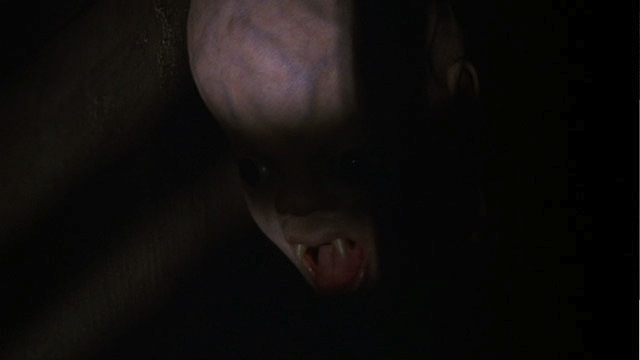
nullIt started with a poster. Amidst a field of black stands a Victorian basinet, its quaint domesticity rudely marred by a fleshy, twisted claw hanging ominously over the side. I stared at this disturbing image for weeks as it occupied the “coming attractions” window of the St. Croix Mall Theater, a cinder block “two-plex” in a Minnesota suburb. In the bygone America of a Ray Bradbury story, impressionable youngsters would be drawn to similar posters announcing the imminent arrival of a travelling fair or circus. In American suburbs of the 1970s, we had low-budget, grainy horror movies, which I believe were every bit as magical and transformative as the wonder-shows of old.

The advertising campaign for Larry Cohen’s It’s Alive (1974) was accompanied by two irresistible tag lines. The first spoke directly to the poster image: “There’s just one thing wrong with the Davis baby . . . It’s Alive!” The second warned menacingly that this was “The one film you should NOT see alone,” a warning that ran counter to the MPAA’s peculiarly lenient PG rating. At eight years old I was certainly unprepared for the horrors I was to encounter in the smaller and seedier of the St. Croix Mall’s two theaters, and the excesses I was exposed to would shape me in ways I could not have anticipated. If my standing decision not to become a father was a result of this film, I owe Larry Cohen my undying gratitude; but I suspect its actual influence was more complicated.

Expecting more of the gothic imagery and mutated appendages advertised in the poster, what I encountered instead in the film’s first fifteen minutes was one of the most horrific birth scenes in the history of cinema. Anticipating another take on the monster movie formulas I’d grown accustomed to on late night television, what I got was an immersion in the fetid waters of repressed Freudian psychodrama. From the moment the doctors began strapping the nice Davis lady into her obstetric harness to the point where the last dying intern staggered from the operating room, I experienced something closer to Alex’s therapy in A Clockwork Orange than the cozy thrills of Saturday night’s Creature Feature. I remember little else of the film from that first traumatic screening, but I know that I slept next to my parents' bed for a week, having regressed to an emotional age I thought I’d left behind.

null

In many ways, the warning of the film’s second tag-line is something of a mockery: when we encounter that rare thing, a genuinely disturbing film, it is inevitably alone that we face the horrors it shows us and those it awakens from the dark places in ourselves. It is tempting to follow Bruno Bettelheim and argue that, like the classic fairy tale, the modern horror film, by confronting viewers with what they fear most, enables them to work through their fears imaginatively and healthily, thus preparing us for the challenges we meet in every day life.  In some cases this is undoubtedly so, but, as horror film enthusiasts know, once in a while we see a film that confronts us with something we simply cannot process, and which leaves its aberrant mark, perhaps forever. In this respect, horror is the quintessential genre of excess, presenting us with images and situations that we didn’t ask for and can’t dispose of.

null

Seeing It’s Alive as an adult, it becomes clear that this problem of excess is precisely what the film is about: the Davises did not want their baby, and yet they can’t simply dispose of it. A clear response to the tragic side-effects of the sedative Thalidomide, widely prescribed to pregnant women in the late-fifties and early-sixties before its harmful effects were known, the film brings together a host of contemporary environmental fears, as numerous explanations are offered for the Davis’ mutant child. The baby becomes the embodiment of every environmental and biological excess perpetrated by pharmaceutical, agricultural, and power companies since the Second World War. One of the expectant fathers sharing a waiting room with Frank Davis observes: “We're slowly but surely poisoning ourselves, you know that?,” to which Frank replies, “Fine world to bring a kid into, fellas.” Larry Cohen is one of the great satirists of horror, a skill particularly evident in the decision to make the child’s father a PR man, the very person who would be responsible for crafting plausible narratives that would enable polluting companies to sweep their excesses under the media's rug.  

Yet unlike Cohen’s more outrageous satires (Q, The Stuff), It’s Alive treats its protagonists with a tremendous sense of compassion, as they come to bear the burden of all their society has come to fear and resent. John P. Ryan brings an astonishing emotional range to his performance as Frank Davis, as we see him gradually come to terms with being the father of the child no one wants. Ryan’s heavy-browed, brooding features shift surprisingly to expressions of wry amusement and tender affection, as when he responds to his wife anxiously asking if he’s afraid of her after giving birth to a monster with the reply, “I’ve always been afraid of you, especially those eyes.”  

null

Subtle character touches like these make the Davises’ struggles vividly plausible, and desperately tragic. After renouncing his child and wounding it with gunfire, Frank Davis gradually comes to accept this strange being as his own. Finding the baby lying helpless in the sewer during the film’s climactic chase scene, he tearfully embraces it and apologizes: “I know it hurts.  I know that, but everything's going to be all right.  See, I was . . . I was scared, like you are.” Fear becomes the basis for understanding and compassion. Cohen’s film, like all great horror films, does not argue that what doesn’t kill us makes stronger, but rather that what terrifies us makes us weaker, and out of that weakness may emerge genuine compassion and forgiveness.

null

It’s Alive presents a dialectic of horror in which monstrous excess is first repudiated and rejected, then returns in the form of self-loathing and social stigmatization, and is finally painfully accepted as an essential part of ourselves. In this it resembles popular film adaptations of Mary Shelley’s Frankenstein, from which it may also take its title, those famous two words announcing the creature’s birth in James Whale’s great 1931 version. This connection isn't lost on Cohen’s protagonist, when in conversation with a pair of biologists who want to use the baby in laboratory experiments: “When I was a kid, I always thought the monster was Frankenstein.  Karloff walking around in these big shoes, grunting. I thought he was Frankenstein. Then I went to high school and read the book and I realized that Frankenstein was the doctor who created him. Somehow, the identities . . . get all mixed up, don't they?”

The police chief’s sardonic reply to this astute meta-interpretation of the film might serve as another misleading tag-line:  “One must not allow oneself to be impressed by escapist fiction.”

Jed Mayer is an Associate Professor of English at the State University of New York, New Paltz.

VIDEO ESSAY: Mapping the Long Take: Béla Tarr and Miklós Jancsó

VIDEO ESSAY: Mapping the Long Take: Béla Tarr and Miklós Jancsó

Originally published on Fandor.

The Red and the White Shot #70

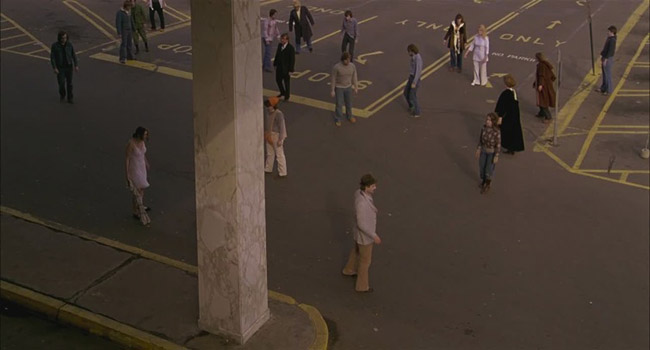
From what I can tell, this shot from Miklós Jancsó‘s The Red and the White (1968) was filmed with the camera mounted on a single dolly track that allowed it to move smoothly back and forth across several feet. By combining different degrees of zooms at different positions along the dolly track, the scene yields a stunning variety of shots. The camerawork has a pendulum-like quality. Not only does it move left and right along the dolly, it also zooms forward and backward, alternating between close-ups that capture the intimate expressions of a face, or exchanges between two people, and wide panoramic shots of soldiers and prisoners in formation. While the camera rests at certain points, it is never stable, conveying a sense of anxious uncertainty in wartime.

This one shot features over 100 actors, and the choreography of their bodies creates different geometries and patterns from start to finish. Notice how this shot is the same as one at the beginning, except now a group of prisoners are lying where it was once an open field of grass. It attests to the clockwork choreography of the scene. All of this culminates in a brilliant moment, this amazing deep focus shot of the White Army soldiers spotting Red Army horses across the river, and the White Army captain is then killed by a shot from an offscreen source. The horses were a decoy for the Red rebels to launch their attack from the opposite direction. It’s a scene whose timing is full of irony—if the rebels had arrived earlier, they could have stopped the executions, but they had to wait for the White platoon to leave, ironically in search of the rebels. The choreography of the scene is symbolic, representing the conflict between the order imposed by the oppressive White Army and revolutionary chaos of the Red soldiers. Here, the victory is a conquest of cinematic space.

The Turin Horse Shot #22

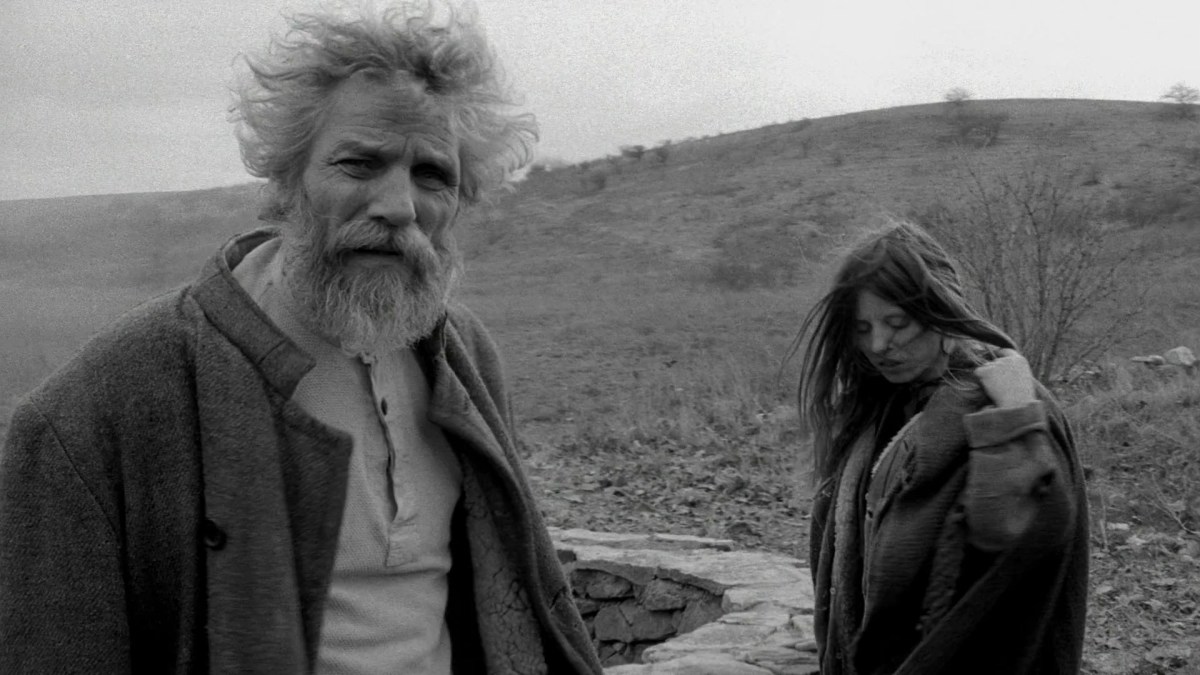
Comparing this one shot from The Turin Horse (2011) with the one that we just watched, you can see how Bela Tarr‘s use of the long take both incorporates and rejects different elements of Jancso’s camerawork. Here the camera is less active and elaborate, and the staging is less busy. Instead, there’s a greater emphasis on physicality. The wind and the leaves blowing across the frame, the way the camera tracks along closely with the woman as she hauls the wagon, focusing on her exertion. The moments where the camera is static let us focus on the material, tactile qualities of the visuals: stone, wood and dirt. The camera follows the man with a sweeping lateral motion. The low angle conveys a perspective of reverence towards this figure.

Miklos Jancso uses the real-time long take to create an abstract spectacle of human cruelty as a function of time and space. Bela Tarr uses it to convey the palpable sensations of a lived experience, one of harsh, grueling exertion. Like the Jancso scene, there’s a pendulum-like rhythm to the camera movement as it moves back and both between two poles of activity. Like Jancso, though to a lesser degree, Tarr is able to use off-screen space to economize activity: Notice how by the time the camera returns to the house, the woman has almost finished packing the wagon.

All of this is done with a handheld camera, which gives it a slightly unstable quality, in contrast to the precision of Jansco’s dolly-mounted camera. Again, the emphasis is on human effort. Here, each footstep has a felt impact. There’s a greater sensitivity to the textures, of the many layers of clothing heaped on the woman, how they stretch and rustle with each stride forward.  There’s a paradoxical sense of life moving forward, yet everything stays the same. Everything on screen has a fundamental immutable essence, moving and staying still.

Kevin B. Lee is Editor in Chief of IndieWire’s PressPlay Video Blog, Video Essayist for Fandor’s Keyframe, and a contributor to Roger Ebert.com. Follow him on Twitter.

EYE OPENERS: VIDEO ESSAY: Mickey Rourke: Highs & Lows

EYE OPENERS: VIDEO ESSAY: Mickey Rourke: Highs & Lows

The video essay above, by Jason Bellamy, is a tribute to Mickey Rourke, in honor of his 60th birthday, which is today. Originally posted at Bellamy's blog, The Cooler, It takes us through Rourke's best performances and his moments of distended excess, from Rumble Fish to 9 1/2 Weeks to Angel Heart to Sin City to The Wrestler.  And, as such, it's a moving tribute to the changing career—and changing body—of a remarkably complicated screen actor.

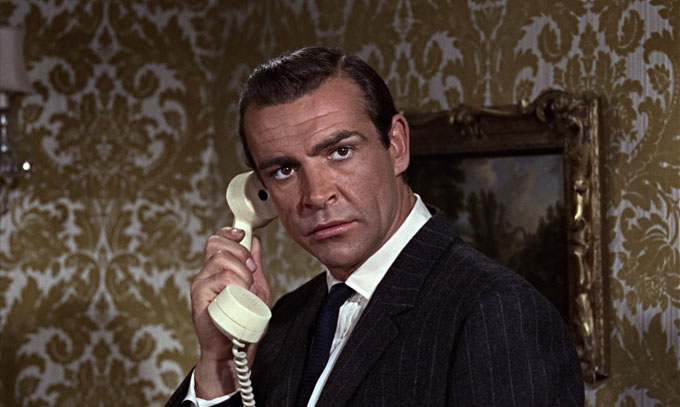
FROM RUSSIA WITH LOVE is not unsophisticated. You are.

FROM RUSSIA WITH LOVE is not unsophisticated. You are.

null

From Russia With Love was released almost 50 years ago.

I point that out not to make anyone reading this feel old (or young), but because I revisited the second James Bond picture on a big screen recently, in a small but packed Manhattan theater, and it made me painfully aware that for a good many people, movies aren’t art or experience, they’re product. And products date.

Some of the patrons seemed truly, deeply, un-ironically into the film, but many more seemed to be treating it as a nostalgia trip. The very qualities that made the film seem modern and exciting when it came out amused them. The film’s lack of newness prevented connection with the audience.

Scratch that. It wasn’t the film’s fault. It was the audience’s.  

I hate to be the guy who says “You’re watching it wrong,” but these people definitely were.

There might be a lot of factors contributing to the viewers' failure to engage (surely including lack of film literacy), but ultimately, that’s their decision and their loss.

It’s up to the individual viewer to decide to connect or not connect with a creative work. By "connect,” I mean connect emotionally and imaginatively—giving yourself to the movie for as long as you can, and trying to see the world through its eyes and feel things on its wavelength.  

That wasn’t happening here.

I heard constant tittering and guffawing, all with the same message: “Can you believe people once thought this film was daring? It’s so old-fashioned.” The arch double-entendres; the bloodless violence, long takes, and longer scenes; the alpha male attitudes toward women and sex; John Barry’s jazzy, brassy, borderline-hysterical score: all these things elicited gentle mockery. They laughed at Sean Connery’s hairy chest. They laughed at some obvious stunt-double work. When Bond flirted with the secretary Moneypenny and put his face close to hers, a guy a couple of rows in front of me stage-whispered to his friend, “Sexual harassment!”

I saw From Russia With Love with my good friend Stephen Neave. He’s a huge James Bond fan. The audience pissed him off. Afterward he told me the two young men in front of us were snickering and joking so much that he wanted to smack them across the backs of their heads.

“Why pay twelve bucks to see an old movie in a theater, then sit there the whole time and act superior to it?” he said. “That doesn’t make any sense to me. If you act that way, you’re wasting your money. You’re not getting everything out of the movie. You’re not experiencing it. Plus, this is not a black-and-white subtitled movie about sheepherders. It’s James Bond!”

I know what he meant.

I don’t think highly of many of the Bond pictures as movies. With few exceptions, they don’t have much in the way of emotional content, and they don’t knock themselves out trying to create nuanced characters or tell coherent stories. They’re pure escapism—action scenes strung together by cheesecake, gadgets, and banter.

But if you meet them on their own terms, even the worst Bonds are, or ought to be, watchable, if only for their surface pleasures: the clothes, the cars, the explosions, the scenery, the hero’s brawny chest and cruel smile, the curves on the women. From Russia With Love has two of the sexiest images I’ve ever seen: the opening credits with the names projected on belly dancers’ writhing, whirling bodies, and the scene where a bare-chested, towel-clad Bond enters his bedroom and finds Tatiana Romanova in his bed. Images like that aren’t cute. They’re primordial. The Jean-Luc Godard quote “All you need for a movie is a girl and a gun” sums up the franchise in twelve words. Films like this are cheeky erotic daydreams. The idea of somebody sitting through a cheeky erotic daydream with a smirk is just sad. Why not engage in some daydreams of your own?

null

I like imagining myself seeing From Russia with Love for the first time in 1963 while on a date with a woman I fancied, having no clue what shifts in technology and morality the future would bring, and maybe thinking something like: Hey, the movie just made a joke about oral sex, and then it cut to a close-up of the Russian agent’s lipsticked mouth. It’s filling up the whole screen! I’ve never seen a movie do that. How did that get past the censors? Hey… Look at that. My date isn’t embarrassed. She’s laughing in a sort of delightedly nervous way. She’s cool. Maybe we can get a drink after this.

The 2012 IFC crowd’s reaction reminded me of an experience in college circa 1988. My film history teacher, an associate professor from NYU who’d just arrived on campus a month earlier, kicked off his very first film history course by showing Singing in the Rain. Most of the students laughed and joked from start to finish. They thought it was hilarious.

I expected the professor to shush them, but he didn’t. He later told me that he was so disturbed by the students’ refusal to engage that he wanted to let it continue so he could study it.   

He opened the post-screening lecture by asking the crowd to please tell him what was so funny.

“This movie is a musical comedy,” he explained, “so I expected laughs, but the laughs were in what seemed to me like strange places,” he said. “I picked this movie to open my fall film history class because I wanted to open with something accessible and fun, and it sounds as though a lot of you didn’t think it was either of those things. And I’d like to know why.”

A young woman raised her hand.

“Well, it was just funny,” she said, “because they’d just, you know, be talking, and then they’d start singing, and you’d hear this orchestra suddenly start playing out of nowhere, and then they’re dancing these really elaborate routines.”

Another student volunteered that the characters talked in a “corny” way and smiled so much that their performances didn’t seem “natural.”

Another said that, compared to videos that aired on MTV circa 1988, the film seemed “really primitive and kind of unsophisticated.”

The teacher shifted back and forth on his heels, staring at the ground, weighing words in his head.

Then he looked up and said, “I don’t know if I can ever explain this to you in a way that makes sense, but I just have to say that it disturbs me that you would think a movie like Singing in the Rain is corny and unsophisticated. Music videos can be works of art in their own rights, but they’re not necessarily more sophisticated than Singing in the Rain. In fact, I would argue that a movie that has people standing around having conversations with each other, and then suddenly has them singing and dancing to a score that appears out of nowhere, then goes back to having them talk, asks more imagination from its audience than a music video. You have to decide to be OK with whatever the film is doing at any moment. You have to decide to accept it as normal, and decide to care about what’s happening even though it just suddenly turned into a different kind of movie. It’s like when you’re at a play and you just decide to pretend that the characters are wherever the play tells you they are, rather than looking at the stage and seeing a couple of actors in chairs pretending to be people they aren’t. Any work that would ask something like that of an audience cannot be called unsophisticated. It’s sad to think that there was once a time when Hollywood released dozens of movies like this each year, and millions of people went to see them, and enjoyed themselves, and laughed, and sang along, and got wrapped up in the story, and that if the same kind of movies were released right now, people would laugh at them and call them unsophisticated. That so many of you could sit there and snicker at Singing in the Rain for being unsophisticated depresses me beyond words. This movie is not unsophisticated. You are.”

His contract was not renewed.

Matt Zoller Seitz is the co-founder of Press Play.

[EDITOR'S NOTE: The volume of response to this piece sparked the writer to publish a follow-up, which you can read here.]