VIDEO ESSAY: Our Scary Summer: 1979

VIDEO ESSAY: Our Scary Summer: 1979


[Jed Mayer’s script for the video essay follows.]

The cover of the June 1979 issue
of Newsweek featured an image of
Sigourney Weaver from Alien. The
caption read: "Hollywood’s Scary Summer." I was thirteen. The horror movies
released that summer would form a grotesque
carnival that mirrored my own and the world’s anxieties.  Earlier in the
spring there was the disastrous nuclear accident at Three Mile Island. That summer, major oil spills polluted the Gulf of Mexico
and the North Atlantic Ocean. This year, oil prices doubled, Margaret Thatcher
was elected, and the Ayatollah Khomeini rose to power.   I slowly came
into awareness of the political and environmental degradation around me that
year. The films I watched reflected that, as well as my own thirteen-year-old desires
and fears .

As tag-lines go, George Romero’s Dawn of the Dead sports a pretty good one: “When there’s no more
room in Hell, the dead will walk the earth.” I stared for weeks at the lurid
poster bearing these ominous words. It hung in the front windows of the
Maplewood Mall multiplex.  Looking back,
I think a more fitting tag-line might have come from a speech given by President
Jimmy Carter later that same summer: “Often you see paralysis and stagnation
and drift.  What can we do?”

Carter was addressing what he described as a “crisis of
confidence” in America. His July 15, 1979 address has been called “the malaise
speech” for its focus on the country’s financial woes and lack of
direction.  Like Romero’s film, the
speech offered a disturbing vision. It showed a world drained of vitality and
meaning.

What better setting for such a vision than a mall, where the
film’s protagonists hide out to weather the zombie apocalypse?  And what better place for me to have seen
this film, in the mall where I was to spend so many pointless afternoons,
wandering the aisles and riding the escalators like Romero’s zombies?

1979 was also the year when my family decided we needed
solutions to our own paralysis and stagnation. We sought it through family
therapy, proudly airing our co-dependencies and dysfunctions, along with many
other American families caught up in the family therapy movement. 

Few films expose the limitations of therapy narratives more
ruthlessly than David Cronenberg’s The
Brood
.  Cronenberg explored the
psychosexual demons haunting the individual human psyche in Shivers and Rabid. He then anatomized the late-70s zeitgeist by turning his attention
to the monsters lurking within the fractured family.

The poster advertising John Frankenheimer’s Prophecy featured a grotesque image of a
monstrous fetal creature wrapped in its placenta. I responded to this image with
equal parts fascination and horror.  After
seeing the film, however, I discovered that horror could help me to make sense
of the era’s toxic events.  With Prophecy, Frankenheimer wanted to create
an environmentally-conscious horror film that would raise the ethical stakes of
popcorn fare.  It can hardly be said that
he succeeded in this goal—the director has blamed his own alcoholism at the
time, as well as production issues, for the film’s relative failure. However,
the film did succeed in presenting images and settings that managed to distill the
toxic environments of the 1970s, at least for one young filmgoer. 

Star Wars was
predicated on an escapist premise that used science fiction conventions to
blast us into a galaxy far, far away. In the universe of Alien, on the other hand, space
is confined, claustrophobic.  It is a
universe very much like our own, subject to the laws of supply and demand.  As we watch a complex mass of space-borne
metal slide slowly across the screen, a superimposed text tells us this is the
commercial towing spaceship Nostromo. The
ship is hauling a refinery and twenty million tons of mineral ore.  Space, the final frontier, has become, like
all frontiers, a resource to be exploited. 

Although I wasn’t yet old enough to have a driver’s license,
like everyone in 1979 I was highly conscious of rising gas prices and their
effects.  I watched those daily images of
gas station lines so long they looked like shanty towns with a grim fascination.
They closely resembled the conjoined images of excess and destitution common to
those post-apocalyptic films I loved from that era. Films like The Omega Man, Damnation Alley, and Soylent
Green
seemed half in love with the world’s death.  What did the earth that the Nostromo’s crew
were trying to return to actually look like? 
Probably something much like the one depicted in these films. The images
I watched on the nightly news seemed to be offering a disturbing preview of
that world.

Nelson Carvajal is an independent digital filmmaker, writer and content
creator based out of Chicago, Illinois. His digital short films usually
contain appropriated content and have screened at such venues as the
London Underground Film Festival. Carvajal runs a blog called FREE CINEMA NOW
which boasts the tagline: "Liberating Independent Film And Video From A
Prehistoric Value System." You can follow Nelson on Twitter
here.

Jed Mayer is an Associate Professor of English at the State University of New York, New Paltz.

Looking at YouTube: KIDS REACT and Procrastitainment

Looking at YouTube: KIDS REACT and Procrastitainment

On a laptop screen, a small rectangle surrounded by a jumble
of text, ads and windows sends light into the retina of an isolated viewer, who
sees the image of a chalkboard. Two tiny speakers emit the brittle, violently
cheery sound of a chorus of children chanting “Kids React to…technology! This episode…old computers!

What started as magnetic ones and zeros residing on a hard
drive on the server floor of a Google data center in Council Bluffs, Iowa, ends
up here at the portals of individual eyes and ears thousands of miles away, or perhaps
just down the street. The viewers are a twelve-year-old girl in her parent’s
living room, or a twenty-three year old woman distracting herself from a
particularly dreary workday, or a forty-seven year old father of two who
clicked a link in his Facebook feed. All of them sought the same thing: five
minutes of diversion. At one time or another, twelve million other people who sought
the same thing watched this video.

The seven-minute show is an episode in a popular YouTube series
called Kids React, in which children ranging from ages five to thirteen respond
to viral videos, technology, video games, music videos and technology. The show
debuted in 2010; within a year, it had racked up so many views that its channel
became one of the original one hundred channels to receive funding from Google.
The producers of the show, two brothers from Brooklyn who call themselves the
Fine Brothers, have essentially arranged for children to be simultaneously the
subject of and the reviewers of viral entertainment. The brothers make viral
videos about viral videos.

New approaches often develop when bars to entry are lowered
by new technology, and different types of people make it through who might
otherwise never have found a foothold. The brothers, Benny and Rafi, grew up in
an orthodox Jewish household in Flatbush, Brooklyn. Their father is a rabbi. Only
Rafi received a film degree, at Hunter, the city university of New York. Their
background, temperament and interests were not exactly an ideal match for
schmoozing their way into the traditional film and TV industries and producing
material that would be unveiled in the festival circuits. Lena Dunham, by
comparison, was born into a household that provided her with access to elite
credentials and networks of connected people. She was raised by a painter
father and a photographer mother and attended Saint Ann’s, a prestigious private
school in New York, and Oberlin College. She was born to be successful in
traditional media. The Fine Brothers were not. YouTube has become one way for
young filmmakers to bypass the traditional means of access to inner circles of
industry and find another way in.

The structure of Kids
React
is strictly formulaic. Each episode is shot from a single static
camera position in a small, low-budget set, sparsely decorated with public
education-ish accouterments like apples, pencils, a G-clef. In each episode, a series
of cute children are seated at a desk looking at a video monitor, are shown a viral
video or piece of technology of some kind, respond to it and are then asked
questions about it. This format pays off in two ways: by eliciting a nostalgia
reaction from the older viewers who are old enough to have experienced the outmoded
technologies or clips of older shows and web videos the first time around, and
by showcasing the cuteness of the children’s first, innocent reaction.

Like Tosh.O, Ridiculousness, and World’s Dumbest, Kids React is a mostly a web clip show in
the business of aggregating and recycling viral material from YouTube and then
adding another layer: a kind of virtual social presence sharing the digital footage
with the viewer. The formula works more or less the same way that Beavis and Butthead did, if Beavis and Butthead were reimagined as smart,
polite children. The novel element and source of all the heavy lifting with Kids React is the children’s affect. The
show is powered by a kind of affective child labor.

The idea of capitalizing on the commercial potential of the
affective labor of children is not a new one. The first show that featured
child responses was a segment called “Kids Say the Darndest Things” on Art
Linkletter’s radio show House Party, beginning
in the 1940s. Kids’ responses were then used on Linkletter’s TV show through
the 50s and 60s. Alan Funt borrowed the format on Candid Camera during the 1960s, and it was used once again by Bill
Cosby in the late 1990s. Kids React
recycles the idea yet again, this time adding a greater level of dialogue
between the children and the producers. The Fine Brothers themselves never
appear on camera. Like documentary filmmakers, they are only heard with off-screen
prompts and questions, but they are very much characters on the show. One can
feel them behind the scene, straining to draw out particular responses from the
children, and they are the children’s audience during the filming.

American audiences prefer their reality shows to be as
artificial as possible. There is a soothing effect created by dramas like Pawn Stars or Duck Dynasty that present themselves as ostensibly “real” and therefore
somewhat unpredictable, but are actually highly scripted and controlled. This
pattern is central to the reality show genre. After all, much of what we think
of as an unpredictable “reality” in our own lives is actually the result of more
or less pre-established scripts like genetics and the social roles we are born
into. The fact that audiences and producers prefer realities that are the
result of casting calls mirrors this situation. Kids React is no exception to this pattern. The Fine Brothers found
all the children in Kids React from
notices the brothers placed on LACasting.com. The show would be more accurately
titled Child Actors React. The children
are the subjects of the show, but they are also actors playing video bloggers, cast
in that role by an agency. There is a viral element at work here, but the
viruses have been manufactured in a laboratory.

Many viral videos are actually designed, produced and
promoted by professionals. Successful viral videos share certain
characteristics: they tend to be concise, and they feature humor, cuteness,
children, or injury. They trigger emotion, have a clear story, encourage
positive emotional resonance, and easily lend themselves to sharing. Kids React recycles viral videos that
already have these characteristics and replicates many of these same qualities with
the children’s responses. It is a doubling of the viral formula designed for maximum
propagation. Like viruses in nature, YouTube viral videos have information and
structure, but lack the machinery needed for replication. The cost of Web
series must be kept low because there is only a small amount of ad revenue
available through YouTube. There usually isn’t enough money at stake for video
creators to pay for advertising to propagate their shows the way network
television producers do. Viruses need to enter the infected organism’s own cells
and get the host’s body to do the work of propagation for them. This is what is
happening when viewers share videos on social media.


YouTube provides the distribution system for what content
producers create, and it also takes the lion’s share of the profits from the ad
revenue. The average per-click profit for a YouTube partner is low, something
like seven cents, and most YouTube partners earn something like a few hundred
dollars a year. Discounting the setup expense of a cell phone or a data plan
and/or a computer and a monthly broadband service that has already been paid,
the viewers see what appears to be free content with ads. The content creators
get much less money per view than in traditional television, but they also
don’t have to convince developers and producers to invest large sums of money in
them. They also don’t have spend years grinding their way up through a tightly
controlled system of social and professional networks that determine who gets
access to the best resources and opportunities. All they need is a camera, subscribers
and views.

The production challenges a YouTube channel creator faces, in
creating a few minutes of acceptable low-resolution images to stream across a small
rectangle on a computer or iPhone screen are not particularly daunting. Kids
React
looks relatively professional for a web series, but that still puts it only
a few notches above Zachary Galafianakis’s willfully shoddy Funny or Die series Between Two Ferns. Producing something expensively polished would be
pointless, considering the limited parameters of the screens involved, and
would go against both the aesthetic and the business model of internet
television. Many of the viewers of this type of show are younger people whose
parents have paid for the installation cost of mobile devices, computer and
cable internet service. They are part of the MP3 generation; they have never
had an expectation of technical quality in their free entertainment. They traded
this for the expectation of access; and as a value, access has replaced
fidelity. The economy of advertising revenue on YouTube is also the inverse of
high quality cable shows, which use high production values and are centered around
generating scarcity of access, which in turn maintains profit margins. With
YouTube channels, it’s the opposite. They use low production values and
generate abundance of access. 

The current limits inherent in the delivery mechanism of YouTube
are similar to the limits faced in earliest days of motion pictures. As film, Kids React is structurally similar to Thomas Edison’s Kinetoscope
reels, a technology dating from the 1890s. Both utilize a one-camera static
shot, done on a small inexpensive set, depicting a single subject for a short
amount of time for a single individual. The default screen window in a YouTube Web
page is roughly the same size as the Kinetoscope’s peephole viewer window at
the top of the device. Unlike film, with many people looking a screen at the
same time, and unlike TV, with a small group viewing together, Kinetoscopes involved
a single person peering into a single machine. This is how YouTube is currently
formatted; the difference is that it distributes the isolated individuals looking
into machines across distance with network computing. This new form of television
created by YouTube has brought with it a reversion to a 19th-century
style of filmmaking and viewing.

Viewers of web TV utilize a much different economy of time
than network and cable television. Web series are generally viewed during brief
moments between doing other things during the day, often at work or while
commuting. Five-minute chunks of wasted time can easily be rationalized, and
may prove refreshing. These shows serve the function of helping to facilitate
procrastination in an entertaining way: procrastitainment. To accommodate this,
the videos must be brief, usually three to seven minutes, and can’t require any
investment from the viewer. Each one has to be self-contained and self-explanatory.
This tends to result in formulaic material that presses buttons effectively.

Kids React is
entertaining when a single episode is watched, by itself, but the formula becomes
stale on repeated views. Binge watching reveals the show’s inherent weaknesses:
a rigid adherence to formula, lack of original ideas and pandering to the
broadest possible viewership. The banality of its unremitting wholesomeness quickly
grows exhausting. The Fine Brothers have created several equally successful spin-off
series based on the formula of the show, including the stultifying Teens React, which features things like teenagers
with bored expressions watching a video from the 1990s internet, and the torpid
Elders React, which manages to make
the spectacle of elderly people dancing to Skrillex seem unremarkable. Originality
tends to be avoided in both the most inexpensive web series like Kids React and the most lavishly over-financed
Hollywood blockbusters, due to the need to maximize viewership in as broad a
manner as possible. Ironically, the problem is brought on both by too much financial
investment and by too little. Any idea that is not pre-screened for popularity starts
to seem too risky. One of the more interesting aspects of Kids React is the occasional inclusion of serious topics on a show
that doesn’t seem to call for them. They’ve had the children react to topics
such as Bin Laden’s death, gay marriage, and bullying. These episodes broaden
the series and reveal that the Fine Brothers have a genuine curiosity about
others that is part of their creative philosophy.

Over the course of the series, the children appear bright and
cute, and they produce answers that are eminently acceptable, even laudable to
an adult audience. Anyone who has spent any time with children in the wild can
attest to the weirdly unpredictable, surreal, and sometimes surprisingly
unacceptable things they might regularly say. Little of that appears in Kids React. The children are cast, prepared,
and framed to produce sunny responses that make viewers, especially children and
parent viewers, feel good about themselves. This is part of the viral formula. This
pattern says less about kids’ personalities than it does about the worldview of
the filmmakers. The show also tends to reflect middle class identity back to
its viewers. One episode involves the kids’ appalled and offended reactions to
an outmoded Nintendo Game Boy from the 1980s, and it becomes clear that most of
these children own their own iPads and would certainly prefer to use them for
their gaming. You can be sure there will be no spinoff episodes entitled Working Class African American children
respond to . . . yoga for dogs.

The set of emotions an adult has, seeing the shot of a child
utterly baffled by a rotary phone, goes beyond amusement. This kid is unable to
understand an object the viewer probably used all through his or her own
childhood. There is a bit of poetry hidden inside the cliché of consumer technology
progress on display here. The slow, normally invisible cycle of generational
forgetfulness spanning the years becomes palpable in a single moment.

The simplicity of the show creates limitations, but it is
also one of its biggest assets. Watching a child completely dumfounded when
asked to turn on an Apple IIe computer from the early 1980s has a slapstick
element that is inherently entertaining. Some of the charm the show creates comes
from the fact that the degree to which adults are fundamentally different from children
is not always clear. When we laugh at kids who are not about to allow a total
lack of knowledge or experience stop them from theorizing and having a strong
opinion about something, we are laughing at ourselves.

The Fine Brothers YouTube franchise has led them into work
in traditional TV. They started out making unremarkable amateur action figure
satires of Lost and G.I. Joe. Late in 2014, they will have their own show on Nickelodeon,
another variation on Kids React
called React to That. They have found
their way in. As web series like theirs jump to TV, TV may increasingly pursue
strategies that seek to monetize Pavlovian behaviors in an imitation of the
internet economy. It’s unclear how well the expansion from five minutes of
distraction to a half-hour of entertainment will pan out. The technology that
creates these changes will also change, and eventually television and the web could
merge. The result is likely to be that television producers will push out web
series pioneers. The Fine Brothers have made sure this is not going to happen
to them.

Drew Gardner’s books include Chomp Away (Combo, 2010), and Petroleum
Hat (Roof Books, 2005). He tweets at @chompaway and lives in New York
City.

VIDEO ESSAY: Slow Motion Movie Supercut

VIDEO ESSAY: Slow Motion Movie Supercut


LOOK. PAY ATTENTION. NOTICE THE MOVEMENT.

If you grew up during the 1970s, and first came into
sentient moviegoer-ship during the 1980s, then one slow-motion scene
which probably dented your consciousness was the running scene at the beginning
of Chariots of Fire, showing the film’s
two heroes running down a beach to the tch-tch-tch-tch-tch-tch of a
much-imitated Vangelis soundtrack. The purpose of the slo-mo here turns out to
be one of the key purposes of this technique—to give dignity to an action whose
speed we might otherwise take for granted. The slow motion impresses upon us
the gravity of the movement, its meaning above and beyond mere movement. In the
same way, a director might present someone walking in slow motion to show,
somehow, that the character in question has hit his or her stride; the crooks
of Reservoir Dogs might be leaving brunch to go to work, in one sense, but the
work they are doing is sinister, however darkly and semi-comically confused it
might become after that brunch. Sometimes that slo-mo walk might simply show a
character who is at ease inside her own identity, as in the case of Gwyneth
Paltrow’s Margot, gliding towards her brother to Nico’s frail voice in The Royal Tenenbaums; unhappy as she may
be, she has full possession of her unhappiness. Motion may be slowed down to
draw out the tension of a scene like pulling, pulling, pulling on a rubber band, with the understanding that if
the scene were played in real time, the action might be too explosive for us to
bear—but also raising the question as to whether the motion is so much more
bearable in slowness. Think of the falling carriage in The Untouchables: step,
after step, after step, bullets flying, but achingly, achingly slowly… And yet what about the
cases in which slow motion seems to be presented for its own sake, to show us
the terrible beauty of things blown apart: glass windowpanes, buildings, cars,
even human heads? Or to show us what a bullet looks like as it flies to its
destination, or, as in the case of Wanted, is deflected by Angelina Jolie’s wrist?
Leigh Singer’s video shows us 113 different films featuring slow motion, dating
from 1936 to the present, demonstrating that, above all, the use of the
technique forces us to do what any film worth its salt should do: LOOK. Singer
wisely places a crucial, classic slo-mo scene near the piece’s very end: a shot
of the apes, the earliest human ancestors, pounding bone with bone in 2001: A Space Odyssey. Kubrick used
slow motion in this case for one reason, and one reason only, to make sure we
would not forget our history. And at this speed, who could, indeed, forget it?–Max Winter

Leigh Singer is a freelance film journalist, filmmaker and screenwriter.
Leigh studied Film and Literature at Warwick University, where he
directed and adapted the world stage premiere of Steven Soderbergh’s
‘sex, lies and videotape’. He has written or made video essays on fllm for The Guardian, The Independent, BBCi,
Dazed & Confused, Total Film, RogerEbert.com
and others, has appeared on TV and radio as a film critic and is a
programmer with the London Film Festival. You can reach him on Twitter
@Leigh_Singer.

Max Winter is the Editor of Press Play.

What if Time Travel Destroys the Future? The Big Problem with X-MEN: DAYS OF FUTURE PAST

What if Time Travel Destroys the Future? The Big Problem with X-MEN: DAYS OF FUTURE PAST

nullAs a kid, I was obsessed
with the idea of time travel. What started as curiosity became much bigger in
my mind; as with many other children, the realization of my inevitable death overwhelmed
me, and thoughts of time travel helped, in their way, assuage things. Though I
was too young then to know about the existing theories on the subject (they
would have been over my head even if I had been familiar with them), I nitpicked
over the moral and logistical particulars. What happened if you altered history
in ways you couldn’t mediate? What if you got stuck in a time loop? What if
_____? Because I spent so much time fixating on time travel, I scrutinized any narrative
that dealt with it, and, over time, an unspoken knot tightened within me. I
became one of those curmudgeons who demands Primer-levels
of consideration if I’m to enjoy a given piece of media or literature that uses
the trope. After seeing the most recent installment of the X-Men franchise—something that activates in another way the ghost
of childhood—I was able to reflect on what time travel means psychologically,
and realized the potent metaphor it embodies in contemporary American culture.
There’s a beautiful escapism in it: the chance to use hindsight to prevent the
problems of the past from metastasizing into the even more daunting problems of
the present.

As the trailers indicate,
Days of Future Past merges the two X-Men
timelines: the one set in the “present” and the one in the “past.” In the
beginning of the film, we discover that the world of the “present” has gone to
shit. Humans trudge through their dreary slave lives (think Metropolis), enslaved by the sentinels,
android-y killing machines constructed of a virtually indestructible non-metal
polymer that shares Mystique’s ability to morph on a moment’s notice. What’s
worse, they’re programmed to sniff out the “mutant gene,” living with the sole intent
to destroy our heroes in the most grisly imaginable ways.

It’s so bad, it’s
hopeless; so hopeless that the finest of Xavier’s School for Gifted Youngsters would
be long dead if not for Kitty Pryde’s ability to send knowledge back in time.
Reunited as they face a common enemy, Professor X and Magneto decide that the
only option left to them is to send knowledge of this dismal future far enough back
in time to prevent the creation (and the events leading to the creation) of the
sentinels in the first place, through the only vessel capable of sustaining the
resulting physical damage: Wolverine. So off we go to the ‘70s; bell-bottoms
and chest hair abound.

Without spoiling too
much, let’s just say that what we learn is that the sentinels came into
existence because America—motivated by fearmongering, greed, and bad timing in
equal measure—made some pretty bad choices in the face of some exceedingly
reasonable warnings against said choices. If this sounds familiar to you, you
may have been paying attention to the recent publications about the “irreversible
collapse

of the Antarctic sheet, which scientists expect will cause a the sea level
to rise by 4 feet over the next two centuries.

nullOr that our inability to
incorporate sustainable energy into our lifestyle will spur further
environmental damage
,
as evinced in the recent Oklahoma earthquakes.

Or that overfishing and
the swiftly dwindling bee population
(U.S. beekeepers reported 40 to 50 percent losses in the Winter 2012-13
alone) will leave us without major food sources alongside our own
overpopulation.

Or that, when the resulting
shortages hit home, likely externalities will be bumps in crime and class violence

null

Yeah, if you’re paying
attention, it feels pretty bleak. It would be amazing to go back to the year
1973 and try to stop those silly imbeciles from getting us into this mess in
the first place.

But that’s the point: we
can’t. And by perpetuating hopes for a reset button, we only distance ourselves
further from the solutions we need to be generating at present. Focusing on
what could have gone differently, while an entertaining exercise, averts our
eyes from the hard truths about the world we live in now. The world has provided us with incredible resources, and, to
borrow a cliché from another Marvel franchise: with great power comes great
responsibility.

So, here’s my claim:
movies that rely on time travel as a problem-solver are harmful for us right
now. The reasons we turn to narratives for entertainment are numerous and too
difficult to encapsulate, but maybe one of the most important reasons is to see
our ghosts turned into metaphor, to see fictional depictions of our problems
and witness how others opt to handle them. Whether or not our heroes succeed, we
enjoy the experience of seeing them (forced to) try. Last summer, I wrote about
a growing trend I called “apocalypse porn,” showcased in zombie and disaster movies, which, I argued, provided us catharsis
in its offering of a “clean slate.” Time travel films do the same thing, only
with the added gloss of the supposed reclamation of the lives we could have had,
rather than the imposition of messy new ones (a la World War Z). Time travel is hardly new, but there’s
been an inarguable resurgence in mainstream cinema in recent memory, seen in Star Trek, Looper, and most recently, The
Edge of Tomorrow
, among many others. Hindsight, and what we do with it, is
a valuable part of our existence, and there’s certainly something to be said
for the ways this type of narrative helps us see that, but we don’t have time
to focus so much on the past anymore. Except in maybe the broadest, most
metaphorical terms, we’ve never faced anything like the problems we face now.
New challenges demand creative solutions.

It’s likely that by this
century’s close, for instance, my hometown will be underwater, and even if it
wasn’t specifically any one of our faults, it’s still what we’re left to
manage. While developers focus more and more on creating virtual
realities,
we’re losing the opportunity to salvage the world we already have—or at least
our ability to continue living on it and enjoying it the way we have for millennia.
And, for all the problems any of us might face, this world is a pretty
miraculous thing, a thing worth fighting to save, even if we lose that battle.

Look, you’re not wrong
for enjoying Days of Future Past. I enjoyed
it too (I especially loved Quicksilver’s bullet-time jaunt to “Time in a
Bottle”). And I’m not implying I have the answers, or that writing this
crotchety ramble absolves me of my complicity in the system. To argue that art
has a moral obligation is a subjective viewpoint not shared by all, but it’s
important not to underestimate how integral media is in shaping our cultural
ideas and mores. Days of Future Past
got a few things right on that score, prizing teamwork over individual triumph and
empathy over revenge. With the kind of budgets afforded these franchise movies,
though, there were any number of plots—whether original or adapted—at the
filmmakers’ disposal. In choosing one that involves a convenient reset, there’s
an implicit hopelessness that, if not downright poisonous, is at least
unconstructive. With its hyperbolic depictions of human prowess and battles of
epic proportions, the superhero genre is perfectly suited to offer useful,
nuanced metaphors for ways we might confront our problems rather than wish them
away. If you ask me, we’re in desperate need of a wake-up call. We’ve been in
desperate need of a wake up call for a long time, but we can’t do anything
about that now. We’ll never get now back.

Jesse Damiani is Series Co-Editor for Best American
Experimental Writing (Omnidawn, 2014). He lives in Madison,
WI.

VIDEO ESSAY: From SLACKER to BOYHOOD: Cinematography in the films of Richard Linklater

VIDEO ESSAY: From SLACKER to BOYHOOD: Cinematography in the films of Richard Linklater

In the late fall of 2001, in a movie theater in New York, I
fell asleep during Richard Linklater’s Waking
Life
. Strangely enough, I think he might have welcomed that response. Or
at least his cinematographer’s camera would have. We’ve posted viewers’
reports of sleeping
during films before at Press Play, but this was a different
sort of sleep, guided, in a sense, by the camerawork. Cinematography occupies a
strange place in Linklater’s films. While the movies are, on the one hand,
quite speech-driven, which is to say that the dialogue characters say to
each other sometimes forms the entire story, as in the Before… trilogy, we cannot
say that watching one of his films is not a visual experience as well. But it’s
a curious sort of visual experience. At the time I fell asleep during Waking
Life
, I wasn’t dozing off out of boredom; it was out of comfort. Just over a
month before I saw the film, the World Trade Center had collapsed. Despite the
fact that New Yorkers were charging ahead with their lives all around me, the
air still smelled like burned flesh. I needed some relief. Sitting down to watch Waking
Life
, with its delicately drawn characters floating gently through their
delicately drawn world, brought a sense of reassurance, a sense that, in
artistic works, at least, one might dwell without fear of imminent harm. All
that would take place here, after all, was that characters would talk to each
other, and the camera would watch them, or rather would display them, moving in
the flickering manner of animated figures, easily, relaxedly. The figures on
the screen would move forward in their way, and I, in my seat, processing the
film and the events taking place in the world outside the theater, would move
forward in my way, in a spirit of peaceful coexistence. There was solace, there, but there was also engagement, of a kind. This is, indeed, the
way the camera has functioned in Linklater’s films from his earliest works
onwards. It doesn’t force itself on you, and yet nevertheless it brings you in.
The intimacy, for instance, of the “You’re gonna miss that plane” scene in Before Sunset would be far diminished if
it weren’t for its sense of strange stillness, created by the sensitive use of
the camera. You could say it’s a Taoist lens—it does very little, at least
little that we notice, and yet we feel utterly immersed when we watch this
director’s films. You can feel the heat in Slacker’s
Austin; you can smell the chalkdust in School
of Rock;
you can feel the night breeze in Dazed and Confused. And yet the camera here dosn’t have the aggressive, probing presence of that of a
Scorsese or an Allen or a Lynch. The cameras of Linklater’s numerous cinematographers–Lee Daniel, Pete James, Tommy Pallotta, or Maryse Alberti, or Rogier Stoffers, or Shane Kelly, or Dick Pope–share the characteristic of operating on a softer register, trying
less hard to get our attention than they might. And yet films like Boyhood would be far diminished without their sense of visual
scope, of the hugeness of the Big Bend, of the quietness of a Texas lake, of
the plainness and innocence and perplexity of a boy’s face, in close-up. Watching these films becomes an experience of gentle exchange, rather than spectatorship. And what do we, the viewers, get out of it? A sense of living differently, for an hour or two.–Max Winter

Nelson Carvajal is an independent digital filmmaker, writer and content
creator based out of Chicago, Illinois. His digital short films usually
contain appropriated content and have screened at such venues as the
London Underground Film Festival. Carvajal runs a blog called FREE CINEMA NOW
which boasts the tagline: "Liberating Independent Film And Video From A
Prehistoric Value System." You can follow Nelson on Twitter
here.

Max Winter is the Editor of Press Play.

The Last Star: Elaine Stritch 1925–2014

The Last Star: Elaine Stritch 1925–2014

nullWe don’t have stars anymore. Not in the way we used to. I
may not even be old enough to remember true stars, who embodied the marvel of
showbiz with their very demeanor, their aura, how they carried themselves on
screen and off, on stage and off. Instead we have celebrities, contrived and
constructed fabrications from an industry that falsely believes it can create
what can only be born. A star was someone who didn’t need to be announced, but
whose very presence accomplished just that. Growing up, I had an organic sense
of this distinction: Johnny Cash on The
Muppet Show
, seeing Carson’s monologue the first time, Kathleen Turner’s
voicing of Jessica Rabbit. They simply embodied the essence of showbiz
brilliance. But the one that stuck with me, and yet seemingly doesn’t fit into
this pantheon of stardom, was Elaine Stritch, who passed away Thursday at 89.

I have a very lucid memory of Stritch appearing on The Cosby Show in the late 80s. I didn’t
watch a lot of TV growing up, and I have no other memories of television of
this era as rich in specificity. For whatever reason (as memories do), Stritch’s
three appearances on The Cosby Show
find a way to the forefront of my consciousness from time to time. In the 70s
and 80s, Cosby was a star; even without the help of sycophantic tabloidism, I
was well aware of this. My parents had his comedy albums. I watched Fat Albert and the Cosby Kids Saturday
mornings. Even by the way he carried himself onscreen as the patriarch of the
Huxtable clan, you knew Cosby was something to behold. But here, in season 6 of
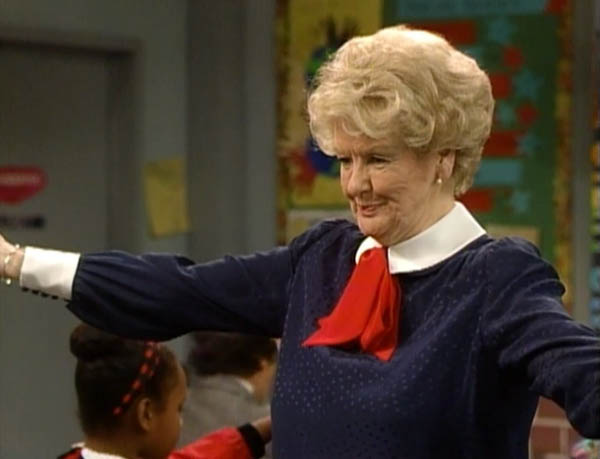
Cosby’s 80s vehicle, was Stritch as Rudy’s teacher, Mrs. McGee, going to
toe-to-toe with the giant that was Cosby. And I remember reading the credits at
the sitcom’s end and wondering, who the hell was Elaine Stritch?

Elaine Stritch was a star. 

To consider her stage credits is to review the history
of contemporary theater. The native of Detroit trained at the prestigious Dramatic
Workshop of The New School in New York. She made her theater debut before the
end of the Second World War and was a mainstay on stages in London and New York
for nearly 70 years. She performed the work of Noël Coward, Irving Berlin, and
Stephen Sondheim, among many others. Stritch was conceived for the stage. She
had it all: she was beautiful, she was funny, she could sing, she could dance, she
could drink, she could curse, and she had a voice that begged for your attention.
She would finally win a Tony upon her fifth nomination for her one-woman play Elaine Stritch at Liberty in 2001, a
review of her career that was still far from over at the time.

She was the original Trixie Norton on The Honeymooners

She was a contemporary of Marlon Brando, Ben Gazzarra, and
Rock Hudson, and dated them all.

She appeared in films with Charlton Heston, Tony Curtis,
Janet Leigh, and Jane Fonda. 

She worked with David O. Selznick and Woody Allen.

She lived in the famed Carlyle Hotel in New York. Who
else, but a star, lives in The Carlyle? 

And Stritch wanted to be a star. When asked why she chose
show business, she replied, “I want to be talked about. I want to be written
about. I want everything about me! And I don’t make any bones about that.” But
she never begged for it, not on stage, and not on screen. Instead she demanded
it, which illustrates the divide between stardom and celebrity.

But all of this meant nothing to a barely teenaged kid
watching The Cosby Show on a Thursday
night in 1989. There was no IMDB. No Wikipedia. My phone had no answers. But I
knew Stritch was a star. I knew by the way she carried herself. By the way she
allowed the acting of her younger less experienced co-stars to inform hers. By
her impeccable comic timing and palpable grace. By the manner with which the
studio audience fell for her every twitch, hung on her every syllable, cackled
at her every eye roll, breathed her every moment. By the way she commanded
attention without asking for it. But mostly, in the way she battled Cosby. In
their moments on screen together, one had the sense that you were watching
something magical, something brilliant, something special. 

Stritch made her last appearance on television on 30 Rock, playing the mother of Alec
Baldwin’s Jack Donaghy, a fierce and hilarious performance. Her work with
Baldwin and Tina Fey on the show was a fitting end to her television career: a
stage actress with a brilliant performance on a New York filmed sitcom. 30 Rock was a show that mocked the
industry within which it existed, the extravagance of celebrity, and the
superfluous nature of stardom. It argued that behind the curtain there were no
stars, only degrees to which the moderately talented were pandered to. I fear
this was more documentary than satire, or as Stritch herself put it, “Everybody’s
just lovin’ everybody else just too much for my money.”

Damn right.

Mike Spry is a writer, editor, and columnist who has written for The
Toronto Star, Maisonneuve, and The Smoking Jacket, among
others, and contributes to MTV’s
 PLAY
with AJ
. He is the author of the poetry collection JACK (Snare
Books, 2008) and
Bourbon & Eventide (Invisible Publishing, 2014), the short story collection Distillery Songs (Insomniac Press,
2011), and the co-author of
Cheap Throat: The Diary of a Locked-Out
Hockey Player
(Found Press,
2013).
Follow him on Twitter @mdspry.

VIDEO ESSAY: Total Cinema: SNOWPIERCER

VIDEO ESSAY: Total Cinema: SNOWPIERCER

In its narrative, Snowpiercer is not a
subtle film. Its characters are broadly drawn, like figures in a myth,
or maybe an allegory. Its themes are repeated and reiterated through the
plot, dialogue, and mise en scène. This is all to its benefit, because
the complexities of Snowpiercer enrich its margins, silences, and
shadows.

On one hand, Snowpiercer is an engrossing sci-fi action movie, a
great addition to the blockbuster season. Take it for that and nothing
but that, and you will enjoy most of it. But even if you manage to
ignore the various signs that there is more going on than what’s on the
surface, the film’s resolution won’t leave you thinking this is just a
bunch of summer fun. The last section of the film is provocative, and
the final scene is among the most audacious of any recent movie I know.
(I won’t tell you anything about it here, since the film is new and in
relatively limited release, but it is certainly an ending that deserves
discussion.) This is typical of director Bong Joon-Ho—when I first saw
them, the endings of Memories of Murder and Mother both sent me quickly
back to re-watch the entire movie, as the conclusions made those movies
into something more than I’d known them to be during the initial
viewing. Bong loves telling stories from within familiar genres because
genres encourage certain expectations, and those expectations can then
be exploited. Much of the power of Snowpiercer comes from the desires
our expectations command: we think we know where the story is going,
because we think we know what kind of story it is, and we want it to go
in certain directions—to stay on the track of its genre, as it were—and it seems to be going there, but then … no … and no … and no…
The effect is almost that of Brecht’s Verfremdungseffekt: we are
alienated from our desires, distanced into reflection, to wondering why
we wanted the journey to follow a particular path in the first place.

The distancing doesn’t wait till the end, though. From early on,
Bong uses multiple techniques to keep us from ever settling down into
knowing exactly what the film is up to. Serious scenes of violence
suddenly shift to broad humor, and vice versa. The mix of tones in
Snowpiercer is jarring at first, because it’s hard to get our bearings.
Is this an earnest political parable? Is it satire? Is it a comment on
human nature, or revolution, or maybe race or nationality? The only
answer is: Yes.

Its multitude of tones and apparent purposes are equalled by the
multitude of references to other movies (passionate cinephiles could
spend at least one viewing just looking for allusions), some obvious and
some not, as well as its own occasional meta moments, for instance a
character referring to the uprising among the people at the back of the
train as "a blockbuster production with a devilishly unpredictable
plot."

It’s a slumgullion stew, this movie, but it’s all held together by
the clear, simple movement of the plot, the quest of the characters to
get to the front of the train. It’s a focused quest, a narrow one, and
it structures the characters’ actions and the viewers’ hopes and fears.
It’s like tunnel vision—and, indeed, tunnel vision is an important
element of one of the most impressive sequences in the film. The ending
recontextualizes it all, however, and offers a new vision, one that
opens the film to ambiguous and perilous meanings, and sends us back to
wonder about our own world, the one we return to when the movie ends.
What is the engine that powers the train that keeps us on our own
tracks? What structures our own actions, hopes, fears? What lenses let
us see in tunnels but hide the possibilities beyond, the invisible
dreams in our periphery?

Matthew Cheney’s work has been published by English Journal, One Story, Web Conjunctions, Strange Horizons, Failbetter.com, Ideomancer, Pindeldyboz, Rain Taxi, Locus, The Internet Review of Science Fiction and SF Site, among other places, and he is the former series editor for Best American Fantasy. He is currently a student in the Ph.D. in Literature program at the University of New Hampshire.

FARGO, TRUE DETECTIVE, JUSTIFIED, RECTIFY and the Construction of the American Small Town (Part I)

FARGO, TRUE DETECTIVE, JUSTIFIED, RECTIFY and the Construction of the American Small Town (Part I)

null

PART
ONE

At some point in the second half of the twentieth
century, the way in which we think about the American small town, its
particular brand of community and stability, began to shift. "What
happened," according to Frederic Jameson, as he wrote in an essay in his seminal 1991
collection The Cultural Logic of Late
Capitalism
, “is that the autonomy of
the small town (in the provincial period a source of claustrophobia and
anxiety; in the fifties the ground for a certain comfort and even a certain
reassurance) has vanished.”  Thus, for
Jameson, “[w]hat was once a separate point on the map has become an
imperceptible thickening in a continuum of identical products and standardized
spaces from coast to coast.” This "thickening
continuum," a byproduct of our appetite for cable television, franchising
and box stores, and other modern amenities, posed a radical threat to small
town identity. As Jameson describes it, the American small town was once (but
no longer) "contented
with itself, secure in the sense of its radical difference from other
populations and cultures, insulated from their vicissitudes and from the flaws
in human nature so palpably acted out in their violent and alien histories." Of course, Jameson’s proper subject is actually the popular conception of small-town self-identity and, to the extent his commentary attempts to
speak for small towns, themselves, he’s guilty of a bit of simplification. In
other words, what Jameson describes is not necessarily your experience of small-town America. And it certainly wasn’t mine. 

I grew up, and spent my childhood,
living in the same neighborhood, in a small town in the northeast corner of
Maryland, tucked up against the Pennsylvania and Delaware borders. Elkton, named for its position at the
headwaters of the Elk River, which itself curled off of the tip of the
Chesapeake Bay, had a population of just over 9,000 residents when I left for
college in 1990. Elkton is the largest town in Cecil County. Like so many (but certainly
not all) rural American counties, ours was predominately white and conservative—in 1990, in fact, it was 95% white with 90% of its population living in
neighborhoods that were, themselves, more than 90% white. People
today are most likely to be familiar with Elkton from a few road signs that
clip by as they bisect the county heading north or south on U.S. I-95. In a
different era, it was known as an American Gretna Green, the marriage capital
of the United States—the result of liberal marriage laws so well known that,
when Ben Walton ran off to marry seventeen-year-old Cindy Brunson on Season
Seven of The Waltons, the couple
headed for Elkton. Those days are mostly gone, though wedding chapels still
dot Main Street.

Not all public awareness of us has
been so benign. The Elkton Walmart has,
in recent years, been the site of no small amount of cruel cultural absurdity, including
xBox-related near-riots, customers
superglued to toilet seats, and dead
bodies in Chrysler Sebrings.
Digging deeper, there’s also the county’s occasional flirtation with the Ku
Klux Klan, from rallies on local farms in the 1960s and -70s to
Klan-run anti-Obama meetings held in Elkton municipal buildings as recently as
last year. It
doesn’t matter that these rallies generally packed more bluster than bite, with
gawkers and protestors outnumbering participants. For many residents of neighboring
counties the area remains "Ceciltucky": defiantly redneck,
anachronistic. That view isn’t wholly misguided.
To some extent, it’s even a source of pride: my fifth grade gun safety class at
Gilpin Manor Elementary culminated (to my enormous delight) in a teacher-chaperoned
field trip to a local state park where we were given bolt-action rifles to fire
on paper targets.

My memory is both more complicated
and more sentimental than these data points might suggest. Yes, there’s the
recollection of perfectly-seasoned blue crabs piled high on newspaper-covered
picnic tables (with buttered and salted silver queen corn nearby).
The .99 movie theater in downtown Elkton where I saw Rick Springfield in Hard to Hold in 1984, the first movie I
ever attended without parental supervision. And, although there was ample bluegrass
music and square dancing, there was also the all-black-but-me Parks & Rec
basketball team on which I played (a cherry-picking) point guard and the
mostly-Catholic-but me CYO basketball team on which I played (a less-effectively
cherry-picking) point guard (and that once lost a game against a Wilmington,
Del. team 99-27). There’s also no question that I spent a large portion of my
teenage years dreaming of escape—into what, I had no idea. When I go back, however,
(and I do, when I can) it’s these memories that I’m revisiting. But it’s also
true that (contra Prof. Jameson) many of us welcomed the intrusion of
outlet malls, the internet, cable television, that whole thickening continuum
thing. Because, in an essential paradox, the extrinsic, pan-American
homogeneity that Jameson maligns resulted in diversity within our small towns, an increase in both the variety and quality
of services and products.  Improvements in
the quality of our day-to-day lives that helped narrow the sprawling distances
between how we saw ourselves and how we imagined everyone else in the free world
lived.  In other words, the isolation and
radical difference that Jameson places at the crux of small-town self-identify
may be nothing more than a symptom of perspective. In the end, I suppose, my struggle
to define my own experience keeps frustrating and coloring the way I watch a
variety of well-received television shows, including Fargo, True Detective, Justified, and Rectify, that have aired over the last few years. Each of these
shows has significant strengths—strong, charismatic performances, sharp
direction. But it’s no accident that the complexity of the moral universe at
issue in each show is dictated by location and perspective—by just how much
the writers confuse traditional representations of small towns or rural life
for the real thing. 

*          *          *          *

nullNoah Hawley’s miniseries Fargo is, ostensibly, the story of four
characters, the insurance salesman Lester Nygaard (Martin Freeman), the deputy
Molly Solverson (Allison Tolman), the Duluth policeman Gus Grimly (Colin
Hanks), and a killer, Lorne Malvo (Billy 
Bob Thornton), whose paths cross in and around the (very real) small
town of Bemidji, Minnesota (pop. 13,000). Although faithful in certain ways to
the Coen brothers’ film from which it derives its name and, at least loosely, setting,
Hawley’s Fargo is different, darker. In
large part this is due to the importance given to the character of Lorne Malvo—a contract killer and confidence man who is not from Bemidji. Or anywhere, really, which is probably the
first sign that he’s up to no good. Hawley,
who drafted each script himself but collaborated on the overall story with a
group of writers, has expressed a fascinated, forgiving relationship with Malvo,
describing him as “really interesting" and “a very fun character.”
Indeed, although Malvo slaughters dozens, Hawley has stated his belief that “the
violence [Malvo] does to the social contract is almost as bad as the real
violence that he does.” To Hawley, the philosophical purity of the Malvo
character sets him apart, and free: “When you see a shark swimming in the ocean,
you’re not judging the shark. We don’t judge Malvo because he’s not pretending
to be anything else.”
But Hawley can’t be serious—Malvo pretends to be “something else” at each
turn. It’s how he gains access to his marks and how he avoids capture. He veils
his threats against women and children in small-talk and friendly advice. In
other words, if we can’t judge Malvo, who can
we judge?  The answer, it appears, is
pretty much everyone else.

Malvo, shape-shifter,
has a Mephistophelean swagger, and it’s the Mephistophelean that places Malvo, and Fargo, squarely within a tradition of
Faustian American literature—what Hawley
has called the “stranger comes to town story”—a lineage  that includes (but isn’t
limited to) Mark Twain’s Mysterious
Stranger
and Ray Bradbury’s Something
Wicked This Way Comes
. Both novels use a (yes) mysterious stranger who visits
a small town to examine, to different conclusions, the way our desires lead us to betray ourselves,
our communities, and our values. [1]  Not surprisingly, perhaps, the books arrive
at different conclusions. Twain forwards a near-Nietzschean nihilism, leaving
no doubt that he views “civilization” as a leash burning at our necks, if not a
wholesale fiction. Bradbury’s Mr. Dark, on the other hand, is eventually
defeated by joy, familial love, and friendship. Provided with a choice between
the path of Twain and the path of Bradbury, Hawley goes dark, choosing Twain’s
model. Although the show ostensibly reinforces Fargo (the movie) in its appreciation of small-town common sense
(“decency trumps all,” is how one critic characterized the series’ conclusion),
given the show’s body count, it’s hard to view the triumph of small town values
as anything but pyrrhic. Where it counts, in its characterizations, the
day-to-day life of its citizens, Fargo
shares the cynicism and nihilism of Twain’s unrepentingly dark novel. But to
what end? Twain’s nihilism seeks to liberate man by stripping away the very
things the fundamentally conservative Fargo
ends up celebrating.

But perhaps the mixed messages are
to be expected. One takeaway from Hawley’s countless press interviews on behalf
of the show is that his Bemidji isn’t much more than a blank canvas onto which he
can project his ideas about good and evil—or, as he phrases it, about what
happens when a “civilized man meets an uncivilized man,” or
an “anarchic force enters polite society.” Our
enjoyment of the show hinges on how much stock we put in Hawley’s experiments
in human behavior, but this isn’t fatal to the show’s success. Nonetheless, it’s
hard to see Hawley’s “polite society” as much more than a petri dish in a spotless
laboratory. Although he describes his show as a battle between “the best and
worst of America
,” what
he’s really done is introduce a foreign agent into a static environment. (And
then reintroduced it, for that matter. Malvo returns to eliminate Nygaard for
unknown reasons and, absent that return, the story has no discernible momentum
or end.) It’s not the gauzy layers of snow and ice, the tense, beautiful
blizzard shootout, or the frozen lake into which Lester plummets at the series’
end that constitute the show’s blankness. It’s the lack of any perceptible
response from the town of Bemidji as the deaths mount—the series somehow manages
to squeeze thirty-four deaths into 10 episodes.
In spite of the carnage, Hawley clings to a "romantic idea
that you go off and you face evil and you come back and your reward is to lead
a simple life," that what these characters have faced is not, in the end,
a "dark journey." Of
the series’ four main characters, one has been shot and wounded, two have been
turned into killers (one already was
a killer, of course), and two are dead. The town, itself, is piled high with the
bodies of people who, if Grimly does his job in Episode One, would have been spared.
By my measure, the only people who might come out on the other side events like
these without being “haunted” are people who never really felt anything in the
first place.

The cost of Hawley’s
“romantic idea” is that it necessarily strips Bemidji of collective or
institutional knowledge. The town is never granted a life of its own, even at
the baseline, fight-or-flight level of self-preservation. [2]  As a result, we don’t
think twice when Malvo sits across a diner counter from Deputy
Solverson’s father Lou (Keith Carradine), an ex-state trooper, and Lou doesn’t
recognize him.  At this point in the
series, of course, Malvo has been caught on camera kidnapping a murder victim,
arrested, and even interrogated by Lou’s now-son-in-law.  And yet, even after Malvo creepily inquires
about Lester, the man at the center of
his daughter’s investigation
, he is permitted to drive off without anyone
in pursuit. All of this is of a piece with Hawley’s failure to allow Bemidji an
existence greater than the sum of its parts. And
those parts are inherently limited: so many of the citizens of  Bemidji are self-interested and venal,
bullies and predators. The women, in particular, fail to generate sympathy—whether it’s Gina Hess (Kate Walsh), an ex-dancer who laughs off her husband’s murder
and chases the insurance payment, Kitty Nygaard (Rachel Blanchard), Lester’s
sister-in-law, a vain ex-beauty queen, or the needling wives of Lester and
Milos (both are relentless and shrill). Although the characters are sharply, if
superficially, drawn, an air of entitlement emanates from each. Even Linda
(Susan Park), Lester’s sweet, boring, second wife, admits to Lester just before
she’s shot that she coveted Lester while he was still married and fantasized
about “getting his wife out of the picture”—she envisioned herself as a
“Cinderella,” clinging tightly to the belief that Lester “would come along and
take her away from all this.” It’s not just
the women, of course. Sam Hess (Kevin O’Grady), Chaz Nygaard (Joshua Close), and
Milos Stavros (Oliver Platt) are each the asshole father of daft, cruel, and/or
damaged children.  In the end, it’s hard
not to feel that the grisly or abject ends greeting so many of these characters
constitute karmic punishment. 

For all of Hawley’s talk about the
“stoicism” of Midwesterners, the motives of Fargo’s
characters are never far from this surface. 
Maybe this is meant to suggest a regionally-specific anti-mystery or maybe
it’s just a convenience. In either case, it’s a far cry from the Coens’ vision
of small-town Midwestern life, where the conventions of “Minnesota nice” create
inscrutability. Hawley has stated that his “job was not to portray
Minnesota as it is in real life. It was to portray the Minnesota that Joel and
Ethan portrayed in the movie.” In keeping with this, perhaps, he doesn’t pay
much attention to Bemidji as it
actually is (it’s a hub of Native American culture, though there’s not a single
Native American character on the show). [3]
But how true is he to the Coens’ vision? If there’s a takeaway from Fargo the movie, it might be that the
inherent inscrutability of human behavior is not a reason for nihilism or
solipsism. Marge Gunderson’s (Frances McDormand) short soliloquy, as the movie
wraps up, distills this to a point:

"So that was Mrs.
Lundegaard on the floor in there. And I guess that was your accomplice in the
wood chipper. And those three people in Brainerd. And for what? For a little
bit of money. There’s more to life than a little money, you know. Don’tcha know
that? And here ya are, and it’s a beautiful day. Well. I just don’t understand
it." 

Of course, for Peter Stormare’s Gaear Grimsrud, it
isn’t about money at all. In the end, Marge’s incomprehension of his motives
proves no bar to her pursuit—though she is aided by a brief encounter with an
old classmate, Mike Yanagita, that spurs her to push deeper. In one of the
film’s more remarkable scenes, Marge figures out, over dinner at the Radisson during
a work-trip to Minneapolis, that the emotionally disturbed Yanagita has lied to
her about his life (inventing both successes and tragedies) in order to make a desperate,
loneliness-driven pass at her. In the course of ten minutes, the Coens show us
two sides of “Minnesota nice.” 

Although Marge’s trusting nature temporarily blinds her to Yanagita’s motives,
she nonetheless uses Yanagita’s desire to conform to “Midwestern” conventions
(modesty, a desire not to cause a scene, the fear of imposing on another) to
reject him gently but firmly, defusing the situation. Beyond this, however,
Yanagita provides Marge with a glimpse at the obscure alchemy that transforms human-scale
desire into elaborately irrational action, a realization that sends her back to
re-interview Jerry Lundegaard. If there is a single scene in Fargo (or any Coens’ movie) that defines
the Coens’ vision, it’s this one.  And
yet Hawley’s comments in interviews suggest that he never completely grasped its
importance,
a fact I can’t be alone in finding troubling.

*          *          *          *

nullHawley’s exposure of the
barely-concealed venality underlying the placid surface of Bemidji suggests
less the Coens of Fargo (venality and
greed have their place, but the characters rarely fall prey to
one-dimensionality) than the David Lynch of Blue
Velvet
and Twin Peaks. This is,
perhaps, a natural or even obvious parallel, given that both Fargo and Twin Peaks are thematic continuations of revered films. An overt
debt is suggested by Lorne Malvo’s discourse on pie in Fargo’s penultimate episode, as well as the presence of  Bemidji Deputy Bill Oswalt (Bob Odenkirk) who,
like Twin Peaks’ crime-scene weeper
Deputy Andy Brennan (Harry Goaz), can’t handle the sight of a dead body. Both shows,
as well, provide sly, structural acknowledgements that they take up where their
predecessors left off. In Fargo, it’s
the bag of ransom cash left behind by the film’s ill-fated Carl Showalter and
found by the show’s ill-fated Milos Stavros. In Twin Peaks, there’s the way the opening credits move from an image
of a Varied Thrush to the town’s churning mill machinery, a casual
deconstruction of the mechanical robin that sits on the windowsill, a beetle in
its mouth, at the end of Blue Velvet.
In each case, we are assured the stories, although different, are nonetheless
connected.

Of course, it’s not exactly novel
to acknowledge that Fargo owes a
great deal to Twin Peaks (the list of
shows with a similar debt is long and distinguished).  Still, something seems to get lost in
translation. Whereas Fargo (the
series) adopts the naturalism and
realism of its forbearer —not just the pretty snowscapes, but the grubby
reality of ice-laced sidewalks, parkas, mukluks, and bulky sweaters—Twin Peaks eschews naturalism for Peyton Place-like melodrama. Lynch’s
performers, pushed toward soap operatics, enact a kind of repeated denaturalization.  Twin
Peaks
’ distance from realism (and the
real
) is established from the opening credits of the first (and each) episode,
which inform us that Twin Peaks is far from
a small town (pop. 51,201).  As a result,
the sense that it’s a place where everyone knows everyone else (Laura Palmer’s
corpse is recognized by everyone at the crime scene) isn’t based on geography, demographics,
or any other extrinsic ordering principle. In other words, the world Lynch is
exploring is, and is not, ours. It remains unbounded by logic even as it mimics
the narrative logic of other genres.

In the end, the Lynch of Blue Velvet and Twin Peaks is less concerned with human nature than he is in the
ways we simplify it—and thus betray it—through representation. Indeed, the
“wholesomeness” of Twin Peaks is really the construct of Agent Cooper (Kyle
McLachlan)—who eventually takes up whittling because it’s “what you do in a town where a yellow light still means
slow down, not speed up”—and not the town itself, which is full of secrets. The image
of Blue Velvet’s fop-ish Jeffrey
Beaumont wandering the streets of a very 1950s-appearing Lumberton (in what
Jameson would describe as a “synthesis of nostalgia-deco and punk,” but what
non-academics might identify as an art-house cousin of Back to the Future’s Marty McFly) swaps historical linearity for an
eternal feedback loop in which artists merely adjust the dials. At its best,
however, Lynch’s fusion of “aw-shucks sincerity” with a non-programmatic pastiche
hints at genuine mystery within the “depthlessness." Indeed, in a period
when small towns could be elevated to the level of fetish through the violent,
nationalistic jingoism of movies like Red
Dawn
(1984), attacking these representations at the root is admirable. In a
sense, Jameson mistakenly identifies depthlessness where there is simultaneity.
And he fails to give enough credit to Lynch’s attention to the animal drives
underlying the placid, constructed surface of wholesome Americana. Sure, we
push through the lush grass at the outset of Blue Velvet to find the terrifying, chittering beetles churning
beneath. But what separates those beetles from the robin that devours them? In
other words, in the Lynchian universe, "civilized" and "uncivilized"
may be nothing more than a matter of perspective.

Although Hawley’s Fargo foregoes Lynchian pastiche, it doesn’t
avoid pastiche altogether. Instead, his series is a collage and pastiche of the
Coens’ films as a whole, with the heaviest cribbing coming from No Country for Old Men and A Serious Man.
And, indeed, the nihilistic outsider has a long-standing place in the Coens’
cosmology, spanning from Tex Cobb’s bounty hunter in Raising Arizona to Anton Chigurh in No Country. But this “mash-up” of radically different source
material leads to problems. Even the Coens, masters of tonal manipulation,
struggle at times to keep their competing tonalities in balance. When they
fail, they slip into belittling condescension (Burn After Reading, A Serious
Man
). Fargo (the movie) took some
heat from critics for this on release, but in watching it now, its balance and
control seem exceptional, a highpoint in the Coens’ filmography.  The laughs are real, but its swift, graphic
violence is unsettling. For the Coens, there is no “good America” or “bad
America,” only America in endless variety. 
Thus, the cultural conventions that amount to “Minnesota niceness” are
nuanced and, like all conventions, neutral. In other words,

Midwestern
niceness can be deceptive—a form of fiction, or a means of avoiding the
unpleasantness that constitutes so much of the world. If the Coens only
highlighted the pleasant parts of the Midwestern disposition, that would be
condescending in its own right. Smartasses they might be, but they respect the Midwest enough to chronicle it in all its niceness and its
complexity.

But Hawley lacks the Coens’ mastery, and his Fargo provides little evidence of the
generosity—the grant of personality, intelligence, agency —that a sense of
the “tragic” requires. The reliance on stupidity and venality to drive the
series’ plot has significant psychic costs. In particular, I’m thinking of the
death of Glen Howerton’s Don Chumph, whose dimness and small-scale ambitions
(he wants to extort just enough money to open a Turkish bath) are seized upon
by Malvo, who belittles his dream and orchestrates his death. That death, duct
taped with a shotgun to a chair, in a hail of bullets that would make Peckinpah
proud, is given an operatic treatment so much larger than Chumph’s life that it
can only be seen as a last joke at his expense. It’s one thing to play the
dimness of your characters for laughs; to then dispatch them violently,
mercilessly, or worse, humiliatingly, is nothing more than cruelty.

*          *          *          *

null


Fargo
isn’t the only major
miniseries of the past year that centered on a mysterious outsider spinning
webs of Philosophy 101-level nihilism, of course. There’s a moment early in Nick
Pizzolatto’s True Detective, the
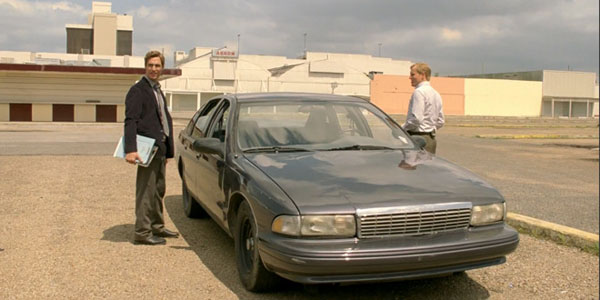
camera tracking Detectives Martin Hart (Woody Harrelson) and Rust Cohle (Matthew
McConaughey) from high above their Chevy Caprice as they glide through the
Louisiana countryside, where Cohle offers his opinion of the people he’s sworn
to protect and serve: “People around here,” he says, “it’s like they don’t even
know the outside world exists. Might as well be living on the fucking moon.”
Like the clockwork universe of Hawley’s Fargo,
True Detective’s Louisiana also takes
issue with individual ambition. Down on Louisiana’s southernmost edge, in
Pelican Bay, the grandfather of murder victim Rianne Olivier restates the
sentiment as an ethical imperative, suggesting that her disappearance is the
result of fatal immodesty: “Everybody
think they gonna be something they not. Everybody, they got this big plan.”

True Detective doesn’t
share Fargo’s single, coherent
community, of course. As enamored with Louisiana’s landscape as True Detective is – the camera lingers
over not only its idiosyncratic natural landscape but also its “jigsaw” of
pipelines and the refineries – it’s far more interested in that landscape as a site
of cosmic horror than in socioeconomics. As a result, the show traffics in clichés
of Bayou exoticism: the Cajun, the Creole, corruption and conservative
politics, “Santeria and Voudon all mashed together,” Mardi Gras, evangelism, a
swampy apocalypticism. [4] As
Detectives Cohle and Hart move among the kith and kin of the murder victims, the
thread tying the various characters together seems to be a feeling of persistent
degradation: the headaches and corroded hands of Dora Lange’s Mother (Tess
Harper), the neurologically-damaged former baseball player Danny Fontenot
(Christopher Berry), Burt (Douglas M. Griffin), the castrated and
mentally-handicapped member of a local church, and even Tiger Thomas (John
Eyez), the drug dealer kidnapped and tortured by Ginger and his crew of Iron
Crusaders. 

These witnesses and leads never
amount to much more than a gothic menagerie (a touch of Flannery O’Connor, a
bit of Night of the Hunter). They
provide True Detective with rich
atmospherics, and an occasional red herring, but Pizzolatto doesn’t ask his
audience to imagine the day-to-day (let alone the internal) lives of the characters.
Instead, they’re emblematic of the forces of entropy (both natural and
cultural) that continue to work on the landscape and its inhabitants, the
zombie population of Cohle’s “fading memory of a town.” This persistent
degradation—of memory, culture, and landscape—presents a staging ground for
cosmic terror.  Our brief experiences
with the residents of southern Louisiana makes it abundantly clear that they’re
incapable of resisting whatever forces are at work. And Errol Childress (Glenn
Fleshler), in the grotesque grandeur of his ruined family and his ruined home,
is the embodiment of that terror. Perversely, and fittingly, it is in the
chaotic aftermath of Hurricane Katrina’s destruction that this evil is
permitted to "have a real good time."

Of course, True Detective was, from the jump, more interested in what was
going on inside that Chevy Caprice than in how people live outside it, in the
dialectic between the flinty Cohle and the good-old-boy Hart (with its easy
reduction into “cold” and “hot” and “coal” and “heart”): the former shunning
community while secretly craving it, the latter arguing on its behalf while
constantly betraying it. Hart invites Cohle to dinner, but doesn’t really want
him to stay; Cohle doesn’t even want to show up and yet lingers in conversation
long past (Hart’s) welcome. When we finally arrive at the story’s end, after the
climax has finally, definitively divorced the story from reality, it’s pretty
clear that the narrative and emotional drive of the series is fundamentally
that of a Romantic Comedy (by way of its homosocial cousin, the “buddy cop”
story) that happens to have a Southern-fried supernatural thriller grafted onto
it.  Because of this, the show’s
preoccupation with the relationship of its main characters means that we hear a
lot about what the characters think
about community rather than experiencing that community for ourselves. And yet
there are moments that reveal the region’s social and cultural transformation
as, over the years, the pastoral background gives way (enacting Jameson’s
“imperceptible thickening,” perhaps) to an anodyne wasteland of strip malls and
storage units. When the detectives visit a dilapidated bunny ranch tucked off
of the secondary roads near Spanish Lake, we glimpse the myriad ways in which
cultural and/or economic entropy can lead to new social arrangements.  It’s also one of the show’s sole assertions
of female autonomy. Even if that autonomy is colored by sexual commerce, it
stands out from the other scenes in which Cohle and Hart talk with witnesses by
being something more than a simple reification of narrative hierarchies.

*          *          *          *

What is it
about these small towns and rural spaces that inspired Hawley and Pizzolatto to
animate them with their cosmic and/or philosophical stories of good and evil?
Their reasons are different on a number of counts, I’m sure.  But I can’t help but think they share at
least two. The first is a reliance on their settings as “separate points on a
map,” a separateness that allows them to control their experiments in good and
evil but only at the expense of nuance and complexity. The second is diminished
expectations. Whether it’s the novelty of Hawley’s surprisingly cruel
Minnesotans, or the passive acceptance of the evil in the midst of Pizzolatto’s
Louisianans, stereotypes and assumptions about the people who inhabit the shows’
locales allow Hawley and Pizzolatto free reign to wax exegetic on so-called
forces of light and dark. Indeed, it’s hard to imagine anyone accepting their
manipulations anywhere but the "moonscape" of small town or rural
life.  As with Jameson’s essay, however, this
tells us more about how we imagine small towns than it does about those who
live in them.  Of course, our own
collective imagination has been influenced by a long, pervasive history of
representation. Shows that manage to step outside or beyond the level of
stereotype or trope are rare.  The second
part of this essay will discuss some of that history and two recent examples of
shows that complicate it.

Spencer Short is an attorney and author. His collection of
poetry,
Tremolo (Harper 2001), was
awarded a 2000 National Poetry Series Prize. His poetry and non-fiction have
been published in
The Boston Review, Coldfront, the Columbia Review, Hyperallergic,
Men’s Digest, Slate, and Verse. He lives in Brooklyn.


[1] Thornton
has described his character in interviews as “this mysterious stranger who
comes to town.”  See http://www.vulture.com/2014/04/billy-bob-thornton-fargo-interview.html

[2] The graphic nature of the violence in the
Coens’ Fargo leaves one with the mistaken impression that there are far more
casualties than there actually are. Further, the Coens’ directly reference the
impact violence has on community in Blood
Simple
, a phrase taken from Dashiell Hammett that acknowledges its
collective psychic toll.

[3] In this sense, “small town” fictions,
particularly in the Midwest, provide an opportunity to avoid pesky diversity
issues.  In Fargo, the cast is overwhelmingly white, and the few minorities
written into the script are the object of ridicule, violence or both.

[4] As others
have noted, the Louisiana landscape is a perfect fit for Pizzolatto’s purposes
– which is probably why it’s also the setting for HBO’s other series about the small-town supernatural, True Blood. 
See
http://www.slate.com/articles/arts/culturebox/2014/03/true_detective_louisiana_is_more_than_just_the…

John Lithgow on Process, His Past and Playing an Artist in LOVE IS STRANGE

John Lithgow on Process, His Past and Playing an Artist in LOVE IS STRANGE

nullLithgow is one
of the most versatile actors of our time. When I learned I’d have a chance to
chat with him, I wondered how I could possibly cover the expansive portfolio of
his work. But his character in Love is Strange
is beautifully similar to Lithgow himself, who is also a painter; this made the conversation considerably easier. It turns out
there were many things I didn’t know about Lithgow, including his adoration for
painting, Alfred Molina, and how he grew up going to poetry readings on Bleecker
Street.   

In the film, directed and written by Ira Sachs,
Lithgow and Alfred Molina star as Ben and George, two artists struggling to
find a home after George looses his job. They are divided in New York City; Ben
forced to crash with Kate (Marisa Tomei) and George with his friend Ted
(Cheyenne Jackson). It’s an honest film with a subtle, poignant comedy,
exploring the challenges of being an aging artist and what it means to maintain
a partnership.

MA: You’ve played some over-the-top characters and it was nice
to see you play someone simple and raw. Was that something that drew you to the
character in the first place?

JL: Very much so. Everything drew me to it. I read the script
and I just wanted to do nothing else. You read something like this, and you know
this is going to be so exquisite. Fred was already set when I was hired for it,
and I knew the relationship would be perfect.

MA: Watching the film, I felt like it was a relationship, where
you had known each other previously.

JL: We did know each other very well. We’d never worked
together. There had been a couple of odd things that had brought us together.
The real thing we had in common was a very dear friend, Ileen Getz, who passed
away of cancer. We hung out together on her hospital ward. This was about 10
years ago.

MA: What an intimate way to get to know someone.

JL: I really saw what a big heart he had, and a wonderful sense
of humor. He’s just a great stage actor. I knew it was going to be effortless,
and it was.

MA: There is that sense of humor about the script, even though
there are some dark moments. Did Ira allow the actors to include their own
humor?

JL: We talked about humor very specifically. The wonderful scene
between Marisa and me where I’m talking and she’s trying to work sold me on the
project. It plays like a sitcom scene and it’s completely real. Ben is this
wonderful character, in equal measure, adorable and infuriating!

MA: It reminded me of Harry
and the Hendersons!
 It’s the same
sort of endearing character.

JL: (Laughing) Yes! A character that comes and throws everyone
off their game! Ben is an artist, a kind of abstraction. I have this lovely
moment in the film where [George and I} are dealing with a real-estate woman.
I’m listening; I’m trying to be good. Then suddenly I drift off and start
thinking about something else. That’s an artist. An artist is always thinking
of something else. My father was like that. He had this feeling of abstraction
and I do too. I just put it to work for Ben. When I do a painting, I can sit
for 15 minutes and look at the painting.

MA: Didn’t the film use your own work?

JL: I did this collaboration with a very big painter Boris Torres,
Ira’s husband. We worked together because I joined the film halfway through the
shooting, and they had to have the paintings. So he did the paintings based on
my techniques so that when I actually painted I was painting something he had
already half done.  The only time you
really see one of my paintings is in one of the very first scenes. I walk into
the kitchen, and the camera follows me and stops on a painting of a boy on the
deck of a ship. That’s my painting.

MA: There’s a moment where your nephew’s son comes up onto the
roof where you’re painting and says, “You’re not even that good.” You say, “You
don’t mean that!” That felt like what the core of the film is, the struggle of
the artist. 

JL: I choked up even reminiscing about that scene. It devastates
me when I see it! He’s not a great artist, he’s a perfectly good artist but he’s
certainly not a successful artist. Ira spent a lot of time talking about just
how good or bad he is. He’s a nice, but not a successful, one.

MA: Do you think there’s a difference between people who are successful and people who are truly
good artists? 

JL: There’s a huge difference. I really prize and love great painting.
It’s so out of date now. It’s slightly come back in. Painting is being valued
again, but twenty years ago you’d go to art school and they wouldn’t even teach
painting! They would send you off to do a plaster caste of a racecar or
something! That’s the nice thing. He’s a good old-fashioned painter.

MA: There’s that old-fashioned element in the film. I picture you
and Alfred… I feel like I don’t know him well enough to say Fred!

JL: You can say Fred!

MA: I picture you and Fred, your younger selves, doing what you
do in this film. Did you live that life of couch hopping in New York City?

JL: Not really. I was married very young. I lived a very middle
class life. I was married at age 21, divorced at 31. I didn’t sleep on people’s
couches.

MA: Was it interesting to play a character with that lifestyle?

JL: I went to Princeton High School, when I was very serious
about being an artist. I was in a theatre family but I didn’t want to become an
actor. Every Saturday I would go into New York to take figure-drawing lessons
at the Art Students League. Those were fabulous days. I was 15, 16, 17 years
old. This movie Inside Llewyn Davis,
that was the life I lived, going to those folky clubs, listening to poetry
readings on Bleecker Street. That’s the closest I came to it. I certainly had my
years as an out of work actor but I was married with a baby. My wife was
supporting us.

MA: I have friends that are 25 living the life that your
character lives in the film, going what
am I doing with my life, I’m out of work, what is my craft?
Given I now
know you lived a different lifestyle, how did you relate?

JL: You play a part and it’s a leap of imagination. To me it was
all there in the writing. Fred and I brought so much of ourselves. Ira has a
way of reaching into the actor’s experience and putting it to work. He had a
very interesting work method. I was making a film in Calgary. Fred was living
in LA. Ira flew out and spent two days with me, two days with Fred and never
wanted us to work together. We just talked and went through the script line by
line, never wanted me to perform it at all, save it all for the actual
experience of acting with Fred. We just answered all these questions about
Ben’s backstory. The first thing Fred and I shot was singing on that piano
bench. We hadn’t done any other scenes and you think they’ve been together for
forty years. Who knows how we accessed that, but it happened.

MA: If you guys didn’t rehearse, how did you guys feel
comfortable with each other’s bodies?

JL: We were just comfortable with each other’s bodies. I wish
you could meet him. He is the most adorable, accessible man, so available,
wonderful to act with. You just feel an automatic connection with him. The
camera stops, and that connection goes on. 
He would make me laugh so hard. We would tell each other jokes and get
crippled with laughter.

MA: Are there other actors you’ve worked with that you had that
companionship with?

JL: This had been pretty unusual. I’ve had that on stage in a
lot of things. M. Butterfly with BD
Wong, Dirty Rotten Scoundrels with
Leo Butz, Sweet Smell of Success with
Brian d’Arcy James.

MA: Do you think in theater there’s more of an opportunity for
that intimacy?

JL: It all depends on the material.
 

MA: Have you ever thought about playing King Lear?

JL: Why do you think I have a beard? I’m playing it this summer!
In Central Park! How did you-what
occurred to you to ask that? I just spent the past two months learning the
role! 

MA: Are you really? I’ve been reading the play recently!

JL: "Darkness and devils! Saddle my horses; call my
train together. Degenerate bastard! I’ll not trouble thee. Yet have I left a
daughter!" I could do the
whole role for you right now. You have to come see it.

Meredith Alloway is a LA local and Texas native. She is currently Senior
Editor at TheScriptLab.com where she focuses on screenwriting education
and entertainment resources. She also launched her own interview show,
"All the Way with Alloway," where she scoops the latest up and coming
industry insiders. She received her Playwriting and Theatre degree from
Southern Methodist University and continues to pursue her own writing
for film and stage.

ARIELLE BERNSTEIN: Ciphers, Masks and Longing: Old Hollywood Ethos and Lana Del Rey

ARIELLE BERNSTEIN: Ciphers, Masks and Longing: Old Hollywood Ethos and Lana Del Rey

nullLana Del Rey’s latest album, Ultraviolence, is filled with hazy and seductive contradictions,
affirming the glamour and seduction of old Hollywood icons, femme fatales with
Veronica Lake waves, and mobster wives with baby voices. Del Rey is certainly
not the only female singer to be drawn to these motifs.  But the worldview that Del Rey constructs is
not Beyonce’s sepia-hued “Why Don’t You Love Me?”, where Queen Bey playfully
dismantles the image of the 1950s housewife.

Nor is it Madonna’s
wink to Marilyn Monroe in her video for “Material Girl.”

Del Rey isn’t
interested in reclaiming the figure of the housewife or movie star. In fact she
takes her feminine icons very seriously. 
Her video for "Shades of Cool," for example, has echoes of Marilyn Monroe’s
famous pool scene in “Something’s Got to Give,” and in “Brooklyn Baby” she
references her in lyrics, based on some of Monroe’s famous diary entries where
she wonders why no one takes her seriously.

The world of Ultraviolence is filled with reverence for a
rock-and-roll lifestyle that many feel has already come and gone, but that Del
Rey clearly appreciates for more than the sake of nostalgia. In interviews she
has explained that her songs are mostly autobiographical, plucked from times in
her life when she has felt most lost, and also the times, generally in the arms
of a lover, when she has felt most genuinely free.

One of the main reasons that Del Rey has been maligned has to
do with the fact that she is an artist who is more interested in the masks we
wear than in being a “strong female role model.” Critics of Del Rey have long
denied her authenticity (her records under her given name, Lizzy Grant, looked
and felt intrinsically different than her first album as LDR, Born To Die) as well as her agency. Del
Rey has historically been seen as a pawn of record executives, or, even worse,
as a figure that is merely empty and submissive. Pitchfork called Born To Die the “equivalent of a faked orgasm” and critics like Ann Powers
lamented that Del Rey represented “the worst parts of being a girl.”

For a woman to be perceived as “submissive” or “docile” is
the ultimate feminist insult, even though these words are often strangely
unspecific, related to being gentle, soft-spoken, quiet, or even just being
disarmingly pretty, or liking or wanting male attention. Songs demanding better
treatment and female empowerment existed before the girl power anthems I grew
up on in the late 90s and early 2000s.  In
the 60s, Aretha Franklin demanded respect . . .

. . . and Carole King and
Joni Mitchell urged us to listen to women’s stories; artists from Madonna,
Beyonce, Christina Aguilera, TLC to Lil Kim, Missy Elliott, and Nicki Minaj
often explicitly sing about double standards in the music industry and in the
bedroom. While they all define it in a different way, each artist explicitly
urges women to seek empowerment above all else.

Del Rey doesn’t play into this script. Catherine Vigier,
whose essay The Meaning of Lana Del Rey is
often discussed when pop culture critics lament the influence of Del Rey on the
Millennial generation, claims that one of the reasons Del Rey is so controversial
is that she is a woman who is clear that she doesn’t know what she wants, in a
world where feminists argue that knowing what you want is the ultimate and
definitive feminist act.

But is Del Rey’s desire to play with the many masks she is
given inherently anti-woman? In recent interviews Del Rey has made it clear
that she is less interested in talking about feminism than space, a quote that,
like many of Del Rey’s quotes, could lead to a thousand different interpretations.
In truth, Del Rey’s influences are mostly moody depressives, icons like Kurt
Cobain, whose vulnerability was read as “sensitive,” rather than “vacant.”

Unlike many current female artists, like Lily Allen, and
popular comedians, like Amy Schumer, whose social commentary is laid thick with
sarcasm, there is something about Del Rey that is disturbingly earnest.

Her constant need for
sex is more akin to The Rolling Stones’ howl for “Satisfaction” than Samantha’s
need to get laid on Sex and the City.

Del Rey is closer to a character in a Mary Gaitskill
collection: she is a submissive, like many of Gaitskill’s narrators, who seek
out fantasies and are ultimately calling all the shots, rather than an empty
headed, meek ingénue like Anastasia in Fifty
Shades of Grey.

Though some insist that Del Rey’s nostalgic styles are
inherently anti-feminist, female sexuality in pre-code and even post-code
Hollywood,was, in reality, filled with saucy, sexually assertive women, vixens
and femme fatales who played up their sexual charms joyfully—Barbara Stanwyck,
Marlene Dietrich, Greta Garbo, Josephine Baker, as well as the ever delightful
Mae West.

Playful banter remained a mainstay in classic Hollywood
cinema, where female wit was both smart and playful, a way to reel a guy in or
keep the men at bay. Heterosexual banter often sizzled on screen because it
managed to highlight sexual tension between equals.

Del Rey is certainly more Marilyn Monroe than Mae West, but
her self-described “gangster Nancy Sinatra” image is also one that is much more
about the female gaze than the male one. Del Rey is obsessed with the way women look at men, about
the desire to be desired. In the video for “Blue Jeans”, for example, we watch
Del Rey watching her lover undress, her face sinking into pure pleasure as he
gently slides his fingers into her mouth.

In her video for
“Ride,” Del Rey is in constant pursuit of pleasure, her little red sneakers
walking tentatively on pavement, her hands thrown back in the air, while riding
on the back of a motorcycle.

If she lives for the
men she loves, as many criticize, it is also those men who are cheering for her
in the spotlight. Is the desire for male attention inherently anti-feminist,
as some theorists claim? For men like The Fonz on Happy Days, The Situation on The
Jersey Shore
, and Barney Stinson on How
I Met Your Mother
, their entire sense of identity is based on their ability
to pick up chicks. Indeed, the same is
true in many commercials. Take, for instance, the Axe body spray commercial,
predicated on the idea that male power is derived from the ability to score
with a hottie.

When men alter their
body hair, douse themselves in cologne and use “pick-up artist” techniques,
they are seen as active, free agents, in charge of their own destiny, but when
women like Del Rey paint their nails, don pretty dresses and talk about boys
they want to love, they are dismissed by many men and women as being
empty-headed and unserious. 

The Bechdel test, the idea that female characters in a movie
should have at least one scene where they are talk to one another about
something other than a male romantic interest, is often cited as a means of
figuring out whether female characters are allowed true agency. If one uses
this test as a guideline for romantic and sexual obsession for heterosexual
women, it automatically reduces the complexity of their characters. This idea
plays itself out all the time, especially in films targeting teenagers. Male
teen lust is portrayed as natural, and learning to approach women is seen as a
way that young men can build their identity. In contrast, teenage girls and
young women who are interested in romance are often portrayed as foolish,
unintelligent, or “boy-crazy”. 

For all her sauciness, Mae West would have failed the
Bechdel test. Throughout her self-made career she was often portrayed as the
single female being admired by a gaggle of men eager for her affection and
approval. She is obsessed with
seeing herself as an object of great desire, which she doesn’t see as being
antithetical to being seen as an individual who can get whatever she wants with
her fiery wit and her insistence on being taken seriously.

Del Rey insists on a different kind of seriousness: she
really wants her despair to be seen as human, for her conflicted desires to
reach the same level of gravitas that we afford male leads. One of her favorite
icons, Marilyn Monroe, wanted the same thing: to be taken seriously for her
intelligence, for her viewers to look beyond the mask—that baby voice, that
golden coifed hair—and see the person underneath the artifice. 

Unlike Monroe, whose desire to be seen for her humanity over
her status as “sex icon”, went largely unrecognized in the era she lived, Del
Rey’s status in a post-third wave feminist world is constantly discussed. But perhaps Del Rey’s image is charged
precisely because viewers haven’t changed as much as we think we have since the
40s and the 50s, when a post Hays code world supplied a crib sheet for what
desirability looked and sounded like. In her article, “Pretty When You Cry,”
for Pitchfork, Lindsay Zoladz claims there is in fact something subversive
about Del Rey’s insistence on sadness, her refusal to wear a happy face; in a
world where people often demand female exuberance, Del Rey refuses to placate
audiences with a smile and a wink.

While I grew up on the angry rock anthems
of artists like Fiona Apple, Tori Amos and Alanis Morrissette, I also take Del
Rey seriously when she says she doesn’t find feminism particularly interesting.
Despite how drenched in femininity her persona is, Del Rey is much more
interested in being an icon, period, than a female icon, and her gritty image
on Ultraviolence is all about
swagger. In “Ultraviolence” she croons The Crystals’ uncomfortable lyrics, “He
hit me and it felt like a kiss,” and sounds like a breathy Bill Withers
beckoning a lover, “If it feels this good being used / you just keep on using
me / until you use me up.” In this same song she also references the
novel Lolita, which Del Rey has often
cited as a source for inspiration.

In the end, Lana Del Rey could care less about your girl
power anthems and political charges. Ultraviolence
is about the contradictions in the human experience—lust and sadness and
existential need and desires that don’t have easy answers and won’t be fixed
with better public policies. The world of
Ultraviolence
is important not because it necessarily has specific
political aims, but because it is about the messiness of the human experience
and how, no matter how many power ballads we write, true satisfaction, for men
and women, is still often mysteriously elusive.

Arielle Bernstein is
a writer living in Washington, DC. She teaches writing at American
University and also freelances. Her work has been published in
The
Millions, The Rumpus, St. Petersburg Review and The Ilanot Review. She
has been listed four times as a finalist in
Glimmer Train short story
contests
. She is currently writing her first book.


***A special thanks to Serena Bramble for the Monroe/West/Bacall and Knowles/Mitchell/Dietrich medleys posted above!***