Watch: Why DO the Characters in Quentin Tarantino’s PULP FICTION Spend So Much Time in the Bathroom?

Watch: Why DO the Characters in Quentin Tarantino’s PULP FICTION Spend So Much Time in the Bathroom?

Of the myriad questions raised by Quentin Tarantino’s now-classic Pulp Fiction, I would have to confess that one of them was not, for me, "Why do the film’s characters spend so much time in the bathroom?" And yet this video essay by Michele Bucci raises the question, and answers it, and argues for its validity. The answer is more complicated than you might think–it reaches towards both the true definition of pulp, as well as examining what’s going on (beyond the obvious) when Vincent Vega, Mia Wallace, et al. are in that little room. Enjoy!

Watch: A Video Essay on Setpieces Throughout Film History

Watch: A Video Essay on Setpieces Throughout Film History

Screenwriter John August describes a setpiece as "a scene or sequence
with escalated stakes and production values, as appropriate to the
genre… Done right, set-pieces are moments you remember weeks after
seeing a movie." Proper setpieces should serve as spikes within the
plotline. In contemporary cinema, a setpiece can range from an edgy gag
in a romantic comedy, to a multi-million dollar CGI-infused battle
scene in an action film. Regardless, a setpiece always seems to be
"that scene" when discussing movies. Here is a look at some of the
biggest, priciest, and most recognizable setpieces in cinema.

List of Films (in order of appearance):

There Will be Blood

The Dark Knight Rises


Die Hard


Django Unchained


Inception


The Matrix


Swordfish


Apocalypse Now


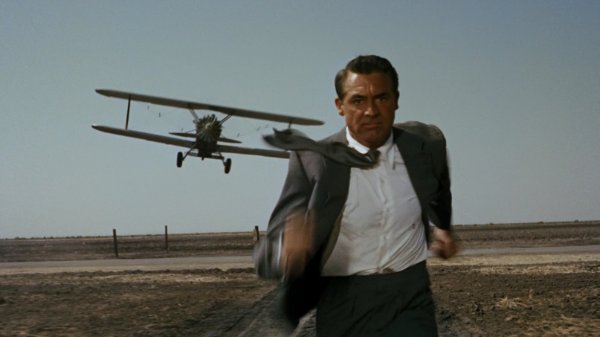
North by Northwest


X-Men: Days of Future Past


Spider-Man 2


Kill Bill Vol. 1


Magnolia


The Dark Knight


The Lone Ranger


Guardians of the Galaxy


Terminator 2: Judgment Day


Titanic


The Wolf of Wall Street


Flight


Children of Men


The Matrix Reloaded


Mission Impossible


Scarface (1983)


E.T.


Jurassic Park


Jaws


King Kong (2005)


Man of Steel


The Avengers


Inglourious Basterds


Gangs of New York


World War Z


True Lies


Batman Begins


Raiders of the Lost Ark


Stand by Me


Super 8


Godzilla (2014)


Star Wars


Twister


The Perfect Storm


Lord of the Rings: Return of the King


300


The Shining


Psycho (1960)


Taxi Driver


The Shawshank Redemption


Gravity

Music: "Mind Heist" by Zack Hemsey

Jacob Swinney is an industrious film editor and filmmaker, as well as a recent graduate of Salisbury University.

METAMERICANA: On Crispin Glover’s Epic Performance Art

METAMERICANA: On Crispin Glover’s Epic Performance Art

nullBetween
1987 and 1995, actor, musician, and author Crispin Glover gave America
one of the longest-running and most inscrutable performance art projects
of the postwar era, and did so on one of the largest stages available
to any performer in the States: late-night television. Even now, twenty
years on, the exact nature and purpose of Glover’s project is
unclear–as it’s been deliberately left unclear by its creator–even
though anyone with access to the Internet and YouTube can trace each
stage of the project’s development. What we find, when those individual
and temporally far-flung stages are combined, is an exemplary piece of
“metamericana” that may well have been decades ahead of its time.

*

Crispin
Glover has always been an idiosyncratic and even downright strange man,
and he still is today. In 1987, however, Glover’s quirks were far less
well-known, as besides a forgettable Friday the 13th appearance and a single high-profile role–as the George McFly (both the younger and older versions) in Back to the Future–he’d only been featured in a single movie (River’s Edge) that more than a handful of American moviegoers had seen. And in fact Glover was left off the second and subsequent Back to the Future movies for a reason: he had ideas of being a genuine artist, an ambition of which the director of the Back to the Future
films, Robert Zemeckis, has never been accused. (Zemeckis, among a
number of high-profile, high-grossing thrillers, also produced the Paris
Hilton vehicle House of Wax.)

Though
only 23 in 1987, Glover had already published a novel and performed in
several low-budget art house flicks. He’d also begun writing some
bizarre music that would later feature prominently in his performance
art, which for the purposes of this article I’ll refer to as The Crispin
Glover Project.

*

The Project began in 1987, with Glover’s publication of a novel called Rat Catching. Possibly the first metamodern novel–it was written a decade before David Foster Wallace’s Infinite JestRat Catching was a pre-Internet remix the likes of which America had not yet seen (at least in its popular culture). What Glover did in Rat Catching
was take a public domain text–a 1896 manual for how to catch and kill
rats–and alternately blacked or whited out large sections of it to
create his own storyline. Sentences were also rearranged at will, and
captions to the many pictures included in the original manual were
altered; finally, Glover’s name was sloppily affixed to the title page
over the name of the original author.

Rat Catching
is an astounding and disturbing book, one that simultaneously
deconstructs an existing text and constructs from it a new and only
partially related one. It juxtaposes deconstruction and construction in a
single “reconstructive” literary act. Importantly, the novel was
eminently readable, even if the purpose behind its deconstruction of a
rat-catching manual–or even the purpose of the novel Glover replaced
that manual with–was unclear. Rat Catching was therefore not so
much a degradation of language conducted with a political point in
mind–as is typically in the case with work we identify as
“postmodern”–but a re-purposing of language made with no obvious
critique in mind, or at least no evident critique, but only the desire
to create something new and unforgettable.

At the same time that Rat Catching was being published, Glover was finishing up work on Rubin and Ed,
a low-budget film that (unbeknownst to Glover at the time) wouldn’t be
released for several more years. It was in this context that Glover made
his first appearance on the David Letterman show, an appearance still
regarded as one of the strangest five minutes in television history.

*

On
July 28, 1987, Glover, sporting glasses, unusually long hair, and
platform shoes, conducted a five-minute interview with Letterman–if it
could be called that–before Letterman walked off the set in both
disgust and (he would later indicate) a fear for his personal safety.
Here’s a clip of Glover’s first appearance on Late Show with David Letterman:

Note
that Glover answers most questions while looking into an unknowable
middle distance, seems either scared or anxious (it’s not clear which),
and begins his descent into outright lunacy only after a woman in the
audience–many now believe her to have been a plant–begins heckling
him. “Nice shoes!” the woman shouts, and everything quickly deteriorates
into madness.

In
the early stages of his "breakdown," Glover seems to be raising the
question of how the media covers celebrities (he takes out a wrinkled
newspaper clipping to opine about it, and certainly appears to be
dressed as someone other than the celebrity he was and is) but at no
point does any real commentary or critique materialize. What Glover
does, instead, is nearly fall off the stage and then execute a possibly
impressive and certainly violent-looking karate kick.

After
a commercial break, Glover is nowhere to be seen; Letterman implies he
was kicked off the set. Letterman’s bandleader, Paul Schaffer,
speculates–in a moment of (for him) unusual candor and insight–that
the whole event was a “conceptual piece.” Letterman isn’t so sure, and
seems genuinely put off by Glover.

Nevertheless, he agrees to have him back on the show a second time.

*

Glover’s
second visit to Letterman’s program was as strange as the first, but in
an entirely different way: Glover is meek, harmless, and giggling, in
fact giggles so frequently that–coincidentally–he never has to answer
any of the host’s questions about his first appearance on the program.

The
short version of what’s happening: Glover, again without Letterman’s
knowledge–let alone permission–is controlling the interview. He does
so in a way that’s so confusing to the audience that they start booing
Letterman, not Glover, when the former makes repeated fun of the
latter’s demeanor, twice threatens to assault his guest, and repeatedly
implies that he’s about to throw Glover off the show again.

As
you can see in the video above, when Letterman asks Glover to explain
his first appearance, Glover refuses to say whether the clothes he wore
during the appearance were his “real” clothes or merely props. He
giggles uncontrollably and asks Letterman, “Well, what did you get [from
it]?” when the host asks him to explain his previous visit. And yet, as
odd as Glover’s words seem, everything he says to Letterman could
readily serve as a description of one brand of metamodern art: that
being metamodern art inspired by the writings of university professor
Mas’ud Zavarzadeh, who coined the term “metamodernism” in 1975:

Says Glover:

(1) “It’s self-explanatory…kind of…”

(2) “There it was, or there it is…”

(3) “I feel like I shouldn’t say anything [about it]…”

(4) “I wanted it to be this interesting kind of thing that would happen that people would find interesting…”

(5) “The point…was [to create] interest…”

(6) “It was going to go to a different point…it wasn’t going to escalate, it was going to go down into a newer [sic] state…”

Letterman,
literally leaning forward in his chair to get an answer to his
questions, never gets any answer at all. “What was the point?” he asks
Glover repeatedly. But Glover, who in fact was not then (and is not now)
an obsessive giggler, and who’s widely perceived as an intellectual and
creative genius by his peers and many fans, offers no answer because
the answer is already right in front of Letterman and the audience:
Glover has used language and bodily performance to get and keep the
attention of an audience, but has done so without any evident purpose in
mind. He shows Letterman, that is, that attention is the currency of
contemporary America–a maxim that would be infinitely enhanced in
veracity and utility after the popularization of the Internet–and that
the primary value of the most successful attention-seeking art is not
that it critiques language or culture through Modernist constructions or
postmodernist deconstructions, but that it removes viewers from their
own lived realities.

When
Glover asks Letterman, “Did you find it interesting, in one way?”,
Letterman shakes his head “no.” Yet that answer is belied by the fact
that the host invited back his troublesome guest just days after his
first appearance–and would invite him back repeatedly afterwards.
Glover is so interesting to Letterman that his interest manifests as an
intense aversion he associates with disinterest.

We
see the same phenomenon at play on the Internet today: we follow and
discuss with an eerie obsession those we claim to dislike and even be
viscerally put off by; we give additional attention to people we
consider superfluous by way of writing at length about how they deserve
no attention; we follow types of art we detest with an even greater
intensity of attention than those we claim to be enamored by; we even
write critiques of that art in which we simultaneously claim that it has
no effect on its audience and note that everybody just can’t stop
talking about it. Again and again we see art that seems higher-brow and
more intricate and laud its qualities and even, specifically, its
memorability–but see no self-contradiction in our analysis when it
later fails to excite much ongoing attention at all. It’s almost as
though we know very what type of art finds clever ways to gain and hold
attention in the Internet Age, but need to half-heartedly construct
narratives in which we assure ourselves that it’s otherwise.

In
other words, when we encounter metamodern art or personalities we often
unwittingly consume the very paradoxes they and their art perform.

*

Every
episode of Letterman’s program, for decades, has been either funny or
not, either instructive or not, either “real” or “staged,” either “good
TV” or “bad TV”–except
for those nights Crispin Glover has appeared on the program, and the
few times that others interested in Glover’s creative vision have aped
his methods in the same venue.

The Crispin Glover Project was designed to overleap poles of thought and affect like “real” or “staged” in order to
create a space in which all poles are simultaneously present and
absent. Glover’s performances on Letterman are both funny and not, and
therefore end up being neither; they feel like bad television but have
the staying power all good television has; they’re ambivalent on the
question of whether they’re “real” or “staged,” and for this reason are
impossible to forget. After all, we tend to remember those experiences
that most wrench us from the known and comforting–often calling these
experiences “sublime”–and the Crispin Glover Project was intended to
show that concept-driven art can create these experiences better than
any other method.

*

Glover
believes, as do a certain strain of metamodernists, that in the
Internet Age the most important civic quality we can all develop is an undirected attentiveness--a
paradoxical state in which we’re ready to believe things and act on
beliefs that are normally outside our experience of the world. If we can
learn to be most attentive in those moments we’re most out of our
comfort zones, we can begin acting in the world in a way that isn’t
bound by the same conventional thought that hasn’t worked out for many
of us in the past. We might therefore call Glover’s apolitical art
“preparatorily political.”

When
Glover ends his second appearance on Letterman by showing the host a
series of art objects that make no sense whatsoever, both Letterman and
the audience are rapt: not because what they’re looking at is garbage,
but because they don’t even know what they’re looking at–and Glover’s
explanations of each object are just plausible-seeming nonsense. If
postmodern deconstruction asks us to so minutely dissect meaning and
performance that there’s literally no end to the levels of precision and
distinction we can produce, Glover’s metamodern art asks us to do
precisely the opposite: accept that there are things we cannot know or
understand, but see also that this "not-knowing" can, paradoxically, be a
powerful preparation for future action.

In
Glover’s third appearance on Letterman’s program, much like during his
second one, he giggles and stutters demonstrably less the moment he’s
asked about his current art projects instead of the The Crispin Glover
Project. In fact, not only does Glover dress “normally” for his 1990
interview with Letterman–continuing his trend of dressing progressively
more conventionally with each appearance–but in fact only stutters or
giggles whenever Letterman asks him about a topic he wishes to avoid.
When speaking of other projects, Glover acts as any other guest might,
and speaks with great clarity and focus. But one thing he doesn’t
do is answer any of Letterman’s questions about the Project; instead,
he deliberately runs out the clock on his segment by telling a story
that superficially might, but also might not, have anything to do with
his first appearance on the program. And once again, Letterman gets
booed on his own show for his abrupt treatment of his guest.

The
above video is worth watching not only for Glover’s continuation of his
performance art project, but also because it marks the debut of “Clowny
Clown Clown,” a Glover song–with accompanying video–that is neither
"understandably bad" to the point it can be made fun of, nor good enough
to admire. Instead, like the rest of the Project, it’s basically
inscrutable. It deconstructs linear narrative into incoherence, but does
so with such a naive commitment to creation and self-expression that it
seems every bit as Modern as it is postmodern. The crowd loves it, and
boos Letterman when he calls Glover “Eraserhead” at the close of the
interview.

Here’s the full music video for “Clowny Clown Clown”:

Listen
to the song without watching the video and you’ll see that, in fact,
it’s just a rather silly but conventional (and in fact linear)
narrative. The lyrics even make mention of “Mr. Farr,” the character
Glover may have “played” during his first Letterman interview. “Thinking
back about those days with the clown,” sings Glover toward the end of
the song, “I get teary-eyed–and snide. I think, deep down, ‘I hated
that clown. But not as much as Mr. Farr.’” The meaning here isn’t hard
to interpret at all, despite the video’s attempts to make it seem
opaque. (A reasonable read would be that Glover is speaking of the three
roles he plays: the “I” is Glover, the “clown” is
Glover-as-performance-artist, and “Mr. Farr” stands in for one of the
many Hollywood acting jobs Glover has taken on. Glover hates not being
able to be himself in public, but he’d rather act the clown–someone
simultaneously midway and "beyond" his actual and acting selves–than
merely be remembered for the characters he’s played on screen.)

*

The coda to the Project is Glover’s last performance art-related appearance on Letterman,
in 1992. Again Glover refuses to justify or explain his first
appearance on the program, or even to tell the host whether he was
wearing a wig on that (by now) infamous night. “Why can’t you just
answer this?” asks an agitated Letterman. “I mean, if it’s a wig, it’s
fine, but if it’s not a wig, it’s fine. Either way.” In fact,
Letterman’s need to know the answer suggests that he can accept either
of two opposite possibilities–a sign of maturation on Letterman’s
part–but that he still can’t accept not knowing whether either of these
possibilities is the “real” answer to his question. “Sure, it is fine,” says Glover, refusing to say more.

The
most telling statement by Glover in the video above is this one: “I
like to leave it…mysterious. Well, here’s the facts: I’m wearing a wig
in the movie [Rubin and Ed], and I look exactly the same in the
movie as I did when I was on the show.” Though Letterman acts as though
his interrogation has yielded fruit, in fact this is yet another
non-answer: Glover merely restates the facts as everyone agrees them to
be, refusing to either deconstruct or synthesize them on anyone else’s
behalf.

*

In
all of this, we have to remember the behavioral oddities of the role
that made Glover famous, and for which he’s still best known today:

If
you’ve watched the video above, you’ve probably noticed the key to The
Crispin Glover Project, which is that, by and large, the entirety of the
Project comprises Glover performing an amplified version of George
McFly in public. For years.

Here, below, is Glover as he actually
is, explaining to two radio hosts what acting as George McFly–and
being remembered almost exclusively for that role–taught him about
propaganda:

Per Glover, Zemeckis was able to convince viewers of Back to the Future II
of a lie–that Glover was in the film, when in fact he was not–simply
by giving them what they expected to see. In response, Glover found a
way to use the very same character Zemeckis was manipulating to give
viewers of David Letterman’s television show something they couldn’t
possibly expect. One might even say that Glover offered America the
opposite–in both form and effect–of propaganda. (He also, in an
interesting historical note, sued Zemeckis for misuse of his image–and
won.)

Now
here’s Joaquin Phoenix stealing Glover’s idea nearly twenty years later
and (in a show of real gall) doing so on the very same television
program:

And
here’s the most talked about celebrity in America right now, Shia
LaBeouf, wearing exaggeratedly ragged clothing and stealing from Joaquin
Phoenix stealing from Crispin Glover:

It’s
no coincidence that LaBeouf’s seeming point is the same one we might
glean from Glover’s project: that new media destroys, if we permit it
to, both the reality-artifice spectrum and many other polar spectra
besides. Which frees us to free ourselves from these limiting spectra as
well.

Over
the next twenty years, we’ll hear a lot about art that is
simultaneously sincere and ironic and neither, naive and knowing and
neither, optimistic and cynical and neither. While two of the theorists
presently associated with metamodernism, Tim Vermeulen and Robin van den
Akker, originally described such art as “oscillating” between
conditions traditionally associated with Modernism and
postmodernism–for instance, sincerity and irony, respectively–their
view has changed in recent months. Now, they, and other metamodernists,
are more likely to note that metamodern art permits us to inhabit a
“both/and” space rather than merely the “either/or” spaces deeded us by
the “dialectics” of postmodernism.

“Both/and” means transcending
the poles that have been thought to dominate our lives ever since Plato
devised the term "metaxis" to describe this condition of moving
perpetually between opposites. By comparison, “either/or” means that
everything is a zero-sum game and can never be otherwise. On online
discussion boards, for instance, "either/or" dialectics prompt us to
believe that others can only agree with us or oppose us, to understand
us in our entire selves or be deliberately and permanently foreign to
us; there’s no room for partnerships in which not all perspectives are
shared, let alone partnerships in which participants’ goals but not
their values are in common.
If the ultimate ambition of metamodern art, and metamericana generally,
is to help us discover what the “and” in “both/and” could possibly
mean, we must credit Glover with being one of the pioneers in that
historically important search.

Seth Abramson is the author of five poetry collections, including two, Metamericana and DATA,
forthcoming in 2015 and 2016. Currently a doctoral candidate at
University of Wisconsin-Madison, he is also Series Co-Editor for
Best American Experimental Writing, whose next edition will be published by Wesleyan University Press in 2015.

VIDEO ESSAY: Anita Ekberg: Artist and Model

VIDEO ESSAY: Anita Ekberg: Artist and Model

Even as a 16-year-old, it was impossible not to fall in love with Anita Ekberg in La Dolce Vita.
Her childlike glee when howling with the coyotes could melt the coldest
of hearts, and her physical curves made Marilyn Monroe, the clear
inspiration for her American starlet Sylvia, look like a stick figure.
As I tried to explain to my mom at age 16, "The word ‘voluptuous’ was
created for this woman!" (Now, at age 25, I still imagine gaining 15
pounds so I too can dress up in a black strapless dress and dance to
"Ready Teddy" one day on Halloween.) In Fellini‘s world view about the
shallowness of the 60s jet set, you still want to believe that Sylvia’s
joie de vivre will pull herself, and Marcello, out of the sadness of the
celebrity culture into which they find themselves sinking. 
In
a modern context, we might cynically categorize Sylvia as a "Manic
Pixie Dream Girl," the childlike foil whose purpose to the script is to
be emotionally available to a vacant man and give him a reason for
living, but even the term’s coiner, Nathan Rabin, would be against that,
for Fellini’s greatest gift to Ekberg’s career was to contextualize
her–and, yes, her curves as well–into the emotional territory of his
scripts, instead of merely making her a sex object or plot device, as many of her
American films did before Fellini granted her cinematic immortality. He
celebrates her body in La Dolce Vita and Boccaccio 70, where
Ekberg plays a billboard come to life, but in both films, her sexual
prowess is used to expose the insecurity of man while capitalizing on
Ekberg’s trademark wit and comedic timing. On screen, she was the dream
you never wanted to stop chasing, even though you knew she’d never give
you her full attention. But she gave hope in an otherwise depraved
world, who knew that la dolce vita boils down to this simple line: "I like lots of things, but there are three things I love most: Love, love, and love."

Serena Bramble is a film editor whose
montage skills are an end result of accumulated years of movie-watching
and loving. Serena is a graduate from the Teledramatic Arts and
Technology department at Cal State Monterey Bay. In addition to editing,
she also writes on her blog Brief Encounters of the Cinematic Kind.

On A MOST VIOLENT YEAR: When Homes Start to Look Like Their Owners

On A MOST VIOLENT YEAR: When Homes Start to Look Like Their Owners

nullThe places where we live shape us, and we shape the places
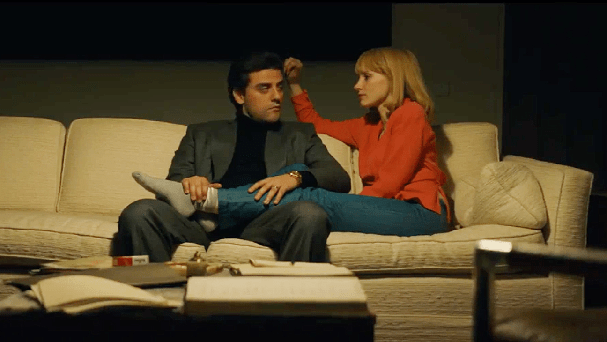
where we live to suit our temperaments. This truth is driven home repeatedly by
J.C. Chandor’s newest film, A Most
Violent Year
, which has been compared repeatedly to The Godfather but just as easily could be compared to On the Waterfront, Winter’s Bone, or The Truman
Show
as a study of the way inhabitants of an environment deal with and
modify their environment. Chandor has foregrounded setting to such an extent
that the two powerful performances at the film’s heart—Oscar Isaac’s as the manager of an oil trucking company, learning how to defend himself against the aggression of his semi-criminal colleagues, and Jessica Chastain’s as his
wife, who already knows and is desperate to teach him—seem to grow naturally
out of the milieu in which we receive them. However, these figures also shape
the settings in which they thrive.

The first sight we have of Abel shows him running, nimbly,
though a modest suburban New Jersey neighborhood. The setting is appropriate
for a character like his: contained, inwardly manicured, almost frustratingly
righteous and plodding when it comes to the moral shorthand those around him
employ for survival’s sake. There is something bleak about these streets,
comfortable as they might seem; there’s a notable lack of other people in
Abel’s surroundings, a visible emptiness, that suits the story, and suits also
the story he is writing with his actions here. After he makes the first payment
on his business, huddled in a cold-seeming trailer, his partner, played with
memorable paleness by Albert Brooks, encourages Abel to take a look around his
future headquarters, and so he does: down by the river, facing Manhattan from
the Jersey side, perhaps picturesque in one sense but at this moment, in the
middle of winter, standing behind oil tanks, it seems less like a view of
dreamland than a reminder of what obstructions lie ahead. The buildings are all
the same color, they’re all huge, and they’re all a long way off. When we see
Abel’s house for the first time, its sleekness is impressive but its coldness
is telling. The impression it makes is not that Abel is cold—for he isn’t. As
confidently portrayed here by Isaac, he’s a warm person, almost warm to a
fault, naïve in his trust of ethics, good faith, honesty, and the people in his employ. The house suggests,
though, the high-flown way he believes a man of his stature should live: high ceilings, pristine
surfaces, vast spaces, off-white walls, the perfect kitchen, the perfect
library. But it’s a borrowed idea of perfection. When we meet one of his
associates, played here with semi-beefy malevolence by Alessandro Nivola, it
appears that they share this same notion of coldness, the appearance of
perfection, as an aesthetic. The colleague has a racquetball court built into
his house, pinging opulence at us with the force of the ball itself. When the
two share a drink and discuss a loan which could push Abel into career
adulthood, they sit in a space-age interior, resembling something out of an
advertisement rather than a place where anyone might live. This is fitting,
though, because the people Chandor is filming here place little stock in homes,
in domesticity; for them life is work, and work is life. Work, further, is all about the rewards you reap, and the rewards you reap are, in essence, your life.

Chandor is smart about this dichotomy, though. When we see
the home of one of Abel’s employees, a vulnerable man who, after being beaten
up by the thugs whose aggression against Abel’s drivers propels the story, shoots his aggressors and then flees, the apartment’s modesty and hominess, with its inexpensive furniture, its drawn shades, and its
lived-in quality stand in stark contrast to the other interiors we’ve seen. It’s
clear hat the employee isn’t suffering under the same preconceived notions Abel
suffers under—but when he meets a sad fate, we wonder if such illusions might
have helped him. In an interview, Oscar Isaac
recounted how Chandor had stressed the importance of the suits Abel wears in
the film, and how their presence might dictate the character’s behavior, and in
fact his entire world view. This is a profound truth, when all is said and
done: outer trappings can shape the person to which they are attached, in
greater or lesser degrees. It’s the direction that shaping takes that makes all
the difference.

Max Winter is the Editor of Press Play.

KICKING TELEVISION: Why David Costabile, Mary Louise Parker, Gary Cole, Michael Keaton, Ellen Page, Joan Allen, Adam Driver, and Beyonce Need Vehicles!

KICKING TELEVISION: Why David Costabile, Mary Louise Parker, Michael Keaton, Ellen Page, Joan Allen, & Beyonce Need Vehicles!

nullIn my look
back at 2014
, I bemoaned the wasting of good talent on bad TV. Fewer
things are more frustrating in film and television than a performer withering
under the bright lights of a production unbecoming of their abilities. As I
binge-watched TV over the festive season while adding 20 pounds raiding my parents’
fridge, I became more and more aware of how prevalent this neglect is. And then I was reminded
of it when J.K. Simmons won a Golden Globe on Sunday. Simmons is a character
actor with few peers. And yet, when he finds himself on TV, it’s in doomed-from-the-start series like Growing Up Fisher or
Family Tools. Alternately, pilot
season is filled with actors and actresses undeserving of their own programs who are regurgitated each year. What exec’s nephew thought we needed a Kyle
Bornheimer-led comedy? 

There is no shortage of acting talent wandering aimlessly
from lot to lot in Hollywood. True
Detective
brought Matthew McConaughey and Woody Harrelson back into the
public discourse, reminding us that they’re actors first and celebrities
second. In season two, the same revitalization will be attempted with Colin
Farell, Vince Vaughn, and Taylor Kitsch. But True Detective can’t provide every underused actor a path to
salvation.

What the industry seems to lack is the ability recognize
talent and find suitable vehicles for them to succeed in a series. What follows
is a list that could go on longer than an explanation for Anger Management, but recognizes a few actors and actresses who I
think could really excel in a series, especially in the new world of streaming
television where shows like Transparent
and House of Cards are not just made,
but celebrated.

David
Costabile

null

Costabile has had recurring or small roles in several of
the most interesting and innovative TV shows in recent memory, and more often
than not, he’s the best thing on screen. His CV includes Damages, Breaking Bad, The Wire, and Flight of the Conchords. Even in the soapy guilty pleasure of Suits, he stole scene after scene
stepping beyond the work of his co-stars. Costabile is a standout amongst his
peers, and would be excellent in a leading role in a show of the pedigree of
those he has guested on. Costabile is the least known on this list, and was one
of many character actors who I considered including, such as David Morse,
Margot Martindale, James Remar, and their peers. Here, Costabile stands for all
of them. A quietly accomplished screen presence who could no doubt define a
series if given the opportunity.

Mary
Louise Parker

null

I never liked Weeds.
The first few seasons were somewhat palatable, but the narrative got more and
more ridiculous and suffered from child casting gone awry with puberty so bad
that Robert Iler could feel better about himself. But Parker was always an
engaging presence, even in the later seasons when even she seemed embarrassed
to be enduring the silliness of the plots and wasted guest stars like Albert
Brooks and Richard Dreyfuss. Parker’s best role to date was the recurring Amy
Gardner on The West Wing. While Aaron
Sorkin is often maligned for writing poorly realized female characters,
Parker’s Gardner was a sublime revelation, and I often hoped she’d be added to
the full-time cast. Gardner’s mix of quirky intelligence and aloof indifference
to the chaotic world around her would’ve been an interesting spin-off, and a
series with Parker at its center that respected the quality of her performative
acumen. 

null

Gary
Cole

Gary Cole has been in everything. Seriously. He had a
cameo in my buddy Phil’s Bar Mitzvah video. The popular parlour game Six
Degrees of Kevin Bacon should be renamed for Cole. My introduction to Cole was
in the short-lived NBC series Midnight
Caller
, and I’ve been a fan of his in everything he has done since. An alum
of the Steppenwolf Theatre Company, Cole has been the best part of 36 episodes
of The Family Guy, stole laughs from
Will Ferrell in Talladega Nights, is
part of pop culture lore from his role in Office
Space
, and was nearly elected President – in The West Wing. And the dude has great hair. Like, George Clooney great.
How he has never been part of the main cast of a (successful) live action
series is beyond me, but then again Jon Cryer has won two Emmys, so what do I
know?

Michael
Keaton

Fresh off his Golden Globe win for Birdman, and now a frontrunner for an Oscar, Keaton has revived his
career after fading from the spotlight in the past decade. The real Batman will
likely have his choice of film scripts to choose from, but to me his place is
on the small screen. After a lauded performance as a former superhero actor who
turns to the stage in an effort to find his place in the canon of contemporary
film, Keaton could learn from Riggan Thomson and turn to a more interesting
medium in the twilight of his career. And what possible better film role will
ever come his way? Keaton was a giant in the 80s and 90s, stepping seamlessly
between comedy (Mr. Mom, Multiplicity) and drama (Batman, Clean and Sober) unlike almost any actor of that era. He would’ve
made an interesting choice for new seasons of True Detective, and a series of that ilk built around Keaton would
be a welcome addition to the TV landscape.

Ellen
Page

null

Where’d you go, Ellen Page? Her Oscar-nominated turn in
Juno was eight years ago, and since then, Page has been seen only sporadically on
screen, and often lost in the grandiose of the franchise (X-Men) or the scope of the premise (Inception). Page’s coming out in a speech at the Human Rights
Campaign’s "Time to Thrive" conference reminded us of her remarkable
presence despite the absence of the false Hollywood sheen. As
a Canadian, I recall Page from her start in TV on Pit Pony and ReGenesis,
and would love to see her return to her roots in a series befitting her
marvelous talent. The problem is, Hollywood has no idea what to do with a 5’2”
Canuck lesbian who’s best known for an indie romcom role as a pregnant teen.
Ideally, they’d like to pair her with Michael Cera in Juno 2: Twins! but she deserves so much more.

Joan
Allen

null

Hollywood’s inability to cast women over 38 as anything
other than mothers and quirky older sisters is not just a plague on the
industry, but an indictment of its lack of imagination. There is perhaps not a
more captivating yet underappreciated screen presence than the three-time Oscar
nominated, Tony Award-winning Steppenwolf alum. If she had a penis, she’d be
George Clooney. One of my favorite films of the past two decades is The Contender, in which Allen’s
performance outdoes brilliant turns by Gary Oldman, Jeff Bridges, and Sam
Elliott. She’s the only life in the antiseptic aesthetic of the Bourne films.
In fact, I’d love to see her CIA Deputy Director Pamela Landy in a series of
her own. Who do you call at Netflix to get that done?

Adam
Driver

null

Girls is
awful. I mean, it’s beyond awful. I’d rather spend the rest of my life in Chuck
Lorre’s screening room than endure another episode of HBO’s series about
privileged white girls in Brooklyn trying to monetize their MFAs is exhausting
self-indulgent tripe. But Driver, is excellent. And wasted. He’s similarly
excellent and wasted in the disappointing This
is Where I Leave You
, and the only reason to suffer the Daniel
Radcliffe/Zoe Kazan romcom The F Word.
With a prominent role in the upcoming Star
Wars
sequel The Force Gets Up Early,
Driver is likely meant for more big screen turns, but is better suited for the
character driven serial quality of TV. He has the manner of a character actor
and the charm and presence of a matinee idol, traits that beg for a series. But
not NCIS: Greenpoint.

Beyoncé
Knowles

This isn’t a list of performers who need a break, it’s a
list of those who need a vehicle to fit their talents and engage viewers in the
genre of TV. Perhaps I’m still smitten by my WATCHABLES
podcast episode one Beyoncé learning from Arielle Bernstein
, but
the star among stars Ms. Knowles is a presence unlike any we’ve seen in a
generation. And she has held her own in films such as Obsessed, Cadillac Records,
Dreamgirls, and even Austin Powers 3: More Britishy and Silly.
Does she need a TV show? No. Would it immediately be a hit not matter the
quality? Yes. But talent intrigues me, and just as I wondered
aloud recently about non-TV auteurs could revitalize the sitcom
, I
would love to see what Bey could do on the small screen. And I’m not talking
about Z & Bey @ Home. I’m talking
about real TV. Like, Yoncé in twelve episodes directed by David Fincher written
by Gillian Flynn. But, you know, funny too. Hell, there’s already a trailer:

Mike Spry is a writer, editor, and columnist who has written for The
Toronto Star, Maisonneuve, and The Smoking Jacket, among
others, and contributes to MTV’s
 PLAY
with AJ
. He is the author of the poetry collection JACK (Snare
Books, 2008) and
Bourbon & Eventide (Invisible Publishing, 2014), the short story collection Distillery Songs (Insomniac Press,
2011), and the co-author of
Cheap Throat: The Diary of a Locked-Out
Hockey Player
(Found Press,
2013).
Follow him on Twitter @mdspry.

Watch: “I sing a song about bananas…”

Watch: “I sing a song about bananas…”

There’s more than one way to do a video essay. Many of the video essays we run here are forms of film criticism. However, these pieces can also be instructional. But about bananas? Yes. This piece, the newest offering from the narrative geniuses at Delve, tells the story of why bananas are so cheap, and how we happen to eat them in such large quantities. The tale has something to do with a company called United Fruit (Heard of them? If you eat bananas, you have), but also something to do with the U.S government. There’s conspiracy, there’s bloodshed, there’s capitalism… and there’s a small, innocuous-seeming yellow fruit from Nicaragua. This piece teaches us something about the relationship between the Americas, the Red Scare, and the sad way in which business is sometimes conducted, in a snappily edited and highly entertaining fashion.

Watch: LEBOWSKI DRIVE, A Mix of The Coen Brothers’ THE BIG LEBOWSKI and David Lynch’s MULHOLLAND DR.

Watch: LEBOWSKI DRIVE, A Mix of THE BIG LEBOWSKI and MULHOLLAND DR.

There are few American directors whose work has not been touched, in one way or another, by the work of David Lynch, and the team of Joel and Ethan Coen is no exception. The surreal touches. The ersatz humor. The pristine cinematography. The recurring dream sequences. And the plots. Vimeo users Jae et Gail have construed a similarity between the Coens’ mixed-up-identity drama The Big Lebowski and Lynch’s famously warped tale of two identities which are swirled together and spat out, Mulholland Dr.–and they have made a small and at times decidedly NSFW film out of it. Is it a video essay? Sure. Is it a collage? Sure. A mash-up? That too. A supercut? Maybe. Its own entity? Definitely.

WATCHABLES Podcast #1, Feat. Arielle Bernstein and Mike Spry! From Beyonce to BOYHOOD to BIRDMAN To…

WATCHABLES Podcast #1, Feat. Arielle Bernstein and Mike Spry!

nullWe’re proud to present the first installment of Press Play’s new podcast, Watchables! This segment features our columnists Mike Spry and Arielle Benstein; future installments will bring Seth Abramson into the mix! On a semi-regular basis, the brave podcasters will discuss anything that’s… well… watchable, from film to TV to viral videos to Instagram. Today, Bernstein and Spry ruminate on their favorite things from 2014. What does this mean, for them? It means Beyonce meets Boyhood meets Birdman meets Obvious Child meets John Oliver meets… well, you’ll see. (Note: it was recorded some time ago, so forgive some references to certain holidays that might cause a slight time-machine effect.) The link is at the bottom of the page. And: if you need a visual reinforcement for some of the watchables discussed, we’ve provided a couple of those as well!

ARIELLE BERNSTEIN: Out of the WILD

ARIELLE BERNSTEIN: Out of the WILD

nullThe
explorer is, often problematically, a part of America’s cultural heritage. We
still revere early American colonizers like Christopher Columbus in the same
way that we idolize the modern American cowboy. The explorer is portrayed as an
admirable adventurer in America’s literary landscape too, from Henry David
Thoreau’s Walden to Jack Kerouac’s On the Road. We cheer on the male leads
in films ranging from Indiana Jones
to Lord of the Rings, from children’s movies like The Lion King, to dark dystopian
landscapes like The Road.

What
does it mean to be a woman in this largely male-dominated history? In The Power of Myth, Joseph Campbell
argues that the hero’s journey is universal and serves a fundamental
psychological purpose, in that it allows us to overcome our demons, to pursue
our passions, to become who we need to become. But Campbell also argues that
women have a distinctly different journey, one that is turned inwards, rather
than outwards. He attributes this to basic biology—that boys need to do
something external to symbolize the transition to manhood, while girls simply
don’t have to. He argues that a girl’s natural biological changes are the only
ushering she needs into womanhood.

I
deeply resented reading Campbell’s descriptions of what it meant to become a
woman when I first read The Power of Myth
in high school. I didn’t feel like changes in my body made me any more prepared
for adulthood. I longed for experiences that would catapult me out of my
childhood and into the world.

Attitudes
about girls and women have changed substantially since I was a young girl
hungering for female characters with agency. The influx of female heroes during
the past several years has ushered in a kind of mainstreaming of female power.
Today we have heroes like The Hunger
Games’
Katniss Everdeen, and shows like Orange
is the New Black
, where the lives and experiences of women are central.

Still,
many female travel narratives are often presented as the domain of the
pampered. Movies like Eat, Pray, Love
and Stealing Beauty showcase the
female journey as pure escapism, in which a privileged white woman gets to take
a journey of personal fulfillment, a voyage that is often maligned in our
popular culture for being vapid and self-absorbed.  

Wild, though still tinged with a soft Oprah self-help glow, is
doing something fundamentally different—reimagining the female journey as
existential quest. 

Based
on her memoir by the same name, Wild
is about a woman who takes risks and makes choices in struggling to find a way
out of her grief after the death of her mother, the self-described love of her
life. Along the way she develops a heroin habit, cheats on her incredibly
patient and loving husband, and decides, ultimately, to walk the Pacific Coast
Trail alone as a symbolic gesture to try and reclaim a sense of self. The story
is often told in flashbacks—scenes from when Strayed was a child and a teenager
and early twenty-something, scenes from her young marriage and its
disintegration, scenes of Strayed’s ensuing addiction to casual sex with
strangers and drugs—with moments in the present as Strayed overcomes hurdle
after hurdle of being alone in the very literal wild.

Strayed,
the real life author, is a fantastic writer, and while the director of Wild, Jean-Marc Vallee, strives to
capture her tone through voiceover, I found myself longing for Vallee to translate
Strayed’s experience to film with a greater emphasis on the images she
encounters on the way. Vallee’s storytelling throughout tends to be overly
directive, from the opening scene where we hear Strayed’s heavy breathing in
the background and assume she is having sex, only to find her struggling to
remove an injured toenail at the top of a cliff, to the use of an elusive,
beautiful fox following her around her journey. In scenes like these, Vallee
directs how we should feel emotionally and how we should view Strayed’s
character, as well as her journey. Witherspoon is a talented actress and
Strayed’s memoir is so ripe with emotion that I felt the film could benefit from
more subtlety and a greater focus on the landscape itself. Often I wanted us to
be given the space to really discover ourselves in Strayed’s journey.

Of
course, this was probably a challenging film to make, not least of all because
of the gender of its brave protagonist and the fact that we often don’t see
female characters as being naturally relatable. Many film reviewers, myself
included, could not see Wild without
considering the novelty of the solo female traveler. In “Why Every Man Should
See Wild
,” Julianne Ross talks about ways in which the film is instructional in
showing men the way that sexism and micro-aggressions from men impact the
experience of solo female travelers. And I was impressed by the nuance with
which male reviewers like Andrew O’Hehir noted how the experience of travel is still
very gendered in today’s world. “There
are times in every woman’s life where her safety depends on the goodwill, or
just on the whims, of men. That can only be exhausting and depressing,” he
reflects in his review for Salon. 

Some reviewers have still struggled with empathy. David Denby, in his New Yorker review, focuses on the shock
at how small Reese Witherspoon is, how she “doesn’t have the muscular legs of a
hiker,” even though it’s clear from the film that Strayed outlasts several more
experienced male hikers on the trail. (And he also, unnecessarily, fixates on
the fact that Witherspoon’s Strayed is tiny, while the real-life writer Strayed
seems “big-boned.”)

That a woman could be at the center of that kind of narrative is
exciting, but the way we talk about that narrative is also still relatively loaded.
I sometimes worry that we simply don’t have a vocabulary for talking about this
type of narrative without positioning woman as the “other.” Today’s Internet
culture has created rich discussions about the ways in which white, male
protagonists have historically been positioned as the default, but the creation
of special interest groups on the web also seems to play directly into that
belief. When my Facebook newsfeed is covered with articles telling me what 10
female writers I had to read in 2014, I am proud that women are getting the
attention they deserve, but I also can’t help but feel disappointed that women
and minorities still need to be separated out in order to get the recognition
they deserve.

One of the reasons that Strayed’s Dear Sugar column at the literary
magazine The Rumpus was so successful was that it was anonymous—we
couldn’t be sure of the gender or age or ethnic background of the columnist,
even as those details slowly emerged over time, over the course of every
column. In the end I don’t want Strayed’s story to get attention because it
could be seen as instructional or representative of women’s experiences more
broadly. I want us to tell women’s stories because they have teeth. 

While viewers may be surprised to see a petite woman on the trail alone
in Wild, Strayed’s arc is less about
portraying the female experience specifically, than showing us how the female
experience is a human experience. The
most poignant scenes in Wild showcase
Strayed’s regrets. In flashbacks, we consider her sadness about moments when
she was dismissive towards her mother, or treated her with condescension or
disrespect. We empathize with Strayed about whether she should have shot her
mother’s beloved horse, when they had no money to take it to a vet. I wanted
Strayed’s journey into the wild and back to civilization to interrogate these
moments more fully, for us to spend less time thinking about how a petite
blonde could survive on the road, and more time thinking about the ways we are
each forced to contend with a world that takes away as much as it gives.

Arielle Bernstein is
a writer living in Washington, DC. She teaches writing at American
University and also freelances. Her work has been published in
The
Millions, The Rumpus, St. Petersburg Review and The Ilanot Review. She
has been listed four times as a finalist in
Glimmer Train short story
contests
. She is currently writing her first book.