WATCH: A Beautiful Video Essay on Ingmar Bergman’s Use of Mirrors

WATCH: A Beautiful Video Essay on Ingmar Bergman’s Use of Mirrors

Ingmar Bergman was my first love in film, and I suspect he will be my last. I was introduced to him, by way of Wild Strawberries, when I was 12, and although the subject matter of the film–growing old amid regrets–was lost on me, I nevertheless was astounded, even at a young age, by how complex and intellectually entertaining he had made the story. How many human mistakes, and quirks, and moments of discovery there were in this film! The rest of his work would continue to amaze me; the story lines he managed to address–a knight playing chess with death in The Seventh Seal, the misadventures of a traveling performance troupe in The Magician, the tortures of a young couple plagued by exterior and interior demons at odd hours in the middle of nowhere in The Hour of the Wolf–always represented the outer limits of what a filmmaker might accomplish. What better agent for Bergman’s dour narrative than the mirror, here lovingly explored by ::kogonada in this latest video essay, done for the Criterion Collection? When you look in the mirror, after all, there will most likely be no one else watching, and yet it also represents an arena in which you might take down your guard without being entirely alone. The essayist intelligently chooses the poetry of Sylvia Plath, balladeer of the inward-looking life, for a voiceover track for the piece–and beneath the audio, the haunted, sharp tones of a harpsichord composition by Vivaldi keep us marching through Bergman’s films, searching for meaning, certainly, but also trying to determine what it is that the characters see in the mirrors they gaze into. Is it some flaw they are trying to detect? Or are they, like their viewers, trying to determine, as goes the age-old question, what comes next?

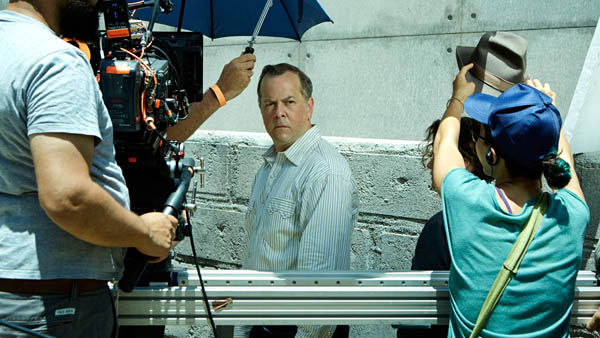
Kicking Television: EXCLUSIVE Behind-the-Scenes Look at the USA Series DIG with Co-Star David Costabile

Kicking Television: EXCLUSIVE Behind-the-Scenes Look at the USA Series DIG with Co-Star David Costabile


In this
Indiewire exclusive, we go behind the scenes of the new USA series DIG with its co-star David Costabile (Suits, Breaking Bad, Damages). DIG,
from creators and executive producers Tim Kring (Heroes) and Gideon Raff (Homeland)
is the story of a murder in Jerusalem, but set against the backdrop of a much
larger mystery that takes viewers from Norway to New Mexico and into the
depths of the Holy Land. Costabile, recently praised
in this space
as an actor in need of a vehicle, plays Tad Billingham, a
deceptively charming author, TV personality, and leader of a cult who plays a
crucial role in the mystery.

The
series also stars Jason Isaacs (Awake),
Anne Heche (Save Me), Alison Sudol (A Fine Frenzy, Transparent), Richard E. Grant (Downton
Abbey
), Regina Taylor (The Unit),
Lauren Ambrose (Six Feet Under), Omar
Metwally (Non-Stop) and Ori Pfeffer (World War Z).

Anthony McCarten and the Art of Trying Harder: The Screenwriter of ‘The Theory of Everything’

Anthony McCarten and the Art of Trying Harder: The Screenwriter of ‘The Theory of Everything’

nullWriting a
film about one of the most brilliant men on earth can’t be an easy task. The Theory of Everything, though, not only showcases Stephen Hawking, but even more so his wife Jane. When I
sat down to chat with screenwriter Anthony McCarten, I wasn’t surprised that he
had a compassionate and introspective attitude towards every topic we
discussed. I thought, this man was made
for storytelling.
McCarten, though, was quick to stress just how much work
it requires: a theory Mr. Hawking might agree with himself. Telling the best
stories and revealing the most exciting secrets comes with the greatest
responsibility.


After McCarten and I discussed our favorite teahouses in
London–yes, he’s very British–we got down to his beginnings. “I started as a
journalist.” This is where McCarten first learned a little about writing. He
recalls the first story he ever wrote: “We used to put these stories in vacuum
cylinders, and they used to shoot across the room to the sub-editor.” He remembers
her, surrounded in clouds of smoke as she crossed out and filled in an array of
articles. “She wrote some stuff on it and she put it back in the vacuum
tube. I opened up the little cannister,
and it was all entirely crossed out, with just the words, ‘Try harder’.”

This stuck with McCarten. I point out how elusive that
statement can be. We’ve all heard it before, whether from our third-grade math
teacher or our adult boss. He specifies what it meant to him.

“Be more ambitious.
Do your homework. There’s no easy way around this. We live in an age of, what course can I sign up for and in 24 hours
become a screenwriter
?”

He’s got a point. But McCarten didn’t learn
screenwriting quick. He’s been in the business of writing for many years,
working also as a novelist and playwright. I brought up his most successful
play to date, Ladies Night. It had
eight sell-out national tours of Britain and has been translated into twelve
different languages. McCarten laughs, “It’s been everywhere! It’s been done on
an ice floe in Greenland!” He’s kidding: “No, but almost.” But
that success didn’t come until after he had a number of other plays produced.
He shrugs: “But no one went to them. Commercial success and quality are not
necessarily allied.”

He compares playwriting to his work as a screenwriter,
discussing that although plays are built upon dialogue, the two crafts aren’t
dissimilar. “It’s the same game, but it’s different tools from the toolbox.” McCarten does point out that he finds novel
writing is the most “meditative, most prayer like.” He’s
had the best experiences with screenplays when he’s allowed to also reach that peaceful state.
Luckily for McCarten, he’s developed a way to enter this meditative state regardless of location: “I was born to a very
large family, one of 7 kids, I grew up with carnivals and chaos all around me,
so I can write anywhere.” He wrote his last novel entirely on a dining car on a train
in Germany, enjoying the sounds of the car and people around him.

So, how did McCarten, who’s clearly already made a name for
himself in the British literary scene get involved with The Theory of Everything? As it turns out, winning the approval of
Jane Hawking wasn’t as easy as one may think. 

McCarten read Jane Hawking’s book, Traveling to Infinity: My Life with Stephen in 2004 and was already
“hyper-aware of Stephen Hawking and the dramatic potential of his story.” He
realized “this is God’s gift to a storyteller.” McCarten attributes that to the
uniqueness of Hawking. “When that voice comes out of the computer…. it’s the
voice of God himself! It has an enormous power.” A relationship story centered on
a man like this excited him.

“Love stories are all
about obstacles.”

Approaching Jane required some guts, more than just reaching
out to an editor or agent. “I had to do something more outlandish,” McCarten
reveals. “I stalked her!” He went to Cambridge and showed up at her door. Her publisher
had set up the appointment, but she had never met McCarten before. I had to know
what pitching Jane Hawking was like: “I sketched it out
roughly on the train. It was three movies in one. I wanted to give equal weight
to all those three threads.”

“I used a clumsy
image of a triple helix, of these three threads complementing each other. The
threads would be this one of a kind love story, with all the little unorthodox
changes in course. The second thread would be the physics that would tell us
something about the birth of time and the nature of time. The third element would
be the horror story of Stephen’s physical decline.”

This was his pitch, and McCarten is thankful the script never
changed much from his original idea. “I wanted the story of the career to be
just as important as the care. I wanted the woman’s story to be just as
important as that of the iconic man.” To his relief, Jane was convinced of his ideas,
enough to tell him to write a draft of the script. “That began the
process of me winning her trust.” 

Again, like the “try harder” goal, gaining someone’s trust
can be equally as abstract. How do you actually do it? McCarten reveals
that for him, gaining trust for a project means, “You prove it on paper. In the
end it’s not the pitch, it’s the work you produce.” When Jane finally read his
draft, she could tell that it wasn’t all talk. After that, McCarten and Jane started
to make progress. Up until then. McCarten explains that Jane’s autobiography
had been unflinching. “Some of the press in England can be a little malicious
and gave the book quite a hard time. They don’t want to hear that side of the
story. They don’t want to hear that it might have been hard work looking after
Stephen.” But for McCarten, that’s exactly the element of the story he wanted
to bring to life.

As McCarten got deeper into writing the script, and one
about a man he greatly admired, he admits, “It brought out the best in me. It
required nothing less than my best shot.” But his greatest worry wasn’t
capturing the Hawkings’ voices as much as it was that they would never be
heard. He wrote on the film for years without a guarantee it would be made.
“That was the scary thing. It would have been like a creative death or
something.” It would have been the script that slipped through his fingers.

Fortunately, it didn’t. Before we got to the details of
shooting the film, I had to know how McCarten crafted such a massive story. The
characters are just as complex as the concepts. Starting within his helix idea,
McCarten knew the beats in all three threads of the story. He carefully allowed
each thread, the love story, the science and the physical decline to naturally
weave together. ”It was really painterly in the approach, a little magenta, a
little bit of blue, a little bit of yellow and in the juxtaposition of these
elements, something else was born.” He found parallels between the expansion of
the universe and the growth of Hawking’s mind, “the black holes
being contractions of the universe and then his body collapsing. It was like
adding two chemicals together and getting a third reaction.”

These mirror images are prevalent in the film and powerful,
without being heavy-handed. Time is also something that connects all three
threads and serves as a throughline. “The theory of everything: another phrase for
that is the unifying principle, and the unifying principle of this whole entire
script is time. It’s implicit in his doctoral thesis in the beginning of it.”
Hawking, from the beginning, is living at a different speed, experiencing time
differently than the characters around him. “Although we’re very much
intellectually driven to look forward, the heart is a bit of a time traveler
and it’s just as alive in the past as it is in the present.” Upon a closer look,
time travel is even mentioned in the dialogue, Jane ascribing her love for
literature to it.

McCarten reveals that the concept of time travel was
implemented in more than just the dialogue. ”Everyone on the team tried to
embody it in their own way. I know that the cinematographer, Benoît
Delhomme, did a great job of finding cosmic elements that would, without
rupturing reality, give you a sense of timelessness.” He did so with lighting,
keeping a stronger light on Stephen because he was the sun. In the visual and
emotional language of the film, everyone orbited around him. McCarten laughs, “Everyone
was trying to dial up the inner poet.”

So much of the film did rely on the visuals, more so than
usual, given the protagonist is losing his capacity for words. Although
McCarten comes from a playwriting and novelist background, he was excited to
work on a project not so reliant on word play.

“I wanted to work
with the restrictions almost Stephen had, taking away the primary tool in my
toolbox which is dialogue and working with almost nothing.”

A scene with Stephen and Jane comes to my mind. He tells her
he’s moving to America and their marriage is basically ended. So much is communicated,
with such little speech. McCarten agrees that it’s one of the scenes he’s most
proud of. “By the end of the scene they’re no longer husband and wife, and to do
that with almost no words was one of the great challenges and joys of writing
this kind of material.” While developing that scene, he scraped away the
dialogue till there was almost none, having each word communicate multitudes. When
Jane says, “I have loved you,” it’s a single line that changes their entire
relationship so far.  McCarten knew that in
order to earn this moment, and have it prove effective, he had to plant the
seed early on. He began with Jane and Stephen as a “witty, young couple and at
the end almost incapable of movement. They would be the polar opposite of each
other. I thought that central architecture would be really fascinating to play
with and I thought, the less dialogue I use in the end, the greater the
dramatic reward.”

McCarten’s construction of the script and the characters is
indeed elegant. Still, I was curious where he
was in the story. Every writer leaves an imprint of themselves on any
project. At first, McCarten explained that it’s more that “in between the known
points, they’re like stars in the sky, there are these vast empty spaces, and
this is where you have to use poetic license.” 

“It’s distilled
through what I think is appropriate for them, but they’re not there to give me
the exact words. I call it inspired speculation.”

McCarten never had the guarantee that he would get it right,
that these inspired moments would prove affective. But when Jane Hawking saw
the film and said, “I feel like I’m floating on air” and Stephen sat through it
and his “nurse wipe[d] tears from his cheeks,” McCarten was relieved, having a
realization he must have done something right:
“95% of the dialogue is just my best shot at what they might have said!” He admits,  “That’s you, that’s
your personality. You can’t write a character more brilliant than yourself. It’s
just not physically possible.” He brings us back to where we began, with his
first piece as a journalist. Whatever he’s working on, whether sending it
through a vacuum tube to an editor or onto a screen in front of Jane and Stephen
Hawking, McCarten still repeats that phrase to himself,  “Try harder!”

Meredith Alloway is a Texas native and a freelance contributor for CraveOnline, Paste, Flaunt, and Complex Magazine. She is also Senior Editor at The Script
Lab. She writes for both TV and film and will always be an unabashed
Shakespeare nerd. @atwwalloway

Watch: A Video Essay on Werner Herzog’s View of Nature

Watch: A Video Essay on Werner Herzog’s View of Nature

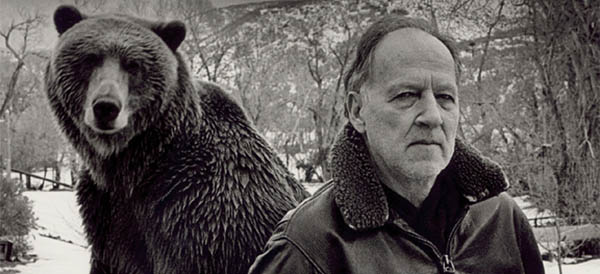
Peru, 1981. A moustached man appears mildly shaken against a jungle
background. His speaking voice reveals a German accent
and a hint of victimized violation as he spits out his diatribe: "Nature
here is vile and base. I wouldn’t see anything erotical (sic) here. I
would see fornication and asphyxiation and choking and fighting for
survival and… growing and… just rotting away." Such was my first
introduction into the world of Werner Herzog, a director whose aesthetic
I always assumed was that of the German nihilist to Terrence Malick’s
evangelical Christian, the way of nature versus the way of grace–the
thesis of my pitch for this very montage. Indeed, Herzog makes his views
on nature clear via voiceover narration, asserting that "the common
denominator of the universe is not harmony, but chaos, hostility, and
murder." What surprised me in marathoning his filmography was finding
the similarities to Malick, not the differences. The sun-kissed lens
flare, the close-ups of insects, even an overlapping playlist of
classical music would cause anyone to (at least momentarily) mistake the
two filmmakers. And ultimately, both share the common denominator of
their central theme that man is hubristic to believe that he can conquer
nature, but where Malick finds serenity in that surrender, Herzog finds
madness and destruction. This more cautionary admiration for the likes
of Timothy Treadwell, Brian Sweeney Fitzgerald, or suicidal penguins is
essential not only to his films (a more romantic version of Grizzly Man
could be one of the most dangerous films ever made), but also his own
sanity; only a person with a very grounded sense of self-preservation
could survive Klaus Kinski for more than one film. Through the jungle of
chaos, hostility and murder, Herzog ultimately emerges a humanist, for
when he praises Treadwell’s footage of animals unintentionally revealing
a look into ourselves, he might as well be talking about himself as a
filmmaker. Our hunger of violence and revenge in Into the Abyss, our need to research and document as a way of understanding our place in the universe in Encounters at the end of the World, and our inevitable desire for storytelling found in the cave paintings of Cave of Forgotten Dreams
are just a sampling of a much larger tapestry Herzog weaves in his
search for reason in the chaos of our decisions and the consequences,
which ultimately are the greater threats than nature. He admires
humanity, but against his better judgment.

Serena Bramble is a film editor whose
montage skills are an end result of accumulated years of movie-watching
and loving. Serena is a graduate from the Teledramatic Arts and
Technology department at Cal State Monterey Bay. In addition to editing,
she also writes on her blog Brief Encounters of the Cinematic Kind.

KICKING TELEVISION: The ‘House, M.D.’ That Love Built

KICKING TELEVISION: The ‘House, M.D.’ That Love Built

nullI’m not very good at love. Now, in
the St. Valentine’s season, I’m lucky enough to be in love. She’s very patient.
She tolerates my idiosyncrasies and flaws. We’d like to get a dog. My folks dig
her. I’m not quite sure how many times I’ve been in love before. At least once.
Most likely two-and-a-half times. And once in high school, but that doesn’t
count. I suffer from acute loneliness, which often leads to binge television
watching. At least once every two years I revisit my favorite series: Lost, Friday Night Lights, West
Wing
. They stand in as replacements for love, for companionship. Lately, in
the throes of a new relationship, I have found less of a need to binge on
TV. But a few weeks ago, as I quickly flipped past Gilmore Girls as a Saturday night viewing option on NetFlix, I
stopped briefly on House, M.D. At one
time, it had been in my binge rotation. As an argument for the virtues of Rory
and Lorelai filled my periphery, I wondered how House fit into the mix. In the absence of love, Lost, Friday Night Lights, and West
Wing
all told some sort of love story. Jack and Kate. Small town America
and football. Aaron Sorkin and whimsical banter. But House seemed on the outside, counter to the affections of my
loneliness. And then it occurred to me, in an epiphanic moment of distant
wonder, that House is the greatest
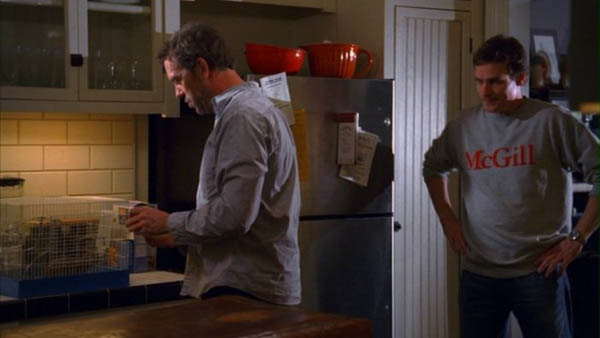
love story television has ever told. The love between Drs. Gregory House and
James Wilson, that is.

I’m not talking about the kind of
love you find in House fan fiction.
And I’m not talking about the kind of love that existed between Cameron
(Jennifer Morrison) and House (Hugh Laurie), a love born of daddy issues and a show’s attempt to create sexual tension. And I’m not talking about the Cuddy
(Lisa Edelstein) and House love, which always seemed contrived and formulaic. What existed between Laurie’s House and Robert Sean Leonard’s Wilson defied
the traditions of television which ran deeper and were more transcendent than Sam and Diane,
Ross and Rachel, Pepé Le Pew and Penelope Pussycat.  

Not unlike the love I have now, I
almost missed out on House. Just as
my partner and I briefly parted ways for superficial and ancillary reasons this
past December, I dismissed House as
typical serialized fare. It was ER with fewer characters. Hugh Laurie was
over-the-top. The guy from Dead Poet’s
Society
(Leonard) seemed under-used. The Australian was too pretty. And I
never liked Edelstein as an actress, particularly her underwhelming performance
as an escort on West Wing in all four
of my viewings of it. But like love, I gave House
a second chance, and I became enamoured by it. Maybe even obsessed. Dare say I
loved House, and all its
idiosyncrasies and flaws.

What drew me most to House was Laurie’s performance, and it
is indeed brilliant. Playing a drug-addicted and gifted diagnostician proved to
be a character for the ages.
His
Holmesian problem solving at first seemed too much in the tradition of Columbo, but Laurie made it feel
genuine, as the solution to the diagnosis fulfilled his character’s need more
so than that of the arc and narrative of the episode, counter to the traditions
of the genre and tropes of the procedural drama.  And Leonard’s Wilson was the Watson
to Laurie’s Holmes. But more than anything else on the show, I was drawn to the
extreme friendship between House and his oncologist conscience. It was the kind
of love between friends that simply isn’t shown on TV or in film, and certainly
not between men. According to the TV and film auteurs of today, all male friendships are
some form of bromance, or homoerotic exercise, or dudebro vehicle. Judd Apatow,
or Lethal Weapon, or Judd Apatow. On House,
we were treated to a love between men that I remember from home, from youth,
that I’ve missed in the transience of my adulthood, a kind of love that is
beyond sex and marriage and poetry and children and Christmas dinner and
minivans and mortgage rates and the new Keurig and Viagra and debt and
infidelity and data plans. This was a love story that aspired to more than what
the medium had ever attempted to offer before.

Every great love story revels in
the mythology of its origins. House and Wilson met as Romeo and Juliet did: at
a medical convention in New Orleans. Wilson started a bar fight in a bar after
Billy Joel’s "Leave A Tender Moment Alone" was played repeatedly by
another patron. Having witnessed the event, House posted Wilson’s bail and an undeniably real love was born.

In early seasons, Wilson enabled
House’s addictions and extremes. He writes, or allows House to forge,
prescriptions for Vicodin. He supports, or excuses, House’s alcoholic
tendencies, his affection for prostitutes, his acerbic wit. He indulges or
celebrates the oddity of House’s genius. Enabling is a form of love, as long as
it does not endanger anyone. Wilson always controlled his affections. He
managed House. He was his conscience, his sponsor, his moral center. And though
at times it bordered on burden, the friendship certainly wasn’t one-sided.

This love can best be seen in an
episode from Season 3, "Son of Coma Guy." House awakens a man (the
brilliant John Laroquette) from a coma, and he and Wilson take him to Atlantic
City for a last hurrah before the ultimate sleep. House has to euthanize the
man in order to preserve his organs and save his son. While Wilson’s morality
would never allow him to lead such an act, he supports House’s morality in providing an
alibi and advice on methodology. Love is unconditional in this way, and love on
television would rarely aspire to this form, a love so true it is literally
criminal. Joey would never have helped Dawson bury Pacey’s body.

This altruistic love continued
throughout the series. Wilson would manage House’s mania, take him to rehab,
comfort those bruised by his violent pathology. House provided the buttoned-up
Wilson with his freedom, his shy eccentricities, his inner manchild. From
adolescent pranks to monster trucks to binge drinking, House allowed Wilson to
be free to the confinements of his responsibilities. House saved Wilson from bad
relationships, from a life of stasis, and a lack of companionship. He paid a
child actor to pretend to be Wilson’s illegitimate son to provide the tangible
realization that kids are a hassle. Chandler would never do that for Joey.
Hell, he slept with Kathy.

In House’s final season, the roles between House and Wilson are
reversed when the oncologist is diagnosed with cancer. Suddenly, it is Wilson
who is embattled and prone to questionable decisions, who is faced with his
mortality the way House’s addictions continually forced him to. After failed
treatments (both traditional and experimental), Wilson is resigned to death,
something that House has never been able to consider as an option for his
patients. At this moment, House realizes he may lose his one true partner, his
one true love.
 

"You don’t have to just accept
this."

"Yes I do have to accept this. I
have five months to live. And you’re making me go this through this alone. I’m
pissed because I’m dying and it’s not fair and I need I need a friend. I need
to know that you’re there. I need you to tell me that my life was worthwhile
and I need you to tell me that you love me."

"No, I’m not going to tell you that
unless you fight."

If there has been a more true and
honest declaration of love on television, I have not seen it. Wilson’s affirmation
is a thesis statement of their relationship, and the essence of true love
itself. House’s inability to do exactly as his friend needs is in and of itself
an act of selflessness and love.

In the series final episode, House
has faked his death to escape jail so that they may spend the rest of Wilson’s
life together. The entire series had been built on the premise that House
needed the puzzle of diagnosis, the Holmesian existence, in order to live. It
was more to him than the Vicodin, or the pain, the Vicodin, or Cuddy,
or family. But in this final act, a final act of absolute love argues that the
series was not about House at all, but rather the long tale of a complicated
platony, and in more universal terms the human need for companionship above all
else.

And fittingly, astride their
motorcycles, leathered up in a wink of homoerotic wit, the two men drive off
into the sunset, to their final moments together, an epic nod to the iconic
fades into sunset.

Love is at its worst on television
and on Valentine’s Day. In these instances it is a caricature of itself. The
difference is that on TV the love portrayed is unattainable. On Valentine’s
it’s unrealistic. An overly sugared candy heart. A sitcom of emotion. Love on
television tends to be superficial, shallow, and simple. It is stained by the
inevitability of reconciliation, the false promise of happiness, and The Bachelor. What Wilson and House
shared eclipsed our hollow idea of love.

Mike Spry is a writer, editor, and columnist who has written for The
Toronto Star, Maisonneuve, and The Smoking Jacket, among
others, and contributes to MTV’s
 PLAY
with AJ
. He is the author of the poetry collection JACK (Snare
Books, 2008) and
Bourbon & Eventide (Invisible Publishing, 2014), the short story collection Distillery Songs (Insomniac Press,
2011), and the co-author of
Cheap Throat: The Diary of a Locked-Out
Hockey Player
(Found Press,
2013).
Follow him on Twitter @mdspry.

WATCH: The Shower Scene from Alfred Hitchcock’s ‘Psycho’: A Shot by Shot Analysis

WATCH: The Shower Scene from Alfred Hitchcock’s ‘Psycho’: A Shot by Shot Analysis

Try as you might, you’ll never entirely understand the shower scene from Alfred Hitchcock’s Psycho. And by understand, I mean grasp its technique: understand why Hitchcock made the choices he made, why he arranged images in the sequence he chose, why this scene seems, time after time, such a concentration of cinematic energy. You can poke and prod the scene, even map it out meticulously, as Lorenzo Gerbi has done in this excellent video essay–graphing it, monitoring the shifts in focus and the shifts in attenuation as the scene moves forward. And you will gain a certain kind of "understanding" from that activity. But you’ll never fully feel as if you’ve pinned it down, and, if the truth were told, the chances are good that Hitchcock himself would not be able to explain all the choices he made. As dangerous as it may be to make generalizations about creative works, it’s safe to say art doesn’t operate like that. The scene is a masterpiece of planning and deliberation, and as a result it is one of the most watched and talked-about scenes in the history of film. But it also maintains that status because lightning struck, and Hitchcock happened to be in the right place to absorb it, and he transformed his momentary electrocution into the transcendent sequence you can watch here.

Watch: A Video Essay About Sofia Coppola’s Dreamlike Aesthetic

Watch: A Video Essay About Sofia Coppola’s Dreamlike Aesthetic

What defines the Sofia Coppola aesthetic? Is it the sublime use of soft
and natural lighting? Is it the subtle pastels of the color pallet?
Maybe the handheld camera that dizzily floats around the characters?
All of these visual characteristics work together harmoniously to create
Coppola’s distinct dreamlike atmosphere. However, the aesthetic
reaches far beyond the idea of a visual trademark–Coppola’s atmosphere
seems to mirror the inner workings of her characters. As Charlotte
ponders a fully-realized life in Lost in Translation, the camera
stutters around her in a circular motion. She is washed away, her
clothing blending into the matching surroundings. In The Bling Ring,
the silhouetted bandits streak across the glittery horizon as they chase
their gaudy and tainted desires. In Marie Antoinette, the fanciful
nature shots portray a longing for freedom and self-fulfillment.
Coppola crafts these dreamscapes to show us not only who her characters
are, but who they want to be.

Watch: A Video Homage to David Cronenberg’s Unsettling and Rich Body of Work

Watch: A Video Homage to David Cronenberg’s Unsettling and Rich Body of Work

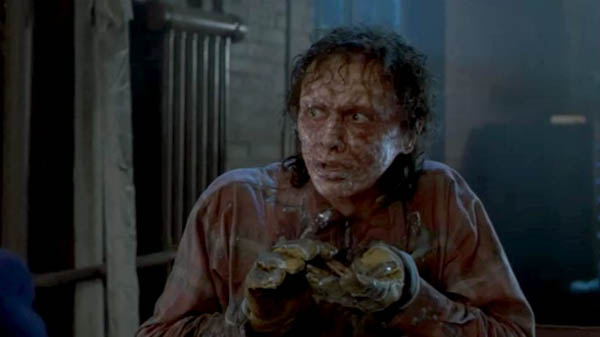
David Cronenberg’s work is analytical, eccentric, violent, and humane, all at once. It also has the power, when encountered at the right time, to make the viewer feel changed, transported, taken from one "place" in the mind to the other. Many years ago, I reviewed Naked Lunch and Steven Soderbergh’s Kafka back-to-back; I was startled to find, when I got home, a large cockroach in my bathtub. Had the film continued? Had I passed out? This piece by the prolific "Hello Wizard" flips us through 45-plus years of Cronenberg’s work at a fast clip. Throughout, you can feel the mixture of tones here, the blend of empathy, and horror, and panic, and mystification, and euphoria. When we see Jeff Goldblum late in his transformation stage into a fly, sure, we’re terrified–but we’re also sad. When a man’s face begins to rupture in Scanners, it’s difficult not to think of the special effects involved–but it’s also difficult not to think about what the face once looked like, and to try to read the emotions in the victim’s tortured features. Even in as sleek a film as Cosmopolis, the seeming coldness of the actors, their stylized slowness and blankness, read as mini-critiques, implied complaints, ultimately reminders of the humanity that could lie elsewhere. Cronenberg is a director to whom it is always exciting to return; he continues turning ideas over and over, always finding some new facet through which to view them.

WATCH: Fifty Shades of, Er-Hem, Steve Buscemi

WATCH: Fifty Shades of, Er-Hem, Steve Buscemi

Oh, why NOT? Sam Taylor-Johnson’s film adaptation, as you may have heard, of E.L. James’s Fifty Shades of Grey will be coming to American screens in almost no time (this Friday 2/13 in some cities), and in honor of its opening, Boo Ya Pictures has offered an alternative version, with a unique casting choice. Leather. Humiliation. Domination. Ecstasy. Steve Buscemi. Little more need be said: watch, and enjoy.

WATCH: How Nicolas Winding Refn’s ‘Bronson’ Turns the Prison Movie Genre on Its Head

WATCH: How Nicolas Winding Refn’s ‘Bronson’ Turns the Prison Movie Genre on Its Head

Although the primary charge in Nicolas Winding Refn’s Bronson derives from the electric performance of Tom Hardy, as one of Britain’s most violent criminals, the film builds on a number of sources. As this elegantly stated video essay by Jessie McGoff points out, directors from Jim Sheridan to Stanley Kubrick can be found inside this complex, alarming, surreal work. Refn, in this essayist’s estimation, rewrites the work of these ancestors, not so much exploiting them as putting a new face on them. And, in so doing, Refn updates our conception of the "prison film," a genre which one would think had run out of potential.