The Double Life of James and Juliette: Mysteries and Perceptions in Kiarostami's Certified Copy from Peter Labuza on Vimeo.
Narration:
 The newest film from Iranian director Abbas Kiarostami, Certified Copy, is a complete and total enigma. Many films pose mysteries at their centers, including detective stories, thrillers with multiple twists, and now often art films that pose ambiguous endings. But Certified Copy emerges as something of a different order, because it challenges the spectator to explore the mystery yet never come to any particular solution. But by examining the clues Kiarostami gives us, we, the audience, can understand the philosophical ideas of what our answers may suggest.
If you haven't seen the film, I should note that this essay will include spoilers, which is unavailable on DVD in the United States but now on Netflix Instant. That actually includes people who have actually seen Certified Copy, as there's much that one may miss a first and even a seconding viewing, a testament to the art of Kiarostami.
Certified Copy follows an art philosopher named James Miller, played by William Shimell and an unnamed character played by Juliette Binoche, only known as "She" in the credits. For simplicity sake, I'll be referring to the character as Binoche. The two strangers meet after he gives a lecture, and walk around a small Tuscan village without much of an agenda. But suddenly the film seems to switch – these are no longer strangers, but a married couple struggling through the day after their fifteenth wedding anniversary.
Kiarostami has said in interviews that there is no direct answer to whether the two protagonists had a previous relationship or not. However, that doesn't mean we shouldn't search for the clues to answer it. Certified Copy is one of those rare films that ties its emotional stakes to its philosophical stakes. If we believe one solution, it means we must assume some proposition about the nature of art that James discusses in his book. At the core of Certified Copy is Kiarostami's own philosophical proposition, explained by James in his opening lecture:
What I want to do is discuss here are three theories related to the film and its central mystery, and explore how Kiarostami hints at them with visual details, the use of particular dialogue (including the delivery of that dialogue), and the metatextual elements of the film, a crucial key in many of Kiarostami's films.
There's a particular turning point in Certified Copy where we realize the film we thought were watching completely turns into something different. While sitting in a café, the owner begins talking with Binoche while James is away.
Binoche tells this to James, who does not dispute.
It is after they leave this café where the movie changes from something more reminiscent of Before Sunrise to something much more dramatic.
James and Binoche stop acting like strangers having a somewhat awkward first date, and begin to act like they've known each other for years. My theory here is that both parties have never met, but Binoche wants to test James. Earlier in the film, we learn that she disagrees with certain points from James's book on the idea of whether a copy can be just as authentic as the original. So Binoche's game is this: If James and her can recreate the emotions of a real couple, and make their drama as authentic as any other, then he wins, so to say.
The question here, however, is who is this game being played for. But Kiarostami presents the answer quite simply.
Us.
We are the judges in Certified Copy, and Binoche directly challenges us. I started to notice this when James and Binoche first sit down at the café. She's staring directly at us, and while Kiarostami gives us her point of view of James, he does not do the same. His look is just off center, and thus that intense connection we get with Binoche through her eyes, we never feel with James.
 This puts us in the position of James, who always seems to be one step behind in keeping up in his role as "husband." He doesn't remember the events that Binoche seems utterly convinced of, and she seems to have the whole scheme planned, trying to lead him on to as many details as possible.
This also brings up the nature of casting in film. Binoche is an international superstar, so big that the year Certified Copy premiered at the Cannes Film Festival, it was her face on the festival's poster. But Shimell, who gives a remarkable performance, is someone we don't recognize at all, something he actually comments on at the beginning of the film.
His origins are in the British opera, so for most audiences, it is easier to identify with him as an unknown, especially given that he has a name, James, while she remains to us as simply Binoche, an actress giving a performance on top of a performance. If we consider what an actor is supposed to do, his or her job is to copy the emotions of life and present them on screen. And thus, Binoche does exactly that, whether it is her, the actress, or the character pretending to be someone else.
In fact, much of the film's background feels like copies upon copies. The streets seem to mimic each other; the cypresses that line the drive to the town. And then there's the case of weddings. As soon as we arrive in the town, we see bride…
After bride…
After bride…
After bride.
Kiarostami has chosen marriage and weddings as a running background theme in Certified Copy not just because of the emotional stakes that weddings suggest, but the idea of marriage as a sacred ritual that is supposed to be a one-time event.
Kiarostami plays with this during one of the film's masterful shots, as a couple pleads with James to be in their wedding photo, having believed that Binoche and him took a similar photo fifteen years ago.
James initially resists, but he soon gives in, and Kiarostami makes a masterstroke by showing another bride lining up, the woman already tearing up over the importance of this event. Weddings thus become copies among copies, each a fleeting moment in the lens of Kiarostami, and an essential reminder that traditions themselves are copies of events from the past, but none are ever given less value.
As the weddings remind us of the joy of marriage, our two protagonists act out their fifteen years of strife and turmoil, trying to discover what went wrong. The two bring up stories to challenge the other – his choice to never be around, her lack of understanding for his situation. Kiarostami constantly brings us closer to the more intimate into the details of their relationship. As they try to cross boundaries, so do we.
One of the major keys is a discussion James has with a French man, who suggests that James simply approach Binoche from the side, and put his arm around her. Doing this action is of course nothing original, but when we see James do it.
Can we really say we don't feel it emotionally? Kiarostami makes this moment a literal bridge as they pass by a tree. Where they were once separate, they are now together. Their emotions may not be authentic, but from our perspective, they certainly are.
When James and Binoche first meet, the two seem like amicable strangers. Why they are meeting, we don't exactly know, but everything seems perfectly fine. As they drive in the car and begin to talk, Kiarostami pulls this in all one straight single take. And then…
This precise cut shows the breaking of a boundary, not only between James and Binoche, but us, the audience, and them. There's also is something curious about Binoche's performance here, a sudden desperation in her voice, a worry not present before. We see the first crack in her armor, perhaps of a secret she's not ready to reveal.
 So what I'm suggesting in this theory is that the illusion of the copy is not what comes during the second half of the film, but what comes from the first half. What appears as illusion or just a game may actually be truth, and their pretend date is actually a copy of perhaps a date fifteen years ago.
The crucial point comes right before the moment that changed the narrative. James tells a story about seeing a son following 50 feet behind her mother. It doesn't seem to have any particular relevance, but then Binoche changes the stakes through one line of dialogue.
To even many diligent viewers, this may seem like a odd story for Binoche to tear up at, especially given that we, the audience, don't necessarily understand the circumstances of the situation. However, it was on my third viewing that I noticed something that changed how I read this scene. It's right after Binoche and her son leave the lecture to go get food…
The story that James tells could be coincide, or perhaps, a copy that Binoche responds to, but this seems to be too sensitive of a detail, too shocking of a memory to recall, to simply be a story.
And thus, it is this spark that allows the two to finally admit to their true selves, or some version of it. Consider how the film uses different languages. Kiarostami is of course an Iranian director, and this is his first narrative feature film outside his home country. As a European production – financed mostly by France, shot in Italy, with a cast of one Englishman and one French national – Kiarostami uses different languages throughout the film to clue us in. For the first part of the film, James and Binoche only speak English to each other. Later, when talking to the owner of café, Binoche remarks on his lingual abilities…
However, when the "game" begins, so to say, James decides to switch his linguistic tendencies.
We could simply believe that James is playing along, making stories as quickly as she is, and the two are working together to form a fabricated history. But there's one detail that proved for me this cannot be the case. It deals with James's facial hair, which comes up at the café.
And then again near the end of the film.
Kiarostami relays this important moment while striking an essential visual clue with his characters. As Binoche rests her head on James, we immediately hearken back to their previous discussion about a statue of a man protecting a woman, who laid her head on his shoulder just the same.
If they replicate this statue, do the feelings thus translate between the original work of art and the humans imitating the pose? Because, of course, the artwork itself is an imitation of a gesture the artist of the sculpture must have seen. And thus, the dilemma continues…
 To say Kiarostami made Certified Copy without an answer in mind is a little bit of a constructive lie. I think the director has built a film that allows us to believe whatever answer we want. This deals with Kiarostami's real theme of the film – the nature and role of perception.
This brings me to my third theory, which is something of a strange mixture between the two previous ones. If we begin to think about answering the mystery, there are issues we can take with both theories.
Obviously, if James has lied about knowing French and can recall specific details of their relationship, he is certainly no stranger.
However, if Binoche's son has no idea who James is, when he should clearly know his father as the story suggests, then the two can't be the married couple they pretend to be.
Plus, James argues with the role himself…
There is a third option, however – one bizarre but worth proposing. It returns us to the moment on the piazza that has inspired James's book.
James explicitly says that it was five years ago. If they've been married for fifteen, why did this story take place five years ago?
References to five years ago keep coming up and up. My suggestion is this: James certainly knows Binoche, not from their marriage, but being a close friend and perhaps lover that she has hidden over the last five years. So, why the game?
The first part is to stay secret while in a town where someone may recognize the two together, but I think Binoche is interested in creating a copy. Binoche's husband is obviously absent, not only physically, but also emotionally as well. The town she takes James to might be the one she was married at, but she hopes to make a copy of her anniversary, using the man she truly loves, James, instead of her husband.
This theory, tenuous at best, does seem to explain a lot of issues. It proves why James is ambivalent about taking the picture with the couple. Or why he can't recall the hotel they stay at for their wedding night.
It also answers why he knows so many intimate details about the relationship between Binoche and her husband. Perhaps he was a best man at their wedding.
This theory, and all the theories really, get to the meaning of what Kiarostami really wants to talk about when discussing art: its really all about perception.
This is an issue that James and Binoche discuss at length. It comes up when Binoche takes James to a small museum that holds a copy of a painting that they continue to cherish as much as they did when they thought it was an authentic original.
James and Binoche not only discuss this theory as related to art, but in personal and human connection.
 Each person in Certified Copy is obsessed with perception. During the sequence in which Binoche tries on the different earrings and makeup in the mirror, she is considering the perception of what James will think of her. She is still the same person, but the different lipsticks and earrings may change how he sees her.
Perception is also a theme that has appeared in many of the works of Kiarostami. In Taste of Cherry, a man who plans on committing suicide, for no reason told to the audience, receives three different answers to why he, or any man, should live. In Close-Up, Kiarostami makes a fake documentary about a man who pretends to be a famous Iranian director. When he is asked in court whether he is acting because there are cameras there, the man tells us "I'm speaking of my suffering, that is not acting." Perhaps, but that's only one perception.
And it is perception that will change how we look at James and Binoche, and whether they've been married or not. This is what Certified Copy is truly about. It's not what the art is, it's how we, the audience, view it. Which is why Kiarostami's film is so open to many different interpretation. However we want to view the film – based on our emotions, our intellect, our philosophy – will create a different picture for us.
In the final moments of Certified Copy, James finally looks at us in the camera. He stares into the mirror the same way Binoche has the entire film. What does he think? What do we think? When he leaves the frame, we see the church bells, but through the frame of the window. If we perceive it through the frame does that change our perception? Kiarostami's beauty as a filmmaker is that he never gives complete answers – he has been quoted as saying that he removes elements from his films, and it is up to the audience to finish the film for him. In this essay, I've tried to complete some of those gaps, but anyone can do so, and create a completely different film. After all, it is how you perceive the object, not what the object truly is.
Peter Labuza is a film writer in New York City originally from Minnesota. He was the former film editor for the Columbia Daily Spectator and has contributed pieces for the CUArts Blog, Film Matters, and MNDialog. He plans to attend graduate school and focus on the history of American film genres. He currently blogs about film at www.labuzamovies.com, where this article was cross-posted. You can also follow him on Twitter.


 A disgraced journalist, Mikael Blomkvist (Daniel Craig), is called to the home of aging magnate Henrik Vanger (Christopher Plummer) to investigate an ancient crime in the magnate's family — the disappearance and presumed death of Vanger's niece, Harriet, decades ago. Parked in a drafty cabin on the island where many of the Vangers still live (and back-bite), Blomkvist looks into the locked-room mystery, and as matters become more complex, he requires a research assistant — the same researcher, it turns out, who dug into him at Henrik Vanger's request. This researcher is, of course, the eponymous Girl, Lisbeth Salander (Rooney Mara): pierced, bony, rendered by turns mute and blunt by traumas past and present.
 I should warn you now that I'm one of Those Zodiac Cultists who bangs on about how the Academy jobbed that movie, Downey is awesome in it, blah blah blah, and I'll skip the bulk of the harangue, but that film showcases what I liked about Dragon Tattoo: the little moments in longtime/working relationships. Fincher's good with a credits sequence (Panic Room) and good with a tricksy time lapse (Zodiac), he varies his shots in their angles and lengths and his cutting team keeps things interesting and on pace. But my favorite Fincher thing is how he lets his actors work with each other, letting gallows humor percolate up, waiting for that exchanged eye-roll. There's an understanding that the characters have interior lives, opinions about sushi and double-parking, entirely outside of the film's plot. Some of that proceeds from the scripting, obviously, but it's seldom the same writer on each movie, and that wouldn't explain the seemingly uniform respect the films have for the partnership vibe. Nobody gets better play on an actor's face when his/her character is struggling not to call a higher-up a fucking moron than David Fincher. Probably not what he wants on his tombstone, but it's nice for Rooney Mara under the circumstances.

 Anyone but Hardy, really. To be fair, The Wicker Tree’s script, which Hardy also adapted, is pretty sharp. He capably evokes the main ideas and wryly cynical sense of humor that makes Cowboys for Christ so entertaining. (Christopher Lee, who starred in the original Wicker Man and has a cameo in The Wicker Tree, heartily endorsed the book by saying, “It's comic, romantic, sexy but also horrific enough to melt the bowels of a bronze statue.”) But as a director, Hardy hasn’t improved drastically in the intervening four decades between The Wicker Man and The Wicker Tree. If there’s anything holding The Wicker Tree back from being the adaptation Hardy’s charmingly mean-spirited source material deserves, it’s unfortunately Hardy.
 Beth Boothby (Brittania Nicol) is a Texan pop star that used to sing empty-headed, salacious pop songs and now performs Christian-themed country music. Together with Steve (Henry Garrett), her cowboy boyfriend, Beth sets out to convert the residents of Tressock, Scotland to Christianity. This makes Beth and Steve prime targets for the sardonic Sir Lachlan Morrison (Graham McTavish) and his wife Delia (Jacqueline Leonardas), community leaders that are more bemused than off-put by the Americans’ arrival. To Lachlan and Delia, the two missionaries are unexpected but not entirely unpleasant additions to their May Day festivities: Beth will be their Queen of the May and Steve will be their Laddie.
 Likewise, Beth wants to turn her back on her past as a randy sex object and focus on her current position as a symbol of Christian piety. But the fact that she acknowledges that she willingly objectified herself in the past suggests that Beth’s also adept at role-playing. It’s fitting then that the character that bridges the ideological gap between Lachlan and Beth is Lolly (Honeysuckle Weeks), a nymphomaniac that has sex with whomever Lachlan tells her to—for the good of their community.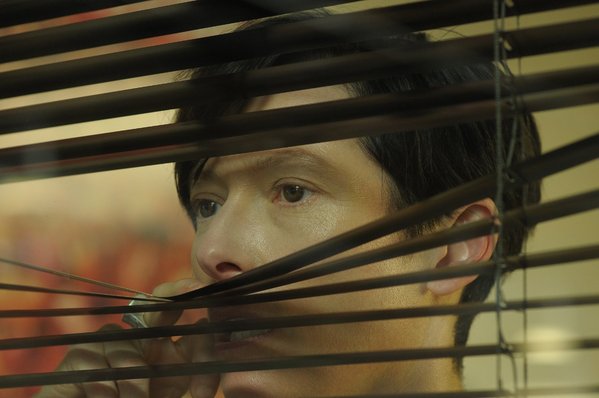
 Nothing gets a horror fan more ticked off than a director with airs claiming her new film isn’t
  Ramsay’s film fascinates like Goldfrapp’s radical, downcast remix of Lady Gaga’s “Judas” fascinates: as a remix more than an adaptation. Goldfrapp took Gaga’s pop-club banger, cut it to half time and deconstructed it to almost unrecognizable effect. It was creepy, scary, strange, way cool, but not a touch on the original, and is ultimately mainly interesting in relation to its source. In a similar way,
  In the book, which is told as a series of letters to her all-American/Republican husband Franklin (played in the film by John C. Reilly as a generic Dad), we meet Eva, a pushing-40, self-centered, unbearably obnoxious Manhattan woman who probably reads Mary Gaitskill,
  In the book, the tone and mode and Eva herself flip on a dime, and everything becomes
  The book’s grandest achievement is how it both accuses Eva as complicit in making a monster and then forgives her; how it takes a thoroughly unlikeable woman and evolves her into someone with a hard self-awareness we have to respect. The film? Ultimately, we’re back to the remix analogy, but without Goldfrapp’s unity of purpose – even if there isn’t much of one.
 Deal is, I always thought the New Wave was about deleting excess syntax so you could get to the heart of cinema. Ramsay uses some of its disjunctive tropes brilliantly so she never has to commit to anything but Swinton’s pursed grimace.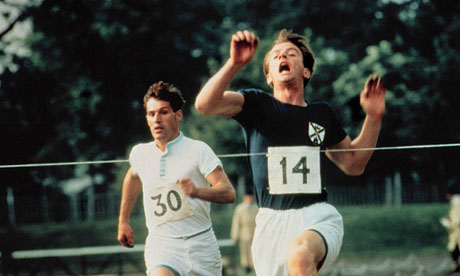

 A turning point for Abrahams comes when he watches Liddell run. Not only does he see that his unbroken winning streak can be threatened by the awkward but fast Liddell, but he also meets Sam Massabini (Ian Holm), a professional track coach who has tried unsuccessfully to recruit Liddell. Abrahams persuades Massabini to come see him run, and Massabini agrees to coach him, an arrangement that displeases two Cambridge dons (Sir John Gielgud and Lindsay Anderson) with a strong commitment to the notion of amateurism. Abrahams ignores their protest, gives them a tongue lashing for trying to impede progress, and starts to train for the Olympics with Massabini, who becomes something of a surrogate father to him.
 Chariots of Fire takes few liberties with the facts, but screenwriter Colin Welland and director Hugh Hudson arrange them in such a way as to make the underlying story a conflict between mortal men and God. Indeed, the very title of the film quotes from a very pertinent book of the Torah,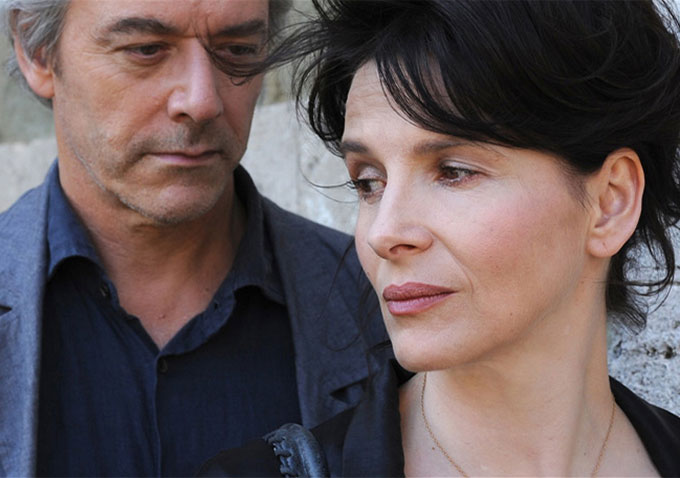


 I actually never saw the infernal arm-wrestling Stallone movie from the '80s, although I saw the hateful Kenny Loggins video from same approximately 17,000 times — but I'm pretty sure Real Steel is the same shit (but with, you know, robot boxing). Robot-boxing impresario/dillweed Charlie (Hugh Jackman) is down on his luck and behind on his rent when he finds out that an ex-girlfriend has died, leaving him in custody of a son, Max, he's never seen (Dakota Koyo). The ex's sister, Debra (Hope Davis), wants t– you know what, who cares. Robots box; the flimsy backstory excuse for Jackman to develop those magnificently ridonk biceps is totally justified; everything works out.


 Four years and a $18 million worth of Paramount's money later, Spielberg and Lucas released Raiders of the Lost Ark, featuring up-and-coming action hero Harrison Ford — Han Solo in Lucas' Star Wars franchise — as the whip-cracking archaeology professor trying to keep the Lost Ark of the Covenant out of Hitler's hands. As scripted by Lawrence Kasdan, who rewrote the Star Wars sequel The Empire Strikes Back, Indy was a rumpled, unshaven, refreshingly human hero, surly but decent, less like a Bond-style sexy sociopath than a Gary Cooper character in a bad mood. The combination of Ford's casual fearlessness, Lucas' gee-whiz sensibility, Spielberg's kinetic precision and costar Karen Allen's tomboy sass made the film into the year's biggest hit, a sleeper that rolled into multiplexes opposite Superman II and the latest James Bond entry For Your Eyes Only and stole their box office thunder. Raiders grossed $209 million in North America and took the "So popular that we can't ignore it" spot in the following year's Best Picture lineup. It also inspired knockoffs, including the network TV series Tales of the Gold Monkey and Bring 'Em Back Alive and the movies High Road to China, Romancing the Stone and The Jewel of the Nile.
  Spielberg didn't stint on the violent action; this was probably one the first PG movies in which a lone hero singlehandedly and bloodily eliminated scores of foes, and definitely the first in which the power of God made Nazis' heads melt, implode and detonate, spewing meat chunks into the camera. Three summers later, the even more extreme violence of Indiana Jones and the Temple of Doom and the Spielberg-produced Gremlins
  Raiders was a career-redefining entry on the resumes of its major players. Ford stepped into the lead after CBS refused to release the filmmakers' first choice, Magnum, P.I. star Tom Selleck, from his TV contract, and proved he could sell tickets without a laser pistol in his hand; the film's success marked the start of a 20-year run as one of Hollywood's highest-paid actors. Ford's regular employer Lucas showed the studios that he wasn't just the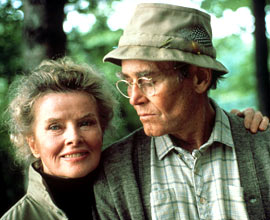
 At the time of the Academy Awards, the film's box office take was closing in on $80 million. It was obviously hitting a chord with audiences, but the critical response was mixed at best. The positive notices seemed to be written under duress. The rest of the mixed-to-negative reviews rang of hardened resistance to being moved at the sight of two old geezers puttering about and saying the damnedest things. (I know one critic who at the time referred to the movie as On Golden Shower.) Some critics and younger film buffs scoffed at a movie they perceived as appealing to middlebrow tastes – i.e., conservative older moviegoers who probably say things like, “Why don’t they make more movies like that?” On Golden Pond was one of the first big Reagan-era dramas, the anti-Ordinary People. The pairing of
  If you didn’t know the movie was based on a play it wasn't hard to figure out, and not just because the story takes place in and around one location.
  (Watching Henry Fonda in On Golden Pond, I was struck at how son Peter Fonda’s career-capping performance in Ulee’s Gold is like the dark side of Norman Thayer; the younger Fonda is playing both his dad and Ulee Jackson.)
 Jane Fonda’s interactions with Hepburn and her father demonstrate her skill at being able to adapt to differing acting styles. Her scenes with Hepburn have a loose give-and-take feel. There’s a remarkable scene where mother and daughter go skinny-dipping at night. Seeing their heads poking above the water at night, we register that it is possible Jane could be the offspring of these two. Her sharp features and her quivering, clipped voice are just right. Her big scene with her father is one for the time capsule. The way her Strasberg-training acting style and his do-it-as-rehearsed strictness rub against each other beautifully illustrates the generational gap they are trying to close. The elder Fonda hated improvisation. He felt there was no need to change what was already on the page. This leads to a fleeting moment where the real world comes crashing into the movie. Chelsea tells Norman she wants to be his friend. When the camera switches to Henry Fonda’s side of the scene, Jane/Chelsea improvises a gesture and puts her hand on his arm. (You’ll miss it if you’re not looking for it.) This bit of business was not rehearsed and startled the elder Fonda. His fleeting reaction to this moment of affection is real. You see him turn, almost embarrassed by the intimacy of the moment. At the end of the movie, when Chelsea, who always refers to her father as “Norman,” calls him “Dad,” we can no longer separate the characters’ quiet acknowledgement of their love from seeing Jane and Henry finally connect with one another.
 Press Play Video Blog