VIDEO: All the Animals Come Out at Night: WALT DISNEY’S TAXI DRIVER

VIDEO: All the Animals Come Out at Night: WALT DISNEY’S TAXI DRIVER

nullBryan Boyce's brilliant short film "Walt Disney's Taxi Driver" cherry-picks scenes between psychotic cabbie Travis Bickle and his love object Betsy in Taxi Driver, but substitutes Disney imagery for Travis' obsession with urban decay. This is a masterstroke: not a gimmick, but a flourish. Much writing on Taxi Driver tends to situate the film within its era, and fixate on certain details established by director Martin Scorsese, screenwriter Paul Schrader and star Robert DeNiro: specifically Travis' traumatic experience in Vietnam and his culturally reactionary response to seedy New York circa 1976. Part of what makes "Walt Disney's Taxi Driver" so wonderful is the way that it lifts Travis' character out of context without actually losing the context, so that you can see him more clearly as a literary creation, and recognize that his mania is adaptable and timeless. The 1976 New York setting turns out to be important in this mash-up, but not until the very end. The first part of the video disentangles Travis from his world, lifts him out of the muck (and the almost purely subjective structure of Scorsese's film) so you can get a better look at him. When it returns him to his context, Boyce's short becomes a cinematic time machine, connecting Travis' past and our present. Watch it here:

The first time we see Betsy through Travis' eyes, she's got an animated bird on her arm, which effectively transforms the "angel" Travis describes in voice-over into a Disney princess (same difference, given how asexual Travis is). When Travis takes Betsy to the movies, it's to see Disney cartoons instead of porn. But while the marquee advertises Lady and the Tramp and "Steamboat Willie" as "Explicit! Provocative!", when Travis and Betsy look at the screen we're watching unaltered Mickey Mouse. The images seem faintly sexual only because they've been inserted (heh) into Taxi Driver. Yet the sense of Travis as a tone-deaf, maybe socially autistic misfit still shines through. He's taking a sleepy-eyed bombshell to see G-rated cartoons on their first date? It's not exactly a romantic mood-enhancer. When Betsy shifts uncomfortably in her seat, her reaction now seems to have less to do with the content onscreen than the fact that Travis chose a film program that was of interest only to him. Suddenly the scene isn't about sickness, but how casual narcissism can prevent two people from connecting. "I don't know why I came in here," she says, storming out of the theater with Travis in pursuit. "I don't like these movies!"

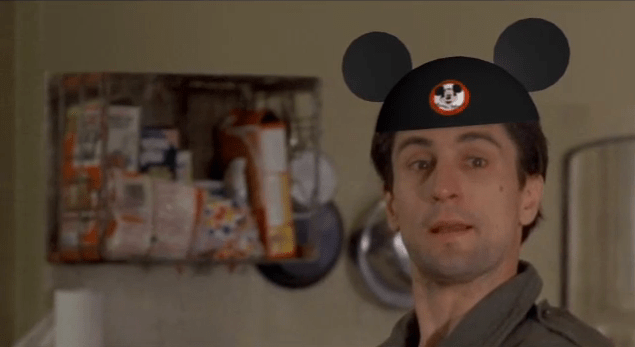
The piece builds to a giddy, surreal climax, inserting Disney creatures into Travis' "All the animals come out at night" monologue and superimposing a Mickey Mouse Club cap on Travis during his "You talking to me?" rant (that it's clearly animated makes it seem like Travis' unhinged projection). The  asexual, paranoid, controlling traits exhibited by Travis in Scorsese's original movie manifest themselves differently here, but they're alternate versions of the same urges. When Boyce replaces a 1976 object of Travis' ire, couples dancing sensuously on American Bandstand, with the parting theme of The Mickey Mouse Club ("'C' ya real soon!'), it confims that the Disney imagery is all in Travis' head — an aspect of this Travis' pre-sexual, childlike fantasy of cleanness that's different from, but connected to, the original film's fantasy of bloody, righteous cleansing. The filmmaker mucks with Taxi Driver's famous final shot of Travis glancing at himself in the rearview mirror, then slapping the mirror away to avert his own gaze. In this version, Boyce replaces Times Square circa '76 with a composited, modern Times Square that literally been Disneyfied: made bright and cheerful, harmless. It's a genius embellishment that connects present-day megacorporate dominance of Manhattan (and urban life in general) with mid-'70s Silent Majority resentment. The world we live in now is the one that Joe the construction worker, Archie Bunker and other '60s and '70s symbols of conservative disquiet dreamed of; once it became clear there was money to be made in catering to them, their wishes upon stars came true. The Disneyfied Times Square means Travis Bickle won. A real rain came and washed all the scum off the streets: a rain of money.

VIDEO ESSAY: BLACK SUNDAY: Three Reasons for Criterion Consideration

VIDEO ESSAY: Burton versus Bava

Just as people ultimately judge a book by its cover, many of us are quick to judge a film by its trailer.  When I was asked to set my sights on Tim Burton's upcoming Dark Shadows, a movie based on the cult TV show of the late 1960s, as my next entry point for Criterion Consideration, I immediately knew where my judgment would most likely fall. I might find it hard to veil my contempt for Burton's recent work. His early films had a profound impact on my childhood and may very well be responsible for who I am today, but as I became an adult Burton began rewriting the rest of my childhood in ways that make me confused and horrified. Remaking the classic films from my youth, Burton has me questioning my admiration. Also, with the upcoming release of his animated Frankenweenie, Burton has begun remaking himself. We could list his later films and describe how the themes and storylines are still consistent with his earlier work, so maybe I just grew out of him. Now, every time I see one of his films, I end up screaming at the screen, vowing never to see the next Tim Burton film. Still, I cannot deny that his films are intriguing, innovative, and entertaining, if not infuriating. In his collaborations with Johnny Depp, Burton has given us classics likeEdward Scissorhands and Ed Wood, capturing some of the finest performances from Depp in eight films thus far, but I wish that Johnny would begin to show more discretion. Shilling for Burton in promotional videos, Johnny admits to instigating him to collaborate on "a vampire film," citing the classics of German Expressionism, Universal Horror films from the 1930s, and the Hammer Studio films as an influence for this new adaptation. Thankfully all those classics of cinema are thrown into the meaningless mess of Dark Shadows. Sporting the worst make-up job since Alice in Wonderland, Depp's Barnabas Collins struts in front of the living legends of horror cinema, including a direct (slap in the) face-to-face cameo with Jonathan Frid (who played the original character on the TV show). Even before I saw the trailer for Dark Shadows, I knew there would most likely be a nod to Mario Bava's first film, Black Sunday (or The Mask of Satan from its original title La maschera del demonio). Burton has been vocal about Bava's influence, and over a decade ago there were rumors that he would remake Black Sunday. That never exactly came to be, but Burton did evoke a lot from the film for his adaptation of Sleepy Hollow, which unmistakably borrows Bava's visual style. 

One of the most important directors in the horror genre, Mario Bava began his career as a cinematographer for Roberto Rossellini during the Italian Neo-Realist movement.  He first learned the tools of the trade from his father Eugenio Bava, who was an expert on special effects and also a cameraman.  Mario then was contracted by Galatea Studios, where his skills as a photographer, as well as his ability to work quickly and efficiently, would bring many of the studio’s films to life with stunning chiaroscuro. His films always show a deep understanding of the history of the horror genre, with its strange settings and eerie environments, and a weird and wonderful worldview that would become Bava's trademark style. That style would later influence many notable directors, such as Ridley Scott (Alien), Joe Dante (The Howling), and Burton himself, in Sleepy Hollow. In the late 50s, Bava would have to complete principle photography for Riccardo Freda, who abandoned his directorial duties on I Vampiri (Lust of the Vampire) because of the tight shooting schedule. Bava would do the same thing again with Freda's Caltiki, The Immortal Monster in 1959. To show his gratitude, Galatea's producer, Lionello Santi, allowed Bava to choose his (official) directorial debut, which was the adaptation of Nikolai Gogol's short story The Vij. While evoking the traditional story of witchcraft and vampirism at the heart of Gogol’s tale, Bava simultaneously paid his respect to the classic Universal Studios' horror films and the (then) contemporary Hammer Horror films with Christopher Lee and Peter Cushing.   Black Sunday relies heavily on the pantheon of 1930's horror, while including the eroticism and gimmicky gore of the new horror wave, creating one of the most beautiful and disturbing horror films of all time.

The film begins with a prologue, describing the superstitious tradition that one day in every century, Satan is allowed to walk the Earth, and his evil disciples can haunt and torment their descendants.  We are introduced to Princess Asa (Barbara Steele, a dead-ringer for Tim Burton's old muse, Lisa Marie) and her lover Javutich (Arturo Dominici) while they are standing trial by the Inquisition for acts of Satan worship and witchcraft.  Asa is branded with the mark of a witch, before having the iron mask of Satan nailed to her face.  Such a gruesome beginning was a standard shock tactic of the time, to keep audiences hooked from the start, but this particular opening was considered so shocking that the British Film Board banned the film for seven years after its release.  Before Princess Asa is put to rest, she vows to return from beyond the grave to seek revenge on her family for condemning her to the Inquisition.  Two centuries later, doctors Kruvajan (Andrea Checchi) and Gorobek (John Richardson) are traveling to Moscow when their carriage conveniently breaks down next to Asa's tomb.  After a slight scuffle with an enormous (and barely visible) bat, Dr. Kruvajan accidentally breaks open her coffin, allowing Princess Asa to return from the grave to torment and acquire the body from her living-image descendant Katia Vajda (also played by Steele).  Her father, Prince Vajda (Ivo Garrani), is the only member who still believes the family's sordid history, and he becomes instantly aware that Asa has returned when he sees the ghostly vision of her mask in his evening cup of tea.  Once Asa summons Javutich from his grave, she hypnotizes Kruvajan to help her exact revenge and take over Katia's body.

nullFilming in gorgeous black and white, Mario Bava was both the cinematographer and the director for Black Sunday, which has proven to be more than just a meaningless homage to the Universal visual standard.  In the decades before Bava’s film, horror had become the subject of parody and pastiche.  Classic monster figures suddenly had brides, reverted back to teenagers, and had mutated into radioactive amalgamations, thanks to a wave of low-budget science-y gimmicks. Bava's chiaroscuro masterpiece harkened back to a simpler time, when horror relied on tense atmospheric emotions, technical skills and claustrophobic mise-en-scene and blocking.  Bava was able to accomplish this entirely on the Galatea backlot, utilizing the masters’ techniques with a distinctively innovative approach.  Keeping his camera on a dolly at all times, the film moves with restless fluidity, creating an ambience unmatched in its time.  When Kruvajan first arrives at Vajda Castle, the camera tracks through endless corridors and secret-passageways before leading him to Asa's tomb.  It's sometimes hard to believe that Bava was able to create such a genuinely creepy atmosphere entirely on set, but his technical background elevated all the tired horror tropes to engaging new levels.  Bava also found an excellent leading lady in Barbara Steele, who would later become the scream queen of Italian horror because of Black Sunday.  Notoriously difficult to work with, Steele created problems for Bava in every regard.  Costumes had to be changed or altered, false vampire teeth had to be remolded (then only to be removed from the film completely), and once Steele refused to come on set because she was convinced the Italians had developed a camera that could shoot through clothing.  But even she remembered fondly Bava's ability as a director and as a cameraman.  Somewhat shy about her status as a horror icon, she attributes her standing to Bava and what he was able to accomplish with Black Sunday.
Bava's magnificently malicious worldview still stands the test of time and hasn't aged a day in light of recent splatter-filled gore-fests currently pass as cinema.  Perhaps it is because Bava's films helped usher in subsequent movements in the horror genre that Black Sunday remains untarnished and undated.  His later film Black Sabbath (with horror legend Boris Karloff) is credited with starting the Italian giallo films and the American slasher movement.  With so many directors indebted to Bava's films, it’s no surprise that a director like Tim Burton would return to Bava again and again for inspiration.  Whether Burton will decide to remake Black Sunday remains to be seen, but if that should ever happen it will only allow the next generation of filmmakers to fully embrace Mario Bava's original film.  Naturally, I would never want Burton to actually reboot Bava's film, since he would most likely set the film in the American 1960s, needlessly inserting some appalling 80s-style comedy.   Maybe before Burton's Dark Shadows is released on DVD, Criterion will seize the chance to bring Black Sunday to Blu-Ray, a format in which it so desperately needs to be seen.  If Criterion chooses the film, it would categorize Black Sunday as a superior work, allowing all of us film hipsters to say, "I told you so" and put directors like Tim Burton in their place.  In the meantime, if you're looking to avoid the long lines at the cinema for Dark Shadows, I highly recommend watching Black Sunday first.  It will not disappoint.

Robert Nishimura is a Japan-based filmmaker, artist, and freelance designer. His designs can be found at Primolandia Productions. You can follow him on Twitter here.

VIDEO – Motion Studies #34: John Cook’s SLOW SUMMER Revisited

VIDEO – Motion Studies #34: John Cook’s SLOW SUMMER Revisited

The Oberhausen International Short Film Festival presents "Film Studies in Motion", a Web Series curated by Volker Pantenburg and Kevin B. Lee. This series, available on the festival's website and Facebook page, presents weekly selections of analytical video essays on the web, in preparation for Pantenberg and Lee's presentation  "Whatever happened to Bildungsauftrag? – Teaching cinema on TV and the Web", scheduled for April 28 at the festival.

Episode 7: Critics and Scholars on Video

The online video essay format opened a new playing field for critical and scholarly analysis of movies, providing opportunities for innovative explorations of films while also challenging the established conventions and limitations of text-based film criticism and scholarship. In its early stages, the video essay format was legitimized by the involvement of such prominent critics as Jonathan Rosenbaum and Matt Zoller Seitz and scholars such as Nicole Brenez and Kristin Thompson. One characteristic of these early videos is that they often resembled narrations of written texts with the video serving a secondary role as illustration. Over time, the relationship between text and media has evolved into more sophisticated works that seek to fully utilize the potential of the medium to illuminate itself. As more people continue to adopt the medium to advance their scholarship, the creative and analytical possibilities of this emerging genre will continue to evolve.

Today's selection:

John Cook's Slow Summer Revisited

Michael Baute, Volker Pantenburg, Stefan Pethke (2008)

View all Motion Studies video selections.

Volker Pantenburg is assistant professor for moving images at the media faculty of the Bauhaus-Universität Weimar. 

Kevin B. Lee is Editor in Chief of IndieWire’s PressPlay Video Blog, Video Essayist for Fandor Keyframe, and contributor to Roger Ebert.com. Follow him on Twitter.

VIDEO – Motion Studies #33: Touching the Film Object?

VIDEO – Motion Studies #33: Touching the Film Object?

The Oberhausen International Short Film Festival presents "Film Studies in Motion", a Web Series curated by Volker Pantenburg and Kevin B. Lee. This series, available on the festival's website and Facebook page, presents weekly selections of analytical video essays on the web, in preparation for Pantenberg and Lee's presentation  "Whatever happened to Bildungsauftrag? – Teaching cinema on TV and the Web", scheduled for April 28 at the festival.

Episode 7: Critics and Scholars on Video

The online video essay format opened a new playing field for critical and scholarly analysis of movies, providing opportunities for innovative explorations of films while also challenging the established conventions and limitations of text-based film criticism and scholarship. In its early stages, the video essay format was legitimized by the involvement of such prominent critics as Jonathan Rosenbaum and Matt Zoller Seitz and scholars such as Nicole Brenez and Kristin Thompson. One characteristic of these early videos is that they often resembled narrations of written texts with the video serving a secondary role as illustration. Over time, the relationship between text and media has evolved into more sophisticated works that seek to fully utilize the potential of the medium to illuminate itself. As more people continue to adopt the medium to advance their scholarship, the creative and analytical possibilities of this emerging genre will continue to evolve.

Today's selection:

Catherine Grant (2011)

Touching the Film Object?

View all Motion Studies video selections.

Volker Pantenburg is assistant professor for moving images at the media faculty of the Bauhaus-Universität Weimar. 

Kevin B. Lee is Editor in Chief of IndieWire’s PressPlay Video Blog and contributor to Roger Ebert.com. Follow him on Twitter.

VIDEO: Motion Studies #32: David Bordwell on OXHIDE II

VIDEO: Motion Studies #32: David Bordwell on OXHIDE II

http://www.movingimagesource.us/flash/mediaplayer.swf?id=143/944

The Oberhausen International Short Film Festival presents "Film Studies in Motion", a Web Series curated by Volker Pantenburg and Kevin B. Lee. This series, available on the festival's website and Facebook page, presents weekly selections of analytical video essays on the web, in preparation for Pantenberg and Lee's presentation  "Whatever happened to Bildungsauftrag? – Teaching cinema on TV and the Web", scheduled for April 28 at the festival.

Episode 7: Critics and Scholars on Video

The online video essay format opened a new playing field for critical and scholarly analysis of movies, providing opportunities for innovative explorations of films while also challenging the established conventions and limitations of text-based film criticism and scholarship. In its early stages, the video essay format was legitimized by the involvement of such prominent critics as Jonathan Rosenbaum and Matt Zoller Seitz and scholars such as Nicole Brenez and Kristin Thompson. One characteristic of these early videos is that they often resembled narrations of written texts with the video serving a secondary role as illustration. Over time, the relationship between text and media has evolved into more sophisticated works that seek to fully utilize the potential of the medium to illuminate itself. As more people continue to adopt the medium to advance their scholarship, the creative and analytical possibilities of this emerging genre will continue to evolve.

Today's selection:

David Bordwell (2011)

Slow Food. Oxhide II and the art of dumpling making

View all Motion Studies video selections.

Volker Pantenburg is assistant professor for moving images at the media faculty of the Bauhaus-Universität Weimar. 

Kevin B. Lee is Editor in Chief of IndieWire’s PressPlay Video Blog and contributor to Roger Ebert.com. Follow him on Twitter.

VIDEO ESSAY: FAREWELL, MY LOVELY, The Last Philip Marlowe Movie

VIDEO ESSAY: FAREWELL, MY LOVELY, The Last Philip Marlowe Movie

For decades, the detective Phillip Marlowe has been iconic character in American cinema, but who is Phillip Marlowe? Is he the sly and dashing professional of The Big Sleep? The tough yet vulnerable man from Murder, My Sweet? Perhaps we may think of Marlowe as the stalking camera of Lady in the Lake, or even as the bumbling comic in Robert Altman’s The Long Goodbye. But perhaps none of these are the true Marlowe, the one present in the pages of Raymond Chandler’s fiction. What exactly makes Phillip Marlowe, and what if he couldn’t be Marlowe, anymore?

Made in the wake of the box office failure of The Long Goodbye, Dick Richards’s Farewell, My Lovely is an elongated and weary trip of nostalgia into the world of film noir, as well a melancholic lament for the passing of the Marlowe mythology. The film manages to be both an homage to film noir, as well as a bleak deconstruction of the Marlowe character. Richards and screenwriter David Zelag Goodman create something quite the opposite of Robert Altman’s film, which had a zany and esoteric approach, placing the classic hero in the modern age. Instead, they would transport us back to a slower time, but move Marlowe forward.

By casting Robert Mitchum, perhaps the most iconic star of film noir, Richards set the stage for a weary and tiring detective who must solve one last mystery, but not because he searching deeply for the truth. Marlowe’s story revolves around two cases: a missing girl and a sour deal that leaves a client dead.

But Marlowe’s interest in both cases is less motivated by pride or the professionalism of film adaptations past. Here instead it is guilt. An added character from the novel, Tommy Ray, is murdered early in the story, and Marlowe continually reminds us that this is why he can’t let go of the case.

Otherwise, Marlowe seems to be more inefficient than ever. He gets clocked, drugged, beaten, and saved by others at every moment. He also takes time out of his case work to find out the latest news about the Yankee baseball star, Joe DiMaggio.

During the summer of 1941, when the film is set, DiMaggio was on a legendary hitting streak, still the longest in baseball history. Marlowe identifies with DiMaggio’s record not out of talent, but the player’s ability to soldier on, one hit a day. The streak also allows him to ignore the impending doom of World War II.

The film slyly plays with this impending history. Marlowe blatantly ignores what could happen; he’s seen it all, and what’s another war compared to the crimes he’s seen? Richards and Goodman understand the pain that has followed Marlowe throughout the cases from his novels. Chandler’s Marlowe is not some professional who always finds himself two steps ahead of the bad guys. To paraphrase the author, he was a knight in an era with no need for knights.

The film’s visual palette also provides a world Marlowe can’t fit in. The film’s director of photography, John Alonso, had just come off Chinatown, and shot the film in Fujicolor, the first American film to do so. These textures not only give the film a soft 1940s-like palette, but give these intense colors that seem to soak Marlowe in blood red throughout the film. This is not film noir, but film rouge, with Marlowe unable to escape these distorted colors that now frame his world.

Goodman also changed the background narrative of the film by making race and gender a larger issue than either the film’s original adaptation in 1942 or even the novel by Chandler. The writer not only added additional African-Americans and Asian-Americans characters, but changed Amthor from a card reading psychic into a butch lesbian who runs a whorehouse. Such revisionism displaces Marlowe even further from the social pariahs he often identified with in the classic Hollywood films. His identity as a straight white male in the lower class seems more out of touch than usual, like a walking relic of an older time.

Like The Long Goodbye, Farwell revels in its Hollywood nostalgia. Marlowe makes a number of glib remarks containing cinematic references, and the film’s visual style includes a number of references from the classic Marlowe films. Even Jim Thompson, the writer of many classic crime novels from the 1950s, as well as Stanley Kubrick’s The Killing, makes a brief cameo. But he, like Marlowe, is too old to be a force within the narrative, and is instead played for a patsy.

But the most fascinating aspect of Farewell is Mitchum’s drained and battered performance. Like his work in The Friends of Eddie Coyle, Mitchum embodies his ghosts throughout. Pauline Kael once referred to Mitchum as an actor “who wore a gut as a badge of honor.” You don’t just see an old man trying to play Philip Marlowe; you see the tired heroes of film noir trying to fit into a new era of even grayer ambiguity and stronger institutional control. Mitchum’s slow and laborious walks, his almost tone deaf narration, and those soulful eyes that have seen too much all build into a very different, but in many ways, the most authentic, vision of Marlowe.

What happened to Phillip Marlowe? Like The Long Goodbye, Farwell, My Lovely suggests a world in which the era for Marlowe has finally passed. Marlowe was never an iconic hero, meant to last beyond his era. He got old. By the end, all he can do is walk out of the narrative. Some heroes are meant to last forever. But for the Marlowe myth, Farwell suggests it is the end.

Peter Labuza is a film writer in New York City originally from Minnesota. He has written for Indiewire, Film Matters, the CUArts Blog, the Columbia Daily Spectator, and MNDialog. He will be attending Columbia University in the fall for a Master in Film Studies, focusing on the history of American film genres. He currently blogs about film at www.labuzamovies.com. You can also follow him on Twitter.

VIDEO: Motion Studies #30: Girish on THE WOMAN IN THE WINDOW

VIDEO: Motion Studies #30: Girish on THE WOMAN IN THE WINDOW

The Oberhausen International Short Film Festival presents "Film Studies in Motion", a Web Series curated by Volker Pantenburg and Kevin B. Lee. This series, available on the festival's website and Facebook page, presents weekly selections of analytical video essays on the web, in preparation for Pantenberg and Lee's presentation  "Whatever happened to Bildungsauftrag? – Teaching cinema on TV and the Web", scheduled for April 28 at the festival.

Episode 7: Critics and Scholars on Video

The online video essay format opened a new playing field for critical and scholarly analysis of movies, providing opportunities for innovative explorations of films while also challenging the established conventions and limitations of text-based film criticism and scholarship. In its early stages, the video essay format was legitimized by the involvement of such prominent critics as Jonathan Rosenbaum and Matt Zoller Seitz and scholars such as Nicole Brenez and Kristin Thompson. One characteristic of these early videos is that they often resembled narrations of written texts with the video serving a secondary role as illustration. Over time, the relationship between text and media has evolved into more sophisticated works that seek to fully utilize the potential of the medium to illuminate itself. As more people continue to adopt the medium to advance their scholarship, the creative and analytical possibilities of this emerging genre will continue to evolve.

Today's selection:

Girish Shambu (2008)

“The Woman in the Window” (Fritz Lang)

View all Motion Studies video selections.

Volker Pantenburg is assistant professor for moving images at the media faculty of the Bauhaus-Universität Weimar. 

Kevin B. Lee is Editor in Chief of IndieWire’s PressPlay Video Blog and contributor to Roger Ebert.com. Follow him on Twitter.

VIDEO: Motion Studies #31: Elliptical Editing in VAGABOND

VIDEO: Motion Studies #31: Elliptical Editing in VAGABOND

The Oberhausen International Short Film Festival presents "Film Studies in Motion", a Web Series curated by Volker Pantenburg and Kevin B. Lee. This series, available on the festival's website and Facebook page, presents weekly selections of analytical video essays on the web, in preparation for Pantenberg and Lee's presentation  "Whatever happened to Bildungsauftrag? – Teaching cinema on TV and the Web", scheduled for April 28 at the festival.

Episode 7: Critics and Scholars on Video

The online video essay format opened a new playing field for critical and scholarly analysis of movies, providing opportunities for innovative explorations of films while also challenging the established conventions and limitations of text-based film criticism and scholarship. In its early stages, the video essay format was legitimized by the involvement of such prominent critics as Jonathan Rosenbaum and Matt Zoller Seitz and scholars such as Nicole Brenez and Kristin Thompson. One characteristic of these early videos is that they often resembled narrations of written texts with the video serving a secondary role as illustration. Over time, the relationship between text and media has evolved into more sophisticated works that seek to fully utilize the potential of the medium to illuminate itself. As more people continue to adopt the medium to advance their scholarship, the creative and analytical possibilities of this emerging genre will continue to evolve.

Today's selection:

Elliptical Editing in Vagabond

Kristin Thompson (2012)

Read related article: "The #1 Textbook on Film, Now with Video"

View all Motion Studies video selections.

Volker Pantenburg is assistant professor for moving images at the media faculty of the Bauhaus-Universität Weimar. 

Kevin B. Lee is Editor in Chief of IndieWire’s PressPlay Video Blog and contributor to Roger Ebert.com. Follow him on Twitter.

VIDEO ESSAY: Where Experiment Meets the Mainstream

VIDEO ESSAY: Where Experiment Meets the Mainstream

In an age of redundant remakes (Total Recall, Fright Night), attempted revamps (21 Jump Street, The Three Stooges) and even 3D re-launchings (Titanic 3D, Star Wars: Episode 1 – 3D) of past Hollywood fare, it’s easy to become disheartened at the current state of film and television. Then again, any sort of significant movement in cinema history stems from a desire to break free from the established filmmaking “norms” of that era (French New Wave, Italian Neorealism, etc.). Therefore, if today’s mainstream filmmaking temperament is rooted in simply remaking past scripts, movies and TV shows for new audiences—what is a strong way for select filmmakers to retaliate in an effort to create striking work? By absorbing the complex, original and impressionistic styles of post-1940s experimental cinema, the holy grail of non-traditional storytelling. And by surveying facets of some contemporary films, it becomes clear how influential experimental cinema is to today’s visual rhetoric.

One of the most important pieces of American experimental cinema, Meshes of the Afternoon (1943) by Maya Deren and Alexander Hammid, shows filmmakers turning the cinema of its time on its head. To read the script, Deren and Hammid’s film seems to be illustrating a woman’s feverish dream. Yet, at the time, audiences hadn’t witnessed a dream quite like this. Meshes took a conventional narrative, with characters, action, and music, and then restructured it into a circular story by repeating certain imagery, employing an offbeat editing rhythm, and using unusual camera angles to make everyday objects (a phonograph, a house key) seem ambiguously ominous. These stylistic traits are now readily evident in the works of such filmmakers as David Lynch (Inland Empire), Carolee Schneemann (Body Collage), Su Friedrich (Scar Tissue), and Barbara Hammer (Nitrate Kisses), among others. Further, the unforgettable visuals of Meshes—like a cloaked grim reaper with a mirror for a face—have bled into the pop culture via some music videos (e.g. Ambling Alp by Yeasayer).

There are even cases when Hollywood accidentally soars on the strength of some experimental films’ imagery—whether Hollywood realizes it or not. Case in point: Terry Gilliam’s 1995 sci-fi film 12 Monkeys is obviously inspired by (if not a remake of) Chris Marker’s La Jetée from 1962. La Jetée boldly told its story (of a man traveling through time in an attempt to save a post-apocalyptic Paris) simply by presenting a series of powerful still images and voiceover narration. But Gilliam’s film is not the only place a cinephile’s interest could be directed. For example, the image of the strained, blindfolded hero from La Jetée no doubt was in the mind of Steven Spielberg while making his Minority Report (2002). Who could forget the virtuoso sequence where Tom Cruise emerges blindfolded from an ice-cold tub to find a horde of crawling robotic spiders?  Cruise’s shocked face, frozen in time, mirrors the still image of the hero in La Jetée. In fact, imagery from Marker’s post-apocalyptic experimental masterpiece still shows up in other modern films (see the Jake Gyllenhaal character in Duncan Jones’ 2011 film Source Code) and music videos (e.g. Jump They Say by David Bowie) as well.

The most powerful impressions of experimental cinema in modern movies, though, are found in the works of filmmakers who are unabashedly rehashing the distinct styles of the avant-garde masters. For example, the abstract and vibrant visuals in Stan Brakhage’s film works (like The Dante Quartet, 1987) have left their mark on recent films by Paul Thomas Anderson (Punch Drunk Love, 2002) and Terrence Malick (The Tree of Life, 2011). Love splits up the chapters of its narrative by spraying abstract pieces of art on the screen; Tree features a sequence that flies by city storefronts until they bleed into vibrant, overlapping colors.

We could also look at the audacious narrative risks in an experimental classic like Michael Powell and Emeric Pressburger’s The Red Shoes (1948). The Red Shoes unexpectedly took its otherwise straightforward story about an ambitious ballerina and smothered it in psychedelic, voluminous colors and emulated elements of the surreal through bizarre imagery and costume design. The film was no doubt a psychological inspiration for Darren Aronofsky’s similarly ballet-themed Black Swan (2010). Swan even goes so far as to create similar fantastical characters (via hallucinations) and re-stage the earlier film’s distressed close-up shot on its heroine’s face during a climatic dance. In his Tetro (2009), Francis Ford Coppola takes it one step further by brilliantly restaging some Red Shoes-esque ballet dance sequences; Coppola even photographs them in the same 1:37:1 aspect ratio as Powell and Pressburger’s film.

In the end, perhaps the most profound (and possibly most important) sign of contemporary film’s wrestling with its experimental influence comes in 2001’s criminally underrated Vanilla Sky, by Cameron Crowe. Crowe’s film, like a plethora of other Hollywood films, is a remake of an already celebrated film (in this case, Alejandro Amenábar’s 1997 drama Open Your Eyes). In both films, a man is coming to terms with the life he lived and the (possible) life in front of him. Yet, unlike so many Hollywood remakes, Crowe is able to surpass the source material. Crowe does this by allowing the stylistic impressions of titan experimental filmmaker Jonas Mekas to enter Vanilla Sky. Mekas, known for his prolific filmography composed of personal film diaries (e.g. As I Was Moving Ahead Occasionally I Saw Brief Glimpses of Beauty [2000]), has developed a fragmentary visual style, created by quick edits and strategically inserted (handwritten) title cards. What separates Vanilla Sky from Open Your Eyes is the way Crowe capitalizes on Mekas’ visual strategy: Vanilla Sky unforgettably closes with a vomiting of personal archival footage in order to convey an internal reckoning of its hero.

What all of these examples show—other than how the unique styles of experimental cinema have become embedded in certain filmmakers’ techniques—is how vital it is to challenge the norms or ideas behind “traditional” moviemaking. If it weren’t for the risks of a select group of filmmakers, most directors would still be thumbing through Hollywood’s Rolodex of remake-ready titles.

Nelson Carvajal is an independent digital filmmaker, writer and content creator based out of Chicago, Illinois. His digital short films usually contain appropriated content and have screened at such venues as the London Underground Film Festival. Carvajal runs a blog called FREE CINEMA NOW which boasts the tagline: "Liberating Independent Film And Video From A Prehistoric Value System." You can follow Nelson on Twitter here.

VIDEO – Motion Studies #29: Vertigo Variations

VIDEO – Motion Studies #29: Vertigo Variations

http://www.movingimagesource.us/flash/mediaplayer.swf?id=158/976

From now through April, the Oberhausen International Short Film Festival will present "Film Studies in Motion", a Web Series curated by Volker Pantenburg and Kevin B. Lee. This series, available on the festival's website and Facebook page, presents weekly selections of analytical video essays on the web, in preparation for Pantenberg and Lee's presentation  "Whatever happened to Bildungsauftrag? – Teaching cinema on TV and the Web", scheduled for April 28 at the festival.

Week Six: Personal Obsessions

The widespread accessibility of online video creation and sharing allows us to explore and indulge our fascinations with films in unprecedented ways, as seen in these four examples: a close scrutinizing of a seemingly throwaway moment in Preminger’s “Anatomy of a Murder;” extended, heartfelt contempt for the Star Wars prequel; a fixation on Hitchcock’s “Vertigo” and the “spectacular improbabilty of its plot;” the sensation of sleeplessly watching Cronenberg’s “Dead Ringers” after days of “Occupy Wall Street.” Immersed in distinctly personal perspectives, these videos make explicit what is implicit in all the videos presented in this series: that subjective engagement is what brings flavor and fire to our analytical endeavors.

Today's selection:

Vertigo Variations

B Kite (2011)

This first part of an hour long video essay spins an elaborate tale of a lifelong obsession with Hitchcock's masterpiece.

View all Motion Studies video selections.

Volker Pantenburg is assistant professor for moving images at the media faculty of the Bauhaus-Universität Weimar. 

Kevin B. Lee is Editor in Chief of IndieWire’s PressPlay Video Blog and contributor to Roger Ebert.com. Follow him on Twitter.