Watch: Wes Craven’s ‘A Nightmare on Elm Street’: A Journey Through Sound

Watch: Wes Craven’s ‘A Nightmare on Elm Street’: A Journey Through Sound

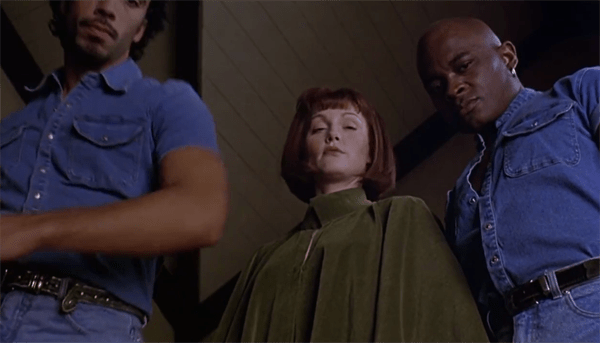
The ears are gateways to the emotions as frequently as the eyes are, though culturally, no one dwells on auditory phenomena as much. The ever-more-prolific Jacob T. Swinney has put together a short but telling homage to late horror director Wes Craven’s use of sound in his masterpiece ‘A Nightmare on Elm Street‘ that is as tight as a drum. Watch–but also listen.

Watch: The Early ‘Star Wars’ Images Predict the Later Ones

Watch: The Early ‘Star Wars’ Images Predict the Later Ones

Taking its inspiration from a quote by George Lucas in which he compares the way images echo each other in the ‘Star Wars’ films to the way they correspond in poetry, Pablo Fernández Eyre has produced a very persuasive video essay; watching the images cycle and reiterate themselves between the 1970s films and those of more recent times is a thrill. Enjoy!

Watch: The Coen Brothers Show Their Humanity Through the POV Shot

Watch: The Coen Brothers Show Their Humanity Through the POV Shot

Why do we watch films? Beyond entertainment, beyond distraction, beyond visual dazzlement, what I look for in the movie theater is a sense of recognition, a sense that I understand or have felt previously an emotion expressed on the screen, be it sadness, terror, joy, or confusion. One of the most obvious ways a director can stir identification of this sort is through cinematography. The Coen brothers, for instance, use the POV shot to their advantage, as well they should, given that many of the scenarios they describe are beautifully outlandish and, being so, require extra nudging to bring them within the range of most viewers’ identification. This fun and discombobulating video essay by frequent Press Play contributor Jacob T. Swinney takes us through the Coens’ numerous POV explorations: watch, and see if you don’t feel something for the bedraggled, flung-around, assaulted, and entrenched characters in these films, from ‘The Big Lebowski‘ to ‘Inside Llewyn Davis‘ to ‘O Brother, Where Art Thou?‘ and onwards.

Watch: Steve McQueen’s Acute, Intense Eye for Detail

Watch: Steve McQueen’s Acute, Intense Eye for Detail

Steve McQueen would seem to be a filmmaker with considerable remove and detachment from his subjects, whose impartial and unflinching gaze heightens the shock in the subjects he depicts in such films as ‘12 Years a Slave‘ or ‘Shame,’ but the reality is that without an underpinning of attentiveness to small things, the films’ devastation would not be nearly as great. Alex Kalogeropoulos’s newest video piece, a look at the way McQueen depicts hands and fingers, tells the truth about McQueen’s method: while we may remember the scenes which, like certain paintings, command us to look at a whole vista, however disturbing, the moments of closeness are equally significant, asking the crucial question: Where is the humanity in this story of inhumanity?

Watch: Christopher Nolan’s ‘Insomnia’ (2002) vs. Erik Skjoldbjaerg’s ‘Insomnia’ (1997): Two Cultures

Watch: Christopher Nolan’s ‘Insomnia’ (2002) vs. Erik Skjoldbjaerg’s ‘Insomnia’ (1997): Two Cultures

In the range of Christopher Nolan’s films, ‘Insomnia’ is far more satisfying than any of the ‘Dark Knight’ films. Why do I say that? Well, there’s a concentration of hardened talent in the one, versus younger, less proven or battle-tested talents in the latter series. The former film seeks to tell a story, while the latter series seeks to impress, through volume, set-design, special effects, and sheer enormity. The former is a tale of psychology, of different modes of desperation, while the latter series builds on a story-line, or maybe a mythos, which is on it way to being spent. This Fandor video essay by Kevin B. Lee looks at Nolan’s 2002 ‘Insomnia‘ alongside Erik Skjoldbjaerg’s 1997 original. Both transfix us, but by different methods; what the comparison shows is that Skjoldbjaerg remains, even at the film’s most intense moments, at an arm’s length from the action, always intent on having us gaze on the events occurring onscreen rather than immersing us in them–while Nolan takes quite the opposite approach. As Lee shows in this meticulous, methodical piece of work, every move Nolan makes–with visual effects, use of silence, use of noise, pacing–is designed to plunge us inwards, even if the film is hardly blockbuster-level in its throat-grabbing urge. Given that approach, and given the skill and subtlety Nolan used in telling this tale, his work proves rewardingly re-watchable in this case, not so much in the case of his more widely known movies. 

Watch: Why The Coen Brothers’ ‘A Serious Man’ Is Their Most Profound Film To Date

Watch: Why The Coen Brothers’ ‘A Serious Man’ Is Their Most Profound Film To Date

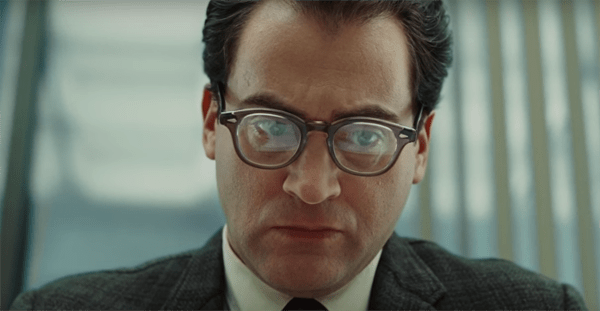
There can be no doubt that ‘A Serious Man‘ is the Coen Brothers’ most profound film. It’s not their funniest film (that honor goes to ‘The Big Lebowski’). It’s not their most complicated film (see ‘Miller’s Crossing’–scratch that, memorize ‘Miller’s Crossing’). And it’s not their most outlandish film (hello, ‘Raising Arizona’). But it is the film that grapples most extensively and most compellingly with huge, near-imponderable questions, most notably one we ask all the time, but rarely have a conclusive answer to: What’s going on? Also addressed: What is the meaning of existence? What unifies all events on Earth? And, last but not least, or easiest: Why are we here? Evan Puschak, or "The Nerdwriter," as he calls himself on YouTube, has been making a remarkable series of video essays for quite some time now, on a range of subjects: his latest discusses the crucial question at the heart of the Coens’ most understated, but also most gravitas-infused, movie. For anyone who wants to know more about the Coens’ work–or, in fact, how to close-read a film–this piece is invaluable.

Watch: ‘True Detective’ Season 2 Is Brilliant, and Here’s Why

Watch: ‘True Detective’ Season 2 Is Brilliant, and Here’s Why

TV critics, TV bloggers, TV tweeters, and other TV commentators: RELAAAAAAAAAAAAAAAAXXXXXXXXXXXXXXXXX. At least where ‘True Detective‘ is concerned. The second season of the HBO series was recently greeted with so much anticipation, commentary, prognostication, critique, concern, and general reactiveness before it even started that, had it been a child, it would have been the equivalent of the youngest sibling in ‘A Christmas Story,’ smothered in winter clothing, lying on the sidewalk, screaming, "Don’t leave me! Don’t leave me! Come baaaaaaaack!" Expectations were too high, and the series disappointed many. But not Nelson Carvajal, whose beautiful video essay captures the visual intelligence the show’s creators packed into it, while also addressing its crucial themes, in a collection of images strung together by music by Philip Glass, among other musicians. Watching this, I’m reminded, oddly enough, of my first prolonged encounter with the work of Gertrude Stein in college. The professor suggested that, rather than bringing our expectations to the work, we should let the work itself stir expectations; rather than looking at what we wanted to be there, we should look at what’s there. I’m not saying the series is the equivalent of Stein, merely that it might deserve the same approach. Enjoy.

Watch: ‘Mr. Robot’ Dances around the Rules of Composition

Watch: ‘Mr. Robot’ Dances around the Rules of Composition

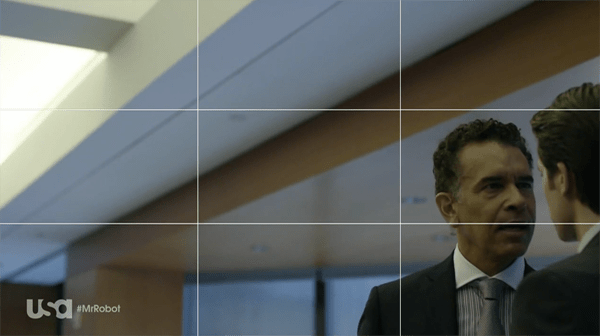
Rules hold sway over us, whether we realize it or not. Safety rules. Traffic rules. Rules of grammar. Laws. Codes of social behavior. Rules for arrangement of objects in your personal space. Rules for dress. Rules for business. The same holds true, oddly enough, when we watch films. We expect certain results. We expect certain placements, settings, orientations–and we even expect that the stories we enfold ourselves in will obey certain habitual patterns, will fall into place with a click. This character will fall in love with that character. Character X will win, and Character Y will lose. When it comes to visual rules, our expectations become a little harder to call out or examine because they are perhaps more engrained in us. The truth is, though, that it is the defiance of rules that makes a lasting work; whatever our expectations might be, the more eccentric works are the ones we remember. What better television show in which to examine the violation and transcendence of visual rules than the USA Network’s ‘Mr. Robot,’ as video editor Semih has done in this close-up, smart piece? Can you imagine a show about computer hackers that actually obeyed compositional rules?

Watch: Meet Jean-Pierre Melville, Cinematic Dreamer

Watch: Meet Jean-Pierre Melville, Cinematic Dreamer

[A transcript follows.]

Jean-Pierre
Melville was a French filmmaker celebrated for some of France’s greatest crime
films. He was born Jean-Pierre Grumbach on October 20th, 1917. He
chose the last name ‘Melville’ after notable author Herman Melville, most famous
for writing the epic tale of the sea ‘Moby Dick.’ He started using the name
‘Melville’ as part of the French Resistance during World War II in Nazi
occupied France, in which he fought in an Allied invasion of southern France
called ‘Operation Dragoon.’
 
When he was only six years old, he was given a small hand-crank camera, which
is when he says that he decided that he wanted to be a filmmaker. He became a
lover of film as a child—citing the first time he saw a talkie called ‘White
Shadows in the South Seas’ as the day he fell in love with cinema. He spent
most of his youth watching around five movies a day.
 
After World War II ended, he tried to become an assistant director to no avail,
so he started his own studio and made films independently. The genre that he
seemed most comfortable in was noir gangster films—his first being a 1956 film
titled ‘Bob le flambeur’ (or ‘Bob the Gambler’) about a gambling addict who
aids in a casino heist. The film used a great deal of hand-held camera work and
location shooting, which caught the eye of then film critic Jean Luc Godard.
 
Melville was an early hero to the champions of the French New Wave because of
his aesthetic and is penchant for shooting on location with natural light.
Godard drew a great deal of inspiration from ‘Bob le flambeur’ and Melville
even had a cameo in Godard’s first feature film, ‘Breathless.’ Allegedly, it
was Melville who suggested that Godard use jump cuts in the film which went on
to be one of the film’s most memorable features.
 
‘Bob le flambeur’ would become one of the main films to incite the French New
Wave—a film movement that strived for truth in the image by taking a documentary
approach to filmmaking. However, Melville once said,
 
“All my films hinge on the fantastic. I’m not a documentarian; a film is first
and foremost a dream, and it’s absurd to copy life in an attempt to produce an
exact recreation of it. Transposition is more or less a reflex with me. I move
from realism to fantasy without the spectator ever noticing.”
 
This does not only pertain to subject matter, but production technique as well.
Melville was one of the first to move effortlessly between soundstage shooting
and location shooting.
 
Perhaps Melville’s most famous film and most influential is 1967’s ‘Le
Samouraï’—starring Alain Delon—about a hitman who lives the code of the Samurai. ‘Le
Samouraï’ is a beautiful convergence of the Hollywood noir with the Japanese
samurai film and all against the backdrop of 1960’s France. Delon’s
intensely cool Jef Costello character has been credited as the inspiration for
the protagonists of such films as ‘Ghost Dog: The Way of the Samurai,’ ‘The
American,’ and ‘Drive’ to name a few. ‘Le Samouraï’ displays Melville’s mastery
of style and tone and has deservedly earned its cult status.
 
Melville’s entire filmography is a treasure trove of French cinematic
greatness. Whereas there wasn’t enough time to go over them all, no doubt
whichever you pick, you are in for something special. 

Credits:

‘Les Enfants Terribles’ (1950 dir.
Jean-Pierre Melville)

‘Bob le Flambeur’ (1956 dir. Jean-Pierre
Melville)

‘Léon Morin, Priest’ (1961 dir. Jean-Pierre
Melville)

‘Le Doulos’ (1962 dir. Jean-Pierre Melville)

‘Le Deuxieme Souffle’ (1966 dir. Jean-Pierre
Melville)

‘Le Samouraï’ (1967 dir. Jean-Pierre Melville)

‘The Army of Shadows’ (1969 dir. Jean-Pierre
Melville)

‘White Shadows in the South Seas’ (1928 dir.
W. S. Van Dyke, Robert J. Flaherty)

‘Breathless’ (1960 dir. Jean-Luc Godard)

‘Ghost Dog: The Way of the Samurai’ (1999 dir.
Jim Jarmusch)

‘The American’ (2010 dir. Anton Corbijn)

‘Drive’ (2011 dir. Nicolas Winding Refn)

Tyler Knudsen, a San Francisco Bay Area native, has been a student of film for most of his life. Appearing in several television commercials as a child, Tyler was inspired to shift his focus from acting to directing after performing as a featured extra in Vincent Ward’s What Dreams May Come. He studied Film & Digital Media with an emphasis on production at the University of California, Santa Cruz and recently moved to New York City where he currently resides with his girlfriend.

Watch: ‘The Empire Strikes Back,’ John Williams, and the Growth of a Soundtrack

Watch: ‘The Empire Strikes Back,’ John Williams, and the Growth of a Soundtrack

Even the harshest critic would have a hard time contesting the quality of John Williams’ soundtrack work for the ‘Star Wars’ films. His sense of grandiosity found a match in the immensity of the story George Lucas was telling with these films–and in case you were wondering what it would be like to be a fly on the wall during his composition, Vashi Nedomansky offers us this remarkable video essay showing Williams watching one famous scene in ‘The Empire Strikes Back‘ for the first time, in which Han Solo (Harrison Ford) is about to be sent into the deep freeze as a prisoner of war, in a sense, and Princess Leia (Carrie Fisher) blurts out her love for him–to which Solo responds, "I know." (That’s an interesting response, not quite as dated as one would think at first.) Without the soundtrack, the scene could be forgettable, but with Williams’ percussion and string swells behind it, the characters’ interaction reaches its full magnitude.  And as we watch Williams watching the scene, as we do here, we can see a mind beginning to shape a melody, a look of interest, the germ of the final product.