FARGO, TRUE DETECTIVE, JUSTIFIED, RECTIFY and the Construction of the American Small Town, Part II

FARGO, TRUE DETECTIVE, JUSTIFIED, RECTIFY and the Construction of the American Small Town, Part II

null
In Part One of this essay, I was
pretty tough on Fargo and True Detective, accusing them of an
absence of imagination, and generosity, in their approach to small-town and
rural life. Perhaps I should heed my
own call for generosity, however. Both Fargo
and True Detective are, in the grand
scheme of things (or, at least, relative to so much television that’s come
before), ambitious, stylish, well-made shows. In certain ways, they are
perfectly wedded to their truncated mini-series form; small towns and miniseries
provide and require just enough life to flesh out a narrative but not so much that
they necessarily overflow with life,
with randomness, imposing their messiness on an auteur’s message. Rejecting for
the most part Frederic Jameson’s "thickening continuum" of geographical
indistinguishability, both Fargo and True Detective rely on their locales to
convey an iconoclasm and remoteness that makes possible the tragic events that
transpire. This isolation is reinforced by the general absence of pop cultural
signifiers—the television, film, or musical touchstones that have become so
ubiquitous in contemporary television and film that they often go unnoticed. [1] Modern
technology plays a diminished role, as well (even taking account of the fact
that shows aren’t precisely contemporary). Fargo‘s
disgraced FBI agents Pepper and Budge work in an old-school, analog file room;
the relevant "files" that True
Detective’s
Hart and Cohle seek are said to be lost in post-hurricane
flooding. Instead of GPS tracking there
are French Connection-style
stakeouts. In an age of cell phones, Fargo’s
Gus Grimly nonetheless communicates with his daughter on a walkie-talkie. The
"murder board" at the Bemidji police station is a string figure of
red yarn and local vernacular (one suspect is identified as the "deaf
fella").

It’s hard to tell if the shows
ignore the march of culture and technology as an homage to the by-gone genres they
recall (noir, pulp fiction) or whether those genres provide Hawley and
Pizzolatto an opportunity to slip out of our networked and interconnected world
for a moment, providing a bit of space and quiet to map out their ideas. Either
way, it’s hard not to identify a flattening at work. Still, it’s not as if Fargo or True Detective
are the first shows to reduce small-town and rural life to one-dimensionality
or to a trope. Indeed, twenty-five years before Frederic Jameson wrote his
essay on the false, flat history of small towns and nostalgia films, the Andy
Griffith Show
was providing America with a weekly window into a "time gone
by" via Mayberry, North Carolina. Though it was filmed in, and ostensibly took
place in, the 1960s, Griffith himself has explained that the show consciously
catered to a nostalgia for times past, cultivating an 1930s-ish atmosphere. This is the endless reservoir of our
nostalgia. The Andy Griffith Show has
been on the air (in some form) since it debuted on CBS in 1961, and audiences continue
to watch it today out of nostalgia for a time that the show itself sought to
escape via an even deeper nostalgia. 

The Andy Griffith Show was among the first of its kind. By 1971, CBS
had seven rural-themed shows in its line-up, a glut of bumpkin-escapist fare so
pervasive, so identified with cultural complacency, that Gil Scott Heron
indicted it in his seminal spoken-word piece "The Revolution Will Not Be
Televised" ("Green Acres, The
Beverly Hillbillies, and Hooterville Junction
will no longer be so Goddamn relevant"
). That year, as part of
an attempt to appeal to a younger, more contemporary demographic, CBS initiated
what became known as "the rural purge"—cancelling its entire line-up of rural
shows, including Mayberry RFC, Green Acres, and (the year before) Petticoat Junction. As one actor joked, "It
was the year CBS killed everything with a tree in it." [2] And just like that, the "noble rubes" and
barnyard hijinks were gone. But only briefly. A popular (and political) uproar led to CBS’
attempt to placate critics a year later with The Waltons, which followed a decidedly noble family’s travails in
a hardscrabble 1930s Virginia.  Initially
expected to fail—for both demographic and scheduling reasons—The Waltons stayed on the air for nearly a decade (a run extended by several television movies), and it peaked
at Number 2 in the Nielsen ratings in 1973-74. Although it may have been intended to placate the fans of CBS’s canceled
shows, The Waltons also marked a departure
from its predecessors, in part by being more overtly historical (it took place
forty years before its air date) if still folksy, but also by foregoing broad
characterizations and humor. (NBC would try to tap into a similar audience via
the even more historical, more folksy themes of Little House on the Prairie in 1974.) That
said, pre-Waltons cartoonishness
would make a brief return with the Dukes
of Hazzard
in the late 1970s. And the comic conflict between rural unreason
and urban sophistication (and exasperation) seen in Green Acres would be revisited, and revised, by Newhart (1982-1990). In other words, The Waltons didn’t really supplant the
shows it replaced. It simply added another trope to the mix. 

Together,
these 1960s and 70s series have provided, and continue to provide, a template
for the numerous rural and small-town shows that followed. For main characters
and audiences alike, television’s version of small-town America have frequently
served as something more than a source of easy laughs. They suggest an escape
from, or a corrective to, the misguided ambitions and increasing complexity of American
life. There are variations within the tropes, of course, whether it involves shaking
off the corrupting influence of New York corporate law (Ed), or a Manhattan transplant at the liminal edge of Alaska’s vast
wilderness (Northern Exposure), or
the Lake Wobegon-esque hermeticism of a town where everyone is strong,
good-looking, and above-average (Gilmore
Girls
, Everwood, Dawson’s Creek). Northern Exposure debuted a short six months after Twin Peaks and though the two shows are
marked by thematic similarities—an outsider arrives from out of town and is introduced
to a cast of eccentric characters in a rustic Northwestern setting—Northern Exposure incorporated and
civilized Twin Peaks’ rough edges,
retrofitting its strangeness to familiar frameworks. [3] 
Structurally, Northern Exposure was closer
to Newhart, even if it seemed a
little artier around the edges. [4]
Despite their differences, the majority of these more modern rural and
small-town series attack the fundamental premise of a show like Peyton Place—Jameson’s "claustrophobia
and anxiety," or the assumption that small towns are prisons one must
escape—with aggressive eccentricity (Northern
Exposure
), geniality (Ed), and/or
wit (Gilmore Girls). As enjoyable as
these shows were, watching them again, all of the effort nonetheless suggests a
touch of over-compensation.

*          *          *          *

null
Though
there’s no question that the charm of the more contemporary shows discussed
above is revved up high, it’s also true that they are, in many ways, more
self-aware and sophisticated than their 1960s and 1970s predecessors. Take Ed, which ran on NBC from 2000-2004.  On one level, it’s a traditional nostalgia
show. Ed Stevens (Tom Cavanagh), a local son of Stuckeyville, Ohio who left to
become a New York attorney,  "loses
his job and his wife on the same day" (she sleeps with the mailman—which
is the first notice that we’re entering the region of television tropes as much
as we’re entering small-town America)—and takes off to regroup in his
hometown of Stuckeyville, Ohio. There, inspired by a brief but genuine romantic
moment with his high school crush, Carol Vessey (Modern Family’s Julie Bowen), Ed buys the local bowling alley and opens
up his law practice inside. He quickly slips back into a slightly revised
version of his teenage life. His social circle is made up of high school acquaintances;
two of them actually teach at Stuckeyville High. The main characters, thirty-ish, mostly
single, prone to juvenile pranks, remain caught between childhood and adulthood.
Ed, in particular, is boyish in all respects, baby-faced, impulsive, stubborn,
and, most tellingly, endlessly impressed with his own cleverness. The stakes in
Ed are so low, the threat of conflict
so attenuated, that Ed aggressively pursues Carol for seasons-on-end without any
indications from the show’s creators that his behavior might be inappropriate. [5]
If anything, the show posits Carol’s resistance to Ed’s advances as a violation
of the narrative contract, punishing her with a series of terrible boyfriends.
Her fiancé, Dennis Martino (John Slattery), was so despised by Ed‘s audience that fans devoted a
website to the myriad ways they might kill him off. Meanwhile, the show unfolds a high
school sub-narrative, the story of current high school student Warren Cheswick (Justin
Long) who (surprise!) has a crush not only on Carol (his teacher at
Stuckeyville High) but also on Stuckeyville High’s prom queen (and thus Carol’s
teenage analog). In other words, Warren acts as both a bridge and an avatar for
Ed, a perfect vehicle for Ed to relive his youth in its actual and its
alternative forms. [6] Ed’s
second chance also extends to his work. His Stuckeyville legal practice has little
to do with his prior life as a lawyer; instead, he becomes a champion of
community values—his low-stakes, high-principle, long-shot cases rarely end
in a positive judgment, but even so, they often trigger heartfelt confessions
or settlements. His clients (aging pastors and doddering party magicians, good Samaritans,
a variety of sad sacks), and his causes (turning his bowling alley into a
historical landmark, for instance) consistently thrust Ed into the role of
quixotic resistance fighter against bottom-line tendencies. In other words, Ed’s
legal battles are antithetical to, and a kind of redemption for, his prior work
on behalf of faceless multinational corporations—a job Ed was fired from for
"missing a single comma in a 3,000 page document." I mean, is there anything
worse than craven capitalism that’s also
prissy about punctuation?

But
Ed is flush with self-awareness, as
well. When Stuckeyville High decides to start a student-run television station,
Warren’s vision of the station’s programming sounds a lot like an original
pitch for Ed: "Americans
these days are looking to television for something comforting, something warm,
gentle and reassuring." The show
not only acknowledges its genealogy (name-dropping Northern Exposure early in Season One), and its peers (via a
guest-starring role for Picket Fences’ Adam
Wylie), it’s also steeped in television history. In addition to the shows
mentioned above, the first season alludes to, among others, Archie Bunker, Happy Days, M.A.S.H., One Day at a Time, and The Rockford Files. This might be viewed
as yet another embodiment of the loss of small-town autonomy (and identity) at
the hands of "identical products and standardized spaces" that
Jameson laments. And perhaps it is. But Ed
relies on pop cultural memories as a source of stability, using that shared
heritage to link the characters in the show to each other and, of course, to
the audience. With its foregrounding of familiar tropes and its web of cultural
allusions, you can almost feel the nostalgia of Ed the show, pulling against the nostalgia of Ed the character, in
its suggestion that what we long for isn’t the idyll of the small town itself
but rather the television shows that have taken its place. And so, although a
large crowd shows up to see the cast of Happy
Days
at a Stuckeybowl promotion, Ed’s attempt to preserve Stuckeybowl
itself as a cultural landmark is met with far less fanfare. In its way, this pop cultural nostalgia signals
a kind of irreversible cultural shift from a childhood of local exploration to
the latch-key childhood of television (or video game) as geographically-indistinct
babysitter. [7] Ed embraces
cultural signification but dispels with the chaotic surrealism of, say, Twin Peaks by stabilizing that
signification. It becomes a kind of
currency.

*          *          *          *

The
persistence of these tropes makes one appreciate all the more those shows that
manage to accrue complexity and ambiguity. Justified,
for instance, which tracks the life and work of a U.S. Marshal banished to his
backwater birthplace, completed its fifth season on FX this year. That
birthplace, Harlan County, Kentucky, is vibrant, and the show takes its time
establishing not just the region’s class hierarchies but also sub-strata, the
teeming and disparate socioeconomic microhabitats that exist even within social
classes. Justified plays out against
a very real backdrop of failed farms and a changing mining industry (Season Two
revolves around the attempts of a mining company to secure land rights) that no
longer supplies the jobs and money it once did. [8]
Not surprisingly, the citizens of Harlan County view both foreign (i.e.,
out-of-state) corporations and the federal government with wariness. And Justified makes clear that the rise of
crime (and drug abuse) in the region is tied to, but not dictated by, economic
conditions. Although the show is genre television—it doesn’t pretend to be
much more than serialized crime fiction—its creators and writers have learned
something fundamental from Elmore Leonard, the genre-master who wrote the novels
and short-story from which Justified
draws its main character, Raylan Givens (Timothy Olyphant). [9]
Justified’s stories
are full of family and regional history, nature and nurture, issues of class,
race, and even gender. These forces work their way through most episodes, and
the result is a cast of characters who make life-and-death decisions in ways
that are frequently unpredictable but rarely incomprehensible. There is a local logic to the Justified universe. As a result, its strongest seasons—two and
four—are those that are most grounded in Harlan County’s history, culture,
and economics. 

At
the end of Season Four, as the violence escalates and the stakes are continuously
raised, it’s a shared, local memory (of an Apollo astronaut’s helicopter
landing at their high school twenty years before) that proves life-saving for both
Raylan and his nemesis, Boyd Crowder (Walter Goggins), Raylan’s childhood
friend and, at times, his uneasy ally. Boyd is a brilliant character—most
fans of the show are aware that its creators intended to kill him off in Season
One but couldn’t because Goggins was so good—but he may not be the show’s best.
It will be a while before anyone comes up with an antagonist as fascinating,
terrifying, and ultimately tragic, as the criminal matriarch Mags Bennett from
Season Two. Powered by a smart, steely performance by Margo Martindale, Mags is
all the more compelling because the character’s power and dangerousness is
terrestrial and local—she is inseparable from the Harlan County that she
loves and that she sells out, torn between tradition and opportunity, loyalty
and fairness, family and community. It comes as no surprise, then, that Justified’s weakest season—this most
recent one—was the first to take events far away from Kentucky (even if it
eventually circled back to familiar soil). And it’s probably not a coincidence
that this was the first season in which neither of the two main characters had
a father figure; Boyd’s father Bo died in Season One, and Arlo, Raylan’s father
and Boyd’s surrogate father, died in Season Four. The show’s first steps
outside of the well-developed regional and familial history result in a loss of
gravity that renders the jokes tinny and more mocking and the violence more arbitrary
and gratuitous than in prior seasons. The show has never lacked for the
stereotypes audiences expect of shows in a rural setting (there are "dumb
rednecks" to spare), but when it’s on its game, it shares Leonard’s genuine
affection for characters, including the dimwitted outcasts. Even better, it
plays with those same stereotypes. Outsiders who underestimate the locals do so
at their own peril. In the end, Justified
pays respect to its characters by constructing a complex moral universe; one
worthy of the characters’ life-changing decisions.

*          *          *          *

null
Unlike Fargo, True Detective, and Justified, the violence in Ray McKinnon’s slow-building but (for
me, at least) transcendently powerful Rectify
(The Sundance Channel) remains, for the most part, in the distant past or the
uncertain future. Season One follows the first free week in the adult life of
Daniel Holden (Aden Young), once convicted of killing his high school
girlfriend and now released back into the wild (in this case, his hometown of
Paulie, Georgia) after twenty years on death row. [10]
The show doubles its narrative, frequently flashing back to Daniel’s last
year(s) on death row, chronicling his relationship with his fellow inmates,
including his closest friend, Kerwin (Johnny Ray Gill), with whom he has a
running dialogue through a vent connecting their cells.  Like True
Detective’s
Cohle, Daniel is an autodidact who leans heavily on
intellectual structure to measure and mediate a universe that has treated him
with cruel arbitrariness. Unlike Cohle, however, Holden acknowledges early on that
the approach has severe limits—that a "world view" that does not allow for "optimism"
is a "kind of fantasy itself."  The first
six episodes are primarily the story of Daniel’s attempt to escape the limits
of a compulsive pessimism that, while necessary in prison, proves altogether
more destructive outside its walls. The show does not shake this pessimism
easily. There’s a lingering acknowledgment in the show’s slow-boiling threat of
malice and violence of the possibility that, as Daniel’s dying former defense
attorney, Rutherford Gaines (Hal Holbrook) puts it to Daniel’s current defense
attorney, Jon Stern (Luke Kirby), we’re nothing more than "monkeys going to
nowhere." Lorne Malvo would no doubt agree. [11]

Rectify
is, like Fargo, concerned with the lessons
in scale and seclusion that attend small-town experience. Over the course of its
first season, Rectify complicates,
but does not fully reject, the Peyton
Place
cliché that small towns are prisons. For Daniel, fresh off of decades
of  Spartan solitude, Paulie’s banality is
almost too much, a source of wonder and confusion he can’t understand let alone
control. [12] But
the show also makes clear that Paulie is painfully restrictive for Daniel’s
family members and has been for years. Notions of freedom, confinement, and
privacy are interrogated from the very first scene, where we watch (in profile,
through a dark room and a window) the intake of a newly-arrived prisoner,
complete with cavity search. In the
background, watching through another window and a closed door, is Daniel, waiting
to be processed and released. For the first time in twenty years, Daniel is on
the other side of a window, the surveillor, not the surveilled. In keeping with
this, a guard turns his back to allow Daniel to change into civilian clothes
and even offers him a drink while he waits. 
These first minutes of the first season are typical of Rectify’s approach throughout: a carefully
arranged scene that lets the camera linger when other shows would move it along.
Here, the camera watches Daniel closely, using the muted bewilderment washing
over him to measure the significance of the changes at work.

The
changes do not last long, and the panopticon of prison life gives way to a
different surveillance state. Because Daniel has not been exonerated—he is
released on the basis of DNA evidence that has called his conviction into
question, pending retrial—there is nowhere he, or his family, can go that is
not noted, watched, catalogued, and commented upon by the citizens of Paulie.
("Remember," his attorney tells the family, before they’ve even been reunited
with him, "everything we do is being watched and judged.") Paulie’s citizens
may not agree about Daniel but they do not lack for opinions and, twenty years
after his conviction, the shockwaves still continue to cause damage. In one
flashback, Kerwin, his friend from the adjacent cell on death row, attempts to
cut through Daniel’s pessimism, asking Daniel to "just imagine . . . a world
full of windows." But we come to understand that windows constitute both a
freedom and a threat; as if on cue, we’re brought into Daniel’s present, with television
cameras crowding around his mother’s car as the two of them attempt to leave
the parking lot of a large box store.

And
yet Rectify never construes Paulie
narrowly. Save for one or two characters, it refuses to simplify even the town’s
most unlikeable citizens. A gossipy waitress (Kim Wall), for instance, who
spreads the rumor that Daniel’s sister, Amantha (Abigail Spencer) is sleeping
with Stern, also sends Daniel home with fried chicken from the diner, without
charge. [13]
Ted Jr. (Clayne Crawford), Daniel’s step-brother, is a familiar brand of
jackass, all bluster and baseless self-confidence, who struggles to be
understanding and supportive on Daniel’s return when, in truth, he feels both
threatened and slightly undone by the events. Nonetheless, Ted Jr.’s love for
his wife, Tawny (he passes up the opportunity to cheat without a thought when
he’s on the road for work) and his step-mother appear unconditional. Oft-maligned
institutions are treated with similar ambiguity.  Rectify’s
portrayal of big tent religious revivalism is in marked contrast to that of True Detective, where the church’s
collection of misfits (resembling a circus sideshow) mostly serves to give
Cohle the opportunity to lob insults (Cohle derides their "collective IQ,"
noting that it’s "safe to say no one [t]here is gonna be splitting the atom"). Daniel,
on the other hand, rushes into a baptism at the urging of Tawny, with whom he
has a not-completely-innocent connection. In keeping with Rectify’s
painstaking narrative process, Daniel’s baptism resolves nothing, registering
as a moment of catharsis that nonetheless leaves Daniel confused and raw.  Transcendence might not be in the offing, but
the show nonetheless refuses to judge those with faith, like Tawny, who dare to
suggest that "miracles" might be possible "in this town, right now." [14]

Rectify is slow-paced, and its long silences hang heavily. The
deliberate pace is also a destabilizing force; Rectify packs abundant weirdness into its vast, languid spaces. A
lot of this weirdness stems from Daniel, who remains as much of an enigma to us
as he does to his family and fellow citizens. We come to learn a little about
the child who was sent to prison twenty years before—smart, strange—and he
retains no small amount of teenage goofiness. Early in the first season there’s
a scene where Daniel dances in the family’s attic, wearing his father’s hunting
gear and spinning a duck call while listening to Cracker’s "Low" on his old Walkman,
that is absurd, touching and very funny all at once. Still, his anger and his urges are quite
real, and very powerful. Just how lost Daniel is becomes clear in the fifth
episode of Season One, when, wandering the streets sleepless, Daniel is picked
up by a grizzled (and, yes, mysterious)
stranger [15]
in a beater of a truck (W. Earl Brown) who asks Daniel to help him with some
errands. To go into too much detail would be to destroy a delightfully strange
hour of television. Nonetheless, at one point Daniel and his new friend wrestle
in a field in the early morning and, as the violence becomes increasingly
pronounced, the scenes suggest the real possibility that Daniel could, in that
moment, kill or be killed. More than this danger, and dangerousness, however,
the scenes reveal a loneliness so deep that Daniel is willing to throw himself
into the fight’s visceral, brutal tenderness as a (lousy) surrogate for
intimacy and touch. Watching the episode—in addition to being strange, one of
the finest hours of television I’ve watched in a long time—I was reminded of
the dark, funny surrealism of Denis Johnson’s classic Jesus’ Son, which navigates similar territory, blurring the lines
between reality and dream and between violence, failure, and transcendence.

Rutherford
Gaines tells Stern, a lawyer for a death penalty public interest group, that Stern
will never understand Paulie’s treatment of Daniel because he wasn’t there to experience
the terror and anger that gripped the town at the time of the murder and trial.
But if collective memory is the engine of the town’s anger, it also suggests inherent
limits. There are characters—not just Tawny, but a hair stylist, an
acquaintance or two, a few random individuals—who suggest the possibility that
Paulie will be able to move on from the events, that the specter of Daniel will
not always linger. Of course, it’s
not as simple as forgetting. A town’s collective memory can be persistent and
self-perpetuating, and legend and folklore frequently step in when actual
memories start to fade. This persistence is driven home in Rectify’s second season, when Stern and Amantha are confronted by a
Paulie resident outside of the town’s roller-skating rink for nothing more than
the mindless enjoyment each other’s company. Stern challenges her indignation:

Jon: How old were you then?
Five? Eight?

Woman: I was old enough.

Jon: Old enough…for what? To listen to what your parents told you and
believe it because they told you it was the truth? Afraid to think for
yourself? Scared to look at all the facts?

Perhaps word-of-mouth and local legend also have their
limits, however. More than any other characters, it’s those, like Daniel’s
half-brother, Jared (Jake Austin Walker), who weren’t born when the events
transpired (and thus, like Stern, weren’t there to experience that collective
pain) that provide the most substantial indication that Daniel could reclaim possession
of his life. This promise is evident even in the obnoxious teens who snap
photos of themselves with Daniel. They’re drawn to Daniel out of a morbid curiosity,
a horror-attraction that’s familiar to many of us who grew up in small towns. At
a certain age, darkness has an appeal simply because it’s different. And who needs Black Sabbath when you have a convicted
killer next door? But that attraction is abstract, the opposite of experiential—indeed, it is based on the foreignness of
the horror—and thus a passing phase. Even Daniel seems to understand this,
explaining to Jared, somewhat ominously, that Jared’s curiosity about him (or,
as Daniel phrases it, his curiosity about the "taboo") is natural,
but demands caution.

Although
Rust Cohle is True Detective’s philosopher-king,
it’s Harrelson’s Martin Hart who provides us with the show’s core philosophical
observation: "infidelity is one kind of sin but my
true failure was inattention."
This inattention abounds in the True
Detective
universe – whether it’s the intrinsic inattention of the state
police force, families, and schools that ignore the disappearances of their
daughters or the extrinsic inattention of the world at large, the failure of anyone
to notice what is going on in southern Louisiana allows evil to fester and
grow. [16]
This is what makes Rectify’s rejection
of traditional narrative demands so remarkable. The town’s vigilance is, in
many ways, pernicious; and yet it’s the show’s refusal to look away for the
convenience of narrative, its willingness to let moments hang in the air, and
its patience in following side characters through seemingly digressive
plotlines, that grants it a rare, and powerful, moral authority. 

*          *          *          *

null
I
suppose I shouldn’t find it surprising that each of shows on which I’ve focused
centers around the law, whether it be
lawmen, lawyers, or alleged law-breakers. After all, the law is our foremost nexus
and repository of social and cultural currents. And if criminality is an
expression of frustrated ambition, what better specimen than a small-town
crook? Even Cecil County, where I grew up, has its version, straight out of Justified’s playbook. In the late 1970s,
the area in-and-around the county, on both sides of the Mason-Dixon line, was
the stalking ground of the infamous "Johnston Family Gang," who made
a small fortune stealing farm equipment, cars, drugs, money, and antiques they
fenced through friends and neighbors they’d charmed or intimidated into silence.
Although the Johnstons "worked" out of Chester County, Pennsylvania, Bruce
Johnston, Sr., the ring-leader, was living in Elkton with a girlfriend at the
time of his eventual arrest, and the gang’s crimes routinely crossed state
lines into Maryland and Delaware. From a distance, the Johnston Gang seems in
keeping with television’s tradition of hillbilly rebels—the kind whose crimes
are more ornery than malicious.  But the
Johnstons were ruthless. In 1981, Bruce Sr. and his brothers Norman and David
were convicted of murdering six people (among them three teenagers, including Bruce
Jr.’s fifteen-year old girlfriend, Robin), and attempting to murder Bruce, Jr.,
in order to silence potential testimony against them. Papers around the country
covered the trials, and in the end each brother received multiple life
sentences. Just five years later, in 1986, the Johnston Gang served as the
lightly-fictionalized basis for James Foley’s At Close Range (starring Christopher Walken and Sean Penn), providing
fifteen fleeting minutes of fame for our pocket of the mid-Atlantic. 

The
Johnston legend did not end with those convictions, however. In 1999, Norman hatched
a daring, if old-school, plan of escape, managing to break out of Huntington
State Prison by "stuff[ing] a dummy trimmed with
human hair into his cell bed, then bust[ing] through window bars and
vanish[ing]
." He avoided custody
for 19 days. And for those 19 days he was a constant presence in the papers and
the constant source of sightings—on a porch, in a park, at a fruit stand,
along railroad tracks—and speculation in Cecil County, particularly that he
was returning "for revenge or to get money." Johnston’s escape provided ample opportunity for city papers to reinforce small-town
and rural clichés, proving that hackneyed depictions of small towns are not the
exclusive province of the television writers’ room and translating the county’s
“cornstalk lined neighborhood yards” into hoary tropes:

None of this is comforting
to residents of Cecil County, many of whom are used to leaving doors unlocked.
Now, many of them report staying home, with their windows locked and front door
bolted. Streets that last week were filled with the noise of children on
bicycles have fallen silent.

There’s no question that Johnston’s presence
was unsettling for locals. But the above is the stuff of folklore, not news. Instead
of terror, the evidence suggests that, like the curious teens of Rectify, the people who lived along the
Mason-Dixon line enjoyed their brief flirtation with the lawlessness (or taboo)
that Johnston symbolized. That, not
fear, goes a long way toward explaining why copies of At Close Range flew off the shelves of local video stores during Johnston’s
time on the run
. Buried under the bullshit in those 1999 newspaper
articles, as well, is a sense of pride, a belief among locals that Johnston’s knowledge
of the land and homegrown resilience would be enough to evade the massive
manhunt dedicated to his capture:

"He knows the area.
… The man was a hunter. The
man was a farmer," said Tim Bickling, who has been following reports about the
manhunt. "If he wants to hide, he can hide," said Bickling, standing
outside his white clapboard home in nearby Cherry Hill.

The combination of memory, fear, morbid
fascination, and regional pride is potent, and the area buzzed for the duration
of Johnston’s flight. In the end, however, his capture proved both
anticlimactic and a little comic:

But for days on end, he was on the run from state troopers,
crouching in the cornfields, his heart pounding with each pass of the state
police chopper. He was frustrated by his inability to steal new cars with
tricky alarms and to operate self-serve gas pumps. After 20 years in prison,
even his old Chester County stomping grounds didn’t seem the same. "He was
dazed by all the change," said his brother, Joe Rivera, who spoke to
Johnston once during his time on the run.

For all his ingenuity, Johnston
couldn’t anticipate or adapt to the changes in landscape and technology that
took place during his twenty years away. There were new housing developments
and factories where once there were open fields. His old networks had dried up and disappeared.  And so, after all of that work to get free,
he escaped into a world that was not just unwelcoming but foreign to him. Which makes me think of Daniel Holden’s attempts to
navigate a once-familiar world that similarly moved on, inexorably, during his
twenty years in prison. The irony, of course, is that these disorienting forces
of change are also those that might, eventually, set Daniel free.  Even then, however, it can’t help but be a long,
dark journey. 

Spencer Short is an attorney and author. His collection of
poetry,
Tremolo (Harper 2001), was
awarded a 2000 National Poetry Series Prize. His poetry and non-fiction have
been published in
The Boston Review, Coldfront, the Columbia Review, Hyperallergic,
Men’s Digest, Slate, and Verse. He lives in Brooklyn.


[1] It’s easy to point to shows like Buffy
the Vampire Slayer
, Versonica Mars,
and even light comedy-dramas like USA’s Psych,
all of which rely on popular culture in a variety of ways.  But even a show as by-the-book as CBS’s NCIS includes a character (Tony DiNozo)
who provides film-based metacommentary on the narrative.

[3] Some
shows, like David E. Kelley’s Picket
Fences,
tried to triangulate Twin
Peaks
and Northern Exposure,
keeping a touch of the menace but losing the strangeness.  Picket
Fences
also stands out for its embrace of hot button public/social issues.
It struggled with ratings for most of its relatively short life, however.

[4] The
shows share not only a conceptual framework but also a flair for the surreal
with their forebearer, Green Acres.

[5] Although I tend to disagree with her
examples, and even (to some extent) her thesis, it’s hard not to apply
Genevieve Valentine’s take on the nice
guy
stalker to Ed Stevens. See http://www.avclub.com/article/full-boyle-guys-who-dont-hear-no-just-arent-funny–202474

[6] Like Ed, Warren has an unpopular classmate
(Ginnifer Goodwin) who pines for him. Ed never truly considers Molly (Lesley
Boone), his funny, charismatic, loyal friend, an option. Unlike Ed, Warren eventually
reciprocates the attention. 

[7] Its purest form can be found on VH1’s contemporaneous (and successful) pop
culture/nostalgia-fetishizing shows like I
Remember the 90s
and Pop-Up Video.

[8] The
latter is the result of a variety of factors, including depletion from a
century of mining and  the advent of mechanized
surface mining that has cut down on the need for manpower (while devastating
the landscape). See http://www.maced.org/coal/mining-employ.htm

[9]
Givens is, himself, an anachronism, a throw-back to the shoot-first lawmen of
Westerns (the genre that gave Leonard his start).

[10]
Although Season Two recently began,
I’ve limited my analysis (for the most part) to Season One because I’ve had
time to watch and re-watch the shows. While I’ve enjoyed Season Two a great
deal, the show really demands more time and attention than I’ve been able to
devote to it.

[11] For
Malvo, animal is our true nature, and he believes (and
Lester Nygaard seems to prove) that embracing our inner-predator constitutes a
liberating return to form. For
Gaines, however, our primal origins constitute (literally) a form of original
sin. As a result, Rectify inverts Fargo’s frustrated race-to-the-bottom
into the story of our failed transcendence.

[12] If
I have one complaint about the show, it’s that it leans a little heavy on this
wonder, with its barrage of lens flares, its high blue skies, and its endless
meadows.

[13]
Bigger surprises lurk in Season Two.

[14] It shares this sensibility with Justified, whose.  Its traveling evangelists in Season 4 aren’t
saints, but they aren’t wholly insincere, either. And there’s no questioning at
least some positive influence on at
least some portions the community
(I’m looking at you, Ellen May).

[15] Erik Adams, at the AV Club, reads these
scenes as a straightforward Christian allegory (and Brown’s character as,
essentially, "the Devil"). I don’t read it quite so narrowly, if only
because the "temptation" offered by Brown’s character is so slight,
so temporary, and, in the end, oddly
therapeutic
.  It may have set Daniel
on the path to his baptism, but not because of any latent evil. Rather the
experience lets him know just how lost he is (and remains).  See http://www.avclub.com/tvclub/rectify-drip-drip-97543

[16] Cohle
is, perhaps, most guilty of inattention – neglecting the moment, community, his
own needs and hiding behind work and nihilistic cosmology.

Looking at YouTube: KIDS REACT and Procrastitainment

Looking at YouTube: KIDS REACT and Procrastitainment

On a laptop screen, a small rectangle surrounded by a jumble
of text, ads and windows sends light into the retina of an isolated viewer, who
sees the image of a chalkboard. Two tiny speakers emit the brittle, violently
cheery sound of a chorus of children chanting “Kids React to…technology! This episode…old computers!

What started as magnetic ones and zeros residing on a hard
drive on the server floor of a Google data center in Council Bluffs, Iowa, ends
up here at the portals of individual eyes and ears thousands of miles away, or perhaps
just down the street. The viewers are a twelve-year-old girl in her parent’s
living room, or a twenty-three year old woman distracting herself from a
particularly dreary workday, or a forty-seven year old father of two who
clicked a link in his Facebook feed. All of them sought the same thing: five
minutes of diversion. At one time or another, twelve million other people who sought
the same thing watched this video.

The seven-minute show is an episode in a popular YouTube series
called Kids React, in which children ranging from ages five to thirteen respond
to viral videos, technology, video games, music videos and technology. The show
debuted in 2010; within a year, it had racked up so many views that its channel
became one of the original one hundred channels to receive funding from Google.
The producers of the show, two brothers from Brooklyn who call themselves the
Fine Brothers, have essentially arranged for children to be simultaneously the
subject of and the reviewers of viral entertainment. The brothers make viral
videos about viral videos.

New approaches often develop when bars to entry are lowered
by new technology, and different types of people make it through who might
otherwise never have found a foothold. The brothers, Benny and Rafi, grew up in
an orthodox Jewish household in Flatbush, Brooklyn. Their father is a rabbi. Only
Rafi received a film degree, at Hunter, the city university of New York. Their
background, temperament and interests were not exactly an ideal match for
schmoozing their way into the traditional film and TV industries and producing
material that would be unveiled in the festival circuits. Lena Dunham, by
comparison, was born into a household that provided her with access to elite
credentials and networks of connected people. She was raised by a painter
father and a photographer mother and attended Saint Ann’s, a prestigious private
school in New York, and Oberlin College. She was born to be successful in
traditional media. The Fine Brothers were not. YouTube has become one way for
young filmmakers to bypass the traditional means of access to inner circles of
industry and find another way in.

The structure of Kids
React
is strictly formulaic. Each episode is shot from a single static
camera position in a small, low-budget set, sparsely decorated with public
education-ish accouterments like apples, pencils, a G-clef. In each episode, a series
of cute children are seated at a desk looking at a video monitor, are shown a viral
video or piece of technology of some kind, respond to it and are then asked
questions about it. This format pays off in two ways: by eliciting a nostalgia
reaction from the older viewers who are old enough to have experienced the outmoded
technologies or clips of older shows and web videos the first time around, and
by showcasing the cuteness of the children’s first, innocent reaction.

Like Tosh.O, Ridiculousness, and World’s Dumbest, Kids React is a mostly a web clip show in
the business of aggregating and recycling viral material from YouTube and then
adding another layer: a kind of virtual social presence sharing the digital footage
with the viewer. The formula works more or less the same way that Beavis and Butthead did, if Beavis and Butthead were reimagined as smart,
polite children. The novel element and source of all the heavy lifting with Kids React is the children’s affect. The
show is powered by a kind of affective child labor.

The idea of capitalizing on the commercial potential of the
affective labor of children is not a new one. The first show that featured
child responses was a segment called “Kids Say the Darndest Things” on Art
Linkletter’s radio show House Party, beginning
in the 1940s. Kids’ responses were then used on Linkletter’s TV show through
the 50s and 60s. Alan Funt borrowed the format on Candid Camera during the 1960s, and it was used once again by Bill
Cosby in the late 1990s. Kids React
recycles the idea yet again, this time adding a greater level of dialogue
between the children and the producers. The Fine Brothers themselves never
appear on camera. Like documentary filmmakers, they are only heard with off-screen
prompts and questions, but they are very much characters on the show. One can
feel them behind the scene, straining to draw out particular responses from the
children, and they are the children’s audience during the filming.

American audiences prefer their reality shows to be as
artificial as possible. There is a soothing effect created by dramas like Pawn Stars or Duck Dynasty that present themselves as ostensibly “real” and therefore
somewhat unpredictable, but are actually highly scripted and controlled. This
pattern is central to the reality show genre. After all, much of what we think
of as an unpredictable “reality” in our own lives is actually the result of more
or less pre-established scripts like genetics and the social roles we are born
into. The fact that audiences and producers prefer realities that are the
result of casting calls mirrors this situation. Kids React is no exception to this pattern. The Fine Brothers found
all the children in Kids React from
notices the brothers placed on LACasting.com. The show would be more accurately
titled Child Actors React. The children
are the subjects of the show, but they are also actors playing video bloggers, cast
in that role by an agency. There is a viral element at work here, but the
viruses have been manufactured in a laboratory.

Many viral videos are actually designed, produced and
promoted by professionals. Successful viral videos share certain
characteristics: they tend to be concise, and they feature humor, cuteness,
children, or injury. They trigger emotion, have a clear story, encourage
positive emotional resonance, and easily lend themselves to sharing. Kids React recycles viral videos that
already have these characteristics and replicates many of these same qualities with
the children’s responses. It is a doubling of the viral formula designed for maximum
propagation. Like viruses in nature, YouTube viral videos have information and
structure, but lack the machinery needed for replication. The cost of Web
series must be kept low because there is only a small amount of ad revenue
available through YouTube. There usually isn’t enough money at stake for video
creators to pay for advertising to propagate their shows the way network
television producers do. Viruses need to enter the infected organism’s own cells
and get the host’s body to do the work of propagation for them. This is what is
happening when viewers share videos on social media.


YouTube provides the distribution system for what content
producers create, and it also takes the lion’s share of the profits from the ad
revenue. The average per-click profit for a YouTube partner is low, something
like seven cents, and most YouTube partners earn something like a few hundred
dollars a year. Discounting the setup expense of a cell phone or a data plan
and/or a computer and a monthly broadband service that has already been paid,
the viewers see what appears to be free content with ads. The content creators
get much less money per view than in traditional television, but they also
don’t have to convince developers and producers to invest large sums of money in
them. They also don’t have spend years grinding their way up through a tightly
controlled system of social and professional networks that determine who gets
access to the best resources and opportunities. All they need is a camera, subscribers
and views.

The production challenges a YouTube channel creator faces, in
creating a few minutes of acceptable low-resolution images to stream across a small
rectangle on a computer or iPhone screen are not particularly daunting. Kids
React
looks relatively professional for a web series, but that still puts it only
a few notches above Zachary Galafianakis’s willfully shoddy Funny or Die series Between Two Ferns. Producing something expensively polished would be
pointless, considering the limited parameters of the screens involved, and
would go against both the aesthetic and the business model of internet
television. Many of the viewers of this type of show are younger people whose
parents have paid for the installation cost of mobile devices, computer and
cable internet service. They are part of the MP3 generation; they have never
had an expectation of technical quality in their free entertainment. They traded
this for the expectation of access; and as a value, access has replaced
fidelity. The economy of advertising revenue on YouTube is also the inverse of
high quality cable shows, which use high production values and are centered around
generating scarcity of access, which in turn maintains profit margins. With
YouTube channels, it’s the opposite. They use low production values and
generate abundance of access. 

The current limits inherent in the delivery mechanism of YouTube
are similar to the limits faced in earliest days of motion pictures. As film, Kids React is structurally similar to Thomas Edison’s Kinetoscope
reels, a technology dating from the 1890s. Both utilize a one-camera static
shot, done on a small inexpensive set, depicting a single subject for a short
amount of time for a single individual. The default screen window in a YouTube Web
page is roughly the same size as the Kinetoscope’s peephole viewer window at
the top of the device. Unlike film, with many people looking a screen at the
same time, and unlike TV, with a small group viewing together, Kinetoscopes involved
a single person peering into a single machine. This is how YouTube is currently
formatted; the difference is that it distributes the isolated individuals looking
into machines across distance with network computing. This new form of television
created by YouTube has brought with it a reversion to a 19th-century
style of filmmaking and viewing.

Viewers of web TV utilize a much different economy of time
than network and cable television. Web series are generally viewed during brief
moments between doing other things during the day, often at work or while
commuting. Five-minute chunks of wasted time can easily be rationalized, and
may prove refreshing. These shows serve the function of helping to facilitate
procrastination in an entertaining way: procrastitainment. To accommodate this,
the videos must be brief, usually three to seven minutes, and can’t require any
investment from the viewer. Each one has to be self-contained and self-explanatory.
This tends to result in formulaic material that presses buttons effectively.

Kids React is
entertaining when a single episode is watched, by itself, but the formula becomes
stale on repeated views. Binge watching reveals the show’s inherent weaknesses:
a rigid adherence to formula, lack of original ideas and pandering to the
broadest possible viewership. The banality of its unremitting wholesomeness quickly
grows exhausting. The Fine Brothers have created several equally successful spin-off
series based on the formula of the show, including the stultifying Teens React, which features things like teenagers
with bored expressions watching a video from the 1990s internet, and the torpid
Elders React, which manages to make
the spectacle of elderly people dancing to Skrillex seem unremarkable. Originality
tends to be avoided in both the most inexpensive web series like Kids React and the most lavishly over-financed
Hollywood blockbusters, due to the need to maximize viewership in as broad a
manner as possible. Ironically, the problem is brought on both by too much financial
investment and by too little. Any idea that is not pre-screened for popularity starts
to seem too risky. One of the more interesting aspects of Kids React is the occasional inclusion of serious topics on a show
that doesn’t seem to call for them. They’ve had the children react to topics
such as Bin Laden’s death, gay marriage, and bullying. These episodes broaden
the series and reveal that the Fine Brothers have a genuine curiosity about
others that is part of their creative philosophy.

Over the course of the series, the children appear bright and
cute, and they produce answers that are eminently acceptable, even laudable to
an adult audience. Anyone who has spent any time with children in the wild can
attest to the weirdly unpredictable, surreal, and sometimes surprisingly
unacceptable things they might regularly say. Little of that appears in Kids React. The children are cast, prepared,
and framed to produce sunny responses that make viewers, especially children and
parent viewers, feel good about themselves. This is part of the viral formula. This
pattern says less about kids’ personalities than it does about the worldview of
the filmmakers. The show also tends to reflect middle class identity back to
its viewers. One episode involves the kids’ appalled and offended reactions to
an outmoded Nintendo Game Boy from the 1980s, and it becomes clear that most of
these children own their own iPads and would certainly prefer to use them for
their gaming. You can be sure there will be no spinoff episodes entitled Working Class African American children
respond to . . . yoga for dogs.

The set of emotions an adult has, seeing the shot of a child
utterly baffled by a rotary phone, goes beyond amusement. This kid is unable to
understand an object the viewer probably used all through his or her own
childhood. There is a bit of poetry hidden inside the cliché of consumer technology
progress on display here. The slow, normally invisible cycle of generational
forgetfulness spanning the years becomes palpable in a single moment.

The simplicity of the show creates limitations, but it is
also one of its biggest assets. Watching a child completely dumfounded when
asked to turn on an Apple IIe computer from the early 1980s has a slapstick
element that is inherently entertaining. Some of the charm the show creates comes
from the fact that the degree to which adults are fundamentally different from children
is not always clear. When we laugh at kids who are not about to allow a total
lack of knowledge or experience stop them from theorizing and having a strong
opinion about something, we are laughing at ourselves.

The Fine Brothers YouTube franchise has led them into work
in traditional TV. They started out making unremarkable amateur action figure
satires of Lost and G.I. Joe. Late in 2014, they will have their own show on Nickelodeon,
another variation on Kids React
called React to That. They have found
their way in. As web series like theirs jump to TV, TV may increasingly pursue
strategies that seek to monetize Pavlovian behaviors in an imitation of the
internet economy. It’s unclear how well the expansion from five minutes of
distraction to a half-hour of entertainment will pan out. The technology that
creates these changes will also change, and eventually television and the web could
merge. The result is likely to be that television producers will push out web
series pioneers. The Fine Brothers have made sure this is not going to happen
to them.

Drew Gardner’s books include Chomp Away (Combo, 2010), and Petroleum
Hat (Roof Books, 2005). He tweets at @chompaway and lives in New York
City.

What if Time Travel Destroys the Future? The Big Problem with X-MEN: DAYS OF FUTURE PAST

What if Time Travel Destroys the Future? The Big Problem with X-MEN: DAYS OF FUTURE PAST

nullAs a kid, I was obsessed
with the idea of time travel. What started as curiosity became much bigger in
my mind; as with many other children, the realization of my inevitable death overwhelmed
me, and thoughts of time travel helped, in their way, assuage things. Though I
was too young then to know about the existing theories on the subject (they
would have been over my head even if I had been familiar with them), I nitpicked
over the moral and logistical particulars. What happened if you altered history
in ways you couldn’t mediate? What if you got stuck in a time loop? What if
_____? Because I spent so much time fixating on time travel, I scrutinized any narrative
that dealt with it, and, over time, an unspoken knot tightened within me. I
became one of those curmudgeons who demands Primer-levels
of consideration if I’m to enjoy a given piece of media or literature that uses
the trope. After seeing the most recent installment of the X-Men franchise—something that activates in another way the ghost
of childhood—I was able to reflect on what time travel means psychologically,
and realized the potent metaphor it embodies in contemporary American culture.
There’s a beautiful escapism in it: the chance to use hindsight to prevent the
problems of the past from metastasizing into the even more daunting problems of
the present.

As the trailers indicate,
Days of Future Past merges the two X-Men
timelines: the one set in the “present” and the one in the “past.” In the
beginning of the film, we discover that the world of the “present” has gone to
shit. Humans trudge through their dreary slave lives (think Metropolis), enslaved by the sentinels,
android-y killing machines constructed of a virtually indestructible non-metal
polymer that shares Mystique’s ability to morph on a moment’s notice. What’s
worse, they’re programmed to sniff out the “mutant gene,” living with the sole intent
to destroy our heroes in the most grisly imaginable ways.

It’s so bad, it’s
hopeless; so hopeless that the finest of Xavier’s School for Gifted Youngsters would
be long dead if not for Kitty Pryde’s ability to send knowledge back in time.
Reunited as they face a common enemy, Professor X and Magneto decide that the
only option left to them is to send knowledge of this dismal future far enough back
in time to prevent the creation (and the events leading to the creation) of the
sentinels in the first place, through the only vessel capable of sustaining the
resulting physical damage: Wolverine. So off we go to the ‘70s; bell-bottoms
and chest hair abound.

Without spoiling too
much, let’s just say that what we learn is that the sentinels came into
existence because America—motivated by fearmongering, greed, and bad timing in
equal measure—made some pretty bad choices in the face of some exceedingly
reasonable warnings against said choices. If this sounds familiar to you, you
may have been paying attention to the recent publications about the “irreversible
collapse

of the Antarctic sheet, which scientists expect will cause a the sea level
to rise by 4 feet over the next two centuries.

nullOr that our inability to
incorporate sustainable energy into our lifestyle will spur further
environmental damage
,
as evinced in the recent Oklahoma earthquakes.

Or that overfishing and
the swiftly dwindling bee population
(U.S. beekeepers reported 40 to 50 percent losses in the Winter 2012-13
alone) will leave us without major food sources alongside our own
overpopulation.

Or that, when the resulting
shortages hit home, likely externalities will be bumps in crime and class violence

null

Yeah, if you’re paying
attention, it feels pretty bleak. It would be amazing to go back to the year
1973 and try to stop those silly imbeciles from getting us into this mess in
the first place.

But that’s the point: we
can’t. And by perpetuating hopes for a reset button, we only distance ourselves
further from the solutions we need to be generating at present. Focusing on
what could have gone differently, while an entertaining exercise, averts our
eyes from the hard truths about the world we live in now. The world has provided us with incredible resources, and, to
borrow a cliché from another Marvel franchise: with great power comes great
responsibility.

So, here’s my claim:
movies that rely on time travel as a problem-solver are harmful for us right
now. The reasons we turn to narratives for entertainment are numerous and too
difficult to encapsulate, but maybe one of the most important reasons is to see
our ghosts turned into metaphor, to see fictional depictions of our problems
and witness how others opt to handle them. Whether or not our heroes succeed, we
enjoy the experience of seeing them (forced to) try. Last summer, I wrote about
a growing trend I called “apocalypse porn,” showcased in zombie and disaster movies, which, I argued, provided us catharsis
in its offering of a “clean slate.” Time travel films do the same thing, only
with the added gloss of the supposed reclamation of the lives we could have had,
rather than the imposition of messy new ones (a la World War Z). Time travel is hardly new, but there’s
been an inarguable resurgence in mainstream cinema in recent memory, seen in Star Trek, Looper, and most recently, The
Edge of Tomorrow
, among many others. Hindsight, and what we do with it, is
a valuable part of our existence, and there’s certainly something to be said
for the ways this type of narrative helps us see that, but we don’t have time
to focus so much on the past anymore. Except in maybe the broadest, most
metaphorical terms, we’ve never faced anything like the problems we face now.
New challenges demand creative solutions.

It’s likely that by this
century’s close, for instance, my hometown will be underwater, and even if it
wasn’t specifically any one of our faults, it’s still what we’re left to
manage. While developers focus more and more on creating virtual
realities,
we’re losing the opportunity to salvage the world we already have—or at least
our ability to continue living on it and enjoying it the way we have for millennia.
And, for all the problems any of us might face, this world is a pretty
miraculous thing, a thing worth fighting to save, even if we lose that battle.

Look, you’re not wrong
for enjoying Days of Future Past. I enjoyed
it too (I especially loved Quicksilver’s bullet-time jaunt to “Time in a
Bottle”). And I’m not implying I have the answers, or that writing this
crotchety ramble absolves me of my complicity in the system. To argue that art
has a moral obligation is a subjective viewpoint not shared by all, but it’s
important not to underestimate how integral media is in shaping our cultural
ideas and mores. Days of Future Past
got a few things right on that score, prizing teamwork over individual triumph and
empathy over revenge. With the kind of budgets afforded these franchise movies,
though, there were any number of plots—whether original or adapted—at the
filmmakers’ disposal. In choosing one that involves a convenient reset, there’s
an implicit hopelessness that, if not downright poisonous, is at least
unconstructive. With its hyperbolic depictions of human prowess and battles of
epic proportions, the superhero genre is perfectly suited to offer useful,
nuanced metaphors for ways we might confront our problems rather than wish them
away. If you ask me, we’re in desperate need of a wake-up call. We’ve been in
desperate need of a wake up call for a long time, but we can’t do anything
about that now. We’ll never get now back.

Jesse Damiani is Series Co-Editor for Best American
Experimental Writing (Omnidawn, 2014). He lives in Madison,
WI.

The Last Star: Elaine Stritch 1925–2014

The Last Star: Elaine Stritch 1925–2014

nullWe don’t have stars anymore. Not in the way we used to. I
may not even be old enough to remember true stars, who embodied the marvel of
showbiz with their very demeanor, their aura, how they carried themselves on
screen and off, on stage and off. Instead we have celebrities, contrived and
constructed fabrications from an industry that falsely believes it can create
what can only be born. A star was someone who didn’t need to be announced, but
whose very presence accomplished just that. Growing up, I had an organic sense
of this distinction: Johnny Cash on The
Muppet Show
, seeing Carson’s monologue the first time, Kathleen Turner’s
voicing of Jessica Rabbit. They simply embodied the essence of showbiz
brilliance. But the one that stuck with me, and yet seemingly doesn’t fit into
this pantheon of stardom, was Elaine Stritch, who passed away Thursday at 89.

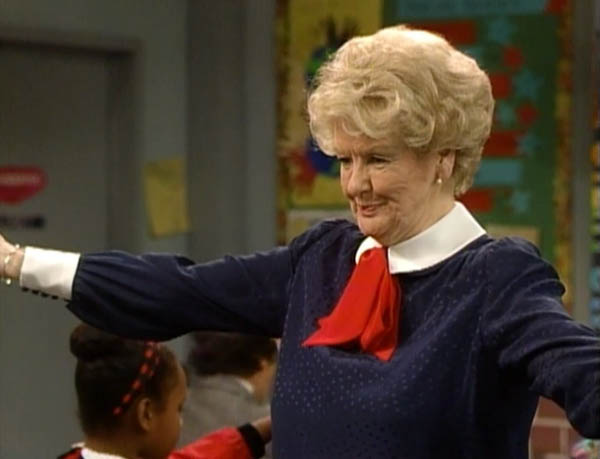
I have a very lucid memory of Stritch appearing on The Cosby Show in the late 80s. I didn’t
watch a lot of TV growing up, and I have no other memories of television of
this era as rich in specificity. For whatever reason (as memories do), Stritch’s
three appearances on The Cosby Show
find a way to the forefront of my consciousness from time to time. In the 70s
and 80s, Cosby was a star; even without the help of sycophantic tabloidism, I
was well aware of this. My parents had his comedy albums. I watched Fat Albert and the Cosby Kids Saturday
mornings. Even by the way he carried himself onscreen as the patriarch of the
Huxtable clan, you knew Cosby was something to behold. But here, in season 6 of
Cosby’s 80s vehicle, was Stritch as Rudy’s teacher, Mrs. McGee, going to
toe-to-toe with the giant that was Cosby. And I remember reading the credits at
the sitcom’s end and wondering, who the hell was Elaine Stritch?

Elaine Stritch was a star. 

To consider her stage credits is to review the history
of contemporary theater. The native of Detroit trained at the prestigious Dramatic
Workshop of The New School in New York. She made her theater debut before the
end of the Second World War and was a mainstay on stages in London and New York
for nearly 70 years. She performed the work of Noël Coward, Irving Berlin, and
Stephen Sondheim, among many others. Stritch was conceived for the stage. She
had it all: she was beautiful, she was funny, she could sing, she could dance, she
could drink, she could curse, and she had a voice that begged for your attention.
She would finally win a Tony upon her fifth nomination for her one-woman play Elaine Stritch at Liberty in 2001, a
review of her career that was still far from over at the time.

She was the original Trixie Norton on The Honeymooners

She was a contemporary of Marlon Brando, Ben Gazzarra, and
Rock Hudson, and dated them all.

She appeared in films with Charlton Heston, Tony Curtis,
Janet Leigh, and Jane Fonda. 

She worked with David O. Selznick and Woody Allen.

She lived in the famed Carlyle Hotel in New York. Who
else, but a star, lives in The Carlyle? 

And Stritch wanted to be a star. When asked why she chose
show business, she replied, “I want to be talked about. I want to be written
about. I want everything about me! And I don’t make any bones about that.” But
she never begged for it, not on stage, and not on screen. Instead she demanded
it, which illustrates the divide between stardom and celebrity.

But all of this meant nothing to a barely teenaged kid
watching The Cosby Show on a Thursday
night in 1989. There was no IMDB. No Wikipedia. My phone had no answers. But I
knew Stritch was a star. I knew by the way she carried herself. By the way she
allowed the acting of her younger less experienced co-stars to inform hers. By
her impeccable comic timing and palpable grace. By the manner with which the
studio audience fell for her every twitch, hung on her every syllable, cackled
at her every eye roll, breathed her every moment. By the way she commanded
attention without asking for it. But mostly, in the way she battled Cosby. In
their moments on screen together, one had the sense that you were watching
something magical, something brilliant, something special. 

Stritch made her last appearance on television on 30 Rock, playing the mother of Alec
Baldwin’s Jack Donaghy, a fierce and hilarious performance. Her work with
Baldwin and Tina Fey on the show was a fitting end to her television career: a
stage actress with a brilliant performance on a New York filmed sitcom. 30 Rock was a show that mocked the
industry within which it existed, the extravagance of celebrity, and the
superfluous nature of stardom. It argued that behind the curtain there were no
stars, only degrees to which the moderately talented were pandered to. I fear
this was more documentary than satire, or as Stritch herself put it, “Everybody’s
just lovin’ everybody else just too much for my money.”

Damn right.

Mike Spry is a writer, editor, and columnist who has written for The
Toronto Star, Maisonneuve, and The Smoking Jacket, among
others, and contributes to MTV’s
 PLAY
with AJ
. He is the author of the poetry collection JACK (Snare
Books, 2008) and
Bourbon & Eventide (Invisible Publishing, 2014), the short story collection Distillery Songs (Insomniac Press,
2011), and the co-author of
Cheap Throat: The Diary of a Locked-Out
Hockey Player
(Found Press,
2013).
Follow him on Twitter @mdspry.

FARGO, TRUE DETECTIVE, JUSTIFIED, RECTIFY and the Construction of the American Small Town (Part I)

FARGO, TRUE DETECTIVE, JUSTIFIED, RECTIFY and the Construction of the American Small Town (Part I)

null

PART
ONE

At some point in the second half of the twentieth
century, the way in which we think about the American small town, its
particular brand of community and stability, began to shift. "What
happened," according to Frederic Jameson, as he wrote in an essay in his seminal 1991
collection The Cultural Logic of Late
Capitalism
, “is that the autonomy of
the small town (in the provincial period a source of claustrophobia and
anxiety; in the fifties the ground for a certain comfort and even a certain
reassurance) has vanished.”  Thus, for
Jameson, “[w]hat was once a separate point on the map has become an
imperceptible thickening in a continuum of identical products and standardized
spaces from coast to coast.” This "thickening
continuum," a byproduct of our appetite for cable television, franchising
and box stores, and other modern amenities, posed a radical threat to small
town identity. As Jameson describes it, the American small town was once (but
no longer) "contented
with itself, secure in the sense of its radical difference from other
populations and cultures, insulated from their vicissitudes and from the flaws
in human nature so palpably acted out in their violent and alien histories." Of course, Jameson’s proper subject is actually the popular conception of small-town self-identity and, to the extent his commentary attempts to
speak for small towns, themselves, he’s guilty of a bit of simplification. In
other words, what Jameson describes is not necessarily your experience of small-town America. And it certainly wasn’t mine. 

I grew up, and spent my childhood,
living in the same neighborhood, in a small town in the northeast corner of
Maryland, tucked up against the Pennsylvania and Delaware borders. Elkton, named for its position at the
headwaters of the Elk River, which itself curled off of the tip of the
Chesapeake Bay, had a population of just over 9,000 residents when I left for
college in 1990. Elkton is the largest town in Cecil County. Like so many (but certainly
not all) rural American counties, ours was predominately white and conservative—in 1990, in fact, it was 95% white with 90% of its population living in
neighborhoods that were, themselves, more than 90% white. People
today are most likely to be familiar with Elkton from a few road signs that
clip by as they bisect the county heading north or south on U.S. I-95. In a
different era, it was known as an American Gretna Green, the marriage capital
of the United States—the result of liberal marriage laws so well known that,
when Ben Walton ran off to marry seventeen-year-old Cindy Brunson on Season
Seven of The Waltons, the couple
headed for Elkton. Those days are mostly gone, though wedding chapels still
dot Main Street.

Not all public awareness of us has
been so benign. The Elkton Walmart has,
in recent years, been the site of no small amount of cruel cultural absurdity, including
xBox-related near-riots, customers
superglued to toilet seats, and dead
bodies in Chrysler Sebrings.
Digging deeper, there’s also the county’s occasional flirtation with the Ku
Klux Klan, from rallies on local farms in the 1960s and -70s to
Klan-run anti-Obama meetings held in Elkton municipal buildings as recently as
last year. It
doesn’t matter that these rallies generally packed more bluster than bite, with
gawkers and protestors outnumbering participants. For many residents of neighboring
counties the area remains "Ceciltucky": defiantly redneck,
anachronistic. That view isn’t wholly misguided.
To some extent, it’s even a source of pride: my fifth grade gun safety class at
Gilpin Manor Elementary culminated (to my enormous delight) in a teacher-chaperoned
field trip to a local state park where we were given bolt-action rifles to fire
on paper targets.

My memory is both more complicated
and more sentimental than these data points might suggest. Yes, there’s the
recollection of perfectly-seasoned blue crabs piled high on newspaper-covered
picnic tables (with buttered and salted silver queen corn nearby).
The .99 movie theater in downtown Elkton where I saw Rick Springfield in Hard to Hold in 1984, the first movie I
ever attended without parental supervision. And, although there was ample bluegrass
music and square dancing, there was also the all-black-but-me Parks & Rec
basketball team on which I played (a cherry-picking) point guard and the
mostly-Catholic-but me CYO basketball team on which I played (a less-effectively
cherry-picking) point guard (and that once lost a game against a Wilmington,
Del. team 99-27). There’s also no question that I spent a large portion of my
teenage years dreaming of escape—into what, I had no idea. When I go back, however,
(and I do, when I can) it’s these memories that I’m revisiting. But it’s also
true that (contra Prof. Jameson) many of us welcomed the intrusion of
outlet malls, the internet, cable television, that whole thickening continuum
thing. Because, in an essential paradox, the extrinsic, pan-American
homogeneity that Jameson maligns resulted in diversity within our small towns, an increase in both the variety and quality
of services and products.  Improvements in
the quality of our day-to-day lives that helped narrow the sprawling distances
between how we saw ourselves and how we imagined everyone else in the free world
lived.  In other words, the isolation and
radical difference that Jameson places at the crux of small-town self-identify
may be nothing more than a symptom of perspective. In the end, I suppose, my struggle
to define my own experience keeps frustrating and coloring the way I watch a
variety of well-received television shows, including Fargo, True Detective, Justified, and Rectify, that have aired over the last few years. Each of these
shows has significant strengths—strong, charismatic performances, sharp
direction. But it’s no accident that the complexity of the moral universe at
issue in each show is dictated by location and perspective—by just how much
the writers confuse traditional representations of small towns or rural life
for the real thing. 

*          *          *          *

nullNoah Hawley’s miniseries Fargo is, ostensibly, the story of four
characters, the insurance salesman Lester Nygaard (Martin Freeman), the deputy
Molly Solverson (Allison Tolman), the Duluth policeman Gus Grimly (Colin
Hanks), and a killer, Lorne Malvo (Billy 
Bob Thornton), whose paths cross in and around the (very real) small
town of Bemidji, Minnesota (pop. 13,000). Although faithful in certain ways to
the Coen brothers’ film from which it derives its name and, at least loosely, setting,
Hawley’s Fargo is different, darker. In
large part this is due to the importance given to the character of Lorne Malvo—a contract killer and confidence man who is not from Bemidji. Or anywhere, really, which is probably the
first sign that he’s up to no good. Hawley,
who drafted each script himself but collaborated on the overall story with a
group of writers, has expressed a fascinated, forgiving relationship with Malvo,
describing him as “really interesting" and “a very fun character.”
Indeed, although Malvo slaughters dozens, Hawley has stated his belief that “the
violence [Malvo] does to the social contract is almost as bad as the real
violence that he does.” To Hawley, the philosophical purity of the Malvo
character sets him apart, and free: “When you see a shark swimming in the ocean,
you’re not judging the shark. We don’t judge Malvo because he’s not pretending
to be anything else.”
But Hawley can’t be serious—Malvo pretends to be “something else” at each
turn. It’s how he gains access to his marks and how he avoids capture. He veils
his threats against women and children in small-talk and friendly advice. In
other words, if we can’t judge Malvo, who can
we judge?  The answer, it appears, is
pretty much everyone else.

Malvo, shape-shifter,
has a Mephistophelean swagger, and it’s the Mephistophelean that places Malvo, and Fargo, squarely within a tradition of
Faustian American literature—what Hawley
has called the “stranger comes to town story”—a lineage  that includes (but isn’t
limited to) Mark Twain’s Mysterious
Stranger
and Ray Bradbury’s Something
Wicked This Way Comes
. Both novels use a (yes) mysterious stranger who visits
a small town to examine, to different conclusions, the way our desires lead us to betray ourselves,
our communities, and our values. [1]  Not surprisingly, perhaps, the books arrive
at different conclusions. Twain forwards a near-Nietzschean nihilism, leaving
no doubt that he views “civilization” as a leash burning at our necks, if not a
wholesale fiction. Bradbury’s Mr. Dark, on the other hand, is eventually
defeated by joy, familial love, and friendship. Provided with a choice between
the path of Twain and the path of Bradbury, Hawley goes dark, choosing Twain’s
model. Although the show ostensibly reinforces Fargo (the movie) in its appreciation of small-town common sense
(“decency trumps all,” is how one critic characterized the series’ conclusion),
given the show’s body count, it’s hard to view the triumph of small town values
as anything but pyrrhic. Where it counts, in its characterizations, the
day-to-day life of its citizens, Fargo
shares the cynicism and nihilism of Twain’s unrepentingly dark novel. But to
what end? Twain’s nihilism seeks to liberate man by stripping away the very
things the fundamentally conservative Fargo
ends up celebrating.

But perhaps the mixed messages are
to be expected. One takeaway from Hawley’s countless press interviews on behalf
of the show is that his Bemidji isn’t much more than a blank canvas onto which he
can project his ideas about good and evil—or, as he phrases it, about what
happens when a “civilized man meets an uncivilized man,” or
an “anarchic force enters polite society.” Our
enjoyment of the show hinges on how much stock we put in Hawley’s experiments
in human behavior, but this isn’t fatal to the show’s success. Nonetheless, it’s
hard to see Hawley’s “polite society” as much more than a petri dish in a spotless
laboratory. Although he describes his show as a battle between “the best and
worst of America
,” what
he’s really done is introduce a foreign agent into a static environment. (And
then reintroduced it, for that matter. Malvo returns to eliminate Nygaard for
unknown reasons and, absent that return, the story has no discernible momentum
or end.) It’s not the gauzy layers of snow and ice, the tense, beautiful
blizzard shootout, or the frozen lake into which Lester plummets at the series’
end that constitute the show’s blankness. It’s the lack of any perceptible
response from the town of Bemidji as the deaths mount—the series somehow manages
to squeeze thirty-four deaths into 10 episodes.
In spite of the carnage, Hawley clings to a "romantic idea
that you go off and you face evil and you come back and your reward is to lead
a simple life," that what these characters have faced is not, in the end,
a "dark journey." Of
the series’ four main characters, one has been shot and wounded, two have been
turned into killers (one already was
a killer, of course), and two are dead. The town, itself, is piled high with the
bodies of people who, if Grimly does his job in Episode One, would have been spared.
By my measure, the only people who might come out on the other side events like
these without being “haunted” are people who never really felt anything in the
first place.

The cost of Hawley’s
“romantic idea” is that it necessarily strips Bemidji of collective or
institutional knowledge. The town is never granted a life of its own, even at
the baseline, fight-or-flight level of self-preservation. [2]  As a result, we don’t
think twice when Malvo sits across a diner counter from Deputy
Solverson’s father Lou (Keith Carradine), an ex-state trooper, and Lou doesn’t
recognize him.  At this point in the
series, of course, Malvo has been caught on camera kidnapping a murder victim,
arrested, and even interrogated by Lou’s now-son-in-law.  And yet, even after Malvo creepily inquires
about Lester, the man at the center of
his daughter’s investigation
, he is permitted to drive off without anyone
in pursuit. All of this is of a piece with Hawley’s failure to allow Bemidji an
existence greater than the sum of its parts. And
those parts are inherently limited: so many of the citizens of  Bemidji are self-interested and venal,
bullies and predators. The women, in particular, fail to generate sympathy—whether it’s Gina Hess (Kate Walsh), an ex-dancer who laughs off her husband’s murder
and chases the insurance payment, Kitty Nygaard (Rachel Blanchard), Lester’s
sister-in-law, a vain ex-beauty queen, or the needling wives of Lester and
Milos (both are relentless and shrill). Although the characters are sharply, if
superficially, drawn, an air of entitlement emanates from each. Even Linda
(Susan Park), Lester’s sweet, boring, second wife, admits to Lester just before
she’s shot that she coveted Lester while he was still married and fantasized
about “getting his wife out of the picture”—she envisioned herself as a
“Cinderella,” clinging tightly to the belief that Lester “would come along and
take her away from all this.” It’s not just
the women, of course. Sam Hess (Kevin O’Grady), Chaz Nygaard (Joshua Close), and
Milos Stavros (Oliver Platt) are each the asshole father of daft, cruel, and/or
damaged children.  In the end, it’s hard
not to feel that the grisly or abject ends greeting so many of these characters
constitute karmic punishment. 

For all of Hawley’s talk about the
“stoicism” of Midwesterners, the motives of Fargo’s
characters are never far from this surface. 
Maybe this is meant to suggest a regionally-specific anti-mystery or maybe
it’s just a convenience. In either case, it’s a far cry from the Coens’ vision
of small-town Midwestern life, where the conventions of “Minnesota nice” create
inscrutability. Hawley has stated that his “job was not to portray
Minnesota as it is in real life. It was to portray the Minnesota that Joel and
Ethan portrayed in the movie.” In keeping with this, perhaps, he doesn’t pay
much attention to Bemidji as it
actually is (it’s a hub of Native American culture, though there’s not a single
Native American character on the show). [3]
But how true is he to the Coens’ vision? If there’s a takeaway from Fargo the movie, it might be that the
inherent inscrutability of human behavior is not a reason for nihilism or
solipsism. Marge Gunderson’s (Frances McDormand) short soliloquy, as the movie
wraps up, distills this to a point:

"So that was Mrs.
Lundegaard on the floor in there. And I guess that was your accomplice in the
wood chipper. And those three people in Brainerd. And for what? For a little
bit of money. There’s more to life than a little money, you know. Don’tcha know
that? And here ya are, and it’s a beautiful day. Well. I just don’t understand
it." 

Of course, for Peter Stormare’s Gaear Grimsrud, it
isn’t about money at all. In the end, Marge’s incomprehension of his motives
proves no bar to her pursuit—though she is aided by a brief encounter with an
old classmate, Mike Yanagita, that spurs her to push deeper. In one of the
film’s more remarkable scenes, Marge figures out, over dinner at the Radisson during
a work-trip to Minneapolis, that the emotionally disturbed Yanagita has lied to
her about his life (inventing both successes and tragedies) in order to make a desperate,
loneliness-driven pass at her. In the course of ten minutes, the Coens show us
two sides of “Minnesota nice.” 

Although Marge’s trusting nature temporarily blinds her to Yanagita’s motives,
she nonetheless uses Yanagita’s desire to conform to “Midwestern” conventions
(modesty, a desire not to cause a scene, the fear of imposing on another) to
reject him gently but firmly, defusing the situation. Beyond this, however,
Yanagita provides Marge with a glimpse at the obscure alchemy that transforms human-scale
desire into elaborately irrational action, a realization that sends her back to
re-interview Jerry Lundegaard. If there is a single scene in Fargo (or any Coens’ movie) that defines
the Coens’ vision, it’s this one.  And
yet Hawley’s comments in interviews suggest that he never completely grasped its
importance,
a fact I can’t be alone in finding troubling.

*          *          *          *

nullHawley’s exposure of the
barely-concealed venality underlying the placid surface of Bemidji suggests
less the Coens of Fargo (venality and
greed have their place, but the characters rarely fall prey to
one-dimensionality) than the David Lynch of Blue
Velvet
and Twin Peaks. This is,
perhaps, a natural or even obvious parallel, given that both Fargo and Twin Peaks are thematic continuations of revered films. An overt
debt is suggested by Lorne Malvo’s discourse on pie in Fargo’s penultimate episode, as well as the presence of  Bemidji Deputy Bill Oswalt (Bob Odenkirk) who,
like Twin Peaks’ crime-scene weeper
Deputy Andy Brennan (Harry Goaz), can’t handle the sight of a dead body. Both shows,
as well, provide sly, structural acknowledgements that they take up where their
predecessors left off. In Fargo, it’s
the bag of ransom cash left behind by the film’s ill-fated Carl Showalter and
found by the show’s ill-fated Milos Stavros. In Twin Peaks, there’s the way the opening credits move from an image
of a Varied Thrush to the town’s churning mill machinery, a casual
deconstruction of the mechanical robin that sits on the windowsill, a beetle in
its mouth, at the end of Blue Velvet.
In each case, we are assured the stories, although different, are nonetheless
connected.

Of course, it’s not exactly novel
to acknowledge that Fargo owes a
great deal to Twin Peaks (the list of
shows with a similar debt is long and distinguished).  Still, something seems to get lost in
translation. Whereas Fargo (the
series) adopts the naturalism and
realism of its forbearer —not just the pretty snowscapes, but the grubby
reality of ice-laced sidewalks, parkas, mukluks, and bulky sweaters—Twin Peaks eschews naturalism for Peyton Place-like melodrama. Lynch’s
performers, pushed toward soap operatics, enact a kind of repeated denaturalization.  Twin
Peaks
’ distance from realism (and the
real
) is established from the opening credits of the first (and each) episode,
which inform us that Twin Peaks is far from
a small town (pop. 51,201).  As a result,
the sense that it’s a place where everyone knows everyone else (Laura Palmer’s
corpse is recognized by everyone at the crime scene) isn’t based on geography, demographics,
or any other extrinsic ordering principle. In other words, the world Lynch is
exploring is, and is not, ours. It remains unbounded by logic even as it mimics
the narrative logic of other genres.

In the end, the Lynch of Blue Velvet and Twin Peaks is less concerned with human nature than he is in the
ways we simplify it—and thus betray it—through representation. Indeed, the
“wholesomeness” of Twin Peaks is really the construct of Agent Cooper (Kyle
McLachlan)—who eventually takes up whittling because it’s “what you do in a town where a yellow light still means
slow down, not speed up”—and not the town itself, which is full of secrets. The image
of Blue Velvet’s fop-ish Jeffrey
Beaumont wandering the streets of a very 1950s-appearing Lumberton (in what
Jameson would describe as a “synthesis of nostalgia-deco and punk,” but what
non-academics might identify as an art-house cousin of Back to the Future’s Marty McFly) swaps historical linearity for an
eternal feedback loop in which artists merely adjust the dials. At its best,
however, Lynch’s fusion of “aw-shucks sincerity” with a non-programmatic pastiche
hints at genuine mystery within the “depthlessness." Indeed, in a period
when small towns could be elevated to the level of fetish through the violent,
nationalistic jingoism of movies like Red
Dawn
(1984), attacking these representations at the root is admirable. In a
sense, Jameson mistakenly identifies depthlessness where there is simultaneity.
And he fails to give enough credit to Lynch’s attention to the animal drives
underlying the placid, constructed surface of wholesome Americana. Sure, we
push through the lush grass at the outset of Blue Velvet to find the terrifying, chittering beetles churning
beneath. But what separates those beetles from the robin that devours them? In
other words, in the Lynchian universe, "civilized" and "uncivilized"
may be nothing more than a matter of perspective.

Although Hawley’s Fargo foregoes Lynchian pastiche, it doesn’t
avoid pastiche altogether. Instead, his series is a collage and pastiche of the
Coens’ films as a whole, with the heaviest cribbing coming from No Country for Old Men and A Serious Man.
And, indeed, the nihilistic outsider has a long-standing place in the Coens’
cosmology, spanning from Tex Cobb’s bounty hunter in Raising Arizona to Anton Chigurh in No Country. But this “mash-up” of radically different source
material leads to problems. Even the Coens, masters of tonal manipulation,
struggle at times to keep their competing tonalities in balance. When they
fail, they slip into belittling condescension (Burn After Reading, A Serious
Man
). Fargo (the movie) took some
heat from critics for this on release, but in watching it now, its balance and
control seem exceptional, a highpoint in the Coens’ filmography.  The laughs are real, but its swift, graphic
violence is unsettling. For the Coens, there is no “good America” or “bad
America,” only America in endless variety. 
Thus, the cultural conventions that amount to “Minnesota niceness” are
nuanced and, like all conventions, neutral. In other words,

Midwestern
niceness can be deceptive—a form of fiction, or a means of avoiding the
unpleasantness that constitutes so much of the world. If the Coens only
highlighted the pleasant parts of the Midwestern disposition, that would be
condescending in its own right. Smartasses they might be, but they respect the Midwest enough to chronicle it in all its niceness and its
complexity.

But Hawley lacks the Coens’ mastery, and his Fargo provides little evidence of the
generosity—the grant of personality, intelligence, agency —that a sense of
the “tragic” requires. The reliance on stupidity and venality to drive the
series’ plot has significant psychic costs. In particular, I’m thinking of the
death of Glen Howerton’s Don Chumph, whose dimness and small-scale ambitions
(he wants to extort just enough money to open a Turkish bath) are seized upon
by Malvo, who belittles his dream and orchestrates his death. That death, duct
taped with a shotgun to a chair, in a hail of bullets that would make Peckinpah
proud, is given an operatic treatment so much larger than Chumph’s life that it
can only be seen as a last joke at his expense. It’s one thing to play the
dimness of your characters for laughs; to then dispatch them violently,
mercilessly, or worse, humiliatingly, is nothing more than cruelty.

*          *          *          *

null


Fargo
isn’t the only major
miniseries of the past year that centered on a mysterious outsider spinning
webs of Philosophy 101-level nihilism, of course. There’s a moment early in Nick
Pizzolatto’s True Detective, the
camera tracking Detectives Martin Hart (Woody Harrelson) and Rust Cohle (Matthew
McConaughey) from high above their Chevy Caprice as they glide through the
Louisiana countryside, where Cohle offers his opinion of the people he’s sworn
to protect and serve: “People around here,” he says, “it’s like they don’t even
know the outside world exists. Might as well be living on the fucking moon.”
Like the clockwork universe of Hawley’s Fargo,
True Detective’s Louisiana also takes
issue with individual ambition. Down on Louisiana’s southernmost edge, in
Pelican Bay, the grandfather of murder victim Rianne Olivier restates the
sentiment as an ethical imperative, suggesting that her disappearance is the
result of fatal immodesty: “Everybody
think they gonna be something they not. Everybody, they got this big plan.”

True Detective doesn’t
share Fargo’s single, coherent
community, of course. As enamored with Louisiana’s landscape as True Detective is – the camera lingers
over not only its idiosyncratic natural landscape but also its “jigsaw” of
pipelines and the refineries – it’s far more interested in that landscape as a site
of cosmic horror than in socioeconomics. As a result, the show traffics in clichés
of Bayou exoticism: the Cajun, the Creole, corruption and conservative
politics, “Santeria and Voudon all mashed together,” Mardi Gras, evangelism, a
swampy apocalypticism. [4] As
Detectives Cohle and Hart move among the kith and kin of the murder victims, the
thread tying the various characters together seems to be a feeling of persistent
degradation: the headaches and corroded hands of Dora Lange’s Mother (Tess
Harper), the neurologically-damaged former baseball player Danny Fontenot
(Christopher Berry), Burt (Douglas M. Griffin), the castrated and
mentally-handicapped member of a local church, and even Tiger Thomas (John
Eyez), the drug dealer kidnapped and tortured by Ginger and his crew of Iron
Crusaders. 

These witnesses and leads never
amount to much more than a gothic menagerie (a touch of Flannery O’Connor, a
bit of Night of the Hunter). They
provide True Detective with rich
atmospherics, and an occasional red herring, but Pizzolatto doesn’t ask his
audience to imagine the day-to-day (let alone the internal) lives of the characters.
Instead, they’re emblematic of the forces of entropy (both natural and
cultural) that continue to work on the landscape and its inhabitants, the
zombie population of Cohle’s “fading memory of a town.” This persistent
degradation—of memory, culture, and landscape—presents a staging ground for
cosmic terror.  Our brief experiences
with the residents of southern Louisiana makes it abundantly clear that they’re
incapable of resisting whatever forces are at work. And Errol Childress (Glenn
Fleshler), in the grotesque grandeur of his ruined family and his ruined home,
is the embodiment of that terror. Perversely, and fittingly, it is in the
chaotic aftermath of Hurricane Katrina’s destruction that this evil is
permitted to "have a real good time."

Of course, True Detective was, from the jump, more interested in what was
going on inside that Chevy Caprice than in how people live outside it, in the
dialectic between the flinty Cohle and the good-old-boy Hart (with its easy
reduction into “cold” and “hot” and “coal” and “heart”): the former shunning
community while secretly craving it, the latter arguing on its behalf while
constantly betraying it. Hart invites Cohle to dinner, but doesn’t really want
him to stay; Cohle doesn’t even want to show up and yet lingers in conversation
long past (Hart’s) welcome. When we finally arrive at the story’s end, after the
climax has finally, definitively divorced the story from reality, it’s pretty
clear that the narrative and emotional drive of the series is fundamentally
that of a Romantic Comedy (by way of its homosocial cousin, the “buddy cop”
story) that happens to have a Southern-fried supernatural thriller grafted onto
it.  Because of this, the show’s
preoccupation with the relationship of its main characters means that we hear a
lot about what the characters think
about community rather than experiencing that community for ourselves. And yet
there are moments that reveal the region’s social and cultural transformation
as, over the years, the pastoral background gives way (enacting Jameson’s
“imperceptible thickening,” perhaps) to an anodyne wasteland of strip malls and
storage units. When the detectives visit a dilapidated bunny ranch tucked off
of the secondary roads near Spanish Lake, we glimpse the myriad ways in which
cultural and/or economic entropy can lead to new social arrangements.  It’s also one of the show’s sole assertions
of female autonomy. Even if that autonomy is colored by sexual commerce, it
stands out from the other scenes in which Cohle and Hart talk with witnesses by
being something more than a simple reification of narrative hierarchies.

*          *          *          *

What is it
about these small towns and rural spaces that inspired Hawley and Pizzolatto to
animate them with their cosmic and/or philosophical stories of good and evil?
Their reasons are different on a number of counts, I’m sure.  But I can’t help but think they share at
least two. The first is a reliance on their settings as “separate points on a
map,” a separateness that allows them to control their experiments in good and
evil but only at the expense of nuance and complexity. The second is diminished
expectations. Whether it’s the novelty of Hawley’s surprisingly cruel
Minnesotans, or the passive acceptance of the evil in the midst of Pizzolatto’s
Louisianans, stereotypes and assumptions about the people who inhabit the shows’
locales allow Hawley and Pizzolatto free reign to wax exegetic on so-called
forces of light and dark. Indeed, it’s hard to imagine anyone accepting their
manipulations anywhere but the "moonscape" of small town or rural
life.  As with Jameson’s essay, however, this
tells us more about how we imagine small towns than it does about those who
live in them.  Of course, our own
collective imagination has been influenced by a long, pervasive history of
representation. Shows that manage to step outside or beyond the level of
stereotype or trope are rare.  The second
part of this essay will discuss some of that history and two recent examples of
shows that complicate it.

Spencer Short is an attorney and author. His collection of
poetry,
Tremolo (Harper 2001), was
awarded a 2000 National Poetry Series Prize. His poetry and non-fiction have
been published in
The Boston Review, Coldfront, the Columbia Review, Hyperallergic,
Men’s Digest, Slate, and Verse. He lives in Brooklyn.


[1] Thornton
has described his character in interviews as “this mysterious stranger who
comes to town.”  See http://www.vulture.com/2014/04/billy-bob-thornton-fargo-interview.html

[2] The graphic nature of the violence in the
Coens’ Fargo leaves one with the mistaken impression that there are far more
casualties than there actually are. Further, the Coens’ directly reference the
impact violence has on community in Blood
Simple
, a phrase taken from Dashiell Hammett that acknowledges its
collective psychic toll.

[3] In this sense, “small town” fictions,
particularly in the Midwest, provide an opportunity to avoid pesky diversity
issues.  In Fargo, the cast is overwhelmingly white, and the few minorities
written into the script are the object of ridicule, violence or both.

[4] As others
have noted, the Louisiana landscape is a perfect fit for Pizzolatto’s purposes
– which is probably why it’s also the setting for HBO’s other series about the small-town supernatural, True Blood. 
See
http://www.slate.com/articles/arts/culturebox/2014/03/true_detective_louisiana_is_more_than_just_the…

ARIELLE BERNSTEIN: Ciphers, Masks and Longing: Old Hollywood Ethos and Lana Del Rey

ARIELLE BERNSTEIN: Ciphers, Masks and Longing: Old Hollywood Ethos and Lana Del Rey

nullLana Del Rey’s latest album, Ultraviolence, is filled with hazy and seductive contradictions,
affirming the glamour and seduction of old Hollywood icons, femme fatales with
Veronica Lake waves, and mobster wives with baby voices. Del Rey is certainly
not the only female singer to be drawn to these motifs.  But the worldview that Del Rey constructs is
not Beyonce’s sepia-hued “Why Don’t You Love Me?”, where Queen Bey playfully
dismantles the image of the 1950s housewife.

Nor is it Madonna’s
wink to Marilyn Monroe in her video for “Material Girl.”

Del Rey isn’t
interested in reclaiming the figure of the housewife or movie star. In fact she
takes her feminine icons very seriously. 
Her video for "Shades of Cool," for example, has echoes of Marilyn Monroe’s
famous pool scene in “Something’s Got to Give,” and in “Brooklyn Baby” she
references her in lyrics, based on some of Monroe’s famous diary entries where
she wonders why no one takes her seriously.

The world of Ultraviolence is filled with reverence for a
rock-and-roll lifestyle that many feel has already come and gone, but that Del
Rey clearly appreciates for more than the sake of nostalgia. In interviews she
has explained that her songs are mostly autobiographical, plucked from times in
her life when she has felt most lost, and also the times, generally in the arms
of a lover, when she has felt most genuinely free.

One of the main reasons that Del Rey has been maligned has to
do with the fact that she is an artist who is more interested in the masks we
wear than in being a “strong female role model.” Critics of Del Rey have long
denied her authenticity (her records under her given name, Lizzy Grant, looked
and felt intrinsically different than her first album as LDR, Born To Die) as well as her agency. Del
Rey has historically been seen as a pawn of record executives, or, even worse,
as a figure that is merely empty and submissive. Pitchfork called Born To Die the “equivalent of a faked orgasm” and critics like Ann Powers
lamented that Del Rey represented “the worst parts of being a girl.”

For a woman to be perceived as “submissive” or “docile” is
the ultimate feminist insult, even though these words are often strangely
unspecific, related to being gentle, soft-spoken, quiet, or even just being
disarmingly pretty, or liking or wanting male attention. Songs demanding better
treatment and female empowerment existed before the girl power anthems I grew
up on in the late 90s and early 2000s.  In
the 60s, Aretha Franklin demanded respect . . .

. . . and Carole King and
Joni Mitchell urged us to listen to women’s stories; artists from Madonna,
Beyonce, Christina Aguilera, TLC to Lil Kim, Missy Elliott, and Nicki Minaj
often explicitly sing about double standards in the music industry and in the
bedroom. While they all define it in a different way, each artist explicitly
urges women to seek empowerment above all else.

Del Rey doesn’t play into this script. Catherine Vigier,
whose essay The Meaning of Lana Del Rey is
often discussed when pop culture critics lament the influence of Del Rey on the
Millennial generation, claims that one of the reasons Del Rey is so controversial
is that she is a woman who is clear that she doesn’t know what she wants, in a
world where feminists argue that knowing what you want is the ultimate and
definitive feminist act.

But is Del Rey’s desire to play with the many masks she is
given inherently anti-woman? In recent interviews Del Rey has made it clear
that she is less interested in talking about feminism than space, a quote that,
like many of Del Rey’s quotes, could lead to a thousand different interpretations.
In truth, Del Rey’s influences are mostly moody depressives, icons like Kurt
Cobain, whose vulnerability was read as “sensitive,” rather than “vacant.”

Unlike many current female artists, like Lily Allen, and
popular comedians, like Amy Schumer, whose social commentary is laid thick with
sarcasm, there is something about Del Rey that is disturbingly earnest.

Her constant need for
sex is more akin to The Rolling Stones’ howl for “Satisfaction” than Samantha’s
need to get laid on Sex and the City.

Del Rey is closer to a character in a Mary Gaitskill
collection: she is a submissive, like many of Gaitskill’s narrators, who seek
out fantasies and are ultimately calling all the shots, rather than an empty
headed, meek ingénue like Anastasia in Fifty
Shades of Grey.

Though some insist that Del Rey’s nostalgic styles are
inherently anti-feminist, female sexuality in pre-code and even post-code
Hollywood,was, in reality, filled with saucy, sexually assertive women, vixens
and femme fatales who played up their sexual charms joyfully—Barbara Stanwyck,
Marlene Dietrich, Greta Garbo, Josephine Baker, as well as the ever delightful
Mae West.

Playful banter remained a mainstay in classic Hollywood
cinema, where female wit was both smart and playful, a way to reel a guy in or
keep the men at bay. Heterosexual banter often sizzled on screen because it
managed to highlight sexual tension between equals.

Del Rey is certainly more Marilyn Monroe than Mae West, but
her self-described “gangster Nancy Sinatra” image is also one that is much more
about the female gaze than the male one. Del Rey is obsessed with the way women look at men, about
the desire to be desired. In the video for “Blue Jeans”, for example, we watch
Del Rey watching her lover undress, her face sinking into pure pleasure as he
gently slides his fingers into her mouth.

In her video for
“Ride,” Del Rey is in constant pursuit of pleasure, her little red sneakers
walking tentatively on pavement, her hands thrown back in the air, while riding
on the back of a motorcycle.

If she lives for the
men she loves, as many criticize, it is also those men who are cheering for her
in the spotlight. Is the desire for male attention inherently anti-feminist,
as some theorists claim? For men like The Fonz on Happy Days, The Situation on The
Jersey Shore
, and Barney Stinson on How
I Met Your Mother
, their entire sense of identity is based on their ability
to pick up chicks. Indeed, the same is
true in many commercials. Take, for instance, the Axe body spray commercial,
predicated on the idea that male power is derived from the ability to score
with a hottie.

When men alter their
body hair, douse themselves in cologne and use “pick-up artist” techniques,
they are seen as active, free agents, in charge of their own destiny, but when
women like Del Rey paint their nails, don pretty dresses and talk about boys
they want to love, they are dismissed by many men and women as being
empty-headed and unserious. 

The Bechdel test, the idea that female characters in a movie
should have at least one scene where they are talk to one another about
something other than a male romantic interest, is often cited as a means of
figuring out whether female characters are allowed true agency. If one uses
this test as a guideline for romantic and sexual obsession for heterosexual
women, it automatically reduces the complexity of their characters. This idea
plays itself out all the time, especially in films targeting teenagers. Male
teen lust is portrayed as natural, and learning to approach women is seen as a
way that young men can build their identity. In contrast, teenage girls and
young women who are interested in romance are often portrayed as foolish,
unintelligent, or “boy-crazy”. 

For all her sauciness, Mae West would have failed the
Bechdel test. Throughout her self-made career she was often portrayed as the
single female being admired by a gaggle of men eager for her affection and
approval. She is obsessed with
seeing herself as an object of great desire, which she doesn’t see as being
antithetical to being seen as an individual who can get whatever she wants with
her fiery wit and her insistence on being taken seriously.

Del Rey insists on a different kind of seriousness: she
really wants her despair to be seen as human, for her conflicted desires to
reach the same level of gravitas that we afford male leads. One of her favorite
icons, Marilyn Monroe, wanted the same thing: to be taken seriously for her
intelligence, for her viewers to look beyond the mask—that baby voice, that
golden coifed hair—and see the person underneath the artifice. 

Unlike Monroe, whose desire to be seen for her humanity over
her status as “sex icon”, went largely unrecognized in the era she lived, Del
Rey’s status in a post-third wave feminist world is constantly discussed. But perhaps Del Rey’s image is charged
precisely because viewers haven’t changed as much as we think we have since the
40s and the 50s, when a post Hays code world supplied a crib sheet for what
desirability looked and sounded like. In her article, “Pretty When You Cry,”
for Pitchfork, Lindsay Zoladz claims there is in fact something subversive
about Del Rey’s insistence on sadness, her refusal to wear a happy face; in a
world where people often demand female exuberance, Del Rey refuses to placate
audiences with a smile and a wink.

While I grew up on the angry rock anthems
of artists like Fiona Apple, Tori Amos and Alanis Morrissette, I also take Del
Rey seriously when she says she doesn’t find feminism particularly interesting.
Despite how drenched in femininity her persona is, Del Rey is much more
interested in being an icon, period, than a female icon, and her gritty image
on Ultraviolence is all about
swagger. In “Ultraviolence” she croons The Crystals’ uncomfortable lyrics, “He
hit me and it felt like a kiss,” and sounds like a breathy Bill Withers
beckoning a lover, “If it feels this good being used / you just keep on using
me / until you use me up.” In this same song she also references the
novel Lolita, which Del Rey has often
cited as a source for inspiration.

In the end, Lana Del Rey could care less about your girl
power anthems and political charges. Ultraviolence
is about the contradictions in the human experience—lust and sadness and
existential need and desires that don’t have easy answers and won’t be fixed
with better public policies. The world of
Ultraviolence
is important not because it necessarily has specific
political aims, but because it is about the messiness of the human experience
and how, no matter how many power ballads we write, true satisfaction, for men
and women, is still often mysteriously elusive.

Arielle Bernstein is
a writer living in Washington, DC. She teaches writing at American
University and also freelances. Her work has been published in
The
Millions, The Rumpus, St. Petersburg Review and The Ilanot Review. She
has been listed four times as a finalist in
Glimmer Train short story
contests
. She is currently writing her first book.


***A special thanks to Serena Bramble for the Monroe/West/Bacall and Knowles/Mitchell/Dietrich medleys posted above!***

Richard Linklater’s BOYHOOD Recreates the Experience of Reading

Richard Linklater’s BOYHOOD Recreates the Experience of Reading

nullA large part of writing a review is telling what experiencing the work in question is like—the feeling one gets when reading, or watching, or listening,
or looking. This can be difficult, especially in works that reach deeply, that dig
into seldom explored territory. If I say that watching Richard
Linklater’s remarkable new film Boyhood,
which traces the life of a boy named Mason from age 6 to 18 in rapidly
changing segments, is like reading a
book, I need to clarify. The idea is not that the film could be “read” like a
book, each element analyzed to consider how it functions within the work as a whole; that goes without saying. The film, instead, acts on you the way a book
might act on you, which is to say, it doesn’t force itself on the viewer, and
in fact it asks the viewer to force itself on it, to make sense of it, to keep
going with it, and to sit with it, for a while, to see where it’s going. And the film does go somewhere which might remind viewers suspiciously of their own lives.

On the most basic level, we get to know, or at last
understand, Linklater’s characters in a gradual and highly relaxed fashion. In
many scenes, the characters, as they age together in different locations in
central to West Texas, simply sit and have conversations with each other. In so
doing, they teach us about themselves. We learn, through his introspection,
that Mason (Ellar Coltrane) is a thoughtful boy whose greatest spiritual investment will always
be in his own ruminations. His mother, played here with a great sense of regret by Patricia Arquette, reveals herself to be
caring but lacking in judgment, which will sadly shape her children’s lives,
causing them to move from house to house throughout their childhood, sometimes
suffering abuse from their mother’s poorly-chosen partners. In a very subtle
and moving performance, Ethan Hawke plays their father, likable on the
surface, but a near-archetype of a shady, untrustworthy dad. We notice all of
these things, and we pay attention to them, and we think about them, because
Linklater forces us to. There aren’t any exploding cars in the film. No one secretly
turns out to be a robot. There are no musical numbers. One is free, then, to
make observations, to interpret, and to absorb. One might find one’s self
making judgments, of a sort. Though the kids’ father is erstwhile in many respects, he
has far better chemistry with his children than either of the partners their mother
chooses after him.  We watch Mason’s sister Samantha (Lorelei Linklater) developing from a
mannered, funny child into a cool adult with odd phrasing (when it’s her turn
to make a speech at her brother’s graduation party, all she says is “Uh… good
luck.”), and the difference is noticeable. She’s lost the forwardness she
had as a child, but it’s metamorphosed into something more interesting, or more
deeply rooted within her. These are nuances that are not necessarily always
brought out in films, given so many films’ debt to drama itself, which demands a
structure, a pace, which does not encourage extensive lingering.
Linklater has achieved a strange marriage of two works: one film which tells the
story of a life, and one which tries to be interesting without telling any
story at all. The elements that might interest a viewer here—family dynamics,
the effect of aging, outer and inner growth—require meditation, and they don’t
require the framework of a plot to be meaningful. This is the kind of license taken frequently in literary works–writers from Chekhov to Ann Beattie to Karl Ove Knausgaard have availed themselves of it–but not seen as frequently in film.

The structure here is a very matter-of-fact one–you might miss it if you were weren’t looking, so seamless is Linklater’s deployment of it. As has
been widely discussed, Linklater made the film over a twelve-year period,
taking the actors aside for a couple of weeks each year to film a short segment, a
handful of minutes. The development in the film is based simply upon the
passage of time, a strong reminder that nothing the characters might do could
make the years move any more quickly, or slowly. Mason’s mother refers to this, at
the end, when she cries that she thought there would be “more” before her son
left for college—but as we know, nothing makes the days any shorter or longer.
The time Linklater allowed himself for the film seems to have tinged the entire
venture with a contemplative mood. The years pass without fanfare. The only way
we know the characters have aged, or that time has passed, is by the change in
their appearance. We are forced, then to look at these people, really look at them. We watch the mother
put on weight, slightly, as she gets older; she begins to look more settled, if
not complacent. We watch the childen’s father lose his youthful spark, fill out a bit,
mellow in his mood; his laughs don’t come as quickly, there’s not as much sense
of destructive mischief in his eyes. And Mason grows larger, more
stoop-shouldered, his features increase in size, he becomes less comfortable in
his skin, more self-conscious, his voice acquires the faint rasp of someone
who’s been shouting at a concert for the last several hours. These, then, are
the events we witness, and they become as interesting as an exploding
half-human car might be in another film. This sort of motion, in which inner
changes and developments loom largest, forming the topography of a work, is an example of something a book can do that a film, simply by virtue of the medium, might not do so easily. You sit with a book,
quietly, and read it, and things such as characterization, a description of
someone’s eyebrows, a well-placed phrase, become gigantic. They become large
enough to sustain the work, in some cases, and they may be the things you take
away most from the experience. But this viewer has found that, often, films must offer a slightly greater plenitude of elements to sustain themselves.

In a sense, saying that watching a certain film is like
reading a book might seem critically useless. How can one compare two
experiences that are so radically different, and that access such radically
different parts of the brain? You can’t hear a printed book any more than you
might read a montage out loud. Also, how can one make generalizations like this? And yet, and yet:
everyone approaches artistic experiences from a different starting point. For
this writer, reading is one of the most meaningful, important experiences he
might have—there’s competition for that spot, of course, but it ranks highly, up there with love and food. And so
there’s a little voice in this writer’s head, chattering away as the Linklater
film unfurls itself: Is this as good as….? Is it up to the experience of…? Yes,
I know you enjoy it, but is that enjoyment as great as the enjoyment of…? And if the answer to these questions is yes, the experience of watching Boyhood is equivalent to the satisfaction one has after reading a wonderful, spare piece of writing, which is to say one feels moved and quieted, given a fresh awareness of one’s place in the world, then that is the highest compliment this reviewer could pay the film.

Max Winter is the Editor of Press Play.

Apes vs. Zombies: New Skin for the Old Apocalypse in DAWN OF THE PLANET OF THE APES

Apes vs. Zombies: New Skin for the Old Apocalypse in DAWN OF THE PLANET OF THE APES

nullMatt Reeves’ Dawn of
the Planet of the Apes
echoes George Romero’s Dawn of the Dead in more than just its title. Both films are concerned
with the end times, and both films explore the nature of what it is to be human by
thinking about the nonhuman.  Both films
are also part of larger franchises, Apes being
the second installment of a reboot that is, astonishingly, superior to any of
its antecedents. Dead, likewise, is the
second installment of a series that would spawn countless imitators, most of them as
mindless as the zombies they portray. 
Like the fictional diseases that create them, zombie films are a virus,
and like a virus they need a powerful antibody to destroy them: Dawn of the Planet of the Apes might
just be that antibody.

Many theories have been advanced as to why zombies have
become such a cultural obsession. Though several theories are plausible, I would
suggest that their popularity is largely due to our abiding fear of nature. Not the nature of majestic trees, rolling
hills, and rippling streams, but the nature of
germs, bugs, and putrefaction. The nature we don’t like to think about but that increasingly rules our lives.  Zombie films are essentially about what
happens when the drugs don’t work, when we no longer have a means of controlling
these unmanageable mounds of flesh we call our bodies.  On those rare occasions when they focus in on
this weird biology (as in World War Z)
or on its larger societal impact (as in 28
Days Later
), the model of the zombie film can make for surprisingly thoughtful pieces of
horror.  More often, however, the zombie
premise serves as a cheap device that enables a select group of alpha males to act
out their survivalist fantasies.  A
potentially radical premise for exploring what we’re made out of, and what
bodies mean, generates instead an endless mashup of Soldier of Fortune with The
Book of Revelations
.

And this is why we need a new take on the old apocalypse.  Anyone who’s paying attention knows that the human species is well nigh fucked, and since our politicians are largely in denial
of this, we depend on artists like filmmakers to tell us stories about the
world we’re soon to be living in. 
Science fiction helps us think about the future, and hence it is always
political. You can either tell a story about how people work together to make a
bad situation better, or you can tell about how a few tough guys kick ass.  As the zombie genre seems to have devolved
into the latter, it’s time for a new way of talking about the end.  Enter the ape virus.

Rise of the Planet of
the Apes
ended with the spread of a virus that kills humans while making
apes smarter.  Remarkably, this felt less
like an apocalypse than a fresh start. 
Humans in that film, with the possible exception of James Franco, are portrayed as sadistic, slippery, and selfish, while apes are
compassionate, candid, and cooperative.  Humans
manipulate nature for their own ends, while apes live in harmony with it.  I can’t think of any other film where you feel like cheering when another species takes over the world.  By comparison with the famous conclusion of the
original Planet of the Apes, with
Charlton Heston venting his anger at the remains of the Statue of Liberty, the
ending of Rise is not so much “Damn
you!” as “Damn, you!” as the audience cheers on our successors to the top of
the food chain.

Dawn of the Planet of
the Apes
does its predecessor one better by asking us actually to think
through the moral and philosophical implications of a post-human world.  Rise
offers an escape valve for human excesses that evades broader questions of
culpability, while Dawn suggests that
our limitations as a species are not so easily evaded.  The central moral revelation of Dawn comes when Caesar realizes that his
former belief that apes were better than humans was false, and that the
similarities between the species are as important as the differences.  This revelation is actually a much deeper one
than the hackneyed “Can’t we all just get along” premise, since Dawn is honest enough to recognize that
mutual understanding will inevitably exist alongside mutual loathing.

So the conflict of Dawn
is less between apes and humans than between compassion and
intolerance.  While apes tend to exhibit
more compassion than humans, they hold no more of a monopoly on it than humans do on intolerance.  The good guys
of the picture are those who recognize kinship across the species barrier, the
bad guys those who want to exterminate the "other."  On the human side, the genocidal position is
embodied by Dreyfus (Gary Oldman), who rebuts pleas for mercy toward the apes
by saying “they’re only animals,” and who fights not so much for the survival
as for the supremacy of the human race. 
More complex is the character of Koba (Toby Kobbell), a bonobo tortured
for most of his life in a laboratory, and consequently a passionate hater of Homo sapiens.  While it might be argued that hatred is
effectually implanted into this otherwise peaceful creature by inhumane
science, it is also likely that as our nearest evolutionary relations, great apes will share
many of our worst, as well as our best, characteristics. 

Like the science of primatology, the rebooted Planet of the Apes franchise looks at
apes as a means to think through the nature of what it is to be human.  Apes tell us where we came from, and thus
they might provide us with some clues as to where we are going.  Judging by the conflicts that emerge in Dawn, the news isn’t good. However, unlike
most zombie films, this apocalypse does provide some meaningful solutions in response to
the humanity’s destructive tendencies. 
The most important of these is a message that film is uniquely suited to
delivering: look into the eyes of the other.

An inordinate amount of screen time is given over to
close-ups of Caesar, played with astonishing veracity by Andy Serkis.  What makes this performance so compelling is
that we are never allowed to forget that this is an ape, even as we see
aspects of ourselves in his troubled gaze. 
Philosopher and Holocaust survivor Emmanuel Levinas famously argued that
morality begins when we gaze into the face of the other.  For Levinas this meant recognizing the
radical difference of another being as well as the sense of kinship we are
capable of feeling for that being. 
Unfortunately, Levinas’ philosophy fell short of embracing other
creatures who might also be said to have faces, dismissing them with the same
disdain as Gary Oldman’s human-centric Dreyfus displays when he says, “They’re only
animals.”

The virtue of Dawn of
the Planet of the Apes
is that it gives us an apocalyptic narrative in
which we are asked to confront the other in ourselves, and ourselves in the
other, to look across the species barrier and see something more than just an
animal.  This is essentially what is
lacking in the old zombie apocalypse: when we look in the eyes of a zombie, we
see only decay, or a mockery of our meaty selves.  Gazing into Caesar’s eyes, we see difference
as well as well as kinship, and we realize that our relationship with other
creatures on our planet is a complicated one, and that we might better use our remaining
time in considering the other rather than indulging in fantasies of mutually
assured self-destruction.

And that’s why I say, long live the Ape, the Zombie is dead!

Jed Mayer is an Associate Professor of English at the State University of New York, New Paltz.

The Value of Incoherency: Taking Michael Bay’s Transformers Films Seriously

The Value of Incoherency: Taking Michael Bay’s Transformers Films Seriously

nullMichael Bay’s Transformers
movies are incoherent. That is not a controversial claim; I doubt many would
argue otherwise. Yet two questions remain: How do they achieve their
incoherency? And is that incoherency of any value? In this article, I will try
to answer both questions.

Before I
begin, though, I should address one objection. No doubt some readers will think
this analysis unnecessary, even ill-founded. I can already hear the following
comments being typed below: “Bay’s Transformers
movies are stupid and not really even films”; “You’re just over-thinking things”;
“You’re putting more thought into his movies than he himself does.” These
potential objections—which are commonly applied to “dumb summer blockbusters”—are
at heart arguments meant to forestall critical consideration, and imply that
popular filmmaking is devoid of craft. This article is a refutation of those assumptions.

I. Why Are Michael Bay’s
Transformers Films Incoherent?

Perhaps the most common complaint about Michael Bay’s Transformers films is that they are
rapidly cut, a complaint commonly applied to other contemporary Hollywood
movies, as well. It’s certainly true that today’s movies are more rapidly cut
than the films made a generation ago—see Barry Salt’s Film Style and Technology for more on this topic, as well as this graph:

See also this video essay, where Matthias Stork documents the rise of what he calls "chaos cinema."

But since everyone is cutting more rapidly these days, can
rapid cutting explaing Bay’s Beyhem? After all, the films of Edgar
Wright
are, if anything, more rapidly cut than Bay’s, but are nowhere near as
disorienting as the Transformers quadrilogy.

Another problem
with looking solely at editing speed is that it doesn’t distinguish between
different types of cuts—the different
uses to which cutting can be applied. For instance, it doesn’t distinguish
between cuts that occur within scenes
(intra-scene cuts) and cuts between
scenes. Nor does it distinguish between crosscutting (when the film cuts
between two simultaneous scenes), elision (when a cut is used to omit an action
or the passage of time), jump cuts (when a shot cuts to a similar version of
itself), cuts between different angles or perspectives, cuts to close-ups or
long shots, or cuts to insert shots.

In order to
understand why Michael Bay’s Transformers
films give people headaches, we need to look more closely at what’s actually
happening in the shots themselves, as well as how he’s cutting between them.

Take, for
instance, the first six minutes or so of the second film, Revenge of the Fallen (2009). I analyzed the first 380 seconds, in
which a military strike team and some Autobots assault a Decepticon. We get 133
shots, yielding an Average Shot Length (ASL) of just under three seconds (2.9).
This is very rapid cutting. And in reality, the cutting is even faster, since one
shot is twenty-nine seconds long. (Taking that out yields a revised ASL of 2.7.)

What the
ASL doesn’t tell us, however, is that this opening sequence also features no
fewer than twenty-six scenes. In
other words, the scenes last, on average, just under fifteen seconds each.

We begin in
the Stone Age, in 17,000 B.C., as some early human hunters come across alien robots.
(Already this summary sounds like self-parody, but we really do begin there: a
title tells us so.) After eighty-five seconds of watching Transformers assault cavemen
, we cut (via the main title) to Shanghai, China, “22:14 HRS – TODAY,” where
some kind of industrial accident seems to be underway. We mostly see people
being evacuated by the police. That lasts nineteen seconds. We then cut to an
interior—“PENTAGON – NEST COMMAND”—where for twenty seconds we watch military
personnel watching the situation in Shanghai (on screens, just like us). We
then cut to thirteen seconds of an ice-cream truck ambling about somewhere in
China (it passes under a bright neon sign in Chinese) and making threatening announcements.
And so on.

Yes, these
scenes are rapidly cut (the ASL of the first 143 seconds is 3.8). But consider
what else is happening besides mere cutting. In these opening minutes, we’ve been
treated to scenes set on three different continents, occurring across two
millennia. In the present day alone, there have so far been four separate
locations (the factory, a nearby city, the NEST base, and wherever the
ice-cream truck is—it’s presumably near the factory, but it doesn’t look the
same). There have also been dozens of actors. And in the next few minutes,
rather than focusing on any of those locations or actors, the film will
introduce yet more characters—the NEST strike team, Sideswipe, other
Transformers, Decepticons—and stage action across yet more locations. (As it
turns out, the toxic spill is a cover so a secret US military strike team can
attack a hiding Decepticon. How the U.S. military has gotten permission to carry
out raids on Chinese soil is left unexplained.)

This style
is consistent across Michael Bay’s work. Bay is rarely content to allow one
storyline to play out with interruptions. Instead, his preferred method is to keep
scenes short, and to cut between simultaneous actions, which are usually taking
place in wildly different locales. His most recent Transformers film, Age of
Extinction
, recalls Revenge of the
Fallen
in that it presents, in short succession, an opening prehistoric
sequence (this time featuring dinosaurs), then contemporary action set in the
Arctic, Texas, a derelict cruise ship, and a secret CIA headquarters. We are thus
rapidly introduced to numerous characters (whose precise relationships with each
other are sketchy at best). Their scenes rarely play out to completion.
Instead, Bay starts the scenes only to interrupt them, cutting elsewhere, then
cutting elsewhere. The helpful titles that appear onscreen, informing us about new
locations (“THE ARCTIC”), are so cursory they might as well not exist. (One
doesn’t need a title to distinguish “THE ARCTIC” from “TEXAS”—but these titles
do announce that a new scene is starting, a fact that might otherwise be
unclear.)

Compounding
this interruptive storytelling further is Bay’s tendency to include multiple scenarios
in the same scene. In Age of Extinction,
we get an early scene where Mark Wahlberg’s conflict with his teenage daughter
is repeatedly interrupted by his assistant’s jokey attempts to get a robot
butler to deliver him a beer. A more sincere moment is thus juxtaposed with
more absurd humor. Similarly, the fight scene at the opening of Revenge of the Fallen is occasionally interrupted
by the comical antics of the two Autobots comprising the ice-cream truck, Mudflap
and Skids.

It would be
easy to describe Bay here as a frantic, hyperkinetic man-child with ADHD, and leave
it at that. But if we take these films seriously, and consider Bay’s direction
intentional—or “up to something”—then we have our first insight into his
aesthetic. He prizes juxtaposition, and his goal is to disorient the audience,
unable to tell where the action will jump to next, or whether it will be
dramatic or comical. The narrative, then, remains lurching, unpredictable. All
we can say with confidence is that whatever comes next, it will most likely be dramatically
different than what we’ve already seen. Bay’s cinema is one of constant
difference.


"Transformers 2"Even when we do settle on an action, it isn’t always a given
that we’ll understand it. As with narrative, Bay uses compositions
inconsistently. At times, his Transformers
films feature striking and indelible imagery. Age of Extinction is filled with shots that linger in the mind long
after the film has concluded: Mark Wahlberg and his daughter backlit by the
setting sun, the silhouette of an abandoned gas station, Wahlberg standing
beside a rusted train, vertiginous shots of a cramped apartment complex in Hong
Kong (actually Detroit—an impressive bit of production design). And there are
many others. Bay’s films are sometimes beautifully, even poetically shot.

But the
operative term is “sometimes.” Elsewhere, Bay seems entirely unconcerned with
clarity of image, and it can be difficult to discern what is happening
onscreen. For every crisp slow-motion shot of a helicopter whirling below us,
or a motorcycle leaning precariously to take a corner, or a bevy of sinister-looking
government agents exiting sinister-looking cars, there are just as many shots
in which the viewer doesn’t know where to look, or what they are even seeing.
This tends especially to be the case when the Transformers are transforming,
and fighting one another in their robot forms. (Critics have likened them to junkyards
either having sex or exploding.)
The Transformers robots, good and bad, tend to be uniform in color, made up of countless
moving parts, and not always that distinct from the backgrounds of their shots.
Compounding this further is the continuously moving camera, which constantly
alters the composition. See, for instance, the lengthy shot in Revenge of the Fallen where Ironhide initially
transforms. It’s  twenty-nine seconds
long, but the lack of cutting does not make the action any more coherent.

As always,
though, Bay proves inconsistent. In Age
of Extinction
, there is a long slow-motion shot wherein Bumblebee
transforms into his robot form while flying over a bridge. His three human
passengers fly out and tumble through the air, only to be caught by Optimus
Prime, who then crashes through a tractor trailer. All of the action in the
shot is completely discernible. The viewer is also given plenty of time to
study the image. Elsewhere, one can barely get a sense of the action, which
registers simply as—action. Throughout, the viewer can never predict when such
clarity will appear. Nor can they predict how Bay will shoot a scene: he
alternates freely between deep and shallow focus, and constantly varies his uses
of lighting, lenses, angles, and more—all without any apparent rhyme or reason.

Another
difficulty posed by Bay’s films is that one often gets the feeling that a scene
or shot is missing. Part of this is due to his tendency to delay exposition
(which is itself unusual in Hollywood filmmaking). As we’ve already seen in Revenge of the Fallen, we only gradually
learn what’s happening in terms of the overall action. We receive information
elliptically, and in fragments, and we often receive misinformation. Only gradually can we piece together the whole
picture, and then we might have to revise as we go: “OK, so there’s been a
toxic spill of some kind in Shanghai. Oh, no, that’s just a cover story—the
U.S. military is up to something. Oh, it’s actually a secret strike force. Oh,
and some Transformers are there—Ironhide, for instance. Oh, and Sideswipe is
also there. Have we met them yet? I can’t remember. Oh, there’s Optimus Prime!
As well as some other Autobots I don’t think have been properly introduced. I’m
not sure who the Decepticons are, though. Wait—didn’t this movie open in the
Stone Age?”

Similarly,
in Age of Extinction, there is a
scene involving a Transformer that disguises itself as an Oreos vending machine—at
least, I think that’s the case. I can’t claim to have noticed it when it was a
vending machine. But after it transformed, Oreo ads were still clearly visible
on its body. Mind you, I was watching the film pretty carefully, but I cannot
tell you who this Transformer is, why it transformed, or what subsequently happened
to it. I remember only that the film cut to it at some point, and then the
creature disappeared.

Another
strategy that makes actions difficult to follow is Bay’s tendency to portray complex
actions as montage sequences, which make heavy use of elision. This is hardly
uncommon in Hollywood cinema, but in the Transformers
films, one can rarely predict which sequences will receive this treatment.
Thus, Mark Wahlberg’s character’s effort to infiltrate Stanley Tucci’s research
facility is something of a blur. First, Cade Yeager (Wahlberg) uses a stolen
drone to scan a man’s ID badge. Then he has Bumblebee somehow create a replica.
All of this happens very quickly, in a flurry of shots presented with little
explanation. Then, Cade and his daughter’s boyfriend, Shane, drive Bumblebee to
the lab. (They bicker on the way, once again juxtaposing broad comedy with tense
action.) Spatially, it isn’t clear where they are, or why they are trying to
break in. Before, Tucci’s facility seemed to be in downtown Chicago; now it
seems to be in a more rural location. The discrepancy is never resolved.

Cade and
Shane manage to get inside the base. Some slapstick ensues as Bumblebee takes
offense at a sinister replica modeled on him. Then Cade and Shane get separated
somehow, Cade gets captured, and the other Autobots break in to rescue him. And
Kelsey Grammer’s evil CIA operative is there, for some reason. All of this transpires
with the logic of a dream, not unlike the scene in Inception where Dom Cobb explains to Ariadne that although one
might remember being somewhere while dreaming, one never remembers how they got
from point A to point B.

Even when the
viewer can discern the underlying plot logic—the character’s motivations, their
objectives, and their plans to achieve those objectives—it doesn’t always make sense.
Here Bay differs from most Hollywood cinema, which is typically founded on
carefully and repeatedly communicating such information to the viewer. (In Inception, for instance, it’s perfectly
clear that Dom Cobb is performing one last heist in order to be able to see his
children.) To this end, Hollywood films traditionally provide each character
with a clear role: they either aid the protagonist, or oppose them. For his
part, Bay often includes characters whose function is entirely unclear. While I
wasn’t unhappy to see Sophia Myles and Li Bingbing in Age of Extinction (they even get a scene that, while fleeting,
allows the film to pass the Bechdel Test), their presence is extraneous at best.
Their scenes could be cut, and the end result would hardly be any different.
But the same is true of many of the characters, including most of the
Transformers. Even Shane, once he rescues Cade and Tessa, does little more than
act as a thorn in Wahlberg’s side.

Although
what Wahlberg’s Cade is trying to accomplish is itself unclear. Also unclear is
whether he’s making progress toward his desired outcome. As viewers, we might
broadly understand that Cade wanted to infiltrate Stanley Tucci’s character’s company—but
why? He obtained information, but we could have been given that information by
Tucci and his assistants, who had already provided us with lots of information
regarding their enterprise. Finally, the Autobots come crashing through the
facility’s front wall, rendering Cade’s infiltration moot. All that really
happened was that we changed locations.


nullOverall, the Transformers
films give us the sense they’re being made up as they go along. (I’d say they
were like The Lego Movie in that
regard, but the plot of The Lego Movie
is actually more straightforward and coherent.) I frequently suspected that the
screenwriter of Age of Extinction, Ehren
Kruger, while writing the earlier scenes, had no idea what would later happen
in the film. When the later scenes arrive, it feels as though the screenwriter had
forgotten what occurred earlier on. The scripts come across as first drafts, hastily
scrawled out and never revised. What’s
lacking is a sense of the whole
. Time and again, priority is given to whatever
is happening at the current moment. While the scenes may be bound loosely by a narrative,
the films are collections of scenes, unpredictable and arbitrary. And I doubt
Bay wants it any other way. Kruger has claimed that “When
you’re talking about aliens, robotic machines which disguise themselves as
vehicles and animals, you start to make your peace with the idea that logical
sense doesn’t have to be the be-all, end-all. It needs to be amazing fun for
the audience. They need to be swept up, and be promised that they’re going to
see things that make it worth spending money on a ticket.” The film is pure spectacle,
constantly striving to outdo itself. That is to say, because making a movie
takes time, the Michael Bay on day 90 of the shoot is trying to outdo the
Michael Bay of day 20. Given this approach, it’s hardly surprising that Bay’s films
turn out to be constantly evolving animals.

It’s also
why character intentions tend not toward the subtle and complex, but toward the
broad and vague: so-and-so wants to stop something, or kill someone, or make
money. The characters also sometimes suddenly shift motivation without warning:
the Optimus Prime of Age of Extinction,
who earlier wanted to defend humans, now wants to kill them and flee planet
Earth. More than anything, the characters often give the impression that they
are children, acting entirely impulsively. They feel very strongly whatever
they are feeling at the moment. Even the Autobots tend to squabble with one
another.

On the rare
occasions that we do see long-term planning, it tends not to make sense. For
instance, Stanley Tucci’s scientist is a Steve Jobs parody. (The IMDb tells me
his name is Joshua Joyce, but I’ve blanked on whether the film ever conveys
that fact. Surely it must have? But I don’t remember it. It’s possible I was
too captivated by Tucci’s performance: he was a total delight to watch the
entire film, and I thoroughly enjoyed all the Jobs- and Apple-like imagery,
even if I didn’t understand what Bay was trying to communicate with it.)
Anyway, Joyce wants to design his own Transformers for the military (which he
and Grammer will be able to control). He attempts to replicate Optimus Prime
(for some reason), but his robot keeps shifting to look like Megatron. Joyce complains
loudly to his employees about this, wondering why it keeps happening. Later in
the film, it’s revealed that Joyce stole the technology at least partly from
Megatron’s head; after that, it’s revealed that the resulting robot, Galvatron,
is indeed Megatron in disguise. Well, Megatron hardly need be a “Decepticon” in
order to reactivate himself, given what a dunce Joyce is. The characters, to put
it simply, are buffoons.

But they are deliberately made buffoons.
I never get the impression that Michael Bay thinks his characters clever,
either. They are clowns, just clowning around. Even they seem to feel the need
to remind themselves of what it is they are doing—hence their tendency to
announce their intentions or goals very clearly. Their declamations, like
everything else, tend not to matter. At one point late in Age of Extinction, Optimus Prime commands some of the humans to
take a bomb over a bridge and out of the city (Hong Kong). Much action ensues,
but the characters never actually cross a bridge, or leave the city. Nor do
they seem to be trying to even do that—they’re just driving and running about. Elsewhere,
the villainous Lockdown, having learned that Optimus Prime has escaped his
capture, orders his robotic servants to return his spaceship to Earth. That
much they do. Lockdown then activates some kind of humongous magnet, which he hovers
over Hong Kong, sucking up all manner of metal objects, then dropping them. Why
does he do this? In Man of Steel,
when General Zod does something similar, we may be vague on the specifics, but
we understand that he’s trying to turn Earth into a New Krypton. Here, however,
Lockdown’s scheme is unclear. The viewer could be forgiven for thinking that Lockdown
is searching for the seed bomb, especially since a blue light on the bomb is
flashing, and Joshua Joyce has declared (somehow) that a homing mechanism has
been activated. Lockdown soon catches our heroes, and starts drawing the bomb
toward him. But Lockdown wasn’t concerned with the bomb—he was instead hunting
Optimus Prime. But the Autobot leader, all this time, is well outside the city,
subduing the Dinobots.

Well, the
characters are buffoons, not unlike the villains on children’s cartoon shows. People
can complain that Bay has not respected the original Transformers source material, but watching his films, I am often
reminded of screeching, didactic characters like Megatron and Starscream. (I’m
also reminded of Cobra Commander, Destro, and Serpentor. I loved these shows as
a child because I loved the way their villains bickered and sneered.)

At times, the
characters’ declamations stop being logical, and become farcical. For instance,
Hound tells his human friends (this is a paraphrase), “I’m going to cover you.
And if I stop covering you, that’s because I’m dead. But don’t worry, because
that won’t happen.” The dialogue is absurd in its unnaturalness, and in its commitment
to articulating exactly what Hound intends to do at the present moment. (Oddly,
Hound later gives up, having run out of ammo, and needs to be urged by Cade to
continue fighting. I guess he didn’t consider that contingency!)

Of course,
the Transformers’ voices are recorded by celebrities in sound booths somewhere—Hound
was voiced by John Goodman—and it’s all looped in later on, in editing. In this
regard, the Transformers films are no
different than any other CGI-laden blockbuster. But little effort seems to have
been taken to integrate the looped dialogue with the action. Instead, it frequently
sounds disconnected, even arbitrary. As Hound whirls around, firing his guns, John
Goodman declares, “I’m a fat ballerina who takes names and slits throats!” Elsewhere
he intones, “I’m a wicked warrior robot!” Why does he say either? Who knows?
The lines—many of the lines—are entirely arbitrary;
Hound could say anything, or nothing. Inconsistency and abstraction rule the
day.

Lest this
sound like I’m knocking Michael Bay’s sensibilities, I actually find myself in
awe of them. I’ve read enough about Bay to know he prizes improvisation and
impulsiveness and energy and action. Empire
Magazine
’s Age of Extinction set
visit report, for instance, stressed repeatedly that his working method is to
rip up whatever he’s planned and invent something new on any given day. The end
results certainly seem evidence of that.

All of the
elements that I’ve described contribute to the sense that these films exist only
in the present moment. Each scene lives and dies independently of every other
scene. (It should go without saying that there is little continuity between the
films themselves.) At times, it seems as though the characters themselves cannot remember anything that has
happened to them previously, as though they are living without memory. They
(and the viewer) are caught in an eternal present, in which they can neither remember
nor anticipate anything.

Any one of
these elements, taken on its own, would be disorienting. Taken collectively,
they represent nothing less than a furious attempt on Bay’s part to disorient
the audience, and to lay waste to the confines of reason, logic, coherency, and
continuity. He assails it on several fronts at once. Despite all the elements I
have described, I haven’t come close to exhausting Bay’s varied strategies. Age of Extinction, for instance,
includes a flashback at one point (narrated by a character who appears
precisely for that purpose, then disappears). Why? Why not? At other points,
actions are depicted first going one way, then another way, then another way
(e.g., left, right, left). The whiplash effects are not accidental: they are edited
together in flurries presumably designed to discombobulate viewers. I should
emphasize that this is not a failure to abide by the principles of standard
continuity editing: this is a direct refutation
of those principles.

“What’s
going on?” Cade Yeager shouts at one point, giving voice to what the audience
is undoubtedly thinking. We must conclude that the only person who really knows
is Michael Bay, who is essentially amusing himself. His aesthetic could be
described as “chaos reigns.” The most surprising moments in the film aren’t the
parts where things fail to make sense, but when the movie suddenly settles down,
and becomes like any other film—for instance, the odd scene where a White House
delegate visits Kelsey Grammer and his boss. For once, a whole, uninterrupted
scene plays out in steady, stable, clear shots. Bay even mostly keeps to one
side of the 180-degree line. Perhaps he threw the scene in for the sake of
contrast?


null
II. Is There Any
Value to Bay’s Incoherency?

It is often said that Bay’s films are an assault on the
viewer, and I agree. But they are also assaults on classical unity and formal
coherence. Bay proves entirely consistent in his inconsistencies, which can
hardly be accidental. It is to this end that he includes extraneous characters,
actions, settings, and scenes. It is to this end that he jumps rapidly across
time and space, and elides actions and explanations. It is to this end that he varies
his means of shooting shots and scenes. His desired goal is to produce
mishmash. His films are, in a word, anarchistic.

In this
regard, Bay seems unlike most Hollywood directors. But he reminds me of other
artists. Indeed, he reminds me of a pertinent debate in art, one that has
existed for nearly one hundred years, if not longer. That debate is: what role
should form play in art-making? Is it an aid? Or a hindrance?

Over the
past hundred years, many artists have come to distrust not only form, but the usefulness
of thinking and analysis in making art. Indeed, many have come to distrust
consciousness itself. According to this argument, art should be produced wildly,
impulsively, spontaneously, embracing immediacy and impact, and rejecting the
censoring effects of conscious deliberation. Art should be done, not thought about, and certainly not planned out. This
anti-rational impulse has become fundamental to much of what we call
avant-garde art, having been explored by traditions as varied as Dada, Futurism,
Surrealism, Viennese Aktionism, chance operations, happenings, conceptual art,
performance art, and more. Michael Bay is akin to those artists who believe the
function of art to overwhelm the audience, battering away at inhibition and the
tendency toward conscious rationality. Batter away, and then batter some more,
until the audience, exhausted, is left with nothing but his or her unguarded
emotional response. (This is why the films must be so interminably long.)

Here many
readers are no doubt scoffing and rolling their eyes at my daring to mention
Bay’s name amidst such august company, but I will stand by my argument: Bay’s
films make more sense when you consider his aims in this light, and his
strategies as attempts to struggle out of the grip of rational coherence. Mind
you, I’m hardly claiming that Bay is the equal
of, say, André Breton, John Cage, or Sol LeWitt; such a claim would, at any
rate, be impossible to prove or deny. Instead, I am arguing that, like many 20th
Century avant-gardists, Bay is antagonistic toward classical tradition, formal
unity, and rational sense-making, all of which he envisions as fetters on his creative
abilities. To restate this position very bluntly: thinking too much about art
harms the art. And like those artists, Bay prefers the ad-hoc, the incidental, the
capricious, the impulsive—the arbitrary. His artistic temperament is Protean,
and changes from moment to moment. If he remade any one of his films tomorrow,
it would turn out totally differently, depending on how he felt that day.

Because of
this, while it is possible to analyze Bay’s films objectively—we can examine
them, and state what he has done (as I’ve tried to do so here)—any attempt to objectively
evaluate them is, quite frankly, a waste of time. In the end, the films are
arbitrary, and any decision made is as good as any other. There is no whole
that the parts are looking to for guidance. Instead, they are fleeing from the whole.
Each part, each moment is an expression of how Michael Bay felt at a given point
in time. As such, it’s impossible to say how the films could be “improved.”
(Those who wish they were more coherent are entirely missing the point.) In the
end, all that matters is that they have a disconcerting effect on their audiences.
Was the viewer appalled? Excited? Battered beyond good sense and reasonable
manners? That is all that matters to Michael Bay. His opponents’ complaints—“I didn’t
understand it,” “I was exhausted.” “How the hell does this guy keep getting to
make movies?”—are, rather than valid criticisms, evidence of his success.

The question now becomes: What is the value of such an art? Which
is also to ask: What is art’s relationship with formal unity, rational thought,
and conventional notions of good or bad? As already stated, this question is at
least a century old. It will have to suffice for me to claim that, for good or
for ill, Michael Bay has aligned himself with the camp that argues against
form, against reason, against conscious control.

In this
regard, however, we should note that Michael Bay is a wholly remarkable
filmmaker, one who has succeeded in doing something that few other artists have
achieved: he has made blockbusters out of challenging films that arguably bear
more resemblance (and more kinship) to avant-garde art than they do to
traditional Hollywood fare. As the cliché goes, Hollywood movies are made by
committee, and are bland and predictable and safe, wholly familiar. They want
nothing more to be liked, and will never risk offending their audiences. But somehow,
and despite the modern studio system, Bay’s films are loud, obnoxious, violent,
crude, unpredictable, unbearable. They are experimental and impulsive. Whether
they are great works of cinema is not for me to say. But they are without doubt
the works of a true auteur.

Do people
like his movies? That is, do people like Michael Bay’s incoherencies? Certainly
they like them well enough that each film earns hundreds of millions, even billions,
at the box office—which suggests a final point.

It’s common
to hear educated filmgoers and critics complain about Bay’s Transformers films. Here is one
example
, and here
is another
. But I believe that those very viewers who complain the loudest are
enjoying Bay’s films the most. Indeed, I’m reminded of nothing so much as the
way certain filmgoers often revel in “bad” movies, works of z-grade cinema that
are, as the saying goes, “so bad they’re good.” The joy in watching those films
often amounts to seeing the normal, predictable, stale conventions of
filmmaking get turned on their heads. Why did Tommy Wiseau make The Room the way he did? Who can really say?
But obviously the man didn’t know how to make a film “the right way.” So does
that make The Room a great movie?
Hardly—but it is an immensely enjoyable film to watch, and to laugh about with
friends. Anyone who has seen The Room
knows that the pleasure lies wholly in sharing it with friends, all the while
commenting on how bizarre Wiseau’s filmmaking choices are.

Bay doesn’t
inspire laughter in quite the same way as Wiseau, but he does inspire incredulity. Like a lot of z-grade
filmmakers, Bay is making the movie up as he goes along. One can hardly believe
what results: “Is that a robot with giant testicles?”
So if you won’t buy my claim that Michael Bay is a kindred soul to the
avant-garde, perhaps you’ll find more tolerable my claim that Michael Bay is, effectively,
the highest profile z-grade filmmaker currently working. Indeed, he’s raised
z-grade cinema to the level of the commercial blockbuster.

Bay
presumably knows “the right way” to make a film, and his movies are hardly
incompetent. (Age of Extinction features
many marvelous moments, shots, and scenes.) Instead of making incoherent messes
because he knows no other way to make a film, Bay makes incoherent messes
because he can, and because he wants
to
. His incoherence, his unpredictability, is the very value of his films.
And I think that’s precisely what audiences are lining up to see, whether they
admit it or not.

A.D Jameson is the author
of three books:
  Amazing Adult Fantasy (Mutable Sound, 2011), Giant Slugs (Lawrence and Gibson, 2011), and 99 Things to Do When You Have the Time (Compendium Inc., 2013). Other
writing of his has appeared
at
Big
Other
and HTMLGIANT, as well as in dozens of literary journals. Since August 2011 he’s been a PhD student at the University of Illinois at
Chicago. He is currently writing a book on geek cinema. Follow him on Twitter at
@adjameson.

Compassionate Release: The Agony and the Empathy in ORANGE IS THE NEW BLACK

Compassionate Release: The Agony and the Empathy in ORANGE IS THE NEW BLACK

null
[This essay contains mild spoilers for Season 2 of Orange Is the New
Black]

When US Weekly began its
photo-driven series “Stars—They’re Just
Like Us!
” it was a revelation in the art of Hollywood propaganda. The
magazine rolled up the red carpet and instead offered readers a rare view of
celebrities, not just in their own natural habitats, but in ours. “They recycle! They shop at
Wal-Mart! They sell 100% organic lemonade at a homespun
card-table stand outside their Brentwood mansions!
” The series fashioned a different illusion of us vs. them: a shared world in which we’re all essentially the same people,
but some of Us just happen to have a
few million more dollars in our bank accounts than others.

This is a kind of
reverse-empathy, a strange effort to level the playing field, to “humanize”
celebrities—arguably the most privileged people on the planet (at least the
true A-Listers), those for whom the odds are ever in their favor. It’s a compelling pitch—but it’s tough to ignore that many are
still on the outside, peering in through the pages of a magazine that they probably
didn’t even buy, shopping at the Dollar Store out of necessity in lieu of choice, grazing on photos that are glossy but not so
shiny that they can actually see their own reflections staring back.  

Now that Season One of
the Netflix Original series Orange Is the
New Black
is safely stitched into our pop culture quilt, the show has shed
its initial hesitation and has its crazy eyes on its viewers just as much as they
have theirs on it. Season Two feels emboldened by its newfound
responsibility—to its characters, to its audience, and to actual women in
actual prison. 

The show had its origin, of
course, with an actual woman in actual prison—Piper Kerman, who served a year
or so in federal prison for money laundering and drug trafficking, and then
wrote the memoir on which the show is based. Kerman, like her fictional
counterpart Piper Chapman, is white, blonde, a self-described WASP, educated at Smith, and born into wealth: the
celebrity who’s just like us, except behind bars. But through Orange Is the New Black, she’s also the
glossy magazine, our window into a world of women largely unseen, unexperienced
by most people—most people, that is, who can afford the time and money needed
to subscribe to and binge-watch Netflix.

Women not like us, except
for when they are. 

Showrunner Jenji Kohan first
described the character of Piper Chapman as her
“Trojan Horse,”
her spoonful-of-sugar
access point to be able to sell a show—and have it received successfully—that
is primarily about the lives of marginalized women: the elderly, women of
color, women of varying sexualities and gender identities, and—it’s actually
not an obvious point to make—women with criminal histories. Season One took a
deserved hit for falling short in shifting our gaze away from Piper’s story,
and while Season Two definitely improves upon the silence, it misses many
opportunities to change the conversation, most importantly from “Can you
believe this happens in prison?” to “You really need to know that this happens
in prison.” Put another way, it’s the difference between a tweet and the linked article a tweet lures
its reader into clicking.

Prison-themed shows and
movies often trade
in tropes
the way their characters barter with cigarettes: shower violence,
the uber-butch
lesbian who spends the majority of her time looking for a submissive sex
partner
, prison
breaks
. Kohan does take on the greater cultural mantle of her subject
matter—her indictment of the federal system and the prison industrial complex
is not insignificant, especially in the confines of a comedy. But she often
doesn’t let the punishment fit the crime: she exposes the issue of
guard-on-inmate sexual assault, but then throws a blanket of romance and
“consent” over it, derailing her focus on a
real problem

Tasha “Taystee”
Jefferson, for example, is a black woman essentially raised in the foster care
system before going into juvenile detention at the age of 16. In Season One,
she actually wins her release from a parole panel, but because of a wholly
inadequate re-entry plan, she quickly returns to prison—her only remaining
family—to finish out her sentence. We learn in Season Two that she spent much
of her time in foster care living in group homes. With just this handful of
facts, Kohan has the opportunity to tell a very real, very common, very
troublesome story: girls of color in foster care, especially those who live in
group homes rather than families, and especially those who move from home to
home, are
much more likely than their peers outside the child welfare system
to
experience school dropout, early pregnancy, poor health and—as
Taystee demonstrates—juvenile
delinquency
. Young people who go through both the foster care and juvenile justice systems (often called “crossover youth”) are most likely
to be African-American girls, and they accumulate even more
risk factors
: they are more
likely to be detained as a result of their court cases (rather than released
with community-based consequences or dismissed), and they’re more likely to be
given harsher sentences
than youth who aren’t involved in both systems.

Taystee tells us these
facts about her life, but we don’t grasp what makes her experience different or
important in the context of our non-fictional lives. Instead, we’re given a troubling
stereotype in Vee, the “evil foster mother” who intentionally takes on wards to
exploit them into her drug ring. Through flashback, we see Vee scouting 11-year-old
Taystee at a foster care/adoption ice cream social, knowing immediately that the
facts are stacked against the young girl: Taystee is not a baby, lives in a
group home, projects a self-assurance that reads as defiance, and tries too
hard to be loved—traits, we learn, as Taystee is told directly by Vee, that will
keep her from being any family’s choice. The nuance of Taystee’s struggles to
define who is and isn’t her family is a truly admirable aspect of her character,
but Kohan could have dug much deeper, given plot lines based on the actual, rich
stories all around us, and still introduced the villain she needed in Vee.

The problem is not so
much that OINTB’s back-stories are not to be believed; it’s more so that these
less-common stories reinforce the general public’s confirmation bias about
important social issues, and as such they betray the true widespread crises
within the criminal justice system and society at large. Suzanne “Crazy Eyes”
Warren is an entertaining, powerful, endearing character. But portraying her as
so physically violent belies the experience of the majority of people with
mental health issues: they are much more likely to be the victims of violence than to
perpetrate it
. To send the false
message isn’t just artistic license; it’s actually damaging
misinformation—especially in an era when nearly 45% of inmates in federal prison have symptoms of
serious mental illness
, such as
major depressive symptoms like attempted suicide, extreme loss of appetite and
extreme insomnia, and psychotic disorders that produce delusions or hallucinations,
among others. Crazy Eyes’s
suggestibility to violence, at the hands of Vee, becomes a much more
heavy-handed theme of Season Two than the notion that Suzanne is being victimized and likely not receiving proper mental
health treatment.

And don’t food stamps (the
colloquial name for the SNAP program) get a bad enough (false) rap already? Do
we need a character whose backstory rap sheet perpetuates the most overused, under-informed urban legend, that food stamp fraud is rampant, a story that
politicians so often use to fear-monger against the poor? Audiences need to
know that most people who depend on SNAP are children, the elderly, disabled
people and working adults who still fall below the poverty line. Smart people
who study these programs estimate that SNAP
lifted nearly 4 million people out of poverty in 2011
, all through a
federal safety net program with a fraud rate of only about
2%
. Storeowners like Gloria certainly exist, but Kohan should weigh the
consequences of using that as her defense. Truth does not always equal
responsibility, I s’pose.

This is not a call for Orange Is the New Black to function as
a documentary, or to make its audience eat broccoli when there’s cake to be shared. There are fine moments when Kohan allows an
important story to be told from the inside-out—as with Laverne Cox’s
outstanding portrayal of transgender inmate Sophia Burset (which
has led to more IRL advocacy opportunities for Cox
), and there are further
fine moments when Kohan does not equivocate. She makes no bones about her bold
indictment of inadequate prison health care throughout both seasons: from
Burset’s inability to receive proper hormone treatment and Tricia’s overdose in
Season One to Season Two’s hunger strike demands and—perhaps the most moving
subplot of all—Jimmy’s “compassionate release,” though she is
addled with dementia

And there are times Kohan
weaves policy and humor so effortlessly it’s dazzling. When the Latinas in the
kitchen serve “special trays” to the Black women filled with food wretched with
salt, Poussey, amongst the grumblings, snaps: “Man, they f*ckin’ us this way
’cause they know our people’s
predisposition for hypertension.”


And there are times Kohan’s
nuance is a deft jam: towards the end of Season Two, Piper—whether out of
boredom or cunning or a way for Kohan to further highlight Piper’s book-smarts
vs. her fellow inmates’ street-smarts—starts a prisoner-run newspaper. (+1 to
Kohan, as these enterprises have an important history and role in U.S. prisons.) The show pulls such a fun sleight-of-hand
in Caputo asking Piper to include a column featuring the guards.
“Guards—They’re Just Like Us!” she brightly suggests, though Caputo misses her
wink and edits it to “Guards—They’re People, Too.” The complexity is all the
richer for delivering so much insight so quickly—having the prison focus support
on a program designed to help inmates have empathy for their guards; the uneasy
lack of distinction between those who wear orange jumpsuits and those who wear
blue shirts; and even a sly gut-punch to our own ribs using the very same US
Weekly
shtick.  

nullPrisoners—They’re Just Like Us

It’s what Kohan wants us
to experience, even if it seems as unreal as Piper’s first day behind bars. She
succeeds in many ways: we have empathy for her characters, for these fictional
individuals we feel we’ve come to know, come to care for, despite their
faults—and in some cases, their incredibly violent crimes. We smile warmly when
Frieda, the gray-haired inmate with the octopus neck tattoo, helps Red regain
her confidence, but this is a woman (at least she claims) who severed her
husband’s penis. We know that calm Zen-master Yoga Jones was somehow
responsible for the death of a child. Morello has been called “the most heart-breaking character of Season Two,” and yet we know she stalked a man and his
girlfriend to the point of planting a bomb on their car. And if you looked at
Miss Claudette’s jacket, it would’ve said premeditated murder. In the kitchen.
With the butcher knife.

Are these women just like
us? If we read about them in the morning paper, would we call them heart-breaking,
or throw-away-the-key vicious and irredeemable? Advocates—those who fight
against poverty, over-incarceration, and solitary confinement—use
storytelling to create empathy
.
They use personal, lived stories that shake the status quo, challenge
assumptions and dispute stereotypes in order to effect change and create
connections between all members of a community. Recently, the
New York Times’ five-part series on
11-year-old Dasani
, a young girl experiencing homelessness in Brooklyn,
rattled the internet with its personal, unflinching detail of her family’s
struggle. The expose may not have radically changed the conversation around
homelessness, but it’s not insignificant that an internet search for “Dasani”
returns the article as its 5th result in a country where Coca-Cola
is a brand of patriotism
.

And yet, those with the
time and knowledge and resources to respond and help bring about that change seem
to display more empathy, more compassion for fictional characters than for their very real, real-life
counterparts. We adore Black Cindy for her humor and her charm, enough to laugh
at her penchant for felony theft. Google “Omar from The Wire” and
you get nearly five million results in 0.27 seconds. A shotgun-toting,
murderous, thieving, homeless black man. In the fictional world of The Wire, he’s a charismatic, quotable, beloved Robin
Hood—even President Obama calls him the best Wire character
of all time
.

Viewers watch portrayals
of characters like Taystee and Black Cindy and Omar Little and feel smart when they
call it “real.” They come up with answers the way you might have aced the
reading comprehension sections of the GRE or the LSAT. The theme of the story is how politics makes strange bedfellows, even
in prison
. The theme of the story is
enduring friendship, even in the harshest of conditions. The theme of the story
is that people are more alike than they are different.
We identify all the
right injustices, like circling in a seek-and-find puzzle: solitary confinement
is torture; black women receive longer sentences than white women; sexual
assault in prison is real. We know poverty because we know The Wire’s Baltimore.

It’s no small wonder,
then, that the death announcement of Donnie Andrews, the man who inspired Omar
Little, is paired with a photo of the actor Michael K.
Williams
. Andrews served 18 years
on a murder charge, then founded a youth outreach organization after his
release. He was only 58 years old when he died.

Watching television shows
like OITNB and The Wire has become a kind of compassionate release for our
collective conscience. But then what? What thoughts and words and deeds would we have for these characters
if we were sitting on their jury? What expression would be on our collective
faces if we passed them on a Baltimore corner?

Kohan’s two seasons so
far are hilarious, poignant, irreverent, weird, and ground-breaking for
television in their breadth of gender, race and identity. And worth watching. Season
Three has already begun filming. And it’s fair for us to ask for more from it.
But it’s entirely fair for the show to ask for even more from us, too.

Amy Woolard is a writer and child welfare/juvenile justice
policy attorney who lives in Charlottesville, Virginia. She is a graduate of
the Iowa Writers’ Workshop and the University of Virginia School of Law. Her
work has appeared or is forthcoming in the
Virginia Quarterly Review,
the Massachusetts Review, the Indiana Review, The Journal, Fence, and the Best
New Poets 2013 anthology, among others. You can find her at shift7.me, and on Twitter as @awoo_.