
After last week’s announcement of this year’s Oscar nominees, a handful of Press Play contributors gathered together via email to discuss the highs and lows in some of the major award categories. Below are some of the highlights of the conversation, and as always, we encourage you to keep the discussion going. The site's consensus picks for the films and individuals that should win be announced next week, starting Monday.
Matt Zoller Seitz: Has anybody seen A Better Life, for which Demián Bichir was nominated as Best Actor? That seemed out of left field. I feel like Gary Oldman might be a lock for that one, what do you think?
Glenn Close and Rooney Mara nominated for Best Actress is interesting, too. Some thought Close's work was too stunt-y. Mara seems a total surprise for me, as her character is so not Academy-friendly (in terms of looks and demeanor), and Mara is not anywhere close to a known quantity.
 Ali Arikan: Rooney Mara has been lauded by the critics and the industry, and the studio had been hyping her since the summer, so I'm not at all surprised that she got a nomination. Despite the fact that the Millennium books are terrible, people seem to love them, and Lisbeth Salander has become an iconic character. Plus, she also did sterling work in a solid film. What is interesting, however, is that either she or Glenn Close edged out Tilda Swinton for We Need to Talk About Rosemary's Omen. I thought she would be a lock.
I am happy about Moneyball, a film I thought I would hate, but ended up loving. I am one of the few in "our circles" who felt The Tree of Life was lacking, and I don't think it deserved a Best Picture nomination over Tinker Tailor Soldier Spy.
Extremely Loud and The Help are just risible. The latter was always going to be in there, but I thought Bridesmaids might have snuck in instead of Extremely Loud. Either way, having nine nominees obviously shows that the field is still pretty wide open.
 Matt: I like The Tree of Life best of the Best Picture nominees, though I know opinion in this thread is mixed. It's the most unconventional of any nominated film, so much so that I am pleasantly surprised that it became a sort of event when it hit theaters. I think more films that experimental should be made at the Hollywood level. There are not too many directors holding down the fort for that kind of experience, not even Malick's fellow '70s movie brats Spielberg and Scorsese.
Aaron Aradillas: I would argue that in their own ways, both Hugo and Tintin are experimental films. I mean, if it wasn't for their directors, I seriously doubt a studio would've rolled the dice on 'em.
Sarah D. Bunting: Margin Call got a Best Original Screenplay nod. Shut up, Oscars. Barf.
Ali: I also second Sarah's barf. Ewww.
My feelings about Melissa McCarthy mirror Scott Tobias' thoughts on Extremely Loud and Incredibly Close. I disliked Bridesmaids, but I despised her performance.
Aaron: I've yet to fully grasp the dislike for her performance. I know it exists, but I don't get it. I don't remember anyone being offended when Kevin Kline won for making a mockery of being a dumb, sexist man.
Nick Nolte is terrific in Warrior, but it is clearly a great performance of something he does well. He makes look effortless what Tom Hardy and Joel Edgerton huff and puff and make look so tiring. Besides, Nolte did a better version of this in Affliction.
 Christopher Plummer gives his career performance. There's no fat on it. Unlike The Insider, where he's a hoot, Plummer doesn't push it in Beginners, and that's why he leaves such an impression on those of us who love the movie. The way he embraces life at such a late date is funny, touching and ultimately quite sad. Ewan McGregor's character never acknowledges it, but he learns his father's final lessons and that's what leads to the movie's astonishingly hopeful and romantic ending. He is finally his father's son. Plummer's presence is felt in every scene. It be McGregor's story, but it's Plummer's film.
I'm a fan of Midnight in Paris, but Woody Allen's screenplay is not entirely original. It's kind of a variation on The Purple Rose of Cairo. Margin Call is a script written about how we're living right now. It trumps Mamet by not getting all tangled up in being clever with its verbal scenes.
Mara's my second choice in the Best Actress category, but Viola Davis is the only lead actress who literally has to create a character from scratch. The other performances all have something already existing that they're working off of.
Ali: I am not basing my dislike of McCarthy's performance on a curve. It was too easy, without any nuance and did not add anything to a film that definitely needed some sort of a breakout-star factor to make it less boring (and, you know, funny). So, I'd love to hear the case for her.
 Aaron: The beauty of McCarthy's performance is there isn't a trace of self-loathing or self-doubt that would probably get in a dozen other comedies with a character like hers. She is the most confident and aware person in the circle of Bridesmaids.
I'm willing to make a gentleman's bet that Meryl Streep will not win Best Actress. I think Viola Davis is going to "surprise" everyone and take it home.
Kevin B. Lee: If anything, Davis is the odd sober person surrounded by a carnival of sass, crass and crazy in The Help. Octavia Spencer and Jessica Chastain are like intrepid migrants from John Waters-land, while Davis anchors it in gravity and respectability ‒ she's the whipped cream atop the shit pie. I'm not sure whether she saves the movie or adds a layer of Oscar-mongering disingenuousness to what really should be an all-out camp farce. But her final scene standing up to Bryce Dallas Howard is a feat of acting gymnastics, going through a series of emotional states in lightning succession.
In contrast, The Iron Lady is pretty much all Meryl Streep (and everything that implies, good and bad). But it's an MVP performance; she actually made me like Margaret Thatcher for two hours.
Lisa Rosman: The Help is a tepid movie at best, offensive at worst, but as is so often the case, the performances far outstrip the film. Viola Davis never gives up an inch ‒ she may cater less as an actress than anyone else in Hollywood ‒ but so much goes on behind the eyes that she ignobles what could be a wretched role. And on that note, I love Rooney, but this is not the film for which she should win an Oscar. It's a one-trick-pony role and though she does it well, it doesn't have enough shades to win a golden naked man.
 I hate hate hate hate the idea of McCarthy winning this. The role is not just unfunny; it's mean-spirited and she executes it more poorly than she's done anything else in her career. (Wherefore art thou, Sookie?) Nay, for me it's Janet McTeer, who does everything that Close herself fails to do in the otherwise craptacular and super outdated Albert Nobbs. It's a finely tuned performance that brings real pathos and humor and at least three dimensions to the kind of person that Hollywood always, always gets wrong.
The rest I am less adamant on. I love Malick but The Tree of Life is not legible in ways that actually matter to me. Scorsese should take Best Director for Hugo, but I can understand why others do not agree. Gary Oldman should, of course, take it; it's a terrific performance, and Tinker Tailor the Thief Cook should get Best Adapted Screenplay. I don't love any of the Best Picture nominees but think Moneyball comes closest to being what I want a big movie to be. And sorry for the barfers, but I love Margin Call for Best Original Screenplay.
Aaron: I'm for Brad Pitt. I think he gives a star turn and acting powerhouse at once. George Clooney is great (and I have no problem if he wins), but he was going deeper into a character he does best: the good-looking asshole who is brought up short by life.
 There is real mystery to Pitt's take on Billy Beane. He loves the game, but knows the game is changing. He knows he has to get wins in order to keep his job and is more than willing to modernize for that reason. But he also knows there is something you can't calculate about the game of baseball. The scenes of Pitt driving to work or sitting in the locker room show a man who is constantly trying to figure out the odds and knowing deep down that there are some things you can't figure out. Also, Pitt is a great subtle comic performer in the scenes where he's making deals or bossing around others in the room. Like Jesse Eisenberg, he is a natural when it comes to Aaron Sorkin's writing.
Kevin: I think Pitt's performance falls under the same school of acting I endorse. (Clooney, on the other hand, is on autopilot).
Aaron: Clooney's not on auto, but I'll leave it at that. I do know Pitt is happy as can be to be nominated in the same category as Gary Oldman. His death scene in Fight Club is inspired by Oldman. Pitt says on that film’s commentary, "No one dies like Gary!" It should also be noted that Pitt gets a slight advantage in that his work in both Moneyball and The Tree of Life show how wide a range he truly has.
Lisa: I actually agree Clooney's not on auto, but I disliked the conceit of the casting of that film immensely. (Alexander Payne loves to get notoriously charismatic actors to play schlubs; it underscores his misanthropic view of "average people.")
 Ali: I, too, am for Pitt, even though I liked Tinker Tailor Soldier Spy Doo-Dah Doo-Dah more than any other American film this year. Goldman is magnificent as George Smiley, closer to John le Carré's vision than Alec Guinness' portrayal, and he explodes with understated pathos (paradoxically) the one time he shows his emotions (the incredible Soviet national anthem scene where he sees his wife having it on with Colin Firth).
That said, I have a problem with his voice and accent. He sounds like a constipated baboon trying to do an impression of Ian McKellen. It was but a minor quibble when I first saw the film, but after three times, it's just grating. (For what it's worth, Tom Hardy gives the best performance in that movie.)
As for Brad Pitt, first of all, his is an almost old-fashioned movie star performance. He's charming and cheeky and funny, and hella good looking. (Yes, I've just used "hella" ‒ I am a 14-year-old kid from 1998.) I have no idea who Beane is, so this is my estimation of the character as he is seen on the screen: as Aaron said, here is a person who decides to ride the waves of change. Pitt plays him as a nexus of frustration; he never made the big time, so he is trying to make up for that lost opportunity. He is clever, though. He knows that he is unable to see the forest for the trees (the final scene with Jonah Hill, the earlier conversation with his daughter, etc.), but that's what obsessive-compulsive people are like. They know what they're doing is irrational, but they have to keep doing it.
Also, the final shot shows him in full command of his face ‒ an incredibly important skill for a screen actor.
Matt: What about this Demián Bichir fellow? Nobody's really mentioned him as a contender….
Aaron: A Better Life is good, and he's really good, but not award-worthy, especially when you consider someone like, say, the criminally underrated Steve Carell or Kevin Spacey's triumphant return to good acting in Margin Call. If one is going to label his nomination the Indie Nod, I much prefer Michael Shannon. Take Shelter is far from perfect, but Shannon is amazing.
The biggest problem with A Better Life is the character of the 14-year-old son. The actor is pretty bad and the character, as written, is pretty thin. An old-school Mexican dad would not put up with half the shit this kid gives him. Compared to the father-son dynamic in A Bronx Tale, A Better Life comes up short.
 Can I make my case for The Help one more time? If the best 9/11 movies are not explicitly about 9/11 (Zodiac, Munich), then why can't one of the best films about race today be a movie about recent history? The outcry from so-called open-minded liberals was telling in that just because the movie was supposedly playing it safe by telling a story we all can agree on that it wasn't also making people think about the here and now.
Race is the one truly unspoken-about issue in this country. When it is spoken about, it is in an obvious safe way. The Help is about the moment when an open discussion was needed in order for change to occur. What the movie also makes clear is that discussion needs to be ongoing. And that is simply not the case right now.
Just because the movie delivers its "message" in bawdy, emotional, mass-appeal entertainment doesn't make it unworthy of praise (or awards). The Help not only attempts to keep recent history fresh in our minds, but also old-fashioned awards-worthy entertainment alive as well.


 But Hugo is unsupervised because his parents have both died. (…I believe? I'm not entirely clear on what has become of his mother; his father, played by Jude Law, is consumed by a fiery backdraft in flashback, and this is not explained either.) Hugo's druncle Claude (Ray Winstone) takes custody of the boy, sticks around long enough for Hugo to learn the station-clock trade, then goes on walkabout, and Hugo is left to fend for himself. Fortunately, he's gifted at fixing things, so he keeps the clocks running in the hopes that nobody will notice Claude has gone missing, and dodges the station inspector (Sacha Baron Cohen), an orphan-phobe with a mechanical leg and an equally hostile Doberman. Hugo nicks pastries from bakeries, and spare parts from Georges, the sour proprietor of a toy stall (Ben Kingsley), because on top of keeping the time and staying out of the boys' home, Hugo has a third job: trying to fix an old automaton repatriated by his father from a museum, in the hope that the machine will send him one last message from beyond the grave. And it does, in more ways than one.
 The mythological story — the labors to earn back the notebook, the redemption of the warrior of the past who now toils in heartbroken obscurity — might not seem like an intuitive choice for Martin Scorsese. But the story is a love letter to film, and to the "indoorsy kids" through the ages who, confined to quarters, learned the world through the stories of others. That sort of elegy could pall quickly, and the speeches about the magic of cinema are…just that, but they're also relatively short, utterly sincere, and backed by Scorsese's voluminous knowledge. I liked The Artist well enough, but Hugo makes it look even gimmickier by comparison.
 [EDITOR'S NOTE: Sarah D. Bunting of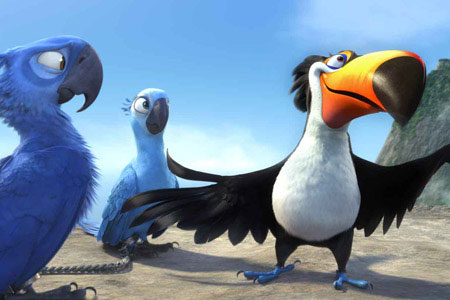
 A serviceable but obvious animated tale about a blue macaw named Blu (Jesse Eisenberg, typecast even in avian-cartoon form) who reluctantly returns to his roots in Brazil, then finds love…and his wings. Awww! But also, kind of zzzz! Rio's most striking visuals and renderings of animal physicality will only remind you of How To Train Your Dragon, a smarter and more thoughtful film across the board, which you will then want to watch instead!

 I should warn you now that I'm one of Those Zodiac Cultists who bangs on about how the Academy jobbed that movie, Downey is awesome in it, blah blah blah, and I'll skip the bulk of the harangue, but that film showcases what I liked about Dragon Tattoo: the little moments in longtime/working relationships. Fincher's good with a credits sequence (Panic Room) and good with a tricksy time lapse (Zodiac), he varies his shots in their angles and lengths and his cutting team keeps things interesting and on pace. But my favorite Fincher thing is how he lets his actors work with each other, letting gallows humor percolate up, waiting for that exchanged eye-roll. There's an understanding that the characters have interior lives, opinions about sushi and double-parking, entirely outside of the film's plot. Some of that proceeds from the scripting, obviously, but it's seldom the same writer on each movie, and that wouldn't explain the seemingly uniform respect the films have for the partnership vibe. Nobody gets better play on an actor's face when his/her character is struggling not to call a higher-up a fucking moron than David Fincher. Probably not what he wants on his tombstone, but it's nice for Rooney Mara under the circumstances.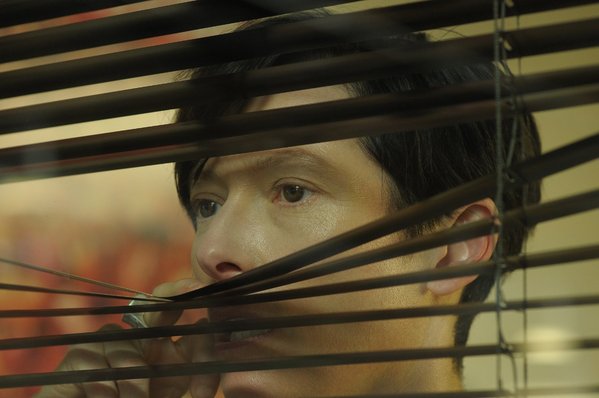
 Nothing gets a horror fan more ticked off than a director with airs claiming her new film isn’t
  Ramsay’s film fascinates like Goldfrapp’s radical, downcast remix of Lady Gaga’s “Judas” fascinates: as a remix more than an adaptation. Goldfrapp took Gaga’s pop-club banger, cut it to half time and deconstructed it to almost unrecognizable effect. It was creepy, scary, strange, way cool, but not a touch on the original, and is ultimately mainly interesting in relation to its source. In a similar way,
  In the book, which is told as a series of letters to her all-American/Republican husband Franklin (played in the film by John C. Reilly as a generic Dad), we meet Eva, a pushing-40, self-centered, unbearably obnoxious Manhattan woman who probably reads Mary Gaitskill,
  In the book, the tone and mode and Eva herself flip on a dime, and everything becomes
  The book’s grandest achievement is how it both accuses Eva as complicit in making a monster and then forgives her; how it takes a thoroughly unlikeable woman and evolves her into someone with a hard self-awareness we have to respect. The film? Ultimately, we’re back to the remix analogy, but without Goldfrapp’s unity of purpose – even if there isn’t much of one.
 Deal is, I always thought the New Wave was about deleting excess syntax so you could get to the heart of cinema. Ramsay uses some of its disjunctive tropes brilliantly so she never has to commit to anything but Swinton’s pursed grimace.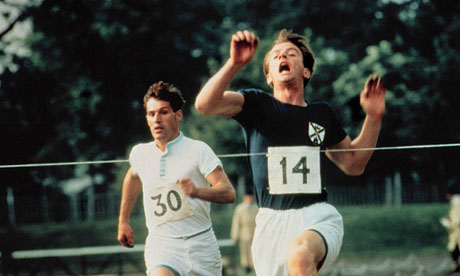

 A turning point for Abrahams comes when he watches Liddell run. Not only does he see that his unbroken winning streak can be threatened by the awkward but fast Liddell, but he also meets Sam Massabini (Ian Holm), a professional track coach who has tried unsuccessfully to recruit Liddell. Abrahams persuades Massabini to come see him run, and Massabini agrees to coach him, an arrangement that displeases two Cambridge dons (Sir John Gielgud and Lindsay Anderson) with a strong commitment to the notion of amateurism. Abrahams ignores their protest, gives them a tongue lashing for trying to impede progress, and starts to train for the Olympics with Massabini, who becomes something of a surrogate father to him.
 Chariots of Fire takes few liberties with the facts, but screenwriter Colin Welland and director Hugh Hudson arrange them in such a way as to make the underlying story a conflict between mortal men and God. Indeed, the very title of the film quotes from a very pertinent book of the Torah,

 I actually never saw the infernal arm-wrestling Stallone movie from the '80s, although I saw the hateful Kenny Loggins video from same approximately 17,000 times — but I'm pretty sure Real Steel is the same shit (but with, you know, robot boxing). Robot-boxing impresario/dillweed Charlie (Hugh Jackman) is down on his luck and behind on his rent when he finds out that an ex-girlfriend has died, leaving him in custody of a son, Max, he's never seen (Dakota Koyo). The ex's sister, Debra (Hope Davis), wants t– you know what, who cares. Robots box; the flimsy backstory excuse for Jackman to develop those magnificently ridonk biceps is totally justified; everything works out.
 Four years and a $18 million worth of Paramount's money later, Spielberg and Lucas released Raiders of the Lost Ark, featuring up-and-coming action hero Harrison Ford — Han Solo in Lucas' Star Wars franchise — as the whip-cracking archaeology professor trying to keep the Lost Ark of the Covenant out of Hitler's hands. As scripted by Lawrence Kasdan, who rewrote the Star Wars sequel The Empire Strikes Back, Indy was a rumpled, unshaven, refreshingly human hero, surly but decent, less like a Bond-style sexy sociopath than a Gary Cooper character in a bad mood. The combination of Ford's casual fearlessness, Lucas' gee-whiz sensibility, Spielberg's kinetic precision and costar Karen Allen's tomboy sass made the film into the year's biggest hit, a sleeper that rolled into multiplexes opposite Superman II and the latest James Bond entry For Your Eyes Only and stole their box office thunder. Raiders grossed $209 million in North America and took the "So popular that we can't ignore it" spot in the following year's Best Picture lineup. It also inspired knockoffs, including the network TV series Tales of the Gold Monkey and Bring 'Em Back Alive and the movies High Road to China, Romancing the Stone and The Jewel of the Nile.
  Spielberg didn't stint on the violent action; this was probably one the first PG movies in which a lone hero singlehandedly and bloodily eliminated scores of foes, and definitely the first in which the power of God made Nazis' heads melt, implode and detonate, spewing meat chunks into the camera. Three summers later, the even more extreme violence of Indiana Jones and the Temple of Doom and the Spielberg-produced Gremlins
  Raiders was a career-redefining entry on the resumes of its major players. Ford stepped into the lead after CBS refused to release the filmmakers' first choice, Magnum, P.I. star Tom Selleck, from his TV contract, and proved he could sell tickets without a laser pistol in his hand; the film's success marked the start of a 20-year run as one of Hollywood's highest-paid actors. Ford's regular employer Lucas showed the studios that he wasn't just the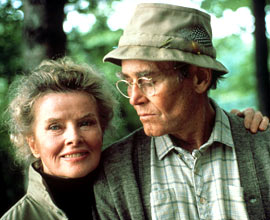
 At the time of the Academy Awards, the film's box office take was closing in on $80 million. It was obviously hitting a chord with audiences, but the critical response was mixed at best. The positive notices seemed to be written under duress. The rest of the mixed-to-negative reviews rang of hardened resistance to being moved at the sight of two old geezers puttering about and saying the damnedest things. (I know one critic who at the time referred to the movie as On Golden Shower.) Some critics and younger film buffs scoffed at a movie they perceived as appealing to middlebrow tastes – i.e., conservative older moviegoers who probably say things like, “Why don’t they make more movies like that?” On Golden Pond was one of the first big Reagan-era dramas, the anti-Ordinary People. The pairing of
  If you didn’t know the movie was based on a play it wasn't hard to figure out, and not just because the story takes place in and around one location.
  (Watching Henry Fonda in On Golden Pond, I was struck at how son Peter Fonda’s career-capping performance in Ulee’s Gold is like the dark side of Norman Thayer; the younger Fonda is playing both his dad and Ulee Jackson.)
 Jane Fonda’s interactions with Hepburn and her father demonstrate her skill at being able to adapt to differing acting styles. Her scenes with Hepburn have a loose give-and-take feel. There’s a remarkable scene where mother and daughter go skinny-dipping at night. Seeing their heads poking above the water at night, we register that it is possible Jane could be the offspring of these two. Her sharp features and her quivering, clipped voice are just right. Her big scene with her father is one for the time capsule. The way her Strasberg-training acting style and his do-it-as-rehearsed strictness rub against each other beautifully illustrates the generational gap they are trying to close. The elder Fonda hated improvisation. He felt there was no need to change what was already on the page. This leads to a fleeting moment where the real world comes crashing into the movie. Chelsea tells Norman she wants to be his friend. When the camera switches to Henry Fonda’s side of the scene, Jane/Chelsea improvises a gesture and puts her hand on his arm. (You’ll miss it if you’re not looking for it.) This bit of business was not rehearsed and startled the elder Fonda. His fleeting reaction to this moment of affection is real. You see him turn, almost embarrassed by the intimacy of the moment. At the end of the movie, when Chelsea, who always refers to her father as “Norman,” calls him “Dad,” we can no longer separate the characters’ quiet acknowledgement of their love from seeing Jane and Henry finally connect with one another.
 Press Play Video Blog