CRUEL SUMMER: STRIPES (1981)

CRUEL SUMMER: STRIPES (1981)

In this series, frequent Press Play contributor Aaron Aradillas will analyze a significant movie from each year of the 1980s. The previous installment: The Blues Brothers (1980).

When Bill Murray came on the scene at the start of the 1980s, he represented a fundamental shift in comedy. He specialized in an utter emotional detachment from any and all situations. His fans claimed he was deconstructing the absurdity of whatever predicament he found himself in. The famous Saturday Night Live sketch of Murray as a lounge act performer singing about Star Wars was funny because he knew how pathetic the guy was. Murray did nothing but asides and put-ons. Some critics praised him as a Groucho Marx type, but if you looked closely, some of his lines had a nasty streak; while Groucho took the air out of a tense situation, Murray made you tense.

Performers like Jack Nicholson, Richard Pryor, even Eddie Murphy in 48 HRS., specialized in upsetting the status quo, speaking up for those who couldn’t speak, and expressing suspicion of those in power, Murray spoke for himself, suspicious of everyone. The most courteous thing he would do is not remind you that he’s the smartest person in the room. It’s almost impossible for Murray to do sincerity. His worst scene as an actor? His plea for goodwill toward your fellow man at the end of Scrooged. He’s like a bully telling you to be kind to others or else.

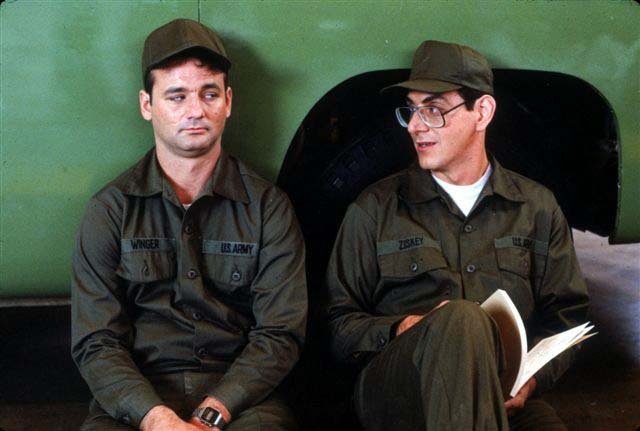
Murray became a comic hero pretty quickly. He gave the genial summer-camp comedy Meatballs a groovy anarchic charge. Along with Rodney Dangerfield, he was the highlight of the surprise hit Caddyshack. But it wasn’t until the release of Stripes in the summer of 1981 that Murray became a star. A service comedy that was surprisingly reverential toward the military, Stripes was the kind of anti-Establishment comedy that appealed to audiences. It was safely subversive but not offensive.

Directed by Ivan Reitman and written by Len Blum and Dan Goldberg, along with Harold Ramis, Stripes had the kind of anti-authority attitude that even conservatives could get behind. Rather than trashing institutions like the military, the movie just made the individuals in power look comically foolish. This was a big change from the thinking of just a decade earlier. At that time, young people questioned the nature of long-standing institutions far more aggressively. (It’s interesting to note that Stripes was originally conceived as a vehicle for Cheech and Chong. They truly didn’t trust institutions.) Now, it seemed, a compromise was being reached as Stripes predicted the coming onslaught of pop militarism in American movies. Just six months before the release of Stripes, Goldie Hawn had scored a hit (and an Oscar nomination) with the post-feminist service comedy Private Benjamin. Now we had Stripes. Throughout the 1980s, a whole series of movies did a brilliant job of allowing us to forget the trauma of Vietnam. Uncommon Valor, An Officer and a Gentleman, Missing in Action, Firefox, Rambo: First Blood Part II, Heartbreak Ridge, Aliens, Iron Eagle, Top Gun, RedDawn, Platoon Leader, and Commando all suggested, in one way or another, that Vietnam was a winnable battle. A lot of these movies were outrageously entertaining. They were also cinematic recruitment posters. (Oliver Stone’s Platoon would single-handedly provide the antidote to Hollywood’s love affair with war.)

The opening of Stripes indicates it’s going to both play with and poke gentle fun at images of authority. The first image we see is a commercial for the Army playing on a television. Murray’s John Winger views the commercial with a mix of skepticism and (possible) curiosity. Murray’s trademark ironic detachment surfaces with his first line of dialogue. (“I don’t think I’ve ever been this happy.”) Winger is so blasé about life that when his girlfriend leaves him, he looks as if he is just going through the motions of being hurt. When Winger says, “Then, depression,” we laugh: If a Murray character is depressed, that would suggest he was once happy.

(Murray aficionados will no doubt know that Joel McHale’s character on Community is an homage to the stock Murray character. The difference being is that McHale’s Jeff Winger genuinely does care about his studymates.)

Luckily for the movie Murray’s coolness is tempered by Harold Ramis as his loyal best friend Russell. When Winger decides to join the Army because, frankly, he has nothing else to do, Russell accompanies him almost for the intellectual exercise of seeing where this will lead them. Or, in the parlance of Animal House, one stupid gesture deserves another. What gives the movie its zip is the comic spin given to standard basic-training scenes. There’s a less abrasive National Lampoon/MAD Magazine quality to some of the gags. There’s also a surprising sense of reverence toward the military, particularly in a shot at dusk where the platoon is going through an obstacle as they sing a recruitment song. Bill Butler’s crisp cinematography makes it clear this shot is not meant to be ironic. On the other end of the shot is the famous scene of the men marching and singing Manford Mann’s “Do Wah Diddy Diddy” as a cadence. (It is said that after the release of Stripes this became a popular cadence.) What you get with that bit is the acknowledgement of rock & roll’s place in the military.

Sgt. Hulka gives the movie’s situational comedy some weight. It was a masterstroke to cast Warren Oates as Hulka. He represents authority, but not totalitarian authority. He has Winger’s number the moment he sees him. He understands the impulse to question people in power. (He does it himself.) But he also knows that some semblance of order is needed to sustain life. Murray’s best scene is when Sgt. Hulka calls him out on his bad attitude and the audience ultimately comes to side with Sgt. Hulka.

From that point on, Murray’s performance picks up. The scene where he takes the guys to a mud wrestling contest has a playful three-ring circus quality. (The sequence is helped tremendously by John Candy’s wonderfully light comic presence.) When Murray is called upon to deliver an inspirational speech (a staple of 80s movies), he makes it off-kilter enough that he almost sounds convincing. It’s a jingoistic speech with a little sting. (“We’ve been kicking ass for 200 years! We’re 10 and 1!”)

The movie climaxes, of course, with an action sequence, as Winger, Russell, and their MP girlfriends must enter enemy territory (Germany and Czechoslovakia!) to rescue their fellow soldiers. Like the parade finale of Animal House, this sequence is about destruction, but it ALSO works as an action set-piece. Stripes toys with AN anti-authority stance but ultimately adheres to tradition. And at the center is Murray, thumbing his nose at everyone and everything. In recent years. a generation of filmmakers have found interesting ways to utilize Murray's limited range of emotions. John McNaughton located Murray's capacity for menace in the brilliant Mad Dog and Glory, while Wes Anderson maximized Murray's deadpan detachment by turning him into a terrific supporting actor in Rushmore and The Royal Tenenbaums. (When Anderson forced Murray to play a front-and-center character who had to care about others in The Life Aquatic With Steve Zissou, the result was both compelling and uneven.) But in the beginning, with Stripes, Murray's what-me-worry cocky arrogance turned out to mirror both the audience's and American movies during the 1980s.

San Antonio-based film critic Aaron Aradillas is a contributor to The House Next Door, a contributor to Moving Image Source, and the host of “Back at Midnight,” an Internet radio program about film and television.
TRAILER MIX: GANGSTER SQUAD

TRAILER MIX: GANGSTER SQUAD

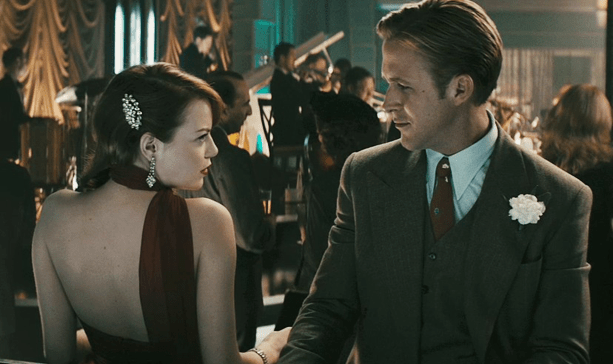
The trailer for Gangster Squad isn't selling nostalgia so much as retrograde, standard-issue images of masculinity. An account of the L.A. Police Department's fight against the East Coast mob in the '40s and '50s, the film, directed by Zombieland helmer Ruben Fleischer, is pitched as one manly affair, but unfortunately courts its target bros with a lot of tired bromides. Testosterone is front and center as soon as the preview starts, with ugly-mugged mafioso Mickey Cohen (Sean Penn) pounding away at a punching bag and dining with a loaded pistol by his side. Cut to Nick Nolte, another gruff actor with sandpaper features, playing a department head who tells Josh Brolin's squared-jawed cop that “Los Angeles is a damsel in distress” and needs to be saved. It's offered as a quaint proposal for chivalrous heroism, but it really just reminds us, with a sexist air to boot, that tough guys are running the show. “I'll need men,” Brolin's squad chief replies. Naturally.

There's nothing wrong with having a core audience, but with this first clip, Gangster Squad doesn't give much credit to the smarts of its would-be ticket buyers, who've surely heard better speeches about whores and dope than the one Penn's character caps off with an Emeril-like, “Bam!”  (“Overcooked” might be the right word for this umpteenth riff on the Scarface power pledge.) And while the rat-a-tat-tat of tommy guns, like mid-century L.A., will never go out of style in the movies, the same can't be said for a showy montage of bad-cop brutality, or grab-bag catchphrases like “We're going to war” and “There's no going back.”

Ironically enough, the trailer's most interesting element is markedly un-masculine: the squeaky, near-flamboyant voice adopted by Ryan Gosling. A leading man with unlikely character-actor gifts, Gosling gives his womanizing officer a memorable wrinkle of interest, and looks to continue his captivating string of ace performances. He still utters the same Will Beall-penned platitudes delivered by his rather typecast co-stars, but he registers as a fresh gem amid stale goods.

With its basic story seen before in everything from The Untouchables to American Gangster to Public Enemies, Gangster Squad would have done well to differentiate itself, beginning, of course, with this first look. Judging from what's presented, though, journalist Paul Lieberman's source material, a series of articles dubbed “Tales from the Gangster Squad,” has inspired a boilerplate, shoot-'em-up, cat-and-mouse popcorn flick, with a low opinion of its demographic to boot. In one final effort to present a certain hipness, the preview ends with a track from Jay-Z, whose all-too-relevant lyrics about “the American Dream” accompany an admittedly nifty image of cops shooting through a movie screen (take that, 3D!). But in this age of rappers linked to, and long inspired by, unlawful lifestyles, the music cue is just another cliché, and yet more bait for dudes who aren't as dumb as the trailer thinks they are.

R. Kurt Osenlund is the Managing Editor of Slant Magazine's The House Next Door, as well as a film critic & contributor for Slant, South Philly Review, Film Experience, Cineaste, Fandor, ICON, and many other publications.

CRUEL SUMMER: THE BLUES BROTHERS (1980)

CRUEL SUMMER: THE BLUES BROTHERS

In this series, frequent Press Play contributor Aaron Aradillas will analyze a significant movie from each year of the 1980s. First up: The Blues Brothers (1980).

According to John Landis, The Blues Brothers was the last movie made under the old studio factory system, in which Universal had everything from the props to the costumes made on the lot. The Blues Brothers feels, indeed, like a transition from the old to the new. It takes the form of a big studio musical, but its execution is all 1980s bigger-is-better filmmaking.

The first movie to expand a sketch from Saturday Night Live, The Blues Brothers was “high concept” before that term even existed. When The Blues Brothers was made, Landis was the go-to comedy director working in Hollywood, having just made National Lampoon’s Animal House,the most successful comedy in movie history. Stars Dan Aykroyd and John Belushi had just ended their time on SNL, possibly the most culturally influential TV show of the late ‘70s. The Blues Brothers was the right movie, hitting at just the right moment. This movie fed an audience leaning toward the sophisticated comedy of Woody Allen and Steve Martin on the one hand and slob comedies like Animal House, Caddyshack, and Meatballs on the other.

The movie itself, despite its winning ingredients, is a big, lumbering, at times awkwardly paced thing that only intermittently comes to life. The screenplay by Aykroyd and Landis is less a script than a scenario. The story of Jake (Belushi) and Elwood (Aykroyd) putting the band back together, in order to raise money to pay off the back taxes owed by the orphanage where they grew up, has a Mickey-and-Judy-let’s-put-on-a-show innocence that’s quite appealing. The problem is that Landis stretches this story to over two hours, which allows for several unnecessary storylines. (Pacing has always been a problem in Landis’ work. It’s telling that his best movie, An American Werewolf in London, is also his shortest.) There are no scenes in The Blues Brothers. The movie consists entirely of sequences, numbers, and set-pieces. Consequently there aren’t any real characters. Everyone is more or less a cast member. As it turns out, this would be the modus operandi for a vast majority of movies made throughout the 1980s.

The problem with The Blues Brothers movie is the concept of the Blues Brothers themselves, a soul gimmick. (The band’s best performance remains their cover of Sam & Dave’s “Soul Man.” The sight of white boy John Belushi proclaiming he has soul is funny and kind of touching.) At the time no one seemed to question or even be concerned with the sight of a couple of white guys performing predominantly black music. (Inexplicably, The Blues Brothers’ Briefcase Full of Blues remains one of the all-time best-selling blues records.) The difference between the Blues Brothers and, say, Elvis or the Stones or Eminem is they rarely attempted to do anything that would test them as performers. They were an instant nostalgia act.

Landis probably knew the appeal of the act was limited and that’s why he added so many subplots, ranging from Illinois Nazis to Illinois state troopers to The Good Ole Boys to Jake’s parole officer to Carrie Fisher chasing the boys in their trademark police car. All of these adversaries have potential, but most of them don’t go anywhere. (The Illinois Nazis unfortunately provide the movie with a gratuitous scene of Henry Gibson shouting ugly rhetoric into a bullhorn.) Landis is clearly emulating It’s A Mad, Mad, Mad, Mad, World, but what made that movie a masterpiece was its gags on top of gags. It also allowed performers like Buddy Hackett, Phil Silvers, Sid Caesar, Ethel Merman, and Jonathan Winters to play characters that showcased their talents. Belushi and Aykroyd are kept mostly in check throughout this movie. Belushi’s kamikaze style is what made his appearances in Animal House and 1941 so memorable. And Aykroyd is best when he uses his Asperger’s-esque detachment to subversive comic effect. (His career performance remains his portrayal of Joe Friday in the underrated Dragnet.) The only sequence where the buried antisocial behavior of their act comes to the surface takes place when they disrupt the peace in a snooty restaurant in order to persuade Mr. Fabulous to join the band.

The musical performances are a mixed bag; small bits of each number indicate just how good they could potentially be. Whatever reservations you may have about Belushi and Aykroyd as bluesmen, the band itself, a combination of Stax musicians and a New York horn section, is always fun to listen to. And a couple of the players manage to emerge as terrific comic actors, especially Willie “Too Big” Hall and the recently deceased Donald “Duck” Dunn. The band’s big performance at the Palace Hotel Ballroom is fun but the song selections just remind you how good the originals are. I mean, compared to Solomon Burke’s original or The Rolling Stones’ cover, Belushi’s version of “Everybody Needs Somebody to Love” just ain’t cutting it. Belushi’s best vocal is on the movie’s opening song, “She Caught the Katy.” The song is used to score Jake’s release from jail and reunion with his brother. The opening guitar picking and blast of the horn section get the movie started on a high note, And Belushi’s phrasing is good because he doesn’t force it.

Unfortunately the promising opening song is followed by the movie’s worst musical number. The boys are sent to church to get some inspiration. James Brown plays Rev. Cleophus James, a showman who leads his congregation in a boisterous rendition of “The Old Landmark.” Designed as a tribute to black gospel music, the number borders on offensive as George Folsey’s frenetic editing makes the dancers into leaping bodies, killing any chance of the song’s building to a climax, and turning the spiritual into something comical. Besides, who wants to see The Godfather of Soul do a gospel song? Aretha Franklin does better with her rendition of “Think,” but Landis stages the dancing awkwardly. And when the band plays a rowdy country bar, the mere sight of Jake and Elwood in their costumes performing “Theme from Rawhide” simply doesn’t do enough to make the connection between country music and the blues.

Then, Ray Charles does a fantastic cover of “Shake a Tail Feather.” Charles proves to have perfect comic timing. (“It breaks my heart to see a boy that young go bad.”) And it’s also the best edited and choreographed of all the musical numbers. Even better is Cab Calloway donning his trademark white tux and performing “Minnie the Moocher.” He makes an effect Belushi and Aykroyd struggle to accomplish look effortless.

The Blues Brothers is best remembered for its extended climactic car chase, and it’s still a doozey. Cars fly, spin, flip, careen, and crash into one another like a pileup at a Hot Wheels factory. (“This is car 55. We’re in a truck!”) Landis sustains the comic momentum of the sequence in what amounts to the movie’s best musical number. The sheer audacity of the sequence at the time turned out to be prophetic, as it pretty much announced the 1980s as the decade of the bigger-and-louder-is-definitely-better school of filmmaking. The Blues Brothers put the existential dread and emphasis on the personal of ‘70s filmmaking in its rearview mirror. What it was speeding toward didn’t matter. The chase was all that mattered.

San Antonio-based film critic Aaron Aradillas is a contributor to The House Next Door, a contributor to Moving Image Source, and the host of “Back at Midnight,” an Internet radio program about film and television.
GREY MATTERS: Black Widow Spins Webs Around THE AVENGERS

Black Widow Spins Webs Around THE AVENGERS

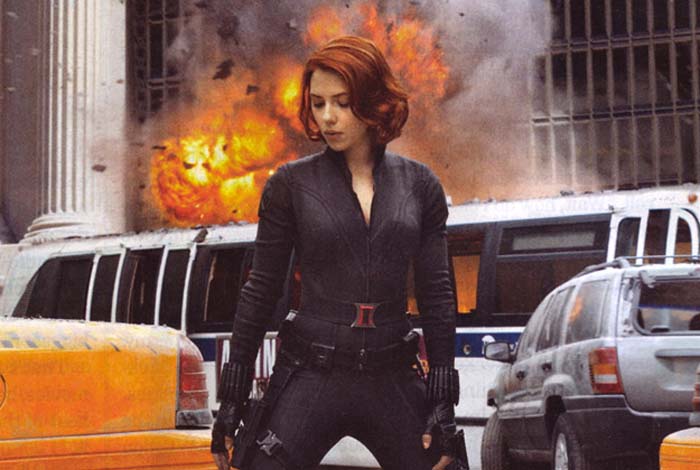
nullBlack Widow is the first hero seen in The Avengers, the latest entry in Joss Whedon's career-long feminist project. She does not immediately display the super powers enjoyed by the other Avengers—Captain America’s unnatural super-strength, The Hulk gamma-ray rage giant, Iron Man’s wearable rock ‘em, sock ‘em robot suit, or Thor’s hammer of the demi-gods. The only visibly super things about Black Widow are the latest in cat suit couture and a striking asymmetrical crimson bob. And yet she’s still able to trash a clutch of Russian scumbags with her hands tied behind her back. With a chair tied to her rear. While talking on her cell phone.

She’s also the sole Avenger that S.H.I.E.L.D. leader Nick Fury (Samuel Jackson) trusts to convince Bruce Banner (Mark Ruffalo) to join Thor (Chris Hemsworth), Iron Man (Robert Downey, Jr.), and Captain America (Chris Evans) in the fight against Thor’s psychotic brother Loki (Tom Hiddleston) who, having stolen the ultimate source of power in the universe, the Tesseract, plans to use an alien army to devastate the Earth. (The plot ends there.)

As egos collide, Black Widow—street name, Natasha Romanova—is the only character who does not throw a monstrous hissyfit.  The only character to gather actionable intelligence against Loki from Loki. The character who not only literally kicks sense back into the brainwashed Hawkeye, but then absolves him of any sins performed while under the loony god’s spell.

You want fearless? When midtown Manhattan is swarming with thousands of robo-aliens, the dreaded Chitauri, Black Widow commandeers one of their slippery aero-sleds and flies it to steal Loki’s glowing phallic scimitar so as to save the world so Iron Man can blow up the aliens.

Oh—and the Tesseract? It’s female. I know this because everyone calls it by female pronouns—respectfully. How does that work? Well, the way all Whedon works: second viewings reveal not only layer after layer of multiple meanings, jokes piled on jokes, but seemingly random elements that are actual thematic glue. Nothing is never there without a reason.

Anyway, Black Widow! A worthy addition to Whedon’s female action bloodline, right? The flame-haired heir to Buffy, Faith, Kendra, River, Echo, Zoe, Fred, and Illyria, right?

No.

Writing in The Guardian, Henry Barnes noticed Black Widow but could not be bothered to isolate just what she did in the film. The New York Post’s Kyle Smith dreamed of a Black Widow who would perform one errand and and then be gone.

The New York Daily News’ Joe Neimaier admitted that Black Widow “kickstarts” things, but by deleting her from the rest of his coverage, implied that was that. Still, that was a lavishment compared with the treatment by A.O. Scott, who in his New York Times review found it beneath himself to even give Black Widow a job description, while The Globe and Mail went with “token sexy female,” clearly hoping only young boys and people who hadn’t seen the film were reading.

Meanwhile, in The Wall Street Journal, Joe Morgenstern claimed Black Widow “spends lots of time looking puzzled or confused,” while Steven Rea's Philadelphia Inquirer review dispensed with Black Widow’s name, suggesting we “watch Scarlett Johansson clench her brow” while in “Ninja garb.” The Miami Herald’s Rene Rodriguez wasn’t as generous—his single sentence also accused Johansson of playing dress-up, but, perhaps mercifully, did not specify what in.

Meanwhile, as if transported from another dimension, Kim Voynar’s Movie City News review both acknowledged Black Widow and lavished almost two paragraphs on Johansson’s terrific performance.

Over at Think Progress, Alyssa Rosenberg took for granted what the aforementioned critics could or would not see. “The two characters least-well served by their previous incarnations in Marvel movies,” she wrote, “the Hulk and Black Widow, are the ones best served by Whedon’s greatest gifts and strongest tendencies.”

Rosenberg hit key reasons why Black Widow matters:

She never becomes a victim or a lesser member of the team. Her pain and exhaustion after a CG Marvel battles triggers our empathy, and centers us. And while all this superhero battling may look fun, without superhero augmentation, it must be terrifying. Johansson offers a true career-best turn here, easily negotiating splinter-thin spaces separating old pains and a chilly professionalism that hides we’re not sure what—regret? Denial? Lingering rage over the childhood abuse that turned her into Black Widow? It’s all hinted at as the actor works Whedon’s many shades of dark grey beautifully. In short, and despite all the Wagnerian bam-boom-pow, Whedon and his star never lose sight of the fact that Natasha is profoundly vulnerable, with nothing but smarts, heart and a .45 for protection.

Finally, AlterNet’s Julianne Escobedo Shepherd cut to the chase and celebrated The Avengers’ “stark feminist perspective” and what she saw as fact: that “Johansson’s Black Widow is just as front-and-center as the rest of the cast.”

To which I can only say—exactly! And: isn’t this remarkable? Two parallel realities! Men who see nobody at all and women who see the next Faith (without the crazy, I mean). Don’t tell Disney, or they’ll be marketing the film as 4-D.

Jokes aside, how to explain this blanket amnesia?

If I were to be optimistic, I’d say this brand of blindness is about change happening too fast. Change is weird, scary and disorienting. And TV’s a great place for incremental change because it shows slow transformations occurring over time.

At first, Buffy, the Vampire Slayer was, literally, a joke. A cheerleader fighting the undead! Hilarious! And she’s so unthreateningly cute! But over time, people came to believe in the take-charge slayer, until someone in Season Four’s “A New Man” [sic] episode could remark to Buffy that “You're, like, make the plan, execute the plan, no one giving you orders,” and instead of intimidation, there was a shrug. Because it was true.

And so over time people weren't alarmed when Alias’ Sydney Bristow nicked bits of the 007 crown. Or when a female Starbuck showed Han Solo-level energy in the new Battlestar Galactica.

But The Avengers moves so fast, with so many zingers, tiffs, explosions, turnarounds and implications that I’d like to think reviewers simply didn’t have time to process just how radically and playfully Whedon (whose mother co-founded Equality Now) cedes yards of traditionally male genre property and space to Black Widow. 

Some part of the male unconscious, down there where The Hulk lives, just didn't go for it.

How is there not at least one guy who can figure out how to fly Chitauricraft? Why is Captain America looking to Black Widow for strategic ideas in midtown Manhattan? And the greatest power of the universe is a She? How does that work?

Answer: It works so easily that The Avengers is well on its way to becoming one of the most popular films in human history. Maybe a mess of male critics can’t see a triumphant Black Widow in the malange of superheroes crowding the film. But in this election year defined by demeaning treatment of women, it’s encouraging to know that a whole lot of America can.

Ian Grey has written, co-written or been a contributor to books on cinema, fine art, fashion, identity politics, music and tragedy. Magazines and newspapers that have his articles include Detroit Metro Times, gothic.net, Icon Magazine, International Musician and Recording World, Lacanian Ink, MusicFilmWeb, New York Post, The Perfect Sound, Salon, Smart Money Magazine, Teeth of the Divine, Venuszine, and Time Out/New York.

SIMON SAYS: An Interview with Bobcat Goldthwait

SIMON SAYS: An Interview with Bobcat Goldthwait

null

When you talk to Bobcat Goldthwait, the American stand-up comic turned Police Academy sideshow attraction and now filmmaker, you see that his demeanor is very similar to the even-handed tone of his films. During our talk, Goldthwait casually referenced Preston Sturges and Falling Down as he addressed the tone of his controversial comedies. And he did it all while talking very matter-of-factly about the logic behind making movies centered around outlandish behavior.

Goldthwait’s recent breakthrough as a director was Sleeping Dogs Lie (2006), a romcom about a woman who admits to her fiancé that she once drunkenly gave a blowjob to her dog. He then followed that up with World’s Greatest Dad (2009), a black comedy about a father/teacher (Robin Williams) who admits that he didn’t always love his son (a perversely inspired performance by Daryl Sabara). Now, Goldthwait has directed a film called God Bless America (2011), a characteristically thoughtful black comedy about an unlikely pair of vigilante killers (one of whom is played by Mad Men’s Joel “Freddy Rumsen” Murray) who murder people whose bad behavior they can’t stand.

God Bless America is, like Goldthwait’s last two movies, a comedy about characters who eventually give in to their morally weaker impulses. But the film has been weirdly mischaracterized by many detractors as a goofy revamp of Natural Born Killers. I talked to Goldthwait on the phone about his audience’s expectations, directing a superhero movie, and his idea for a remake of Billy Jack.

I saw God Bless America at Toronto and am still taken aback by how wildly misinterpreted it’s been. How would you describe the reception it’s gotten?

Bobcat Goldthwait (BG): It’s had its fair share of positive reviews and . . . well, you know, my other movies had the same thing. People will say, “It’s a one-joke movie.” Well, yeah, if you don’t empathize with any of those characters. Then it’s a no-joke movie. I’m not into comedies that are joke-driven. I’m not trying to make Two and a Half Men: The Movie.

One of the thing’s that’s striking about your films is that you do try to get us to empathize with your characters. One of the things I found most bizarre about the negative pans was the way people compared God Bless America to Natural Born Killers. Natural Born Killers is about the psychosis of its characters, whereas this film seems to be about how your characters allow themselves to be seduced by psychosis. That’s not really the subject of the film, right?

BG: Yes, right. And Natural Born Killers, at the end of the day, was trying to implicate the media. And with this movie, I’m not trying to blame the media. I’m trying to make a movie that questions our own appetite for distraction, and that raises the question of where are we going. If you’re disappointed that I didn’t have a scene where I keep cutting back to Harvey Keitel in front of a big map saying, “I gotta get inside the brains of these people! Where are they gonna strike next?! Oh, I got it: this reality TV show,” I have no interest in doing that kind of movie.

The movies I make don’t take place in reality. I have a problem with vigilante movies. Usually, they start with a very gratuitous rape. And at the end, the hero kills all the bad people. So people can get their rocks off watching this gratuitous rape and then they can get their rocks off watching people get blown away.

In this movie, at first you’re rooting for the characters, and in the end, the wheels fall off. You should be questioning their behavior all along. Frank eventually realizes that he’s a flawed human being, and that this whole thing that he put into motion doesn’t really work. [laughs] I mean, for instance, if people were to treat Sleeping Dogs Lie as a serious examination of bestiality, they’d be out of their minds! This isn’t a movie about serial killers, it’s a movie about our own appetite for distraction.

That comparison to Sleeping Dogs Lie is striking as it doesn’t look like it’s being made by God Bless America’s critics. I think people get confused about the characters’ speeches—or more accurately, the rants—and they assume they’re speaking for an authorial voice. Which is ridiculous, considering what the consequences of those rants are.

BG: Yeah, I think it’s funny that people mistake those rants for my opinions. I wouldn’t make those speeches in everyday life. People think, “Oh, this movie is preaching,” but obviously those are people that don’t agree with what’s being said or think that they should agree with everything. I like to go to the movies and watch characters who make me question how I see the world. I don’t want to watch a movie where everyone does things I agree with. I think people see this movie on a superficial level sometimes and think that’s what it is. Those are the people that are more likely to go see The Avengers.

I was actually going to ask you later—beg you—to please, please try to make a superhero movie. I think you’d make a great Dr. Strange.

BG: [laughs] They usually use their own people, or they’ll sniff around and say, “Are you interested?” I briefly tried to look at the Marvel catalogue, and everything is gone. The only thing I could find was, during the CB craze of the ‘70s, a trucker called Razorback.

Yes!

BG: My friend who helped me find this character says, “You gotta make the Razorback movie!” [both laugh] I say to him, “You’re out of your mind!” Somebody told me about World’s Greatest Dad, “Wow, you really created a whole world there. I half expected Batman to show up at any moment!”

[laughs] That’s the thing about your movies: I almost want to describe them as Bobcat Goldthwait’s Moral Tales. Without shaming the audience, they’re about a sense of perspective people get when they realize they can be pushed beyond their comfort zones. World’s Greatest Dad, Sleeping Dogs Lie and God Bless America all have these characters that think, “Oh, I don’t even understand myself beyond a point.” That almost goes hand-in-hand with the superhero genre!

BG: That’s what interests me about making movies. I don’t think I’m smarter than the audience and I’m not trying to manipulate them. I’m making movies about people as flawed as myself and the viewers. So if you just have a reptilian brain and live your life simply by reacting to things, my movies aren’t going to work for you. They’re not going to make any sense, you know? I’m not trying to manipulate you with clever zingers. I don’t have all the answers. I’m still trying to figure it out.

That reminds me of something [comic book writer and artist] Howard Chaykin said. He’s said he that he creates characters who were flawed because he felt it would be dishonest to create paragons of virtue when he himself isn’t totally virtuous.

BG: Right. Right! And that’s the thing: there are plenty of things that Frank complains about that I’m guilty of. I’m not this angry guy that wishes the world would operate the way I see it. Another movie people bring up is Falling Down. But that movie—I don’t think people understand. He really wants to go to his daughter’s birthday party. It’s a racist movie! [laughs] When they finally get around to killing people, the Michael Douglas character winds up being a closeted Nazi. But we’re supposed to go, “Well, I still don’t hate this guy, but he’s still a Nazi.” In the movie I made, you should be going, “Well, none of this is right. This is all a little screwy.”

When I’m ego-surfing on the web, and I look at people’s comments to the movie’s trailer, and they go, [slow voice] “So, what, I’m not supposed to text during a movie anymore?!” [both laugh] I make these tiny, independent movies with my friends on a very, very small budget. I don’t make them for everybody. I expect to continue to pay rent for the rest of my life. [laughs]

World’s Great Dad and God Bless America have gotten some pretty good exposure. One of the things that’s striking about you is that, while you see plenty of actors and comedians try their hands at directing movies, you’ve kept at it. How difficult is it for you to keep on making these films?

BG: I actually write a lot of screenplays. I don’t really have an objective. I don’t sit down and go, “Well, this is one I can get made this year. Movies with penguins are really popular.” I just write whatever comes out of me. And then I try to get money and get all of them going. The key is I don’t make them if I have to compromise. I would rather not make a movie than compromise or to change something in the story so it’s more sensible or less offensive. So for good or for bad, these movies have my voice.

Even given the increasingly positive response you’ve gotten to your movies, are there some ideas that you thought were so extreme that only you could write and direct them?

BG: I don’t make compromises. One of the movies I wrote—I said to my wife, jokingly, “I’m tired of not making money. I’m going to write a genre picture.” I love Billy Jack, so I wanted to make something like Billy Jack

Oh, wow.

BG: I'm, like, 45 pages in, and she comes over and asks, “Well, how’s it goin’?” And I go, “Well, he’s gay now.” And she goes, “We really are just going to keep renting, aren’t we?” [both laugh] Well, anyway, he goes into a redneck town and kicks ass.

And again, it’s meant to question all this craziness about equal rights for the gay community. I did it in a funny way, but the joke’s not that this guy dresses funny. He’s an ass-kicking Marine that gets kicked out during Don’t Ask, Don’t Tell. I want to make that movie, but when I do make it, I want to make it the right way, with the right cast. I can’t get money for that. I’m surprised, but not a lot of action stars want to make out with a dude on camera! [both laugh]

But that’s an example of how I work. I just write it and say, “This is the world I want to see.” And then I wait until I get the right people to pull the trigger on the money. I wrote five screenplays, and God Bless America is one of them.

One of the things I find striking about your movies—and also Spike Lee’s movies—is that you assume that these prejudices come from somewhere. And the places where they come from, like family and religion—those institutions have the potential to be good things. They’re not always bad. They have the potential to bring people together. That even-handedness is striking. When you write characters who aren’t necessarily totally sympathetic but also aren’t black-hat-wearing bad guys, how do you make them somewhat sympathetic?

BG: Well, as I said, none of these movies take place in the real world but I try to make the lead characters in these movies very real people. I’m a big Preston Sturges fan and the leads in his films are often quite flawed. They have a lot of dimension to ‘em, even the sillier ones. But then there are always these one-dimensional characters that are circling around these people. And that’s how I see these movies, where the main people are hopefully well-rounded characters and that’s why you empathize with ‘em.

That’s why I think Joel did a terrific job in this movie. I didn’t want people to pity Frank. I didn’t want him to be someone they felt bad for, I wanted him to be somebody they empathized with.

Yeah, there’s usually a level of latent patronization or condescension in comedies when audiences are asked to sympathize with a character. Your movies place your characters on a pretty even level with the audience.

BG: That’s the goal, thanks. I hope folks see that. Sometimes I’ll pop out jokes and get rid of things that are a little too funny or too silly if they compromise the world that this guy comes from. It’s funny that, for a guy that was a night-club comedian for so long, jokes are the last thing I think about when I’m writing a screenplay.

Really? Do you work it in afterwards?

BG: Yeah, or they just come up organically, like an actor will pitch a funny line or on the day I’ll come up with a funny line. But like I said, I don’t like comedies that are joke-driven. And I don’t like comedies where the theme is an afterthought. Like, at the end of the day, it feels like they just made it up. Like, “Friends are the most important friends,” or, “If you don’t give up, you’ll wind up believing in yourself.” For me, it’s the themes and the world first and then I figure out who those people are from there.

That conjured up an image of Judd Apatow’s comedies. They often have an improvisatory feel to them. They just go on forever and there never seems to be anyone calling cut. There’s just a lot of riffing and that’s sort of become a style unto itself.

BG: Yeah, that’s a form and people enjoy it the same way… I don’t have that luxury when I go to make a movie. There are scenes that are ad-libbed, and I do ask people to contribute. That’s usually because the people I collaborate with, we collaborate from day one. [laughs] I don’t have the budget to deliver a four-hour cut of a movie.

At what point do you start talking to your collaborators about what the characters’ voices are?

BG: Well, when somebody’s hired, because of the small world that I make my movies in, you’re dealing with people that are the right people for the job first. So they usually already have that character dialed in. They audition, or I already know that they can do it. But, you know, Joel had a lot of questions about the character, and I reflected it in the screenplay. He said, “Well, he wouldn’t do this and he wouldn’t do that.” And I said, “Yeah, you’re right.” So I would rewrite it.

I think I’ve got what I need. So I just want to urge you: please, please make an Antman movie or a Razorback movie. [Goldthwait laughs] You don’t even need to think of it as selling out, you’d just be doing a Bobcat Goldthwait movie on a different level.

BG: It’s so hard! All the good ones are taken. All of them are in development, that’s the problem.

Yeah, I can’t imagine them doing anything with a lot of these properties but I’m sure all of them are in development hell on some stage or another.

BG: Yeah. Well, maybe I’ll make a movie about my alter ego when I was a little boy, which was Super Rabbit.

Super Rabbit. What’s the story behind that?

BG: When I was a little boy, my sister would make pills out of dough. When I took the pills, I would have all the powers and strength of a rabbit. [laughs]

Uh…oh, wow.

BG: What happened was, when me and [Sponge Bob voice actor] Tom Kenny were kids—he had actually written it out, he had a character named Captain Caribou.

Oh my gosh.

BG: Which was about a guy that was bitten by a radioactive caribou in Alaska. And he had these antlers that he had to live with . . .

I think you’ve got your next movie right there.

BG: [laughs] Captain Caribou and Super Rabbit!

Simon Abrams is a New York-based freelance arts critic. His film reviews and features have been featured in The Village Voice, Time Out New York, Slant Magazine, The L Magazine, The New York Press and Time Out Chicago. He currently writes TV criticism for The Onion AV Club and is a contributing writer at the Comics Journal. His writings on film are collected at the blog, Extended Cut.

Sure, You Can Film a Poem: Charles Bukowski’s “The Man with the Beautiful Eyes”

Sure, You Can Film a Poem: Charles Bukowski’s “The Man with the Beautiful Eyes”

If you're reading this, chances are you don't read poetry too regularly (just a guess). You may even feel slight revulsion towards it, that mysterious, elusive presence in the literary spectrum, that stuff that sometimes rhymes, but most of the time just makes you scratch your head. That's okay! Be revulsed! Be confused! Any reaction is a good reaction.

If someone, like, say, me, or rather I, told you a poem could be filmed, you'd say, "No way!" And in part you might be right. The idea of a filmed poem conjures up a host of images, none of them pleasant: ever seen those placemats with scripture printed on them? Pastoral scenes? Clouds? Windswept plains? Pairs of footprints in the sand? Picture that as a film, with a voice-over by some out-of-work baritone. You get the idea. The concept of filming something without structure or narrative is a quicksand, just waiting for someone to step into it.

But fear not: various filmmakers, animators, and other pasty-faced, tired-looking souls have been hard at work for years, disproving this hypothesis, and the results of their experiments have been fine, indeed.

One of the first products I'll show you is a fairly safe bet: it's an animation of a poem by Charles Bukowski, and a much-beloved animation, at that.

null

Many people go through a Charles Bukowski phase: usually it's in your college years, when all you see is the openness, the directness, the humanity, and the humor of his poems; because his chronic alcoholism and self-destructive isolationism, along with his rampant misogyny and sexual degradation, seem romantic to you, you're not really able to analyze the quality of the work. He could say anything, literally anything, and you might think it was wonderful.

So you buy all of his books, and you drink a lot, because he did, and you keep reading him, and you keep talking about him, and you keep swapping favorite poem/favorite line stories with your friends, and then, eventually, you read something else. And then? In a year's time, maybe two, if you read enough, Bukowski becomes an "oh, yeah, him, whatever" author. The problem here is not his work, really, which was wildly inconsistent. It's also not the fact that you can cast him aside so easily. It's that the drunken bravado of a lot of his poems ultimately outshadowed what he was really good at, which was telling stories. That, and the fact that he was imprisoned by his style–but that's another blog post altogether. His numerous fictional works (Ham on Rye and Notes of a Dirty Old Man being notable examples) attest to the fact that his narrative impulse always competed with his poetic impulse; when the storyteller took the mike from the poet in his poems, the positive result was always noticeable.

"The Man with the Beautiful Eyes," cast remarkably here in bold, confidently drawn blacks and blues and reds and whites and grays by artist Jonny Hannah and animator Jonathan Hodgson, is a testament to Bukowski's elegant, perfect, utterly personal narrative ability. It's a gorgeous little movie, full of the fear and the wildness and the pure silliness and awfulness of reality that comprise childhood, presented in a rough-cut, aggressive, startling manner that suits Bukowski's work, and all in just over five minutes. It's not exactly new, having been first released in 2000, but if you haven't seen it, it will be a real discovery… Watch it, and see.

–Max Winter

TRAILER MIX: RUBY SPARKS

TRAILER MIX: RUBY SPARKS

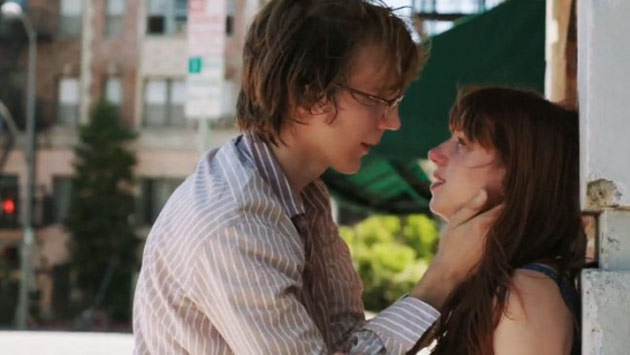
Trumpeting the long-awaited sophomore effort of Little Miss Sunshine creators Jonathan Dayton and Valerie Faris, the trailer for Ruby Sparks tackles that age-old challenge of visualizing the tribulations of a writer, which are inherently and notoriously un-cinematic. Editing substantiates the daily grind of someone like Calvin (Paul Dano), a squirmy novelist whose bursts of inspiration are expressed via fast cuts of punched keys and typewriter carriage returns. Going a bit further, the preview shows us Calvin's writerly thoughts in the office of his shrink (Elliot Gould), whose stucco, vented ceiling is seen through Calvin's eyes and superimposed on his thoughts of the titular dream girl (Zoe Kazan), who starts as his written creation and then actually appears in his apartment.

Manifesting a writer's ideas in three-dimensional, flesh-and-blood form is of course the ultimate way to commit them to film, and it's the basic conceit of this quaint indie rom-com, which matches an author's plight with the sweet reward of found love. As the trailer promises, Ruby Sparks is a less cynical exploration of territory already roamed in films like Secret Window and Stranger Than Fiction, wherein Will Ferrell's lead character was in fact the doomed creation of Emma Thompson's troubled author. Indeed, the similarity inevitably shows a lack of originality, and the sterile production design showcased in the preview only indicates a probable generic quality in the film. From Calvin's ultra-modern space to his hip little typewriter, the film is shown to have a Pier 1-style, catalog aesthetic, which these days is more prevalent in supposedly arty films than pricey blockbusters.

But despite all the trailer's missteps and boilerplate elements (the choral tune accompanying the tonal pick-me-up is dead-tired, while the flashes of big-name players like Annette Bening are dead-lazy in their hectic star promotion), it ably communicates a palpable sweetness that suggests it's not just another cerebral quirkfest. Paul Dano, captured in panicky moments that yield excellent expositional soundbites, may show new range as a performer in this film, ditching his usual gloom and rage to inhabit an endearing, love-struck dork. Naturally, his earnestness is met with obligatory macho wisdom from a co-star (Chris Messina), who speaks for male stereotypes everywhere when Calvin's control over Ruby is discussed. But Dano, ever at home in the roles he chooses, could very well overcome the shallow limits put on him by the film itself.

Where the trailer finally triumphs is in the chemistry between Dano and Kazan, who, in a bit of trivia only relevant for its apparent onscreen benefits, are an actual offscreen couple. Kazan penned the script and wrote the lead role for Dano, and there's something undeniably effective about these two arthouse darlings sharing their rising-star romance with the audience. It may not be the kind of “magic” Calvin preciously professes, but in just over two minutes, it’s immediately more genuine than dozens of other filmic pairings. What's more, for all its familiar beats, the trailer has the decency to withhold the whole of the plot, and never states if it's the kind of film that's bound for happily ever after. “Don't tell me how it ends,” Ruby pleads, and thankfully, nobody does.

R. Kurt Osenlund is the Managing Editor of Slant Magazine's The House Next Door, as well as a film critic & contributor for Slant, South Philly Review, Film Experience, Cineaste, Fandor, ICON, and many other publications.

GREY MATTERS: The Decline and Fall of April Ludgate

GREY MATTERS: The Decline and Fall of April Ludgate

null

I guess it was inevitable, especially when you think about the place of women in TV and the size of the NBC machine. But the worst has come to pass, and April Ludgate, the beyond-deadpan carrier of careless anarchic energies, the one-woman friction element who’s kept Parks and Recreation from being an Office clone from the unsteady git-go, has been muffled into a millennial-generation version of a wacky neighbor from a sitcom.

This, well, sucks. Because April Ludgate, it’s not a stretch to say, is the most extreme, most uncompromisingly strange, noncompliant female character in the history of broadcast TV. There is no mold for April Ludgate to break. When she ends up sunning herself in a South American dictator’s pool in one episode, the joke is that she fits there as well as she fits in small town America. Meaning she doesn’t, to her amusement.

Because of April, Parks and Recreation was an utterly unique situation comedy, set in a binary universe.

On the one hand we had Amy Poehler, playing Leslie Knope, a passionate bureaucrat in an Indiana small town’s Parks and Rec department, and her hugely adorable co-workers.

And on the other hand, as if reporting in from a parallel universe lorded over by deadpan semi-surrealist Steven Wright, there was April Ludgate (Aubrey Plaza), permanently hunched over, with huge, give-me-a-break rolling eyes, snark, and all-around Dada-esque hostility.

April’s acid grin gave the Libertarian outbursts of Ron Swanson (Nick Offerman) their exclamation points. Her eye-rolling threw water onto Leslie’s eternal happy hour of optimism. She showed proper disgust when one-joke wannabe playa Tom (Aziz Ansari) said something, well, disgusting. Let’s put it baldly: April Ludgate was Parks and Recreation’s stealth weapon.

But now? Now the girl who used to answer the phone with impossible dates and times, glower at the horizon for fun, and hang up on people for sport—all to the endless delight of her boss, no-government Ron, it should be mentioned—has been shorn of her playful, perverse and puckish identity.

She now prefers conservative work force clothing to better integrate into the office. She also shares hugs with anyone when needed, and when her cutely thick musician husband Andy (Chris Pratt) does something really dumb, she will throw her arms up and cry “Andy!” like a million other flustered wives before her. All that’s missing is a laugh track.

How far the mighty fall. I mean, sure, she’ll say something surly every now and then: I bet they have five or six 18 year old interns at NBC tasked with the job of coining her devilish rejoinders.

Anyway. Back in the day (before this season), I loved the way that April and Ron had bonded as peers in their mutual disgust over institutions, government, groups and, hell, everything but rare steaks, whiskey and causing more problems.

Not anymore! Now that Ron has committed an actual act of governance and promoted April to a job with more responsibilities, he has also become a father figure for April, because all girls, the subtext logic goes, especially uppity ones like April Ludgate, are really looking for the right substitute father.

Maybe here you can see why The Girl with the Dragon Tattoo was so remarkable. When Rooney Mara’s punk hacker was dragged into another dubious Girl Domestication scenario with another Oedipal-freighted father replacement, she soundly rejected it: that just doesn’t happen that much. That is breaking the law, after all.

Meanwhile, as I mourn April Ludgate’s spiky soul—I can see, in indelible ink, the writing on her face, saying “Don’t worry folks! She’s normal! Really!”—the show itself trundles to an ignoble season’s end.

Knope has run for city council. Since this is NBC and actual political parties cannot be named, the show instead goes for the Maureen Dowd school of politics, where there are no issues or ideologies, only personalities.

Knope should win, the show argues, because she’s wanted it longer. Me, I could use less of my favorite comic actor getting shitfaced and falling into hot tubs, failing career-making interviews and becoming the buffoon she never was.

Meanwhile, over in the kingdom of bad decisions of which April is queen, we find a high princess in Ann Perkins (Rashida Jones). Like April, Ann has been shorn of delightful prickliness and is now so needy that she pairs up with Tom, because he is now an adorable man-child. Or child-man.

Look. I revel in the promise of serialized TV’s ability to let people change. But there has never been any fine print about devolving them. And the other promise and pleasure is that they also stay essentially the same. I just don’t buy a Knope who’s recently so often a dope, or an Ann willing to forget everything she knows about romance so that Tom can annoy her into having sex—or as Tom described it, “The four sweetest words: you wore me down.”

Maybe I’m spoiled by girls doing whatever they want. Maybe I’m paranoid about endless notes and tweakings by suits after terrible ratings because lord knows Parks & Rec had those last year, but when all your female characters have been blunted and your male characters left the same or improved, it's just weird. Add on characters name-dropping the feminist critic Laura Mulvey and making knowing reference to “the male gaze” in time for Ron to have hot monkey sex with an actual female feminist, and I can’t help but feel as if the showrunners are not only winking at us, but at least partially aware that they knew exactly what they were doing with, say, April,
and probably knew we'd be at least somewhat put off by it, and hence the un-Parks and Rec-like avalanche of Community-style referencing meant to ensure we don’t get actually mad at them about doing any of it, because, like, see, we get the whole discourse, so we’re cool, right?

This irks me.

Still, the anarchy-in-the-USA energies have been passed to a male body now: that of real-life Republican Rob Lowe, here playing state auditor Chris Traeger.  (Yes, that is irony.)

At first a running joke of narcissism and mortality fear, Chris’s encroaching middle age anxieties have turned him into the show’s new wildcard of strange/insightful behavior (playing terrifying Gregorian chants at a Valentine’s Day DJ gig for example). Chris, it seems, is the new April.

With HBO’s Girls zeitgeist on the one hand and FOX’s retrogressive indie pixie gold mine The New Girl on the other, next season will tell whether April and the other women on Parks and Rec are allowed to rediscover their spiky roots. I hate to say it, but my hopes are not high. And maybe if I don’t watch any more demoted Aprils, I can think of this impossible character more as some incredibly rare, unstable mineral that let off this amazing, crazy light that was never meant to shine more than a few years before exploding beautifully into nothing. Yeah—I can think about it that way without getting cranky.

Ian Grey has written, co-written or been a contributor to books on cinema, fine art, fashion, identity politics, music and tragedy. Magazines and newspapers that have his articles include Detroit Metro Times, gothic.net, Icon Magazine, International Musician and Recording World, Lacanian Ink, MusicFilmWeb, New York Post, The Perfect Sound, Salon, Smart Money Magazine, Teeth of the Divine, Venuszine, and Time Out New York.

SIMON SAYS: On THE AVENGERS, Joss Whedon, Dan O’Bannon, and Zapped Toads

SIMON SAYS: On The Avengers, Joss Whedon, Dan O’Bannon, and Zapped Toads

nullIn the beginning of The Avengers, when Hawkeye says, “Oh, I see better from a distance,” I feared the worst and I thought of Joss Whedon, Dan O’Bannon, Lifeforce (1985) and X-Men (2000). I thought, “Oh god, that poor toad in the X-Men movie got hit by lightning and a bad line of dialogue all over again.” And I groaned mightily, albeit somewhat prematurely, because I thought that Joss Whedon was about to prove yet again that he, like most mortals, is fallible. Bear with me a moment—this will take some unpacking.
The Avengers, which for the record is mostly serviceable even if it is laughably contrived and underdone, was directed and scripted by Joss Whedon. Whedon is the grand geek poobah creator behind such cult projects as Buffy the Vampire Slayer, Firefly and Dr. Horrible’s Sing-Along Blog. He’s a singular voice in contemporary science fiction and fantasy who is famous for his complex characters and snappy dialogue, and he’s a major geek celebrity. But with Whedon’s storied reputation as a sharp pop artist also comes a series of incidents that have turned Whedon into a de facto martyr. Any time something goes wrong with a Whedon-related project, it’s assumed that it can’t be Whedon’s fault. That stigma of being misunderstood by people in power has only been enhanced by Whedon’s rocky history with 20th Century Fox. Let’s unpack that confusing relationship a little, as well.

First there was the script that Whedon wrote for Alien: Resurrection, a fairly unremarkable script in itself that was then turned into something different from Whedon’s original ideas. Which is basically, you know, what happens to most scripts when they get made into movies. Since Alien: Resurrection (1997), the fourth film in the 20th Century Fox’s Alien film franchise, had plenty of on-set production difficulties (for example: director Jean-Pierre Jeunet didn’t speak English), Whedon publically blamed the film’s director for the film’s numerous shortcomings. In a 2001 interview with the AV Club, Whedon complains:

I listened to half the dialogue in Alien 4, and I’m like, “That’s idiotic,” because of the way it was said. And nobody knows that. Nobody ever gets that. They say, “That was a stupid script,” which is the worst pain in the world[…]In Alien 4, the director changed something so that it didn’t make any sense. He wanted someone to go and get a gun and get killed by the alien, so I wrote that in and tried to make it work, but he directed it in a way that it made no sense whatsoever. And I was sitting there in the editing room, trying to come up with looplines to explain what’s going on, to make the scene make sense, and I asked the director, “Can you just explain to me why he’s doing this? Why is he going for the gun?” And the editor, who was French, turned to me and said, with a little leer on his face[…]”Because eet’s een the screept.” And I actually went and dented the bathroom stall with my puddly little fist. I have never been angrier. But it’s the classic, ‘What something goes wrong, you assume the writer’s a dork.’ And that’s painful.

Whedon has since publicly admitted that there were some shortcomings inherent in his script. Still, he’s only sharing blame here, though I wouldn’t really expect any screenwriter to fall on their creative sword and assume responsibility for everything that went wrong with Alien: Resurrection (it really is a mess, albeit an interesting one).

Then there was the cancellation of Firefly, a very strong science fiction TV show that Whedon created and directed. Firefly aired originally on Fox, but it was soon canceled after it failed to attract high ratings. After the show’s rabid fans banded together, Whedon got to write and direct Serenity, a feature-length theatrical release. The show has also been released on DVD, thanks to its vocal fans.

Then there was Dollhouse, a conceptually interesting but rarely well-executed science fiction/spy program about a high tech brothel where prostitutes who are secretly intelligence agents have their identities reprogrammed cybernetically to suit their clients’ desires. The show was teetering on the edge of cancellation after the first season. After heavy rewrites, the show was renewed for a second season, receiving relatively sturdier ratings, but the show was not renewed for a third season.

In between these three major events, there is a fairly minor but nonetheless relevant anecdote about Whedon’s work as a script doctor on X-Men, the first and mostly forgettable live-action film of Marvel Comics’ mutant superhero team. Whedon has taken credit for writing the line where Storm (Halle Berry), a mutant with powers to control the weather, taunts a villain named Toad by saying, “Do you know what happens to a toad when it's struck by lightning? The same thing that happens to everything else." Whedon says that the line was not the problem but rather the line-reading, insisting that Berry read the line “like she was [The Addams Family’s] Desdemona.” I fear that, in this case, it’s the writer’s fault. No matter what sarcastic register Berry might have affected, that toad-frying line is dopey.

Whedon’s creative woes makes me think of Lifeforce and Dan O’Bannon, the acclaimed screenwriter of Dark Star and Alien, who complained of having his work significantly altered by director Tobe Hooper (The Texas Chain Saw Massacre, Funhouse). Like O’Bannon before him, Whedon is a recognized talent with a respectable track record that infrequently climbs onto a cross for very silly reasons. Once again, a troubled production history and outlandish reports of Hooper’s unprofessional and unfocused behavior seem to have been confirmed by the tonally inconsistent and utterly bizarre film that was theatrically released. O’Bannon still took a check for the movie, but he grumbled intensely about it. He was misrepresented, and of course that had nothing to do how cheesy and flat-out bad an idea it is to have a naked energy vampire (Mathilda May, hubba hubba) virtually seduce everyone she meets on planet Earth.

Make no mistake, O’Bannon and Whedon have both made exemplary work. O’Bannon’s scripted a number of great projects, like Alien and Dark Star, and he’s even directed one of the very best horror-comedies, Return of the Living Dead (1985). Whedon’s TV work has similarly been consistently strong, and the handful of stories he wrote in the Astonishing X-Men comic book series was also pretty engaging.  But sometimes, it’s enough to just not say anything about work that’s not very good. This probably won’t happen with The Avengers. Whedon’s script is marred by garden-variety contrivance, but some of its ideas are rather underdone, especially the ones in the film’s first half-hour. Hawkeye’s line about “see[ing] better from a distance” is especially dismal when you consider that he’s being asked why he hasn’t involved himself in a group project. Renner delivers the line with a straight face. He could not have been misreading it, since Whedon also directed the film. That line is just a tediously literal-minded joke.

There aren’t many painfully awkward moments like this one in the rest of The Avengers, but there are a couple. For instance, Loki (Thomas Hiddleston) is first identified to viewers in the film by a character who unceremoniously blurts out, “Loki! The brother of Thor!” Or how about when Loki brainwashes Hawkeye in the film’s first twenty minutes, (not a spoiler, true believer!) after tapping his magic spear on Hawkeye’s chest and lamely declaiming, “Freedom is life’s great lie.” Just before tapping on Hawkeye’s breast and hypnotizing him into becoming one of his minions, Loki adds, “Once you accept that in your heart . . . you will know peace.” (Sort of a spoiler!) Simply put, these are bad lines. In the future, if Whedon complains about creative interference again without doing actively disowning the work, he’ll be leaving himself wide open to some really bad cardiac-arrest-related puns.

Simon Abrams is a New York-based freelance arts critic. His film reviews and features have been featured in The Village Voice, Time Out New York, Slant Magazine, The L Magazine, The New York Press and Time Out Chicago. He currently writes TV criticism for The Onion AV Club and is a contributing writer at the Comics Journal. His writings on film are collected at the blog, Extended Cut.

BONUS TRAILER MIX: THE DARK KNIGHT RISES

BONUS TRAILER MIX: THE DARK KNIGHT RISES

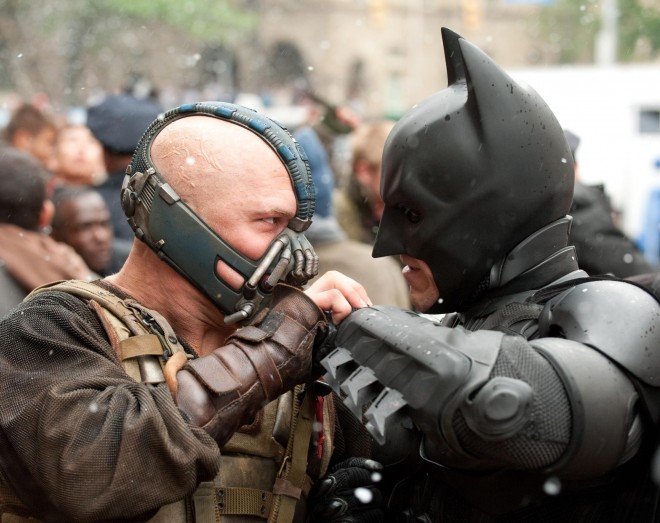
At the end of The Dark Knight, Commissioner Gordon (Gary Oldman) had to explain to his son why Batman (Christian Bale) was being willfully chased by police—disgracing himself and abandoning his post for the greater good of Gotham. The new trailer for The Dark Knight Rises zeroes in on the sleepy void that abandonment left behind, positioning Batman as the embodiment of hope, which won't return to the city's people until he himself returns. At the center is another boy who, while chalking the bat symbol on the pavement and chatting with Joseph Gordon-Levitt's beat cop, asks the question on everyone's mind: “Do you think he's coming back?”

Christopher Nolan hasn't been wont to cater to fanboy demands, but with the inclusion of idealistic children, he allows for the presence of both innocence and wide-eyed admiration, representative of vulnerable Gothamites and minute-counting franchise diehards. The moods of both parties are evoked in the trailer's first half, which, but for a light score accented with gentle piano notes, uses the sound of silence to ratchet up tension and augment awe. In rather Spielbergian fashion, both viewers and city residents look on as epic effects ravage Gotham in an eerie hush, its bridges, football fields, and crowded interiors handily destroyed by Bane (Tom Hardy), representing the self-professed “Reckoning” of the gray metropolis. “Hope is lost” and “Faith is broken,” read the ominous intertitles, setting up everything, from the music to the masked avenger, to ultimately rise, appeasing all who were flabbergasted by Gotham's quiet undoing.  

Through it all, the trailer finds precious balance in shady Selina Kyle (Anne Hathaway), a character who, beyond possessing unique allure, has notoriously played both sides in Batman's world. In voiceover, she whispers that “a storm is coming,” which one could apply to everything from Bane's impending assault to the movie's probable record-breaking sales. And with both a teasing menace and a clear devotion to the hero, her ambiguity is employed to amplify the theme of unease, another figure denoting citizens' fears and fans' rapid pulses.

The double entendres continue to pour from Selina's mouth, as she assures Batman that he “[doesn't] owe these people anymore,” and that he's “given them everything.” “Not everything,” Batman replies. “Not yet.” Without doubt, this exchange speaks directly to the tricks still tucked up Nolan's sleeve, and aims to assure the masses there's still plenty to come from the Caped Crusader. It's a promise that requires more faith than one may have expected, seeing as this preview doesn't boast the kind of wow factors oft-associated with a year's most anticipated film (the tacked-on reveal of a new Bat-vehicle seems more like a shameless trick than a thrilling addition). But in its use of the silent hovering of hope, the latest Dark Knight Rises trailer weaves audience loyalty into its very fabric, and leaves to the ticket-buyer the final assertion that the storm was worth waiting for.

R. Kurt Osenlund is the Managing Editor of Slant Magazine's The House Next Door, as well as a film critic & contributor for Slant, South Philly Review, Film Experience, Cineaste, Fandor, ICON, and many other publications.