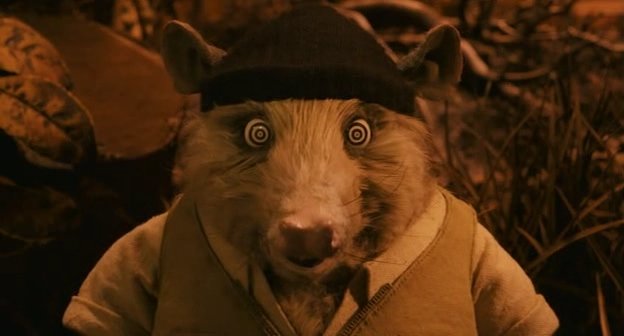
Is Wes Anderson influenced by Federico Fellini? Yes. Inasmuch, of course, as any American film director of the past 50 years might have been influenced by him. Fellini, Ingmar Bergman, Francois Truffaut, Jean-Luc Godard and others opened up a possibility for expansiveness and experiment in cinematic storytelling in the mid-years of the twentieth century that is as irreplaceable as it is hard to dispute. As this haunting piece by Andrew Infante shows, there’s a lot of similarity to note here, whether it’s the vaguely dreamlike way events occur in Anderson’s films, external logic giving way, beneath the surface, to something darker and stranger, or the lack of context for so many of the images and scenarios Anderson presents, from the garish outfit Max Fischer wears onstage in Rushmore to the strange silence of the hawk in Fantastic Mr. Fox and onwards. There’s also a sense of nostalgia, of looking backwards, in Anderson’s films that very much recalls Fellini classics like Amarcord or Juliette of the Spirits–in which the sense we get is not so much that the past was better, but that it was richer, even if that richness included equal parts suffering, temptation, and ecstasy. And is there decadence in Anderson’s films that rivals that shown in Fellini’s work? Yes. The older director filmed it: the parties, the orgies, the makeup, the wealth. Anderson embraces the same spirit, but works towards allowing his own imagination, the cult of one in which his vision is the founder and the sole acolyte, to steer his films. You could say "self-indulgent," but that’s not quite it: it’s a career in which, rather than killing his darlings, Anderson has multiplied them, magnified them and built them up to show the world the great benefit which has been reaped by keeping them alive.
Editor's Note: Press Play has two critics covering the Cannes Film Festival this year. Simon Abrams and Glenn Heath Jr. are tag-teaming their way through the most anticipated collection of screenings in the film industry. This is your ticket to Cannes. Enjoy!
Moonrise Kingdom is a great success, both within the context of Wes Anderson's body of work and as a work unto itself. Initially, however, its Wes- Anderson-y-ness is almost off-putting. At the start of this very mature children’s romance about two pre-teens, the camera tracks through almost every room of a house; the separate but equal nature of each of the house’s various inhabitants is matched with a song from a child’s record, explaining how an orchestra's sections come together to perform a piece by British composer Benjamin Britten.
The aforementioned sequence is a table setting scene, establishing the film’s main conceit. Similarly, in successive scenes, Anderson’s mise en scene characteristically consists of various objects which stick out like sore thumbs, such as different types of fishing tackle hanging on a wall, or old mailboxes arranged on a shelf behind a telephone switchboard). These objects draw attention to themselves, but, in Anderson’s eyes, they function as parts of a whole. Thankfully, Anderson and co-writer Roman Coppola (CQ) demonstrate how difference creates mass unity as the film goes along. No matter how discontent Anderson's latest film’s protagonists might feel, they are always in concert with the people who care for them.
Moonrise Kingdom is about the cascading repercussions of young love in the small community of New Penzance Island. Sam (Jared Gilman), a talented but “emotionally disturbed” member of the island's Khaki Scout troop, loves Suzy (Kara Hayward), a self-possessed but “troubled” singer, the only girl in her family’s brood of five children. Suzy’s emotionally estranged parents, Laura and Walt (Frances McDormand and Bill Murray) and Scoutmaster Ward (Ed Norton) are beside themselves when they learn that their respective charges have fled. But the search for Sam and Suzy eventually involves almost everyone on New Penzance, including a local Island policeman (Bruce Willis) and a mysterious narrator (Bob Balaban). Every character is an equally important member of Anderson’s wild bunch, even if not all of them are created equally (as in the case of one poor eye-patch-wearing Khaki scout).
That being said, Anderson and Coppola do fully explore the group dynamic aspect of Suzy and Sam’s relationship. Scenes like the one where Laura and Walt talk obliquely about their marriage woes nicely illustrate how it’s possible for Sam and Suzy to be alone together and also with their various friends and surrogate family members.
Anderson typically champions his protagonists’ eccentricities as the means by which they define themselves. But his characters are also often unified by the understanding that excluding each other is pointless, as everybody brings something to the group’s collective table. Even the crueler Khaki scouts learn this lesson in a hilarious scene built around a polemic from a pint-sized (former) bully.
The use of song cues, especially those from Britten’s Noye’s Fludde and Camille Saint-Saens’s Carnival of the Animals, subtlely establishes that characters defined by their difference and unhappiness are always an integral part of the film’s whole. In fact, the characters' quirks and unhappiness only further embellish Anderson’s comedy of power dynamics.
Simon Abrams is a New York-based freelance arts critic. His film reviews and features have been featured in The Village Voice, Time Out New York, Slant Magazine, The L Magazine, The New York Press and Time Out Chicago. He currently writes TV criticism for The Onion AV Club and is a contributing writer at the Comics Journal. His writings on film are collected at the blog, Extended Cut.
EDITOR'S NOTE: We are proud to present an unusual and personal series of articles by critic Peter Tonguette about grief and mourning on film, and how certain moviegoing experiences affected him in the aftermath of his father's death. Peter's series includes pieces on Hereafter, The Darjeeling Limited, Running on Empty, Men Don't Leave and A Soldier's Daughter Never Cries. If you would like to read the introduction to the series, Pictures of Loss: Introduction, click here. If you would like to read part 1 of the series, Pictures of Loss: Hereafter, click here. If you would like to read Pictures of Loss: Running On Empty, click here.If you would like to read Pictures of Loss: Men Don't Leave, click here. If you would like to read Pictures of Loss: A Soldier's Daughter Never Cries, click here.— Matt Zoller Seitz
About a year-and-a-half after my father died, I was at the Ohio Theatre (a former Loew’s movie palace in Columbus, Ohio) waiting for a screening of To Kill a Mockingbird to begin when I mindlessly reached for my inside jacket pocket. I seldom wear the navy blue blazer I had on, and I suppose I was curious to see what old to-do list or movie program I might find stuffed in it. What I found instead was some unused Kleenex tissue, neatly folded in the shape of a square. “What was that doing there?” I thought at first.
Then I remembered one of the last times I had worn this jacket. When my father was buried at Dayton National Cemetery (he was an officer in the Air Force before going into banking), I tried to go prepared. I wanted to absorb what was said at the service. I wanted to take in the physical surroundings where my father would be laid to rest, as unimaginable as it is for me to write those words, even now. More than anything, I wanted to anticipate what my own reaction to all of this might be. I did not think I would break down, but I knew enough to know that I could not be sure.
So, in lieu of a handkerchief, I must have placed the folded Kleenex tissue in my inside jacket pocket. I had forgotten all about it until eighteen months later, as To Kill a Mockingbird was about to begin.
When I went to see the movie that ordinary Sunday afternoon in June, it was just another thing to do. I loved Harper Lee’s story and Robert Mulligan’s direction. I wondered what Gregory Peck’s courtroom speeches would sound like in a big theatre. But I was not thinking that I would relive my grief. Then again, I wasn’t expecting to find that Kleenex either.
I realized that day that I would never be able to see an old favorite the same way again. When I revisit certain films now, the magic has dissipated. I’ll always remember how genuinely hilarious I thought Bringing Up Baby was when I saw it for the first time at age sixteen. My reaction was not unlike Peter Bogdanovich’s during his first viewing: “I screamed with laughter, but also with amazement: they had done this!” When I saw the movie again this summer—this second summer without my father—I admired it as much as ever, but something was missing. Missing in me. Bringing Up Baby should be laughed at, not “admired.”
When I decided to have a look at Wes Anderson’s films for the first time since my father’s death, I wasn’t sure what to expect. In my mind’s eye, I pictured nothing but the joyous derring-do of Anderson’s protagonists, like Max Fischer leaving a case of bees in Herman Blume’s hotel room or Raleigh St. Clair listening to a private investigator’s report on his wife Margot Tenenbaum’s extramarital activities. As far as I was concerned, these movies represented the same thing Bringing Up Baby did: a happier time, now lost.
The movies, however, told a different story. A decade ago, in his seminal Film Comment essay on Anderson, Kent Jones identified Max Fischer’s “profound anger and sadness over his mother’s death” as the source of the character’s iconoclastic behavior. In his films since Rushmore, Anderson has become even more preoccupied with mortality. It seems to have been his raison d’être in making The Royal Tenenbaums: “I was trying to make a movie in which there was the possibility that people could die,” he told Film Comment’s Gavin Smith. In that film, of course, the eponymous patriarch does die, and it is the death of, respectively, a beloved friend and a beloved father in The Life Aquatic with Steve Zissou and The Darjeeling Limited that inspire the quests that occupy the main characters of those wonderful movies.
Until The Darjeeling Limited, I think much of this was lost on me. When Max Fischer sat beside his mother’s grave in a smoky cemetery, I know I liked the shot (which, the director says, was influenced by the great final shot of Peter Bogdanovich’s Daisy Miller), but I don’t remember connecting with the emotion. As for the funeral that concludes The Royal Tenenbaums, I think I saw it mostly in dramatic terms—a satisfying grace note to end with. I certainly wasn’t thinking about my own father.
But by the time The Darjeeling Limited came out, I was older. So was my father. The three brothers in the film—Peter (Adrien Brody), Francis (Owen Wilson), and Jack (Jason Schwartzman)—seemed roughly my age. And their father (who has recently died as the film opens) seemed roughly my father’s age.
The movie struck a chord.
In a dozen superficial ways, The Darjeeling Limited got under my skin as no other Anderson film had before. I related most of all to the middle brother, Peter. Let’s start with his first name. For as long as I could remember, my parents had instilled in me a sense of pride in my given name. They liked it and so did I. Growing up, I never knew another Peter, but that didn’t bother me—to the contrary, it made me feel even more special. Oddly enough, I associate my name with the British movies my mother took me to as a child. She would invariably point out the many Peters among the cast and crewmembers listed in the end credits of films produced in England.
Now, all of these years later, there was a Peter in The Darjeeling Limited. It meant something that he was called that rather than Dignan or Max or Royal or Steve Zissou.
In the film’s opening scene, Peter sees the apparition of his father (Bill Murray), who is racing to catch a train somewhere in India. At the last moment, Peter, who is supposed to be on the same train, runs past him, but not before doing a double take. After Peter hops on board, he pauses to take a long look back at the ghost of the man he’s left behind. He seems disbelieving for a moment—could it be him? He lifts up the pair of sunglasses he’s wearing—which turn out to be his father’s—to seemingly get a better view. But then reality sets in—whoever it is back there, he isn’t going on any train trip—and Peter turns away, his eyes downcast, his lips pursed.
As I’ve said, I saw a great deal of Peter in myself. I felt I shared his thoughtful, serious manner—not for me, the whimsy of Max Fischer. I admired his sense of style, too, especially the trim Louis Vuitton suit he wears throughout the film. I liked the insouciance with which he lit a cigarette, even though I myself didn’t (and don’t) smoke. As one who suffers from migraines, I even related to his headaches, which seemed so much like my own (if his perpetual massaging of his temples was any indication). My point is that I think my identification with Peter allowed me to comprehend his stoic grief in the scene I just described. “That could be me,” I thought to myself. “That is how I might look or act if I experienced a death in the family.” I would have been quick to add, “And thank God I haven’t.”
But now I have.
Watching the film again, I seized on the scenes that dealt directly with the brothers’ grief. As Meghan O’Rourke writes in her memoir The Long Goodbye, “I was hungry for death scenes.” It reminds me of the way Peter, seated for dinner with his brothers on The Darjeeling Limited, keeps returning to the short story Jack has written about the day of their father’s funeral (“He had been killed suddenly, struck by a cab while crossing the street”), in spite of the distractions—Francis’s odd behavior and appearance, the two German ladies seated across from them—that surround him. Later, he excuses himself to re-read a portion of the story in the men’s room on the train. He does so by himself because he finds he is moved to tears and doesn’t want to cry in front of others.
Wes Anderson gets it: We let so few see how we really feel.
I have become convinced that Anderson was wrong when he told Gavin Smith that in his earlier films “one thing you knew is that none of these characters could die.” If that is the case, then why, in Rushmore, do I think of Max’s mother every time Max is on screen? And Edward Appleby every time Miss Cross is on screen?
Of course, this is a recent development for me. When I have watched Rushmore in the past, I always looked forward to one especially lovely moment. It comes during the montage sequence set to Cat Stevens’s “Here Comes My Baby,” after Max has asked Miss Cross for them to remain friends “in a strictly platonic way” and has agreed to her request to “make a go of it and settle down at Grover Cleveland.” It’s a very quick shot: at a game of tennis, Mr. Blume and Miss Cross are resting until Max enters the frame and shoos Mr. Blume back onto the court. So that Max can sit next to Miss Cross. Max flashes her a broad smile, which she sweetly returns.
This moment always reminded me of the terrifically romantic first line of Philip Roth’s Goodbye, Columbus: “The first time I saw Brenda, she asked me to hold her glasses.” Maybe it’s because both scenes are set at country clubs.
In that exchange of looks between Max and Miss Cross, I always thought I was watching a hopelessly smitten kid and a beautiful, carefree young woman. But now I see an orphan—and a widow. I am as surprised by this reaction as I was by what I found when I reached for my inside jacket pocket.
Peter Tonguette is the author of Orson Welles Rememberedand The Films of James Bridges. He is currently writing a critical study of the films of Peter Bogdanovich for the University Press of Kentucky and editing a collection of interviews with Bogdanovich for the University Press of Mississippi. You can visit Peter's website here.



 Glenn Heath Jr.
 Simon Abrams
 Moonrise Kingdom is a great success, both within the context of Wes Anderson's body of work and as a work unto itself. Initially, however, its Wes- Anderson-y-ness is almost off-putting. At the start of this very mature children’s romance about two pre-teens, the camera tracks through almost every room of a house; the separate but equal nature of each of the house’s various inhabitants is matched with a song from a child’s record, explaining how an orchestra's sections come together to perform a piece by British composer Benjamin Britten.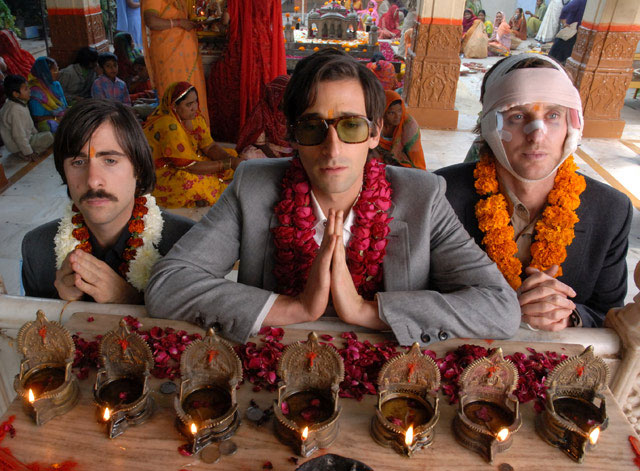

 When my father was buried at Dayton National Cemetery (he was an officer in the Air Force before going into banking), I tried to go prepared. I wanted to absorb what was said at the service. I wanted to take in the physical surroundings where my father would be laid to rest, as unimaginable as it is for me to write those words, even now. More than anything, I wanted to anticipate what my own reaction to all of this might be. I did not think I would break down, but I knew enough to know that I could not be sure.


 Press Play Video Blog