VIDEO ESSAY – MAD MEN Moments: The Sad Clown Dress

VIDEO ESSAY – MAD MEN Moments: The Sad Clown Dress

Part of the Mad Men Moments Video Essay Series

Click here to watch this on your mobile device.

In selecting an iconic moment for Season Two of Mad Men, we wanted to shift the focus away from the storied office shenanigans of Sterling Cooper and spend time unpacking the domestic storyline that, while less sexy, imbues the world of Mad Men with added dimension and depth. By focusing on the idyllic domestic world of Betty Draper and how it all falls apart within a 24-hour span, this video serves as a complement to the Season One video portrait of Don Draper in "The Carousel." 

The script for this video essay is written by Deborah Lipp, narrated by Roberta Lipp, and edited by Kevin B. Lee.

TRANSCRIPT

Mad Men's Betty Draper is a master of surfaces.

A former model who is happiest when praised for her beauty.

She lives the life expected of her, but the suburbs bore her and she has no real interest in motherhood.

Her husband is a mystery…and a philanderer.

In episode 2.08, A Night to Remember, it all comes apart.

Betty intends to prove herself the perfect hostess and wife, throwing the perfect party.

She then discovers she's a pawn.

She spirals into a rage. Don has broken the pact to maintain a perfect surface. Now there is nothing for Betty to hide, and so much to expose. 

Betty spends the night with her daughter instead of Don, as if to seek solace in a childlike state.

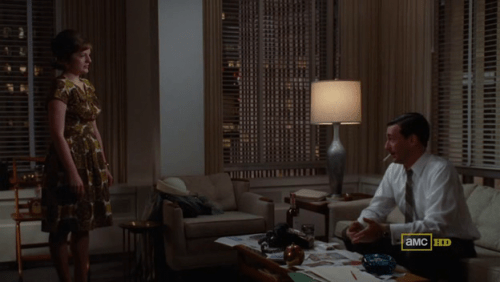
Over the course of the next day , her flawless party look–which costume designer Janie Bryant calls her “Sad Clown Dress”– falls to ruin.

She no longer bothers putting on a show of perfection. It no longer exists.

And she won’t move beyond this moment, until she finds the proof she seeks: that this man, and the idyllic life they’ve created are built on a lie.

But she’s unable to expose Don. She can only hurt herself.

And yet, she knows what she knows. She can no longer trust appearances, since that’s all her husband has to offer. Don stays in the shadows, denying everything.

Betty’s hair is held back in a band so that we see the full effect of emotion on her face.

The surface of perfection is gone. She’s exposed and looks broken. But underneath is a new found conviction about herself.

Finally, she faces Don without makeup, without a hairdo, without even a color. The white robe accentuates the starkness of this moment.

Now it is Don who’s afraid of losing everything. And it’s his expression of fear that brings her back.

The next day, the house is filled with warm, renewing light. Betty is back to being an immaculate housewife, as if nothing happened.

But a TV commercial brings it all back.

It has all crumbled. Her perfect home, her handsome husband, they are empty surfaces that have all been sold to her.

Betty is no longer buying.

Deborah Lipp is the co-owner of Basket of Kisses, whose motto is "smart discussion about smart television." She is the author of six books, including "The Ultimate James Bond Fan Book."

Roberta Lipp is the co-owner of Basket of Kisses and is or has been a voiceover artist, improvisor, actor, singer/songwriter, blogger and Mad Men aficionado. She plans to produce a one-woman show.

Kevin B. Lee is Editor in Chief of IndieWire’s PressPlay Video Blog and contributor to Roger Ebert.com. Follow him on Twitter.

VIDEO ESSAY – MAD MEN Moments: The Lawnmower

VIDEO ESSAY – MAD MEN Moments: The Lawnmower

Part of the Mad Men Moments Video Essay Series

Click here to watch this on your mobile device.

Our iconic moment of Mad Men season three easily ranks as one of the most shocking of the entire series to date. To explore it in depth, we adapted one of the best pieces we could find about the episode, written by Amanda Marcotte of Pandagon. This video is narrated by Roberta Lipp of Basket of Kisses and edited by Kevin B. Lee.
 

Amanda Marcotte is a Brooklyn writer who likes indie rock, quality television, and political blogging. She blogs at Pandagon. Follow her to Twitter

Kevin B. Lee is Editor in Chief of IndieWire’s PressPlay Video Blog and contributor to Roger Ebert.com. Follow him on Twitter.

VIDEO ESSAY – MAD MEN Moments: The Fight

VIDEO ESSAY – MAD MEN Moments: The Fight

Part of the Mad Men Moments Video Essay Series

Click here to watch this video on your mobile device.

There is near unanimous consensus that 4.07: "The Suitcase" is the standout episode of Season Four of Mad Men, so we knew that our video essay on a singular moment from that season had to come from that episode. But there are so many great moments in "The Suitcase:" Peggy's telephone breakup with her boyfriend (and her family), the scenes between Don and Peggy in the diner and the bar (where they express their mutual attraction as far as they allow themselves to); the confrontation with Duck Phillips back in the office; the early morning phone call; and of course the hand-holding. But for this video, we decided on the fight that erupts between Don and Peggy after she decides to devote her evening in the office with him on the Samsonite ad campaign. There is just so much to unpack in this swift, three minute scene, four seasons' worth of narrative and character subtext that has built up and finally explodes between them. What's also remarkable is how much of this is conveyed through subtle but effective choices in staging and direction, as we hope this video illustrates.

The script for this video essay is written by Serena Bramble, Deborah Lipp and Kevin B. Lee, based on "a kernel" of an idea by Serena Bramble. The video is edited by Kevin B. Lee and narrated by Roberta Lipp and Kevin B. Lee.

TRANSCRIPT

Don has received an ominous phone message about his dying friend Anna.

Telephone at his side, he is trying to bring himself to call.

Don is staged front and center, conveying a sense of isolation and confrontation with himself.

The framing of this wide shot emphasizes the distance between Don and Peggy.

The rest of scene goes back and forth between these two shots of Don seated on the couch and Peggy standing as if above him.

The staging highlights Peggy's newfound aggressiveness towards Don in this scene. She is emboldened by her breakup. He is weakened by Anna's imminent death.

The following dialogue plays like an exchange of blows that resonates with the episode's boxing subplot. It even lasts about the 3 minute length of a boxing round.

Don's response doesn't invite further conversation or empathy. It is action-based, in line with his past advice to Peggy.

Don’s smile betrays relief that he won’t be alone. He can put aside the call. But he conceals this by acting as if Peggy could easily have left.

The framing of Don on the couch has shifted left. A space has opened.

Peggy wants to finish the fight she started with Mark by taking on the man at the opposite end of what’s expected of her. Her insult of Don's personal life is as much towards herself as to him. The remark doesn't faze Don in the least.

Peggy's body now occupies the space to Don's left, further establishing her imposing presence.

Now it is Don who insults Peggy's personal life, patronizing her for being girlish. But Peggy, too, is unfazed. She jabs directly at what really bothers her.

Unlike with Peggy's insult of his personal life, Don takes this insult of his professional life as "personal" Don is ready to fight, if only to drown out the more painful feelings of grief. He can do it best where he feels most at home: the office.

The scene moves into tighter closeups of Don and Peggy as they exchange jabs with increased intensity

Like Cassius Clay in the prize fight going on that night, Peggy fights with sharp, rapid flurries. Like Clay’s opponent, Sonny Liston, Don is slower, methodical, and forceful.

Don's face is intensely red. He needs the emotional release of this fight as much as Peggy.

Peggy again seeks recognition, but now it’s not professional. It’s emotional. But showing emotions is unprofessional. She’s been caught with her gloves down. Don finally unleashes.

The knockout blow: one last insult encapsulating the conflicts running through the scene.

Serena Bramble is a film editor currently pursuing a Bachelor's degree in Teledramatic Arts and Technology from Cal State Monterey Bay. In addition to editing, she also writes on her blog Brief Encounters of the Cinematic Kind.

Deborah Lipp is the co-owner of Basket of Kisses, whose motto is "smart discussion about smart television." She is the author of six books, including "The Ultimate James Bond Fan Book."

Roberta Lipp is the co-owner of Basket of Kisses and is or has been a voiceover artist, improvisor, actor, singer/songwriter, blogger and Mad Men aficionado. She plans to produce a one-woman show.

Kevin B. Lee is Editor in Chief of IndieWire’s PressPlay Video Blog and contributor to Roger Ebert.com. Follow him on Twitter.

VIDEO – Motion Studies #3: Falling: The Architecture of Gravity

VIDEO – Motion Studies #3: Falling: The Architecture of Gravity

For the next seven weeks, the Oberhausen International Short Film Festival will present "Film Studies in Motion", a Web Series curated by Volker Pantenburg and Kevin B. Lee. This series, available on the festival's website and Facebook page, presents weekly selections of analytical video essays on the web, in preparation for Pantenberg and Lee's presentation  "Whatever happened to Bildungsauftrag? – Teaching cinema on TV and the Web", scheduled for April 28 at the festival.

Press Play will track the series, posting four or five of the selected videos each week as they also become available on the Oberhausen Film Festival website.

This week is an initial sampling of exemplary works from the emerging genre of online video essays on cinema. Combined they cover a wide range of subject matter (a genre, a sequence in a film, a cinematic motif, a director’s body of work). They demonstrate a variety of stylistic approaches to the video essay form, using an array of techniques: montage and rhythm, split screens, narration, creative use of on-screen text, etc. These works, some of them conceived as multi-part series, are made typically on computers with consumer-grade editing software, but they display an ingenuity that is comparable to that of the films they explore.

Today's selection:

Falling. The Architecture of Gravity

Jim Emerson (2009)

The video essay at its most direct, eloquent and illuminating, by virtue of simple comparison and astute observation.

Volker Pantenburg is assistant professor for moving images at the media faculty of the Bauhaus-Universität Weimar. 

Kevin B. Lee is Editor in Chief of IndieWire’s PressPlay Video Blog and contributor to Roger Ebert.com. Follow him on Twitter.

VIDEO – THREE REASONS: BATTLE ROYALE, a HUNGER GAMES for Grownups

VIDEO – THREE REASONS: BATTLE ROYALE, a HUNGER GAMES for Grownups

[EDITOR'S NOTE: Contributor Robert Nishimura's video series Three Reasons continues with Kinji Fukasaku's Battle Royale. He feels this film – a Hunger Games for Grownups – deserves release on the Criterion label.]

With Hollywood poised and ready to drop the next big book-to-screen adaptation on March 23, The Hunger Games will be the latest tween sci-fi/fantasy franchise to wipe moviegoer's minds of wand-waving witches and vapid vampires.  Frankly, if my editor hadn't informed me of this fact I would've been blissfully unaware of the whole thing.  I had no idea that Suzanne Collins had written a series of insanely successful young adult novels, thus dubbing her one of the most influential people of 2010.  I didn't know that Gary Ross had directed the film adaptation featuring a star-studded cast of younglings (plus Woody Harrelson, Stanley Tucci, and Donald Sutherland to make the film tolerable for parents). Fans of the novels had camped out hours before an early screening at LA Live, anxious to have the book retold to them. It has already broken records in advance ticket sales, beating out Twilight: Blah Blah Blah.  

I have no doubt that the movie franchise of The Hunger Games will be as insanely popular as the books. Whether we like it or not, the next three films are already in pre-production.  Lionsgate has tailor-made "youthful, edgy, exciting high quality entertainment," so it will be guaranteed to thrill and tantalize preteens across the globe.  Perhaps bows and arrows will come back into fashion.  Maybe the film will inspire some kids to kill each other, or in the very least grow wacky facial hair.  Now that I've been inundated with all the hype for The Hunger Games, I feel like I've already seen it, and not because the trailer spelled it out for me. 

The blogosphere was quick to point out the similarities between Collins' Hunger Games Trilogy with Koushun Takami's 1999 novel, Battle Royale, going so far as to call it a bold-faced ripoff.  Suzanne Collins admitted to never having heard of the book, nor has she read it since continuing the series.  So it goes without saying that Collins has never seen Kinji Fukusaku's film adaptation of Battle Royale, which will undoubtedly bare a striking resemblance to Gary Ross' The Hunger Games.  Both sources portray various degrees of a dystopian future, where teenagers are forced to fight to the death for the amusement of the government/home-viewing audience.  

Beyond that, it would be a waste of time to defend Battle Royale from plagiarism, since The Hunger Games has an entirely different set of cultural baggage, as well as being a disservice to countless other source material that deal with the exact same subject matter.  Collins just happened to tap in to the creative collective consciousness, drawing on ideas that have played out many times before, in addition to her intentional reference to Greek mythology.  There are elements of Orwell and Huxley at work here, but just enough to pander to its target audience.  The trailer for The Hunger Games focuses on defining the characters of Jennifer Lawrence, Josh Hutcherson, Liam Hemsworth, and the rest of the primped up cast, but showed me very little of what I'd really like to see: these pretty people killing each other.

Takami's Battle Royale is set in an alternative universe in which Japan was victorious in the Second World War, making it an authoritative world power.  It's the turn of the century, and society is falling apart with an economy on the brink of collapse, a rise in unemployment and in teen delinquency.  The government reacts by installing the Millennial Reform School Act (BR Act) as a means to thin out the numbers of juvenile delinquents.  Every year one 9th grade class is randomly chosen to compete in Battle Royale, forced into a game of survival in which there can only be one winner.  The unknowing selected class is then kidnapped, whisked away to a de-populated island, and each student is given a unique weapon, a map, and enough provisions to last three days.  Each participant is fitted with a metal necklace that monitors their whereabouts, exploding if they attempt an escape.  

As the game progresses, sections of the island become "forbidden zones," to keep the students moving closer to each other.  If you are caught in a forbidden zones your necklace explodes.  If there is more than a single survivor at the end of the three days, all the necklaces will explode and the game is forfeited.  If one person does survive he/she is allowed to return home, or in some cases, be allowed to play again.  To make things more interesting the BR Committee will plant "transfer students" in certain schools months before the class is selected.  Having these seasoned killers among the 40 student class helps speed the game along and forces the other students to play.  Takami's original novels reveals much more about this universe and the relationships of the students, whereas the film adaptation of Battle Royale very quickly establishes the setting and introduces this year's lucky participants, Shiroiwa Junior High School, Class B.

nullThe man responsible for selecting this year's class is Kitano (brilliantly cast with "Beat" Takeshi Kitano), who used to work at Shiroiwa Junior High School years before becoming the mouthpiece for the BR Committee.  His calm demeanor is especially off putting as he describes the rules to the game, pausing occasionally to kill a student to set an example for the rest of the class.  It's especially poignant to see Takeshi Kitano in this role since it would ultimately be Fukusaku's swan song.  Fukusaku had a long established career as a genre filmmaker, responsible for some of the most energetic and innovative yakuza exploitation films.  His crowning achievement could be the Battles Without Honor and Humanity series, known in the West as The Yakuza Papers.  

Takeshi Kitano's directorial debut, Violent Cop was originally intended for Fukusaku, who passed the film along to Kitano because he was too ill at the time.  A few years later, Kitano would (re)pay homage to Fukusaku's Sympathy for the Underdog (1971) with his film Sonatine (1993).  Kitano's films are largely indebted to Fukusaku and his generation of filmmakers.  Reaching the end of his career, Battle Royale brought Fukusaku back into the limelight, garnering several Japanese Academy Award nominations in addition to some well deserved controversy.  After 40 years in the business, Fukusaku still had the moxy of a young exploiter.  He managed to shoot only one scene for Battle Royale 2: Requiem (coincidentally, with Kitano) before passing away, leaving his son Kenta to complete the film in his father's memory.

In The Hunger Games contestants are chosen in pairs from various districts, some of whom seemingly have been training their whole lives to enter the game.  They are complete strangers to each other, the only attachment (as for the viewer) is purely physical.  The students in Battle Royale have known each other for years, and in some cases quite intimately.  This has a profound effect on the game and how it is played.  Some students try to form alliances to avoid any violence, while other students immediately start playing as soon as they leave the gate, desperate to to be the winner or seeking revenge for past grievances.  Most of the students are frightened beyond belief, questioning themselves and suspicious of even their closest friends.  The couple that we are meant to identify with are Shuya (Tatsuya Fujiwara) and Noriko (Aki Maeda), who now must confront their feelings for each other as well as frequent attacks from their fellow classmates.  

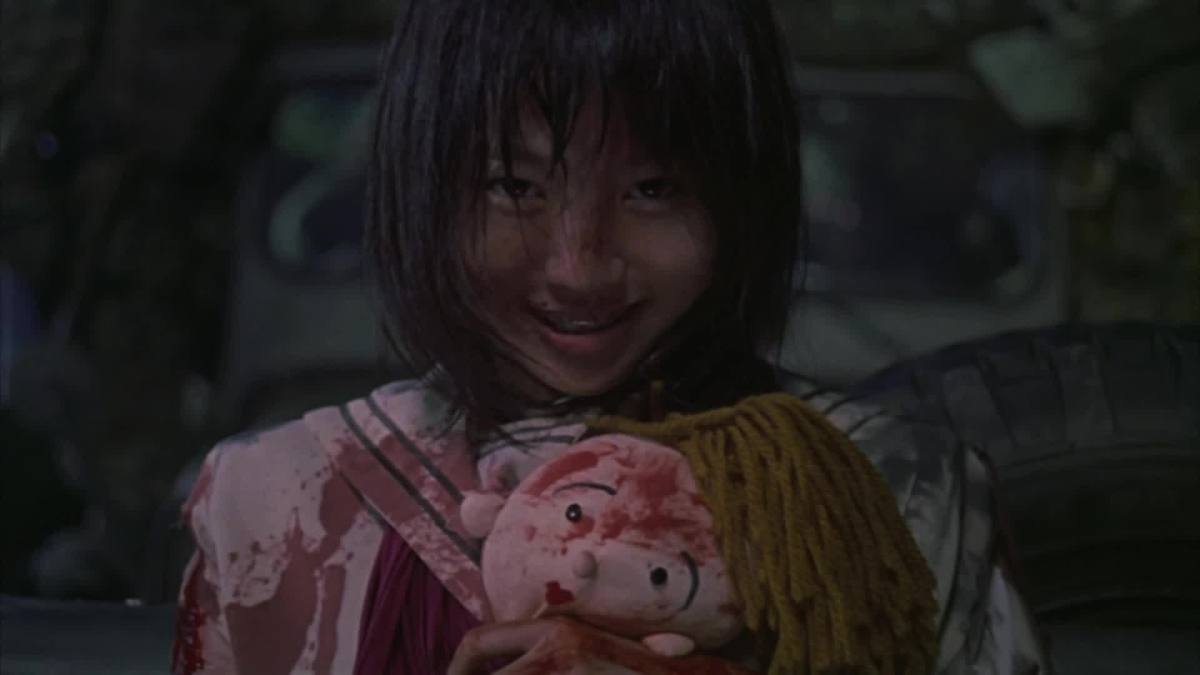
nullOne notable assailant is played by Chiaki Kuriyama, who basically reprises the the same role in Quentin Tarantino's love letter to J-sploitation, Kill Bill.  Fans of QT will recognize the tone that Fukusaku maintains throughout the film.  Realistic violence pushed to the point of absurdity, sometimes even cartoonish.  Shuya and Noriko witness all their friends (and enemies) unravel from fear and paranoia, either killing each other out of spite or suspicion.  As the student body dwindles away, they form an alliance with Shogo, one of the "transfer students" who had played the game before.  Together they devise a way to end the game and seek revenge on Kitano, who is surveilling them from the center of the island.

Contrary to popular belief, Battle Royale was never banned from US distribution.  The file was released soon after the Columbine incident, which wasn't the best time to be promoting a film that glorified killing your classmates.  Why the film hadn't be picked up since is the real mystery.  For years the film had garnered a cult following in the US, and still no distributor would touch it.  Even after Tarantino had given it his hipster seal-of-approval, he could have at least put it out under his Rolling Thunder label.  Criterion had already released David Lean's Lord of the Flies and Ernest B. Schoedsack's The Most Dangerous Game, so Battle Royale would have fit snugly betwixt those classics.  If only Criterion had picked up Battle Royale years ago it could've quite possibly saved us all from The Hunger Games.  

nullCriterion missed their chance to nab this title, and now that The Hunger Games have begun, another company has stepped up to finally bring Battle Royale to the US.  It would appear that my Three Reasons video is already an empty gesture since Anchor Bay is set to release the long-awaited special edition of Battle Royale 1 & 2 on DVD and Bluray, three days before The Hunger Games hits theaters.  It's loaded with features on Fukusaku's career and the impact Battle Royale had on cinema in Japan.  We can certainly trace the line from Battle Royale to The Hunger Games without too much difficulty, even though the film was never released in the US until now.  Its influence on Western cinema over the past decade has justified having our own kiddy-porn death-match. The level of violence in cinema has caught up to speed that we can now have our The Hunger Games, so it seems the US is finally ready for Battle Royale. For anyone who has not seen Battle Royale, it will not disappoint, but it may steal the "edge" that The Hunger Games is so desperately trying to project.

Robert Nishimura is a Japan-based filmmaker, artist, and freelance designer. His designs can be found at Primolandia Productions. His non-commercial video work is at For Criterion Consideration. You can follow him on Twitter here. To watch other videos in his "Three Reasons" series, click here.

VIDEO: Motion Studies #2: A Diary on David Holzman

VIDEO: Motion Studies #2: A Diary on David Holzman

For the next seven weeks, the Oberhausen International Short Film Festival will present "Film Studies in Motion", a Web Series curated by Volker Pantenburg and Kevin B. Lee. This series, available on the festival's website and Facebook page, presents weekly selections of analytical video essays on the web, in preparation for Pantenberg and Lee's presentation  "Whatever happened to Bildungsauftrag? – Teaching cinema on TV and the Web", scheduled for April 28 at the festival.

Press Play will track the series, posting four or five of the selected videos each week as they also become available on the Oberhausen website.

This week is an initial sampling of exemplary works from the emerging genre of online video essays on cinema. Combined they cover a wide range of subject matter (a genre, a sequence in a film, a cinematic motif, a director’s body of work). They demonstrate a variety of stylistic approaches to the video essay form, using an array of techniques: montage and rhythm, split screens, narration, creative use of on-screen text, etc. These works, some of them conceived as multi-part series, are made typically on computers with consumer-grade editing software, but they display an ingenuity that is comparable to that of the films they explore.

Today's selection:

Diary on David Holzman Part 1: The Sons and Daughters of David
Kevin B. Lee (2011)

This video essay links an under-seen 1967 American independent film with the current wave of reality TV and video blogs that pervade contemporary culture.

Volker Pantenburg is assistant professor for Visual Media with the main focus “Research of the Moving Image” at the media faculty of the Bauhaus-Universität Weimar. 

Kevin B. Lee is Editor in Chief of IndieWire’s PressPlay Video Blog and contributor to Roger Ebert.com. Follow him on Twitter.

VIDEO – Motion Studies #1: The Substance of Style

VIDEO – Motion Studies #1: The Substance of Style

http://www.movingimagesource.us/flash/mediaplayer.swf?id=11/767

For the next seven weeks, the Oberhausen International Short Film Festival will present "Film Studies in Motion", a Web Series curated by Volker Pantenburg and Kevin B. Lee. This series, available on the festival's website and Facebook page, presents weekly selections of analytical video essays on the web, in preparation for Pantenberg and Lee's presentation  "Whatever happened to Bildungsauftrag? – Teaching cinema on TV and the Web", scheduled for April 28 at the festival.

Press Play will track the series, posting four or five of the selected videos each week as they also become available on the Oberhausen website.

The following introduction to the series is taken from the Oberhausen International Short Film Festival website:

Anyone who has an internet connection and wants to expand their understanding of cinema can behold the remarkable abundance of analytical video essays on the web. Proliferated in just the last five years, these meticulous readings of title sequences, thorough investigations of film style and montage decisions, dialogic inquiries of acting or mise en scene have created a genre in its own right. They can be found on websites like IndieWire's Press Play, Fandor, Moving Image Source and Audiovisualcy, on the last of which curator Catherine Grant has categorized these works under the term "videographic film studies." The essays are expressions of a cinephilia 2.0, fueled by weblogs, internet-journals and streaming platforms, produced from DVDs and digital media, laptops, and DIY editing software.

This week is an initial sampling of exemplary works from the emerging genre of online video essays on cinema. Combined they cover a wide range of subject matter (a genre, a sequence in a film, a cinematic motif, a director’s body of work). They demonstrate a variety of stylistic approaches to the video essay form, using an array of techniques: montage and rhythm, split screens, narration, creative use of on-screen text, etc. These works, some of them conceived as multi-part series, are made typically on computers with consumer-grade editing software, but they display an ingenuity that is comparable to that of the films they explore.

Today's selection:

The Substance of Style, Pt 5: The prologue to The Royal Tenenbaums, annotated
Matt Zoller Seitz (2009)

What better way to kick off the series than with an opening credit sequence, unpacked in such a way that can only be done via video essay?

Volker Pantenburg is assistant professor for Visual Media with the main focus “Research of the Moving Image” at the media faculty of the Bauhaus-Universität Weimar. 

Kevin B. Lee is Editor in Chief of IndieWire’s PressPlay Video Blog and contributor to Roger Ebert.com. Follow him on Twitter.

AUDIOVISUALCY: A New Press Play Column

AUDIOVISUALCY: A New Press Play Column

"I think … of the wonderful impression I received … when confronted with … quotations in which film was taken as the medium of its own criticism",

Raymond Bellour, "The Unattainable Text", Screen, (1975) 16 (3)

For the last five years I have been fascinated by the growing number of videos appearing online that use movie images and sounds as the medium of their own criticism, as the French film theorist Raymond Bellour put it.

In April 2011, I created an open group forum called Audiovisualcy at the Vimeo video hosting site in order to begin to form an online community around an ongoing, crowd-sourced, collection of ‘audiovisual film studies’ that people all around the world are making.Twitter and Facebook versions of Audiovisualcy have also been set up to publicise and discuss video essays published on other sites. 

Audiovisualcy aims to collect and share a broad range of videos that have an analytical, critical, reflexive or scholarly purpose behind their use of movie footage. The videos should fully attribute their sources, and be made according to other Fair Use (or Fair Dealing) principles as well.

The ethos of the group is one of enthusiastic openness to the possibilities of this online format at what is still a relatively early stage in its development. In gathering works of professional journalistic film criticism and academic film studies alongside sometimes very personal, even highly experimental videos, a cross fertilization is very much hoped for. The best essays that Audiovisualcy showcases, in my view, inventively cross over some of the boundaries between their different publishing contexts and original intended audiences.

The Audiovisualcy column on Press Play is a collaboration between Press Play's editors, myself, and a series of guest contributors who will take turns to pick particular video essays and to discuss what it is that we like and value about them.

The video that I've chosen to launch this new feature is one that I added very early on to the Audiovisualcy collection: Jefferson Robbins' iMacGuffin: Portable Infotech and Suspense Cinema.

Jefferson’s video was originally published with an accompanying written text in 2010 at the Film Freak Central website. What’s great about it is that it also works brilliantly as standalone, purely audiovisual, work. It is very entertaining, shot through at every turn with Jefferson’s (and also Hitchcock’s) appealing wit. But it also works well, at more than twenty minutes in length, as a very comprehensive video study of suspense-film MacGuffin devices in the age of information technology; it sets out valid categories for its survey and gives examples from all the key films you’d hope to see included.

Best of all, it wears its undoubted expertise very lightly. It uses minimal text, no voiceover, just wonderfully chosen and expertly edited excerpts from suspense movies as well as from instructional videos about the gadgets it discusses. The sound editing is excellent, too.

This video shows just how compelling studies made in this form can be, especially for the purposes of precise, concise, but also wide-ranging comparison. Exact examples can be juxtaposed, not only in order to quote from the films directly — the feature of such audiovisual studies that so impressed Bellour back in 1975 – but also to allow viewers to experience their comparison in real time, to feel as well as to know how the objects under investigation in the video are actually handled, both by the films and their technologically dazzled characters.

Catherine Grant teaches film studies at the University of Sussex, UK. You can watch her video essays on films and film theory at her Vimeo channel and read her discussion of 'audiovisual film studies' at the academic research websites Filmanalytical and Film Studies For Free. At a Society for Cinema and Media Studies Annual Conference workshop in Boston on March 22, she will discuss "Video Essays: Film Scholarship’s Emergent Form" with Christian Keathley (Middlebury College), Girish Shambu (Canisius College), Benjamin Sampson (UCLA), Richard Misek (University of Kent), Craig Cieslikowski (University of Florida), Matthias Stork (UCLA) and others.

VIDEO ESSAY: Kevin Brownlow, Film Essay Pioneer, on D.W. Griffith

VIDEO ESSAY: Kevin Brownlow, Film Essay Pioneer, on D.W. Griffith

Next week the San Francisco Silent Film Festival will present the complete 5 1/2 hour version of Abel Gance’s epic Napoleon. It is truly a singular event: Due to the expense, technical challenges, and complicated rights issues involved, no screenings are planned for any other American city. This monumental event is being presented by SFSFF in association with American Zoetrope, The Film Preserve, Photoplay Productions, and the British Film Institute.

This full version of Napoleon is restored by legendary film historian and filmmaker Kevin Brownlow, whose epic documentary D.W. Griffith: Father of Film (1993) is available on Fandor. Directed by Brownlow and David Gill, the film tells the story of one of cinema’s most monumental figures, D.W. Griffith. It shares Griffiths’ life and legacy through biographical narration, interviews, and behind-the-scenes looks at his movies.

Of the vast array of material presented in this film, most fascinating are the moments where they analyze Griffith’s filmmaking, revealing his innovative techniques and how he brought them into being. Here is an edited and recontextualized compilation of those sequences distilled from the longform biography of this legendary artist.

Originally published on Fandor.

VIDEO ESSAY: American Harmony

VIDEO ESSAY: American Harmony

null

Watch this video on Vimeo (optimized for mobile devices).

When moviegoers think of quintessential American cinema, the images and ideas that spring to mind are that of a passionate John Cusack holding up a boom box serenading his love in Say Anything or of Sylvester Stallone triumphantly running up the Philadelphia Art Museum's snowy steps in Rocky. In fact, if one looks at any "Best Of" list concerning American cinema, they are usually built around these iconic moments of heroic elevation. What else are the movies for, if not to transport us to moments of unbelievable success and joy? But most American people don't fit the titular roles of Rocky or Norma Rae or Erin Brockovich. The America of yesterday and today is still full of the occasionally inspired but mostly ordinary individual.  Perhaps that is why the recent works of Harmony Korine fall under the heading of being "uniquely American."

After exploding onto the American indie film scene at the early age of nineteen with his screenplay for Kids, Korine quickly churned out two of the 1990s most polarizing works: Gummo and Julien Donkey Boy. Both of those films challenged the conventional narrative and presented audiences with unnerving and unwelcome notions. Then Korine spirited overseas to film his strangely touching commune drama Mister Lonely. And since 2009, the filmography of Korine–Trash Humpers, Act Da Fool, Curb Dance and Snowballs–has morphed into a visual canon of the purest form. Korine's camera has become much more subjective and invasive. The cinematography has turned far grittier. The editing rhythm now depends on the individual pulse of an idea or image.

nullThe subjects and characters that Korine presents exist outside the mainstream frame of heroes or villains. The silver screen heroines of Hollywood are now replaced with the rebellious, foul-mouthed street teens in Act Da Fool. The team of charming casino robbers or frontier-bound cowboys is now replaced with the outcast garbage can fornicators in Trash Humpers. By stripping away any safe scenario that would be found in a typical "movie," Korine forces the audience to reevaluate their primal reactions to some of the most obtuse and harrowing images. Therefore, these films transcend the visual mechanics behind the “normal” American narrative. Added, the locations that Korine uses for these films–decrepit housing, low-income neighborhoods–represent an underexposed cross-section of very real America (when compared to popular Hollywood content).

It's easy to write off Korine’s visual works as misanthropic. It’s even easier to file them under the often-misused label of "Trash Cinema." Yet if one looks closely enough to actually discover the embedded ideas expressed in these works–work, love, tragedy, success, and failure–it's not hard to appreciate Korine's deconstruction of the strange symphony that is the day-to-day American life.

Nelson Carvajal is an independent digital filmmaker, writer and content creator based out of Chicago, Illinois. His digital short films usually contain appropriated content and have screened at such venues as the London Underground Film Festival. Carvajal runs a blog called FREE CINEMA NOW which boasts the tagline: "Liberating Independent Film And Video From A Prehistoric Value System."