
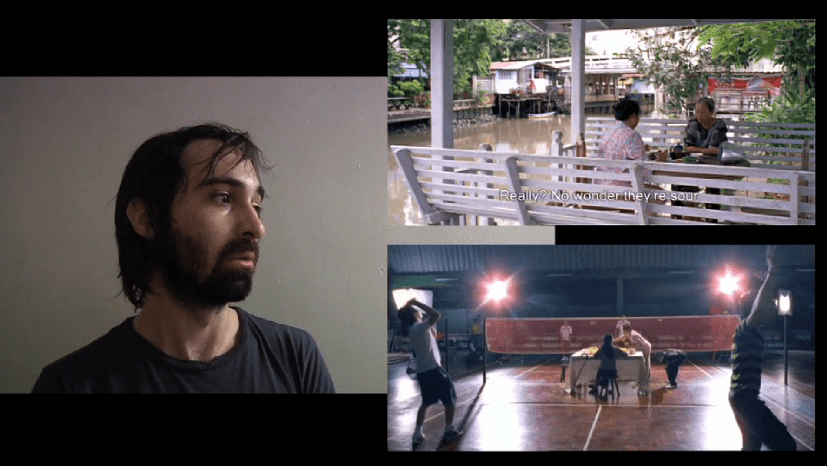
Critic and Sight & Sound contributor Vadim Rizov submits his answer with his selection of a film by Apichatpong Weerasethakul, one of the pre-eminent directors to have emerged in the past decade; with his first feature Mysterious Object at Noon released in 2000, he can be considered one of the first true post-millennial filmmakers. Rizov takes his selection further by not choosing one of Apichatpong (aka Joe)'s most critically vaunted features, Tropical Malady (2004), Syndromes and a Century (2007) or Uncle Boonmee Who Can Recall His Past Lives (2010). In fact, Rizov doesn't select a feature film, but Joe's short film The Anthem, co-commissioned by Frieze Projects and LUX in 2005. The short, intended as a "cinematic purification ceremony" to be played in movie theaters at the start of a screening, takes its inspiration from two ceremonial fixtures in Thai culture: Buddhist purification rituals and the playing of the Thai royal anthem at the start of film screenings and other public events. Rizov explains his selection in the video: "If I had to choose one film to show someone who was completely unfamiliar with arthouse cinema of the last 10-15 years what they had been missing in five minutes, I would choose Joe's short film The Anthem."
The selection of a short as one of the all-time greatest films may be more significant than selecting a film that is only seven years old. Shorts are all too often overlooked; I've spoken with more than one poll participant who was surprised to learn that short films were even eligible for consideration. But the first Sight and Sound Poll in 1952 placed a short film in the top ten: Jean Vigo's Zero for Conduct. Since then, no short film has come close to that ranking, though 1992 featured an especially strong showing of short films in the top 50: Maya Deren's Meshes of the Afternoon, Humphrey Jennings' Listen to Britain, Alain Resnais' Night and Fog and Luis Bunuel's Un Chien Andalou. All of those shorts fell in the 2002 balloting, excet for Un Chien Andalou, the only short in the top 100, and along with Chris Marker's La Jetee, the only short to receive three votes or more.
My own 2012 ballot features two shorts: Farough Farrokzad's The House is Black (1962) and Peter Tscherkassky's Outer Space (1999). I don't expect either of these to place well in the aggregate results, but that doesn't stop them from being two of the most stunning films I've seen: Farrokhzad's is a supreme fusion of non-fiction, essay and poetry; Tscherkassky's is a horrifying, spellbinding eulogy to the end of 20th century celluloid cinema. They do more in ten minutes than most films can do in 100.
Special thanks to Bill Georgaris of They Shoot PIctures, Don't They? for the Sight and Sound poll statistics cited in this entry.
Vadim Rizov is a freelance film writer based in Brooklyn. His work regularly appears in Sight & Sound, the L Magazine, the LA Weekly and the AV Club, among others. Follow him on Twitter.
Kevin B. Lee is Editor in Chief of IndieWire’s PressPlay Video Blog, Video Essayist for Fandor Keyframe, and contributor to Roger Ebert.com. Follow him on Twitter.


 Listening to Haskell speak about the film conjures visions


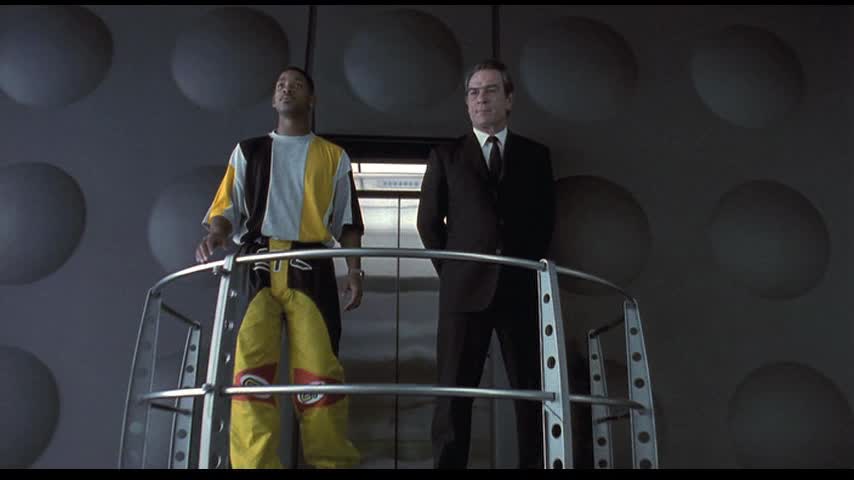
 Funny Games (1997) This is an obvious riff on the “remote control” moment that follows the shot chosen here, but with the aim to dissect one of the film’s most disturbing moments (that’s also the most cheer-inducing for the audience). Instead of blood and guts exploding from Frank Giering’s midsection, we see some special effects paraphernalia: a safety pack on his belly to protect him from exploding gunpowder, and some impressive coordination between the explosion effects both in front of and behind him. What’s also impressive is his posture as he receives the blow. Most people would flinch, cower, or curl, but Giering stands erect, practically heroic; all the better for the particles to fly from his chest.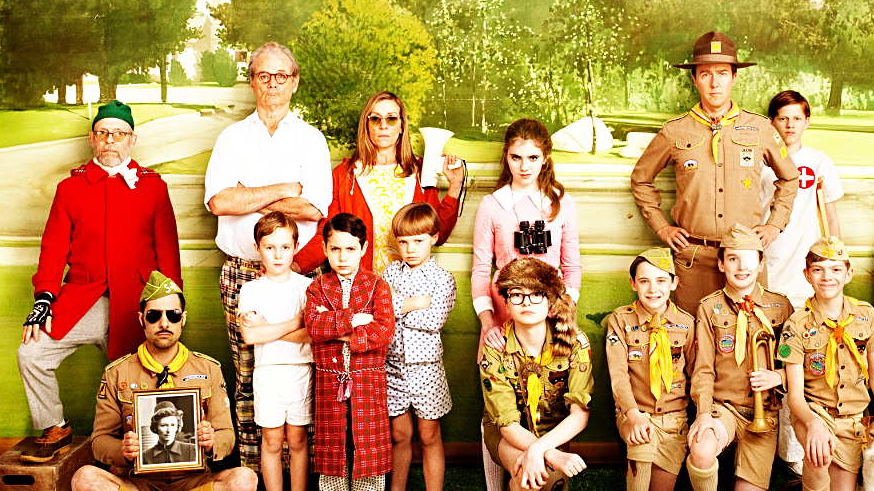
 Yet, for a director who addresses such heavy themes in his work, Anderson himself remains an enigma. His public persona—sporting a hipster-ish corduroy and scarf-laden wardrobe—suggests that he is quiet, quirky, and undeniably cerebral. His films all


 Press Play Video Blog