VIDEO ESSAY: A Death Foretold: Foreshadowing in MAD MEN

VIDEO ESSAY: A Death Foretold: Foreshadowing in MAD MEN

This video essay and its accompanying text also appear today on Vulture, the blog of New York Magazine; the staff of Vulture asked Press Play's editors to contribute a piece on Mad Men, and this was the result.

[Editor's note: this article and the accompanying video contain spoilers for all of season five of Mad Men. Read or click at your own risk.]

Now that Mad Men has drawn to a close and we prepare to spend the rest of the summer looking back on a particularly dense season, we can reflect on all the clues that led to one of this year’s biggest plot turns — Lane Pryce’s suicide. The show’s death obsession dominated recaps and comments threads throughout the last twelve weeks, and with good reason. Every episode contained one or more hints that a major character would die. Indeed, more so than any other season of Mad Men, this one earns the adjective novelistic. No single episode can be considered wholly apart from any other; each chapter replenishes the death/mortality motif in imaginative, sometimes playful ways.

This video essay, titled "A Death Foretold," collects a few of the more obvious and subtle predictors from season five. The piece is a joint effort by me; writer Deborah Lipp, who recaps the show for my IndieWire blog Press Play and co-publishes the Mad Men–centric blog Basket of Kisses; and Kevin B. Lee, the site's editor-in-chief and in-house cutter. It's not meant to be comprehensive; we originally compiled a three-page list of death references, then realized if we put them all in one video it would have been as long as a Mad Men episode! But we hope it'll offer the show's fans another pretext (as if we need any) to pick apart the show’s narrative architecture and argue about whether a cigar is just a cigar.

A critic, journalist and filmmaker, Matt Zoller Seitz is the staff TV columnist for New York Magazine and a finalist for the Pulitzer prize in criticism. He has worked as a movie critic for The New York Times, New York Press, and New Times Newspapers, and as a TV critic for The Star-Ledger of Newark. His video essays about Terrence Malick, Oliver Stone, Kathryn Bigelow, Budd Boetticher, Wes Anderson, Clint Eastwood, Michael Mann and other directors can be viewed at the The Museum of the Moving Image web site. Seitz is the founder of The House Next Door, a website devoted to critical writing about popular culture. His book-length conversation with Wes Anderson about his films, titled The Wes Anderson Collection, will be published in fall 2012 by Abrams Books.

Deborah Lipp is the co-owner of Basket of Kisses, whose motto is "smart discussion about smart television." She is the author of six books, including "The Ultimate James Bond Fan Book."

Kevin B. Lee is Editor in Chief of IndieWire’s PressPlay Video Blog, Video Essayist for Fandor Keyframe, and contributor to Roger Ebert.com. Follow him on Twitter.

VIDEO ESSAY: Cocaine du Cinema

VIDEO ESSAY: Cocaine du Cinema

For roughly the last one hundred and thirty years cocaine has been the drug of choice for the working class—in fact, for even longer than that, common workers often used it as an energizer. South American indigenous populations in the Andean Region survived centuries of arduous living conditions (rough terrain, high elevations) by chewing on the cocaine leaf; in North America, during the 1890s, African American workers were actually given cocaine by their employers in an effort to help them pummel through the harsh working conditions of railroad construction and mining. The modern world, however, has seen the cocaine drug go down two polar, simultaneous routes: the “crack” cocaine circuit in poverty-stricken inner-cities, and the elite, expensive distribution rings among the rich and powerful urban elite. And in today’s pop culture, cocaine has retained its rebellious status of being an exciting and attractive goad, especially on the silver screen. It’s no surprise that Scarface’s Tony Montana remains a better-known figure than say, To Kill A Mockingbird’s Atticus Finch.

But cocaine’s presence in movies is a tricky object to dissect. It’s never really a MacGuffin. Audiences are very familiar with cocaine’s societal significance. It is, after all, a destructive catalyst in the never-ending, off-camera narrative called The War on Drugs. Still, even with an awful, bloody contemporary history under its belt, cocaine seems to be the “cool” drug for modern cinematic heroes and heroines. Unlike marijuana, which often inspires bum-lazy comedies (Half Baked, Up In Smoke) or heroin, which provokes stark warning-label movies (Requiem For A Dream, Trainspotting), cocaine is usually presented as the “Fonzie” of narcotics: in style and very much the life of the party. Sure, there are the occasional movies offering instructive principles on the perils of cocaine addiction (Less Than Zero comes to mind) but for the most part, movies treat cocaine with zeal and elation. Johnny Depp defined his crime kingpin character with a badass stroll through the airport—with suitcases of cocaine in hand—to the tune of Ram Jam’s “Black Betty” in Blow. Uma Thurman snorted some lines of coke in the Jack Rabbit Slims women’s restroom before partaking in a show-stopping dance with John Travolta in Pulp Fiction. Even when it’s the punch line of comedies (Walk Hard, Corky Romano), cocaine miraculously dodges any serious negative connotation. Cocaine is the naughty drug that no one in the movie auditorium will dare admit to being drawn to—a narcotic pastiche that’s continually expanding its cinematic iconography.

Ultimately, in the movies—as in life—the cocaine-laden screen heroes get their comeuppance. Who could forget Uma’s near-fatal mistaking of a bag of heroin for cocaine in Pulp Fiction? Or Mark Wahlberg almost getting his head shot off during a botched coke deal at the end of Boogie Nights? Strangely, such climactic, nightmarish instances aren’t what moviegoers tend to recall or replay in their heads.  Moviegoers like to remember Tony Montana as a king perched behind his cocaine-piled desk, and not as a dead body floating in a mansion lobby fountain. As on the wretched morning after a wild party, it’s always easier to cling on to the previous night’s happier moment. And for audiences, this may be the safest of vicarious pleasures; a gateway drug to cinematic escapism, without having to face the reality of cocaine addiction and violence.

Nelson Carvajal is an independent digital filmmaker, writer and content creator based out of Chicago, Illinois. His digital short films usually contain appropriated content and have screened at such venues as the London Underground Film Festival. Carvajal runs a blog called FREE CINEMA NOW which boasts the tagline: "Liberating Independent Film And Video From A Prehistoric Value System."

VIDEO ESSAY: Sight and Sound Film Poll – Adrian Martin on Philippe Garrel’s L’ENFANT SECRET

VIDEO ESSAY: Sight and Sound Film Poll – Adrian Martin on Philippe Garrel’s L’ENFANT SECRET

Press Play presents Sight and Sound Film Poll: Critics' Picks, a series of video essays featuring prominent film critics on films they selected for Sight and Sound magazine's poll of the greatest films of all time. New videos will premiere each week until the poll results are announced later this summer.

When Adrian Martin visited Chicago last May, I made certain not to miss the opportunity to record him for this video series. Martin was one of the earliest enthusiasts of video essays when they started popping up online a few years ago, and I've wanted to collaborate with him since. At the tail end of a busy trip (a film criticism conference at Northwestern Univeristy and a master class on dance in cinema at the Univeristy of Chicago), we met to discuss his all-time favorite film, Philippe Garrel's L'Enfant Secret / Secret Child. The ease with which Martin delivers his testimony is remarkable (and made for a pleasant editing session); perhaps it's no surprise given that Martin has recorded 33 DVD commentaries and has regularly appeared on Australian TV and radio. I've long admired the range of his work: from mainstream broadcast media to teaching at Australia's Monash University; his writing appears in everything from books to international film journals to his own online journals, such as Lola (co-edited with Girish Shambu).

What distinguishes Martin's scholarship for me is his passion for all that is improbable or even impossible about the cinema; how cinema breathes life into things that can't exist or last in reality. This spirit of vital, celebratory defiance in cinema came through in his presentation on dance in film that I attended: instead of doting on the familiar instances of Fred Astaire and Gene Kelly, he showed breathtaking clips from Leos Carax's Mauvais sang, David Lynch's Twin Peaks: Firewalk with Me and John Waters' A Dirty Shame that reconceive the meaning of cinematic dance as a gesture that somewhat defies meaning. That spirit of dancing at the fringe of our understanding can also be sensed in Martin's love of Philippe Garrel and especially L'Enfant Secret, a chronicle of a tortured, fragile existence that embodies those qualities in its material properties: a film that at times "threatens to disintegrate."

To some extent the delicate filmic qualities of L'Enfant Secret that are crucial to Martin's testimony can't be conveyed in an online video essay, due to the limitations of transposing the film between mediums.  One can only hope that this video will induce further efforts to present the film in its intended format, so that audiences might have the same visceral reaction that Martin relates in this video. In addition to this video, one should also read Martin's article on the film published in Transit magazine (in Spanish and English).

Adrian Martin is a film critic, scholar and co-editor of the online film journal Lola. He is winner of the Australian Film Institute's Byron Kennedy Award and the Pascall Prize for Critical Writing. 

Kevin B. Lee is Editor in Chief of IndieWire’s PressPlay Video Blog, Video Essayist for Fandor Keyframe, and contributor to Roger Ebert.com. Follow him on Twitter.

VIDEO ESSAY: A Drop of BLOOD Through the Heart – A TRUE BLOOD Tribute

VIDEO ESSAY: A Drop of BLOOD Through the Heart

It's perhaps either a fitting coincidence or a realization of my own 20-something existential crisis that the making of this True Blood montage came shortly after I completed my video contemplation of the world of Mad Men's Don Draper. The similarities might not be obvious, but they are there: While Don Draper struggles to conceal his true identity as Dick Whitman as others around him try in vain to scratch beneath the surface, Sookie Stackhouse is still on a journey to reconcile her supernatural fairy blood with her human existence.

The essays contrast the question "Who is Don Draper?" with "What are you?" At its heart, True Blood is exactly about how we cope when we realize our constant, our humanity, is taken from us—new vampire Jessica's relationship with human Hoyt, shapeshifter Sam's investigation into the lives of his birth parents, and Bill's flashbacks to his first few decades as a vampire with Lorena are all examples. As the dearly departed Queen Sophie-Anne reminds Bill, "we started out [as humans] too." And when we left off in the Season 4 finale, mortality had never been more pressing than when Debbie and Tara had seemingly died—and perhaps even more shocking was Sookie's pulling of the trigger on Debbie in cold blood. I have a feeling that humanity, in addition to Tara's mortal life and Sookie's redemption, will be a huge theme in Season 5. And wild werewolves couldn't drag me away from seeing what happens next.

Serena Bramble is a rookie film editor whose montage skills are an end result of accumulated years of movie-watching and loving. Serena is currently pursuing a Bachelor's degree in Teledramatic Arts and Technology from Cal State Monterey Bay. In addition to editing, she also writes on her blog Brief Encounters of the Cinematic Kind.

VIDEO: A Todd Solondz Tribute Concert

VIDEO: A Todd Solondz Tribute Concert

Hailing “America’s crown prince of comic discomfort,” this week Film Society of Lincoln Center celebrated Todd Solondz with an advance screening of his new film, Dark Horse)—and this video attempts to do the same. It is, I hope, the ultimate tribute to the inimitable films of Todd Solondz. No director in the past three decades of American cinema has been as good at taking audiences where they don’t want to go as Solondz, who pokes at the ugliest of human behaviors and taps into an oozing vein of unexpected humor and pathos.

Watching all six of Solondz’s features prior to Dark Horse (including his debut, Fear, Anxiety and Depression), I was newly struck by how critical a role music plays in the work. From Welcome to the Dollhouse, with its suburban garage band’s off-kilter cover of the Stones’ “Satisfaction” and Dawn Weiner’s harrowing rendition of her school’s fight song at the end, to Jared Harris’s surprisingly touching serenade of “You Light Up My Life” in Happiness down to Life During Wartime‘s haunting interlude where Joy sleepwalks through suburban Florida to the tune of Devendra Banhart’s “Heard Somebody Say,” some of Solondz’s funniest and most lyrical moments have come through music. And while Solondz has dismissed Fear, Anxiety and Depression as a failed work due to reported lack of creative control, arguably its finest assets are the abundant musical numbers that run throughout, mostly written by Solondz, that charge the film with a giddy (if deranged) Broadway energy. His penchant for music is most explicit in his NYU student short “Feelings” where his own nasal crooning gleefully tears a new one in the old lounge chestnut.

This video takes three musical instances from Solondz’s filmography to form a kind of mini-tribute concert for the man’s work. Each song has its own distinct mood reflecting one side of Solondz’s flms and sensibilities, from tentative, hopeful yearnings of happiness, to painfully awkward romantic expressions, to surreal visions of suburban devastation. Once these songs lined up, the best moments of Solondz’s body of work fell into their natural place among them. Still, many great moments and lines didn’t make the cut, but this final musical trilogy still offers a potent six minutes of happiness, Solondz style.

Kevin B. Lee is Editor in Chief of IndieWire’s PressPlay Video Blog, Video Essayist for Fandor Keyframe, and contributor to Roger Ebert.com. Follow him on Twitter.

AUDIOVISUALCY – MAD MEN Redefined by Online Video: a Roundtable Chat

AUDIOVISUALCY – MAD MEN Redefined by Online Video: a Roundtable Chat

Part of Audiovisualcy, a column exploring the art and technique of the online video essay.

KEVIN B. LEE: Jim, your latest Mad Men video "The Other Woman & the Long Walk" (watch it above) really got my attention. On a design level, it seems pretty straightforward. Watching it, at first it seems like I'm just watching clips from the show, one after another. But very soon I realize that the video – and you, as its editor – are doing much more than this.

As one clip cuts to another, I feel a conversation beginning to emerge between them, which you are orchestrating. I start to feel like I am watching the show through another set of eyes. To do this without any explicit commentary, text, elaborate editing or effects, is remarkable.

In fact, I think it's because of this non-invasive approach that the viewer can have a special experience. It gives the viewer room to piece together the connections you are making without being told what they are. It's like playing a puzzle with one's eyes – a quality that distinguishes Mad Men from most other shows in that it leaves a lot of subtexts for the viewer to piece together on their own. Your video compresses and intensifies that experience.

Among the things I got from watching your video:

– I LOVE how it reorients the show around the women. One of my gripes with Mad Men for a while has been how it seemed at times to talk from both corners of its mouth, poking holes at the patriarchy while retaining its male-centric hold on the narrative (for all its rich female characters, it still often amounted to The Don Draper Show). Season Five has been a satisfying redress of this imbalance, with Don seeming to slip into the sidelines of a world spinning beyond his control, especially in regards to women – but watching your video is in some ways even better.

– How far the show has come from its first episode. That dialogue with Joan walking Peggy through the office from the series pilot is so expository; I don't think the writers would be caught dead being that on the nose today. Nor do they have to be – after five seasons so many layers of narrative and character subtext have accumulated, that even a simple moment like watching Don Draper teach a boy how to drive resonates on multiple levels and past episodes.

– I noticed how Joan addresses "Mr. Draper" in the pilot and realized how much her relationship with him and the other men in the office has evolved, just as much as Peggy's has. Their parallel trajectories are something you bring out vividly.

Anyway, your video got me thinking about the other videos you've made, as well as the series of videos Press Play produced at the start of the season by myself and Deborah Lipp, with a team of contributors – most notably Serena Bramble, who created "It's a Mad World," a dazzling tribute montage that understandably went viral. I thought the four of us could have a conversation about our experience making these videos and what they taught us about the show and about video essays. For now, over to you Deborah.

DEBORAH LIPP: Mad Men Moments (MMM) were the first video essays I worked on, and it was, for me, an exercise in using images to express verbal ideas, and using words to describe visual ideas. I'm a word person: My life has been spent as a writer. Working with Kevin I got to see how a visual person, someone who expresses himself through visual media, works. The thing I love about our MMM is that each approaches the subject matter very differently. "Season 1: The Carousel" was almost non-verbal, using only words from the episode. "Season 2: The Sad Clown Dress" was about images, but essentially used images to talk about something that could easily have been written. "Season 3: The Lawnmower" illustrated a remarkable written essay, and "Season 4: The Fight" was essentially a dialogue between subtext and image.

So the thing that leaps out at me in your essays, Jim, is the lack of words. You're communicating entirely through visuals. In fact, the essay titles tend to be the only thing that tells, in words, what your essays are about. Yet they're still easy to "read" and they say a lot about the topic.

I almost wish "The Long Walk" had been more strictly chronological, because I cannot get enough of the narrative arc of Peggy's remarkable changes from pony-tail wearing Brooklyn secretary all the way to copy chief at Cutler, Gleason & Chaough. I disagree with Kevin that the series gives lip service to the women. I think Season 4, if anything, was the most powerful in regard to women's issues, and I think "The Beautiful Girls" is one of the standout episodes of five seasons of Mad Men.

So, my question is about how you approach the material visually. How you select images and decide on a topic inside a non-verbal framework. I'd like to ask that same question to you, Serena. How pre-designed and how intuitive was your process in assembling clips from all the seasons? Whatever the case, it worked!

JIM EMERSON: First, thanks for your comments and for inviting me to participate in this discussion. I'm with you, Deborah, about the women on the show — in 2010 (after the Slattery-directed "The Rejected," which ended with the exchange of looks between Peggy and Pete through the SCDP glass lobby doors), I referred to "Mad Men" as "The Peggy Olson Show Featuring Don Draper" — and the four MM video essays I've done for seasons 4 and 5 ("Modern Compartments," "Beautiful Girls [and Mad Men]: Ghosts of the 37th Floor," "The Ladies in the Boxes," "The Other Women") have all focused on the women, because I think they're the most fascinating, complex and deeply mysterious characters on the show: Peggy, Joan and Megan, of course, but also Sally (the heart and soul of Season 4, in my opinion) and Betty.

And thank you, Deborah and Roberta and Kevin, for "The Sad Clown Dress," one of the most insightful and moving pieces I've seen about Betty. (I'd love to do a piece devoted entirely to the fainting couch…) BTW, I've never understood the criticism of January Jones in this role; whenever she comes across as wooden or phony or robotic it's because that's the way Betty often is! Like when she spews talking points she's learned at Weight Watchers, or talks to Sally about her period. Betty's not a bad person in these scenes, and Jones is not a bad actress. Betty just, fundamentally, lacks empathy — almost as if she's emotionally autistic. She has no idea who she is, and she's not comfortable in her own skin, so she goes on auto-pilot a lot, and you capture that in "The Sad Clown Dress." (Poor Betty is so clueless about other people that she just latches on to the suspicions saboteur Jimmy Barrett implants in her head, without really understanding why. But my theory all along has been that she sensed her husband was not who he said he was, but she can't explain why, and that pretty much drives her insane. Don's deceptions make her borderline schizophrenic.)

The first video essay I ever did (called "close up" was in 2007 for the House Next Door "Close-Up Blogathon" and it was images and music (and a lot of sound mixing) without any titles or dialog or narration, mainly because I did it over the weekend and had to teach myself to use iMovie at the same time. So, I had to keep it fairly simple (even though there are multiple layers of sound under the images). It was just a stream-of-consciousness thing, as most of mine are. My intention, as Kevin points out, is to convey what was going through my head — memories, motifs — while I was watching the episode/movie. Critical writing has to be both descriptive and analytical, and what I love most about video is its ability to create new contexts for the patterns I notice, using pieces of the original itself.

So, briefly (I hope), the idea for "The Long Walk" began with a desire to shuffle between the key conversations in "The Other Woman," because they are all strikingly similar, and all about the women declaring "no negotiation." So, I started with the two exchanges between Joan and Pete (in her office, then in his), the "Little Murders" flare-up between Don and Megan in their bedroom, and the final talk between Don and Peggy. Then it seemed they could be made to reverberate a little more by including Lane and Joan in her office, Peggy and Ted Chaough at the diner, and Don and Joan in Joan's apartment.

The way Peggy went in to collect her stuff (notice the three pieces of technology in the corner of her office: the typewriter, the phone, the speaker box — same as the "technology even women could use") reminded me of Joan's "orientation" in Episode 1, when Peggy first carried a box of stuff into the original Sterling-Cooper offices. And then it grew from there. The first thing I thought of was the sound of high heels on linoleum, because it seemed to me that the whole episode centered on the idea of Peggy walking away, so I searched around for the sound I wanted (bought it for five bucks from an online sound effects place) and layered it under the existing sound at the beginning and the end. I wanted to use it in a disembodied way, like the sound of the ringing phone at the beginning of "Once Upon a Time in America," combined with the dislocated walking scenes interspersed throughout "The Discreet Charm of the Bourgeoisie." Anyway, that's where the idea came from, I think!

(Just now, as I was writing this, I got a comment from somebody on Vimeo saying he would never have made the connection between Joan's "men love scarves" in S01E01 and Peggy's scarf in her meeting with Ted Chaough in S05E11 if he hadn't seen "The Long Walk." That's the kind of thing you hope to accomplish with these pieces!)

The elevator stuff at the end seemed natural, but I wanted those last two false endings to echo the repeat of Don's visit to Joan's apartment in the episode itself. Also like "Discreet Charm" (in which people wake from dreams into other dreams), Peggy breaks the spell of the final shot of "The Beautiful Girls" by pushing the elevator button again, and then Don interrupts "You Really Got Me" by pushing the same button… and then peering into the empty elevator shaft. For me, that's the void Peggy's leaving behind. Then there's "She's a Lady," which I started singing after I'd finished dancing around the room (with tears in my eyes) after "You Really Got Me," the first time I saw the episode. It's anachronistic (1971), but I didn't start it until the end credits. I considered doing a music video for the song using images of Peggy, Joan and Megan from this episode (lyrics by Paul "My Way"/"Having My Baby" Anka; lead guitar by Jimmy Page!).

Serena, "It's a Mad World" is absolutely beautiful and haunting — a dazzling example of my personal-favorite kind of video "essay" (sans narration). I love the way it's thematically organized into sections/songs on various subjects: the city, "Who is Don Draper?," advertising, booze and smokes, "What do women want?"… Can you tell us a little about how you went about organizing and putting all this together?

SERENA BRAMBLE: Well, luckily I was already a big fan of Mad Men before I created the montage, so I already had a grasp on the myriad of themes Weiner and co. spin in the series, but doing the montage I scraped just an inch more underneath the surface of who Don Draper is–or rather, the conflict between the man Don wants to be (which to me birthed his rush engagement to Megan and seems to be haunting him into their marriage), the very imperfect man, husband and father he really is, the image of perfect masculinity he sells with the same soothing reassurance as he sells products that people do not need, and above all, the man he is running away from, Dick Whitman. That is the heart of Mad Men: the secrets that pain us versus the lies we tell ourselves to keep face. Five seasons in, we are no closer to truly understanding who Don Draper really is, because he himself doesn't even know how to answer that question. I don't know if this is true or not, but I've heard a rumor that in every single episode, there is a line of dialogue that is a variation on the line, "What do you want me to say?" I really, really wanted to include a clip of Don saying that to Betty in "The Inheritance" (the episode where Gene is conceived in a moment of desperation), because it encapsulates the heart of that: that the Don Draper persona is a projection of what Dick Whitman thinks people want him to be: the debonair professional, the loving husband and father, the man who says what you need him to say. Essentially, the man who can be whatever we want him to be–the man who is whatever room he walks into, according to Bert.

I knew that I wanted to construct my montage so it would start on the surface–establishing the setting, time and place because it's so different from what we understand from modern times, yet as Rachel says, is the place too perfect to be true, and then work my way inward as best as I could. I was also influenced by the opening of Midnight in Paris with my opening montage, so I found public domain footage of Greenwitch Village from the late 60s, as a way of showing life as it really was, then cross-fading to the old New York of Mad Men, the place too good to be true, and the secondary characters trying to pinpoint Don, to no avail. Of course another major facet of Don's life is his work–in the season 4 opener and later in "The Suitcase," he uses his work as a shield for his crumbling personal life, so I segued into a work montage since most of the series' best moments take place at the office. I feel it's impossible to talk about Mad Men without mentioning the drinking, which is frequently covered up with a sly, Nick-and-Nora-like playfulness and slightness, and I also didn't want my montage to get too heavy with existentialism, so it was a fun part to put together.

I feel inferior talking about this when Jim did such a lovely, perceptive job at depicting the same theme in his essay "The Other Woman & The Long Walk," but I also felt it was important to at least note the treatment of women on the show in my montage–namely, how men perceive them, and what they're actually going through. The pitch of Belle Jolie lipstick as a woman "marking her man" is comically ironic, first for the way Don weaves female territorialism into something romantic (Peggy does the same thing later with the ham publicity stunt in Season 4), and secondly because it's impossible to believe that anybody in the real world would find lipstick on a man's cheek as anything other than a nuisance.

Betty Draper gets a lot of hate on the show, but I don't see her role as an initially vacant housewife a detraction from the series; after all, like Newton's law of motion, if you believe there is a girl like Peggy who is so progressive she eventually becomes Don's professional equal, you have to believe there is an equal and opposite reaction–in this case, a woman who remains stuck in the past of traditional values. And it's too easy to forget Betty's past, her love/hate relationship with her mother that also seeps into her relationship with her own daughter Sally, though I imagine the generational gap of the 60s will drive a deeper wedge into their relationship. The mother who wanted her daughter to be beautiful "so I could find a man," only to denounce Betty's modeling career by calling her a prostitute–in retrospect, Betty's current weight problems were hinted at in season 1, with Betty telling her therapist, "My mother was very concerned about looks and weight. And I've always eaten a lot. And I like hot dogs. My mother used to say, 'You're going to get stout.'" Which begs the question: Is Betty's current dramatic weight gain a side effect of another unsatisfying marriage, or a form of freedom from her mother's restrictions just as Sally's friendship with Glen is from Betty's curtailment? Finally, is it really fair to blame Betty when all her life the only value placed on her was her beauty, and then she had the bad luck to fall in love with a man who personifies whatever people want him to say?

Don can sleep with as many women as he wants–13, according to James Lipton–but the most healthy relationship he will ever have with a woman is his deep professional and personal friendship with Peggy, who has had the most growth on the show than any other character, from the girl who didn't know how to say no to her male co-worker's gaze to the only woman to truly stand up to Don. Their argument in "The Suitcase", wonderfully broken down in Kevin and Deborah's video essay, encapsulates their differences, yes, but also how comfortable they are with each other that they *can* shout at each other as a way of communicating. I felt it was a perfect way to segue from the women's issues to the existential gaze on the ruins of one's life that Frank O'Hara's poem Mayakovsky. I knew I wanted to use it because it so beautifully states the thing Don is always trying to do, which he nearly accomplishes in season 4: to find himself, or at least the honest, better man he aspires to be. Season 4 is so much about Don's rebirth from the ashes of "the catastrophe of my personality," yet self-defeat is inevitable, and maybe another reason why Don's controversial decision to marry Megan instead of Faye makes so much sense, if only from a screenwriter's standpoint: Once Don finds happiness and realizes who Don Draper actually is, the show will no longer have a purpose.

Because of my previous love for the show, the montage was exceptionally easy to make–once I had all the clips imported, it took me about 5-6 days to create an 8-minute rough cut, which repeated itself on a True Blood montage I'm currently working on. Whenever I do a montage, the first thing I do is look for the perfect music, because once you have the right music, everything will write itself and the wheels will turn so easily. (This is a good lesson that is being lost in the conversion from film to digital movie-making: always have a pre-production outline instead of winging it; editing is indeed a process of trial and error, but even that process is greatly aided by a map). There are still things I wish I could have included, clips I should have changed up, and even weeks after the fact I recently went back to delete a cross-dissolve. But the greatest gift, and in some ways the greatest curse the montage gave me is the realization that Mad Men is the greatest show on television right now, to which nothing can compare. It personifies patience, showing not telling, and audience gratification. It is not a show designed for the narrative cliffhanger hooks shows like Lost or Christopher Nolan movies have conditioned us to expect. It fills the screen with so much information that even on numerous re-watches, there are still subtle jokes to be discovered in the background of a shot. It's the patience of the audience that is rewarded handsomely by Weiner's utter trust in us to discover the breadcrumbs he leaves for us. People complain that nothing much happens on Mad Men. Everything happens–it's just up to the audience to discover the changes better than the characters themselves realize.

JIM EMERSON: Kevin, your piece on "The Carousel" (I used only one little snippet from Don's Kodak presentation leading into a similar line from his Jaguar presentation) is exquisite, with bizarre Lynchian moments, as well. I would never have put the maypole together with the carousel (and other circular motifs) without having seen this. (I wish I'd used something from "The Carousel" when I used the merry-go-round-like loop I made from "I've Got You Babe" — final song in "Tomorrowland" — in "The Ladies and the Boxes.") A lot of narrated video essays strike me as simply written pieces with audio-visual accompaniment; there's very little meaningful give-and-take between the images and the commentary. It's like the images are just there to give somebody the opportunity to talk over them. And in "The Carousel," you were working with a pre-existing written essay, and yet you integrated it with the images perfectly. Can you talk about how you approached composing this one?

KEVIN B. LEE: Jim, whatever the circumstances that necessitated it, it's remarkable that you caught on to a non-narration oriented approach to video essays right out of the gate. Same with Serena, who's always been skillful at speaking through montage. It took me years to catch on, and now it's what I am most interested in exploring: to have a film comment on itself rather than rely on the more conventional mediators of voice and text. What I like about this approach is that it isn't as locked into one particular meaning as what you typically find with a narrated commentary. There's more room for the viewer to engage with the footage and extract multiple insights.

"The Carousel" video was a major opportunity to shift my approach. Tommaso Toci wrote a great piece on the Carousel scene that was to serve as the video script, but as I tried to adapt it I had trouble visualizing how the narration would flow with the scene. I kept playing the scene over and over trying to figure it out. And then it dawned on me that the scene itself provided the perfect structure: Don Draper selling us an idealized version of his life, from one perfect image and sentiment to the next, just asking to be torn into given everything to the contrary that we've witnessed of him. The clicking of the slidewheel and the momentary lapses of darkness between images suggest holes in his projection of perfection, so I thought: why not make those holes the portals into the dark reality under the projected surface? The clicking sound also reminded me of a soldier stepping on a landmine, bringing the war flashback scene to mind, which of course is the "big bang" event that gave birth to "Don Draper." 

From there it was just a matter of going through every episode of the first four seasons, gathering all the memorable scenes, images and bits of dialogue around Don, and weaving them together around motifs and patterns. I'd recently seen a cool video by Gina Telaroli that does a lot with superimpositions and slow motion, so I played with those techniques, which kind of give a David Lynch quality to the footage, especially the domestic suburbia scenes. The slow motion also has a doting, fetishistic quality to it, slowing images down as if trying to get at their essence.

With Season Five mostly in the can, I have to say that this video works out with Season Four as the endpoint. The proposal scene to Megan from the Season Four finale really brings it full circle with the final image from Don and Betty's wedding in the slide show.

As I mentioned before, I've long held reservations about the degree of centrality Don has in the world of Mad Men, when the women characters are as richly developed but have gotten significantly less screen time. So it's ironic that the most intense and time-consuming video I did for the Mad Men series was on the guy I felt was already overexposed. At the same time I loved the challenge of trying to piece together a coherent picture of who Don Draper is. Working with all the available footage was like playing with the biggest puzzle set of any of the Mad Men characters. Though perhaps with a piece left missing by the show. As Serena says, even Don Draper doesn't know who he is, but of course we keep trying to figure him out. And the finely crafted surfaces, images and lines have everything to do with our being seduced as viewers – in a sense the video is as much about those elements as it is about Don.

JIM EMERSON: Kevin: Yes! It's that idea of getting inside the work itself, and inside your own experience with it, that I find so exciting about this approach, too. And Mad Men is ideal for it because it's so rich and layered. Most shows have a "bible" with all the details about the stories and characters in one place so the writers can consult it. I wonder what form the Mad Men bible is in. Do they have cross-referenced video clips with certain spoken and visual motifs (boxes, hands, doors, hats, etc.)? Tom & Lorenzo (a site I learned that Deborah is familiar with, though I just discovered it a few days ago) noticed that the fur coat Joan wears to her assignation with Herb is the very one Roger gave her back in 1954:

the one that caused her to coo “When I wear it, I’ll always remember the night I got it.” Well, fuck you, Roger Sterling. That’s EXACTLY what this outfit is saying. “You ruined what we had by letting me do this, so I’m ruining what you gave me.” We’d be surprised if she ever wore it again. It’s one of those beautiful costuming moments that takes a sad, horrifying scene and makes it even more so once you realize what she’s wearing.

That's the level of resonant emotional and thematic detail on which this show operates. It repays the closest readings we can give it. I'm also glad to hear that, for you and Deborah and Serena, your process may by necessity be somewhat systematic (so much to keep track of!), but the creative aspect is more instinctual. I love diving in with a few ideas and then seeing where the show takes me.

nullI'd like to return to one thing Kevin mentioned earlier, about Joan's famous "orientation tour" for Peggy — which is also our introduction to the world of Sterling Cooper and "Mad Men." The series has been criticized from the beginning for trying to score modern feminist points by overplaying the sexism, but I don't see it that way at all. What may seem "over the top" to 21st century sensibilities was just taken for granted in the 1950s and 1960s. When Joan says, "Don't be intimidated by all this technology. The men who designed it made it so simple that even a woman can use it," she's echoing any number of popular advertising campaigns from the '40s and '50s. This kind of thinking (in the era when "women drivers" were routinely ridiculed on television, for example) was so common that it spawned parody ad campaigns — including the recent one for a British oven cleaning product, Oven Pride," that was accused of reverse-sexism: "So easy, even a man can do it." And by 1968, Virginia Slims cigarettes were marketed to women with the slogan: "You've come a long way, baby" — which, in some ways, is just as condescending as "even a woman can do it."

But about Peggy in the first season: Deborah is quite perceptive about her response to the post-party garbage in the office, and we've seen how she's grown, gained confidence, loosened up (especially in Season 4, when she broadened her social circle to include Village pals like Joyce and Abe). She was so eerie (Elisabeth Moss has talked about how deeply strange Peggy was at first, which is what she found so compelling about the role) that I actually wondered if maybe she was mentally ill when we first met her. Maybe the show should really be called "Mad Women" — because the men tend to drive them mad, one way or another.) She was almost zombie-like at times (not unlike Betty). And that added to the suspense when she put her trembling hand on Don's after her first day. Look at her eyes, unfocused and blank. Now we know that she was terrified, unsure of who she was and what was expected of her, and she did wind up institutionalized for a while. And I've always loved that about Peggy. You can never be entirely sure you're reading her correctly or completely, because there's such a gap between how she sees herself and how others see her and how she presents herself. Which makes her the perfect counterpoint to both Betty and Don. None of them are who they seem, but for different reasons.

Serena: Your extensive knowledge and grasp of the show are absolutely evident in your work. I hadn't heard that about "What do you want me to say?" but I think you get to the heart of it. I found an interview with Matthew Weiner on the AMC web site, and he said:

A: Well, when Don says, "What do you want to hear?" or "What do you want me to say?", that's on purpose. I feel like that's the ultimate thing for Don to say. But Peggy saying "Maybe this is my time" is the kind of line that should only happen once. Q: Why is that the ultimate Don line? A: Because he's being kind, but still being honest. I think it's a great way of dissolving a conflict in a powerful way. He's basically maintaining control, but at the same time submitting.

As you say, so much of the show centers around the differences between the internal person and the external person. It's all about what we now call "spin" — which is essentially what advertising is, too. And everything is a performance, from your job to your most intimate relationships to your clothes and your apartment. The integrity and authenticity of the performance varies from situation to situation, moment to moment, but there's always a (self-)awareness that it is a performance. As Weiner said in the same interview, he thinks Don is basically a "good person" (whatever that means), and echoes what Megan told him in bed in "Tomorrowland": "I feel like the theme of the show, when it's over, is that it's hard to be a person. You should try to be a good person, but you will fail, all of the time."

Now that two of the major characters are gone (one obviously for good), I really hope the series will develop Dawn more fully. You recall that Season 5 was delayed because of costs, and there was talk about cutting some prominent characters to keep costs down (good god, who's next? Ken? Pete?), but it seems downright odd that they've done so little with Dawn. In some cases they actually seem to be shooting around her. You know where she sits, but they don't show her. Surely the actress Teyonah Parris is not that expensive! The scene in Peggy's apartment was perfectly played (with Peggy hesitating over her purse just long enough to realize how it must look to Dawn; and Dawn, who'd been sleeping in the office, noticing Peggy's awkward hesitation) — and there's got to be somewhere to go with that. MLK was killed in 1968, so maybe the show will use that, as it used the Cuban Missile Crisis and the deaths of JFK and Marilyn Monroe. I think Dawn has great possibilities…

Jim Emerson is the founding editor-in-chief of RogerEbert.com and runs the Scanners blog.

Serena Bramble is a film editor currently pursuing a Bachelor's degree in Teledramatic Arts and Technology from Cal State Monterey Bay. In addition to editing, she also writes on her blog Brief Encounters of the Cinematic Kind.

Deborah Lipp is the co-owner of Basket of Kisses, whose motto is "smart discussion about smart television." She is the author of six books, including "The Ultimate James Bond Fan Book."

Kevin B. Lee is Editor in Chief of IndieWire’s PressPlay Video Blog and contributor to Roger Ebert.com. Follow him on Twitter.

VIDEO ESSAY: Ridley Scott’s PROMETHEUS Timeline

VIDEO ESSAY: Ridley Scott’s PROMETHEUS Timeline

It’s perplexing to survey the recent surge of excitement from sci-fi movie fans about Ridley Scott. Sure, Scott’s two directorial sci-fi films—Alien and Blade Runner—set the benchmarks for the sci-fi horror and the sci-fi futuristic thriller, respectively, but Scott hasn’t directed a sci-fi film in thirty years. In fact, Scott hasn’t garnered much critical or financial success for a large chunk of his recent work (Body of Lies, Robin Hood, Kingdom of Heaven and A Good Year). So this excitement must be the result of two forces: 1) the studio’s clever marketing strategy of highlighting the fact that Scott only directed the original Alien, thus forgiving those late, lackluster spin-offs in the franchise; and 2) moviegoers’ desperate yearning for a credible companion piece to that same landmark 1979 film (e.g. Roger Ebert on the fourth Alien film: “There is not a single shot in the movie to fill one with wonder”). Considering these notions, Scott’s newest film, Prometheus, is destined to come under harsh scrutiny.

For starters, Prometheus was long thought to be a prequel to Alien—until Ridley Scott vehemently insisted that Prometheus was not a “prequel” per se, but a film that occupied the same fictional universe—a dark, capitalism-gone-awry space frontier full of privately funded space vessels and government-manned cargo ships—Scott created with Alien. This notion clashes with the studio’s marketing strategy of anchoring both Scott and Prometheus with Alien trademarks (the similar font for its title in the trailer, a strong female lead battling monstrous beings, etc.). As a result, much Internet speculation has surfaced regarding the possible linkage between Alien and the new Prometheus; where would Scott’s new film take place and would it feature the franchise’s aliens? The irony here is that Prometheus—once shrouded in secrecy—has become one of the year’s more transparent blockbusters. After releasing three (yes, three!) teaser videos announcing the arrival of its first theatrical trailer back in December 2011, Prometheus began a viral marketing campaign illustrating the visual history of its own place in Scott’s fictional universe. And if one were to do some homework and logical placement of events, the Prometheus-universe timeline would look something like this:

2023 – Weyland Industries Founder Peter Weyland gives a bold speech at a TEDTalks event, declaring humans’ new roles as Gods because of their ability to create human-like “cybernetic” individuals (a reality embodied in the Alien franchise, with Androids like Bishop and Call).

2089 – Archaeologist Elizabeth Shaw discovers an ancient map in a cave and then sets off a series of events leading to a space expedition to discover the origins of human life.

2093 – The Weyland Industries expedition crew, aboard the spaceship named Prometheus, lands on the distant moon LV-223. Instead of the origins of human life, they discover destructive beings (but not the titular monsters from Alien). The crew is killed. In the end, one of these destructive beings evacuates LV-223 in an ancient space pod of some sort.

The next date is not a Prometheus viral video; it is a known event from the original Alien film.

2122 –The crew of USCSS Nostromo (the cargo vessel carrying Alien heroine Ellen Ripley) investigates the planetoid LV-426 (which wouldn’t be too far from LV-223) and discovers a wrecked alien ship. Lo and behold, they find the fossilized remains of the destructive being from Prometheus.

In conclusion, Scott seems to have created a “peripheral prequel” to his historic sci-fi horror film Alien. There are no direct character lineages (outside of Weyland Industries) or same alien threats (presumably). The important difference between Alien and Prometheus seems to come down to Scott’s polarizing themes. With Alien, Scott set out to rewrite the space opera (e.g. Star Wars, Star Trek) into a terrifying gore fest. Judging from the ideas and content in the Prometheus viral videos (the origins of life, man’s ambition to play God), Scott now looks to expound on the hazards of ambition and hubris. If that’s the case, then maybe Scott’s thirty-year absence from sci-fi is worth the wait.

But this is all speculation. Maybe Scott just wants another monster to pop out of someone’s chest. We’ll find out on June 8th.

Nelson Carvajal is an independent digital filmmaker, writer and content creator based out of Chicago, Illinois. His digital short films usually contain appropriated content and have screened at such venues as the London Underground Film Festival. Carvajal runs a blog called FREE CINEMA NOW which boasts the tagline: "Liberating Independent Film And Video From A Prehistoric Value System."

VIDEO ESSAYS: The Seventh Art on GIRL WITH THE DRAGON TATTOO and SON FRERE

VIDEO ESSAYS: The Seventh Art on GIRL WITH THE DRAGON TATTOO and SON FRERE

This month the online video film magazine The Seventh Art has published two video essays on films: one on David Fincher's remake of The Girl with the Dragon Tattoo, and one on Son Frere and depictions of death and dying in cinema. The videos are part of The Seventh Art Issue 4.

"The Girl with the Dragon Tattoo as a Meta-Remake". Written by Christopher Heron, edited by Simone Smith, sound recording by Brian Robertson, narrated by John Cohen. Excerpt:

The two most common types of film remakes at the moment are remakes of older films and remakes of recent foreign language films. The remakes of these foreign films aim to port the domestic success of a film to a North American market that has not seen the original. David Fincher’s remake of The Girl with the Dragon Tattoo is somewhat of an aberration because the original film had grossed a very healthy $10 million in the United States based, in part, on the success of the source novel. Compare that with the recent remake of Let the Right One In, another Swedish domestic success, which only accumulated $2.1 million in the U.S. ahead of its own American remake. It’s fair to say that The Girl with the Dragon Tattoo is a unique remake where a fair amount of the prospective audience is aware that it’s a remake.  

"'The Color & the Texture of Blood': Visible Mortification of the Body in Son frere." Written by Elysse Leonard, edited by Christopher Heron, sound recording by Brian Robertson, narrated by John Cohen. Excerpt:

Classical cinema’s approach to non-­‐violent, or “natural,” death can be differentiated from that of post-­‐classical cinema in several ways. Death in classical cinema is meaningful, narratively functional, and, perhaps most significantly, invisible. Post-­‐classical death, however, is irrational, contemplated, and highly visible as a material process. This is represented in Son frère through a nonlinear story, close-­‐up shots of the body and the use of camera to identify with the dying character.

VIDEO: Sight & Sound Film Poll: Ekkehard Knörer and Michael Baute on UNDER THE BRIDGES

VIDEO: Sight & Sound Film Poll: Ekkehard Knörer and Michael Baute on UNDER THE BRIDGES

The fifth video in our ongoing series is the first to involve a film on my own top ten list for the Sight & Sound Film Poll. But I'm not one of the commentators on the video. Nor is the film on the top ten list of either of the commentators. But somehow the three of us form "an inclusive whole" (to use a phrase in the video) to make the case for why Helmut Käutner's Under the Bridges is one of the greatest films ever made.

I first watched the film three years ago as part of Shooting Down Pictures, where I started producing video essays. My viewing of the film came weeks before a trip to Berlin, where I discussed my video essays in public for the first time, as part of the series Kunst der Vermittlung (translated as "Cultural Education" according to Google) organized by Stefan Pethke, Michael Baute, Volker Pantenburg, Stefanie Schluter and Erik Stein. This was an extensive series of screenings and talks dedicated to showcasing film criticism and scholarship performed within the medium of film and video.

I was really taken by the project organizers' enthusiasm for this sub-genre of filmmaking and film criticism, and proposed to collaborate on a video essay on Under the Bridges. Michael Baute accepted the invitation and also enlisted the help of Ekkehard Knörer, editor of the film journal Cargo and one of Germany's leading film critics. We met at Michael's apartment in Kreuzberg, I with my recording equipment and Michael and Ekkehard with a voiceover script they prepared. We recorded the narration; later that day Michael accompanied me on a boat tour of Berlin's Spree River, where we filmed several bridges, thinking it might be a good visual element for the video. I concluded my visit happily and went back to the States with freshly recorded footage ready to edit.

Three years later, the video is finished. I'll refrain from listing extenuating circumstances for why it took three years to make this video essay. I've already apologized to my collaborators, and I am happy to report that they are satisfied with the results. This comes as a relief to me, because the quality of their commentary is such that it may have caused some trepidation on my part, contributing to the delay. Until that time, I had never been handed such an eloquent and extensively prepared narration with which to produce a video. In fact, this narration played no small part in opening my eyes to the splendor of this film.

Knörer and Baute talk about the film's attempt to create beauty in the most unlikely and unyielding circumstances: the end of the Nazi regime, with bombs falling all over Berlin and hardly any resources for filmmaking. They talk about a film whose style embodies a richness borne of poverty: finding the sublime in the most quotidian images and slightest of gestures. They talk about the alchemy of filmmaking, creating miraculous effects out of an improbable scenario bordering on a whimsical absurdity out of touch with the reality of its times – and yet strangely appropriate, even necessary. Necessary because of the small, delicate, and redemptive human touches that float across the screen from start to finish, and that culminate in a feeling of unassuming yet profound grace.

As modest in its brilliance as it is brilliant in its modesty, Under the Bridges is precisely the kind of film that deserves to benefit from an exercise like the Sight & Sound Critics Poll. While many come to the list curious about the new consensus over what the greatest films are, many others are craving to discover lesser-known titles that others passionately cherish. This is such a film. Please watch this video, and learn about one of the greatest films ever made. – Kevin B. Lee

Ekkehard Knörer is a film critic and editor and co-founder of Cargo Film/Medien/Kultur as well as the editor of Merkur Deutsche Zeitschrift für europäisches Denken.

Michael Baute works as an author, critic and curator and in various media-related projects. Since 2001 he is a contributor to the weblog newfilmkritik. In 2006 he (together with Volker Pantenburg) published a book on Charles Laughton’s Night of the Hunter. Recently he’s been the artistic director of Kunst der vermittlung, a website and screening series exploring the art of video-form criticism.

Kevin B. Lee is Editor in Chief of IndieWire’s PressPlay Video Blog, Video Essayist for Fandor Keyframe, and contributor to Roger Ebert.com. Follow him on Twitter.

TRANSCRIPT

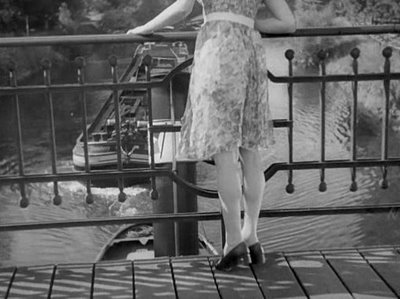
EK: "Under the bridges" is a film about Willy and Hendrik, two skippers on a cargo barge who, as a song sung by one of them makes explicitly clear, have led a skipper's promiscuous life. This, however, they have now decided, has to come to an end. They are, very literally, on the lookout for a woman to love. They both are, which brings up the issue of their friendship, their life together on this barge named Lotte. "Under the bridges" on the surface is not much more than a romantic comedy about these two men and their attempt to find a way of integrating a woman in their unsteady lives. But "Under the bridges" is far stranger than it seems. It was shot in wartime, from May to October 1944. You wouldn't know from the film. The Berlin you see is a city in peace. Its buildings are unscathed. Indeed, everything here, these industrial buildings, the landscapes and even these people and their relationships, seem made up from the scraps of better times. But they had no means at all, no money, when they did it, bombs were falling at the time, it really is an arte povera film.

MB: The question then becomes: Is this escapism? The devastations of real life in Germany at the time seem purposefully suppressed in every single image and montage. But at the same time something else makes itself felt underneath the peaceful floating of the barge and the joking and the erotic innuendo. "Under the bridges" is in every respect a film about having to make do, about never expecting too much, about confining yourself to what is near. This is true of Hendrik and Willy who are never es free and independent as they seem. There is even an explicit symbol for that in the film: their barge lacks an engine so they have to rely on other boats taking their barge upriver.

EK: Anna, the woman, with whose fate theirs will be connected, is in quite similar a position. She has very recently arrived in Berlin from an Eastern province and her first attempt to find a partner has disastrously failed. When Hendrik and Willy "meet" her she is standing on a bridge, at night, throwing money in the water. Hendrik and Willy suspect that she may jump and follow the money, with suicidal intent. They take her on board and they begin, in their unassuming ways, wooing her. It seems an impossible task this story has set for itself: Making one out out of these three on an allegorically floating thing like this barge.

MB: There is a kind of suspense in the film that has little to do with the question of how to succeed with that. (And it is obvious that success can only lie in all of them finally taking something like a back seat.) No, the real suspense of the film has much to do with a back and forth of little charges and discharges. This is one of the film's most intimate scenes. It is Anna's first night on the boat, she can't sleep, alone on a boat with two strangers, but also because of all the little noises. Hendrik, however, explains it to her. These natural sounds, made by the rope and the reed, are not noises, but in fact they are music. Natural life, the everyday, is in this way charged with the notion that in fact it is something more poetic. In this case: music. Listen to that.

EK: "Under the bridges" is a film about efforts, but in an almost paradoxical way: efforts are being made to make things seem effortless. It is a film where every feast is frugal, but frugality is made into a feast. And love, the feast of feasts, is effortlessly made into something on which not too many efforts, nor too many words or too many gestures or feelings should be spent. Modesty is what this film strives for, in the middle of a war it makes every effort to ignore. Efforts are visibly made, however, also on the aesthetic plane. "Under the bridges" is not simply a film in the vein of what very soon will be called neo-realism. The expressionist heritage makes itself felt in quite a few scenes playing with darkness and light. The camera moves in rather sophisticated ways, and also the actors are moving naturally and at the same time seem quite choreografed. The effortless flow Käutner achieves comes from his blending of these two seemingly contradictory movements.

MB: Let's concentrate on two emblematic scenes. In the first one Hendrik comes to surprisingly visit Anna at her place. She lives in one of those Berlin courtyards. All she can see of the city is a cigarette ad on the wall of a building and a rather small aperture between the walls of this yard. And now they are intimately together. It is, in its very own way, the film's major love scene. Nothing much happens but in this "nothing much" lies the core of this film's ideology. You have to make do. Käutner manages to charge the most frugal rapprochment with a lot. This is the film's most moving scene because it sums up what "Under the bridges" is all about: You have to be able to find the jubilatory in even the most everyday gesture. One later scene even plays out like a montage reminding of Walter Ruttmann's "Berlin, Symphony of a Big City". We see Anna and Willy on a small lake in a much smaller boat. They stop, under a bridge, in the dark. What we experience here is more than one denouement. This is the moment when Willy learns that all his hopes are dashed, that Anna will never love him, but has always only loved Hendrik. All Käutner needs and wants at the moment is another very small gesture: Willy is lowering his head. He takes this blow in the most modest and gentle way possible.

EK: This most definitely is not a typical scene for the film. But it is decisive and absolutely necessary because it delivers all the plot details whose postponement has kept this potentially melodramatic story so low key before. All the melodramatic potential that Käutner so purposefully never unfolds is compressed into this fast and technically rather elaborate montage. It's a film in the film, so to speak, that by absorbing most of the narrative as well as the emotional pressures makes possible the seeming effortlessness of the low key semi-comedic rest of the film. And, one could argue, the solution that will be found is only possible after this intricate denouement. This scene, I would say, is the film's hidden engine. It makes the rest of it flow so effortlessly. The happy ending is no longer a miracle after that.

VIDEO ESSAY: THREE REASONS: Kaneto Shindô’s HUMAN

VIDEO ESSAY: THREE REASONS: Kaneto Shindô’s HUMAN

In the early morning of May 29th, Japan lost its oldest living director, and in my opinion one of the best. Kaneto Shindô lived to be 100 years old, as old as Nikkatsu Studios, who would later employ Shindô before he decided to quit the studio system altogether.  Born on April 22, 1912 in Hiroshima prefecture, Shindô began working as an assistant director and screenwriter in 1934, collaborating with such cinematic luminaries as Kenji Mizoguchi, Keisuke Kinoshita, and Kōzaburō Yoshimura. Shindô's first film as a director was Story of a Beloved Wife in 1951. That film’s star, Nobuko Otowa, whom he had met while working on Kōzaburō Yoshimura's The Tale of Genji, immediately became his leading lady in life and in all his subsequent films. Although Kaneto Shindô had been successful working as a writer and director for various major studios throughout the 1950′s, by 1960 Shindô was starting to find his true voice as a director. He founded his own production company, Kindai Eiga Kaikyo (Modern Film Association), to independently finance what would be his first masterpiece, The Naked Island. He followed that with Human, an underrated, yet equally compelling little “love story” set on a boat lost at sea.

Naturally, without the help of the major studios to back him, Shindô had trouble exhibiting the film. At that same time, the fledgling independent cinema group, The Art Theatre Guild, was gaining influence with their single art-house cinema in Shinjuku. By that point, the ATG was primarily showing foreign films that the majors couldn’t care less about (Fellini, Godard, Bergman, and other no-name hacks), but Shindô’s Human was to be the first domestic title for ATG exhibition (along with Hiroshi Teshigahara’s Pitfall). It was the beginning of the most significant period in Japanese film history, and it helped kick start a movement that would completely change Japanese cinema. With the help of the ATG to finance Shindô's films, he was able to make the kind of films he wanted to make without restrictions. The result was one of the most impressive bodies of work from any director, in such a short amount of time. Coincidentally, when the ATG finally dissolved in 1992, it was Shindô’s film, The Strange Tale of Oyuki, that closed the curtain.

Based on Nogami Yaeko’s original novel, The Neptune, which was based on real-life events, Human follows four people stuck on a small fishing boat adrift at sea. After running out of fuel and losing their rudder in a storm, they find themselves lost with no way to navigate, and very little food. It’s also during Obon, a weeklong Japanese religious holiday, which means no one will be out looking for them during the festival. As they drift farther and farther out to sea, their provisions running out, they turn on each other. They immediately split into two groups, the Captain and his young nephew (Taiji Tonoyama and Kei Yamamoto, respectively), and headstrong Hachizo (Kei Satô) and Gorosuke (Nobuko Otowa), the woman who is corrupted by Hachizo as the film progresses. Everyone becomes increasingly desperate as they realize the inevitable conclusion of their situation.

It's unfortunate that it takes a director's death to make most people aware the director even existed. One of Shindô’s notable fans was actor Benicio Del Toro, who presented retrospectives of Shindo’s work both in Los Angeles and Puerto Rico to celebrate Shindo’s 100th birthday. But Criterion had always included Shindô in its catalogue, alongside the other masters of Japanese film. Criterion's release of Onibaba was my first introduction to his work, and provoked me to seek out as much as I could from Japan's first indie darling.  Criterion may be gearing up to release more from Shindô, given the recent tragic news, and they certainly have many amazing films to choose from. Human would be a good addition if Criterion is looking for titles. It’s really a remarkably distilled and tightly edited film that never fails to engage me and make me hungry for more Kaneto Shindô (as well as food) whenever I watch it.

Robert Nishimura is a Japan-based filmmaker, artist, and freelance designer. His designs can be found at Primolandia Productions. You can follow him on Twitter here.