VIDEO ESSAY: THREE REASONS: Kaneto Shindô’s HUMAN

VIDEO ESSAY: THREE REASONS: Kaneto Shindô’s HUMAN

In the early morning of May 29th, Japan lost its oldest living director, and in my opinion one of the best. Kaneto Shindô lived to be 100 years old, as old as Nikkatsu Studios, who would later employ Shindô before he decided to quit the studio system altogether.  Born on April 22, 1912 in Hiroshima prefecture, Shindô began working as an assistant director and screenwriter in 1934, collaborating with such cinematic luminaries as Kenji Mizoguchi, Keisuke Kinoshita, and Kōzaburō Yoshimura. Shindô's first film as a director was Story of a Beloved Wife in 1951. That film’s star, Nobuko Otowa, whom he had met while working on Kōzaburō Yoshimura's The Tale of Genji, immediately became his leading lady in life and in all his subsequent films. Although Kaneto Shindô had been successful working as a writer and director for various major studios throughout the 1950′s, by 1960 Shindô was starting to find his true voice as a director. He founded his own production company, Kindai Eiga Kaikyo (Modern Film Association), to independently finance what would be his first masterpiece, The Naked Island. He followed that with Human, an underrated, yet equally compelling little “love story” set on a boat lost at sea.

Naturally, without the help of the major studios to back him, Shindô had trouble exhibiting the film. At that same time, the fledgling independent cinema group, The Art Theatre Guild, was gaining influence with their single art-house cinema in Shinjuku. By that point, the ATG was primarily showing foreign films that the majors couldn’t care less about (Fellini, Godard, Bergman, and other no-name hacks), but Shindô’s Human was to be the first domestic title for ATG exhibition (along with Hiroshi Teshigahara’s Pitfall). It was the beginning of the most significant period in Japanese film history, and it helped kick start a movement that would completely change Japanese cinema. With the help of the ATG to finance Shindô's films, he was able to make the kind of films he wanted to make without restrictions. The result was one of the most impressive bodies of work from any director, in such a short amount of time. Coincidentally, when the ATG finally dissolved in 1992, it was Shindô’s film, The Strange Tale of Oyuki, that closed the curtain.

Based on Nogami Yaeko’s original novel, The Neptune, which was based on real-life events, Human follows four people stuck on a small fishing boat adrift at sea. After running out of fuel and losing their rudder in a storm, they find themselves lost with no way to navigate, and very little food. It’s also during Obon, a weeklong Japanese religious holiday, which means no one will be out looking for them during the festival. As they drift farther and farther out to sea, their provisions running out, they turn on each other. They immediately split into two groups, the Captain and his young nephew (Taiji Tonoyama and Kei Yamamoto, respectively), and headstrong Hachizo (Kei Satô) and Gorosuke (Nobuko Otowa), the woman who is corrupted by Hachizo as the film progresses. Everyone becomes increasingly desperate as they realize the inevitable conclusion of their situation.

It's unfortunate that it takes a director's death to make most people aware the director even existed. One of Shindô’s notable fans was actor Benicio Del Toro, who presented retrospectives of Shindo’s work both in Los Angeles and Puerto Rico to celebrate Shindo’s 100th birthday. But Criterion had always included Shindô in its catalogue, alongside the other masters of Japanese film. Criterion's release of Onibaba was my first introduction to his work, and provoked me to seek out as much as I could from Japan's first indie darling.  Criterion may be gearing up to release more from Shindô, given the recent tragic news, and they certainly have many amazing films to choose from. Human would be a good addition if Criterion is looking for titles. It’s really a remarkably distilled and tightly edited film that never fails to engage me and make me hungry for more Kaneto Shindô (as well as food) whenever I watch it.

Robert Nishimura is a Japan-based filmmaker, artist, and freelance designer. His designs can be found at Primolandia Productions. You can follow him on Twitter here.

VIDEO ESSAY: MEN IN BLACK: Three Reasons for Criterion Consideration

VIDEO ESSAY: Three Reasons: MEN IN BLACK

For this month’s Criterion Consideration, coming up with a suitable equivalent to Barry Sonnenfeld's latest film, Men in Black III, was a bit of a challenge.  In many ways, the franchise can’t be compared to other films of the genre.  How exactly would you categorize MIB?  An odd couple buddy-cop sci-fi comedy?  Immediately I thought of Ghostbusters, which has been threatening recently to corrupt its origins with an unnecessary sequel, but Ghostbusters had already had its day in the sun when Criterion was still pumping out laserdiscs. I could easily have tried to loosely tie a thousand different titles to MIB III, but really, the only reasonable association is the first film in the franchise.  Like most things, the original is always the best, leaving its successors in the dust.  It's been a decade since we all sat through the utterly intolerable MIB II, and no matter how fresh and shiny Sonnenfeld's latest effort may attempt to be, it will ultimately only remind us of the power of the original film.

Based on the comics by Lowell Cunningham, the original film was an inventive reworking of the Men in Black mythology, a phenomenon that emerged in American pop culture shortly after that supposed UFO-crash incident in Roswell, New Mexico in 1947. Sonnenfeld took further inspiration from the resurgence of conspiracy theory permeating 1990's pop culture. The paranoid visions that pervade The X-Files are rendered to ridiculous extremes as Earth's resident aliens hide in plain sight. What makes Sonnenfeld's film work is the business-as-usual approach that the Men in Black take toward in their daily routine. The black-suited men of mystery are merely intergalactic immigration officers, content to anonymously survey all alien activity in the New York area. Contrary to the shameless marketing strategies that would befall the franchise, the film's offbeat deadpan sensibilities were a welcome break from those of the mainstream blockbusters of that time.

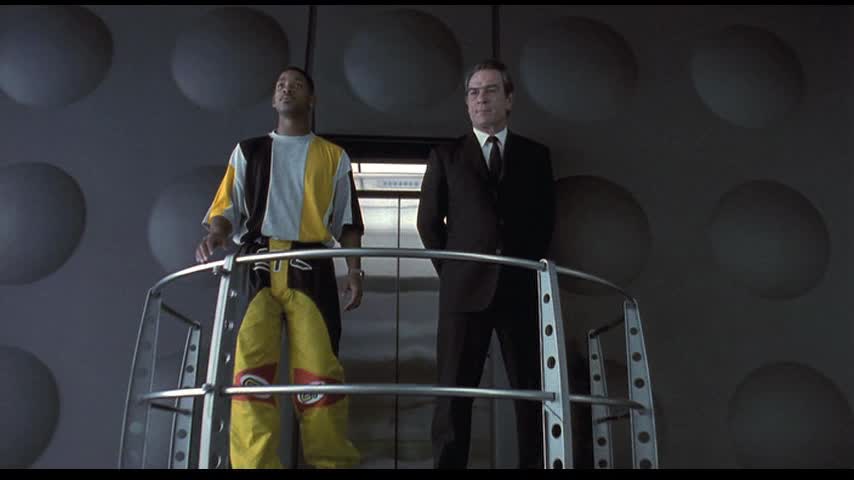
This perfect combination of elements made MIB exceptionally ambitious and artistically innovative.  Sonnenfeld's experience behind the camera (notably with the Coen Brothers' early films) brought a subtle visual wit to an otherwise flashy elaborate blockbuster.  The decision to cast underrated comedians in minor character roles also added class to seemingly minor scenes.  Ed Solomon's writing provided some endlessly quotable one-liners, and helped reinforce the chemistry between Tommy Lee Jones and Will Smith.  The way they play off each other appears genuine, with Jones' straight-faced delivery pitted against Smith's posturing wisecracks.  Rick Baker, the special effects wizard behind every notable sci-fi/horror film from the past thirty years, is allowed to let his imagination run wild, creating some remarkable alien life.

Oddly enough, the qualities that made the first MIB so engaging are exactly what killed its first sequel.  The formula for its success became so immediately apparent that even the original risked losing its charm.  Celebrities quietly suspected of being aliens were now given needless cameos, CGI took over most of the creature effects, and although the relationship between Agent K and J still works quite well, the rest of the film does not.  Early reviews of MIB3 have been mixed, but overall the formula remains unchanged.  Try as Sonnenfeld might to neurolize any trace of Men in Black II, his latest installment might very well be the long-awaited end to a nearly forgotten franchise.

Robert Nishimura is a Japan-based filmmaker, artist, and freelance designer. His designs can be found at Primolandia Productions. You can follow him on Twitter here.

VIDEO ESSAY: BLACK SUNDAY: Three Reasons for Criterion Consideration

VIDEO ESSAY: Burton versus Bava

Just as people ultimately judge a book by its cover, many of us are quick to judge a film by its trailer.  When I was asked to set my sights on Tim Burton's upcoming Dark Shadows, a movie based on the cult TV show of the late 1960s, as my next entry point for Criterion Consideration, I immediately knew where my judgment would most likely fall. I might find it hard to veil my contempt for Burton's recent work. His early films had a profound impact on my childhood and may very well be responsible for who I am today, but as I became an adult Burton began rewriting the rest of my childhood in ways that make me confused and horrified. Remaking the classic films from my youth, Burton has me questioning my admiration. Also, with the upcoming release of his animated Frankenweenie, Burton has begun remaking himself. We could list his later films and describe how the themes and storylines are still consistent with his earlier work, so maybe I just grew out of him. Now, every time I see one of his films, I end up screaming at the screen, vowing never to see the next Tim Burton film. Still, I cannot deny that his films are intriguing, innovative, and entertaining, if not infuriating. In his collaborations with Johnny Depp, Burton has given us classics likeEdward Scissorhands and Ed Wood, capturing some of the finest performances from Depp in eight films thus far, but I wish that Johnny would begin to show more discretion. Shilling for Burton in promotional videos, Johnny admits to instigating him to collaborate on "a vampire film," citing the classics of German Expressionism, Universal Horror films from the 1930s, and the Hammer Studio films as an influence for this new adaptation. Thankfully all those classics of cinema are thrown into the meaningless mess of Dark Shadows. Sporting the worst make-up job since Alice in Wonderland, Depp's Barnabas Collins struts in front of the living legends of horror cinema, including a direct (slap in the) face-to-face cameo with Jonathan Frid (who played the original character on the TV show). Even before I saw the trailer for Dark Shadows, I knew there would most likely be a nod to Mario Bava's first film, Black Sunday (or The Mask of Satan from its original title La maschera del demonio). Burton has been vocal about Bava's influence, and over a decade ago there were rumors that he would remake Black Sunday. That never exactly came to be, but Burton did evoke a lot from the film for his adaptation of Sleepy Hollow, which unmistakably borrows Bava's visual style. 

One of the most important directors in the horror genre, Mario Bava began his career as a cinematographer for Roberto Rossellini during the Italian Neo-Realist movement.  He first learned the tools of the trade from his father Eugenio Bava, who was an expert on special effects and also a cameraman.  Mario then was contracted by Galatea Studios, where his skills as a photographer, as well as his ability to work quickly and efficiently, would bring many of the studio’s films to life with stunning chiaroscuro. His films always show a deep understanding of the history of the horror genre, with its strange settings and eerie environments, and a weird and wonderful worldview that would become Bava's trademark style. That style would later influence many notable directors, such as Ridley Scott (Alien), Joe Dante (The Howling), and Burton himself, in Sleepy Hollow. In the late 50s, Bava would have to complete principle photography for Riccardo Freda, who abandoned his directorial duties on I Vampiri (Lust of the Vampire) because of the tight shooting schedule. Bava would do the same thing again with Freda's Caltiki, The Immortal Monster in 1959. To show his gratitude, Galatea's producer, Lionello Santi, allowed Bava to choose his (official) directorial debut, which was the adaptation of Nikolai Gogol's short story The Vij. While evoking the traditional story of witchcraft and vampirism at the heart of Gogol’s tale, Bava simultaneously paid his respect to the classic Universal Studios' horror films and the (then) contemporary Hammer Horror films with Christopher Lee and Peter Cushing.   Black Sunday relies heavily on the pantheon of 1930's horror, while including the eroticism and gimmicky gore of the new horror wave, creating one of the most beautiful and disturbing horror films of all time.

The film begins with a prologue, describing the superstitious tradition that one day in every century, Satan is allowed to walk the Earth, and his evil disciples can haunt and torment their descendants.  We are introduced to Princess Asa (Barbara Steele, a dead-ringer for Tim Burton's old muse, Lisa Marie) and her lover Javutich (Arturo Dominici) while they are standing trial by the Inquisition for acts of Satan worship and witchcraft.  Asa is branded with the mark of a witch, before having the iron mask of Satan nailed to her face.  Such a gruesome beginning was a standard shock tactic of the time, to keep audiences hooked from the start, but this particular opening was considered so shocking that the British Film Board banned the film for seven years after its release.  Before Princess Asa is put to rest, she vows to return from beyond the grave to seek revenge on her family for condemning her to the Inquisition.  Two centuries later, doctors Kruvajan (Andrea Checchi) and Gorobek (John Richardson) are traveling to Moscow when their carriage conveniently breaks down next to Asa's tomb.  After a slight scuffle with an enormous (and barely visible) bat, Dr. Kruvajan accidentally breaks open her coffin, allowing Princess Asa to return from the grave to torment and acquire the body from her living-image descendant Katia Vajda (also played by Steele).  Her father, Prince Vajda (Ivo Garrani), is the only member who still believes the family's sordid history, and he becomes instantly aware that Asa has returned when he sees the ghostly vision of her mask in his evening cup of tea.  Once Asa summons Javutich from his grave, she hypnotizes Kruvajan to help her exact revenge and take over Katia's body.

nullFilming in gorgeous black and white, Mario Bava was both the cinematographer and the director for Black Sunday, which has proven to be more than just a meaningless homage to the Universal visual standard.  In the decades before Bava’s film, horror had become the subject of parody and pastiche.  Classic monster figures suddenly had brides, reverted back to teenagers, and had mutated into radioactive amalgamations, thanks to a wave of low-budget science-y gimmicks. Bava's chiaroscuro masterpiece harkened back to a simpler time, when horror relied on tense atmospheric emotions, technical skills and claustrophobic mise-en-scene and blocking.  Bava was able to accomplish this entirely on the Galatea backlot, utilizing the masters’ techniques with a distinctively innovative approach.  Keeping his camera on a dolly at all times, the film moves with restless fluidity, creating an ambience unmatched in its time.  When Kruvajan first arrives at Vajda Castle, the camera tracks through endless corridors and secret-passageways before leading him to Asa's tomb.  It's sometimes hard to believe that Bava was able to create such a genuinely creepy atmosphere entirely on set, but his technical background elevated all the tired horror tropes to engaging new levels.  Bava also found an excellent leading lady in Barbara Steele, who would later become the scream queen of Italian horror because of Black Sunday.  Notoriously difficult to work with, Steele created problems for Bava in every regard.  Costumes had to be changed or altered, false vampire teeth had to be remolded (then only to be removed from the film completely), and once Steele refused to come on set because she was convinced the Italians had developed a camera that could shoot through clothing.  But even she remembered fondly Bava's ability as a director and as a cameraman.  Somewhat shy about her status as a horror icon, she attributes her standing to Bava and what he was able to accomplish with Black Sunday.

Bava's magnificently malicious worldview still stands the test of time and hasn't aged a day in light of recent splatter-filled gore-fests currently pass as cinema.  Perhaps it is because Bava's films helped usher in subsequent movements in the horror genre that Black Sunday remains untarnished and undated.  His later film Black Sabbath (with horror legend Boris Karloff) is credited with starting the Italian giallo films and the American slasher movement.  With so many directors indebted to Bava's films, it’s no surprise that a director like Tim Burton would return to Bava again and again for inspiration.  Whether Burton will decide to remake Black Sunday remains to be seen, but if that should ever happen it will only allow the next generation of filmmakers to fully embrace Mario Bava's original film.  Naturally, I would never want Burton to actually reboot Bava's film, since he would most likely set the film in the American 1960s, needlessly inserting some appalling 80s-style comedy.   Maybe before Burton's Dark Shadows is released on DVD, Criterion will seize the chance to bring Black Sunday to Blu-Ray, a format in which it so desperately needs to be seen.  If Criterion chooses the film, it would categorize Black Sunday as a superior work, allowing all of us film hipsters to say, "I told you so" and put directors like Tim Burton in their place.  In the meantime, if you're looking to avoid the long lines at the cinema for Dark Shadows, I highly recommend watching Black Sunday first.  It will not disappoint.

Robert Nishimura is a Japan-based filmmaker, artist, and freelance designer. His designs can be found at Primolandia Productions. You can follow him on Twitter here.

VIDEO – THREE REASONS: BATTLE ROYALE, a HUNGER GAMES for Grownups

VIDEO – THREE REASONS: BATTLE ROYALE, a HUNGER GAMES for Grownups

[EDITOR'S NOTE: Contributor Robert Nishimura's video series Three Reasons continues with Kinji Fukasaku's Battle Royale. He feels this film – a Hunger Games for Grownups – deserves release on the Criterion label.]

With Hollywood poised and ready to drop the next big book-to-screen adaptation on March 23, The Hunger Games will be the latest tween sci-fi/fantasy franchise to wipe moviegoer's minds of wand-waving witches and vapid vampires.  Frankly, if my editor hadn't informed me of this fact I would've been blissfully unaware of the whole thing.  I had no idea that Suzanne Collins had written a series of insanely successful young adult novels, thus dubbing her one of the most influential people of 2010.  I didn't know that Gary Ross had directed the film adaptation featuring a star-studded cast of younglings (plus Woody Harrelson, Stanley Tucci, and Donald Sutherland to make the film tolerable for parents). Fans of the novels had camped out hours before an early screening at LA Live, anxious to have the book retold to them. It has already broken records in advance ticket sales, beating out Twilight: Blah Blah Blah.  

I have no doubt that the movie franchise of The Hunger Games will be as insanely popular as the books. Whether we like it or not, the next three films are already in pre-production.  Lionsgate has tailor-made "youthful, edgy, exciting high quality entertainment," so it will be guaranteed to thrill and tantalize preteens across the globe.  Perhaps bows and arrows will come back into fashion.  Maybe the film will inspire some kids to kill each other, or in the very least grow wacky facial hair.  Now that I've been inundated with all the hype for The Hunger Games, I feel like I've already seen it, and not because the trailer spelled it out for me. 

The blogosphere was quick to point out the similarities between Collins' Hunger Games Trilogy with Koushun Takami's 1999 novel, Battle Royale, going so far as to call it a bold-faced ripoff.  Suzanne Collins admitted to never having heard of the book, nor has she read it since continuing the series.  So it goes without saying that Collins has never seen Kinji Fukusaku's film adaptation of Battle Royale, which will undoubtedly bare a striking resemblance to Gary Ross' The Hunger Games.  Both sources portray various degrees of a dystopian future, where teenagers are forced to fight to the death for the amusement of the government/home-viewing audience.  

Beyond that, it would be a waste of time to defend Battle Royale from plagiarism, since The Hunger Games has an entirely different set of cultural baggage, as well as being a disservice to countless other source material that deal with the exact same subject matter.  Collins just happened to tap in to the creative collective consciousness, drawing on ideas that have played out many times before, in addition to her intentional reference to Greek mythology.  There are elements of Orwell and Huxley at work here, but just enough to pander to its target audience.  The trailer for The Hunger Games focuses on defining the characters of Jennifer Lawrence, Josh Hutcherson, Liam Hemsworth, and the rest of the primped up cast, but showed me very little of what I'd really like to see: these pretty people killing each other.

Takami's Battle Royale is set in an alternative universe in which Japan was victorious in the Second World War, making it an authoritative world power.  It's the turn of the century, and society is falling apart with an economy on the brink of collapse, a rise in unemployment and in teen delinquency.  The government reacts by installing the Millennial Reform School Act (BR Act) as a means to thin out the numbers of juvenile delinquents.  Every year one 9th grade class is randomly chosen to compete in Battle Royale, forced into a game of survival in which there can only be one winner.  The unknowing selected class is then kidnapped, whisked away to a de-populated island, and each student is given a unique weapon, a map, and enough provisions to last three days.  Each participant is fitted with a metal necklace that monitors their whereabouts, exploding if they attempt an escape.  

As the game progresses, sections of the island become "forbidden zones," to keep the students moving closer to each other.  If you are caught in a forbidden zones your necklace explodes.  If there is more than a single survivor at the end of the three days, all the necklaces will explode and the game is forfeited.  If one person does survive he/she is allowed to return home, or in some cases, be allowed to play again.  To make things more interesting the BR Committee will plant "transfer students" in certain schools months before the class is selected.  Having these seasoned killers among the 40 student class helps speed the game along and forces the other students to play.  Takami's original novels reveals much more about this universe and the relationships of the students, whereas the film adaptation of Battle Royale very quickly establishes the setting and introduces this year's lucky participants, Shiroiwa Junior High School, Class B.

nullThe man responsible for selecting this year's class is Kitano (brilliantly cast with "Beat" Takeshi Kitano), who used to work at Shiroiwa Junior High School years before becoming the mouthpiece for the BR Committee.  His calm demeanor is especially off putting as he describes the rules to the game, pausing occasionally to kill a student to set an example for the rest of the class.  It's especially poignant to see Takeshi Kitano in this role since it would ultimately be Fukusaku's swan song.  Fukusaku had a long established career as a genre filmmaker, responsible for some of the most energetic and innovative yakuza exploitation films.  His crowning achievement could be the Battles Without Honor and Humanity series, known in the West as The Yakuza Papers.  

Takeshi Kitano's directorial debut, Violent Cop was originally intended for Fukusaku, who passed the film along to Kitano because he was too ill at the time.  A few years later, Kitano would (re)pay homage to Fukusaku's Sympathy for the Underdog (1971) with his film Sonatine (1993).  Kitano's films are largely indebted to Fukusaku and his generation of filmmakers.  Reaching the end of his career, Battle Royale brought Fukusaku back into the limelight, garnering several Japanese Academy Award nominations in addition to some well deserved controversy.  After 40 years in the business, Fukusaku still had the moxy of a young exploiter.  He managed to shoot only one scene for Battle Royale 2: Requiem (coincidentally, with Kitano) before passing away, leaving his son Kenta to complete the film in his father's memory.

In The Hunger Games contestants are chosen in pairs from various districts, some of whom seemingly have been training their whole lives to enter the game.  They are complete strangers to each other, the only attachment (as for the viewer) is purely physical.  The students in Battle Royale have known each other for years, and in some cases quite intimately.  This has a profound effect on the game and how it is played.  Some students try to form alliances to avoid any violence, while other students immediately start playing as soon as they leave the gate, desperate to to be the winner or seeking revenge for past grievances.  Most of the students are frightened beyond belief, questioning themselves and suspicious of even their closest friends.  The couple that we are meant to identify with are Shuya (Tatsuya Fujiwara) and Noriko (Aki Maeda), who now must confront their feelings for each other as well as frequent attacks from their fellow classmates.  

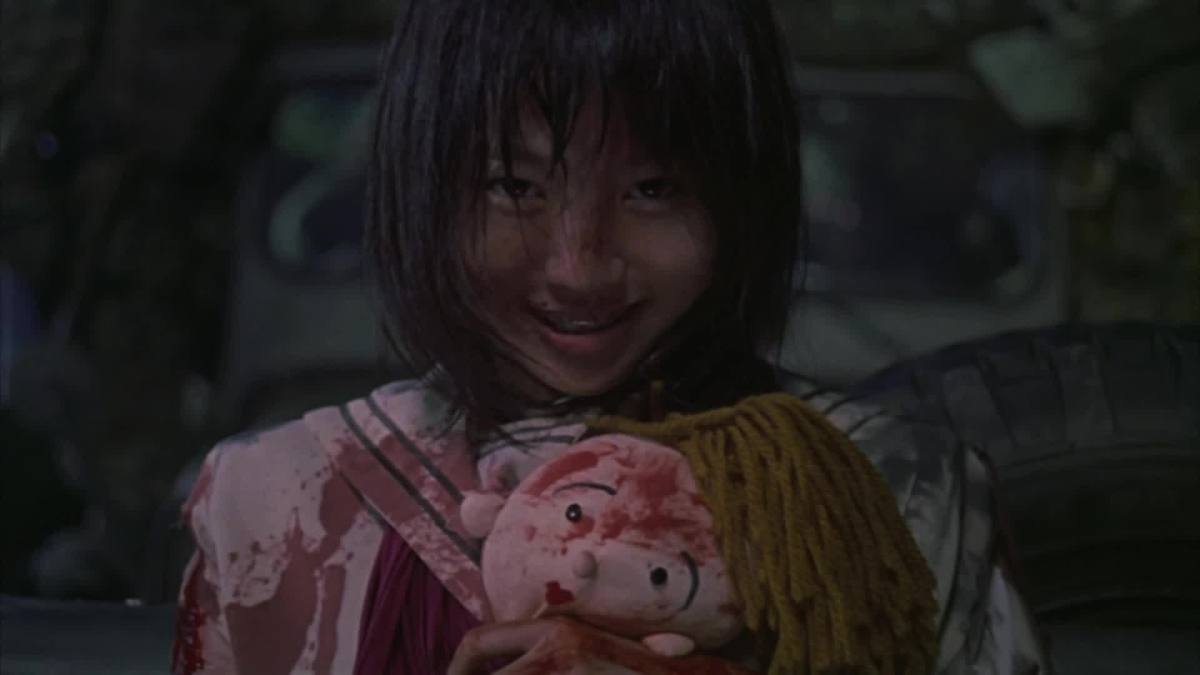
nullOne notable assailant is played by Chiaki Kuriyama, who basically reprises the the same role in Quentin Tarantino's love letter to J-sploitation, Kill Bill.  Fans of QT will recognize the tone that Fukusaku maintains throughout the film.  Realistic violence pushed to the point of absurdity, sometimes even cartoonish.  Shuya and Noriko witness all their friends (and enemies) unravel from fear and paranoia, either killing each other out of spite or suspicion.  As the student body dwindles away, they form an alliance with Shogo, one of the "transfer students" who had played the game before.  Together they devise a way to end the game and seek revenge on Kitano, who is surveilling them from the center of the island.

Contrary to popular belief, Battle Royale was never banned from US distribution.  The file was released soon after the Columbine incident, which wasn't the best time to be promoting a film that glorified killing your classmates.  Why the film hadn't be picked up since is the real mystery.  For years the film had garnered a cult following in the US, and still no distributor would touch it.  Even after Tarantino had given it his hipster seal-of-approval, he could have at least put it out under his Rolling Thunder label.  Criterion had already released David Lean's Lord of the Flies and Ernest B. Schoedsack's The Most Dangerous Game, so Battle Royale would have fit snugly betwixt those classics.  If only Criterion had picked up Battle Royale years ago it could've quite possibly saved us all from The Hunger Games.  

nullCriterion missed their chance to nab this title, and now that The Hunger Games have begun, another company has stepped up to finally bring Battle Royale to the US.  It would appear that my Three Reasons video is already an empty gesture since Anchor Bay is set to release the long-awaited special edition of Battle Royale 1 & 2 on DVD and Bluray, three days before The Hunger Games hits theaters.  It's loaded with features on Fukusaku's career and the impact Battle Royale had on cinema in Japan.  We can certainly trace the line from Battle Royale to The Hunger Games without too much difficulty, even though the film was never released in the US until now.  Its influence on Western cinema over the past decade has justified having our own kiddy-porn death-match. The level of violence in cinema has caught up to speed that we can now have our The Hunger Games, so it seems the US is finally ready for Battle Royale. For anyone who has not seen Battle Royale, it will not disappoint, but it may steal the "edge" that The Hunger Games is so desperately trying to project.

Robert Nishimura is a Japan-based filmmaker, artist, and freelance designer. His designs can be found at Primolandia Productions. His non-commercial video work is at For Criterion Consideration. You can follow him on Twitter here. To watch other videos in his "Three Reasons" series, click here.

VIDEO – THREE REASONS: King Vidor’s THE CROWD

VIDEO – THREE REASONS: King Vidor’s THE CROWD

[EDITOR'S NOTE: Contributor Robert Nishimura's video series Three Reasons continues with King Vidor's The Crowd. He feels this film deserves attention in light of the Best Picture Oscar for The Artist and is a perfect candidate for restoration and release on the Criterion label.]

The last time the Academy nominated a silent film for Best Picture was in 1929, at the 1st Academy Awards ceremony.  Hosted by Douglas Fairbanks and held at the Hollywood Roosevelt Hotel, the ceremony honored the best films produced in 1927 to 1928.  At that time the Best Picture category was broken into two separate awards, one for Outstanding Picture Production and one for Unique and Artistic Production.  Those distinctions were quickly eliminated in the subsequent Academy Awards in favor of a single statuette for Best Picture.  Although sound film had already made an appearance by this time, all the films nominated for Best Picture (in both categories) were silent.  F.W. Murnau's Sunrise: A Song of Two Humans won for its artistic merit and William Wellman's Wings won for making Paramount an ass-load of money.

It should be no surprise that all of the nominees at the first Academy Awards were for silent pictures, since the event was created to defend itself from the threat of sound film.  Louis B. Mayer (one of the Ms in MGM) came up with the whole idea for The Academy as a response to the shift in technology and as a way to keep "the talent" in their right place.  Essentially a means to praise itself, the Academy Awards reinforce the Hollywood mythology and provide the perfect venue to pat itself on the back.  By the time the 2nd Academy Awards were held the following year, Hollywood had fully embraced sound technology and a silent film was never allowed to grace the red carpet again.

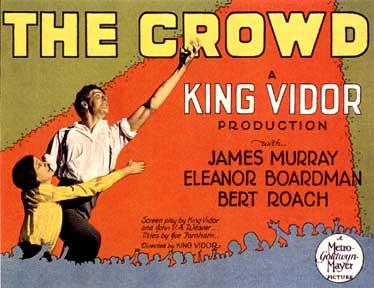
nullAmong the films nominated for Best (Artistic) Picture at that first fabled ceremony was King Vidor's The Crowd.  Considered by many to be his masterpiece and a timeless American classic, The Crowd shares many thematic elements to this years Best Picture winner, Michel Hazanavicus' The Artist.  Although both film's protagonists have similar trajectories, The Crowd is the opposite of how The Artist presents itself. King Vidor's film was remarkably different for its time in portraying a very non-Hollywood representation of everyday life.  While revealing the stylistic influence of his European predecessors, Vidor evoked a natural realism that had not been seen before on American screens.  Casting a relatively unknown actor (James Murray) in the lead role of John Sims, he embodied the everyday struggle of a typically average American trying his best to make his mark in a massively foreboding big city.  An ambitious, experimental, and socially relevant film, its no wonder why it had been nominated for Best Picture, or why it still resonates today.

The film begins with the birth of John Sims on the fourth of July, 1900.  On such an auspicious date, John is destined to become someone great and as his father proclaims, John "is a little man that the world is going to hear from."  We see the progression of John's life from an ambitious childhood to mundane adulthood.  But with every turn of fortune there is equal tragedy (usually double).  In fact almost every moment of brief triumph is accentuated by a harsh bittersweet tragedy that forces John to struggle even harder.  As a child we see John's aspirations to be "someone big."  As soon as these words are uttered John's father immediately dies, leaving John to be the man of the house at an early age.

When John turns 21 he naturally goes to New York City with the high hopes of making it big. We see John at work, one of the many faceless drones in a sea of desks, but John doesn't fit in with the monotonous routine.  John aspires to write ad slogans and is constantly doodling ideas while at work.  He soon meets his bride-to-be, Mary through a co-worker who entices John to a night on the town.  Played superbly by Vidor's wife Eleanor Boardman, Mary provides the next logical step in John's life; get married and have kids.  The expectations that John has towards married life do allow some respite from his boring job, but soon tragedy strikes again by taking their youngest child.  Desperate and unable to work, John's domestic life is threatened to fall apart as well, causing him to contemplate suicide right in front of his son.

John is able to find solace by becoming a member of the crowd, instead of struggling to rise above it.  Like Jean Dujarin's character Valentin in The Artist, John hits rock-bottom by trying to maintain a sense of pride and ambition, and ultimately must learn to embrace conformity in order to survive.  John's self-realization comes full circle when he becomes the very thing that he despised at the start of the film; just another poor sap in the crowd of people.  The last shot of The Crowd finds John seemingly content with his family enjoying a vaudeville show, but as the camera cranes away from the Sims it feels much more desperate than the faceless laughing masses would indicate.  Just as Valentin must perform his little song and dance to regain approval from the studio heads, John must grin and bear the weight of being just another cog in the machine, and one that will inevitably be replaced when the time comes. Vidor is able to perfectly sum up our lot in life with one intertitle, "The crowd laughs with you always…but it will cry with you for only a day."

The same year that King Vidor made The Crowd he made another film that was eerily similar to The Artist. Show People was Vidor's swan-song to the silent era and included cameos from every prominent star of the day.  Chaplin, Fairbanks, and a host of others all showed up to show their support for King Vidor (although it had probably more to do with William Randolph Hearst who was pushing for the project).  It spoke volumes on the transition from silent film to talkies, in addition to being a vehicle for Marion Davis in her portrayal of struggling actress Peggy Pepper.  Both of these Vidor films were re-released in the 80s and Carl Davis composed amazing scores to accompany them, so if Criterion were to release The Crowd it would be an ideal supplement to include Davis' score as well as any others that compliment the film.

It goes without saying that Hazanavicus' borrowed heavily from film history to make The Artist, and possibly from Vidor specifically, but it is not my intention to single out every cinematic reference point of the film.   Hazanavicus clearly has an understanding of silent film choreography and editing that is easily missed by an average moviegoer, but again, this is not about The Artist.  This was just a friendly reminder that we should not forget which came first.  Unfortunately it seems that MGM has already forgotten as The Crowd still remains unavailable on DVD/Blu-ray.  Should Criterion decide to release The Crowd it would allow a home viewing audience to see what Hazanavicus had in mind. The Artist's Best Picture win is the first time a silent film has taken home a statuette in 83 years, but it's not the first time the Academy gave praise to a film that glorifies the Hollywood mythology. As Hollywood runs screaming from yet another technological advancement, history repeats itself.

Robert Nishimura is a Japan-based filmmaker, artist, and freelance designer. His designs can be found at Primolandia Productions. His non-commercial video work is at For Criterion Consideration. You can follow him on Twitter here. To watch other videos in his "Three Reasons" series, click here.

THREE REASONS: ELECTRA GLIDE IN BLUE, directed by James William Guercio

THREE REASONS: ELECTRA GLIDE IN BLUE, directed by James William Guercio


[EDITOR'S NOTE: Contributor Robert Nishimura's video series Three Reasons continues with James William Guercio's Electra Glide In Blue. He feels this cult film is a perfect candidate for restoration and release on the Criterion label.]

Cult films have always remained one of the more enigmatic areas in Cinema Studies. There doesn't seem to be a distinct aesthetic that all cult films follow. Films that have been deemed cult-worthy come from any genre, country or time period. They are not limited to the independent or the underground, either. More often than not, cult films come from Hollywood's fly-by-night flops that end up in the bargain bin only to be fished out by eager or unsuspecting viewers. Since most cult films evade any common elements, any critical investigation on the subject quickly falls apart. The only definitive thread in this phenomenon is the fanatical devotion of its audience. Like any cult, the uncompromising worship among their marginal fan bases are what set these films apart from the rest.  

Cult Cinema Studies really began with the advent of home-viewing technologies. Danny Peary's landmark book, Cult Movies (1981), was the first to make that classification, collecting all the obscure films and the extreme effects they have on their audiences. For the first time, fans could cull their resources to satiate their limitless appetites for that obscure film of their desire. Tape trading, bootlegging, midnight screenings and fan conventions became an immediate subculture that progressed so quickly that we have already reached the point where you would be hard-pressed to find someone who WASN'T a cultist in some regard. Social media sites and apps seem to be tailor-made for the cultist, allowing instant access and confirmation. Thirty years later the inmates are already running the asylum.

nullThe most important component that entices the cult film fan is the film's relative obscurity – the exclusivity that comes from finding a rare cinematic gem, being a part of the privileged few who know about it, obsess over it, and quote from it incessantly. Prime examples for cultist celebration are films that had a limited run or never saw a proper release. Usually this was due to poor initial reviews or controversy involving the production or subject matter. The most popular examples of the cult film are those which, by mainstream standards, are "bad" movies. The argument that "it's so bad, it's good" is one that allows fans to have an ironic distance from the films, and is the major pitfall in the cultist ethos. The pinnacle of this would be the riffing maestros who ran Mystery Science Theatre 3000, their constant comedic commentary even overshadowing a few "good" movies. Another unfortunate aspect of the cult film is that once a film is given that status, it rarely, if at all, is allowed to transcend that distinction. The kitsch label is impossible to shake.

Such is the case with James William Guercio and his sole directorial effort, Electra Glide in Blue. Loathed and lambasted by critics upon its release, it came and went with nary a second thought until the cultists got their hands on it. It was too easily regarded as a Republican response to Easy Rider, which is probably why it was labeled “fascist” by critics and the hippie movement of which the film takes aim. But Electra Glide in Blue offers much more in its politics, style and genre than any film to emerge from the ‘70s counterculture. Easy Rider, in addition to kick-starting the New Hollywood movement, was the touchstone of a generation. It has become the quintessential document of the ‘60s counterculture movement, the transformation of the American Dream and the rise and fall of the hippie movement. Electra Glide in Blue offers much of the same thing, only from the pig's point of view. That is not to say it justifies the actions of the conservative right; it is a condemnation of both sides, and its moral ambiguity would mark the beginning of a new era in film history. If Easy Rider should be the film that encapsulates the decade of the ‘60s, Electra Glide in Blue deserves that distinction for the decade that followed.

nullRobert Blake gives an amazingly humane performance as John Wintergreen, an Arizona motorcycle cop whose moral code is so steadfast that it stands in opposition to both the left and the right. Wintergreen ritualizes his preparation for work, donning his uniform, determined to uphold the letter of the law in the protection of the innocent. Wintergreen only wants to get away from "the white elephant" they make him ride and become a detective, where he would be paid to think and not merely pass out speeding tickets. When he stumbles upon an apparent suicide in this sleepy little town, only Wintergreen can recognize it as a homicide, and is finally given an opportunity to show his skills as a detective. Under the inept tutelage of a senior detective, Wintergreen quickly realizes that corruption and ignorance is beset on both sides of the law. The opposing forces of the right and left leave Wintergreen little space to stand his own ground as a humanist.

At the time of its release, the knee jerk reaction by critics to classify the film as fascist was to be expected. The Vietnam War was still raging, the counterculture movement stood in such a stark contrast to the conservative right that there was no room for a neutral middle ground – certainly not from a motorcycle cop. Everyone in the film except Wintergreen is a caricature, from the long-haired pig-farming hippies to the racist, fascist rednecks who torment them. Both sides are ludicrous representations, but each are guilty of have the same narrow viewpoint. Electra Glide in Blue doesn't take sides; it only portrays the shortcomings of a two-sided argument. Never more applicable than today, a humanist without affiliation will only be drowned out by the clash of the right and left, Democrats and Republicans, Pepsi and Coke. The cultist phenomenon mirrors this same ambiguity in regard to viewer ownership and appreciation. The cultist can position films by Jean-Luc Godard and sexploitationist Doris Wishman on the same pedestal. The political message of each film(maker) is irrelevant to the cultist, only it's entertainment value.

nullJust as its politics were easily misconstrued, Electra Glide in Blue takes on various styles which makes it difficult to define. Rarely do we find a more confident directorial debut that runs the gamut from experimentalism to classic traditionalism. James William Guercio began his career as the producer of The Chicago Transit Authority (better known as just Chicago), and his roots in music production shine through. The film has elements of a concert film and frequent moments of musical montage. On the surface it seems like a typical murder mystery, but as in its Easy Rider counterpart, the plot has little consequence on how the story unfolds. Guercio was set to make a modern western parable and hired veteran cinematographer Conrad L. Hall, who had just won the Oscar for Butch Cassidy and the Sundance Kid. Setting the film in Arizona's Monument Valley, Guercio allows Wintergreen (and the viewer) to soak up the landscape. At several points in the film, usually at Wintergreen's introspective moments, Hall's beautiful cinematography lingers on the surroundings, evoking the same spirit of John Ford's western classics. Similarly, Guercio's Wintergreen acts as the lone lawman, supervising the desolate expanse of lawlessness. By the end of the film, Guercio accentuates this theme by having what may be one of the longest single-take tracking shots in film history. The long and winding road on which Wintergreen has served and protected will be his final resting place. For those who have already seen Electra Glide in Blue, it's easy to see why it has been given the cult film seal of approval. The cultist can recognize the value in this rarely seen film. But the cult film usually stands outside the canon of widely accepted films. On the surface, the film could be associated with the countless exploitation flicks that flooded the market after the Easy Rider/Biker Film craze had its heyday. Or it could be Robert Blake's current infamy that keeps the film within the cultist realm. Electra Glide in Blue isn't a lost or forgotten film, it's just been unjustly ignored as socially relevant. We have already reached the point where all information is readily available. Cultural memes and viral videos are continually introduced at a breakneck speed, so the very idea of cult status has become redundant and irrelevant. Forgotten films are no longer inaccessible for those outside the cult. All things are available for public evaluation, and Electra Glide in Blue deserves to be reevaluated by mainstream audiences. It is a film ahead of its time, in form, politics and it's compassion for humankind.

Robert Nishimura is a Japan-based filmmaker, artist, and freelance designer. His designs can be found at Primolandia Productions. His non-commercial video work is at For Criterion Consideration. You can follow him on Twitter here. To watch other videos in his "Three Reasons" series, click here.

THREE REASONS FOR CRITERION CONSIDERATION: Shuji Terayama’s PASTORAL, TO DIE FOR THE COUNTRY (1974)

THREE REASONS FOR CRITERION CONSIDERATION: Shuji Terayama’s PASTORAL, TO DIE FOR THE COUNTRY (1974)

null

[EDITOR'S NOTE: Press Play's Robert Nishimura spotlights the provocative career of the late Japanese avant-garde director Shuji Terayama. He has created this essay with the accompanying trailer for Pastoral, To Die In The Country in an effort to convince Criterion to restore and release this important work as part of its collection.]

Every great filmmaker reaches a point in their career when they need to reflect upon their life and childhood, tracing the path that lead them to where they are today. Most often these nostalgic quandaries find their way into new fictionalized scenarios, drawing on personal experience to entertain themselves as well as audiences. Sometimes a director takes a more direct approach, probing their past in the form of autobiographical diaries. Our experiences as children inevitably make us who we are today, and tapping into those memories can provide some tasty material for any filmmaker who questions why they make the kind of films they make. (Look to Federico Fellini’s entire career for further evidence of that point.) Not all memories are immediately accessible to recall, especially those associated with extreme emotional connections.

Those particular memories are stored in the deep recesses of our subconscious and often emerge in our dreams; even then, they're not exactly clearly defined. So, then, what happens when a director decides to make a film about their childhood, but also must confront issues of psychological trauma that have been buried within their subconscious? The result is Shûji Terayama's Pastoral, To Die in the Country, a film so unique and spellbinding that it transcends all classification.
null
Shûji Terayama is probably the most radically subversive yet well-respected director in Japanese film history. He was the filmmaker's filmmaker, a media darling and a true Renaissance man. For many directors from the 1970s onward, Terayama was pure inspiration. In my previous Three Reasons installment for The Noisy Requiem, Matsui Yoshihiko told me that seeing Pastoral was an eye-opening experience, one that immediately inspired him to become a filmmaker himself. In Japan, Terayama was a well-known poet, artist, writer, street performer and leading figure in Japan's growing avant-garde theater movement in Tokyo. He had a profound effect on the art community in Tokyo, but remained elusive to mainstream attention outside of Japan. One of his first films, Emperor Tomato Ketchup, a wildly experimental short in which children overthrow the adult world, shocked critics upon its release and managed to get banned outright in several countries. Despite being completely avant-garde and metaphoric, what offended the censors were the film's scenes of simulated sex involving children. By today's standards, these same scenes would hardly lift an eyebrow. Even a casual Freudian reading of the film reveals what would be his strongest contextual trademark: serious mommy issues.

For anyone who would like to know more about Terayama's life, Pastoral is as good a place as any to start. For the most part it is an autobiographical film, teaching us all about Terayama's upbringing in a small countryside village in Aomori Prefecture. After losing his father during WWII, Shûji was raised by his very domineering mother as well as the determinedly traditional and superstitious townspeople. We see Shûji compete with these traditional values, struggling to find stimuli and sexual satisfaction in a small town that is very much stuck in time. All Shûji wants to do is break away from his mother and the other backward hillbillies, get laid by the milf next door and catch the first train out of town. Such a synopsis might very well have been from the movie you watched last night at the multiplex (like Judd Apatow's Midnight Train to Bonerland, coming to a cinema near you…probably), but Pastoral is in no way a traditional narrative. Just as our own memory becomes fragmented and nonlinear, Terayama utilizes the same disjointed dream logic that corrupts all our memories. Characters float in and out inexplicably, settings change without warning, the cinematography and editing are highly expressionistic, and just when you start getting comfortable with this style of storytelling the film abruptly stops. Halfway through Pastoral, we learn that not only are we watching a film, but that Terayama hasn't finished making it yet. The director (played by Kantarô Suga) isn't satisfied with how things are going and must go back in time, enter his own film and change the outcome.
null
The film begins (as does the Three Reasons video) with his earliest childhood memory: playing kakurenbo (the Japanese equivalent to hide and seek) in a cemetery. As little Shûji lifts his head to find his playmates, all the people associated with his youth come creeping into view from behind the tombstones. At this point we see that all the characters in the film are wearing whiteface, a characteristic usually reserved for ghosts. But these are not ghosts come to haunt him, they are the specters of his past that have become faded over time, himself included. These characters are stuck in time as well as place. Terayama uses images of clocks throughout the film to exemplify this point, especially in his own childhood home, where his mother's refusal to fix their broken clock indicates her unwillingness to change, forcing young Shûji to be stuck along with her. The film maintains dull monochromatic tones whenever Terayama is at home or in the village. The villagers are represented by a coven of black-hooded, eyepatch-wearing old women who keep the town in a stranglehold of superstition. Just outside the town is a traveling circus troupe, constantly preparing for a show that never occurs. Whenever we visit this particular location, a kaleidoscopic spectrum of color fills the screen and covers the circus characters. For Terayama, these characters represent modernity with their wild sexual escapades and complete freedom from time and tradition. Once Shûji is exposed to these people his desire to run away is firmly cemented. The only thing holding him back is his mother.

Terayama once wrote that life was like an enormous outgoing book. So if we needed to change something about ourselves, we need only go back and rewrite what happened. Pastoral represents his desire to do just that. This is why the Terayama character must go back and confront his younger self. In order to complete his film Terayama must convince his younger self of what needs to be done: kill their mother. In scenes where Terayama is in contact with the younger Shûji, his subconscious is allowed to run wild. Free associations and dream-derived figures parade past the two Terayamas in one particularly beautiful sequence. Fans of Luis Buñuel's surrealistic films or Guy Maddin's recent introspective films will find a kindred spirit in Terayama. But in many ways Terayama is Maddin's stylistic opposite, and Buñuel couldn't hold a two-sided candle to the effortless phantasmagorical freedom of Pastoral.
null
Albeit titled "For Criterion Consideration," I largely use that phrase as a euphemism. This film needs to be seen; I just point to Criterion because they are respected for bringing important films to a wider audience (in the best editions, etc., etc.). Needless to say, Pastoral, To Die in the Country is an important film by an important filmmaker. The unfortunate fact that none of Terayama's films are distributed anywhere outside of Japan forces determined cinephiles to use questionably legal means to find them. Japan's FilmForum does have the English-friendly four volume compilation of Terayama's short films, which includes the oh-my-god-think-of-the-children Emperor Tomato Ketchup. Die-hard fans of Japanese cinema or the avant-garde will know Terayama, but it is time that the West pay their proper respects to a great filmmaker by allowing his films to be widely seen. I cannot think of a better salute to Shûji Terayama than a Criterion release in the U.S. or a Masters of Cinema release in the U.K.

Robert Nishimura is a Japan-based filmmaker, artist, and freelance designer. Born and raised in Panamá, he then moved to the US, working at the University of Pittsburgh and co-directing Life During Wartime, a short-lived video collective for local television. After fleeing to Japan, he co-founded the Capi Gallery in Western Honshu before becoming a permanent resident.

THREE REASONS: THE NOISY REQUIEM, directed by Yoshihiko Matsui

THREE REASONS: THE NOISY REQUIEM, directed by Yoshihiko Matsui

EDITOR'S NOTE: Once again, Robert Nishimura's Three Reasons shines a spotlight on a film that merits the Criterion treatment.

Three Reasons: The Noisy Requiem from For Criterion Consideration on Vimeo.

By Robert Nishimura
Press Play Contributor

The Noisy Requiem revolves around Makoto Iwashita, a homeless serial killer who murders young women so that he can harvest their reproductive organs. He collects these visceral mementos so he can stuff them in the belly of his lover, the model woman of his desire, a mannequin. Makoto lives on the roof of an abandoned tenement building with his wooden mistress, making love to her through a makeshift vagina. The organs he acquires are to ensure that she can bear his child, which she eventually does until tragedy falls upon their happy home. The film follows Makoto through his daily routine: feeding some pigeons, decapitating them, finding some other chicks to murder and maim, and landing a job as a sewer scooper for a pair of incestuous midget siblings. We are also introduced to an older vagabond who carries with him a severed tree trunk that looks remarkably like a woman's torso. The rest of the film's inhabitants are the actual people who live in Shinsekai, floating in and out of the periphery like ghosts in a forgotten district of hell.

All of this happens within the first ten minutes of the film. Not a single word of dialogue has been spoken, aside from the few monosyllabic grunts here and there. Makoto practically melts into the background, a killer in plain sight, completely ignored by everyone around him. We then cut to a scene at the park, where two young schoolgirls watch some busking war veterans beg for change. One of the girls tells her friend of the dream she had the night before. In it she watches a pure white dove compete for breadcrumbs. As the bird struggles for each scrap of food, it begins to transform into a black crow, as the breadcrumbs become human remains. As the girls give the buskers some money, she explains that it was only natural for the dove to become a crow, for out of desperation to find happiness we all lose our innocence. These are some pretty profound words coming from the mouths of a couple of kids just shooting the shit in the park. But the film's director, Yoshihiko Matsui, has clearly defined where Makoto is coming from and where he will inevitably go. All the film's crows are that way out of necessity — still desperately searching for attention and love in a society that has abandoned them.

The Noisy Requiem is very much a product of Japanese cinema in the 1980s. The era marked the beginning of the end of an era that encouraged and supported innovative filmmaking, and the beginning of the next generation of underground filmmaking — one born out of necessity and circumstance.

The great radical masters of the previous decades — Nagisa Ôshima, Shôhei Imamura, Shûji Terayama, Hiroshi Teshigahara, and Kazuo Kuroki — had been assimilated and spat out by the mainstream studios, some of them producing their swan songs before fading away, unnoticed and unappreciated. The Art Theater Guild of Japan, which had fostered independent filmmakers, producing many groundbreaking films throughout the sixties and seventies, was getting out of production altogether. Only a handful of films came out of the ATG before it closed up shop in the mid-80s. But by this point the country's major studios were already flailing in a bone-dry creative pool. The majors had co-opted the themes and visual styles from underground cinema, sanitized it for mainstream audience consumption and left the masters behind; at the same time, the studios were moving towards a vertically integrated system that would force independent producers like ATG out of business.

Out of the collapse of the ATG came a new movement that favored a more DIY approach to filmmaking. Driven by Japan's growing underground punk music scene, young filmmakers took the cheapest route available: 8mm (Japan continued using single gauge 8mm film long after Super 8 was introduced in the West). Yoshihiko Matsui emerged from this tradition along with Sogo Ishii, both film students at Nihon University. Sogo Ishii would quickly gain a name for himself with the growing v-cinema boom and cyberpunk movement that took off at the start of the decade. Ishii's Panic High School and Crazy Thunder Road were all completed while the director was still in film school and are all considered required viewing by hardcore fans of the movement. Matsui Yoshihiko worked closely with Ishii during this time and acted as Assistant Director for most of Ishii's early films. In turn Ishii shot Matsui's debut feature Rusty Empty Can and his sophomore effort, the elegantly titled, Pig Chicken Suicide.

Matsui's next film was The Noisy Requiem. It wasn't completed until several years after Pig Chicken Suicide, and it took a while for a distributor to pick it up. It was not merely Matsui's finest film, but his most distinctive, an evolutionary step beyond his previous films, which owed much to the style of his partner-in-crime Ishii Sogo. Since the cyberpunk movement was gaining popularity, The Noisy Requiem became an immediate underground success, but it evaded critical attention at home and abroad. The reviews that it did get were polarized, and focused mainly on its disturbing plot points and characterizations. Its stark black-and-white, hand-held 16mm photography add to its already unnervingly naturalistic feel; there is a strong sense of immediacy to the film. Yet there is still a feeling of timelessness. At points it feels like a documentary that slips into moments of madness and sublime expressionism. Perhaps the film was ignored because of its setting in a homeless community of Kamagasaki, Shinsekai in Osaka. To this day, the Japanese government has still maintained the absurd claim that there are no homeless people in Japan, an idea that immediately falls apart if you've even been to any city in the country; a collective national urge to ignore the guy who scored a refrigerator box for the night could explain why a film like The Noisy Requiem went largely unnoticed.

As Johannes Schönherr (at Midnight Eye) already pointed out, the first ten minutes of The Noisy Requiem firmly establish Matsui's worldview and, with Shakespearean bravado, foreshadow its unavoidable outcome. From the moment our schoolgirls leave the frame the film takes a derisive turn in many stylistic directions. Makoto soon enters the scene to accost the two buskers. Matsui suddenly walks away from the action before the argument culminates into violence. Matsui's camera spastically revolves around the park, coming full circle to the action as Makoto starts beating the crap out of the handicapped veterans. Makoto represents the blackest of crows in our already pitch-black aviary. But as Matsui will soon reveal, the depths of his obscene depravity are matched only by his obsessive devotion.

As the film continues we are introduced to our two white doves: a beautiful young couple dressed in white. We never learn their names or how they ended up in Shinsekai, but we immediately recognize that they are innocent, and very much in love. Matsui overexposes the scene so that the characters are surrounded by pure white light, erasing everything else around them. They are never referenced within the film and never speak throughout their transformation, their transformation to hungry black crows, pecking at the rest of the dead. At first it seems as though this couple is meant to contrast Makoto’s black crow, but as the film progresses we witness our white dove’s fall from grace, driven by the boy’s lust for the girl. As hard as they try to maintain their innocence, their environment ultimately corrupts them. By showing the couple unable to resist temptation, Matsui only strengthens Makoto's purity in his devotion to his mannequin. His love for her is real enough, and there is no distraction from his loyalty to her.

There is no question that Makoto’s love for his mannequin is pure. We see how they first met, the moments they share together, cleaning her, tending to her, protecting her, and killing for her. This is all shown in such a way that we cannot help but empathize with Makoto. In a style usually reserved for romantic melodramas, Makoto dances with her as the camera revolves around them, with pools of filth glimmering around them in the moonlight. Later in this scene Makoto confesses his hatred for the world around him. Like Travis Bickle in Taxi Driver, Makoto is waiting for the cleansing rain to wash away the dirty streets and disgusting people he sees outside of Shinsekai. Matsui’s seems to share Makoto's view of morality in Shinsekai and of the outside world.

Matsui defends Makoto as an honorable character, but like everyone in the film, his obsession will only lead to ruin. There is no other outcome for these poor souls, and each will meet their own grisly death. Everyone is desperately clinging to whatever they can in a place that has forsaken them, and Makoto’s rooftop home offers a place for them to indulge in their passion. But saying that the characters lack any moral compass is problematic once Matsui shows how people act in “the outside world.” Matsui portrays normal society as something equally disgusting, and in some scenes he simply hides his camera and records the reactions of “normal society” to his characters. In another scene a busload of senior citizens bust out laughing when a midget woman falls over (twice). Although this scene was clearly staged, it doesn’t paint a pretty picture of a supposed moral society. Matsui doesn't condone Makoto's actions, but it is clear that Matsui considers him noble in his dedication to his mannequin.

Most recent reviews of the film are quick to call Matsui’s style nihilist and disturbing, and certainly after reading the above synopsis you would probably agree.  Matsui’s guerilla filmmaking approach reinforces that kind of reading, especially since much of the film was clearly shot without permits or permission.  Matsui actually set the roof of a building on fire near the film’s climax, and then snuck away to a neighboring building to film the fireman and cops sniff around the remains of Makoto’s makeshift home.  Matsui’s complete disregard for linear storytelling offers a glimpse into the reality of Kamagasaki, often leaving characters behind while the camera walks up and down the street showing the real inhabitants going about their lives.  Flawlessly edited, the cinematography flows effortlessly from vérité to dream-like fantasy, kinetic and visually abstract.  But also slow paced, lingering on beautifully composed moments of horror and misery, as well as love and desire.  Some viewers might avoid the film because of the described violence, or others may have high expectations to see some crazy J-style weirdness.  The Noisy Requiem stands apart from most genre classifications, and certainly should not be lumped together with other v-cinema cyberpunk films of that period.  The violence is disturbing, but it is never graphic or fetishized. It is a deeply personal film, made with compassion for it's subject matter and an understanding of what innovative cinema can be.  Like many of his mentors from the ATG, Matsui was able to evoke the spirit of his generation while maintaining his own unique vision.  Having a film like The Noisy Requiem in the Criterion Collection would give Matsui the recognition he deserves, and would allow the Western world to see one of the most important independent films to come out of Japan since the fall of the Art Theatre Guild.

Robert Nishimura is a Japan-based filmmaker, artist, and freelance designer. His designs can be found at Primolandia Productions. His non-commercial video work is at For Criterion Consideration. You can follow him on Twitter here. To watch other videos in his "Three Reasons" series, click here.

THREE REASONS: Albert Brooks’ REAL LIFE (1979)

THREE REASONS: Albert Brooks’ REAL LIFE (1979)


By Robert Nishimura and Matt Zoller Seitz
Press Play Contributors

EDITOR’S NOTE: This week's Three Reasons by contributor Robert Nishimura concerns Albert Brooks' Real Life, about a documentary filmmaker who interferes in his subjects' lives in order to make his movie more exciting. For context, we're publishing a slightly expanded version of Press Play founder Matt Zoller Seitz's article, "The Reel World," written for New York Press in 2005.


Three Reasons: Real Life from For Criterion Consideration on Vimeo.


“The most hilarious comedy, the most gripping drama, the most suspenseful disasters – they don’t happen on the movie screen, they happen in my backyard and yours!”

So says Albert Brooks in 1979 debut feature Real Life. The film is a comic response to Alan and Susan Raymond’s groundbreaking 1973 PBS series An American Family, now considered the forerunner to so-called reality television. The documentary observed the real-life Loud family (including then-controversial, openly gay teen Lance Loud) via hidden cameras installed in their homes; it was a huge ratings success for PBS and was as closely watched and discussed as any fictional TV soap. Real Life cops to its inspiration by quoting Margaret Mead’s praise for An American Family in its introductory crawl. “It is, I believe, as new and as significant as the invention of drama or the novel,” Mead said of the PBS series, “…a new way in which people can learn to look at life, by seeing the real life of others interpreted by the camera.” But although Brooks engages the PBS series head-on, he soon moves past it, into outrageous, prescient comedy. The hairstyles, clothes, technology and architecture are dated, but in every other way, Real Life feels like it came out last week.

Real Life hammers on a conundrum ducked by most documentaries, An American Family included: no matter how unobtrusive a filmmaker tries to be, his subject is still likely to react to the cameras by subtly altering his behavior, thereby making existence into a kind of performance, infusing life with fiction’s DNA and creating a hybrid monster that’s at once real and unreal.

In Real Life, an ambitious young filmmaker (Brooks, playing "himself") goes to Phoenix and dogs the middle-class Yeager family (headed by Charles Grodin and Lee McCain) with documentary crews and hidden cameras. Brooks hopes to record mundane truths that elude Hollywood, but his academic bromides were never heartfelt (an introductory press conference in Phoenix ends with Brooks crooning "Something's Gotta Give"; while backed by Merv Griffin's orchestra). As the experiment unreels, delivering muted footage of middle-class domestic angst rather than conventional movie thrills, we're appalled but not surprised when the director tries to liven things up by showing up on unannounced in a clown suit, proposing a family trip to a day spa, and plotting to seduce Mrs. Yeager.

One of the most neglected great comedies of the '70s, Real Life is a mother lode of culturally clairvoyant bits. (Showing off his production team's state-of-the-art camera-helmets, he brags,"All picture and sound information is recorded digitally on these integrated circuit chips, some no larger than a child's fingernail.") But Real Life doesn't just anticipate so-called reality shows (first predicted by 1976's Network) and the technology that would be used to produce them. It investigates the tangled assumptions behind documentary cinema itself.

The biting script — which was co-written by Monica Johnson and Harry Shearer — sees through the academic pretense of An American Family, which was ultimately less a record of events that might have happened anyway than a filmed experiment whose real (if unintended) subject was the psychological strain inflicted by surveillance. Teasing that theme, Brooks' director/narrator keeps up the pretense that he's just watching the Yeagers go about their business, yet they're aware of being filmed every second. That awareness infects their consciousness, turning them into self-obsessed worrywarts like Brooks. "Could you please stop talking about the movie for just one minute?" Mrs. Yeager asks Mr. Yeager during her grandmother's funeral. Brooks' satire points the way toward the likes of MTV's The Real World, a warped grandchild of An American Family with younger, hotter subjects and zero shame. Yet even The Real World avoided acknowledging its own central contrivance: every season, one or more participants decided they'd had enough and disappeared from the show, at which point their housemates would innocently wonder where they'd gone.

The tension between life and drama is nothing new; that in fact, it is the essential fuel of cinema. Robert Flaherty's influential 1922 documentary Nanook of the North was praised for recording Inuit traditions that were on the verge of vanishing even back then. Yet we now know that Flaherty wasn't much more pure than Brooks' character, just more serious. He wasn't merely going on location and photographing what he saw, he was recreating situations described in books, personal testimonies and his own notebooks, then filming them. Similarly, D.A. Pennebaker's great Bob Dylan film Don't Look Back is considered a classic of fly-on-the-wall nonfiction filmmaking, but is the sarcastic, hectoring shaman-folkie onscreen the "real" Dylan, or a performance Dylan is giving during that particular tour, or for this particular movie? Is the film's true subject Bob Dylan, or the relationship between real people and their screen image? To some degree, don't all documentaries end up being about that relationship, no matter how hard the filmmakers or the subjects try to keep things as spontaneous as possible?

Unanswerable questions, all. Yet Brooks prods us to ask them by refusing to take the documentarian's vow of non-interference (the equivalent of Star Trek’s Prime Directive) at face value. He suggests instead that reportage and drama are kissing cousins, and that ultimately, even the most outwardly circumspect nonfiction reveals less about the tale than the teller: his presumptions, his preoccupations, his vanity. "It's undeniable that you've strongly altered the reality you're filming," a researcher warns Brooks mere weeks into the experiment. "In my opinion you're getting a false reality here, and I don't know what you're going to do about it." Brooks processes this for a moment, looking deeply troubled, then turns to another researcher and says: "You said I looked heavier now than when filming started. Where would that be, in the cheeks?"

Robert Nishimura is a Japan-based filmmaker, artist, and freelance designer. His designs can be found at Primolandia Productions. His non-commercial video work is at For Criterion Consideration. You can follow him on Twitter here. To watch other videos in his "Three Reasons" series, click here.
A critic, journalist and filmmaker, Matt Zoller Seitz is the staff TV columnist for Salon.com and the founder of Press Play.

ROBERT NISHIMURA’S THREE REASONS: Ken Russell’s THE DEVILS

ROBERT NISHIMURA’S THREE REASONS: Ken Russell’s THE DEVILS

Three Reasons: The Devils from For Criterion Consideration on Vimeo.

EDITOR'S NOTE: Press Play's Robert Nishimura video series Three Reasons continues with Ken Russell's The Devils. He feels the disturbing film is a perfect candidate for restoration and release on the Criterion label.

By Robert Nishimura
Press Play Contributor

Ken Russell’s The Devils (1971) was doomed from the moment it finished production.  The censors immediately gave it an X rating, even after Russell removed over thirty minutes of film.  The U.S. poster art is basically a warning to anyone who wandered off the street into the cinema: The Devils is not for everyone. (An actual blow-up of the poster appears below.) It might as well have read: "Watching this film will cause instant miscarriage and paralysis below the waist." Whereas most provocateurs would kill for that type of publicity, The Devils suffered the terrible fate of being banned in several countries and forgotten. It's now unavailable, of course.  This year saw it's first actual uncut "premiere" in London, which means a restored home-video release is inevitably in the works.

The Devils was partly based on Aldous Huxley’s 1952 non-fiction novel The Devils of Loudun, as well as John Whiting’s 1960 follow-up play The Devils.  Both sources were inspired by the notorious case of supposed demonic possession in 17th-century France, in which a charismatic Catholic priest, Urbain Grandier, was accused of bewitching nuns to commit vile acts of sexual debauchery. Whether true or not, the story was perpetuated by Cardinal Richelieu to King Louis XIII as an excuse to destroy a small village that just so happened to have a large community of Protestants.  Russell's film highlights the delirious excess of French patriarchy, the corruption of Church and State and the degradation of religious principles, points that still hold true today.  But that's not what caused critics to universally pan the film upon its release as "monstrously indecent."  What enraged most critics/audiences/countries is what Russell subsequently edited out, that which only very recently has been restored and replaced: the sweet, sweet sexual debauchery.

A quick search will reveal just what exactly had to be removed, and there's little point in including those scenes here (or in the video) because it has become irrelevant.   Like censoring a porno to exclude the money shot, Russell's worldview is loud and clear; we just don't get the satisfaction at the end.  Cross-dressing kings shooting Protestants dressed like birds, a nunnery home for wayward nymphomaniacs, barbaric 17th-century medical practices, torture, rape and religious genocide – just some of the family-friendly fun actually deemed "good enough" to make the cut. Maybe if critics had viewed the film as satire, or at least (charred-) black comedy, the scenes they singled out would be unnecessary to excise. Russell so willingly made the cuts because his overall message had remained intact and, luckily, overlooked by the censors.

What makes the film so compelling is Oliver Reed’s performance as the libidinous priest, Urbain Grandier.  Russell always recognized Reed's potential as an actor, and there weren't too many directors capable of restraining Reed's self-destructive tendencies long enough to get a great (or sober) performance out of him.  Just one year earlier the Academy was practically throwing Oscars at Russell for showing Reed and Alan Bates wrestle in the nude in Women in Love, yet having Reed being burned alive for heresy didn't even get so much as a nod from any award-givers.  Another tragically ignored performance came from Vanessa Redgrave, whose portrayal of Mary, Queen of Scots in Charles Jarrott's film of the same name earned her a nomination for Best Actress the same year Ken Russell was nominated for Women in Love.

For the past few years there's been the rumor that Warner Bros. was restoring the film for home release, even going so far as to design a DVD jacket for online retailers.  Then, suddenly, poof – the film was pulled without any mention of cancellation or delay.  Perhaps when they finally saw the film in it's entirety, they thought better of it.  Perhaps when they saw Reed and Redgrave finally "get together" in the film's conclusion, Warner Bros. feared backlash from the same conservative zealots that the film lampoons.  Regardless, an uncut print exists in the U.K., which means a release is possible in the U.S.  Hopefully, Criterion gets the message and first dibs.

Robert Nishimura is a Japan-based filmmaker, artist, and freelance designer. His designs can be found at Primolandia Productions. His non-commercial video work is at For Criterion Consideration. You can follow him on Twitter here. To watch other videos in his "Three Reasons" series, click here.