Beautiful and Claustrophobic: MAD MEN’s Inferno

Beautiful and Claustrophobic: MAD MEN’s Inferno

nullWhen I
started taking classes in creative writing, one of my teachers told our class
that all we had was one story we would spend our entire lives rewriting. At the
time I found the prospect of this frightening. In a home of Cuban-Jewish
refugees I had grown used to two concepts: the impermanence of material things
and the permanence of loss. Both themes were ones I strove to break away from.
I nurtured an intense fascination with born-again Christianity. There seemed
something glorious to me about the idea that you could start again, fresh in
the world, free from the past. 

The longing
for rebirth is a motif, which dominates our literary imagination and our
spiritual and emotional lives. The rebirth narrative is often constructed as a
narrative of resolution. We long to read about characters who are constantly
making choices which propel their life forward and we love reading about heroes
and heroines who are brave enough to make the choices that will ultimately lead
to some kind of change. In real life we are creatures of habit. We love a
routine, because it makes an unruly universe seem manageable and safe. In
fiction we open a box in one scene and in the next we close that box for good.
In real life, we keep—consciously or subconsciously—reopening that box.

Mad Men, which at first glance seems to
be a period drama, has actually proven to be a drama that explores how every
rebirth is a repetition. When I first started watching, I’d feel a deep,
overwhelming sense of dread with every episode. Ever swig of a martini, every
suck on a cigarette, every fuck behind another spouse’s back filled me with great
anxiety. On Mad Men, no character
(except, arguably, Peggy Olson) is ever able to change, even as the world is rapidly
changing around them. Our desire to rebuild our lives is shown to be just as
much of an illusion as anything else Don Draper or Peggy or Pete Campbell tries to sell to a
client. Both Don and Betty Draper repeat patterns from their old marriage in their new
ones. The new ad agency may look different from the old ad agency, but the same
ugliness that hid beneath the surface of the old polished veneer is there under
bright lights, mod fashion and art deco design.   

In many
ways, Mad Men’s insistence on denying
us the pleasure of resolution is the secret to its success and the reason so
many of us are hooked on it, despite being frustrated that nothing ever really
changes, time and time again. Repetition of experience is electric. It grounds
us in the past and connects us to the present. We think what we seek is an
experience, which is new, but what we really want to feel connected to is an
experience that makes us feel happy and safe, in a way we once felt happy and
safe before. All addictions are nurtured by our love of repetition, a need to
feel as high as we once were, as loved as we once were loved. Don’s continuous
cheating has always had a somewhat addictive quality to it. In every case Don
wants the simultaneous thrill of the new, along with the comfort of the old.           

The
repetition of familiar collective memories and period fashions has always given
Mad Men a kind of warm intimacy,
which is strange because many of its most fervent viewers haven’t personally
experienced the 60s. In an article for Vanity
Fair
, “You Say You Want a Devolution,” Kurt Anderson claims that this
yearning for the past is a peculiar development of the 21st century,
which he claims is a reaction to constant technological newness. In Anderson’s
view we would rather rehash the past, rather than create anything new at all. We
watch television shows that are episodic, where characters continuously revisit
experiences, and we live in the age of the remix, where we borrow snippets
from the past as a way to reinvent the present.

But, in reality, I don’t think that
our desire for repetition is anything new at all. There is something very human
about our love of patterns. Our obsession with the past is more than just
fashion. It is built into our bones. We harvest food according to different
seasons. We pray for different purposes at different times of the day and
different times of the year. Ceremonies like graduation and weddings are built
into the very fabric of our culture, in both religious and secular settings. Poets
and lyricists have long been seduced by repetition. You can find the repeated
word or line in a classic love poem, and you can find it in contemporary songs.
We sing song refrains ranging from, “Hey Jude” to “Mmm Bop.” 
The repeated onomatopoeia word can be sing-songy, as in children’s
songs, or visceral and raw. Kanye West’s brutal album, My Beautiful Dark Twisted Fantasy, is often about obsession and
addiction and its most brutal, harrowing lines are repeated words. When Kanye West sings “bang, bang, bang, bang, bang,” so icy and
perfectly metered, on his new album, are these words the sound of a gang-bang
or a gunshot? The more we hear a word repeated, the stranger it sounds and the
more we re-think meaning.

Anyone who
has participated in a writing workshop knows that there is a danger in treating
art as personal therapy. Often, especially for beginning writers, we do repeat
the same story over and over, until we reach the sense that we have finally get
it “right”—we’ve made sense of the motifs we were continuously drawn back
to.  My writerly “coming-of-age” was no
different. In grad school most of my writing focused on two relationships: my
relationship with my mother and a romantic relationship that broke my heart in
two.  

One story resolved. For months after
the relationship was over the repetition of words from my ex’s poems would
drift through my brain at odd intervals, like a song I knew all the words to,
until one day, I didn’t remember many of those words at all. At that stage I no
longer loved this person any more and it felt like what it had become: a tiny,
tender loss, wholly different than the dramatic poems I wrote when I was still
angry and passionate about a love I didn’t want to see die.

In contrast, the relationship with
my mother evolved. We learned to understand each other. I’m not sentimental by
nature. I don’t obsess over pictures. When I move I throw stuff out. My mother
is the opposite. She takes forever to get rid of anything. Whenever I go back
home, my room is a museum of me, except it isn’t a museum of me at all: it is a
museum of the girl I was when I was 15 years old. Whenever I go home I am
stunned at how much I’ve changed and how I haven’t changed at all.

Repetition reminds us of that gap within each
of us: between that part of us that stays constant and that part of us that is
willing and able to evolve. It reminds
us that if everything is ephemeral, repetition is all we have. It reminds us
there are lovers we will leave behind and mothers we will love forever.

The opening image of Mad Men shows a man falling to his
death; in reality, the path down is a spiral rather than a straight line, which
means it is ultimately going to take a longer time to bottom out.  This season the space between Don’s domination of
Sylvia and his tiny voiced “please” begging her to stay is getting narrower
and narrower. This season’s first Mad Men
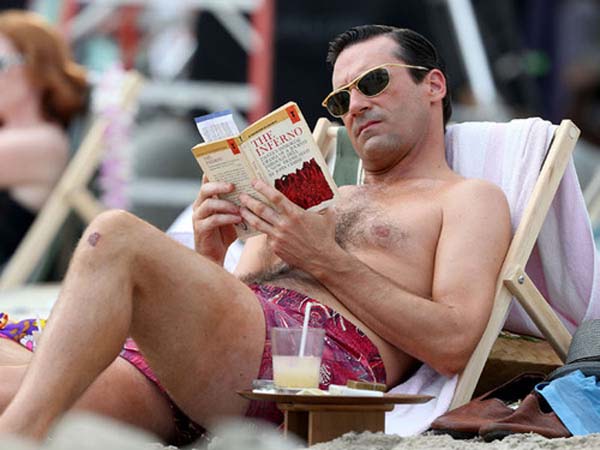
episode opened with a scene on the beach and Don reading The Inferno. It ended with an ad that Don created: the image of
an empty beach, bare tracks in the sand, discarded clothes, the open ocean. For
Don this was an image of escape. For his clients it was an image of a suicide. Escape and suicide have always been
dangerously close throughout the series, but this season, we are reminded
over and over how it is impossible to only love the beginning of things, when
everything that begins is ultimately going to end.

Arielle Bernstein is a writer living in Washington, DC. She teaches
writing at George Washington University and American University and also
freelances. Her work has been published in
The Millions, The Rumpus, St. Petersburg Review, and South Loop Review, and she has twice been listed as a finalist in Glimmertrain‘s Family Matters Short Story Contests. She is Associate Book Reviews Editor at The Nervous Breakdown.

You Are What You Play With: How SESAME STREET and Legos Generated a Generation

You Are What You Play With: How Sesame Street and Legos Generated a Generation

null

For a man or woman of a certain age, it’s hard to imagine a
single commercial or non-profit venture having had more of an impact on one’s
psychological maturation than Legos or Sesame
Street
. Yet even today’s youth might say the same thing: In 2013, we have
Lego-based television shows (Ninjago: Masters of Spinjitzu and Legends
of Chima, 
both on the Cartoon Network), Lego-based video games (more
than forty-six so far, including sequences based on Lego Star Wars, Harry
Potter
, and Indiana Jones sets), and even a forthcoming
feature-length film (The Lego Movie, due out in 2014 and starring the
voice-acting talents of Will Ferrell, Liam Neeson, Morgan Freeman, and Will Arnett).
Meanwhile, Sesame Street, now in its forty-fifth year of broadcasting,
remains ubiquitous in the lives of millions of American children. In short, it
would be difficult to name two cultural touchstones more worthy of being
written about by pop-culture critics, yet less often discussed in the
mainstream media. I’m thirty-six, and like many my age I spent much of my
childhood amongst the friendly monsters of Sesame Street, and another
significant percentage of my child’s play amongst store-bought and self-modeled
creations from Lego’s City, Space, and Castle lines of building bricks. So when
The Lego Group, now in its sixty-fourth year of operation, suddenly sat front
and center in the news last week due to a new report on design changes to its
building blocks, I paid closer attention than I would have anticipated. 

A recent study urges
parents to consider, when purchasing toys for their children, the indisputable
fact that Lego minifigures are substantially more likely today than twenty
years ago to feature angry or otherwise non-smiling plastic faces. Meanwhile,
anxious parents continue fretting publicly today, as they have for decades,
about the entertainment options available for their kids on television and at
the movies, meaning Sesame Street remains ever at the border of
conversations about American child-rearing, just as The Lego Group is right
now. And certainly there’s good reason for parents to worry about both toys and
television: Children are sponges, often noticing stimuli adults don’t. In
internalizing certain stimuli and ignoring others, they decide, by themselves,
the sort of adults they’ll become. The question, then, is a simple one for many
of today’s most anxious parental units: Does the anger painted on the face of a
toy make it more difficult for a child to access happiness? Would the gradual
loss of children’s programming of the caliber of Sesame Street—which is
increasingly likely, as each year it seems a greater and greater percentage of
children’s entertainment is provided by the Disney Channel rather than Jim Henson’s
heirs and successors—contribute to a generation incapable of growing up? And a
larger question: Isn’t one of American culture’s most unsettling blind spots
that it takes us longer to mature emotionally than seems to be the case in
other cultures? And isn’t this at least partially attributable to how we spend
our playtime as children and young adults?

nullThe answer to the above questions may well be
“yes,” but it may also be that these are the wrong questions. When I
was a Lego-obsessed child, the thing about every Lego minifigure featuring the
same smiling, yellow-plastic face—and they did; it wasn’t until 1989 that
additional facial features got added to Lego minifigures, and it took until
2003 for Lego to introduce lifelike skin tones—was that you quickly learned to
ignore your Lego minifigures’ facial expressions in imagining your own
Lego-based melodramas. Children instinctively (and from hard experience) know
that not every moment is a happy one. If their toys seem to be selling a
different story, they opt for empiricism over marketing and ignore the false
positives in their midst. If, however, as is now the case, Lego minifigures are
carefully painted to represent a series of distinct ethnicities, facial
expressions, and emotional attitudes, it’s much more difficult for a child to
impose their imaginative will upon their playthings. The same is true for the
feature of modern-day Legos most children and AFOLs (Adult Fans of Lego)
complain about, which is that increasingly Lego sets feature stickers to
portray complicated bits like engines or headlights or chassis details. This means
that once again children are denied the authority (and discouraged from
exercising their capacity) to imagine these features on their own.

If store-bought Lego sets represent, more and more, a
predetermined endpoint rather than a beginning, it says much for the
opportunities today’s kids do or don’t have to engage in imaginative play. That
said, the fact that Lego now regularly uses flesh-toned hues for its
minifigures rather than stock yellow headpieces is a far more significant
development than the one that made the news last week, at least from the
standpoint of child psychology. What happens when the cartoonishly fantastical
World of Lego begins to look significantly more lifelike, with minifigures that
are (variously) white, black, Latino, pale, tanned, young, old, et cetera? The
study states that what happens—as I’d suggest has been the case with Sesame
Street
from the very beginning—is that children begin to make decisions
about which faces and temperaments are most relatable to their own experiences,
and it’s in those decisions that juvenile psychologies may well get formed, or
so instinct and common sense tell us. It’s all to the good that children can
now play with toys featuring faces that don’t look like their own, and perhaps
it’s even to the good that children can now play with toys whose facial expressions
better match the range of expressions present in kids’ real-time environs; the
question is whether it would be even better if Lego minifigures were configured
abstractly enough to encourage children toward entirely-homespun playtime
narratives.

When Sesame Street was testing its pilot episodes
before audiences in 1969, social scientists told Henson and his collaborators
that children would be confused if puppets and human beings appeared on-screen
together. Yet the juxtaposition of Henson’s friendly puppet
“monsters,” who individually represented dramatically different
emotional and intellectual archetypes, and human beings, who generally
exhibited the full range of homo sapiens’ complexity, scored much better
among young test audiences and so—just like that—the social scientists’
objections were pushed aside. The result, of course, is one of the most
celebrated television programs in American history. It’s also a cultural
phenomenon that tells us much about how Generations X and Y learned to understand
themselves.

Each of the “Muppets” featured on early episodes
of Sesame Street could credibly be said to have represented a discrete
set of emotional and intellectual characteristics; some of these were
“positive” traits, some “negative,” though of course this
is a gross over-simplification (one popular theory
holds
that it’s more useful to think in terms of “Chaos Muppets” versus
“Order Muppets”). In the broadest terms, however, each of the
“major” Muppets of the early years of Sesame Street
represented a personality portfolio a child could instinctively choose to
relate to or be repelled by. Because these bundled archetypes were commingled
on-screen with human actors, it seemed reasonable for children to see Henson’s
friendly monsters as worthy not only of sympathy but empathy. Sesame Street
thus featured a pantheon of Muppetry ranging from the generally admirable
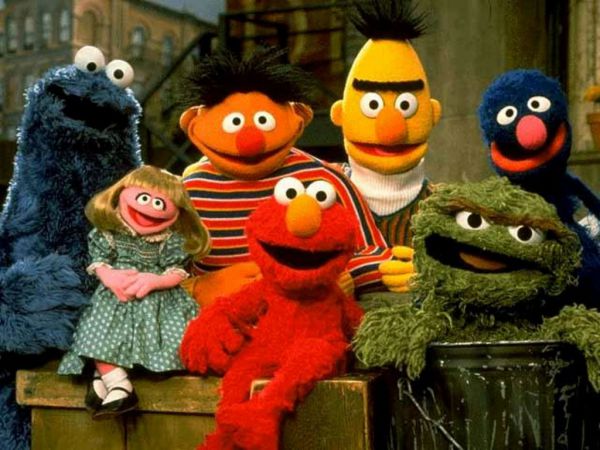
(e.g., Big Bird, Elmo, Kermit, and Grover) to the generally undesirable (e.g.,
Oscar, Bert, and Cookie Monster). Yet each Muppet was just three-dimensional
enough for any child to find them at least partially relatable.
 

nullGiven all this, we might posit here a personality test, in
the mold of the Meyers-Briggs assessment, that uses Muppets instead of
readily-definable character traits as its primary touchstones. It seems a
worthwhile hypothesis, given that so many of the Muppets of the 1970s and 1980s
simultaneously exhibited positive and negative characteristics that were
essentially symmetrical. That is, each “positive” trait had a
“negative” corollary, and vice versa. For instance, Big Bird, and
later Elmo, were both naive and oversensitive, but also—on the other side of
the same coin—friendly and empathetic. Perennial fan-favorite Grover was unwise
and impetuous, but also courageous and self-confident. Telly was neurotic and
anxious, but also kind-hearted and sympathetic. Ernie was irresponsible and
flippant, but also jovial and extroverted. Cookie Monster, like The Count,
could equally be seen as harrowingly obsessive and admirably passionate. Bert
was often tense, irritable, and impatient, but he was also intelligent,
motivated, and a self-starter. Oscar the Grouch, like Kermit the Frog, sat more
steadfastly at one of the spectrum than the other: If Oscar was generally
undesirable for his ill temper, pessimism, and reclusiveness, the Kermit of Sesame
Street
was consistently admirable for his intelligence, wisdom, and
emotional acumen. Other high-visibility monsters on Sesame Street also contained
important dichotomies, albeit more subtle ones: Herry Monster, for instance,
was, like so many of our fathers, equal parts imposing/unapproachable and
powerful/comforting.

As a child I most admired Ernie, Grover, and Cookie Monster,
which sounds suspiciously like my own psychological profile. I imagine some readers
will likewise be able to see themselves in some triangulation of Reagan-era
Muppetry. Are you a BCE (Big Bird, Cookie Monster, Ernie)? A COG (Cookie
Monster, Oscar, Grover)? Whatever one’s predilections, the point is that we can
understand, now, why parenting advocates are constantly mindful of what their
children are watching, and why social scientists are so skeptical of Legos’
recent evolution. Still, the question for both parents and social scientists
remains the same: Are we really considering, in our activism and our science,
how children consume entertainment, or do our anxieties merely underscore what
building blocks and puppets mean to us now, as adults? When I consider my own
history with Legos, for instance, I’m reminded that up until the age of
fourteen I wanted to be an architect, as it was somehow kept from me until that
time that architects have to do a lot of math; likewise, up until my
mid-twenties I carried with me the sort of childlike naivety about the ways of
the world that would be familiar to anyone who’s spent any time on Sesame
Street. It wasn’t, in either case, that either my toys or my television were
too constricting, but rather that just enough imaginative freedom was provided
me by them to make my playtime either a danger or, depending on my luck and my
instincts, a boon.

Seth Abramson is the author of three collections of poetry, most recently Thievery (University of Akron Press, 2013). He has published work in numerous magazines and anthologies, including Best New Poets, American Poetry Review, Boston Review, New American Writing, Colorado Review, Denver Quarterly, and The Southern Review.
A graduate of Dartmouth College, Harvard Law School, and the Iowa
Writers’ Workshop, he was a public defender from 2001 to 2007 and is
presently a doctoral candidate in English Literature at University of
Wisconsin-Madison. He runs a contemporary poetry review series for
The Huffington Post and has covered graduate creative writing programs for Poets & Writers magazine since 2008.

Attention Red Wedding Crashers: Get a Grip, Sit Back, and Enjoy a Best-in-Genre Moment

Attention Red Wedding Crashers: Get a Grip, Sit Back, and Enjoy a Best-in-Genre Moment

null**Warning: This piece contains spoilers. Read at your own risk.**

If one struggles to name any fantasy-genre
standout on the small screen or silver screen that isn’t a book adaptation, an
animation, or a mawkish cult classic like David Bowie’s Labyrinth, the reason’s simple: American audiences consider
the entire genre frivolous and flippant, and won’t embrace it in new
media unless book-lovers, kids, or hipsters have already given it their stamp
of approval. In other words, outside the context of video games, Americans need
an excuse to love a fantasy-genre production; either it borrows its gravitas
from the fact of it having sold well in bookstores first, it needs no gravitas
because it’s essentially kiddie-candy, or it operates beyond the reach of
gravitas because it’s pure kitsch. The end result is that no one takes the
genre seriously and, beyond a few hundred thousand mass-market paperbacks sold
annually at brick-and-mortar bookstores, no one really cares much about it.
It’s tangential to American life; it’s a first-world curiosity. The reason?
Fantasy authors, animators, and directors have never found a way to make
readers or audiences feel in their gut the grotesque moral savagery around
which the genre is built, or to see in fantastical morality plays lessons with
timely relevance for modern living, and in consequence no story rendered as a
fantasy ever properly lands with American audiences. It’s simply too removed
from anything that really matters.

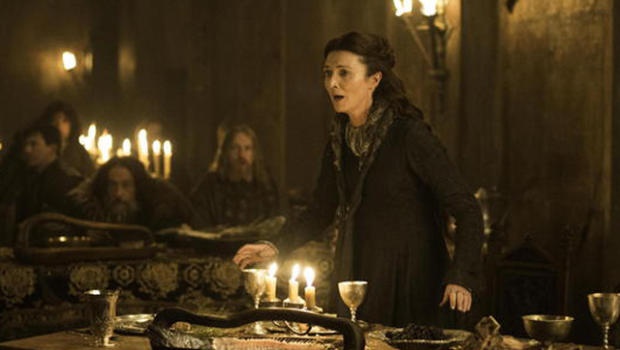
The Red Wedding scene from the HBO series
“Game of Thrones” may not have reinvigorated a genre—one could argue that the entire series, which
lights up Twitter and Facebook weekly like few other cultural artifacts do, has
done that—but it may well have reinvented it. Martin’s controversial killing off of
three major characters in the middle of the series’ seasons-long story arc, and
his unceremonious ending of the two-family feud at the center of that arc
seemingly seasons too early, is a best-of-genre moment that has roused much
anger among television-watchers precisely because it changed the ground rules
of an entire genre in mid-stride.

Many Americans, this author included, go to
television generally, and fantasy or fantastical shows specifically, as a means
of escaping time—that is, to watch consequence-free melodrama in a space that
feels entirely removed from anything we really care about. Horror films don’t
meet that standard because they frighten; contemporary dramas, because they make
use cry; comedies, because they make us laugh (and sometimes, when done right,
cry while laughing); and romances because they make us swoon. Fantasy shows and
movies are supposed to be more like documentaries that entertain us in the
absence of any informational content; if they refresh our spirit, they do so
quietly and only with our implicit preapproval.

Enter “The Rains of Castamere,” an
episode of “Game of Thrones” that led fans of the series to take to
Twitter and Facebook to issue death threats to the series creator, George R.R.
Martin; many others announced they’d no longer watch the show. Fans of the book
had a similar reaction when the now-infamous Red Wedding scene appeared in the
book on which Season 3 of “Game of Thrones” is based, A Storm of Swords.

In the scene immediately preceding the Red
Wedding in the Robb Stark/Catelyn Stark storyline, the King of the North’s
mother urges him to let his mortal enemies, the Lannisters, know what it feels
like to lose something they love. It’s considered, by both Stark scions, to be
just about the only thing that will awaken the callous Lannisters from their
complacent wealth and endless political victories (also, a string of de facto
military victories brought on not by their own military prowess but the
weakness and disorder of their enemies). In the very same way, Martin’s killing
off of the two senior Starks has affected a complacent, wealthy, victory-rich
nation—America—by taking from it two characters it loves and admires, and doing
so without any of the advance warning first-world countries implicitly demand
before they’re handed a major defeat. That’s what really gets our goat about
the Red Wedding: It was a sneak attack against our affections and our courage,
launched from a platform (the fantasy genre) which has long been free of
such audience-rattling excursions. It’s no wonder the most successful
fantasy-film franchise in the history of Hollywood, the Lord of the Rings trilogy, was based on a book Britons once voted
the best of the twentieth century and which, consequently, both the English and
their American cousins already know the ending to. The Red Wedding was
something different; it was a nasty surprise that stole from us something we
actually value and made us actually hurt, thereby breaching the contract
fantasy readers and filmgoers have implicitly always had with the genre.

But George R.R. Martin has taken this particular
best-in-genre moment even further, and in doing so has returned fantasy to
real-time cultural consequence for the first time in, well, forever. Fans
mourning the deaths of Robb Stark, Catelyn Stark, and Talisa Stark fail to see
that these are precisely the characters who needed to die. They needed to die
immediately and they needed to die in precisely this way, for what has always
made the fantasy genre the most underrated of all the genres is not only that
(as with the Red Wedding) it carries the capacity to move us as deeply as any
other form of entertainment, but also that it teaches us better than any other
genre about the moral savagery that still endangers us daily. Whatever we may say
of their deaths, the now-deceased Stark trio each had it better than almost
anyone in Westeros, which left viewers with little to learn from them except
the falsehood that in an unpredictable world the emotionally rich are rarely in
peril. 

Robb Stark had a father who not only loved him
but inspired him, a mother who loved him and modeled for him every strength a
man or woman of any time-period could need, a wife with whom he shared true love, a home for which he felt genuine fondness and with which he shared a
genuine spiritual attachment, brothers and bannermen and vassals who he loved
and who loved him in return. He knew himself, he knew his cause to be just, and
he knew himself to be capable of generative moral audacity and abiding
political courage. The same could be said of his wife and his mother, excepting
that his mother also enjoyed the most loving marriage in Westerosi history for
several decades and was perhaps the first mother in Westerosi history to be
sincerely and justifiably proud of every one of her children (even Sansa). The
tragedy of her last year of life, like the tragedies of Robb’s and Talisa’s
last months together, in no way erases the permanent mark of a life well lived.

In a fantasy book or film, we expect emotional
removal and cultural irrelevance, and so we expect a life well lived to end happily,
as in our own reality they so often do not. In our reality, children are killed
by cluster bombs dropped pursuant to military squabbles they have nothing to do
with; loving mothers are killed in childbirth or by drunk drivers or from
breast cancer; good men are ruined by men with fewer scruples, baser instincts,
and a larger quantity of money. Sometimes, but with precious rarity, what is
true in life is also true in fantasy: We learn from goodness, when we learn
from it at all, only from its downfall. That that’s a lesson we rarely get from
artifacts of the fantasy genre is something we’ve come to live with, in fact
it’s become something that (ironically) makes fantasy palatable to American
audiences.

We call George R.R. Martin a cretin for killing
off the three most noble Starks this side of Arya—Ned, Robb, and Catelyn—but
look for a moment at the miserable lives of his tale’s supposed
“victors.” Cersei is still alive; she’s a beautiful and intelligent
woman who’s never felt romantic love for anyone but her brother, is afforded a
tenth of the respect her intellect deserves, was married off like a parcel of
property (and is about to be so married again) to a man she doesn’t love or
respect, has no mother and fears rather than loves her father, has no friends,
parented a sociopath into a reign of unfettered derangement, and will never
achieve even a fraction of her life’s ambitions. Her brother and lover Jamie
Lannister has led a life of such self-loathing that the first consequential
interpersonal encounter of his thirty-something years is with a six-foot-tall
virginal pariah who’s charged with his prisoner’s transport; it’s not clear that
he’s ever had sex with anyone but his sister or been loved by anyone but her
and his near-universally-despised little brother. Petyr Baelish has spent his
entire life pining after a woman who doesn’t love him and compensating for a
childhood spent getting the snot beat out of him by stronger, taller,
better-looking, better-armored men. He has not a single friend. Lord Varys is a
castrato who endured years of penury, torture, forcible rape, and public
humiliation just so he could work harder than anyone in his immediate vicinity
on behalf of a kingdom that does not appear to deserve (or in any sense
appreciate) his efforts to counter Baelish’s Chaos with Order. Let’s put aside
that no one loves him, either, that he loves no one, and that his only
“friend” is Tyrion Lannister—who doesn’t trust him. All of these
people, and the many other Lannisters and assorted baddies who survived the Red
Wedding, are miserable wretches whose lives and loves we do not admire or envy.
The few days and weeks and months we’re permitted to watch their lives
notwithstanding, they’ve suffered substantially more, and lived substantially less
well, than those they have killed or have just heard about being killed at the
Red Wedding.

The lesson of the Red Wedding, then, isn’t just
that well-written fantasy takes from us things that are precious to us in a way
that actually hurts us, but that we learn more from the suffering of the bad
than the clean living of the good. This isn’t a lesson we normally associate
with fantasy–in fantasy, or so the casual fantasy-watcher thinks, the evil
ultimately perish and the good ultimately prosper—but it’s a lesson many of us
have been associating with the very best exemplars of the genre for a very long
time. If you’re a Ned Stark-like father-figure who happens to live in a
war-torn Middle Eastern country, all your hard lessons about righteousness and
many years of dedicated love may not keep your children or wife safe; if
you’re a homosexual in the wrong place on Earth, your true love for another may
someday lead to your brutal murder; if the way you live and love is an
inspiration to others, you may have your entire life toppled someday by someone
lacking your stringent codes of honor and various self-restrictions. The only
way to encourage a nation to fight the worst human instincts—whether they arise
from within the nation or without it—is to engender in that nation an abiding
understanding of what it means to lose what one loves and what it means to
watch the devious succeed. By the same token, the only way to encourage a
nation to honor the best human instincts—whether they arise from within the
nation or without it—is to enforce an understanding that goodness sometimes
leads to happiness before it leads to tragedy, and that savagery often leads to
misery before (and even while) it leads to perpetual skin-of-one’s-teeth
survival.

One of the worst things about human history is that
we have often learned the above lessons, when we’ve learned them at all, from
violence and loss of life; one of the best things about human history is its
continual production and reproduction of art, and one of the best things about art is that it teaches us what we need to learn about ourselves and language
and the nature of attachment without any accompanying need for bloodshed.

Don’t hate George R.R. Martin for taking from
you what you love, “Game of Thrones” viewers, thank him. Don’t hate “Game
of Thrones” for bending the conventions of fantasy to make you feel
something real in real-time, be grateful for it. And don’t underestimate the
beauty of something good—whether a life or a love—because it’s ended, nor
overestimate the comforts of something false and miserable because it persists.
Most of all, don’t treat the death of a pregnant woman, her husband, and his
mother as the end of an era for a television program; treat it as what it is:
the rebirth of an entire genre, and a regeneration of the belief all
well-intentioned persons share, which is that living justly and kindly is its
own reward and earns back any subsequent cost a thousand times over.

Seth Abramson is the author of three collections of poetry, most recently Thievery (University of Akron Press, 2013). He has published work in numerous magazines and anthologies, including Best New Poets, American Poetry Review, Boston Review, New American Writing, Colorado Review, Denver Quarterly, and The Southern Review.
A graduate of Dartmouth College, Harvard Law School, and the Iowa
Writers’ Workshop, he was a public defender from 2001 to 2007 and is
presently a doctoral candidate in English Literature at University of
Wisconsin-Madison. He runs a contemporary poetry review series for
The Huffington Post and has covered graduate creative writing programs for Poets & Writers magazine since 2008.

KILLER KARAOKE: Reality Television and the Death of the American Middle Class

KILLER KARAOKE: Reality Television and the Death of the American Middle Class

null

“There’s been class warfare going on for the last twenty years and my class has won.” —Warren Buffett

“I’m about to get my ass kicked by crawfish.”—Steve-O

It doesn’t seem unreasonable to imagine that, at the brainstorming session where the phrase “Not Reality. Actuality.” was coined, one of the copywriters might have pointed out that these two words are synonyms. Apparently this observation was never made, or not with sufficient conviction, because this is now the official motto of Turner Broadcasting’s TruTV network, which specializes in reality programming. Viewers might anticipate a new threshold of lowered expectations for the shows featured on this network, based solely on its grammatically challenged motto, but one show on it, Killer Karaoke, was recently described by the New York Times as “the highest possible use of the medium and the most profound statement ever made about the human condition.” This statement may be a bit of ironic hyperbole, but it contains a kernel of truth. Killer Karaoke is a window on the shrinking opportunities and declining fortunes of the American middle class.

The show combines two popular reality TV game show formats, the singing competition and the stunt challenge. It is essentially a mash-up of American Idol and Fear Factor. Like most other new reality television shows, the producers go out of their way to avoid cluttering up the show with original ideas. It is based on Sing If You Can, the 2011 British singing competition that celebrates performing while being subjected to extremely distracting circumstances, including having snakes draped on your body and being blasted with a high-powered mechanical storm simulation. Most of the concepts for the stunts on Killer Karaoke are drawn directly from Sing If You Can.

The contestants on Sing If You Can are well-known singers playing for charities, showing viewers the spectacle of celebrities experiencing various states of stress and alarm. Like American Idol or The Voice, the set design is cavernous and ostentatiously expensive-looking, and like those shows, the overarching feel of the show is one of inaccessible wealth, a wealth the audience is meant to voyeuristically ogle. The celebrity contestants on Sing If You Can may be amusingly stressed in the face of their challenges, but the audience is still very much meant to register them as betters existing in an untouchable universe of privilege.

Killer Karaoke takes this class structure and turns it on its head. The set is modest and the contestants read as average middle class karaoke enthusiasts, enthusiasts who hunger to be seen on television. The deal they accept by appearing on the show is startlingly bad. They are promised a chance to win “up to” $10,000. But it’s clear that the final challenge of the show is designed to pay out an average closer to half that amount. The largest amount won so far is $7,800. Survivor offered the winning contestant one million dollars. Fear Factor offered $50,000. The deal has been getting worse and worse as reality shows have progressed.

nullThe shows that exploded in the early aughts, starting with Survivor and Big Brother, represented a new historical relationship between reality TV actors and employers. Most reality shows today enjoy a spectacularly profitable exploitation of their actors. These shows are attractive to produce because creating the content and, ultimately, much of the show’s value requires them to utilize a class of unorganized low-paid laborer: the American reality contestant.

Capitalist economic systems require one central point of internal logic for them to function; in order to constantly expand profits, workers must be paid less than the value their work creates, ideally as little as possible, as little as the labor market will bear. In classical economic theory, new value only comes from one place, labor. In order to concentrate wealth for owners, shareholders and managers, this surplus value is then concentrated into financial instruments and forms of rent that charge the workers who created the value in the first place. It is a parasitic relationship.

Reality TV contestants are an excellent object for this kind of relationship, because they are a disposable, easily replaced group of workers. Because their working conditions are not regulated by the Screen Actor’s Guild, contestants can work unusually long hours, Some shows require a working day as long as 12-18 hours. Appearing on a show requires temporarily leaving, even risking, one’s job. Union pay for an actor on a scripted situation comedy is $25,000 per episode. Reality TV contestants are often paid nothing at all for their work, though some receive a modest stipend. Most agree to work for food and shelter during the time they are being filmed, in hopes that the exposure might lead to some future opportunity, if not just for the sheer narcissistic reward of appearing on television.

The worsening conditions for television workers with the advent of reality TV mirror the gradually worsening conditions of the American middle class over the past few decades. Since the early 1970s, business leaders and the pro-business lobby have orchestrated a massive wealth transfer from the middle class to the ruling elite through deregulation and changes in trade and tax policies that favor the upper classes at the expense of the working and middle classes. The Pew Research Center reports that the number of households earning two-thirds to twice the median income has shrunk from sixty-one percent of the US population in 1971 to fifty-one percent today, and that reduced middle class earns a lower percent of total national income. The 1972 adjusted gross wages for the average worker was $738 per week. In 2008 it was $598. In 1970 the average CEO made twice what the average worker made. Today that same CEO makes five hundred times what the average worker makes. The income of the richest one-percent has tripled since 1980, while at the same time the income of the bottom ninety percent has dropped by twenty percent. Bill Clinton and politicians from both sides of the aisles promised to create jobs with NAFTA in the early 1990s, but according to the Economic Policy Institute, NAFTA actually cost the United States nearly 700,000 jobs, mostly in manufacturing.

nullThere has only been one brief moment where the American middle class grew at all in the last thirty years: during the tech bubble of the late 1990s. Reality television as we know it began just after this anomalous growth spurt began reversing itself. Shows like Survivor, Big Brother and Fear Factor dramatized the new economic realities: vicious competition, humiliation, hard work for little reward, and winner-take-all ethics. These shows reflect the American economic policymakers’ ideology, where policy is decoupled from ethics, as well as from common sense. As wealth is more and more shifted from the middle class to a small concentration of the upper classes, demand begins to shrink, and with it, the ability to recover from the cyclical crises that are part of our economic system. The middle class is the main consumer class of the United States, and consumption is two thirds of the US economy. As the middle class shrinks, consumption shrinks. As consumption shrinks, the time it takes to recover after recessions grows. Increasing income inequality also translates into increasing economic instability and slower growth. Since the 1980s the job market has taken longer and longer to recover after every bust. More than five years after the great recession of 2007, the job market still hasn’t recovered, but the stock market is booming. Because of this, the wealthy are enjoying full recovery, while the middle and working classes are falling behind, largely because of high unemployment. Corporate profits are booming, but only during the Great Depression has the share of GDP going to salary and wages ever been lower. American workers are less and less part of American prosperity.

The new economy of reality television has helped American Idol become the most profitable show in the U.S. Its contestants represent legions of unpaid laborers. American Idol presents itself as an aspirational drama, but the perspectives of the show are very much those of the ruling elite. Success in this competition is about pleasing famous millionaires on their terms. Idol‘s Horatio Alger stories remain the mythic ideal, but the statistics point to a very different reality. In America, the chances of someone’s making it to the top or to the middle from the bottom are lower than in any other advanced industrial country. The essence of American Idol is not so much the performances of the singers as it is the dramatization of the unbridgeable class divide between the ruling elite panel sitting behind the desks and the average citizen contestants standing on stage.

nullThe early rounds of American Idol feature inappropriate contestants with little or no talent who are intentionally let through the cattle call weeding process. This represents an ugly and compelling entertainment spectacle that allows viewers to enjoy the drama of a few elite upper class celebrities verbally torturing some unfortunate neurotic caught in their web. These early scenes are job interviews designed to go horribly wrong. The hopeless contestants seem to deserve this fate because their grotesquely delusional overestimation of their talents and complete lack of understanding of what is expected of them by their prospective employers violates some primal sentiment of self-preservation in us. What they are really being punished for is not a lack of talent. They are being punished for being socially maladapted. Sadistic spectators at a ritual enforcement of conformity, we enjoy watching these sickly deer being culled from the herd.

In the later rounds, when we root for the talented underdogs who have made it through the culling process, our sentiment shifts: now we’re thrilled at someone else’s success. But we’re also connecting with our own desire to sell out. Can this person hold on to a vestige of their humanity and individuality while achieving the extreme-sports version of selling out? American Idol openly and engagingly celebrates the triumph of commercialism over art. As viewers, we are rooting for the corporate machine that manufactures these celebrities as much as for the contestants themselves.

Killer Karaoke breaks with this tradition. There is no panel. The contestants are judged only by the audience, according to whatever criteria they please, probably a mix of singing talent, courage, and how entertainingly they flip out. But winning is not exactly the point of the show. Something of an afterhtought, the anti-climactic final challenge involves singing while remaining balanced on a giant rotating turntable with two other remaining contestants. The point of the show is to see how winningly contestants can suffer humiliation and pain under objectionable working conditions. In contrast with American Idol, Killer Karaoke encourages the audience to sympathize with all the contestants from the beginning: though we’re amused by their suffering, we’re also rooting for them. We want everyone to succeed, in a situation where success comes down to freaking out in the most hilarious way.

nullThe host Steve-O (Stephen Gilchrist Glover), a graduate of Ringling Bros. and Barnum & Bailey Clown College, went from working in a Florida flea market circus to being one of the most visible performers on Jackass, the MTV reality show featuring self-harming stunts. His role on that show was marked by the  extremity of his stunts, his oddly calm and polite demeanor, and his notorious struggles with drugs and alcohol. The inane and sublime poetics of Jackass inform Killer Karaoke to a significant degree. The qualities the now drug-free Steve-O brings with him from his former show—a particular combination of affability, masochism, encouragement, and sunniness in the face of pain and humiliation—help form much of the tone of Killer Karaoke and differentiate it from a host of other reality shows. He is a man dumb enough to consent to be choked unconscious six times in a row, and sensitive enough to tenderly French-kiss a giraffe. He helps steer the contestants to do their best to accept the challenges in the Jackass spirit, and some of them do seem to have fully embraced the idea that their suffering and fear are meant to bring joy to others.

Steve-O is consistently lucid and endearing on the show, even when the occasional shadow of substance-induced derangement briefly passes over his face. It’s clear he is not really involved in the design of the stunts, which are extreme by game-show standards but lightweight compared to some of the activities featured on Jackass, which often veered closer to self-harm-oriented performance art than reality TV. Steve-O is very much a traditional game show host in this role on Killer Karaoke, an updated Bud Collyer. He stays out of the action and keeps to the role of explaining the stunts and drawing comments out of the contestants. In a recent interview about the show, he said, “Breaking bones and sticking things up my ass was not getting any easier.” It’s clear that he has a strong grasp of the economy of the show, and perhaps about reality TV in general: “It’s about the misfortune of others and exploiting people’s willingness to sacrifice their dignity and well being just to be on TV for a brief moment.” Steve-O’s host character is an expert on ill-advised activities who has happily gotten himself promoted to a upper management position.

One particularly telling challenge has the contestants singing while taking on the job of a waiter, serving Steve-O a five-course meal while being shocked by multiple electric collars attached to various parts of their bodies. This tableau of this challenge perfectly mirrors the increasingly debased working conditions in the United States. Before the performance, Steve-O briefly zaps himself on the neck with the shock collar set on full-strength, partly to associate himself with the contestant, and partly to imply that the singer is participating in the equivalent of a Jackass stunt. It is clear, though, that Steve-O is no longer engineering pain for himself but organizing it for others. Following the inevitable logic of career self-advancement, he has gone from being the exploited to being the manager of other people’s exploitation.

The genuine class anxiety-fueled schadenfreude of American Idol isn’t really a part of Killer Karaoke. Just before the stunts, Steve-O always says something to the effect of “You can do this, we’re all rooting for you,” even when it’s obvious that the contestant is about to get considerably more of a challenge than they are prepared for. This is a show where everyone is supposed to enjoy the pain together. Even when one contestant completely loses all traces of composure and stops singing entirely, Steve-O smiles and said afterward, “Nobody comes here to see everything go well.” Instead of notes from a panel of wealthy authority figures, the contestants, rather, get one line of instruction: “No matter what happens, do not stop singing.” All that is expected of them is to remain committed to the performance of the song in absurdly unacceptable circumstances. This mirrors being middle class in a country where a middle-class lifestyle has increasingly been an unsustainable performance that is only possible to continue though reckless borrowing. Is it that much of stretch to imagine a similar electric shock system being utilized on Amazon.com warehouse workers when the GPS units they’re forced to carry indicate they’re not moving fast enough? Currently these warnings come in text messages.

All the contestants can sing, but at its root Killer Karaoke is not really a singing show. It’s the interruption of the singing that counts. Most performers do not even get to the chorus of their chosen songs before their voices begin to lurch and jump into moans, screams, disconcerted verbal objections, fragments of melodies, and awkward gaps of silence. One particular challenge always seems to set off the most dynamically cacophonous additions to the songs. The challenge involves lowering the singer into a tank of cold water and then gradually filling the tank with larger and larger snakes. The physical discomfort combined with primal fear has produced some amazingly original variations in song interpretation. These musical ideas are accidental, but they are also compelling. The result is that Killer Karaoke is the only place where it is possible to hear avant garde music on television. If played outside the context of the show, some of these songs could easily rival early 1970s Yoko Ono recordings like “Unfinished Music,” for use of extended vocal technique, edginess and genuine expressiveness unsullied by commercial compromise. These are the primal screams of the disappearing American middle class.

Killer Karaoke‘s DNA can be traced back to one of the earliest reality shows, Beat the Clock. Beat the Clock, hosted by Bud Collyer, began airing in 1950, and featured contestants competing for money as they attempted timed stunts. Killer Karaoke, like Beat the Clock, is structured as a series of tasks: in other words, work. And it does something that TV is particularly good at: showing a person’s immediate, visceral response. Killer Karaoke doesn’t go farther into the contestant’s backstory than their name and what song they’ve chosen. Their reactions are their story.

What is relevant to viewers’ lives in Killer Karaoke is the purging, through laughter, of the stress of increasingly difficult and unrewarding work conditions. Its contestants have little to gain. The show exists in a world where the pretense of social mobility is almost totally gone. It’s taken for granted that the terms of work are bad. The show is about how well and how entertainingly the singers go through their ordeals, reflecting the increasingly shrinking opportunities and humiliating work conditions now facing the majority of the American workers, where one can expect little from working hard and playing by the rules. Maybe one day someone will make a show about how to actually change these conditions that is this much fun to watch.

Drew Gardner’s books include Chomp Away (Combo, 2010), and Petroleum Hat (Roof Books, 2005). He tweets at @chompaway and lives in New York City.

Why FX’s THE AMERICANS May Feature the Most Compelling Romance on TV

Why FX’s THE AMERICANS May Feature the Most Compelling Romance on TV

nullThe rise of the antihero in American dramatic television has been nearly fifteen years in the making. Since Tony Soprano revealed a gangster as touching as he was menacing in 1999 (those ducks!), television has introduced programming with a level of thematic and ethical complexity at a consistency never before achieved in the medium. A glimpse at the major award circuit in the past half-decade reveals not only a critical interest in this turn, but a popular one, as well. Mad Men, Breaking Bad, and most recently, Homeland are just three shows that have achieved widespread recognition for their presentation of morally compromised protagonists.

nullFX, known for its “There is no Box” brand, is no stranger to this breed of conflicted character. Its breakthrough program, The Shield, was a benchmark in the era of the antihero, considered by many to be an answer to HBO’s oft-discussed flagship. But where Tony Soprano was already a ringleader in an entrenched system of corruption, Vic Mackey was a crime-fighter, one of the good guys. Yet, in his Machiavellian lust to thwart baddies, we witness him torture, blackmail, plant evidence, and murder. In that sense, The Shield can be seen to usher in what has become the current antihero paradigm: where moral ambiguity abounds in spaces beyond the expected arenas of gangsters and thugs—among doctors and high school teachers, ordinary people.

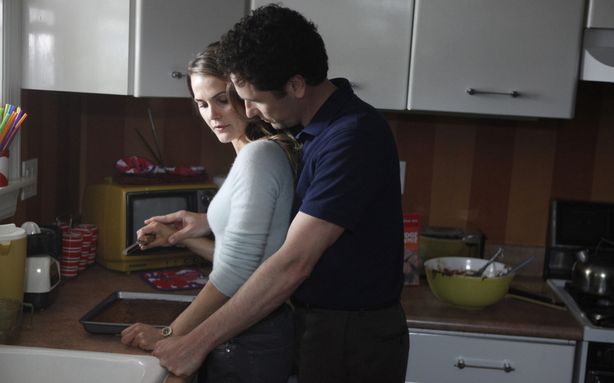
It’s fitting, then, that FX is the first network to attempt a redirection of this trend in its newest drama, The Americans. Though it is as flush with moral ambiguity as its predecessors, Joe Weisberg’s creation offers an altogether different breed of protagonist. Some antihero dramas attempt to portray the slow degradation of character (Breaking Bad), others show us how obsession deepens madness (Dexter, Homeland), and others still allow the vicarious experience of power and its consequences (Mad Men, Boardwalk Empire). What separates The Americans is its foregrounding of the simplest device in the history of narrative: love. In effect, The Americans is an extended remarriage plot. Sure, it’s replete with the trappings of espionage, but all the mad chases, brutality, and political intrigue function in service of its romantic core. What leaves viewers clinging to their armrests in these moments of pulpy thrill is the underlying terror that, at any moment, the fledgling relationship between protagonists Philip and Elizabeth Jennings (played by Matthew Rhys and Keri Russell), will suffer a blow—whether physically, emotionally, or both—that it cannot survive.

nullDiscussion of The Americans, thus far, has been largely centered around its relation to Showtime’s Homeland. However, the shows bear little resemblance to each other beyond their basic conversation about what it means to be a double agent, or, in a broader sense, to lead a double life. Homeland is sparked and sustained by a central terrorist plot. The romance that springs up between Claire Danes’s Carrie Mathison and Damian Lewis’s Nicholas Brody is, if a bit predictable, a delectable garnish. Specific motives correlate to known and desired effects (how will sniffing out a new piece of information help Carrie & Co. develop more effective counterterrorist responses?), and these propel the show. But neither Elizabeth nor Philip has a specific agenda—in typical Cold War style, there is no clear, overarching object—so the long-form conflict that emerges is largely character-driven, supplemented by action.

In this way, The Americans bears a closer likeness to HBO’s Deadwood, a show more interested in how communities are constructed than in marinating in its own conceits. But where Deadwood’s magic lay in its expansive cast, The Americans’ charm is in its limited focus; there’s something intoxicating about its tight ecosystem of quiet moments, its emphasis on the accumulation of gestures in meaning-making. If anything, a discussion of lineage is important here in a global sense; there’s a certain degree of predictability to any show, but after over a decade’s worth of writers willing to put their darlings through the ringer, we know better than to let ourselves get comfortable when things appear to go well for Mr. and Mrs. Jennings. In the episodes following the emotional high of the pilot’s climax, we see the two confront past and present infidelities (Philip’s sexual manipulation of the assistant to the undersecretary of Defense to ascertain information, Elizabeth dealing with her years-long love affair with a “co-worker”), professional dilemmas that generate disputes that feel more personal than political (the Reagan assassination attempt is used to great effect here in underscoring their differing loyalties), as well as a new boss (played by Margo Martindale) who informs them that work is about to become even more life-threatening than it already was.

nullA romance is only as good as its obstacles, and, as aforementioned, we find no shortage of obstacles in The Americans. If anything, the degree of coincidence incorporated in creating these barriers has been, for some viewers, the show’s primary shortcoming. But when coincidence deepens conflict instead of helping to resolve it—imbuing a certain degree of inevitability rather than deus ex machina—most are quick to forgive. So, when CIA agent Stan Beeman (Noah Emmerich’s savvier analog to Breaking Bad’s Hank) moves down the street from the Jenningses, we’re more interested in the “loaded gun” stress this generates than decrying its improbability. In the end, we don’t want Philip and Elizabeth to have an easy go until they’ve really earned it, and we’re rewarded amply for our masochism.

Repression and the unspoken form the dramatic fulcrum of The Americans. Much in the way that 1960s gender roles cast character conflict in Mad Men, the Jenningses’ employment as spies operates as a sort of de facto silencer. Like all effective period dramas, this speaks both to the ethos of the 1980s—the carefully constructed veneer of safety in spite of deep-rooted anxieties—and to the current post-9/11 zeitgeist. So, when Philip approaches Elizabeth about defecting to America in the pilot, we realize that multiple layers of psychological maneuvering are afoot. Though they’ve duped everyone around them—their children included—they’ve always known that their marriage is just a vehicle for their true marriage to the KGB; it’s their cover in American suburbia. The moment it gets in the way of a mission is the moment it loses efficacy. As such, when Philip pushes for defection, Elizabeth is not only confronted with deciphering his intentions—he could be on a private mission from headquarters intended to test her loyalty—but navigating the undercurrent of his now apparent feelings for her (particularly in light of the emotional distance she’s cultivated with anything related to her American life), how to respond to his eroding patriotism (her training would dictate she report him to headquarters), what this dichotomy will mean for them, and lastly, having been pitted between the two most important things in her life, negotiating her own feelings for Philip.

Moments like this are hardly isolated. In some way or another, paranoia looms behind every action taken, every choice made. Unlike the usual tropes of romance, Philip and Elizabeth already have all the physical manifestations of domestic bliss: the house, the car, the kids. They’re older. They’ve lived past the age of youthful naivety and impulse, and, because of their work, they understand the fragility of life. At the same time, these are also two people who made the decision to dedicate their lives to country as teenagers—not to mention the fact that they’ve spent years kidnapping and murdering—and their emotional self-awareness suffers commensurately. Their silence isn’t just professional. Love necessitates vulnerability, and, particularly for Elizabeth, whose loyalty to “the cause” has been unflinching, this is an unbearable idea.

nullWhich maybe helps explain why the romantic moments we see unfold here are more touching than just about anything else on television. The premium channels seem to have adopted a per-episode sex quota, and meanwhile, The Americans encapsulates passion in handholding, meaningful looks, and veiled apologies. And the moments of spillover, whether pronounced or Victorian, are downright gut-wrenching. We know what’s at risk, what makes it so difficult for them. Once we understand the kind of traumas (emotional, physical, self-inflicted) Elizabeth has suffered, for instance, no amount of nudity, one night stands, or marital harmony elsewhere can better capture our affections than when, in spite of a seeming incapacity for tenderness, she reaches out and puts her hands on Philip’s shoulders. Sometimes, these romantic moments converge with violence, as in the pilot’s climax, and the effect is so powerful that it manages to transform Phil Collins’s “In the Air Tonight” into something anthemic, hard-hitting, and steamy.

If, under the lens of perspective, we suspend the remnants of latent anti-Communism, we come to realize that Philip and Elizabeth may in fact be the worst antiheroes ever written insofar as being antithetical to heroism. That may sound semantic, but the pair is principled, in some respects similar to Vic Mackey. But unlike Mackey, it is absolutely clear that neither relishes in harming others; even if their capacities for love and violence can seem disturbing at times, we also see an underlying desire to do good. In a sense, this show lets us eat our proverbial cake: we get the grime and complex ethical scenarios, but we can root for our heroes the way we might those in classical epics.
 
As we’ve witnessed over the past fourteen years, television is an incredible medium for portraying slow deterioration. But The Americans reveals that television is equally capable of showing the opposite: the precarious steps we take to build community, how we maintain in the face of obstruction, and how we teach ourselves to love and be made vulnerable in a world that knows exactly how to exploit and destroy us. In the course of Breaking Bad, Walter White becomes the self he is apparently always capable of being, and we watch how his obsessive pursuit of power brings his whole life—and with it, any true sense of fulfillment—crumbling around him. In The Americans, though, Philip and Elizabeth begin from a place of alienation and move toward redemption, just as their world becomes an even more dangerous place.

The best art is that which both imitates life and helps us to escape it. Within exotic, exciting, and fantastical contexts, we still crave reflections of ourselves and the worlds we inhabit. The Americans is a show about dealing with the consequences of the choices made in youth, about trusting intuition and loving in spite of fear, about accepting that what we love most in each other is also what we can come to most hate or fear. Even for those of us not steeped in a paranoid existence, the world can at times feel like a hard, lonely place. With the inescapability of our mortality, the best we can hope for is true human connection while we still have time for it. That kind of redemption, which The Americans seeks to offer, is a rare beacon—something, without realizing it, that we’ve been desperately waiting to see.

Jesse Damiani is Series Co-Editor for Best American
Experimental Writing
(Omnidawn, 2014). He lives in Madison,
WI.

THE NEWSROOM RECAP 5: AMEN

THE NEWSROOM RECAP 5: AMEN

This episode of The Newsroom was the closest the show's ever come for me to doing what I think it wants to be doing: effectively interweaving accounts of principled reporting and the ethical dilemmas of journalism with snappy explorations of its characters' personal lives. Unfortunately, it founders on the same shoals it always does: MacKenzie's and idiot, and Will thinks it's all about him. This week, the reasons we know that Atlantis, the company that owns News Night, is a Fictional News Paradise of Legend are that its gossipy morning show makes a real effort to teach its viewers about a substantive media conflict of interest, and that it took almost a year for one of more than 100,000 people who received a hugely embarrassing email about major figures in the organization to figure out that it might be of interest to media reporters. Not to mention that it’s truly hilarious to think that anyone wouldn’t have known Will and MacKenzie dated when they were together because journalists are notorious gossips, a quality you’d think would be catnip to Sorkin.

nullBut no, the real problem here is the rift between the rest of the episode and Will’s defense of MacKenzie to Nina, a reporter, when he has been tipped off by Gary, the Smart Black Guy Who Isn’t Afraid to Criticize Obama, Validates Jim’s Seduction Techniques, and Also Has a Sideline in Bribery, that TMI takes payoff money from celebrities. “I hired the best EP in broadcasting in spite of her being my ex-girlfriend,” Will tells Nina, who he believes is going after him for sexually slighting her at New Year’s (never mind insulting her job), in angrily warning her to step away from his staff. But nothing in the show indicates that. In fact, everything we see indicates that MacKenzie is a disastrously ill-informed and naive woman.

She misses that her boyfriend Wade is using her to prep for a Congressional run, which would be a heartbreaking tale about a skeptical journalist letting down her guard and being disappointed if she didn’t know so little about everything else. She confesses to Sloan that her economics knowledge only extends as far as thinking “a lot of what’s going on in the world has to do with the economy,” and that her oversight of the economics statements she’s producing consists of the following: “I pretend to read what you give me, then I nod.” Her response to the news that the Army is filling the power void in Egypt? “The army’s not the good guys?” All of this might have been cute for Mary Richards back in the days when she was still ordering Brandy Alexanders during job interviews, but there’s something distasteful about Sorkin’s asking us to buy incompetence in the guise of dizzy adorability. Nina would be justified in investigating MacKenzie’s utter lack of qualifications even if there weren’t ethical lapses in her current performance or errors of judgment in her past.

This glaring contradiction is doubly unpleasant because it sullies the best job The Newsroom’s done so far at actually showing the challenges and pains of directing correspondents on the ground from a cable control room. The reason the coverage of Tahrir Square works is that Will and his team don’t magically discover a major scoop simply because they care about it more than anyone else, or avoid a major error because they’re so much more ethical than their competitors. The episode is, instead, largely about process and the dangers of reporting in a war zone.

First, Elliot and Don’s frustrations, which have been boiling since election night when Don urged Elliot to jump into the scrum of commentary, end up having real consequences. Elliot, who’s been confined to his hotel room giving useless broadcasts that add nothing to the network’s coverage of Egypt, hits the streets after Don’s pestering, and is badly beaten by the crowd. On his return, Don wants to put him on the air for reasons related both to public interest and his own interest. “We show what’s going on. Journalists are getting beaten up,” he urges Charlie, Will, and MacKenzie. “I know that we’re not the story. But Jesus, goddamnit, nobody else is going to know . . . In the media, we’re all effete, elitist assholes.” In a show that’s all about trying to paint a journalist as hero, this is the first moment that’s effectively captured the anxieties of reporters about their standing in the wider world, and the risk and guilt that accompany those times when journalists are recognized by the broader public for their personal accomplishments.

And the show navigates a more difficult set of emotions skillfully, too. “I sent him down there. I bullied him into going out into the street and they beat him up with a rock,” Don confesses to Will. “I know. Everybody knows,” Will tells him, before getting at the petty kind of thinking that can plague journalistic accomplishment. “We’re all jealous it isn’t us with the bruises on our face. You didn’t give him an order. You gave him permission.” That kind of emotion, or the self-congratulatory sequence after the show when the News Night team managed not to disastrously screw up their reporting on Rep. Gabrielle Giffords’ shooting, are interesting, ambiguous places to be, the actual baseline people like Will and his staff are trying to rise above. It’s not really gossip columnists and media reporters who make up the Pit from which decent newsmen must rise. Instead, it’s their own venality.

But The Newsroom, sadly, can’t linger there, in that rich and ambiguous place. No, it has to end with a recreation of Rudy. After an Egyptian stringer is taken prisoner, so upsetting the News Night staff that they repeatedly injure themselves and corporate refuses to ransom the young man, Will insists on paying for his rescue. Because the self-injuries have to be seen to be believed, watch below:

This all might have been more effective had Will not already tried to bribe Evil Nina, and in a prior episode, privately paid for the cab rides of an undocumented immigrant so the man could get to his job. And it might have worked even better if it was a subsequent attempt to create a complicity between Neal and Will, who ridicules Neal’s internet abilities and obsessions much of the time, but who does seem to respect the younger man’s skills and passion. But no, it has to be about how the whole staff does their bit to pay Will, who makes $3 million a year, for his act of generosity, and then celebrates him publicly.

It’s amazing that a man, and the show that celebrates him, can recognize any news when they spot it, given how much time Will and The Newsroom spend in a self-regarding set of funhouse mirrors that seem to reflect only the most flattering version of Will back to him.

Alyssa Rosenberg is a culture reporter for ThinkProgress.org. She is a correspondent for TheAtlantic.com and The Loop 21. Alyssa grew up in Massachusetts and holds a BA in humanities from Yale University. Before joining ThinkProgress, she was editor of Washingtonian.com and a staff correspondent at Government Executive. Her work has appeared in Esquire.com, The Daily, The American Prospect, The New Republic, National Journal, and The Daily Beast.

BREAKING BAD RECAP 2: MADRIGAL

BREAKING BAD RECAP 2: MADRIGAL

The most striking aspect of tonight’s episode was our introduction to German mega-company Madrigal Elektromoteren (and, of course, the short-order introduction and elimination of suit Herr Schuler, who was clearly complicit in the late Mr. Fring’s meth empire, though we don’t quite know yet to what degree). The episode’s opening scene (below), with Herr Schuler absently munching chicken fingers as a scientist explains the money-saving formulas in their dipping sauces, seems absurd at first, until you think of the number of times Herr Schuler had to taste the “authentic” blend of spices for the meth-concealing Pollos Hermanos chicken recipe. Schuler is distracted, and we find out very quickly why: apparently, there are police here to see him, and more of them than last time, according to his assistant. Uh oh.

As Schuler makes his way toward his self-inflicted demise, we’re shown just how far-reaching the Madrigal empire is as he passes the backlit logos of fast-food chains such as Whiskerstay’s, Haau Chuen Wok, Burger Matic (hilariously abbreviated to “BM”), and Pollos Hermanos. (It’s also worth noting that these fast food chains are most likely just a fraction of Madrigal’s overall business; I would imagine a majority of what they produce relates to auto parts, judging from the “Elektromoteren” part of their name.) Schuler pauses to watch two workmen take down the Pollos sign, clearly wondering how such an innocuous-sounding fast food joint could have possibly led to his undoing. For us, one thing’s for sure: Hank’s excellent police work has traced a few of the superlab’s equipment pieces back to Madrigal, and Schuler is on borrowed time. As Schuler passes by his office, he watches one of the Polizei eyeballing a picture of himself and Gus Fring golfing in happier times, and decides this can’t be worth it. Gus must have seemed like such a sure thing. Well, until Walt came along.

Another large chunk of tonight’s show was dedicated to Jesse and Walt’s “search” for the ricin cigarette (below), the loss of which triggered their rift last season when Brock fell ill from an apparent poisoning. Jesse is obviously made distraught by its absence, but Walt can’t really explain to him why one of Saul’s goons lifted it from him without coming clean about the Lily of the Valley, so he gets to work not only hiding the actual ricin vial (it may come in handy again sometime, so he hides it in an electrical outlet; I’m sure that’s going to be important again soon), but also creating a dummy cigarette and helping Jesse discover it in his Roomba to give him some peace of mind (and I have to give it to the sound department here; every sound of Walt and Jesse rifling through the apartment during the montage has a rhythmic quality that syncs with the musical cue, adding to the scene’s urgency while also increasing the fun factor of watching). Executed with perfect Walter White-style conniving trickery, he even gets Jesse to cry from the guilt he feels for even thinking about shooting him last season, allowing Walt to slip right back into father figure mode, further bonding Jesse to him.  Of course, this also gives Walt the perfect opportunity: “What happened, happened for the best, you hear me?…Having each other’s back?  It’s what saved our lives. And I want you to think about that as we go forward.”  “Go forward where?”

It was also interesting to see Mike essentially forced into a position where he had to take Walt’s offer of partnership. Between Lydia’s high-strung desire to eliminate everyone even remotely connected to the Pollos empire and Hank’s discovery of the account in his granddaughter’s name, Mike doesn’t seem to have much choice. Of course, it’s helpful that Lydia still has some methlamine connections, otherwise there’d be no precursor, but her character (played by Laura Fraser) is far too high-strung and nervous (her “you’re really running me through my paces” line when she finds out that the roadside diner doesn’t have any tea other than Lipton’s was perfect) to be good news for the Heisenberg empire in the long run. She’s already sold Mike out to his own guys, and she’ll be sure to do whatever she can to protect herself and her little girl (and her amazing house, too). I suspect that that Mike’s decision to not kill her had something to do with her having a little girl. However, her ability to get methlamine, thus getting Walt’s operation back up and running, will allow Mike to keep earning money for his favorite little girl, as his old Fring account has, for all intents and purposes, gone bye-bye.  Still, though, she may have been able to hide behind the financial machinations of Madrigal’s support of Pollos’ not-so-little secret when Gus was still around, but without him, she’s an exposed nerve, and a very jumpy one at that. Not good for anyone, least of all Ol’ Mike.

Mike’s interaction with Hank and Gomez was fantastic, as well. At this point, most viewers have affinities with both characters (Hank and Mike, at least), so watching them interact with each other is always fun because it’s so hard to pick a side.  Hank is natural police, and he knows how to get under even Mike’s skin. But Mike, being the road-worn soldier that he is, has seen it all, even, apparently, from the law enforcement perspective, and it’s always a pleasure to watch Jonathan Banks play Mike’s eye-rolling resignation, even while realizing the money for which he’s taken a lot of crap is essentially gone. Of course, he saves his pissed face for when he’s walking out the door; as far as Hank and Gomey are concerned (at least, on the record), he’s cool as a cucumber, and only tangentially connected to Fring’s quickly-unraveling drug web.

And, as in Live Free or Die, this episode features yet another cringe-inducing scene with Walt and Skyler (below), in which Walt willfully ignores Skyler’s paralyzed fear in order to feign intimacy with her. She doesn’t say a single word as he prattles on about dinner and how “it gets easier,” and then proceeds to kiss and grope her as she clutches her pillow so tightly it looks like it might disintegrate. “When we do what we do for good reasons, then we’ve got nothing to worry about,” Walt waxes, kissing Skyler’s neck. “And there’s no better reason than family.”  This is no longer Walter White trying to get himself out of the dog house. This is Heisenberg. This is Heisenberg’s house, and he has just found out that Mike is back in, and that the Southwestern meth trade is his for the running, and he doesn’t need to justify anything to anyone. This is Heisenberg telling his wife how it is, and how it’s going to be from now on; that there’s nothing to worry about, there’s no monster under the bed . . . at least no monster that could compare to the one that roams this house.

But, we all know things are going to change, and Walt’s overconfidence will surely play a large part in his eventual undoing. If the M60 he receives on his 52nd birthday is any indication, his current attitude is going to result in Walt finally digging a hole for himself that he can’t undig, and there will be lots of needless bloodshed. 

Dave Bunting is the co-owner (with his sister and fellow Press Play contributor, Sarah D. Bunting) of King Killer Studios, a popular music rehearsal and performance space in Gowanus, Brooklyn. He plays guitar and sings in his band, The Stink, and dabbles in photography, video editing, french press coffee, and real estate. Dave lives in Brooklyn with his wife, son, and sister.

FALLING SKIES RECAP 6: MOLON LABE

FALLING SKIES RECAP 6: MOLON LABE

Here's where we start to hope. Here's where we begin fervently, passionately hoping that two outstanding back-to-back episodes of Falling Skies make a trend, possibly the shape of things to come. I say this fully aware that the episode prior to these two was flawed and even irritating. But Molon Labe was excellent television; it was exciting, it was (as I so often say about Falling Skies) surprising, it was absolutely ruthless in its adherence to the realities of the world it is building, and it was full of promise for future episodes. If this show keeps fulfilling its potential, then I will feel genuinely rewarded for slogging through a very uneven first season and several episodes in Season 2 that were almost-but-not-quite, in terms of what excellent televised science fiction could be.

nullMolon Labe cranked the stakes up high. Last week, I noted that we had an excellent episode with no alien creatures at all. This week, there were aliens everywhere, including some sort of creature we've never seen before: a creepy-crawly, gut-wrenching (literally) metal-boring arachnid that may just give me nightmares. We saw other aliens in brand-new contexts as well. We got a clearer look at an Overlord, one of the ten-foot tall "grays" that are running the show, and we see how the other creatures—including Karen, a harnessed human—protect and serve them. And, almost as disturbing as the new spidery things, we saw Karen actually holding one of the giant slug creatures that becomes a harness; a symbiotic alien that merges with and overtakes human teens.

In addition to learning about HORRIBLE SPIDER THINGS and giant slugs, we also learned that the skitter rebellion hinted at in the last episode is real. Skitters are the creepy eight-legged lizardlike foot soldiers of the alien invasion. We recently encountered a skitter ("Redeye") who claimed that some skitters have formed a rebellion against the Overlords, and they wanted to join forces with the human resistance. Naturally, the humans couldn't know whom to trust. Redeye escaped.

Now we know that the Overlord in this episode fears the rebellion, and last week's elaborate ruse to kidnap Ben—our hero's formerly-harnessed middle son—was only done in order to gather information about the uprising, which corroborates Redeye's claims. 

Military stakes were high as well. Molon Labe (or Molon Lave) is an Ancient Greek phrase meaning "Come and take them." It was famously used by King Leonidas I of Sparta during the Battle of Thermopylae. He defiantly refused to surrender his army's weapons, although vastly outnumbered. This battle entered popular culture through the film 300.

Our hero, Tom Mason (Noah Wyle), was a history professor before the invasion, and Falling Skies has struggled to present that effectively. At worst, his history leads to a lot of lecture-hall-style speeches about military history and the Meaning Of It All. At best, Mason’s references contextualize the invasion with a deft hand. To me, this falls on the better side; we have a pervasive sense of history surrounding us. Ben mentions Revolutionary War soldiers in an argument with Tom. This makes sense, given their relationship; surely the historian lectured his kids at home, back in the day, and it strengthens the atmosphere of history without shoving it down our throats. (Their arguments this episode had the feeling of a real family’s arguments, and they were quite moving.)

Another such example is Anne describing Jamil as a "Trojan Horse" in the scene below. I warn you, it's a scary scene that will probably give you the creeps, but it's great.

This week we say goodbye to two regular characters, recurring guest stars throughout the season: Jamil (Brandon Jay McLaren), and Boon (Billy Wickman). Jamil was last week's super-mechanic and Lourdes's love interest: Two very strong reasons for thinking he'd stick around. (He was also played by an excellent character actor with real screen presence who previously appeared as the teacher on The Killing). Boon was recently seen getting his ass handed to him by Tom Mason for letting Tom's youngest son, Matt, serve as skitter bait. If you'd flat-out asked me who the writers would kill, I might have allowed Boon as a reasonable choice, but Jamil? No way. He was gradually worming his way into an important and visible spot, there was that romance, he's a bit of eye candy, and he was becoming vital to maintaining vehicles and other machines.

This is smart writing. Even minor characters, if they're important to us, if we know who they are, are shocking to lose, and they let us know this war is very real. A death like Jamil's matters much more than that of a character we didn't know—which is who writers kill off when they're afraid of alienating their audience.

And what a death! What a disturbing, horrifying, my-skin-is-crawling death! Watch it in the video above (if you're not squeamish, that is).

Last season, Lourdes (Seychelle Gabriel) was super-religious and featured in some heavy-handed sequences about faith in the face of devastation. I can imagine the collective television audience tearing out its hair in frustration. Surely even deeply religious people don't want such simplified pablum! This season, we've had one scene of prayer and that's about it. Lourdes has mostly been in the background as Anne's assistant, with some sweet touches of her burgeoning romance with Jamil. Now, with Jamil dead, we see her lose her faith, all at once. This resolves a question: Is Gabriel a bad actress, or was her material last year badly written? I now feel confident that the answer is "bad actress." The wave of bitterness might have seemed compelling in more skilled hands, but not from her. It's a shame to have a weak actress in the middle of things, because otherwise this cast is strong. I love a lot of the small character roles, and knowing that any of them are expendable gives small scenes a "life is precious" quality; I find myself really appreciating these characters.

The writing this week avoided a number of obvious pitfalls. The first was the "helpless people trapped in the basement" scenario. Recall: Tom goes around back to see if the battle out front is a diversion. It is, and he lights oxygen on fire to defeat a mech (mechanized servant of the aliens). The resultant fireball and explosion traps Anne, Lourdes, and Matt in the basement, unbeknownst to Tom.

Now, a number of clichés were just waiting to come to life at this moment. I expected characters to try to outrun a fireball. They didn't. I expected that much of the episode would revolve around a rescue attempt. Perhaps one of the trapped people would be injured, or in desperate straits, or become a pivotal pawn in the battle occurring outside. Mostly, I expected these three to be helpless. After all, they fit the expected trope: Anne is the hero's love interest, Lourdes is a young woman who had just been in a scene that reminded the audience of her young romance, and Matt is a little boy—the hero's little boy. Brilliantly, thrillingly, none of the action played as expected. None of these people were helpless, Anne and Matt were particularly heroic, and it was Lourdes’s male love interest who ended up helpless (and gruesomely dead), not sweet young Lourdes herself.

Tom had another encounter with another chatty alien. Yep. That gets old. This time, the same Overlord who tortured and interrogated him between Seasons 1 and 2 was his prisoner. The Overlord said a few predictable things about humans and their silly ol' sentiment and their screwed-up planet—things that sounded like they'd been written by Gene Roddenberry. But this time, the encounter was much shorter on words and much longer on action, with a tormented and manipulated Ben present to make sure it wasn't a gabfest. One Roddenberry-style sentence wrapped that part of it up, and then we were back to interesting and unpredictable content.

Now Karen is still out there with a wounded Overlord, Ben has run to join the skitter rebellion, and the surviving Second Massachusetts is on the road to Charleston, where a group of survivors may (or may not) have formed a rudimentary government and restored some modicum of civilization. Anything could happen. Anything.

Deborah Lipp is the co-owner of Basket of Kisses, whose motto is "smart discussion about smart television." She is the author of six books, including "The Ultimate James Bond Fan Book."

POLITICAL ANIMALS: Purple Haze

POLITICAL ANIMALS: Purple Haze

null

When we first see Elaine Barrish Hammond (Sigourney Weaver)—former first lady, former presidential candidate, and soon-to-be secretary of state—in Political Animals, she's onstage giving a concession speech, dressed in a purple disco jumpsuit. “Postpartisan purple,” says a friend who's writing a book on color. Purple serves two functions in this soapy miniseries: to signal Elaine’s shifting position in the red-blue Tron that is federal government and to provide an easy mnemonic for her alliance with conflicted journalist Susan Berg (Carla Gugino), who also sports purplish hues.

Berg is correct to wear the color of indecision, because she dwells in a twilight world of journalism in which talking about blogs and pageviews is vulgar and one wins a Pulitzer in one’s twenties for covering Southerner Bud Hammond’s Clintonesque infidelities. She has a dangerously high level of access to the Hammonds and has always been the family’s enemy, because she combines the clout of a sterling newspaper and the temerity to say that Elaine is a fool and a bad feminist to have stayed with her philandering husband.

When the show’s pilot aired on Sunday, this seemed like a stretch. If Political Animals is Hillary porn—a revisionist fanfic in which she leaves Bill and runs for president without his greasy hands on her apron strings, or Obama drops Biden to finish the marathon’s last leg with a proven winner—it’s also not a plausible alternate universe. A well-connected Washington friend confirms that, while it’s common scuttlebutt that HIllary will run in 2016 so as to "get a position that's not seen as coming from her relationship with a guy (wife, opponent who lost),” no one in real-life D.C. circles still thinks or cares about Bill Clinton’s infidelities or considers them a hindrance to the career of Hillary, who seems to be doing fine. Also, says my friend, “she'd never leave Bill; she needs him by her side exactly like people like The Good Wife's husband need their wives. It's all a political calculation.”

Then again, the day after the pilot aired, Slate reported, “Protesters threw tomatoes and shoes at Secretary of State Hillary Clinton’s motorcade Sunday during her visit to Egypt. Although a tomato hit an Egyptian official in the face, the armored car carrying Clinton was around the corner from the incident, reports Reuters. Protesters were chanting ‘Monica, Monica,’ in reference to Monica Lewinsky.” It’s a chilling picture. Just as Elaine can’t take a step without hearing that Bud has, in Berg’s exposition-laden phrase, “been linked to TV star Eva Flores,” Hillary may never quite be free of that cursed cigar.

Aside from being a wistful/schadenfreudistic fantasy about the Clintons and a muddled exploration of modern journalistic dilemmas, the show also wants to comment on feminism. In this season of “Why Women Still Can't Have It All,” in which Anne Marie Slaughter’s Atlantic story has brought work-family conflicts back into popular and two-gender discourse, we have two heroines (in purple), torn between professional ambition and personal and moral responsibility.

It looks so far as though Elaine will be okay with further sacrificing her privacy, since there’s probably not much left for the media to uproot. As for risking being perceived as unfeminine, it’s one of the show’s subtextual obsessions; we must continually be reminded that despite her ambition, Elaine is still smokin’ hot, that she has current sex, that she has a soft, motherly heart that just doesn’t show to those cold reporter and pundits.

But Berg, retroactively sheepish author of the book When Bitches Rule, has a residual yearning for traditional things even as she spews unlikely, and probably punishable, sexist abuse at her hot mini-Wonkette younger colleague. Her newspaper-editor boyfriend is cheating on her with said Wonkette, a demonic robot of new media (“My blog hit over one million unique users this month!”), but he’s such a blank-eyed Bil Keane nonentity that there must be another man in store for her. Perhaps the Hammonds’ anxious son Douglas (James Wolk), Elaine’s chief of staff who’s properly engaged to a nice girl? As the Gallant to his brother TJ’s Goofus, so eager to please his parents that he doesn’t notice his fiancee’s bulimia, Douglas is surely destined for some politically inconvenient temptation.

As for Goofus (Sebastian Stan), he seems to have been dropped into this ostensibly stentorian family from an episode of Entourage. He snorts coke, has nightclub-ownership dreams, says “bro” a lot, and gets away with murder. We’re meant to believe he’s just spoiled, but maybe the family is just afraid of what he’ll do if they don’t tolerate his whining, rudeness, and capacity for public embarrassment. That he was the first out gay offspring of a sitting president is meant to excuse his terrible behavior, and his noodling around on the piano demonstrates that he still has a sensitive soul. But the near-stereotype of a damaged, dangerous gay man is a retrograde premise that may entirely negate the show’s purportedly enlightened inclusion of a gay character. TJ may be standing in for the Bush twins, and seems to enjoy as few serious consequences for his manipulative-addict behavior as did Jenna, Barbara, and Bush Jr.

Perhaps appropriately for the perpetually identity-seeking USA network, in a season of far-fetched political promises, Political Animals wants to include a little something for everyone: a fast-paced Middle East story for the 24 junkies, some goofy canoodling for fans of Dave and The American President, the requisite staff backstabbing and wisecracking à la The West Wing, and a touch of Intervention for the rest of us. As a bonus, Ellen Burstyn, as sexy grandma Margaret Barrish, flings outré zingers in the tradition of Maggie Smith in Downton Abbey.

No one could accuse the miniseries of being intimidatingly cerebral or edgy in its gender politics, but, aside from the winking mise-en-scène of the purple outfits, semiotic crumbs seem to be scattered everywhere. Do they merely allude to familiar things —i.e., Barrish is a secret smoker with killer arms, combining both Obamas in one—or are they Agatha Christie–style clues to a sinister subplot we won’t see coming until the finale?

Americans never do quite seem to shake their royalist roots, and Political Animals is ultimately a familiar story of rich people in nice clothes, plotting successions and scandals from a comfortable position of power. Meanwhile, there’s a story here that hasn’t been told to my satisfaction. You know who really can’t shake her legacy? Monica Lewinsky. She’s in a purgatory of perpetual internship and disgrace despite her subsequent education and accomplishments.

I’d like to see a miniseries starring a Lewinsky character, wearing purple, with a political bucket of blood for the prom-queen politicos who left her high and dry. As Barrish explains to Berg, “You’ll never get to the next great moment if you don’t keep going.” When bitches rule, indeed.

Emily Gordon is the online editor of The Washington Spectator and has written the blog Emdashes since 2004. She tweets at @emdashes.

TRUE BLOOD RECAP 6: HOPELESS

TRUE BLOOD RECAP 6: HOPELESS

Tonight’s meh True Blood was proof double-O positive of the Law of Fives. Seriously, if physicists applied themselves, I trust they’d find the Law of Fives almost as immutable as the Law of Gravity, and not nearly as funny.

nullAs much as tonight’s episode sort of amused us it was also reminding us that it was, in this final Alan Ball-written episode of this final Ball-supervised season, one over-repeated riff, theme or trope away from self parody, accidental camp or worse.

What I mean: a troop of rednecks in Obama masks yelling, “Yes we can!” as they blow up a vampire . . . . Well, can’t speak for you, but that’s pretty much what “trying too hard” looks like in True Blood terms.

But back to the Law of Fives: from The Wire to Alias to that other great vamp show, Angel, five seasons is just the perfect amount. Under, say, four seasons, is cruel undernourishment (Deadwood, Firefly, Terriers) and over five seasons, just wears a show down, out or beyond its strengths, even for titans (much of Lost and Buffy’s respective six and seventh seasons, sadly.)

The issues of time and termination are raised right off after Bill Compton (Stephen Moyer) and Eric Northman (Alexander Skarsgård) lead the forces of the Authority to the insane asylum where the batty nihilist Russell Edgington (Denis O'Hare) is getting ready to wreck havoc on everything he can find.

“Maybe you’re just bored after one thousand years but you not not make that decision for me,” says Bill to Eric, for not playing along/kissing ass with the Authority.

Eric, alas, is being pulled under by some deep seas of ennui now that he’s separated from Pam, the social context of Fangtasia, the love of Sookie (Anna Paquin and hey, remember her?), and now he learns that his sister Nora (Lucy Griffiths) is a crazed member of the blood cult fundamentalist Sanguinista movement. Skarsgård is such a terrific actor—who knew there were so many colorations of “disinterested because of multi-centennial pain”?

Jason, meanwhile, is pulled in the direction of ultimate discovery: a dream brings the vision of his lost father and a possible truth of his death.

Terry (Todd Lowe) is, as psych professionals might say, totally fucked.

He confronts Arlene with getting wasted in Iraq and his unit killing a family and his killing an old woman after she cursed him. “Now I’m being hunted by an evil smoke monster,” he complains, which when we saw them in a flashback looked just like the fire god from Wrath of the Titans but way smaller.  We’ll see what redemption looks like; I’m leery.

The show’s other problematic male, Lafayette (Nelsan Ellis), did poorly this week as well. He visited his crazy mom at the convalescent home where Jesus used to work, which meant lots of zany sentences where the name “Jesus” was inappropriately placed in sentences.  Please.

At one point in this very randomly structured episode—I find myself writing about it out of sequence to try and enforce a shape on it which the writers didn't supply—Eric and Bill must glamor Sookie—hey, remember her?—lest The Authority have them killed for seeing something they shouldn’t have seen.

Bill goes gallant. He tells her that not only will she not remember this night, she will not recall ever knowing him and furthermore, she will only love those who live in the sun. Oh, Bill.

Eric, meanwhile, tells Alcide (Joe Manganiello and his freakishly well-defined upper body) to forget as well, and to take care of Sookie—and to develop a deep loathing of any physical contact with her forever.

But ten minutes later, Sookie reads Alcide’s mind and undoes all of this glamoring. Back in the day (last season) not remembering important things could power an entire season.

Now, I guess that the only reason the glamor scenes existed was to remind newer viewers what separates Bill (romantic!) from Eric (scamp!).

By the time Russell makes his appearance—"silvered" and bound—for an execution in the Council’s chambers, there’s an electric friction between the forced civil behavior of the council and Russell’s Southern gentleman nihilist nutjob. The performances come alive, but director Daniel Attias’s staging is clumsy.

Russell finds Roman’s notions of “mainstreaming,” of humans living with vampires in peace, to be nonsense. “Peace is for pussies!” he quips, a born politician yelling his first campaign button catch phrase.

Roman pushes the button on his killer I-Stake app but Russell doesn’t die—treachery!—and the episode flames out with Russell stabbing Roman in the chest: cue scratchy old blues record (a favorite, but tired True Blood trick).

Look, this is a not prime rub Blood. Or rather, the show Ball’s presided over for five years is getting some more parts together for the grand finales.

It’s just that Attias, an extremely experienced TV and film director, doesn’t display the needed élan or post-Hammer sleaze panache that Michael Lehmann or Romeo Tirone bring to knottier scripts.

And I worry this problem will leak into next week’s episode. Until then, we have the relationship between newly turned vamp Tara (Rutina Wesley) and maker Pam (Kristin Bauer) continue to complicate. And Hoyt continuing to debase himself to impress Jessica (Deborah Ann Woll) or because he really is a skeezy perv in the making while Jessica continues to solidify as the show’s most essentially decent person—whoddathunk?—and poor Sam the shifter (Sam Trammell) finally gets a family together for reals (if the Obama-faced crew doesn’t kill him.)

And Sookie (remember her?) goes with Jason to the fairy nightclub to learn more about their family/vampire issues. Sookie is actually kind of awesome in this episode: she’s discovered the rich world of grown-up self-loathing and Paquin's having hell’s own time not fluttering around that butter-colored set being all distressed and girly. She’s not angry, or sad either, she’s just over this vampire and fairy shit and her part in it. We forget, sometimes, that Paquin is a superlative, not just good, actor.

And that True Blood is, at heart, an incredibly lively, romantic, old school production. The queer hatred it poked fun at way back in 2008 feels way different now after the real Obama’s monumental legal changes, the elegance of Cooper and the acid of Savage changing the lenses but not the disease.

But the times are right, unfortunately, for the desperate, knowing self-gay-hate and pitiful monsters of desperate abjection and real fear of the terribly beautiful Teen Wolf. Even when it’s working, even when it’s delightful, True Blood already has the feel of a relic. I’m just not sure yet of what.

Ian Grey has written, co-written or been a contributor to books on cinema, fine art, fashion, identity politics, music and tragedy. Magazines and newspapers that have his articles include Detroit Metro Times, gothic.net, Icon Magazine, International Musician and Recording World, Lacanian Ink, MusicFilmWeb, New York Post, The Perfect Sound, Salon, Smart Money Magazine, Teeth of the Divine, Venuszine, and Time Out New York.