13 Ways in Which RED RIDING Can Satisfy Your Jones for TRUE DETECTIVE

13 Ways in Which RED RIDING Can Satisfy Your Jones for TRUE DETECTIVE

null

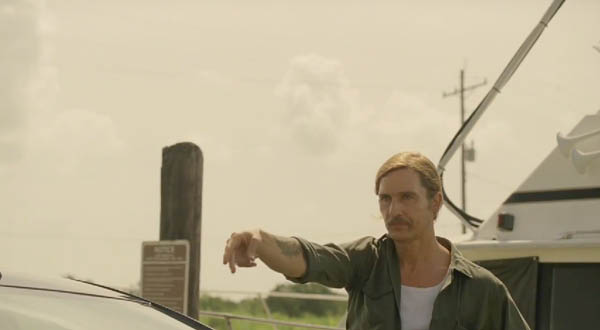
The stars of last night’s finale of True Detective were Errol Childress’
Cary Grant accent, his mentally challenged stepsister, his creepy labyrinth,
and Rust’s epiphany about love in the universe—which sucked up air time at the
expense of about 90% of the case details—details that, for my money, were far
more interesting than Rust’s epiphany.  Will
Rust exact revenge on the Tuttle family? Will Marty and Rust continue to fight crime
together as private dicks? Why was Billy’s mouth sewn shut? If he was dead, why
was he so well-preserved? Will we ever find out why Errol had those burn marks
on his face? What was the song Errol was whistling? While
speculative pairings for Season 2 abound on Twitter
, actor Matthew McConaughey
recently told a reporter, “We won’t be back for season two…Season one was
finite. Eight episodes, that’s the [end of conversation].”

So how are you
going to quench that thirst for a tall glass of hardboiled noir topped with a
side order of pedophile rings, smothered in police corruption until season 2—if
there is one? Try Red Riding, based on David Peace’s books, The Red-Riding Quartet. Set against a
backdrop of the Yorkshire Ripper murders, Red Riding’s narrative
complexity combined with grizzly brutality gave birth to a new subset of hardboiled
crime dubbed “Yorkshire Noir.” Three of Peace’s books were made into episodes
for Britain’s Channel 4, which ran in 2009 and were released theatrically in the states in
2010.

null

True
Detective
stole big from Red Riding. It’s a far more savage depiction of
police corruption and poverty with fewer allusions to the occult and philosophy.
The three episodes run from 1.5-1.75 hours each. With all the rewinding you’ll
do to make sure you caught the dialogue, your total viewing time will be about
the same as True Detective—though Red Riding can’t compete with the time
suck of poking around Reddit for Yellow King theories or Googling “capuchon
Mardi Gras
.” Sorry. Nothing will fill that hole.

Warning:
Spoilers abound below, but with Red Riding’s thick-as-Hasty-pudding accents, it
helps to have a leg up. You can read the books first, watch with subtitles,
precede/follow your viewing with episode synopses, or all of the above—the way
some people do with Game of Thrones. It’s worth it.


1. Three Is A Magic Number

Both True
Detective
and Red Riding jump through three different time periods. In True
Detective
: 1995, 2002, and 2012; in Red Riding: 1976, 1980, and 1983. The time
jumps and fractured narrative throughout True Detective, and in the second
two episodes of Red Riding allow us to witness the evolution of the characters—as
well as their cognitive dissonance. We see the mistakes they’re making as they
make them—and that they’re telling lies as they tell them. We watch Marty give the
court reporter a rim job in the past, while his voice over in the present lectures,
“A man without a family can be a bad thing.” But as Rust will tell you,
linear time’s for squares.

Time jumps give
the storylines more ambiguity and slipperiness. In both, every crucial,
case-breaking detail has been reported to, and ignored by, the cops. Files and
evidence have been lost, hidden, and destroyed. But because we’re time jumping,
if it’s an important detail, we’ll touch on it again and again. Most detective
stories trot out their flashbacks at the end, like Murder She Wrote, which
always made clues found in the linear present glint and yell, “Look at me! I’m
a broken fireplace poker!”

2. Location, Location, Location

Place is as
crucial in both True Detective and Red Riding as any of the stories’ characters.
For True Detective, the hurricane-ravaged bayou landscape of Louisiana
reminds us all that men and their machinations inevitably fall victim to nature’s
insatiable maw. Think of all those long aerial shots of the water slicing the
land to lace. If you stand still long enough, kudzu’s gonna choke you out. 

Red
Riding
takes place in the green-grey drizzle of Yorkshire. Historically, the land’s
awash in blood. One long shot of a doomed little girl wandering home along Yorkshire’s
ancient, narrow streets—flanked by dilapidated shacks that look like Charlie
Bucket’s house in Willie Wonka and the
Chocolate Factory,
from which a rheumy set of eyes peers out a toaster-sized
window—says it all: these angelic little moppets have been fodder for the grinding
stone from time immemorial.

3. Cops Gone Wild

When Rust
says, “I’m police. I can do terrible things to people with impunity,” it
means he’s capable of doing bad
things. When a bunch of cops boisterously toast, “To the North! Where we do
what we bloody want!” we know they are
doing bad things.

4. Smokestacks
In both shows, the gray concrete towers and power lines of factories and plants
loom in the background, reminding us that police and pedophiles aren’t the only
ones killing off the residents. The poor are prey; cops, religious jerkoffs,
and corporations are hunting them for sport. No one’s watching. No one cares. Bludgeoned
on the ground, choked by the air.

5. Thick Regional Accents

null

Certainly, “With
all the dick swagger you roll you can’t spot crazy pussy?” was one of True
Detective’
s shiniest gems, but if Rianne Olivier’s
crab trappin granddad’s “Ehbuhdy dink
dey gone beh sometin
dey nat” made you swoon, Red Riding is for you. These
lads are not only slogging through Yorkshirese, they’re hardcore mumblers and
furtive whisperers to boot. Subtitles help, but David Morrissey (the Governor
for The Walking Dead and Time Lord Jason Lake on Doctor Who) is especially
incomprehensible—yet one of the most compelling characters in the series. You
just gotta sit back and let his deee-licious chocolate-colored corduroy suit
and tan tie do the talking.

6. ‘Staches Make the Men

As do
sideburns, beards, mutton chops, bugger grips, mouth mirkens, and chin
chocolate. In Red Riding and True Detective’s sea of face pubes, it’s the clean-shaven
characters who seem out-of-step with the world and estranged from their own consciences.
As 2010 Rust gets in the Gregg Allman face lace race , his perceptions of the
case and himself grow clearer (“I know who I am. And after all these years,
there’s a victory in that”) whereas clean-cut Marty doesn’t know who he really
is until he cries in his hospital bed. In Red Riding, the squeaky-cleanest
character, Assistant Chief Constable Peter Hunter, is thoroughly despised
by everyone, including the woman he had an affair with and wants to have an
affair with again (she really doesn’t
want to).

7. Animals

In True Detective, bodies are adorned with deer antlers; in Red Riding, severed swan wings are sewn
onto a young victims’ back—and wolves, pigs, and rats figure prominently.

8. Ritualistic Abuse & Murder

null

I was glad the glimpse we saw of the
video tape recording of Marie Fontenot’s murder was mostly blocked by
Marty’s back—and the grainy black and white snippet we could see looked like an
early episode of Dark Shadows. Most of the violence on True Detective was “witnessed” through
the retelling of people’s stories. We weren’t forced to watch violence
happen—except for shooting Reggie LeDoux—and damn, that felt good. We saw the crime scenes and the
survivors—not the act of violence, but the aftermath. While Red Riding
normally excels in the violence department, it turns the camera away in a similar
scene to the one where Marty discovering the kidnapped children in the storage
shed* at Reggie LeDoux’s cook house. Red
Riding
skips the gory visuals on that one, too. The violence perpetuated
against children in Red Riding is seen only in one dimly lit flashback**,
which is as haunting as that scene from The
Shining
with the man in the tuxedo and the person (?) in the bear suit.

9. Transsexual Prostitute Survivors of Ritualistic Abuse & Murder

BJ and Johnny Joanie: the boys who
got away grew up very, very gay (and one of them lives in a storage shed*). Just
once, I’d like to see a show in which the boy who survives ritualistic abuse
grows up to be Dale Earnhardt Jr. or Guy Fieri or someone like that.

10. *Storage Sheds & Garages (pronounced gairijiz)

When you need to lay low. How low?
Like Jim Nabors singing “The Impossible Dream” low.

11. Ludicrously One-Dimensional Female Characters
Red Riding and True Detective are both Bechdel Bombs.
Aside from the trailer park madam, (“
Girls
walk this earth all the time screwing for free. Why is it you add business to
the mix and boys like you can’t stand the
thought? I’ll tell you: It’s ‘cause suddenly you don’t own it, the way you thought you
did.”), the women
characters in True Detective are
fairly brainless: they’re dead, sluts, dead sluts, guileless children, nagging
wives, or old, sick women.

null

When Maggie tries to break out of her
dutifully duped wife role by having an affair with Rust, he gives her a taste
of some Real Man Lovin’—without all that fairy tale frosting on top that
Marty’s been keeping her down with. And how does that Real Man Lovin’ taste to
Maggie? Like licking a Port Authority payphone: totally scary and gross. So she
pulls her little pink panties back on and high tails it home—implying good
women can’t handle real male sexuality: it’s too gross. Eeeeeew! Which reminds
me of that Louis CK bit about men being naturally besieged by disgusting sexual
thoughts:

“Women try to compete. [in a woman’s
voice] ‘Well, I’m a pervert. You don’t know. I have really sick sexual
thoughts.’ No, you have no idea. You
have no idea. See, you get to have those thoughts. I have to have them. You’re a tourist in
sexual perversion. I’m a prisoner there. You’re Jane Fonda on a tank. I’m John
McCain in the hut. It’s a nightmare. I can’t lift my arms.”

The most developed female character in Red Riding is the stunned
mother of one of victims who’s playing both sides of the fence and leaking information
to her daughter’s wealthy killer. She’s a blond, breathy, sad, soft-focus
nitwit. The other is a medium who wails a lot. I like her, but she does indeed
wail a lot.

Is it possible to create a similar police
corruption/pedophile ring premise with a female protagonist? Sure. Jane Campion
did it in Top of the Lake, along with bringing other very unique female characters to the story (Holly Hunter plays a
character I’ve never seen anywhere) and lots of unexpected twists. It’s another
great show to alleviate True
Detective
withdraw, but Top of the Lake becomes much more about its
cop protagonist (Elisabeth Moss)—and her intimate relationships—than the
criminals she’s chasing. And it lacks the estrangement of noir.

True
Detective
and Red Riding are pure noir—which the
Oxford Dictionary defines as fiction characterized by cynicism, fatalism, and
moral ambiguity. It’s a genre in which women, historically, have been double-D wooden
window dressing. There’s such a complete absence of actualized female
characters in both
True
Detective

and Red Riding—in the midst of
such intelligent writing—it’s beyond oversight. It’s a kind of willful
blindness: because Marty (and most of the other men on the show) can’t see
women as three-dimensional characters, let’s not have any. But then again, how
many evolved women would be caught dead in the storyline of
True
Detective
or
Red Riding? There’s a reason why smart
women do not attend dog fights.
True
Detective
might have a season
2, and a chance to redeem itself. I
could easily see the cast of American Horror Story: Coven eatin’ them Tuttle
boys alive. Throw Patricia Arquette in there, and cue a Cajun rendition of the theme
from Cops.

12. Mentally Challenged Men with Physically-challenged Testicles

If you think women get the short end of the stick in True Detective and Red Riding, try being a mentally
challenged man.
True
Detective
’s
Burt with his bowl cut and Red Riding’s
Michael Mishkin with his finger twisting twitch share 1) a childlike inability
to withstand the violence of poverty, and 2) nonfunctional testicles. They’ve
been unburdened with all that scary sexuality simmering under Cole’s surface
and right on top of Marty’s. I
n True
Detective
Burt has been maimed by criminals, whereas
in Red Riding, Michael’s disfigurement is congenital, but that doesn’t
mean he hasn’t suffered at the hands of cops.

This is a key difference in the shows: when Marty’s beating
the snot out of the skate punks, you can kind
of
understand why. They did
double-team his daughter, after all. But in
Red Riding, the violence is incomprehensible. No one beats Yorkshire cops
at beating the shit out of people; they’re sadists, and the greatest source of the
city’s pain—if not at their own hands, then by omission, by allowing
others—through their wealth or influence—to inflict pain on the little people.
As Sonchai, the Buddhist cop in Bangkok 8,
tells us, cops are merely a few incarnations away from being criminals.
Red Riding’s got a lot
more bad cops on the payroll. Even the good ones are shits.

13. Kings & Crowns
Red Riding
’s labyrinth can’t hold a
candle to the Yellow King’s, but we learn that the same kind of games have been
played there for many years. **“Mr.
Piggott is king today. You be nice to Mr. Piggott.”

Jennifer
L. Knox 
is
the author of three books of poems,
The Mystery of the Hidden Driveway, Drunk by
Noon, and A Gringo Like Me—all available from Bloof
Books—and
Holliday, a chapbook of
poems written in the voice of Doc Holliday. Her writing has appeared in 
The
New Yorker, The New York Times, and four
times in the Best American Poetry series. She is at work on
her first novel.

“No redneck is this creative”: TRUE DETECTIVE and the Horror of Folk Art

“No redneck is this creative”: TRUE DETECTIVE and the Horror of Folk Art

null

Now and then a television series comes along that seems to
define its own, unique genre: think of Twin
Peaks, The X Files, The Singing Detective

Now think of True Detective,
which might be described as the first Cult Ritual Serial Killer Southern Gothic
Weird Procedural.  Which is not to say it
is without precedents: since its debut the series has spawned a plethora of online
discussions and commentaries tracing the show’s connections with, and
references to, a host of texts, from pulp fiction to true crime, nihilist
philosophy to urban myth.  Especially
fascinating in these discussions is the way in which a background of seemingly
unrelated stories and images magically click into place, as if they had been
waiting for a narrative that would connect them. 

One of the more distinctive and grimly fascinating elements
of True Detective is its preoccupation
with weird folk art, or what could be called outsider art.  Odd and intricate wooden sculptures are found
carefully arranged around the dead body of the series’ first victim, Dora
Lange.  The body itself is decked with
antlers and arranged against a tree in an elaborate display of sacrificial
obeisance, the victim’s back tattooed with a mysterious spiral symbol.  When Rust Cohle (Matthew McConaughey) returns to the scene years
later, this spiral seems to have taken wooden form, in an elaborately
sculptured circle, reminiscent of Andy Goldsworthy’s environmental art.  When clues lead to an abandoned religious
academy, Cohle finds a veritable forest of wooden sculptures inside the
derelict building.  The walls are also
decked with drawings of sinister angels, in a primitive style resembling a
painting discovered earlier in a burnt-out church depicting a horned being that
looks like Dora Lange’s dead body. 
Whatever might be said of the killer responsible for Lange’s death, he certainly
is prolific.  Had he found the right art dealer,
he might have become the next Henry Darger or Judith Scott.

The association of horror and folk art in True Detective, like its many other
thematic strands, has a rich and peculiar history, most notably in film.  Much has been written about folk elements in
British horror, as seen in such classics as Wicker
Man, Witchfinder General
, and Blood
on Satan’s Claw
, and more recently in a new wave of low-budget British
horror films, including The Fallow Field,
Overhill,
and A Field in England.  But relatively little has been said about the
parallel tradition in American horror, one that is every bit as rich, and which
True Detective helps us to see anew.

Folk art shouldn’t necessarily be equated with what is
called, alternately, outsider, visionary, or naïve art, but they do share a
quality that might be described as obsessiveness.  In folk art this is generally a healthy,
robust quality, reflecting as it does extreme care in the application of
time-honored traditions, while in outsider art this obessiveness imparts a
certain strangeness, perhaps from the fact that the artist is usually working
in isolation, outside of an enabling tradition. 
The similarity between the obsessiveness of artists and serial killers
may be an arbitrary one, but it is one that many filmmakers have
exploited.  Cohle explains why: when
his partner, Marty Hart (Woody Harrelson), compares their suspect to one in an earlier case,
Cohle replies, “That’s just drug insanity. That’s not this, this has
scope.”  A drugged-up killer is
frightening; one with scope is terrifying. 
This killer, says Cohle, “articulated a personal vision. Vision is
meaning. Meaning is historical.”  The
same might be said of folk art.

One of the most terrifying instances of folk art in American
horror is The Texas Chainsaw Massacre,
in which a family of demented slaughterhouse workers make grotesque sculptures
out of bones and skin.  When one of their
victims enters their house, she discovers a veritable art gallery of gore: rib-cages
and broken turtle shells hanging like mobiles; human and animal bones
intricately connected to form elaborate standing sculptures; teeth, feathers,
and other parts festooning a primitive gas generator; a perverse chaise longue
built of bones and skulls. 

Such images clearly derive from the loathsome objects d’art fashioned by notorious
serial killer Ted Gein from his victims’ remains, but director Tobe Hooper
brings to these objects a demented element of pure form that distinguishes this
sculptor as a kind of twisted visionary. 
Remembered largely for its gore and violence, Hooper’s film is as
remarkable for its almost mythic evocation of sadism joined to creativity.  If the meat sculptures of Texas Chainsaw Massacre convey a
particular zeitgeist, it is one best captured by Rust Cohle’s pessimistic view
of Homo sapiens: “I think human
consciousness is a tragic misstep in evolution. We became too self-aware.
Nature created an aspect of nature separate from itself – we are creatures that
should not exist by natural law.”

While Hooper took murder as folk art to a new extreme, his
imagery has precedents, most notably in Alfred Hitchcock’s Psycho.   Norman Bates was,
of course, a talented taxidermist, and his revivified birds loom over the
fateful conversation with the aptly named Marion Crane that precedes her murder.  His sculptural talents are shown in their
fullest expression later, when Marion’s sister, Lila, discovers the preserved
body of Norman’s mother sitting in the cellar. 
Such perverse craftsmanship suggests the kind of concentrated attention
Bates brings to all of his work, including murder.

In contrast, the sculptures of Texas Chainsaw Massacre derive much of their horror from their
association with folk art, an association seen in a film like Deliverance that plays upon the cultural
prejudice that connects backwoods folk culture with the sinister or malevolent.  The brilliance of John Boorman’s film (as with
the James Dickey novel on which it was based) is that it places much of this
associated horror in the eye of the beholders, those Atlanta businessmen who
use the remote Georgia wilderness as their playground.  In the famous “dueling banjos” scene, the
character of Drew is barely able to keep up with his accompanist, despite the latter’s
obvious disabilities, and the scene culminates with Drew prophetically shouting
“I’m lost” as he accepts defeat.  Though the backwoods banjo player’s birth defects mark him—and by extension his
music—as grotesque in the visitors’ eyes, the inability of the urbanite to master his arcane art
serves as a measure of folk music’s richness and complexity.

The association of rural culture and the macabre is further
explored in The Blair Witch Project,
where the hapless team of documentary filmmakers stumbles on a backwoods site
filled with primitive cairns and elaborate hanging stick sculptures, the clear
precedent for those that appear repeatedly in True Detective.  When Cohle
shows his drawings of these sculptures to a pastor, he says they look “like
something my old auntie taught us to make when I was a tyke . . . some folks call
them ‘bird traps.’ Old Auntie told us that they were ‘devil nets.’ You put them
around the bed, catch the devil before he gets too close.”  In such moments, the line between madness and
tradition becomes blurred, in a manner that reflects on True Detective’s compelling sense of place.  While the Gen-Xers in Blair Witch are horrified at what these sculptures portend, since
“No redneck is this creative,” True
Detective
is more intent on exploring the connection between rural culture
and the sinister in the popular imagination. 
Cohle’s fascination with the weird folk art he uncovers turns this
association back on the increasingly obsessive investigator himself, and, by
extension, the perversely fascinated viewer who follows his investigation, episode after episode.

Jed Mayer is an Associate Professor of English at the State University of New York, New Paltz.

In Memory: Sid Caesar and YOUR SHOW OF SHOWS

In Memory: Sid Caesar and YOUR SHOW OF SHOWS

null

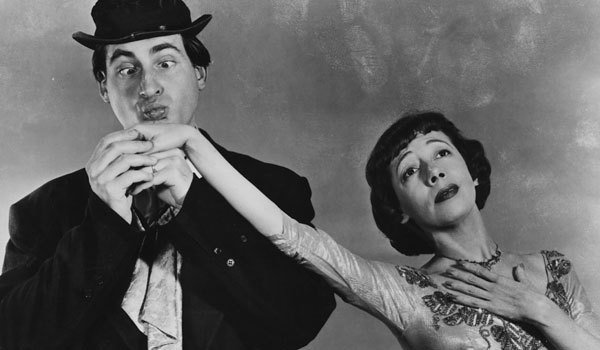
“Your Show of Shows” was a 90-minute, comedy/variety program
that ran on NBC from 1950 to 1954 and featured Isaac Sidney Caesar—Sid, to
you and me—as its star. Caesar was an intimidating, strong-shouldered force
who could also be a face-contorting wiseass. He often barreled through sketches
with a bull-in-a-china-shop ferociousness. Working with invaluable co-stars and
comic supporting actors Imogene Coca and Howard Morris as well as an alpha team of
writers including future comedy legends Mel Brooks, Neil Simon and fellow
sketch player Carl Reiner (Larry Gelbart and a young, nebbishy fellow named
Woody Allen would later write for Caesar on the truncated “Caesar’s Hour”),
Caesar was the aggressively clownish captain of a usually madcap operation.

               
One of
my favorite sketches from “Shows” was a sketch I actually discovered when I was
nine. It was a parody of that old docu-series “This Is Your Life” called “This
Is Your Story.” Reiner played a host who approaches Caesar, sitting in the
audience as a man named Al, and tells him that’s it’s his life that the show
will be chronicling on this evening. At first, he passes out from shock. Then,
he tries to escape from Reiner’s grip when he attempts to get him onstage. Once
he escapes, he tries to make a run for the exit, only to be chased and tackled
by ushers and ultimately carried onto the stage.
It gets
only more hysterical from there. Morris shows up as his “Uncle Goopy,”
blubbering into Caesar’s arms as they both wail and refuse to let each other go
for several minutes. More family members appear and follow suit, all falling
over each other. Then, a beautiful blonde shows up. Who is she? Caesar doesn’t
know, but he’s gonna smother her with kisses anyway. (She’s supposed to do the
show next week.) Finally, Caesar’s old bandmates the New Jersey Drum and Bugle
Call start marching and blaring all around the stage, as an emotionally wrecked
Caesar is in the middle of it all. It’s still eleven minutes of the most
chaotic sketch comedy I’ve ever witnessed.

While
I’m too young to have seen Caesar in his “Shows” prime, watching old Kinescope clips of “Shows” and other programs of its ilk throughout the years reminds
me how television back then was, at times, entertainingly anarchic. It’s not
anarchic in the sense that these shows came up with their
material on the spot. (“Shows” producer Max Liebman was notorious for
reprimanding those who dared stray from the script and ad-libbed—“you would
have been drummed out of the corps,” Coca once said.) But there was this
feeling of unbridled unpredictability, as these shows constantly threw stuff
out there to see what stuck.

“Shows”
did that with aggression, mostly because the writers were all backstage stampeding
over each other in order to get their jokes and skits on the air. In his 1975
Playboy interview, Mel Brooks compared the writers’ room to “rats in a cage,”
filled with desperate, competitive jesters who lived only to appease the king.
“Everybody hated everybody,” Brooks said. “The pitch sessions were lethal. In
that room, you had to fight to stay alive.”
The
desperation also seeped its way on-screen, mostly through Caesar. In the same
Playboy interview, Brooks noted that his boss “had this terrific anger in him;
he was angry at the world.” Audiences at home could sense it too. Even when he
was being his most lovable and/or ridiculous, the fear that he might just blow
a gasket and go off always lingered. In the book of essays “Prime Times:
Writers on Their Favorite TV Shows,” the late novelist Barry Hannah recalled
his younger years watching “Shows” and seeing Caesar—“the clown so hard-put
in a gray flannel suit,” Hannah called him – put in serious work just to get a
laugh:
“I
recall Caesar sweating, cross-eyed, sputtering. He was a damned fool over and
over again, in any role—a pirate, a businessman, an emperor in the East with
a way big-assed sword. He was just not getting the hang of it.”
Nevertheless,
Hannah took a shine to Caesar, as he and Coca (whom Hannah praises for being
“perfect, drab and scrawny and simply overcome”) mugged and contorted for our
viewing pleasure. “The black and white of that show seemed so grainy and raw,”
Hannah wrote, “Caesar and Coca appeared to be wrestling with the medium
itself.”    
Decades
later, that insanity would be the inspiration behind the movie “My Favorite
Year,” where Peter O’Toole played a swashbuckling, alcoholic movie star who
inflicts madness on an already disorganized variety show (Joseph Bologna played
the Caesar stand-in as a blustery softie) and the play “Laughter on the 23rd
Floor” (written by former caged rat Neil Simon), whose original Broadway run
had Nathan Lane as a pill-popping TV star often going for the throats,
literally, of his neurotic writing staff.
Caesar’s
recent passing at the age of 91 only reminds us he’s the last of the damned
fools—Allen, Berle, Gleason, Kovacs—who became TV’s earliest innovators. These
go-for-broke funnymen made figuring out what would entertain TV audiences for
generations to come a weekly chore—televised trial by fire. “Shows,” a weekly
revue that was as manic and uproarious as it was smart and clever, quietly
invented the sketch-comedy show, leading the way for “Saturday Night Live” and
all its offspring.
However,
even after all these years, “Shows” and those variety shows of yesteryear still
exhibit a loose energy that “SNL” (and even most of television today) is often
too stiff and rigid to indulge in. Everything seems too prepared these days.
But as prepared as those shows might have been back in the day, there was still a
feeling of anything-goes anticipation. As these programs were broadcast live
from coast-to-coast, everybody involved, from the people watching the show to
the people putting on the show, were going on a ride. And there was Sid,
insuring us that the ride would be fun—and a little bit dangerous.

Craig D. Lindsey used to be somebody. Now, he’s a freelancer. You can read all his latest articles over at his blog. He also does a podcast called Muhf***as I Know.

By the way, if Helen Mirren or Christina Hendricks is reading this, get at me, ladies!

On THE BLACKLIST: Why James Spader Is the Perfect Star for the Increasingly Unreal Medium of Television

On THE BLACKLIST: James Spader Is the Perfect Star for the Increasingly Unreal Medium of Television

null

The television medium, and the act of watching television,
have always been remarkably surreal, and they only grow more so by the day. The
very action of sitting and watching flickering pixels on a screen which, in
most cases, is smaller than you are stands in direct contradiction to
everything we might call living,
enjoyable and stimulating as this non-life might be. For many viewers, it requires absorption;
for other viewers, it requires absorption and darkness; for still others, it
requires absorption, darkness, and complete silence.   As time has passed, TV has only become more
strange, and private; at one time, the screen formed the hub of a gathering
place, but it is less so now, as increasing numbers of people watch television
on their own terms: on their phones, on their computer screens, at off –hours,
while commuting. The idea of scheduling one’s day around a TV show is
increasingly uncommon. Given these developments, it stands to reason that James
Spader, a shocking presence on The
Practice
and Boston Legal in the
past, and a rousing presence in NBC’s The
Blacklist
, would be its ideal actor.

The reasons why Spader is so appropriate for television have
to do both with his qualities as an actor and, actually, with the history of
television itself, in the last 25 to 30 years. Spader’s arrival in his first
major TV role, that of Alan Shore on The
Practice
, was not universally well-received at its outset. Why was this?
Well, because his film roles in the past had often contained a healthy layer of
sexuality—and often warped sexuality. The three most glaring examples of this
would be his remarkable breakthrough performance in
Steven Soderbergh’s sex, lies, and
videotape
, in which he filmed women talking about sex (and doing other
stuff) and then pleasured himself to videotapes of the sessions, giving an empathetic face to the perversity of voyeurism; his role as James
Ballard in David Cronenberg’s Crash,
including a sex scene with a scar in a woman’s leg; and Steven Shainberg’s Secretary, in which his officious lawyer Mr. Grey “got to know” his employee by masturbating
on her panties as she bent over his desk, skirt up. What was this man doing in
a fairly nondescript show about a law firm? Everything and nothing. At the
time, it seemed fairly clear that he had been added to boost ratings and make
the show more exciting; he did both, in spades. His character’s open-faced form
of brazen dishonesty gave considerable texture to a show which was gradually
building a wall around itself consisting entirely of predictable plots (the
same rut which some of Law and Order’s
variants have fallen into). His great comfort with sleaziness and with
destructive transgressions provided a meaningful satire of the nature of the
law profession and of the hidden altruism within many shows about that
profession, in which show’s characters become heroes by making the “right”
choice. He has roughly the same role in The
Blacklist
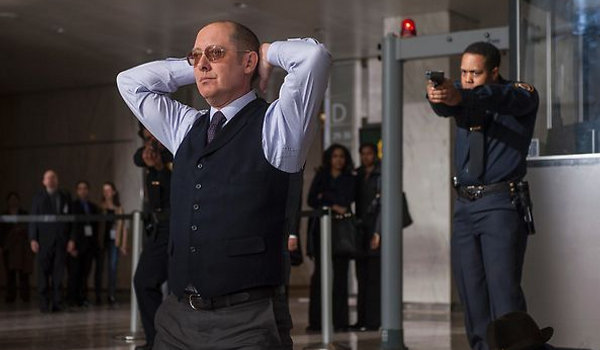
’s Raymond “Red” Reddington, a “most wanted” criminal whose wealth
of information makes him ultimately indispensable to his pursuers, and he plays
it with the same aggressively insouciant quality, as if every line he speaks is
not only the best line ever written for a television actor but is also the most
explosive; and the more dramatically he speaks the line, the more of a detonation it sets off.
In a sense, Spader’s delivery is like that of an old-fashioned stage actor,
speaking to an audience who may or may not absorb what he is saying. The
simplest exchanges become broad-voiced utterances; whether you understand the
motivation for the line becomes secondary importance—the main thing is the
momentously frank delivery. And so, in pushing himself outwards in this
theatrical way, isn’t Spader fulfilling the earliest dream of television,
which was to provide a home-based version of the theatrical experience?

But, back to the present. Spader is occupying, with unusual
elan, a historical moment in TV watching and reception: he is with us as TV
becomes an almost entirely private personal phenomenon, in which viewers
develop relationships with characters and plotlines that they cannot quite
shake, sometimes to an almost humorous degree, and in which viewers choose
which shows they wish to watch at length—and at how much length. It is indeed
significant, then, that Spader’s breakout role, his turn as bully Steff in Pretty in Pink notwithstanding, was in sex, lies and videotape, a film about a
man who derives his sole sexual pleasure from watching images on a TV screen,
after the fact, in total solitude and at his command. Fast forward 25 years: many
viewers these days watch television long after its air date, and with utter
control over the conditions of viewership. In 1989, when the film was released,
the VCR, as we know it in its home-friendly form, was less than 10 years old,
and rapidly gaining in popularity. By starring in such a film, Spader
associated himself indelibly with what has become a dominant mode of
viewership: what I want, when I want it. The binge watch. The repeat view. TV
shows ranging from Moonlighting to St. Elsewhere to (even) Mystery Science Theater 3000 nudged us,
at this time, towards a smarter view of what we were seeing on the screen:
couldn’t we view a multi-episode TV show as a kind of novel? Couldn’t we expect more from
television? It’s hard to think that that the development of VCR capability, giving viewers the chance to re-watch and scrutinize certain shows,
didn’t contribute to this change. Granted, the tapes Spader’s character was
watching in Soderbergh’s film were not the VHS tapes we might be familiar with,
but the impulse was the same.

Of course, The
Blacklist
is not necessarily the best vehicle for Spader. The episodic
nature of the show guarantees that viewers will not devour it in the same way
they devour more intellectually complex shows like Breaking Bad or The Wire.
Also, each episode is built around a different number on the FBI’s Most Wanted
list; these figures become much like the villains in comic strips, or their TV
counterparts. Each villain is neatly tracked down by the end of each episode each mystery resolved. Nevertheless, Spader’s presence, and his history, and his delivery—which constantly seems to look back at us as if to ask, If you think you’re above this, why are you watching it?—raise a
question about television, which, though it may have been raised before, can’t
be asked enough. As television continues to become more nuanced and
intellectually demanding, its approach, and its casts, will need to change.
Spader is unique in that he doesn’t give in to the demands of acting for a
smaller screen—the pandering, the mincing, the mugging; the charge we receive
from him is based on his staunch defiance of those requirements. Perhaps his
performance will draw some new colleagues in the future, from a place in which
the screen is brighter and larger, and the audience is darker and more
mysterious.

Max Winter is the Editor of Press Play.

Turning 40 with the Help of THE ROCKFORD FILES

Turning 40 with the Help of THE ROCKFORD FILES


This
is Jim Rockford. At the tone, leave your name and message. I’ll get back to you
.

The
party plans had been elaborate: my wife had invited all of my friends,
including several from out of town who bought airplane tickets for the
occasion, to surprise me at a steakhouse in Chicago’s South Loop. The party was
to have an eighteenth-century “Clubb” theme, inspired by my love of James Boswell’s
Life of Johnson and his journals, and
by the elaborate dinners often enjoyed by Jack Aubrey and Stephen Maturin of
the Royal Navy, as depicted in Patrick O’Brian’s series of novels. There would
be costumes; there would be wigs; there would be speeches and heroic couplets
and all the prime steak and good Scotch we could swallow. But: two or three
days before I turned forty, I came down with a fever. The fever became severe
and the glands in my neck swelled to the size of golf balls. The doctors
concluded that I had a particularly virulent strain of strep throat, or maybe
it was mono. I could barely speak or swallow, and the pain in my neck,
shoulder, and especially my sinuses was excruciating: it felt as if a sadistic
clown were inflating a giant party balloon inside my skull. The party, which
was going to be a surprise party, was canceled, and Emily tearfully narrated
all the details of it to me so that I could imagine it, almost taste it. Then I
retreated upstairs to our bedroom, scarcely to emerge for the next two weeks, while
Emily played the unfamiliar roles of nurse and single mom, and my colleagues in
the English Department scrambled to cover my missed classes. The antibiotics
weren’t helping and neither were fistfuls of ibuprofen. I was too dazed to
read. I was forty years old. I had one comfort: my iPad, Netflix, and James
Garner in The Rockford Files.

Who
is Jim Rockford? The opening credits show him practicing his vocation as
private eye: tailing people, asking questions on the street, arguing with cops,
covering his face with an enormous bug-eyed pair of binoculars in one still.
But we also see him on dates, breaking into a grin as he gets a laugh out of the
woman he’s with. We see him in his trailer, cigarette on his lip, hanging up
the phone, pulling a jacket on, heading purposefully out the door. We see him
nonplussed in the frozen food aisle of a supermarket, recalling, at least for
me, Allen Ginsberg: “In my hungry fatigue, and shopping for images, I went into
the neon fruit supermarket, dreaming of your enumerations!” Ginsberg is talking
about Walt Whitman, but he could just as easily be talking about the six
seasons and 123 episodes of Rockford,
not to mention the eight TV movies released in the 1990s. I saw you, Jim Rockford, childless, lonely old grubber, poking among
the meats in the refrigerator

But Jim’s
loneliness is not as essential to his character as it is for other fictional
PIs, and this is affirmed most resonantly by the last images in the credits,
which show Jim fishing with his dad Rocky. Played by Noah Beery, Jr. during the
show’s regular run (another actor played him in the pilot), Rocky is the show’s
secret weapon, its emotional anchor, the tip of the iceberg of Rockford’s
bottomless likability. Jim has a dad, and they care for and squabble with and
go fishing with each other: that simple emotional fact roots Rockford’s heroics
in something more human than the chilly abstract chivalry of a Philip Marlowe.
It helps too that Rockford, though perennially unattached, doesn’t have a
misogynistic bone in his body: here is a man who genuinely loves and
appreciates women, whose body in no way shrinks or tightens in the presence of
the opposite sex, who has the enviable gift of becoming larger and more like
himself when he talks to a woman and makes her laugh. The Rockford Files was often a vehicle for an un-showy 70s
feminism, embodied most frequently in Gretchen Corbett’s Beth Davenport. Beth
is Rockford’s attorney and sometime love interest, whose mental toughness and
sharp comebacks to preening judges and leering small-town cops mark her as Jim’s
equal. Her sometimes brittle vulnerability makes her a good match for Rockford,
who is averse to physical violence and rarely resorts to carrying the small
revolver that he keeps tucked into a cookie jar in his kitchen.

There’s not much
else to Rockford’s back story: we know that he did time in prison for a robbery
that he didn’t commit, that he was pardoned for the crime but maintains a
network of contacts from those shady days that help and more often hinder him
in his work. Most memorably there’s Stuart Margolin’s Angel: squirmy, febrile,
cowardly, honest about nothing except his own brazen self-interest, the venal
Pancho to Rockford’s wearily forgiving Quixote. But Jim has a never-ending
series of friends from the old days always coming out of the woodwork to
provide plots and motivations deeper than the two hundred bucks a day (“plus
expenses”) that he routinely demands and very rarely receives from his clients.
More often than not, he gets emotionally invested in his cases, and he follows
them through to the end, invariably outwitting the bad guys without ever lining
his wallet in the process.

Jim’s capacity for
friendship is emblematic of the most enduring of the old pre-cable network
shows, before HBO turned scripted television dramas into serialized
nineteenth-century novels, fundamentally literary in their storytelling
resources and techniques. Don’t get me wrong, I like many of those shows: The Sopranos, Deadwood, and The Wire form for me, as for many
others, a profane trinity of high-quality storytelling, not least for their
remarkable feel for language. And no one will ever compare The Rockford Files to Shakespeare or Dickens, as routinely happens
with the three shows mentioned (though it’s worth noting that Sopranos creator David Chase cut his
teeth as a scriptwriter on Rockford).
But those shows’ unfolding intricacies of darkly thwarted patriarchies and institutions—the
moral bleakness, the frustration of aspirations that inevitably spirals into
gruesome violence—had little appeal for me during the sickness that knocked me
down on my birthday. I lay in bed and watched episode after episode, becoming
quietly addicted to the theme music (especially the bluesy harmonica bridge)
and the square aspect ratio that fits an iPad perfectly. The Rockford Files is ghostly and homeless on a modern widescreen
TV, with two black bars running down either side of it, as if parodying the
horizontal letterboxed bars signifying that one is worshipping at the shrine of
the dead god Cinema. That squareness extends to the show’s worldview: in spite
of its veneer of post-Watergate cynicism, in spite of Jim’s willingness to bend
and break the rules (most often by posing as some sort of businessman or
official, usually with the help of business cards that he cranks out using a
little printing press he keeps in the trunk of his iconic Pontiac Firebird), the
arc of The Rockford Files bends
always toward justice.

When I watch the
show, I am comfortably enclosed in a decade that eerily resembles ours, with
its breakdown in trust in public institutions, its vague guilty consciousness
of environmental degradation, its retreat from political life into narcissism and navel-gazing. That feeling
of regression is amplified by the show’s imagery, which recalls my 1970s
childhood: the hairstyles, the clothes, the fragments of outdated slang, the
gigantic boat-like cars that chase or are chased by Jim’s Firebird in seemingly
endless, frankly boring sequences that serve now as tours of a seemingly
pre-capitalist semi-urban landscape, devoid of product placement or corporate
brand-names, long shots of empty sun-flooded boulevards and parking lots
through which the essential dead desert of Los Angeles makes itself visible in
winks and flashes. The desert of the present: sweating into pillows, the day
and its business passing out of reach, my wife’s tightening face or my
three-year-old daughter’s voice from downstairs asking how much longer Daddy will
be sick. Steady on: here’s Jim tracking down missing girls, breaking a corrupt
ring of truckers and unraveling insurance scams, and tracking down more missing
girls, without ever losing his sense of humor. This isn’t the same as never
losing his cool, because Jim Rockford is not cool, even in sunglasses: he lives
in a trailer and drives a car the color of a polished turd and wears shapeless
sportcoats and lives on tacos with extra hot sauce. Jim is warm: the character
exudes compassion, cracks jokes at his own expense, bleeds when he gets
punched, and has a capacity for enjoying life on and off the case that is so infectious
that to me, ebbing on the bed, it felt like an almost adequate substitute for
life itself.

Nostalgia encased
me and buffered me from the ravages of my infection, and protected me for a
while from something even more irresistible: the reality of aging. I never
watched The Rockford Files when it
was originally on the air: my parents only let me and my sister watch a little
PBS, though when I was a little older I snuck episodes of Knight Rider and Airwolf and
the Tom Baker Doctor Who whenever I
could. I guess I’ve always been susceptible to stories of lone investigators
and solitary knights (though they rarely lack female company). There was an odd
purity to my nostalgia in watching the show, then, since nostalgia is always a
longing for something fundamentally imaginary. The show had formed no part of
my real experience. And yet lying there watching it through my haze of
antibiotics and prescription painkillers was
a real experience: there was a halo, a boundary, surrounding the washed-out
colors flickering across the screen, and I was all too conscious of what that
boundary was keeping out. In my vulnerable state I feared the future as I never
had before: it was not just my own aging that worried me, but what seemed to be
the rapid aging of the world: the ever-accelerating Rube Goldberg machine of
climate change was often on my mind, and in my fever dreams I could see the
desert of Jim Rockford’s Los Angeles growing and spreading and rippling outward
to cover the earth. To a hallucinatory synthesized bluesy beat, the gold
Firebird wove its way through the empty, sunbaked streets as if it were tracing
a mandala, past poker-faced houses and burnt umber hills, a vast landscape made
tiny and inconsequential. Then Jim’s face again, that grin. Action: a fist to
the jaw, a hail of harmless bullets. Another case closed. Another fit of banter
between Jim and his companions, his friends, of whom I was one.

 That’s what a certain kind of television can
do at its best: scripted series television, not reality shows or intricately
plotted season-long plots or funny cat videos on YouTube. The Rockford Files, Taxi, Barney Miller: the old shows
characterized by their smallness of scale, their putting plot in the service of
characters or a mood. These shows weren’t Seinfeld;
they weren’t “about nothing,” not exactly. They function, strangely, like
poetry. In its very inconsequence, its mere being, The Rockford Files makes nothing happen:

                                                            it
survives

In the valley of
its making where executives

Would never want to
tamper, flows on south

From ranches of isolation
and the busy griefs,

Raw towns that we
believe and die in; it survives,

A way of
happening, a mouth.

                                                (W.H.
Auden, “In Memory of W.B. Yeats”)

It survives, a way
of happening, in the face of James Garner in the years 1974—1979, a man in
his forties rueful, grinning, scolding, surprised, sly, smiling. Perpetually
unattached to any woman, perpetually childless, yet saved always by his
relationships: with his father and with Beth and with Angel and with Sergeant
Dennis Becker, the irascible but upright policeman who is Jim’s only friend on
the force. Wise to the ways of the world, yet capable of being shocked: Jim’s
fundamental innocence (he is, remember, that rara avis, an innocent jailbird)
is the show’s hallmark: the hallmark of a decade whose pervasive cynicism is rendered
moot by the simple fact of its being encased impregnably in a past that looks
less fundamentally damaged, more reparable, and more fun than our present. The
Seventies has become a small town, populated by familiar faces, an object of
nostalgia, a homeland that never was. MeTV, indeed.

Yet Rockford’s unglamorous
Los Angeles is also a raw town, and in every episode he encounters the desolate
inhabitants of “ranches of isolation” with their “busy griefs.” There’s real
darkness on the edges of some of the early episodes. Season One’s “Slight of
Hand” presents us with a tale of Jim’s disappeared girlfriend, who vanishes
from his car after a trip up the coast with the woman’s daughter, who
hauntingly murmurs the phrase, “Mommy didn’t come home with us last night.” Jim
solves the case but it leaves him bruised, bitter, and as close to noir as The Rockford Files ever comes. In Season
Three’s “The Family Hour,” Jim and Rocky get mixed up with a twelve-year-old
girl who has seemingly been abandoned by her father, played by the ubiquitous
Burt Young (the sweaty cuckolded husband in Chinatown;
the sweaty brother-in-law of the title character in the Rocky movies, the sweaty trucker Pig Pen in Convoy, etc., etc.). In a wrenching confrontation late in the
episode, Young’s desperate father challenges a drug-dealing federal agent to
kill both him and his daughter, who’s standing right there. The bad guy
flinches and the day is saved, but the raw anguish on the father’s face stayed
with me long after the smirky or sentimental freeze-frame that ends every
episode and which, by freezing on a single image, usually of Jim’s grin, separates
this universe from the universe of future episodes.

These fragments of
real terror, real feeling, are hermetically sealed off from each other, and so
we are shielded from the full impact of the sunlit noir that may be the
decade’s most enduring contribution to pop culture. The Conversation, Night Moves, The Long Goodbye, The Parallax View,
Chinatown
: the great neo-noirs of the Seventies always end in the
corruption, if not the outright destruction, of the hero, whose personal code
proves to be no match for the systemic pervasiveness of the evil that he
confronts. Jim is saved in part by not having a code: only warm responsiveness,
and wisecracks, and a network of relationships that never really let him down:
even Angel is reliable in his venal unreliability. But what really preserves
him is the show’s illusory continuity, fundamental to the form of episodic television.
There are recurring characters and very occasional references to past events,
but it’s as if the show and its characters were created anew each time the
credits roll. That’s the nature of nostalgia: we never play, we re-play. And
I’ve seen enough episodes of The Rockford
Files
to feel like each new one I see is something I’ve seen before. The
déjà vu is built in.

I got over my
infection and got over turning forty, but I never did get over Jim Rockford.
He’s still out there, somehow, waiting for the call of imaginary friendship.
When you’re finished watching you may feel the chill of the twenty-first
century, of real relationships rendered somehow intangible by social media or
distraction or sheer carelessness. You might remember the news, or Mad Men, or the weirdness of the
weather, and be impelled back toward—or father away—from what we’ve agreed to
call reality. But if you’re like me you’ll also remember friendship: how
fragile it is, how necessary. Nostalgia can be self-indulgent and escapist, yes.
It’s also a form of friendship with the self. So the next time you’re feeling
low, defenses down, the world too much with you, spend an hour with Jim
Rockford. You’ll be glad you did.

Joshua Corey has two books forthcoming in 2014: Beautiful Soul, a novel (Spuyten Duyvil); and The
Barons and Other Poems (Omnidawn Publishing). Author of the poetry
collections
Severance Songs (Tupelo Press, 2011), Fourier Series
(Spineless Books, 2005), and Selah (Barrow Street Press, 2003). With
G.C. Waldrep he edited
The Arcadia Project: North American Postmodern
Pastoral (Ahsahta Press, 2012). He is Co-Director of Lake Forest College
Press / &NOW Books and lives in Evanston, Illinois. He tweets
here and blogs here.

Press Play Hosts Dear Television: Letter # 3: In Praise of the Haven’t-Seens

Press Play Hosts Dear Television: Letter # 3: In Praise of the Haven’t-Seens

null

This
week, Dear Television—Jane Hu, Lili Loofbourow, Phillip Maciak, and new
addition Anne Helen Petersen—will be hosting a very special Emmy Anti-Prom here
at Press Play. Why Anti-Prom? We love the Emmys—the red carpet, the goofy
speeches, the spectacle of Jon Hamm and Jennifer Westfeldt’s perfect
relationship—and we love reading Emmy coverage—the dissection of the host, the
hand-wringing, the Poehler-worship. But the world has enough think-pieces about
whether or not Emmy voters need to chill on
Modern Family—they
do! Instead, we’ve decided to exploit the generosity of Press Play and get all
abstract, in order to showcase the snubbed, the losers, and all the other kids
who didn’t get invited to the dance. 
This Emmy week, we will attempt the possibly foolish task of having a
conversation about the Emmys without stepping into the
who-will-win/who-deserves-to-win maelstrom. We have plenty of personal
investments in the outcomes of this crazy program, but, for the moment, we want
to ask: What are we really talking about when we talk about the Emmys?

(To read Phillip Maciak’s previous post, click here.)

(To read Anne Helen Petersen’s previous post, click here.)

Dear Television,

Happy to be here with you all at our first Emmys Anti-Prom! Not
that I ever expected an actual invitation from the Emmys, but I think I like
this better anyway. Not being invited to the dance is the new being invited to
the dance! Or something. And from what I’ve gleaned of the Emmys, actual prom
doesn’t look all that gratifying anyway. (Though those dresses—I will say that
the sartorial surprises of the Emmys can make up, at least for me, for some of
its other disappointments.) But “Will cream colours rule the red carpet this
year” questions aside (not that these aren’t taken
seriously
, let’s turn to some more pressing questions asked by
critics.

The annual Who-Will-Who-Won’t (Who-Should-But-Won’t) predictions
and buzz anticipating the Emmys will never flag, but let’s be serious: it can
only end in heartache. We even know to prepare, as HitFix’s
Alan Sepinwall and Dan Fienberg separate their thoughts into who should win and who will win. As Phil and
Anne have already noted, some things don’t change about the Emmys—and one of
them is that this award show that purportedly celebrates television has a
rather narrow, indeed bland, view of what exactly television is today. At least
in America, the Emmys’ TV might not really coincide with viewers’ (and
critics’!) TV. The Homecoming Queen rarely turns out to be who you hoped, as
the women of Mad Men might sympathize.

So Anti-Prom starts looking less and less like a collection of outliers
than like the majority. And we all know that to rage against the machine is,
partly, to be absorbed into it. It’s hard to talk against
the conventions of the Emmys without falling into speaking in conventions
ourselves (as Phil’s “snub-bait” might attest). Ah yes, Parenthood’s
Monica Potter
: a classic Emmy snub. In a way, though, this gives us
more leeway in how we celebrate Anti-Prom—as well as how we approach who won’t
be attending (that’s not to mention those that simply
can’t
, and I want to stretch this expansive space of the snubbed to
include those who, though they are attending, might still feel a little out of
place.

null

Yes, I’m talking about Outstanding Miniseries or Movie category.
That thing that happens in the final third of the awards show, and which has
that palpable force of making the ceremony suddenly feel verrrry drawwwn
outttt. You might not remember the Miniseries/Movie section from last year if
you, like so many, stopped watching at that point. Most Emmy viewers have seen
at least some scenes of Modern Family or
Two and a Half Men. But what
percentage of them have watched, say, Phil
Spector
or Behind The Candelabra?
I’m not trying to affirm HBO’s elitist judgment that “It’s not TV,”
but it’s good to remind ourselves that “It requires a subscription to
watch” 1/3 of the shows nominated under this category. This year, also
nominated are FX’s American Horror Story:
Asylum
, the History Channel’s The
Bible
, USA’s cable miniseries Political
Animals
, and Sundance’s miniseries Top
of the Lake
. More and more, this loosely-grouped set of odd nominees feels
like they could stand in for a kind of insurgent Anti-Prom themselves. We have
two Oscar-studded HBO films, an Oscar winner film director’s miniseries, a
commercial hit docudrama from the History Channel, a campy season of horror
that you might read as a miniseries by virtue of the fact that it is contained,
and a cable miniseries that never really caught on. Also, it’s partly a
category of convenience—how else would film talent get their EGOTs
otherwise??

Though in the current heat of week-to-week exegeses on the
current final season of Breaking Bad,
there might be especially something vital to be said about not just what gets
snubbed and subsequently mourned, but what is never really noticed to begin
with: what is untimely, or watched on one’s own time, or belatedly. There are
some things you can’t live-tweet; for everything else, there’s the Outstanding
Miniseries and Movie category. There cannot be enough said about the sheer fact
of access and convenience that would hinder a person from watching even one,
not to mention all, of the nominees under the category, but we should also take
into consideration that because most of these nominees don’t fit the
traditional season-long week-by-week episode format, it makes generating viewer
interest or investment that much harder.

null

The rhythm of a miniseries like Top of the Lake is dramatically different from that of a two hour
film, or a season of American Horror
Story
. Jane Campion’s miniseries—when it did finally find its way to
television—aired its seven episodes on three separate nights. To split the
seven hours of Top of the Lake—originally
aired without breaks at the Berlin Film Festival—into three chunks of seven
episodes each feels not just odd, but arbitrary. (My desire to keep watching
only speaks to the power of Campion’s storytelling—maybe this season’s Breaking Bad episode cliffhangers can
take a page out of her book,

 e.g., you can give your audience enough credit that if they’re still
watching at this point, they don’t need episodes to black out with literal questions
of life and death.

) Still, the very otherness of the
Miniseries/Movie-On-TV genre makes me wonder if we can find a better way to
fit, say, Campion’s miniseries into the context of our television sets. Or, is
it best to just think of it as a long film, however interrupted? You can always,
after all, stream it on your computer. And for TV bingers, seven hours is
hardly an outlandish commitment. The slipperiness of miniseries into movie is
also affirmed by the Emmys’ choice to group them together (funny for an award show
that acknowledges the genre differences between comedy and drama!)—a pairing
that happened only 2011, when the Emmys realized there weren’t enough
miniseries in production. But the miniseries has also recently made a
comeback—just this time in extended and pay cable, rather than in its previous
realm of broadcast. Due to FX’s and Sundance’s newfound interest in the genre,
though, might this change again in the future?

Whether we consider it a miniseries or an extended film, Top of the Lake didn’t create too much
buzz when it premiered on the Sundance Channel. Michelle Dean and I found that
by the time we had time to complete the second instalment of our
yak about the show
, it was no longer, as they say, timely. Hence, no
second instalment. But speaking with filmmaker Barry Jenkins afterward (who
came to the series months after it aired), he expressed how much he wished we’d
written on how the show ended. And even if we were looking for pegs, Top of the
Lake has something the rest of its fellow nominees this year don’t: it was
available on Netflix Instant almost immediately upon completing its run on the
Sundance Channel, giving the miniseries a chance to experience another surge of
interest. People watched it. Of course they did—it’s really, really good.

But will Top of the Lake win
among its category of outcasts come Monday evening? Certainly more people have
watched American Horror Story or The Bible, both of which are important
experiments in genre and storytelling especially when it comes to television.
Sepinwall and Feinberg agree that the Emmys are too conservative to vouch for
AHS, and that “‘Top of the Lake’ is probably too challenging and Sundance is
probably too inexperienced at making the push,” so HBO’s Candelabra will probably, in the end, bring home the goods. Perhaps
one cheering aspect of the Outstanding Miniseries or Movie subset is that
almost any win will feel like a virtuous act on behalf of the Emmys. These
nominees! They’re so different. Let’s not forget them; let’s throw them
into this crazy category we don’t really know what to do with. Still, it’s a
category that rewards experimentation to a point. We still
want our glossy prestige film to win, for goodness sake.

The fact that the Emmys can be, well, unpredictable at times, by
virtue of not giving prizes to what, as Phil said, might be judged as
Most Aesthetically Inventive or Most Subtle Acting Range (can you imagine
Elisabeth Moss might get her first Emmy not because of Peggy Olson, but because
of her portrayal of Robin? I mean, I sort of can!) can also mean that the Emmys
can also go so far as to surprise us. And as Anne said, television qua
television isn’t getting much respect out there in Promland, so when it
does—when the mundane and milquetoast gets recognition—it sort of results in
a mixed delight. Remember when a burgeoning Modern
Family
racked up all those awards after its first season? Such results give
viewers hope that they’ve got a say in their television.

So this year, don’t turn off the television when the Emmys turn
to their miniseries and movies. Because the question “Who Cares?” is
tied to the more simple question “Who Has Seen It”—and the best way
to start is to tune in. This Anti-Prommer wants more American Horror Stories, more Top
of the Lakes
, more Behind The
Candelabras
, just as much as she wants Elisabeth Moss to get her damn Emmy.

It’s not just TV, it’s the Emmys,

Jane

Jane Hu is a writer and student living in Montreal. You can follow her on Twitter.

A head’s up: Dear Television will be blogging each week at the Los Angeles Review of Books this fall, so keep an eye out for them there!

Press Play Hosts Dear Television: Letter # 1: The First Annual Dear Television Emmy Anti-Prom

Press Play Hosts Dear Television: Letter # 1: The First Annual Dear Television Emmy Anti-Prom

null


This
week, Dear Television—Jane Hu, Lili Loofbourow, Phillip Maciak, and new
addition Anne Helen Petersen—will be hosting a very special Emmy Anti-Prom here
at Press Play. Why Anti-Prom? We love the Emmys—the red carpet, the goofy
speeches, the spectacle of Jon Hamm and Jennifer Westfeldt’s perfect
relationship—and we love reading Emmy coverage—the dissection of the host, the
hand-wringing, the Poehler-worship. But the world has enough think-pieces about
whether or not Emmy voters need to chill on
Modern Family—they
do! Instead, we’ve decided to exploit the generosity of Press Play and get all
abstract, in order to showcase the snubbed, the losers, and all the other kids
who didn’t get invited to the dance. 
This Emmy week, we will attempt the possibly foolish task of having a
conversation about the Emmys without stepping into the
who-will-win/who-deserves-to-win maelstrom. We have plenty of personal
investments in the outcomes of this crazy program, but, for the moment, we want
to ask: What are we really talking about when we talk about the Emmys?

Monica Potter’s Field

by Phillip Maciak

Dear television,

Last year’s Emmy red carpet
rolled out in a completely different world. Host Jimmy Kimmel was not yet the
P.T. Barnum-meets-The-Grinch figure he was to become post-Twerkgate; Lena
Dunham was not yet running a Tammany Hall-style influence machine for the NYC
comptroller elections; and Netflix was still just the place where I would
compulsively watch The Office episodes
until I fell asleep every night, not the place where I could pile all of my
irrational hopes and dreams about the future of serial narrative. But here we
are in 2013, the Emmys are back, G.O.A.T. awards show host Neil Patrick Harris
is at the helm, and I am excited!

Before I start getting all gooey
about it, though, let’s take a step back. This is an Anti-Prom, after all—we’re
dancing to 70s-era punk music, everybody’s cross-dressing, we’re all using air
quotes about everything. So now is not the time to start pinning corsages. As
the first poster in this Anti-Prom, I want to try to shatter some paradigms,
deconstruct cultures of value, put my distant-reading goggles on. But, as a
human person with a heart and tear ducts, I also have an intense desire to moan
about snubs! So, in order to split the difference, I want to talk a little
about a performance I instinctively felt was snubbed and then think a little
bit about why maybe my instinct was a false one.

null

Let’s begin with my instinctive
reaction: Parenthood’s Monica Potter
should have been nominated for an Emmy. If Judd Apatow and John Cassavetes had
a baby boy, and that baby was raised by Connie Britton, he would grow up to be
Jason Katims.  Katims cut his teeth on
the brilliant, belated My So-Called Life,
he was head writer and showrunner for the pop naturalist epic Friday Night Lights, and, in 2010, he
created NBC’s Parenthood, a show that
many critics consider among the best ensemble dramas on TV and that Emmy voters
have seemingly never heard of. The observational realism, improvisatory acting,
and fragile humanity of the series he writes make them feel almost avant-garde
compared to their network mates. And you would quickly run out of fingers and
toes trying to count the number of previously unassuming actors who have given
transcendent, career-best performances under his guidance. Chief among those
actors, at the moment, is Monica Potter.

This past season on Parenthood, partly as a result of
Potter’s own suggestion, her character Kristina received a breast cancer
diagnosis. Her arc was predictably tough and redemptive—she weakens physically,
goes through chemo, hides aspects of her illness from her college-bound
daughter, and struggles with sex, drugs, and the oppressive support of her
adoptive family before ultimately going into remission by season’s end. It
sought a particular, almost polemical, sense of audience empathy, and it attempted
to turn Kristina into a kind of Everywoman survivor. While the beats might have
been familiar, Potter played them with heartbreaking comic style and a
startling lack of vanity. A career television actress was handed a
traditionally sentimental role, and what emerged was a performance that both
embraced and challenged that sentimentality. Monica Potter crafted, this past
year, a radiantly intelligent performance about the costs and benefits of feeling, at all.

In turn, I figured that Potter
was a lock for an Emmy nomination. (And I was not alone—at least among the
twitterati.) She was a dark horse—coming from a series that had, in its four
seasons, received only a guest actor nomination—but the role was so juicy and
so well-played, so topically direct even, in a way other Emmy-repellent Katims
roles often resist, that many felt this was Parenthood’s
breakthrough moment. Monica Potter as Kristina Braverman, in other words, had
become “Emmy-bait.”

But the Emmys did not bite.
Potter was “snubbed” in favor of Breaking
Bad
’s Anna Gunn, Game of Thrones
Emilia Clarke, The Good Wife’s
Christine Baranski, Homeland’s Morena
Baccarin, Mad Men’s Christina
Hendricks, and, of course, the Dowager Countess Dame Maggie Smith. Gunn,
Baranski, Hendricks, and Smith are all repeat nominees, coming from series that
are also repeat nominees. Clarke and Baccarin are central ensemble members for
two of the biggest Premium Cable sensations since The Sopranos.  It’s not a
surprise that Potter wasn’t included here—though it’s certainly dispiriting,
considering the aimlessness of Baccarin’s performance. (It’s a surprise we ever
thought Potter could be nominated in the first place.)

The role Potter played was identified
as Emmy-bait almost as a knee-jerk reaction, but, looking at the above list—and
others like it over the past number of years—it’s hard to find another
performance like it. Do the Emmys really like to reward performances like
Potter’s? In 2012, Smith won for her wit and gravitas; in 2011, Margo
Martindale won for her matriarchal villainy on Justified; in 2010 Archie Panjabi won for the dangerous sexuality
of her Kalinda on The Good Wife. In
fact, you have to go back to 2007’s Katherine Heigl to find a supporting
actress winner whose role was even remotely comparable to the emotionality that
characterized Kristina Braverman and mistakenly marked the role as a perfect
fit for the Emmys. And Katherine Heigl is no Monica Potter.

What we’re talking about when we
talk about Emmy-bait in this way is really, to some extent, Oscar-bait.  The Emmys, in this category’s recent history
at least, don’t seem that interested in the kind of broad sentiment and deep
tearful emotion of a performance like Potter’s. The Oscars, however, eat that up.
Anne Hathaway, Octavia Spencer, Melissa Leo, Mo’Nique, Penelope Cruz—for the
past several years, the best supporting actress Oscar has primarily been a
prize for raw emotion. If Parenthood had
been a film, Monica Potter would be picking out a dress and borrowing designer
jewelry Shirley MacLaine-style.

But what does all of this mean? I
certainly don’t claim that I’ve definitively disproved the concept of
“Emmy-bait,” but the past few years in this one category certainly don’t hold
up as evidence. So if it’s not based on precedent or logic, why do we sometimes
have a tendency to conflate what the Emmys want with what the Oscars want? I
think part of this is aspirational. Online writers like us continue to claim
that either television is becoming more like cinema or that television is now
the place where a certain mid-budget mode of filmmaking now lives and breathes,
and we want the Emmys to act like it. Not only do we feel these awards should nominate a certain type of
performance, we retroactively insist—despite evidence to the contrary—that they
traditionally do reward a certain
type of performance.  

The Oscars, for their part, have
notable and exploitable pressure points. Mental or physical illness, historical
roles, complex villains, alcoholics, old actors making last stabs at
profundity, young actors taking ambitious first stabs at it, attractive
actresses “going ugly”—these are reliable prejudices that provide entry-points
for marginal performances or major performances in marginal films. Moreover,
they are archetypal roles, roles that define certain traditions in American
screen acting. The Oscars have prejudices, but they are based in what we are
constantly reminded is a storied and glorious—and conservative and misguided
and sometimes pretty racist—history. Asking the Emmys to have prejudices like
these is a way of asking television to have a more prestigious—more
cinematic—history. And this perspective—an admittedly snobbish one—invites
disappointment. Monica Potter’s performance was less Emmy-bait than it was
snub-bait.

null

On the other hand, there’s also
a tendency to apply a qualitative logic to a profoundly non-qualitative
selection procedure. Sure a lot of those performances are great, but a lot of
the nominations are based alternately in habit and trend. Performances like
Clarke’s and Baccarin’s get swept up in fever for their shows, and Dame Maggie
Smith will have a slot in this race until the day she dies, if that ever even
happens. Christina Hendricks will likely never have the clout or the momentum
to win this category, but she’s been nominated four times and likely has a
fifth coming for next year’s final season. Hendricks is and has always been
sensational on Mad Men, but you have
to ask yourself why the voters keep nominating an actress they never intend on
awarding. The quality of a performance is often secondary to the context in
which it occurs, and the Emmys are not often friendly to breakthrough
performances that are not otherwise a part of some larger zeitgeist. (It’s
worth noting that Connie Britton basically had to become a meme before the
Emmys would even nominate her supernaturally good lead performance on Katims’ Friday Night Lights.)

And then there’s the question of
popularity, viewership, and cultures of taste. Hopefully, you all will delve a
little further into this than I have, but I just want to note here that Adam
Sternbergh’s recent spectacular spread on popularity in the New York Times Magazine is particularly
enlightening here. For every TV critic who felt Potter was snubbed, there is a
viewer who doesn’t know Parenthood is
a show on television. The viewing world is made up now of micro-cultures, some
of which are silent, others of which are loud and influential. The snubbing of
Monica Potter is, in some sense, the result of some weird Venn-diagramming of
these cultures. As Sternbergh says of HBO’s Girls,
“By one measure, no one watches Girls.
By another, it’s fantastically popular.” Parenthood
has fallen under the bleachers of this popularity contest. The season four
finale of Parenthood was watched by
nearly five times the number of people who watched the season two finale of Girls. But Girls has captured popular culture in a way that Parenthood never will. Likewise, despite
its commanding lead over Girls, Parenthood has by no means the same kind
of numbers that The Big Bang Theory—another
Emmy favorite—has. We talk optimistically about the idea that small-scale, naturalist,
emotional adult drama has found a home on television after having been evicted
from Hollywood, but, in between prestige and popularity, does it really have a
home at the Emmys? And who else is hanging out with you, me, and Monica Potter
beneath the bleachers?

Clear eyes, full hearts,

Phil.

Phillip Maciak is Assistant Professor of English and Film Studies at Louisiana State University, and he is at work on a book about secularism and U.S. culture at the turn of the twentieth century. His film and television criticism has appeared at Salon, The House Next Door, Slant Magazine, In Media Res, and The New Republic. He is co-founder—with Jane Hu, Evan Kindley, and Lili Loofbourow—of the weekly television criticism blog, Dear Television. He tweets @pjmaciak and keeps a website at phillipmaciak.com.

A head’s up: Dear Television will be blogging each week at the Los Angeles Review of Books this fall, so keep an eye out for them there!

John Luther and the New Face of Evil

John Luther and the New Face of Evil

Those
with only a passing interest in the BBC detective drama Luther, or
who’ve watched the program only half-heartedly, will wrongly say that this is a
show about a dirty cop. In fact, what it is is a program about a man trying to
be heroic in all the wrong ways. The show’s title character, John Luther (Idris
Elba), is a Detective Chief Inspector working for London’s Serious Crime Unit;
while Luther has a set of skills that come in handy in homicide investigations,
this by no means confirms his career choice as a wise one. The show seems to
intimate that this is often the way with heroes: They misidentify the optimal
utilities of their skill-sets, blinded by the clarity of their ambitions. As a
former cop turned murderous flunky says of Luther at one point, “He’s not
a dirty cop. He’s a man over a barrel. There’s a difference.” 

While
I’ve never myself been a police officer, I have been a public defender, and
public defenders are known for having an even more complex and self-destructive
Jesus Complex than do patrolmen and detectives. For the seven years I defended
children and adults in criminal cases ranging from marijuana possession to
first-degree murder, I had nightmares almost every night. But they weren’t
nightmares about my clients, or about the things my clients may or may not have
done—as 99.8% of alleged crimes are of the most banal sort—they were nightmares
about failure. About letting down those I’d sworn to protect. And those
nightmares made me work even harder during my waking hours, or, when too
exhausted to work harder, caused me the worst sort of guilt about not being at
my best. That sort of internal struggle is slowly but surely destructive, which
is why I ultimately left the law, and why it’s particularly wrenching for me to
see John Luther so tied to a job that’s slowly killing him. Indeed, it’s not too
much to say that Luther is a documentary of suicide-by-profession.
The lead is always intimating he’s about to leave the force—a strange conceit,
for a detective drama—but the viewer never quite believes it. Luther without a
badge is merely a broken man without a purpose, not because his skills aren’t
transferable but because he lacks the imagination to conceive of such a
transference.

In
the second season of Luther, a teenage porn actress who claims to
enjoy her job—a job that entails being gang-raped while unconscious—is
admonished by Luther to call her mother. Her response: “It’s not my voice
she wants to hear. She’s no different from the freaks who get off on these
films. It’s not who I actually am that matters, it’s who they wish I was.”
Throughout the three seasons of Luther that have aired on the BBC
so far, the show’s lead is constantly being given hints like these—by porn
stars, actresses, even sociopaths he’d once hoped to arrest and prosecute—that
he himself is the one most in need of self-knowledge and salvation. Indeed, even
those who’ve never worked in the public service sector can see in Luther a
series of traits readily recognizable to anyone who’s ever wanted to be a hero,
or who’s ever relied overmuch on someone else who wanted to be a hero, or who’s
ever had the misfortune of being the spouse or child of someone who wants to be
a hero. In short, Luther sacrifices his mental health to be very, very good at
what he does, and he does so because he places a higher premium on the well-being
of others than on his own. The readily predictable result: Those he loves get
hurt, and he himself begins a slow descent into despair.

For
all its quirks, Luther does have many of the usual trappings of a
detective show: a smart and strangely charismatic leading man whose weaknesses
undermine his professional life and ensure persistent chaos in his personal
life; a cast of loyal compatriots, sprinkled with the occasional two-faced
villain in policeman’s gear; a series of brutal crimes that can only be solved
by a man nearly as troubled as the perpetrators themselves. What’s unusual
about Luther, apart from the stunning brutality of some of the
crimes it depicts—viewer discretion ought be repeatedly and urgently advised—is
the sense it provokes that it’s always mere seconds from going off the rails
completely. It’s not that John Luther is unpredictable, though he is; or that
he’s perpetually surrounded by intrigues of the most scandalous and destructive
sort, though that’s also true; it’s that Luther is a psychological drama
disguised as a detective show, not, like Monk
or another recent BBC hit, Sherlock
Holmes
, a detective show masquerading as a character portrait. So the
inherent instability of Luther’s circumstances indeed cuts at the very structure
of the series itself.

null

Rarely
have I been so repeatedly surprised by a television program. Issues which seem
likely to linger for several episodes are neatly resolved in minutes, only to
reappear much later as significantly more complicated destructive mechanisms.
Wise decisions made by characters are shortly reversed, with disastrous
consequences. Natural allies, including most of Luther’s administrative
superiors, become enemies under circumstances in which neither party is truly
to blame. Minor characters who’ve been minor for some time suddenly receive
promotions to “major” status. Killers are not always caught; in fact,
they don’t always remain villains, as one of the show’s primary characters, Alice
Morgan, is a known killer Luther now uses as a clandestine advisor on other
investigations. The genre of the show oscillates between police procedural and
horror flick, as undoubtedly the crimes portrayed on Luther are
some of the most heinous ever to appear on television. The show’s habitually
tight shots, particularly of victims at crime scenes, create a sense of
claustrophobia mediated only by an occasional wide shot of sterling beauty.
Ultimately the very structure of the show, as to both its plot and its
cinematography, is every bit as chaotic as the life and times of Luther
himself. As Luther unravels, so do (and so must) our expectations for what his
world should and will look like.

What’s
superlative about Luther is that it draws no attention whatsoever
to its oddities. The show’s lead plays Russian roulette with himself while
sitting alone in a room, but it’s merely one scene among many with more bells
and whistles; he assaults a suspect while in disguise to capture a DNA sample,
and it seems strangely apropos rather than creepy and illicit; Alice Morgan turns from a villain into Luther’s ally by a process of osmosis so slow it’s
almost imperceptible; the basis for a shifting allegiance five
episodes down the line is put repeatedly under your nose, only you don’t
realize it until you’re trying to put together the pieces later on. One can
only conclude, from all this, that Luther is seeking to normalize
that which cannot be normalized, in much the same way that Luther himself—who
wants very much to be a hero, however understated his body language is—must
normalize his psychic degeneration in order to keep doing the job he loves so
much.

Luther
poses for the attentive viewer an important question about the daily
manifestations of evil, and our own complicity in their devastations. How many
of us make erroneous assessments of what we do or don’t need in our lives? Or
of what we are or are not called upon to do, or who we are or are not capable
of being good to, or of what we can or cannot withstand? Luther is
a show about the crime of having both too much and too little self-knowledge,
not the harrowing and intricate gorefests staged by the show’s murderous
rogues’ gallery. It’s a show worth watching because it’s a cautionary tale, not
because we feel the vindication of justice served or heroic instincts validated
by merely watching it. Such instincts aren’t validated; in fact, they’re
revealed as poisonous, and in time we see them cause as much injustice to the
innocent as to the guilty. 

Luther—the
man as much as the show—is an emotional train-wreck it’s impossible to look
away from. The series is so cunningly disguised as entertainment that we can almost
(but not quite) forget how many of our own errors in judgment it reflects back
at us. Evil at its most pure, as Luther says in Season 2, quoting verbatim
(ironically) an unrepentant murderer, is a “black hole”—anything that
“drags you in and crushes you to nothing.” Earlier, another
unrepentant murderer is heard distinguishing between the banality of evil,
which he considers rightly taken for granted, and the much less feared but
considerably more insidious “evil of banality.” Detective work is a
civic function—a workaday banality—John Luther feels compelled to
execute, but which he cannot participate in without self-harm;
it’s just the sort of black hole that slowly and almost invisibly crushes
a man into nothingness. Like many detective shows, Luther is
finally about the insidious mechanisms of evil: it’s just not the sort of evil
you’d ever expect, nor the sort of self-destruction you’d ever see coming.

Seth Abramson is the author of three collections of poetry, most recently Thievery (University of Akron Press, 2013). He has published work in numerous magazines and anthologies, including Best New Poets, American Poetry Review, Boston Review, New American Writing, Colorado Review, Denver Quarterly, and The Southern Review.
A graduate of Dartmouth College, Harvard Law School, and the Iowa
Writers’ Workshop, he was a public defender from 2001 to 2007 and is
presently a doctoral candidate in English Literature at University of
Wisconsin-Madison. He runs a contemporary poetry review series for
The Huffington Post and has covered graduate creative writing programs for Poets & Writers magazine since 2008.

Are the Belchers of BOB’S BURGERS the New All-American Family?

Are the Belchers of BOB’S BURGERS the New All-American Family?

null

The conceit that made The Simpsons the
longest-running animated series and sitcom in U.S. television history was
simple enough: Focus attention on a working-class family whose members are all
of above-average intelligence relative to their age—with the notable exception
of the breadwinner—and let hilarity ensue. Most of the resultant humor
focused, in the early seasons, on Bart’s ready ability to outsmart his elders;
in later seasons, Homer’s tendency to win the day without any know-how or even really
trying stole the show. Here and there, toddler Maggie’s age-inappropriate
intelligence, Lisa’s nerdy maturity, and Marge’s throwback do-gooderism offered
a spoonful of additional comic relief.
 

The premise behind Bob’s Burgers is altogether
different. Instead of being across-the-board shrewder and more insightful than
their peers, the Belcher kids are defined by the type of their intellects rather than their magnitudes: Louise is
strategic, Tina self-conscious, and Gene unpredictable. More broadly, and far
more importantly, all three seem to suffer from significant mental and
emotional disabilities. Louise, the youngest Belcher, wears bunny ears at all
times, relishes violence and conflict, and only rarely shows even a hint of
emotional attachment to her parents and siblings; Tina, the eldest, is a
depressed and anxious pre-teen whose creepy obsession with sex is made all the
more unsettling by the fact that she speaks in a boyish monotone; Gene, the
only son and middle child, alternates between making insightful observations
and farting uncontrollably, between an attention span measured in seconds and
being willing to eat or say or do absolutely anything if asked. The upshot of
all this is that viewers can smell the dysfunction a mile away—even if they
lack the clinical terminology to diagnose it.
 

nullBy comparison, Bob and Linda Belcher, the show’s Baby Boomer
parents, are refreshingly normal-seeming. Linda is on occasion overbearing and
melodramatic, and her voice and physical mannerisms undoubtedly grating, but
she’s reasonably intelligent and loves her children ferociously. Bob’s not a
particularly good father, in part owing to his fixation on an ailing small
business and in part due to his garden-variety egotism—which has, over the
years, made him less attentive to his offspring. Viewers therefore get to
witness all at once two common fears about Baby Boomers: either that they’ve
grown up to become squares like their parents (as with Linda), or that their
narcissism and baseline immaturity has doomed them and their families to a
diminished quality of life (as with Bob). Meanwhile, their kids stand in for
not one but two generations of overdiagnosed and overtreated younger Americans,
though in Bob’s Burgers there’s a notable twist on even that (somewhat
tired) form of social satire: The Belcher kids’ presumptive diagnoses would probably turn out
to be perfectly well-founded.
 

A few of the show’s peripheral characters are interesting as
well—there’s erstwhile burger-joint patron Teddy, a middle-aged bachelor who’s
chatty, “local,” and unsophisticated; the mysterious Calvin
Fischoeder, Bob’s landlord and a likely grifter; and Mort, a white-bread
funeral home director with no social circle—but most of the show’s extras are
simply foils for its ingeniously zany plotlines. More important is that, unlike
Bob and Linda, who have at least a dollop of parental instinct, the Belcher
children live in a borderless world, one in which kids are free to give vocal
and dramatic expression to their every neurosis.

nullAs middle-school-aged children on the cusp of young
adulthood, the looming question for the Belcher brood is, “Will they stay
like this into adulthood? Is this what the next generation of Americans looks
like, in crude caricature?” Of course this has been the chief fear of
red-blooded middle-class Americans for years: That soft, upper middle-class
living, marked by self-indulgent lawlessness, will become standard in the
United States. Thus Louise’s instinctive unwillingness to be feminized by her
father, mother, or school; Tina’s androgyny and repressed sexual deviance; and
Gene’s perpetual infancy. These same phenomena likewise encapsulate two fears
long endemic to the nation’s eldest two generations: That women will refuse to
or forget how to “act like women,” and that boys will never evolve
into “real men” capable of fighting and winning wars and running the
economy. Implied in all of this is that Bob, and perhaps America, would meet
with greater economic success if a lid were finally put on such first-world
eccentricities as the Belcher children display.

And yet, never has an animated show exhibited such
light-hearted contempt for average men, women, and children. To call Louise,
Tina, and Gene’s middle-school classmates drooling idiots is to merely describe
their appearance, demeanor, and intelligence with precision. Some of them
actually do drool, and all are imbeciles for whom two-dimensionality would be
an improvement on their characters. What few neighborhood adults populate the
Belchers’ highly-circumscribed little world are conspicuously underwhelming.
All of which encourages the view that, while the Belcher kids are indeed
suffering from emotional and (as to Tina and Gene, if not Louise) intellectual
degeneration, at least they’re not flatliners like everyone else. This celebration
of eccentricity would be a tad
unsettling if it wasn’t also so uniquely American. What others abroad might
term antisocialism is, in the United States, individualism at the level of the
individual and patriotism at the level of the nation. 

Ultimately, what makes Bob’s Burgers perhaps the funniest
animated series ever aired on U.S. television—and adorably escapist, rather
than arch-conservatively dystopic–is the sitcom format, which ensures that
borderlessness does not, ultimately, lead to chaos. True, the humor of the
series is often predicated on every joke or snippet of dialogue going two or
three steps farther than one normally might be comfortable with, but the
emphasis is finally not on American family life permanently jumping the rails
but on the ways modern living lets families ride their own nonsense to its farthest
waystations. So it is that when Tina threatens to punch a female classmate if
she ever gossips about her, the violent threat is issued not merely once or
twice but ten times. In the same episode, Gene confronts mild, harmless,
intermittent bullying at school with severe, persistent, physically threatening
bullying of his own. Louise, meanwhile, makes manifest her anger at her
father’s shifting affections by literally attacking a gift her father gets for
her brother with a sharp object. In other words, the overstimulated Belcher
kids habitually pass on their over-stimulation in the form of overreaction, or
else honor the ways they’re emotionally and intellectually underdeveloped with
gross under-reaction—much like, many would say, American culture tends
to do. These days, any crank will tell you, no public nuisance fails to produce
a public outcry, no private slight fails to become an occasion for a public
meltdown, and no grotesque facet of American culture is so harrowing that the
nation’s children can’t gradually become desensitized to it.

nullThe Belchers’ five-booth diner may require a re-opening

after its initial opening (and a re-re-opening after that, and a
re-re-re-opening after that; ephemeral disasters seem to follow this family),
but open for good it finally does, and if it makes virtually no money at all—a
fact uncomfortably remarked upon by Bob in most episodes—it also never quite
goes bankrupt, either. The message is implicit: With a younger generation like
this, and with parents like these, America’s middle class may never prosper,
but it’ll somehow eke by. If this throughline seems identical to the one
popularized by The Simpsons in the 1990s, it’s because, while the
Belchers are certainly not the Simpsons, they’re still, at base, an
all-American family whose members are perfect avatars for an empire in decline.
Only in a nation unmoved by its own excesses and turgid economy can simply
treading water as small businesses come and go—the opening of each episode of Bob’s Burgers features at least one
local storefront that won’t make it to the next episode—be considered good
enough.

It’s nearly impossible to find an animated television family
designed to be lifelike, so it’s not reasonable to expect animated art to
mirror actual life. But for all that, there’s a sense in which—at the level of
metaphor, and with an eye towards an entire nation rather than just one nuclear
family—the Belchers are as representative an American family as we’ve seen on
TV in a very, very long time.

Seth Abramson is the author of three collections of poetry, most recently Thievery (University of Akron Press, 2013). He has published work in numerous magazines and anthologies, including Best New Poets, American Poetry Review, Boston Review, New American Writing, Colorado Review, Denver Quarterly, and The Southern Review.
A graduate of Dartmouth College, Harvard Law School, and the Iowa
Writers’ Workshop, he was a public defender from 2001 to 2007 and is
presently a doctoral candidate in English Literature at University of
Wisconsin-Madison. He runs a contemporary poetry review series for
The Huffington Post and has covered graduate creative writing programs for Poets & Writers magazine since 2008.

STAR TREK Into Remission: Gene Roddenberry’s Most Famous Creation, Cancer and Me

STAR TREK Into Remission: Gene Roddenberry’s Most Famous Creation, Cancer and Me

null  

To
begin as Spock might begin: often, when a full-blown crisis happens in a
person’s life, media may be used to cope with stress and adversity. And no matter
how relevant or irrelevant that media is to the circumstances of the crisis, it
may be a source of comfort, distraction and catharsis. This is a personal
account of such coping.

From
February 2006 to March 2007, I was diagnosed with and treated for Hodgkin’s Disease,
also known as Lymphoma, a form of cancer. I was in my early twenties,
unemployed, back to living at my parents’ house as recourse, and I had too
much dreadful time on my hands.

At
first I was given a combination of relatively standard chemotherapy and
radiation treatments, but my cancer relapsed a month after those ended. As a
last ditch effort, I had an autologous stem cell or bone marrow transplant,
which involved higher, more potent doses of chemotherapy, a harvesting of my
white blood stem cells through an extracorporeal process called Apheresis,
“rebooting” my immune system by replanting the harvested stem cells into my
body, and a month of hospitalized medical isolation due to being severely
immuno-compromised. It was the closest thing to being put through an actual
wringer, and my immune system is still recovering from the ordeal.

Besides
causing diseases and infections in me like shingles and pneumonia, which would
normally cause anxiety but were then seen as ancillary concerns, the treatments
exhausted me and caused a type of cognitive impairment that is often called  “chemo brain.” Things like reading, writing or
maintaining a conversation became difficult. Yet despite my diminished faculties,
I watched movies and TV shows, as I am wont to do. In the latter category, I
watched Mad Men, The Wire, Lost and Breaking Bad. Most notably, I became
more familiar with the original Star Trek
series, which ran on NBC from 1966-69.

*******

Growing
up, I had seen the numerous Trek
series and movies, but by no means was I a bona fide fan, who might attend a
Trekkie convention, or who could tell you the fuel used in the Enterprise’s
warp engine. My appreciation was casual. Yet I watched the original Star Trek series as well as the movies
starring the original series cast, and I came to intuit the shows’ significance
as my treatments progressed. The very ideas of the show grew in me, and I
became a Trekkie as I was cheating death, Captain-Kirk style.

nullOne
reason for this reappraisal was a sense of wish fulfillment. In the world of Star Trek, medical science is so
advanced that it is only really tested by strange, intergalactic diseases and
disorders. Curing the cancer that I had would be a cinch for Dr. “Bones” McCoy,
and if he had seen me during my treatments, he would’ve ranted against the
barbarity of pre-23rd century medicine, just as he did in Star Trek IV: The Voyage Home. I would
have found such commiseration from him comforting.

This
ideal healthcare could be seen as an extension of the progressive and utopian
ethos of the show’s world, best embodied in its fictional government, The
Federation, a republic of planetary governments based on the ideas of liberty,
basic rights, and equality.

Yet,
aspects of Star Trek’s future or the
Federation could be criticized by those who have a more conservative political
worldview: for instance, the Starfleet-based concept of the Prime Directive (to
not deliberately interfere with or influence alien cultures) could be seen as
“bleeding heart” liberalism. But as someone who has liberal leanings, that’s a
world in which I wouldn’t mind living. And the notion of an improved future gave
me hope as I fought cancer, even as I identified the elements of the show that
could now be seen as naïve (i.e. the episode “Let That Be Your Last
Battlefield”, an all-too-simplistic allegory on conflicted race relations),
dated (the show’s overall mise-en-scene), campy (i.e. Kirk fighting Gorn in
“Arena”) or politically incorrect (why do the female crew members have to wear
mini-skirts? and why is a Caucasian man assumed to be more qualified as captain
than the biracial and multi-talented Spock?)

However,
Star Trek isn’t just fantasy. Because
it is by its nature an episodic, scenario-driven TV show, problems and dilemmas
occur, and it presents a utopia riddled with caveats. Sure, things are good in
the future of Star Trek, but in it
there are still things like warring Klingons or Romulans, strange
extraterrestrial entities or plagues that destroy other beings, dangerous and
demented megalomaniacs, an evil parallel universe, accidental time travel, specifically
anachronistic planetary cultures, and even Spock’s seven year itch.

Yet an upside is that intelligent life in the world of Trek has never been more able to deal with and acquire social understanding and self-knowledge from these challenges. Consequently,
the show is as much about personal and interpersonal exploration and discovery
as it is about new universes and beings: an optimistic interpretation of the
often repeated Nietzsche aphorism that if you gaze long enough into an abyss,
the abyss will gaze back into you. And, existentially, what is cancer besides a
look into an ever-increasing void or extension of nothingness that
paradoxically provides an opportunity for growth, clarity and resolve?

nullAlso,
the resolutions of many Star Trek
episodes involve some sort of relativistic thinking. Captain Kirk and crew are
often presented with difficult, problematic and threatening situations, but
what often saves them and others is a seemingly counter-intuitive shift in
perspective. For instance: in “The Corbomite Maneuver,” the USS Enterprise is
forced into combat with a bizarre alien ship that is commandeered by Balok. During
its height, Spock compares the dire situation to a game of chess, but Kirk changes the analogy to a game of poker, which inspires him to bluff Balok by making him believe that the Enterprise is encased in Corbomite, a fictitious substance that will defensively rebuff any attack. This buys Kirk and his crew more time, which leads to a surprising resolution to the standoff. (And it is
notable that foes like Khan, Gary Mitchell, and Garth of Izar tend to be undone
by their maniacal absolutism, and their unwillingness to compromise or shift
perspective.)

Ingenuity,
bravery, adaptable thinking, and, sometimes, traumatic loss or sacrifice are
key to survival and prosperity—as in the show’s most renowned episode, “The
City on the Edge of Forever,” in which Kirk and Spock have to go through a time
doorway on a planet in order to stop a temporarily insane McCoy, who
impulsively jumped through the doorway, from somehow retroactively changing history
to their total disadvantage. The two travel to New York City in the 1930s,
where they meet social worker Edith Keeler (Joan Collins). Kirk falls for
Edith, but Spock drops a bombshell: McCoy will prevent Edith from dying in a
traffic accident, which needs to happen in order to prevent Edith from starting
a pacifist movement that will cause the U.S. to delay its involvement in World
War II. This allows the Nazis time to develop an atomic bomb and take over the
world, which causes the non-existence of the Federation.  At the climax, Kirk and Spock reunite with a
sane McCoy, but Kirk has to deny his love for Edith by stopping McCoy from
saving her life. It is the most heartbreaking moment in the series.

nullAnd
in the episode “The Immunity Syndrome,” the Enterprise encounters and becomes
trapped by a giant, energy-sucking amoeba. After some setbacks, which include
Spock’s disappearance on a suicide mission by means of the shuttlecraft Galileo, Kirk and McCoy brainstorm to find
a solution after framing the situation in medical terms: send an “antibiotic” antimatter
time-bomb into the amoeba in order to stop it. Kirk and crew do so, and they
kill the parasitic organism. They also save Spock in the process. Truly, Space
becomes a metaphor here for a disease that the Enterprise triumphs over and
learns from.

*******

Like
any life-threatening disease, cancer can transform outlooks. It’s a state of
being where the ground constantly shifts and one has to find new, unexpected
ways to be bolstered. It’s a dark frontier, and if there’s a Star Trek episode title that evokes the
feeling of having and dealing with it, it’s “For the World is Hollow and I Have
Touched the Sky.”

But
when you have cancer or anything like it, optimism, an honest acceptance of
struggle and a flexible point-of-view can be as crucial to improving and
beating the odds as any medical treatment. At their best, Captain Kirk and his
crew—as well as subsequent Trek
captains and crews—embody these attributes. And at the show’s best, Star Trek promotes these virtues as
things to emulate, emblems of a shining future. For this reason alone, it’s not
difficult to see why it has melded with the minds of so many fans.

It
is also for these reasons that—through the haze of a cure that was almost as
bad as the disease, during my own Kobyashi Maru, in which I had to find a way
to rig the situation in my favor—the show resonated with me. And it, along with
the Trek movies that star the
original series cast, still resonates, sometimes to the point of bringing
embarrassing tears to my eyes.

I
survive for a number of reasons, including good luck, health insurance, medical
financial assistance, skilled medical professionals who constitute the staff of
the Stanford Cancer Center in Palo Alto, the care and support of loved ones,
and even a supplemental and experimental treatment like one that a modern day
McCoy would devise. Yet—because Star Trek
provided me with extra incentive to boldly go on further down the road to
remission—it is a sentimental favorite. I like to imagine that Spock in his
older, wiser and more humanistic form would find this fascinating.

Holding
degrees in Film and Digital Media studies and Moving Image Archive
Studies, Lincoln Flynn lives in Los Angeles and writes about film on a sporadic
basis at
http://invisibleworkfilmwritings.tumblr.com. His Twitter handle is @Lincoln_Flynn.