CANNES 2012: Michael Haneke’s AMOUR (Simon Abrams’ Take)

CANNES 2012: Michael Haneke’s AMOUR

null

Indifference kills quietly in Amour, the new psychodrama from Austrian provocateur Michael Haneke (The White Ribbon, Cache). In this devastating character study about the hell that is caring for an ailing loved one, writer and director Haneke explores grief as a slow, gnawing process. Coping with loss does not, however, begin with a catalyst as mundane as physical illness. Instead, it starts and ends with a debilitating kind of depression that’s facilitated by solitude. For Haneke, grief is just as frightening as death because it’s also a draining progression that we necessarily go through alone.

Georges (Jean-Louis Trintignant), an elderly pensioner, cares for his dementia-afflicted wife Anne (Emmanuelle Riva) to the best of his abilities, but he is gradually consumed with depression, making the confines of his apartment eventually resemble a baroque prison to him. But Georges isn’t ostensibly alone. His daughter Eva (Isabelle Huppert) offers assistance, as do a couple of home healthcare aides. Still, Georges turns all of them away eventually, for unspecified reasons. Their concern, as Georges tells Eva at one point, is irrelevant, as it can only serve to separate him from his wife.

Georges' belief that Anne needs his care clouds his judgment. He feels that no one else can deal with this burden, as no one else sees her or can care for her in the same way. However, this is only partially true: something as simple as a touch on the hand is enough to quiet Anne down during some of her more hysterical moments, but only for a while. Haneke treats Anne's deterioration very matter-of-factly. Knowing that there is no hope for Anne's recovery, Georges' only recourse is to retreat further into his own tortured headspace and brood alone.

Amour is striking for its subdued and relatively un-provocative quality. Haneke has become known for poking a stick in viewers’ eyes and then asking them why they keep coming back for more. And yet Amour’s icy calm representation is of a piece with earlier films like The Seventh Continent and Lemmings, in that all three are characterized by existential despair. Nobody can intervene and save Georges from the nightmarish routine that Anne’s illness and his obsessive but un-sensationalized affection for her have forced upon him.

Moreover, Haneke even teasingly suggests that Anne’s illness is probably just an arbitrary event that pushed Georges over the edge. Georges has a nightmare about home invasion, but the concern about burglars is introduced early in the film, before he even knows Anne is sick. Anne’s illness only speeds up a process that began before Anne fell ill. Harrowing but also disturbing on a more subtle level, Amour addresses individual concerns even as it demonstrates Haneke’s cynical and highly seductive brand of agnosticism.

Simon Abrams is a New York-based freelance arts critic. His film reviews and features have been featured in The Village Voice, Time Out New York, Slant Magazine, The L Magazine, The New York Press and Time Out Chicago. He currently writes TV criticism for The Onion AV Club and is a contributing writer at the Comics Journal. His writings on film are collected at the blog, Extended Cut.

CANNES 2012: ONCE UPON A TIME IN AMERICA (RESTORED)

CANNES 2012: ONCE UPON A TIME IN AMERICA (RESTORED)

null

If nothing else, the new 4K restoration of the late Once Upon a Time in America proves the necessity of film preservation. This essential new cut of Sergio Leone’s last film was re-assembled from newly rediscovered footage long thought lost. At last night’s packed screening, actor James Woods insisted that Leone “died of a broken heart” because he could never release the cut of the film he really wanted to. So the mandate to restore the film was clear, once the footage was recovered and cleaned up by a number of people, including Gucci, the Leone estate, and the Film Foundation. And while though Leone couldn’t supervise the restoration of his last masterpiece, the new footage that debuted yesterday is every bit as essential as one could hope.

Rest assured, the new scenes, including a new final confrontation between Max (Woods) and the head of the union, are definitely not extraneous. Some new scenes serve as crucial juxtapositions against relatively canonical ones, like a previously missing sequence after Noodles (Robert De Niro, also in attendance last night) drives his gang’s car off of a short pier and (more on this in a moment).  Others remind us of characters’ limited agency and inability to totally remake/self-fashion themselves, as when Noodles talks to a chauffeur who disapproves of the fact that he’s both Jewish and a gangster (“Everyone knows what you are.”). When viewed holistically, the new cut is revelatory. Its restoration has only served to make this masterpiece that much more fulfilling.

I've singled out the new brief scene after Noodles drives the car into the water because, while it seems fairly negligible, it's surprisingly rich when placed alongside other scenes. In this new sequence, all the gang members resurface except Noodles. This understandably makes Max nervous. He panics and thrashes around trying to find his friend but is overshadowed by a nearby crane that’s busily and indiscriminately picking up garbage from the bottom of the sea floor.

This short sequence creates a parallel with Max's garbage compactor suicide as well as mirroring an earlier scene where the group, as adolescents, scheme to recover submerged contraband with sacks of salt. So in an instant's time, this newly restored scene further establishes Noodles' fatalistic identification with Maxie as his twin. The post-crash footage also sets up a troubling intermediary image to connect the relatively innocent past with a forbidding future. And this is probably the least impressive of the recovered scenes!

Sequences like the one where Deborah (Elizabeth McGovern, who was also at last night’s screening) performs Cleopatra's death scene in Shakespeare’s Antony and Cleopatra or Noodles talks to the caretaker of the gangsters' tomb confirm Leone’s status as a master choreographer. The film’s vision of life is all the more complex for these bridging scenes, because they call attention to Noodles’s inability to reconcile his past with his oppressive present. It’s as if key missing pieces of a never-completed jigsaw puzzle have finally been put into place. Every piece is important, even the smaller ones.

Simon Abrams is a New York-based freelance arts critic. His film reviews and features have been featured in The Village Voice, Time Out New York, Slant Magazine, The L Magazine, The New York Press and Time Out Chicago. He currently writes TV criticism for The Onion AV Club and is a contributing writer at the Comics Journal. His writings on film are collected at the blog, Extended Cut.

CANNES 2012: Michel Gondry’s THE WE AND THE I

CANNES 2012: Michel Gondry’s THE WE AND THE I

null

Michel Gondry brazenly announces the difference between The We and the I and most other contemporary coming of age movies and/or teen sex comedies with a strategically planted poster for an imaginary film called Megalomania (which happens to be a project Gondry is developing with his son Paul). Contemporary filmmakers like Todd Phillips (Project X) and Josh Trank (Chronicle) ostensibly examine their young protagonists' narcissism, but in The We and the I, Gondry is more ostentatious than they are, and also more genuinely concerned with indulging and then deflating his teens' egos. 

 
Gondry's film follows a group of high schoolers on the last day of school. The long ride home on the fictional Bx66 bus gives the film's protagonists' ample time to goof off, hurt each others' feelings, and realize that they're all on the verge of drifting apart from each other and becoming new people. So The We and the I starts with a lot of crude jokes/dises about fat girls, gawky guys, and tiny penises, and it ends with John-Hughes-by-way-of-Spike Lee-style declamatory speeches. Gondry and his two co-writers don't quite tack on The We and the I's ending; they prove, rather than just claim, that they're down with this unruly Breakfast Club 2.0. 

 
The We and the I's plot largely concerns the roundabout way various disparate high school cliques interact with each other. For example, Michael and Theresa (Michael Brodie and Theresa L. Rivera, two stand-out amateur performers), a pair of estranged ex-lovers, serve as the film's emotional anchors. But Michael's group of bullies also teases the hot girl and her dorky best friend, who in turn razz the arty nerd, whose nose is buried in his sketchpad, who also was picked on earlier by Michael and his friends. The film's plot is an amorphous series of testosterone and estrogen-fueled encounters spurred on by maniacally catty urges that are, thankfully, not all redeemed at the film's eleventh hour.

Gondry makes a point of showing that some truths about the unwitting cruelty resulting from being young and horny are universal. While YouTube and texting has changed the way The We and the I's teens tease each other, these kids also still play Truth-or-Dare and agonize over who to invite to their Sweet Sixteen parties. When Gondry and co. launch their characters into "The Chaos," the film's second of three narrative chapters, which is best characterized as a haze of undiluted teen Drama, Gondry's kids are irredeemably mean to each other—sometimes to great comic affect, as when a curvy girl is called "two pounds of bologna in a one pound bag." 
 
But these characters' more bratty, sadistic actions also often have immediate consequences. The broad beats of The We and the I's narrative may be arranged on a series of criss-crossing schematic laundry lines, but the film is at its best when characters' actions create a chain reaction. Once Gondry's characters bluntly tell us what the stakes of the film's drama are, the movie loses potency. But at the height of its frenzy, Gondry's latest movie buzzes with hormones and posturing and All That Angst.
 

Simon Abrams is a New York-based freelance arts critic. His film reviews and features have been featured in The Village Voice, Time Out New York, Slant Magazine, The L Magazine, The New York Press and Time Out Chicago. He currently writes TV criticism for The Onion AV Club and is a contributing writer at the Comics Journal. His writings on film are collected at the blog, Extended Cut.

CANNES 2012: Apichatpong Weerasethakul’s MEKONG HOTEL

CANNES 2012

null

Mekong Hotel is another quiet but deeply impressive drama set in Weerasethakul-Land, an increasingly strange landscape created by celebrated Thai avant garde filmmaker Apichatpong Weerasethakul (Tropical Malady, Worldly Desires). For those who don't know Weerasethakul’s considerable body of work, Weerasethakul-Land is typically over-run with serene echoes of a troubled, carnal past that may or may not ever have existed.

Clocking in at 61 minutes, Mekong Hotel is Weerasethakul’s triumphal return to Cannes, just two years after his 2010 feature Uncle Boonmee Who Can Recall His Past Lives won the Palme D’Or. As with Moonrise Kingdom and Wes Anderson, Mekong Hotel is nothing new from Weerasethakul. In his Thailand, hungry ghosts, reincarnated animals and frank but casual discussions of sex and violence just . . . happen, unobtrusively.

And that’s perfectly all right. Even when charting deceptively familiar territory, Weerasethakul keeps finding startling new dark corners of his characters’ collective unconsciousness to explore. Weerasethakul’s characters all dream of an eeriely mundane existence where the supernatural and the super-sexual collide. Weerasethakul-land itself is, after all, also a dream world, an imaginary place which is intensely familiar but also paradoxically soothing and jarring at once, making it all the more alien.

Like many of Weerasethakul’s other films, Mekong Hotel doesn’t have a linear narrative. Phon and Masato, two young lovers, meet and bond after Masato’s dog is devoured by a entrails-gobbling Pob ghost. That ghost happens to be Phon’s mother, who lives with her in a hotel room near the Mekong River. Over time, a series of elliptically represented events show us that the barrier separating the living from the dead doesn't exist (or at least, it's not located near the Mekong River).

The film’s acoustic guitar-centric score particularly accentuates Mekong Hotel’s otherworldly tranquility. Weerasethakul’s films aren’t really nightmares, though strange and gross things sometimes happen in them. Theoretically, watching a dowdy-looking woman munch on a pile of large intestines while another character prays in a separate corner of the room would be traumatic. But thanks to the film’s score, the scene is neither frightening nor gruesomemore a product of the pure dream logic governing Weerasethakul-Land.

Weerasethakul doesn’t judge Mekong Hotel’s characters, as events in his films always have a matter-of-fact mood to them. Things happen for reasons we don't understand, simply because this is the pace of life in his films. Thailand is Weerasethakul’s foremost concern, being the locus for Mekong Hotel’s impressionistic portrait of longing, both fulfilled and unrequited, and its most refreshingly beguiling protagonist.

Mekong Hotel is simultaneously breezy and dense, giving it an incantatory strength. Annotations certainly wouldn’t hurt any interpretation of the film’s series of anecdotal vignettes, like discussions of a Laotian refugee camp or another character’s third boyfriend (“It hurt my ass rather pleasurably.”). But they’re also not really necessary either. This is Weerasethakul-Land: happily, time and narrative logic as we know them don’t apply here.

Simon Abrams is a New York-based freelance arts critic. His film reviews and features have been featured in The Village Voice, Time Out New York, Slant Magazine, The L Magazine, The New York Press and Time Out Chicago. He currently writes TV criticism for The Onion AV Club and is a contributing writer at the Comics Journal. His writings on film are collected at the blog, Extended Cut.

CANNES 2012: Wes Anderson’s MOONRISE KINGDOM

CANNES 2012: Wes Anderson’s MOONRISE KINGDOM

nullMoonrise Kingdom is a great success, both within the context of Wes Anderson's body of work and as a work unto itself. Initially, however, its Wes- Anderson-y-ness is almost off-putting. At the start of this very mature children’s romance about two pre-teens, the camera tracks through almost every room of a house; the separate but equal nature of each of the house’s various inhabitants is matched with a song from a child’s record, explaining how an orchestra's sections come together to perform a piece by British composer Benjamin Britten.

The aforementioned sequence is a table setting scene, establishing the film’s main conceit. Similarly, in successive scenes, Anderson’s mise en scene characteristically consists of various objects which stick out like sore thumbs, such as different types of fishing tackle hanging on a wall, or old mailboxes arranged on a shelf behind a telephone switchboard). These objects draw attention to themselves, but, in Anderson’s eyes, they function as parts of a whole. Thankfully, Anderson and co-writer Roman Coppola (CQ) demonstrate how difference creates mass unity as the film goes along. No matter how discontent Anderson's latest film’s protagonists might feel, they are always in concert with the people who care for them.

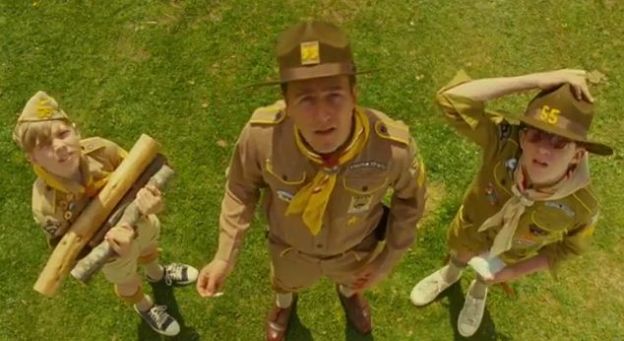
Moonrise Kingdom is about the cascading repercussions of young love in the small community of New Penzance Island. Sam (Jared Gilman), a talented but “emotionally disturbed” member of the island's Khaki Scout troop, loves Suzy (Kara Hayward), a self-possessed but “troubled” singer, the only girl in her family’s brood of five children. Suzy’s emotionally estranged parents, Laura and Walt (Frances McDormand and Bill Murray) and Scoutmaster Ward (Ed Norton) are beside themselves when they learn that their respective charges have fled. But the search for Sam and Suzy eventually involves almost everyone on New Penzance, including a local Island policeman (Bruce Willis) and a mysterious narrator (Bob Balaban). Every character is an equally important member of Anderson’s wild bunch, even if not all of them are created equally (as in the case of one poor eye-patch-wearing Khaki scout).

That being said, Anderson and Coppola do fully explore the group dynamic aspect of Suzy and Sam’s relationship. Scenes like the one where Laura and Walt talk obliquely about their marriage woes nicely illustrate how it’s possible for Sam and Suzy to be alone together and also with their various friends and surrogate family members.

Anderson typically champions his protagonists’ eccentricities as the means by which they define themselves. But his characters are also often unified by the understanding that excluding each other is pointless, as everybody brings something to the group’s collective table. Even the crueler Khaki scouts learn this lesson in a hilarious scene built around a polemic from a pint-sized (former) bully.

The use of song cues, especially those from Britten’s Noye’s Fludde and Camille Saint-Saens’s Carnival of the Animals, subtlely establishes that characters defined by their difference and unhappiness are always an integral part of the film’s whole. In fact, the characters' quirks and unhappiness only further embellish Anderson’s comedy of power dynamics. 

Simon Abrams is a New York-based freelance arts critic. His film reviews and features have been featured in The Village Voice, Time Out New York, Slant Magazine, The L Magazine, The New York Press and Time Out Chicago. He currently writes TV criticism for The Onion AV Club and is a contributing writer at the Comics Journal. His writings on film are collected at the blog, Extended Cut.

SIMON SAYS: An Interview with Bobcat Goldthwait

SIMON SAYS: An Interview with Bobcat Goldthwait

null

When you talk to Bobcat Goldthwait, the American stand-up comic turned Police Academy sideshow attraction and now filmmaker, you see that his demeanor is very similar to the even-handed tone of his films. During our talk, Goldthwait casually referenced Preston Sturges and Falling Down as he addressed the tone of his controversial comedies. And he did it all while talking very matter-of-factly about the logic behind making movies centered around outlandish behavior.

Goldthwait’s recent breakthrough as a director was Sleeping Dogs Lie (2006), a romcom about a woman who admits to her fiancé that she once drunkenly gave a blowjob to her dog. He then followed that up with World’s Greatest Dad (2009), a black comedy about a father/teacher (Robin Williams) who admits that he didn’t always love his son (a perversely inspired performance by Daryl Sabara). Now, Goldthwait has directed a film called God Bless America (2011), a characteristically thoughtful black comedy about an unlikely pair of vigilante killers (one of whom is played by Mad Men’s Joel “Freddy Rumsen” Murray) who murder people whose bad behavior they can’t stand.

God Bless America is, like Goldthwait’s last two movies, a comedy about characters who eventually give in to their morally weaker impulses. But the film has been weirdly mischaracterized by many detractors as a goofy revamp of Natural Born Killers. I talked to Goldthwait on the phone about his audience’s expectations, directing a superhero movie, and his idea for a remake of Billy Jack.

I saw God Bless America at Toronto and am still taken aback by how wildly misinterpreted it’s been. How would you describe the reception it’s gotten?

Bobcat Goldthwait (BG): It’s had its fair share of positive reviews and . . . well, you know, my other movies had the same thing. People will say, “It’s a one-joke movie.” Well, yeah, if you don’t empathize with any of those characters. Then it’s a no-joke movie. I’m not into comedies that are joke-driven. I’m not trying to make Two and a Half Men: The Movie.

One of the thing’s that’s striking about your films is that you do try to get us to empathize with your characters. One of the things I found most bizarre about the negative pans was the way people compared God Bless America to Natural Born Killers. Natural Born Killers is about the psychosis of its characters, whereas this film seems to be about how your characters allow themselves to be seduced by psychosis. That’s not really the subject of the film, right?

BG: Yes, right. And Natural Born Killers, at the end of the day, was trying to implicate the media. And with this movie, I’m not trying to blame the media. I’m trying to make a movie that questions our own appetite for distraction, and that raises the question of where are we going. If you’re disappointed that I didn’t have a scene where I keep cutting back to Harvey Keitel in front of a big map saying, “I gotta get inside the brains of these people! Where are they gonna strike next?! Oh, I got it: this reality TV show,” I have no interest in doing that kind of movie.

The movies I make don’t take place in reality. I have a problem with vigilante movies. Usually, they start with a very gratuitous rape. And at the end, the hero kills all the bad people. So people can get their rocks off watching this gratuitous rape and then they can get their rocks off watching people get blown away.

In this movie, at first you’re rooting for the characters, and in the end, the wheels fall off. You should be questioning their behavior all along. Frank eventually realizes that he’s a flawed human being, and that this whole thing that he put into motion doesn’t really work. [laughs] I mean, for instance, if people were to treat Sleeping Dogs Lie as a serious examination of bestiality, they’d be out of their minds! This isn’t a movie about serial killers, it’s a movie about our own appetite for distraction.

That comparison to Sleeping Dogs Lie is striking as it doesn’t look like it’s being made by God Bless America’s critics. I think people get confused about the characters’ speeches—or more accurately, the rants—and they assume they’re speaking for an authorial voice. Which is ridiculous, considering what the consequences of those rants are.

BG: Yeah, I think it’s funny that people mistake those rants for my opinions. I wouldn’t make those speeches in everyday life. People think, “Oh, this movie is preaching,” but obviously those are people that don’t agree with what’s being said or think that they should agree with everything. I like to go to the movies and watch characters who make me question how I see the world. I don’t want to watch a movie where everyone does things I agree with. I think people see this movie on a superficial level sometimes and think that’s what it is. Those are the people that are more likely to go see The Avengers.

I was actually going to ask you later—beg you—to please, please try to make a superhero movie. I think you’d make a great Dr. Strange.

BG: [laughs] They usually use their own people, or they’ll sniff around and say, “Are you interested?” I briefly tried to look at the Marvel catalogue, and everything is gone. The only thing I could find was, during the CB craze of the ‘70s, a trucker called Razorback.

Yes!

BG: My friend who helped me find this character says, “You gotta make the Razorback movie!” [both laugh] I say to him, “You’re out of your mind!” Somebody told me about World’s Greatest Dad, “Wow, you really created a whole world there. I half expected Batman to show up at any moment!”

[laughs] That’s the thing about your movies: I almost want to describe them as Bobcat Goldthwait’s Moral Tales. Without shaming the audience, they’re about a sense of perspective people get when they realize they can be pushed beyond their comfort zones. World’s Greatest Dad, Sleeping Dogs Lie and God Bless America all have these characters that think, “Oh, I don’t even understand myself beyond a point.” That almost goes hand-in-hand with the superhero genre!

BG: That’s what interests me about making movies. I don’t think I’m smarter than the audience and I’m not trying to manipulate them. I’m making movies about people as flawed as myself and the viewers. So if you just have a reptilian brain and live your life simply by reacting to things, my movies aren’t going to work for you. They’re not going to make any sense, you know? I’m not trying to manipulate you with clever zingers. I don’t have all the answers. I’m still trying to figure it out.

That reminds me of something [comic book writer and artist] Howard Chaykin said. He’s said he that he creates characters who were flawed because he felt it would be dishonest to create paragons of virtue when he himself isn’t totally virtuous.

BG: Right. Right! And that’s the thing: there are plenty of things that Frank complains about that I’m guilty of. I’m not this angry guy that wishes the world would operate the way I see it. Another movie people bring up is Falling Down. But that movie—I don’t think people understand. He really wants to go to his daughter’s birthday party. It’s a racist movie! [laughs] When they finally get around to killing people, the Michael Douglas character winds up being a closeted Nazi. But we’re supposed to go, “Well, I still don’t hate this guy, but he’s still a Nazi.” In the movie I made, you should be going, “Well, none of this is right. This is all a little screwy.”

When I’m ego-surfing on the web, and I look at people’s comments to the movie’s trailer, and they go, [slow voice] “So, what, I’m not supposed to text during a movie anymore?!” [both laugh] I make these tiny, independent movies with my friends on a very, very small budget. I don’t make them for everybody. I expect to continue to pay rent for the rest of my life. [laughs]

World’s Great Dad and God Bless America have gotten some pretty good exposure. One of the things that’s striking about you is that, while you see plenty of actors and comedians try their hands at directing movies, you’ve kept at it. How difficult is it for you to keep on making these films?

BG: I actually write a lot of screenplays. I don’t really have an objective. I don’t sit down and go, “Well, this is one I can get made this year. Movies with penguins are really popular.” I just write whatever comes out of me. And then I try to get money and get all of them going. The key is I don’t make them if I have to compromise. I would rather not make a movie than compromise or to change something in the story so it’s more sensible or less offensive. So for good or for bad, these movies have my voice.

Even given the increasingly positive response you’ve gotten to your movies, are there some ideas that you thought were so extreme that only you could write and direct them?

BG: I don’t make compromises. One of the movies I wrote—I said to my wife, jokingly, “I’m tired of not making money. I’m going to write a genre picture.” I love Billy Jack, so I wanted to make something like Billy Jack

Oh, wow.

BG: I'm, like, 45 pages in, and she comes over and asks, “Well, how’s it goin’?” And I go, “Well, he’s gay now.” And she goes, “We really are just going to keep renting, aren’t we?” [both laugh] Well, anyway, he goes into a redneck town and kicks ass.

And again, it’s meant to question all this craziness about equal rights for the gay community. I did it in a funny way, but the joke’s not that this guy dresses funny. He’s an ass-kicking Marine that gets kicked out during Don’t Ask, Don’t Tell. I want to make that movie, but when I do make it, I want to make it the right way, with the right cast. I can’t get money for that. I’m surprised, but not a lot of action stars want to make out with a dude on camera! [both laugh]

But that’s an example of how I work. I just write it and say, “This is the world I want to see.” And then I wait until I get the right people to pull the trigger on the money. I wrote five screenplays, and God Bless America is one of them.

One of the things I find striking about your movies—and also Spike Lee’s movies—is that you assume that these prejudices come from somewhere. And the places where they come from, like family and religion—those institutions have the potential to be good things. They’re not always bad. They have the potential to bring people together. That even-handedness is striking. When you write characters who aren’t necessarily totally sympathetic but also aren’t black-hat-wearing bad guys, how do you make them somewhat sympathetic?

BG: Well, as I said, none of these movies take place in the real world but I try to make the lead characters in these movies very real people. I’m a big Preston Sturges fan and the leads in his films are often quite flawed. They have a lot of dimension to ‘em, even the sillier ones. But then there are always these one-dimensional characters that are circling around these people. And that’s how I see these movies, where the main people are hopefully well-rounded characters and that’s why you empathize with ‘em.

That’s why I think Joel did a terrific job in this movie. I didn’t want people to pity Frank. I didn’t want him to be someone they felt bad for, I wanted him to be somebody they empathized with.

Yeah, there’s usually a level of latent patronization or condescension in comedies when audiences are asked to sympathize with a character. Your movies place your characters on a pretty even level with the audience.

BG: That’s the goal, thanks. I hope folks see that. Sometimes I’ll pop out jokes and get rid of things that are a little too funny or too silly if they compromise the world that this guy comes from. It’s funny that, for a guy that was a night-club comedian for so long, jokes are the last thing I think about when I’m writing a screenplay.

Really? Do you work it in afterwards?

BG: Yeah, or they just come up organically, like an actor will pitch a funny line or on the day I’ll come up with a funny line. But like I said, I don’t like comedies that are joke-driven. And I don’t like comedies where the theme is an afterthought. Like, at the end of the day, it feels like they just made it up. Like, “Friends are the most important friends,” or, “If you don’t give up, you’ll wind up believing in yourself.” For me, it’s the themes and the world first and then I figure out who those people are from there.

That conjured up an image of Judd Apatow’s comedies. They often have an improvisatory feel to them. They just go on forever and there never seems to be anyone calling cut. There’s just a lot of riffing and that’s sort of become a style unto itself.

BG: Yeah, that’s a form and people enjoy it the same way… I don’t have that luxury when I go to make a movie. There are scenes that are ad-libbed, and I do ask people to contribute. That’s usually because the people I collaborate with, we collaborate from day one. [laughs] I don’t have the budget to deliver a four-hour cut of a movie.

At what point do you start talking to your collaborators about what the characters’ voices are?

BG: Well, when somebody’s hired, because of the small world that I make my movies in, you’re dealing with people that are the right people for the job first. So they usually already have that character dialed in. They audition, or I already know that they can do it. But, you know, Joel had a lot of questions about the character, and I reflected it in the screenplay. He said, “Well, he wouldn’t do this and he wouldn’t do that.” And I said, “Yeah, you’re right.” So I would rewrite it.

I think I’ve got what I need. So I just want to urge you: please, please make an Antman movie or a Razorback movie. [Goldthwait laughs] You don’t even need to think of it as selling out, you’d just be doing a Bobcat Goldthwait movie on a different level.

BG: It’s so hard! All the good ones are taken. All of them are in development, that’s the problem.

Yeah, I can’t imagine them doing anything with a lot of these properties but I’m sure all of them are in development hell on some stage or another.

BG: Yeah. Well, maybe I’ll make a movie about my alter ego when I was a little boy, which was Super Rabbit.

Super Rabbit. What’s the story behind that?

BG: When I was a little boy, my sister would make pills out of dough. When I took the pills, I would have all the powers and strength of a rabbit. [laughs]

Uh…oh, wow.

BG: What happened was, when me and [Sponge Bob voice actor] Tom Kenny were kids—he had actually written it out, he had a character named Captain Caribou.

Oh my gosh.

BG: Which was about a guy that was bitten by a radioactive caribou in Alaska. And he had these antlers that he had to live with . . .

I think you’ve got your next movie right there.

BG: [laughs] Captain Caribou and Super Rabbit!

Simon Abrams is a New York-based freelance arts critic. His film reviews and features have been featured in The Village Voice, Time Out New York, Slant Magazine, The L Magazine, The New York Press and Time Out Chicago. He currently writes TV criticism for The Onion AV Club and is a contributing writer at the Comics Journal. His writings on film are collected at the blog, Extended Cut.

SIMON SAYS: On THE AVENGERS, Joss Whedon, Dan O’Bannon, and Zapped Toads

SIMON SAYS: On The Avengers, Joss Whedon, Dan O’Bannon, and Zapped Toads

nullIn the beginning of The Avengers, when Hawkeye says, “Oh, I see better from a distance,” I feared the worst and I thought of Joss Whedon, Dan O’Bannon, Lifeforce (1985) and X-Men (2000). I thought, “Oh god, that poor toad in the X-Men movie got hit by lightning and a bad line of dialogue all over again.” And I groaned mightily, albeit somewhat prematurely, because I thought that Joss Whedon was about to prove yet again that he, like most mortals, is fallible. Bear with me a moment—this will take some unpacking.

The Avengers, which for the record is mostly serviceable even if it is laughably contrived and underdone, was directed and scripted by Joss Whedon. Whedon is the grand geek poobah creator behind such cult projects as Buffy the Vampire Slayer, Firefly and Dr. Horrible’s Sing-Along Blog. He’s a singular voice in contemporary science fiction and fantasy who is famous for his complex characters and snappy dialogue, and he’s a major geek celebrity. But with Whedon’s storied reputation as a sharp pop artist also comes a series of incidents that have turned Whedon into a de facto martyr. Any time something goes wrong with a Whedon-related project, it’s assumed that it can’t be Whedon’s fault. That stigma of being misunderstood by people in power has only been enhanced by Whedon’s rocky history with 20th Century Fox. Let’s unpack that confusing relationship a little, as well.

First there was the script that Whedon wrote for Alien: Resurrection, a fairly unremarkable script in itself that was then turned into something different from Whedon’s original ideas. Which is basically, you know, what happens to most scripts when they get made into movies. Since Alien: Resurrection (1997), the fourth film in the 20th Century Fox’s Alien film franchise, had plenty of on-set production difficulties (for example: director Jean-Pierre Jeunet didn’t speak English), Whedon publically blamed the film’s director for the film’s numerous shortcomings. In a 2001 interview with the AV Club, Whedon complains:

I listened to half the dialogue in Alien 4, and I’m like, “That’s idiotic,” because of the way it was said. And nobody knows that. Nobody ever gets that. They say, “That was a stupid script,” which is the worst pain in the world[…]In Alien 4, the director changed something so that it didn’t make any sense. He wanted someone to go and get a gun and get killed by the alien, so I wrote that in and tried to make it work, but he directed it in a way that it made no sense whatsoever. And I was sitting there in the editing room, trying to come up with looplines to explain what’s going on, to make the scene make sense, and I asked the director, “Can you just explain to me why he’s doing this? Why is he going for the gun?” And the editor, who was French, turned to me and said, with a little leer on his face[…]”Because eet’s een the screept.” And I actually went and dented the bathroom stall with my puddly little fist. I have never been angrier. But it’s the classic, ‘What something goes wrong, you assume the writer’s a dork.’ And that’s painful.

Whedon has since publicly admitted that there were some shortcomings inherent in his script. Still, he’s only sharing blame here, though I wouldn’t really expect any screenwriter to fall on their creative sword and assume responsibility for everything that went wrong with Alien: Resurrection (it really is a mess, albeit an interesting one).

Then there was the cancellation of Firefly, a very strong science fiction TV show that Whedon created and directed. Firefly aired originally on Fox, but it was soon canceled after it failed to attract high ratings. After the show’s rabid fans banded together, Whedon got to write and direct Serenity, a feature-length theatrical release. The show has also been released on DVD, thanks to its vocal fans.

Then there was Dollhouse, a conceptually interesting but rarely well-executed science fiction/spy program about a high tech brothel where prostitutes who are secretly intelligence agents have their identities reprogrammed cybernetically to suit their clients’ desires. The show was teetering on the edge of cancellation after the first season. After heavy rewrites, the show was renewed for a second season, receiving relatively sturdier ratings, but the show was not renewed for a third season.

In between these three major events, there is a fairly minor but nonetheless relevant anecdote about Whedon’s work as a script doctor on X-Men, the first and mostly forgettable live-action film of Marvel Comics’ mutant superhero team. Whedon has taken credit for writing the line where Storm (Halle Berry), a mutant with powers to control the weather, taunts a villain named Toad by saying, “Do you know what happens to a toad when it's struck by lightning? The same thing that happens to everything else." Whedon says that the line was not the problem but rather the line-reading, insisting that Berry read the line “like she was [The Addams Family’s] Desdemona.” I fear that, in this case, it’s the writer’s fault. No matter what sarcastic register Berry might have affected, that toad-frying line is dopey.

Whedon’s creative woes makes me think of Lifeforce and Dan O’Bannon, the acclaimed screenwriter of Dark Star and Alien, who complained of having his work significantly altered by director Tobe Hooper (The Texas Chain Saw Massacre, Funhouse). Like O’Bannon before him, Whedon is a recognized talent with a respectable track record that infrequently climbs onto a cross for very silly reasons. Once again, a troubled production history and outlandish reports of Hooper’s unprofessional and unfocused behavior seem to have been confirmed by the tonally inconsistent and utterly bizarre film that was theatrically released. O’Bannon still took a check for the movie, but he grumbled intensely about it. He was misrepresented, and of course that had nothing to do how cheesy and flat-out bad an idea it is to have a naked energy vampire (Mathilda May, hubba hubba) virtually seduce everyone she meets on planet Earth.

Make no mistake, O’Bannon and Whedon have both made exemplary work. O’Bannon’s scripted a number of great projects, like Alien and Dark Star, and he’s even directed one of the very best horror-comedies, Return of the Living Dead (1985). Whedon’s TV work has similarly been consistently strong, and the handful of stories he wrote in the Astonishing X-Men comic book series was also pretty engaging.  But sometimes, it’s enough to just not say anything about work that’s not very good. This probably won’t happen with The Avengers. Whedon’s script is marred by garden-variety contrivance, but some of its ideas are rather underdone, especially the ones in the film’s first half-hour. Hawkeye’s line about “see[ing] better from a distance” is especially dismal when you consider that he’s being asked why he hasn’t involved himself in a group project. Renner delivers the line with a straight face. He could not have been misreading it, since Whedon also directed the film. That line is just a tediously literal-minded joke.

There aren’t many painfully awkward moments like this one in the rest of The Avengers, but there are a couple. For instance, Loki (Thomas Hiddleston) is first identified to viewers in the film by a character who unceremoniously blurts out, “Loki! The brother of Thor!” Or how about when Loki brainwashes Hawkeye in the film’s first twenty minutes, (not a spoiler, true believer!) after tapping his magic spear on Hawkeye’s chest and lamely declaiming, “Freedom is life’s great lie.” Just before tapping on Hawkeye’s breast and hypnotizing him into becoming one of his minions, Loki adds, “Once you accept that in your heart . . . you will know peace.” (Sort of a spoiler!) Simply put, these are bad lines. In the future, if Whedon complains about creative interference again without doing actively disowning the work, he’ll be leaving himself wide open to some really bad cardiac-arrest-related puns.

Simon Abrams is a New York-based freelance arts critic. His film reviews and features have been featured in The Village Voice, Time Out New York, Slant Magazine, The L Magazine, The New York Press and Time Out Chicago. He currently writes TV criticism for The Onion AV Club and is a contributing writer at the Comics Journal. His writings on film are collected at the blog, Extended Cut.

The Androgyny of Artists: An Interview with Mary Harron

The Androgyny of Artists: An Interview with Mary Harron

null

In the short span of four feature films, director Mary Harron has created an intense body of work, in which deeply conflicted characters work through identity crises. Harron’s most famous protagonist is probably the psychotic Patrick Bateman in American Psycho (2000). But just like Patrick, both Valerie Solanas in I Shot Andy Warhol (1996) and Bettie Page in The Notorious Bettie Page (2005), Harron's two other films, find themselves trying to strike poses that don’t quite fit them.

So goes Harron’s new movie, The Moth Diaries (2011), a vampire melodrama set at an all-girls' boarding school. Rebecca (Sarah Bolger), a young but lonely adolescent, unconsciously reshapes her life as a gothic novel. This makes Ernessa (Lily Cole), a pale and mysterious new girl, Dracula to Rebecca’s Mina Harker. I talked with Harron via email last week about the effect of conflating ourselves with our public personas.

Many of your movies revolve around the disparity between modes of representation (journals, plays and pornography) and the essence of what they're portraying. Having been an arts critic, I'm curious how you feel the gothic novel has grown, and how that's reflected in The Moth Diaries' use of the gothic novel as a false source of comfort for our heroine. Her narrative is, after all, phrased as a dysfunctional gothic novel (as Ernessa says at the end, nothing can save Rebecca, not even the gothic novel narrative she's created for herself).

Mary Harron (MH): I can't really speak to the present day gothic novel, because I haven't read many of them.  When I was working on The Moth Diaries, I did read a lot of the classic gothic, Bram Stoker, and Sheridan Le Fanu, and some later British horror like M.R. James.

In the film, when Rebecca reads Le Fanu's Carmilla, is the book giving her clues to understanding who Ernessa really is, or is it fueling her paranoia?  You have to draw your own conclusions.  However, I don't think it's true that nothing can save Rebecca.  I think she saves herself—because she's created so much havoc, she's taken away from the school. To me it's quite a hopeful ending. She's left the school (adolescence), and now she's out in the world. She's going to face her adult life, whatever that will be.

The teacher, Mr. Davies, who is conducting the class in 'literature and the supernatural,' is the 'expert' you always find in gothic literature.  The early vampire stories always have a professor or academic or doctor who comes in and explains everything, but sometimes he gives the wrong explanation, or can't see what's in front of his eyes.  I love how you can't trust the experts in those books.  Anyway Mr. Davies thinks that his discussions with Rebecca are about Gothic literature, about metaphor, and she thinks they are about something absolutely real.  Just as when she comes to talk to him about Lucy, he thinks they're talking about anorexia but she's trying to tell him about a vampire.  Neither one is listening to the other.

I also find it striking that almost all of your feature films contain characters that are just as much victims as they are active creators of their own self-images, which often come across as schizoid personas. Bettie Page is a good girl that can't stop herself from being bad. Patrick Bateman can barely hide his blood thirst beneath a sheen of yuppy respectability. Valerie Solanas grew to resent that her pointedly vulgar and revolutionary rhetoric was misunderstood. And now The Moth Diaries' Rebecca is a victim of the traditional gothic story she's created for herself. Is it necessarily perilous for someone to reinvent themselves?

MH: Oh no, it can be very good to reinvent yourself. Bettie Page got a lot out of her reinvention of herself, until the censors came down hard on her.  And so did Valerie, until madness took over.  I don't know that Bateman actually re-invented himself —  he's more of a monster hiding behind a mask.  I have to say that I don't really see Rebecca as a victim, because in the end she goes down into the basement, she faces her fears — and she gets herself thrown out of that school, which is a good thing!

Speaking of being image-conscious, you directed an episode of Fear Itself recently. I imagine this is because of American Psycho, so I have to ask: do you feel like you've been pigeonholed as a horror filmmaker?

MH: I'm kind of flattered when that happens, because I don't consider myself a real horror filmmaker.  It always seemed funny to me that American Psycho was in the horror section of video stores. It's more like a satire with horror elements.  It's ironic, because when I try to get television work in comedy I'm told that people think I can't do comedy! But my first three films have a lot of comedy in them, I think. Not Moth Diaries, that's more teen melodrama.  

I just read Midnight Movies and saw that there's a note about your portrayal of Solanas in there. Having been a critic, I wonder how much you pay attention to criticism of your films and whether or not you're concerned with the way your films seem to be rather literally critiqued for not being period-specific or exaggerating details to elicit a specific effect.

MH: Hmm, I haven't read Midnight Movies.  Because I was a critic, I probably take reviews more seriously than other filmmakers. However, there is just so much to read now, with all the blogs and all the comments added in, it can become overwhelming and destructive. Maybe it's better to wait five years, until the dust has settled, and then read your reviews!

My first movie was very well received, but American Psycho and The Notorious Bettie Page both got mixed reviews and were understood better a few years after release. That makes me question the immediate reaction. Also, when I was a critic I sometimes gave bad reviews to things that I later found I liked.

Tell me about the way you film the past in your films' flashbacks: it seems your representations of past events is reliant on an understanding of nostalgia as being associated with dated technology, as in the flashbacks in The Notorious Bettie PageI Shot Andy Warhol and now the black-and-white flashbacks in The Moth Diaries.

MH: I think that comes from all my early experience in documentary film.   I was a researcher in British television and worked on a lot of biographies of artists, which involved looking at loads of archive film in many different formats—black and white, color, 35mm, 16mm, super 8, video.  I think that's where I get my love of mixing different film stocks and formats together, and using them to evoke a particular era.

Do you think representations of LGBT characters in films have changed since you made I Shot Andy Warhol? I know you directed an episode of The L Word, and the notion of having an uncomfortable sororal bond is in both The Notorious Bettie Page and The Moth Diaries.

MH: Yes, LGBT representations have changed hugely in the last fifteen years.  Being transgender wasn't even part of a mainstream discussion.  The 'sororal' bonds in The Moth Diaries are quite complicated. Teenage girls pour all their emotion into their female friendships, which are very intense and quite romantic.  They fantasize about boys, and have relationships with them, but their strongest bond is with their friend. Those intense girls friendships can be very beautiful, and also very destructive when they go wrong. The relationship between Lucy and Ernessa goes farther than that romantic/platonic girl friendship, though… 

I'm particularly struck by the contrast of strong femininity projected both by Page and by Solanas: the dominatrix and the man-hater. Given that Bateman is the most macho man in your movies and is a psychopath for it, it stands to reason that the independent women in your films are marginalized or still finding their voices. But I'm also reminded of how Solanas is asked what she will do for money and how she can get by without money. Trying to be revolutionary or even just different seems to mean you have to be misunderstood. By contrast, Bateman is misunderstood but accepted because he's a paragon of caricatured manliness, no?  

MH: Well, as Bateman says, he's just trying to fit in! He's so insecure, and so obsessed with getting all the surface details right, that no one notices what's going on underneath.

Then again, one of the things that struck me about I Shot Andy Warhol is how Solanas comes to irrationally despise these two effete men of power, Andy Warhol and Maurice Girodias. Androgyny, in both that film and in The Moth Diaries, specifically with Ernessa, seems to be an indicator of a conflicted kind of enlightenment. Is woman the future of man?

MH: It's sad, because Valerie turned her aggression on the only people who encouraged her, Warhol and Girodias. They had their failings but they weren't the enemy as she laid it out in the SCUM manifesto.  Gay men like Warhol were supposed to be women's allies.  I don't know if woman is the future of man, but I do think artists tend to be androgynous, in sensibility at least…

Who are the filmmakers and storytellers that you feel influence and inspire you the most?

MH: Polanski, Hitchcock, Kubrick, Bunuel.  Also I love Howard Hawks, in all his different genres,  and thirties comedy for its wonderful lack of sentimentality and its brilliant pacing.  I love David Cronenberg and David Lynch, and admire the careers they have, in which they never stopped making interesting films. Gus Van Sant was another inspiration for me. Drugstore Cowboy caused a big revelation, that you could actually make a movie like that.

What are you working on next?

MH: I'm attached to a film called Wicked/Lovely that is based on a young adult novel.  It has a lot of visual effects and is expensive, so the producers are still working on putting the money together. Then I have a couple of other projects I'm working on, but it's too early to talk about those!  

Simon Abrams is a New York-based freelance arts critic. His film reviews and features have been featured in The Village Voice, Time Out New York, Slant Magazine, the L Magazine, the New York Press and Time Out Chicago. He currently writes TV criticism for The Onion AV Club and is a contributing writer at the Comics Journal. His writings on film are collected at the blog, Extended Cut.

SIMON SAYS: The Vulgarian Frontier: On The Three Stooges’ Patently Inconsistent Comedic Genius

SIMON SAYS: The Vulgarian Frontier: On The Three Stooges’ Patently Inconsistent Comedic Genius

 null

                  “The Vulgarian Frontier: Subject to Change Without Notice.” –Signpost in Dutiful but Dumb (1941)

Now that The Three Stooges, the new Farrelly brothers mediocrity, is just a day away from nationwide release, it’s very easy to misremember what made Larry Fine and Moe, Larry, Curly, and Shemp Howard’s routine so memorable. Like many Vaudevillians' acts, the Stooges’ brand of violent slapstick humor comes from a flagrantly low-brow kind of self-loathing. The fates seemed to regularly conspire against the Stooges but it somehow seemed justified because their personae were so very ugly. In fact, many of their best gags are about how unattractive they are, like when Shemp tiptoes around an old dark house in Spooks! (1953) and recoils in horror when he sees a bat with his face on it. “What a hideous, monstrous face,” Shemp says, before the bat descends on fishing wire while burbling, “Bib-bib-bib-bib.” The Stooges were never high artists but they were very good at taking themselves down a peg or six.

At the same time, one of the more dated and, yes, problematic aspects of the Stooges’ act is that they make fun of themselves by proxy, mocking many of the women that they try to woo. Being initiated in the Women Haters' Club in Women Haters (1934) is not much different than the Stooges’ scheme to get Larry married so that he inherits a fortune in Brideless Groom (1947), in that both scenarios assume that women can only be equal to men if they’re just as loutish, conniving, or fugly. Women often beat up the Stooges, but not because these guys were feminists, and wanted to joke about how ineffectual and chauvinistic their Stooge personas were. Actually, the Stooges just had really low self-esteem. So when Moe, Larry and Curly get wrangled into a car by a trio of women in False Alarms (1936), it’s telling that the most vocal gal is a thuggish-looking dullard who sees the Stooges as a meal ticket: “Come on, girls, let’s go places and eat things.”

Women were, however, not consistently used as direct reflections of the Stooges’ own insecurity. Women are more generically used as trophies, in shorts like Gents Without Cents (1944) and Pardon My Backfire (1953). This shows to go you that while the repetition of certain routines is a staple of the Stooges’ brand of humor, Fine and the Howards don't have a consistent philosophy on life or comedy. (This isn’t necessarily a bad thing, though, since that lack of focus is also a central part of the group’s charms–more on this in a moment.)

Besides, the Stooges never really needed anyone else to prove just how grossly incompetent they were, since their bumbling behavior was always an extension of their “hideous” looks and, thankfully, the Stooges never opted for plastic surgery. Scowls, dumb show stares, bulbous noses, and the group’s signature hair-stylings are just as integral to the group’s masochistic schtick as the vigorous eye-poking and cheek-slapping that made them famous.

Then again, the Stooges are often at their funniest when the pacing of their gags is so manic that you can hardly understand them.  For instance, in Spooks!, each successive gag is delivered at a successively faster rate, until finally a giant gorilla that’s been skulking about out of sight makes a dramatic re-appearance. Additionally, some of the gags are weirdly dense and feature puns that are so cerebral that they’re practically middle-brow. In Malice in the Palace (1949), the boys pore over a map that shows in great detail the geography of the imaginary land of Shmow. Now, you can pause your dvd and pore over the details of punny made-up territories like the Bay of Rum, Igypt, Jerkola and Great Mitten. But the fact that this intricate gag was originally shown for only a few seconds makes the Stooges' anything-for-a-laugh modus operandi all the more apparent.

Besides, being flagrantly nonsensical suited the Stooges, as in an earlier part of Malice in the Palace where the group tries to eat meat that they're convinced was once a cat or a dog (whenever they prod the food with their flatware, a pooch and a puss respectively yelp and hiss). Or how about when Moe inadvertently destroys a car's horn in Pardon My Backfire and the horn spontaneously exclaims, "They got me," as if it were dying? If nothing else, the Stooges are at their best when they're charging out of left field. Their jokes aren't exactly avant-anything, and their sense of humor certainly isn’t consistently surreal. But with 200+ shorts at their backs, it's safe to say that the group's longevity stems from the variety of ways they contrived to hurt themselves. They kept enough variety in their gags to make even the sleepiest of their shorts feature one or two gut-busters. Pretty impressive for a bunch of guys that couldn’t even stand to look at their own reflection.

Simon Abrams is a New York-based freelance arts critic. His film reviews and features have been featured in The Village Voice, Time Out New York, Slant Magazine, The L Magazine, The New York Press and Time Out Chicago. He currently writes TV criticism for The Onion AV Club and is a contributing writer at the Comics Journal. His writings on film are collected at the blog, Extended Cut.
BULLY: The Conversation

BULLY: The Conversation

null

The recent documentary release Bully is an up-close look at 5 families of children who have been the victims of bullying.  The film attempts to examine the problem from several different sides. The film has been the subject of much interest and debate since it came out; here, writers Simon Abrams and R. Kurt Osenlund offer their own takes.

Simon Abrams:

How did this happen, Kurt? When Bully came out, all anybody could talk about was the ratings controversy that its distributors drummed up for publicity's sake. Somewhere, Kroger Babb and Dave Friedman are smiling down on Bob and Harvey for having sold their film's steak based on its sizzle and not its substance.

Then again, as we have both written, there isn’t much meat on Bully's bones, is there? Director Lee Hirsch and co-writer Cynthia Lowen's 2012 documentary is so myopic that its scope only leaves room for a very narrow representation of bullying in heartland America. The film features problematic latent assumptions about bullying and how it should be handled in real life that I strongly dislike.

For instance, one parent insists, "we're nobody" when he complains that changes haven't been made in his kid's school system strictly because of political reasons. I understand what this father means to say: parents and kids are being ignored because American schools are beholden to powerful and apathetic people of influence. But this footage speaks to bigger concerns in Bully's vision of victimization. Firstly, the way that Hirsch lets this man babble suggests that the filmmakers find more than just pent-up frustration in his ranting. Hirsch and Lowen suggest that the man is right for thinking that the school system is corrupt. You sat next to me at the Bully press screening I attended when some moviegoers were doing everything short of booing and hissing at footage of one school's disinterested vice principal. Hirsch's message couldn't be clearer: school administrators are to blame because they're hypocrites and are quick to turn a blind eye.

Another thing I found frustrating about the aforementioned father's insistence that he's "nobody" was how his rap speaks to the film's emphasis on Middle American kids and parents. I wouldn't be surprised if Hirsch had deliberately steered clear of urban schools. It's easier to pull your audience's heartstrings when you flatter them by focusing on “real” salt-of-the-Earth types. They're honest, simple people, Kurt, don't you see? They don't have no book-learning or influence to fall back on. They're nobody!

Feh.

There are so many loaded assumptions about bullying and blame in Bully that I really had a hard time narrowing down to one emblematic example. It's especially disappointing to see that neither bullies nor any parents of bullies are given a chance to speak. Presumably, there weren't many that wanted to talk, but again, that's not on the screen. And that's where I think you and I find ourselves agreeing: what this movie puts on screen and how it puts it there are two different things. The film's unearned, faux-heart-warming message is just so solipsistic that I want to buy Philadelphia Weekly critic Sean Burns a beer for tweeting that he wanted to stuff Bully into a locker and steal its lunch money.

R. Kurt Osenlund:

Simon, your last point about Sean Burns's tweet is perfect, because it highlights how this movie isn't capable of changing any bullies' minds, and it also scoffs at the notion that we critics who hated the film are, naturally, the real bullies. I am sick to death of so many subpar documentary films coming down the pike, and accruing praise simply because the director wields a camera and a noble cause—as if the discussion the film starts will account for the film's own shortcomings. Though I haven't seen Tom Sadyac's I Am, I think it's safe to say Bully is the worst offender of this type, since, in addition to actual filmmaking that isn't about to turn many heads, it continually sets up a conversation it isn't equipped to have.

Whether ballooned by the media or not, bullying is a hot-button issue right now, and I, for one, at least expected this film to better address what headlines would call “a national epidemic.” But, as you stated, Hirsch is only interested in a convenient, meat-and-potatoes cross-section, where families are more than ready to open their doors, hearts, and mouths for a flashy film crew that rolls into town. It's just one example of the many shortcuts Hirsch takes, others being the oft-discussed issue of a lack of bully presence, and the decision to point the finger at an oppressive administration, embodied by a “horrifying” assistant principal who, unless I missed something in my press notes, has got to be acting for the camera.

I know I'm already inviting charges of cynicism, but this movie elicits it relentlessly, and I'm disheartened that so many major reviewers chose to ignore their better judgments' whispers of “bullshit.” Without a frame witnessed, the film already has that maddening Weinstein PR push, which, as you said, aims to squeeze every last ticket sale out of a who-cares controversy that roped in celebrities and villain-ized the MPAA (cuz, y'know, they're just as insensitively bureaucratic as the damned school systems).

Just in case I haven't offended anyone enough, I'll say that I did not find this film's events, as presented, particularly troubling. I sympathized (even empathized) with young Alex, and I thought the (unexplored) implications of Ja'Meya's school-bus vengeance incident were provocative. But virtually every scene, save a heated town hall meeting, feels rife with the strain of manufactured drama, and without a single visible conflict, the storyline with out lesbian Kelby, who's surrounded by supportive family and friends, seems downright idyllic. Hirsch's poor instincts for meaningful footage and subject matter are compounded by his insensitive shots, which at many points begets a feeling of outright exploitation. I know one shot contained not one, not two, but three redneck-y instances of an eight-point buck—one inked on a man's arm, one emblazoned on his shirt, and one physically mounted to the wall. And perhaps you, Simon, can tell me what the director's intention was in shooting poor Alex walking around the playground with wing sauce smeared all over his face.  

Simon:

Well, Kurt, I don't know if I'd go so far as to say that Hirsch and co. were ever really trying to change bullies' minds. I think Bully, like so many other activist docs, is very self-congratulatory. It’s representative of a subgenre of documentary filmmaking that I think recently found very good expression in The Art of the Steal. Steal’s narrative is so dense and well-researched that I can easily forgive it for its filmmakers' biases and the lapses in argumentative logic that those biases create. Some other superior examples of inherently problematic but effective muckraking docs include Inside Job or almost any of Joe Berlinger's documentaries. But I admit, I’m usually wary of how people are presented in such films as being emblematic of a cause or more generally how their lives are re-packaged into narratives. 

Bully is as odious as it is both because its creators are very myopic but also because what they do show us feels, as you wrote, manufactured. It's the same reason why Comic Con Episode IV: A Fan's Hope, Morgan Spurlock's new doc about the San Diego Comic Con, is so irritating. Spurlock took real-life people and turned them into generic narrative mosaic tiles that, when put together, give you an equally unimpressive cumulative effect. He makes the courtship of two young nerds the counterpoint to the failure of an aspiring bartender/hopeful comic book artist, which in turn is the counterpoint for a successful comic book artist's story of finding work at the convention. I don't mind that these characters are performing for the camera after a point. What I mind is how Spurlock makes these people’s stories trite and uninteresting.

Similarly, I'm frustrated by the way that Hirsch and Lowen don't acknowledge that Ja'Maya, a bullied student that took a gun to school and almost was sent to jail for a very long time, essentially went from being a victim to a bully. The continuation of the vicious cycle of victimization and bullying is hinted at when the Evil vice principal that we've both already alluded to reprimands a student by saying that he shouldn't stoop to the level of his bullies. If he does, then this kid becomes just as bad as his bullies. Why isn't Ja'Maya held to similar standards? I think Hirsch and Lowen's pseudo-fly on the wall approach, which is presumably where the wing sauce scene you mentioned comes from, is craven, in that sense. If they’re trying to make an activist doc, one where the cause is presumably supported by human examples, being a fly on the wall is coy at best and at worst is, as it is here, crassly manipulative.

Kurt:

I remember you bringing up that same point about Ja'Maya after our screening, Simon, and I think it's a very interesting one. I don't know how well portraying the girl as yet another predator would have served this film's purposes (that seems like material for a far more broad and objective look at bullying phenomena), but that it's not even addressed is indeed more evidence of Hirsch's tendency to glaze over elements so he can bag half-realized stories. Which I think speaks to your point about the lack of opposition being a problem. I, too, saw The Art of the Steal, and was very impressed with the sheer breadth of its detective-like story, however clearly biased it was. The difference is, Don Argott tried like hell to get his film's very specific villains to participate, and virtually all of them refused. So he made the best movie he could with his mountain of material, and risked letting the argument skew more sharply toward his own politics. Hirsch's villains, in general, aren't exactly in short supply. I don't think it would have killed him to find a creative way to incorporate the participation of some sort of bully, if only to introduce an antagonist's mentality and reach toward understanding.

Perhaps changing bullies' minds was not part of Hirsch and company's objective. But in making a film about this topic, in this time, I damn sure think it should have been part of it. I don't know how realistic it is to think that a documentary film is going to affect the daily decisions of an eighth-grade jerk, but I believe it's imperative to at least strive for that result. This movie's platitudes, manipulation, lack of focus, and lack of follow-through weaken its impact and mar its opportunity to actually make some kind of difference. Sean Burns was cracking a joke, but it's not a good sign that this movie could actually fire bullies up instead of incite them to change.

I certainly have deep sympathy for the families in the film who lost their children. But right from the opening scene, with shattered parents David and Tina Long, I felt even more sorry for other families who've suffered the same tragedy, and no doubt turned to this film for a reflection of themselves. What Hirsch shows instead is one clichéd and cloyingly staged scene after another—real-life family turmoil that reeks of directorial coaching. It all boils down to the birthing of a grassroots anti-bullying movement, which, if the director had waited for it to develop, would actually warrant worthwhile documentary coverage. But, no—Hirsch uses it as a commercialistic coda, complete with a hashtag and a URL that'll make Twitter followers out of every tear-eyed viewer. And that, unfortunately, is the message I was basically left with: that Bully, like Harvey Weinstein's press releases, is an advertisement. 

Simon Abrams is a New York-based freelance arts critic. His film reviews and features have been featured in The Village Voice, Time Out New York, Slant Magazine, The L Magazine, The New York Press and Time Out Chicago. He currently writes TV criticism for The Onion AV Club and is a contributing writer at the Comics Journal. His writings on film are collected at the blog, Extended Cut.

R. Kurt Osenlund is the Managing Editor of Slant Magazine's The House Next Door, as well as a film critic & contributor for Slant, South Philly Review, Film Experience, Cineaste, Fandor, ICON, and many other publications.