VIDEO ESSAY: HAJI!

VIDEO ESSAY: HAJI!


I personally prefer the aggressive female . . . the superwoman. — Russ Meyer

In the 1960s there was a huge revival in striptease by way of topless go-go dancing. In Los Angeles there were a bevy of strip clubs that catered to all tastes. One particular swanky strip joint on La Cienega Boulevard, called The Losers, highlighted unpopular figures from current events. Richard Nixon, Fidel Castro, and other celebrity screw-ups would be lit up on the billboard as the loser of each week. Aside from that tasteless gimmick, The Losers was a little more classy than your usual strip club. Its dancers promoted classic burlesque and Las Vegas-style showmanship that attracted more sophisticated customers. One infamous patron of the establishment was Russ Meyer, who would often go there to select the sumptous starlets for his features. Nearly all of Meyer's stars began their career at The Losers: Tura Satana, Erica Gavin, Kitten Navidad, Bebe Louie, Shawn "Baby Doll" Devereaux, and my personal favorite, Haji. If there were any kind of pecking order at The Losers (which there was), Tura Satana would certainly be at the head of the table, but Haji would be second in command. When Mr. Meyer finally persuaded Haji to audition for a minor role in his next picture, Haji admitted that she didn't know the first thing about acting.  "Stick with me, kid," said Meyer, "I'll teach you everything you need to know." It would only be the beginning of her legendary, ass-kicking career.
 
Robert Nishimura is a Japan-based filmmaker, artist, and freelance designer. His designs can be found at Primolandia Productions. You can follow him on Twitter here.

VIDEO ESSAY: THREE REASONS: Kaneto Shindô’s HUMAN

VIDEO ESSAY: THREE REASONS: Kaneto Shindô’s HUMAN

In the early morning of May 29th, Japan lost its oldest living director, and in my opinion one of the best. Kaneto Shindô lived to be 100 years old, as old as Nikkatsu Studios, who would later employ Shindô before he decided to quit the studio system altogether.  Born on April 22, 1912 in Hiroshima prefecture, Shindô began working as an assistant director and screenwriter in 1934, collaborating with such cinematic luminaries as Kenji Mizoguchi, Keisuke Kinoshita, and Kōzaburō Yoshimura. Shindô's first film as a director was Story of a Beloved Wife in 1951. That film’s star, Nobuko Otowa, whom he had met while working on Kōzaburō Yoshimura's The Tale of Genji, immediately became his leading lady in life and in all his subsequent films. Although Kaneto Shindô had been successful working as a writer and director for various major studios throughout the 1950′s, by 1960 Shindô was starting to find his true voice as a director. He founded his own production company, Kindai Eiga Kaikyo (Modern Film Association), to independently finance what would be his first masterpiece, The Naked Island. He followed that with Human, an underrated, yet equally compelling little “love story” set on a boat lost at sea.

Naturally, without the help of the major studios to back him, Shindô had trouble exhibiting the film. At that same time, the fledgling independent cinema group, The Art Theatre Guild, was gaining influence with their single art-house cinema in Shinjuku. By that point, the ATG was primarily showing foreign films that the majors couldn’t care less about (Fellini, Godard, Bergman, and other no-name hacks), but Shindô’s Human was to be the first domestic title for ATG exhibition (along with Hiroshi Teshigahara’s Pitfall). It was the beginning of the most significant period in Japanese film history, and it helped kick start a movement that would completely change Japanese cinema. With the help of the ATG to finance Shindô's films, he was able to make the kind of films he wanted to make without restrictions. The result was one of the most impressive bodies of work from any director, in such a short amount of time. Coincidentally, when the ATG finally dissolved in 1992, it was Shindô’s film, The Strange Tale of Oyuki, that closed the curtain.

Based on Nogami Yaeko’s original novel, The Neptune, which was based on real-life events, Human follows four people stuck on a small fishing boat adrift at sea. After running out of fuel and losing their rudder in a storm, they find themselves lost with no way to navigate, and very little food. It’s also during Obon, a weeklong Japanese religious holiday, which means no one will be out looking for them during the festival. As they drift farther and farther out to sea, their provisions running out, they turn on each other. They immediately split into two groups, the Captain and his young nephew (Taiji Tonoyama and Kei Yamamoto, respectively), and headstrong Hachizo (Kei Satô) and Gorosuke (Nobuko Otowa), the woman who is corrupted by Hachizo as the film progresses. Everyone becomes increasingly desperate as they realize the inevitable conclusion of their situation.

It's unfortunate that it takes a director's death to make most people aware the director even existed. One of Shindô’s notable fans was actor Benicio Del Toro, who presented retrospectives of Shindo’s work both in Los Angeles and Puerto Rico to celebrate Shindo’s 100th birthday. But Criterion had always included Shindô in its catalogue, alongside the other masters of Japanese film. Criterion's release of Onibaba was my first introduction to his work, and provoked me to seek out as much as I could from Japan's first indie darling.  Criterion may be gearing up to release more from Shindô, given the recent tragic news, and they certainly have many amazing films to choose from. Human would be a good addition if Criterion is looking for titles. It’s really a remarkably distilled and tightly edited film that never fails to engage me and make me hungry for more Kaneto Shindô (as well as food) whenever I watch it.

Robert Nishimura is a Japan-based filmmaker, artist, and freelance designer. His designs can be found at Primolandia Productions. You can follow him on Twitter here.

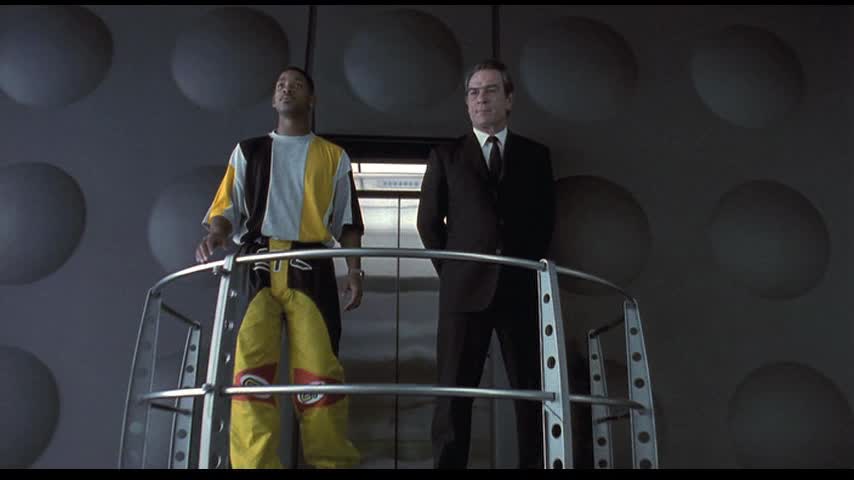
VIDEO ESSAY: MEN IN BLACK: Three Reasons for Criterion Consideration

VIDEO ESSAY: Three Reasons: MEN IN BLACK

For this month’s Criterion Consideration, coming up with a suitable equivalent to Barry Sonnenfeld's latest film, Men in Black III, was a bit of a challenge.  In many ways, the franchise can’t be compared to other films of the genre.  How exactly would you categorize MIB?  An odd couple buddy-cop sci-fi comedy?  Immediately I thought of Ghostbusters, which has been threatening recently to corrupt its origins with an unnecessary sequel, but Ghostbusters had already had its day in the sun when Criterion was still pumping out laserdiscs. I could easily have tried to loosely tie a thousand different titles to MIB III, but really, the only reasonable association is the first film in the franchise.  Like most things, the original is always the best, leaving its successors in the dust.  It's been a decade since we all sat through the utterly intolerable MIB II, and no matter how fresh and shiny Sonnenfeld's latest effort may attempt to be, it will ultimately only remind us of the power of the original film.

Based on the comics by Lowell Cunningham, the original film was an inventive reworking of the Men in Black mythology, a phenomenon that emerged in American pop culture shortly after that supposed UFO-crash incident in Roswell, New Mexico in 1947. Sonnenfeld took further inspiration from the resurgence of conspiracy theory permeating 1990's pop culture. The paranoid visions that pervade The X-Files are rendered to ridiculous extremes as Earth's resident aliens hide in plain sight. What makes Sonnenfeld's film work is the business-as-usual approach that the Men in Black take toward in their daily routine. The black-suited men of mystery are merely intergalactic immigration officers, content to anonymously survey all alien activity in the New York area. Contrary to the shameless marketing strategies that would befall the franchise, the film's offbeat deadpan sensibilities were a welcome break from those of the mainstream blockbusters of that time.

This perfect combination of elements made MIB exceptionally ambitious and artistically innovative.  Sonnenfeld's experience behind the camera (notably with the Coen Brothers' early films) brought a subtle visual wit to an otherwise flashy elaborate blockbuster.  The decision to cast underrated comedians in minor character roles also added class to seemingly minor scenes.  Ed Solomon's writing provided some endlessly quotable one-liners, and helped reinforce the chemistry between Tommy Lee Jones and Will Smith.  The way they play off each other appears genuine, with Jones' straight-faced delivery pitted against Smith's posturing wisecracks.  Rick Baker, the special effects wizard behind every notable sci-fi/horror film from the past thirty years, is allowed to let his imagination run wild, creating some remarkable alien life.

Oddly enough, the qualities that made the first MIB so engaging are exactly what killed its first sequel.  The formula for its success became so immediately apparent that even the original risked losing its charm.  Celebrities quietly suspected of being aliens were now given needless cameos, CGI took over most of the creature effects, and although the relationship between Agent K and J still works quite well, the rest of the film does not.  Early reviews of MIB3 have been mixed, but overall the formula remains unchanged.  Try as Sonnenfeld might to neurolize any trace of Men in Black II, his latest installment might very well be the long-awaited end to a nearly forgotten franchise.

Robert Nishimura is a Japan-based filmmaker, artist, and freelance designer. His designs can be found at Primolandia Productions. You can follow him on Twitter here.

VIDEO ESSAY: BLACK SUNDAY: Three Reasons for Criterion Consideration

VIDEO ESSAY: Burton versus Bava

Just as people ultimately judge a book by its cover, many of us are quick to judge a film by its trailer.  When I was asked to set my sights on Tim Burton's upcoming Dark Shadows, a movie based on the cult TV show of the late 1960s, as my next entry point for Criterion Consideration, I immediately knew where my judgment would most likely fall. I might find it hard to veil my contempt for Burton's recent work. His early films had a profound impact on my childhood and may very well be responsible for who I am today, but as I became an adult Burton began rewriting the rest of my childhood in ways that make me confused and horrified. Remaking the classic films from my youth, Burton has me questioning my admiration. Also, with the upcoming release of his animated Frankenweenie, Burton has begun remaking himself. We could list his later films and describe how the themes and storylines are still consistent with his earlier work, so maybe I just grew out of him. Now, every time I see one of his films, I end up screaming at the screen, vowing never to see the next Tim Burton film. Still, I cannot deny that his films are intriguing, innovative, and entertaining, if not infuriating. In his collaborations with Johnny Depp, Burton has given us classics likeEdward Scissorhands and Ed Wood, capturing some of the finest performances from Depp in eight films thus far, but I wish that Johnny would begin to show more discretion. Shilling for Burton in promotional videos, Johnny admits to instigating him to collaborate on "a vampire film," citing the classics of German Expressionism, Universal Horror films from the 1930s, and the Hammer Studio films as an influence for this new adaptation. Thankfully all those classics of cinema are thrown into the meaningless mess of Dark Shadows. Sporting the worst make-up job since Alice in Wonderland, Depp's Barnabas Collins struts in front of the living legends of horror cinema, including a direct (slap in the) face-to-face cameo with Jonathan Frid (who played the original character on the TV show). Even before I saw the trailer for Dark Shadows, I knew there would most likely be a nod to Mario Bava's first film, Black Sunday (or The Mask of Satan from its original title La maschera del demonio). Burton has been vocal about Bava's influence, and over a decade ago there were rumors that he would remake Black Sunday. That never exactly came to be, but Burton did evoke a lot from the film for his adaptation of Sleepy Hollow, which unmistakably borrows Bava's visual style. 

One of the most important directors in the horror genre, Mario Bava began his career as a cinematographer for Roberto Rossellini during the Italian Neo-Realist movement.  He first learned the tools of the trade from his father Eugenio Bava, who was an expert on special effects and also a cameraman.  Mario then was contracted by Galatea Studios, where his skills as a photographer, as well as his ability to work quickly and efficiently, would bring many of the studio’s films to life with stunning chiaroscuro. His films always show a deep understanding of the history of the horror genre, with its strange settings and eerie environments, and a weird and wonderful worldview that would become Bava's trademark style. That style would later influence many notable directors, such as Ridley Scott (Alien), Joe Dante (The Howling), and Burton himself, in Sleepy Hollow. In the late 50s, Bava would have to complete principle photography for Riccardo Freda, who abandoned his directorial duties on I Vampiri (Lust of the Vampire) because of the tight shooting schedule. Bava would do the same thing again with Freda's Caltiki, The Immortal Monster in 1959. To show his gratitude, Galatea's producer, Lionello Santi, allowed Bava to choose his (official) directorial debut, which was the adaptation of Nikolai Gogol's short story The Vij. While evoking the traditional story of witchcraft and vampirism at the heart of Gogol’s tale, Bava simultaneously paid his respect to the classic Universal Studios' horror films and the (then) contemporary Hammer Horror films with Christopher Lee and Peter Cushing.   Black Sunday relies heavily on the pantheon of 1930's horror, while including the eroticism and gimmicky gore of the new horror wave, creating one of the most beautiful and disturbing horror films of all time.

The film begins with a prologue, describing the superstitious tradition that one day in every century, Satan is allowed to walk the Earth, and his evil disciples can haunt and torment their descendants.  We are introduced to Princess Asa (Barbara Steele, a dead-ringer for Tim Burton's old muse, Lisa Marie) and her lover Javutich (Arturo Dominici) while they are standing trial by the Inquisition for acts of Satan worship and witchcraft.  Asa is branded with the mark of a witch, before having the iron mask of Satan nailed to her face.  Such a gruesome beginning was a standard shock tactic of the time, to keep audiences hooked from the start, but this particular opening was considered so shocking that the British Film Board banned the film for seven years after its release.  Before Princess Asa is put to rest, she vows to return from beyond the grave to seek revenge on her family for condemning her to the Inquisition.  Two centuries later, doctors Kruvajan (Andrea Checchi) and Gorobek (John Richardson) are traveling to Moscow when their carriage conveniently breaks down next to Asa's tomb.  After a slight scuffle with an enormous (and barely visible) bat, Dr. Kruvajan accidentally breaks open her coffin, allowing Princess Asa to return from the grave to torment and acquire the body from her living-image descendant Katia Vajda (also played by Steele).  Her father, Prince Vajda (Ivo Garrani), is the only member who still believes the family's sordid history, and he becomes instantly aware that Asa has returned when he sees the ghostly vision of her mask in his evening cup of tea.  Once Asa summons Javutich from his grave, she hypnotizes Kruvajan to help her exact revenge and take over Katia's body.

nullFilming in gorgeous black and white, Mario Bava was both the cinematographer and the director for Black Sunday, which has proven to be more than just a meaningless homage to the Universal visual standard.  In the decades before Bava’s film, horror had become the subject of parody and pastiche.  Classic monster figures suddenly had brides, reverted back to teenagers, and had mutated into radioactive amalgamations, thanks to a wave of low-budget science-y gimmicks. Bava's chiaroscuro masterpiece harkened back to a simpler time, when horror relied on tense atmospheric emotions, technical skills and claustrophobic mise-en-scene and blocking.  Bava was able to accomplish this entirely on the Galatea backlot, utilizing the masters’ techniques with a distinctively innovative approach.  Keeping his camera on a dolly at all times, the film moves with restless fluidity, creating an ambience unmatched in its time.  When Kruvajan first arrives at Vajda Castle, the camera tracks through endless corridors and secret-passageways before leading him to Asa's tomb.  It's sometimes hard to believe that Bava was able to create such a genuinely creepy atmosphere entirely on set, but his technical background elevated all the tired horror tropes to engaging new levels.  Bava also found an excellent leading lady in Barbara Steele, who would later become the scream queen of Italian horror because of Black Sunday.  Notoriously difficult to work with, Steele created problems for Bava in every regard.  Costumes had to be changed or altered, false vampire teeth had to be remolded (then only to be removed from the film completely), and once Steele refused to come on set because she was convinced the Italians had developed a camera that could shoot through clothing.  But even she remembered fondly Bava's ability as a director and as a cameraman.  Somewhat shy about her status as a horror icon, she attributes her standing to Bava and what he was able to accomplish with Black Sunday.

Bava's magnificently malicious worldview still stands the test of time and hasn't aged a day in light of recent splatter-filled gore-fests currently pass as cinema.  Perhaps it is because Bava's films helped usher in subsequent movements in the horror genre that Black Sunday remains untarnished and undated.  His later film Black Sabbath (with horror legend Boris Karloff) is credited with starting the Italian giallo films and the American slasher movement.  With so many directors indebted to Bava's films, it’s no surprise that a director like Tim Burton would return to Bava again and again for inspiration.  Whether Burton will decide to remake Black Sunday remains to be seen, but if that should ever happen it will only allow the next generation of filmmakers to fully embrace Mario Bava's original film.  Naturally, I would never want Burton to actually reboot Bava's film, since he would most likely set the film in the American 1960s, needlessly inserting some appalling 80s-style comedy.   Maybe before Burton's Dark Shadows is released on DVD, Criterion will seize the chance to bring Black Sunday to Blu-Ray, a format in which it so desperately needs to be seen.  If Criterion chooses the film, it would categorize Black Sunday as a superior work, allowing all of us film hipsters to say, "I told you so" and put directors like Tim Burton in their place.  In the meantime, if you're looking to avoid the long lines at the cinema for Dark Shadows, I highly recommend watching Black Sunday first.  It will not disappoint.

Robert Nishimura is a Japan-based filmmaker, artist, and freelance designer. His designs can be found at Primolandia Productions. You can follow him on Twitter here.

VIDEO ESSAY: Doris Wishman: The First Lena Dunham

Doris Wishman: The First Lena Dunham

In just a few short years, Lena Dunham has quickly made a name for herself in the indie film scene.  In 2010 she caught everyone at the SXSW Film Festival by surprise with her detached but deeply personal debut Tiny Furniture.  She was heralded as the Woody Allen of our generation (or rather, of a generation), and landed at the top of the so-called Mumblecore movement.  Two years later Dunham returned to SXSW with the first three episodes of her new HBO series, Girls, which premieres April 15th.  The event also marked the release of Tiny Furniture on DVD, which could be considered to be the ultimate accomplishment for Dunham or any fledgling filmmaker: acceptance into the Criterion Collection.  (For more insight on the topic Dunham gave a very revealing interview with IndieWire's own Nigel M Smith.)

When Criterion first announced that Tiny Furniture would be in the collection, the decision to include Dunham with such esteemed filmmakers came as quite a surprise to many (who troll the Internet), and even more surprising was the announcement that Dunham was developing a series with HBO, and beyond that, Judd Apatow would serve as producer.  Although it may have seemed to some as if Dunham sold out, Girls is very much a continuation of Tiny Furniture.  Dunham's style is indicative of what independent film has become in the new century:  personal character studies, naturalist, improvised performances in sometimes aimless narratives, all produced on a micro-budget level.  The term Mumblecore itself may be irrelevant at this point, but that label certainly helped a lot of filmmakers get more exposure in a market that relies heavily on categorization.  Dunham has had a privileged upbringing, but her films remain grounded and self-aware.  Dunham is also aware of the implications of setting Girls in New York City, the old stomping grounds of Carrie Bradshaw in Sex and the City.  The story revolves around Hanna (played by Dunham) and her friends as they try to make do in the big city.  Although Dunham's Girls may have been influenced by Sex and the City, it is much more in tune with the generation it portrays.  Playing with the cultural cliché of a girl coming to NY to seek her fortune, Girls might just be the antidote to Bradshaw's artificial quest for love and fame.

Now that I've got your attention with something currently relevant, I'd like to talk about another woman whose films closely resemble Dunham's work and (forgive me) the Mumblecore aesthetic.  Doris Wishman was one of the most prolific female directors working in the sexploitation genre in the 1960s.  In fact, she may have been the only woman working in the field at that time, at least behind the camera.  She began her career making "nudie-cutie" films like Nude on the Moon and Gentlemen Prefer Nature Girls.  Set in Florida's nudist communities, Wishman's early films were loosely tied narratives, haphazardly thrown together for the sole purpose of showing semi-clad (and usually middle-aged) men and women sitting around a pool, playing volleyball, checkers, and other mundane activities.  Like most nudist films, the mere fact that they are partially nude does nothing to make the films more exciting.  In fact, the majority of the films in the nudie-cutie genre are completely unwatchable.  What makes Wishman's films exemplary is her seemingly complete disregard for narrative structure and continuity.  Appropriately regarded as “The Female Ed Wood,” Wishman's work was so poorly executed that it amazes me that she was able to continue for nearly half a century.  But there is a genuine innocence in her work, and a strong visual style that makes her work distinctive.  Albeit unintentionally, her films almost reach levels of paracinematic genius.  She worked cheaply, using non-professional actors (or anyone willing to take their clothes off in front of a camera), shot repeatedly in her own home, dubbed most of the characters with her own voice, and produced completely without outside investors.  Wishman was always able to conform to the shifting demands in the sexploitation market, relying on gimmicks to keep audiences coming (pun intended).

In the mid-sixties Wishman relocated to New York City, which marked a drastic change in her work.  Known as her "roughie" period, these films became much more ambitious but also entered into much darker territory.  Harmless titles like Diary of a Nudist and Hideout in the Sun were replaced by Bad Girls Go to Hell and Indecent Desires.  These films usually centered around a guileless sylph who spirals down to sexual degradation and shame.  The first film in her Roughie Cycle, the wonderfully titled The Sex Perils of Paulette, focuses on an innocent country girl being corrupted by the big city.  In many ways the film is allegorical to Wishman's own life; she left Florida's sunny beaches after a messy divorce forced her to seek out her new life in NYC.  Paulette arrives in the Big Apple with dreams of finding love, success, and becoming a better person.  Once there, Paulette falls into a bad crowd of sexual deviants and sadists.  Like Carrie Bradshaw, Paulette finds her Mr. Big in Tony Lo Bianco, but denies herself the happiness of a normal relationship because NYC has turned her into a "bad girl."

Much like Dunham, Wishman frequently shows us scenes of women inexplicably standing around in their underwear (black lace, a Wishman trademark).  When we are introduced to Tracy (the incomparable Darlene Bennett), Paulette's new flatmate, the camera starts on her face, then slowly moves down to show off her body.  In the film, Wishman abruptly cuts from images like these to images of various knickknacks that happen to be nearby, or sometimes the camera will just sort of meander away.  Although the film was obviously made for men to rub one out in a dark grindhouse theatre, Wishman seemingly avoided all the 'money shots' by inserting images of feminine desires, or as in this case, by showing off the interior of her house.  Scenes are often cut out of sequence, much like Jean Luc Godard's Pierrot le fou, which coincidentally was released the same year as Sex Perils.  Although it is highly unlikely that Wishman was aware of Godard's work and the distancing techniques of the nouvelle vague, Wishman seemed to have tapped into the creative consciousness at that particular cultural moment and interpreted them in her own unique way.  Wishman made her narratives even more complicated than those of the New Wave style.   Since Wishman used silent film stock, she often relied on reaction shots, so that she could dub her own voice in afterwards, seemingly improvising the voice-over narration after she edited the footage together.  The result is a bizarre, almost surreal exercise in anti-erotica, completely composed of reaction shots and random cutaways.  Wishman didn't seem to have much interest in sex. Instead she focused on potted plants, radios, beauty accessories, and lots of foot shots, with just enough accidental yonic imagery to validate its cinematic worth and allow film students like Lena Dunham to keep turning in term papers. While it might amuse some film students to ironically distance themselves from Wishman's work, it could be just as rewarding to simply accept Wishman's bizarre world view like that of any other auteur.

Doris Wishman had 30 films to her credit, although the exact number is uncertain, since she used multiple aliases, and in some cases disowned certain titles that she wasn't happy with.  She would also rerelease her films with different titles to make a quick buck.  She eventually dipped into hardcore in the late seventies (although Wishman was adamantly opposed to it, supposedly leaving the room whenever hardcore scenes were shot).  When hardcore pornography became too extreme, Wishman gave up her career as a filmmaker and returned to Florida, getting a job at a cosmetics store.  Her career comeback came long after the sexploitation market had dissolved.  Thanks to the home video market, Wishman was able to enjoy a brief return to filmmaking with Dildo Heaven in 2002.  Sadly, Doris passed away while making her final film, Each Time I Kill later that same year.  John Waters helped to release the film posthumously in 2007 and has a cameo as well, as does B-52's frontman Fred Schneider, but no DVD is available at this time.  Criterion should just release all the unedited footage as a supplemental feature, much like Charles Laughton Directs Night of the Hunter—it would be an outstanding document of a genius at work.  Wishman's legacy needs proper recognition if we are to truly appreciate Dunham's Girls and the evolution of the girl-in-the-city subgenre.  An Eclipse set of Wishman's Roughie Cycle would be an ideal starting point for Criterion, followed by a set dedicated to her nudie-cutie films.  Should Criterion decide to include Wishman in the collection for a mainline release, The Sex Perils of Paulette would be the perfect choice.

Robert Nishimura is a Japan-based filmmaker, artist, and freelance designer. Born and raised in Panamá, he then moved to the US, working at the University of Pittsburgh and co-directing Life During Wartime, a short-lived video collective for local television. After fleeing to Japan, he co-founded the Capi Gallery in Western Honshu before becoming a permanent resident. He currently is designing for DVD distributors in Japan and the US, making short and feature films independently, and is a contributing artist for the H.P. France Group and their affiliate companies. All of his designs can be found at Primolandia Productions and his non-commercial video work is at For Criterion Consideration.

THREE REASONS: ELECTRA GLIDE IN BLUE, directed by James William Guercio

THREE REASONS: ELECTRA GLIDE IN BLUE, directed by James William Guercio


[EDITOR'S NOTE: Contributor Robert Nishimura's video series Three Reasons continues with James William Guercio's Electra Glide In Blue. He feels this cult film is a perfect candidate for restoration and release on the Criterion label.]

Cult films have always remained one of the more enigmatic areas in Cinema Studies. There doesn't seem to be a distinct aesthetic that all cult films follow. Films that have been deemed cult-worthy come from any genre, country or time period. They are not limited to the independent or the underground, either. More often than not, cult films come from Hollywood's fly-by-night flops that end up in the bargain bin only to be fished out by eager or unsuspecting viewers. Since most cult films evade any common elements, any critical investigation on the subject quickly falls apart. The only definitive thread in this phenomenon is the fanatical devotion of its audience. Like any cult, the uncompromising worship among their marginal fan bases are what set these films apart from the rest.  

Cult Cinema Studies really began with the advent of home-viewing technologies. Danny Peary's landmark book, Cult Movies (1981), was the first to make that classification, collecting all the obscure films and the extreme effects they have on their audiences. For the first time, fans could cull their resources to satiate their limitless appetites for that obscure film of their desire. Tape trading, bootlegging, midnight screenings and fan conventions became an immediate subculture that progressed so quickly that we have already reached the point where you would be hard-pressed to find someone who WASN'T a cultist in some regard. Social media sites and apps seem to be tailor-made for the cultist, allowing instant access and confirmation. Thirty years later the inmates are already running the asylum.

nullThe most important component that entices the cult film fan is the film's relative obscurity – the exclusivity that comes from finding a rare cinematic gem, being a part of the privileged few who know about it, obsess over it, and quote from it incessantly. Prime examples for cultist celebration are films that had a limited run or never saw a proper release. Usually this was due to poor initial reviews or controversy involving the production or subject matter. The most popular examples of the cult film are those which, by mainstream standards, are "bad" movies. The argument that "it's so bad, it's good" is one that allows fans to have an ironic distance from the films, and is the major pitfall in the cultist ethos. The pinnacle of this would be the riffing maestros who ran Mystery Science Theatre 3000, their constant comedic commentary even overshadowing a few "good" movies. Another unfortunate aspect of the cult film is that once a film is given that status, it rarely, if at all, is allowed to transcend that distinction. The kitsch label is impossible to shake.

Such is the case with James William Guercio and his sole directorial effort, Electra Glide in Blue. Loathed and lambasted by critics upon its release, it came and went with nary a second thought until the cultists got their hands on it. It was too easily regarded as a Republican response to Easy Rider, which is probably why it was labeled “fascist” by critics and the hippie movement of which the film takes aim. But Electra Glide in Blue offers much more in its politics, style and genre than any film to emerge from the ‘70s counterculture. Easy Rider, in addition to kick-starting the New Hollywood movement, was the touchstone of a generation. It has become the quintessential document of the ‘60s counterculture movement, the transformation of the American Dream and the rise and fall of the hippie movement. Electra Glide in Blue offers much of the same thing, only from the pig's point of view. That is not to say it justifies the actions of the conservative right; it is a condemnation of both sides, and its moral ambiguity would mark the beginning of a new era in film history. If Easy Rider should be the film that encapsulates the decade of the ‘60s, Electra Glide in Blue deserves that distinction for the decade that followed.

nullRobert Blake gives an amazingly humane performance as John Wintergreen, an Arizona motorcycle cop whose moral code is so steadfast that it stands in opposition to both the left and the right. Wintergreen ritualizes his preparation for work, donning his uniform, determined to uphold the letter of the law in the protection of the innocent. Wintergreen only wants to get away from "the white elephant" they make him ride and become a detective, where he would be paid to think and not merely pass out speeding tickets. When he stumbles upon an apparent suicide in this sleepy little town, only Wintergreen can recognize it as a homicide, and is finally given an opportunity to show his skills as a detective. Under the inept tutelage of a senior detective, Wintergreen quickly realizes that corruption and ignorance is beset on both sides of the law. The opposing forces of the right and left leave Wintergreen little space to stand his own ground as a humanist.

At the time of its release, the knee jerk reaction by critics to classify the film as fascist was to be expected. The Vietnam War was still raging, the counterculture movement stood in such a stark contrast to the conservative right that there was no room for a neutral middle ground – certainly not from a motorcycle cop. Everyone in the film except Wintergreen is a caricature, from the long-haired pig-farming hippies to the racist, fascist rednecks who torment them. Both sides are ludicrous representations, but each are guilty of have the same narrow viewpoint. Electra Glide in Blue doesn't take sides; it only portrays the shortcomings of a two-sided argument. Never more applicable than today, a humanist without affiliation will only be drowned out by the clash of the right and left, Democrats and Republicans, Pepsi and Coke. The cultist phenomenon mirrors this same ambiguity in regard to viewer ownership and appreciation. The cultist can position films by Jean-Luc Godard and sexploitationist Doris Wishman on the same pedestal. The political message of each film(maker) is irrelevant to the cultist, only it's entertainment value.

nullJust as its politics were easily misconstrued, Electra Glide in Blue takes on various styles which makes it difficult to define. Rarely do we find a more confident directorial debut that runs the gamut from experimentalism to classic traditionalism. James William Guercio began his career as the producer of The Chicago Transit Authority (better known as just Chicago), and his roots in music production shine through. The film has elements of a concert film and frequent moments of musical montage. On the surface it seems like a typical murder mystery, but as in its Easy Rider counterpart, the plot has little consequence on how the story unfolds. Guercio was set to make a modern western parable and hired veteran cinematographer Conrad L. Hall, who had just won the Oscar for Butch Cassidy and the Sundance Kid. Setting the film in Arizona's Monument Valley, Guercio allows Wintergreen (and the viewer) to soak up the landscape. At several points in the film, usually at Wintergreen's introspective moments, Hall's beautiful cinematography lingers on the surroundings, evoking the same spirit of John Ford's western classics. Similarly, Guercio's Wintergreen acts as the lone lawman, supervising the desolate expanse of lawlessness. By the end of the film, Guercio accentuates this theme by having what may be one of the longest single-take tracking shots in film history. The long and winding road on which Wintergreen has served and protected will be his final resting place. For those who have already seen Electra Glide in Blue, it's easy to see why it has been given the cult film seal of approval. The cultist can recognize the value in this rarely seen film. But the cult film usually stands outside the canon of widely accepted films. On the surface, the film could be associated with the countless exploitation flicks that flooded the market after the Easy Rider/Biker Film craze had its heyday. Or it could be Robert Blake's current infamy that keeps the film within the cultist realm. Electra Glide in Blue isn't a lost or forgotten film, it's just been unjustly ignored as socially relevant. We have already reached the point where all information is readily available. Cultural memes and viral videos are continually introduced at a breakneck speed, so the very idea of cult status has become redundant and irrelevant. Forgotten films are no longer inaccessible for those outside the cult. All things are available for public evaluation, and Electra Glide in Blue deserves to be reevaluated by mainstream audiences. It is a film ahead of its time, in form, politics and it's compassion for humankind.

Robert Nishimura is a Japan-based filmmaker, artist, and freelance designer. His designs can be found at Primolandia Productions. His non-commercial video work is at For Criterion Consideration. You can follow him on Twitter here. To watch other videos in his "Three Reasons" series, click here.

THREE REASONS FOR CRITERION CONSIDERATION: Shuji Terayama’s PASTORAL, TO DIE FOR THE COUNTRY (1974)

THREE REASONS FOR CRITERION CONSIDERATION: Shuji Terayama’s PASTORAL, TO DIE FOR THE COUNTRY (1974)

null

[EDITOR'S NOTE: Press Play's Robert Nishimura spotlights the provocative career of the late Japanese avant-garde director Shuji Terayama. He has created this essay with the accompanying trailer for Pastoral, To Die In The Country in an effort to convince Criterion to restore and release this important work as part of its collection.]

Every great filmmaker reaches a point in their career when they need to reflect upon their life and childhood, tracing the path that lead them to where they are today. Most often these nostalgic quandaries find their way into new fictionalized scenarios, drawing on personal experience to entertain themselves as well as audiences. Sometimes a director takes a more direct approach, probing their past in the form of autobiographical diaries. Our experiences as children inevitably make us who we are today, and tapping into those memories can provide some tasty material for any filmmaker who questions why they make the kind of films they make. (Look to Federico Fellini’s entire career for further evidence of that point.) Not all memories are immediately accessible to recall, especially those associated with extreme emotional connections.

Those particular memories are stored in the deep recesses of our subconscious and often emerge in our dreams; even then, they're not exactly clearly defined. So, then, what happens when a director decides to make a film about their childhood, but also must confront issues of psychological trauma that have been buried within their subconscious? The result is Shûji Terayama's Pastoral, To Die in the Country, a film so unique and spellbinding that it transcends all classification.
null
Shûji Terayama is probably the most radically subversive yet well-respected director in Japanese film history. He was the filmmaker's filmmaker, a media darling and a true Renaissance man. For many directors from the 1970s onward, Terayama was pure inspiration. In my previous Three Reasons installment for The Noisy Requiem, Matsui Yoshihiko told me that seeing Pastoral was an eye-opening experience, one that immediately inspired him to become a filmmaker himself. In Japan, Terayama was a well-known poet, artist, writer, street performer and leading figure in Japan's growing avant-garde theater movement in Tokyo. He had a profound effect on the art community in Tokyo, but remained elusive to mainstream attention outside of Japan. One of his first films, Emperor Tomato Ketchup, a wildly experimental short in which children overthrow the adult world, shocked critics upon its release and managed to get banned outright in several countries. Despite being completely avant-garde and metaphoric, what offended the censors were the film's scenes of simulated sex involving children. By today's standards, these same scenes would hardly lift an eyebrow. Even a casual Freudian reading of the film reveals what would be his strongest contextual trademark: serious mommy issues.

For anyone who would like to know more about Terayama's life, Pastoral is as good a place as any to start. For the most part it is an autobiographical film, teaching us all about Terayama's upbringing in a small countryside village in Aomori Prefecture. After losing his father during WWII, Shûji was raised by his very domineering mother as well as the determinedly traditional and superstitious townspeople. We see Shûji compete with these traditional values, struggling to find stimuli and sexual satisfaction in a small town that is very much stuck in time. All Shûji wants to do is break away from his mother and the other backward hillbillies, get laid by the milf next door and catch the first train out of town. Such a synopsis might very well have been from the movie you watched last night at the multiplex (like Judd Apatow's Midnight Train to Bonerland, coming to a cinema near you…probably), but Pastoral is in no way a traditional narrative. Just as our own memory becomes fragmented and nonlinear, Terayama utilizes the same disjointed dream logic that corrupts all our memories. Characters float in and out inexplicably, settings change without warning, the cinematography and editing are highly expressionistic, and just when you start getting comfortable with this style of storytelling the film abruptly stops. Halfway through Pastoral, we learn that not only are we watching a film, but that Terayama hasn't finished making it yet. The director (played by Kantarô Suga) isn't satisfied with how things are going and must go back in time, enter his own film and change the outcome.
null
The film begins (as does the Three Reasons video) with his earliest childhood memory: playing kakurenbo (the Japanese equivalent to hide and seek) in a cemetery. As little Shûji lifts his head to find his playmates, all the people associated with his youth come creeping into view from behind the tombstones. At this point we see that all the characters in the film are wearing whiteface, a characteristic usually reserved for ghosts. But these are not ghosts come to haunt him, they are the specters of his past that have become faded over time, himself included. These characters are stuck in time as well as place. Terayama uses images of clocks throughout the film to exemplify this point, especially in his own childhood home, where his mother's refusal to fix their broken clock indicates her unwillingness to change, forcing young Shûji to be stuck along with her. The film maintains dull monochromatic tones whenever Terayama is at home or in the village. The villagers are represented by a coven of black-hooded, eyepatch-wearing old women who keep the town in a stranglehold of superstition. Just outside the town is a traveling circus troupe, constantly preparing for a show that never occurs. Whenever we visit this particular location, a kaleidoscopic spectrum of color fills the screen and covers the circus characters. For Terayama, these characters represent modernity with their wild sexual escapades and complete freedom from time and tradition. Once Shûji is exposed to these people his desire to run away is firmly cemented. The only thing holding him back is his mother.

Terayama once wrote that life was like an enormous outgoing book. So if we needed to change something about ourselves, we need only go back and rewrite what happened. Pastoral represents his desire to do just that. This is why the Terayama character must go back and confront his younger self. In order to complete his film Terayama must convince his younger self of what needs to be done: kill their mother. In scenes where Terayama is in contact with the younger Shûji, his subconscious is allowed to run wild. Free associations and dream-derived figures parade past the two Terayamas in one particularly beautiful sequence. Fans of Luis Buñuel's surrealistic films or Guy Maddin's recent introspective films will find a kindred spirit in Terayama. But in many ways Terayama is Maddin's stylistic opposite, and Buñuel couldn't hold a two-sided candle to the effortless phantasmagorical freedom of Pastoral.
null
Albeit titled "For Criterion Consideration," I largely use that phrase as a euphemism. This film needs to be seen; I just point to Criterion because they are respected for bringing important films to a wider audience (in the best editions, etc., etc.). Needless to say, Pastoral, To Die in the Country is an important film by an important filmmaker. The unfortunate fact that none of Terayama's films are distributed anywhere outside of Japan forces determined cinephiles to use questionably legal means to find them. Japan's FilmForum does have the English-friendly four volume compilation of Terayama's short films, which includes the oh-my-god-think-of-the-children Emperor Tomato Ketchup. Die-hard fans of Japanese cinema or the avant-garde will know Terayama, but it is time that the West pay their proper respects to a great filmmaker by allowing his films to be widely seen. I cannot think of a better salute to Shûji Terayama than a Criterion release in the U.S. or a Masters of Cinema release in the U.K.

Robert Nishimura is a Japan-based filmmaker, artist, and freelance designer. Born and raised in Panamá, he then moved to the US, working at the University of Pittsburgh and co-directing Life During Wartime, a short-lived video collective for local television. After fleeing to Japan, he co-founded the Capi Gallery in Western Honshu before becoming a permanent resident.