


Warning: This piece contains aggressive and open use of spoilers. In fact, spoilers are crucial to the piece. So, if you don’t want to hear about the surprise ending, where everyone leaves on a bal–oops. Never mind.
In the late 1980s, radio commentator Ian Shoales said he didn’t like The Big Chill‘s characters because he was positive none of them would have been friends with him in high school, or words to that effect. The four friends who form the center of Drinking Buddies, though not unlikeable, give off a similar whiff of coolness—so much so, in fact, that they resemble archetypes of young, urban hipsters. This is only worthy of mention, really, because coolness, or its lack, is a defining part of the film, and where each character falls on the film’s coolness axis at any given moment in the film is inversely proportional to that character’s ability to resonate with the unassuming, unsuspecting audience member.
Two of these four confused lovers work at a microbrewery, a perfect fit for them. The microbrew has long been an acknowledged emblem of hipsterhood, regardless of how many knit-capped gals and fellas might clutch Pabst Blue Ribbon 16-ouncers in however many over-crowded performance spaces these days. The brewery provides a perfect Petri dish in which cool affectations can grow and flourish—as when Kate (Olivia Wilde) wears sunglasses at work all too frequently, perhaps to hide hangovers earned after nights spent drinking with friends, but perhaps not. Wilde is comfortable and calm in this role—it’s not a complex part, at first blush, but she uses it to occupy the screen effectively, in the best sense of the word occupy: to inhabit, to live in, to stretch out within. Her friend Luke (Jake Johnson) should be a familiar figure to anyone who’s ever eaten in a gastropub, or been to a show in a hipster deposit area such as Williamsburg, Brooklyn—he has an artfully sloppy beard, he wears a gimme-cap indoors and outdoors, he likes building bonfires (a time-honored hipster ritual), and the company he keeps (artists and other clean-cut, well-spoken types) doesn’t match his folksy exterior. He’s on roughly the same high point of the coolness axis as Kate, for most of the movie. Most of it.
Kate’s boyfriend, Chris (Ron Livingston), is at the other end of that axis, as is Luke’s girlfriend, Jill (Anna Kendrick). Chris seems to be a writer, of some kind, though it’s not clear what type. Livingston is masterful here; Chris has an ingrained arrogance about him which he tries to cover up with a rustic, outdoorsy, wholesome affect, but can’t, quite, and it’s easy to sympathize with his failure. Uncool gestures issue from him like a series of violent sneezes he is helpless to control. In one particularly poignant moment, he lends Kate a copy of Rabbit, Run, a notable misstep, given that John Updike, apart from being one of America’s great prose stylists, was a master of near-pornographic sex scenes in which female characters were almost always objects, rarely subjects. Jill, also, is a wonderfully awkward special education teacher and artist; Kendrick is miles away, in this film, from her breakout role as the malfunctioning corporate drone in Up in the Air, spending her off-hours here making dioramas. When the film requires Jill to step outside of her comfort zone, to handle the possibility that she might have done something devious, she can’t—and all we can think of is that Kate would have handled a similar challenge with far more poise and, yes, cool. We can’t be sure if this is a good thing.
So what happens to rock the apple cart? These characters drink, a lot, as a rule. When you take them out of Chicago and into the woods for a weekend retreat near a beach, well . . . what do you think’s going to happen? Boundaries are crossed: first one, and then the other, and at the end, who breaks up? Kate and her boyfriend. All in all, this isn’t surprising; Chris doesn’t have much of a chance, here, among Kate’s crowd, and he knows it, which is why, after the weekend’s events, he calls things off. What tilts the film in Kate’s favor, though, is the facial expression she makes before Chris is about to break up with her, when he says, in simple terms, that they have to talk; she mashes her lips, and she grimaces, and we know, at this moment, that she’s really feeling something, that she’s reached the antithesis of cool. When is Jill’s uncool moment? Most of the movie, perhaps, but most notably when she returns early from a tropical vacation, crying because she’s done wrong by her man, Luke, and the honest girl inside her can’t stand the thought of it. And Luke? Luke collapses when, after helping Kate move, ripping his hands up on sofa nails, and getting into a fist fight with a stranger over parking, he can’t get Kate to spend time with him alone. The gimme cap, the beard, and the down-to-earth affect help Luke very little here, and he knows he’s whipped; when she suggests they hang out with friends, he makes fun of her, but he ultimately has to leave, his mimicry coming across as empty whining more than anything else. At these moments, the film casts an anchor out, and it hits bottom; we know, after waiting patiently, that we are in the presence of humans. It’s reassuring.
Joe Swanberg, as has been duly noted elsewhere, is building a portrait of a generation with his body of work. You’ve been next to these people at the grocery store, you may have ridden on subways with them, you’ve seen them at certain movie theaters, you’ve most definitely seen them at coffee shops. It’s easy to imagine that, as Swanberg’s films expand in scope, the crisis his characters face, the crucial question—can my plaid, my organic coffee, and my iPod survive my larger life crisis?—will become a more and more resounding issue, until it’s almost deafening. This is a moving, coherent film that could communicate to viewers at any point in the coolness spectrum—the question is, how far is Swanberg willing to depart from that frame of reference to tell a story?
Max Winter is the Editor of Press Play.
 For a culture obsessed with maintaining control—over our


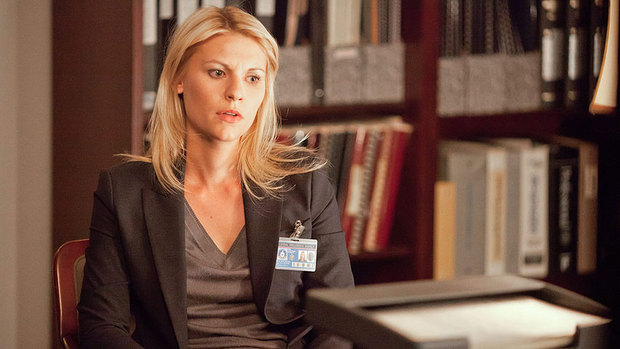

 Carrie’s a character whose entire life, as the brilliant credits sequence reminds us every week, is literally defined by terrorism, fear and trying to control that fear by building a life, a personage as a person in strict control, serving her country, her profession and the one real man in her life, her mentor and father figure Saul Berenson (the mighty Mandy Patinkin).
 Right, bipolar disorder. I didn’t mention that, to add some tension spice to Carrie’s character, Homeland makes Carrie suffer really badly from bipolar disorder. Like, it’s so bad that she has to take her meds every day or else she’ll go into a manic tailspin and lose her mind. The poor thing, she can’t even go to a regular doctor for those meds because the C.I.A. would kick her out as a security risk. So, she visits her psychiatrist sister on the down-low for her weekly supply, which translates into even more suspense, and some shame and anxiety to boot; this bipolar thing is paying off big-time and all they had to do was say she has it. Poor Carrie. This is going to be one rough season.
 Don't get me wrong: I don’t suggest Homeland hang itself on the horns of scientific accuracy (or a WebMD search). I just ask that it create a ‘verse where there are laws for Carrie’s condition, and then stick to those laws, like the way Vulcans can or can’t intermarry and the like. (On the other hand, absurdity met ugliness when the showrunners had Carrie, in deep depression, diagnosing herself – with her sister mutely complicit – for electroconvulsive therapy, a.k.a. shock treatment, a controversial, risky, cognition- and memory-impairing but highly photogenic treatment calling for Danes to be strapped and gagged, electrodes glued to her scalp. Then they cranked the juice as her body spasmed grotesquely. If you’re suffering from depression, there are a million other ways to get help – this is just an ignorant TV show by the guys who made the torture-happy 24.)
 Meanwhile, in Brody’s frequent shirtless scenes we see his scars and their implied memories of unimaginable months of pain and horror, which now have no apparent effect. (Even his attempted terrorist act is based not on torture, but on love of a child.) This is Spielbergism; take a sad song and make it ludicrously better, one-upping it by saying the sad song doesn’t exist even as you’re looking at it.

 You’d have to work pretty hard to cover up that kind of wear, but that’s kind of the point of Ghost Protocol: Cruise’s Hunt is not in denial. He’s in great shape – did you not see him clean up the world’s tallest building in Dubai? Or, on foot in a sand storm, running around like a madman? Or crashing several BMW luxury sedans? Just think of Tom Cruise’s face as the portrait of Dorian Gray, which I guess makes his body Dorian Gray…except in Ghost Protocol, Dorian Gray is galloping around the world with his portrait on display. Which is…odd, to say the least.
 But in all seriousness, Ghost Protocol needs Cruise’s over-seriousness and his tendency of making himself look that much more focused, that much more determined and that much more capable than everyone around him. Even newcomer Jeremy Renner looks like a girly man compared to Cruise, like in the scene where Renner is floating around (literally, floating around) in an overheated subterranean tunnel while wearing a chain mail suit that levitates his whole body.
 Press Play Video Blog