Truth, Based on a Story: Disney’s MILLION DOLLAR ARM

Truth, Based on a Story: Disney’s MILLION DOLLAR ARM

nullSport is blessed with narrative. In no sport is this more
apparent than in baseball. Through an affection for and addiction to
statistics, one can draw lines between a century of stories. The game, unlike
most others, has barely changed since Abner Doubleday claimed to have invented
it. There’s wooden bats, leather gloves, nine innings, and at any point,
anything can happen. Its exposition is what writers dream of having the talent
to divine. Which makes Hollywood’s penchant for altering its history so
confounding, as displayed once again in Disney’s Million Dollar Arm. In altering the truth the film unnecessarily
takes a compelling story and makes it a contrived and derivative Hollywood tale
of the American Dream.


Million
Dollar Arm
is based on a true story born for the silver screen, the
tale of two poor Indians who through luck, happenstance, and determined will found
themselves pitching for a chance at major league contracts. It was quite
literally a rags to riches story. Unfortunately, the film has Disney-fied the
story, corrupting its narrative, and producing a feature that is a victim of
its own attempts to be successful. Cursory investigation of the real story
behind Million Dollar Arm suggests
the filmmakers left a better movie somewhere in the ether of truth.

This has been done before with baseball films. Recently, Bennett
Miller’s Moneyball, the story of
baseball’s statistical analysis revolution,
altered timelines in order to suit Steven Zaillian and Aaron Sorkin’s
script’s desires. Oakland A’s first baseman Carlos Peña is a star on the rise in
the film, which was not the case in reality. Philip Seymour Hoffman’s brilliant
portrayal of A’s manager Art Howe is an interpretation of the real man, and not
at all what Howe or other A’s of that era claim him to be. And Jeremy Giambi is
presented as a player added to the Oakland A’s roster before the season upon
which the film is based, when in fact he was on the team the year before, and
was involved in one of baseball’s most notorious plays, New York Yankees’ Derek
Jeter’s “flip play” in the 2001 American League Division Series. The
changes were not major, leaving one to wonder: Why make the changes at all?

In a sport whose fans are manic and devout in their faith
in statistics and lore, why rewrite an already compelling story? Million Dollar Arm falls victim to the
Hollywood treatment in its attempt to make the story a contrived fantasy about
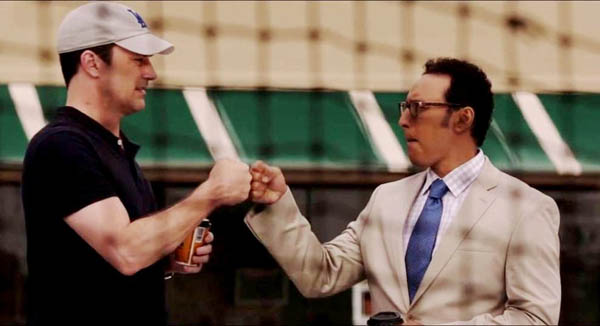
the American Dream. Sports agent J.B. Bernstein (Jon Hamm) and his partner Ash
Vasudevan (Aasif Mandvi) are struggling to make their agency thrive in an era
of greed and opulence. Times may be hard indeed: how else might Bernstein be
about to lose his Porsche and palatial L.A. home? In the film, Bernstein comes
up with the idea (while watching cricket and Britain’s Got Talent, no less) to search India for the next great
baseball talent. In reality, Vasudevan was a venture capitalist whose partner
Will Chang came up with the scheme. Would the truth have made a less compelling
film? Not at all.

The true failure in Million
Dollar Arm
is not in its reworking of history but in its choice of the lens
through which history is filtered. Disney chose Hamm’s Bernstein, so that a pretty
man with pretty things could get more pretty things, including a pretty wife,
and somewhere along the way have an epiphanical father figure transition moment
all within a 2-hour run time. A more interesting, compelling, and logical
choice would have been to tell the story through the eyes of the aspiring
Indian ball players Rinku Singh (Suraj Sharma) and Dinesh Patel (Madhur Mittal).
The two youngsters came from nothing and, in real life, ended up far from home
with their one billion countrymen watching as they attempt to do the
impossible. The film touches on their story, obviously, but addresses them as noble
savages, insulting the audience and illustrating the simplicity of the
Hollywood film factory.

Even if the filmmakers had been afraid of non-white males
as leads, another option would’ve been to explore the story through Tom House
(Bill Paxton), the exiled former Major League pitcher and coach, among the
first major leaguers to use steroids, whose coaching techniques were
controversial, using research and technology to assess training needs, and
frowned upon by the traditions of the sport, not unlike the statheads at the
core of Moneyball. There is a natural
redemption story in House’s tale as he attempts to take two boys who know
nothing about a complicated game, who have never held a baseball, and make them
legitimate prospects. But, Tom House is not pretty, and perhaps already had
enough pretty things from a major league baseball career that the filmmakers
figured his story was not one that audience would want to be spoon-fed.

The preposterous misguided swagger of Hollywoodism is
confounding. A producer of last year’s 42
might well have suggested in a meeting to make Jackie Robinson Asian in order
to appeal to the lucrative foreign market. Perhaps in a remake The Pride of the Yankees, Lou Gehrig
could discover a cure for ALS, and rejoin the Yankees as manager, leading them
to a dynasty in the ‘80s. ESPN’s The
Bronx Is Burning
, the story of the 1977 Yankees set against the backdrop of
a tortuous summer for New York: blackouts, looting, finanical peril, and the
NYPD’s hunt for the Son of Sam, would have been a far better film had John
Turturro’s Billy Martin caught David Berkowitz, kicked his drinking problem,
found a cure for the energy crisis, and single-handedly put out out the fires
that raged through the Bronx in the summer of 1977.

There are other odd discrepancies in Million Dollar Arm. Patel’s subplot of wanting to buy his father a
new delivery truck is all Disney. Brenda Fenwick (Lake Bell), Bernstein’s love
interest (because you need a love interest) was not a doctor, as she is in the
film. And Patel and Singh were actually from East St. Louis, and not Lucknow,
India. Okay, that last part isn’t true, but: Hollywood indulges in changes to
stories because they don’t trust in the audience’s ability to consume truth.
But baseball is rooted in truth, truth that can be traced back and forward
through generations. That truth is the sport’s lifeblood, its essence, and to alter
it is folly. Million Dollar Arm is
not a horrible film, but in its wake we’re left to wonder if a better film
existed in the truth they chose not to tell.

Mike Spry is a writer, editor, and columnist who has written for The
Toronto Star, Maisonneuve, and The Smoking Jacket, among
others, and contributes to MTV’s
 PLAY
with AJ
. He is the author of the poetry collection JACK (Snare
Books, 2008) and
Bourbon & Eventide (Invisible Publoshing, 2014), the short story collection Distillery Songs (Insomniac Press,
2011), and the co-author of
Cheap Throat: The Diary of a Locked-Out
Hockey Player
(Found Press,
2013).
Follow him on Twitter @mdspry.
Better Red Than Dead: Director Gabe Polsky Revisits the Cold War Through Hockey

Better Red Than Dead: Director Gabe Polsky Revisits the Cold War Through Hockey

Sport is nothing if not a battle
of ideologies. The West Coast offense versus the Option. Tradition versus sabermetrics.
Defense wins championships. In the Cold War era, international sport provided a
unique look into all manners of ideology, from citizens’ approach to sport to
the all-encompassing Communism versus Social Democracy debate. From Olympic
boycotts to defections to Rocky IV,
sport provided a venue for discussion of larger issues of ideology through the
microcosm of its very nature and metaphor. Nowhere was this more evident than
in hockey.

As a Canadian, I was taught the
greatest hockey team of all-time was the 1972 Team Canada that beat the Soviets
at the Summit Series. Paul Henderson’s series-clinching goal had as much
magnitude as our national anthem. Similar arguments were made of the 1987
Canada Cup team that boasted both Wayne Gretzky and Mario Lemieux. That’s the
greatest hockey I’ve ever seen, or likely ever will see.

For Americans, I imagine a
similar argument could be made for the 1980 Miracle on Ice in Lake Placid
(they’d be wrong, but my nationalist bias causes me to digress), if not for the
team then for the virtue of its victory. But history is born of nationalism,
written not so much by the victors, as Winston Churchill suggested, but rather by
those with a medium with which to argue who was the greatest, who were the
heroes, the villains, and indeed the victors. Filmmaker Gabe Polsky’s upcoming documentary
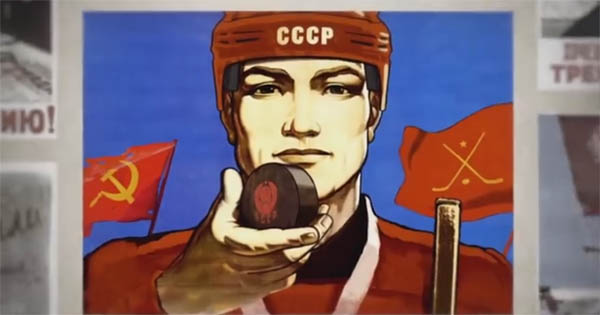
Red Army “tells the story of the most
dominant sports team in history: the Soviet Union’s Red Army ice hockey
team.” 

Polsky is the son of
Russian-Ukrainian immigrants, and grew up in Chicago. He played hockey at Yale.
I don’t for a second doubt his credentials as a hockey documentarian (even though my Canadian
passport demands I should) nor his affection for his subject matter (it is
infectious). But my immediate reaction, as a Canadian, as a hockey fan, to the
above quote from the film’s production company was: I’ve got a whole country
that disagrees with you. However, I will admit, Polsky’s argument is
compelling. And according to its director, Red
Army
is about more than hockey. It’s about an era. It’s about the rise and
fall of an ideology, and the end of the Cold War.

While North American hockey was,
and is, built around stars, the Red Army team was more interested in the
collective. As Polsky says, “A lot of Soviet ideology ended up in sport. They
didn’t emphasize the individual.” This shouldn’t be that much of a surprise, as
the Red Army team was the international face of a communist dictatorship. They
took their brand of hockey and social order around the world, to battle on the
ice and in spectators’ minds.

As a student of the game, I had
always believed that creativity was born of individuals such as Gretzky, Orr,
Lemieux, who took us out of our seats to revel in their artistry.
Interestingly, Polsky argues the opposite, that it is the collective approach that
truly bred creativity, likening it to “what Brazilians did with soccer…
[they’re] more creative and they have more style to the game, brought a more
artistic approach to the game. A more beautiful game.”

Red Army uses Soviet defenseman Viacheslav Fetisov as a
narrator of sorts, a vehicle through which to tell the film’s story. Fetisov
played through “three generations of Soviet teams,” and was one of the first
wave of Russians to be allowed to play in the NHL. What’s compelling for Polsky,
a hockey fan who grew up during these eras, is the transition of Fetisov from
enemy (on the Red Army teams), to sympathetic character (in his desire to play
in the NHL), to endearing fan favorite (in his later years with the Detroit Red
Wings). Polsky sees Fetisov as the ultimate embodiment of the Cold War, from its
rise to its eventual fall.

If Fetisov’s story represents the
arc of the protagonist, then the story’s antagonist is Viktor Tikhonov, the head
coach of the Red Army team during its most dominant era. Tikhonov was the
communist dictator of a team during a communist dictatorship. To his team, he
was the USSR itself. When I was growing up, invested and engrossed in the later
era Super Series and the 1987 Canada Cup, I recall thinking Tikhonov’s embodiment
of evil was straight out of a Bond film, and indeed Polsky calls him a “perfect
villain.”

The director recalls a story of Vladislav
Tretiak, perhaps the greatest goaltender to ever strap on pads, asking his
coach if he could train at home because he wanted to see his family. Tikhonov
told him “no” and that if he didn’t train with the collective he “wasn’t
playing.” Contrast this with Tretiak’s rival and competition for the greatest
goalie ever title, the Montreal Canadiens’ Ken Dryden, who sat out during the
1973-74 season over a contract dispute, and used that year to complete a law
degree at McGill University. Perhaps nowhere better can we see the vast
difference between the ideologies resting on opposite sides of the globe than
in the dichotomy of the goaltenders’ narratives.

Just as communism never made it
stateside, the practices of the Red Army team never became part of the habits
of the NHL, with the exception of the Scotty Bowman-era Red Wings, who employed
the Red Army’s 5-man units, as opposed to the North American system, which
interchanges 4 forward lines and 3 defense pairings. Interestingly, Fetisov
(who Bowman drafted in 1975 while coach of the Montreal Canadiens, despite
knowing he’d never be allowed to come to the NHL) was a part of those team, as
were Red Army disciples Vyacheslav Kozlov and Igor Larionov. Teams that notably
won three Stanley Cups during Bowman’s tenure.

Bowman appears in Red Army, creating a bridge between
ideologies and histories, as he also coached against the Red Army in the 1976
and 1981 Canada Cups, as well as what has been called the greatest game ever,
the Red Army versus the Montreal Canadiens on New Year’s Eve 1975. But the NHL
has always eschewed innovation, and the influence of the Red Army begins and
ends with Bowman. But does the argument for the more virtuous system, in hockey
and beyond, end there as well? The Berlin Wall fell. The Cold War ended and the
Soviet Union with it. Russian players came to the NHL, and are now a staple in
the league. Red Army will be a
fascinating look into a part of hockey’s history rarely told, and an intriguing
look into an era of the sport that defines its mythology.

Red Army (directed by Gabe Polsky and produced by Jerry Weintraub and
Werner Herzog) will be released later this year.

Mike Spry is a writer, editor, and columnist who has written for The
Toronto Star, Maisonneuve, and The Smoking Jacket, among
others, and contributes to MTV’s
 PLAY
with AJ
. He is the author of the poetry collection JACK (Snare
Books, 2008), the short story collection
Distillery Songs (Insomniac Press,
2011), and the co-author of
Cheap Throat: The Diary of a Locked-Out
Hockey Player
(Found Press,
2013). His next poetry collection,
Bourbon & Eventide, is forthcoming in 2014
from Invisible Publishing. Follow him on Twitter
@mdspry.

The Shame of Pageantry: The 2014 Sochi Winter Olympics Opening Ceremony

The Shame of Pageantry: The 2014 Sochi Winter Olympics Opening Ceremony

null

I’m deeply offended by opulence.
I think people who eat three meals a day are showing off. I don’t understand
expensive watches. If I was ever talked into getting married, diamonds would
not be involved. Nor would ceremony. There would be no cake. I drive a ‘99 Ford
Taurus that doesn’t have any heat, which to me is a little showy. I have two
pairs of shoes and two pairs of jeans, but I’m shy about admitting to my
spending on such extravagances. You can only imagine what it was like for me to
watch the opening ceremonies of the Sochi Winter Olympic Games.

Sport revels in pageantry: The
uniforms, the mascots, the musical interludes, the coronation of heroes, the
parades of celebration, retiring numbers to the rafters. When competition is on
an international level, that pageantry marries jingoism, and we’re left with a
cartoonish representation of who we are as people, where we come from, and what
role sport plays in our lives. When a country like Russia, once proud, still
proud, with some post-Cold War self-esteem issues, is awarded an Olympic games,
we would be left to expect unmatched, unfettered, unapologetic pageantry.

“Welcome to the centre of
the universe!”

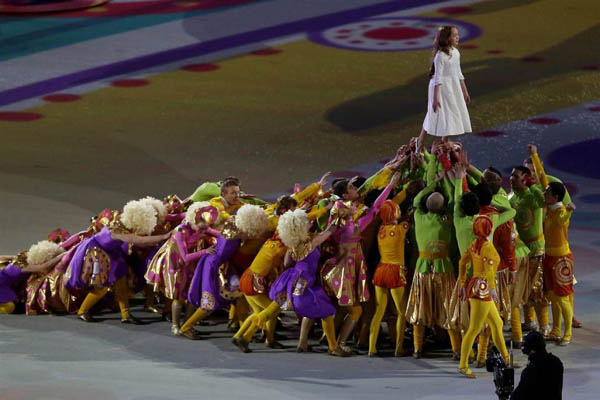
And so began the Games. Russian
TV star Yana Churikova shouted the phrase among swirling crescendos of
Tchaikovsky and t.A.T.u., and what followed was so opulent it would make a
royal wedding blush. Next came a strange mix of historic documentary and dance,
children dressed like Disney extras, a fair amount of hammering, a dash of sickling,
lots of Cyrillic, and more children in bright colors. I’m not a opening
ceremonies aficionado, but I expect they’re all like this to some extent. By “like this,” I mean horribly self-indulgent, and kind of offensive.

Once the entire history of Russia
was summarized (and somehow without the use of matryoshka dolls) over the
course of 20 minutes that felt like six or seven days, the countries paraded
into the stadium. Each country was dressed either as the most offensive
caricature of their nation, or a second year design student whose work is
informed by Selena Gomez and the explosive nature of Pop Rocks. The Canadians
were dressed as Mounties, of course, after the original plan to dress them as
polite hockey players with universal healthcare didn’t come to realization. The
Swedes were straight from Ikea, the Japanese from anime. The Chinese were
stoic. The Jamaicans danced to Bob Marley’s “Three Little Birds,” though the
music may have only been playing in my head. Some country where it hasn’t
snowed since ground brontosaurus was its biggest export paraded its only
participant, all smiles and no expectation. The US team’s outfits looked like
the July Fourth section at Target exploded. It was all quite awful.

For a moment I may have blacked
out, endured a seizure brought on by excessive flashing and excessive, well,
excess. When I tuned back in Hall of Fame goaltender Vladislav Tretiak and a
petite woman who Paul Henderson never scored on were taking the Olympic torch
on its last jog, lighting the flame that will burn for the duration of the
games. That’s right: this isn’t just a $52 billion dollar outdoor Wiggles
concert. There’s some sporting to be done.

Unfortunately, in these games,
the sport takes back seat to both the opulence of the endeavor, and the intolerant
oligarchy of its host. Already LGBTQ rights protestors have been arrested
before a puck has dropped, a skate laced, a luge luged. Dutch snowboarder
Cheryl Maas raised a rainbow glove palm to the camera after competition. Maas,
one of only six openly gay Olympians, is now the answer to the question: Who
was the first Sochi Olympian to protest Russia’s archaic anti-gay legislation
during the 2014 Games? And I suppose in that answer lies my larger frustration
with the opening ceremonies. I kept waiting to spot a small rainbow flag or a
You Can Play logo, anything from the athletes showing solidarity and support
for a community that is being oppressed by the country that is providing those
athletes with the grand stage for what they hope will be their finest hours.

But there were no flags. And
there was no support. Except for rainbow Greek mittens and pseudo-rainbow
German jackets, neither acknowledged by their nations as potest, but rather
happenstance. And if we’re looking to the Greeks and Germans as the voices of
reason, we’re all in trouble. And two countries. Just two. And not the one I
call home.

Within the maelstrom of opulent
noise, indulgent sheen, and radiant jingoism, there was the alarming dichotomy
of quiet.

I understand it is not the
responsibility of Olympians to make political stands. I understand it, but I
don’t agree with it. Olympians are there carrying my passport, wearing my flag,
representing my home. With that comes the great responsibility of carrying our
moral authority, our righteous indignation, our commitment to a tolerant world,
an inclusive world. This, to me, is the very purpose of the Olympics. Its
essence. Nations, people coming together in a search not just for personal
glory, but vicarious glory, and a glory that is filtered through the prism of
nationality.

These Games will come and go.
Heroes will be found. Stories written to be forever told. My hope is that they
are a safe Games, but also a Games where the opulence of its host, the shame of
pageantry over substance, is punished by fearless voices. The opening
ceremonies tried to tell the story of Russia, a story that currently finds a
strained narrative, with the whole world there to watch, wait, and wonder if
this is not the moment where morality and bravery trump opulence. Where a voice
will take the opportunity not to just revel in pageantry, but to use it to
celebrate a larger purpose.

Mike Spry is a writer, editor, and columnist who has written for The
Toronto Star, Maisonneuve, and The Smoking Jacket, among
others, and contributes to MTV’s
 PLAY
with AJ
. He is the author of the poetry collection JACK (Snare
Books, 2008), the short story collection
Distillery Songs (Insomniac Press,
2011), and the co-author of
Cheap Throat: The Diary of a Locked-Out
Hockey Player
(Found Press,
2013). His next poetry collection,
Bourbon & Eventide, is forthcoming in 2014
from Invisible Publishing. Follow him on Twitter
@mdspry.

Complicit in THE ARMSTRONG LIE

Complicit in THE ARMSTRONG LIE

null

In no other place are we so
desperate to crown monarchs, to live vicariously through victory and wealth,
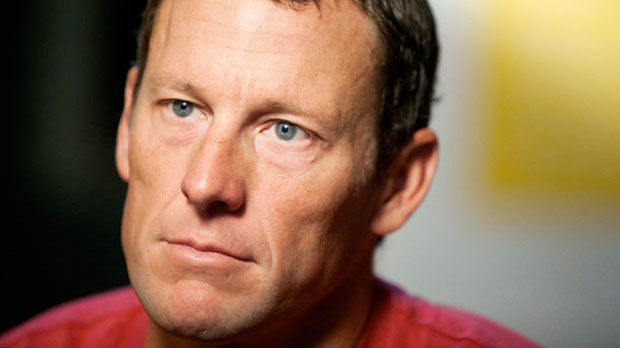
than in the realm of celebrity. We are smitten by the success of others. In Lance
Armstrong, we were given a character for the ages. A man born to a single
mother in East Nowhere, Texas. A cancer survivor who rose to prominence in a
sport dominated by Europeans and ignored by Americans. While Michael Jordan, Wayne
Gretzky, and Brett Favre were preceded by Julius Erving, Bobby Orr, and Roger Staubach,
Armstrong was a singular entity, the king of a land that had just been
discovered. He dated rock stars and supermodels. He was handsome and wealthy. His
celebrity was virginal, and unique in the glimmering magazine cover world
dominated by common and contrived stories.

And it was, in its entirety,
built on lies all too familiar. Built on vengeance. Cheating. A complex system
of blood doping and performance-enhancing drugs designed to take him to the
forefront of his sport, and the heights of celebrity.

Alex Gibney’s The Armstrong Lie began as a tale of
redemption. In 2009, the disgraced cyclist returned to the scene of his
greatest achievements, the Tour de France, where he had won a record seven
titles, and brought Gibney and crew to capture his comeback. But, once again,
Armstrong (as is now well-documented) was caught cheating and doping, and
Gibney’s film was put on hiatus. Four years later, Armstrong reached out to
Gibney to set the record straight on his marred career, and the documentary
became a story of a man so driven to greatness, so oblivious to his own self-destructive
nature, that he was deluded into believing he had yet another comeback in him, a
comeback not in competition, but in the public spectrum, one that would feature
Oprah in a supporting role as his hand-picked interviewer/enabler/PR shill, and
one that Gibney would capture for posterity.

Unfortunately, both the film and
its subject are deeply flawed. Armstrong is fearlessly naïve about his ability
to dope without being caught, to charm without being transparent– and Gibney
is so taken by Armstrong’s aura and the story he hopes to tell that he raises
the question as to why viewers have been asked to empathize with a ruthless,
destructive, vindictive cheat. In footage shot during the 2009 Tour comeback,
Armstrong and Gibney come off as teammates, certainly more than Armstrong and
his actual teammates, who more closely resemble reluctant participants in the
lies. Gibney, on more than one occasion in his narration and the film’s action,
reveals himself to be cheering for Armstrong, a revelation both awkward for the
audience and counter to the medium of documentary. A successful documentary
revels in its subject and defines the immersive; it puts the viewer at the
story’s core and the filmmaker in the quiet shadows. The Armstrong Lie takes on a promotional tone, and though
Armstrong’s warts are revealed, Gibney foolishly attempts to apply cover-up, by
shifting blame or asserting over-and-over that everyone in cycling was doping, to
conceal what the audience is already well aware of, that Armstrong cheated his
way to celebrity, and did so with no care for those around him. Armstrong uses
Gibney as he used his teammates, his celebrity, his fans, and his sport.

What is also startling about The Armstrong Lie’s failings is its
overt effort to isolate Armstrong, a man who defines isolation through his
manner and sport. Whether it be from former teammates, Italian doping doctor Michele
Ferrari, or Gibney himself, the film tries desperately to reveal Armstrong as a
loner, a man on a mission to dominate a sport, and attain celebrity no matter
the cost. However, Armstrong does this with little or no help. Gibney’s heavy
hand is present throughout, most notably through the near total absence of
Armstrong’s family. Some of his children appear for a moment, when they are awkward
witnesses to a surprise drug test, a test seemingly as common as the breakfast
it interrupts. Armstrong’s first wife is not mentioned. His current partner is
acknowledged briefly, as are his dalliances in celebrity dating. Perhaps Gibney
wanted viewers to simply assume known facts–but this comes across as an
attempt by a director to find the movie he wants, and not the film unfolding
before him.

What appears above may seem like
an indictment of the film, though it is anything but. Through his complicity in
the Armstrong lie, Gibney reveals the very manner in which we are all complicit
in the deception of celebrity. While Gibney shows Armstrong with children
struggling with cancer as an attempt to elicit empathy, instead we see a man
who will use anyone, including children suffering from the very disease that
nearly claimed his life, in order to disguise the truth of his being. Gibney is
as taken by Armstrong as the children are, as the cameras are, as we were. 

During the height of the
Armstrong affair I appeared on the sports and pop culture program, PLAY with A.J. As part of their humorous
“30 Seconds of Fame” segment, I were asked, “The Huffington Post is reporting that there are three
Lance Armstrong movies in the works…what should the movie be called?”
My reply was: “One Ball, but What a Dick:
The Lance Armstrong Story
.” I wouldn’t normally dare to find a punch line
in cancer, a horrific disease that is devoid of humor or prejudice. But
Armstrong’s betrayal of his fans, family, his charity, his sport, allowed for
my humour.

But the joke said more about the celebrity
relationship of sports fandom than the failings of Armstrong. With The Armstrong Lie, Gibney is no different from the fans that
cheered Barry Bonds to 73 home runs in 2001, golf’s apologists who continued to
feed the Tiger Woods machine despite sordid tales of flawed character, or the
NFL fans who continue to embrace Michael Vick despite his serving jail time for
abusing dogs. Sports fandom allows for this obliviousness in a manner that
Hollywood does not because of cultural familiarity. We’ve all ridden a bike,
swung a bat, tossed a football, and yet so few of us have sung on stage, or
acted, or written. We live vicariously through athletes because we don’t
require a giant leap of faith to imagine ourselves in their Nikes. And so we
excuse their faults because we so wish that their faults could be ours.

We know how the story ends, and The Armstrong Lie is well aware of that.
The documentary’s post-script is unnecessary. Armstrong was stripped of his
seven Tour de France titles, dropped by his sponsors, and dismissed by his own
cancer charity, Livestrong. If it was Gibney’s intention when editing his
footage to include himself as a character through which the audience
experiences the director’s flaws analogous to our own, then the film is a
rousing success. If it was unintentional, then it fails as a documentary film,
but not as a document. Either way, The
Armstrong Lie
is a riveting examination of both celebrity and those of us
who feed it, and while it may not completely give us permission to laugh, it
asks us to consider our relationship with those through whom we live
vicariously.

Mike Spry is a writer, editor, and columnist who has written for The
Toronto Star, Maisonneuve, and The Smoking Jacket, among
others, and contributes to MTV’s
 PLAY
with AJ
. He is the author of the poetry collection JACK (Snare
Books, 2008), the short story collection
Distillery Songs (Insomniac Press,
2011), and the co-author of
Cheap Throat: The Diary of a Locked-Out
Hockey Player
(Found Press,
2013). His next poetry collection,
Bourbon & Eventide, is forthcoming in 2014
from Invisible Publishing. Follow him on Twitter
@mdspry.