VIDEO ESSAY: The Coen Canon

VIDEO ESSAY: The Coen Canon

Simply put, fear is funny. More clearly put, fear is at the root of much of what we consider humorous in films, even though we might not recognize it as such. We call it by different names—confusion, precariousness, coincidence—but the fear that something, whether it’s a job, a relationship, or some larger dramatic situation, might go wrong is always present in cinematic humor. This tendency goes back to the earliest comic films. In one famous scene in Modern Times, Chaplin’s factory worker is supplied with an eating machine intended to feed him while he works, but he can’t eat and work at the same time, and so he’s bombarded by hot dogs and corn on the cob. We laugh a lot at this—not only because of Chaplin’s droll presentation, but because we fear the machine might never stop. In Woody Allen’s Annie Hall, we laugh at Alvy Singer’s caustic observations on his surroundings partially because of Allen’s cleverness but also partially because it spooks us, momentarily, that someone noticed the same thing about other humans that we did. In Planes, Trains, and Automobiles, we laugh because we envision a future in which Steve Martin and John Candy might never return home, but also because we know they will eventually return, in one form or another. When we watch Groundhog Day, we fear that Bill Murray will never wake up—but we also, in some small, quiet part of ourselves know that he will, so it’s okay to laugh. Fear and comedy are linked in the Coen brothers’ films as well—and more directly. This connection is a large part of what gives the films their power: we come to expect humor borne out of despair from these two minds, and we wonder what variation will arise next.

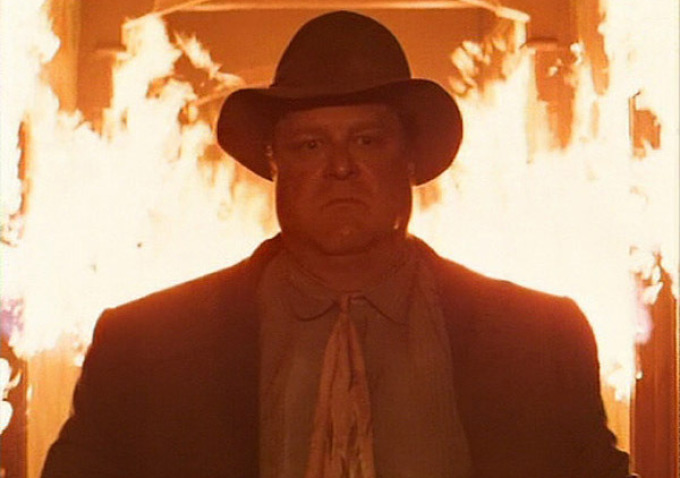
From their earliest films onwards, the Coens have used and exploited varying shapes and forms of the horrific for their comic potential. In Barton Fink, our first glimpse of the titular character (John Turturrro) shows him with a mortified expression on his face. Why is he mortified? Because, while watching his play being performed, he is scared of becoming second-rate. It would be easy enough, as well, to read the film’s conclusion, resounding with Charlie Meadows’ (John Goodman) near-immortal “I’ll show you the life of the mind,” as a suggestion that to truly look into the mind would be more terrifying than any of Fink’s visions of mediocrity; even so, the tone of the statement has a slightly leering quality to it, as if the very idea were a joke.  In Raising Arizona, what do H.I.’s escaped con pals (John Goodman and William Forsythe) do when they realize they’ve lost Nathan, Jr,? They scream, loudly and comically. Why? Because they’re scared of what the baby might be feeling, the baby’s sense of terror being as far from their experience as they can imagine. This exploration continues as the Coens’ films progress. Fargo is memorable not so much as a crime story as for its interweaving of the violent and the comic. When silent, brooding Gaer Grimsrud (Peter Stormare) blows a police officer’s head off from his car seat, the action is horrifying but also delivered with semi-comic timing; when Grimsrud feeds Carl Showalter (Steve Buscemi) into a wood chipper, we’re repulsed, of course, but we also giggle, a little, as we do when Jean Lundegaard, after being tied up in a kidnapping staged by her husband and having a hood thrown over her head, rolls helplessly around in the snow. The comedy here is a strong mix of terror and slapstick, made all the more dramatic by the flat, relaxed quality of its characters’ Midwestern accents. The Big Lebowski balances its share of fear and comedy, as well—the precariousness we witness here is the upending of the daily assumptions by which The Dude (Jeff Bridges) lives, on a daily basis. First his rug is stolen, then he’s attacked, then he’s drugged by a porn king—the obvious question, and the big question, is: what next? And the tumbleweed at the end of the film provides an answer, of sorts: because we don’t know, the best answer is to drift, and to take things lightly if we can. There are many darkly comic moments in No Country for Old Men, which flash by us like bullets, but the brothers slow down to present us with one scene which is pure Coeniana, as well as comic, as well as connected, one one level, to fear: a scene in which a black dog chases Llewelyn Moss (Josh Brolin). The dog runs after him, leaps after him, and, perhaps most memorably, swims after him, through rapids and waterfalls, across fields, over fences. Moss runs, of course, because, despite his courage in some ways, he is in some way scared of the dog, and beyond that, scared of being pinned down. Fear is all over A Serious Man, primarily fear of the future, and what grim events it might hold—and yet the Coens, by their own testimony, considered the torture of Larry Gopnik (Michael Stuhlbarg) to be central to its comedy, right up to the tornado in its conclusion. Fear lurks in Inside Llewyn Davis too, when viewed from the right perspective. There’s the much-chronicled runaway cat scene, in which Davis could be said to be scared of losing a part of himself, maudlin as the chase might be; but there’s also the fear that goes into any sort of performance, the fear that accompanies any launch of self into the void of an audience’s ears or eyes or minds, a fear empowered and increased by the great, great risk of failure. or rejection.

This is not to say that this is the only thing driving the Coen brothers’ movies. It’s certainly not. Their love of interiors, of drowning us in a certain period, along with the mood of that period; or their love of language (from Miller’s Crossing’s “What’s the rumpus?” to “He’s givin’ me the high hat!” to the outlandishly long sentences of True Grit, largely taken from Charles Portis’s book but doubtless part of what attracted them to the project; or their fascination with dream logic, cf. the progress of Barton Fink from a stiff stage play to a burning hotel—all of these things are part of the mixture as well. But without their humor, and without its (ironically) fearless push to the brink of disaster, their work might not be as compelling. The blazing, wild humor in their films serves as the mystery factor, the invisible keystone in an arch of energized idiosyncrasy. — Max Winter

Nelson Carvajal is an independent digital filmmaker, writer and content
creator based out of Chicago, Illinois. His digital short films usually
contain appropriated content and have screened at such venues as the
London Underground Film Festival. Carvajal runs a blog called FREE CINEMA NOW
which boasts the tagline: “Liberating Independent Film And Video From A
Prehistoric Value System.” You can follow Nelson on Twitter
here.

Max Winter is the Editor of Press Play.

How WHITE REINDEER Defies Cliches of Grief

How WHITE REINDEER Defies Cliches of Grief

null

Spoiler Alert: This piece could be said to contain spoilers, but it would be difficult to discuss the film without spoilers.

Grief is a vast, ugly emotion. No one cries beautifully. No
one copes with death gracefully. Of the emotions one might depict on the big
screen, it would seem to be the most difficult. And yet, in the movies, we have
grown to accept a comfortable set of images, moods, even whole scenes that
communicate it: the hug, in which we usually see a comforting look on one
character’s face as he or she comforts someone else; the collapse in a hospital
hallway, seen from a distance, on the receipt of bad news; the lone tear,
rolling down a cheek, of a person on a telephone, when we can’t hear what’s
being said but we know what it is just the same; the downcast eyes; the slumped
shoulders. We respond to these images, generally, without realizing we’ve seen
them many times before, or perhaps because
we’ve seen them before (paging Susan Sontag, maybe). In any case, Zachary Clark’s White Reindeer is all about a woman’s grieving
process—is steeped in it, in fact—and its great strength lies in its
determination to work against filmic clichés of that process. Its outstanding
set of actors, fantastically chosen soundtrack, and moving, sensitive
cinematography make this film so genuine you can almost taste it.

We’ve all known someone like Suzanne, played beautifully
by Anna Margaret Hollyman. As if she were switching masks, she wears a perky
face at times, and a near-slack face at others, deploying them expertly. She
has a blond, pretty, all-American look, and she knows it—and yet… When we first
see her, she is watching her husband deliver the weather on a local news
station as she waits to show a house to two clients (she’s in real estate),
eyebrows raised, half-smiling, a devoted spouse; after the showing, which goes
very well, her seemingly wholesome clients overjoyed, we get a side view of her,
bent over for some energetic and talkative standing-up sex, in work clothes.
When tragedy hits, only a few scenes later, after she has arrived home from
Christmas shopping (the film is set in that cliché-laden time of the year), the
first thing she does is drop her vacuum cleaner, in near-comic fashion: her
husband is lying dead on the floor, shot in the head. The next thing she does
is file a police report and eat a candy cane the detective offers her (a candy
cane?); later she goes to a Marriott, where her parents arrive to stay with her,
and her mother, in fact, sleeps in her bed. The director presents these scenes
to us without preparation or fanfare—in fact, the lack of either is dramatic in
and of itself. When we do see Suzanne break down, she’s on the toilet, dress
around her knees, sobbing loudly and without inhibition. This would
seem, in hindsight, near-sentimental if it weren’t for the fact that the
director gives us another bathroom scene later, after her husband’s funeral; as he cries loudly—blubbers, in fact—he tells Suzanne her husband cheated on her with a stripper.

It doesn’t help Suzanne that the film is set in the
Christmas season, when happiness is obligatory for all and attainable by fewer
than we’d think—but it does help the film, by casting her approach to grief
into relief. (And it also gives Clark the chance to fill the soundtrack with ghoulishly
cheery Christmas music, some in English, some not, which gives the whole film a
strangely taut, wired feeling.) After finding out where her husband’s mistress
worked, she does what any responsible widow would do: she tracks the stripper
down, gets acquainted, and then goes out clubbing with her. This isn’t before,
of course, she buys over five thousand dollars’ worth of holiday oriented
clothing and Christmas decorations. She does cry again, but she shares this moment
of sadness with a stack of empty egg nog cartons. There are moments in the film
where some viewers’ sense of decency might make them think Clark has gone too
far—but the feeling shouldn’t last, because what he actually doing is trying to
convey the ersatz reality of human reactions, and human behavior. Not pretty. Not
graceful. Not believable, ironically enough. Indeed, Suzanne parties plenty,
for someone who’s just lost her husband. She attends a holiday party, thrown by
her earlier clients, which turns out to be an orgy—yes, an orgy, complete
with swinging breasts, hand jobs, masks, oral and anal sex, everything. And Suzanne
participates, if sadly.

Clark’s very smart move in this film is to temper the satire
(in its truest sense, given that Clark is asking us to acknowledge the reality
of the way we humans act when faced with unmanageable sadness, and to distrust
the way grief happens in the movies) with poignance and attentiveness.
Fantasia, the stripper, is played with unsettling poise by Laura
Lemar-Goldsborough; as the movie winds along, we find out about her home life
with her mother and her child, revealed in soft, funny touches (the child wakes
Suzanne up from her sleep on Fantasia’s sofa after a long night out by banging
a gift near her head and screaming “Wake up, Wake up, Wake up!”). The two women have
an immediate bond, as people, and not just as a cheating husband’s wife and her
husband’s lover—this friendship steels the movie, giving it a sense of uplift.

But that uplift comes from elsewhere, as well.
What Clark is actually suggesting is something larger—that the answer to the
problem of handling loss comes from letting the world in, in whatever form.
This is very much a movie about survival—and another one of its strengths is
that, even as it makes a myriad of dark jokes, it doesn’t make either grieving or subsequent survival seem
easy or simple. Suzanne’s pain in the film is mixed, in even portions, with
excitement, with love, and with intoxication of all kinds. Much like, it turns
out, life itself.

Max Winter is the Editor-in-Chief of Press Play.

Some Things Are Best Done the Old-Fashioned Way, Pixar Studios: The Beauty of IS THE MAN WHO IS TALL HAPPY?

Some Things Are Best Done the Old-Fashioned Way, Pixar: The Beauty of IS THE MAN WHO IS TALL HAPPY?

null

Imperfection will always be more interesting than perfection. We will always be drawn towards a work, be it a film, a novel, or a piece of music, for the ways in which it swerves, for the decisions the creator of the work has made which make it distinct from others of its type, or elevate it. And yet our culture does not necessarily move this way—in fact, accuracy, perfection, flawlessness, whatever you would like to call it, receive tremendous cultural validation. This sort of striving is desirable in the sciences, but disturbing when it edges over into the arts. The most recent trend in animated films, for instance, has been to make them smoother, to make their figures more polished in appearance and strangely realistic, even as their actual proportions are distorted; we don’t see the shaky hand of the animator in these works at all, because many times the animator’s physical hand has been replaced by a mouse or a computer key, or maybe a stylus, dragged across a specially constructed pad. And the result of this? Gradually, the public memory of, and appreciation for, older, more personal ways of creating films is being erased, to be replaced by images which give the illusion of being more “advanced” because they have been created with more advanced technology. Why watch Fantasia when you could watch Toy Story? Why watch the early Warner Bros. cartoons when you could watch Monsters University? Michel Gondry’s latest, Is The Man Who Is Tall Happy?, is an animated film on a linguist and political philosopher, seemingly an invitation to disaster. However, the film is anything but. Gondry tells two stories at once, here: one is a plain-spoken, relaxedly paced conversation with Noam Chomsky about his life and thought; the other is the story of a filmmaker’s attempt to understand Chomsky’s words, expressed through highly personalized and gloriously imperfect drawings. Technology was obviously quite important to the making of this film–nevertheless, in telling both of these stories, Is the Man Who Is Tall Happy? is a strong reminder of the power of the human touch, for lack of a better phrase, in artistic works.

The first story the film tells is one which many Chomsky fans may be familiar with already. Gondry asks Chomsky a number of questions, both personal and impersonal, and Chomsky gives dry but straightforward responses. Chomsky has a congenial, warm, and fairly comforting tone, even as he issues intellectual challenges. We learn about Chomsky’s father, and his love of classic Hebrew tales; we also learn about Chomsky’s school days, and how he hated sports, asking why anyone would want to be better than anyone else (there’s a foreign policy statement in a nutshell); we also learn that Chomsky is uncomfortable speaking about his late wife, the only moment in a continuous stream of monologic explanation in which the interviewee is simply silent. The explanation present here addresses Chomsky’s ideas about language: why and how words might have certain meanings for us, and where we get our ideas about what those words mean. Gondry does his best to parry productively, in a verbal way, with Chomsky, but often comes up short, even by his own admission. Chomsky’s solution to the problem–how does one have a meaningful conversation across a vast language and (possibly) intelligence gap?–is profound. He draws. And the drawings move, and they also speak, albeit silently.

But saying they move is an oversimplification. They cavort; they shimmer; they dominate, at times, with poor Chomsky reduced nearly to the size of a talking footnote. And what does Gondry draw? All sorts of things. At time the designs take the shape of rows of parallel lines extending outwards, up, down, over, back; at time Gondry draws huge machines that push their robotic arms across the screen; at times Gondry draws simple, childlike figures, meant to represent him or Chomsky. Of course, calling them childlike isn’t so accurate: drawing is, in this particular instance, an immediate form of communication, however long (several years) it took Gondry to make the film. Gondry is trying to translate the concepts he is facing in visual terms–and this makes the second, more interesting and complicated story in the film. In constructing the film in this way, Gondry makes himself vulnerable–very few of us, who aren’t professionally trained, can draw flawless representations of anything. This imperfection is, in fact, a sign of humanity. Despite their roughness, though, the illustrations in the film communicate, with their energy, and perhaps with some other indescribable element, akin to those notes that only dogs can hear, that Gondry does grasp Chomsky’s concepts (even if he denies it). And, knowing that, we feel that we can grasp them as well.

But, all this aside, why are the drawings important? So Gondry made an animated film about a subject most people would think to be unanimateable–so what? Well, the significance is this: the problem with films such as Toy Story 1, Toy Story 2, Toy Story 3, Up, Monsters University, Brave, or Ratatouille is that, entertaining and complex as these films might be, and as impressively droll and clever as their storylines might be, and as purely dynamic as they might be, and as impressively realistic as they might be, hovering somewhere between animation and photography, they’re not real in the right sense, in that they don’t tell you anything about the person who made them. They don’t tell you if their creators could actually make a real drawing, in pencil, on paper; they don’t tell you how the creators feel about their subject, as this film so often does; while they might have grand themes, as in Brave, or Up, you’re never entirely sure who it is who’s communicating it, as an absence of style becomes an absence of, well, presence behind the camera. Is there a camera, even? It’s okay to take for granted that our telephones will become smarter and smarter; it’s okay to take for granted that travel will become more and more comfortable, or that even that all cars will someday drive themselves. But is it okay for filmmakers to take for granted that all their viewers want is more accuracy on screen, more “polish,” leaving out the possibility that the reflection of “reality” viewers want might be one more clearly filtered through a human being’s perspective?

Max Winter is the Editor-in-Chief of Press Play.

In the Future We Will Have Less of Everything: On HOW I LIVE NOW and Its Predecessors

In the Future We Will Have Less of Everything: On HOW I LIVE NOW and Its Predecessors

null

Has there ever been a film about the future that advocated in favor of progress, rather than against it? Metropolis, A Clockwork Orange, Blade Runner, the Mad Max series, AI, and then onwards to such recent films as Never Let Me Go, The Hunger Games, and, most recently, How I Live Now, do not offer a bright outlook for the results of our ostensible progress, in technology, government, or in any form of broader social structure. The days of the Buck Rogers or Flash Gordon visions of the future, in which everything is easier, happier, better, or faster, are long over–increasingly, films purporting to be about our society’s future either involve an apocalypse which has left devastation behind it or predict one which may well occur during the film itself. If there is no apocalypse, then something else has been taken away: consider Children of Men, in which even women’s fertility has been taken away. The theme, then, seems to continually be one of deprivation, or a sense that something has been removed which was once present. This could occur for a number of reasons, ranging from the sense, on a given director’s part, that to predict the future carries with it a moral imperative, to the more basic sense, frightening as it might sound, that a happy future is a weak basis for a story, that unless something bad is coming, characters have nothing against which to gird themselves.

How I Live Now, the latest film in this trend, starts interestingly, suggesting that it might just be a film about the future in which the future itself doesn’t play a lead role—and, despite odds, it is successful in this attempt. Saoirse Ronan’s Daisy, resplendent in dark eyeshadow, dyed hair, and a host of voices whispering encouragements and admonishments in her head, charges through an airport, punk-ish music blasting on her headphones, to meet her cousin; she will be staying with her aunt in the English countryside because, as she views it, her father (her mother is deceased) would rather not have her around. From the beginning, relationships are foregrounded, even as little visual cues that we are in the future (such as retina identification devices at the airport) continue to pop up. This continues as the movie progresses; Daisy can’t stand her cousins, dismissing them as naive and vaguely obnoxious. There is even a love interest: Eddie, portrayed with silent charm here by George MacKay. Eddie talks to animals and seems to have a knack for accessing Daisy; he wins her over when he’s able to make an entire herd of cows and bulls move out of her way. Daisy gradually loses her punk/goth affectations, relaxes, begins to enjoy herself, make conversation: the film shows signs of being a heartwarming tale of an angry girl’s growing-up, with a winning mood of immediacy.

Then, the future enters in more aggressively. London is bombed, an attack claimed by 15 different terrorist groups. Daisy’s aunt, played briefly but memorably by Anna Chancellor, is away on a business trip when it happens; she is always away, in fact, leaving the children on their own, and at the very most she is around late in the evening and early in the morning. This core loneliness at the heart of the childrens’ lives—Eddie, being the oldest, serves as a surrogate parent, but he is, after all, only a child himself, and so he can’t provide much nurture for his younger siblings—is only the tip of the iceberg. The London bombing serves as a harbinger of what the rest of the film sets out to prove, and what many films that attempt to forecast what lies ahead tell us, as well: that the future we have to look forward to, as a race, is dark, and that self-reliance will be important because, to put it simply, there will be less of everything. Fewer people, less food, fewer landforms (after bombing has destroyed them), fewer cities, fewer options; as daily processes become more efficient, this simplification itself will come to resemble a form of deprivation. 

Slight statement though this might be, How I Live Now ends on a more optimistic note than it could have ended on, which is significant; after Daisy and her very young cousin Piper (Harley Bird) take a Homeric-cum-Arthurian-cum-Grimm’s Fairy Tale-esque march through deep woods in search of the others, from whom they have been separated (by rough, aggressive soldiers, seemingly separating them for their own good, as there is an invasion in progress), there is a homecoming, of sorts, but it isn’t without substantial loss along the way. Ultimately, the title says it all. In the film’s last moments, we see a very simple tableau: humans, caring for each other, taking care of themselves. And what are they surrounded by? A forest in the film, but nothingness, in another sense. So the future is a metaphor? Not entirely: the message of the film, and the films that have come before it, might well be more literal than this, a suggestion that more and more may be taken away from us as the decades pass, in obvious and not-so-obvious ways, until we are left, finally, staring at ourselves. There may well be any number of slap-happy movies about our future in the depths of film history–Brazil, for example, was gleeful, but in a highly mordant way, or one could always, in a pinch, try Woody Allen’s Sleeper, overcast as it was by its director’s inherent neurosis–but the films which have made the most cultural impact have, at their heart, substantial melancholy: one part regret, one part fear, one part uninventiveness , one part guilt. How I Live Now, in its own quiet way, works beautifully and admirably against this trend, pervasive as its gloom might be, in suggesting that the sanctity of human relationships can create a barrier between the self and the crumbling world.

Max Winter is the Editor of Press Play.

SUNLIGHT JR. and American Film’s Misunderstanding of Poverty

SUNLIGHT JR. and American Film’s Misunderstanding of Poverty

null

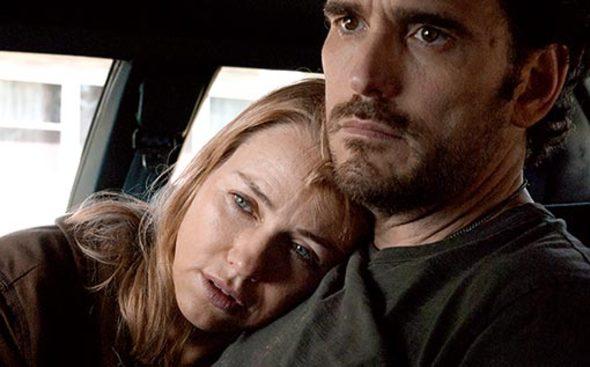
American filmmakers don’t understand the poor. From Charlie Chaplin’s Tramp films on through Push: Based on the Novel by Sapphire, the portrayal of impoverished people in films has settled into a comfortable group of cliches: living rooms crowded with children and toys. Bad teeth. Extreme lighting: either too dark or too bright. Bad posture: usually slouched. Dilapidated cars. Disgruntled employees, merciless employers. Bad pop music. Drug habits, usually debilitating. Bad luck, often contributing towards plot developments. Poor judgment in sexual, financial, and interpersonal matters. Terrible diet, often consisting of junk food. Crumbling housing, run-down neighborhoods. A taste for petty crime. Ragged clothes. Lack of personal upkeep. These are but some of the guideposts by which we, as viewers, are misled about the nature and the pervasiveness of poverty in America, or the different forms it might take. (Hey, why doesn’t someone make a film about poor graduate students, or, better yet, adjunct professors?) Sadly, Laurie Collyer’s Sunlight Jr. does little to reverse these cliches. Muzzling gifted actors with a middling script, it plunges into a sadness so deep but also so shallow that, despite the despair at the core of the storyline, about a man and a woman facing one set of closing doors after another in the strip mall territory of Florida, the film at times seems near-comic.

Matt Dillon, as Richie, and Naomi Watts, as Melissa, are both actors with a tremendous amount of control, though this manifests itself differently in each case. Films such as Drugstore Cowboy, Factotum, or even Beautiful Girls show Dillon’s comfort with his body and his size, whether he’s playing a drug addict, a drunk, or a washed-up high school hunk–here, Dillon plays a man in a wheelchair, and he looks as if he’s been in it for years. And, likewise, anyone who watched Naomi Watts in her best performance, the budding actress in Mulholland Dr., couldn’t argue that she is willing to take the risks necessary to embody an emotion fully, as in her near-orgasmic eruption during a movie audition. And yet, natural as both these talents might be, the words Dillon and Watts say in this film simply don’t fall comfortably out of their mouths, giving it more the feeling of an educational filmstrip than that of a story or a narrative.

Or perhaps it’s not so much the words as the structure in which they’re placed. Very early in the film, punishingly early, when Melissa shows up for work at the convenience store which gives the movie its name, she asks her boss, all-too-brightly, if he’s found out about the store’s college program, tapping us on the forehead with a hint that she’s ambitious. The moment doesn’t float. Later, once she and Richie have been evicted from the motel where they’ve shacked up, and she’s staying with her mother (who has a living room full of adopted children), she points at a hot plate and asks one of the kids, “You know what’s that?” Does anyone actually talk like this? And who would make conversation about a hot plate, if not to bring attention to it as a symbol of poverty? Watts fares more poorly than Dillon here; he gets through his lines by achieving a state of depressed relaxation. When he announces, early in the film, that he’s going to repair a piece of electronic equipment, and bring some money in, he almost mumbles it, which makes this exposition, this introduction of the concept of “scraping by,” a smidgen more believable.

The film takes us from one depressing locale to another. It starts in an intensely dark motel room which stays dark throughout, its bedside lamps dim, its shades always drawn. The bar where Richie goes when Melissa is at work is similarly dim, and nearly empty. The cheaply carpeted home where Melissa’s mother lives and drinks excessively isn’t necessarily dark, but it’s ratty and, as Melissa discovers, infested with bed bugs. One would think the palm trees native to Florida would provide some small uplift here–but instead they tower above the film, as if they might fall on it at any moment. The interior of the Planned Parenthood clinic where Melissa goes when she find out she’s pregnant is, as one might expect, lit by bright flourescent lights. The only seemingly hopeful moment occurs in a daydream, when Richie is (surprise, surprise) being told by a government worker there are few work options for him; he imagines that he gets up, walks out of the office, and out into a gloriously bright day that offers us the first ray of sunshine we’ve seen yet in the film.

As one might suspect, things don’t go well for these downtrodden figures–how could they? The film often reads as if Collyer took Nickel and Dimed, the Barbara Ehrenrich book about the working poor which gave the film its inspiration, a bit too literally, bleeding the element of surprise or unpredictability out of her subject matter, presenting viewers with a tale which is resolved before it has begun. And yet, as America’s economy declines, this subject matter may become increasingly common–and those who wish to render it will need to find a new way to approach it.

Max Winter is the Editor of Press Play.

The Good Struggle: ILYA AND EMILIA KABAKOV: ENTER HERE

The Good Struggle: ILYA AND EMILIA KABAKOV: ENTER HERE

null

What do we do when things get worse than we can stand? Or better yet, what do we do when things have been worse than we could stand? Some of us crumple. Some of us lash out, and in so doing, may make things more horrific for ourselves. Many of us, though, choose a much more complicated response: we create, we do things, we act. The creation of art as a sublimation of pain or suffering is not a new concept, but it comes close to being made new in the work of Russian artist Ilya Kabakov, born and raised in Soviet Russia, an American expatriate for nearly 25 years. In one of his sculptures, a pair of booted legs descends from the ceiling, soles firmly planted on the ground. The work’s title is “What Is Our Place?” In one of his installations, we see a room papered with all kinds of wild, colorful posters; the ceiling of the room contains a gaping hole, plaster from the ceiling hanging down, along with peeling paint. The work’s title? “The Man Who Flew Into Space from His Apartment.” Amei Wallach’s Ilya and Emilia Kabakov: Enter Here is less a documentary than a study of the ways we react to tragedy, to trauma, to past suffering–in Kabakov’s case, the trauma was the time he spent living under Soviet rule, from 1933 to 1987. And yet, miraculously, these works never seem overburdened by the past behind them: they are always guided by the urge to narrate, to tell a story. You might feel, bumping up against one of his installations, that you’ve been dropped into the middle of a surreal novel. The works suggest that for Kabakov, the telling of a story provides the means for one to leave suffering, to fly into space.

It is significant, then, that the documentary concerns itself with a trip Ilya and Emilia Kabakov took in 2008, back to Moscow, which they had not visited in 20 years (they currently live in Long Island, outside New York City), for a vast retrospective of Kabakov’s work–well-deserved, given that Ilya is one of the most widely-known Russian artists now living. The film shows little of Moscow itself, but the little it does show, along with the references made to it in the film, are enough to communicate the essence: raw, oppressive, intense, unhappy, dark. The artist’s acquaintances–fellow artists, patrons, scholars–establish that Ilya’s time in Soviet Russia, illustrating children’s books for survival while also secretly making work which would certainly have earned him punishment by the government, was quite difficult, even soul-destroying. 

Kabakov’s work itself displays this same sort of truculence, only in a quieter, more inventive manner. The exhibition described in the film occurred in three different locations; the most elaborate and eccentric of these exhibits was staged in a former bus garage–in fact, the site of Dziga Vertov’s famous 1929 film, Man with a Movie Camera–now the Garage Center for Contemporary Culture. One part of the exhibit was called the “museum”; in this museum hung rows and rows of paintings, meant to emulate the Soviet-approved artwork that permeated Kabakov’s youth, filled with false happiness: happy workers returning home from their (dreary) jobs; cheerful, rosy-cheeked families eating dinner together; delighted children playing in the snow. As we watch Kabakov setting up this exhibition, we notice things one might not normally notice in a documentary about an artist who has worked his way, literally, out of years of oppression: his masterful walk, the strangely humble expression on his face, his grace when instructing workers about where to place parts of the display. He resembles nothing less than a little Prospero, exercising magical powers when necessary to keep the island of his sensibility in order. His wife is a presence here too; a frequent collaborator with Kabakov, she most resembles a guide for her extremely intense husband.

My own first experience with Kabokov’s work was in 1993, at the Whitney Biennial. Young as I was, I harbored incredibly jaded, cynical feelings as I walked through much of the exhibition. The works I saw, with their loud colors, their video loops, their larger-than-life signage, were more than I could digest at one time, or perhaps more than I could stomach. Only two artists paused my arrogant 23-year-old’s wandering eye–Ida Applebroog, with her storied, direct approach to her subject, seemingly antiquated in this context, and Kabakov. The work on display was an installation, a small crowded, cluttered room, with numerous tiny, human figures arranged on the floor. My immediate response was wonder: how did these figures get here? What was I to think? And it is this same sense of wonder that drives Enter Here. One wonders out of what recesses in his imagination Ilya Kabakov is able to pull the concept for his works–and beyond that, how he is able to keep producing them. In the presence of his work, we all become like those small figures, dropped down into alien territory, trying to make sense of it all, and yet feeling, at the same time, as if the scenarios we witness are strangely familiar.           

Max Winter is the Editor of Press Play.

The Tragic Absorption of THE MOTEL LIFE

The Tragic Absorption of THE MOTEL LIFE

null

There are times, during THE MOTEL LIFE, when it seems as if the film is sustaining itself on pure mood. Directors Alan and Gabriel Polsky have put substantial energy, in their delivery of this story of two brothers with flawed judgment but unfailing commitment to each other, into its darkness, into drenching us in the dim light of motel rooms or the darkness of city streets at night, so that when the film moves into a brighter location, such as a hospital room or a casino (the film is set in Reno), the shift comes as a shock, as if someone were shining bright lights on the story, asking us to look it in the face, possible interpretations of it being as various as the viewers themselves.

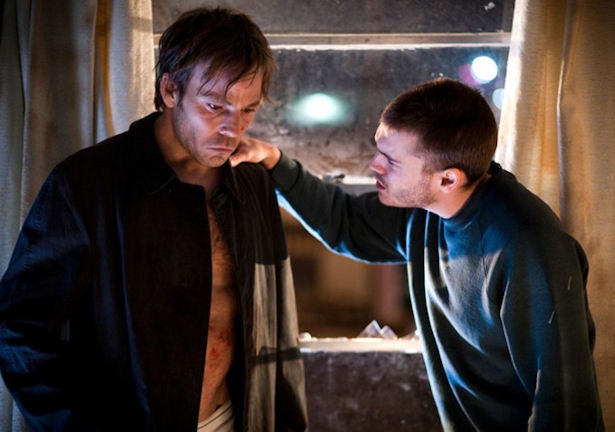
The story is a sad one, without much room for light. The two brothers, Jerry Lee and Frank, ran away from home as children after their mother’s death from cancer. In an accident which occurred while they were train-hopping, Jerry Lee lost half of one leg–and as it is, the lost half-limb comes to serve as an outer manifestation of his personality; as Stephen Dorff plays him, he seems only half-present for much of the film, as if he were talking to others while also having another conversation with himself. By contrast, his brother, played here with depressed immediacy by Emile Hirsch, seems more grounded, carrying the burden of the brothers’ perpetual rootlessness along that of his brother’s needs. After Jerry Lee kills a young boy in a hit and run accident, what was a dour story becomes much more dour–the brothers have to run from the police, and what was previously a seemingly hand-to-mouth existence becomes rife with traditional images of desperation and outsiderhood. All the motels look the same. All the meals are take-out. Frank carries a bottle of whiskey around with him like a holy chalice.

What is amazing, in the body of the film, is how much texture and soul the directors manage to reap from such a bleak story. The Nevada landscape is sublime, in the truest sense of the word, its grand, uncrossable mountains a comment on the impossibility of the brothers’ situation. Kris Kristofferson shines here in a minimal part, as an old boss of Frank’s who tries, beautifully un-invasively, to counsel Frank on how to lead a responsible, or at least a forward-looking life. Dakota Fanning is mature, and sad, and memorable as a girlfriend of Frank’s, left and then found again, living in the tiny, poetically barren town of Elko. And then there are the oddballs: one sadsack who we first meet after he’s been hospitalized following a liquid-acid binge, and another old friend of Frank, a generally unlucky gambling addict who persuades Frank to go in with him on an implausible-seeming bet.

True to itself, the progress of the movie is both sad and upbeat. As options decrease for the brothers, their trajectory becomes more wild and stealthy. They sustain themselves, as they have since childhood, through story-telling; Frank tells Jerry Lee possible anecdotes from possible lives he hasn’t lived—and the directors take a risk by animating these stories in the style of Jerry Lee’s own cartoonish drawings, a touch which doesn’t necessarily work in all movies (such as Howl, which was at its most successful when most simple, its animated sequences a distraction from James Franco’s responsible performance) but which gives a pleasant sense of release, of taking off, to this work.

As we’ve learned from Breaking Bad, from Cormac McCarthy, from Sam Shepard, from Badlands, and even from the recent COG, the land west of the Mississippi can be a fecund setting for stories having to do with loss, or restlessness, or despair, or hopelessness. The Motel Life, while it operates on a quiet enough register that it might not reach all viewers, brings home a meaningful story without significant compromise, a promising debut feature from two very skilled filmmakers.

The Axis of Cool in DRINKING BUDDIES, and How It Tilts

The Axis of Cool in DRINKING BUDDIES, and How It Tilts

null

Warning: This piece contains aggressive and open use of spoilers. In fact, spoilers are crucial to the piece. So, if you don’t want to hear about the surprise ending, where everyone leaves on a bal–oops. Never mind.

In the late 1980s, radio commentator Ian Shoales said he didn’t like The Big Chill‘s characters because he was positive none of them would have been friends with him in high school, or words to that effect. The four friends who form the center of Drinking Buddies, though not unlikeable, give off a similar whiff of coolness—so much so, in fact, that they resemble archetypes of young, urban hipsters. This is only worthy of mention, really, because coolness, or its lack, is a defining part of the film, and where each character falls on the film’s coolness axis at any given moment in the film is inversely proportional to that character’s ability to resonate with the unassuming, unsuspecting audience member.

Two of these four confused lovers work at a microbrewery, a perfect fit for them. The microbrew has long been an acknowledged emblem of hipsterhood, regardless of how many knit-capped gals and fellas might clutch Pabst Blue Ribbon 16-ouncers in however many over-crowded performance spaces these days. The brewery provides a perfect Petri dish in which cool affectations can grow and flourish—as when Kate (Olivia Wilde) wears sunglasses at work all too frequently, perhaps to hide hangovers earned after nights spent drinking with friends, but perhaps not. Wilde is comfortable and calm in this role—it’s not a complex part, at first blush, but she uses it to occupy the screen effectively, in the best sense of the word occupy: to inhabit, to live in, to stretch out within. Her friend Luke (Jake Johnson) should be a familiar figure to anyone who’s ever eaten in a gastropub, or been to a show in a hipster deposit area such as Williamsburg, Brooklyn—he has an artfully sloppy beard, he wears a gimme-cap indoors and outdoors, he likes building bonfires (a time-honored hipster ritual), and the company he keeps (artists and other clean-cut, well-spoken types) doesn’t match his folksy exterior. He’s on roughly the same high point of the coolness axis as Kate, for most of the movie. Most of it.

Kate’s boyfriend, Chris (Ron Livingston), is at the other end of that axis, as is Luke’s girlfriend, Jill (Anna Kendrick). Chris seems to be a writer, of some kind, though it’s not clear what type. Livingston is masterful here; Chris has an ingrained arrogance about him which he tries to cover up with a rustic, outdoorsy, wholesome affect, but can’t, quite, and it’s easy to sympathize with his failure. Uncool gestures issue from him like a series of violent sneezes he is helpless to control. In one particularly poignant moment, he lends Kate a copy of Rabbit, Run, a notable misstep, given that John Updike, apart from being one of America’s great prose stylists, was a master of near-pornographic sex scenes in which female characters were almost always objects, rarely subjects. Jill, also, is a wonderfully awkward special education teacher and artist; Kendrick is miles away, in this film, from her breakout role as the malfunctioning corporate drone in Up in the Air, spending her off-hours here making dioramas. When the film requires Jill to step outside of her comfort zone, to handle the possibility that she might have done something devious, she can’t—and all we can think of is that Kate would have handled a similar challenge with far more poise and, yes, cool. We can’t be sure if this is a good thing.

So what happens to rock the apple cart? These characters drink, a lot, as a rule. When you take them out of Chicago and into the woods for a weekend retreat near a beach, well . . . what do you think’s going to happen? Boundaries are crossed: first one, and then the other, and at the end, who breaks up? Kate and her boyfriend. All in all, this isn’t surprising; Chris doesn’t have much of a chance, here, among Kate’s crowd, and he knows it, which is why, after the weekend’s events, he calls things off. What tilts the film in Kate’s favor, though, is the facial expression she makes before Chris is about to break up with her, when he says, in simple terms, that they have to talk; she mashes her lips, and she grimaces, and we know, at this moment, that she’s really feeling something, that she’s reached the antithesis of cool. When is Jill’s uncool moment? Most of the movie, perhaps, but most notably when she returns early from a tropical vacation, crying because she’s done wrong by her man, Luke, and the honest girl inside her can’t stand the thought of it. And Luke? Luke collapses when, after helping Kate move, ripping his hands up on sofa nails, and getting into a fist fight with a stranger over parking, he can’t get Kate to spend time with him alone. The gimme cap, the beard, and the down-to-earth affect help Luke very little here, and he knows he’s whipped; when she suggests they hang out with friends, he makes fun of her, but he ultimately has to leave, his mimicry coming across as empty whining more than anything else. At these moments, the film casts an anchor out, and it hits bottom; we know, after waiting patiently, that we are in the presence of humans. It’s reassuring. 

Joe Swanberg, as has been duly noted elsewhere, is building a portrait of a generation with his body of work. You’ve been next to these people at the grocery store, you may have ridden on subways with them, you’ve seen them at certain movie theaters, you’ve most definitely seen them at coffee shops. It’s easy to imagine that, as Swanberg’s films expand in scope, the crisis his characters face, the crucial question—can my plaid, my organic coffee, and my iPod survive my larger life crisis?—will become a more and more resounding issue, until it’s almost deafening. This is a moving, coherent film that could communicate to viewers at any point in the coolness spectrum—the question is, how far is Swanberg willing to depart from that frame of reference to tell a story?

Max Winter is the Editor of Press Play.

VIDEO ESSAY: Gliding Over All: The Cinematography of BREAKING BAD, Season 1

VIDEO ESSAY: Gliding Over All: The Cinematography of BREAKING BAD, Season 1

This video essay is a co-production of Press Play and RogerEbert.com.

What is it about the desert?

Put more simply, what is it about the desert that simplifies
human conflicts, desires, and fears as represented in film and literature?

Think of Kobo Abe’s Woman
in the Dunes
, Paul Bowles’ The
Sheltering Sky
, Sam Shepard’s True
West
. Terrence Malick’s Badlands. Sergio Leone‘s Once Upon a TIme in the West.

Or, more relevantly to this discussion, Breaking Bad.

Put more specifically, what is it about the desert that, in
early episodes of this show, threatens to topple the narrative with the
sparseness of its scenery, with shots so dry you can practically taste the
sand?

It’s the emptiness.

The sense that there is nothing but the air between a
character and his problems, and that air is so thin it might as well not be
there.

The sense that a man, when faced with a problem, be it the
legality of his enterprise, death, the ineptitude of other humans, or all
three, might flail in the desert air, and find nothing giving resistance,
moving him forward.

The tedium of all of it. The difficulty.

But, at the same time, the profound importance of it.

There is also the way conversation sounds in the desert: the
way each sentence falls into silence, like a coin falling into a dry well.

We don’t hear the clink of the coin at the bottom of the
well, because it doesn’t have a bottom. Not on this show.

Another thing about the desert, particularly the New Mexico
desert, is that it dehydrates you. It sucks everything out of you. You come to
it with a set of complications, a set of morals, a set of daily worries, and
you find, in almost no time, that they’re all gone, lost in the cold night wind.

All that’s left is you, and the matter that brought you
here.

Another thing about the desert is that it’s where we all
started. (Depending on who you ask.)

Not in the desert, literally—but in the semblance of desert.
With nothing.

Nothing except, of course, that 800-pound elephant,
shimmering in the heat in front of you.

You can either stay where you are, and hope, until the sun
goes down, that the elephant goes away.

Or you can do something. And walk towards it.

And that moment, right there, that first step, is where your
troubles begin.

You think, If I can
just kill that elephant, all my problems will go away. I can leave. I can step
over its corpse, and head back to what I was doing before this.
 

But sadly,

and truthfully,

and unavoidably,

you think you’re walking out, but in reality, you’re just
walking farther in.–Max Winter

For a terrific essay by Nick Schager on the cinematography of Breaking Bad’s inaugural season, go here:

http://www.rogerebert.com/balder-and-dash/cinematography-of-breaking-bad-season-1

To watch the video essay on Season 2, along with an interview with director of photography Michael Slovis, go here:

http://www.rogerebert.com/balder-and-dash/gliding-over-all-the-cinematography-of-breaking-bad-season…

To watch the entire series on Press Play, go here:

http://blogs.indiewire.com/pressplay/tag/dave-bunting-jr

Dave Bunting, Jr. is the co-owner (with his sister and fellow Press Play contributor, Sarah D. Bunting) of King Killer Studios, a popular music rehearsal and performance space in Gowanus, Brooklyn.  He plays guitar and sings in his band, The Stink,
and dabbles in photography, video editing, french press coffee, and
real estate.  Dave lives in Brooklyn with his wife, son, and sister.

Max Winter is the Editor-in-Chief of Press Play.

Can’t See the Movie for the Screen: THE CANYONS and the American Worship of Celebrities

Can’t See the Movie for the Screen: THE CANYONS and the American Worship of Celebrities

null

I could write an entire essay about The Canyons–1000-2000 words, at least–without ever having seen it. The amount of sheer context that has surrounded this wildly underwhelming film, concerning its director, its screenwriter, and its star, provides substantial fodder for conversation. About what? The movies that are made, the movies we choose to see, why we choose to see them, and, frighteningly, what we think of them. The Canyons has attracted lengthy, considered commentary from many corners, including some corners, including the New York Times or Salon, in which you would have thought the critics there, after seeing the film, would have passed on the opportunity to write about it. How could they have passed, though, with all the backstory surrounding it, like an enormous fur overcoat? This backstory grows–and vibrantly–from the American obsession with celebrity culture, which amounts to a near-celebritocracy.

About that backstory, though: let’s start with the film’s director, Paul Schrader. His scripts for Taxi Driver and Raging Bull, from nearly 40 years ago, elevated him to near-godlike status among film buffs and regular moviegoers alike. However, that early promise did not lead to sustained, wide-ranging popularity; films ranging from American Gigolo to Mishima to Auto Focus were critically acclaimed, but not sufficiently critically acclaimed to be considered cinematic events (with the possible exception of American Gigolo). As his films have relentlessly explored the seamier sides of life, fewer and fewer viewers have been willing to take the journey with him, beyond a militia of devotees. After his lengthy New York Times article about the difficulties of working with his star, Lindsay Lohan, it was hard not to think that using the star was an attempt to raise his own status at the box office, to prove himself capable of creating a spectacle. And then there’s the screenwriter, Bret Easton Ellis, most famous for early, dynamic novels like Less Than Zero or American Psycho. In recent years he has become more famous for his overbearing presence and his nasty tweets than for his work, which has not struck quite the same loud chord with readers as did his earlier books. Again, it’s tough not to read his engagement with this film as an attempt to pull himself into the spotlight by a notorious star’s bootstraps (to mix metaphors).

But what about those bootstraps? And what about that star?

Oh, that poor star.

There’s a lot you would have to ignore if you wanted to take The Canyons, or Lohan’s performance in it, on their own terms. The prison time. The ankle bracelets. The driving while intoxicated. The missed court dates. The court dates made while wearing stunning apparel. The embarrassing interviews, each more falsely “honest” than the last. And there, almost completely crowded out by all that we’d have to set aside, would sit her two good performances, in Mean Girls and A Prairie Home Companion, the latter of which was probably missed by many. And then there are the aforementioned tales of her behavior on-set, her tantrums, her absences, her lack of preparation, her immaturity, and her apparently newsworthy near-toppling of the whole venture.

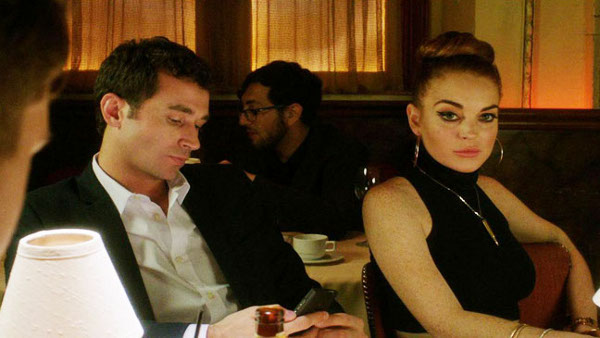
And the venture itself? Sadly, it would be impossible for anyone with both a conscience and a wholly functional critical apparatus to find this attention-grabbing film more than marginally interesting, artful, or, least of all, shocking. We can give points, if to nothing else, to the cinematography, which evokes the deadened, shallow, decaying Hollywood we’ve come to expect from countless other films about that same microcosm. The gray, deserted, drab theaters the film uses as interstitial shots provide an admirable backdrop for the film’s satire of moviemaking. The story to which that satire is hitched, unfortunately, is woefully thin: Christian, a young, trust-funded filmmaker (James Deen) “keeps” Tara (Lohan) in a beautiful house overlooking the ocean. He’s cast a studly young man (Nolan Funk) in his new film, who turns out to be an ex-boyfriend of Tara’s. As Christian digs, he finds out information that makes him unusually jealous of Tara, and he promptly loses all control of his drug-addled mind (to make a long story short). Before this happens, though, we gain an insight into this resoundingly unpleasant couple’s lifestyle, transitioning fairly smoothly between an opening dinner scene–in which the couple spends most of their time out with another couple (the star of the film Christian is directing, and his girlfriend) staring at their cell phones–into a scene in which they have a threesome with a man Christian found on the Internet. The sex in the film, though perhaps a shocking move for a former member of the Mickey Mouse Club, isn’t shocking by comparison with other films that have been released, say, within the last 25-50 years. There’s a deflated feeling hovering over the entire film: the dialogue, such as it is, is delivered with awkward pauses after each line, as if the actors were waiting for a laugh track. Lohan’s acting, by comparison with her co-stars, is compelling, but again only by comparison. More often than not, because her co-stars are so inexpressive in their delivery, her excesses of emotion (mainly crying) seem rather unusual, as if perhaps she had walked into the wrong movie.

One could ask, then, why see such a film? Why write about it? Why give it the time? Because it has a mood of controversy about it, and controversy can be fascinating. Because the publicity for it, as is often the case with over-hyped films, transcends the product—but is no less persuasive for doing so. Because it has talent attached to it, and hope springs eternal.  But the film itself? Daring? Shocking? The most shocking thing about it is the degree to which it reflects, as a phenomenon, the de-evolution of American sensibility, the allotment of power and, weirdly, aesthetic influence to whichever figure displays most flashingly before us. Ultimately, this film is most interesting as a phenomenon, as evidence of the power of, to put it simply, talk, talk so loud that it shapes our tastes, and ultimately, our lives.

Max Winter is the Editor-in-Chief of Press Play.