Richard Linklater’s BOYHOOD Recreates the Experience of Reading

Richard Linklater’s BOYHOOD Recreates the Experience of Reading

nullA large part of writing a review is telling what experiencing the work in question is like—the feeling one gets when reading, or watching, or listening,
or looking. This can be difficult, especially in works that reach deeply, that dig
into seldom explored territory. If I say that watching Richard
Linklater’s remarkable new film Boyhood,
which traces the life of a boy named Mason from age 6 to 18 in rapidly
changing segments, is like reading a
book, I need to clarify. The idea is not that the film could be “read” like a
book, each element analyzed to consider how it functions within the work as a whole; that goes without saying. The film, instead, acts on you the way a book
might act on you, which is to say, it doesn’t force itself on the viewer, and
in fact it asks the viewer to force itself on it, to make sense of it, to keep
going with it, and to sit with it, for a while, to see where it’s going. And the film does go somewhere which might remind viewers suspiciously of their own lives.

On the most basic level, we get to know, or at last
understand, Linklater’s characters in a gradual and highly relaxed fashion. In
many scenes, the characters, as they age together in different locations in
central to West Texas, simply sit and have conversations with each other. In so
doing, they teach us about themselves. We learn, through his introspection,
that Mason (Ellar Coltrane) is a thoughtful boy whose greatest spiritual investment will always
be in his own ruminations. His mother, played here with a great sense of regret by Patricia Arquette, reveals herself to be
caring but lacking in judgment, which will sadly shape her children’s lives,
causing them to move from house to house throughout their childhood, sometimes
suffering abuse from their mother’s poorly-chosen partners. In a very subtle
and moving performance, Ethan Hawke plays their father, likable on the
surface, but a near-archetype of a shady, untrustworthy dad. We notice all of
these things, and we pay attention to them, and we think about them, because
Linklater forces us to. There aren’t any exploding cars in the film. No one secretly
turns out to be a robot. There are no musical numbers. One is free, then, to
make observations, to interpret, and to absorb. One might find one’s self
making judgments, of a sort. Though the kids’ father is erstwhile in many respects, he
has far better chemistry with his children than either of the partners their mother
chooses after him.  We watch Mason’s sister Samantha (Lorelei Linklater) developing from a
mannered, funny child into a cool adult with odd phrasing (when it’s her turn
to make a speech at her brother’s graduation party, all she says is “Uh… good
luck.”), and the difference is noticeable. She’s lost the forwardness she
had as a child, but it’s metamorphosed into something more interesting, or more
deeply rooted within her. These are nuances that are not necessarily always
brought out in films, given so many films’ debt to drama itself, which demands a
structure, a pace, which does not encourage extensive lingering.
Linklater has achieved a strange marriage of two works: one film which tells the
story of a life, and one which tries to be interesting without telling any
story at all. The elements that might interest a viewer here—family dynamics,
the effect of aging, outer and inner growth—require meditation, and they don’t
require the framework of a plot to be meaningful. This is the kind of license taken frequently in literary works–writers from Chekhov to Ann Beattie to Karl Ove Knausgaard have availed themselves of it–but not seen as frequently in film.

The structure here is a very matter-of-fact one–you might miss it if you were weren’t looking, so seamless is Linklater’s deployment of it. As has
been widely discussed, Linklater made the film over a twelve-year period,
taking the actors aside for a couple of weeks each year to film a short segment, a
handful of minutes. The development in the film is based simply upon the
passage of time, a strong reminder that nothing the characters might do could
make the years move any more quickly, or slowly. Mason’s mother refers to this, at
the end, when she cries that she thought there would be “more” before her son
left for college—but as we know, nothing makes the days any shorter or longer.
The time Linklater allowed himself for the film seems to have tinged the entire
venture with a contemplative mood. The years pass without fanfare. The only way
we know the characters have aged, or that time has passed, is by the change in
their appearance. We are forced, then to look at these people, really look at them. We watch the mother
put on weight, slightly, as she gets older; she begins to look more settled, if
not complacent. We watch the childen’s father lose his youthful spark, fill out a bit,
mellow in his mood; his laughs don’t come as quickly, there’s not as much sense
of destructive mischief in his eyes. And Mason grows larger, more
stoop-shouldered, his features increase in size, he becomes less comfortable in
his skin, more self-conscious, his voice acquires the faint rasp of someone
who’s been shouting at a concert for the last several hours. These, then, are
the events we witness, and they become as interesting as an exploding
half-human car might be in another film. This sort of motion, in which inner
changes and developments loom largest, forming the topography of a work, is an example of something a book can do that a film, simply by virtue of the medium, might not do so easily. You sit with a book,
quietly, and read it, and things such as characterization, a description of
someone’s eyebrows, a well-placed phrase, become gigantic. They become large
enough to sustain the work, in some cases, and they may be the things you take
away most from the experience. But this viewer has found that, often, films must offer a slightly greater plenitude of elements to sustain themselves.

In a sense, saying that watching a certain film is like
reading a book might seem critically useless. How can one compare two
experiences that are so radically different, and that access such radically
different parts of the brain? You can’t hear a printed book any more than you
might read a montage out loud. Also, how can one make generalizations like this? And yet, and yet:
everyone approaches artistic experiences from a different starting point. For
this writer, reading is one of the most meaningful, important experiences he
might have—there’s competition for that spot, of course, but it ranks highly, up there with love and food. And so
there’s a little voice in this writer’s head, chattering away as the Linklater
film unfurls itself: Is this as good as….? Is it up to the experience of…? Yes,
I know you enjoy it, but is that enjoyment as great as the enjoyment of…? And if the answer to these questions is yes, the experience of watching Boyhood is equivalent to the satisfaction one has after reading a wonderful, spare piece of writing, which is to say one feels moved and quieted, given a fresh awareness of one’s place in the world, then that is the highest compliment this reviewer could pay the film.

Max Winter is the Editor of Press Play.
VIDEO ESSAY: The Coen Brothers: Men of Constant Sorrow

VIDEO ESSAY: The Coen Brothers: Men of Constant Sorrow

Woe be to you if you should be so unlucky as to be a male
character in a Coen Brothers film. You will be punched. You will be yanked off
moving trains. You will frequently be plagued either by melancholy or by
ethical torment. Things won’t go well for you. And often, you won’t be terribly
likable. Take the plight of Jerry Lundegaard in Fargo.
Could a terrible kidnapping plan have possibly gone any more poorly than this
one? But, at the same time, could there be a less amiable character? The
simpering, the crying, the sneakiness, the stammering–who could stand it? Or think of Tom Reagan of
Millers Crossing. He
perpetually tries to take control—of people, of his job, of his existence—and yet perpetually gets his
come-uppance, in grand style, sometimes quite bluntly. His moment of mercy
shown to Bernie Bernbaum in the forest, when he could take a shot, and doesn’t,
is repaid by punishment, like all the best good deeds. Does he invite this bad
luck? Sure, but don’t we all, sort of? Or consider Jeff Lebowski. Just consider
him, for a moment. The peeing on the rug? The ferret in the bathtub? The blow
to the head? All wholly unasked for, and yet delivered with a vengeance. But,
and this is the million-dollar (literally) question, by who? Or what? It’s been
tossed out that the Coen Brothers are, in some sense, religious—that,
especially as shown in A Serious Man, their films are about how we humans are,
in a sense, little more than plastic cowboy and soldier figurines being moved
around in someone or something’s deranged, Old-Testament-Style shadowbox, open to whatever hurricane or other unexpected blow from above might descend upon them. But
the opposite could also be asserted, that their films show what it is like to
live in a world without a G-d, without mercy—and that what might pass for
punishment in another view is simply the business of everyday life. How the men
of these films transact that business is entirely up to them. One would think
that Anton Chigurh of No Country for Old
Men
was wholly in control of his destiny, being as he is a reptilian
sociopath—but even he likes a coin toss every now and then. True Grit? Same
story, in a sense: though the men in this film have intentionality, they’re wandering
through a terrain—the West—which is famously unpredictable, famously wild. And
they’re being led by a young woman a quarter their age. And, beyond that, the
Coens have constructed the script in such a way, with such faith to the
original dialogue, that one sometimes feels the characters, male and female
both, are at the mercy of the words coming out of their mouths. Leigh Singer’s beautiful piece places us right in the middle of the Coen dilemma, in a form so exhilarating you might forget how much despair is being depicted.–Max Winter

Leigh Singer is a freelance film journalist, filmmaker and screenwriter.
Leigh studied Film and Literature at Warwick University, where he
directed and adapted the world stage premiere of Steven Soderbergh’s
‘sex, lies and videotape’. He has written or made video essays on fllm for The Guardian, The Independent, BBCi,
Dazed & Confused, Total Film, RogerEbert.com
and others, has appeared on TV and radio as a film critic and is a
programmer with the London Film Festival. You can reach him on Twitter
@Leigh_Singer.

The Sobering, Beautiful Lessons of LIFE ITSELF

The Sobering, Beautiful Lessons of LIFE ITSELF

nullI almost didn’t write this review. This was not because I didn’t
appreciate the film at hand, but because a question was nagging at me. It’s a
question that I ask before I write any treatment of a book or a film, and it
runs something like, What can I bring to
this piece that will both serve the work and be memorable for its readers,
personal in some sense?
In the month leading up to the film’s release, an
intimidating number of reviews have appeared of it. In the most notable of those
reviews, the reviewer has a relationship with Roger Ebert, the film’s subject, either
by dint of personal acquaintance or lifelong worship, and so the reviews
express heartfelt respect mingled with critical assessment. He was a great
nurturer of film critics, around the world, in fact—and someone who maintained
contact with a vast network of people throughout his life, right up to its end.
And so I was wondering, what can I bring to this piece that hasn’t already been
brought? Where’s my 50 years of film criticism? 25? 10? 5? Who the heck am I to be
writing this? Put more gently, the question was: what in the
film would speak to me, trigger a response that might be
interesting to both me and to readers? I might like the film, but what in it
might flip the switch, give me an entry into it?

As it turns out, quite a bit. 

To begin, there’s the pure story of it. The film starts with intensely wrenching footage of
Ebert in the hospital. As most who know anything about his life already know,
by the end of his life, due to numerous complications that had begun in 2002 with cancer in his thyroid gland, he had no lower jaw, he couldn’t drink, he couldn’t eat, he couldn’t swallow, and he couldn’t speak. He was fed through a tube, and periodically he had to
undergo a painful process called “suction,” during which the look of pain in
his eyes is quite hard to watch. After this beginning, though, quite quickly,
we ease into a very different sort of film. A rolling, ambling melody on the soundtrack, with
pianos and horns and drums mingling in an easy way, pushes us forward, in a
slow and graceful manner. We’ve seen the end of his life, and now we’re seeing
the beginning. It’s a great story, told here by director Steve James at a reasonable, comfortable pace, as if to make sure he included every last correct detail–but at the same time it is never tedious or boring. As a young man, growing up in Chicago, Ebert
wanted to be a journalist, and so he become one, pursuing the career as
aggressively as he could. The earliest writings we sample are from the
newspaper of the University of Illinois, and they display the same
intensity and communicativeness that would serve him throughout his life, as he
chronicles such 1960s mileposts as the assassination of JFK and the infamous bombing of a church in
Birmingham, Alabama, among other events. Then we watch his rise to
prominence through his career as a film critic at the Chicago
Sun-Times,
lasting through different ownerships, always a stolid employee,
filing his reviews dutifully as the paper sorted and resorted itself, and then winning
the Pulitzer in 1983. Up until this point, Ebert has been a model of both focus
and of living with enthusiasm; his colleagues describe his ability to simply
conceptualize a review and write it down, often in half an hour’s time. We also
learn that, if not always a prince among men (due to heavy carousing, sleeping
with prostitutes, and other kinds of debauchery), he was someone who was always
lively, and a remarkable storyteller, not above swinging from a lamp at O’Rourke’s,
his favorite bar in Chicago. We learn, too, about his realization of his
significant drinking problem, and his subsequent abstinence after 1979.

The story shifts, then, bringing us to one of its most
poignant parts, the description of his relationship with Gene Siskel, his
longtime partner for the TV show, Siskel and Ebert at the Movies. One is Ivy-educated, the other not;
one hobnobs with Hugh Hefner, the other could never. The relationship is like
one you might find in a novel: multi-layered, storied, full of witty repartee,
theatrical, at its funniest during out-takes where Ebert mocks Siskel’s
delivery and Siskel mocks Ebert’s arrogance, at its saddest when we realize the two never fully expressed their respect for each other to each other. After many years of striving for
national broadcast, the show finally achieves it, and the two become the most
widely known film reviewers in American history. In a further personal ascent, indeed a milestone, Ebert
marries the charismatic, compassionate Chaz Ebert, at age 50. A life of hard work, then, leads to a very happy marriage. Next, though, tragedy strikes. In another kind of story,
this would be called a turning point, at which the protagonist must make a
decision which will affect the story’s outcome. Here, Ebert is given a tremendous
obstacle to handle, in the form of his thyroid cancer. Where most would buckle,
Ebert decides to take another course, one anyone could learn from.

Survival is difficult, either at the most basic level of
life or in a career of any sort. Several qualities are needed: aggression,
toughness, and patience are three of them. Also, though, one needs flexibility,
the ability to take things as they come, roll with the punches, and move
forward. Ebert certainly possessed that quality. As his sickness worsened, it’s
no secret to his fans that his review output grew, primarily through his
website. We learn that he was a huge advocate of social media, from its
earliest days forward, and that his Twitter feed was legendary; we can only
think that he understood his need to communicate, to interact, was part of his
life force, and that it fed him as he continued to work, and he used these avenues because they were readily available to him, and he recognized that he had no other choice. Even in his last hours,
he was emailing with the filmmaker; one of his last acts on the planet was a
blog post. James, throughout the film, does a wonderful job of showing the
difficulties of incapacity, both for Ebert and for those around him: the pain of
walking, after a hip injury; the awkwardness of having to write statements down
on paper, the urgency of expression sometimes making him near-frantic; and the
sadness of not being able to enjoy the things he might have once enjoyed. It’s
to James’ great credit, though, that these moments aren’t sentimental in the
least; James’ camera, indeed, his entire aesthetic skews away from sentiment.
What also helps to ward off sentimentality is a basic truth about Ebert himself,
which would make sentiment somewhat impossible: he was of a very particular
tribe, that of doers, of makers, people who put things into the world that
they’ve crafted, themselves. His illness didn’t remove him from that tribe.
Why? Because writing, projecting his thought outwards, seems to have been as natural to him as
breathing.

Here’s the thing: whether you’re a film reviewer, a painter, a poet, a
composer, a ceramicist, a filmmaker, or a painter of highway signs, these
things you’ve made last, after you’re dead. Ebert’s life is a testimony to the
importance, if you have such a talent, of exercising that privilege to the
greatest of your ability, regardless of adversity. This film has been called
many things: touching, moving, inspiring, saddening, fascinating, entertaining,
and heartbreaking, among others. And it is all of these things. Almost more
than these, though, it is sobering. At the time of this writing, this reviewer
is what many might call over-extended, numbering editorship of this
publication, co-editorship of a small press whose responsibilities grow by the
day, partial editorship of a literary magazine considered by many to be a
leader in its particular arena, not to mention daily deadlines as a freelance
editor and writer, and above and beyond those, continuing to write poems, among his daily preoccupations—and yet I would not give up
any one of these things for any other. And I would especially not give them up after watching
this film–if nothing else, the film shows that the rewards of doing, of striving, are far too great to forsake.

Max Winter is the Editor of Press Play.

How THE INTERNET’S OWN BOY Raises the Wrong Questions–Or Are They?

How THE INTERNET’S OWN BOY Raises the Wrong Questions–Or Are They?

null
The Internet’s Own Boy
, a recent documentary about the short
life and subsequent suicide of Aaron Swartz, raises a lot of questions, and it
moves forward very swiftly, efficiently, and with a fair amount of
heartbreak—but some of the questions it raises are not the ones you might think it
would raise. The story, oft-told, runs as follows: after helping to develop
RSS, after creating the information-sharing website Reddit, and after hacking
into JSTOR and downloading many rights-bound academic documents, Swartz was
ambushed by the federal government and handed an extremely strict jail
sentence, at which point he hung himself at age 26, in January 2013. The questions you would
think one might come away with are: how could the government do this? What was
wrong with Swartz’s hacking activity? How can we change society to loosen
corporate control over data? And yet, because the film provides ready answers
to these questions—the government treats citizens unfairly, there was nothing really wrong with Swartz’s activity, and
we must protest individually, each day, respectively—the questions one is left
with, and which the film does not answer to, are slightly more pedestrian, more
likely to come from a kindly grandparent than a curious absorber of information
in the 21st century. They run something like this: Was he depressed, even if the film says he
wasn’t, really? Did he not think he would be punished? And what’s the
cumulative effect of spending your life on the Web? Un-sexy questions, all. But
necessary, and ultimately valid, given that the filmmakers seem to have
resolved more thorny debates before the film has even begun. In glazing over these issues, the director only makes them stand out more boldly.

It should be said, at this juncture, that Swartz is a
fascinating, brilliant figure. The footage director Brian Knappenberger displays here reveals a person
with a relentlessly inquisitive mind, inquisitive almost to excess. Swartz made
his first accomplishments at age 14, developing the mechanism of the RSS feed with programming experts far his
senior; even as a teenager, speaking on a stage as part of a professional
panel, he has tremendous charisma. The film shows extensive interview footage of
Swartz, and as with other similarly driven, impish figures (the Bob Dylan of Don’t Look Back comes to mind), the young man
is interesting to watch. At one moment he smirks; at another he seems
wide-eyed; at still another, he seems a million miles away. He seems as if he
might be the sort of person—they’re fairly common—who talks to you without
really talking to you, radiating a certain blankness that is nevertheless
animated enough to be watchable. As he speaks about his goals, and about the
“realization” that the power structures surrounding the protection of
information (on the Web in particular) are flawed and unethical, one has the
strong sense that Swartz is not really “in” the conversation, that the conversation
he, Swartz, is having, is an entirely different one from the exchange he is
having with his interviewers, that the sights Swartz has his eyes on are too
large to be contained, really, within the confines of a documentary. This is as it should be, given that he had a tremendous, expansive mind, and it’s unlikely that any simple question from an interviewer would get a simple answer from him. The
director supplies quite a bit of information about Swartz and his life’s work
through his interviewees, including Cory Doctorow, Lawrence Lessig, Swartz’s
two partners near the end of his life, and others. These individuals are quite
voluble about a couple of things: their intense involvement with Swartz, which
has lasted beyond the grave, and the rightness of all that he was doing,
whether that meant making it more possible for more people to have more access
to information, or, as it happened, getting that information for himself,
without asking or obtaining permission—permission, in this case, being a funny
word, implying that those who “owned” the JSTOR documents Swartz downloaded
could legitimately claim the authority to guard it from the public. The film
indicates, with the moral equivalent of a sledgehammer, that such authority
could not be legitimately claimed by anyone.

Framing Swartz’s moral unimpeachability—as well as that of
hacker groups like Anonymous or Wikileaks—as a certainty causes the mind,
ultimately, to wander to other questions about this hero. These are bad questions to hear
one’s self asking. If someone risks their life, essentially, to make
information more broadly available and loosen the chokehold of corporations
over data, should the first question be, But
why did he kill himself?
Well, possibly it should. From the very start of
the film, Swartz appears a very headstrong, some would say beautifully
obstinate child. He reads at age 3. He doesn’t like school because he learns
better by reading by himself. In his early teen years, he only eats white food,
which is, by and large, an unhealthy diet. What he really wants to do is work
on his computer, a machine which will never talk back to him, which he can
control, and which is, essentially, the site of a bottomless project for his
young mind. We’re given no clear indications, in the film, that Swartz was an
unhappy child—and yet we’re also not given any indication that he had any other
interests besides the electronic coursings inside his computer after a certain
age (we see he has a large book collection, but his primary allegiances seem to lie elsewhere, at least as the film portrays it)—and beyond that, an interest in making things right, as a sibling
expresses it, a sense that he had a firm idea of justice and injustice, which
he would spend his life trying to execute, by the use of the Internet. And what of the Internet here? Swartz, and his colleagues interviewed in the film, seem very much under the sway of its importance and strength, as evidenced by their
vocal inflections and their firm belief in Swartz’s work—and yet this tool for
gaining information cannot be seen as fallible. When one is searching the web
for data, one is not engaging with others; one is completely alone. Regardless
of Swartz’s sociability—he seems to have been quite attractive to women, at
least in his twenties; the film shows him drifting from one relationship to
another fairly fluidly, even at a time when he was being questioned by the
Feds—he projects a personal shield in the film, a certain recessiveness which speaks more loudly, in some ways,
than his accomplishments (even including the legions of Internet publications he helped to begin) or than his justification for committing the acts
which ultimately caused his legal troubles. Nihilistic
is not possibly the word for someone with such a strong moral sense, and
yet one might possibly say he cloaked a certain nihilism, paradoxically enough,
in what he saw as concern for the common good. A concern, indeed, so strong,
that he was shocked when the authorities (the Feds) did not recognize his
activities as harmless. Which raises another bad question: didn’t he see it
coming? Could he have honestly been surprised that the hungry lion of the
federal government, when he presented himself as a piece of red meat, opened its
jaws? It’s terrible to ask this question, possibly stupid, beside the point, wrong-headed, but the film’s one-sidedness doesn’t
leave any choice. The question rises, and we don’t get an answer.

Watching The Internet’s Own Boy: The Story of Aaron Swartz reminded me of something
that happened to me recently. I had just finished reading a fairly long novel,
and, as is my habit, I had chosen another one to begin; I brought the book with
me to read during lunch. I also brought my iPhone. In an idle moment, I checked
my Twitter feed and noticed quite a bit of chatter surrounding one person, or
rather two: a book critic prone to engaging with others in protracted,
occasionally vulgar Internet spats and a newly debuted novelist whose previous
stints included an editorial position at an Internet gossip site. The critic,
after publishing an 11,000 word blog post rant on the novelist’s hypocrisy and
wrong-doing, announced via Twitter that he would be committing suicide shortly,
even Tweeting a picture of the bridge he planned to jump off of. I was quite
fascinated, reading the rant that preceded the threat, reading other Tweets
about the critic, the threat, the novelist, the 11,000-word blog post itself,
and anything else I could find about the event. By the time I had sufficiently
immersed myself in this data, my lunch was done, I had to leave, and I hadn’t
cracked the new novel. Walking out of the sandwich shop into the rather brisk
afternoon, I had to wonder a couple of things: would the same events have
transpired (the critic retracted his threat, but still) without the Internet’s
facility of communication and articulation? Had the two individuals only
interacted in person, would the exchange have headed in the same direction? I
also wondered: why didn’t I just read the novel? Why read about all of this, in tiny lettering, on my phone? My feeling after absorbing all
of this information was sadness, of course, and emptiness, and exhaustedness, but I can’t be sure if these feelings
were due to the information itself or due to the obsessive, stoplessly gluttonous
way in which I absorbed it, staring fixedly at a small screen which reflected, however
dully, my own face, my own fixed stare.

Max Winter is the Editor of Press Play.

Speak, BATMAN: Tim Burton’s Version, 25 Years Later

Speak, BATMAN: Tim Burton’s Version, 25 Years Later

null
In the summer of 1989, I had just completed my first year at
Columbia University, fresh out of the family car from Dallas, Texas. While some might say the winters
in New York have gotten milder, the summers have not changed: it was miserably
hot. I was living in a dorm room in Wien Hall, a block of Soviet-style student
quarters in a tall red brick tower whose most exotic characteristics were its
co-ed bathrooms and the private sink in each room. My diet was terrible: pancakes, hamburgers, coffee, soda, bagels, beer.
I was not in a good place. The academic year had left me spent. I hadn’t slept much,
with all the work, but my grades had nevertheless been poor. Most of my
acquaintances (I had few friends) had left for the summer. The campus was
thoroughly empty. At sunset, the expansive steps of Low Library, full during
the school year, could boast just a few random, out-of-shape young souls
hunched over unusually large slices of pizza (my other choice for dinner). The
view north on Amsterdam Avenue, which seemed like a glittering slope of traffic
lights and taillights leading down into unknown territory from September to May,
now seemed like a shimmering tunnel into a bottomless oven. Dangerous. Out of bounds.
Chaos. I was touchy, every second: the smallest thing could send me into a funk
for days. Love, or anything remotely like it, was very, very far off. My Friday
nights often began and ended with a trip to the Metropolitan Museum, open until
9. That was my life. The city itself wasn’t much better off than I was. The crime
rate, which had been escalating for the past few decades, was at an unusually
high point. That spring, the Central Park Jogger incident had occurred, with
all that event entailed, damage lasting for many years afterwards. The crack
business was thriving: the corner of 94th and West End was known as
“Crack Central.” The homeless population on the Upper West Side was large and
often aggressive. In this climate, along with a bunch of other seemingly harmless
summer movies, Tim Burton’s Batman
opened in 1989, on June 23.

I wasn’t necessarily initially drawn to see the film. As a
high school student, I had watched mainly foreign films—Bergman, Fellini,
Truffaut—or older classics—The Wild One,
Streetcar, Psycho
. In fact, I’d studiously stayed away from anything
that didn’t have a fair amount of cultural intellectual endorsement. Due to the
nurturing influence of a number of friends in high school, I’d cautiously added
certain American directors, most notably Martin Scorsese (whose frequent
lunches in the Columbia student center were a high point of the academic year)
and Woody Allen (ah, the pleasure of seeing Radio
Days
or Hannah and Her Sisters at
the time of their release!). Something, though, got me to the theater, to see
Burton’s film: perhaps it was my love of Beetlejuice,
perhaps it was the concept of casting someone as schlubby as Michael Keaton as
a superhero; maybe it was the heat. But there I was. And, at the time, I
probably found the film quite entertaining, and funny: Michael Keaton was still
a relatively new talent to me. Jack Nicholson retained some of the mystery he
held for me after having starred in The Shining, Prizzi’s Honor, and Terms of
Endearment,
all within one career. And Kim Basinger, was, for most 19-year-old
heterosexual males, still carrying the line of credit for titillation she’d earned in 9½ Weeks, however witheringly wrong-headed
that film might seem at this point. Watching Batman today is a bit like watching the 1970s Star Wars today: the good parts stand out, the bad parts seem
worse. Jack Nicholson’s Joker is a remarkable figure, the work of an actor
pulling out all the stops, enjoying himself, and possibly scaring himself in
the process. Michael Keaton’s self-consciousness is still amusing, his mouthed
“I’m Batman” still an indication that this is, above and beyond its
summer-comic-book-thriller-blockbuster aspirations, a movie about repressions,
and psychological damage. The rest is a bit of a wash: Kim Basinger’s quite
stiff as photographer Vicki Vale, Robert Wuhl is stumble-footed as reporter Alexander
Knox; the other supporting actors deliver their lines with the awkwardness of Law & Order extras. The onrush of
Danny Elfman’s soundtrack sounds dated, as well, almost like soundtracks from
before the first Batman movie, of the
1960s.

A couple of things about the film, though, do endure. One
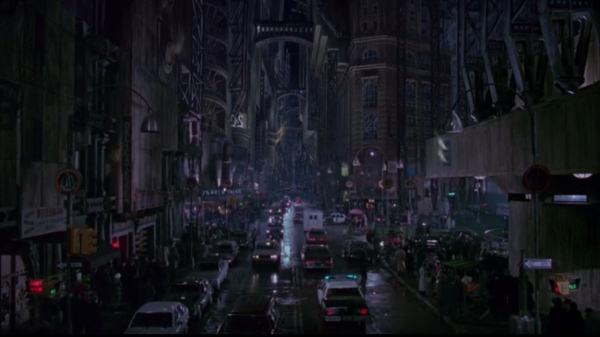
is, of course, its design. Burton’s Gotham/New York, as Anton Furst created it,
is a dangerous, gritty place, and at the time, it matched New York all too
well. Although, as with all of Burton’s films, you can practically see the
brushstrokes in his urban tableaux, you can still sense a seething energy in
the frame, as the old (the dilapidated look of the buildings, the pedestrians
in fedoras) brushes up against the new (the shiny look of the taxicabs). In
1989, Times Square was still a dangerous, seedy, unpredictable place; the risk
of being mugged there, if you were alone, was considerable. I remember being
palpably nervous when going there in broad daylight to get a fake ID (so I
could see a show at the long-departed King Tut’s Wah-Wah Hut), so nervous, in
fact, that I gave my dormitory address as my home address for my “Official
Identification Card.” Avenue A, bordering Tompkins Square, was not for lone
travelers after dark, and really not much fun during the daytime either.
Williamsburg was barely a place, it was so dangerous. When I looked at the blue-black
hues of Burton’s Gotham, I saw a reflection of the city I both worshipped and,
from a Texan’s perspective, feared.
 

In addition, its Black-White-and-Gray Morality Play lasts. I
identified with this aspect of it partially because of my own mental state at
the time. I was blasted out from a year’s worth of reading everything from
classics to Lolita to Mayakovsky to Marquez to Hobbes to Hume, lonely, freaked
out, psychologically tired from combating the regular pressure New York puts on a novice. The world began to seem like one of extremes to me:
either a day was good, or it was terrible. Either I was sated, or I was
starving. Either I was wide awake, or I was collapsing. Similarly, the movie’s
polarities are dramatic: Rich vs. Poor. Innocent vs. Corrupt. Happy vs. Unhappy.
Past vs. Present. (In other words, it’s a movie based on a comic book.) The
movie isn’t necessarily simple-minded—these qualities dance around each other,
and occasionally disguise themselves, in the film, but the manipulation we
witness is writ large. There’s nothing complex about the way the complexity is expressed.
Bruce Wayne is Batman, but he is tormented about it—and then, on the other
hand, he isn’t. All of these sides of his character are openly stated.
Similarly, the Joker’s complicated stance—a crook out-crooked by his more crooked
boss, with a tremendous sense of humor (remember his sparing of the Francis
Bacon grotesques in the museum? Or “I’m no Picasso”? Or “This town needs an
enema”?)—makes him both malevolent and sympathetic, as with all the great
villains of literature and film. His complexities, as with Batman’s, were
broadcast on such a large scale that you would have had to have been asleep or deeply stupid not to have noticed them. So, my younger self, nursing the
dogmatically snotty should-I-be-here feeling only a 19-year-old can pull off,
sat in the theater, surprised at the degree to which I could relate to the film, and to its warped figures.

Things would improve: for Batman retellings, for Gotham, and
for me. It would be hard to deny, in all honesty, that Christopher Nolan’s
Batman films, based as they are on a more nuanced telling of the superhero’s
story, are more subtle, more multi-layered, more deftly filmed, more atmospheric,
and possibly more profound than Burton’s version, or any of its sad successors;
Batman Returns could boast the gifts
of Michelle Pfeiffer and Danny DeVito, but the series did not progress well
after that point (enough said). New York City looked up after 1989 as well; while David
Dinkins’ mayoralty of New York was problematic on many levels, the crime rate
was reduced, and with each successive leader, the metropolis has continued to change. Today, Times Square is a clean, well-maintained tourist
depository; Avenue A is prime real estate territory and a dining destination;
and many parts of Williamsburg resemble a suburb populated by Ivy-League
educated hipsters who like drinking beer out of the can. And me? Well, my days
became more well-rounded, the summers shorter; my sociability intensified; my
mind grew; my urban environment became, rather than a vast zoo in which I was
wandering without defenses, a complex place with which I would develop a relationship,
much like an interpersonal relationship—and a place in which I would build a
life. Nevertheless, I remember Burton’s film as a document of the summer of
1989, of a particularly odd patch in my own life, and as a film with a
tremendous amount of, for lack of a better word, soul, with all of that word’s
glories and imperfections.

Max Winter is the Editor of Press Play.

How BORGMAN Makes an Ideal Storytelling Lesson

How BORGMAN Makes an Ideal Storytelling Lesson

null

The following contains spoilers, of a sort.

If you were a novelist, or a filmmaker, or a playwright, or
even a scholar, or a critic, and you wanted a primer on how a story might be put
together, you would need to look no further than Alex van Warmerdam’s Borgman. No, it wouldn’t teach you that all stories should contain
humanoids who may or may not come from another planet, or that all stories
should feature disembowelment or, beyond that, social critique. It could,
however, teach you how to start a story, how to make it interesting, and how to
end it. The film, which tells the story of a man’s intrusion and destruction of
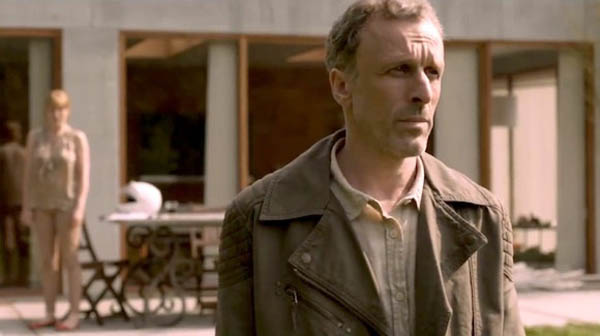
a harmonious home, has many wonderful attributes: a strong, mercurial
performance by Jan Bivjoet as the title character, coupled with an empathetic performance
by Hadewych Minis as his onetime love interest, now a comfortably married suburban wife and
mother; a gorgeous sense of stillness in its tableaux, often shot from a
distance, so we look both harder and less attentively at the on-screen events;
a remarkable sense of pacing; and above all, an enticing, pervasive spirit of surrealism. But its structure is its most enduring element.

The film begins, persuasively, with a mystifying sequence, intended solely to raise questions in the viewer’s mind. Several men march, in a dogged
group, into a deep forest with weapons; there is a priest among them, and even
the priest is armed. At a certain spot, they stop, and they begin driving poles
into the ground. It so happens that they are poking into the underground home
of Camiel Borgman, the film’s questionable protagonist. He vacates his well-appointed
grotto immediately at the first sign of siege. He escapes quickly and finds his
comrades, all of whom are sleeping in what seem to be pods just underneath the
leaf-covered ground. Who are these men? Why do they live this way? Why are the
other men seeking them out? Have they done something wrong? Are they dangerous?
The film raises these questions and then, smartly, changes course.

A sudden shift in perspective is a common technique in
storytelling; films as varied as The
Crying Game,
Down By Law, or Mulholland Dr. all make sudden leaps,
the immediate effect being disorientation, the culminating effect being a sense
that a larger world tableau has been examined than might have been expected at
the film’s outset. Here, the shift is to a traditional stage for plot-making:
the happy home. That home, in this case, is a vast house in the suburbs, owned
by Richard, an entertainment executive, and his wife Marina, an artist. They have three children
and a live-in nanny. Into their lives comes shaggy Camiel, claiming both that he
hasn’t bathed in days (probably true, from his bedraggled appearance) and that
he knows Marina, that in fact she was his nurse at one point. Camiel is soon
stealthily ensconced in the family’s life, without Richard’s
knowledge—which means their happiness is about to be disrupted. From the time
of Paradise Lost forward,
storytelling demands that if a situation does not have any readily apparent
problems, its surface must be disrupted. Otherwise, there is no story. In this
case, the disruption is immediate. When Richard first meets Camiel, he beats him
for making inappropriate comments about his wife—and then he and Marina
fight. Marina sneakily finds Camiel a spot in a guest house on their rambling property. Not long after
that, we see Camiel, naked, crouched on top of Marina’s naked, sleeping body, disturbing
her dreams. And not long after that, Camiel kills the family gardener: one
disruption on top of another. Here, van Warmerdam deploys yet another standard
storytelling technique: the use of a crystal-clear, memorable image which
encapsulates all that happens within a story. When Camiel, along with two
be-suited associates (we never find out how these malevolent figures are connected),
kills the gardener, he also kills the gardener’s wife. The way in which he
disposes of their bodies tells us quite a bit about what the film is trying to
do, and elegantly: the victims’ heads are buried in buckets of concrete and they
are tossed to the bottom of a lake. We watch the bodies descend, slowly,
gradually coming to rest with their legs pointing directly upwards and their head
pointing directly downwards: they are turned upside down, just as the lives of
those above them are, increasingly, turned upside down and cast into disorder.

Here the narrative once again doubles upon itself, as if to
demonstrate to a viewer the extents to which stories must go to reach their
desired destinations—and also to show that within one narrative, constant
revolution may sometimes be necessary to keep it alive. In this story, Camiel
bathes, gets himself a haircut, and shows up once again at the family’s door,
this time in an interview for the gardener’s replacement. Richard, not
realizing that he is talking to the vagrant he pummeled earlier, likes him and gives
him quarters in the house itself. Shortly after his arrival, Camiel marshals a
tractor to tear up the garden, ostensibly in an effort to improve its
appearance—but, of course, also tearing up all the family has cultivated, all
of its peace, here embodied in the carefully landscaped trees. We learn,
gradually, that Camiel and Marina do indeed have a history; she reaches out to
him, and he does not reach back until a stage, of a sort, has been set. The
setting of that stage is gruesome, involving murder, drugging the children,
and, once again, Camiel’s invasion of the family’s dreams. From this point
forward, everything that van Warmerdam has put in place moves quite smoothly towards a neat (and perhaps all-too-neat).

For all of its structure, the actual conflict in the story
arises primarily from the alien quality of Camiel’s presence. The question of
what his purpose is in the film rises with beautiful restraint, until finally
he achieves his objective—at which point the film ends. Borgman has been chided
for not providing enough answers to the questions it raises—which may be fair,
given that if those answers were provided, the emotional weight of the film might
increase. For a film of this type, though, the questions are more significant
than any answer the director might provide. Indeed, the absence of such answers
helps to accentuate the film’s ultimate accomplishment, which is to show the
shapes madness and anarchy may take when properly contained—and how every story
is, in a sense, like the house described here, a box with four walls and a
roof, in which nightmares and daily realities compete for our attention.

Max Winter is the Editor of Press Play.

Lukas Moodysson, Teacher of Women’s Stories: WE ARE THE BEST! Indeed

Lukas Moodysson, Teacher of Women’s Stories: WE ARE THE BEST! Indeed

null

There’s a scene near the end of Show Me Love, Swedish director Lukas Moodysson’s first film, that tells everything about
the director’s sense of humanity in one short burst, showing that he is a good teacher as
well as a swift storyteller, and that what he is teaching is how being human feels (in case we’d forgotten, as well we might have). In the scene, Agnes, one
of the film’s lovelorn centerpieces, has just thrown a birthday party, and Viktoria, who
is wheelchair-bound, is the only one to show up. Because Agnes is a teenager,
and troubled, and angry no one showed up to her party, especially not the girl
she is in love with, she makes vicious fun of Viktoria, saying cruel things, as
bluntly as only someone her age could say them. Viktoria finally leaves the house, crying.
Rather than filming her departure dramatically, Moodysson simply shows us her back,
as she wheels along all alone, up a quiet, dark street. One gets the sense that
Moodysson knows exactly what it feels like to be Viktoria, in that wheelchair,
moving slowly through the dark, cast out, misunderstood. Moodysson understands what
it feels like to be hurt. But also how it feels to rise out of that pain: Show Me Love, Together, Lilya-4-Ever and We Are the Best!, within his filmography, all teach what sadness
feels like, and show characters’ development as a sort of rumbling around inside that sadness, sometimes escaping, sometimes not.
Above and beyond that, though, Moodysson is a skillful teller of women’s tales: Show Me Love is a juvenile lesbian love story, Together the tale of a
woman’s seeking of refuge within a chaotic commune, and the subsequent Lilya 4-Ever
a blisteringly educational journey into the world of sex trafficking. While the
reviews of the current film have praised it as “upbeat,” “adorable,” and other
such adjectives, for the undeniable cuteness of its three juvenile leads, it is
easy to overlook that this filmmaker quickly and effectively takes viewers
inside the female experience in a male-centered society, telling how it feels
in numerous ways–and has done so throughout his career. We Are the Best!
addresses issues timelessly relevant to women with great power and directness—even
if the film’s leads are in their preteens. In fact, the youth of these characters
makes Moodysson’s points all the more poignant, demonstrating that issues of
acceptance and adaptation may start at a very early age.

Let’s start with their looks: the female leads in this film
look like boys, and they suffer for it, however indirectly. The film’s spiritual
center. Bobo (Mira Barkhammar), has short-cropped hair and often carries herself blockily; when
she walks around in her tights, you might easily think she was a boy wearing
pajamas around the house. She’s the best actor of the three; Moodysson’s
trademark close-ups reveal a thoughtfulness and reflectiveness in her gaze, a
silence before she speaks, that’s striking in a film about three schoolmates
forming a punk band. Her bandmate, Klara (Mira Grosin), is similarly boyish in appearance,
with a cocky mohawk and a raffish aggression that reminds one of the male
characters in the film; her emotions are fairly simple ones—happy, sad,
confused, without much nuance. The two friends gradually adopt Hedwig (Liv LeMoyne), a
Christian who also plays classical guitar proficiently, as part of their
band—though more classically “pretty,” with long blondish hair, she too has a
vaguely blunted quality to her, a sub-verbal affect expected more from a sullen teenage
boy than a rocker in a girl band. When the trio interacts with the other girls in their school, all wearing
heavy make-up, we realize that the bandmates are foils for the other characters’ more
stereotypically “feminine” affectations, and that the film’s sympathies are
obvious—the more “popular” girls here seem callous beside the rebellious, more alive
protagonists. Ultimately, other children’s ridiculing of the bandmates comes
across here as the beating down of the less-attractive by the more-attractive. Male
treatment of these girls can be brutal at times; more than once, they are called
“ugly,” reinforcing their status as social outcasts—and reinforcing the idea, all
too common,  of a “typical” female appearance,
which doesn’t include cropped hair, boyish features, or mohawks. (At least not in Sweden.) When the girls
cut Hedwig’s long blond hair short, the act reads a little bit like an
initiation into a post-archaic vision of womanhood.

Moodysson, given his intense sensitivity to
female concerns, doesn’t really present male characters comfortably. Here, as in his other
films, either they’re brutes or they’re overly gentle—there’s never an excess
of subtlety in the characterization. In this film, the receding quality of many of the male characters
brings the band members’ attitudes into the foreground. When the girls meet up
with another punk-ish band, all male, the boys in the other band, shoegazers par excellence when they’re not playing
their instruments, seem like dull knives beside the more fiery protagonists of
this film—they make poor conversation, and they’re hopeless as flirts. Whether
faking her indifference or not, Bobo dismisses the boys in the band as boring,
and her dismissal makes good sociological sense, in this context; in a
community not entirely ready to accept the idea of a girl band, what could be
more conventional than a group of young boys playing punk, and oafishly? Likewise,
male authority figures, like the bumbling supervisors in the rec center where
the girls practice, or even Bobo’s father, often seem passive. Bobo’s father
is gone a lot of the time; Bobo’s mother sleeps around quite often; his is a
sham of fatherhood. Unable to fully command others, or take a stand, the male
characters in this film ultimately leave the female characters, regardless of
their age, to make their own way, and their own rules, successfully. The film
becomes a parody of male dominance.

Near the end of We Are
the Best!,
as if to top things off, the girls even have to cope with what
we would call “mansplaining,” or whatever the Swedish version of it would be,
as one of the rec center directors insists on showing off his guitar skills, as a demonstration of proper playing,
only to watch Hedwig, who is adept at classical guitar, play circles around
him. The scene is not overplayed, and yet, like everything else in the film, it
is set up for a highly deliberate purpose. The older men in the rec center
don’t have a chance; any disciplinary or authoritative gesture they make can
only show their incompetence. It’s to the film’s credit that, despite the
simple, straightforward way it develops, it manages to arrive at an ending that
shows the girls as successful on their own terms, even if they get a stormy
reception, complete with food-throwing. The film, beyond being a girls’
hero-saga, indicates that these characters, these women can live for each other—and
in so doing, teaches a little bit, or perhaps a mouthful, about human survival.

Max Winter is the Editor of Press Play.

Of Literary Television, and the Damage Done

Of Literary Television, and the Damage Done

null

If one accepts that “literary television,” with
its references, counter-references, allusions, character nuances, plot
mechanisms and other trappings typically associated with books, as demonstrated
admirably in shows ranging from The Sopranos to Breaking Bad to Mad Men, is a
part of the cultural landscape that must be reckoned with, then it’s only fair that, given a certain amount of
intellectual distance, one might look at where it is headed. If the sensitive
among us, and those knowledgeable about trends, and where they lead and
where they don’t lead, were to make such an assessment and then not feel a small
ounce of queasiness, as a result, then two things are true: all
is as it’s supposed to be, and we, as a “culture,” have a problem.

There’s no denying the pleasure to be had in stretching out
and watching an episode, or seven, of The Sopranos, listening to Jersey patois
deployed in comic and artful ways, or witnessing the unfolding of eccentric
storylines, or drifting through dream sequences from inside the head of a Mafia
boss. Similarly, entering the desert world of Breaking Bad, with its beautiful
cinematography, and its deranged but sincerely human storyline, or that of Mad
Men,
with its cool and yet also jabberingly active period-authentic dialogue, rich
with the thrill of the pursuit of money, provides excellent escape, even
absorption. But it is necessary, at a certain point, to consider what is
involved in that absorption. Any artistic work, be it a sonata or a
blockbuster, makes requirements of its viewers. On one level, of
course, there’s suspension of disbelief—the idea that anything that seems
improbable or unlikely within a story can be forgiven because the work in
question is fictional, not reportage—and that’s just the way storytellers do things. In the case of these shows,
though, something extra is required: a sense that one is, somehow, above the
story being watched, that the viewer is obviously not capable of the depths to
which the characters sink, nor would ever condone the illegal activities and
trespasses depicted. This breeds, with time, a sense of viewer toughness: Of course we can watch a human body being
dissolved in acid and then falling, in a bloody, gelatinous mess, through several
layers of wood, cement and sheetrock. It’s for the purpose of a larger story.
Or:
of course, we can watch advertising
executives drink themselves into a stupor at their desks. That all took place
long ago, and we would never, ever do such a thing today. Who could? And we certainly
wouldn’t cheat on our wives, either.
The sense is that the viewer, being
“above” the actions portrayed on screen, can digest an episode or two and then
move on, unhindered, unaffected. This toughness, though, is not necessarily
foolproof. You can’t absorb the “smart” part of a series—the cross-references,
the character layers, etc.—and not somehow absorb the part
of that series more commonly considered abhorrent. And if this is the case,
what’s the cumulative affect of all of this absorption, of all of these hours
spent binge-watching?

Take, for example, The
Sopranos
. Since the days of The
Godfather,
the Mafia, with its secrecy, its sudden violence, its strangely
lyrical mode of verbal expression (“Luca Brazzi sleeps with the fishes”) has
been seemingly easily digested by the culture at large—so great is the sense
that their comings and goings are separate from ours  that jokes can be easily made at their
expense and have, by and large, lost whatever “edge” they may once have had. To
“make someone an offer they can’t refuse” is a nearly meaningless expression at
this point in time. The Sopranos, as
has been widely discussed, placed viewers in an uneasy relationship with the
Mafia, and with crime in general. To accept the show, or to continue watching
it, would mean that the viewer would have to tread a highly quavery line: that
of accepting the insecurities of its central character, sentimental attachment
to ducks, panic attacks, troubled relationship with his mother, and all—and
rejecting that which one knew to be wrong, i.e. the violence, the extortion,
the bullying, the breaking of the laws of the land. And yet: it would be a rare
viewer who did not, at some point, if only for a second, surrender and suppose:
What if I were him? He has so much
authority. Those guys, they really know how to get things done.
And similar
sentiments, all adding up to a sense that, whatever the law and common morality
might say, Tony and his co-workers were an impressive bunch. Said feeling, once
had, would immediately be squelched. And the next episode would be queued.

Similarly, Breaking
Bad
required that one both sympathize with its central figure, Walter White, a man
stricken with cancer, and recognize the lawlessness of his actions: the
manufacture of meth, the sale of it for his own treatments and the sake of his family, the murders, the increasingly violent way
in which the day’s activities were completed, the wholesale deception of his
family (at first). The distancing required here, the sense of superiority, was
a bit more complex. After all, there seemed to be a specific reason for this journey,
on which all viewers were passengers, into a dark and forbidding place, both a
mental nadir and a socioeconomic pit, however complexly portrayed it might have
been—and this reason, personal preservation, was a rather primal one. Coupled
with this was the sense that, whatever his trespasses might be, White
was achieving power where he had previously had none, an irresistible tale,
psychological rags to riches, the victory of the underdog. Viewers were given plenty to marvel at besides
the story line: the camera work (which this publication has given
considerable attention), the literary references, the complexity of the plot,
the almost droll attitude the show’s creator took towards its development. This was enough to prevent direct engagement, for the most part, with the actual
content of the show—to somehow allow viewers to both dwell in the mind of a
criminal and step outside of it, to appreciate the form without grappling with
the content, and have that be enough. And yet was it? Wasn’t there some small part
of some viewers that might, every now and then, watch the violence on screen
and cheer inside, get some small charge from it? One might use words like devastating or horrific to describe it—but these words might be code for impressive or, sadly, enviable.

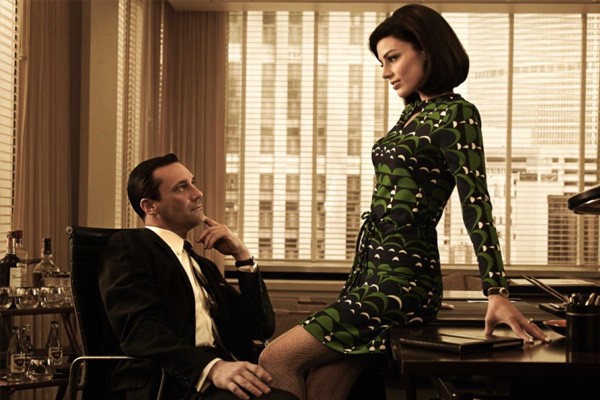
And currently there’s Mad Men, a show about a supremely
unredeemable set of ad executives, from a period in American history that was,
in many ways, horrible, acting viciously towards each other and their loved
ones—and yet doing so with such an immaculately clever script, such a
remarkably accurate set, in such stand-out wardrobes, again eerily faithful to
the period, and with such a natural sense of dynamism and such a crackling,
wired sense of the potential of human conversation that it is difficult, for its
millions of viewers to feel anything but rapt worship for it. This worship
translates into its critical reception; in its most skilled commentators, it
typically inspires flights of lyricism one would best reserve for a creative
writing class, a love letter, or a eulogy. The setting-aside one must do here
is, again, quite complex. To engage with the show on its terms—to follow Don
Draper from his false identity forward, through a career marred but also
invigorated by a healthy diet of booze, adultery, familial betrayal, and
narcissism—one has to both forgive him and separate one’s self from his
misdeeds, issue stern rebukes to the mischievous voice in one’s ear whispering,
What about that martini at lunch? Why not
have an affair? Who needs to tell the truth? How old-fashioned!
This is
where toughness comes in: one has to watch the horror-show of sexist, racist,
and classist attitudes circulating through the show’s office hallways and
remind one’s self of one’s natural distance, perspective, and self-respect—and
hope the reminder sticks. The show’s army of recappers all call Draper a
misogynist, a sexist, a pig, any name you might think of. But few of them
dismiss his ad pitches.

So in a sense, what we’re doing when we watch “literary
television” is pretending we’re not watching what we’re watching—we hold the
program at the level of commentary, of satire, seemingly preventing it from affecting us
in any way. The problem is, though, that the shows mentioned touch us in primal
ways, and so they can never be just commentary: mob hits, carnage, adultery,
rampant alcoholism, or what have you all move us, in small ways. We like to
pretend we’re tough enough to place everything, from the most maudlin part of a
TV show to the most horrific event in “offscreen” life, in perspective. And, in
fact, daily life demands that, increasingly. We keep up, steadily, with
whatever happens outside of ourselves: The text messages. The emails. The
Tweets. The Facebook posts. The Youtube videos. The gossip. The commentary on
the gossip. The TV shows. The commentary on the TV shows. And onwards, until
whatever happens in the “real” world is inconsequential until it becomes absorbed,
translated into a language we recognize, posted somewhere, with a photo, or better yet, slipped into a Tweet. In the current social context, a television drama
that asked its viewers to follow, for an extended period of time, a series of
events in the lives of well-drawn, well-acted characters who weren’t gangsters,
drug dealers, or ad executives from a decade largely unknown to said viewers wouldn’t
have much of a chance. Why? Because it would provide no opportunity to escape.
In a world in which escape—from the self, ultimately—is a goal shared by many, such
a show would be decidedly, for lack of a better word, unsexy. I will admit that
I’m happy to live in a time when such brilliant, staggeringly accomplished
shows as those described above are on television—and yet, at some times, I’m
also terrified at what lies ahead.

Max Winter is the Editor of Press Play.

On GORE VIDAL: THE UNITED STATES OF AMNESIA: The Current State of the “Public Intellectual”

On GORE VIDAL: THE UNITED STATES OF AMNESIA: The Current State of the “Public Intellectual”

null

What does it mean to be a “public intellectual” in 21st
century America? To answer this question properly, you have to answer two smaller
questions: what does it mean to be public? And what does mean to be an
intellectual? The answer to the first is simple. If you have a computer and an
understanding of passwords, you can establish both a Twitter and a Facebook
account in a matter of minutes. Voila! You’re public. Any thoughts you might
have will be shared with anyone who cares to seek them out. The second question
is more thorny. Education has changed. The country has changed. America remains
only a smidgen above third world nations in its educational quality, and has
occupied that spot for many years. So the answer to the question becomes: being
an “intellectual” means being smart enough to make people listen to you, and believe you. (No mean feat.) So
what of the whole label? Can a blogger be seen as a public intellectual? Are
the pundits we read at Salon, Slate, and the Huffington Post the seers we look
to for stimulation of thought and dialogue? Or, to take it farther, when a
Tweeter with nearly a million followers writes a glib 140-character statement that provokes dialogue, can we consider this an act of
public intellectualism? Are the fomenters in comment boxes on Facebook, blogs, news sites, to be seen as public intellectuals, themselves, for the command
of a virtual and potential audience? Think about these questions too hard, and
you might just throw up in your mouth. Seeing Gore Vidal: The United States of
Amnesia
might shed some light on the matter, or at least suggest what the strange term “public intellectual” used to mean. 

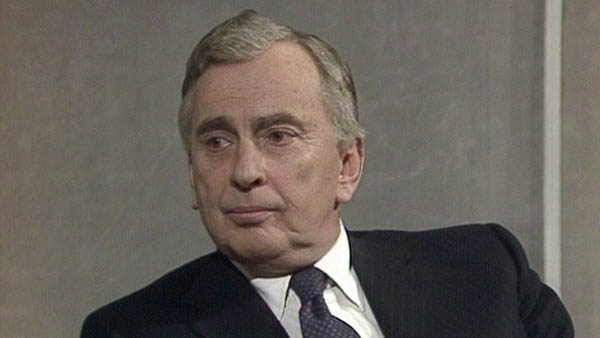
There was very little that Vidal, who died in 2012, didn’t
do, and the documentary shows us his working life in loving detail. He was a
novelist, throughout his life; his frankly homoerotic 1954 novel The City and the Pillar gave him great
notoriety on its publication, and in fact it guaranteed that the New York Times
would not review his books for many years afterwards. Finding that he needed to
make a living, he turned to plays and teleplays, one of the most successful of these
being the stage play The Best Man, a sharp social drama that saw a revival in 2000 and 2012. Much later in life, he would write the—again—scandalous Myra Breckinridge, about a transsexual,
for which he also wrote a screenplay, which was made into what some think was
one of the worst films ever made. He also ran for public office twice: for the
House of Representatives in 1960, and for the Senate in 1982. His chief
function in American life, though, and that for which he is perhaps most widely
remembered, was as an essayist (for the Partisan Review, the New York Review of
Books
, and elsewhere), a brilliant commentator, an eminently witty pundit—a public intellectual of the
grandest type. Despite the fact that he himself came from a very wealthy
background, he was unabashedly liberal. The most hair-raising moments in a
documentary jammed with Vidal’s controversial but wise statements come first
from footage of a famous series of televised debates he had with William F.
Buckley in 1968. As police clashed violently with protesters at the Democratic
Convention in Chicago, Vidal and Buckley talked quite heatedly about, put simply,
ideas. Asked to comment on the riots, Buckley expressed the hardline view that
they were anarchistic, to which Vidal responded that Buckley was a
“proto-Nazi,” to which Buckley responded that Vidal was a “queer” who should
take himself away from his “pornography”—and the conversation went on from
there, verging on violence. This wouldn’t be the only such rodeo for Vidal: in
a similarly famous debate with the notoriously pugnacious and masculinist but
highly articulate Norman Mailer, the two men nearly came to violence. The
topic? Feminism. Vidal was in favor, Mailer a skeptic, natch. There are nits to
pick, here, as virtuous and intelligent as Vidal might seem. When Vidal and
Buckley debate, they often seem here to be competing to see who can do the best
moneyed drawl, the best James Mason imitation, or both. It might also be argued
that, from a position of wealth and privilege, Vidal was not in a position to
change anyone’s mind about anything—as he knew not whereof he spoke, at least
as far as his views on the life of the poor were concerned. (Rarely in the present-day sections of the film do we see Vidal outside of his mansion overlooking the sea, in Italy.) Nevertheless, what he
and his quasi-contemporaries (Susan Sontag, Joan Didion, and yes, William F. Buckley, and yes, Norman Mailer)
stood for was the value of the written word, of clarity, of beauty and succinctness of expression.
Along with, of course, superior education and background. These intellectuals
were celebrities because of the way they spoke, not because of financial status
or their ability to dodge flying cars. (Or, for that
matter, because of their legs.) It would be hard, in other words, to imagine Jimmy Fallon,
comically gifted as he might be, sitting down with Vidal and Buckley and
hosting a chat of the sort they had in the 1960s; talk shows, at present, cater to celebrities of an entirely different caste. Christopher Hitchens, of recent thinkers, might come closest to this older standard, in terms of his public presence and his acceptability beside celebrities of other types; indeed, he flickers
in and out of the documentary, once named by Vidal as his unofficial “heir” or “dauphin”
and then rejected when he wrote essays in favor of the Iraq War.

And so, where have we landed? All we can say with any
certainty is that, in some senses, it is easier to command public attention
with words than it used to be. The rise of blogs, personal websites, and other
such publications as sources of commentary and outlets for expression has
elevated the importance of the first-person perspective and given a broader
swath of individuals a mass audience, through the Internet, that they wouldn’t
necessarily have had before. Who’s to say that’s a bad thing? However, perhaps
the general level of our commentary has decreased, with time. Can we say that
Patton Oswalt, who live-Tweets Downton Abbey, or famously race-baited Fox News
through a series of cleverly worded Tweets, or Louis C.K., whose invective
against smartphones spawned a wide range of commentary, or whose recent Tweets against the Common Core aroused attention from many different quarters, represent the 21st
century’s version of a public intellectual? I’m not complaining, if so, because I love
both comics dearly. But then, on the other hand…

Max Winter is the Editor of Press Play.

The Curious Appeal of Griffin Dunne

The Curious Appeal of Griffin Dunne

null

I don’t like hubris in any form; when I see it on screen, my
dislike is amplified. Hence, I tend not to be a huge fan of Lead Actors. Joaquin
Phoenix is a Method-fueled blur, Cate Blanchett a scenery chewer, Leonardo
DiCaprio too young, even at his age. I tend to be drawn towards character
actors, or at least those who have built their careers on secondary roles: the Brad Dourifs, the Tom Noonans, the Marcia Gay Hardens, the
non-mega-stars. I tend, also, to be a fan of Griffin Dunne, wherever he appears.
Dunne is an interesting case: he gave early star turns in An American Werewolf in London and After Hours, but has since then been primarily a supporting player, albeit a consistent one.
He formed a standard Griffin Dunne expression in the early films, one which
combines three stages of rage: the initial outburst, the growing anger, and the
acknowledgment that there is nothing to be done, settling into a fixed glower
that never entirely leaves his face. This vulnerability, and his frustration
with it, is too ingrained in him for him to ever be a leading man—he seems to
feel his pains the way the rest of us feel them. He wants to hide them, but he
can’t. Insecurities, fears, and anxieties in the Lead Actor, by contrast, must occur like the
psychological equivalents of exploding cars; they must be huge, expansive, intimidating,
screen-filling. Dunne doesn’t fill the screen, and yet he does occupy it. In
his current film, The Discoverers, he
occupies the screen much like a human grounding plug—his presence never allows
other characters’ histrionics to go too far. Any rage of his own is, likewise, contained.

Granted, The
Discoverers
had stiff competition, given that it opened on the same day as
Godzilla; if faced with the choice of
seeing a film about the career struggles of a poorly shaven history professor
or a movie about a gigantic lizard from the bottom of the ocean, the decision might, for many viewers, be fairly simple. This is regrettable, because any flaws the
film contains (and there are a few) are small in contrast with the strength of
its different elements. The story has a shaggy-dog quality to it, one part road movie, one part self-realization saga: divorced
history professor Lewis Birch (Dunne) is traveling to Portland for a professional conference
with his two children, here beautifully deadpanned by Madeleine Martin and Devon Graye; he has
also just sent his 6,000-plus-page history text on a minor figure in the Lewis
and Clark Expedition to a diminutive, obscure academic publisher. Neither of
these attempts are destined to be successful; Birch broadcasts their impending
failure with his entire bearing: the stubble on his chin, his poor posture, his
messy apartment, even his dirty car, suggest things won’t work out so well for
him. The fact that he moonlights as a security guard indicates, in tandem with
all of the other clues, that the trip is a bit of a Hail Mary pass. What
distinguishes Dunne’s performance from those of other actors who have “gone
sloppy” for the sake of a role (see Michael Douglas in Wonder Boys, for a famous example) is that it hurts more. In a
swerve that shapes the story, Birch is forced to make a detour en route to the
conference to see his estranged parents, one receding into dementia, the other
fatally ill. The lack of love communicated between Birch and his father, played
beautifully by Stuart Margolin, is palpable; what radiates here is less alienation
than profound dislike. It comes out in small ways, such as their inability to
look fully at each other for long, or the vaguely deadened, aggravated sound in
Dunne’s voice when he speaks to his father. The two are left alone because Birch’s mother dies suddenly, before she speaks a line of dialogue; her absence
hangs over the rest of the film as if it might be the only thing that would
cement their relationship.

In After Hours and American Werewolf, as with subsequent roles, Dunne seemed more
rational than any of the players surrounding him. After Hours found his modest office worker wandering through the
streets of Soho at night, being toyed with and pursued by a host of brilliantly
portrayed characters, including a be-beehived Teri Garr, a sad, brooding,
obsessive John Heard, and a vengeful Catherine O’Hara. In American Werewolf, he still offered the voice of reason, even from
beyond death, as his soon-to-be-lupine friend couldn’t control the changes
occurring in his body and mind and Dunne’s gorily maimed corpse had to explain things
to him, in a sarcastic, do-I-really-have-to-explain-this tone. Here, similarly, Dunne’s grounding-plug instincts are put to the test
as he must follow his father into the woods, where he has gone with a group of
re-enactors of the Lewis and Clark expedition. Predictably, the re-enactors all
speak in period language, eschew modern convenience, act somewhat
freakishly—and predictably, hijinks ensue. But these hijinks don’t reach nearly
the pitch they could have—the film’s strength lies in the fact that neither
their absurdity nor Dunne’s sad state are entirely laughable. The director
chooses, instead, to come close to embracing them—we learn a lot about the
expedition through Birch and through his father’s band of cohorts, as the film
looks openly at the re-enactors, considering why they might have arrived at
this point. Perhaps the most touching of these performances comes from Cara
Buono, playing a potentially damaged soul-seeker, a million miles from her more strident recent role as Faye on Mad Men. Similarly, we come to
see Birch as less a middle-aged, down-at-heels academic than a confused son of
confused parents, striving to be more than marginally better at parenting
himself.

Dunne is the leading man of this film, and yet he is not the
leading man. The film offers too much competition, in every way, even beyond
the strengths of its other actors. The script, while it has its moments of pat
indie-com humor, is admirably restrained and intimate; even Birch’s daughter’s
indication of a stray pube on a bathroom floor, as she and Birch are both sitting there, turns into a
moment of closeness. The film’s visuals, as well, rise beyond the story: the
blue of a mountain range or the immensity of a fog-filled morning write their
own kind of script here, across the film’s plot, and they operate in a gorgeous
counterpoint with it. Dunne can’t compete with these elements, nor does he try
to. The strength of actors like this, those who operate on a fainter register than others,
is that they remind us of what we are like, rather than what we are told we might
be like, if we tried. The strength of Dunne’s performance here is that, despite the fact
that he’s arguably the center of the film, you’d never know it to look at him.

Max Winter is the Editor of Press Play.