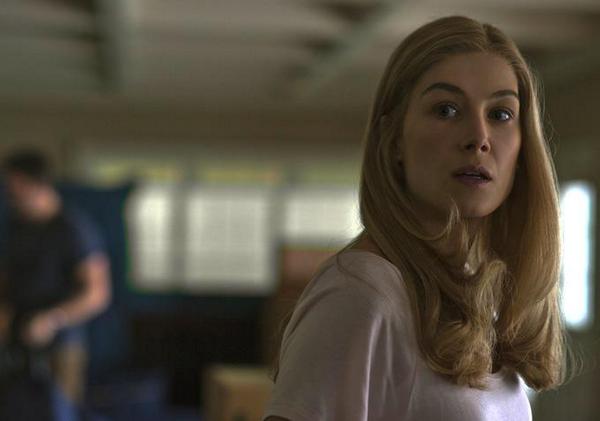
GONE GIRL’s Cool Girl: Hero or Villain?

GONE GIRL’s Cool Girl: Hero or Villain?

nullSpoiler Alert: The following piece contains spoilers.

Gone Girl is a prickly, cerebral film, not unlike the dazzling villain who sets Gillian Flynn’s immaculately constructed
story into motion. It’s shot in bruised grays, with cold, antiseptic lighting;
the plot leads to a  dénouement that has sparked a thousand
thinkpieces and awkward dinner date conversations about gender and violence,
and the nature of marriage itself. However, I left the theater thrumming with
emotion: inchoate half-thoughts made more potent by their rawness. I couldn’t
articulate the power of what I’d seen until the following night, when I sat in
the back row of a burlesque show. One of the performers took the stage in a
gold sheath dress, fabric wings, and a dragon mask.  She whipped her lithe, muscular body around
the stage, shimmying out of her dress, down to g-string and pasties; towards
the end of the song—Lorde’s “Royals”—she removed her mask, revealing an
elaborate make-up of jewel-bright gold, blue, and green that made her face look
as if it were covered in scales. Underneath her dragon’s head was a female
body, pale and pliant. Woman as fantasy. Woman as monster. Object of desire.
Destroyer of worlds.

I
return to this image, and the awe it inspired in me, as I take stock of the
discussions buzzing around Gone Girl, film and novel alike: the importance of
likeability in male and female protagonists; the ethics of constructing a
central character like Amy Elliott Dunne, who falsely accuses men who’ve
angered her of rape and abuse; and feminist deconstructions of the Cool Girl.
Gone Girl is a sardonic horror story that upends the tired Primetime tropes of
the suburban hubby with a heart of darkness beating under his pastel polo
shirt and his angelic-looking blonde victim by repositioning that
angelic-looking blonde as the predator. The story has a chokehold on the zeitgeist because it offers something
exceedingly rare and unimpeachably vital: a protagonist who shows that women
don’t have to be the sheep fleeing as the winged shadow swoops down. We can, in
fact, be the beasts with the long teeth.

In an essay
excoriating our cultural scab-picking over “likeable” female characters, the novel’s author and the film’s screenwriter Gillian Flynn writes: “[Men] have
a vocabulary for sex and violence that women just don’t. And we still don’t
discuss our own violence … women have spent so many years girl-powering
ourselves—to the point of almost parodic encouragement—we’ve left no room
to acknowledge our dark side. Dark sides are important.” Most mentally healthy
women who settle down in the dark to watch Amy Elliott Dunne frame her
philandering husband, Nick, for her murder, and take a box-cutter to the throat
of her Nice GuyTM ex-boyfriend, the king of condescending micro-aggressions,
certainly wouldn’t follow suit or agree that her reactions were proportional to
the offenses against her. Similarly, most men who watch American Psycho don’t
get their jollies shooting homeless people with nail guns. And yet, any woman
who has ever been cast aside for “a younger, bouncier Cool Girl” or had a man
explain to her what her best interests are has burned with the incandescent
rage that lights Amy’s torch, that glints off the axe she grinds.

Gone
Girl
is the first film in recent memory, and, arguably, one of the few films,
period, to offer a female villain who isn’t just the token henchwoman to the
true nemesis—the figure who exists so that the hero, amidst the rock ‘em-sock
‘em violence, can demonstrate his fundamental goodness by agonizing over
whether he can hit a woman, as in Scott Pilgrim vs. The World; or so that
the hero’s love interest can prove her pluck (and be counted as a “strong
female character”) by relieving him of the burden and fighting the evil bitch
herself, as did Mariko in The Wolverine—but
a vicious mastermind out for her own ends. Her drive for power and control
doesn’t manifest in a rah-rah “girls run the world” way; it emerges with an
arctic darkness that aligns her with characters like Michael Corleone or
Patrick Bateman or Walter White. These men’s violence and cunning often
articulate—and complicate—particular modes of masculinity: the boss of all
bosses, the soulless executive, the one who knocks.

The novel winks
slyly at the conventions of the anti-hero, the man who transfixes us
despite—or, more likely, because of—his badness. Nick is a case study in
internalized misogyny: “… my father, a mid-level phone company manager who
treated my mother at best like an incompetent employee … his pure, inarticulate
fury would fill the house for days, weeks, at a time, making the air humid,
hard to breathe … He just didn’t like women. He thought they were stupid,
inconsequential, irritating.” At first, we think we’re reading yet another
account of another white man struggling with his savage nature; then Amy wrests
the narrative from him in ways that the Carmela Sopranos and Sklyer Whites, or
the countless movie femme fatales who need the love of a good man to get out
from under a bad man’s thumb, never do.

The
machinery of Amy’s plot whirls and grinds on the standards and ideals of
feminine identity: “Amazing Amy … Ultimate-Frisbee Granola and Blushing Ingénue
and Witty Hepburnian Sophisticate. Brainy Ironic Girl and Boho Babe … Cool Girl
and Loved Wife and Unloved Wife and Vengeful Scorned Wife.”  Her Lecter-like precision in orchestrating
Nick’s trip up the river; the machete-sharpness of her observations about
gender, power, and identity; and the tremulous divide between the Amy who
outlines her plan and her motives with a crisp alacrity and the Amy who churns
with a pure, inarticulate fury make her a more compelling, even charismatic
character and a more effective predator.

Amy shifts through
a Kaleidoscope of identities to court, hold, and ultimately destroy the man of
her dreams. More than that, she wants to thrive—to win—in a world that still
just doesn’t like women. She uses the tropes of female victimhood—“a wonderful
good-hearted woman—whole life ahead of her, everything going for her, whatever
else they say about women who die—[who] chooses the wrong mate and pays the
ultimate price”—as the scaffolding of her plan. She is Snidely Whiplash in
damsel’s clothing, and this feels like a liberating alternative when women’s
suffering is treated like the wallpaper decorating so much of our
entertainment.

The week before Gone
Girl
was released in theaters, I saw The Equalizer, an extravaganza of
slow-motioned, nü-metal soundtracked, fetishized violence; the scene in which
our hero, a former black ops assassin, drives a corkscrew into his mafioso
opponent’s throat is almost loving in its meticulousness. However, his
berserker fury is acceptable, even heroic, because he is taking on the Russian
mob to ostensibly save a teenager trafficked into sex work—a character that
only exists to sport mini-skirts and black eyes, to be beaten and degraded so
that our hero can be stirred into righteousness. By contrast, Amy is her own
avenger; she will play victim, but she will not be one.

Gone Girl has been
rightfully praised as a satire of our media’s bloodlust, especially for the
stories of violated women: kidnapped co-eds, teenage sex slaves, battered
wives, rape victims; stories that are intended, on the surface, to shock and
appall with the scope of women’s suffering but can, instead (and perhaps
deliberately) turn that suffering into something titillating. Amy weaponizes
this suffering. When she’s forced to turn to Desi, her controlling ex, for
shelter and support, she plies him with sob stories of being beaten into a
miscarriage, fearing for her life; to con him, she becomes a fusion of broken
girl and happy housewife. In a New York Times interview, Flynn says that, “She
embodies [these stereotypes] to get what she wants and then she detonates
them.” And after Amy murders Desi—slitting his throat mid-coitus in a moment of
Grand Guignol that rivals Hannibal Lecter’s face-eating or Patrick Bateman
shimmying to “It’s Hip to be Square” as he hacks a rival to death—she plays to
the chivalric impulses of the mostly male FBI team handling her case, spinning
a graphic yarn of rape, torture and debasement; the things that, on some level,
every woman fears when she walks through a parking garage with her keys between
her knuckles or leaves a Match.com date’s name, number, and photo with a good
friend. 

As she gives good
victim, Amy wears the blood of the man she fucked and killed, blood that mocks
the willful naiveté and complacency of the cops—who prove all of her theories
about how men regard complex, difficult women correct when they silence the
lone woman detective who dares to ask probing, potentially damning questions.
Home from the hospital, she strips down in front of her husband, and that blood
is war paint; her naked body isn’t an object to be punished or desired—it is a
threat. The remainder of the film is a sly inversion of the typical domestic
violence narrative: one shot of Nick locking himself in the spare bedroom,
pensively staring at the door as the monster-he-married sleeps one room over,
is a mirror image of “Diary Amy,” the persona Amy created to frame Nick,
cowering under the covers, confessing on the page that the man of her dreams
may truly kill her. That shot provoked a nervous twitter of laughter throughout
the theater I attended, a sign that we’re still so ill at ease with a woman
assuming the full potency of the villain archetype, an archetype that will keep
its hold on us as long as there are slasher flicks and crime dramas, action
blockbusters and gritty indies.

There’s been a lot
of editorial hand-wringing over whether Amy’s actions make her Bad For Women.TM
Yet, we don’t wonder whether Patrick Bateman, skinner of women, represents a
misandrist’s wet dream. We don’t insist that Hannibal Lecter or Alex De Large serve
as exemplars of masculinity, or Michael Corleone be led away in handcuffs for
ordering the hit on his brother—in fact, we don’t want to see him humbled or
reduced. We want the vicious, vicarious thrill of watching him get away with
it. Think of the fans who study that diner scene that ended The Sopranos as if
it were the Zapruder film, searching for proof that Tony lives to lie and
scheme and kill another day.  Male
characters don’t have to be moral in order to be complex or aggressive.

Novel Nick unwittingly
articulates how our culture’s supposedly full-throated endorsement of the
strong, independent woman is, in some ways, merely a hiccup: “I can celebrate
and support and praise—I can operate in sunlight, basically—but I can’t deal
with angry or tearful women. I feel my father’s rage rise up in me in the
ugliest way.” We embrace Katniss Everdeen and Danerys Targaryen and Michonne
because they are heroes (even if they don’t want to be). Though they can be
killers, their anger and tears are funneled into liberating innocents and
protecting the people they love. Each of these women is an important,
empowering figure; still, she is lethal, but not dangerous. And we need
dangerous women on-screen; women who can claw open and bite down into the scarred
center of any woman (every woman) who has suppressed an unfathomable anger, a
will-to-power that can’t be contained in a pin-stripe suit. We need women whose
talons break through skin and spread bones to rip out the great, thick
throbbing heart. We need women who breathe fire. 

Laura Bogart’s work has appeared on The Rumpus, Salon, Manifest-Station,
The Nervous Breakdown, RogerEbert.com and JMWW Journal, among other
publications. She is currently at work on a novel.

Joan Rivers: A Trailblazer Who Got Stuck in the Mud

Joan Rivers: A Trailblazer Who Got Stuck in the Mud

nullHumor can be the cut and the balm—sometimes
one-in-the-same, in the course of a single joke.  Sarah Silverman wryly laments: “I was raped
by a doctor, always a bittersweet experience for a Jewish girl.” Wanda Sykes riffs
on how “Black folks, we always have to be dignified, ‘cause if we fuck up, we
just set everybody else back a couple of years. We should have killed Flava
Flav like ten years ago!” A young Joan Rivers does a bit about her mother’s
desperation to marry her off: “Oh, Joan, there’s a man at the door with a mask
and a gun!”

Comedy can also be the hand on the backs of our
necks. Tracy Morgan tells his audience that, if his son came out to him, he’d
stab the boy to death. Daniel Tosh artlessly ponders the fate of a female
heckler: “Wouldn’t it be funny if that girl got raped by, like, five guys right
now? Like, right now?” Joan Rivers serves as the commissioner of the fashion
police: “I took Elizabeth Taylor to Sea World. It was so embarrassing. Shamu
the whale jumps out of the water; she asks ‘does he come with fries?’”

Rivers occupies a complex position in comedy. Her
early work is rightly lauded for its unflinching candor about women’s issues,
and for bringing those issues—the pressure to marry and the tedium of
housewifery, the joys and annoyances of sex, and even abortion—to a national
audience. She is celebrated for serving as the first woman to host her own late
night talk show, and venerated for her tenacity in the wake of tragedy (the
betrayal of her beloved mentor, Johnny Carson; the suicide of her husband and
producer). As a writer and a feminist, I should have called in my own tribute
on the switchboard of Facebook. And yet, I can’t. Rivers’ early work may have
been a slingshot lobbing stones against the powers-that-be, but, in her later years,
her cruelty became a cannon unloading upon the oppressed. She trafficked in
tired slut-shaming and fat jokes.

In perhaps the only way that I will ever be likened
to Elizabeth Taylor, I too have endured my fair share of comparisons to Shamu.
I was a fat girl who became a fat woman, even after dieting and exercising and
binging and purging and taking “nutritional supplements” more potent than 50’s
housewife’s physician-prescribed speed. My fat ass has been the butt of so many
jokes over so many years that I’ve become intimately acquainted with the ways
that “humor” can be used to enforce social codes. Before I was ever aware of
her history, Joan Rivers was that voice that came from the TV in my mother’s
bedroom, a voice that, despite its off-putting raspiness, affected a favorite
wicked aunt chumminess that drew me in until it spit me out: “If Kate Winslet
had dropped a couple of pounds, the Titanic never would have sunk.”

I wasn’t one of those high school girls whose
ticket sales bought James Cameron a summer home, still, I could look up to Kate
Winslet: I would never have her hourglass figure (or her gorgeous red curls),
but her body, and its emancipation from Paltrow thinness, was far closer to
mine than any other modern starlet’s. And there she was on the silver screen,
the real ship of dreams. Ravishing. Desired. So, when Joan Rivers let it rip
with that joke, she was issuing a warning to every fat girl (every girl,
really): There’s only one way to be a woman, and there’s a price to pay for not
looking the part.

This is why,
unlike so many of my peers, I come to bury Joan Rivers, not to praise her.
Rivers famously quipped that, upon her death, her body shouldn’t be donated to
science, but to Tupperware: In truth, all of that plastic has been melted down
and sculpted into an altar to St. Joan of Snark, the groundbreaking vulgarian
who spoke the brutal truths that nice girls were never supposed to say (let
alone in public). Rivers muscled her way to prominence in a male-dominated
field, and she worked steadily for fifty years. It’s no wonder, then, that an
armada of think pieces seeks to defend Rivers as a capital-F feminist (even if
she’d have been reluctant to claim the label for herself). In Time magazine,
Eliana Dockterman equates Rivers’ legendary work ethic and savvy for
self-promotion as an innately feminist endeavor: “Nothing was off-limits as Rivers
wise-cracked her way to the top. And it was this
undisguised and ‘unladylike’ desire for success that made Rivers a feminist
icon.”

Assessments like this
strike me as an uncomfortably corporatized definition of feminism: The will to
work alone does not a feminist make, especially if the work affirms the
structures and mentalities that shame women—for their bodies (though weight was
one of Rivers’ primary comic milieux, she was also free and easy with the word
tranny); their sexualities (and anyone who fell on either side of the
virgin/whore dichotomy was fair game, as evidenced by her cracks about Taylor
Swift’s knees being “together more than Melissa and I” and the Kardashian
sisters needing to find “true love standing up. They’ve had more men land on
them than we’d had in Afghanistan.”); and even for being the victims of
violence (she once said that “those women in Cleveland” had more space in the basement
where they’d been raped and tortured than she had in her daughter’s supposedly
cramped living room; she also joked about slapping Rihanna for possibly
reconciling with Chris Brown).

If her latter-day
humor was particularly vicious toward women, it certainly didn’t spare the
gents. In Rivers’ world, men are shallow dogs following the bone of lithe,
leggy female beauty. They are sexual bullies who don’t see women as people.
They are simultaneously the arbiters of a very specific standard of female attractiveness
and horny devils unable to get it in their pants: “I
said to my husband, ‘Why don’t you call out my name when we’re making love?’ He
said, ‘I don’t want to wake you up.’”  

Rivers’ full buy-in to the aesthetic standards that confine
women manifests in more than her stage act; she co-signed with a scalpel. Over
the years, her face attained a stretched-taut surrealness that turned her into
a breathing caricature. There is an unintended but undeniably apt symbolism in
the idea that her natural ability to register and express authentic feeling was
tombed under layers of scar tissue. Her self-loathing, and not her wit, became
her weapon.

As a thirtysomething, I have grown up with the Joan Rivers
who puffed out her cheeks and imitated (her version of) a fat woman’s waddle on
the Letterman Show when discussing Adele, remarking that the latter’s song
“Rolling in the Deep” (which should surely be etched in a Mount Rushmore of
number one pop songs of all time) should be called “Rolling in the Deep Fried Chicken”—diminishing
Adele’s accomplishments as a singer and songwriter by reducing her to a body.
Today’s “Rolling in the Deep Fried Chicken” is yesterday’s “Elizabeth Taylor is
so fat, she has Ragu in her veins.”

As I see these remarks
on list after list of “Joan Rivers’ Best Burns,” I think of Margaret Cho’s
appearance on Rivers’ online interview series In Bed with Joan, and how
their conversation turned to Cho’s body—specifically, how svelte she’d become.
Rivers recalls meeting Cho years prior, when Cho was the anointed It Girl with
a sitcom in the works: “You were a bit of a …” she says, and her pause is the
plank that Cho must walk down before jumping into the deep. A bit of a fat
girl, she admits. Never mind that Cho’s studio-mandated compulsion to lose
weight (and lose it fast) resulted in kidney failure.

Cho may be considered one of Rivers’ heirs apparent, but she
proves that there’s more than one way to be woman who brings a carefully
calibrated cruelty to comedy. Her stand-up is more akin to Rivers’ early work,
bringing a “and fuck you if you don’t like it” bravado to her real talk about
her real pain. Her filth and fury is deployed against the double standards and
the beauty standards that Rivers, in her later years, always endorsed. Cho’s
stand-up film I’m the One that I Want details—with naked rage and
unexpected pathos—her own private Hell-as-a-hamster-wheel of constant dieting:
“I knew I was crazy because I was watching Jesus Christ Superstar and the part where Jesus carries the
cross up the mountain, I actually said to myself, ‘Wow! That must be a really good workout! Yeah, because you’re
doing arms and cardio!’”

She roars and
rampages and names names (including the actual producer whose “concerns” set
Cho on that hamster wheel); still, she shows the kind of woundedness and
vulnerability typically denied to any “nice girl,” in any era, by recounting,
with a necessary explicitness, the physical ravages of all that dieting. She
describes being in the ER, broken and bleeding, and then vaults into an
impersonation of the aggressively earnest nurse who tends to her: “Hi, my name
is Gwen and I’m here to wash your vagina!” This
hyper-attentiveness to the body and its failings (in terms of true mechanical
break-down and in meeting cultural expectations) isn’t just the province of
women.

Much has been written about “And So Did the
Fat Lady,” the episode of Louie that deals earnestly (if not always
successfully) with the stigmatization of fat women; and most of that critique
has focused on the epic monologue delivered by Vanessa, the titular fat
lady—however, the episode also shows how Louie’s hesitance to date Vanessa
stems from his own poor body image and fear of guilt by association (something
that Vanessa even calls him on: “You know, if
you were standing over there looking at us, you know what you’d see? That we
totally match.”).  This episode
skewers the contradictions between America’s cult of thinness and the glut of
consumption that comes with a Starbucks on every corner. Louie and his brother
partake in a “bang bang,” a family tradition of going to two different
restaurants (in this case, an Indian place and a diner) and ordering
full-course meals.

Louis C.K. ribs
himself about his weight, but he still shows great tenderness toward his own
fat body. In the season four finale, he takes a romantic bath with his
long-time crush, Pamela; the camera lingers on Louie’s derriere and Pamela
cracks a joke, and yes, when Louie lowers himself into the tub, water sloshes
to the floor, snuffing some of the candles. However, this awkwardness somehow
makes that final moment between Louie and Pamela even sweeter.

Watching Cho and C.K. prompts the question of what
Rivers could’ve done if she’d applied the same tenacity she showed for Liz
Taylor’s waist line to a culture that expects women to be perpetually thin and
everlastingly young. There could be something undeniably powerful in Rivers’
self-abnegation. When so many of our stories about women still hinge on their
prettiness and their experience of being desired, being an outlier to those
desires creates a sense of obliterating isolation. Rivers’ barbs at her own
expense may have come dressed in the baubles and furs of vicious wit, but
underneath those pearls and those stoles there was a naked little heart beating
in sorrow and wrath—and its pulse became a siren song.

Rivers was canny enough to recognize that the
breadth and intensity of her cosmetic surgeries had become a key component of
her celebrity, at times eclipsing her actual body of work. She played herself on
an episode of Nip/Tuck where she implored the plastic surgeon
protagonists to undo all that she’d had done because she wanted her grandson to
see her natural face. She’s horrified by the computer simulation of that
natural face, with all of the lines and wrinkles that anyone lucky enough to
live into their seventies could expect, and she opts for another face lift. The
predictability of this reversal is supposed to be the punchline, but the fact
that a woman with Rivers’ history and influence still views her self-worth
through the prisms of youth and attractiveness is just plain sad. 

The difference between Rivers’ quip that her
husband killed himself because she removed the bag over her head during sex (or
that the only she conceived her daughter because her husband rolled over in his
sleep) and Cho’s riff on the producer’s comment about the roundness of her face
(“I had no idea that I was this giant face taking over America! Here comes the
face!”) is that Cho places the shame squarely where it belongs—on our culture,
and its militant insistence on one type of beauty.

null

Perhaps the most disheartening aspect of what some
could view as Rivers’ artistic decline is that she was once brilliantly,
blazingly capable of taking our culture to task. “I feel sorry for any single
girls today … the whole society is not for single girls,” she says, in a now
widely circulated clip from the Ed Sullivan show. The clip was filmed in 1967,
and Rivers—who looks shockingly girlish, unrecognizable from the woman she’ll
become—speaks directly to those single girls because she was one of them,
peppering her bit with “you know that!” and “isn’t that so? Yes! Yes!” and “it
just kills me!” She rips into the double standards around attractiveness: “a
boy on a date, all he has to be is clean and able to pick up the check … the
girl has to be well-dressed, her face has to look nice, the hair has to be in
shape …” Her take on the pressure to settle down and start a family young (too
young) belongs in a more caustic version of The Bell Jar: “The neighbors
would come over and ask ‘how’s Joan, still not married?’ and my mother would
say ‘if she were alive.’ Do you know how that hurts, when you’re sitting right
there?”

As I watched this clip, still in shock that this
scrappy young woman (the kind of girl I’d want to get drinks with) had ever
become the comic who told women in her audience that they were single because
they were over-educated (“no man will ever put his hand up your dress looking
for a library card”), I thought of how timeless her words remain, of how I
could see them being written in a monologue on Girls, one likely
delivered by Lena Dunham, architect of lines like “So any mean thing someone’s gonna
think of to say about me, I’ve already said to me, about me, probably in the
last half hour.”
 

I may never be equipped to fully appreciate Joan Rivers;
if, in order to be thankful for her work, I needed to experience a time when
Happy Homemaker was the only role for women and the word abortion was verboten
on TV. She may always be a trailblazer who got stuck in the mud. But I know
that humor can burn and soothe in the same beat: I remember calling a good
friend after I was rushed to the ER with chest pains and palpitations; I told
her that the attending physician warned me off the diet pills, purging, and
starvation unless I wanted “a more severe cardiac incident.” Without pausing,
my friend quipped, “So, you have to choose between your face or your ass or
your heart.” I laughed, and that laugh, however short, was a moment away from my
fear; that laugh acknowledged the untenable position I’d allowed myself to be
put in, because of the things I believed I needed to be.

Laura Bogart’s work has appeared on The Rumpus, Salon, Manifest-Station,
The Nervous Breakdown, RogerEbert.com and JMWW Journal, among other
publications. She is currently at work on a novel.

I Spit on Your Fairy Wings, and Your Little Dog, Too!: On MALEFICENT and Other Films

I Spit on Your Fairy Wings, and Your Little Dog, Too!: On MALEFICENT and Other Films

null

“The woman has
power if she’s a villain.” That’s what my college art professor told me once,
when we were discussing the Disney films we’d grown up with. If you were a
girl, or female-identifying, you were Team Ursula. Team Wicked Queen. Team
Maleficent. These villains resonate with girls like us, who’d grown up knowing
that they’d never be Prince Charming’s type; that all of creation, from the
beasts in the forest to the flowers in the field, would never sing of our
sweetness; that our parents would never be royalty.

The villainesses
offered a new paradigm: If you can’t be beloved, be angry. Reduce the king of
the seas to simpering plankton, poison an apple, will your body to turn into a
dragon’s. But closer reflection, as well as exposure to feminist texts and more
adult film fare, reveals that what may seem like delicious wickedness is, in
fact, not real power: It’s just bullying. These women get back at the kings
(and the kingdoms) that have cast them out and insulted them by attacking
innocent princesses, young girls who haven’t done them wrong. This isn’t real
vengeance; it’s just women sinking their talons into other women. And why?  Just because.

Maleficent,
which reimagines the Sleepy Beauty story from the vantage point of the woman
who cast the curse, embraces the beating black heart of the villain’s
appeal—only to sink its fangs into it. The movie is a Disneyfied exploitation
flick: Maleficent’s curse is her roaring rampage against Stefan, the man who,
once upon a time, promised her true love’s kiss before drugging her and
stripping off her wings, so he could appease a dying king, and be named his
successor. Maleficent roars, and she rampages, but she doesn’t get bloody
satisfaction until she comes to the unsettling truth that she’s deployed her
power against Stefan’s daughter, the innocent Aurora, instead of directly
attacking the man who actually wronged her (and the patriarchal will-to-power
that he represents). Maleficent (and the movie that bears her name) turns the
righteous wrath of the woman wronged from a knife’s edge to a tightrope: She
tiptoes along that fine line between between claiming justice and identifying
with her aggressors.

null

Take Ursula the
Sea Witch, who may rival Maleficent as the most beloved baddie in the magic
kingdom. Ursula once lived in the pearlescent splendor of The Little Mermaid’s aquatic kingdom, only to be cast out (for
reasons unknown) by King Triton; the circuitous route of her revenge—getting
him to sign his soul to her to save his daughter—is designed as a pile-driving,
pile-on of pain for the king. And yet to do this, she literally steals the
voice of another woman. Ariel’s only “crime” is being the wasp-waisted
embodiment of everything that Ursula is not, and Ursula’s grand revenge becomes
an attack on the pretty girl—which, given the dark potency of her spells, is a
waste; it reinforces, instead of breaking open, that tired binary of the
lovely, much-loved “homecoming queen” vs. the ugly outcast whose countenance
matches her soul.

We can shrug this
off as a fairy-tale, a genre where only the purest of the pure-hearted and the
blackest of the black-hearted get starring roles. However, it’s still deeply
problematic to see a powerful woman literally tower over our innocent
heroine—especially when so many women, particularly younger women, believe that
there is no place for them within feminism because they “like men” or wear
make-up or want to be a stay-at-home mom. They believe that feminism isn’t a
movement for equality, it’s a matter of us vs. them—and never, sadly, a matter
of us vs. the real enemy, the Stefans of the world, people who value having
power over respecting the dignity and autonomy of women everywhere.

The in-the-flesh
incarnation of Maleficent is able to get the revenge that eludes her cartoon
counterpart because she realizes that the casting of the curse makes her no
better than her former love. Stefan is the flattest character in the film, a
man defined only by what he wants the most: to be king. His bristling ambition
parallels her blazing rage: It allows him to steal the parts of her that
brought her to the heavens, just so he can wear the crown. It allows her to
condemn a laughing baby to a living death, just so she can hear the king beg.
But she doesn’t truly get the better of him, or at least bring about his richly
deserved end, until she’s reconciled with Aurora.

Aurora liberates
Maleficent’s wings from the glass case where Stefan has entombed them, and
Maleficent drags him out of his castle, lets him fall; in his last moments, he
watches her hover above him as the air rushes around his body, and he knows
what it means to desperately long for wings. Stefan’s death is more than just the extinguishing of an enemy; it’s
the end of an era. The film ends with Maleficent crowning Aurora as a queen
without a king: the arbiter of a new age of matriarchy.

Maleficent now
exists within the archetype of the woman warrior, the righter of wrongs, and
the avenger. This archetype wields her wand and sword, her pistol and Tiger
Crane Kung-Fu, and, above all, her wits, directly against her enemies. She is
Coffy, hiding razor blades in her hair; she is Beatrix Kiddo, crossing names
off her “Death List Five”; she is Arya Stark, whispering her own kill list as a
nightly prayer; she is Carrie, unleashing telekinetic Hell against the high
school sadists and the fundamentalist mother who’ve tormented her; she is
Mystique, the mutant revolutionary out to assassinate the political operatives
who oppress her kind. She is Katniss Everdeen, who must “remember who the real
enemy is” if she’s to escape the ceaseless spiral of violence and use her power
for a purpose. And she is Maleficent, who must learn that cruelty is simply
scratching an itch, not treating the wound that burns clear to the bone.  Every time the woman warrior flexes her
might, she’s defining who she is and who she wants to be: the
victim-turned-avenger, asserting her worth against those who tried to break
her—or the villain, just another abuser who thinks that making someone, anyone, pay, is the same as actual gain.

null

We see this
dilemma played out directly with two of the younger, though still ethically
complex, examples of the woman warrior archetype: Katniss Everdeen and Arya
Stark. In Catching Fire, when Katniss, who’s been stop-lossed back into
the arena, has a choice to shoot an arrow straight into another tribute’s
heart, or to take out the heart of the arena itself—and the Capitol that
created it—by aiming her bow at its force-field. She spares the tribute and
sends her arrow whistling toward her oppressors. Arya Stark won’t use her
quickness and cunning to help The Hound steal from a peasant farmer, but she
will spear her sword through the throat of the brigand who’d stolen it from her
years before and used it to murder one of the boys she’d been traveling with.
Arya stares down at the man, who gurgles blood and rasps for air, with an
impervious haughtiness. She parrots back the taunts he’d made as he’d stabbed
her friend; his words are the hammer-strikes sealing his coffin closed: He
brought this on himself the second he raised his blade against Arya and the
people she loves. This is even Steven. This would be about square.

The woman warrior
must choose what—and most significantly, who—merits her lethal gaze, and that
choice reveals everything about her values. Will her capacity for violence imitate
an arrow’s arc, striking with purpose and direction? Or is her rage an engine
revving in a parked car, ceaseless churning and pointless noise? Toward the end
of Maleficent, a now-grown Aurora remarks, “my kingdom wasn’t united by
a hero or a villain, but by one who was both.” Maleficent’s evolution shows how
simple it is to conflate the ability to bring devastation with the snap of her
fingers with actual power, the kind of power that empowers her to stand up for herself and everything she cares
about, that does more than just charge up the same dull machinery of abuse and
degradation. Maleficent must show this
evolution within the confines of a PG rating; however, films like the Kill Bill saga can sift through all the
grit and the spatter for a more nuanced understanding of vengeance, violence,
and the relationships between women who’ve gotten used to feeling of blood
under their nails.

Despite the Kill Bill movies’ joint titles, our
yellow-haired warrior takes the lion’s share of the narrative as she cuts down
her former teammates on the Deadly Viper Assassination Squad, the women who
battered her swollen, pregnant body almost to the point of death after she
tries to leave the group, to become more than Bill’s woman, a woman who kills
for Bill. Beatrix’s impromptu retirement doesn’t actually hurt any of the DIVAS
(indeed, it allows Elle Driver to slip into her much-coveted role of Bill’s
best girl); they attack her at the behest of Bill. They’re a kung-fu coven of Ursulas:
lashing out because of, or in reaction to, some man.

But no matter how
savagely Beatrix and her former comrades battle, there is always a moment—“Just
between us girls …” or “Silly Rabbit, Trix are for kids”—that recalls the
intimacy they once had. Beatrix was one of them, and her arc toward autonomy is
a transition from deadly viper to righteous avenger. It’s fitting, then, that
the only DIVA who is given any substantive backstory is O-Ren, the character
whose origin tale functions as a parallel and an inverse of our heroine’s.
Beatrix recounts O-Ren’s revenge against Matsumoto, the yakuza boss who
murdered her parents when she’s at her own lowest point, freshly awakened from
her coma and willing her limbs out of atrophy. O-Ren’s story is rendered in
hyper-stylized anime and scored with a lean yet operatic mournfulness that
evokes the Fistful of Dollars trilogy,
vesting it with a mythic grandeur that does more than simply align the viewer’s
sympathies with her aim—it suggests that claiming her revenge is a vital, even
sacred task.

null

However, this
anime sequence ends with O-Ren delivering a round-house kick straight to
Beatrix’s pregnant belly, doing Bill’s bidding so he’ll back her Shakespearean
in magnitude quest to become the boss of all bosses of the Japanese yakuza. And
then we’re back to live-action, down to earth, and O-Ren is beheading
dissenters and letting her entourage bully the wait-staff of the bar she owns.
Her violence has no purpose, no passion; trafficking in mindless cruelty, she’s
more akin to Matsumoto than to the young girl who looks him in the eye and asks
if she looks like anyone he’s killed as she twists her sword into his gut. That
girl emerges again, however briefly, in that final fight with Beatrix; after
Beatrix draws first blood, O-Ren bows her head, says, “For insulting you
earlier, I apologize.” The sorrow in those six words shows that she can
remember the raw feeling of violation without recourse. The women rush each
other until O-Ren’s blood ribbons the snow: a single red spatter framed against
a pristine whiteness that suggests the purity of Beatrix’s mission.

Maleficent
shares a thematic kinship with Kill Bill
by suggesting that revenge really can be cathartic, and by having its heroine
find peace after vengeance through her bond with another woman: Maleficent has
Aurora, and Beatrix has B.B., her daughter. 
So it’s appropriate that Maleficent’s
final battle scene is set around another purifying force: fire. Dragon’s
breath surges over stone, leaps over the battlements as a re-winged Maleficent
takes flight with her nemesis, Stefan, clinging to her boot. It’s a grand
fuck-yeah moment, akin to Katniss delivering her quiver-full of a middle finger
to the Capitol and Arya scratching one name off her kill list, Coffy gunning down
her first drug dealer and Carrie turning a prom full of bullies into a taffeta
and sequined holocaust. But these are even more than fuck yeah moments—they’re
fuck yeah moments that show the self-affirming power of revenge. Their message
is written in blood and flame: I matter. I know who hurt me, and I’m going to
make them pay.

Laura Bogart’s work has appeared on The Rumpus, Salon, Manifest-Station,
The Nervous Breakdown, RogerEbert.com and JMWW Journal, among other
publications. She is currently at work on a novel.

The Brando Standard: How Modern Actors Struggle Productively With Marlon Brando’s Legacy

The Brando Standard: How Modern Actors Struggle Productively With Marlon Brando’s Legacy

null

Nearly ten years after his death, Marlon Brando
remains a walking alchemist’s vial of contradictions: the heavy build of a
bruiser, a brawler, a thug, that still evinces a leonine haughtiness that let
him play noblemen and generals in his prime; a quicksilver sensitivity that
flits through his most savage actions like the tail of an electric eel whipping
through dark water. And, of course, there is his handsomeness: a masculine
angularity so intense that it can’t help but invite the same worshipful scrutiny
commonly shown to the Marilyns, the Bardots, and the Lorens – which puts him,
like them, in a gilded cage of good looks, where people are reduced to their
bodies.

Though the name Brando
still evokes the memory of a time when nobody had ever seen anyone like him
before; it has also, ironically, become an adjective of choice when describing
a certain type of actor: a (usually) White, (usually) young, (always)
attractive man of great talent who will let himself be broken down over the
course of a film, who will brood and rage heroically and release a few
strategic tears before his inevitable (even if pyrrhic) triumph. Leonardo
DiCaprio is one of these actors, so is Christian Bale. Nicolas Cage was one of
these actors until he devoted his post-Oscar career to the sort of He-Man action
hero parts that Channing Tatum could sleepwalk through. When Cage does return
to the kind of rigorous roles that defined him as a capital-A actor—like his
turn as an ex-con in Joe—even the
most positive reviews lament his overall artistic decline (the headline for one
recent write-up says it best: “Joe
reminds us why we liked Nicolas Cage”). Johnny Depp literally wore a leather
jacket in one of his first classic roles; that of teen dream/gearhead hellion
Crybaby, which was, in and of itself, an homage to and a loving spoof of
Brando’s Wild One

Each of these actors has an onscreen element stitched
together with aspects of the Brandoesque. And yet, for all of their formidable
talents, and for all of the power and ingenuity in their performances, this new
generation still doesn’t quite compare with Brando himself. The Brando standard
(which derives its definition, for my purposes, from the “young Brando’s”
persona and body of work) isn’t ultimately about swagger or artful brutishness.
It’s about vulnerability—but not the conventional vulnerability traditionally
allowed to leading men: coming gently undone in front of his love interest;
crashing hard after his mission or merger or perfect family life (or all three
at once) falls apart; surviving (barely) a brutal beating from his nemesis.

null

Brando’s vulnerability is rooted in what his acting teacher,
Stella Adler, defined as “his great physical beauty—not just good looks, but
that rarer thing that can only be called beauty.” That beauty is an essence
that feels as delicate and attenuated as Terry Malloy’s fingertips while he
plays with Edie’s white glove in On The Waterfront; and as elemental, as
thick with sex and need as Stanley Kowalski’s cry for his wife. “Brando took
over the vanity and posing and sheer willfulness of a good-looking woman … and
he gave it a male twist”: With these words, critic Harold Brodkey most aptly
describes the dichotomy that defines the Brando standard and gives it its
power—a tempestuous blend of what Brodkey calls “the rigorously male” with a
surrealistic kind of beauty that can’t help but call attention to itself, the
kind of beauty most associated with actresses and models, the kind of beauty
seen as a means to an end. Most of Brando’s early roles, the ones he’s most
known for, use this tension between brawn and beauty to accomplish something
extraordinarily subversive for the time of Father
Knows Best
: turning the alpha male into a sex object.

Terry Malloy may be the anti-hero of On the Waterfront,
pissing away his talents as a boxer by serving as hired muscle for the mob; but
Edie, the brainy “Plain Jane” sister of the kid whose death Terry inadvertently
causes, sends the plot into motion. The heart of the film may be the arch of
Terry’s redemption, but it finds its pulse in the parallel narrative of Edie’s
sexual awakening. He’s in awe of her education, and all-too-keenly aware of his
own limitations—his bosses call him a dummy, all brawn and no brains. Edie is
the convent girl with the teaching job in her future; her belief in him gives
him a sense of legitimacy he’s incapable of finding on his own. All he can
offer her in return is his magnificent body and the promise of pleasure. Edie’s
face in the infamous glove scene, and in the scene where Terry teaches her to
drink beer, is a symphony of barely-repressed lust.  

Smart, ambitious and uncompromising, Edie is the archetype
of a heroine in an early Brando film. What makes her, and all her cinematic
sisters, such as Cathy from The Wild One or
Josefina Zapata from Viva Zapata! (In
which Brando plays the late revolutionary Emiliano Zapata) so unique is that
she doesn’t particularly need
Brando’s character, but she wants
him—even though she has more promise in her pinkie finger than he has in the
sculptural bulk of his entire body. Perhaps the clearest crystallization of
this kind of relationship comes from Viva
Zapata!
where Josefina teaches her peasant-born husband to read while
they’re in bed. Zapata is shirtless, his dark, muscular chest thrown into
relief by thin white sheets; our attention is called to the earthy grandeur of
his physique, but also to the emotions playing over his face—awe of the words
themselves, fear that he’ll never learn them, and shame that he’s as needy as a
child before the woman who was, moments before, in thrall to him.

Terry Malloy and Emiliano Zapata are certainly two of young
Brando’s more tender characters, but even his unabashed brutes like Stanley
Kowalski or Johnny from The Wild One embody
(quite literally) this dynamic. Stanley and Johnny are capricious beasts,
animated by instinct and chaotic whim; this gives them their erotic potency.
Stella Kowalski waxes raptly to her sister about how Stanley broke all the
lights in the house on their wedding night. She’s of the manor-born and he’s a
grease jockey; she’s vastly smarter than he is, but that doesn’t matter when he
rips his shirt off.

null

In The Wild One,
Cathy, the shy waitress who finds herself drawn to Johnny after his biker gang
invades her small town, doesn’t gain the same pleasure of a bare-chested
Brando; she does, however, get to hold onto him as they ride on his chopper, to
feel the engine thrum through the small of his back and the backs of his
thighs. The leather-jacketed rebel astride his Harley is an icon of American
masculinity (which Brando was arguably an architect of), but Johnny’s face
remains inscrutable, impassive; the camera holds on Cathy as desire blooms
across her features. Still, in the scene that follows, she dresses him down for
ravaging her town, calls him out on his macho bluster. All Johnny can do is sit
and listen. He knows she’s right. She’s more than right, in fact. She’s superior to him.

 Many of Brando’s
supposed heirs apparent don’t allow themselves to be as similarly objectified
as he was. Like Cage or Bale, or latter-day DiCaprio, the roles they choose are
too rooted in a more conventional masculinity: These characters may possess
great depth and sensitivity, but they are, at the end of the day, cops and
superheroes, soldiers and executives who just happen to have matinee idol
looks. One could argue that Nicolas Cage’s performance in Moonstruck comes close to the Brando standard, given that his
character, Ronny, a baker who lost his hand to a bread slicer, strikes a spark
inside lonely widow Loretta. However, the friction that strikes this spark
comes from equality, not imbalance: Ronny and Loretta well-matched in intellect
and temperament; their first date is at the opera, and they first fall into bed
after one of those fights where the lovers are really parsing out who’ll be the
unstoppable force and who’ll play immovable object. Unlike Edie and Terry, or Josefina
and Emiliano, nobody is “the brain” and nobody is “the body.” 

DiCaprio, who started his career as a teen heartthrob, has
transitioned away from films like Titanic
or even Total Eclipse, where his
gamine prettiness drives the movement of the film—whether that’s stirring the
heroine to abandon her posh, if constraining, lifestyle for him or driving a
legendary poet to madness and his greatest work. Some of Christian Bale’s
roles, like Bruce Wayne or Patrick Bateman, have required only a sort of
perfunctory handsomeness; a good-looking man will fit the bill, but he doesn’t
have to inspire actual lust. Indeed, the hyper-attentiveness to Bale’s
appearance in American Psycho is a
testament to his character’s soulless superficiality.

null

Actors like Depp or Jared Leto are almost singularly
distinguished by their prettiness—even (perhaps especially) when they take
roles meant to subvert that prettiness. Much of the press surrounding Leto’s
turn as a doomed transgender woman in Dallas Buyers Club focused on how
exquisite his features looked under his drug store make-up. Depp’s portrayal of
Edward Scissorhands has a romantic pathos, and not a horror villain’s
grotesquerie, because we know that his diamond-cutting cheekbones are under
that putty-pale skin with its constellations of scars. These actors lack that
tantalizing sense of menace inherent in the beefcake side of the Brando
standard. Could we ever imagine teen dream-era Johnny Depp breaking down Edie’s
door as Terry Malloy does, his embrace so forceful with need that he pulls them
both to the floor?

To embody the Brando standard is
become a razor’s edge, to possess a beauty that seems too fine to be dangerous,
even as it draws that first delectable lick of blood. Michael Fassbender is
making a career of dancing on that edge. In one of his first breakthrough
roles, as the cad who seduces the adolescent heroine of the film Fish Tank,
Fassbender seemingly exists to be objectified. The movie is skewed through
fifteen-year-old Mia’s perspective, and the viewer partakes of Fassbender’s
body with the same fusion of intrigue, awe, and lust that Mia feels. In an
early scene, Connor teaches her to catch fish with her hands; as he wades out
into the river, the camera holds tight on his back and we see the sculptural
planes of muscle shift under his snug t-shirt just as she does.

null

As Mia
watches the fish twitch and writhe inside his grasp, sunlight dapples the
water—illuminating how agile, how strong his hands are. That sun-color is
referenced again when Mia has sex with Connor: A crisp, painterly crescent of
yellow (presumably from a streetlamp outside her window) connects the side of
Mia’s cheek with Connor’s fingers, which stroke Mia’s hair. Connor is the male
equivalent of the party girl who coasts on a hard body and an easy charm; he
can’t give Mia any of the perks we’d commonly expect the December to offer the
May in that sort of affair: no hard-won wisdom, no finer things in life—just
pure bone-quaking pleasure. But there is a dark current churning under the
stream of Connor’s roguish good looks: When Mia discovers that he has a wife
and a daughter not-too-far from her age, Connor lashes out at her with the
force of a cornered snake. And yet, Mia seems as if she’s always known that
Connor had the capacity for great cruelty. Her facial expressions, post-coitus,
register equal measures relief and regret; she knows better than to do what
she’s just done. Then again, so does Stella Kowalski.

None of the sex in Shame, which is arguably the film
that Fassbender is most known for (mostly because it showcases the organ he is
most celebrated for), approaches the roughest approximation of pleasure. His
character, Brandon Sullivan, compulsively seeks out encounters that are the
equivalent of pressing his thumb into bruises hidden under his clothes. He
cycles through a coterie of call girls, Web-cam hook-ups and skin mag models;
so there is no lover whose view we can enter. The only prominent female
character, Brandon’s sister Sissy, is a sloppy jangle of raw nerve; she serves
as a mirror image of Brandon’s arctic reserve. Director Steve McQueen’s camera frames
Fassbender’s body like a museum centerpiece: We first behold him in the nude,
walking drowsily from bedroom and bathroom; everything behind him is lit in
muted hues, giving Technicolor clarity to a musculature that would make
Michelangelo weep.

Fassbender certainly possesses a Brandoesque beauty, but
he’s also got Brando’s chaotic potency. Brandon’s most pronounced moments of
self-loathing come as assaults on Sissy: The scene when he, half-naked, pins
her to the couch and screams in her face is a sort of nihilistic inverse to
Terry Malloy’s romantic door-smashing. Like Terry, Brandon is savage with need,
but his need isn’t for love or affirmation; it’s for obliteration, release.
Still, the film seems to wink at us by casting a GQ Man of the Year as a sex
addict; even as we watch Brandon debase himself with increasing abandon, we’re
tacitly asked, “Yeah, but you’d still hit that, right?”

null

Like Fassbender, Ryan Gosling has been branded as the
thinking woman’s sex symbol. And like Fassbender—and like Brando before
them—his handsomeness (to put it mildly) is inextricable from his onscreen
persona.  The Place Beyond the Pines opens
with a close-up of Gosling’s immaculate abs as his character, a stunt rider
turned bank robber, flicks his switchblade around with an absent-minded
elegance. His lover, Romina, knows that he’s impulsive at best, violent at
worst; no good will come of him, and she’s got a better man at home. And yet,
like Edie and Stella and Cathy before her—and like every male protagonist who
has ever found himself helpless before a femme fatale—she is powerless before
the promises inherent in his sly half-smile.

Gosling’s character in Blue Valentine, Dean, has
a similar blue-collar appeal; he’s a high school dropout who, much to the
consternation of his wife, Cindy, a successful nurse, doesn’t aspire to be anything
other than a house painter. When they first meet, Cindy is an Edie, a quiet,
studious girl who comes alive under his touch. The most significant (or at
least, the most discussed) sex scene in Blue Valentine is the moment
when Dean goes down on Cindy; the focus gliding from his back and shoulders to
her rapt face. Gosling exists only as an agent and avenue of female desire; the
camera doesn’t return to him afterward, it holds on Cindy as she sighs “Oh God,
Oh God,” again and again.

Brando’s talent is a large diamond held to the sun, casting
light in an infinite array of colors. There are many other elements of his work
worth excavating and many worthy successors to that work. Idris Elba’s turn as
Stringer Bell, the wannabe kingpin who could’ve been a contender, comes
immediately to mind, as does Joaquin Phoenix’s war-wrecked vagrant in The
Master.
So parsing out such a narrow standard for the Brandoesque may seem
unnecessary in a supposed golden age of acting (for men, at least), where
performers on the small and silver screen alike are challenged to renegotiate
the tropes of conventional masculinity.

But even in a time when Batman can have his back broken in a
summer blockbuster and the man in the gray flannel suit can break down in a
pivotal pitch session, male protagonists are allowed to be much more than their
appearances; and this is seen as something that gives them their heft, their
depth. Most of the actors who’ve been deemed modern-day Brandos possess degrees
of his talents and intensity, but precious few of them come close to evoking
his vulnerability. Brando’s willingness to open himself as more than just a
lover or a fighter, a rebel or a brute, but an object of lust still feels
transgressive. He is naked, even in a torn t-shirt.

Laura Bogart’s work has appeared on The Rumpus, Salon, Manifest-Station,
The Nervous Breakdown, RogerEbert.com and JMWW Journal, among other
publications. She is currently at work on a novel.