TRUE BLOOD RECAP 5: LET’S BOOT AND RALLY

TRUE BLOOD RECAP 5: LET’S BOOT AND RALLY

So what’s wrong with this picture: Bill (Stephen Moyer) and Eric (Alexander Skarsgard) and Alcide (Joe Mangianello), Alcide the werewolf for god’s sakes, somehow manage to band together with Sookie (Anna Paquin), in the search for the psychotic Russell Edgington (Denis O'Hare), ex-Vampire King of Mississippi.

nullAnd newbie vamp Tara (Rutina Wesley) not only owning a surrogate mom in her maker Pam but a new BFF in Jessica (Deborah Ann Woll) courtesy an adorable scene—which you can watch above—where the latter waxes irresistable about sex, blood, morality, and how tough it is being a vamp, alone. Yes, there's a tiff over rights to Hoyt's neck, but for reals, these girls are made for each other: we just wonder how much . . .
 
And, after a visit to a fairy nightclub, Jason (Ryan Kwanten) and Captain Andy (Chris Bauer) bromance their journeys of personal growth. But Lafayette (Nelsan Ellis)? Bah! Lafayette turns into a demon, looks at the heavens, cries “I just need some fuckin’ help,” and is answered with a vision of his dead lover Jesus (Kevin Alejandro) with his lips sewn up. Which I guess is an improvement over last week, when his grief caused Jesus’ demon-head to cause Sookie’s car to ram into a tree.
 
In short, it sucks to be Lafayette. It always sucks to be Lafayette. And lately, Ellis’s acting has been suffering as he tries to carry this impossible weight. I think Alan Ball has been over-trying so much to atone for very early Lafayette sins that he’s been forcing poor Ellis into repeated hair shirt moments when all he has to do is one simple thing:  Grieve over the death of Jesus.
 

But Lafayette has been denied that, just like Lafayette always seems to be denied normal things, from the very dubious beginning, when he started the show as a literal slave to the very, very, very white Eric Northman, a black guy laboring in chains.

This was . . . what’s the phrase? Wait. Got it. This was fucked up. This was Black Snake Moan, but backwards. The idea, I think, was to push an envelope so far the envelope shredded. But instead I feel like maybe it messed Alan Ball up in some way he hasn’t quite worked out.

Whatever the deal, True Blood has had a very skittish way with black characters. Jesus? A Latino? No problem. But black people? It’s just weird. This is, after all, a show that gave Tara a black lover named Eggs who became possessed by a demonic white MILF. Then Tara had to get her brains blown out to become interesting.

Mind—I’m not yelling racist. I’m yelling confuse-ist. Or rather, there’s so much subtext bubbling under any given episode of True Blood that if you started talking about race in this show that takes place in the Deep South, it would just be too much. That the show would be about nothing but race.  And that would just be miserable, and life-like.

Anyway—back to Lafayette and Ellis and fantasy misery. Ellis is such a lovable presence, and the True Blood writing room so dependably comes up with ways for him to suffer so horribly, they could at least allow him some down time to suffer his true love’s death.

I mean, sure. Tonight Sam (Sam Trammell) not only had to deal with his two shifter friends’ mysterious death, he also had to watch impotently as a bunch of apparent Slipknot fans blew away Luna. But Sam has Merlotte’s and friends aplenty.

And sure, Hoyt (Jim Parrack) has taken to dressing like he’s in Love and Rockets and hanging at Fangtasia, but that’s so he can get bitten (make contact.)

But Lafayette? How is it that someone this adorable has not discovered Grindr, or the local gay bar? More to the point, why does he still live in a shit hole like Bon Temps?

This is the weird thing about the Law of Fives, or the concept that shows tend to work for about five seasons and then the internal gravity that makes them cohere starts to fall apart. Which is why I believe Ball is leaving the show before the deadly Season Six rears its woeful head.

Before Ball blows, I hope he does all right by the beleaguered Lafayette; on the flip side, I don’t know what the moral calculus is for Terry (Todd Lowe), because what we learned tonight was unforgivable.

We knew from a previous episode that Terry and Patrick dropped acid and boozed it up in Iraq and accidentally obliterated a couple of innocent Iraqi families. Well, tonight they found another guy from their unit who’s living in an underground room surrounded by paintings of a fire demon.

Reason: At Patrick’s urging, the unit killed a surviving woman who let loose a fire demon on them all, after which the three Marines burned all the innocents. Kee-rist.

So Terry’s a mass murderer who burns women and children. Totally fucks with his adorable goofy PTSD profile. It’ll be interesting seeing where this goes. And it’s fascinating that we’re OK with Eric and Bill and Pam and the rest killing like crazy, but that’s sexy supernatural (TM Maureen Ryan) stuff: this is real Iraq War murder.

Meanwhile, Eric, Bill, Sookie and Alcide are looking for Russell in an old building. This is like Waiting for Godot at this point.

But they do find him—along with a clutch of humans he’s mesmerized for future meals. He looks a bit under the weather, but he does have his skin back. There’s a commotion and they cut to a goth classic tune. Kind of a letdown ending, considering that Bill and Eric are wearing I-Stakes (electronic stakes that can kill them from afar.) All in all, the weakest episode this season, the kind that exists to fill in the holes that’ll make the next episode really, really good by comparison.

But even weak Blood can give us Captain Andy, asking with a straight face, “I fucked a fairy?” and Ryan Kwanten swinging his full buttocks for no reason whatsoever except that this is True Blood.  So a fail? Nah, not close. But please, Mr. Ball, cut Lafayette a break, ‘k? We’ll all feel better in the morning.

Ian Grey has written, co-written or been a contributor to books on cinema, fine art, fashion, identity politics, music and tragedy. Magazines and newspapers that have his articles include Detroit Metro Times, gothic.net, Icon Magazine, International Musician and Recording World, Lacanian Ink, MusicFilmWeb, New York Post, The Perfect Sound, Salon, Smart Money Magazine, Teeth of the Divine, Venuszine, and Time Out New York.
FALLING SKIES RECAP 4: LOVE AND OTHER ACTS OF COURAGE

FALLING SKIES RECAP 4: LOVE AND OTHER ACTS OF COURAGE

Hey everyone, Rick's back!

nullI've mentioned Rick in a previous recap. In Season 1, he was one of the harnessed kids* who was rescued, along with Tom's son Ben. Rick left the Second Massachusetts, preferring to rejoin the skitters.

*Quick update for newbies: The alien "skitters" capture children and put biomechanical harnesses on them. The harnesses enslave the kids, and seem to eventually turn them into skitters. Ew, gross.

I liked Rick. He had a smoldering intensity that was creepy and stood out among some too-soft characters last season. But I honestly never expected to see him again. I was wrong. Watch:

This scene introduces an unforeseen plot element that will become vitally important (aliens attacking aliens!). But not only that, it brings back the glowing spikes that have been haunting us for three episodes now—if you've been reading my column, you know that glowing spikes has become something of a catch phrase for me—and the appearance of the spikes causes us to think Ben is in mortal danger. Then, surprise! It's Rick! Injured, mysterious, utterly untrustworthy, yet still a vulnerable child. That's a lot of wallop in one reveal, so I have to say "well done."

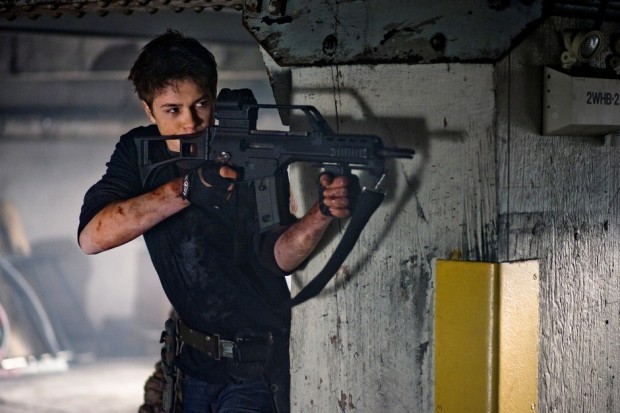
Falling Skies opened strong this season, but this episode, the verbosely-titled Love and Other Acts of Courage, is the weakest so far. One problem: no strong action. The clip above gives us Tom and his crew heroically checking out a battlefield after a battle is over. There's one scene of hiding from mechs (the huge, incredibly deadly mechanical drones that serve the skitters), two scenes of running away, and two scenes showing drawn guns but no battle. By my math, that's no action, although some of the tension was (as usual) very well-played. Maybe I'm just susceptible to tension, but this show always manages to get me.

The episode succeeded in delivering the creepy, although, after last week's hideous reveal of how harnesses are attached to children, nothing is going to measure up any time soon. But if something could measure up, the opening sequence, where the skitter affectionately known as Red Eye seems to pray or call to the skies, and then Ben does the same in an evil-sounding skitter voice? Well, that will do nicely.

It was so disturbing that I honestly assumed it was a dream sequence. Silly me.

And on the list of creepy things, was there blood in a mech head in that battle sequence? It's in the video above, check me on this—is that blood in the hole blown through a mech brain? Are they biomechanical too? Creeeeepy.

Say what you will about this show (and there's plenty of room for criticism), it goes there. It kills characters you thought were safe; it uproots, rearranges, and endangers its characters; and it pulls the rug of the plot out from under you. This is a dangerous war with serious consequences. I never could have guessed that a skitter rebellion would be introduced, or that Red Eye would propose an alliance. Do I think it's real? I have no idea. But I love the insanity of using this as a story element, and that our friends in the Second Massachusetts have no way of knowing who or what to trust, and that all of this is being played for the highest possible stakes.

Hey everyone, Rick's dead!

Just like that, another serious and important death, right on the heels of his restoration to the group. In some ways, this is an easy death for the writers to deliver; Rick wasn't back long enough for us to get attached, yet this was a child, killed by friendly fire, who embodied the distrust that people feel towards  Ben, and it reminds us again of what is at stake. Watching Rick get killed reminds us of how very precarious Ben's life is right now.

The clever reader may have noticed I said this was a weak episode and then proceeded to praise it. That's unfair of me.

What Love and Other Acts of Courage lacked in strong action sequences it made up for in long, long talks about serious, serious things. Talks. About things.

In fact, the core of this episode was a long, long talk between our hero, Tom Mason, and Red Eye, using Rick as his voice.* The problem with this scene (series of scenes, actually, intercutting with other scenes) was that Red Eye had nothing much to say. Tom kept asking for evidence, and Red Eye kept talking about non-evidence. He kept delivering back-story, and pleading his case, and being all serious. The whole thing honestly felt very 1950s, very Alien Invasion B Movie, as the serious-minded alien appealed to an intelligence absent in humans. Think Klaatu Barada Niktu, and all that. It was a strange tone to take in the middle of a very battered war zone, and Tom was completely right to distrust it. When Tom demanded proof, Red Eye should just have said, "I have no proof! Only time-filling exposition!" But that didn't happen, and Tom, the former history professor, even managed to revert to lecturing about history, something he'd mercifully done little of earlier this season.

*Skitters seem to communicate entirely by radio waves; they vocalize only a little. They sometimes use harnessed humans to speak for them, since the harness allows the humans to understand the radio waves. Or something. Even though the harness was removed from Ben and from Rick, it continues to affect them.

Other conversational scenes went a bit better. Hal and Maggie's burgeoning romance? Not bad. I'm not a fan of Drew Roy as Tom's oldest son, Hal, but Sarah Carter as Maggie is quite interesting to watch, and I love her gravelly voice.

There was one really good fight between Ben and Tom, with some actual father-son yelling. If you're going to do family drama in a science fiction show, you have to make it believable. I believed that little shouting match.

The episode ends with Ben telling his little brother, Matt, that he's leaving. Ridiculously, he asks Matt to keep this information a secret, but I suppose all he really wants is a few hours lead time.

I'm hoping that next week we'll get a lot more action, and I'm sure we'll get more surprises. We are informed, this episode, that the travelers are in Richmond, about two weeks from their goal of Charleston. A lot can happen in two weeks, so stay tuned.

Deborah Lipp is the co-owner of Basket of Kisses, whose motto is "smart discussion about smart television." She is the author of six books, including "The Ultimate James Bond Fan Book."

THE NEWSROOM RECAP 3: THE 112TH CONGRESS

THE NEWSROOM RECAP 3: THE 112TH CONGRESS

As much as I believe Aaron Sorkin is, to some extent, correct about the brokenness of our news system, as I’ve watched The Newsroom, I’m finding myself increasingly sympathetic with the people he’s angry at, the ones who knuckle under to commercial pressure and the terms of their contracts as Will McAvoy and the News Night team rise above them. I absolutely agree that established stars like McAvoy should use their power and influence to emphasize facts and to elevate worthy stories. But it turns out to have been pretty easy for MacKenzie and Jim to convince Will that he should be a different kind of newsman and to give him the words to help him do it. The person who’s going through an internal struggle that turns out to be compelling here, the one who doesn’t have Charlie standing as a barrier between him and pressure from Leona and Reese, and the one Sorkin wants me to hate, is Don, my new favorite character.

nullAfter Will’s epic on-air apology for falling down on the job, Don sits down to have a heart-to-heart with Jim, who has effectively replaced him. “I would have loved to be part of that. I could have done the show you guys want to do. I’m equipped for that,” he confesses. “You’ve got a mandate. Bring viewers to ten o’clock. I don’t . . . I have to cover Natalee Holloway. And you guys set me up to look like an asshole before I even got started.” Don is like Will, to a certain extent, a talented man who succumbed to the pressure to put on a show that was likable rather than substantive. But unlike Will, he’s relatively anonymous. He could be fired and Elliot’s show would keep ticking on without him. If Don is going to live in hopes of being able to make the kind of show that Jim and MacKenzie are making for Will, he has to keep his job. And that means kowtowing to a lot of unattractive people’s unattractive senses of what counts as news.
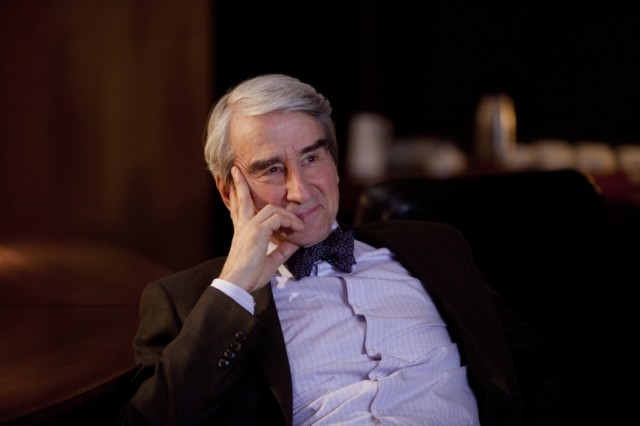
Jim doesn’t seem to understand that his mandate to do good news is a luxury, rather than something he just woke up and decided to do. He begins telling Don that he can just do a good show if he wants before they’re interrupted. Then, he mocks Don later, telling him “You guys did a good show tonight. I wasn’t aware of what was going on with the McRib sandwich.” I kind of don’t blame Don for telling Jim, “Yeah, go fuck yourself.”

And I’m not even sure Jim gets the message later when Maggie, in one of the few moments in The Newsroom where a woman gets to explain something to a man, tells Jim that Don’s failure has more complex roots than Jim acknowledges. “Don’s hands are tied,” Maggie says. “He got marching orders to get the ratings up at ten. And he’s driving a different car than McAvoy. Elliot’s smart, but he can’t do what McAvoy does. Plus, his salary’s tied to ratings.” That, not a studied, cowardly commitment to blandness for its own sake, is the reality of cable news—and the actual source of journalism’s problems.

Will can pontificate all he wants about the fact that the federal government didn’t insist that the networks provide several hours of ad-free news programming every night. But the reality is that it “failed to include in its deal the one requirement that would have changed our national discourse for the better.” And as gratifying as it would be to watch anchors and their producers get mad as hell and refuse to take it anymore, The Newsroom is a more interesting show when it actually explores what happens to people who buck their mandates and see what they can do within the limits of their contracts than it is when it focuses on Will’s ridicule of Tea Party activists and beauty queens.

We almost see an example of that kind of struggle during election night coverage, when Don tries to fire up Elliot, who’s doing his best not to influence the network’s analysis. “I am in there doing everything I can to get Mac to get him to go to you, and he is doing it,” Don grumbles to his boss. “He is inviting you to become a star. Would you stop being so fucking enthralled with the act of punching a ballot?” Instead of acknowledging that Don has a point, though, Elliot pulls rank on him. And instead of having the two men talk about Elliot’s brand, or Elliot’s desire to occupy the space Will left open with his conversion, the closest the writers give us is Elliot’s telling Don “Let me also say, I’m not the one who wants to be a star, Mama Rose.”— Sorkin has Elliot blame Don’s frustrations not on the quality of the news they’re putting out, but on Don’s romantic troubles. It’s a weird punt of what could have been a fascinating journalistic moment.

We do get some sense later that Will’s new approach may be in trouble, in the form of Atlantis CEO Leona (the allusion to Leona Helmsley cannot possibly be unintentional). “What happened to human interest stories?” she grouses at a meeting with Charlie, who thus far has protected Will from her wrath, and Reese, who we learn is her son. “Obesity, breast cancer, hurricanes, older women having babies, iPhones. He was great at that shit.” I don’t think Sorkin intended it this way, but her reminder to Charlie that “You don’t make money for stockholders, which I have a fiduciary responsibility to do” is a sharp puncturing of MacKenzie’s disdain for ratings, something Will warned Charlie about and that Charlie embraced.

Sorkin, and by extension MacKenzie, Charlie, and Will, may not like that news is a business, particularly not part of a large international conglomorate with interests that require Congressional approval and working relationships with major industrialists. But in the absence of an alternative model to pay Will’s staff and get him access to the airwaves, this is the environment he has to work in. Being obsessed with ratings, as Will was before MacKenzie got to him, may have been unattractive. But pretending that they don’t exist, or that Atlantis is a business rather than a non-profit, is to ignore that Leona’s interests and the show’s overlap. Leona has a duty to the shareholders to keep bringing in revenue, but she also needs her business to make money so she can keep paying out Will’s fat contract and the decidedly more meager salaries of his employees. And as we see in this clip, she’s thought through the business end of this proposition more thoroughly than Will, Charlie, and MacKenzie have:

In pursuing a new approach to news, Will’s been pretending the rules of the business don’t really apply to him. Neither he nor the show acknowledges that their revolution can’t possibly last if they don’t find a way for it to be financially sustainable. Now, in Leona’s parlance, he’s going to have to start playing golf, and find a way to make the machinery of the system work for him, and for the people who depend on him for their jobs.

Alyssa Rosenberg is a culture reporter for ThinkProgress.org. She is a correspondent for TheAtlantic.com and The Loop 21. Alyssa grew up in Massachusetts and holds a BA in humanities from Yale University. Before joining ThinkProgress, she was editor of Washingtonian.com and a staff correspondent at Government Executive. Her work has appeared in Esquire.com, The Daily, The American Prospect, The New Republic, National Journal, and The Daily Beast.

CRUEL SUMMER: ROBOCOP (1987)

CRUEL SUMMER: ROBOCOP (1987)

The "Cruel Summer" series of articles examines influential movies from the summers of the 1980s. The previous entries in the series have covered THE BLUES BROTHERS (1980), STRIPES (1981), ROCKY III (1982), WARGAMES (1983), PURPLE RAIN (1984), PEE-WEE'S BIG ADVENTURE (1985), and TOP GUN (1986).

The summer of 1987 saw few new ideas in Hollywood. Coming off of summer ‘86’s head-spinning tug-of-war between steroid genre offerings (Cobra, Top Gun) and movies attempting to deconstruct genre conventions (Aliens, The Fly), Hollywood seemed content to make movies that felt more like covers than original compositions. In his review of the requisite Arnold Schwarzenegger actioner Predator, Roger Ebert wrote, “Predator begins like Rambo and ends like Alien, and in today’s Hollywood, that’s creativity.” Elsewhere, Boomer TV favorites were blown up for the big screen, as with Brian DePalma’s surprisingly square The Untouchables, while Dan Aykroyd gave a career performance in the clever Dragnet. There were also John Hughes-inspired teen comedies like Adventures in Babysitting and Summer School. The creatively bankrupt sequels included Superman IV, Jaws: The Revenge, and Beverly Hills Cop II, a movie that was all sound and fury, signifying absolutely nothing. The newfound Top 40 popularity of oldies music tied to the surprise success of Stand By Me led to movies like La Bamba and Dirty Dancing. (Can’t Buy Me Love managed to cross a John Hughes teen comedy with a golden oldie. That’s what’s known as “high concept!”) Even Stanley Kubrick’s remarkable Full Metal Jacket was viewed by some as an also-ran, coming as it did on the heels of Platoon. But there was one movie that combined violence, satire, and humanity so brilliantly that even its most ardent fans didn’t fully realize it was showing a future that was quickly becoming the present.

Paul Verhoeven’s RoboCop is a future shock comedy set in the very near future, which is really a cracked reflection of the present. Unlike, say, Blade Runner, which luxuriates in its beautifully framed images of urban decay, RoboCop has a more lived-in look and feel that gives its story a startling immediacy. Set in Detroit (shot mostly in Dallas, TX), the movie captures the ever-widening disparity between the corporate-political power structure and everyday working citizens. The glass and steel of the numerous looming skyscrapers reflect the fear and need for protection of those in power from a restless citizenry enveloped in crime and madness.

Verhoeven, a Dutch director who had achieved some success with intense art-house offerings like the psychosexual freak-out The Fourth Man, brought a much-needed dose of subversiveness to Hollywood action movies. Directors like Walter Hill, Richard Donner, and Peter Hyams operated in a slightly accelerated classical form. Clean images and pauses in between action set-pieces were the hallmarks of traditional action movies. Verhoeven gleefully took a butcher knife to classical forms and came up with a potent mix of ultraviolence and biting satire. The screenplay by Ed Neumeier and Michael Miner took a perennial 80s action movie—the cop buddy movie—and cranked up the energy to 11. Audiences conditioned by countless cop buddy movies were ready for a movie that went through whiplash tonal shifts. The popularity of this movie, which would typically go from a laugh to a moment of poignancy to a crowd-cheering bit of vigilante violence within the same few minutes, showed that audiences were able to make emotional adjustments at a quicker pace than previous generations of moviegoers. We were all entering a world of speed-up.

As the movie opens Detroit is being overrun by crime while an undermanned police department threatens to go on strike. The city fathers are so desperate for a solution that they partner with the Omni Consumer Products (OCP) corporation, which has created a prototype for a mechanical law enforcement unit called ED-209. The scene where the ED-209 is demonstrated remains one of the greatest scenes in science fiction movies—the machine malfunctions and kills an executive. The humor comes from the sight of a machine following its programming even in the face of utter compliance. (The machines will always come out on top.) When the ED-209 fails to live up to expectations, another eager executive (Miguel Ferrer) says he has a different program that will keep costs down and is guaranteed to work. All he needs is a volunteer.

That’s when Verhoeven introduces us to Murphy (Peter Weller), an earnest police officer partnered with Lewis (Nancy Allen). Weller infuses Murphy with a winning mix of joy and professionalism that tells us he loves being a cop. (The way Murphy practices un-holstering his gun is a nice touch.) He has such an easy rapport with Allen that we’re immediately on their side. (Verhoeven has some perverse fun by making Allen look almost as masculine as Weller by outfitting her with a haircut that’s just painful to look at.) When Murphy and Lewis find themselves in a high-speed chase they work in almost perfect harmony. A problem occurs when they get separated as they pursue a gang of crazed drug-dealing anarchists into an abandoned warehouse. The scene where Murphy is shot to death is so brutal that it puts us on point in wanting to see him get revenge.

Murphy’s body is so ravaged by gunshots that he becomes the perfect candidate for the RoboCop program. In the sequence where he is built, a series of POV shots subtly replaces a human perspective with a computerized one. The images become more square, as if the world were being viewed through a computer monitor. (The shot of a woman giving RoboCop a kiss is curiously moving.) When RoboCop goes out on the street for the first time Verhoeven clearly riffs on the part in every superhero story where the hero puts on his costume for the first time; Verhoeven frequently takes standard situations like a convenient store robbery or a hostage negotiation and gives them a warped comic spin that doesn’t detract from their excitement. I especially like RoboCop’s solution to stopping a rape in progress. (“Madam, you’ve suffered an emotional shock! I will notify a rape counsel center!”)

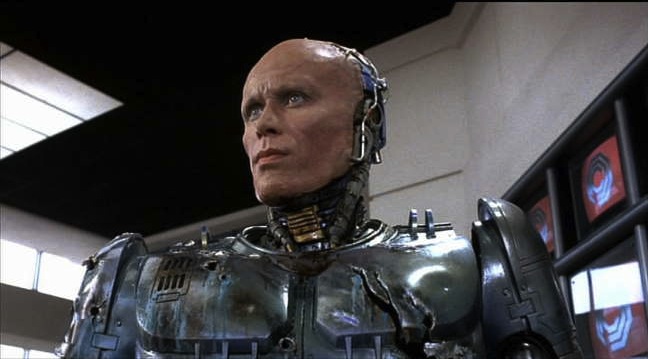
Made in the pre-CGI era, RoboCop is one of the last great practical effects movies. Matte paintings, stop-motion animation, and cutting-edge costumes give everything a tactile quality that’s still thrilling to see. The stop-motion animation of the ED-209 by Phil Tippett is jaw-dropping, especially in a slapstick bit where ED-209 chases RoboCop through the OCP building but is defeated when it can’t navigate a stairwell. Rob Bottin’s make-up effects and costume design remain the best of his career. Coming off his very sticky (and overly painted) effects work on John Carpenter’s The Thing, Bottin’s work here has a more flexible and believable feel. RoboCop’s uniform is like a cross between Japanese comic art work and military chic, turning Murphy into a believable man of steel. (Think a walking Ford Taurus.) Late in the movie, when RoboCop takes off his helmet and we see Murphy’s face for the first time since his death, Bottin’s bald cap prosthetic makes Weller’s already intense blue eyes even more penetrating. RoboCop’s internal struggle with his human instincts is over. Murphy is back.

Verhoeven’s nasty playfulness is constantly popping up throughout the movie. He has an especially kinky preoccupation with the connection between sex and machines. The scene right before Murphy is murdered shows Lewis coming upon one of the more deranged bad guys, Joe (Jesse Goins), taking a leak. When Lewis pauses long enough to glance at his privates, it allows the bad guy to get the upper hand and leads to Murphy’s death. Later, when Lewis and Murphy are reunited, she helps him fix his targeting system by correcting his aim. It’s the closest they will come to consummating their relationship. For Verhoeven, sex is partially mechanical. (Showgirls is all about manufactured sex.) The rousing score by Basil Poledouris uses both orchestration and electronic sounds to highlight the contrast between the organic and mechanical.

Verhoeven’s most daring gambit is the perfectly timed moment of satire. The idea was such brief inserts of humor would lighten the intensity of the action, but instead they just intensify the action, forcing us to be prepared for anything. At various points in the movie the action is interrupted by media newsbreaks (“You give us three minutes, we’ll give you the world!”), that inform us about incidents like American troops aiding Mexican nationals with a raid in Acapulco, or when the U.S. accidentally wipes out Santa BarbAra from outer space. The fake commercials are hysterical, especially a spoof of Electronic Battleship called Nukem. (“Pakistan is threatening my border!”) Of course, the most startling aspect of RoboCop is its depiction of the corporatization of America and the outsourcing of labor for profit. Dick Jones (Ronny Cox), the most ruthless of the OCP execs, spouts rhetoric that at the time sounded like a send-up of Gordon Gekko, but now wouldn’t be out of place on Fox News or a CPAC conference. It’s casually mentioned that OCP has found profitability in industries that had been deemed money losers. These include hospitals, prisons, and space exploration. They now want to take over the Detroit police department and turn it into a moneymaker. In 1987 this sounded like an outrageous satire of the 80s Wall Street culture. Today RoboCop stings, as its vision of the future were all too real. Verhoeven brings it home by staging the final showdown not in the streets of Detroit but in a boardroom.

But RoboCop’s most lasting legacy is RoboCop itself. This film marks the first time moviegoers were made to identify with a machine. Before, machines and aliens in movies were seen as something otherworldly. Even when we were made to feel an attachment to a non-human character like, say, E.T., we saw him through a human perspective. But RoboCop was different because the most human character in the movie was a machine. Every other character in the movie, even the loyal Lewis, was secondary. When RoboCop walks through the now abandoned house where his wife and son lived, we’re made to fill in the emotions he can no longer compute. Movies were now embracing technology and machinery. Everything from Total Recall to Terminator 2 to A.I. to I, Robot to Transformers has showed us machines that are more human than humans. We no longer rage against the machine. We are the machines.

San Antonio-based film critic Aaron Aradillas is a contributor to The House Next Door, a contributor to Moving Image Source, and the host ofBack at Midnight,” an Internet radio program about film and television.

LONGMIRE RECAP 4: DOG SOLDIER

LONGMIRE RECAP 4: DOG SOLDIER

null

There’s an important development in this week’s Longmire, though it’s not immediately apparent. For the first time, Walt Longmire hits the barriers of what the law can do, and he is willing to work outside the law for justice. Not only that, but he's doing so because of specific corruption focused on the Cheyenne. Given the show’s previous focus on Walt’s heroism for upholding the law in the face of (justified, but difficult) bitterness from the Cheyenne, that’s an improvement.

null“Dog Soldier” is built around the kidnapping—no murders this week, initially—of some Cheyenne boys who’ve been committed to foster care. There’s possible evidence of corruption in Social Services, of pedophilia, of corruption within the reservation, child abuse, or more. As the loose threads are connected or removed, the reasons for the kidnappings become more and more clear: the children were “kidnapped” in revenge for their removal, on false premises, from the reservation.

This culminates in arguably the show’s best scene, in which Walt confronts the Social Services worker involved, Crystal Shoemaker, at the end of the episode. He carefully explains what happened, and why he knows she’s involved. She lays out her points—all of the evidence is circumstantial, she can talk a mean game about doing what’s best for the children, and oh yes, she’s white. She’ll get away, even if she is corrupt, and a kidnapper and murderer. And here’s where Walt lays down the lack of law. She’s right, of course. The system is tilted entirely toward her. The government has designed a mechanism by which the adoption/foster care system benefits—and corrupt utilizers of that system personally benefit—from making the Cheyenne on the reservation look worse and removing their children. This is an accurate depiction of both issues with child service agencies and legally enshrined bias against Native Americans.

And Walt knows it. So he doesn’t try to use the power of the state to do the right thing. He acknowledges what the Cheyenne characters have been telling him throughout the episode—that the system is unfairly and presently irredeemably working against them. They have their own extra-legal ways of achieving justice, through an enforcer named Hector who gets paid by the tooth. Hector, and the other members of the Cheyenne community, have clearly figured out the scam by which Shoemaker and her former partners have profited from taking Cheyenne from their home. And they will come for her, possibly out of control, possibly overtaken by the spirit of vengeance: “I believe in transformation. I believe we become vessels for forces we cannot control or understand.”

Walt can’t win as a lawman. So he wins as a person. This is, I think, what separates a competent show from an interesting, potentially great show. Veronica Mars had slick, entertaining mysteries each week with equal parts comedy and drama, but what made it special was its examination of class. The powerful had the law and institutions on their side, while the powerless and poor generally had only less savory options to them, and the main character was caught in the middle. That’s the case here, and it leads to more drama than previous episodes have possessed.

It also connects Longmire more directly to its setting. “The west” in American mythology—largely gone in as much as it ever existed, though rural Wyoming is as close as anything gets— exists in an odd conceptual place. On one hand, pioneers are supposed to represent the ideals of American self-perception. They’re hardy, pragmatic, pure of heart, and self-reliant. They built society, the story goes, instead of having it imposed on them. “The government” is a corrupting force, bringing laws and rules and regulations and, in the case of “Dog Soldier,” financial incentives for corruption and treating people wrong. Walt represents that frontier ideal, doing the right thing for people, regardless of whose people they are, or whether it’s part of the law or not (a far cry from previous episodes explicitly connecting him with the power of the state.)

Yet there’s an inherent tension within that mythology. Those western pioneers achieved most of what they did over the objections, sometimes violent and violently put down, of the natives of that region. The Cheyenne in Longmire have regularly complained about their treatment at the hands of white Americans, but for the first time, in “Dog Soldier,” those complaints are justified. Likewise, the socially conservative voting patterns of the western states make the idea that individual liberty is the dominant feature of western American society too simplistic. Longmire’s titular character may embody western stoicism and self-reliance in many ways, but to the show’s credit, he’s also demonstrating the complications of the western mythology.

One of the ways that Longmire does that is by continuing its overt serialization about Walt’s past. We’ve seen the flashbacks about him getting healed with Henry watching before. In this episode, a letter from the Denver PD triggers further flashbacks, but still very little information. While I generally dislike the manipulation of having the main character know about something the audience doesn’t, in order to maintain a mystery and keep viewers, I do like the way it was used in this episode. Walt’s apparent willingness to move outside the law in his past, and memory of this during the events of this episode, make his motivations more transparent to us. Likewise, the events of “Dog Soldier” work retroactively to make whatever Walt happened to do previously more understandable, when we understand them.

And I remain impressed with Longmire’s ability to construct a mystery. While it became increasingly obvious that something in the corrupt Social Services structure helped trigger the kidnapping case, who and why was still a mystery up until the very end. The revelation made sense—we had the same information Walt did—but still has some level of surprise. This is definitely not a show where a random guest star appearance clearly indicates who the likely culprit is. If Longmire manages to add effective serialization to the examination of the American west it demonstrates here, as well as keeping its episodes impressively constructed, it could get a lot more exciting.

Rowan Kaiser is a freelance pop culture critic currently living in the Bay Area. He is a staff writer at The A.V. Club, covering television and literature. He also writes about video games for several different publications, including Joystiq and Paste Magazine. Follow him on Twitter @rowankaiser for unimportant musings on media and extremely important kitten photographs.

THE NEWSROOM RECAP 2: NEWSROOM 2.0

THE NEWSROOM RECAP 2: NEWSROOM 2.0

null

For Aaron Sorkin’s characters, doing your job and falling in love are often inseparable processes: Natalie schooled Jeremy on television producing and love on Sports Night, Josh Lyman and Donna Moss bantered over bills on The West Wing, and Matt Albie and Harriet Hayes worked out their issues on the set of Studio 60 on the Sunset Strip. The staff of Will McAvoy’s show, from the big dog himself down to his most junior producers, is no exception to this rule. The staffers all have romance troubles they’re working out on set, this week in the form of bizarrely histrionic public displays of angst. And while it’s grating enough to see competent women reduced to workplace fits at the behest of men, there’s a particularly weird contrast between MacKenzie’s extended meltdowns and her antiseptic approach to what she puts on the  air. She’s supposed to be the strongest female character on The Newsroom, but increasingly, it seems like she exists to mouth Aaron Sorkin’s platitudes and to debase herself before Will.

null“We don’t do good television,” she explains towards the beginning of the episode. “We do the news.” It’s the kind of Sorkinism on the journalism business that sounds good at first but doesn’t actually make sense after any careful consideration: good television and the news aren’t actually mutually exclusive. In the pilot, the staff of Will’s show congratulated themselves on covering Deepwater Horizon as a corporate cover-up instead of as a rescue story. The death or survival of a dozen people apparently doesn’t count as news in this schema, unless there’s a demonstrable government cover-up. It left me wondering how News Night might cover the tornadoes in Joplin, Missouri. Would the victims of that natural disaster be deemed unduly heart-tugging if Halliburton wasn’t somehow culpable.

Tonight, MacKenzie deems a source blogger Neal tracked down as unworthy, a man whose parents brought him to the U.S. as a child and who learned in adult life that he was an undocumented immigrant, a chain of events that led to the loss of his driver’s license and potentially his job. “I’ve got to budget 42 minutes. I’ve already spent 18 minutes on Jan Brewer and La Raza,” MacKenzie insists. “Even if we did have the time, it would be emotionally manipulative. We’d be putting him there to feel sorry for him.” Neal protests, “We should feel sorry for him. He’s getting screwed.” MacKenzie crisply tells him, “I don’t want to feel sorry for anyone. I want the facts.”

Again, this sounds good, but it represents a sterile approach to the news. Sometimes, facts are incomprehensible without faces and stories about how they function attached to them. If Will’s supposed to play lawyer, presenting the best form of each side’s arguments, then he needs to have the best possible clients representing those views of the world. In MacKenzie’s view of things, that’s apparently a talking head from the National Council of La Raza rather than someone whose life has directly been impacted by immigration policy—she never considers the possibility that she could bring both men on the air. Maybe that’s a tiny thing to quibble over, but it furthers a sense that The Newsroom is disengaged both from the realities of reporting, and from the kinds of personal stories that often further social change.

For most of the episode, we see MacKenzie as a hectoring, sometimes condescending, but always stringent idealist when it comes to her vision of how the news should be reported. She’s a schoolmarm, telling the audience what to think more than she’s actually teaching her staff how to do their jobs. Given this characterization, you’d think The Newsroom would want to give her a rich, complex personal life, and maybe a sense of humor, so the audience could engage with her as something other than as a scold. But instead, she comes across as an immature, hystrionic brat who demands that everyone else be riveted by her weirdly mundane problems. When she finds out that economics anchor Sloan (Olivia Munn)—who MacKenzie has asked to anchor segments because “If I’m going to get people to listen to an economics lesson I need someone who doesn’t look like George Bernard Shaw”—thinks that Will cheated on MacKenzie and that’s why they broke up, she goes ballistic. “You need to do this. You need to go from person to person and tell them that Will is an extraordinary man with a heart the size of a range rover,” MacKenzie demands. To her credit, she backs off almost immediately, realizing she’s asked for something bonkers. But I’ve still never loved Olivia Munn more than the moment when Sloan informs MacKenzie briskly that she has no intention of re-arranging her day to rectify what MacKenzie views as a massive injustice, because she has facts to report. We don’t learn much about Munn in this episode, but she comes across as brisk and perceptive, a slightly more realistic Avery Jessup from 30 Rock, and at this point, she’s the only character I’m looking forward to getting know better.

That meltdown alone might have had me wondering whether MacKenzie has a split personality, or is just the victim of being Sorkin’s vessel rather than an actual person. But it’s not as if Sloan’s chat with MacKenzie has righted her ship. “Are people here under the impression that Will is an ass?” she asks her staff in a fit of panic, later. “You’re wrong. It’s wrong. And it’s an injustice.” Then, in a plotline that more likely originates in Sorkin’s well-publicized antipathy towards technology than from any actually plausible experience of a war correspondent who’s been filing stories from overseas for years, she sends an email meant for Will that goes to the entire office, then responds by destroying a staffer’s BlackBerry, demanding that she wants “everyone to delete the email you just received. Honor system,” and begging someone to destroy Will’s computer with a baseball bat in an increasingly hysterical tone.

I don’t particularly blame Will for being upset that MacKenzie broke his trust—he’s a vulnerable, vain, prickly man, and I can buy that he wouldn’t want anyone to know he was cheated on even though it was MacKenzie who transgressed. But when he screams at her “You know how something happens in an instant that is so astonishing you completely shut down? That doesn’t fucking happen to me,” he loses me. “The women who are here exist, quite simply, on the theory that nothing is more dramatically important than a man becoming great, and men cannot become great without women to inspire, provoke, and drive them,” NPR’s Linda Holmes wrote in her terrific review of The Newsroom before its release. Like Linda, I find that worldview inherently unattractive, and there’s additionally distasteful in the idea that we’re supposed to care so much about the fact that Will’s composure has been rattled.

When the lives of undocumented immigrants are at stake, emotion is a pointless distraction. But when MacKenzie’s upset or Will’s been wronged, we’re supposed to believe that their feelings are the most critical thing in the world. I know that The Newsroom wants me to feel more attached to its characters than to their subjects. But after two hours in their company I’d rather be hanging out with an undocumented immigrant in Spokane, Washington, than the supposedly-brilliant, self-absorbed people who snidely dismiss him as less than newsworthy.

Alyssa Rosenberg is a culture reporter for ThinkProgress.org. She is a correspondent for TheAtlantic.com and The Loop 21. Alyssa grew up in Massachusetts and holds a BA in humanities from Yale University. Before joining ThinkProgress, she was editor of Washingtonian.com and a staff correspondent at Government Executive. Her work has appeared in Esquire.com, The Daily, The American Prospect, The New Republic, National Journal, and The Daily Beast.

FALLING SKIES RECAP 3: YOUNG BLOODS

FALLING SKIES RECAP 3: YOUNG BLOODS

null

This week's Falling Skies gave us some very earned emotional release. Like almost every episode, the action sequences were kick-ass, but the heart of the episode this week was in its emotional moments. While some of the set-up leading into the key dramatic sequences was schmaltzy, and some dialogue was schmaltzy, I do feel that, if you've been following the series, then the emotion will feel earned and you will have come away feeling the dignity and pathos of these characters.

nullYoung Bloods again proves that Season 2 is a vast improvement over Season 1 of this show. Season 1 faltered mostly in the stupidity area: Characters not taking the war seriously. There was too much sloppiness, as if we were watching an ordinary drama and not a life-and-death invasion scenario. Season 2 is far more serious. There have been some of the same problems this year (leaving the jar with the alien parasite inside it unguarded last week), but the overall effect now has much more gravity. In addition, this week's episode relied too much on sentiment in spots, yet it's definitely improved in that area as well.

What I wish most of all is that the show would trust itself. Guys, you don't have to underline every touching moment with piano music! You don't have set up scenes about the tragedy of disconnection. There's so much terrific drama developing organically that overplayed scenes like Lourdes' discovery that her family's small village has been destroyed, and then playing that emotion a second time for her Love Interest's benefit (and the audience's, just in case we hadn't figured it out), is almost cruel to the audience. (Love Interest's name is Jamil, by the way.) It's so unnecessary; we got it. I like this show a lot; it's got a strong cast and premise, creepy aliens, and is frequently fresh and surprising; for these reasons I recommend it to anyone who asks. But that's like; what I love on TV is a show that trusts its audience to come along for the ride, to understand the nuance, to hear things the first time they're said. Falling Skies hasn't risen to that level yet.

The episode opened with a thrilling action sequence (watch it below). I was fairly sure early on that curly-head Matt was purposely acting as bait, but that didn't take the excitement away. At its best, this show has a killer combination of creepy (the skitter's long fingers coming around the corner), high-octane (the shoot-out), and appealing characters (Matt saying it was "awesome" to get splattered with alien blood). See for yourself:

Last week I called for some hardcore passion between Tom and Anne, consistent with the intensity of the situation they're in. In emergencies and tragedies, people jump into sex and passion to reaffirm their own aliveness. The kissing was a nice start, but they were both a little too coy about the whole thing for my tastes. The scene did remind me, though, that Noah Wyle is a fine actor. His years on ER as John Carter were peppered with dozens of seductions—he was quite the ladies' man, was Dr. Carter. Here we can see why—in the way he tilts his head in towards her, creating intimacy just by angling his body, there's a sweet sexiness that establishes real chemistry.

Anyway, on with our show. Ben has super-hearing, another ability derived from having been harnessed. Man, oh man, are we going to learn that the aliens are from Krypton? Ben's new abilities risk becoming too much of a deux ex machina, but they also inform us who and what the skitters are. It's a fine line the writers must walk. We don't want Ben solving every problem for everyone, but his skitter-acquired abilities are a way of letting us know how well the alien creatures hear, swim, climb, and so on. Fortunately, Ben's angst is becoming more interesting, his isolation more justifiable, and his desire to fit in entirely forgivable. Even if that does mean glowing spikes get a pass for another week.

The theme of this episode was childhood and growing up. Some of it was done with great subtlety. For example, in the love scene, Anne's joy was eloquent when she was given a chocolate treat by Tom—her childhood favorite. Simply by receiving this gift we experienced nostalgia for a lost world, and vivid memory, and visceral pleasure, all rolled into one. Having the scene end with a passionate kiss reminds us that childhood really must end.

At the other extreme was Weaver's relationship with his daughter Jeannie. While their interplay was touching at times and also well-acted, most of it was so heavy-handed, I could almost feel it hitting me over the head. Their reunion was lovely, but their arguments rang false, and her accusations about the divorce were utterly out of place. Hey, Jeannie, you’re in the middle of an alien invasion. Forget about your divorce trauma. The reunion and her eventual departure rang absolutely true by themselves—of course a teenage girl goes with her boyfriend, not her daddy—and didn't need that overblown educational message about anger and communication. In fact, these moments were ones I was thinking of at the beginning when I said the emotional release was earned, so why clutter them up?

Most of the rest of the thematic elements fell between the extremes of delicately subtle and overblown: Tom's struggle to allow his youngest, Matt, some freedom and some danger was very real, and in parts very nicely played, and yet, again, the piano music! That whole subplot could have been done with much more restraint, because, again, with good actors, exciting action sequences, and high stakes, Why add sentiment, when it's already so intense?

Why do groups of kids always band together in warehouses and decorate with old couches? I feel like I've seen that visual a hundred times. I'm reminded of the Miri episode of the original Star Trek, of any number of vampire dens on Buffy the Vampire Slayer, of the episode Vatos of The Walking Dead: Isn't there a way of showing a group banded together like that without resorting to visual cliché?

Later in the episode, everything that happened in the skitter harnessing center was insanely good. The kids face down on the table, the discovery that the harnesses are actually giant, terrifying slugs, the aquarium, the raw fear, and then that battle. Damn that was good television. one thing this show does very well is balancing surprise, effective pacing, and an ongoing education of viewers about its world. This week’s we’ve learned how the harnesses operate: They're giant slugs, kept in aquariums, attached to children like some kind of symbiot. Yuk. .

Jamil ends by saying "Hope's all we got." Too on the nose, but it brings the theme back around; youth and family matter because they're the future, and our heroes are going to have to fight to even perceive there's a future. That's why they're going to Charleston, and that's why giving these characters a quest and a goal—even if Charleston turns out to be a tragic mistake—is the right decision for the show, and for its characters.

Deborah Lipp is the co-owner of Basket of Kisses, whose motto is "smart discussion about smart television." She is the author of six books, including "The Ultimate James Bond Fan Book."

CRUEL SUMMER: TOP GUN (1986)

CRUEL SUMMER: TOP GUN (1986)

The "Cruel Summer" series of articles examines influential movies from the summers of the 1980s. The previous entries in the series have covered THE BLUES BROTHERS (1980), STRIPES (1981), ROCKY III (1982), WARGAMES (1983), PURPLE RAIN (1984), and PEE-WEE'S BIG ADVENTURE (1985).

The 1980s saw Hollywood going to war. America’s defeat in Vietnam instilled a sense of hopelessness that ran throughout the 1970s. The Vietnam movies of the late ‘70s (The Boys in Company C, Coming Home, The Deer Hunter, Apocalypse Now) were all about mourning and the tentative first steps necessary for the country to move on. Then, with the election of a former Hollywood star as President, Hollywood decided to re-up with the military and make movies that were the equivalent of Reagan’s military intervention policies. The distrust of the government and the military during the ‘70s was now giving way to a cinematic flexing of American might. All that was needed to build up morale was a few easy wins, and after that, the Vietnam disaster would hopefully seem like a bad dream.

From the softening of basic training in movies like Private Benjamin, Stripes, and An Officer and a Gentleman to re-staging Vietnam in men-on-a-mission action dramas like Missing in Action and Uncommon Valor,Hollywood saw it was better for business if America came out on the winning side. (The first Rambo movie, First Blood, would be the rare movie during this time that tapped into the rage and marginalization of returning Vietnam veterans. Its sequel, Rambo: First Blood Part II, would turn that rage into comic-book fury, complete with the crowd-baiting question, “Do we get to win this time?”) Vietnam cast a shadow over movies that weren’t even explicitly about the war. Vietnam became a shortcut to character development. Sylvester Stallone’s character in Nighthawks was a pacifist because of his experiences in Nam, while Roy Scheider’s pilot in Blue Thunder suffered from “stress” due to his tours of duty. Movies as varied as The Exterminator to Commando to the first Lethal Weapon all used Vietnam to heighten the audience’s identification with the lead character. All of this cinematic stockpiling of goodwill came to a head in 1986 with the release of a movie that turned Hollywood’s restaging of Vietnam as a winnable war into an advertisement for America’s outsized belief in its own exceptionalism.

Tony Scott’s Top Gun is a visual and aural assault, a full-throttle “ride” that doesn’t stop for pesky things like story. The story goes that the pitch for Miami Vice was “MTV cops.” The pitch for Top Gun could have easily been “MTV pilots.” Scott, along with his older brother Ridley, Adrian Lyne, and Alan Parker, was at the forefront of a group of British TV commercial directors. These directors made advertisements cinematic. When they got their shot at making movies, they infused their movies with a powerful visual sense. Ridley Scott made rust and dirt and grime look authentic and cool in movies like The Duelists and Alien. Parker gave everything an artificial beauty, even a Turkish prison in Midnight Express. Lyne’s use of backlighting throughout Flashdance would become a mainstay on MTV. But Tony Scott was the bad boy of the bunch. He could do everything they could do but he didn’t have any pretensions about subject matter or critical response. Pauline Kael described Top Gun as a “…recruiting poster that isn’t concerned with recruiting but with being a poster.” As it turned out that’s exactly what audiences liked about it. Advertising was now a legitimate form of storytelling.

The story of Top Gun is so simplistic that it’s almost child-like. Producers Don Simpson and Jerry Bruckheimer helped shape mainstream American movies by specializing in movies that anyone could follow. Movies like Flashdance, Top Gun, Beverly Hills Cop, and Days of Thunder gave viewers such a cocaine-adrenaline rush that you came out of the theater ready to take on the world. They made movies about winning, and in the 1980s that’s what audiences wanted to see. The screenplay (more like a scenario) by Jack Epps, Jr. and Jim Cash may have centered on hotshot Navy pilot Maverick (Tom Cruise) and his training at the Top Gun school but, really, the movie was about you and your dream to be the best at whatever you did. Simpson and Bruckheimer’s movies played like a cross between a rock concert and a motivational seminar.

The movies' pop psychology trappings didn't lessen their entertainment value (who doesn’t like a rush of adrenaline?) The opening credit sequence remains one of the best of the decade. From Harold Faltemeyer’s iconic synth-guitar theme to Jeffrey Kimble’s vivid filtered cinematography to the eroticized, slo-mo pans of fighter jets getting ready for a dawn run, the sequence seduces you into wanting to go to war. Even Kenny Loggins’ anthemic “Danger Zone” is part of the quickening of your senses and making you not question the sheer manipulativeness of what you are seeing. (“Revvin’ up your engine/Listen to her howl and roar”…) There aren’t really any scenes in Top Gun, just set-pieces. There aren’t really characters, either. Any nuance or shading in the characters is due to the characters' personalities, not the writing. The characters’ names do most of the work of characterization. When a character named Viper is described as the finest fighter pilot in the world (and he’s played by the sturdy Tom Skerritt), more than half the job is done.

The movie gives us a comic-book version of masculinity. Vulnerability is kept to a minimum. This leads to a good dose of (unintended?) homoeroticism. The verbal showdowns between Maverick and his chief rival Iceman (Val Kilmer) are kind of wonderful in the way the actors play the scenes totally straight. (They’re like the scenes between Charlton Heston and Stephen Boyd in Ben-Hur, except the actors in Top Gun don’t know their secret.) The locker room scenes have a PG level of jocular aggression, while the famous volleyball sequence is meant to appeal to the girls in the audience, but it’s clear Scott knew it would also appeal to men. (The use of Loggins’ awkwardly titled “Playing with the Boys” pretty much seals the deal.)

The aerial photography is still some of the best of its decade, if not in film history. The five major flight sequences help distinguish Top Gun as a superior action movie. Most flyboy fighter pilot movies relied heavily on “realistic” footage but rarely bothered to inform the viewer to what exactly was happening. Scott’s insistence on pre-planning the maneuvers and choreographing the flight sequences allowed him to display a sense of scale that recalls the Death Star run in Star Wars. (Lucas uses CGI the way Scott uses practical and model effects.) We genuinely feel like we’re in the cockpit of one these fighter jets. There’s a palpable feeling of exhilaration during takeoff or when one of the jets has to spin in order to avoid being shot down. There’s also genuine terror, especially when Maverick’s jet goes into a flat spin and he and his co-pilot Goose (Anthony Edwards) are forced to eject.

When Top Gun is in the air, it’s terrific popcorn entertainment. It’s the scenes on the ground that are more problematic. Unlike the non-musical sequences in Purple Rain, where the characters’ interactions were kept direct and intense, the scenes in-between flight sequences have a workman-like pacing that exposes just how thin the story really is. The best performance is by Edwards, who uses humor and sincerity to get us to love him. His death in the movie genuinely hurts. Kelly McGillis is the movie’s biggest weakness. SHE displays none of the confidence that made her so memorable in Witness, her previous movie. She has zero chemistry with Cruise, or more accurately she has just enough to get by. Compared with Cruise’s erotic connection with Rebecca DeMornay in Risky Business or McGillis’ passionate embrace of Harrison Ford in Witness, their scenes together are pretty tame. The one scene between them that works is when they’re sitting on her porch and listening to Otis Redding’s “Sittin’ on the Dock of the Bay.” The movie constantly tells us that they’re in love. (The gorgeous Berlin theme “Take My Breath Away” goes a long way in convincing us they’re a couple.)

Cruise’s chemistry with McGillis doesn’t really matter anyway. What matters is his chemistry with the audience. Cruise’s all-American image is so integral to the success of Top Gun that audiences and critics didn’t fully grasp that it takes a rare kind of acting skill to make what he does look effortless. In Risky Business, he used his baby-faced wholesomeness to get us on his side, even if he was playing a junior pimp. From his somewhat slight frame to his little-boy voice, Cruise, at first glance, wouldn’t seem to have the makings of one of the biggest movies stars in the world. But Cruise’s fabled work ethic is transmuted into his characters’ winning cockiness and we can’t help but be on his side, be it in The Color of Money or A Few Good Men or Magnolia or Mission Impossible: Ghost Protocol. In Top Gun, Tom Cruise became a star by embodying America’s belief in overcoming adversity in order to come out on top.

(NOTE: Oliver Stone would commit a courageous act of star vandalism by casting Cruise in Born on the Fourth of July. Cruise’s Ron Kovic is Maverick, humbled by the ugly reality of war, only to come out a winner on his own terms.)

Is Top Gun a good movie? That’s a tricky question. It’s certainly a watchable one that has managed to stick around long after other, more respectable movies have faded from memory. However, of all the movies surveyed in this series of articles it’s the one that has very little resonance today. The release of Stone’s Platoon at the end of ’86 effectively killed Hollywood’s un-ironic love affair with war. (The release of Robocop the following summer would usher in Hollywood’s long-standing romance with technology and machinery.) Top Gun’s influence can been seen in movies like The Rock, a mostly humorless “ride” that forgot to add the rock ‘n’ roll. (The Rock director Michael Bay is like Tony Scott’s ugly stepson. He’s the father of Chaos Cinema.) Top Gun is an artifact, like bellbottoms or the bob hairdo, from a seemingly more innocent time. It represents a coarsening of summer entertainment, a moment when advertising became a part of the storytelling. Who knew what was once considered crass marketing would now look restrained and old-fashioned?

San Antonio-based film critic Aaron Aradillas is a contributor to The House Next Door, a contributor to Moving Image Source, and the host ofBack at Midnight,” an Internet radio program about film and television.

LONGMIRE RECAP 3: THE CANCER

LONGMIRE RECAP 3: THE CANCER

Longmire’s specific focus on its main character can yield some tense results, as last week’s episode demonstrated effectively. But this approach also leads to difficulties when the scope of the episode is wider. Drugs, Mexican cartels, and veterans of the Afghan war are all big issues, with far more relevance to American viewers than the Mennonites or mobsters of the last two episodes. “The Cancer” opens the door to having larger discussions, but nothing comes through except Walt discussing how the drug trade is a “cancer” that’s usually progressed too far by the time it gets noticed.

nullAnd yet in one scene where Walt meets the local pizza/weed delivery man who also works as a confidential informant, Jamie, the dealer, opens the conversation by describing how sorry he is about Walt’s wife’s death. The two men both note that Jamie helped Walt’s wife as she was sick, presumably by selling her marijuana as a painkiller for cancer and treatment. Yet despite this subjectively valuable (to Walt) use of pot, he doesn’t even consider a possible connection to the weed dealers he’s hunting over the course of the episode. What they’re doing is against the law and a cancer, but what he and his wife did was okay.

Part of the reason for this is that Longmire is Walt Longmire’s show, and it depicts a man who’s a platonic ideal of the manly western hero: all action and expertise, no self-examination or doubt. We know from the pilot that his wife’s death pushed him into a serious depression, but we haven’t seen that. We’ve only seen Walt Longmire, Sympathetic Hero. The show is directed and edited to back up this depiction of Walt. Individual shots are fast, getting to the action and then moving quickly. Instant understanding is assumed for many scenes, which occasionally leaves me disoriented—much like Walt’s deputies, who can mostly follow along, but occasionally get annoyed at being left behind while he’s proceeding with a case.

At times, this makes the show feel crisp and smart. The problems arise when Longmire brings up more complicated subjects that uncomplicated Walt Longmire doesn’t want to deal with—so it doesn’t deal with them. In doing so, it doesn’t just ignore wider potential issues, it justifies Walt’s reaction to those issues. It would obviously be too much of a stretch, for example, to have Walt turn against the Drug War and set up a Hamsterdam or the like, but calling fresh, quality pot a “cancer” when he used it to treat his wife’s illness demands some kind of resolution for the dissonance. And it’s not forthcoming.

The implicit justification of Walt’s worldview points at deeper trends in the show’s world-view, though. “I remember when I could count the number of murders in this county on one hand. Two at most,” says Walt, recalling a simpler time, before his peaceful county was corrupted by “cancerous” outside influences. Every episode so far has had a dead body, two this time. Every single one of those deaths can be traced to influences outside Walt's immediate community: underaged reservation girls as kidnapped sex workers, Mennonites oppressing their women, mobsters from the big city, or Mexican drug cartels.

Meanwhile, the tension between the white people at the center of the show is being resolved respectfully and peacefully via an election—that’s the American way. There are oblique references to the white Americans not being perfect—“When Cheyenne get into business with outsiders . . . never ends well,” says the reservation police chief—but again, this is only a source of drama on the show when he stonewalls the heroes in their attempts to do good for the world.

The number of bodies are also an issue. Not every mystery needs to be a murder, and the darker, grittier tone set by murder mysteries can become repetitious. Why not have an episode of Walt investigating an embarrassing theft? Saving a kitten from a tree? As a small-town sheriff, presumably he’s used to a wider variety of cases, and the show has interesting enough characters to pull off a lighter episode. Longmire could stand a little bit more Veronica Mars and a bit less CSI.

With all that, though, “The Cancer” still worked as a mystery on its own. It did a good job of encouraging suspicion on characters who were red herrings: the reservation chief, and the oddly-behaving woman whose property the bodies was found on. That suspicion seemed just a bit too obvious at first, but when the culprit was revealed to be the park ranger, it made sense without having been obvious. The ranger initially attempts to threaten Walt to gain his freedom, but ends up disarmed by Vic’s sudden appearance. What happens to him? Moreover, what happens to the Mennonite boy who killed his sister a few episodes ago? These things lead to more complex ethical (if not also legal) questions, and go unanswered.

This is my central frustration with Longmire so far. It has the ability to use its setting and characters to examine interesting, difficult questions. But it’s so enamored with the straight-shooting point-of-view of its hero that it doesn’t take that step. Sure, it’s early yet, but we’re almost halfway done with the short, 10-episode season. That’s not much time for it to fulfill its potential.

Rowan Kaiser is a freelance pop culture critic currently living in the Bay Area. He is a staff writer at The A.V. Club, covering television and literature. He also writes about video games for several different publications, including Joystiq and Paste Magazine. Follow him on Twitter @rowankaiser for unimportant musings on media and extremely important kitten photographs.

THE NEWSROOM RECAP 1: WE JUST DECIDED TO

THE NEWSROOM RECAP 1: WE JUST DECIDED TO

HBO’s been trying to sell The Newsroom to audiences on the strength of its opening scene, when Will McAvoy (Jeff Daniels), a bland and personable cable news anchor trapped in his own private hell somewhere between a shout-y liberal and a conservative, snaps and delivers a rant about American greatness—which he immediately blames on vertigo medication. This isn’t the first Sorkin show to have its action kicked off by a rant—Studio 60 on the Sunset Strip began with a sketch show executive producer having a public breakdown—but what most people see as temporary YouTube phenomena, Sorkin sees as an opportunity for a national conversation.

nullThe subject of that conversation, and key to that lost American greatness, we are told in the first episode of The Newsroom, is helping Americans overcome their fear of intellect, and some responsibility for their improvement lies in cable news. I know Aaron Sorkin can write a barn-burner of a monologue, but going into The Newsroom, I was curious to see what comes after McAvoy’s meltdown. If Aaron Sorkin is going to argue that the key to America’s salvation is in fact better, invigorated cable news programming, and a return to commonly accepted facts, it seems like he’d place great value on news reporting.

But in this first hour of the The Newsroom, Sorkin’s view of what it takes to do great reporting is . . . puzzling. The staff of Will’s show figures out earlier than anyone else that Deepwater Horizon will be a major environmental catastrophe because Neal (Dev Patel), whom Will has earlier identified as “the Indian stereotype of an IT guy” proves to have exceedingly useful insights into the workings of offshore drilling rigs. He gained this knowledge, possessed by no one else on any staff of any publication in all the land, because, my hand to God, he “built a volcano in primary school.” Executive producer MacKenzie McHale (Emily Mortimer), at one extreme on her regular pendulum swings between tough, smart producer and flaky, romance-obsessed girl, declares she didn’t know you were actually supposed to learn anything from mucking about with paper-mache and baking soda.

I wish I were joking, but the rest of the staff’s reporting proceeds with similarly magical ease. Jim, possessed of the world’s most coincidental personal connections, turns out to have a college schoolmate working at BP (who makes time to give Jim a ring in the midst of a massive disaster) and a sister who works at Halliburton. “She’s got a PhD in mechanical engineering and she voted for McCain,” Jim explains, in one of the show’s strained attempts to prove that moderate Republicans are something other than unicorns. Will is disbelieving that Jim’s luck could be so good, not just in knowing these people, but in convincing them to flip on their employers and possibly end their careers.

But instead of validating that suspicion, or showing Jim working to convince his sources to go public, The Newsroom cuts away as soon as anyone on staff has a source on the phone. The show is supremely uninterested in the actual and lengthy processes of source development and research. Maybe it’s a tactic to keep the focus on Sorkin’s fast-talking, fact-spewing sock puppets, or to make sure the show whips through a story from the near-past each week, but it lends an airless quality to the proceedings. Everything we need to know, apparently, is already here in this glass and chrome box. This weirdly antiseptic view of journalism turns reporters into brisk bureaucrats, rather than endlessly curious people reaching outside their own experience. It’s not like this process can’t be made fascinating—the BBC miniseries State of Play made the reporting of a single story a thrilling six hours of television. But it’s not a vision that The Newsroom shares.

If there’s a naivete to The Newsroom in its pilot, it’s not coming from the belief that the news would be better if the staffs of cable news shows cared to make it so. It’s coming from the idea that caring is enough to make people admit their misdeeds and tear down walls of government secrecy. In one of the episode’s most credulous sequences, the Minerals Management Service, which was responsible for inspecting rigs like Deepwater Horizon, immediately agrees to have a representative be interviewed on-air by McAvoy just hours after the disaster, and at the request of Maggie, McAvoy’s newly-promoted assistant.
 

In 2010, the people who broke the news that MMS had failed to inspect Deepwater Horizon as often and as rigorously as their internal standards required were reporters for the Associated Press. In the story in which they broke that disturbing news, the AP writers noted “In response to a Freedom of Information Act request filed by AP, the agency has released copies of only three inspection reports, from Feb. 17, March 3 and April 1. According to the documents, inspectors spent two hours or less each time they visited the massive rig. Some information appeared to be ‘whited out,’ without explanation.” The challenge in reporting the truth of Deepwater Horizon wasn’t that no one cared or no one asked how a reckless pursuit of profit and lax oversight caused a disaster. It’s that powerful interests in both the government and the private sector were uninterested in releasing information critical to understanding the disaster and had tools at their disposal to delay providing it to reporters. The Newsroom is plucking the lowest-hanging, juiciest fruit on the vine in sequences like these, oddly unaware that there are bigger targets.

That misdiagnosis of the problem continues when Will gets the Minerals Management Service representative on the phone. Will executes a merciless, snarky pummeling on the guy, full of suggestions for the drastically underfunded agency like, “Would an easy solution be to have oil companies pay for the inspections, like car owners do?” But when it turns out the guy is a trainee four months into his training (something it seems Maggie might have asked about, or at least Googled), Will doesn’t try to draw out what it’s like to be doing inspections you’re unprepared for, or focus attention on a Congressional budget that’s bled dry what turned out to be a critical agency. No, he’s pleased to have delivered a drubbing, no matter that he’s thumped the whipping boy rather the people with actual responsibility and power.

These may sound like quibbles. But Sorkin told New York Magazine recently that having his characters revisit events we’ve already experienced “gives me the chance to have the characters be smarter than we were.” The fact that they face essentially no challenges, that they do by magic and luck what in real life took hard work, sacrifices the potential drama of the episode. It would be much more fun to see this young team of reporters face actual obstacles to getting the information they need, to feel doubt about whether they’ll wrest it from agencies and corporations, and to see them both succeed and fail. Sorkin’s essential uninterest in this process shows how limited his ambition is: he thinks it’s the style in which information is delivered that’s the problem, not the difficulties in tracking it down and the available manpower to do it.

The Newsroom doesn’t have a sense of how journalism works, and its characters aren’t exactly consistent in their approaches, either. The Newsroom tells us that Don (Thomas Sadoski), Will’s old executive producer, previously had a vicious blowout with Will after Don pushed him to be more aggressive in an interview with Gen. Stanley McChrystal. But when Deepwater Horizon starts burning, suddenly Don’s a coward. “You’re going to do an environmental story and you don’t want to at least wait until there’s a picture of an oil-covered pelican?” he asks.

On Will’s first day back, when presumably he’d like to present a respectable night of programming, he and MacKenzie, who apparently love the news, quote Cervantes and speechify at each other while their younger colleagues do the work the bickering senior reporters will later get credit for. Perhaps the most telling thing about the pilot of The Newsroom is how long it takes for Will and MacKenzie’s colleagues take to let them know that a major story is breaking—and the fact that the two journalists are too infatuated with each other to be curious about what’s going on outside Will’s office. Maybe now that MacKenzie and Will have worked out a fragile truce, they’ll start breaking stories themselves.

Alyssa Rosenberg is a culture reporter for ThinkProgress.org. She is a correspondent for TheAtlantic.com and The Loop 21. Alyssa grew up in Massachusetts and holds a BA in humanities from Yale University. Before joining ThinkProgress, she was editor of Washingtonian.com and a staff correspondent at Government Executive. Her work has appeared in Esquire.com, The Daily, The American Prospect, The New Republic, National Journal, and The Daily Beast.