CANNES 2012: David Cronenberg’s COSMOPOLIS

CANNES 2012: David Cronenberg’s COSMOPOLIS

null

Billionaire business mogul Eric Packer (Robert Pattinson) treats his body like a temple, receiving a health assessment from a physician every day like clockwork. One such appraisal takes place midway through Cosmopolis, David Cronenberg’s talky and occasionally scathing post-modern nightmare about the downfall of capitalism in the modern age. This gnarly doctor’s visit includes a brutally frank rectal exam that becomes highly erotic for both Eric and a female colleague standing inches away.

The physical body and all its beautiful horrors have long been essential to Cronenberg, but in Cosmopolis they become a way station for penetrating absurdities and diseased ideas. Lengthy dialogue-driven sequences, most taking place between Eric and various lovers, employees, and business advisors inside his brilliantly white high-tech stretch limousine, explore the way we construct fantasy and gather data to justify our hollowed-out existences. If Eric’s descent into the heart of darkness is any indication, we’ve failed.

Adapted from Don DeLillo’s famous novel, Cosmopolis faithfully follows Eric on a long and slow jaunt across Manhattan to get a haircut. Multiple complications threaten to compromise his trip, including a visit from the U.S. President and the funeral for a famous rap star. During his Ulysses-like journey, Eric’s professional and physical worlds quickly collapse, revealing the ideological rot and deformation of his soul that has been repressed underneath a mountain of wealth. Constantly questioning and forever yearning, Eric is the ultimate empty vessel trying to reclaim something, anything in the way of an identity.

But it’s not just Eric’s existence that seems on the verge of self-immolation: the entire city is tipping into the void. Angry protesters spray-paint Eric’s limo during a heated battled with riot police, screaming “A specter is haunting” while flinging dead rats in every direction. Burning bodies litter the sidewalks, protesters who’ve made the ultimate sacrifice in the name of anarchy. Eric displays a shocking indifference to it all, more concerned with discussing his own self-involved questions about the minutiae of societal contradictions.

If “time is a corporate asset,” as Eric’s advisor Vija Kinsky (Samantha Morton) suggests, then Cosmopolis strips away the 24/7 urgency of capitalist intent and allows one of its titans to ponder the possibilities of his own failure. The entire film is measured in detailed prose and combustible mise-en-scene. In one of the few times Eric leaves the safe haven of his limo, he watches a pick-up basketball game from afar, asking his bodyguard Torval (Kevin Durand) if he likes to play the sport. The sudden consequences of this conversation send Cosmopolis even deeper into a psychological abyss, one in which Eric embraces his own disintegrating persona, seemingly leaving the regular world (if there ever was one) behind.

For a Cronenberg film, Cosmopolis is light on violence and body horror, but the director’s obsession with evolving ideas and tainted perspectives remains on full display. Pattinson brings a ghostly intensity to the demanding role (Eric is in every scene), a trait that becomes even more dynamic in the film’s great final sequence. But does it all add up to something more than a series of striking vignettes about the downfall of personal will? Even if Cosmopolis feels stunted by its limitations of setting and movement, it manages to make small urban spaces feel combustible, ready to explode on a moment’s notice. For that, this is quite the dangerous method.

Glenn Heath Jr. is a film critic for Slant Magazine, Not Coming to a Theater Near You, The L Magazine,andThe House Next Door. Glenn is also a full-time Lecturer of Film Studies at Platt College and National University in San Diego, CA.
CANNES 2012: Carlos Reygadas’ POST TENEBRAS LUX

CANNES 2012: Carlos Reygadas’ POST TENEBRAS LUX

null

Narrative is the devil in Carlos Reygadas’s baffling and intoxicating Post tenebras lux. Finding any coherent structure or storyline in Reygadas’s deeply autobiographical film about a wealthy family’s daily existence in the Mexican countryside is next to impossible. The normal markers of story (psychology, back story, motivation) are all either denied or abstracted through the haze of memory and natural splendor, temporal uncertainties and jarring cuts. The result is a disjointed collection of sublime images, haunting sounds, and elliptical tangents, parts of an attempted exploration of the elemental nature of trauma and isolation. But does the film succeed?

In the film’s mesmerizing opening sequence, Reygadas positions his handheld camera at the eye level of a toddler walking slowly through a vast field surrounded by mountains. As the young girl stomps through puddles saying words like “father” and “mother,” the heft of the moment evokes Malick’s The Tree of Life. Hordes of dogs roam in and out of the frame, then stampeding horses fill the background space. When darkness overwhelms the image, and flashes of lightning provide the only sporadic illumination, the girl’s small figure takes on a near-mystical quality. The entire sequence is an overture to instinctual cinema.

While kinetic movement and wonder define Post tenebras lux’s impressive prologue, stagnation and rot permeate the rest of the film, the product of an overt sense of evil in mankind. This trend begins with the image of a glowing red devil entering a dark living room holding a toolbox, scanning each room, standing face to face with a child, and disappearing behind a closed door. Paternal wickedness is a longstanding theme for Reygadas, and the heightened visualization of Satan as a father figure returning home from work aptly connects with Post tenebras lux’s two perpetually conflicted male characters.

Juan (Adolfo Jiménez Castro), a sporadically violent man trying to repress his rage, lives with his wife Natalia (Nathalia Acevedo) and their two children in a posh villa located deep in the high mountains. Their handyman El Siete (Willebaldo Torres), an alcoholic and deadbeat father, grapples with his own internal demons. Reygadas crosscuts between the two men's slow unraveling over time, jumping forward and backward without any semblance of logic. Sudden violence, as when Juan brutally beats one of his dogs, is the only thing interrupting the rest of the film’s mind-numbing stasis.

With Post tenebras lux, Reygadas, the talented Mexican director behind Japon, Battle in Heaven, and the brilliant Silent Light, expands the anarchic sense of time and space he first explored in his loony short for Revolucion into an entire film.  Nothing adds up in this mostly maddening cinematic experience, but everything feels connected by the same ethereal view of environment, in the way characters languish, and in the nuances of a shifting world half-remembered.

Reygadas seems to be examining his own failure to visualize the past, one example being several gigantic falling trees in the film’s final sequence. Or the fact that all of Post tenebras lux is filmed using a camera lens that blurs the exterior of the frame, leaving only the center clearly defined. When characters move from one side of the image to the other, their bodies suddenly double, refracted by the beguiling aesthetic. For Reygadas, emotional memory is an impenetrable beast, and in many ways, so is Post tenebras lux.

CANNES 2012: Leos Carax’s HOLY MOTORS

CANNES 2012: Leos Carax’s HOLY MOTORS

null

Where does one begin with Leos Carax’s insane Holy Motors? Maybe its incredible central performance(s) by Denis Lavant, who literally transforms into a different character in nearly every other scene, each one stranger than the next? Or perhaps its stark raving mad narrative that bends so far into the absurd, it threatens to break apart? There’s no easy answer, because Holy Motors evolves with each passing minute, both brilliantly human and purposefully silly, a prism of performance and death so different from other films that it seems to have been beamed down from another planet.

Whether you embrace or reject Holy Motors’s challenging approach (I’m still on the fence), it’s impossible to deny that Carax has created a singular mosaic, the rare film that doesn’t just crush the basic rules of storytelling but reinvents them. Lavant plays Oscar, a shape-shifting chameleon who travels around the dark streets of Paris in a white limousine driven by his advisor/chauffeur Céline (Edith Scob). Oscar hatches a new identity between each stop, as if constant metamorphosis were integral to his survival. The interior of his car is a dressing room, the outside world his stage. Oscar’s characters range from a bald assassin to an angry family man to his previous incarnation “Merde,” a raging man-beast who first appeared in the omnibus film Tokyo.

The scenarios following each transformation examine the dynamic power of cinema (with long tracking shots, detailed blocking, kinetic movement), but also the different emotions an actor can express mid-moment. Instant rage and tenderness co-exist in the Merde segment, in which the hunched-over psychotic roams a cemetery, eating flowers, capturing an American model (Eva Mendes), and subjecting her to one of the most bizarre ceremony scenes ever. Lust and instinct dominate the section in which Oscar wears a motion capture suit, grinding on another female actor in what Carax himself calls the “Coitus” dance. Their erotic physical movements lead to the animation of two mind-blowing dragon figures. A motif of mutual destruction runs throughout the film, especially in one sequence in which two identical characters stab each other in the throat, as if the very act of performance could destroy the humanity beneath the mask.

Like Alain Resnais’s You Ain’t Seen Nothing Yet, Holy Motors explores the way performance can transcend death, evoking a collective joy in direct contrast with the consistent physical ugliness on display. The film’s most rousing sequence is also its most random: Oscar leads a marching band of accordion players around a closed-off room, the camera tracking backward constantly, so it looks as if the camera is pursued by the musicians. If this sequence resonates with inspiration and joy, the musical number later in the film (with another time-traveling performer played by Kylie Minogue) is fraught with tragedy. As Oscar trails slowly behind, the woman walks through a gutted-out hotel, stepping over pieces of dismembered mannequins littering the floor. Carax's creation of dualities is endlessly fascinating.

Late in the film, Oscar confesses, “we’re having a ball in the back of beyond,” but the exhaustion on his face tells a different story. Sometimes living so deeply inside your profession is punishing to the point of madness, and with so many masks layered on top of each other, identity becomes fluid, random, even combustible. Holy Motors ends with a series of ridiculous revelations that really don’t reveal anything except more possibilities. Is Oscar an angel? Or a player in the devil’s most sadistic recess game? Like everything in Holy Motors, the answer is up for endless discussion.

CANNES 2012: Abbas Kiarostami’s LIKE SOMEONE IN LOVE

CANNES 2012: Abbas Kiarostami’s LIKE SOMEONE IN LOVE

null

Denial and delusion ripple the pristine visual surface of Like Someone in Love, Abbas Kiarostami’s masterful critique of social and emotional formality, set in Japan. The importance of perception cannot be understated here, since the film often buries its cutting ideology beneath a measured narrative pace interspersed with hypnotic silences. Whereas Certified Copy, Kiarostami’s previous cinematic riddle set outside his home country of Iran, splits the narrative midway through to accentuate the sudden fracturing of romantic love, Like Someone in Love waits until the bitter end to reveal its true nature. In this way, the film is far more disturbing and cagey than anything Kiarostami has done before, examining just how fragile public personas can be when pushed to the limits of control.

Tragic warning signs abound in Like Someone in Love, menacing clues hiding inside each polite glance and in the long conversations between subdued characters. In the film’s multi-layered opening shot, Akiko (Rin Takanashi) argues off-screen with her fiancé Noriaki (Ryo Kase) over the phone as patrons of a posh bar converse. Ambient sounds overlap with her words, blurring the lines of communication even further. The subject of the couple’s heated conversation is trust, or a lack thereof, and since we hear Akiko’s voice before we see her body, it’s clear Kiarostami is concerned with the patterns of verbal discourse and how they can hide our true intentions.

After Akiko hangs up the phone, her boss warns against being involved in such a volatile relationship, advising her to focus entirely on her job as a sex escort. Even though her profession is not necessarily reputable, the older man treats Akiko much like Noriaki does: as an object of formal pride he wants to entomb.

When Akiko is tasked with visiting a client outside of Tokyo, she debates whether or not she should to stop and see her grandmother, who’s left her phone messages while waiting all day for a visit.

Cruising the hyper-colored streets of Tokyo in a taxi, Akiko spots her grandmother underneath a statue outside the train station, her small frame dwarfed by the distance of the shot and the size of the monument. Akiko asks the driver to circle the roundabout once, then twice, obviously struggling to reconnect with her familial past. It’s a wonderfully staged sequence, in which POV advances her character, confirming that she is perpetually stifled by the requirements of formality.

When Akiko finally arrives at the quaint house of retired academic Takashi (Tadashi Okuno), she quickly becomes an emblem of formality for the respected man as well. One line of dialogue late in the film suggests that Takashi has suffered a terrible family trauma in the past, and his fatherly interactions with Akiko certainly suggest that he wants her to play the role of his surrogate daughter. This dynamic is eventually extended by Noriaki, a talented mechanic determined to make Akiko his wife. Noriaki’s obsession with formality is the most constricting of all, almost religious in nature.

Kiarostami plays with color and depth throughout, spraying green and blue hues across the urban frame, layering reflections so that many images feel infinitely realized. Even more so than Certified Copy, Kiarostami’s mise-en-scene attains a level of classiness that ultimately imbues the mostly subtext-laden set pieces with visual grace. The titular song adds an even richer dimension to the languishing and hazy mood in many interior scenes.

The characters of Like Someone In Love fortify their emotions by reinforcing the façades of love, independence, and family they so desperately want to protect. But one supporting character actually speaks truth. A former student of Takashi’s, whom he and Akiko meet while visiting Noriaki’s auto shop, confesses to his ex-teacher that “violence in society interests me.” The horrifying frankness of his statement, and the restrained way it is spoken, breaks Kiarostami’s mosaic of formality for a split second. No one takes these words seriously, and that becomes the key to unlocking Like Someone in Love’s core thesis.

Long dialogue-heavy car rides, sobering reflections, and protracted shot-reverse-shot segments comprise the film’s pulse, all vintage Kiarostami aesthetics that deflect the story’s subtle threads until the consequences of this collective refusal come crashing through the frame. Ultimately, Like Someone in Love assesses the way people (and societies) ignore their own destructive traditions over large gaps in time, bleeding the reserves of emotional infrastructure dry, one false-bottomed promise at a time.

Glenn Heath Jr. is a film critic for Slant Magazine, Not Coming to a Theater Near You, The L Magazine, and The House Next Door. Glenn is also a full-time Lecturer of Film Studies at Platt College and National University in San Diego, CA.

CANNES 2012: Hong Sang-soo’s IN ANOTHER COUNTRY

CANNES 2012: Hong Sangsoo’s IN ANOTHER COUNTRY

null

The screenwriting process produces a kind of sandbox cinema in Hong Sang-soo’s In Another Country, the Korean director’s latest jazz riff on human interconnection. The film’s beach side location may be consistent with earlier films, but its unique characterizations traverse freely outside the logic of conventional storytelling. Made up of three separate pieces, each revolving around a different character played by French actress Isabelle Huppert, the film addresses the overlapping ripple effect of miscommunication, and how a world can be expanded or quantified by simply noticing (or remembering) the details of your surroundings.  

From its beginning, In Another Country somersaults forward, spinning and turning on a dime whenever it pleases. The opening scene finds a woman writing a script in her beachside villa, passing the time by flexing her creative muscles, to avoid dealing with the uncertainties of life. Hong then dives inside her imagination, showing us the film's succeeding stories in chronological order and connecting each divergent thread through recurring dialogue and characters. A product of the hazy desire to experiment with time and space, much of In Another Country feels lovingly improvised, light as the persistent whisper of raindrops in its background. There’s very little rush to the character’s actions, in keeping with the island feel of the mainland coastal setting.

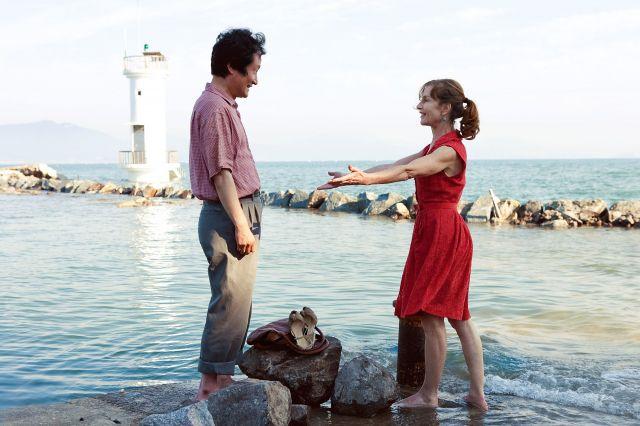
Hong is fascinated with the way people interact during awkward situations, focusing organically on the random channels of human movement and speech in times of momentary duress. The first section of In Another Country, in which Huppert’s famous actress visits a Korean director at his vacation home by the sea, is hilarious because it frames controlled confusion in a loving manner. The climax of Huppert’s indoctrination into the natural rhythm of this particular Korean community occurs when she interacts with a local lifeguard (Yu Junsang) who seems hell bent on pleasing her, no matter the cost. Their respectful banter is something special, in which two people cross paths and can’t quite figure out how to connect.

Like virtually all of Hong’s films, In Another Country is made up of diverging narrative tracks unfolding inside the same universe. Props, lines of dialogue, and character expressions all show up multiple times, but always within a different context. As a result, similar situations and motivations that repeat under similar circumstances are given unique qualities specific to the moment they occur. Hong has played with temporal bridging so many times, most wonderfully in last year’s Un Certain Regard entry The Day He Arrives. But In Another Country feels wonderfully lost at times, almost lovingly so, as if to evade anyone attempting to put a label on its freeform verses. Time really doesn’t matter here.

By the end of In Another Country, Huppert’s performing triptych reveals a surprising balance of tones, whisking comedy and tragedy together to establish a level of nuance that connects the three women as unknown kindred spirits. Taken in context, this is exactly what makes Hong’s films so indelible: the spacious and formative revelations people experience during everyday conversations that sneak up suddenly, and then quietly change your life.

Glenn Heath Jr. is a film critic for Slant Magazine, Not Coming to a Theater Near You, The L Magazine, and The House Next Door. Glenn is also a full-time Lecturer of Film Studies at Platt College and National University in San Diego, CA.

Welcome to the Cannes Film Festival 2012!

Welcome to the Cannes Film Festival!

null

Editor's Note: Press Play has two critics covering the Cannes Film Festival this year. Simon Abrams and Glenn Heath Jr. are tag-teaming their way through the most anticipated collection of screenings in the film industry. This is your ticket to Cannes. Enjoy!

nullGlenn Heath Jr.

`

nullSimon Abrams

Glenn Heath Jr. and Simon Abrams pick the winners at Cannes 2012. 

CANNES 2012: John Hillcoat’s LAWLESS

CANNES 2012: John Hillcoat’s LAWLESS

null

“It is not the violence that sets men apart. It is the distance he is prepared to go.” Old west pragmatism oozes through the gruff words of Forrest Bondurant (Tom Hardy), the 1930s bootlegger and all around bear of a man at the center of John Hillcoat’s Depression-era gangster film, Lawless. One of three brothers profferring booze to Chicago gangsters from their country Virginia stills, Forrest is seemingly indestructible, a local legend for his endurance and survival. The same cannot be said of his younger sibling Jack (Shia LaBeouf), the embodiment of American ambition, who becomes a human punching bag when faced with the slightest conflict. Surname aside, Forrest and Jack couldn’t be more different in size and nature, and they come to represent contrasting visions of Manifest Destiny crashing against each other through family.

Parallel to the battle between tradition and progress runs a sturdy Western theme, and Lawless imbeds the fear of economic expansion in the nuances of brotherly resolve. Ultimately, the two men must confront their ideological conflicts when urban corruption and violence invade the Bondurant’s small town of Franklin, in the form of a corrupt D.A. and his hired gun, a reptilian neat freak named Charlie Rakes (Guy Pearce). This subtext makes Hillcoat’s brutal violence all the more potent. Forrest’s consistent use of brass knuckles on adversaries says a lot about his desire (and ability) to end fights quickly, protecting his family and profit margin with little fuss. In this sense, Lawless uses the gangster film genre to defend the virtues and returns of protecting a small business from corporate takeover.

Loyalty and revenge dominate the film’s mostly messy narrative arc. But convention is only a means to an end for Hillcoat, whose contained vision of Prohibition-era America lingers on intimate details of human suffering; dirt hitting a coffin face, the fluttering of scorched leaves propelled into the air by a dynamite blast, and the gurgling blood from a slit throat are all reminders that Hillcoat’s cinema is equally brutal and poetic. Also, the Great Depression may not be the film’s central focus, but the disparate souls littering the roadsides further remind us that life outside the gangster universe is equally gritty, if not more dispiriting. These images are often juxtaposed with Nick Cave’s brooding score.

Both Hardy and Pearce’s superb method performances deserve the attention they will inevitably receive, and LaBeouf nicely realizes a balance of tenderness and sleaze. But ultimately, Hillcoat sees performance as a way to induce mood, a way to explore landscapes and interiors through an actor’s physical stature. One of the more wonderfully blunt examples of this approach comes early in the film when infamous gangster Floyd Banner (Gary Oldman) stops his speeding car on Franklin’s main drag, walks calmly up the boulevard, and shreds his pursuer’s vehicle with Tommy gun fire. Jack witnesses the shootout from close range, and the slight grin Banner gives him while calmly walking away speaks volumes about the near-mystical divide between gangsterdom and reality.

While Lawless goes astray during an odd prologue mired in voice-over, it’s a genre film with many bold ideas and characterizations. Hillcoat’s ongoing deconstruction of backwoods legends, something he and Cave began to address in the grimy, sweat-soaked The Proposition (2005), takes a more sobering and human turn in Lawless. This is the American outback in all its bloody glory.

Glenn Heath Jr. is a film critic for Slant Magazine, Not Coming to a Theater Near You, The L Magazine, and The House Next Door. Glenn is also a full-time Lecturer of Film Studies at Platt College and National University in San Diego, CA.

CANNES 2012: Matteo Garrone’s REALITY

CANNES 2012: Matteo Garrone’s REALITY

null

The classic fairy tale is an artificial creation in Matteo Garrone’s Reality, something wedding planners and television producers manipulate to create the best possible pomp and circumstance product for their Pavlovian audiences. It’s especially dangerous when gullible, wish-fulfilling viewers buy into their own faux happily-ever-after, truly believing they have a God-given right to popularity. Andy Warhol famously stated as much years before the dawn of our current technological age, but Garrone (director of 2008's much-lauded Gomorrah) manages to visualize the tragic consequences of one man’s delusionary digital dreams with an endlessly nimble cinematic approach. Movement and sound become the necessary tools artists and businesspeople use to warp personal perspective.

Wonderfully staged crane shots rise, fall, and then ascend again in this agile film, maximizing the importance of angle, height, and duration in relation to the fragile point-of-view of lead character, Luciano (Aniello Arena). The broken heart and oblivious soul of Reality, Luciano is a cocky family man who owns and operates a failing fish shop. Conducting shady deals on the side to keep his causal family lifestyle afloat, Luciano rarely shows a hint of stress, even dabbling in cross-dressing as a kind of public performance piece. The character’s reassuring demeanor in the face of economic distress and potentially life-altering situations proves him to be a natural ham, constantly wishing to be the center of attention. After Luciano’s family begs him to audition for Italian Big Brother, he barely bats an eye before diving head first at the chance to gain national notoriety and wealth.

Reality’s stunning opening helicopter shot, which tracks over Naples’s skyline before centering on a classic Victorian horse-drawn carriage speeding down the street, nicely juxtaposes fantasy and reality in the same landscape. This motif continues as Luciano goes through the Big Brother auditioning process, adopting the go-getter attitude most ambitious amateur performers need in order to succeed. Alexandre Desplat’s swooning score further suggests Luciano is creating his own fairy-tale façade out of the bits and pieces of an unlikely future scenario.  Family and friends give Luciano false hope at the most inopportune times, while cagey executives mislead him during a lengthy interview simply to mine personal information for future use. His is a truly modern tableau, marked by hollow surfaces posing as bags of money.

Luciano’s brazen dedication to living vicariously through pop culture symbols, lingo, and products eventually drives him toward madness, and in turn the ultimate realization of his own momentary fantasyland. Surveillance cameras and split screens define his dreams, while all sense of his former self evaporates without much resistance.. The cost of living this existence trickles down to affect Luciano’s children and his wife, who leaves Luciano after he becomes increasingly paranoid, thinking mysterious figures are silently “judging” him from afar.  

This small temporal gap in a crumbling marriage crystallizes the importance of togetherness in Reality. Garrone feels deeply for Luciano’s taxing plight, but never lets him escape the mire of his actions. His self-imposed encasement inside the container of “reality television” is a reflection of personal retreat, not an assessment of society’s many contradictions and failures. In Reality, giving up on ourselves (and each other) is the real tragedy, the true epidemic of character, devoid of a happy ending, real or imagined.

Glenn Heath Jr. is a film critic for Slant Magazine, Not Coming to a Theater Near You, The L Magazine, and The House Next Door. Glenn is also a full-time Lecturer of Film Studies at Platt College and National University in San Diego, CA.

CANNES 2012: Jacques Audiard’s RUST AND BONE

CANNES 2012: Jacques Audiard’s RUST AND BONE

null

Jacques Audiard only knows how to pummel us. The French director of The Beat That My Heart Skipped and A Prophet wouldn’t know a subtle musical cue or composition if it were staring him in the face.  Though such rigorous formalism isn’t necessarily a bad thing, Audiard’s overtly heightened style is problematic because it reflects a lack of interest in mining deeper territory and a thoughtless flair for obvious symbolism. This is a cinema of blunt force trauma, of momentary awe, and all the stylized violence and lens flares merely reinforce a lack of heft in the gracefully repulsive scenarios Audiard creates.

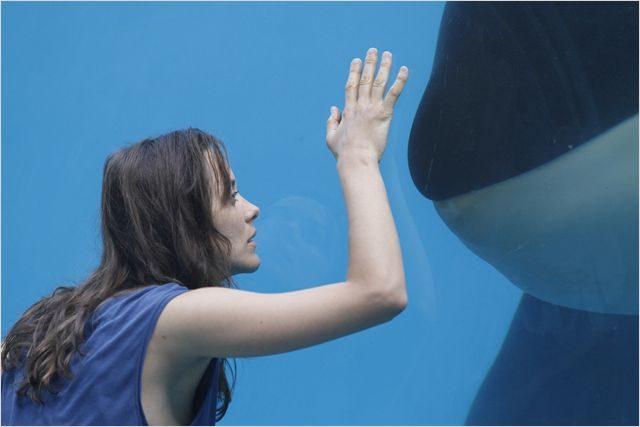
Rust and Bone, Audiard’s latest study in physical weathering and emotional repression, only further confirms his ongoing obsession with surfaces: skin, sunlight, ice, blood, and cement are all key motifs in the story of a perpetually violent ex-fighter who develops an unexpected relationship with a former Orca trainer recently crippled by a devastating accident. Both characters are deformed, one externally and the other internally, but they share an unspoken bond created by mutual rage and momentary quiet. In many instances their two experiences overlap, most strangely when the brutish Ali (Matthias Schoenaerts) is resurrected during a brutal street brawl after watching the legless Stéphanie (Marion Cotillard) use her newly acquired prosthetic limbs to walk toward him. In typical Audiard fashion, the inane reversal of fortune is heightened to the point of melodrama in super slow motion.

Strangely, the central relationship between Ali and Stéphanie, often the most interesting thing about Rust and Bone, is often left in limbo as Audiard cuts away to a number of convoluted subplots involving minor fringe characters. Lingering behind are many fascinating moments, as these two tortured characters attempt to communicate through instinct despite a lot of emotional static. There’s a stunning sun-drenched sequence where Ali carries the legless Stéphanie into the ocean, letting her swim freely as he watches from the beach. Wading in the shallow waters, Stéphanie takes off her shirt and swims into the current, regaining a sense of empowerment. Her transition in this scene feels organic, as opposed to being a product of jarring aesthetics.

For both characters, freedom is often found when engaging with nature. Rust and Bone’s defining image is of Stéphanie standing in front of a giant glass tank, her small body nearly overwhelmed by the giant Orca engulfing the frame. Her tender interactions with the whale hint at the character study Rust and Bone could have been. If sunlight and water allows Stéphanie the opportunity to realize her own self-worth, piercing ice enacts a similar wake-up call for Ali. But the film’s shameless denouement, a snowy set-piece far from the film’s primary setting in the south of France, bungles the chance for his character to attain the same level of resonance. Unlike Stéphanie, Ali’s coming-of-age moment is screenwriting 101, and steeped in sentimentality.

“We continue but not like animals.” There’s admirable resolve in Stéphanie’s telling words to Ali after their first sexual dalliance, but whether or not he understands (or cares) is ultimately a moot point. Throughout Rust and Bone, there’s never any doubt that Audiard will propel his protagonist to the finish line, a little more broken and but all the wiser, cliché be damned.

Glenn Heath Jr. is a film critic for Slant Magazine, Not Coming to a Theater Near You, The L Magazine, and The House Next Door. Glenn is also a full-time Lecturer of Film Studies at Platt College and National University in San Diego, CA.
CANNES 2012: Yousry Nasrallah’s AFTER THE BATTLE

CANNES 2012: Yousry Nasrallah’s AFTER THE BATTLE

null

Governments are inherently evil. Commoners are redeemable imbeciles. Academics are clueless do-gooders. These cookie-cutter generalizations about character motivation and social institutions define Yousry Nasrallah’s After the Battle, an abrasively loud melodrama set in post-Mubarak Egypt that equates dramatic importance with collective self-pitying. It takes a special kind of dud to make the immediacy of the Arab Spring seem trite and spineless, especially since the ripples from that massive uprising still reverberate throughout the Middle East. But that’s exactly what After the Battle achieves. It expresses nearly every theme, emotion, and motif through an onslaught of extreme verbal posturing.  Considering the consistency with which arguments crystallize out of nowhere in After the Battle, one wonders if Nasrallah thinks the louder his characters get, the more relevance their words will have. Talk about beating a dead horse.

Speaking of horses, the film opens with viral video footage taken during “The Battle of the Camel” in Tahrir Square from March of 2011, in which riders on horses and camels crashed through the crowds of protesters, smacking them with whips. One of the assailants is ripped from his saddle, only to be beaten repeatedly by a gathering of bystanders. This raw prologue successfuly establishes After the Battle as a movie of the moment. But that vitality sours when Nasrallah centers the narrative on the downed horseman, a gullible tourist guide from Nazlat named Mahmoud (Bassem Samra), who has become an outcast for opposing the revolution.  When an NGO doctor named Rim (Meena Chalaby) takes an interest in Mahmoud’s conflicted back-story, After the Battle uses their lifeless tryst to explore relevant issues of class and gender still affecting the Egyptian social landscape.

The connection between interpersonal relationships and national trauma fails to gain any traction in After the Battle, mostly because Nasrallah only scratches the surface of his country’s ongoing identity crisis. He simply mixes volatile Youtube footage with fictional dramatic scenarios through amateurish cross-cutting, creating a toothless docudrama whuch is at its most artificial when it tries to be edgy, pointed, and immediate. Juxtaposition like this only reinforces the typical stereotypes perpetrated by Hollywood for years. The region may be different, but all the tropes are the same.

If the high volume of After the Battle’s emotional theatrics doesn’t kill you, its incessant self-pity certainly will.  One particularly heinous example comes during a knock-down drag-out fight between Mahmoud and his wife, who yell aimlessly back and forth with their children sitting uncomfortably in the other room. Mahmoud's weepy emotional breakdown at the end of the argument is altogether unconvincing and unearned. After the Battle becomes one big self-serving metaphor during its painfully blunt final moments, when a bloodied Mahmoud envisions himself climbing a pyramid. The wide shot slowly tilts upward, away from his small figure, lingering on the massive distance he still must cover to reach the pyramid's top. The multi-dimensional dynamics of political and social transition in Egypt deserve something better than this kind of one-note symbolism, but Nasrallah, at least in this film, seems incapable of delivering anything else.

Glenn Heath Jr. is a film critic for Slant Magazine, Not Coming to a Theater Near You, The L Magazine, and The House Next Door. Glenn is also a full-time Lecturer of Film Studies at Platt College and National University in San Diego, CA.