Anthony McCarten and the Art of Trying Harder: The Screenwriter of ‘The Theory of Everything’

Anthony McCarten and the Art of Trying Harder: The Screenwriter of ‘The Theory of Everything’

nullWriting a
film about one of the most brilliant men on earth can’t be an easy task. The Theory of Everything, though, not only showcases Stephen Hawking, but even more so his wife Jane. When I
sat down to chat with screenwriter Anthony McCarten, I wasn’t surprised that he
had a compassionate and introspective attitude towards every topic we
discussed. I thought, this man was made
for storytelling.
McCarten, though, was quick to stress just how much work
it requires: a theory Mr. Hawking might agree with himself. Telling the best
stories and revealing the most exciting secrets comes with the greatest
responsibility.


After McCarten and I discussed our favorite teahouses in
London–yes, he’s very British–we got down to his beginnings. “I started as a
journalist.” This is where McCarten first learned a little about writing. He
recalls the first story he ever wrote: “We used to put these stories in vacuum
cylinders, and they used to shoot across the room to the sub-editor.” He remembers
her, surrounded in clouds of smoke as she crossed out and filled in an array of
articles. “She wrote some stuff on it and she put it back in the vacuum
tube. I opened up the little cannister,
and it was all entirely crossed out, with just the words, ‘Try harder’.”

This stuck with McCarten. I point out how elusive that
statement can be. We’ve all heard it before, whether from our third-grade math
teacher or our adult boss. He specifies what it meant to him.

“Be more ambitious.
Do your homework. There’s no easy way around this. We live in an age of, what course can I sign up for and in 24 hours
become a screenwriter
?”

He’s got a point. But McCarten didn’t learn
screenwriting quick. He’s been in the business of writing for many years,
working also as a novelist and playwright. I brought up his most successful
play to date, Ladies Night. It had
eight sell-out national tours of Britain and has been translated into twelve
different languages. McCarten laughs, “It’s been everywhere! It’s been done on
an ice floe in Greenland!” He’s kidding: “No, but almost.” But
that success didn’t come until after he had a number of other plays produced.
He shrugs: “But no one went to them. Commercial success and quality are not
necessarily allied.”

He compares playwriting to his work as a screenwriter,
discussing that although plays are built upon dialogue, the two crafts aren’t
dissimilar. “It’s the same game, but it’s different tools from the toolbox.” McCarten does point out that he finds novel
writing is the most “meditative, most prayer like.” He’s
had the best experiences with screenplays when he’s allowed to also reach that peaceful state.
Luckily for McCarten, he’s developed a way to enter this meditative state regardless of location: “I was born to a very
large family, one of 7 kids, I grew up with carnivals and chaos all around me,
so I can write anywhere.” He wrote his last novel entirely on a dining car on a train
in Germany, enjoying the sounds of the car and people around him.

So, how did McCarten, who’s clearly already made a name for
himself in the British literary scene get involved with The Theory of Everything? As it turns out, winning the approval of
Jane Hawking wasn’t as easy as one may think. 

McCarten read Jane Hawking’s book, Traveling to Infinity: My Life with Stephen in 2004 and was already
“hyper-aware of Stephen Hawking and the dramatic potential of his story.” He
realized “this is God’s gift to a storyteller.” McCarten attributes that to the
uniqueness of Hawking. “When that voice comes out of the computer…. it’s the
voice of God himself! It has an enormous power.” A relationship story centered on
a man like this excited him.

“Love stories are all
about obstacles.”

Approaching Jane required some guts, more than just reaching
out to an editor or agent. “I had to do something more outlandish,” McCarten
reveals. “I stalked her!” He went to Cambridge and showed up at her door. Her publisher
had set up the appointment, but she had never met McCarten before. I had to know
what pitching Jane Hawking was like: “I sketched it out
roughly on the train. It was three movies in one. I wanted to give equal weight
to all those three threads.”

“I used a clumsy
image of a triple helix, of these three threads complementing each other. The
threads would be this one of a kind love story, with all the little unorthodox
changes in course. The second thread would be the physics that would tell us
something about the birth of time and the nature of time. The third element would
be the horror story of Stephen’s physical decline.”

This was his pitch, and McCarten is thankful the script never
changed much from his original idea. “I wanted the story of the career to be
just as important as the care. I wanted the woman’s story to be just as
important as that of the iconic man.” To his relief, Jane was convinced of his ideas,
enough to tell him to write a draft of the script. “That began the
process of me winning her trust.” 

Again, like the “try harder” goal, gaining someone’s trust
can be equally as abstract. How do you actually do it? McCarten reveals
that for him, gaining trust for a project means, “You prove it on paper. In the
end it’s not the pitch, it’s the work you produce.” When Jane finally read his
draft, she could tell that it wasn’t all talk. After that, McCarten and Jane started
to make progress. Up until then. McCarten explains that Jane’s autobiography
had been unflinching. “Some of the press in England can be a little malicious
and gave the book quite a hard time. They don’t want to hear that side of the
story. They don’t want to hear that it might have been hard work looking after
Stephen.” But for McCarten, that’s exactly the element of the story he wanted
to bring to life.

As McCarten got deeper into writing the script, and one
about a man he greatly admired, he admits, “It brought out the best in me. It
required nothing less than my best shot.” But his greatest worry wasn’t
capturing the Hawkings’ voices as much as it was that they would never be
heard. He wrote on the film for years without a guarantee it would be made.
“That was the scary thing. It would have been like a creative death or
something.” It would have been the script that slipped through his fingers.

Fortunately, it didn’t. Before we got to the details of
shooting the film, I had to know how McCarten crafted such a massive story. The
characters are just as complex as the concepts. Starting within his helix idea,
McCarten knew the beats in all three threads of the story. He carefully allowed
each thread, the love story, the science and the physical decline to naturally
weave together. ”It was really painterly in the approach, a little magenta, a
little bit of blue, a little bit of yellow and in the juxtaposition of these
elements, something else was born.” He found parallels between the expansion of
the universe and the growth of Hawking’s mind, “the black holes
being contractions of the universe and then his body collapsing. It was like
adding two chemicals together and getting a third reaction.”

These mirror images are prevalent in the film and powerful,
without being heavy-handed. Time is also something that connects all three
threads and serves as a throughline. “The theory of everything: another phrase for
that is the unifying principle, and the unifying principle of this whole entire
script is time. It’s implicit in his doctoral thesis in the beginning of it.”
Hawking, from the beginning, is living at a different speed, experiencing time
differently than the characters around him. “Although we’re very much
intellectually driven to look forward, the heart is a bit of a time traveler
and it’s just as alive in the past as it is in the present.” Upon a closer look,
time travel is even mentioned in the dialogue, Jane ascribing her love for
literature to it.

McCarten reveals that the concept of time travel was
implemented in more than just the dialogue. ”Everyone on the team tried to
embody it in their own way. I know that the cinematographer, Benoît
Delhomme, did a great job of finding cosmic elements that would, without
rupturing reality, give you a sense of timelessness.” He did so with lighting,
keeping a stronger light on Stephen because he was the sun. In the visual and
emotional language of the film, everyone orbited around him. McCarten laughs, “Everyone
was trying to dial up the inner poet.”

So much of the film did rely on the visuals, more so than
usual, given the protagonist is losing his capacity for words. Although
McCarten comes from a playwriting and novelist background, he was excited to
work on a project not so reliant on word play.

“I wanted to work
with the restrictions almost Stephen had, taking away the primary tool in my
toolbox which is dialogue and working with almost nothing.”

A scene with Stephen and Jane comes to my mind. He tells her
he’s moving to America and their marriage is basically ended. So much is communicated,
with such little speech. McCarten agrees that it’s one of the scenes he’s most
proud of. “By the end of the scene they’re no longer husband and wife, and to do
that with almost no words was one of the great challenges and joys of writing
this kind of material.” While developing that scene, he scraped away the
dialogue till there was almost none, having each word communicate multitudes. When
Jane says, “I have loved you,” it’s a single line that changes their entire
relationship so far.  McCarten knew that in
order to earn this moment, and have it prove effective, he had to plant the
seed early on. He began with Jane and Stephen as a “witty, young couple and at
the end almost incapable of movement. They would be the polar opposite of each
other. I thought that central architecture would be really fascinating to play
with and I thought, the less dialogue I use in the end, the greater the
dramatic reward.”

McCarten’s construction of the script and the characters is
indeed elegant. Still, I was curious where he
was in the story. Every writer leaves an imprint of themselves on any
project. At first, McCarten explained that it’s more that “in between the known
points, they’re like stars in the sky, there are these vast empty spaces, and
this is where you have to use poetic license.” 

“It’s distilled
through what I think is appropriate for them, but they’re not there to give me
the exact words. I call it inspired speculation.”

McCarten never had the guarantee that he would get it right,
that these inspired moments would prove affective. But when Jane Hawking saw
the film and said, “I feel like I’m floating on air” and Stephen sat through it
and his “nurse wipe[d] tears from his cheeks,” McCarten was relieved, having a
realization he must have done something right:
“95% of the dialogue is just my best shot at what they might have said!” He admits,  “That’s you, that’s
your personality. You can’t write a character more brilliant than yourself. It’s
just not physically possible.” He brings us back to where we began, with his
first piece as a journalist. Whatever he’s working on, whether sending it
through a vacuum tube to an editor or onto a screen in front of Jane and Stephen
Hawking, McCarten still repeats that phrase to himself,  “Try harder!”

Meredith Alloway is a Texas native and a freelance contributor for CraveOnline, Paste, Flaunt, and Complex Magazine. She is also Senior Editor at The Script
Lab. She writes for both TV and film and will always be an unabashed
Shakespeare nerd. @atwwalloway

Margaret Nagle’s Long Path to THE GOOD LIE

Margaret Nagle’s Long Path to THE GOOD LIE

nullWhether immersed in a discussion with Margaret Nagle or in her film The Good Lie, one seems to forget the
materialistic obsessions of our culture. Nagle is no stranger to the industry,
with Emmy and Golden Globe nominations for her work as well as multiple WGA
wins. She’s battled with studios, executives and all the other elements that a
female writer has to wrestle with in the business. Her career is expansive,
encompassing writing on Boardwalk Empire,
the critically praised TV Movie Warm
Springs
and recently creating Red
Band Society
on Fox. But within the spectrum of her work is a common
thread: humanity. Many of her stories, The
Good Lie
included, explore survival. Whether an audience is watching kids
cope with cancer in The Red Band Society or
Sudanese refugees wrestling with America in The
Good Lie,
it’s impossible not to put our culture’s trifles aside and focus
on a much more visceral exploration of humanity.

It’s not often a film breaks down humanity to the basics.  The Good
Lie
is not a story about selfies, iPhones or materialism. It’s about pure
survival. It makes you wonder, do we
really need all this crap to survive?
Nagle gets to the crux of this
question with her story about the Lost Boys of Sudan. The film centers on
Jeremiah, Mamere, Abital, and Paul, a close-knit group of friends who, after
fleeing their country, grow up in a Sudanese refugee camp. 13 years later,
they’re among the lucky few who are posted on a list in the camp, given the chance
to move to America and start a new life. They meet Carrie (Reese Witherspoon),
a woman in Kansas City who helps them get settled. She takes them around to
grocery stores and factories, introducing them to the managers and hoping to
find them employment. Eventually, with her encouragement and persistence, they
find jobs. But the more they become immersed in American culture, the harder
their battle is to preserve their past culture and morals. Jeremiah (Ger Duany)
is scolded for offering a homeless woman food from the grocery store where he
works, even though he’s headed to dump it in the trash. The wasteful nature of
Americans baffles him. Paul (Emmanuel Jal) is tempted with pot by his
co-workers and struggles to maintain his work ethic while building new
friendships. Each of the characters must decide what principles to preserve and
which to sacrifice in order to build their new life.

The film took 11 years to make, with Nagle being attached to
the project, then fired, then re-attached. She never, though, lost her
emotional connection to the film. Despite an apparent difference between Nagle,
a white woman from the US, and a group of Sudanese refugees, their childhoods
possess a similar sense of survival. Despite the public, presentational
environment of our interview (we’re sitting outside Arclight surrounded by
movie-goers) Nagle soon revealed some private, intimate facts. Not only does
she only have her own tale of endurance, taking care of her disabled brother
for years, she admits that writing the film has helped her see that there is
salvation for herself and others. Freedom from guilt and healing can begin,  the catalyst being the act of sharing. Lucky
for her, that’s the beauty of film.

“I was selling purses out the trunk of my car,” Nagle states
matter-of-factly, popping a fry in her mouth. She worked a number of odd jobs
but found time to do her own writing in-between gigs. Two of her purse suppliers
were guys from Senegal whose grandfathers were from Sudan. They were going
through an adjustment, learning American culture, and Nagle became close with
them. Around the same time, she heard about the open assignment at Paramount
about the Lost Boys. She’d never been paid as a writer and just had a spec
script. Nagle is a fighter. Her agent assured her that better known writers
were up for the open assignment and that she should pursue other options. But
after urging her agent countless times, she finally got a meeting.  Soon after, she got the job. Nagle and then-producer
Robert Newmyer traveled the country and pitched the story to The Lost Boys
themselves.  They went to Atlanta, Phoenix,
San Diego and Kansas City twice.  She
wanted to create a fund for their education and knew that making a film about their
community would raise awareness. Nagle, most importantly, also wanted the Lost
Boys to “sign off on the story.” When Newmyer died of a heart attack soon
after, the Lost Boys all drove across the nation to speak at his funeral. Nagle
recalls that they said, ““Bobbie Newmyer was a Lost Boy. He was one of us.”

Nagle spent the next few years trying to get the script
made, even being fired from the project at one point. The studio wanted a
bigger-named writer. But the script eventually landed in the lands of Molly
Smith. Smith’s father had adopted a Lost Boy and put him through college. Six
months after the movie was shot, the Lost Boys told Nagle they “prayed for
Molly.” She was the producer needed to get the project jump-started.

Nagle is adamant many times throughout our chat about how
much research she did, stating that it kept the project strong.  She does “immersion writing” where she learns multiple
levels of a story. She reads every article she can on a subject and is
enthusiastic when discussing her process, clearly passionate about getting into
the psyche and circumstances of her characters. Nagle doesn’t want to meet the
people she’s writing about until she’s made a lot of decisions. With The Good Lie, she used a number of videotapes
of documentarians who couldn’t finish shooting in Sudan. The environment is
extremely volatile and many filmmakers have had to choose their own safety over
the completion of their projects. But this movie is not a documentary. The more we talk, it’s clear that the
project’s continuation isn’t only due to Nagle’s work ethic. I ask her again
what about the story kept the project
going. “Because it’s about such courage. It’s about sacrifice and the ending is
a surprise.”

Although the film is distributed by Warner Brothers and
showing at Arclight, it’s still independent in spirit. The budget was 15
million (okay, so right at the ceiling of what’s considered an indie). All the
children in the film are children of Lost Boys. Even the main actors have
backgrounds that are shockingly similar to their characters’ backgrounds. Many
of them have lost family members and have had to flee their homes. Nagle speaks
warmly about each of them. Kuoth Wiel, who plays Abital, auditioned on her cell
phone “in the library at school. She was born in a refugee camp in Ethiopia.
She walked from Ethiopia to Sudan several times, back and forth.” Emmanuel Jal,
who plays Paul, has a big lion scar on his leg. In the film, Paul has a similar
wound on his arm. Nagle finds it coincidental. “Just so happened I had Paul
have it on his arm. He had a really, really bad life over there.” Ger Duany was
discovered by David O. Russell and appeared in I Heart Huckabees. He was
the first actor Nagle met for the film. Like his character Jeremiah, Duany is
writing his own book on transcendence. He has told Nagle that “religion can make
people do really bad things,” but that it’s how he survived. Arnold Oceng, who
plays Mamere, was raised in London after his father was killed. Nagle recalls
that he “never talked about it, ever” and “felt tremendous survival guilt.”

Up until this point in the conversation, Nagle has revealed
very little about her childhood. As we become more comfortable, she opens up,
admitting she’s often tentative about explaining her childhood to people. “I
grew up with older brothers and we were on our own.” Her parents weren’t
divorced but they were “out of commission” and “high-functioning alcoholics.” Nagle
and her brother took care of their other brother who was disabled through a car
accident, leaving him a quadriplegic, with brain damage. From a young
age, Nagle, too, was forced to learn to survive. The roots are coming together
now. Nagle is Mamere, but also Abital; she had two brothers were “allowed to be
very sexist” towards her. Her parents were in denial.

The parallels are becoming clear. The film’s main character,
Mamere, is fueled by guilt.  At the
beginning of the film, as a child, he lets his brother Theo (Femi Oguns) sacrifice
himself. As the children hide in the brush, Theo rises and tells approaching
soldiers that he is the only one around. He’s then taken away and the other
children are able to escape. I ask if Nagle has been driven by her guilt over
her brother as well. She admits, “I was so scared to live my own life and leave
him behind.” Finally in Chicago as a young adult, Nagle’s therapist put her in
a group with Holocaust survivors. Although she was initially reluctant, her
therapist urged that she, too, had been through a traumatic experience and that
she was “very self- destructive” in ways she couldn’t even understand. She
didn’t agree until the group finally called her out. “You’re full of shit! What
you’ve gone through is terrible!” Eventually, Nagle was able to accept that she
had survived something. Like Nagle,
her characters struggle to not only talk about their past, but accept it.

This film isn’t about wallowing in past trauma; it’s about
liberating oneself from it. We learn late in the film that Carrie lost a sister.  When she invites Abital to live with her, she
begins to discuss how it’s affected her. Through sharing their guilt, their
pain, the characters begin to reach healing. Nagle stops after we draw the
connection: “Oh my god! I can’t believe you’re pointing this out to me!” Her
time with the group validated her pain in the same way Abital validates Carrie.
At this point, Nagle reveals perhaps the most touching moment in our talk. In
the film Mamere and his brother have a game. They draw a square in the sand and
put their hands on top of each other. It’s one of those intimate idiosyncrasies
siblings share.  Nagle did the same with
her brother. “He’d put his hand on the bed and I’d make a line in the sheets.”

It’s Nagle’s personal connection to the film, on the deepest
levels, that makes it so raw. But Nagle has more goals than just personal
catharsis. There aren’t schools in the refugee camps and Nagle stresses, “We
can’t solve the war in Sudan, we can’t change the religious differences. We can
make these camps better for the people that are living in them.” The Good Lie has been screening every
night in Washington, D.C.  UNICEF, Oxfam,
and the Enough Project have all come on board. Nagle is adamant: “How do we
turn this into policy? How do you shift things? It’s so tragic that we’re
allowing these really minor things to divide us. Jeremiah has a last narration
in the film and talks about our common humanity. We share this big world we
call home. For the future of mankind, we’ve got to come together.”

Nagle is undeniably inspiring. Nagle’s passion has again
made me note my materialistic surroundings. Why is everyone around me jamming
in the parking lot with their gas-guzzling cars to flock to see Gone Girl, about bad people doing bad
things to each other? Nagle is clearly calling for the opposite.

“The film is going to be more than just a film. I’m so
proud. I get very choked up because it’s what I wanted.”

Meredith Alloway is a Texas native and a freelance contributor for CraveOnline, Paste, Flaunt, and Complex Magazine. She is also Senior Editor at The Script
Lab. She writes for both TV and film and will always be an unabashed
Shakespeare nerd. @atwwalloway

Stuck in the Middle: 30 Great Films about Middle Age, PART THREE

Stuck in the Middle: 30 Great Films about Middle Age, PART THREE

And so we arrive at the top ten films about middle age, at which point I must
finally ask myself: did I become a perpetual adolescent because I make lists,
or do I make lists because I’m a perpetual adolescent?  At any rate, while I had intended to exorcise
my inner fanboy by accepting my age, I find that I have simply repeated
patterns already set.  Perhaps this is
what it really means to be stuck in the middle…

10.       Georgia (1985)

null

Nothing is worse than being compared unfavorably with a more
successful sibling, and the virtue of this film is that it doesn’t take that
predictable and judgmental route. 
Although the downward spiral taken by drug-abusing singer Sadie
(Jennifer Jason Leigh) is a sad one, the staid, predictable life of her sister
Georgia (Mare Winningham) is hardly exemplary. 
The choice to name the film after the less compelling sister is an apt
one, reflecting as it does her commercial success as compared to her needy and
depressive sister’s lack thereof.  Although the
encounters between the sisters are ostensibly the film’s center, the real drama
occurs onstage.  Director Ulu Grosbard
lets the camera roll allowing Leigh to give some of the most emotionally
exhausting performances of her life, screeching her way through alt-country
numbers as she bares every nerve.  Like
her life, these scenes verge on the unbearable, but are infinitely more
fascinating than her sister’s accomplished but ultimately dull renditions of
folk classics.  While films about
musicians usually suggest that it’s better to burn out than to fade away, this
one actually suggests there might be a dark virtue in doing both at the same
time.

 9.        Jackie
Brown
(1997)

null

The opening credit sequence of this film alone makes it
worthy of inclusion on this list, as we watch a middle-aged flight attendant
ride a moving walkway through LAX to the accompaniment of Bobby Womack’s
“Across 110th Street.”  Pam
Grier conveys a mood of resignation as the automatic machinery of her life
pulls her forward, the blue mosaic tiles rolling by behind her, marking the
passage of time.  By casting a middle-aged
black woman as the central character in a crime drama, Quentin Tarantino not
only revives the politics of liberation that fueled the blacksploitation genre
in the seventies, but also explores the role nostalgia plays in our lives.  The film’s touching portrayal of awakening
mid-life passion, in the relationship between Jackie and her bond agent Max
Cherry (in a mesmerizing late performance by seventies character actor Robert
Forster), is conveyed by the couple’s mutual fascination with Philly soul group
The Delfonics.  Although Jackie’s
criminal life prevents her and Max from finally getting together, they are
still able to share the past.

8.         Hannah and Her Sisters (1986)

null

A film with a happy ending for a change, although the
anguished moments the characters go through to arrive continue to linger even
while they celebrate that rare thing: a happy Thanksgiving.  Structured around three main narratives, providing
intimate perspectives on the many ways of being stuck in the middle, the story
gradually weaves these different experiences together so seamlessly that we
conclude feeling like we’ve lived an entire life in the two years of the
story’s tight arc.  From Elliott’s
(Michael Caine) reawakening of passion for his wife’s sister, to Holly’s
(Dianne Wiest) stumbling attempts to find her life’s direction, to
hypochondriac Mickey’s (Woody Allen) belatedly discovering joy as the meaning
of life, all reflect on distinct aspects of the middle age experience.  The settings, too, resonate with a nostalgia
only those of us past our thirties can know: wandering through New York’s old
bookshops, seeing a Marx Brothers movie at the Metro, and bumping into an old
acquaintance while shopping at Tower Records: these lost places are almost as
romantic as the love affairs.

7.         All That Heaven Allows (1955)

null

Lavish Hollywood melodrama at its finest, this also remains
a daring account of a Spring-Autumn romance, largely because of its reversal of
the expected gender roles.  Middle-age
and well-to-do Cary Scott (Jane Wyman) falls for her hunky gardener Ron (Rock
Hudson) and Cary’s propriety-obsessed set is scandalized.  Particularly incensed are her daughters, who
so forcefully scorn her that she gives up her paramour.  In one of the most painful scenes of 1950s
American cinema, the children give their mother a television set to keep her
company, now that they are all moving away from home.  But in time-honored melodramatic convention,
they are reunited via an improbable deus
ex machina
, and the film ends with a lapidary Technicolor image of a deer in
the snow blessing their reunion, so kitsch it actually works.  It’s all so marvelously complete that when
Todd Haynes reprised it in Far From
Heaven,
he could only write in the margins.

6.         Groundhog Day (1993)

null

Bill Murray was forty-three when he made this
film. The premise of being trapped in a repetitive life is a quintessentially
middle-aged dilemma; and thankfully, so is the promise of self-reinvention that
the story offers.  The brilliance of the
film’s conceit is in the fact that only by embracing every nuance of what we
see every day can we make it new, a potent metaphor for the possibilities that
lie in what seems to confine us.  As a
revision of Frank Capra’s It’s a
Wonderful Life
, Harold Ramis’ masterpiece brings a greater sense of
relevance and urgency to the premise of appreciating what you’ve got by
shifting the emphasis away from small-town communities and into the experience
of rutted repetition in general.  The
result is at once more universal and more precise, and I continue to go back to
this film for perspective on whatever frustrates me.

5.         Savages (2007)

null

Tamara Jenkins’ subtle, understated account of two alienated
siblings dealing with their father’s dementia is a darkly comic relief from the
sentimental twaddle with which such life-experiences are too often met.  Philip Seymour Hoffman gives one of his
subtlest performances as Jon Savage, who teaches drama in a Buffalo college while
writing a book about Bertolt Brecht.  His
sister Wendy, played by Laura Linney with a curious mixture of childishness and
world-weariness, is a struggling playwright so anxious about her lack of
success that she lies to her brother about receiving a Guggenheim Grant.  These mid-life dramas are played out against
a background of encroaching mortality, which the characters confront with a
gracelessness so extreme it verges on grace. 
In one particularly brilliant scene, during an argument in the parking
lot of a high-class nursing home from which their father has just been
rejected, Jon shouts: “People are DYING, Wendy! Right inside that beautiful
building — right now! It’s a fucking HORROR show! And all this wellness
propaganda and landscaping is just trying to obscure the miserable fact that
people die and death is gaseous and gruesome and filled with piss and shit and
rot and stink!” The camera then pulls back to reveal a nurse pushing an elderly
patient past in a wheelchair, and Jon and Wendy hang their heads in shame.  Mixing dry wit with stark sadness, the film
is something like what Charles M. Schulz might have produced in later life if
he hadn’t been stuck writing comic strips about children.

4.         Alice Doesn’t Live Here Anymore (1974)

null

Focusing on a female character for a change, Martin
Scorsese’s portrait of Alice (Ellen Burstyn), a middle-age woman struggling to
make it after the death of her husband, flirts with the conventions of
melodrama, though tempered by astonishing candor and naturalism.  If Burstyn never made another film, this
should have been enough to make her a legend, and her interactions with her
mouthy son Tommy (Alfred Lutter) are as funny and endearing as those in Paper Moon.  Like that film, this is also an unconventional
road movie, but instead of selling bibles, Alice is trying to sell herself, as
a singer that is, and Scorcese films her sweet but rather awkward performance
scenes with a touching intimacy that doesn’t cover up or mock the signs of age
that lie just beneath her make-up and tawdry dress.  The tensions that beset her developing love
affair with rancher David (Kris Kristofferson) are real, as when he disciplines
Tommy to harshly for her mother’s liking, so that when the film concludes with
a rather formulaic happy ending, you believe it because you want to.  Burstyn’s Alice may be film’s most enduring
and endearing middle-age everywoman.

3.         Close Encounters of the Third Kind
(1977)

null

“Like Halloween for grown-ups,” Roy (Richard Dreyfuss) says to Jillian (Melinda Dillon) as they
anxiously wait for the aliens to arrive, and indeed the entire film is a
magical evocation of the resurrection of childhood dreams in middle age.  What keeps this from straying into the trite
sentimentality of Spielberg’s later fantasy films is its attention to the emotional
costs of following the sense of wonder, as Roy increasingly alienates and is
ultimately abandoned by his family.  “I
guess you’ve noticed something a little strange with old Dad,” Roy says with rueful self-mockery, and he might be talking about any number of mid-life
crises.  But the magic of this film is in
the realization of Roy’s dream of escape, one that is anything but nihilistic
but almost an evolutionary step beyond the human self, as the realization of a
fantasy becomes a kind of heroism.

2.         Amarcord (1973)

null

With a few minor exceptions, none of the characters in this
film are middle-aged, only the director, as he brings his childhood past to
lavish life with unembarrassed affection and hyperbole.  Was the snow once so deep that the townspeople
had to dig paths like high ceilinged corridors through the streets?  Did the cruise ship come that close when the
bewitched boaters rowed out to see its dazzling lights at night?  Was the late-winter bonfire really that
high?  Were the tobacconist’s breasts
really that big?  Of course not, and
that’s the whole point.  Fellini
simultaneously mocks and relishes nostalgia’s penchant for fabrication,
creating a magical realist portrait of a world that hasn’t so much faded away
as never really existed, except in the middle-aged film-maker’s mind.

1. Adaptation
(2002)

null

Mid-life self-doubt as post-modernism: this is Charlie
Kaufman’s raison d’etre and this may well be his finest, most ambitious
rendering of that wholly original conception. 
In this layered self-portrait we watch Kaufman struggle to adapt Susan
Orleans’ seemingly unadaptable The Orchid
Thief
, as the struggle becomes a metaphor for, or perhaps just the most
acute manifestation of, a mid-life crisis. 
Just as Kaufman is unable to settle on one plot line he is incapable of
opening himself up to others, particularly to his female friend Amelia Kavan
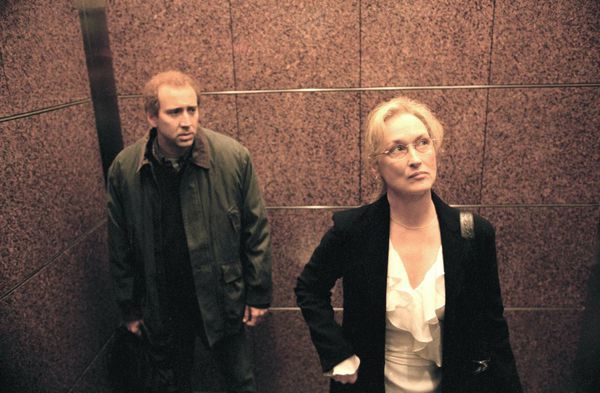
(Cara Seymour), on whom he has a blindingly obvious crush.  Kaufman’s divided self is hilariously
embodied by his twin brother Donald, both played by Nicholas Cage in what is
surely his greatest performance. 
Kaufman’s anxieties are matched by Susan Orleans’ herself, whose loss of
passion forms a subtext to her book: “I want to know how it feels like to care
about something passionately,” she writes, and this desire to desire draws her
to orchid hustler John Laroche (Chris Cooper). 
She discovers that to care passionately about something “whittles the
world down to a more manageable size,” and this becomes the principle
discovered by Kaufman as he puts his script and his life into a (barely)
manageable order.

[Click here to read Part One of this journey into the films of middle age…]


[Click here to read Part Two of this journey into the films of middle age…]

Jed Mayer is an Associate Professor of English at the State University of New York, New Paltz.

Stuck in the Middle: 30 Great Films about Middle Age, PART TWO

Stuck in the Middle: 30 Great Films about Middle Age, PART TWO

I must go on, I can’t go on, I’ll go on: here we are with Part Two of the list of what I consider to be the best movies about middle age.  If you’re still with me, you’ve admitted your
age, and acceptance is the first step towards… whatever, here’s the list.

20. The Prime of Miss
Jean Brodie
(1969)

null

Like so many of us at middle age, teacher Jean Brodie (Maggie
Smith) likes to proclaim she is in the prime of her life, and the devoted
following of her select girl students (whom she dubs the crème de la crème) would seem to confirm it.  But as much as she inspires her charges with
a love of art and nature, she also leads them astray through her misguided adoration
of Francisco Franco and Mussolini.  The
film implies that aging without grace can sometimes land one on the wrong side
of history, and it can also land one on the wrong side of the young.  Pamela Franklin brings a severe intensity to
her performance as Sandy, a student who grows to resent her former idol and
takes revenge by stealing Brodie’s former lover, exposing her dark
secrets.  As Brodie leaves in disgrace, only
Maggie Smith could make us feel sorry for a misguided fascist. 

19. The Man Who Shot
Liberty Valance
(1962)

null

One of John Ford’s most emotionally complex Westerns is also
an ambivalent meditation on the aging process. The film begins with Senator
Ransom Stoddard (James Stewart) returning to the once lawless Old West town
that made his name.  He’s there to attend
the funeral of his old friend Tom Doniphon (John Wayne), and as this frame
narrative gives way to flashback, we hear a story that is as much about
the historical as the personal past.  As
“Ranse” Stoddard progresses from emasculated dishwasher and busboy to the
killer of the film’s title, his brand of pacifism and justice is juxtaposed,
and finally undermined, by his rival turned friend, Doniphon.  While I’m no fan of “the Duke,” he gives a
stunning performance here as a man embodying frontier values at the very moment
of their dissolution.  His trademark
wooden delivery somehow manages to capture the alienation of a man whom history
is passing by, and Stewart’s familiar earnestness is almost childish by
contrast.  The film leaves us wondering
if what we call the wisdom of age might simply depend on a selective memory of
the past.

18. The Big Lebowski
(1998)

null

When I first saw this film in the theater, I felt that it was one
of the funniest, but also the most pointless, of the Coen brothers’ films; now I
regard it as offering one of their more pointed political commentaries on
generational politics.  Set less than a
decade before its release, in 1990, the film raises complex questions about how history is
made, and what role we play in the making of it.  In characteristic fashion, the Coens
foreground the constitutive role of language in shaping how we perceive events:
the Dude (Jeff Bridges) acts as a kind of linguistic sponge, picking up and
recirculating phrases spoken by those around him, including George Bush, Sr.’s
(in)famous “This aggression will not stand” speech.  Once a member of the subversive political
group “the Seattle Seven,” “Dude” Lebowski now spends his time bowling, getting
high, and drinking White Russians, seeming to confirm the accusation leveled
against by his namesake: “Your ‘revolution’ is over, Mr. Lebowski!  Condolences! 
The bums lost!”  But in a world
where the possibility of meaningful political change seems to have been shut
down, perhaps the best answer is to echo back the meaningless rhetoric of the
status quo, making of its very emptiness a kind of accusation: “This will not
stand, ya know, this will not stand, man!”

17. Sideways
(2004)

null

This hilarious road movie about a couple of buddies on a
kind of “stag” wine tour moves effortlessly into a moving meditation on slowly
fading joie de vivre, for which wine
serves as ironic metaphor: ironic, because the characters aren’t necessarily
getting better with age.  In the film’s
most memorable scene, Miles (Paul Giamatti) and Maya (Virginia Madsen) share
their passion for pinots, while tacitly reflecting on how other passions have
grown sour.  Maya movingly observes how
“a bottle of wine is actually alive — it’s constantly evolving and gaining
complexity. That is, until it peaks—like your ’61—and begins its steady,
inevitable decline.”  Though the film
offers a glimmer of hope and possibility at its conclusion, this is its abiding
mood, but fortunately, as Maya adds, “it tastes so fucking good.”

16. The Accidental
Tourist
(1988)

null

Writing travel guides for people who don’t want to travel,
Macon Leary (William Hurt) is a walking advertisement for middle age
malaise.  Fittingly, the symbol used on
his popular series of books is a lounge chair with wings.  The loss of a son has further strained his
marriage, and Macon seems fated to spend his life in a chair for one until his
dysfunctional Welsh corgi leads him to winningly daffy obedience trainer Muriel
Pritchett (Geena Davis), who awakens in Macon something bearing a vague
resemblance to passion.  In addition to its compellingly eccentric love story is, the film also includes an ensemble cast of other aging
eccentrics, offering diverse perspectives on the waning and rekindling of
affections.  Macon’s siblings are all
co-dependently repressed, until spinster Rose (Amy Wright) manages to capture
the heart of her brother’s publisher (winsomely played by Bill Pullman).  The fittingly beige-toned yet romantic
conclusion manages to land somewhere between “The Love Song of J. Alfred
Prufrock” and Breakfast at Tiffany’s.

15. The Squid and the
Whale
(2005)

null

This semi-autobiographical journey into the dark places of
family life is as much an exploration of middle age as it is of
adolescence.  Though told largely from
the point of view of two boys, Walt and Frank, their parents’ split-up becomes
the focus of the film, resulting in a funny and sad account of how people grow
apart.  Their father, struggling writer
Bernard (Jeff Daniels), forces his tastes and lifestyle onto his boys, a habit
that grows worse as he feels threatened by his estranged wife’s publishing
success.  The film shows how early we can
become middle-aged in spirit, as the older son, Frank, begins spouting the formulaic
literary preferences and dislikes of his father, and adopts his cynical,
self-serving worldview.  As he gradually
comes to realize the uncredited role his mother (Laura Linney) played in his
life, we understand that the conflict between his middle-age parents has become
Walt’s inner conflict as well.  Our mom
and dad, they fuck us up, indeed…

14. Picnic (1955)

null

This film is as much an enactment of mid-life crisis as it
is a portrayal of one, in that star William Holden is an actor in his late thirties
playing a character in his early twenties. 
The result is wildly implausible but, because it’s William Holden,
unexpectedly poignant.  As aimless
drifter Hal, he shows up in a small Kansas town on Labor Day, seeking out a
fraternity brother whose father owns a local mill.  Along the way he encounters Madge Owens (Kim
Novak), and passion smolders.  But a
sadder, and in some ways more compelling, romance is also taking place, that
between middle-aged schoolteacher Rosemary (Rosalind Russell) and store owner
Howard Bevens (Arthur O’Connell). 
Rosemary has been trying to get Howard to marry him, and her desperation
spills over as the whiskey flask grows emptier at the annual town picnic,
culminating in a painful scene where she throws herself at William Holden to
make Howard jealous, accidentally ripping the shirt of the “young Adonis” in
front of all.  Layers of awkwardness are
at work here: Rosalind Russell’s vivid portrayal of mid-life sexual desperation
ironically paralleling William Holden’s mid-life desperation as an actor
playing well beneath his age.  Yet it
somehow works.

13. Now, Voyager
(1942)

null

Bette Davis is mesmerizing as a middle-age spinster coming
out of her shell.  Bullied to the point
of mental breakdown by her oppressive mother, mousy Charlotte Vale seeks the
help of psychiatrist Dr. Jaquith (Claude Rains).  As she grows more confident under his care,
she gets away from it all on a therapeutic cruise where she reinvents herself
and falls in love with married man Jerry (Paul Henreid).  If their star-crossed love affair were all
this film were about, it might be just another forties Hollywood melodrama, but
when Charlotte ends up at an asylum under Dr. Jaquith’s care, she
befriends Tina, a young woman who reminds her of her own repressed self.  Though Tina turns out, rather improbably, to
be old flame Jerry’s daughter, the film ends with Charlotte taking the girl
under her wing, and settling for a life of quiet female companionship rather
than torrid romance.  This resolution is
somewhat sad, but poetically right, offering an unconventional view of
middle-age life choices.

12. Mildred Pierce
(1945)

null

As with Picnic and
The Wrestler, this film gains added
depth from the middle-age drama of the actress as much as that of the character
she portrays.  Thanks to Mommie Dearest, we all know how
desperate an aging Joan Crawford was to get this part, and how much she threw herself
into her role; thus, it’s difficult not to see the character of Mildred as
autobiographical.  Left by her husband, Mildred
Pierce works herself out of her and her daughters’ financial desperation, first
as a waitress, then as the owner of a successful chain of restaurants.  Along with Barbara Stanwyck’s Stella Dallas, this is one of the most
powerful portrayals of a working woman from Hollywood’s golden age.  Yet, while she finds satisfaction in work,
her wayward second husband reminds her of her age when she finds him cheating—with
her own daughter.  Rarely has the
generation gap been so nastily rendered.

11. Lost in
Translation
(2003)

null

From the moment Bill Murray stood on the diving board in Rushmore, belly sagging over Budweiser
swimsuit, cigarette hanging out of his drooping mouth, he has become
Hollywood’s great icon of middle age. 
Here he internalizes that sad-sack pose, making it more tragic by hiding
it behind the pasted-on smile of Bob Harris, an aging actor doing a photo shoot
for a series of advertisements for Suntory, a Japanese whiskey (!).  Paralleling Bob’s mid-life crisis, Charlotte
(Scarlett Johansson) is having a “mid-twenties crisis,” and many of the film’s
most compelling scenes are without dialogue, showing her walking through Tokyo,
where nothing seems to make sense.  When
they meet at a hotel bar, their mutual malaise is a perfect match.  “I’m planning a prison escape; we first have
to get out of this hotel, then out of the city, then out of the country,” Bob
tells her, and she answers: “I’m in,” leading to a night of bar-hopping that ends in a karaoke bar.  Murray’s
off-key rendition of Roxy Music’s world-weary “More Than This” is surely one of
cinema’s great moments, turning the classic song into a mid-life anthem.  When they part, Bob whispers something
inaudible in her ear, and they both wander off in irresolution: a perfect way
to (not) end this movingly understated film.

[Click here to read Part One of this journey into the films of middle age…]

Jed Mayer is an Associate Professor of English at the State University of New York, New Paltz.

Better Red Than Dead: Director Gabe Polsky Revisits the Cold War Through Hockey

Better Red Than Dead: Director Gabe Polsky Revisits the Cold War Through Hockey

Sport is nothing if not a battle
of ideologies. The West Coast offense versus the Option. Tradition versus sabermetrics.
Defense wins championships. In the Cold War era, international sport provided a
unique look into all manners of ideology, from citizens’ approach to sport to
the all-encompassing Communism versus Social Democracy debate. From Olympic
boycotts to defections to Rocky IV,
sport provided a venue for discussion of larger issues of ideology through the
microcosm of its very nature and metaphor. Nowhere was this more evident than
in hockey.

As a Canadian, I was taught the
greatest hockey team of all-time was the 1972 Team Canada that beat the Soviets
at the Summit Series. Paul Henderson’s series-clinching goal had as much
magnitude as our national anthem. Similar arguments were made of the 1987
Canada Cup team that boasted both Wayne Gretzky and Mario Lemieux. That’s the
greatest hockey I’ve ever seen, or likely ever will see.

For Americans, I imagine a
similar argument could be made for the 1980 Miracle on Ice in Lake Placid
(they’d be wrong, but my nationalist bias causes me to digress), if not for the
team then for the virtue of its victory. But history is born of nationalism,
written not so much by the victors, as Winston Churchill suggested, but rather by
those with a medium with which to argue who was the greatest, who were the
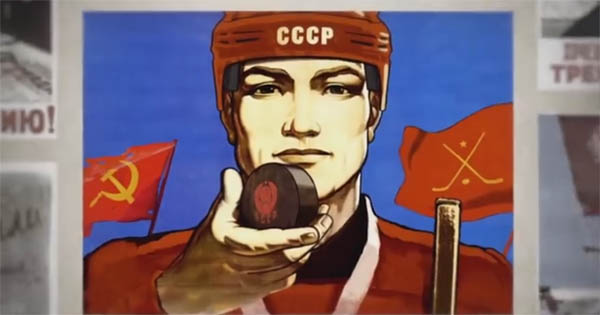
heroes, the villains, and indeed the victors. Filmmaker Gabe Polsky’s upcoming documentary
Red Army “tells the story of the most
dominant sports team in history: the Soviet Union’s Red Army ice hockey
team.” 

Polsky is the son of
Russian-Ukrainian immigrants, and grew up in Chicago. He played hockey at Yale.
I don’t for a second doubt his credentials as a hockey documentarian (even though my Canadian
passport demands I should) nor his affection for his subject matter (it is
infectious). But my immediate reaction, as a Canadian, as a hockey fan, to the
above quote from the film’s production company was: I’ve got a whole country
that disagrees with you. However, I will admit, Polsky’s argument is
compelling. And according to its director, Red
Army
is about more than hockey. It’s about an era. It’s about the rise and
fall of an ideology, and the end of the Cold War.

While North American hockey was,
and is, built around stars, the Red Army team was more interested in the
collective. As Polsky says, “A lot of Soviet ideology ended up in sport. They
didn’t emphasize the individual.” This shouldn’t be that much of a surprise, as
the Red Army team was the international face of a communist dictatorship. They
took their brand of hockey and social order around the world, to battle on the
ice and in spectators’ minds.

As a student of the game, I had
always believed that creativity was born of individuals such as Gretzky, Orr,
Lemieux, who took us out of our seats to revel in their artistry.
Interestingly, Polsky argues the opposite, that it is the collective approach that
truly bred creativity, likening it to “what Brazilians did with soccer…
[they’re] more creative and they have more style to the game, brought a more
artistic approach to the game. A more beautiful game.”

Red Army uses Soviet defenseman Viacheslav Fetisov as a
narrator of sorts, a vehicle through which to tell the film’s story. Fetisov
played through “three generations of Soviet teams,” and was one of the first
wave of Russians to be allowed to play in the NHL. What’s compelling for Polsky,
a hockey fan who grew up during these eras, is the transition of Fetisov from
enemy (on the Red Army teams), to sympathetic character (in his desire to play
in the NHL), to endearing fan favorite (in his later years with the Detroit Red
Wings). Polsky sees Fetisov as the ultimate embodiment of the Cold War, from its
rise to its eventual fall.

If Fetisov’s story represents the
arc of the protagonist, then the story’s antagonist is Viktor Tikhonov, the head
coach of the Red Army team during its most dominant era. Tikhonov was the
communist dictator of a team during a communist dictatorship. To his team, he
was the USSR itself. When I was growing up, invested and engrossed in the later
era Super Series and the 1987 Canada Cup, I recall thinking Tikhonov’s embodiment
of evil was straight out of a Bond film, and indeed Polsky calls him a “perfect
villain.”

The director recalls a story of Vladislav
Tretiak, perhaps the greatest goaltender to ever strap on pads, asking his
coach if he could train at home because he wanted to see his family. Tikhonov
told him “no” and that if he didn’t train with the collective he “wasn’t
playing.” Contrast this with Tretiak’s rival and competition for the greatest
goalie ever title, the Montreal Canadiens’ Ken Dryden, who sat out during the
1973-74 season over a contract dispute, and used that year to complete a law
degree at McGill University. Perhaps nowhere better can we see the vast
difference between the ideologies resting on opposite sides of the globe than
in the dichotomy of the goaltenders’ narratives.

Just as communism never made it
stateside, the practices of the Red Army team never became part of the habits
of the NHL, with the exception of the Scotty Bowman-era Red Wings, who employed
the Red Army’s 5-man units, as opposed to the North American system, which
interchanges 4 forward lines and 3 defense pairings. Interestingly, Fetisov
(who Bowman drafted in 1975 while coach of the Montreal Canadiens, despite
knowing he’d never be allowed to come to the NHL) was a part of those team, as
were Red Army disciples Vyacheslav Kozlov and Igor Larionov. Teams that notably
won three Stanley Cups during Bowman’s tenure.

Bowman appears in Red Army, creating a bridge between
ideologies and histories, as he also coached against the Red Army in the 1976
and 1981 Canada Cups, as well as what has been called the greatest game ever,
the Red Army versus the Montreal Canadiens on New Year’s Eve 1975. But the NHL
has always eschewed innovation, and the influence of the Red Army begins and
ends with Bowman. But does the argument for the more virtuous system, in hockey
and beyond, end there as well? The Berlin Wall fell. The Cold War ended and the
Soviet Union with it. Russian players came to the NHL, and are now a staple in
the league. Red Army will be a
fascinating look into a part of hockey’s history rarely told, and an intriguing
look into an era of the sport that defines its mythology.

Red Army (directed by Gabe Polsky and produced by Jerry Weintraub and
Werner Herzog) will be released later this year.

Mike Spry is a writer, editor, and columnist who has written for The
Toronto Star, Maisonneuve, and The Smoking Jacket, among
others, and contributes to MTV’s
 PLAY
with AJ
. He is the author of the poetry collection JACK (Snare
Books, 2008), the short story collection
Distillery Songs (Insomniac Press,
2011), and the co-author of
Cheap Throat: The Diary of a Locked-Out
Hockey Player
(Found Press,
2013). His next poetry collection,
Bourbon & Eventide, is forthcoming in 2014
from Invisible Publishing. Follow him on Twitter
@mdspry.