WATCH: A Montage of the Sensuous Close-Ups in Paul Thomas Anderson’s ‘Boogie Nights’

WATCH: A Montage of the Sensuous Close-Ups in Paul Thomas Anderson’s ‘Boogie Nights’

The first time I saw Paul Thomas Anderson’s Boogie Nights, and the second, the sexuality which gives the film its essential underpinning didn’t make much of an impression on me. I was aware that vaguely lewd things were going on onscreen, and I suppose I should have been more interested in–if that’s the right way to phrase it–Roller Girl’s proud nudity, in Amber Waves’s sad sexuality, in Dirk’s Diggler, but really, I wasn’t. In all honesty, the appearance of the film was more interesting to me–its flash, its swagger, its Scorsese-esque movement–than its insight into the porn world, or its sexual excesses. That may have been the point, but it’s a little hard to say, in Anderson’s case, because so often his films revel in the depths to which they penetrate, and sexual over-indulgence is certainly one color in his palette, as Press Play has indicated previously. Nevertheless, given that, the close-up shot is an effective tool for Anderson–perhaps just as effective as the long shot. What’s interesting is what Anderson does with the technique: rather than using it for suspense, or to drive narrative, he’s trying to force us to look at something, really look at it, and perhaps get lost in its strangeness for a while. The object could be a camera lens, a cup of coffee being poured, a zipper: regardless, Anderson drives us inward. And we find, as this excellent, if spontaneously executed, montage by Justin Barham shows, that the journey can be very exciting indeed.  

VIDEO ESSAY: Steadicam Progress – the Career of Paul Thomas Anderson in Five Shots

VIDEO ESSAY: Steadicam Progress – the Career of Paul Thomas Anderson in Five Shots

With The Master winning the Best Cinematography award from the National Society of Film Critics over the weekend, here's a look at the evolution of Paul Thomas Anderson's approach to his films' camerawork over his first five features. The video above and essay posted below originally appeared in Sight & Sound.

One thing I wish I had explored in some way was the contribution of Anderson's longtime cinematographer Robert Elswit, who shot Anderson's first five features. The video makes the implicit auteurist assumption that the visions being expressed through the camerawork are that of the director, with the cinematographer acting as a technical facilitator. This of course is a gross oversimplifcation of the collaborative dynamic between director and cinematographer that perhaps gives too much credit to one party.

My dissatisfaction with this reductive approach informs the topic of my subsequent video essay for Sight & Sound, an exploration of the creative contribution of special effects team Rhythm & Hues, as a postulation of the artistic visions brought about by technical craftsmanship.

—–

Thinking on what sets The Master apart from Paul Thomas Anderson’s earlier films, what strikes me most vividly is a marked difference in camera movement and staging. I wouldn’t be surprised if a proper cinemetric analysis found that up to half of the film’s running time consists of close-ups with little to no camera movement.

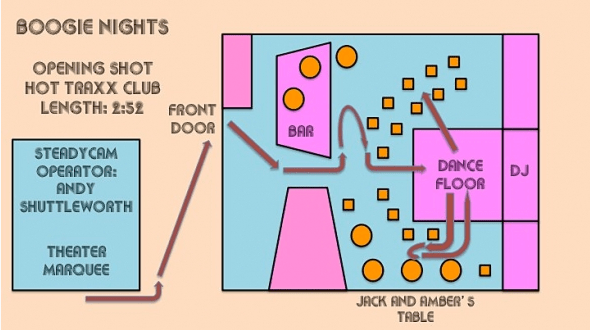
This is a far cry from the run-and-gun days of Boogie Nights and Magnolia with their stunning array of sweeping Steadicam shots, push-ins and whip pans. But upon surveying his career film by film, one can trace an evolution in his technique. This video essay examines one signature tracking shot from each of Anderson’s five previous features, showing how each epitomises his cinematography at each point, from the flashiness of his earlier films to a more subtle approach that favours composition over movement.

While The Master offers a couple of swirling tracking shots in a department store, and later a pair of straight-line lateral tracking shots to match the onanistic thrill of motorcycle joyriding, the film settles more often into shot/reverse shot dialogues in cozy interior sets. It seems that Anderson’s camera strategy here has less in common with ScorseseAltman or even Kubrick (with all of whom he’s frequently compared) than with Jonathan Demme. Indeed, in the DVD commentary of Boogie Nights, Anderson expresses a profound emulation of Demme, though Demme himself couldn’t recognise a shot from Boogie Nights that Anderson claimed to have blatantly derived from him.

Here the connection is apparent as never before, in a film that seems less concerned with riding the kinetic thrill of a camera set in motion than in tapping the psychic voltage of physiognomies seen up close. In his most psychologically intimate film to date, Anderson largely foregoes his signature camera movements in order to tunnel into the human mind.

Kevin Lee is a film critic, filmmaker, and leading proponent of video form film criticism, having produced over 100 short video essays on cinema and television over the past five years. He is a video essayist and founding editor of Fandor, and editor of Indiewire’s Press Play blog, labelled by Roger Ebert as “the best source of video essays online.” He tweets at @alsolikelife.

VIDEO ESSAY: Cocaine du Cinema

VIDEO ESSAY: Cocaine du Cinema

For roughly the last one hundred and thirty years cocaine has been the drug of choice for the working class—in fact, for even longer than that, common workers often used it as an energizer. South American indigenous populations in the Andean Region survived centuries of arduous living conditions (rough terrain, high elevations) by chewing on the cocaine leaf; in North America, during the 1890s, African American workers were actually given cocaine by their employers in an effort to help them pummel through the harsh working conditions of railroad construction and mining. The modern world, however, has seen the cocaine drug go down two polar, simultaneous routes: the “crack” cocaine circuit in poverty-stricken inner-cities, and the elite, expensive distribution rings among the rich and powerful urban elite. And in today’s pop culture, cocaine has retained its rebellious status of being an exciting and attractive goad, especially on the silver screen. It’s no surprise that Scarface’s Tony Montana remains a better-known figure than say, To Kill A Mockingbird’s Atticus Finch.

But cocaine’s presence in movies is a tricky object to dissect. It’s never really a MacGuffin. Audiences are very familiar with cocaine’s societal significance. It is, after all, a destructive catalyst in the never-ending, off-camera narrative called The War on Drugs. Still, even with an awful, bloody contemporary history under its belt, cocaine seems to be the “cool” drug for modern cinematic heroes and heroines. Unlike marijuana, which often inspires bum-lazy comedies (Half Baked, Up In Smoke) or heroin, which provokes stark warning-label movies (Requiem For A Dream, Trainspotting), cocaine is usually presented as the “Fonzie” of narcotics: in style and very much the life of the party. Sure, there are the occasional movies offering instructive principles on the perils of cocaine addiction (Less Than Zero comes to mind) but for the most part, movies treat cocaine with zeal and elation. Johnny Depp defined his crime kingpin character with a badass stroll through the airport—with suitcases of cocaine in hand—to the tune of Ram Jam’s “Black Betty” in Blow. Uma Thurman snorted some lines of coke in the Jack Rabbit Slims women’s restroom before partaking in a show-stopping dance with John Travolta in Pulp Fiction. Even when it’s the punch line of comedies (Walk Hard, Corky Romano), cocaine miraculously dodges any serious negative connotation. Cocaine is the naughty drug that no one in the movie auditorium will dare admit to being drawn to—a narcotic pastiche that’s continually expanding its cinematic iconography.

Ultimately, in the movies—as in life—the cocaine-laden screen heroes get their comeuppance. Who could forget Uma’s near-fatal mistaking of a bag of heroin for cocaine in Pulp Fiction? Or Mark Wahlberg almost getting his head shot off during a botched coke deal at the end of Boogie Nights? Strangely, such climactic, nightmarish instances aren’t what moviegoers tend to recall or replay in their heads.  Moviegoers like to remember Tony Montana as a king perched behind his cocaine-piled desk, and not as a dead body floating in a mansion lobby fountain. As on the wretched morning after a wild party, it’s always easier to cling on to the previous night’s happier moment. And for audiences, this may be the safest of vicarious pleasures; a gateway drug to cinematic escapism, without having to face the reality of cocaine addiction and violence.

Nelson Carvajal is an independent digital filmmaker, writer and content creator based out of Chicago, Illinois. His digital short films usually contain appropriated content and have screened at such venues as the London Underground Film Festival. Carvajal runs a blog called FREE CINEMA NOW which boasts the tagline: "Liberating Independent Film And Video From A Prehistoric Value System."