GAME OF THRONES RECAP 5: THE GHOST OF HARRENHAL

GAME OF THRONES RECAP 5: THE GHOST OF HARRENHAL

 
One of the most appealing things about Game Of Thrones as a fantasy narrative is the lack of magic at the core of its story. Magic exists on the outskirts of the world—Danaerys in the Dothraki Sea with her dragons, Jon Snow and the Others beyond, at the wall—but the bulk of the story, taking place in the Seven Kingdoms, has entirely revolved around human concerns. “Fantasy” as a genre usually means Tolkien-esque heroic quests, filled with prophecies, gods, and wizards, making Game Of Thrones’ focus on entirely human-scale drama a breath of fresh air. All that disappears in tonight’s episode, when Melisandre’s shadow Stannis assassinates King Renly.

nullThe increased importance of Stannis and Renly as characters had built up dramatic potential in previous episodes. Both opposed the Lannisters, and both were sympathetic in many respects. But they also disdained Robb Stark’s claim as King In The North, and were more than willing to fight one another, proving that petty ambition mixed with righteous certainty could be a poisonous combination. That balance is gone, thanks to Melisandre, whose magical ability shattered the rules that govern Game Of Thrones’ world. It feels disappointing, more like a narrative cheat than a fascinating narrative twist. Out of nowhere, an interesting, major character like Renly is simply removed from the board. It feels like it breaks the rules of this world, which is negative, as opposed to Ned’s death, which was positive (if shocking) because it violated the expectations of narrative.

Despite the problematic nature of Renly’s death, it does help tie “Ghost Of Harrenhal” together. Arya Stark puts it best, if a little bit too blatantly: “Anyone can be killed.” The episode’s title comes from an alliance between Arya and Jaqen H’ghar, the odd foreign man she rescued from chains in the midst of a battle two episodes ago. Jaqen promises Arya three deaths for the three lives she saved. With her first, she asks for the torturer known as “The Tickler” to die, which happens. “The Ghost Of Harrenhal” is a pre-pubescent girl, acquainted with violence well beyond her years.

The chaos unleashed by the war and intrigue of Game Of Thrones doesn’t kill just “anyone,” though. It’s primarily the men that die. In some cases, it turns women into warriors. Arya Stark has killed before, stabbing a stable boy who attempted to capture her in the first season. Now she’s a righteous ghost, assassinating the most evil men when they hold too much power.

Brienne of Tarth, the show’s other female warrior, gets the spotlight in this episode. Serving as Renly’s guard when he gets assassinated by Melisandre’s shadow, she is instantly blamed for Renly’s death and is forced to kill two knights. She and Catelyn flee, and eventually, Brienne, confused about her future and shocked by Renly’s death, swears her allegiance to her fellow fugitive. It’s a wonderful little scene, about how war destroys the social order. The patriarchs—Renly and Ned, in this case—are dead, so these two women re-enact one of the strongest bonds of Westerosi patriarchy, the knighthood ceremony. Brienne’s confusion, and her immediate attachment to Cat’s strength, are more over the top than Gwendolyn Christie, but it works in the end: she really was that loyal to Renly, and that shaken up by his death. That scene appears below.

Two other women are thrust into power by death during this episode. Margaery Tyrell, with her husband dead and many of his lords transferring their loyalty to Stannis, has choices to make. Littlefinger approaches her and asks: “Do you want to be a queen?” “No. I want to be the queen.” His sly smile suggests a plan, and with Margaery embodying the powerful, wealthy House Tyrell on Game Of Thrones, this could be interesting as it develops.

There’s also Dany, a woman thrust into power by the deaths of two patriarchs: her brother Viserys, the former heir to the Targaryen crown, and her husband Drogo, the Dothraki Khal. Dany’s name, connections, and dragons maintain some level of power for her. But with only the power of influence, she has to negotiate constantly to maintain it, while increasing her more direct forms of power. I like where the show is going with Danaerys in Qarth. The city and its people are off-putting: her host proposes marriage, a warlock performs apparent magic for her, and a strange woman with her face almost entirely covered by a scaled mask talks to Ser Jorah. There’s a strong connection between the oddness of Dany’s surroundings and the precariousness of her situation. The foreign nature of Dany’s location of the story acts as an interesting balance to the more conventional culture of the Seven Kingdoms.

Anyone can be killed in the world of Game Of Thrones for any reason now, including magic. And while I may dislike the magical assassination that drives “The Ghost Of Harrenhal,” this is a story about the effects of war and death. If anyone can die, then anyone can pick up the pieces. And if it’s always the men who die, the pieces are left for the women.

Adaptation:

Many of the best scenes in “The Ghost Of Harrenhal” were actually taken primarily from the novels, like Catelyn and Brienne’s exchange, instead of being created for the show. There were a few minor changes, but seeing Littlefinger start negotiating with Margaery and demonstrating the specificity of her ambition to become queen was the only major change.

The most successfully adapted scene, though, was in Winterfell, as Bran filled in as lord with more confidence, quickly responding to petitioners with apparently beneficial effects, as when he sent two orphans to help an overburdened shepherd. Bran is probably the character who has been treated the worst in the adaptation from page to screen, as most of his chapters were primarily internal monologues, as he comes to terms with his injury as well as his connection to his direwolf. It may be a little late, but it’s a demonstration that Game Of Thrones remembers that there are important characters and places away from the front lines.

Rowan Kaiser is a freelance pop culture critic currently living in the Bay Area. He is a staff writer at The A.V. Club, covering television and literature. He also writes about video games for several different publications, including Joystiq and Paste Magazine. Follow him on Twitter @rowankaiser for unimportant musings on media and extremely important kitten photographs.

VIDEO ESSAY: Where Experiment Meets the Mainstream

VIDEO ESSAY: Where Experiment Meets the Mainstream

In an age of redundant remakes (Total Recall, Fright Night), attempted revamps (21 Jump Street, The Three Stooges) and even 3D re-launchings (Titanic 3D, Star Wars: Episode 1 – 3D) of past Hollywood fare, it’s easy to become disheartened at the current state of film and television. Then again, any sort of significant movement in cinema history stems from a desire to break free from the established filmmaking “norms” of that era (French New Wave, Italian Neorealism, etc.). Therefore, if today’s mainstream filmmaking temperament is rooted in simply remaking past scripts, movies and TV shows for new audiences—what is a strong way for select filmmakers to retaliate in an effort to create striking work? By absorbing the complex, original and impressionistic styles of post-1940s experimental cinema, the holy grail of non-traditional storytelling. And by surveying facets of some contemporary films, it becomes clear how influential experimental cinema is to today’s visual rhetoric.

One of the most important pieces of American experimental cinema, Meshes of the Afternoon (1943) by Maya Deren and Alexander Hammid, shows filmmakers turning the cinema of its time on its head. To read the script, Deren and Hammid’s film seems to be illustrating a woman’s feverish dream. Yet, at the time, audiences hadn’t witnessed a dream quite like this. Meshes took a conventional narrative, with characters, action, and music, and then restructured it into a circular story by repeating certain imagery, employing an offbeat editing rhythm, and using unusual camera angles to make everyday objects (a phonograph, a house key) seem ambiguously ominous. These stylistic traits are now readily evident in the works of such filmmakers as David Lynch (Inland Empire), Carolee Schneemann (Body Collage), Su Friedrich (Scar Tissue), and Barbara Hammer (Nitrate Kisses), among others. Further, the unforgettable visuals of Meshes—like a cloaked grim reaper with a mirror for a face—have bled into the pop culture via some music videos (e.g. Ambling Alp by Yeasayer).

There are even cases when Hollywood accidentally soars on the strength of some experimental films’ imagery—whether Hollywood realizes it or not. Case in point: Terry Gilliam’s 1995 sci-fi film 12 Monkeys is obviously inspired by (if not a remake of) Chris Marker’s La Jetée from 1962. La Jetée boldly told its story (of a man traveling through time in an attempt to save a post-apocalyptic Paris) simply by presenting a series of powerful still images and voiceover narration. But Gilliam’s film is not the only place a cinephile’s interest could be directed. For example, the image of the strained, blindfolded hero from La Jetée no doubt was in the mind of Steven Spielberg while making his Minority Report (2002). Who could forget the virtuoso sequence where Tom Cruise emerges blindfolded from an ice-cold tub to find a horde of crawling robotic spiders?  Cruise’s shocked face, frozen in time, mirrors the still image of the hero in La Jetée. In fact, imagery from Marker’s post-apocalyptic experimental masterpiece still shows up in other modern films (see the Jake Gyllenhaal character in Duncan Jones’ 2011 film Source Code) and music videos (e.g. Jump They Say by David Bowie) as well.

The most powerful impressions of experimental cinema in modern movies, though, are found in the works of filmmakers who are unabashedly rehashing the distinct styles of the avant-garde masters. For example, the abstract and vibrant visuals in Stan Brakhage’s film works (like The Dante Quartet, 1987) have left their mark on recent films by Paul Thomas Anderson (Punch Drunk Love, 2002) and Terrence Malick (The Tree of Life, 2011). Love splits up the chapters of its narrative by spraying abstract pieces of art on the screen; Tree features a sequence that flies by city storefronts until they bleed into vibrant, overlapping colors.

We could also look at the audacious narrative risks in an experimental classic like Michael Powell and Emeric Pressburger’s The Red Shoes (1948). The Red Shoes unexpectedly took its otherwise straightforward story about an ambitious ballerina and smothered it in psychedelic, voluminous colors and emulated elements of the surreal through bizarre imagery and costume design. The film was no doubt a psychological inspiration for Darren Aronofsky’s similarly ballet-themed Black Swan (2010). Swan even goes so far as to create similar fantastical characters (via hallucinations) and re-stage the earlier film’s distressed close-up shot on its heroine’s face during a climatic dance. In his Tetro (2009), Francis Ford Coppola takes it one step further by brilliantly restaging some Red Shoes-esque ballet dance sequences; Coppola even photographs them in the same 1:37:1 aspect ratio as Powell and Pressburger’s film.

In the end, perhaps the most profound (and possibly most important) sign of contemporary film’s wrestling with its experimental influence comes in 2001’s criminally underrated Vanilla Sky, by Cameron Crowe. Crowe’s film, like a plethora of other Hollywood films, is a remake of an already celebrated film (in this case, Alejandro Amenábar’s 1997 drama Open Your Eyes). In both films, a man is coming to terms with the life he lived and the (possible) life in front of him. Yet, unlike so many Hollywood remakes, Crowe is able to surpass the source material. Crowe does this by allowing the stylistic impressions of titan experimental filmmaker Jonas Mekas to enter Vanilla Sky. Mekas, known for his prolific filmography composed of personal film diaries (e.g. As I Was Moving Ahead Occasionally I Saw Brief Glimpses of Beauty [2000]), has developed a fragmentary visual style, created by quick edits and strategically inserted (handwritten) title cards. What separates Vanilla Sky from Open Your Eyes is the way Crowe capitalizes on Mekas’ visual strategy: Vanilla Sky unforgettably closes with a vomiting of personal archival footage in order to convey an internal reckoning of its hero.

What all of these examples show—other than how the unique styles of experimental cinema have become embedded in certain filmmakers’ techniques—is how vital it is to challenge the norms or ideas behind “traditional” moviemaking. If it weren’t for the risks of a select group of filmmakers, most directors would still be thumbing through Hollywood’s Rolodex of remake-ready titles.

Nelson Carvajal is an independent digital filmmaker, writer and content creator based out of Chicago, Illinois. His digital short films usually contain appropriated content and have screened at such venues as the London Underground Film Festival. Carvajal runs a blog called FREE CINEMA NOW which boasts the tagline: "Liberating Independent Film And Video From A Prehistoric Value System." You can follow Nelson on Twitter here.

GREY MATTERS: PERSON OF INTEREST: A Noir for the New Depression

GREY MATTERS: PERSON OF INTEREST A Noir for the New Depression

null

Person of Interest isn’t the sole new scripted television show in the Top Five because it’s a gold standard procedural mystery. Or because it’s a terrific grown-up look at living with regret that also finds time to explore post 9-11 hot topics of class and morality in the New Depression.

No. Person of Interest is a Top Five show with 13.5 million viewers because it’s figured out a way to use classic noir style while seeming to do something completely of this moment.

Person stars Michael Emerson, much loved for his work in Lost, as Finch, a Manhattan genius billionaire, and creator of a post 9-11 computer system, “a machine that spies on you very hour of every day,” originally designed to predict terrorist attacks.

When Finch became obsessed with the idea that The Machine should predict regular crimes, the government nixed the idea, and so Finch (somehow) took matters—and The Machine—in his own hands, but then realized he needed a partner in pre-crime enforcement.

He settled on an emotionally cauterized ex-CIA operative: "John Reese" (Jim Caviezel, best known as Jesus Christ in Mel Gibson’s gore porn movie about the Gospels). 

Not much is known about Reese aside from his remarkable military skills, detached affect, and preference for $2,000 Hugo Boss-style high couture suits worn, one assumes, out of habit from his spy days at the height of the Cheney years, killing whomever his CIA superiors order for incomprehensible reasons. The result: Reese is a hollow man, he enjoys nothing, indulges no pleasures, and is without family or friends. Caviezel works his three shades of ever-pained grey with aching, Emmy-worthy precision.

Finch favors suits as well, but more stylish numbers that made me think of recent Gucci, all business but with flair and actual color in them, suggesting a past liveliness long extinguished by . . . we don’t know what.

Like the bird whose species he suggests, Finch is wide-eyed and watchful, but thanks to an unspecified past injury, he cannot turn his head, limps, and lives in his library, alone with The Machine. It’s the most curious of pleasures, watching these true two pros feint and parry as their characters test each others’ boundaries. We all know Emerson’s skill with studied strangeness, but Caviezel has the heavier load: he has to both ‘do’ detachment with a dash of rage and occasionally freight it with the driest of drollery, without compromising Reese’s basic deadpan. Kids, don't try this at home.

Anyway, each week The Machine spits out names. They may be victims or they may be perps. Reese does whatever it takes to save or stop that person: surveillance, fighting, killing if necessary.

Eventually, an NYPD Detective named Joss Carter (Taraji P. Henson) joins Finch and Reese in their pre-crime fighting, and voila—it’s the first post-9-11 non-biological family. It takes a while, but as Carter realizes the depths of corruption in her department, she also comes to accept that the man in the striking suits and his friend with the more striking technology are the more effective crime stoppers. The process took time, but Person is all about time.

But so what? Gloomy weirdoes, ex-CIA, mopey cop. How is this really that noir? And why should I care?

The reasons that Person works as noir are intertwined with the reasons you should care. Person limns a version of our world where the shadows are a little deeper, and the debasement of institutions and the people running them are more prevalent.

Another twist is the show’s look, which hop-skips past classic Expressionist chiaroscuro and lands in a New York City Sidney Lumet would recognize, the New York only natives know, which ironically adds a certain exotica to the show. We visit the Queens of kitsch Greek diners, the East Village of fusty Alphabet City coffee shops, of deep Brooklyn storage facilities where you could shoot ten people and nobody would notice for as many days. It’s the opposite of Taxi Driver’s intoxicating filth noir. It’s what's come after Manhattan’s Disney-fication—it’s blah noir.

And corruption festers in the warrens of blah. Corrupt builders, politicians, technocrats, bankers, foster care workers, Wall Street players. An entire section of the NYPD, “the HQ,” is dedicated to facilitating more corruption.

You want mobsters? Person gives you Russian, Hungarian, Polish and Italian post-NAFTA, no-rule-or-regulation mobsters. Arguably worse than them all are the strange, horrible men seen in flashbacks, the monstrous CIA of the Cheney years, who are the source of Reese’s self-loathing and who we see ordering him to commit war crimes like they were going out of business. Which I guess they were. Anyway, the casual, decade-long density of human vileness suggests something James Ellroy would have cooked up.

Even as the show insists on noir’s golden rule—there is no way out—it argues that people have choices, however limited or hard.

In the episode "Cura Te Ipsum," a drug cartel narrative carries us through the soul crisis of a good doctor (Linda Cardellini) going bad. In “Legacy,” a Latina from the projects (April Hernandez-Castillo) trying to escape a lousy past becomes a lawyer representing the wrongfully imprisoned and almost dies for her efforts. Meanwhile, a Ludlum-style spy story powers “Foe,” where a Stasi agent (Alan Dale) who cannot forget ancient slights forces Reese to confront his own bad times. 

Repeatedly, relentlessly, as per noir tradition, episodes hinge as much on the memory of bad things as they do on actual crimes. And it comes as no surprise that the show is the creation of Jonathan Nolan, whose short story "Memento Mori" was adapted by his brother Christopher into the surprise reverse-memory noir hit, Memento (2000).

For me, this memory stuff is pure catnip. As I’ve written here at Press Play, the collision of my face with a bus in 1986 caused sufficient brain damage for me to lose memory of a goodly portion of the 90s.

But seeing as we all exist in the rush of time with only memory on our side, Person has as universal a hook as you could want. And as frenzied as Person’s stories may be, the progress of its protagonists is something best engaged with in the long form offered by television, where a twenty-three episode network order allows vastly more observed and organic character growth.

Reese, on occasion, will now share the ghost of a smile. Finch, on the other hand, is processing something—but what?

We still don’t know the real deal about Finch and his relation to Ingram (Brett Cullen), the close friend with whom he created The Machine. We don’t know if Ingram was killed by the government, by one of the people he tried to save, or any number of scenarios argued about with great relish on Person of Interest fan sites.

What we dread is that Finch killed Ingram and picked Reese because he could relate to his guilt. What we hope is that Finch gained his injuries in an explosion that killed Ingram and is in a process of healing a compromised brain.

Meanwhile, Carter’s been saying she trusts Finch. But she hits that note so hard that one wonders if she’s trying to convince herself more than anyone else. Remember: this is still noir, and trust usually comes with a body count.

At its core, Person of Interest is a noir drama that tries to go beyond noir’s limiting darkness while admitting every week the difficulty of healing and redemption, and how almost anything can screw it up. And how you never know when your number’s up. Nowadays, that’s what will have to pass for optimism.

Maybe people tune in because Person is the rare show they can trust not to lie to them.

Ian Grey has written, co-written or been a contributor to books on cinema, fine art, fashion, identity politics, music and tragedy. Magazines and newspapers that have printed his articles include Detroit Metro Times, gothic.net, Icon Magazine, International Musician and Recording World, Lacanian Ink, MusicFilmWeb, New York Post, The Perfect Sound, Salon, Smart Money Magazine, Teeth of the Divine, Venuszine, and Time Out New York.

VIDEO – Motion Studies #29: Vertigo Variations

VIDEO – Motion Studies #29: Vertigo Variations

http://www.movingimagesource.us/flash/mediaplayer.swf?id=158/976

From now through April, the Oberhausen International Short Film Festival will present "Film Studies in Motion", a Web Series curated by Volker Pantenburg and Kevin B. Lee. This series, available on the festival's website and Facebook page, presents weekly selections of analytical video essays on the web, in preparation for Pantenberg and Lee's presentation  "Whatever happened to Bildungsauftrag? – Teaching cinema on TV and the Web", scheduled for April 28 at the festival.

Week Six: Personal Obsessions

The widespread accessibility of online video creation and sharing allows us to explore and indulge our fascinations with films in unprecedented ways, as seen in these four examples: a close scrutinizing of a seemingly throwaway moment in Preminger’s “Anatomy of a Murder;” extended, heartfelt contempt for the Star Wars prequel; a fixation on Hitchcock’s “Vertigo” and the “spectacular improbabilty of its plot;” the sensation of sleeplessly watching Cronenberg’s “Dead Ringers” after days of “Occupy Wall Street.” Immersed in distinctly personal perspectives, these videos make explicit what is implicit in all the videos presented in this series: that subjective engagement is what brings flavor and fire to our analytical endeavors.

Today's selection:

Vertigo Variations

B Kite (2011)

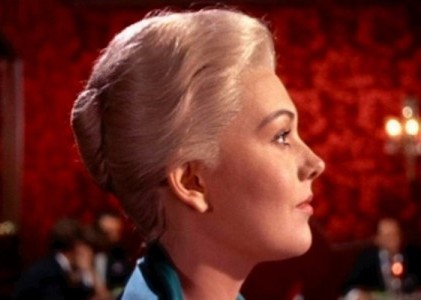
This first part of an hour long video essay spins an elaborate tale of a lifelong obsession with Hitchcock's masterpiece.

View all Motion Studies video selections.

Volker Pantenburg is assistant professor for moving images at the media faculty of the Bauhaus-Universität Weimar. 

Kevin B. Lee is Editor in Chief of IndieWire’s PressPlay Video Blog and contributor to Roger Ebert.com. Follow him on Twitter.

SIMON SAYS: Productive Awfulness, or: THE RAVEN Opens This Week

SIMON SAYS: Productive Awfulness, or: THE RAVEN Opens This Week

null

About every month or so, Steve Carlson and I co-host a movie-themed podcast called the Bad Idea Podcast. The podcast’s main conceit, in short: Steve and I are cinephile dumpster divers. We either watch a collection of bad movies or a selection of movies united by a stupid theme (example: movies featuring killer trees in time for the release of Terence Malick's Tree of Life). We do this, as Steve often says, because we're looking for "buried treasure," or, more importantly, a reason "to justify these films' existence."

Fun as this is, I still often wonder if there is such a thing as a productively awful film. We don't think of the films we watch as immediately satisfying but not especially hardy cine-junk food, any more than Solaris is a, uh, cultural vegetable (to be clear: I love Stalker, Solaris and Ivan's Childhood and am fascinated by The Mirror and The Sacrifice, too). So the issue of whether or not there is such a thing as a guilty pleasure film is only tangentially related to our goal for the podcast. Steve and I both acknowledge that we often highlight fundamentally rotten movies, and that, yes, there's something odd about going out of your way to look for the sublime in the awful. But just because a movie is strange does not always mean it's interesting, as we saw during the month when we watched a swath of E.T. ripoffs from around the world. (We watched a German period porno starring a girl in a very bad and very revealing E.T. costume. That was a rough watch.). The kind of film we’re looking for is something that can give us an experience like the one we had while watching Black Devil Doll from Hell, a title we watched for our month dedicated to killer puppets. Black Devil Doll from Hell is insane but it’s insane in a weird, sui generis, avant-garde-meets-blaxtaploitation kind of way. It’s weird in ways that made both Steve and I want to rewind and compare a scene where a woman, while showering, is psychically raped by a sentient puppet to Chris Marker's ground-breaking use of photo-montage in La Jetee. Black Devil Doll from Hell is our kind of movie.

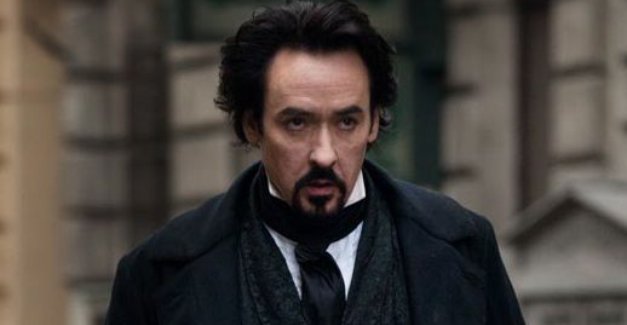
So, it's with little guilt that I express my interest in The Raven, a new thriller in which Edgar Allan Poe runs around trying to catch a serial killer whose murders are all based on gruesome scenes from Poe's stories. The Raven might very well be just a garden variety turd. The plot looks pretty formulaic, and John Cusack looks seriously miscast as Poe (sorry, but Say Anything’s Lloyd Dobler just doesn't have that kind of acting range). But: James McTeigue is directing, which leaves me simultaneously excited and confused.

McTeigue is most well-known as the director of the recent glossy but approachable and not altogether unintelligent adaptation of V for Vendetta. Though that would normally be enough to make me interested, that's not why I'm curious about The Raven. McTeigue also served as 2nd Assistant Director on a number of other Wachowski siblings' related projects: McTeigue worked with the Wachowskis on the Matrix movies, as well as on Speed Racer, as the second unit director. Directing under the influence of the Wachowskis, filmmakers who know how to shoot characters in motion, is not McTeigue’s problem. It's also not really why I'm interested. The single reason for my interest in The Raven is this: McTeigue's last film, the memorably tacky Ninja Assassin.

Ninja Assassin hails from a long tradition of awful movies about ninjas made by white guys. Enter the Ninja, Ninja Terminator, Revenge of the Ninja–all of these films were directed by white guys, and all of them happily exploited the near-mythic image of Nippon's own brutal, stealthy black pajama-clad killers in better Japanese movies (such as Samurai Spy or any of the Lone Wolf and Cub movies). Co-scripted by Matthew Sand and Babylon 5 creator J. Michael Straczynski, Ninja Assassin is pure ninjasploitation. Every narrative cliche is deployed, from the doomed love subplot that teaches Raizo (Korean pop star Rain), our stoic ninja hero, to the domineering but heartless father figure who meaninglessly and firmly urges Raizo to "always remember who you are." The film's action scenes suck because they rely heavily on fountains of computer-generated blood, murky shadows, and goofy action poses to achieve a fairly meager effect. Ninja Assassin's cookie cutter plot has no heart, and its ostentatiously elaborate set pieces have no style. Ninja Assassin is not a diamond in the rough—it's just rough. So why can't I look away?

Something about the expertly executed superficial rotten-ness of his last film gives me hope that with his new movie, McTeigue has taken his propensity for dimwitted melodrama and done something truly flabbergasting. I want to see John Cusack twirl his mustache, drink heavily, and then, who knows, hallucinate that he is a serial killer, or even end up chasing a man-sized blackbird in a trenchcoat. I want to see John Cusack give us a top ten list of pathological clues that point toward the real killer, with a literal bullet punctuating the end of his list. I want to see Edgar Allan Poe get drunk in order to solve crime, just as Jackie Chan’s character gets inebriated in order to fight in the Drunken Master movies. In other words: I want to believe that McTeigue will use the mandate that his big budget and cluelessness as a storyteller have naturally bestowed upon him to make the best damn bad, tasteless movie he can. He has financial power at his fingertips that many other incompetent and flamboyant filmmakers only dream of. I sincerely hope he uses it in a productively awful way.  Because when you watch a fantastically bad film, one that makes you feel like you’re hallucinating while watching it, you’re disarmed. You're reacting purely, without hesitation or rationale. Whatever it is you’re feeling when you watch a spectacularly bad movie, it’s from the gut, and it's icky, and it's strange, and it has to be reckoned with. I want The Raven to be that bad.

Simon Abrams is a New York-based freelance arts critic. His film reviews and features have been featured in the Village Voice, Time Out New York, Slant Magazine, The L Magazine, New York Press and Time Out Chicago. He currently writes TV criticism for The Onion AV Club and is a contributing writer at the Comics Journal. His writings on film are collected at the blog, Extended Cut.

VIDEO – Motion Studies #28: Redlettermedia’s STAR WARS: THE PHANTOM MENACE

VIDEO – Motion Studies #28: Redlettermedia’s STAR WARS: THE PHANTOM MENACE

From now through April, the Oberhausen International Short Film Festival will present "Film Studies in Motion", a Web Series curated by Volker Pantenburg and Kevin B. Lee. This series, available on the festival's website and Facebook page, presents weekly selections of analytical video essays on the web, in preparation for Pantenberg and Lee's presentation  "Whatever happened to Bildungsauftrag? – Teaching cinema on TV and the Web", scheduled for April 28 at the festival.

Week Six: Personal Obsessions

The widespread accessibility of online video creation and sharing allows us to explore and indulge our fascinations with films in unprecedented ways, as seen in these four examples: a close scrutinizing of a seemingly throwaway moment in Preminger’s “Anatomy of a Murder;” extended, heartfelt contempt for the Star Wars prequel; a fixation on Hitchcock’s “Vertigo” and the “spectacular improbabilty of its plot;” the sensation of sleeplessly watching Cronenberg’s “Dead Ringers” after days of “Occupy Wall Street.” Immersed in distinctly personal perspectives, these videos make explicit what is implicit in all the videos presented in this series: that subjective engagement is what brings flavor and fire to our analytical endeavors.

Today's selection:

Star Wars the Phantom Menace

Redlettermedia (2009)

A viral sensation, this fanboy parody uses a multi-layered arsenal of disarming rhetoric, satirizing film geek analysis as a way to make its underlying film geek analysis palatable to a wide audience.

View all Motion Studies video selections.

Volker Pantenburg is assistant professor for moving images at the media faculty of the Bauhaus-Universität Weimar. 

Kevin B. Lee is Editor in Chief of IndieWire’s PressPlay Video Blog and contributor to Roger Ebert.com. Follow him on Twitter.

VIDEO ESSAY: Edward Yang’s THE TERRORIZERS, presented by The Seventh Art

VIDEO ESSAY: Edward Yang’s THE TERRORIZERS, presented by The Seventh Art

Press Play is proud to co-present a new series of video essays produced by The Seventh Art, an independently produced video magazine on cinema. Their newest video essay is on The Terrorizers, directed by the late Edward Yang. The video argues that The Terrorizers is not just a postmodern film, but "the postmodern film." 

The video is written by Jimmy Weaver, edited by Christopher Heron and narrated by John Boylan. A transcript of the video essay can be found here.

It is one of several videos from Issue 3 of Seventh Art.

Close Cuts: The Adaptation Process in NO COUNTRY FOR OLD MEN

Close Cuts: The Adaptation Process in NO COUNTRY FOR OLD MEN

null

That No Country For Old Men (2007) constitutes one of Cormac McCarthy’s “lesser” works probably says more about McCarthy’s genius than it does about the book’s individual strengths or weaknesses.  Nearly five years after its release, it stands beside great modern adaptations like One Flew Over the Cuckoo’s Nest and Silence of the Lambs. But the understated greatness of the movie, stemming as it does from the book, must be attributed to the Coen brothers as well, who were able to capture the heart of the book even after shedding some of its most key sections.

Cuts or no cuts, the Coens showed intense loyalty to McCarthy’s work in many ways.  With the exception of about ten scenes, they retained every bit of the book in one form or another, with one broad exception: the larger story of Sheriff Ed Tom Bell (played by Tommy Lee Jones).  The way they altered Sheriff Bell’s dialogue and development is a sterling example of their skillful adaptation of the book, their tightening of McCarthy’s story for the screen.

McCarthy structures the book so that Bell provides its backbone and, in fact, its title. While the movie was marketed around the charismatic characters, the resourceful Llewellyn Moss (Josh Brolin) and the chilling Anton Chigurh (Javier Bardem), Sheriff Bell remains not just the main character, but the very moral compass of the narrative.  McCarthy shows Sheriff Bell’s disillusionment with the world around him through a series of thirteen internal monologues by Bell which open each chapter of the book.  In these monologues, Bell details his unease with life and the pervasive criminal brutality he sees, as well as his back story of painful service in World War II and the dead daughter who haunts him. Bell’s ruminations are long-winded, heavily descriptive, and often dryly monotonous and repetitious; it would probably be fair to say that they make up the weakest collective part of the book, though they remain crucial to McCarthy’s story. Leaving Bell’s monologues out of the movie was likely one of the Coens’ easier decisions.   

The Coens instead synthesized these segments, along with several of Bell’s other scenes, and any mention of his personal story, into three scenes which help the film retain the book’s core: Tommy Lee Jones’s outstanding scenes to open and close the film, and probably the movie’s most mysterious part, near the end, where Sheriff Bell “confronts” the killer Chigurh. 

The Coens solved the problem of how to implement these sections by whittling them down to their bare essence in the opening.  There, Sheriff Bell delivers a short monologue as he discusses his family’s law enforcement lineage, his distress with the crime by a boy he sent to the electric chair, and the larger growing violence of the age.  Constructed with parts of the book’s first, third and fourth chapters and delivered in Tommy Lee Jones’s gravelly, craggy voice as the film pans over the colorful, empty expanse of West Texas, the two minute opening is exquisite, to be watched over and over, and may be the film’s finest sequence.

We hear Sheriff Bell’s winsome, homey, nostalgia become an anxious description of the criminal violence he’s seen, melting into an open, dark despair of the coming storm – embodied seconds later when we see Chigurh viciously strangle a sheriff’s deputy and then shoot down a motorist like cattle.  The film’s ability to effect that difficult transition from McCarthy’s complex prose to the screen while fully retaining the book’s moral direction is a crucial reason for the film’s massive success.

One generally overlooked change the Coens made elsewhere, near the end of the film, further helped streamline the story.  The scene is also fairly mysterious and has vexed many audiences precisely because of how the Coens used it to unpack McCarthy’s text. More than just about any other scene from the book they retained, the Coens altered this scene significantly, and they did this for a central purpose.  They created a more dramatic sequence, yes, but used the scene and Sheriff Bell’s’s imagination to further distill the direction of the cut monologues and show Bell’s breakdown from stalwart veteran sheriff into a conflicted lawman.

The book and the film depict the same basic event in two very different ways, ultimately making the events themselves different. McCarthy’s telling of the scene provides guidance here. After Moss is killed, Sheriff Bell goes back to investigate Moss’s deserted motel room late at night. In the book, Bell approaches and enters the motel room as Chigurh watches him from his truck, driving off before the sheriff can find him. The Coens implemented another sequence.

In the film, Sheriff Bell sits in his cruiser, staring at the police tape and breathing uneasily, before getting out. The camera follows him on each heavy step to the turquoise door.  When Bell creeps up and sees the lock popped out—Chigurh’s calling card of entrance to a closed space via his ever-present cattle gun—he hesitates several times before holstering his gun.

A moment before he does enter, we see Chigurh with his frightening silenced shotgun held tight against his chest, the golden light of the disemboweled lock shaft shining just to his left, the clear intimation being that he is hiding in Moss’s room. A moment after this cutaway, Sheriff Bell pushes open the door, his dark shadow and lowered gun in silhouette against the ugly room. As the audience gasps for his safety, he moves around the room, then, finding no one, he settles on the bed and relaxes before seeing the cover of the vent on the floor, next to several screws and a discarded dime—a tell-tale sign that Chigurh took the case of money out of Moss’s standard hiding place after the police left the crime scene.

This scene begs, where was Chigurh and why didn’t he kill Bell? The answer holds significant implications for the Coens’ adaption.  Based on how we see Chigurh, he appears to be standing, and with light clearly on him, but when Bell enters, Chigurh is neither by the window nor possibly in the open, narrow vent. That leaves one possible hiding space: the door. Here the Coens tease the audience.  When Bell pushes open the door, we can’t see completely behind it, making it just possible that something—or someone—could be there. 

Chigurh may be there behind the door, waiting with his beer can-sized silencer, as the Coens’ clever hint never provides confirmation, but really they don’t have to. From a purely technical standpoint, it’s unlikely that the large killer, holding both his shotgun and the bulky briefcase full of two million dollars could ever fit. Some watchers have stretched to postulate that Chigurh is in the adjacent room.  These views miss the point, based on what the Coens are trying to do with this scene, behind their sleight of hand. 

In the book, Bell approaches and enters the room as Chigurh watches him from his truck, driving off before the sheriff can find him.  While we are led to believe that Chigurh is there, he is also used here as a product of Bell’s imagination, a creature growing out of his fears and revealing of his broader dread, established by the intro and negatively developed. Throughout the course of the movie, Bell has seen Chigurh’s heinous violence as he has murdered people in the coldest blood imaginable. Bell even refers to Chigurh as a ghost right before he goes back to the motel. But while Bell says "it's not that I'm afraid of" the crimes he sees in the opening, he clearly is afraid by the end. This change, developed by McCarthy through his thirteen monologues, is reduced by the Coens to their opening and this scene, where we see Bell relieved that Chigurh isn’t in the room, simultaneously realizing he can no longer serve. The scene leads into Sheriff Bell’s visit to his disabled Uncle Ellis (Barry Corbin), where we learn Bell’s plans to retire.

The final scene, in which Bell reveals two disturbing dreams about his father—and his failure to live up to his legacy—and expresses fear about what is to come, is developed from McCarthy’s thirteenth and final monologue and is as poignant as the first scene is captivating. Interestingly, in an early version of the screenplay, the Coens intended the end of this scene to be given as a voiceover delivered around images of a snowy mountain pass, in much the same way as the beginning was done. Thankfully, they changed their minds, ultimately keeping the camera directly on Bell.  For it is better to see the despair on his haggard face than just to hear it. As he speaks, he is clearly affected and upset by his dreams, and at no point in the film has he looked weaker or more vulnerable than when he finishes and looks to his speechless wife for validation.

Adapting any book, particularly a rich, nuanced one, to screen is an immensely difficult balancing act; the director and screenwriter must create a watchable two-hour product but also can’t cut too much, so as not to risk sacrificing the book’s moral spirit. The Coens perform that balancing act brilliantly, for at that final frame, Tommy Lee Jones captures the soul of McCarthy’s foreboding book and wraps up the Coens’ perfect adaptation.

Mark Greenbaum's work has appeared in The New York Times, Salon, The LA Times, The New Republic, and other publications.

VIDEO – Motion Studies #27: Pass the Salt

VIDEO – Motion Studies #27: Pass the Salt

From now through April, the Oberhausen International Short Film Festival will present "Film Studies in Motion", a Web Series curated by Volker Pantenburg and Kevin B. Lee. This series, available on the festival's website and Facebook page, presents weekly selections of analytical video essays on the web, in preparation for Pantenberg and Lee's presentation  "Whatever happened to Bildungsauftrag? – Teaching cinema on TV and the Web", scheduled for April 28 at the festival.

Week Six: Personal Obsessions

The widespread accessibility of online video creation and sharing allows us to explore and indulge our fascinations with films in unprecedented ways, as seen in these four examples: a close scrutinizing of a seemingly throwaway moment in Preminger’s “Anatomy of a Murder;” extended, heartfelt contempt for the Star Wars prequel; a fixation on Hitchcock’s “Vertigo” and the “spectacular improbabilty of its plot;” the sensation of sleeplessly watching Cronenberg’s “Dead Ringers” after days of “Occupy Wall Street.” Immersed in distinctly personal perspectives, these videos make explicit what is implicit in all the videos presented in this series: that subjective engagement is what brings flavor and fire to our analytical endeavors.

Today's selection:

Pass The Salt


Christian Keathley (2006)

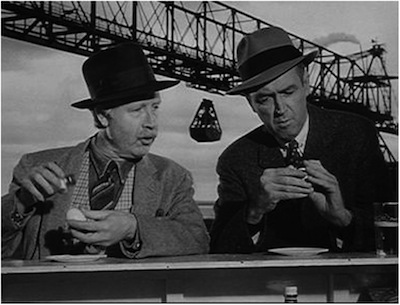
A seemingly harmless scene in Otto Preminger's Anatomy of a Murder becomes an object of fascination until it reveals a startling significance.

View all Motion Studies video selections.

Volker Pantenburg is assistant professor for moving images at the media faculty of the Bauhaus-Universität Weimar. 

Kevin B. Lee is Editor in Chief of IndieWire’s PressPlay Video Blog and contributor to Roger Ebert.com. Follow him on Twitter.

Nicolas Cage is big; it’s the pictures that got small

Nicolas Cage is big; it’s the pictures that got small

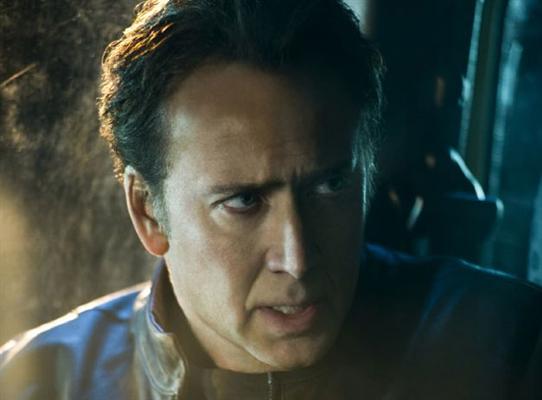
nullThe pictures may have gotten small, but Nicolas Cage is still BIG. More often than not, he acts in CAPS LOCK mode. He HOLLERS and SCREECHES and FLINCHES VIOLENTLY and SHUDDERS LIKE HE'S BEING LOWERED INTO ICY WATER and STARES IN TREMBLING AWE like a guy who just glimpsed a portal into another dimension and is trying to figure out WHAT THE FUCK THOSE CREATURES WITH THE TENTACLES ARE!!!

It took me a while—decades, actually—to accept a couple of facts about Nicolas Cage. One: when he's being subtle, as in National Treasure, It Could Happen To You, Windtalkers and a few other movies, he's good, sometimes affecting, but he tends to lose his special quality; and (2) there's something to be said for a performer whose screen presence is so ridiculously big, and often so knowingly anti-realistic, that it obliterates commonly accepted distinctions between good and bad, believable and unbelievable, and instead becomes an uncanny event, something you evaluate less than you witness. The CAPS LOCK nature of Cage's acting makes him a natural subject for video mash-ups—so much so that my friend Jason Mittell proposed the essay topic "Nicolas Cage as an Axiom of Remix Cinema." Everything Cage does is so vigorously sculpted, underlined, boldfaced and bracketed that you can lift moments from different movies out of context, string them together, and create firecracker-strings of weirdness. And a helluva lot of videos have done just that.

The best, for my money, is Harry Hanrahan's masterpiece "Nicolas Cage Loses His Shit," a symphony of shit-losing backed by a track from Clint Mansell's Requiem for a Dream score. The music track makes it — ties it together like The Dude's rug did his room — because Requiem for a Dream is about junkies being slowly dragged down into a whirlpool of masochistic yet unnervingly romantic agony. It's music fit for a star who can't help doing what he does: a man possessed.

The most troubling Cage mash-ups are the clip reels from Neil LaBute's remake of The Wicker Man. The first one (dated 2007) went viral in a huge way, soon to be held up as proof that the film was poop, its star the worst actor who ever lived. While the out-of-context clips of Cage freaking out are funny enough, they're also unfair to Cage because they shame him for doing something he was specifically hired to do—and does better, or at least more colorfully, than anyone else. I don't think the remake works, exactly, but when you're watching it, there's no doubt that its overheated ludicrousness is intentional: not kitsch, but about style. ("How'd it get burned how'd it get burned HOW'D IT GET BURNED??!!???") Who better than Cage to play a truth-seeker, cycling desperately through fairy tale woods, terrorizing little masked girls and disguising himself in a bear costume? Cage makes as much aesthetic sense in this movie as Gary Cooper did in High Noon. And yet YouTube burned The Wicker Man onto Cage's new calling card and cemented the public notion that he was a rotten actor.

The musical remixes of The Wicker Man were no less problematic, but at least they had a good beat and you could dance to them.

By 2011, the notion of Cage as Crazypants Mega-Ham was so pervasive that Conan O'Brien proposed Nicolas Cage film clips as a replacement for the US government's recently-discontinued "Threat Level" warning system.

Which brings us to Adam Lucas's mash-up "Cage Does Cage." Ostensibly a tribute to avant garde compose John Cage's "4'33" ", wherein musicians do nothing but sit for four minutes and thirty-three seconds, the piece collects snippets of Cage reacting, brooding, etc., without dialogue. Occasionally the actor exhales, sips a drink, or hems and haws while trying to figure out what to say, but for the most part the piece is a hell of a lot quieter than the Cage-mashup norm.

I wouldn't say the video works as a John Cage tribute, because, as Peter Guttmann points, out, the composer's piece "breaks traditional boundaries by shifting attention from the stage to the audience and even beyond the concert hall. You soon become aware of a huge amount of sound, ranging from the mundane to the profound, from the expected to the surprising, from the intimate to the cosmic – shifting in seats, riffling programs to see what in the world is going on, breathing, the air conditioning, a creaking door, passing traffic, an airplane, ringing in your ears, a recaptured memory. This is a deeply personal music, which each witness creates to his/her own reactions to life." Nothing like that happens while you're watching "Cage Does Cage." Let's face it, this video exists because the composer and the actor happen to share a last name. Rather than turn viewers' reactions into the subject of the piece, as "4'33"" does, "Cage Does Cage" keeps the focus on Cage the actor, whose subtlest moments as a listener/reactor/paralyzed spectator are still charged with intimations of future shit-losing. (Indeed, at one point Lucas uses a clip from Vampire's Kiss that was also used in the previously-linked "Nicolas Cage Loses His Shit," but cuts before Cage's pained, fearful expulsion of breath.)

Nevertheless, the video is intriguing, because it's so different from every other Cage mash-up. Its emphasis on reaction and silence casts further doubt on the notion that Cage is a bad actor, as opposed to a performer whose preferred aesthetic doesn't jibe with fashionable definitions of what's good. Even when Cage is being subtle, as he is in many of the clips collected by Lucas, there's an exaggerated (or perhaps "dancer-like") grandness to the way he listens, gathers his nerve, lies down on a floor, or stares out of a train compartment window. It's that silent-film thing again: small viewing window, big actor. But that's not a knock. There's an internal logic to what Cage does and how he does it. You can see this more clearly by observing the quiet Cage than the manic one.

Perhaps the most sensible response to Cage isn't, "What a freak" or "What a bad actor" but "Your mileage may vary." If all acting is small, acting itself becomes small, too; then cinema itself starts to shrink from stylistic risk, for fear of being thought too big, too wild, too "unreal." As Willem Dafoe recently told Press Play columnist Simon Abrams, "I think in many ways, naturalism has ruined movies … I often like understated performances where the actor disappears. I like that a lot. But this imitation-of-life stuff doesn’t always tap into what’s beautiful about the language and the poetry of film."

A critic, journalist and filmmaker, Matt Zoller Seitz is the publisher of Press Play and the TV critic for New York Magazine. His book-length conversation with Wes Anderson about his films, titled The Wes Anderson Collection, will be published in fall, 2012 by Abrams Books.