CANNES 2012: ONCE UPON A TIME IN AMERICA (RESTORED)

CANNES 2012: ONCE UPON A TIME IN AMERICA (RESTORED)

null

If nothing else, the new 4K restoration of the late Once Upon a Time in America proves the necessity of film preservation. This essential new cut of Sergio Leone’s last film was re-assembled from newly rediscovered footage long thought lost. At last night’s packed screening, actor James Woods insisted that Leone “died of a broken heart” because he could never release the cut of the film he really wanted to. So the mandate to restore the film was clear, once the footage was recovered and cleaned up by a number of people, including Gucci, the Leone estate, and the Film Foundation. And while though Leone couldn’t supervise the restoration of his last masterpiece, the new footage that debuted yesterday is every bit as essential as one could hope.

Rest assured, the new scenes, including a new final confrontation between Max (Woods) and the head of the union, are definitely not extraneous. Some new scenes serve as crucial juxtapositions against relatively canonical ones, like a previously missing sequence after Noodles (Robert De Niro, also in attendance last night) drives his gang’s car off of a short pier and (more on this in a moment).  Others remind us of characters’ limited agency and inability to totally remake/self-fashion themselves, as when Noodles talks to a chauffeur who disapproves of the fact that he’s both Jewish and a gangster (“Everyone knows what you are.”). When viewed holistically, the new cut is revelatory. Its restoration has only served to make this masterpiece that much more fulfilling.

I've singled out the new brief scene after Noodles drives the car into the water because, while it seems fairly negligible, it's surprisingly rich when placed alongside other scenes. In this new sequence, all the gang members resurface except Noodles. This understandably makes Max nervous. He panics and thrashes around trying to find his friend but is overshadowed by a nearby crane that’s busily and indiscriminately picking up garbage from the bottom of the sea floor.

This short sequence creates a parallel with Max's garbage compactor suicide as well as mirroring an earlier scene where the group, as adolescents, scheme to recover submerged contraband with sacks of salt. So in an instant's time, this newly restored scene further establishes Noodles' fatalistic identification with Maxie as his twin. The post-crash footage also sets up a troubling intermediary image to connect the relatively innocent past with a forbidding future. And this is probably the least impressive of the recovered scenes!

Sequences like the one where Deborah (Elizabeth McGovern, who was also at last night’s screening) performs Cleopatra's death scene in Shakespeare’s Antony and Cleopatra or Noodles talks to the caretaker of the gangsters' tomb confirm Leone’s status as a master choreographer. The film’s vision of life is all the more complex for these bridging scenes, because they call attention to Noodles’s inability to reconcile his past with his oppressive present. It’s as if key missing pieces of a never-completed jigsaw puzzle have finally been put into place. Every piece is important, even the smaller ones.

Simon Abrams is a New York-based freelance arts critic. His film reviews and features have been featured in The Village Voice, Time Out New York, Slant Magazine, The L Magazine, The New York Press and Time Out Chicago. He currently writes TV criticism for The Onion AV Club and is a contributing writer at the Comics Journal. His writings on film are collected at the blog, Extended Cut.

CANNES 2012: Matteo Garrone’s REALITY

CANNES 2012: Matteo Garrone’s REALITY

null

The classic fairy tale is an artificial creation in Matteo Garrone’s Reality, something wedding planners and television producers manipulate to create the best possible pomp and circumstance product for their Pavlovian audiences. It’s especially dangerous when gullible, wish-fulfilling viewers buy into their own faux happily-ever-after, truly believing they have a God-given right to popularity. Andy Warhol famously stated as much years before the dawn of our current technological age, but Garrone (director of 2008's much-lauded Gomorrah) manages to visualize the tragic consequences of one man’s delusionary digital dreams with an endlessly nimble cinematic approach. Movement and sound become the necessary tools artists and businesspeople use to warp personal perspective.

Wonderfully staged crane shots rise, fall, and then ascend again in this agile film, maximizing the importance of angle, height, and duration in relation to the fragile point-of-view of lead character, Luciano (Aniello Arena). The broken heart and oblivious soul of Reality, Luciano is a cocky family man who owns and operates a failing fish shop. Conducting shady deals on the side to keep his causal family lifestyle afloat, Luciano rarely shows a hint of stress, even dabbling in cross-dressing as a kind of public performance piece. The character’s reassuring demeanor in the face of economic distress and potentially life-altering situations proves him to be a natural ham, constantly wishing to be the center of attention. After Luciano’s family begs him to audition for Italian Big Brother, he barely bats an eye before diving head first at the chance to gain national notoriety and wealth.

Reality’s stunning opening helicopter shot, which tracks over Naples’s skyline before centering on a classic Victorian horse-drawn carriage speeding down the street, nicely juxtaposes fantasy and reality in the same landscape. This motif continues as Luciano goes through the Big Brother auditioning process, adopting the go-getter attitude most ambitious amateur performers need in order to succeed. Alexandre Desplat’s swooning score further suggests Luciano is creating his own fairy-tale façade out of the bits and pieces of an unlikely future scenario.  Family and friends give Luciano false hope at the most inopportune times, while cagey executives mislead him during a lengthy interview simply to mine personal information for future use. His is a truly modern tableau, marked by hollow surfaces posing as bags of money.

Luciano’s brazen dedication to living vicariously through pop culture symbols, lingo, and products eventually drives him toward madness, and in turn the ultimate realization of his own momentary fantasyland. Surveillance cameras and split screens define his dreams, while all sense of his former self evaporates without much resistance.. The cost of living this existence trickles down to affect Luciano’s children and his wife, who leaves Luciano after he becomes increasingly paranoid, thinking mysterious figures are silently “judging” him from afar.  

This small temporal gap in a crumbling marriage crystallizes the importance of togetherness in Reality. Garrone feels deeply for Luciano’s taxing plight, but never lets him escape the mire of his actions. His self-imposed encasement inside the container of “reality television” is a reflection of personal retreat, not an assessment of society’s many contradictions and failures. In Reality, giving up on ourselves (and each other) is the real tragedy, the true epidemic of character, devoid of a happy ending, real or imagined.

Glenn Heath Jr. is a film critic for Slant Magazine, Not Coming to a Theater Near You, The L Magazine, and The House Next Door. Glenn is also a full-time Lecturer of Film Studies at Platt College and National University in San Diego, CA.

CANNES 2012: Michel Gondry’s THE WE AND THE I

CANNES 2012: Michel Gondry’s THE WE AND THE I

null

Michel Gondry brazenly announces the difference between The We and the I and most other contemporary coming of age movies and/or teen sex comedies with a strategically planted poster for an imaginary film called Megalomania (which happens to be a project Gondry is developing with his son Paul). Contemporary filmmakers like Todd Phillips (Project X) and Josh Trank (Chronicle) ostensibly examine their young protagonists' narcissism, but in The We and the I, Gondry is more ostentatious than they are, and also more genuinely concerned with indulging and then deflating his teens' egos. 

 
Gondry's film follows a group of high schoolers on the last day of school. The long ride home on the fictional Bx66 bus gives the film's protagonists' ample time to goof off, hurt each others' feelings, and realize that they're all on the verge of drifting apart from each other and becoming new people. So The We and the I starts with a lot of crude jokes/dises about fat girls, gawky guys, and tiny penises, and it ends with John-Hughes-by-way-of-Spike Lee-style declamatory speeches. Gondry and his two co-writers don't quite tack on The We and the I's ending; they prove, rather than just claim, that they're down with this unruly Breakfast Club 2.0. 

 
The We and the I's plot largely concerns the roundabout way various disparate high school cliques interact with each other. For example, Michael and Theresa (Michael Brodie and Theresa L. Rivera, two stand-out amateur performers), a pair of estranged ex-lovers, serve as the film's emotional anchors. But Michael's group of bullies also teases the hot girl and her dorky best friend, who in turn razz the arty nerd, whose nose is buried in his sketchpad, who also was picked on earlier by Michael and his friends. The film's plot is an amorphous series of testosterone and estrogen-fueled encounters spurred on by maniacally catty urges that are, thankfully, not all redeemed at the film's eleventh hour.

Gondry makes a point of showing that some truths about the unwitting cruelty resulting from being young and horny are universal. While YouTube and texting has changed the way The We and the I's teens tease each other, these kids also still play Truth-or-Dare and agonize over who to invite to their Sweet Sixteen parties. When Gondry and co. launch their characters into "The Chaos," the film's second of three narrative chapters, which is best characterized as a haze of undiluted teen Drama, Gondry's kids are irredeemably mean to each other—sometimes to great comic affect, as when a curvy girl is called "two pounds of bologna in a one pound bag." 
 
But these characters' more bratty, sadistic actions also often have immediate consequences. The broad beats of The We and the I's narrative may be arranged on a series of criss-crossing schematic laundry lines, but the film is at its best when characters' actions create a chain reaction. Once Gondry's characters bluntly tell us what the stakes of the film's drama are, the movie loses potency. But at the height of its frenzy, Gondry's latest movie buzzes with hormones and posturing and All That Angst.
 

Simon Abrams is a New York-based freelance arts critic. His film reviews and features have been featured in The Village Voice, Time Out New York, Slant Magazine, The L Magazine, The New York Press and Time Out Chicago. He currently writes TV criticism for The Onion AV Club and is a contributing writer at the Comics Journal. His writings on film are collected at the blog, Extended Cut.

CANNES 2012: Apichatpong Weerasethakul’s MEKONG HOTEL

CANNES 2012

null

Mekong Hotel is another quiet but deeply impressive drama set in Weerasethakul-Land, an increasingly strange landscape created by celebrated Thai avant garde filmmaker Apichatpong Weerasethakul (Tropical Malady, Worldly Desires). For those who don't know Weerasethakul’s considerable body of work, Weerasethakul-Land is typically over-run with serene echoes of a troubled, carnal past that may or may not ever have existed.

Clocking in at 61 minutes, Mekong Hotel is Weerasethakul’s triumphal return to Cannes, just two years after his 2010 feature Uncle Boonmee Who Can Recall His Past Lives won the Palme D’Or. As with Moonrise Kingdom and Wes Anderson, Mekong Hotel is nothing new from Weerasethakul. In his Thailand, hungry ghosts, reincarnated animals and frank but casual discussions of sex and violence just . . . happen, unobtrusively.

And that’s perfectly all right. Even when charting deceptively familiar territory, Weerasethakul keeps finding startling new dark corners of his characters’ collective unconsciousness to explore. Weerasethakul’s characters all dream of an eeriely mundane existence where the supernatural and the super-sexual collide. Weerasethakul-land itself is, after all, also a dream world, an imaginary place which is intensely familiar but also paradoxically soothing and jarring at once, making it all the more alien.

Like many of Weerasethakul’s other films, Mekong Hotel doesn’t have a linear narrative. Phon and Masato, two young lovers, meet and bond after Masato’s dog is devoured by a entrails-gobbling Pob ghost. That ghost happens to be Phon’s mother, who lives with her in a hotel room near the Mekong River. Over time, a series of elliptically represented events show us that the barrier separating the living from the dead doesn't exist (or at least, it's not located near the Mekong River).

The film’s acoustic guitar-centric score particularly accentuates Mekong Hotel’s otherworldly tranquility. Weerasethakul’s films aren’t really nightmares, though strange and gross things sometimes happen in them. Theoretically, watching a dowdy-looking woman munch on a pile of large intestines while another character prays in a separate corner of the room would be traumatic. But thanks to the film’s score, the scene is neither frightening nor gruesomemore a product of the pure dream logic governing Weerasethakul-Land.

Weerasethakul doesn’t judge Mekong Hotel’s characters, as events in his films always have a matter-of-fact mood to them. Things happen for reasons we don't understand, simply because this is the pace of life in his films. Thailand is Weerasethakul’s foremost concern, being the locus for Mekong Hotel’s impressionistic portrait of longing, both fulfilled and unrequited, and its most refreshingly beguiling protagonist.

Mekong Hotel is simultaneously breezy and dense, giving it an incantatory strength. Annotations certainly wouldn’t hurt any interpretation of the film’s series of anecdotal vignettes, like discussions of a Laotian refugee camp or another character’s third boyfriend (“It hurt my ass rather pleasurably.”). But they’re also not really necessary either. This is Weerasethakul-Land: happily, time and narrative logic as we know them don’t apply here.

Simon Abrams is a New York-based freelance arts critic. His film reviews and features have been featured in The Village Voice, Time Out New York, Slant Magazine, The L Magazine, The New York Press and Time Out Chicago. He currently writes TV criticism for The Onion AV Club and is a contributing writer at the Comics Journal. His writings on film are collected at the blog, Extended Cut.

CANNES 2012: Jacques Audiard’s RUST AND BONE

CANNES 2012: Jacques Audiard’s RUST AND BONE

null

Jacques Audiard only knows how to pummel us. The French director of The Beat That My Heart Skipped and A Prophet wouldn’t know a subtle musical cue or composition if it were staring him in the face.  Though such rigorous formalism isn’t necessarily a bad thing, Audiard’s overtly heightened style is problematic because it reflects a lack of interest in mining deeper territory and a thoughtless flair for obvious symbolism. This is a cinema of blunt force trauma, of momentary awe, and all the stylized violence and lens flares merely reinforce a lack of heft in the gracefully repulsive scenarios Audiard creates.

Rust and Bone, Audiard’s latest study in physical weathering and emotional repression, only further confirms his ongoing obsession with surfaces: skin, sunlight, ice, blood, and cement are all key motifs in the story of a perpetually violent ex-fighter who develops an unexpected relationship with a former Orca trainer recently crippled by a devastating accident. Both characters are deformed, one externally and the other internally, but they share an unspoken bond created by mutual rage and momentary quiet. In many instances their two experiences overlap, most strangely when the brutish Ali (Matthias Schoenaerts) is resurrected during a brutal street brawl after watching the legless Stéphanie (Marion Cotillard) use her newly acquired prosthetic limbs to walk toward him. In typical Audiard fashion, the inane reversal of fortune is heightened to the point of melodrama in super slow motion.

Strangely, the central relationship between Ali and Stéphanie, often the most interesting thing about Rust and Bone, is often left in limbo as Audiard cuts away to a number of convoluted subplots involving minor fringe characters. Lingering behind are many fascinating moments, as these two tortured characters attempt to communicate through instinct despite a lot of emotional static. There’s a stunning sun-drenched sequence where Ali carries the legless Stéphanie into the ocean, letting her swim freely as he watches from the beach. Wading in the shallow waters, Stéphanie takes off her shirt and swims into the current, regaining a sense of empowerment. Her transition in this scene feels organic, as opposed to being a product of jarring aesthetics.

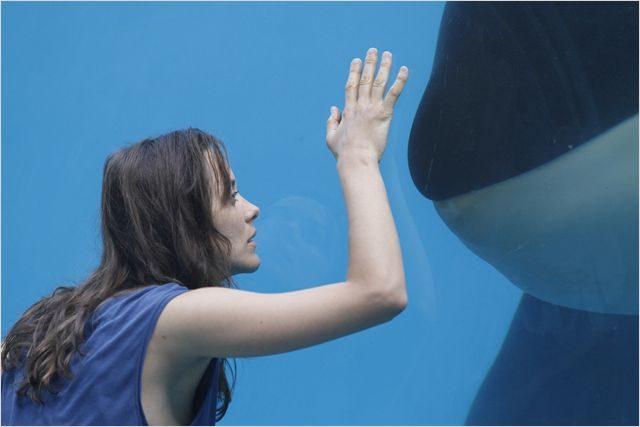
For both characters, freedom is often found when engaging with nature. Rust and Bone’s defining image is of Stéphanie standing in front of a giant glass tank, her small body nearly overwhelmed by the giant Orca engulfing the frame. Her tender interactions with the whale hint at the character study Rust and Bone could have been. If sunlight and water allows Stéphanie the opportunity to realize her own self-worth, piercing ice enacts a similar wake-up call for Ali. But the film’s shameless denouement, a snowy set-piece far from the film’s primary setting in the south of France, bungles the chance for his character to attain the same level of resonance. Unlike Stéphanie, Ali’s coming-of-age moment is screenwriting 101, and steeped in sentimentality.

“We continue but not like animals.” There’s admirable resolve in Stéphanie’s telling words to Ali after their first sexual dalliance, but whether or not he understands (or cares) is ultimately a moot point. Throughout Rust and Bone, there’s never any doubt that Audiard will propel his protagonist to the finish line, a little more broken and but all the wiser, cliché be damned.

Glenn Heath Jr. is a film critic for Slant Magazine, Not Coming to a Theater Near You, The L Magazine, and The House Next Door. Glenn is also a full-time Lecturer of Film Studies at Platt College and National University in San Diego, CA.

CANNES 2012: Yousry Nasrallah’s AFTER THE BATTLE

CANNES 2012: Yousry Nasrallah’s AFTER THE BATTLE

null

Governments are inherently evil. Commoners are redeemable imbeciles. Academics are clueless do-gooders. These cookie-cutter generalizations about character motivation and social institutions define Yousry Nasrallah’s After the Battle, an abrasively loud melodrama set in post-Mubarak Egypt that equates dramatic importance with collective self-pitying. It takes a special kind of dud to make the immediacy of the Arab Spring seem trite and spineless, especially since the ripples from that massive uprising still reverberate throughout the Middle East. But that’s exactly what After the Battle achieves. It expresses nearly every theme, emotion, and motif through an onslaught of extreme verbal posturing.  Considering the consistency with which arguments crystallize out of nowhere in After the Battle, one wonders if Nasrallah thinks the louder his characters get, the more relevance their words will have. Talk about beating a dead horse.

Speaking of horses, the film opens with viral video footage taken during “The Battle of the Camel” in Tahrir Square from March of 2011, in which riders on horses and camels crashed through the crowds of protesters, smacking them with whips. One of the assailants is ripped from his saddle, only to be beaten repeatedly by a gathering of bystanders. This raw prologue successfuly establishes After the Battle as a movie of the moment. But that vitality sours when Nasrallah centers the narrative on the downed horseman, a gullible tourist guide from Nazlat named Mahmoud (Bassem Samra), who has become an outcast for opposing the revolution.  When an NGO doctor named Rim (Meena Chalaby) takes an interest in Mahmoud’s conflicted back-story, After the Battle uses their lifeless tryst to explore relevant issues of class and gender still affecting the Egyptian social landscape.

The connection between interpersonal relationships and national trauma fails to gain any traction in After the Battle, mostly because Nasrallah only scratches the surface of his country’s ongoing identity crisis. He simply mixes volatile Youtube footage with fictional dramatic scenarios through amateurish cross-cutting, creating a toothless docudrama whuch is at its most artificial when it tries to be edgy, pointed, and immediate. Juxtaposition like this only reinforces the typical stereotypes perpetrated by Hollywood for years. The region may be different, but all the tropes are the same.

If the high volume of After the Battle’s emotional theatrics doesn’t kill you, its incessant self-pity certainly will.  One particularly heinous example comes during a knock-down drag-out fight between Mahmoud and his wife, who yell aimlessly back and forth with their children sitting uncomfortably in the other room. Mahmoud's weepy emotional breakdown at the end of the argument is altogether unconvincing and unearned. After the Battle becomes one big self-serving metaphor during its painfully blunt final moments, when a bloodied Mahmoud envisions himself climbing a pyramid. The wide shot slowly tilts upward, away from his small figure, lingering on the massive distance he still must cover to reach the pyramid's top. The multi-dimensional dynamics of political and social transition in Egypt deserve something better than this kind of one-note symbolism, but Nasrallah, at least in this film, seems incapable of delivering anything else.

Glenn Heath Jr. is a film critic for Slant Magazine, Not Coming to a Theater Near You, The L Magazine, and The House Next Door. Glenn is also a full-time Lecturer of Film Studies at Platt College and National University in San Diego, CA.

CANNES 2012: Wes Anderson’s MOONRISE KINGDOM

CANNES 2012: Wes Anderson’s MOONRISE KINGDOM

nullMoonrise Kingdom is a great success, both within the context of Wes Anderson's body of work and as a work unto itself. Initially, however, its Wes- Anderson-y-ness is almost off-putting. At the start of this very mature children’s romance about two pre-teens, the camera tracks through almost every room of a house; the separate but equal nature of each of the house’s various inhabitants is matched with a song from a child’s record, explaining how an orchestra's sections come together to perform a piece by British composer Benjamin Britten.

The aforementioned sequence is a table setting scene, establishing the film’s main conceit. Similarly, in successive scenes, Anderson’s mise en scene characteristically consists of various objects which stick out like sore thumbs, such as different types of fishing tackle hanging on a wall, or old mailboxes arranged on a shelf behind a telephone switchboard). These objects draw attention to themselves, but, in Anderson’s eyes, they function as parts of a whole. Thankfully, Anderson and co-writer Roman Coppola (CQ) demonstrate how difference creates mass unity as the film goes along. No matter how discontent Anderson's latest film’s protagonists might feel, they are always in concert with the people who care for them.

Moonrise Kingdom is about the cascading repercussions of young love in the small community of New Penzance Island. Sam (Jared Gilman), a talented but “emotionally disturbed” member of the island's Khaki Scout troop, loves Suzy (Kara Hayward), a self-possessed but “troubled” singer, the only girl in her family’s brood of five children. Suzy’s emotionally estranged parents, Laura and Walt (Frances McDormand and Bill Murray) and Scoutmaster Ward (Ed Norton) are beside themselves when they learn that their respective charges have fled. But the search for Sam and Suzy eventually involves almost everyone on New Penzance, including a local Island policeman (Bruce Willis) and a mysterious narrator (Bob Balaban). Every character is an equally important member of Anderson’s wild bunch, even if not all of them are created equally (as in the case of one poor eye-patch-wearing Khaki scout).

That being said, Anderson and Coppola do fully explore the group dynamic aspect of Suzy and Sam’s relationship. Scenes like the one where Laura and Walt talk obliquely about their marriage woes nicely illustrate how it’s possible for Sam and Suzy to be alone together and also with their various friends and surrogate family members.

Anderson typically champions his protagonists’ eccentricities as the means by which they define themselves. But his characters are also often unified by the understanding that excluding each other is pointless, as everybody brings something to the group’s collective table. Even the crueler Khaki scouts learn this lesson in a hilarious scene built around a polemic from a pint-sized (former) bully.

The use of song cues, especially those from Britten’s Noye’s Fludde and Camille Saint-Saens’s Carnival of the Animals, subtlely establishes that characters defined by their difference and unhappiness are always an integral part of the film’s whole. In fact, the characters' quirks and unhappiness only further embellish Anderson’s comedy of power dynamics. 

Simon Abrams is a New York-based freelance arts critic. His film reviews and features have been featured in The Village Voice, Time Out New York, Slant Magazine, The L Magazine, The New York Press and Time Out Chicago. He currently writes TV criticism for The Onion AV Club and is a contributing writer at the Comics Journal. His writings on film are collected at the blog, Extended Cut.

VIDEO ESSAY: DIAL K FOR KUROSAWA

VIDEO ESSAY: Dial K for Kurosawa

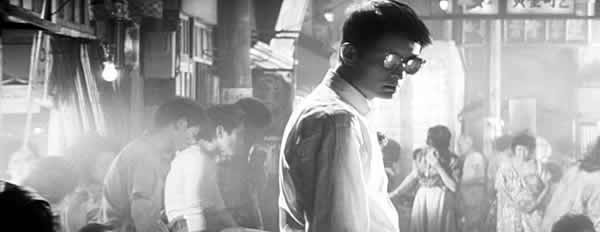
The perfect crime, the wrong man, the speeding train, and the surprising MacGuffin. High and Low has all the best elements of a great Alfred Hitchcock film. But it isn’t Hitchcock—it’s Akira Kurosawa, the Japanese director better known for his samurai flicks and complex moral tales.

When Kurosawa adapted works of Western fiction, he often chose from the greats: Shakespeare, Dostoevsky, Gorky. But High and Low (1963) is not adapted from a literary giant or even a Japanese author, but a minor 1950s American pulp novel entitled King’s Ransom by Ed McBain. King’s Ransom was part of a series of novels following the stories of the 87th police precinct, and while it has its literary qualities, the novel’s style bears no resemblance to the serious tone and moral complexity of Kurosawa’s film.

However, one director in Western cinema made his entire career through the meshing of high and low art: Hitchcock. The master’s reputation stemmed from spinning popular murder and suspense stories while engaging critics and scholars with morbid and psychological themes. High and Low feels as much indebted to Hitchcock as Kurosawa’s samurai films show the influence of John Ford’s westerns. Like Hitchcock, Kurosawa explores the roles of duality, ubiquitous guilt, and the incapacity to understand evil in a frightening and ultimately despairing fashion. High and Low ultimately paints a disturbing portrait of humanity, where evil simply exists within each person without explanation, creating a world similar to the sadistic one Hitchcock often presented.

The film seems ripe for comparison to Hitchcock from the opening shot, as the camera never leaves the home of Gondo. Like Rope, Lifeboat, Dial M for Murder, and especially Rear Window, Kurosawa limits himself by never staging a sequence outside of Gondo’s mansion—even the credits are framed from the large window looking down. Other classic Hitchcock tropes play large roles in the film: a train—essential in the narratives of North by Northwest and Shadow of a Doubt—literally bridges the two sections of the film. And we can see intense shadows, symbolic staircases, voyeurism, and grotesque death, other Hitchcock trademarks.

But High and Low’s most noted motif is the use of doubles and opposites as a sign of similarities between good and evil. Strangers on a Train, Shadow of a Doubt, Frenzy, and countless other Hithcock works explored this topic, and Kurosawa forges the same relationship between Gondo and Takeuchi. Kurosawa foreshadows the duality with the use of the two children, who are so identical that Gondo’s wife confuses them when they switch clothes while playing cops and robbers. The children’s outer appearance might suggest their societal roles, but under the surface, both Gondo and Takeuchi are both conniving and malicious—Gondo simply confines his immoral practices to business.

Kurosawa builds this philosophy into the film’s structure. Like Hitchcock’s Psycho, the narrative breaks into two parts with a protagonists in the center of each part. The film’s first half centers around Gondo and his moral dilemma of whether to save Shinichi. The second half of the film focuses on Takeuchi, operating on an opposing plane. Set in multiple locations, often with crowded frames, the genre of the film changes from morality play to police procedural in this part. The film bears down on Takeuichi’s story—his background, identity, and methodology—as the cops investigate and arrest him. When Gondo and Takeuchi meet face-to-face in the film’s final scene, Kurosawa uses the glass to literally reflect their faces onto each other, a technique that recalls the penultimate shot of Psycho as Norman’s mother’s face is superimposed over Norman’s.

So why does such a fate fall on Gondo? In High and Low, the kidnapping narrative is not just set up as coincidence, but as a fate that Gondo is punished for. As soon as the Osaka deal is set, Takeuchi calls almost immediately with news of the kidnapping. The placement of the phone is made to seem not like coincidence but fate—even one of the rival businessmen later reflects that it was “divine retribution.” Gondo hasn’t done anything terribly wrong, but he does recall Roger Thornhill in North by Northwest.. Before Thornhill becomes a case of mistaken identity (as Shinichi is here), we watch him pretending his secretary is ill, to grab a taxi quicker. Thornhill likes playing pretend, and thus his punishment is an extreme version of that.

Plus, Gondo’s not the only one to be punished. During the first half, Akoi, Gondo’s driver, seems like a humble man who deserves to have his son back. But in the second half, we see how poorly he treats his child, and that perhaps deserves the shame. And during the film’s harrowing alley sequence, we watch an addict suffer at the hands of Takeuchi. Her death seems inevitable, but it only happens because the police, the men responsible with her protection, allow it to happen so they may arrest Takeuchi. As Kurosawa’s camera shoots up to reveal her discarded body on the floor, he reveals that the height of evil is also its lowest point.

These ubiquitous punishments of the not-so-innocent relate to the worldview that both Hitchcock and Kurosawa seem to subscribe to: an evil that is ever prevalent and simply incapable of explanation. In Hitchcock, evil is often presented as kindness and without any precise motivation. Psycho’s famous psychiatrist speech has always had a humorous tone to it, more than one of essential exposition. And what motivation could one even begin to ascribe to the titular animals of The Birds?

In the second half of the film, the main narrative tension derives from the mystery surrounding the identity of the kidnapper and his rationale. The fact that High and Low leaves the spectator with an unsatisfactory answer is only more significant in examining the evil that surrounds the film. Takeuchi turns out to be a simple medical intern who is also a drug dealer, but nothing establishes him as a unique case. In the last sequence, he reveals that he wanted Gondo present to show that he was not afraid to die, but he soon screams in anguish, making him more pathetic than villainous.

The final moment in High and Low, where Gondo stares at his own image, answers the question of where such evil lies. Hitchcock suggested this answer too, but so often, his endings left us with a smile. Kurosawa never mentioned the influence of Hitchcock in any of his interviews, but I can’t imagine watching this modern day crime story and not think of the master of suspense. Kurosawa may have seen Hitchcock’s cinema, but instead of exiting the theater with a smile, he would have left with a chilled face.

And whatever happened to Ed McBain, the author who inspired this masterpiece? His real name was Evan Hunter, and he went on to write a little film called The Birds.

Peter Labuza is a film writer in New York City, originally from Minnesota. He has written for Indiewire, Film Matters, the CUArts Blog, the Columbia Daily Spectator, and MNDialog. He will be attending Columbia University in the fall for a Master in Film Studies, focusing on the history of American film genres. He currently blogs about film at www.labuzamovies.com. You can also follow him on Twitter.

Click here to donate to the NFPF!

In 2011, the New Zealand Film Archive discovered part of The White Shadow, a film directed by Graham Cutts, and written, edited, and assistant directed by the legendary Alfred Hitchcock. The first three reels of this lost work have been arduously restored, but the film has only had a single public screening. For this year’s For the Love of Film: The Film Preservation Blogathon, we are asking for donations to the National Film Preservation Foundation. If we can raise $15,000, the Foundation will provide free streaming of The White Shadow for four months, and record a new score by Michael Motilla. To donate, simply click here. And for more information on the blogathon, please visit Ferdy on Films, the Self-Styled Siren, and This Island Rod. Every donation counts, and we thank you for your continued support of film.

TRAILER MIX: GANGSTER SQUAD

TRAILER MIX: GANGSTER SQUAD

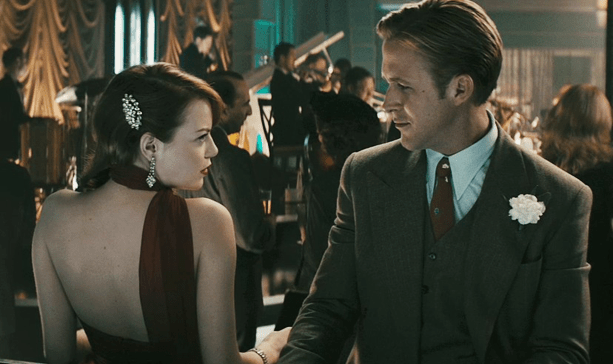
The trailer for Gangster Squad isn't selling nostalgia so much as retrograde, standard-issue images of masculinity. An account of the L.A. Police Department's fight against the East Coast mob in the '40s and '50s, the film, directed by Zombieland helmer Ruben Fleischer, is pitched as one manly affair, but unfortunately courts its target bros with a lot of tired bromides. Testosterone is front and center as soon as the preview starts, with ugly-mugged mafioso Mickey Cohen (Sean Penn) pounding away at a punching bag and dining with a loaded pistol by his side. Cut to Nick Nolte, another gruff actor with sandpaper features, playing a department head who tells Josh Brolin's squared-jawed cop that “Los Angeles is a damsel in distress” and needs to be saved. It's offered as a quaint proposal for chivalrous heroism, but it really just reminds us, with a sexist air to boot, that tough guys are running the show. “I'll need men,” Brolin's squad chief replies. Naturally.

There's nothing wrong with having a core audience, but with this first clip, Gangster Squad doesn't give much credit to the smarts of its would-be ticket buyers, who've surely heard better speeches about whores and dope than the one Penn's character caps off with an Emeril-like, “Bam!”  (“Overcooked” might be the right word for this umpteenth riff on the Scarface power pledge.) And while the rat-a-tat-tat of tommy guns, like mid-century L.A., will never go out of style in the movies, the same can't be said for a showy montage of bad-cop brutality, or grab-bag catchphrases like “We're going to war” and “There's no going back.”

Ironically enough, the trailer's most interesting element is markedly un-masculine: the squeaky, near-flamboyant voice adopted by Ryan Gosling. A leading man with unlikely character-actor gifts, Gosling gives his womanizing officer a memorable wrinkle of interest, and looks to continue his captivating string of ace performances. He still utters the same Will Beall-penned platitudes delivered by his rather typecast co-stars, but he registers as a fresh gem amid stale goods.

With its basic story seen before in everything from The Untouchables to American Gangster to Public Enemies, Gangster Squad would have done well to differentiate itself, beginning, of course, with this first look. Judging from what's presented, though, journalist Paul Lieberman's source material, a series of articles dubbed “Tales from the Gangster Squad,” has inspired a boilerplate, shoot-'em-up, cat-and-mouse popcorn flick, with a low opinion of its demographic to boot. In one final effort to present a certain hipness, the preview ends with a track from Jay-Z, whose all-too-relevant lyrics about “the American Dream” accompany an admittedly nifty image of cops shooting through a movie screen (take that, 3D!). But in this age of rappers linked to, and long inspired by, unlawful lifestyles, the music cue is just another cliché, and yet more bait for dudes who aren't as dumb as the trailer thinks they are.

R. Kurt Osenlund is the Managing Editor of Slant Magazine's The House Next Door, as well as a film critic & contributor for Slant, South Philly Review, Film Experience, Cineaste, Fandor, ICON, and many other publications.

CRUEL SUMMER: THE BLUES BROTHERS (1980)

CRUEL SUMMER: THE BLUES BROTHERS

In this series, frequent Press Play contributor Aaron Aradillas will analyze a significant movie from each year of the 1980s. First up: The Blues Brothers (1980).

According to John Landis, The Blues Brothers was the last movie made under the old studio factory system, in which Universal had everything from the props to the costumes made on the lot. The Blues Brothers feels, indeed, like a transition from the old to the new. It takes the form of a big studio musical, but its execution is all 1980s bigger-is-better filmmaking.

The first movie to expand a sketch from Saturday Night Live, The Blues Brothers was “high concept” before that term even existed. When The Blues Brothers was made, Landis was the go-to comedy director working in Hollywood, having just made National Lampoon’s Animal House,the most successful comedy in movie history. Stars Dan Aykroyd and John Belushi had just ended their time on SNL, possibly the most culturally influential TV show of the late ‘70s. The Blues Brothers was the right movie, hitting at just the right moment. This movie fed an audience leaning toward the sophisticated comedy of Woody Allen and Steve Martin on the one hand and slob comedies like Animal House, Caddyshack, and Meatballs on the other.

The movie itself, despite its winning ingredients, is a big, lumbering, at times awkwardly paced thing that only intermittently comes to life. The screenplay by Aykroyd and Landis is less a script than a scenario. The story of Jake (Belushi) and Elwood (Aykroyd) putting the band back together, in order to raise money to pay off the back taxes owed by the orphanage where they grew up, has a Mickey-and-Judy-let’s-put-on-a-show innocence that’s quite appealing. The problem is that Landis stretches this story to over two hours, which allows for several unnecessary storylines. (Pacing has always been a problem in Landis’ work. It’s telling that his best movie, An American Werewolf in London, is also his shortest.) There are no scenes in The Blues Brothers. The movie consists entirely of sequences, numbers, and set-pieces. Consequently there aren’t any real characters. Everyone is more or less a cast member. As it turns out, this would be the modus operandi for a vast majority of movies made throughout the 1980s.

The problem with The Blues Brothers movie is the concept of the Blues Brothers themselves, a soul gimmick. (The band’s best performance remains their cover of Sam & Dave’s “Soul Man.” The sight of white boy John Belushi proclaiming he has soul is funny and kind of touching.) At the time no one seemed to question or even be concerned with the sight of a couple of white guys performing predominantly black music. (Inexplicably, The Blues Brothers’ Briefcase Full of Blues remains one of the all-time best-selling blues records.) The difference between the Blues Brothers and, say, Elvis or the Stones or Eminem is they rarely attempted to do anything that would test them as performers. They were an instant nostalgia act.

Landis probably knew the appeal of the act was limited and that’s why he added so many subplots, ranging from Illinois Nazis to Illinois state troopers to The Good Ole Boys to Jake’s parole officer to Carrie Fisher chasing the boys in their trademark police car. All of these adversaries have potential, but most of them don’t go anywhere. (The Illinois Nazis unfortunately provide the movie with a gratuitous scene of Henry Gibson shouting ugly rhetoric into a bullhorn.) Landis is clearly emulating It’s A Mad, Mad, Mad, Mad, World, but what made that movie a masterpiece was its gags on top of gags. It also allowed performers like Buddy Hackett, Phil Silvers, Sid Caesar, Ethel Merman, and Jonathan Winters to play characters that showcased their talents. Belushi and Aykroyd are kept mostly in check throughout this movie. Belushi’s kamikaze style is what made his appearances in Animal House and 1941 so memorable. And Aykroyd is best when he uses his Asperger’s-esque detachment to subversive comic effect. (His career performance remains his portrayal of Joe Friday in the underrated Dragnet.) The only sequence where the buried antisocial behavior of their act comes to the surface takes place when they disrupt the peace in a snooty restaurant in order to persuade Mr. Fabulous to join the band.

The musical performances are a mixed bag; small bits of each number indicate just how good they could potentially be. Whatever reservations you may have about Belushi and Aykroyd as bluesmen, the band itself, a combination of Stax musicians and a New York horn section, is always fun to listen to. And a couple of the players manage to emerge as terrific comic actors, especially Willie “Too Big” Hall and the recently deceased Donald “Duck” Dunn. The band’s big performance at the Palace Hotel Ballroom is fun but the song selections just remind you how good the originals are. I mean, compared to Solomon Burke’s original or The Rolling Stones’ cover, Belushi’s version of “Everybody Needs Somebody to Love” just ain’t cutting it. Belushi’s best vocal is on the movie’s opening song, “She Caught the Katy.” The song is used to score Jake’s release from jail and reunion with his brother. The opening guitar picking and blast of the horn section get the movie started on a high note, And Belushi’s phrasing is good because he doesn’t force it.

Unfortunately the promising opening song is followed by the movie’s worst musical number. The boys are sent to church to get some inspiration. James Brown plays Rev. Cleophus James, a showman who leads his congregation in a boisterous rendition of “The Old Landmark.” Designed as a tribute to black gospel music, the number borders on offensive as George Folsey’s frenetic editing makes the dancers into leaping bodies, killing any chance of the song’s building to a climax, and turning the spiritual into something comical. Besides, who wants to see The Godfather of Soul do a gospel song? Aretha Franklin does better with her rendition of “Think,” but Landis stages the dancing awkwardly. And when the band plays a rowdy country bar, the mere sight of Jake and Elwood in their costumes performing “Theme from Rawhide” simply doesn’t do enough to make the connection between country music and the blues.

Then, Ray Charles does a fantastic cover of “Shake a Tail Feather.” Charles proves to have perfect comic timing. (“It breaks my heart to see a boy that young go bad.”) And it’s also the best edited and choreographed of all the musical numbers. Even better is Cab Calloway donning his trademark white tux and performing “Minnie the Moocher.” He makes an effect Belushi and Aykroyd struggle to accomplish look effortless.

The Blues Brothers is best remembered for its extended climactic car chase, and it’s still a doozey. Cars fly, spin, flip, careen, and crash into one another like a pileup at a Hot Wheels factory. (“This is car 55. We’re in a truck!”) Landis sustains the comic momentum of the sequence in what amounts to the movie’s best musical number. The sheer audacity of the sequence at the time turned out to be prophetic, as it pretty much announced the 1980s as the decade of the bigger-and-louder-is-definitely-better school of filmmaking. The Blues Brothers put the existential dread and emphasis on the personal of ‘70s filmmaking in its rearview mirror. What it was speeding toward didn’t matter. The chase was all that mattered.

San Antonio-based film critic Aaron Aradillas is a contributor to The House Next Door, a contributor to Moving Image Source, and the host of “Back at Midnight,” an Internet radio program about film and television.