VIDEO ESSAY: Sight and Sound Film Poll – Adrian Martin on Philippe Garrel’s L’ENFANT SECRET

VIDEO ESSAY: Sight and Sound Film Poll – Adrian Martin on Philippe Garrel’s L’ENFANT SECRET

Press Play presents Sight and Sound Film Poll: Critics' Picks, a series of video essays featuring prominent film critics on films they selected for Sight and Sound magazine's poll of the greatest films of all time. New videos will premiere each week until the poll results are announced later this summer.

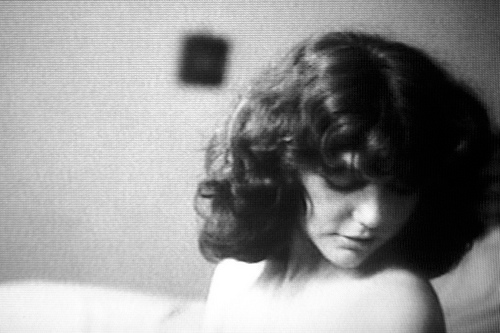
When Adrian Martin visited Chicago last May, I made certain not to miss the opportunity to record him for this video series. Martin was one of the earliest enthusiasts of video essays when they started popping up online a few years ago, and I've wanted to collaborate with him since. At the tail end of a busy trip (a film criticism conference at Northwestern Univeristy and a master class on dance in cinema at the Univeristy of Chicago), we met to discuss his all-time favorite film, Philippe Garrel's L'Enfant Secret / Secret Child. The ease with which Martin delivers his testimony is remarkable (and made for a pleasant editing session); perhaps it's no surprise given that Martin has recorded 33 DVD commentaries and has regularly appeared on Australian TV and radio. I've long admired the range of his work: from mainstream broadcast media to teaching at Australia's Monash University; his writing appears in everything from books to international film journals to his own online journals, such as Lola (co-edited with Girish Shambu).

What distinguishes Martin's scholarship for me is his passion for all that is improbable or even impossible about the cinema; how cinema breathes life into things that can't exist or last in reality. This spirit of vital, celebratory defiance in cinema came through in his presentation on dance in film that I attended: instead of doting on the familiar instances of Fred Astaire and Gene Kelly, he showed breathtaking clips from Leos Carax's Mauvais sang, David Lynch's Twin Peaks: Firewalk with Me and John Waters' A Dirty Shame that reconceive the meaning of cinematic dance as a gesture that somewhat defies meaning. That spirit of dancing at the fringe of our understanding can also be sensed in Martin's love of Philippe Garrel and especially L'Enfant Secret, a chronicle of a tortured, fragile existence that embodies those qualities in its material properties: a film that at times "threatens to disintegrate."

To some extent the delicate filmic qualities of L'Enfant Secret that are crucial to Martin's testimony can't be conveyed in an online video essay, due to the limitations of transposing the film between mediums.  One can only hope that this video will induce further efforts to present the film in its intended format, so that audiences might have the same visceral reaction that Martin relates in this video. In addition to this video, one should also read Martin's article on the film published in Transit magazine (in Spanish and English).

Adrian Martin is a film critic, scholar and co-editor of the online film journal Lola. He is winner of the Australian Film Institute's Byron Kennedy Award and the Pascall Prize for Critical Writing. 

Kevin B. Lee is Editor in Chief of IndieWire’s PressPlay Video Blog, Video Essayist for Fandor Keyframe, and contributor to Roger Ebert.com. Follow him on Twitter.

CRUEL SUMMER: PURPLE RAIN (1984)

CRUEL SUMMER: PURPLE RAIN (1984)

This video essay is part of the "Cruel Summer" series of articles; this series examines influential movies from the summers of the 1980s. The previous entries in the series have covered THE BLUES BROTHERS (1980), STRIPES (1981), ROCKY III (1982), and WARGAMES (1983).

If the 1980s are considered a decade of excess, then 1984 was the peak of that excess. George Orwell’s book 1984 had already given the year so much significance that an inexplicable energy and urgency coursed through it. Reagan’s re-election was pretty much a given, a recession was ramping up, and a wave of conservative values was washing over the country. While there wasn’t yet a sense of hopelessness, there was a feeling that maybe things would get better if only we could just get through the year. All this restless energy was channeled into music. In a rare case in which the stars aligned just right, the music released during 1984 was not only the most exciting of the decade but would turn out to be some of the most endearing pop music of the next 30 years. MTV was entering its third year and had, in a sense, become the number-one radio station in the country. If you had a video in heavy rotation on MTV, you had a hit record. During the summer of 1984 you were likely in any given hour to see videos for Yes’ “Owner of a Lonely Heart,” Madonna’s “Borderline,” Van Halen’s “Jump,” Cyndi Lauper’s “Girls Just Want To Have Fun,” Billy Idol’s “Rebel Yell,” The Cars’ “You Might Think,” Thompson Twins’ “Hold Me Now,” Pretenders’ “Middle of the Road,” Huey Lewis and the News’ “Heart of Rock N’ Roll,” Kenny Loggins’ “Footloose,” Culture Club’s “Karma Chameleon,” Rick Springfield’s “Love Somebody,” Deniece Williams’ “Let’s Hear It for the Boy,” Tracy Ullman’s “They Don’t Know,” John Mellencamp’s “Pink Houses,” Duran Duran’s “The Reflex,” and Bruce Springsteen’s “Dancing in the Dark,” not to mention the videos of Michael Jackson, especially “Thriller.”

The movies took their cue from the music as Hollywood entered into A symbiotic relationship with MTV, both as a new form of storytelling but, more importantly, as a powerful marketing tool to reach the coveted youth audience. Movies like Rocky III, Flashdance, and Staying Alive demonstrated the potential success for music-fueled storytelling and an accelerated editing style, but the movies of 1984 showed Hollywood going all-in on this new aesthetic. Almost any movie worth remembering from 1984 was connected to pop music. Footloose was the movie for the high school class of ’84, while Against All Odds had a power pop sensuality. Repo Man and The Adventures of Buckaroo Banzai had a madcap sci-fi punk vibe, while This Is Spinal Tap deflated the pomposity of heavy metal. The raw energy of the burgeoning hip-hop scene was showcased in the (still exciting) Breakin’ and Beat Street. Even music-oriented movies that flopped had soundtracks that rocked. Walter Hill’s rock ‘n’ roll fable Streets of Fire gave us Dan Hartman’s “I Can Dream About You,” while Rick Springfield’s vanity project Hard to Hold had a soundtrack better that the movie. Disco mastermind Giorgio Moroder made Fritz Lang’s Metropolis relevant to the MTV generation by adding a modern rock score, while ALSO scoring the soundtrack to the unjustly forgotten computer romance Electric Dreams. Even big name directors got into the act, as Brian DePalma showcased Frankie Goes to Hollywood’s “Relax” in his horror-porno satire Body Double while Milos Forman displayed a punk-ish attitude towards classical music in the Best Picture Oscar-winner Amadeus. But there was one movie (and record) from 1984 that would not only be representative of the entire year, but also become a cornerstone of pop culture.

Albert Magnoli’s Purple Rain is a one-of-a-kind mix of rock concert, intense drama, romance, and comedy. A star vehicle designed to showcase the talents of rock-fusion musician Prince, Purple Rain was that rare vanity project that worked. (Both Rick Springfield and Paul McCartney attempted similar movie projects in ’84, but they were a bust.) Magnoli (who had been an editor on James Foley’s youth-rebel drama Reckless) made his feature debut as a director with this film, displaying a remarkable understanding of quick-cut, backbeat-driven movie-music visuals that very few filmmakers have been able to duplicate. When pop stars attempt to cross over into movies, the results are often embarrassing. The Elvis movies are a classic example. Crummy direction and writing turned one of the century’s most charismatic entertainers into a depressing robot on screen. (With the exception of Jailhouse Rock, the Elvis movies would have been perfect for MST3K.) Performers ranging from Diana Ross to Peter Frampton to Neil Diamond all tried to translate their control of the stage to the big screen, and the results were a display of ego gone wild. Their fame as pop stars worked against them, because it caused them not to work hard enough at portraying characters. (Only The Beatles in A Hard Day’s Night displayed the kind of looseness and willingness to look silly that’s required to hold a viewer’s attention.)

Purple Rain was different. Prince was still a mystery, not yet the all-caps superstar he is today. From the movie’s beginning, when we heard a voice introducing The Revolution, followed by an anticipatory electro-synth drone accompanied by Prince’s spoken-word proclamations about life, we knew we were seeing something new, something vital. On songs like “Little Red Corvette,” “Delirious,” and “Controversy” Prince’s fusion of hard rock funk and dance rhythms was like an antidote to the polish of disco. (The music sounded like the next evolutionary step following The Rolling Stones’ Some Girls.) But Prince still hadn’t broken out. Purple Rain was his coming out celebration. Young audiences flocked to it expecting a show, and Prince delivered.

The opening “Let’s Go Crazy” number both sets the stage for Prince’s showmanship and put the story into motion. Unlike, say, Footloose or Flashdance, where the pop music was used to enhance a scene by giving it a beat, Purple Rain integrated the songs into the story. All the musical numbers are both interwoven into the story and separate from the drama, as if commenting on the lives of the characters. At times, Purple Rain plays like a rock ‘n’ roll version of Cabaret. Magnoli keeps the numbers visually arresting by using movement in the foreground to give them different perspectives. Not using a steadicam, he uses the swaying of the crowd’s bodies or the back and forth of waitresses trays to let us know life is going on even while the music plays. (Streets of Fire had a similar introductory musical number, but its song, “Nowhere Fast,” was no “Let’s Go Crazy.”)

The story of Purple Rain is almost primal, with its elements of frustration and rebellion. While the movie isn’t explicitly autobiographical, it creates a heightened version of reality; Prince and all the other performers play characters they can inform with their life experiences. The inexperience of the cast and crew affords them a cocky fearlessness, as the movie has a let’s-put-on-a-show energy, crucial to its success. The young people in the audience knew they weren’t seeing high drama. Instead, they related to the story of The Kid’s (Prince) desire to express his pain as an extension of their own similar desires. The Kid’s tentative romance with Apollonia (Apollonia Kotero) is first fueled by eroticism and hostility, but soon turns into a test of The Kid’s maturity. The movie tells us that if The Kid can learn to be generous and trusting, that might be what he needs in order to become a star.

This all sounds kind of heavy, but Magnoli is wise to keep the non-musical scenes brief and direct. No dialogue-driven scene seems to last longer than five minutes. This isn’t entirely because of the inexperience of the actors, but more because the music is so powerful that the scenes don’t need to be extended. The Kid’s romancing of Apollonia happens mostly through visuals. Their first meeting is done with eye contact and the help of the camera. Their first date is when they go riding on his motorcycle as “Take Me With U” plays on the soundtrack. (“I don’t care where we go/I don’t care what we do.”) When Apollonia is being wooed by The Kid’s rival, Morris (Morris Day), he sings “The Beautiful Ones” as a defiant ultimatum. (“Do you want him? Or do you want me?/Because I want you.”) Magnoli’s editing and the hot cinematography by Donald Thorin (Thief) give each number a palpable sense of momentum. “When Doves Cry” is used powerfully in a mid-movie montage to develop characters and fill in holes in the movie’s chronology, while Thorin uses fiery red lighting for “Darling Nikki” to accentuate The Kid’s desire to humiliate Apollonia.

What’s fascinating about Purple Rain is the matter-of-fact way it presents a racially integrated world. Until Purple Rain most black characters in movies either lived in a white world, or were held at arm’s length in movies dominated by black characters. But Purple Rain presented a world where race and gender were shown in something approximating the right proportions. The explicit sexuality of the characters was thrilling, as black sexuality had been mostly chaste (Sidney Poitier movies) or presented as something mythic (Sweet Sweetback’s Baadasssss Song). The time was right for black sexuality to be presented on screen accurately, and it turned out Prince was just the man to do it. The only drawback was in the treatment of its female characters. Purple Rain isn’t wholly misogynistic but like Saturday Night Fever, it isn’t entirely enlightened either.

Prince doesn’t really act in the film, more often standing still and using his presence to draw us closer to him. This is smart because his normal speaking voice lacks authority. Prince does anger and contemplation beautifully. He’s less assured when trying to be conversational. (His best scene is with Clarence Williams III, who plays his abusive failed musician father. They create just the right amount of tension, giving the scene a hushed intimacy.) Luckily the other actors around Prince are strong enough that they balance some of the movie’s shakier scenes. Wendy Melvoin is quite good in her big showdown scene with The Kid, while Billy Sparks is a natural as the manager of the First Avenue club where all the drama unfolds. Of course the scene-stealers of the movie are Morris Day and Jerome Benton. Day is like a cross between The Mack and James Brown, with Benton as the straight man for his outrageous one-liners. (“Let’s have some asses wigglin'!”) The two performances by The Time ("Jungle Love," "The Bird") are bumptious fun and work as welcome relief from the intensity of the other numbers. Morris is the leader of his band, but he knows to share the spotlight with his fellow musicians. That’s what The Kid needs to learn in order to go to the next level.

The movie’s final act is an extended battle of the bands, as The Revolution and The Time fight for supreme dominance at the club. The three-song set by The Revolution works as a kind of three-part movement toward the movie’s conclusion. “Purple Rain” is a spellbinding one-take performance as The Kid reconciles with those he’s hurt. (I love the moment when he kisses Wendy on the cheek.) “I Would Die 4 U” is used for the movie’s final character montage, while “Baby I’m A Star” pretty much says it all. (It’s easily the best number in the movie.)

Purple Rain is an anomaly, in that no matter how hard directors have tried, its success can’t be repeated. (Anyone remember Under the Cherry Moon or Graffiti Bridge?) It’s a movie whose title conjures up a moment in time. Purple Rain is a movie, a record, a sound. Its legacy is the audience’s wanting nothing but a good time.

San Antonio-based film critic Aaron Aradillas is a contributor to The House Next Door, a contributor to Moving Image Source, and the host ofBack at Midnight,” an Internet radio program about film and television.

For more commentary on significant films of the 80s, see this 5-part video essay by Aaron Aradillas and Matt Zoller Seitz for The L Magazine! Parts 1 and 2 cover 1984.

LONGMIRE RECAP 1: THE LONG ROAD

LONGMIRE RECAP 1: THE LONG ROAD

null

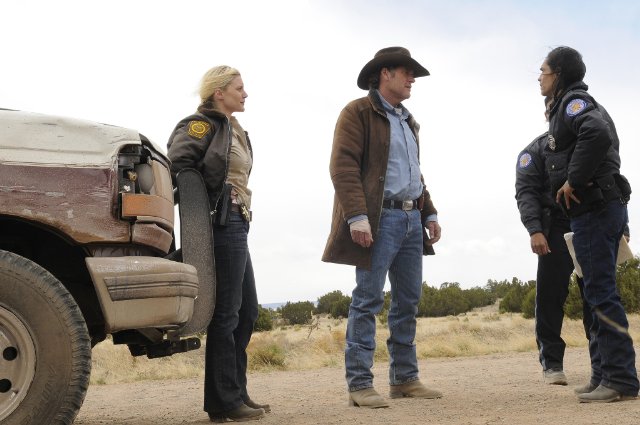
While a mystery procedural isn’t the most revolutionary premise for a television series, there were several aspects of the Longmire pilot that indicated that it might be particularly interesting. First, it had a distinct visual style. The opening scene of the pilot, with Longmire in the shower, the camera bouncing around, and messages left on the answering machine conveys character and tone superbly—and simply—through style.

The show’s setting is also compelling, though not in such a positive way. The rural county in Wyoming is not a common location for a TV show, and Longmire effectively conveys how small and interconnected Absaroka County is. The placement of a Cheyenne reservation nearby also adds specificity, but tensions between the reservation police and the protagonist create an uncomfortable dynamic. The heroic white man, unfairly vilified for exposing native corruption, ends up a hero after reuniting a lost Cheyenne girl with her mother. It’s very White-Man’s-Burden, and quite awkward because of it. I’m hopeful that the show will grow more nuanced in its portrayal of the Cheyenne. Given its competence elsewhere, this seems likely, but the focus on the whites as the primary cast members is less promising.

The show’s use of an election as its main hook for long-form serialization mosyt appealed to the part of me that enjoys analyzing structure. Walt Longmire is the show’s hero, the character it’s named for, but he’s a mess. Branch Connally, his deputy, has recognized that Longmire is a mess, and decided to run against him. Connally’s reasons seem entirely valid—Longmire’s been an absentee sherriff since his wife died, a year ago, and has left the running of the station to the deputies. Had you framed most of the scenes from Connally’s perspective, he would have looked like the hero of this story. “Quality television” is often based on male anti-heroes, but Longmire’s not quite there. He’s more of a broken hero, teetering on the edge of failure. And his failure comes from inaction, not from making the wrong choices—at least, that's the show’s premise.

For better or mostly worse, not many of these qualities are on display in the second episode, “The Dark Road.” Second episodes of dramas are usually weak, to be fair. They’re produced well after the pilot, and they generally serve to reintroduce the characters and world for people who are theoretically tuning in based on word-of-mouth after the first episode. This tends to make second episodes feel watered-down, which describes “The Dark Road.”

The biggest component of the pilot missing here is any mention of the election. Branch Connally is shown as a somewhat cocky member of the department; the only visible tension between him and Longmire is a slight young pup-old dog dynamic. This makes the revelation at the end of the episode—that Connally is sleeping with Walt’s daughter Cady—lose most of its impact.

Instead,  a flashback represents the show’s serialization. Walt is having a scar on his back sewn up, as he talks to his friend Henry, saying that his daughter must never know. That’s the entirety of the scene. This is far less auspicious than the election as a hook for viewers. I tend to be quite wary about overarching mysteries like these. Here, the characters have information that the audience lacks. By not allowing us to see it, the show is essentially taunting us, and that’s not a great way to start a relationship.

This episode also doesn’t deal with the Cheyenne, either, choosing instead to focus on another group of people more common in the rural west than most other places in America: Mennonites. One of their teenagers, a girl on her “rumspringa” outside of the community, has ended up dead. She’s also a stripper, which Sheriff Longmire figures out because the show uses the TV shorthand of saying she’s covered in glitter (because as everyone knows, married men who go to strip clubs love coming home with glitter on them, as it spares them even needing to bother discussing where they’ve been).

The Mennonites come across worse here than the Cheyenne did. The only family we see in any detail is ruled by a patriarchal iron fist, which ends up being the cause of the girl’s death. Her father, knowing she was a stripper, doesn’t care about her death. Her mother is more sympathetic, but paralyzed by the fear of the patriarch. And the mystery’s resolution is that the girl’s brother accidentally killed her while chasing her, because he saw her drifting away from the culture by becoming a stripper, and he had been told that he couldn’t go back unless he returned her as well. This is also a traditionally American argument—that secular laws allowing freedom are superior to religious fundamentalism. The show strongly implies that this is intentional, showing the state flag immediately after the scene where the Mennonite mother admits she wanted her daughter to escape the household tyranny.

There’s an essential conservatism to mystery shows, especially those based around law enforcement. Longmire’s focus on “lost girls” as the victims of the first two episodes—helpless, threatened, needing rescue, or dying—instead of telling their stories shows a fear of girls doing sex work. This may be an entirely valid anxiety, but the decision to talk about the sex workers in both episodes, without actually letting them tell their story, says a lot about Longmire. It’s too early to see if that conservatism is a core feature, and I’m not sure if Longmire intends for it to be. But where the pilot involved an examination of those concepts through the struggles of the characters, “The Dark Road” plays it entirely straight, which is a shame.

Rowan Kaiser is a freelance pop culture critic currently living in the Bay Area. He is a staff writer at The A.V. Club, covering television and literature. He also writes about video games for several different publications, including Joystiq and Paste Magazine. Follow him on Twitter @rowankaiser for unimportant musings on media and extremely important kitten photographs.

GIRLS RECAP 9: LEAVE ME ALONE

GIRLS RECAP 9: LEAVE ME ALONE

The climactic argument between Marnie and Hannah in "Leave Me Alone" is soooo satisfying—and it's not merely because Marnie is acting as the viewer's proxy in calling Hannah fully and completely on her bullshit. That's fun, but Marnie isn't even alone in that this week, because Hannah's finally gotten a semi-, sort-of, part-time coffee-shop job . . . and her manager is Ray. Ray not only sends Hannah home to change when she shows up in a stain-tempting white dress, ordering her to "forget all the BBC you watch at home with your cats" and put on something appropriate; he also advises her on what to buy at American Apparel, complete with hand gestures ("slim leg! slim leg!") (not for nothing, but a skinny jean is about the only thing that would be less flattering to Lena Dunham's figure than the dresses Hannah already wears).

null

Ray also gives explicit voice to the anxieties of young writers about their material—specifically, whether it's "serious enough." I had to accept years ago that I'd never make that cut, because when I was Hannah's age, the internet was considered the JV, at best, never mind writing about television on the internet, or telling funny stories about karate class or doing your laundry. I didn't have an agent, I didn't write literary fiction, and it didn't really matter, at all, but back then, if a guy like Ray had blown off my subject matter as frivolous—"How about divorce? How about death?  . . . How about death?"—I would have taken it to heart, and I would have tried to write a somber, well-researched, mindful, high-fiber piece about municipal politics, and it would have bombed, just like it does for Hannah at her reading. Hannah's former writing prof is very encouraging throughout, and seems to understand what Hannah's writing strength is, whether it's one that Hannah wants to own or not. (He's also played by Michael "Christopher Moltisanti" Imperioli. Imperioli has other, more recent credits, but I have to think the casting is meant to recall "Christophuh"'s struggles with the written word over the run of The Sopranos.)

But Hannah feels that snarky essays about dating a hoarder and spending the night on a stack of flattened Chinese-food cartons won't get you onto "Fresh Air." Of course, that very sort of observation by Dunham has gotten Dunham herself onto "Fresh Air," via "Girls"; the episode really nails the insecurity and toxic envy of starting out as a writer, although I'm not sure it's something Dunham has really experienced in that way. Maybe episode co-writer (and New Yorker cartoonist) Bruce Eric Kaplan helped shape the bits with Tally Schifrin, Hannah's creative-writing program-mate who already has a memoir out. Tally's a perfectly drawn cartoon of the non-fiction classmate we all despised, the well-connected mediocrity just clever enough to leverage a single incident or tagline into a hardcover deal. If you thought Hannah snarking that Tally's "lucky" to have a boyfriend who killed himself so she could write about it was too over the top, even for Hannah, you haven't spent that much time around writers. (And you shouldn't start. We are ruthless.)

Professor Imperioli is comforting, telling Hannah the thing every struggling, lost essayist wants to hear from someone in authority—that Tally's a "shitty" writer, and Hannah is good. It's more than Marnie has mustered; asked her opinion of the hoarder-date essay earlier, Marnie deemed it "a little bit, like, whiny." But when Hannah whines that Marnie could be a bit more supportive, Marnie sighs, "Hannah, I support you. Literally."

And when Hannah comes home from the reading and bags on Marnie for throwing clothes away instead of donating them to Goodwill, it sets off a very rewarding showdown. As I said before, it's partly because Marnie is ranking on Hannah for all her friendship sins: Hannah's selfish; she uses her self-loathing as an excuse to be a narcissist; she has no other subject but herself. Hannah gets a few good shots of her own off—Marnie is too focused on achievement and comparing herself to others; her woe-is-single-me routine is getting old (we haven't really seen that, but I'm fine with inferring it from Marnie's sad-sackishness last week); this is about Hannah having a boyfriend and Marnie not having one, because it throws off the balance of power. Now, Hannah doesn't use exactly those words, and it's a topic so nuclear that most women friends would never go near it out loud—but Marnie is used to having the boyfriend, feeling the pity instead of needing it, fitting into the size 6 (a fact she makes glancing reference to by saying that one of her old dresses might fit Hannah a bit snugly—exactly the right tone and wording for that kind of slight).

It's possible that Hannah isn't only selfish and lacking in empathy for Marnie; it's possible that, as the one who's feeling more settled emotionally for a change, she doesn't know how to support Marnie. But . . . it's more likely that, just as she herself says, being a good friend "isn't a priority for" her right now. Marnie's icy "thank you" when Hannah admits this echoes of the audience—because no shit, first of all, and second of all, it's not just Hannah. It's Marnie; it was me, I think, at that age. I'm not sure I had "friends," exactly, so much as "people I stood next to while holding a beer, in order to hate myself outside my apartment now and then."

All of Hannah's scenes, and the post-collegiate writing-competition stuff, totally resonated with me—and pretty much made up for a baffling plot "development" for Jessa in which Kathryn Lavoyt shows up at her apartment to ask her to come back as her daughters' nanny in spite of everything. It's unclear what Kathryn thinks happened, or how she found out about it—Jeff could have confessed, but it seems like something Jessa would do to quit and explain exactly why—but she takes the opportunity to share a very on-the-nose dream she keeps having about stabbing Jessa and eating her body while her mother is breastfeeding her husband. Kathryn gets a speech about how Jessa causes dramas like this, to distract herself from becoming who she is. Jessa looks intrigued by that possibility, and asks who she's becoming, then; Kathryn's response is more speechifying about how that person might not have a cool job or hair "like a mermaid," but might be happier than Jessa is now. Or . . . something. I really can't tell whether we're meant to hope that Jessa hears something for herself in these Now The Married Lady Will Tell You Your Life pearls of wisdom, or to think that Kathryn's condescending and out of touch. I have to go with the latter, although I don't think the scene came out the way it may have been intended.

And speaking of things that perhaps weren't intended . . . is that a jar of mayonnaise next to Hannah's bed? And do I want to know either way?

Sarah D. Bunting co-founded TelevisionWithoutPity.com, and has written for Seventeen, New York Magazine, MSNBC.com, Salon, Yahoo!, and others. She's the chief cook and bottle-washer at TomatoNation.com.

MAD MEN RECAP 12: THE PHANTOM

MAD MEN RECAP 12: THE PHANTOM

Most nights I watch Mad Men on my living room couch with a computer in my lap. Tonight I watched at a terrific New York City bar, at the Basket of Kisses Season Finale Party, sitting next to Rich Sommer. It was a fantastic experience: Cheers, applause, shock—there's truly nothing like sharing the show with a large, respectful, enthusiastic audience. Respectful, because they're quiet enough that no dialogue is missed, but enthusiastic enough to burst into cheers when Pete gets punched out, and then punched out again—at which point I said, "Joan was right—everybody does want to take a pop at Pete Campbell." Watch the clip:

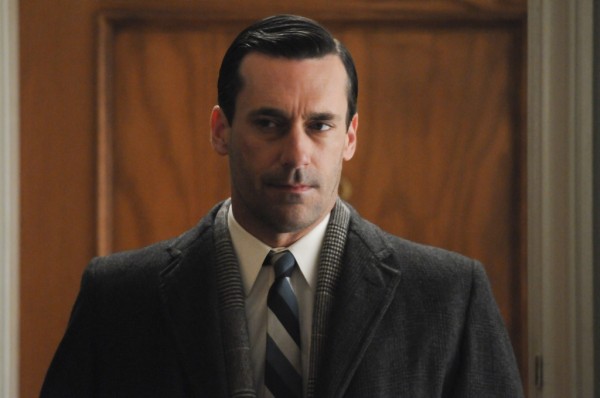
When Don was watching Megan's screen test, I whispered to Rich, "Do you need to leave the room crying?" Obviously, that scene was meant to remind us of Don's famous "Carousel" speech in the Season 1 finale, The Wheel, in which Don looks with love and longing at a slideshow of his family, including his then-wife Betty. Now he looks at his second wife, and his longing and love are again visible.

nullThis episode was filled with doubles and references, doublings back and reboots. Just as the screen test revisits the slideshow from the Season 1 finale, the meeting with Topaz Pantyhose revisits the finale of Season 4, Tomorrowland. In that episode, Peggy won the Topaz account, saving the then-desperate SCDP. Now, SCDP is in great shape, but they might lose Topaz because Peggy is no longer there. "We've never had problems with this client before," Ginsberg says, but they have to start from scratch. Ginsberg is also a double—for Peggy. He is Don's new whipping boy/protégé and junior genius.

Adam Whitman is a revisit, a "phantom" from the title, and Lane's suicide by hanging is the second such suicide of the series. Adam did it first, in Season 1, and Don is haunted by the memory. Phantoms are not just the ghosts of the dead, of course. As Megan's mother, Marie, so cruelly notes, they are the ghosts of our dreams as well. We believe there is a thing that will make us happy, but it is a phantom. When we grasp for it, it eludes us, as Beth eludes Pete. Pete's monologue to Beth is itself haunting, and too beautiful to leave unwatched:

There are three interwoven motifs in The Phantom, that of depression, that of restarting, and that of doubling. Obviously they connect to each other; Beth's cure for depression is a restart, a literal wiping out of her memories so she can start fresh without knowing what caused her pain last time, while Roger's cure for it (or for the fear it will come) is a doubling: He wants to do LSD a second time. Megan drinks wine at home during the day like Betty did, and Rebecca's remarkable, angry slap-down of Don and his check reminded me (and my sister) of Anna Draper's sister in Season 4, who called Don "just a man in a room with a check." Neither woman felt like Don's money gave him any right to access a family's private grief.

I pretty much told everyone that Matt Weiner inserted the James Bond references as a personal gift to me. That may not be accurate (it's fun to say, though), but we share our love of 007. There were two James Bond references in The Phantom–the movie Don and Peggy are seeing is Casino Royale (the comedy starring David Niven). 1967 was a year with two Bond movies, which kind of doubles down on the double identity theme. The second reference is the closing song: You Only Live Twice (considered by many to be the greatest Bond melody), which references doubling not only in the name but in the theme, which addresses rebirth after a faked death (Dick Whitman, anyone?).

So, everything reverts, returns, and wipes out. Everyone is in shock therapy. Partly, there's a lot of real human grief here. Roger wants to see Marie so he can find life again after death came so close. Don wants to give something to Rebecca that will make him feel some closure. Pete sees death everywhere he looks, and even though he verbally rejects suicide, the swimming pool he wanted suddenly looks like a drowning pool. Joan wants to know why, and, after prostituting herself to become a partner, she finds a way to believe she should have done so for Lane. Joan struggles in two ways to find value after what happened to Lane and to her: First, by proving herself as a partner, from her mannish suit to her assiduous assessment of numbers, and second, by believing, nonetheless, that her only value is sexual. The only way to have saved Lane, she thinks, would have been to sleep with him. Poor Joanie!

An awesome crew of two was at our Finale Party, filming people naming their favorite quotes and characters, as part of the DVD extras for Season 5. I had to say, much to my own surprise, that Joan Harris is my favorite. Her extraordinary vulnerability and need to please sits in such strange and beautiful contrast to her competence and brains. I never thought, in Season 1, that I would come to love her so.

So, tonight was a beautiful experience for me. An excellent episode, an exciting party among a hundred or more excited fans, and a whirlwind of emotions to chronicle. It was not, I have to say, exactly conducive to writing a careful episode review, since I took no notes and started writing a good forty minutes later than usual. I hope you'll forgive a slightly choppy review in exchange for sharing some of that experience with you. Tonight is also the wrap-up of my first season of writing for Press Play. It's been exhausting and gratifying, and I hope I'll be able to continue my contributions about Mad Men and possibly other media.

Some additional thoughts:

  • I had a dentist in the spire of the Chrysler Building, this is the truth, my hand to God.
  • Please don't ask me about two dogs fucking. I have no idea.
  • John Slattery has a much nicer ass than I would have anticipated. Also, I never imagined I'd have the chance to write that sentence.
  • Quote of the week is tough without my usual meticulous note-taking, so I'll go with "What is Regina?" because it's funny and a little smutty and I remember it (thanks again, Roger Sterling, who wins this and every season with the most quotes of the week).

Deborah Lipp is the co-owner of Basket of Kisses, whose motto is "smart discussion about smart television." She is the author of six books, including "The Ultimate James Bond Fan Book."

Watch Mad Men Moments, a series of videos on Mad Men, produced by Indiewire Press Play.

TRUE BLOOD RECAP 1: TURN! TURN! TURN!

TRUE BLOOD RECAP 1: TURN! TURN! TURN!

I love True Blood, and I pray this is the end of it. The tea leaves all read "buh-bye," but in this first episode, we’re mainly talking mop-up from last season’s remarkably messy—even by Blood  standards—finale. But before we get into the particulars, some thoughts from this devoted Trubie.

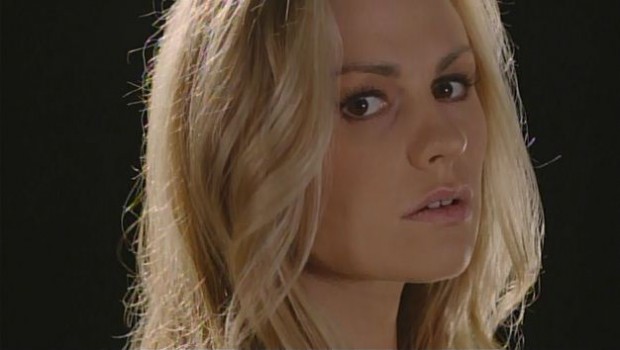
I know there are people who feel the show was great when it was an elegant, fleet, and witty anti-intolerance fable. And feel that, as early as Season Two, when Maryanne the cannibalistic Maenad (Michelle Forbes) started having psychedelic Southern-style Burning Man-ish parties on Sookie's impeccably well-maintained lawn, the chronicles of everyone’s favorite fairy telepath—Sookie Stackhouse (Anna Paquin)—had already fallen into their shark-jumping phase.

Me? I always said that, like that lawn or the improbably ever-fresh pitcher of lemonade in Sookie’s fridge, there were things about True Blood you just accepted. I said, “Cannibalistic Burning Man run by a Mad Maenad? I’ve waited my whole life for this!”

And then when Seasons Three and Four gave us the batty-beyond-belief Russell Edgington (Denis O'Hare), Vampire King of Mississippi, a white trash were-panther named Crystal Beth, the lounging vampire Queen Sophie-Anne Leclerq (Evan Rachel Wood), who loved nothing more than to play Yahtzee (!), the revelation that Sookie was a fairy, that Jesus (Kevin Alejandro), the love of darling Lafayette (Nelsan Ellis), was in fact a powerful Mexican bruja, and a curse caused Pam (Kristin Bauer) to embark on the holy grail of finding the right foundation—Smashbox? MAC? Maybelline?—to cover her rotting face, some called foul.

But me, I was in seventh heaven as the show gave up even the slightest lip service to realism on the road to becoming the most faux Southern fried nü-Hammer, blood-Romantic, were-vamp gore-show, splat-palooza of all time,and it became clear that Blood creator Alan Ball would not drive 55, and the only way he’d stop was if he were six feet under.

And now it must end. It must not be allowed to become an undead parody of a parody of itself, like Dexter.

My sense of Season Five, from its tagline—“Everything is at Stake”—onwards points towards end games from which the show will not be able to renew itself without becoming a faint Xerox of past bloody wonders.

So with the prayer of “I love you—now die,” some highlights:

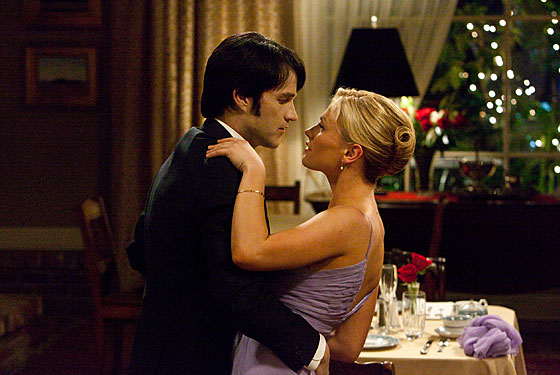
The episode opens one minute before the very end of last season’s finale, whipsawing from Sookie accidentally shooting Tara—whose fate will have to remain a secret for a spell, sorry—to a hilarious frenzy of tidying as, a few miles away, Bill (Stephen Moyer) and Eric (Alexander Skarsgård) clean up the sticky remains of Nan Flanagan (Jessica Tuck) who’d just outed herself as anti-Authority before meeting the True Death at Bill’s hands when he learned she desired some of Sookie’s fairy power.  

Alas, a pack of ninjas (or is that a flock, a murder or a bushel?) bag them in silver netting and stick them in a limo trunk. Eric’s shout of “That’s the Authority we’re up against!” not only IDs their attackers, it suggests a more epic storyline that would render any little tales from humble Bon Temps, LA passé.

Meanwhile, the Rev. Steve Newlin (Michael McMillian), ex-head of the Fellowship of the Sun, shows up gay and glamouring himself into Jason’s apartment, availing himself of that law of physics that says for every standing body of flesh there is a correlative moment when that body WILL fuck Jason Stackhouse (Ryan Kwanten).

But then the door slams open, Jessica (Deborah Ann Woll) declares herself “the progeny of the king of Louisiana!” and Newlin’s old news for now, as Jessica mounts Jason.

Shock cut to: A spy-movie-style male and female pair listening to Paul McCartney’s “Silly Love Songs” in a limousine. In the trunk, Bill and Eric are bound in silver netting (take note, slash fiction folks—this will be a good year for you).

One of the show’s more casually ridiculous escapes transpires: Bill finds an umbrella and stabs the car’s gas tank, which, after he asks Eric for some fire, blows up. Seriously. Bite this, believable solutions!

Crawling from the wreckage, the McCartney fan, whose name is Nora (Lucy Griffiths) finds Eric, and the two embrace and smooch deeply.

Nora is Eric’s sister and yeah—more TV incest. Boardwalk Empire, Game of Thrones, Bored to Death, Dexter, Supernatural, WTF?

At first I had no idea. But then a seeming cop-out, Eric’s revelation to Bill that he and Nora are “only connected through our maker” had me thinking. Because their “maker” is Godric (Allan Hyde), who died, or ascended heavenwards in a swirl of light and ecstatic disintegration season two’s “I Will Rise Up”.

With “everything at stake,” why would the show bring on someone who is Eric’s only living connection to the person he loved more than anyone or anything in his life, Godric?

Okay, before I mull myself into a coma, back to what Nora was actually doing. She’d planned to save Bill and Nora before their umbrella-gas-tank maneuver because, hot taboo sex aside, she’s a ruling member of the Authority working to tear the damned thing down from the inside.

So, Vive la révolution! Except Nora, Bill and Eric get caught by more Authority ninjas and there’s something about the way one of them bullhorns “Do not fucking move!” that makes me think Bill and Eric are screwed for quite a while.

Otherwise, here are the updates you need:

Captain Andy. An APD to all you Wire fans desirous of Chris Bauer nudity—your prayers are answered. Captain Andy is seen consorting with witch Holly (Lauren Bowles). Nice butt, Chris—who knew?

Terry. Terry (Todd Lowe) is now playing guest to his old Iraq war pal Patrick (Scott Foley). Flashbacks, fistfights, hallucinations occur—within, like, five minutes of screen time. How do you ratchet things up from there? A: Terry has kids, a wife, a life, oh dear.

Lafayette. Is this horrible? I want him to die so he can be with Jesus (boyfriend Jesus). Of everyone on True Blood, nobody has suffered more and gained less than Lafayette. So when he and Sook look for Jesus’ body and it’s not there, I’m thinking that if my end game theorem is true, maybe there’s a way Lafayette can peaceably slip this mortal coil and be forever with his beloved Jesus.

Right.

Jason. This whole episode is like a Stations of the Cross redemption trip for Sookie's older brother.

He tries to apologize to Hoyt (Jim Parrack), but Hoyt just calls him a girlfriend-fucker, accurate but hardly sporting.

He goes to Bill’s house, where Jessica is having a party with college kids her own age in a kind of adorable/pitiful simulation of what her life would have been like if the whole vampire thing hadn’t happened. After Rock Banding The Runaway’s “Cherry Bomb” (one of those True Blood moments sure to become a viral animated GIF), Jason leaves with some hottie but gives her an impassioned speech on how he wants be a better man instead of having sex with her, and still the space/time continuum did not collapse. Which leaves . . .

Alcide (Joe Manganiello). Who saves Sam (Sam Trammell)—whose problems with Luna (Janina Gavankar) are just confusing at this point—from becoming puppy chow for the werewolf pack that thinks he killed Marcus (Dan Buran). Alcide tells the pack that he’s a lone wolf now, and then he hightails it to Sookie’s to offer his protection from Russell, who, despite being buried under a few thousand tons of concrete the last time we saw him, is somehow back!

Russell. The only American vampire willing and able to punch his fist through someone’s chest on national TV and gloat about it. Russell (Denis O'Hare)—the one-vamp/one-man guarantor of True Blood quality!

Me, I’m going out on a limb here and predicting a terrific, apocalyptically satisfying season of over-the-topper-most True Blood. May it be its last.

Ian Grey has written, co-written or been a contributor to books on cinema, fine art, fashion, identity politics, music and tragedy. Magazines and newspapers that have his articles include Detroit Metro Times, gothic.net, Icon Magazine, International Musician and Recording World, Lacanian Ink, MusicFilmWeb, New York Post, The Perfect Sound, Salon, Smart Money Magazine, Teeth of the Divine, Venuszine, and Time Out/New York.

VIDEO ESSAY: A Drop of BLOOD Through the Heart – A TRUE BLOOD Tribute

VIDEO ESSAY: A Drop of BLOOD Through the Heart

It's perhaps either a fitting coincidence or a realization of my own 20-something existential crisis that the making of this True Blood montage came shortly after I completed my video contemplation of the world of Mad Men's Don Draper. The similarities might not be obvious, but they are there: While Don Draper struggles to conceal his true identity as Dick Whitman as others around him try in vain to scratch beneath the surface, Sookie Stackhouse is still on a journey to reconcile her supernatural fairy blood with her human existence.

The essays contrast the question "Who is Don Draper?" with "What are you?" At its heart, True Blood is exactly about how we cope when we realize our constant, our humanity, is taken from us—new vampire Jessica's relationship with human Hoyt, shapeshifter Sam's investigation into the lives of his birth parents, and Bill's flashbacks to his first few decades as a vampire with Lorena are all examples. As the dearly departed Queen Sophie-Anne reminds Bill, "we started out [as humans] too." And when we left off in the Season 4 finale, mortality had never been more pressing than when Debbie and Tara had seemingly died—and perhaps even more shocking was Sookie's pulling of the trigger on Debbie in cold blood. I have a feeling that humanity, in addition to Tara's mortal life and Sookie's redemption, will be a huge theme in Season 5. And wild werewolves couldn't drag me away from seeing what happens next.

Serena Bramble is a rookie film editor whose montage skills are an end result of accumulated years of movie-watching and loving. Serena is currently pursuing a Bachelor's degree in Teledramatic Arts and Technology from Cal State Monterey Bay. In addition to editing, she also writes on her blog Brief Encounters of the Cinematic Kind.

GREY MATTERS: ALIEN VS. PREDATOR VS. ALIEN VS. PROMETHEUS

GREY MATTERS: ALIEN VS. PREDATOR VS. ALIEN VS. PROMETHEUS

null

For months Twentieth Century Fox has been frothing us up over Sir Ridley Scott’s return to the Alien business with Prometheus. But for me, this is an occasion to not only celebrate the uncelebrated—Paul W.S. Anderson’s fantastic Alien vs. Predator—but to see through Scott’s contributions and mourn their horrible legacy.

First: Scott didn’t think up Alien’s feminist hero angle. All reports indicate that just sort of happened at the behest of producers David Giler and Walter Hill. Nor did he think up the paradigm-shifting H.G. Giger bio-mechanical alien design. Nor the story.

What he deserves credit for is saying yes to those elements.

But above and beyond that, what Scott—an ace adman whose Chanel #5 ads fused wealth, sex and property to almost pornographic levels—really brought to Alien (1979) was class. And Class.

Writing about Prometheus recently in Box Office, James Rocchi, after trashing the unimportant Alien vs. Predator (2004), just up and said it’s “nice to have Sir Ridley classing the neighborhood back up.”

Yes, ‘Sir”. As in knighted by The Queen. And “classing” things up, one assumes, like he classed up Hannibal with those splendidly art-directed, scrumptiously-lit scenes of Ray Liotta eating his own brains.

But why would you need "class" in a films about chest-bursting phallus monsters? Knowingly or not, Rocchi had used the correct verb.

Back in the late 70s, there’s no way that Scott could help but understand the discomfort we colonials felt around art and the class struggles we’re not supposed to suffer from. Watching Alien, you can see how he capitalized on that discomfort, on the way many Americans were still not quite sure how to process, say, a Bergman film. Did you act as if you got the long pauses, unfamiliar allusions, and the beauty for its own sake? Or should you just walk out, and fear being judged an idiot?

Doing what worked so well in the Chanel ads, he slathered Alien with style and class, and with the glacial pace, mood lighting, anti-hero casting, and doleful music he guessed we’d associate with "serious films." By the time the first finished print rolled through a projector with a really long, 2001-looking spaceship named after Joseph Conrad’s Nostromo and Howard Hanson's august Symphony No. 2 ("Romantic") rolling over the end credits, Scott may have imagined Americans who wouldn’t be caught dead seeing low-class fare like Friday the 13th feeling downright continental about watching what Scott himself called “the Texas Chain Saw Massacre of science fiction."

A Chain Saw, that is, about working-class stiffs deceived by an upper-class android, in which a blue-collar girl (Sigourney Weaver) kills the Giger menace.

British critics like the indispensible Kim Newman (author of Nightmare Movies) saw through the class story, seeing a pose that hid a monster/gore/Ten Little Indians hybrid whose plot required its characters to seek out dark places where they might get killed. But for Americans, that cold, humorless seriousness was the key to what made Alien so damned scary.

James Cameron understood that "serious" was a one trick pony: his war movie remix sequel, Aliens (1986), went for creature battle and feminism, blowing Scott’s pretense and future grunge chic out the air locker: the film was a huge success.

Alas, both Alien 3 (1992), wrought by the future king of high faux seriousness, David Fincher, and Alien: Resurrection (1997) both behaved as if somber, existential gloom—the Sir Ridley touch currently being pimped in the Prometheus teasers like the “Happy, Birthday, David” viral videos, which are basically ruling-class Danish modern architecture porn disguised as futurism—were the key to Alien riches. This proved incorrect.

But then came Paul W.S. Anderson, egalitarian king of deep focus mayhem and why-the-hell-not, ripping any shred of swank out of both the Alien franchise and its déclassé Predator brother, an 80s rasta hunter-monster that was either all developing-world anger-subtext or just a super bad-ass space demon, in a film that pitted one against the other to the death! Finally, some fun, for fuck’s sake!

Anderson is the creator of the terrifyingly strange Event Horizon (1997), the neo-grindhouse exploitationer Death Race (2008), and Resident Evil: Afterlife (2010), which proved that he demonstrably owns the most visionary sense of spatial geometry in modern cinema. He loves mixing, matching, and fusing ideas, conveys a palpable sense of sheer cinema-making glee, and most critics despise him as an aesthetically base-born, second-rate creator of vulgar garbage. 

But beyond these inaccurate judgments lie deeper, troubling, truly dispiriting things that go far beyond anything in any Alien film. I’ll get to that in a minute.

In Anderson’s alternately inspired and nutso screenplay for Alien vs. Predator (or AvP), an African American environmental scientist Alexa (Sanaa Lathan) leads a crew of experts to the Antarctic, where they discover a vast sub-glacier pyramid in which the titular Reagan-era monster icons are about to do battle.

But first, a whopper of a casually sacrilegious backstory posits humanity as just another race, made intelligent enough by predators to farm and worship predator gods, sacrifice themselves, and unknowingly become impregnated with aliens, assuring predators of awesome hunts. And if that doesn’t work out, they can blow up the city and start all over again a millennia later.

And then, back to the present day, amid the pyramid’s Aztec, Cambodian and Egyptian wall carvings, Alexa teams up with Predator to battle the alien queen mother, whose twice the size of either of them.

Anderson stages the main event like some Aztec SF Götterdämmerung, but it’s spiritually the original Kong v. Dinosaur with 21st century technology.

For anyone who’s loved the wonders of Willis O'Brien, Jan Švankmajer, Ray Harryhausen, the men-in-suits of Toho, or other toilers in the strange discipline of bringing the inanimate to life, AvP is like a screaming memorial to gods and monsters made of dead materials.  If Neil Gaiman had relayed this, or if Guillermo Del Toro had filmed the same story, there would be worship.

But Anderson? Too low class, honey. But like I mentioned, it’s more than director issues.

I worry that our always-coded class agita and blind reverence for high seriousness over all considerations has so mangled our appreciation of genre values that people might walk out of Mario Bava’s transcendentally gorgeous Hercules in the Haunted World (1961) or Gareth Edwards’ Lovecraft-in-the-jungle Monsters (2010), because the effects are so “unrealistic” (code-phrase for “not enough money”) and the dialogue “not good enough” (code-phrase for “not ironic, hiply detached, or displaying another luxury commodity trait prized by entitled classes”).

No doubt, Prometheus will offer the usual Scott attributes—as with Blade Runner (1982) and Alien, the out-sourcing of designs to the most exclusive and expensive creators on Earth; the ice-blood mise-en-scene; and gold standard blood and guts effects.

But Anderson? He does what only he can do: His unique mental mad lab, cutting and pasting an endless fountain of pop art, geographic, child-dream, King Kong, multi-culti-architectural, exploitation, Chariots of the Gods, and Lord knows what other fantasies. I imagine him laughing, maybe a little crazily, while the sparks fly.

Ian Grey has written, co-written or been a contributor to books on cinema, fine art, fashion, identity politics, music and tragedy. Magazines and newspapers that have his articles include Detroit Metro Times, gothic.net, Icon Magazine, International Musician and Recording World, Lacanian Ink, MusicFilmWeb, New York Post, The Perfect Sound, Salon, Smart Money Magazine, Teeth of the Divine, Venuszine, and Time Out New York.

VIDEO: A Todd Solondz Tribute Concert

VIDEO: A Todd Solondz Tribute Concert

Hailing “America’s crown prince of comic discomfort,” this week Film Society of Lincoln Center celebrated Todd Solondz with an advance screening of his new film, Dark Horse)—and this video attempts to do the same. It is, I hope, the ultimate tribute to the inimitable films of Todd Solondz. No director in the past three decades of American cinema has been as good at taking audiences where they don’t want to go as Solondz, who pokes at the ugliest of human behaviors and taps into an oozing vein of unexpected humor and pathos.

Watching all six of Solondz’s features prior to Dark Horse (including his debut, Fear, Anxiety and Depression), I was newly struck by how critical a role music plays in the work. From Welcome to the Dollhouse, with its suburban garage band’s off-kilter cover of the Stones’ “Satisfaction” and Dawn Weiner’s harrowing rendition of her school’s fight song at the end, to Jared Harris’s surprisingly touching serenade of “You Light Up My Life” in Happiness down to Life During Wartime‘s haunting interlude where Joy sleepwalks through suburban Florida to the tune of Devendra Banhart’s “Heard Somebody Say,” some of Solondz’s funniest and most lyrical moments have come through music. And while Solondz has dismissed Fear, Anxiety and Depression as a failed work due to reported lack of creative control, arguably its finest assets are the abundant musical numbers that run throughout, mostly written by Solondz, that charge the film with a giddy (if deranged) Broadway energy. His penchant for music is most explicit in his NYU student short “Feelings” where his own nasal crooning gleefully tears a new one in the old lounge chestnut.

This video takes three musical instances from Solondz’s filmography to form a kind of mini-tribute concert for the man’s work. Each song has its own distinct mood reflecting one side of Solondz’s flms and sensibilities, from tentative, hopeful yearnings of happiness, to painfully awkward romantic expressions, to surreal visions of suburban devastation. Once these songs lined up, the best moments of Solondz’s body of work fell into their natural place among them. Still, many great moments and lines didn’t make the cut, but this final musical trilogy still offers a potent six minutes of happiness, Solondz style.

Kevin B. Lee is Editor in Chief of IndieWire’s PressPlay Video Blog, Video Essayist for Fandor Keyframe, and contributor to Roger Ebert.com. Follow him on Twitter.

AUDIOVISUALCY – MAD MEN Redefined by Online Video: a Roundtable Chat

AUDIOVISUALCY – MAD MEN Redefined by Online Video: a Roundtable Chat

Part of Audiovisualcy, a column exploring the art and technique of the online video essay.

KEVIN B. LEE: Jim, your latest Mad Men video "The Other Woman & the Long Walk" (watch it above) really got my attention. On a design level, it seems pretty straightforward. Watching it, at first it seems like I'm just watching clips from the show, one after another. But very soon I realize that the video – and you, as its editor – are doing much more than this.

As one clip cuts to another, I feel a conversation beginning to emerge between them, which you are orchestrating. I start to feel like I am watching the show through another set of eyes. To do this without any explicit commentary, text, elaborate editing or effects, is remarkable.

In fact, I think it's because of this non-invasive approach that the viewer can have a special experience. It gives the viewer room to piece together the connections you are making without being told what they are. It's like playing a puzzle with one's eyes – a quality that distinguishes Mad Men from most other shows in that it leaves a lot of subtexts for the viewer to piece together on their own. Your video compresses and intensifies that experience.

Among the things I got from watching your video:

– I LOVE how it reorients the show around the women. One of my gripes with Mad Men for a while has been how it seemed at times to talk from both corners of its mouth, poking holes at the patriarchy while retaining its male-centric hold on the narrative (for all its rich female characters, it still often amounted to The Don Draper Show). Season Five has been a satisfying redress of this imbalance, with Don seeming to slip into the sidelines of a world spinning beyond his control, especially in regards to women – but watching your video is in some ways even better.

– How far the show has come from its first episode. That dialogue with Joan walking Peggy through the office from the series pilot is so expository; I don't think the writers would be caught dead being that on the nose today. Nor do they have to be – after five seasons so many layers of narrative and character subtext have accumulated, that even a simple moment like watching Don Draper teach a boy how to drive resonates on multiple levels and past episodes.

– I noticed how Joan addresses "Mr. Draper" in the pilot and realized how much her relationship with him and the other men in the office has evolved, just as much as Peggy's has. Their parallel trajectories are something you bring out vividly.

Anyway, your video got me thinking about the other videos you've made, as well as the series of videos Press Play produced at the start of the season by myself and Deborah Lipp, with a team of contributors – most notably Serena Bramble, who created "It's a Mad World," a dazzling tribute montage that understandably went viral. I thought the four of us could have a conversation about our experience making these videos and what they taught us about the show and about video essays. For now, over to you Deborah.

DEBORAH LIPP: Mad Men Moments (MMM) were the first video essays I worked on, and it was, for me, an exercise in using images to express verbal ideas, and using words to describe visual ideas. I'm a word person: My life has been spent as a writer. Working with Kevin I got to see how a visual person, someone who expresses himself through visual media, works. The thing I love about our MMM is that each approaches the subject matter very differently. "Season 1: The Carousel" was almost non-verbal, using only words from the episode. "Season 2: The Sad Clown Dress" was about images, but essentially used images to talk about something that could easily have been written. "Season 3: The Lawnmower" illustrated a remarkable written essay, and "Season 4: The Fight" was essentially a dialogue between subtext and image.

So the thing that leaps out at me in your essays, Jim, is the lack of words. You're communicating entirely through visuals. In fact, the essay titles tend to be the only thing that tells, in words, what your essays are about. Yet they're still easy to "read" and they say a lot about the topic.

I almost wish "The Long Walk" had been more strictly chronological, because I cannot get enough of the narrative arc of Peggy's remarkable changes from pony-tail wearing Brooklyn secretary all the way to copy chief at Cutler, Gleason & Chaough. I disagree with Kevin that the series gives lip service to the women. I think Season 4, if anything, was the most powerful in regard to women's issues, and I think "The Beautiful Girls" is one of the standout episodes of five seasons of Mad Men.

So, my question is about how you approach the material visually. How you select images and decide on a topic inside a non-verbal framework. I'd like to ask that same question to you, Serena. How pre-designed and how intuitive was your process in assembling clips from all the seasons? Whatever the case, it worked!

JIM EMERSON: First, thanks for your comments and for inviting me to participate in this discussion. I'm with you, Deborah, about the women on the show — in 2010 (after the Slattery-directed "The Rejected," which ended with the exchange of looks between Peggy and Pete through the SCDP glass lobby doors), I referred to "Mad Men" as "The Peggy Olson Show Featuring Don Draper" — and the four MM video essays I've done for seasons 4 and 5 ("Modern Compartments," "Beautiful Girls [and Mad Men]: Ghosts of the 37th Floor," "The Ladies in the Boxes," "The Other Women") have all focused on the women, because I think they're the most fascinating, complex and deeply mysterious characters on the show: Peggy, Joan and Megan, of course, but also Sally (the heart and soul of Season 4, in my opinion) and Betty.

And thank you, Deborah and Roberta and Kevin, for "The Sad Clown Dress," one of the most insightful and moving pieces I've seen about Betty. (I'd love to do a piece devoted entirely to the fainting couch…) BTW, I've never understood the criticism of January Jones in this role; whenever she comes across as wooden or phony or robotic it's because that's the way Betty often is! Like when she spews talking points she's learned at Weight Watchers, or talks to Sally about her period. Betty's not a bad person in these scenes, and Jones is not a bad actress. Betty just, fundamentally, lacks empathy — almost as if she's emotionally autistic. She has no idea who she is, and she's not comfortable in her own skin, so she goes on auto-pilot a lot, and you capture that in "The Sad Clown Dress." (Poor Betty is so clueless about other people that she just latches on to the suspicions saboteur Jimmy Barrett implants in her head, without really understanding why. But my theory all along has been that she sensed her husband was not who he said he was, but she can't explain why, and that pretty much drives her insane. Don's deceptions make her borderline schizophrenic.)

The first video essay I ever did (called "close up" was in 2007 for the House Next Door "Close-Up Blogathon" and it was images and music (and a lot of sound mixing) without any titles or dialog or narration, mainly because I did it over the weekend and had to teach myself to use iMovie at the same time. So, I had to keep it fairly simple (even though there are multiple layers of sound under the images). It was just a stream-of-consciousness thing, as most of mine are. My intention, as Kevin points out, is to convey what was going through my head — memories, motifs — while I was watching the episode/movie. Critical writing has to be both descriptive and analytical, and what I love most about video is its ability to create new contexts for the patterns I notice, using pieces of the original itself.

So, briefly (I hope), the idea for "The Long Walk" began with a desire to shuffle between the key conversations in "The Other Woman," because they are all strikingly similar, and all about the women declaring "no negotiation." So, I started with the two exchanges between Joan and Pete (in her office, then in his), the "Little Murders" flare-up between Don and Megan in their bedroom, and the final talk between Don and Peggy. Then it seemed they could be made to reverberate a little more by including Lane and Joan in her office, Peggy and Ted Chaough at the diner, and Don and Joan in Joan's apartment.

The way Peggy went in to collect her stuff (notice the three pieces of technology in the corner of her office: the typewriter, the phone, the speaker box — same as the "technology even women could use") reminded me of Joan's "orientation" in Episode 1, when Peggy first carried a box of stuff into the original Sterling-Cooper offices. And then it grew from there. The first thing I thought of was the sound of high heels on linoleum, because it seemed to me that the whole episode centered on the idea of Peggy walking away, so I searched around for the sound I wanted (bought it for five bucks from an online sound effects place) and layered it under the existing sound at the beginning and the end. I wanted to use it in a disembodied way, like the sound of the ringing phone at the beginning of "Once Upon a Time in America," combined with the dislocated walking scenes interspersed throughout "The Discreet Charm of the Bourgeoisie." Anyway, that's where the idea came from, I think!

(Just now, as I was writing this, I got a comment from somebody on Vimeo saying he would never have made the connection between Joan's "men love scarves" in S01E01 and Peggy's scarf in her meeting with Ted Chaough in S05E11 if he hadn't seen "The Long Walk." That's the kind of thing you hope to accomplish with these pieces!)

The elevator stuff at the end seemed natural, but I wanted those last two false endings to echo the repeat of Don's visit to Joan's apartment in the episode itself. Also like "Discreet Charm" (in which people wake from dreams into other dreams), Peggy breaks the spell of the final shot of "The Beautiful Girls" by pushing the elevator button again, and then Don interrupts "You Really Got Me" by pushing the same button… and then peering into the empty elevator shaft. For me, that's the void Peggy's leaving behind. Then there's "She's a Lady," which I started singing after I'd finished dancing around the room (with tears in my eyes) after "You Really Got Me," the first time I saw the episode. It's anachronistic (1971), but I didn't start it until the end credits. I considered doing a music video for the song using images of Peggy, Joan and Megan from this episode (lyrics by Paul "My Way"/"Having My Baby" Anka; lead guitar by Jimmy Page!).

Serena, "It's a Mad World" is absolutely beautiful and haunting — a dazzling example of my personal-favorite kind of video "essay" (sans narration). I love the way it's thematically organized into sections/songs on various subjects: the city, "Who is Don Draper?," advertising, booze and smokes, "What do women want?"… Can you tell us a little about how you went about organizing and putting all this together?

SERENA BRAMBLE: Well, luckily I was already a big fan of Mad Men before I created the montage, so I already had a grasp on the myriad of themes Weiner and co. spin in the series, but doing the montage I scraped just an inch more underneath the surface of who Don Draper is–or rather, the conflict between the man Don wants to be (which to me birthed his rush engagement to Megan and seems to be haunting him into their marriage), the very imperfect man, husband and father he really is, the image of perfect masculinity he sells with the same soothing reassurance as he sells products that people do not need, and above all, the man he is running away from, Dick Whitman. That is the heart of Mad Men: the secrets that pain us versus the lies we tell ourselves to keep face. Five seasons in, we are no closer to truly understanding who Don Draper really is, because he himself doesn't even know how to answer that question. I don't know if this is true or not, but I've heard a rumor that in every single episode, there is a line of dialogue that is a variation on the line, "What do you want me to say?" I really, really wanted to include a clip of Don saying that to Betty in "The Inheritance" (the episode where Gene is conceived in a moment of desperation), because it encapsulates the heart of that: that the Don Draper persona is a projection of what Dick Whitman thinks people want him to be: the debonair professional, the loving husband and father, the man who says what you need him to say. Essentially, the man who can be whatever we want him to be–the man who is whatever room he walks into, according to Bert.

I knew that I wanted to construct my montage so it would start on the surface–establishing the setting, time and place because it's so different from what we understand from modern times, yet as Rachel says, is the place too perfect to be true, and then work my way inward as best as I could. I was also influenced by the opening of Midnight in Paris with my opening montage, so I found public domain footage of Greenwitch Village from the late 60s, as a way of showing life as it really was, then cross-fading to the old New York of Mad Men, the place too good to be true, and the secondary characters trying to pinpoint Don, to no avail. Of course another major facet of Don's life is his work–in the season 4 opener and later in "The Suitcase," he uses his work as a shield for his crumbling personal life, so I segued into a work montage since most of the series' best moments take place at the office. I feel it's impossible to talk about Mad Men without mentioning the drinking, which is frequently covered up with a sly, Nick-and-Nora-like playfulness and slightness, and I also didn't want my montage to get too heavy with existentialism, so it was a fun part to put together.

I feel inferior talking about this when Jim did such a lovely, perceptive job at depicting the same theme in his essay "The Other Woman & The Long Walk," but I also felt it was important to at least note the treatment of women on the show in my montage–namely, how men perceive them, and what they're actually going through. The pitch of Belle Jolie lipstick as a woman "marking her man" is comically ironic, first for the way Don weaves female territorialism into something romantic (Peggy does the same thing later with the ham publicity stunt in Season 4), and secondly because it's impossible to believe that anybody in the real world would find lipstick on a man's cheek as anything other than a nuisance.

Betty Draper gets a lot of hate on the show, but I don't see her role as an initially vacant housewife a detraction from the series; after all, like Newton's law of motion, if you believe there is a girl like Peggy who is so progressive she eventually becomes Don's professional equal, you have to believe there is an equal and opposite reaction–in this case, a woman who remains stuck in the past of traditional values. And it's too easy to forget Betty's past, her love/hate relationship with her mother that also seeps into her relationship with her own daughter Sally, though I imagine the generational gap of the 60s will drive a deeper wedge into their relationship. The mother who wanted her daughter to be beautiful "so I could find a man," only to denounce Betty's modeling career by calling her a prostitute–in retrospect, Betty's current weight problems were hinted at in season 1, with Betty telling her therapist, "My mother was very concerned about looks and weight. And I've always eaten a lot. And I like hot dogs. My mother used to say, 'You're going to get stout.'" Which begs the question: Is Betty's current dramatic weight gain a side effect of another unsatisfying marriage, or a form of freedom from her mother's restrictions just as Sally's friendship with Glen is from Betty's curtailment? Finally, is it really fair to blame Betty when all her life the only value placed on her was her beauty, and then she had the bad luck to fall in love with a man who personifies whatever people want him to say?

Don can sleep with as many women as he wants–13, according to James Lipton–but the most healthy relationship he will ever have with a woman is his deep professional and personal friendship with Peggy, who has had the most growth on the show than any other character, from the girl who didn't know how to say no to her male co-worker's gaze to the only woman to truly stand up to Don. Their argument in "The Suitcase", wonderfully broken down in Kevin and Deborah's video essay, encapsulates their differences, yes, but also how comfortable they are with each other that they *can* shout at each other as a way of communicating. I felt it was a perfect way to segue from the women's issues to the existential gaze on the ruins of one's life that Frank O'Hara's poem Mayakovsky. I knew I wanted to use it because it so beautifully states the thing Don is always trying to do, which he nearly accomplishes in season 4: to find himself, or at least the honest, better man he aspires to be. Season 4 is so much about Don's rebirth from the ashes of "the catastrophe of my personality," yet self-defeat is inevitable, and maybe another reason why Don's controversial decision to marry Megan instead of Faye makes so much sense, if only from a screenwriter's standpoint: Once Don finds happiness and realizes who Don Draper actually is, the show will no longer have a purpose.

Because of my previous love for the show, the montage was exceptionally easy to make–once I had all the clips imported, it took me about 5-6 days to create an 8-minute rough cut, which repeated itself on a True Blood montage I'm currently working on. Whenever I do a montage, the first thing I do is look for the perfect music, because once you have the right music, everything will write itself and the wheels will turn so easily. (This is a good lesson that is being lost in the conversion from film to digital movie-making: always have a pre-production outline instead of winging it; editing is indeed a process of trial and error, but even that process is greatly aided by a map). There are still things I wish I could have included, clips I should have changed up, and even weeks after the fact I recently went back to delete a cross-dissolve. But the greatest gift, and in some ways the greatest curse the montage gave me is the realization that Mad Men is the greatest show on television right now, to which nothing can compare. It personifies patience, showing not telling, and audience gratification. It is not a show designed for the narrative cliffhanger hooks shows like Lost or Christopher Nolan movies have conditioned us to expect. It fills the screen with so much information that even on numerous re-watches, there are still subtle jokes to be discovered in the background of a shot. It's the patience of the audience that is rewarded handsomely by Weiner's utter trust in us to discover the breadcrumbs he leaves for us. People complain that nothing much happens on Mad Men. Everything happens–it's just up to the audience to discover the changes better than the characters themselves realize.

JIM EMERSON: Kevin, your piece on "The Carousel" (I used only one little snippet from Don's Kodak presentation leading into a similar line from his Jaguar presentation) is exquisite, with bizarre Lynchian moments, as well. I would never have put the maypole together with the carousel (and other circular motifs) without having seen this. (I wish I'd used something from "The Carousel" when I used the merry-go-round-like loop I made from "I've Got You Babe" — final song in "Tomorrowland" — in "The Ladies and the Boxes.") A lot of narrated video essays strike me as simply written pieces with audio-visual accompaniment; there's very little meaningful give-and-take between the images and the commentary. It's like the images are just there to give somebody the opportunity to talk over them. And in "The Carousel," you were working with a pre-existing written essay, and yet you integrated it with the images perfectly. Can you talk about how you approached composing this one?

KEVIN B. LEE: Jim, whatever the circumstances that necessitated it, it's remarkable that you caught on to a non-narration oriented approach to video essays right out of the gate. Same with Serena, who's always been skillful at speaking through montage. It took me years to catch on, and now it's what I am most interested in exploring: to have a film comment on itself rather than rely on the more conventional mediators of voice and text. What I like about this approach is that it isn't as locked into one particular meaning as what you typically find with a narrated commentary. There's more room for the viewer to engage with the footage and extract multiple insights.

"The Carousel" video was a major opportunity to shift my approach. Tommaso Toci wrote a great piece on the Carousel scene that was to serve as the video script, but as I tried to adapt it I had trouble visualizing how the narration would flow with the scene. I kept playing the scene over and over trying to figure it out. And then it dawned on me that the scene itself provided the perfect structure: Don Draper selling us an idealized version of his life, from one perfect image and sentiment to the next, just asking to be torn into given everything to the contrary that we've witnessed of him. The clicking of the slidewheel and the momentary lapses of darkness between images suggest holes in his projection of perfection, so I thought: why not make those holes the portals into the dark reality under the projected surface? The clicking sound also reminded me of a soldier stepping on a landmine, bringing the war flashback scene to mind, which of course is the "big bang" event that gave birth to "Don Draper." 

From there it was just a matter of going through every episode of the first four seasons, gathering all the memorable scenes, images and bits of dialogue around Don, and weaving them together around motifs and patterns. I'd recently seen a cool video by Gina Telaroli that does a lot with superimpositions and slow motion, so I played with those techniques, which kind of give a David Lynch quality to the footage, especially the domestic suburbia scenes. The slow motion also has a doting, fetishistic quality to it, slowing images down as if trying to get at their essence.

With Season Five mostly in the can, I have to say that this video works out with Season Four as the endpoint. The proposal scene to Megan from the Season Four finale really brings it full circle with the final image from Don and Betty's wedding in the slide show.

As I mentioned before, I've long held reservations about the degree of centrality Don has in the world of Mad Men, when the women characters are as richly developed but have gotten significantly less screen time. So it's ironic that the most intense and time-consuming video I did for the Mad Men series was on the guy I felt was already overexposed. At the same time I loved the challenge of trying to piece together a coherent picture of who Don Draper is. Working with all the available footage was like playing with the biggest puzzle set of any of the Mad Men characters. Though perhaps with a piece left missing by the show. As Serena says, even Don Draper doesn't know who he is, but of course we keep trying to figure him out. And the finely crafted surfaces, images and lines have everything to do with our being seduced as viewers – in a sense the video is as much about those elements as it is about Don.

JIM EMERSON: Kevin: Yes! It's that idea of getting inside the work itself, and inside your own experience with it, that I find so exciting about this approach, too. And Mad Men is ideal for it because it's so rich and layered. Most shows have a "bible" with all the details about the stories and characters in one place so the writers can consult it. I wonder what form the Mad Men bible is in. Do they have cross-referenced video clips with certain spoken and visual motifs (boxes, hands, doors, hats, etc.)? Tom & Lorenzo (a site I learned that Deborah is familiar with, though I just discovered it a few days ago) noticed that the fur coat Joan wears to her assignation with Herb is the very one Roger gave her back in 1954:

the one that caused her to coo “When I wear it, I’ll always remember the night I got it.” Well, fuck you, Roger Sterling. That’s EXACTLY what this outfit is saying. “You ruined what we had by letting me do this, so I’m ruining what you gave me.” We’d be surprised if she ever wore it again. It’s one of those beautiful costuming moments that takes a sad, horrifying scene and makes it even more so once you realize what she’s wearing.

That's the level of resonant emotional and thematic detail on which this show operates. It repays the closest readings we can give it. I'm also glad to hear that, for you and Deborah and Serena, your process may by necessity be somewhat systematic (so much to keep track of!), but the creative aspect is more instinctual. I love diving in with a few ideas and then seeing where the show takes me.

nullI'd like to return to one thing Kevin mentioned earlier, about Joan's famous "orientation tour" for Peggy — which is also our introduction to the world of Sterling Cooper and "Mad Men." The series has been criticized from the beginning for trying to score modern feminist points by overplaying the sexism, but I don't see it that way at all. What may seem "over the top" to 21st century sensibilities was just taken for granted in the 1950s and 1960s. When Joan says, "Don't be intimidated by all this technology. The men who designed it made it so simple that even a woman can use it," she's echoing any number of popular advertising campaigns from the '40s and '50s. This kind of thinking (in the era when "women drivers" were routinely ridiculed on television, for example) was so common that it spawned parody ad campaigns — including the recent one for a British oven cleaning product, Oven Pride," that was accused of reverse-sexism: "So easy, even a man can do it." And by 1968, Virginia Slims cigarettes were marketed to women with the slogan: "You've come a long way, baby" — which, in some ways, is just as condescending as "even a woman can do it."

But about Peggy in the first season: Deborah is quite perceptive about her response to the post-party garbage in the office, and we've seen how she's grown, gained confidence, loosened up (especially in Season 4, when she broadened her social circle to include Village pals like Joyce and Abe). She was so eerie (Elisabeth Moss has talked about how deeply strange Peggy was at first, which is what she found so compelling about the role) that I actually wondered if maybe she was mentally ill when we first met her. Maybe the show should really be called "Mad Women" — because the men tend to drive them mad, one way or another.) She was almost zombie-like at times (not unlike Betty). And that added to the suspense when she put her trembling hand on Don's after her first day. Look at her eyes, unfocused and blank. Now we know that she was terrified, unsure of who she was and what was expected of her, and she did wind up institutionalized for a while. And I've always loved that about Peggy. You can never be entirely sure you're reading her correctly or completely, because there's such a gap between how she sees herself and how others see her and how she presents herself. Which makes her the perfect counterpoint to both Betty and Don. None of them are who they seem, but for different reasons.

Serena: Your extensive knowledge and grasp of the show are absolutely evident in your work. I hadn't heard that about "What do you want me to say?" but I think you get to the heart of it. I found an interview with Matthew Weiner on the AMC web site, and he said:

A: Well, when Don says, "What do you want to hear?" or "What do you want me to say?", that's on purpose. I feel like that's the ultimate thing for Don to say. But Peggy saying "Maybe this is my time" is the kind of line that should only happen once. Q: Why is that the ultimate Don line? A: Because he's being kind, but still being honest. I think it's a great way of dissolving a conflict in a powerful way. He's basically maintaining control, but at the same time submitting.

As you say, so much of the show centers around the differences between the internal person and the external person. It's all about what we now call "spin" — which is essentially what advertising is, too. And everything is a performance, from your job to your most intimate relationships to your clothes and your apartment. The integrity and authenticity of the performance varies from situation to situation, moment to moment, but there's always a (self-)awareness that it is a performance. As Weiner said in the same interview, he thinks Don is basically a "good person" (whatever that means), and echoes what Megan told him in bed in "Tomorrowland": "I feel like the theme of the show, when it's over, is that it's hard to be a person. You should try to be a good person, but you will fail, all of the time."

Now that two of the major characters are gone (one obviously for good), I really hope the series will develop Dawn more fully. You recall that Season 5 was delayed because of costs, and there was talk about cutting some prominent characters to keep costs down (good god, who's next? Ken? Pete?), but it seems downright odd that they've done so little with Dawn. In some cases they actually seem to be shooting around her. You know where she sits, but they don't show her. Surely the actress Teyonah Parris is not that expensive! The scene in Peggy's apartment was perfectly played (with Peggy hesitating over her purse just long enough to realize how it must look to Dawn; and Dawn, who'd been sleeping in the office, noticing Peggy's awkward hesitation) — and there's got to be somewhere to go with that. MLK was killed in 1968, so maybe the show will use that, as it used the Cuban Missile Crisis and the deaths of JFK and Marilyn Monroe. I think Dawn has great possibilities…

Jim Emerson is the founding editor-in-chief of RogerEbert.com and runs the Scanners blog.

Serena Bramble is a film editor currently pursuing a Bachelor's degree in Teledramatic Arts and Technology from Cal State Monterey Bay. In addition to editing, she also writes on her blog Brief Encounters of the Cinematic Kind.

Deborah Lipp is the co-owner of Basket of Kisses, whose motto is "smart discussion about smart television." She is the author of six books, including "The Ultimate James Bond Fan Book."

Kevin B. Lee is Editor in Chief of IndieWire’s PressPlay Video Blog and contributor to Roger Ebert.com. Follow him on Twitter.