LONGMIRE RECAP 2: A DAMN SHAME

LONGMIRE RECAP 2: A DAMN SHAME

Only two scenes in “A Damn Shame”  don’t depict Walt Longmire. The opening scene depicts a fire in a barn, with horses panicking, dying, and trying to break free. It’s interwoven with Walt in a sweat lodge, in a deliberately artistic style that pays off well here, making it clear that though Walt’s not in the scene, it’s still his story. The threat to the horses also ties the audience and the show’s characters to the case emotionally. (Click on the video above to view this scene.)

nullThe second scene without Walt takes place in the middle of the investigation, when a man claiming to be an FBI agent shows up at the station with the three main cops from the office. The most junior deputy, the bumbling Ferg, attempts to calm the agent, and in so doing, gives him the location of the family he’s looking for as well as the sheriff’s location. This is necessary to the plot, but we haven’t spent much time with Ferg yet at all, and “A Damn Shame” hasn’t given much previous indication that he’s going to get this much attention. More notably, the absence of Walt, Vic, or Branch at the office makes it clear just how dependent the show is on those characters, and how much stronger the narrative is for Walt's presence.

Once that brief break with Walt’s perspective occurs, it becomes much more apparent how much the episode is built around him. Though he’s not the main character, every shot in "A Damn Shame" focuses intently on Walt, or takes his perspective, or both. (Click on the video below to view the scene.)

As the story and characters converge on a ranch house, the most dramatic moments occur. Walt and Vic start to walk towards the house, shots are fired, they take cover behind the police truck. The camera appears to take cover behind them. When new characters show up, he’s shown arriving in the distance, then he moves to the center of the shot. There are some brief wider shots, but the bulk of them are right alongside the show’s protagonist.

The tight focus on Walt and his perception here helps Walt’s tension become our tension. This can be claustrophobic at times, but in a good way. Were this a few seasons down the road, when Longmire has a larger cast of characters and more story threads to deal with, it might seem like a gimmick or worse, a waste of time. But we’re not at that point. Right now, the show really does seem like it’s just Walt’s show, and for the moment it works.

This tight focus also helps build the tension and set the stage for the solving of the mystery. Longmire, quite effectively, gives Walt as much information as the audience has, so when we’re suspicious, he's suspicious. If the audience is smarter than the main characters, a mystery show starts attracting disdain. On the other hand, if the characters are too much smarter than the audience, then the characters start seeming inhuman or the mystery begins to seem gimmicky. This show's respect for its audience’s patience shows up early in the episode, when a note from the apparently dead man in the barn fire appears. Each of the characters reads it, their reactions showing that the most likely reason for the note—suicide—is also what the note seems to indicate. Yet Longmire lets the reactions take precedence over the text, only substantiating those reactions later.

Through impressive technical competence, surprising for a show so early in its run, “A Damn Shame” maintains a down-to-earth tone in the story it tells, the characters’ reaction to the story, the way the story is shot, and the way the story is constructed. 

Yet all that competence is put into the service of a story that, well, doesn’t actually say all that much. A local man, Ray, appears to have committed suicide. But there’s just enough oddness in his pre-death behavior and the forensic investigation that Walt gets suspicious. Ray is eventually revealed to have been a mobster who bailed on his family and went on the run, and who then faked his death when he was discovered by the mob. Walt discovers Ray hiding in a basement, and confronts him on his cowardice for hiding while his family has been taken hostage, and refuses to believe otherwise based on his murder of the horses. Ray swears he’s not a coward, and wants the chance to redeem himself. Walt cuffs him, but Ray calls attention to himself anyway, helping Walt save Ray’s family, even as Ray himself ends up dead. It’s a conventional, dull redemption story, and sidelines his wife and son, who had been more interesting in the first part of the episode.

I’m much more impressed by Longmire’s ability to tell a story well than I am disappointed by any lack of creativity in its storylines. That sort of depth should come with time, character development, and world-building. Having a stand-out technical core makes the idea that the show will turn special more likely, and even if not, it should still remain high-quality.

Rowan Kaiser is a freelance pop culture critic currently living in the Bay Area. He is a staff writer at The A.V. Club, covering television and literature. He also writes about video games for several different publications, including Joystiq and Paste Magazine. Follow him on Twitter @rowankaiser for unimportant musings on media and extremely important kitten photographs.

GIRLS RECAP 10: SHE DID

GIRLS RECAP 10: SHE DID

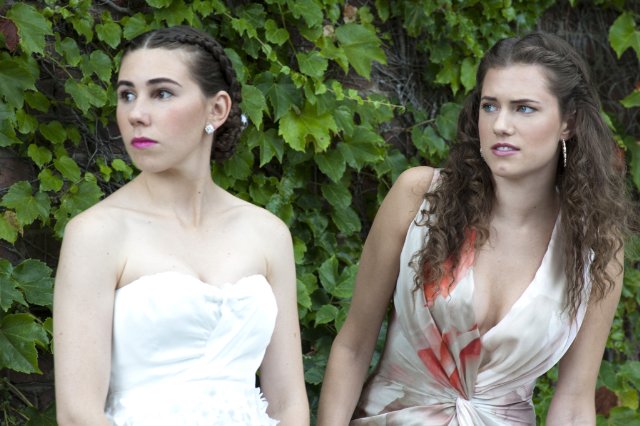
Did she ever—no matter which of the main she's on Girls you might mean. Marnie makes good on her end of her and Hannah's big fight in the last episode; uber-responsible (read: uber-controlling) to the last, she pays the rent up to the end of the month, and then she moves out, leaving Hannah to find a new roommate.

nullJessa also has a new roommate—her husband, Thomas John, a.k.a. the sad guy from the failed three-way. Apparently they went on a couple of dates; confused "new sexual partner, delirium caused by" with "lasting commitment, fitness for"; and invited all their friends to a party that's actually a surprise wedding. Everything about the event is quintessentially Jessa, from the idea that she'll mess with everyone's preconceived notions about free spirits to the "veil" that looks like she picked it out of the trash behind Beacon's Closet. Not only will the ensuing plots for Season Two write themselves (see: the months of material "Felicity" got out of this when Noel Crane married the Doritos girl), but a season-finale wedding is the perfect deus ex cake-ina for throwing characters together and stirring vigorously.

For example: Ray and Shoshanna. As predicted, Ray is really into Shoshanna; Shoshanna is really horrified that, not knowing that the party was a wedding, she dressed in white, and she's almost too preoccupied with that to overthink what she's agreeing to when Ray proposes taking her home that night. Later, in bed, Shoshanna's suffering from her usual logorrhea (observing that her aunt told her that losing her virginity felt like "scratching a sunburn" . . . wow, what?), but Ray is seemingly undeterred, and we're probably to assume that Shoshanna is relieved of her V card shortly thereafter.

Marnie, meanwhile, runs into Charlie at the wedding; he's sans new girlfriend—she's evidently live-blogging a tortilla-soup contest, or something?—and it seems like he and Marnie might go on a reunion tour together, but she isn't quite banged up enough on bubbly to go there . . . yet. The end of the night finds her draining yet another glass of champagne, eating cake with her hands, and making out with the Seth-Rogen-esque wedding emcee.

Even Elijah has moved on—to a new, older boyfriend named George, who's apparently hiding his relationship with Elijah from his homophobic teenage son. Elijah's having to live in an SRO until the kid graduates, which is the plot machination that allows Elijah to stay on the show: Hannah invites him to bunk with her, solving both their problems. (It doesn't hurt that he admits that he probably did give Hannah the HPV after all.)

But while it's a solution, it's also Hannah not moving forward, not growing up—staying stuck, facing backward. Marnie's moving out, without a plan, trying new things (or boys); Jessa's married, which is forward motion even if it's ill-considered; Shoshanna is dumping the virginity that keeps her a girl. Hannah is moving in with her gay ex-boyfriend from college, a known and safe quantity who won't challenge her. Adam has already suggested himself as the new roommate, pairing the proposition with a speech about moving on from toxic relationships without guilt, but Hannah just assumes he doesn't mean it, or that he just wanted to help. "Nobody does anything because they want to help; I did it because I love you!" he snaps.

Hannah doesn't know what to do with that information, and Adam doesn't sympathize at all, going off on her for following him "like [he's] the Beatles" for months and then giving him a "shrug" when he commits to her. The actor does a great job with a scene that, for Adam, is basically delivering an audience-proxy checklist of all the ways in which Hannah is an obnoxious, self-absorbed hypocrite: he yells that this is what Hannah wanted, and now she's not giving back. He bellows that she's pretty and a good writer and a good friend, but she doesn't believe those things about herself. Hannah tries to defend herself, to explain that she's scared, the most scared that anyone is, all the time, which I empathize with, and then Adam basically orders her to get over it, which I also empathize with. And then Adam gets clipped by a passing car, and he refuses to let her ride with him in the ambulance: "Don't let her in here. She's a monster."

The monster gets on the F train by herself.

Sarah: "Girlfriend is totally falling asleep and waking up in Coney Island with no purse, bet you a dollar."

Dirk: "No bet."

Sure enough, that's what happens—been there; walked home from that—and Hannah, who's lost her purse but managed to hold on to the slice of wedding cake, wanders out of the station and down onto the boardwalk as the light is coming up. Sunrise finds her on the beach, the Wonder Wheel behind her, sitting at the edge of the world eating cake. In a way, it's a reflection of her sitting in the bathtub eating a cupcake from the premiere—but everything's changed. But nothing has.

The finale showcases everything the show does well—which, I think, closely follows the list of reasons the show grates on people. Not everyone likes the girls of Girls, their self-absorption, their top-heavy ratio of theoretical to practical experience, their workshoppy ways of living, but Dunham and her co-writers have a perfect-pitch ear for how those people speak to and about each other. Not everyone wants to revisit the "thought we knew everything; actually knew fuck-all"-ness of their twenties, but Girls is a painstakingly researched document of that painful cluelessness.

The finale is also a great stage for the Adam character, who started out as a wince-inducingly accurate and familiar, but two-dimensional type of That Guy—dating around, waxing smug about wood craftsmanship while taking money from Grandma, not remembering where Hannah's from—and evolved into a nicely realized human being. He's also the embodiment of everything Hannah is afraid she'll never have, and at the same time that she will have—and then lose. She's still thinking like her high-school self. (And dressing like she doesn't own a mirror. I would love to know if this is intentional, because the problem is not Dunham's figure. It's that there is always always bunching. I'm just going to assume it's a character beat, because as such, it's quite effective.)

It's a strong end to the season; the writing feels confident, without the overworked or canned bits we got partway through. The show isn't for everyone, and it's about hardly anyone—and the niche appeal of/audience for what Dunham does is a legitimate reason not to watch the show or care about the characters. At the same time, though, you have to take the work for what it is. What's the expression—writing that tries to be for everyone ends up being for no one? Dunham's doing Dunham; she's doing it really well, and it's possible to hear some universals in it.

Sarah D. Bunting co-founded TelevisionWithoutPity.com, and has written for Seventeen, New York Magazine, MSNBC.com, Salon, Yahoo!, and others. She's the chief cook and bottle-washer at TomatoNation.com.

FALLING SKIES RECAP 1: WORLDS APART and SHALL WE GATHER AT THE RIVER

FALLING SKIES RECAP 1: WORLDS APART and SHALL WE GATHER AT THE RIVER

Falling Skies is back for its second season with a two-hour premiere that, as is so often the case with "special premiere events" these days, is actually two episodes shown back-to-back. So, Episodes 2.01 Worlds Apart and 2.02 Shall We Gather at the River constitute our relaunch into the post-invasion world of Tom Mason and the Second Massachusetts. It was not perfect, but definitely was tightly constructed and presented some solid science fiction in a watchable two hours..

nullIf you're just joining this series, it's not too terribly difficult to get caught up. Last season, aliens swooped in and attacked the Earth, winning the war in relatively short order through surprise and superior technology. Now resistance armies are fighting the occupation. Our hero is Tom Mason (Noah Wyle), a history professor whose knowledge of battles of the past proves useful (sometimes cloyingly so, when he rambles on about historical context) to the current situation. In tonight's Season 2 premiere, Tom's impromptu history lectures are mentioned with fond irony by people who've been irritated by them in the past, and maybe that's a sign the show will try to be a little less heavy-handed in that regard (although I really like the conceit that a history professor is useful here; history is, after all, one way to learn battle tactics). Tom has three sons, who are part of the 2nd Mass. Weaver (Bill Paxton) is the head of the division and a career soldier. Pope (Colin Cunningham) is a smart-ass gang leader who has joined forces with the division to the consternation of many, sometimes including the audience.

How the alien thing goes is this: There are nasty creatures we call "skitters" who look like giant reptilian spiders. There are big mechanical soldier types called "mechs." Teens are kidnapped by the aliens, who attach harnesses to the teens which appear to enthrall and change them. The 2nd Mass has been able to remove harnesses from two kids, both of whom experience residual effects, including enhanced physical abilities. One of the kids missed the aliens and rejoined them, the other, Tom's son Ben, hates them.

Late in Season 1, Dr. Glass (Moon Bloodgood) dissects a skitter, discovering a harness inside it. It was obvious to me at that moment that the harness is meant to turn people (and probably other beings) into skitters, but in the S2 premiere we hear two characters wondering how skitters reproduce, so perhaps it's not meant to be as clear as I think.

In addition to skitters and mechs, at the end of S1 we learn there are "overlords," essentially Roswell-style "grays." In the finale last year, Tom Mason boarded an alien vessel to negotiate with an overlord. Now you're all caught up. See? Not painful at all.

There are places where Falling Skies is not bad, specifically, but rather too corny. Tom returns to the 2nd Mass three months later, found, at random in a battle situation, by none other than his son Ben. Corny! Tom awakens from anesthesia at the exact moment that his flashbacks bring us up to the present moment. Corny! Reunions are a skosh too touching, and musical cues a skosh too moving. It's as if the writers don't quite trust that the inherent drama of the situation will entertain anyone. Which is ridiculous because: alien invasion! Earth destroyed! Children kidnapped! No hot running water!

It really is a shame because these situations do have drama, and they are largely well-played. The world of Falling Skies is a world where everyone has post-traumatic stress, and the heightened emotions of such a world do not need clichéd musical cues to deliver the goods.

Our first two hours this year are mercifully free of inspiring speeches, self-righteous prayer, and extended rumination on the Meaning of It All. Instead, there was some very strong television and exciting science fiction adventure, including some engineering trickery and Tom's journey through other parts of the U.S., which helped create real perspective on how far-reaching the war actually is, as well as a creepy alien parasite.

Creepy alien parasite! On the same day I saw Prometheus! UGH.

The creepy alien parasite (without spoiling anything) encapsulates much of what is excellent and also what is weak about Falling Skies. On the one hand: Creepy alien parasite! That is alarming. It's a shivery, oogy journey into science fiction that makes the world of the show as dark and "other" as it needs to be. On the weak side, it is simply not taken seriously enough. The 2nd Mass has both career soldiers and civilian survivors, but the civilians simply refuse to live as though, you know, there’s an alien invasion. There are always too few guards and too little fear.

Any post-apocalyptic entertainment works by showing us how much and how little we've changed, how hard the new life is and how traumatic the loss. It awakens us to what we have, stirs our fears of what we could lose, and plunges us into a fight for survival. This is true not just of Falling Skies but of The Walking Dead, Battlestar Galactica, or any number of others. When these shows succeed, they rouse all these intense feelings. When they fail, they make us feel like the end of the world is a lot like any other television show.

Deborah Lipp is the co-owner of Basket of Kisses, whose motto is "smart discussion about smart television." She is the author of six books, including "The Ultimate James Bond Fan Book."

TRUE BLOOD RECAP 2: AUTHORITY ALWAYS WINS

TRUE BLOOD RECAP 2: AUTHORITY ALWAYS WINS

You know the endlessly self-amused Nazi prick Christoph Waltz played in Inglourious Basterds? Well, someone over at True Blood casting found a prim-o Waltz-alike in the actor Christopher Heyerdahl.

nullHeyerdahl plays Dieter, a sociable sadist and Vampire Authority operative. His vampire theology monologue—shared while torturing Bill (Stephen Moyer), no less–finally gives Alan Ball, who's leaving the show this season, a chance to actually offend people.

Dieter asks Bill if he recalls what’s special about the Vampire Bible.

And we learn that what’s special about this Bible isn’t that it predates The Old and New Testament. Or that it’s the original Testament, telling how God created Adam and Eve as food for vampires and for God’s greatest creation—Lilith. 

No, what’s remarkable in this time of election year Fundamentalist fever is that God created Lilith in his image, as God is a vampire.

As Dieter editorializes, “Powerful stuff indeed!” (To view this scene, please click on the video above.)

If this episode is any indication, Season Five will indeed be powerful stuff. I’m just not even certain what genre it is anymore.

I mean, sure, there are vamps and shifters and werewolves. But Ball is also fusing the zero sum war between Fundamentalism and sanity inside large institutions, with allusions to splintering U.S. conservatism in an election year. And making no bones about it.

But there’s much more. There’s an ongoing, Andrew Sullivan-style "death of gay culture" subtext argument, an import of the main theme of Buffy’s Season Six necro-existential crankiness, courtesy the turning of Tara (Rutina Wesley) into a vampire—or as I’ll call her from now on, the Tarapire.

And at least half the show is finally showing us the Vampire Authority. Damned if their underground realm, all chrome, sleek curving plastics amid a mid-century futurism that never happened doesn’t evoke a Swingin’ 60s spy film, equal parts Phillipe Starck and Ken Adam (the master designer behind Thunderball, Dr. No, and The Ipcress File), 

At the center is Roman, the Authority himself, played by Christopher Meloni with the a brand of hyper-intense, top-dog, apocalyptic Type A times Pi machismo imported from an edgy production of Glengarry Glen Ross.

Roman, the ultimate sanguine super CEO, who loves to toss off non sequiturs like “Do you think that the whole concept of the common good is hopelessly naïve?”—which allows Eric the drollery of “I try to stay away from politics.”

But True Blood certainly doesn't.

But on to recapping. Much of this week is devoted to the Tarapire’s freak out, when she tears down down Sookie’s house.

Dying has been a really positive thing for the Tarapire—she’s very assertive (bam, there goes the fridge), has a killer deathly stare, and most of all, she doesn’t complain.

When she does snarl to Sook and Lafayette (Nelsan Ellis) that “I will neither forgive either of you,” there’s the delicious possibility that she’ll be promoted to full-blown bad guy. (To watch Tara in vampire form, please click on the video below.)

Things are going from bad to incredibly terrible for Bill and Eric (Alexander Skarsgård).

An Authority operative new to the show named Salome (Valentina Cervi) escorts them to the 60s design extravaganza I mentioned earlier, and jails them in a facility where they’re tortured with artificial sunlight and liquid silver and interrogated by sophisticated sociopaths like the aforementioned Dieter.

Over in our werewolf subplot, Alcide (Joe Manganiello) is refusing to join the pack in eating the corpse of ex-pack leader Marcus. Among the ritual diners is Marcus’s mom, Martha (Dale Dickey).

Clearly signed up for her gnarly, white thrash outlaw Sons of Anarchy appeal, and this impressively gross scene aside, Martha is a terrific addition to the cast, a gravel-voiced biker chick in her deep fifties with a worn regal vibe that fascinates.

Martha insists in several scenes that her daughter Emma, child of Marcus and Luna (Janina Gavankar), has more in common with her werewolf father than with her. This is a teaser for a scene that is astonishing, that demands you not drink fluids for you may gag or spit them up.

But right now, we’re talking Terry flashing back to Iraq and saying, “It’s coming for us.”

Will this show ever tire of crazed Iraq storylines? Can’t Terry get possessed by fairy lemurs or something, just once?

Then, a sweet cookie of a backstory is tossed to Pam (Kristin Bauer) fans. It’s a bawdy house in San Francisco, 1905. After a Campari, she hits the street. A creep tries to kill her, but in a flash Eric, in full Victorian eveningwear, kills the guy, licks the blood off his fingers and gives Pam his charm-face. There’s something oddly tentative about the show’s depiction of pre-vamp Pam, like Ball isn’t certain what he think of her quite yet. Still, that dress is a keeper. (Pam meets her maker, Eric, below.)

Sam (Sam Trammell), meanwhile, is recovering from his own wounds when Martha shows up, again insisting that Luna and Marcus’s toddler has supernatural canine blood in her veins. “She’s wolf—I can feel it!”

Are you sitting down? If not, do.

You’ll next see a scene where Jason goes to Hoyt’s mom’s, only to be rebuffed as by Hoyt (Jim Parrack) yet again as a girlfriend-fucker. And then we’re back at Luna’s house.

Suddenly, director Michael Lehmann cuts to a puppy in pajamas.

No CG, no make-up. Just a puppy in jammies. Only on True Blood.

There’s no way to follow that, but the show must go on. We end up deep in vampire Authority HQ, where Dieter is explicating that theology we started with, ending with what I assume will be the crux of this season’s drama:

That there are Vampire Bible fundamentalists who believe in a utopia where humans are farmed for food and human/vampire intimacy is blasphemy.

And there’s the Authority and Roman, who believe in “mainstreaming” and peaceful co-existence with humans.

In their secret chambers, the congress of the Authority lorded over by Meloni, dressed in the ultimate Hugo Boss-style pinstripe power suit.

Roman considers Bill and Eric, and says, “I’m in a real pickle here, boys.”

The pickle is—he needs to mete out justice to the killer of Authority member Nan Flanagan. Who Bill and Eric did kill.

Roman is the king of the mainstreaming cause, and he tells about it in detail, which is cool: I’ll listen to Meloni yell at me about a Google search for superior celery, he’s that violently entrancing.

Meloni wants to stake Eric and Bill. Bill has something to trade: the news that psycho-vamp Russell Edgington (Denis O'Hare) is alive.

Russell the anarchist psycho-vamp who would love nothing more than to destroy the Authority’s mainstreaming initiative for the sheer fun of it.  

As Meloni considers the import of this news, Lehmann cuts to Russell in a cart, his skin cracked into a thousand bloody fissures.

In true Edgington style, he licks his ruined lips. Gross! (Awesome.)

This week’s vestigial subplots:

Luna

She falls victim to Bon Temps’ most prevalent illness: unmotivated Sudden Character Reversal Syndrome. Last year, Sam became a murderous asshole for no apparent reason. Now Luna’s becoming a mean jerk, apropos of nothing.

Steve Nawlins

Steve Nawlins claims vampires for Christ. Will this dovetail with the Authority’s interests?

Jessica (Deborah Ann Woll)

Nawlins tries to buy Jason from her. Jessica says she does not sell her friends. Like, ever.

But mainly this week is owned by  Meloni’s Roman, the Tarapire, and the puppy. Good times.

Ian Grey has written, co-written or been a contributor to books on cinema, fine art, fashion, identity politics, music and tragedy. Magazines and newspapers that have his articles include Detroit Metro Times, gothic.net, Icon Magazine, International Musician and Recording World, Lacanian Ink, MusicFilmWeb, New York Post, The Perfect Sound, Salon, Smart Money Magazine, Teeth of the Divine, Venuszine, and Time Out/New York.

GREY MATTERS: Vidal Sassoon: In the Salon, In the Movies, In Life

GREY MATTERS: Vidal Sassoon: In the Salon, In the Movies, In Life

Vidal Sassoon did nothing less in his astonishing life than co-engineering the design and mindset of desire and freedom in fashion, cinema, and feminism—in ways that echo to this day.

nullIn the mid-60s, his radical, Bauhaus-inspired cuts for Twiggy and Terrence Stamp in Joseph Losey’s Modesty Blaise defined a Mod brand of cool reemerging again today in everyone from Karen O to Ladytron to Lady Gaga; the pixie cut he crafted for Mia Farrow in Rosemary’s Baby made that film all the more effective and is now being rediscovered by Michelle Williams, Ginnifer Goodwin, and Mia Wasikowska, among others; the feathered cut he crafted for Farrah Fawcett in Charlies’s Angels gave the 70s Sexual Revolution a go-to style that, when shortened, also worked for men.

By creating “wash and wear haircuts” that freed women from the tyranny of elaborate post-war styling, Sassoon caused a side effect that was his greatest effect. Women of the early 60s who got Sassoon cuts were no longer spending a huge portion of their discretionary earnings and spare time on the salon, and so, simply in terms of dollars, cents, and time, feminism became that much more logistically possible.

And so I feel as if this amazing history is in danger of being lost when I realize that when people think of Sassoon, they think of superior hair products. In fairness, though, he also created that industry.

Me, I first “met” Sassoon entirely by accident of need.

When Lizzie E. came up to me at high school’s end and asked how I was going to support myself until my band got signed, I was like,  “I have no idea.” When she asked if I wanted to go to beauty school, I said,  “Sure. Why not?”

But beauty school was lame, all boring rudimentary cuts, color, curling iron work, and such. Until The Twins showed up.

The Twins: two impossibly suave young Latino men in Armani suits with hair like Al Pacino in Serpico. They may have had names, but I never learned them. They didn’t talk much. They cut.

The Twins had been to Vidal Sassoon Academy. This was the late 70s. Everyone knew all about Vidal: he was a living media presence in the process of creating that idea, too. Think Tim Gunn but younger, ludicrously cool in his Pierre Cardin suits, and also a mensch.

nullAnyway, at school, students lined up daily as the Twins executed precise Sassoon-style versions of a Ziggy cut, a Bryan Ferry asymmetrical, a pixie, and the Master’s other contribution, the bob.

Everyone came out of a Twin session changed. Happier. More confident. More cool and more themselves at the same time.

I wanted a Twins cut! But I was also only 17 and seething with a crippling sense of how little I deserved such fine things, in part a side effect of the bipolar disorder percolating in my head.

So I just watched.

All very nice, but this is a film blog! Yes, but film and fashion are always absolutely intertwined.  

To explore what I mean by that, you have to ask, and also know: What is a haircut about? You. If you’re in the Marines, for example, it’s about erasing your identity with a buzz cut ten thousand other women and men have, so as to become an interchangeable part of a unit.

A haircut is also code. It’s Audrey Hepburn's hair in Breakfast at Tiffany’s (1961), signaling in streaked hair-color semaphore that she’s a very new sort of girl, an idea and look Gloria Steinem promptly appropriated and repurposed as an act of playful post modernism, whose referencing of Tiffany's was a hidden-in-plain-sight rejection of the top-down, patriarchal conservatism that institution stood for. And all while looking devastatingly chic.

This is all because of an irrefutable bottom line: hair is the most telling human visual tag after skin color. It’s the thing people remember. And that's why when profiling a perp, after race, a cop will ask what color hair, what style, how long, etc. Because everyone remembers that. It’s probably a tribal thing, engrained on a DNA level.

Until Sassoon, post-war America conservatism recognized the threats inherent in hairstyle—sexuality, individualism, personal agency—and quashed them.

A salon visit—and you sometimes needed multiple ones per week—meant enduring having your hair chemically burned with harsh, primitive perm, bleach and color concoctions, then soaked in gum, methylparaben, gelatin, cornstarch-based based adherents, before being wrapped in scalp-tearing curlers. The client was then stuck under burning hot driers for hours on end before having the hair—now decimated tissue resembling burnt wire—tortured into halo-like shapes held together by industrial-strength lacquers.

nullAt this time, the ‘50s and early 60s, nobody looked at hair and thought: Bone structure! Bauhaus! Geometry!

Nobody asked: How can I enhance the way this woman naturally is, instead of warping her into something she’ll never be?

Sassoon did.

Sassoon, who was born in 1928 into such dire poverty that his single mother was forced to send him to a Jewish orphanage, who later joined the Israeli Defense Forces to fight in the 1948 Arab Israeli War, who then, at his mum’s insistence, got in the hair trade, ran a regular salon for a while until he just had it with things as they were, the sheer cruel, ugly oldness of it all.

He threw out the hair driers, the perms, the chemicals, everything but his trusty sheers.

Word spread like wildfire. Some madman was cutting hair based on bone structure, and geometry, and then letting women just leave the salon! No setting! No lacquer. Just beautiful, healthy, shiny hair. Hair he encouraged women to run their fingers through.

nullHollywood came calling: their new, post-war Chinese sex symbol in the making, Nancy Kwan, needed a look. Vidal created a luscious, cascading bob for Kwan for The World of Suzie Wong (1960). The Beats appropriated it, every present-day hipster girl has had one at least once, and actors like Tilda Swinton, Cate Blanchett and Charlize Theron look especially good with one.

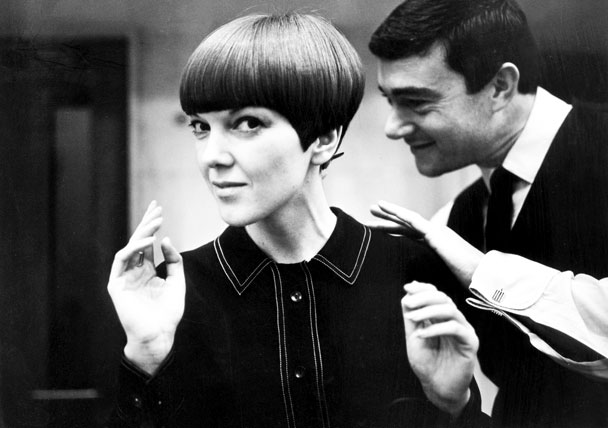
But Sassoon’s eureka moment came in 1964. It was the five-point cut. It was a radical, Bauhaus-inspired design that practically screamed the end of an era and the start of something new.

Craig Teper’s recent gold standard documentary, Vidal Sassoon: The Movie, gets inside the mind of a man who’s known pretty much every way a person can live, and from that experience came a well of empathy that fueled designs that could have been cold or detached or, god forbid, ‘arty’ (and so dismissed.) He could think of hair as a fine artist, as a businessman or, as we’ll see, a method actor. In the film, Sassoon tells his greatest hits in an alternately incarnational/imperious/impish vocal style that’s another pleasure.

nullThere’s the tale of Rosemary’s Baby (1968), where Roman Polanski desperately needed his hero to have a visual signifier of motherhood in crisis that would capitalize on both the rush and anxiety accompanying the first wave of feminism.

He called Vidal. The cut Sassoon delivered for Mia Farrow was short, but feminine. Angular, but not overtly weird. The effect was a triumph of style-based foreshadowing: the idea that this woman would give birth to Satan’s child was totally believable to men—just look at her haircut! American women, ironically enough, wanted to look like Rosemary, and they all flocked to Sassoon-trained stylists.

If I have one complaint with the film, it’s that it’s too humble. Another incredibly important cut, the one worn by Sassoon client Jane Fonda in Alan J. Pakula’s boundary-breaking Klute, is a study in, shall we say, influence. That cut is the missing link between the geometry of the 60s and the flow of the 70s, eventually migrating to the heads of Suzie Quatro and Joan Jett and a good many of the lesbian bars my friend Lizzie E. would hang at.

But his greatest achievement will always be a side effect of the wasted time and money his cuts returned to women. The quarterly perm, the monthly color retouch, the monthly cut, the once, twice, thrice roller/set/comb-out/styling sessions. All of them replaced with one haircut every two or so months.

Without that boon, feminism would have been incalculably harder to pull off.  Or as Vogue’s creative director Grace Coddington, a one-time model who enjoyed the original five-point cut, has said, "He changed the way everyone looked at hair . . . and it liberated everyone."

Me, I never got my hair cut by The Twins. But my band did get a record deal, and the guy who cut my hair was, by incredible good luck, the haircutter for Bryan Ferry, once and future king for all things cool beyond measure.

And, of course, that haircutter trained at Sassoon’s.

null

Ian Grey has written, co-written or been a contributor to books on cinema, fine art, fashion, identity politics, music and tragedy. Magazines and newspapers that have his articles include Detroit Metro Times, gothic.net, Icon Magazine, International Musician and Recording World, Lacanian Ink, MusicFilmWeb, New York Post, The Perfect Sound, Salon, Smart Money Magazine, Teeth of the Divine, Venuszine, and Time Out/New York.

SIMON SAYS: Pure Ideas: Dropping Science (Fiction) with EXTRATERRESTRIAL Filmmaker Nacho Vigalondo

SIMON SAYS: Pure Ideas: Dropping Science (Fiction) with EXTRATERRESTRIAL Filmmaker Nacho Vigalondo

null

Nacho Vigalondo’s films are about ideas. The Spanish filmmaker's two recent science fiction films, Timecrimes and Extraterrestrial, suggest that the drive towards scientific discovery or self-discovery doesn't need to be motivated by personal reasons. Vigalondo also makes the best contemporary high-concept science fiction movies. Timecrimes is a time travel thriller, and Extraterrestrial, his equally worthy 2011 follow-up, is an alien invasion story. At the same time, Timecrimes's story also concerns a struggle between free will and determinism; Extraterrestrial is also a romantic comedy about two people who slowly learn to make the best of their lots in life.

Extraterrestrial is especially striking since it's not about aliens' actions once they've arrived on Earth, but rather the actions of two characters who have elected to hole up in an abandoned apartment building after a UFO arrives. Our heroes never directly make contact with the aliens; Extraterrestrial isn’t about first contact. Instead, Vigalondo’s latest shows two indecisive, amoral protagonists reacting to extraordinary circumstances. 

I sat down with him this Tuesday to talk about the philosophy of time travel, Primer, Stanislaw Lem, and Red Planet Mars, among other things.

I know you’ve said before that Extraterrestrial is sort of an unconventional alien invasion film, unlike [Steven Spielberg’s] War of the Worlds, because your characters can’t see everything that’s going on. When you set out to write Extraterrestrial, what else did you set out to do?

Nacho Vigalondo (NV): I think that significance in your films comes from the movies themselves. Directors don’t always need to be aware of everything they’re doing. For example, when we talk about science fiction films from the ‘50s, we don’t know that those movies were cathartic expression—sorry for my English. When I speak about abstract ideas, it becomes complicated even in Spanish. [laughs] But those movies in the ‘50s talk about global fears about the war, about the unknown, about the others. Communists, for example.

Those films give symbolic expression to that fear. But those filmmakers were not aware of that. So I always try to let my movies talk instead of me. I think my movies have more interesting things to say than I do. So when I’m writing, I try to ignore my motives. When I started to write Extraterrestrial, my first idea was, “Ok, what if we were to tell an alien invasion story from the point-of-view of normal people instead of the heroes, people who would be occupied with everyday things?” That would describe most of us. If you have a toothache, and the end of the world comes, you still have a toothache. So you’ll be desperate for painkillers. So: “What if we talked about this big event from the point-of-view of people who are just waiting for things to happen, who are just waiting for things to be solved by someone else?”

That’s a little childish, I think. It’s a way to amuse myself when I write this sort of thing. But then, I let my movies talk about something else, which is more important. For example, in Timecrimes, what I wanted to do is prove to myself I was able to write a time travel story in which everything happened in real time, and the killer, the instigator and the victim are the same [person]. So I think of those stories as formal challenges.

But later, I found out that both movies are about guilt as well as the feelings you have when you find out you are the other. In both movies, the main guy realizes that he’s not just a good guy, that maybe he’s “the other.” So I feel it’s important, in any art, to let your body of work speak for itself. That’s a religion to me. Movies are more intelligent than their directors. I promise you that that’s the case with me.

Well, that’s also true of viewers and your films. When I was rewatching Timecrimes, I noticed new things that I missed the first go-around, like the way that the main character’s wedding ring is constantly emphasized. So at the end, when he talks to his wife’s hand, it’s sort of a re-affirmation of their relationship. Although at the same time, that gesture is, after the film’s grueling events, almost like a way for the character to silently say, “Well, I accept the fact that there’s only so much I can change in my life. Time to exhale and move on.”

NV: They’re looking up at this dark sky and don’t know what will happen next.

Right. I didn’t remember the ending of Timecrimes, so while I was rewatching it, I was debating with my roommate [Bill Best] whether or not the film was in favor of determinism or individualism. And he was insisting that it was definitely not an individualistic movie, and then I saw the ending again and I thought, “Oh yeah, it isn’t.”

NV: [laughs] This is one of those nice interviews, where you prefer listening to answering.

And in Extraterrestrial you start from the premise that everyone’s gone, so all that’s left for the main character to do is hunker down in an apartment and just move from there with a limited amount of options. So it’s not about the fact that aliens have invaded: that’s a given. The spaceship is in the sky, we can see it. What happens next isn’t even a matter of waiting for people to do something—it’s waiting for this guy to do something. By comparison, since you mentioned ‘50s science fiction movies, I have to ask: have you ever seen the movie Red Planet Mars?

NV: Hm. Sometimes the title gets changed in Spain. Red Planet Mars?

It’s a film based on a play where a radio signal is emanating from the far side of Mars, and people think it’s the voice of God.

NV: Oh, I haven’t seen it. I would remember that, definitely! [both laugh]

The idea is that the Americans and the Russians are competing to find the source of the transmission. And ultimately there’s a complicated conclusion where they find out it was a Russian plot the whole time. But wait, no, it wasn’t the Russians, it was the Americans pretending to be Russians. But then they realize, oh wait, it was God, after all. So ultimately, it’s just people figuring out that however much they think they’re in control, they’re really not.

NV: Oh, great! Who made this film?

I’m not sure…

NV: Because it really sounds like Stanislaw Lem, the guy who wrote Solaris. I’ve been reading this guy all my life, because he’s writing about conspiracies in which, after a certain point, characters have to assume they can’t know what’s going on. And I wanted to take this feeling and put it in Extraterrestrial, in a comical way. In my film, one character says, “Well, why are you here?” And the other replies, “Well, we haven’t thought of that.” That’s a metaphor for the script itself, and it’s something I wanted to play with consciously.

The latest Lem novel I’ve been reading—I’m not sure if it’s been translated into English—is called Fiasco. In it, we find evidence of extraterrestrial life in the universe, and they are expecting us to do something. We react, trying to communicate, but the nature of both civilizations is so deep that we are not able to communicate with them. We don’t understand them, and they will never understand us. It’s not because the language is different: the nature of the language is different. What if we realized that rocks were secretly alive, but we were not able to talk to them? Or we don’t get their references or the way we ordinate reality is totally different? I love when science fiction gives us the chance to look at ourselves as human beings. Instead of picturing ourselves as conquerors or limitless beings, we are just humans, and we have to face the fact that humanity has its limits. I love that, and I wanted to work on that in a different way in Extraterrestrial.

That’s interesting since there’s a rumor that you’re working on a film adaptation of a comic book written by [Kickass and Wanted co-creator] Mark Millar, called Supercrooks.

NV: Not exactly an adaptation, because we wrote the script together. In fact, the comics’ script and the screenplay were made in the same location. So at the end, I appear as a co-plotter. Our collaboration was really intense and one of my best professional experiences ever.

But while your stuff and his have cursory thematic similarities—they both ask how a “normal person” would behave under extraordinary circumstances—your characters are much more indecisive. Your characters are much more amoral than immoral.

NV: One thing I’ve noticed is that when Mark writes comic books, even when it’s just a Marvel comic like Wolverine or Fantastic Four—I have a theory. I’m not even sure he’s aware of this; it’s his nature as a writer. I’m not sure that he’s working on this in a conscious way. But every time he picks a character, he lets us intuit what the darker side of his characters are. So when we see the Fantastic Four in a Wolverine comic, the way you perceive the Fantastic Four is so dark. It’s not in a nasty way; he’s not being a punk writer to them. But you can guess—I don’t know, I’m being a bit crude now, but you can guess that there’s no sex life between Mr. Fantastic and the Invisible Woman. That’s nothing explicitly said but it’s something you can feel based on the kind of relationship they have. He’s too into his job and she feels invisible in many ways.

To get back to your movies: what’s interesting about these two films is that, while they’re science fiction films through and through, they’re also high concept.

NV: I really like to push for a starting point that feels striking and surprising but I don’t like the idea of making a movie that is just a high concept. For example, in the case of Extraterrestrial, the starting point is a mix of two genres that are apparently incompatible[: science fiction and romantic comedy]. But that’s the way it’s going to be described from this point. So we try to work every sequence in a way that we can forget about this starting point.

As in Timecrimes, I wanted everything your intuition says will happen at the end of the movie to happen in the middle. I want to work with audiences on that level. I want to take their hand and push them into different directions they were assuming the movie would take. So for me the idea of high concept is attractive but I don’t want to feel comfortable with that concept.

Not many people are making science fiction without a big budget. Horror movies are prolific because filmmakers know that they can do that on a low budget. But making a low-budget science fiction film is—not many people are doing it.

NV: That’s because science fiction films have become related with production values. Even B-movies from the ‘50s and ‘60s, most of the time they were trying to fake production values in their trailers. So that was the thing that always—sorry, two steps back. I feel sometimes, when I’m talking in English first thing in the morning, like I’m Danny from The Shining when he’s inside the labyrinth and he has to walk backwards [laughs].

But I think if you’re a true science fiction fan, you read novels. Because there aren't so many science fiction movie masterpieces. But if you read science fiction authors like Stanislaw Lem or Philip K. Dick, you’ll realize that science fiction is based on ideas, not descriptions of planets or other civilizations, but pure ideas. In fact, I’m not really sure science fiction is a genre. That's something I love to talk about. Because most of the time, people think science fiction is a genre. But a genre is based on rules, and there are no rules in science fiction.

There are rules in the western, in the crime movie and some horror subgenres. But in science fiction, you don’t have rules. The only rule in science fiction is that you can take ideas to the edge in many ways. You can say I have made two science fiction films, but I have also made a giallo and a romantic comedy. In a common romantic comedy, if you want to lie to someone else, you have this set of lies you can play with. But if there’s a UFO on the horizon, you can say, “Maybe this guy’s an alien?” It’s like giving new truths or new artifacts to a character in a Billy Wilder comedy.

I was recently thinking about the western and how it goes from the classical period to the spaghetti western to the acid western. And the further you go, the more the genre’s rules and tropes become decontextualized. Do you think that in science fiction, contemporary filmmakers just don’t know how to push and break down those ideas? Put another way: have you seen any contemporary science fiction films whose ideas have really impressed you?

NV: Yeah, but I’m not going to surprise you. I think the titles I’m going to give you are the titles you already know.

Go for it.

NV: For example, when I was writing Timecrimes, Primer had just come out. And I was horrified because the shape of the movie was close to mine. But then I saw it, and I saw that it was totally different. But I love the fact that in that movie, there’s no melodramatic implication to the fact that they’re going back in time. There’s no human impulse rather than the excitement of the scientific experiment itself. So you’re not going back in time to save the world, and you’re not going back in time to save the girl: you’re just scientific. I really liked the idea of applying that scientific impulse to the film. I like this film and I even really like an older film like Silent Running.

Oh, I love Silent Running!

NV: What’s amazing about that film is that it runs on ideals. In most movies, filmmakers tend to be universal through the intimate human experience. So it’s easier to tell a story where you’re going to protect your wife than wanting to protect a forest. It’s an unusual film in that the main character is pushed by pure ideals.

What comes next for you? Is Supercrooks filming…?

NV: At this moment, my next film is going to be called Windows. It’s a movie I’ve been developing for a couple of years. In fact, Windows is going to be like Timecrimes in so many ways that I decided to make Extraterrestrial first to prove to myself I can push a different button. Because those two movies—Windows and Timecrimes—are like narrative labyrinths in which, on every page of the script, you find another little twist. The nature of what we’re telling is changing all the time. It’s really plot-driven. I wanted to make something that was totally the opposite of me, so I made Extraterrestrial. I was trying to fight against myself.

And Windows is going to shoot this October, if everything goes well. I wish the casting were finished, so I could tell you about that, but we’re doing the negotiations right now. It’s going to be a really special thriller again in the Hitchcockian tradition. But this time, I really had Brian De Palma on my mind. I don’t want to make explicit references in my films because I want those references to be felt, not told. So if I had in my Vertigo and Psycho all the time while making Timecrimes, the movie I had in front of me for Windows is Blow Out.

Oh my God.

NV: So it’s a movie with an erotic element, and a chase element and the tricks with perception of the characters—it’s really in front of you all the time.

When you said “De Palma,” I was hoping you’d say, “Body Double.” But still.

NV: But you know, Body Double is too Timecrimes for me. I saw Body Double when I was making Timecrimes, and I thought, “This is the movie I’m making now: one guy falls into a trip, there’s an erotic impulse that is manipulated, and this guy has to move from his house to another place, but it’s a trap. Timecrimes is the same kind of film, except that the bad guy is also the good guy. But it’s the same kind of trick. It’s the same bait in both films.”

There will also be a lot of technical tricks in Windows that are going to make it really special. It’s not a found footage film but . . .

Oh, thank God.

NV: But I’m going to play a different game. I’m not going to fake a camera . . .

Oh, thank God.

NV: But I love found footage! Some of it’s good. I was so amazed when I saw Chronicle recently. When you see people flying in that, it’s like you’re seeing people flying on film for the first time. So I find it weird. People tend to criticize the movies, not the tool. And I think found footage is just a tool. This is not a found footage film. But I’d love to use found footage someday.

Simon Abrams is a New York-based freelance arts critic. His film reviews and features have been featured in The Village Voice, Time Out New York, Slant Magazine, The L Magazine, The New York Press and Time Out Chicago. He currently writes TV criticism for The Onion AV Club and is a contributing writer at the Comics Journal. His writings on film are collected at the blog, Extended Cut.

Art That Speaks to Everybody: A Father and Daughter Chat About E.T.

A Father and Daughter Chat About E.T.

[Editor's note: The following is an iChat between Press Play founder Matt Zoller Seitz and his daughter Hannah, a film student, about Steven Spielberg's E.T., which was released 30 years ago this week. It is the most recent installment in a series of dialogues about popular culture; earlier pieces discussed Cinderella, Fantasia and Harry Potter vs. Star Wars.]

Matt Zoller Seitz: Do you remember the first time you saw E.T.? Wasn't it during the 2002 rerelease when you were not quite five?

Hannah Seitz: I don't remember seeing it for the first time at all. But I do remember that when I saw it for the second time a couple of years later, I had no memory of the scenes where the government interferes and E.T. is dying. Was that because I was so traumatized during those scenes the first time?

Matt: Maybe you blocked it out?

Hannah: Maybe. Do you remember me not wanting to watch it at that point? In my mind there was a blank spot between the point where E.T. and Elliott are in the bathroom and the mom comes in, and then the part when Elliot sees E.T. come back to life.

Matt: I don't remember your not wanting to watch that part of the movie when you saw it for the first time, but I do remember you bursting into tears during the scene where the older brother finds the pasty, sickly E.T. lying in that drainage ditch. You were fine up to that point.

I am always a bit surprised by the length and intensity of all the medical stuff near the end. Steven Spielberg really twists the knife. It's like the scene in Dumbo where Dumbo goes to visit his mother in the iron cage. Or the "death" of the Beast in Beauty and the Beast. Stanley Kubrick used to say that he didn't like Disney movies because he thought they were cruel to children, and I don't think he was necessarily wrong in that description. But fairy tales are often cruel, or unrelenting, and we do want to feel things very intensely when we experience art. Some excess seems forgivable when a work is really, really cooking, in the way that E.T. cooks all the way through. It's operatic or symphonic. It's so powerful that it gives me the kind of feeling that I think you're supposed to feel in church, but that I never felt there.

Hannah: I haven't seen E.T. in a while, and this was the first time I really watched it as a film. I always knew it was a great story, but the lighting in the movie and the music really did give it a symphonic feel.

I also noticed an insane amount of religious or spiritual-like imagery. I know the most famous one is when E.T. comes out of the truck wearing the robe with his heart glowing in his chest, but I noticed a lot more shots than that one.

Matt: Such as?

Hannah: One of my favorites is when the brother and the sister first meet E.T. and they're in the closet. They're all kind of peering at him. There's even something in the background that looks like a stained glass window. Then it cuts to E.T., and he's encircled by a bunch of stuffed animals that look like they could be his disciples or something. 

Matt: I hadn't even thought of those images in that way, but you're right.

That closet, which is really E.T.'s sanctuary or home, is a sacred place, part womb and part cave of contemplation. It's almost a geographical metaphor for what happens when Eliott invites him into his life. There is nothing more intimate than inviting somebody you don't really know into your room. And since Eliott's closet is the place where all the toys are stored, the symbol of the childhood innocence that Eliott is still clinging to, it's as if the boy is inviting the alien right into the center of his personality, into the deepest place.

When the devout try to bring somebody into their faith, they often couch it in terms of an invitation. Invite God into your life, let Christ into your heart: that kind of language. Spielberg and Melissa Mathison, who wrote the screenplay, are brilliant at encoding that into the images.

Hannah: I love that scene where E.T. is listening to Elliott's mom reading Peter Pan to Gertie. E.T. is a great character because it's easy to look at him as a figure of wisdom, considering he's super-intelligent. But he's also very childlike, in the sense that's he's very curious and forms attachments easily.

I think that's one of the beautiful things about Elliott's connection with E.T. When Elliott first meets E.T., he doesn't immediately think of him as a higher, more intelligent species that needs to be studied, like the scientists and government workers do. As soon as he meets E.T. he begins to show E.T. around, and he doesn't immediately question what E.T. is or where he came from. And when Elliott does inquire about E.T. and what he's capable of, he does so in a very innocent and non-pushy way.

Matt: Spielberg is a humanist filmmaker, one of the greats, and you can see that come through in the way that he depicts the meeting of different cultures or even species. E.T. and Eliott's relationship is founded on open-mindedness and mutual trust and empathy—as Michael tells one of the researchers near the end, it's not that Elliott thinks what E.T. thinks, it's that he feels what he feels—and that's why they have such a strong and pure friendship, so strong that you can't even classify it.

At various points E.T. is like a mentor to Elliott, the dad that he recently lost to divorce, a friend, an older brother, a younger brother, and a pet. And towards the end, when the full extent of his power is made visible, he becomes angelic or supernatural. And at every point Elliott goes with the flow and accepts wherever the relationship is going. The reverse is also true, of course. Both characters change in relation to one another depending on what's happening in the story.

Communication might be the most important theme in Spielberg's filmography. Close Encounters, E.T., Amistad, Munich, pretty much every one of his films contains one or more scenes of different beings learning to speak to each other, and discovering they aren't as different as they thought.

Hannah: The idea that E.T. has a power that allows him and Elliott to feel each other's feelings is very metaphorical of friendship. In the beginning of the movie, Elliot makes the mother cry by saying his father is in Mexico with some woman named Sally. Michael says, "Dammit, why don't you just grow up! Think about how other people feel for a change." When E.T. comes along, Elliot is really forced to grow up by feeling E.T.'s emotions. He has a deep mutual connection with him, and towards the end it's clear that Elliott has matured a great deal, and made sacrifices as a result of being so connected to E.T.

Matt: Yes. There's a wisdom in the boy's face during that final shot that wasn't there at the start of the film, and all the changes have come about organically, as a result of his living through these extraordinary events.

Hannah: I also love how it portrays the government workers. Although they are the antagonists, the movie doesn't necessarily portray them as evil people who only want to harm E.T. They are, after all, trying to keep him alive. They aren't coldhearted people. They just don't understand how E.T. functions, like Elliot and his siblings do. In a way, their ignorance is really what drives their role as antagonists.

Matt: That's true.  

Hannah: It always sort of gets to me when Keys is talking to Elliott at the end and he says, "He came to me too, Elliott. I've been wishing for this since I was nine years old."

Matt: As you read more about film history you may eventually come across articles about Spielberg that were written in the '70s and '80s when he first became a cultural force. He was described as being culturally very conservative for a young Baby Boomer, and in some ways that's true. But the optimistic way he depicts human understanding, and cosmic understanding, is very much in tune with hippie values. He's a lot more countercultural in his worldview than some of the overtly counterculture filmmakers. He really believes people can make up their minds to be good, to do the right thing, to overcome ignorance and build bridges, that war and violence is rarely necessary, and so forth. All the stuff that modern popular culture tells us is for suckers, Spielberg actually believes in. And I like that about him.

Are there any particular things you noticed about the tone or style of the movie, the way it moved and looked, that spoke to you?  

Hannah: The lighting. Every shot in Elliot's house was lit in a way that represented the content of the scene. A lot of the lighting felt very eerie, or sometimes kind of quiet and lonely.

But it didn't make itself too obvious. The house still felt very real and homelike, no matter what the lighting was. I think the house itself was also one of the best features of the movie. Like you said, it was sort of a temple to innocence and childhood, which was a very magical environment for E.T. to be in. Also the layout of the house felt real and comfortable, not like most Hollywood movies where homes are well furnished and spotless.

Matt: With whom did you identifying with when you watched the movie this time? I ask because when I re-watch movies I've seen many times, my point of view changes.

When I was a kid I used to identify with Elliott, then after a certain point I started to feel more of a connection with other characters, probably because I was maturing. I went through a phase where I would imagine what this experience must have been like for E.T. This time, though, I thought about Mary, the mom. The way she was always emotionally wrung-out and kind of distracted really spoke to me as a single parent. When you're in that situation it's completely plausible that an alien could be walking around behind you in a bathrobe and you wouldn't notice.

And this time I was with Michael, too. The moment where he goes into Elliott's closet and curls up in a corner looking at all the toys and stuffed animals destroyed me.   

Hannah: I can't really say whom I connected to. I'm really bad at answering that question. I'm really not the type of viewer who connects to the characters.

Matt: What kind of viewer are you?

Hannah: I don't know. I don't really connect to characters, like, throughout an entire movie. When I do feel emotionally connected, it sort of just jumps out at me in a particular moment or scene.

I'm a film student now, and although I don't like to admit it because of my high school freshman finicky-ness about the future and careers and such, filmmaking or writing may possibly (emphasis on possibly) be something I want to do with my life. When I write, I usually write about realistic characters and situations, and I would say I'm pretty good in that field. So it was a weird experience watching this movie last night, because after it was finished and I had soaked it all in, I just felt this weird surge of jealousy. Art is made to affect and speak to people, and generally when it does so, the audience is limited, be it by age, ethnicity, gender, etc. I think it's one of the most amazing things in the world when you can create a piece of art that speaks to everybody. E.T. really is a timeless movie that you can enjoy when you're a little kid and appreciate just as much when you're on your last legs. It's really an incredible thing to be able to make something like that.

Five Great Moments of Dramatic Irony in MAD MEN

Five Great Moments of Dramatic Irony in MAD MEN

Before postmodernist self-reference, there was dramatic irony: a little wink from the writer that acknowledges the audience. It's not just that we know something the characters don't. It's that the writer knows we know. This common soap-operatic device lets the audience in on secrets bound for explosion: adultery, murder plots, or the revelation of a child's real parents. Mad Men is more subtle in its use of dramatic irony. Because the show is arguably one long character study, it's not as interested in plots that go boom. Instead, dramatic irony often helps to flesh out the characters involved by demonstrating how they react to situations and adding texture to a scene. Don's real identity, for example, is something that we and certain other characters know about. But his reasons for keeping the secret are treated with more significance than the possibility that anyone else might find out. When the truth is occasionally exposed, the reactions are restrained. Case in point, Bert doesn't even care. Even the scene with Betty lacks melodrama. After five seasons of solid storytelling, here are five of Mad Men's greatest moments in dramatic irony. There were many to choose from, so if your favorite isn't here, tell us about it in the comments.

He's from Europe – "The Jet Set" (S. 02)

The set-up: In the break room, Sal, Joan, Harry and Ken tease Kurt and Peggy about their pending "date" to the Bob Dylan show. To clarify things, Kurt casually tells everyone he's gay. The room goes silent.

Why it's great: There's a bit of a Kuleshov effect that pits Sal's reactions against everyone else's. Peggy brushes off the news, hiding her disappointment. Ken's face literally falls. Joan blushes. Harry serves up slapstick stupor with a piece of donut still lodged in his cheek. And closeted Sal cautiously holds back, waiting to see how disgusted his colleagues will be, or perhaps how much they can tolerate. Piercing the quiet shock, Kurt looks to Peggy, tells her "eight," and pours himself a coffee. Sal is incensed, then dejected. What he works so hard to conceal is something Kurt can put bluntly without breaking a sweat. Kurt and Peggy leave, and the remaining colleagues let their homophobia loose while Sal forces himself to smirk and chuckle in all the right places. This short scene goes from funny to tragic so quickly.

Who would've liked to be there: Kitty Romano, poor thing.

The Promotion(s) – "Out of Town" (S. 03)

The set-up: Having just laid off Burt Peterson, Sterling Cooper's Head of Accounts, Lane Pryce first tells Pete he's been promoted to the position, then tells Ken the same thing, separately. Neither immediately knows they've just gotten the same promotion. Believing they're about to be the other's boss, they exchange loaded pleasantries on the elevator as they head home.

Why it's great: Pete and Ken have been neck and neck for years. On the surface, this conversation has all the trappings of a ceasefire, with a few notes of relief. They commend each other on their strengths, but you have to wonder if there are actually no hard feelings or if the cordial banter covers up each man's plans to fire the other. After all, these niceties are challenged only a few scenes later when Pete and Ken realize they're co-heads.

Who would've liked to be there: The usually impotent Lane would have enjoyed the power this scene attributed to him. Roger would have appreciated its humor. Bert (Cooper) would have relished this prelude to a good old Randian bloodbath.

Betty Knows Dick – "The Gypsy and the Hobo" (S. 03)

The set-up: At the time that this episode aired, viewers had had a good week to process Betty's discovery that Don was really Dick Whitman, and that he'd been married before. She does nothing about it until 25 minutes into "The Gypsy and the Hobo." During that time, she's played the dutiful wife at Sterling Cooper's anniversary party, endured nights alone which she suspected Don was spending with a new mistress, and had a fruitless conversation with her family lawyer. When Betty confronts Don about his past, the conversation takes hours in their narrative, and 14 minutes in real time.

Why it's great: What really cements the tension in this lengthy scene is the fact that Suzanne, Sally's teacher, is waiting for Don in his car the whole time. They're planning a romantic getaway, and she's crouched down in the seat to avoid being seen. While we're thoroughly immersed in the Don and Betty showdown, we can't help but remember the Suzanne loose end, and it makes us uncomfortable while watching the scene. Don demonstrates the depth of his disregard for others. He never considered how Betty might react if she discovered he'd hidden his true identity from her for so long, he's defensive when she calls him on it, and he completely forgets about the mistress in the car. When Don and Betty are done, he doesn't check up on Suzanne. He puts on his pajamas, brushes his teeth and goes to sleep. Come to think of it, that sort of negligence is what got him here.

Who would've liked to be there: It would make pragmatic sense to say Suzanne. But for sentimental reasons, I vote for Adam Whitman.

They Were On a Break – "Chinese Wall" & "Blowing Smoke" (S. 04)

The set-up: On the heels of losing Lucky Strike, Don begs his girlfriend and SCDP psychological consultant Faye Miller to help him poach clients. Furious that he would cross that line, she storms out. A few days later, Don has a tryst with his secretary Megan. Immediately afterwards, he goes home to find Faye waiting for him, ready to give some names.

Why it's great: It seems Don thought things were over with Faye, but if he were more skilled at relationships, he would have known it was just a fight. When he thanks Faye for eventually ceding, you can tell he feels some guilt, an emotion he never reserved for Betty. That audience-only awkwardness returns in the next episode when Faye and Don are discussing cigarette companies in the boardroom, and Megan is framed between them. You almost expect her to stop working, look up and yearn. Later, when they make a dinner date, Faye says to Don pointedly, "tell your girl to make reservations." She's an observant lady. Has she noticed any inappropriate lash-fluttering?

Who would've liked to be there: Let Peggy have this one.

Business At a High Level – "The Other Woman" (S. 05)

The set-up: Jaguar dealer Herb Rennet says he'll happily support SCDP's pitch if Ken and Pete arrange to have Joan spend a night with him. Ken assumes it's the end of the road with Jaguar. Pete thinks it's just the beginning, propositioning Joan and then the partners.

Why it's great: There are so many converging motives in this story, and no one completely comes clean, all to Joan's detriment. Pete uses Joan's open-ended refusal ("you couldn't afford it") to make it sound like she wants to negotiate pricing. Roger begrudgingly agrees to the dirty deed so long as he doesn't have to pay for it, still bitter that Joan snubbed any financial aid towards their son. Lane convinces Joan to ask for a partnership with a 5% stake instead of a lump sum, cleverly covering up his embezzlement. And Bert wants Pete to tell Joan she can still say no, but that information never gets to her. Though Don eventually tells her not to go through with it, when we revisit that heartbreaking scene, we realize it's too late. Pete orchestrates this whole affair with well-timed half-truths, and it works because he banks on everyone else prioritizing their own agendas over Joan's.

Who would've liked to be there: Ken, who even told Peggy that Jaguar was a lost cause.

Honorable mention – Love Among the Ruins (S. 03) Roger settles on the date of his daughter's wedding: November 23, 1963.

Olivia Collette is a writer based in Montreal, which means she knows (someone who knows) Jessica Paré! She's contributed to Roger Ebert's Far-Flung Correspondents, The Spectator Arts Blog, Sparksheet and others. Olivia blogs at Livvy Jams and The Scrawn.

VIDEO ESSAY: A Death Foretold: Foreshadowing in MAD MEN

VIDEO ESSAY: A Death Foretold: Foreshadowing in MAD MEN

This video essay and its accompanying text also appear today on Vulture, the blog of New York Magazine; the staff of Vulture asked Press Play's editors to contribute a piece on Mad Men, and this was the result.

[Editor's note: this article and the accompanying video contain spoilers for all of season five of Mad Men. Read or click at your own risk.]

Now that Mad Men has drawn to a close and we prepare to spend the rest of the summer looking back on a particularly dense season, we can reflect on all the clues that led to one of this year’s biggest plot turns — Lane Pryce’s suicide. The show’s death obsession dominated recaps and comments threads throughout the last twelve weeks, and with good reason. Every episode contained one or more hints that a major character would die. Indeed, more so than any other season of Mad Men, this one earns the adjective novelistic. No single episode can be considered wholly apart from any other; each chapter replenishes the death/mortality motif in imaginative, sometimes playful ways.

This video essay, titled "A Death Foretold," collects a few of the more obvious and subtle predictors from season five. The piece is a joint effort by me; writer Deborah Lipp, who recaps the show for my IndieWire blog Press Play and co-publishes the Mad Men–centric blog Basket of Kisses; and Kevin B. Lee, the site's editor-in-chief and in-house cutter. It's not meant to be comprehensive; we originally compiled a three-page list of death references, then realized if we put them all in one video it would have been as long as a Mad Men episode! But we hope it'll offer the show's fans another pretext (as if we need any) to pick apart the show’s narrative architecture and argue about whether a cigar is just a cigar.

A critic, journalist and filmmaker, Matt Zoller Seitz is the staff TV columnist for New York Magazine and a finalist for the Pulitzer prize in criticism. He has worked as a movie critic for The New York Times, New York Press, and New Times Newspapers, and as a TV critic for The Star-Ledger of Newark. His video essays about Terrence Malick, Oliver Stone, Kathryn Bigelow, Budd Boetticher, Wes Anderson, Clint Eastwood, Michael Mann and other directors can be viewed at the The Museum of the Moving Image web site. Seitz is the founder of The House Next Door, a website devoted to critical writing about popular culture. His book-length conversation with Wes Anderson about his films, titled The Wes Anderson Collection, will be published in fall 2012 by Abrams Books.

Deborah Lipp is the co-owner of Basket of Kisses, whose motto is "smart discussion about smart television." She is the author of six books, including "The Ultimate James Bond Fan Book."

Kevin B. Lee is Editor in Chief of IndieWire’s PressPlay Video Blog, Video Essayist for Fandor Keyframe, and contributor to Roger Ebert.com. Follow him on Twitter.

VIDEO ESSAY: Cocaine du Cinema

VIDEO ESSAY: Cocaine du Cinema

For roughly the last one hundred and thirty years cocaine has been the drug of choice for the working class—in fact, for even longer than that, common workers often used it as an energizer. South American indigenous populations in the Andean Region survived centuries of arduous living conditions (rough terrain, high elevations) by chewing on the cocaine leaf; in North America, during the 1890s, African American workers were actually given cocaine by their employers in an effort to help them pummel through the harsh working conditions of railroad construction and mining. The modern world, however, has seen the cocaine drug go down two polar, simultaneous routes: the “crack” cocaine circuit in poverty-stricken inner-cities, and the elite, expensive distribution rings among the rich and powerful urban elite. And in today’s pop culture, cocaine has retained its rebellious status of being an exciting and attractive goad, especially on the silver screen. It’s no surprise that Scarface’s Tony Montana remains a better-known figure than say, To Kill A Mockingbird’s Atticus Finch.

But cocaine’s presence in movies is a tricky object to dissect. It’s never really a MacGuffin. Audiences are very familiar with cocaine’s societal significance. It is, after all, a destructive catalyst in the never-ending, off-camera narrative called The War on Drugs. Still, even with an awful, bloody contemporary history under its belt, cocaine seems to be the “cool” drug for modern cinematic heroes and heroines. Unlike marijuana, which often inspires bum-lazy comedies (Half Baked, Up In Smoke) or heroin, which provokes stark warning-label movies (Requiem For A Dream, Trainspotting), cocaine is usually presented as the “Fonzie” of narcotics: in style and very much the life of the party. Sure, there are the occasional movies offering instructive principles on the perils of cocaine addiction (Less Than Zero comes to mind) but for the most part, movies treat cocaine with zeal and elation. Johnny Depp defined his crime kingpin character with a badass stroll through the airport—with suitcases of cocaine in hand—to the tune of Ram Jam’s “Black Betty” in Blow. Uma Thurman snorted some lines of coke in the Jack Rabbit Slims women’s restroom before partaking in a show-stopping dance with John Travolta in Pulp Fiction. Even when it’s the punch line of comedies (Walk Hard, Corky Romano), cocaine miraculously dodges any serious negative connotation. Cocaine is the naughty drug that no one in the movie auditorium will dare admit to being drawn to—a narcotic pastiche that’s continually expanding its cinematic iconography.

Ultimately, in the movies—as in life—the cocaine-laden screen heroes get their comeuppance. Who could forget Uma’s near-fatal mistaking of a bag of heroin for cocaine in Pulp Fiction? Or Mark Wahlberg almost getting his head shot off during a botched coke deal at the end of Boogie Nights? Strangely, such climactic, nightmarish instances aren’t what moviegoers tend to recall or replay in their heads.  Moviegoers like to remember Tony Montana as a king perched behind his cocaine-piled desk, and not as a dead body floating in a mansion lobby fountain. As on the wretched morning after a wild party, it’s always easier to cling on to the previous night’s happier moment. And for audiences, this may be the safest of vicarious pleasures; a gateway drug to cinematic escapism, without having to face the reality of cocaine addiction and violence.

Nelson Carvajal is an independent digital filmmaker, writer and content creator based out of Chicago, Illinois. His digital short films usually contain appropriated content and have screened at such venues as the London Underground Film Festival. Carvajal runs a blog called FREE CINEMA NOW which boasts the tagline: "Liberating Independent Film And Video From A Prehistoric Value System."