EYE OPENERS: STILL DOTS: THE THIRD MAN, Frame by Frame

EYE OPENERS: STILL DOTS: THE THIRD MAN, Frame by Frame

null

So, I love projects like this: since last December, at the film/video blog for Minneapolis's Walker Arts Center, Matt Levine and Jeremy Meckler have been analyzing isolated frames of Carol Reed's The Third Man (1949) in a series called Still Dots. They run two pieces a week, switching off responsibility for posts, and they plan to keep doing so until this December. They choose frames 62 seconds apart, using the image itself, with all of its ramifications, as a basis for observations. On Friday the 68th post went up, and Levine manages to make references to Freud, Aqua Teen Hunger Force, Masahiro Mori's "uncanny valley" theory (referring to the discomfort slightly-less-than-human robots cause in humans), Ralph Ellison's Invisible Man, and Dostoevsky within a relatively short space.

What's remarkable about projects like Still Dots, or Nicholas Rombes's similar Blue Velvet Project at Filmmaker Magazine (which inspired Levine and Meckler), is the amount of variety, texture, and inclusiveness possible when the focus of a piece of writing, or any other work, is reduced by somewhat arbitrary constraints. There are several cliches which might apply here: only in specifics can one achieve universals, necessity is the mother of invention, limitation from the outside can lead to greater expansiveness within… But the result, which is the important thing in this case, is golden, and we'll be reading it until the end of 2012.

Plus: The Third Man! What's not to like?

Video: An Editor’s Ballot for the Sight & Sound Greatest Films Poll

Video: An Editor’s Ballot for the Sight & Sound Greatest Films Poll

Press Play presents Sight & Sound Film Poll: Critics' Picks, a series of video essays featuring prominent film critics on films they selected for Sight and Sound magazine's poll of the greatest films of all time. 

For the Sight & Sound Critics Poll of the greatest films of all time, I picked ten films, each one from a different decade, as well as from a different country.

Les Vampires (1915) 
Man with a Movie Camera (1929)
Love and Duty (1931)
Under the Bridges (1946)
Mother India (1958)
The House Is Black (1962)
Killer of Sheep (1977)
City of Sadness (1989)
Outer Space (1999)
Bamako (2006)

Looking at this top ten, I see two films that resonate with each other, even though they were made 70 years apart. What do these films have in common? First, they are radical, groundbreaking approaches to genre moviemaking. I tend to prefer films that break the rules of genre instead of epitomizing them.

With Man with a Movie Camera, here’s a film that on one level is a documentary. Director Dziga Vertov captures an astounding array of life in the Soviet Union. But he breaks so many conventions of documentary, and of most movies for that matter. Narrative storytelling, characters, and even overt meaning: The film rejects all of these principles. It wants to break free from the world of theater and literature and speak in a language of pure cinema. This movie was generations ahead of its time, and I’d say it’s still ahead of ours as well.

Outer Space is my favorite horror movie of all time. It’s only 10 minutes long, but I think those ten minutes capture the essence of what movie horror is all about. The film is actually a kind of remake of a 1981 horror film The Entity, starring Barbara Hershey as a woman being attacked by an invisible, supernatural force. Director Peter Tscherkassky took a celluloid print of the movie and ran it through an untold number of experimental effects, creating something that’s 1,000 times more powerful and scary than the original.

I think both films are supreme examples of the art of film editing. I produce video essays, and half of what I do basically comes down to editing, so I might be biased. But I think editing is the most underappreciated component of a movie, compared to the acting, writing, cinematography, or even sound. Most times, you only notice editing when you notice something wrong with it.

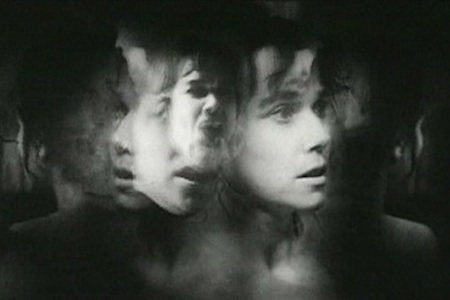
Man with a Movie Camera: Don’t let the title mislead you. This movie is as much about the power of editing as it is about the movie camera. The film unleashes dozens of techniques: dissolves and multiple exposures, stop motion and time lapse, jump cuts and juxtapositions. The film is an essential handbook for every film and video editor, and it’s an eye-opener for anyone interested in how movies are put together, piece by piece.

With Outer Space, we see a movie being taken apart piece by piece, using some of the same techniques as Vertov, but mainly through a painstaking process. Tscherkassky used special laser beams and multiple exposures to manipulate the source footage, spending as much as an hour on each second of film. The images, as well as the amazing soundtrack, become highly unstable, heightening our sense of excitement and dread. It’s as if the celluloid film print itself were being assaulted. We find ourselves watching a film literally falling apart before our eyes.

That is perhaps the supreme achievement of Outer Space, as well as Man with a Movie Camera. Both films pull off an amazing double feat. They make us aware that what we are watching is just a movie. But that awareness doesn’t take us out of the film, instead it pushes us deeper into it. These films are celebrations of cinema’s most basic elements: light, dark, and motion. When I watch these two films, I see those basic elements opening into limitless possibilities.

Originally published on Fandor.

Kevin B. Lee is Editor in Chief of IndieWire’s PressPlay Video Blog, Video Essayist for Fandor’s Keyframe, and a contributor to Roger Ebert.com. Follow him on Twitter.

VIDEO ESSAY: BEAVER’S LODGE: THE RAZOR’S EDGE (1946)

VIDEO ESSAY: BEAVER’S LODGE: THE RAZOR’S EDGE (1946)

This is the fourth installment of BEAVER'S LODGE, a series of video essays narrated by actor Jim Beaver which will offer critical takes on some of Beaver's favorite films. Jim Beaver is an actor, playwright, and film historian. Best known as Ellsworth on HBO’s Emmy-award winning series DEADWOOD and as Bobby Singer on SUPERNATURAL, he has also starred in such series as HARPER'S ISLAND, JOHN FROM CINCINNATI, and THUNDER ALLEY and appeared in nearly forty motion pictures. You can follow Jim on Twitter.

I don’t usually have a lot of patience for navel-gazing, spiritual-trek, meaning-of-life movies, and I don’t think too many of them have been particularly successful, at least commercially. I put off for years watching this 1946 film adaptation of Somerset Maugham’s 1944 novel for just the reason that I didn’t want to spend two and a half hours watching some guy find himself, even if the guy was someone I like as much as Tyrone Power. Well, that delay was a mistake. It’s not for everyone, I’m sure, and it may have faults as drama, but I found The Razor's Edge a richly rewarding experience. Part of that is due to some really exquisite filmmaking by director Edmund Goulding and cinematographer Arthur Miller, a gorgeous score by Alfred Newman, a literate and dramatic script by Lamar Trotti, and some quietly terrific performances by a starry cast including Power, Gene Tierney, Anne Baxter, Clifton Webb, Elsa Lanchester and others. But part of it is due to the fact that this isn’t just a story of a man seeking his soul and its meaning, it’s a fine mixture of character drama and internal drama, the latter of which isn’t often successfully translated to the screen.

Tyrone Power is Larry Darrell, a World War I veteran shaken by his experiences. Returning to his wealthy home surroundings and the girl he loves, he finds he can no longer settle for a life of avoiding meaning, of mere acquisition and societal “respectability.” His girl, Isabel (an incandescent Gene Tierney), cannot understand why he doesn’t want to “make something of himself,” and thinks he merely wants to have a well-deserved and much-delayed youthful fling, so she sends him off happily to get the wild oats out of his system. But Larry has no interest in oats. He wants to understand why he lived through the war when other men just like him didn’t. He wants to have a life built on meaning, not possessions, a life of understanding rather than mere acceptance of the status quo. And so he sets out on a pilgrimage to follow the path of wisdom, across the razor’s edge.

There is more, much more to the film than Larry’s journey, though that of course is the core of the work. Isabel is astonished to learn that Larry really is prepared to give up the life of plenty that she is so accustomed to, and that he hopes she will join him in doing so. She plots to trap him into the kind of marriage she wants, but isn’t able to. Meantime, the couple’s close friend Sophie, a childhood intimate of Larry’s, has her most happy world torn asunder when her husband and child are killed in an accident. What becomes of poor Sophie is the catalyst in which Larry’s growth is experienced, and it is the source of the highest and most deeply affecting drama of the film.

Tyrone Power came back from the Marines in World War II to resume his career, and he pleaded with Twentieth Century Fox producer Darryl Zanuck to give him more serious and rewarding roles than the swashbucklers he’d specialized in before the war. Zanuck reluctantly complied, and in doing so, gave Power possibly the two best consecutive roles of his career, this and the immediately subsequent Nightmare Alley. Power may well have been the most beautiful man ever born, and it would be easy, though wrong, to dismiss him as just a pretty face. His work in The Razor's Edge is convincing in the extreme. He truly seems to be the seeker he portrays, a man of innate goodness terribly desirous of becoming better. Goodness and internal growth—these are among the hardest things for an actor to portray without drifting into sappiness or cliché, and Power does so extremely well.

Gene Tierney is not merely the female counterpart to Power’s extraordinary beauty, she embodies the sensitive yet shallow callowness of Isabel. We see the qualities that Larry loves about Isabel, yet she commits her mistakes and crimes in ways that stem from an almost innocent inability to let go of how she’s always been told things should be. As a result, Isabel is not a monster or a bitch, not at all. She’s a woman clinging to what she believes is good, but not understanding that it isn’t good at all.

Clifton Webb plays Elliott Templeton in an Oscar-nominated, Golden Globe-winning performance. Elliott is Isabel’s uncle, a vain, snobbish, pretentious, yet somehow gentle and likable man, and when his time for comeuppance arrives, we hope to see him spared. It’s a perfectly marvelous piece of acting.

Considering I raised some eyebrows (and hackles, perhaps) a while back by saying I didn’t think nearly as much of All About Eve as I’m supposed to, and not remotely as much about Anne Baxter’s mannered, phony performance in it as I ought to, it might be surprising to learn that I think she deserved the Oscar and Golden Globe she won for her role as Sophie in The Razor's Edge. Something about Baxter’s work has always bothered me, a certain over-earnestness, a deliberateness that spoke of performance rather than recreated life. But none of that applies to her work here. She’s just tremendous. Certainly it’s a role with the kind of range that wins awards, but she plays it with the kind of assuredness and humanity that deserves awards. Sophie is a great tragic figure, and Baxter does her justice.

In a very small part near the end, the wonderful Elsa Lanchester is mesmerizing as the social secretary to one of Elliott’s “friends.” Lanchester does as much in five minutes as some of our greatest actors have done in 120.

As in the novel, Somerset Maugham is a character in his own story. Herbert Marshall plays Maugham, a sort of onlooker/narrator/confidante, and does so very well. I confess that, watching this film with Marshall acting in it and Edmund Goulding directing, I could not avoid remembering a hysterically funny story told in one of David Niven’s autobiographies about him and the wooden-legged Marshall falling down a hill while serving as Goulding’s pallbearers and carrying his coffin. It didn’t help me concentrate on the drama at hand, and now it probably won’t help you, either. But it’s a great story.

I’m so glad I finally wised up and saw The Razor's Edge. I felt very good once I had.
 

VIDEO ESSAY: Ninja Turtles: Generation Y in a Half Shell

VIDEO ESSAY: Ninja Turtles: Generation Y in a Half Shell

“Ugh. Where do they come up with this stuff?” groans a frustrated Raphael, the brooding, red-bandana-wearing member of the Ninja Turtles, whilst walking out of a New York movie theater that’s playing the 1980s creature feature Critters. Here’s why this is an important scene in director Steve Barron’s live-action film Teenage Mutant Ninja Turtles: The 1980s saw an explosion of brawny, Reagan-infused cartoon TV series (e.g. Transformers and G.I. Joe) and live-action romps (e.g. the American family battling the furry aliens in Critters is yet another microcosmic representation of Reagan’s war against international terrorism), but when TMNT hit cinemas in the spring of 1990, its band of sewer-dwelling, skateboard-riding (mutant) outcasts aligned themselves with what we call Generation Y (people born between the late 70s and early 90s), leaving behind the pandemic seriousness of the 80s (industrializing economies, wars in the Middle East, etc.) and embracing a childlike irreverence, a burgeoning urban terrain and yes, lots of pizza with no anchovies. The Turtles were in a pop culture class all by themselves. After emerging as an overnight sensation with comic book fans (Ninja Turtles’ creators Peter Laird and Kevin Eastman only printed 3,000 copies of the original black and white magazine-style comic book in 1984), the Ninja Turtles quickly became a phenomenon both onscreen (its popular animated TV series debuted in 1987) and off (Playmates Toys began producing Turtles action figures in 1987, becoming regular “must-haves” for the youth). Considering all of this Turtlemania, it’s remarkable that Barron’s live-action Turtles film was able to thwart the “Saturday morning” innocence of its source material and create a dark, atmospheric film which dug a little deeper into the themes that would interest its target audience—Generation Y.

In many ways, the Ninja Turtles were the perfect mirrors for the angst-driven Generation Y’ers. Take the case of the family unit, for example. Unlike the generation that came before theirs (Generation X), a substantial number of Generation Y’ers were born into single-parent families. The four Ninja Turtles—Leonardo, Michelangelo, Donatello and Raphael—were no different, living only with their father Splinter (a giant rat), in the most poverty-stricken of homes: a sewer lair. And like most young Generation Y’ers, the Turtles dealt with their anxieties by turning familiar behavioral schemes into occasionally distracting daily routines: The Turtles blended the speech patterns of 1989’s Bill & Ted’s Excellent Adventure into their own vernacular (“Cowabunga!”), while also applying the Ninjutsu practices of 1988’s Bloodsport during their ventures onto the battle worn streets of New York.

Throughout TMNT, isolation is opposed to acceptance. Although the Turtles have a haven in their reclusive sewage den, the rest of New York’s teenage population (i.e. the movie’s “real” Generation Y) seeks acceptance (and shelter) from the Foot Clan, an underground gang overseen by the villainous Shredder. In a disarming scene, Shredder addresses his hordes of loyal teen followers: “You are here because the outside world rejects you. THIS is your family. I am your father.” The dark, striking images in these sections of TMNT (pre-teens smoking cigarettes, young kids fighting each other as part of the training to become a “foot soldier”) are a precursor to future Generation Y films of the 90s that follow teens desperately seeking acceptance, even in the midst of violence (e.g. Menace II Society, Juice and The Basket Ball Diaries). And for a PG-Rated “children’s movie,” the Ninja Turtles talk in a shockingly racy way, too (on more than one occasion, Raphael angrily yells out “Damn!”).

Perhaps the one aspect of TMNT that is not directly linked to Generation Y is its technical accomplishment. The Jim Henson Creature Shop (famous for introducing The Muppets to the world) made an indelible impression on young hearts and minds in multiplexes during the spring in 1990. The lifelike turtle bodysuits that the performance actors wore had movable mouths and blinking eyes. Even the skin of these turtle bodysuits seemed to sweat and pulsate. Detractors of the film always point to the obvious absurdity of watching four grown men high-kicking in giant turtle costumes. But to get hung up on that would ignore how special a film like this can be when it’s done right (as in Spike Jonze’s 2009 live-action film Where The Wild Things Are). And TMNT gets it right. Like the best children’s stories, fables and films, the Teenage Mutant Ninja Turtles movie earns its place as a seminal work of popular fiction by acting as a cultural prism through which viewers (in this case Generation Y) can develop a more profound sense of their identity—depending on their cultural and historical vantage point. As the Turtles would say: “Totally tubular, dude!”

Nelson Carvajal is an independent digital filmmaker, writer and content creator based out of Chicago, Illinois. His digital short films usually contain appropriated content and have screened at such venues as the London Underground Film Festival. Carvajal runs a blog called FREE CINEMA NOW which boasts the tagline: "Liberating Independent Film And Video From A Prehistoric Value System."

The Unbearable Sadness of THE AMAZING SPIDER-MAN

The Unbearable Sadness of THE AMAZING SPIDER-MAN

The Amazing Spider-Man is shockingly terrible, a glorified cartoon with black skies and a black heart. Everyone dies, or is sad about someone dying, or will surely die in the sadly inevitable sequel.

And when an action movie is so grim, and so dark, and so bathed in grays and blacks and the shiny metallic skyline of New York City, it's almost impossible to enjoy the film, due to the fact the characters are miserable, graphically injured, or close in appearance to a big green version of Voldemort. Here is a super-hero movie that is neither noble or enjoyable.

This is a summer blockbuster in which the action scenes are gratuitous and useless, and it’s amazing (ha) any of these characters were able to stay on their Prozac long enough to take any sort of action. This is Kafka’s Spider-Man.

Peter Parker is sad for the entire movie! What follows is a spoiler-laden summary of the film from Peter Parker’s perspective.

First he’s sad his parents left.
Then he’s sad everyone picks on him.
Then he’s sad he’s bad with girls.
Then he’s sad he was bitten by a spider.
Then he’s sad about his parents again.  
Then he’s sad about the fact he created the lizard.
Then he’s sad Captain Stacy won’t listen to him.
Then he’s sad because Captain Stacy dies.
Then he’s sad because he’s not allowed to see Gwen Stacy anymore.

Then, a useless final shot of Spider-Man pointlessly hanging upside down, keeping watch over a city he has now made more dangerous than ever; Having learned nothing from an ordeal that culminated with Peter Parker alone and miserable and beaten to a pulp, along with the crippling emotional weight of knowing he inadvertently caused the death of his Uncle Ben along with Captain Stacy, his ex-girlfriend’s dead father. The movie is all one terrible downward spiral, and this is supposed to be a summer tent pole summer action blockbuster movie, based on Marvel Comics’ signature hero? At this rate, they could have kept Tobey Maguire in the movie and made it about his mid-life crisis.  

This is a Spider-Man movie that is so meekly trying to emulate the style of The Dark Knight, it hurts. The Dark Knight took a grimly dark atmosphere and infused it with three-dimensional characters, excellent writing, a flair for tension and gritty realism, and wrapped it in the grim themes of sacrifice for the greater good and the unrelenting fight against crime. The Amazing Spider-Man is a deadly serious and graphically violent affair almost completely about death and sadness, involving 24-year-old high-school sophomores.

Uncle Ben is graphically shot and murdered, and bleeds profusely; Captain Stacy is painfully impaled, presumably suffering tremendous pain as he waits for Spider-Man to come back and listen to his over-long death monologue. Even the lab rats are cannibalistic killers in this flick. Going beyond just violence, there are about half a dozen disturbing scenes involving biting, swollen faces from fights, and a bunch of lizard-related ickiness. How is it that The Amazing Spider-Man is more visually gory than the Dark Knight films?

Now I know what you’re saying: Spider-Man, in the Tobey Maguire version, has some grim stuff in it too. Willem Dafoe impales himself; Uncle Ben dies again; Spider-Man has to wrestle Macho Man’s ghost, and worse, kiss Kirsten Dunst. There’s also the scene where Oscorp is pumpkin bombed during a parade and some skeletons are shown. But that was deliberately cartoonish in nature, a rollicking good adventure, a little bit scary on purpose. The Amazing Spider-man is shocking and grotesque, filled with graphic violence and intentionally disturbing images. There’s a difference between a movie like Mars Attacks and a movie like Independence Day, and even Independence Day didn’t have a scene of a graphically bleeding chest wound with a high-school-aged boy futilely attempting to put pressure on it, covering his hands in blood.

Then, to make things worse, this movie dares to feature the obligatory post-9/11 “Americans Are Heroes Trademark Moment,” including a cliched low angle shot of a blue-collar American saying something like “he’s one of us” while the camera holds on an American flag in the background just a half second while the music swells. This, of course, is opposite the general mood of the rest of the movie, which is horrid doom. If this is your idea of an American hero, there’s something wrong with your movie, or something wrong with America.

I know Tobey Maguire’s Spider-Man and The Amazing Spider-Man have been compared with each other a billion times, but at least the earlier Spider-Man had a style to it, and despite some flaws, the cinematography at times made you feel as if you were sweeping through New York City. The Amazing Spider-Man is largely shot from afar, moving into and out of the frame, like a multi-million dollar version of a PC animator from 15 years ago.

As well, the fights in the first two Spider-Man films were, at the least, emotionally motivated. Spider-Man, Maguire edition, fought with all he had in the first Spider-Man. After Norman Osborn kidnapped Mary Jane and attacked Aunt May, he was angry. The emotion and tension between the two characters came to a head in a brutal hand-to-hand battle during which an entire wall came down on one of the characters. And while The Green Goblin’s outfit looks too much like a shiny Power Rangers zord, the emotion and tension of this scene carry it. The Amazing Spider-Man, on the other hand, features a sophisticated and drawn out fight scene between characters using the best in computer generated imagery, but is almost entirely devoid of emotion..

Batman and Robin is probably The Amazing Spider-Man’s closest cousin, in its color coding and cartoonish masquerade as an attempt at gothic themes. Batman and Robin was bathed in neon and cliches. The reality of the world was unimportant beside the terrible puns and flimsy action scenes. Actually, Batman and Robin gets points for not taking itself very seriously. The Amazing Spider-Man doesn’t get the same points.

I guess I’m confused and angry, infused with a bit of curmudgeonliness. This is an appropriate take for the Spider-man Mythos? Where everyone is dark and pitiful? Aren’t heroes meant to be looked up to? How many grade-school recess conversations have been focused almost solely about which super-hero you most wish you could be?

Do people want to be this Spider-Man? Depressed and miserable at all times? God, I hope not.

Paul Meekin is a Chicago based writer, television producer, and movie critic for Streetwise Magazine. He can found on Twitter at @MeekinOnMovies and Facebook at www.facebook.com/MeekinOnMovies. He also stars and writes the hit web-based sketch comedy show, "FatMan and Little Girl" on YouTube Channel: ANTVGM64.

Ten Bollywood Memories I’ll Take With Me To My Grave

Ten Bollywood Memories I’ll Take With Me To My Grave

null

If you’re like most Americans, your first exposure to Bollywood cinema was almost assuredly via the opening scene of Terry Zwigoff’s Ghost World. Though your recall of this early 21st century indie flick now consists of little more than a murky haze of kvetching Buscemi and eyeball-rolling Johansson, I’ll bet you five bucks ($5 U.S.) that there is one thing on which your memory is crystal clear: the scene of Enid (Thora Birch) smoking and cavorting around in an oversized reddish-orange graduation robe while watching some of the most crazy-ass, head-shaky dancing every captured on celluloid, courtesy of her bedroom TV. Male or female, straight, L, G, B, or T, you’ve harbored a massive, gut-sinking crush on Enid ever since. Yes?

No.

I have no doubt that you thought you had the hots for Enid. But if we can be honest with each other for a second here? It was never really the raven-haired chunky glasses–wearing social outcast you were lusting after; it was the extremely groovy blindfolded slick-haired and bee-hived line dancers, the John Waters moustache–wielding singer hiccupping “Jaan Pehechan Ho” into the old-timey chrome microphone, the rollickin’ baritone gee-tahr licks, the black-and-white checkerboard dance floor—the whole gestalt. You, my sick friend, have been harboring a massive, decade-long woody for Hindi popular cinema.

Not that I can blame you. I’ve had a boner for Bollywood since the early 90s, when friends dragged me along to see Khuda Gawah, a nearly three-and-a-half hour epic starring Amitabh Bachchan and Sri Devi as star-crossed lovers from warring Afghan tribes, the first five minutes of which slapped my face so hard my jaw has remained partially agape ever since. In the years that followed, I somehow managed to see somewhere between 500 to 1,000 of these all-singing, all-dancing hyper-melodramas from the Subcontinent. Not that every one of them was a, uh, jewel in the crown, or whatever. But let’s just say that, when I finally retire, supine, exhausted, into the pillowy luxury of my final death bed, I’ll be comforted with an array of lurid, supersaturated cinematic memories to help ease the fear and pain.

Here are 10 scenes that will definitely be among them.
 

1. Filmi: Jal Bin Macchli, Nritya Bin Bijili (1971)
Sangeet: “Jal Bin Macchli”

Legendary director V. Shantaram got his start in the late 1920s as a serious innovator, pioneering the use of the trolly shot and telephoto lens in what was otherwise a relatively static, live theater–informed field. Praised early in his career for a series of well-shot socially conscious melodramas, Shantaram’s world—and that of Bollywood itself—dramatically somersaulted with the introduction of affordable color film in the 1950s. From that point on, like an eight-year-old exhorting his parents to watch him tumble across the grass, Shantaram pandered shamelessly to his audience. This scene, from one of the last films in the great director’s oeuvre, features Sandhya, Shantaram’s real-life wife, performing an avant-garde interpretation of a fish out of water (or “jal bin macchli” in Hindi) that, while not as overblown and spectacular as dance scenes later in the film (Sandhya does a whole number on crutches after her evil rival breaks her leg), is utterly mind-blowing, despite its relative restraint.

2. Filmi: Disco Dancer (1982)
Sangeet: “I Am a Disco Dancer”

Babbar Subhash’s melodrama of hyper-ambitious rival dancers may have been half a decade late to the international disco party, but Disco Dancer has gone on to become a bona fide Bollywood b-movie classic. This scene is so jam-packed with eye-popping bits—a line of guys wielding guitars like machine-guns, a purple-clad girl knock-knock-knockin’ on a bald guy’s head, superstar Mithun Chakraborty’s space-age silver suit and WTF wing-tipped headband—it’s impossible for the human brain to process them all in one viewing.

3. Filmi:  Awaara (1951)
Sangeet: “Tere Bina Aag Yeh Chandni” and “Ghar Aaya Mera Pardesi”

Raj “The Showman” Kapoor is one of Hindi cinema’s best-loved directors, and this scene—a dream sequence that took several months to shoot—is probably his most famous. Featuring superlush music from superduo Shankar-Jaikishan (surely their finest hour) and an ethereal Nargis (with whom Kapoor was understandably smitten), it offers sublime beauty and surreal kitsch in equal measure. The tumbling statues toward the end of the scene are nothing short of breathtaking.

4. Filmi: Amar Akbar Anthony (1977)
Sangeet: “My Name Is Anthony Gonsalves”

“You see, the whole country of the system is juxtaposition by the haemoglobin in the atmosphere because you are a sophisticated rhetorician intoxicated by the exuberance of your own verbosity!” Where do you go after a line like that? Well, if you are Bollywood’s biggest (and literally tallest) star, Amitabh Bachchan, it will most likely involve wearing a top hat and coat while doing a back-flip out of a giant Easter egg. Known for his hilarious, twisty plots, Monmohan Desai outdid himself in this fast-paced comedy of errors about three brothers who, separated at birth, go on to follow the three major religions of India (Hinduism, Amar; Islam, Akbar; Catholicism, Anthony).

5. Filmi: Mr. India (1987)
Sangeet: “Hawa Hawaii”

Speaking of inspired nonsense, you’ll note the lack of English subtitles during the first minute-and-a-half of this deliriously un-PC scene featuring Sridevi and her blackface-sporting entourage. That’s because the former Tamil child star turned 1980s Bollywood sweetheart is belting out streams of pure, delicious Zaum. Nothing in the annals of WTF Japan has anything on this number. Oh, and in case you’re wondering, the film—Shekhar Kapur’s breakout hit, and the most successful Indian film of the 80s—is about an evil plot by the island-dwelling villain Mogambo to destroy India that is thwarted by a bracelet that renders its wearer invisible.

6. Filmi: Inteqaam (1969)
Sangeet: “Aa Jane Jaan”

And speaking of blackface and WTF moments—and Bollywood has, alas,  hands down the most of any regional cinema—here’s the ubiquitous uber-vamp Helen at her absolutely most salacious as she pulls out all the stops to tease and inflame her caged, “kazoomiya!”-belting victim—“savage desires” metaphor, anyone? Yes, I feel guilty and unclean every time I watch it. Which, perhaps not uncoincidentally, is about as often as I do my laundry.

7. Filmi: Caravan (1971)
Sangeet: “Piya Tu Ab To Aaja”

More on Helen: Born in Burma just before the Japanese invasion, the half-Burmese, half-Anglo-Indian child escaped the country now known as Myanmar on her mother’s back in the 1940s, growing up in Bombay, where she would go on to become Hindi cinema’s single most ubiquitous character actor slash dancer. Being an immigrant of mixed ethnicity, Helen got the vampy bit-part roles few if any native actresses of her stature would touch, playing everything from Chinese and Japanese to American and British characters. In Caravan, she played a Spanish woman named Monica, who, drunk and panting, exhorts her equally panting, bullfighter boyfriend. In a moment of raw, hot-blooded, unslaked desire, she also dry-humps the underside of a children’s playground slide.

8. Filmi: Kath Putli (1957)
Sangeet: “Hai Tu Hi Gaya Mohe Bhool”

Kamala Laxman, a.k.a. Kumari Kamala, is one of the most celebrated Indian dancers of all time. While her best filmed performances were in Tamil and Telugu films (search her name on YouTube), she did make a few stunning appearances in Hindi film, most notably this insanely exuberant six minutes’ worth of south Indian dance–inspired leaps, pirouettes, hand-gestures and facial expressions rarely seen in Bollywood. And, OMG! Those eyebrows!

9. Filmi: Janwar (1965)
Sangeet: “Dekho Ab To”

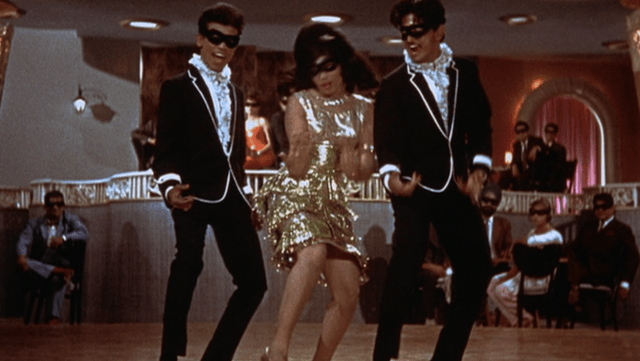
How did I get this far without reppin’ my main man, Shammi Kapoor? Here we have the single most insane dance scene of his entire career. While a quartet of mop-top guitarists in full early Beatles regalia belt out a Hindi bastardization of “I Wanna Hold Your Hand,” the Shamster spazzes out like Elvis Presley simultaneously channeling Jerry Lewis and Jerry Lee Lewis. Words cannot describe how ferociously good watching this makes me feel.

10. Filmi: Mughal-e-Azam (1960)
Sangeet: “Pyar Kiya To Darna Kya"

Color came late to Bollywood; this epic, which was filmed over the course of a decade, was shot mostly in black and white, though two reels, including this scene, were shot in color. And what color! If the hyper-saturated glowing jewels everywhere don’t dazzle you, check your pulse. Or focus in on Madhubala, who gave the performance of her brief but brilliant career in this film, where she played Anarkali, the court dancer who scandalously steals the Emperor Akbar’s son Salim’s heart. I love especially how, some five-and-a-half minutes into this scene, Akbar’s eyes grow redder and redder in anger as he watches images of Anarkali multiply to near-infinity in the palace mirrors until, unable to take it anymore, he throws out his arms, putting a halt to the shameless nautch girl’s performance.

Gary Sullivan’s poetry and comics have been widely published and anthologized, in everything from Poetry Magazine and The Wall Street Journal to The Norton Anthology of Postmodern Poetry (2nd Edition, forthcoming). Everyone Has a Mouth, a selection of his translations of poetry by the Austrian schizophrenic Ernst Herbeck, was recently published by Ugly Duckling Presse. He lives in Astoria, Queens, where he maintains bodegapop.com, a music blog devoted to treasures found in immigrant-run bodegas in New York City.
 

SIMON SAYS: WILLIAM FRIEDKIN ON VIOLENCE, HUMOR, AND IDENTITY

SIMON SAYS: WILLIAM FRIEDKIN ON VIOLENCE, HUMOR, AND IDENTITY

null

"Human nature is violent," William Friedkin tells me, going on to say that he also likes Immanuel Kant's phrase "the crooked timber of humanity." As an artist, Friedkin is as blunt, matter-of-fact, and masterfully cynical as his initial statement suggests. His films indicate that a character's environment is, more often than not, what he reacts to when he snaps. Superior dramas like The French Connection (1971), To Live and Die in LA (1985), Cruising (1980), and Sorcerer (1977) are all about myopic obsessives, characters who are desperate to the point where they can't see how their actions have led them to become fatalistically self-involved. That same tendency towards self-harm is what makes many of Friedkin's movies bleakly and corrosively funny. For example, the hanky code scene in Cruising, where Al Pacino's undercover cop is comically baffled by the semiotics of the hanky code, is humorous because we're being encouraged to laugh as a man denies his own latent attraction to the subcultures he's investigating. 

So in that sense, it's not surprising that Killer Joe (2011), which Friedkin describes as his "darkest film yet," is a comedy. In it, Matthew McConaughey plays a corrupt, schizoid cop hired by desperate white trash to kill one of their own kin in order to collect a $50,000 life insurance policy. "Yes, it's a black comedy, in the way that Dr. Strangelove is a black comedy, nonetheless disturbing because of its subject matter," Friedkin told me Wednesday. He went on to tell me that with Killer Joe, he wanted to make a dark comedy that was direct and brutally "unsentimental." You can see that lack of sentimentality in the way that Friedkin uses Clarence Carter's "Strokin,'" a song that is about exactly what it sounds like what it's about, twice in Killer Joe. "I love 'Strokin'!' I think it's very funny and courageous. It's sort of a character on its own. It's kind of a statement on the all of the bullshit that surrounds today's films, kind of a reaction to that. It's not sentimental and the movie is not sentimental. It's funny, and if you really listen to it, it's a little dark." 

It actually makes sense that "Strokin'" is used during a scene in which a major character gets beaten to a pulp, a nasty choice but not excessive to the point of being gratuitous. For a filmmaker who has, over the years, continually pushed the envelope in his portrayal of violence on film, especially in films like The Exorcist (1973) and Cruising, that's saying a lot. "I thought I went as far as I needed to and no more or no less," Friedkin remarked.  He went on to say that he and his crew were surprised that the film got an NC-17 rating, in spite of its handful of scenes of full frontal nudity and over-the-top violence. Despite his surprise, Friedkin does not contest the rating: "None of us thought we'd get an NC-17, but when we did, I think we realized it's the correct rating. Because I'm not targeting teenagers. Once I got that rating, I knew I could hack that movie to pieces to get an R, but I didn't want to do that. I just didn't want to do that. So once they gave us an NC-17, the distribution company appealed it and they lost the appeal. So we left it alone."

Violence and sex are often the source of dark humor in Friedkin's films, a debt traceable to Friedkin's affinity for Henri-Georges Clouzot's films. Many of Clouzot's movies, like The Murderer Lives at Number 21 (1942) and Le Corbeau (1943) have a vicious sense of humor and are character-based. In fact, Friedkin's Sorcerer is a remake of Clouzot's Wages of Fear (1953), a masterful thriller about a group of broke truckers who go on a suicide mission to deliver highly unstable dynamite to a construction site deep in a South American forest. Friedkin has said in the most recent issue of Film Comment that he'd probably seen Clouzot's Diabolique upwards of 50 times, but he would never consider remaking it. "I love Clouzot's films," Friedkin beamed. "They're hard-edged and they're not sentimental. Diabolique is a very scary film. That nine minute sequence, without a word, is one of the most terrifying scenes I've ever seen."

But what makes Friedkin's films so unique is that sense of acidic humor stems from a perceptive view of the apathetic environments that breed his characters' obsessive and often inexplicable behavior. For example, in Rampage (1987), Friedkin follows the trial of a disturbed mass murderer shown to have Nazi paraphrenalia in his room, which is situated in the root cellar of a house ostensibly presided over by Twin Peaks star Grace Zabriskie. Both the defense seeking to prove that Zabriskie's son is legally insane and hence not in control of his actions, and the prosecuting attorneys who try to prove the defendant's guilt, produce evidence and witnesses that support their claims, leaving it up to the viewer to decide who is right and which factors matter most. 

Similarly, the abrupt demise of the corrupt cop William Petersen (of CSI and Manhunter) plays in Friedkin's To Live and Die in LA is not that shocking, given the context of the drama preceding his death. Petersen plays a character so myopically focused on arresting the counterfeiter responsible for the death of his partner that he can't see anything else around him, not even the vibrant Los Angeles that Friedkin practically makes a central protagonist of his story. "A lot of people found [the death of Petersen's character] shocking at the time, just as they found the death of Janet Leigh shocking in Psycho," Friedkin protested. But at the same time, it's only immediately jarring. Thematically, that violent death is hardly gratuitous.

That same focus on the ways environment and setting shape a character's identity is true of Cruising, a film possibly even more notorious than The Exorcist. In it, Pacino plays an undercover cop who descends from a position of feeling above-it-all—though reluctant to fully embrace the almost god-like, condescending perspective that comes with being a cop—into a struggle to repress latent feelings of homosexuality when he goes in search of a killer in the Meatpacking District’s S&M Clubs. The self-loathing mania that defines Pacino's character has been unfairly called a sign that Friedkin considers homosexuality an abnormal disease, but his character's actions tell a different story when looked at in context. For example, a pair of cops on patrol deliberately paraphrase Taxi Driver's Travis Bickle when they say, "Some day, a rain's going to come to wash all the scum off the streets." Friedkin says he remembered "overhearing that dialogue from cops that were patrolling the Meatpacking District, as it was then. That district is now completely gentrified. But that's the way cops talk. That's the attitude: all these people on the street, they're scum!" 

Friedkin went on to add that Randy Jurgenson, a NYC beat cop who worked with Friedkin on three films, including The French Connection, and was the main source of inspiration for Pacino's character in Cruising, didn't need to explicitly tell him how his undercover search affected his psyche. "[Randy] sort of resembled the victims, who were all dark-haired, with swarthy complexions and mustaches," Friedkin remarked. "And he was about the same height and the same build and he was assigned to attract the killer. And he told me his experiences and how the whole thing really screwed him up and bent his mind. And I remember never asking him further what he meant; I got it! "

The impotence and sociopathic feelings of powerlessness motivating characters like Pacino's character in Cruising and even McConaughey's in Killer Joe are crucial to what makes Friedkin's films so rich and also rather ugly. They have a pragmatic despair at their hearts because, to Friedkin, human behavior is gross and uncontrollable. When I asked him why he thought people were grasping at straws to qualify the "evil" motives behind the recent killings in Aurora, Colorado, Friedkin exclaimed, "Because there's no way to control human behavior, not even in China, where they basically have a dictatorship. And they have no ethnic differences whatsoever, no color differences. The reason why China has made such leaps forward economically is because they can control human behavior and punish it severely if it's at odds with the norm. In this country, we don't. We cannot control the norm. In this country, when you have democracy, there's nothing you can do to modify people's behavior." 

With that in mind, Friedkin's films appropriately function as Rorshach ink blot tests for viewer reactions. For example, the ending of The Exorcist comes after an exhaustive battle for the soul of a young child. That battle is eventually, though hardly inevitably, won, after one priest forcibly defenestrates himself. The calm following this cure is uneasy, at best, making it very easy for viewers to see what they want in that calm after the storm. "The ending of The Exorcist is in the mind of the beholder," Friedkin told me. "What you take from the film is what you bring to it. If you think the world is a dark and evil place, that’s what you will get back. If you think there is hope for a power of the good that is constantly at war with the power of evil, you'll get that."

Simon Abrams is a New York-based freelance arts critic. His film reviews and features have been featured in The Village Voice, Time Out New York, Slant Magazine, The L Magazine, The New York Press and Time Out Chicago. He currently writes TV criticism for The Onion AV Club and is a contributing writer at the Comics Journal. His writings on film are collected at the blog, Extended Cut.

BEAVER’S LODGE: THE PROFESSIONALS (1966)

BEAVER’S LODGE: THE PROFESSIONALS (1966)

This is the third installment of BEAVER'S LODGE, a series of video essays narrated by actor Jim Beaver which will offer critical takes on some of Beaver's favorite films. Jim Beaver is an actor, playwright, and film historian. Best known as Ellsworth on HBO’s Emmy-award winning series DEADWOOD and as Bobby Singer on SUPERNATURAL, he has also starred in such series as HARPER'S ISLAND, JOHN FROM CINCINNATI, and THUNDER ALLEY and appeared in nearly forty motion pictures. You can follow Jim on Twitter.

There was a time when a certain kind of adventure film was popular. The 1960s were its heyday. Sometimes they were realistic, or even drawn from real life. Sometimes they were fanciful. But almost always they were intelligent and enormously entertaining. I haven't seen a new example of that kind of film in 30 or 40 years. Maybe they exist, maybe I've simply forgotten them or never knew of them. But I don't think they make that kind of movie anymore (though I suspect Hollywood thinks it still makes them). I'm thinking of movies like The Dirty Dozen, Von Ryan's Express, The Magnificent Seven, The Great Escape, The Guns of Navarone, and this one, The Professionals.

The Professionals is about four rugged experts in various fields, hired by a rich man to rescue his wife, abducted by a Mexican revolutionary near the Texas border around 1917. Lee Marvin, Woody Strode, Robert Ryan, and Burt Lancaster are the charismatic title figures, each particularly well-equipped for one aspect of the mission. Ralph Bellamy is their wealthy employer, Claudia Cardinale his buxom Latina wife, and Jack Palance is the revolutionary, Raza, with whom Marvin and Lancaster once rode. And Marie Gomez is Chiquita, a delectable tough girl, *really* tough, in a way that suggests it's her way of life, not something the script called for her to do.

Accompanied by a jaunty, rousing score by Maurice Jarre, the film by Richard Brooks is delirious masculine fun, an adventure filled with derring-do, witty quips, and just enough pseudo-depth to make it seem like it means something beyond the fun. I can't speak for women, but it's the kind of movie no guy can pass up, no matter how many times he's seen it. They don't make 'em like this anymore. And it's a shame.
 

THE NEWSROOM RECAP 5: AMEN

THE NEWSROOM RECAP 5: AMEN

This episode of The Newsroom was the closest the show's ever come for me to doing what I think it wants to be doing: effectively interweaving accounts of principled reporting and the ethical dilemmas of journalism with snappy explorations of its characters' personal lives. Unfortunately, it founders on the same shoals it always does: MacKenzie's and idiot, and Will thinks it's all about him. This week, the reasons we know that Atlantis, the company that owns News Night, is a Fictional News Paradise of Legend are that its gossipy morning show makes a real effort to teach its viewers about a substantive media conflict of interest, and that it took almost a year for one of more than 100,000 people who received a hugely embarrassing email about major figures in the organization to figure out that it might be of interest to media reporters. Not to mention that it’s truly hilarious to think that anyone wouldn’t have known Will and MacKenzie dated when they were together because journalists are notorious gossips, a quality you’d think would be catnip to Sorkin.

nullBut no, the real problem here is the rift between the rest of the episode and Will’s defense of MacKenzie to Nina, a reporter, when he has been tipped off by Gary, the Smart Black Guy Who Isn’t Afraid to Criticize Obama, Validates Jim’s Seduction Techniques, and Also Has a Sideline in Bribery, that TMI takes payoff money from celebrities. “I hired the best EP in broadcasting in spite of her being my ex-girlfriend,” Will tells Nina, who he believes is going after him for sexually slighting her at New Year’s (never mind insulting her job), in angrily warning her to step away from his staff. But nothing in the show indicates that. In fact, everything we see indicates that MacKenzie is a disastrously ill-informed and naive woman.

She misses that her boyfriend Wade is using her to prep for a Congressional run, which would be a heartbreaking tale about a skeptical journalist letting down her guard and being disappointed if she didn’t know so little about everything else. She confesses to Sloan that her economics knowledge only extends as far as thinking “a lot of what’s going on in the world has to do with the economy,” and that her oversight of the economics statements she’s producing consists of the following: “I pretend to read what you give me, then I nod.” Her response to the news that the Army is filling the power void in Egypt? “The army’s not the good guys?” All of this might have been cute for Mary Richards back in the days when she was still ordering Brandy Alexanders during job interviews, but there’s something distasteful about Sorkin’s asking us to buy incompetence in the guise of dizzy adorability. Nina would be justified in investigating MacKenzie’s utter lack of qualifications even if there weren’t ethical lapses in her current performance or errors of judgment in her past.

This glaring contradiction is doubly unpleasant because it sullies the best job The Newsroom’s done so far at actually showing the challenges and pains of directing correspondents on the ground from a cable control room. The reason the coverage of Tahrir Square works is that Will and his team don’t magically discover a major scoop simply because they care about it more than anyone else, or avoid a major error because they’re so much more ethical than their competitors. The episode is, instead, largely about process and the dangers of reporting in a war zone.

First, Elliot and Don’s frustrations, which have been boiling since election night when Don urged Elliot to jump into the scrum of commentary, end up having real consequences. Elliot, who’s been confined to his hotel room giving useless broadcasts that add nothing to the network’s coverage of Egypt, hits the streets after Don’s pestering, and is badly beaten by the crowd. On his return, Don wants to put him on the air for reasons related both to public interest and his own interest. “We show what’s going on. Journalists are getting beaten up,” he urges Charlie, Will, and MacKenzie. “I know that we’re not the story. But Jesus, goddamnit, nobody else is going to know . . . In the media, we’re all effete, elitist assholes.” In a show that’s all about trying to paint a journalist as hero, this is the first moment that’s effectively captured the anxieties of reporters about their standing in the wider world, and the risk and guilt that accompany those times when journalists are recognized by the broader public for their personal accomplishments.

And the show navigates a more difficult set of emotions skillfully, too. “I sent him down there. I bullied him into going out into the street and they beat him up with a rock,” Don confesses to Will. “I know. Everybody knows,” Will tells him, before getting at the petty kind of thinking that can plague journalistic accomplishment. “We’re all jealous it isn’t us with the bruises on our face. You didn’t give him an order. You gave him permission.” That kind of emotion, or the self-congratulatory sequence after the show when the News Night team managed not to disastrously screw up their reporting on Rep. Gabrielle Giffords’ shooting, are interesting, ambiguous places to be, the actual baseline people like Will and his staff are trying to rise above. It’s not really gossip columnists and media reporters who make up the Pit from which decent newsmen must rise. Instead, it’s their own venality.

But The Newsroom, sadly, can’t linger there, in that rich and ambiguous place. No, it has to end with a recreation of Rudy. After an Egyptian stringer is taken prisoner, so upsetting the News Night staff that they repeatedly injure themselves and corporate refuses to ransom the young man, Will insists on paying for his rescue. Because the self-injuries have to be seen to be believed, watch below:

This all might have been more effective had Will not already tried to bribe Evil Nina, and in a prior episode, privately paid for the cab rides of an undocumented immigrant so the man could get to his job. And it might have worked even better if it was a subsequent attempt to create a complicity between Neal and Will, who ridicules Neal’s internet abilities and obsessions much of the time, but who does seem to respect the younger man’s skills and passion. But no, it has to be about how the whole staff does their bit to pay Will, who makes $3 million a year, for his act of generosity, and then celebrates him publicly.

It’s amazing that a man, and the show that celebrates him, can recognize any news when they spot it, given how much time Will and The Newsroom spend in a self-regarding set of funhouse mirrors that seem to reflect only the most flattering version of Will back to him.

Alyssa Rosenberg is a culture reporter for ThinkProgress.org. She is a correspondent for TheAtlantic.com and The Loop 21. Alyssa grew up in Massachusetts and holds a BA in humanities from Yale University. Before joining ThinkProgress, she was editor of Washingtonian.com and a staff correspondent at Government Executive. Her work has appeared in Esquire.com, The Daily, The American Prospect, The New Republic, National Journal, and The Daily Beast.

BREAKING BAD RECAP 2: MADRIGAL

BREAKING BAD RECAP 2: MADRIGAL

The most striking aspect of tonight’s episode was our introduction to German mega-company Madrigal Elektromoteren (and, of course, the short-order introduction and elimination of suit Herr Schuler, who was clearly complicit in the late Mr. Fring’s meth empire, though we don’t quite know yet to what degree). The episode’s opening scene (below), with Herr Schuler absently munching chicken fingers as a scientist explains the money-saving formulas in their dipping sauces, seems absurd at first, until you think of the number of times Herr Schuler had to taste the “authentic” blend of spices for the meth-concealing Pollos Hermanos chicken recipe. Schuler is distracted, and we find out very quickly why: apparently, there are police here to see him, and more of them than last time, according to his assistant. Uh oh.

As Schuler makes his way toward his self-inflicted demise, we’re shown just how far-reaching the Madrigal empire is as he passes the backlit logos of fast-food chains such as Whiskerstay’s, Haau Chuen Wok, Burger Matic (hilariously abbreviated to “BM”), and Pollos Hermanos. (It’s also worth noting that these fast food chains are most likely just a fraction of Madrigal’s overall business; I would imagine a majority of what they produce relates to auto parts, judging from the “Elektromoteren” part of their name.) Schuler pauses to watch two workmen take down the Pollos sign, clearly wondering how such an innocuous-sounding fast food joint could have possibly led to his undoing. For us, one thing’s for sure: Hank’s excellent police work has traced a few of the superlab’s equipment pieces back to Madrigal, and Schuler is on borrowed time. As Schuler passes by his office, he watches one of the Polizei eyeballing a picture of himself and Gus Fring golfing in happier times, and decides this can’t be worth it. Gus must have seemed like such a sure thing. Well, until Walt came along.

Another large chunk of tonight’s show was dedicated to Jesse and Walt’s “search” for the ricin cigarette (below), the loss of which triggered their rift last season when Brock fell ill from an apparent poisoning. Jesse is obviously made distraught by its absence, but Walt can’t really explain to him why one of Saul’s goons lifted it from him without coming clean about the Lily of the Valley, so he gets to work not only hiding the actual ricin vial (it may come in handy again sometime, so he hides it in an electrical outlet; I’m sure that’s going to be important again soon), but also creating a dummy cigarette and helping Jesse discover it in his Roomba to give him some peace of mind (and I have to give it to the sound department here; every sound of Walt and Jesse rifling through the apartment during the montage has a rhythmic quality that syncs with the musical cue, adding to the scene’s urgency while also increasing the fun factor of watching). Executed with perfect Walter White-style conniving trickery, he even gets Jesse to cry from the guilt he feels for even thinking about shooting him last season, allowing Walt to slip right back into father figure mode, further bonding Jesse to him.  Of course, this also gives Walt the perfect opportunity: “What happened, happened for the best, you hear me?…Having each other’s back?  It’s what saved our lives. And I want you to think about that as we go forward.”  “Go forward where?”

It was also interesting to see Mike essentially forced into a position where he had to take Walt’s offer of partnership. Between Lydia’s high-strung desire to eliminate everyone even remotely connected to the Pollos empire and Hank’s discovery of the account in his granddaughter’s name, Mike doesn’t seem to have much choice. Of course, it’s helpful that Lydia still has some methlamine connections, otherwise there’d be no precursor, but her character (played by Laura Fraser) is far too high-strung and nervous (her “you’re really running me through my paces” line when she finds out that the roadside diner doesn’t have any tea other than Lipton’s was perfect) to be good news for the Heisenberg empire in the long run. She’s already sold Mike out to his own guys, and she’ll be sure to do whatever she can to protect herself and her little girl (and her amazing house, too). I suspect that that Mike’s decision to not kill her had something to do with her having a little girl. However, her ability to get methlamine, thus getting Walt’s operation back up and running, will allow Mike to keep earning money for his favorite little girl, as his old Fring account has, for all intents and purposes, gone bye-bye.  Still, though, she may have been able to hide behind the financial machinations of Madrigal’s support of Pollos’ not-so-little secret when Gus was still around, but without him, she’s an exposed nerve, and a very jumpy one at that. Not good for anyone, least of all Ol’ Mike.

Mike’s interaction with Hank and Gomez was fantastic, as well. At this point, most viewers have affinities with both characters (Hank and Mike, at least), so watching them interact with each other is always fun because it’s so hard to pick a side.  Hank is natural police, and he knows how to get under even Mike’s skin. But Mike, being the road-worn soldier that he is, has seen it all, even, apparently, from the law enforcement perspective, and it’s always a pleasure to watch Jonathan Banks play Mike’s eye-rolling resignation, even while realizing the money for which he’s taken a lot of crap is essentially gone. Of course, he saves his pissed face for when he’s walking out the door; as far as Hank and Gomey are concerned (at least, on the record), he’s cool as a cucumber, and only tangentially connected to Fring’s quickly-unraveling drug web.

And, as in Live Free or Die, this episode features yet another cringe-inducing scene with Walt and Skyler (below), in which Walt willfully ignores Skyler’s paralyzed fear in order to feign intimacy with her. She doesn’t say a single word as he prattles on about dinner and how “it gets easier,” and then proceeds to kiss and grope her as she clutches her pillow so tightly it looks like it might disintegrate. “When we do what we do for good reasons, then we’ve got nothing to worry about,” Walt waxes, kissing Skyler’s neck. “And there’s no better reason than family.”  This is no longer Walter White trying to get himself out of the dog house. This is Heisenberg. This is Heisenberg’s house, and he has just found out that Mike is back in, and that the Southwestern meth trade is his for the running, and he doesn’t need to justify anything to anyone. This is Heisenberg telling his wife how it is, and how it’s going to be from now on; that there’s nothing to worry about, there’s no monster under the bed . . . at least no monster that could compare to the one that roams this house.

But, we all know things are going to change, and Walt’s overconfidence will surely play a large part in his eventual undoing. If the M60 he receives on his 52nd birthday is any indication, his current attitude is going to result in Walt finally digging a hole for himself that he can’t undig, and there will be lots of needless bloodshed. 

Dave Bunting is the co-owner (with his sister and fellow Press Play contributor, Sarah D. Bunting) of King Killer Studios, a popular music rehearsal and performance space in Gowanus, Brooklyn. He plays guitar and sings in his band, The Stink, and dabbles in photography, video editing, french press coffee, and real estate. Dave lives in Brooklyn with his wife, son, and sister.