VIDEO ESSAY: First Fassbinder

VIDEO ESSAY: First Fassbinder

EARLY FASSBINDER: A ROMANTIC ANARCHIST FROM THE FIRST

The German actor and filmmaker Frank Ripploh interviewed Rainer Werner Fassbinder in March 1982, only a few months before Fassbinder’s death at age 37.

Ripploh’s last question was: “How do you describe yourself?”

“I’m a romantic anarchist,” Fassbinder said.

And so he had been from the beginning. It can be difficult to know what to make of Fassbinder, how to enter his extraordinary body of work, how to assess and appreciate his achievement. Romantic anarchists don’t sum up well.

First, there is the simple problem of scale. Though his career was relatively short, he sometimes directed in one year more movies than other people made in entire lifetimes. Even quantifying the exact number of items is a challenge, because they span so many formats — over 40 feature-length films (both for television and theatrical release), a handful of shorts, some radio plays, numerous stage plays, and a few television mini-series (including the 15-hour Berlin Alexanderplatz, his magnum opus). That Fassbinder is generally known for a small set of major works (The Bitter Tears of Petra von Kant, Fear Eats the Soul, The Marriage of Maria Braun) is partly due to how well those films were originally received at international film festivals, but also because limiting the idea of “Fassbinder” to a small number of titles allows the casual viewer a few touchstones.

It is impossible, though, to get a sense of what makes Fassbinder’s work uniquely powerful and uniquely necessary without knowing at least some of his lesser-known movies. The Rainer Werner Fassbinder Foundation has done excellent work preserving and restoring many of Fassbinder’s films, and the majority have found their way onto home video in one form or another over the years — most recently, the revelatory restoration of Fassbinder’s 4-hour TV mini-series World on a Wire, a captivating, reality-bending science fiction story that had only rarely been seen anywhere since its original airing in 1973. Even some of Fassbinder’s most obscure films are currently available on DVD in Europe, and while that is not the case in the United States, the Criterion Collection has done a fine job of bringing a few of the major works into print in typically excellent packages, and providing others via their Hulu Plus channel. Their most recent release is a selection of five of Fassbinder’s earliest films as part of their Eclipse series of DVDs.

The selection of works for Early Fassbinder is excellent, giving viewers access to the most satisfying films Fassbinder made before his stylistic breakthrough into melodrama with The Merchant of Four Seasons, shot in August 1971. The pleasure of the early films is the pleasure of watching a breathtakingly talented artist discover his art. While completists must certainly lament the exclusion from the Eclipse set of Fassbinder’s first two shorts (as well as, perhaps, Whitey, the production of which at least partly inspired Beware of a Holy Whore), the core of Fassbinder before his deliberate turn to melodrama is represented here.

Various scholars have attempted to categorize and periodize Fassbinder’s output and make the vast sprawl of it more manageable. Fassbinder himself hinted at one way to do this with his early films, saying that they break into two types: cinema films and bourgeois films. The cinema films were primarily in conversation with other films and the world of filmmaking, while the bourgeois films were critiques of middle class values and lifestyles.

Categories hide as much as they show, however, and we should only use the cinema films/bourgeois films taxonomy as a quick way to get oriented with the works up through Beware of a Holy Whore. Other categorizations also work as well or better, for instance Thomas Elsaesser’s two categories for the first quarter of Fassbinder’s career: gangster films and more general tales of violence, self-aggression, and in-groups. No taxonomy is entirely satisfactory, though, because what’s most apparent in the early work is how much Fassbinder is trying out different genres and styles. These are exploratory works, and sometimes almost hermetic works—occasionally, Fassbinder scoffed at his first ten movies, insisting they were made just to amuse his friends and nothing more. At other times, he felt differently; for instance, in 1981 he made a list of “The Top Ten of My Own Films” and placed Gods of the Plague fourth and Beware of a Holy Whore first.

Love Is Colder than Death, Gods of the Plague, and The American Soldier form a loose trilogy, overlapping in both content and style, but each is also unique in ways that may not be apparent immediately. While none is as fast-paced as a film from Hollywood, Gods of the Plague is notably less narrative than the others and distinctly more laconic. The American Soldier brings Fassbinder’s interest in manipulating (or hollowing out) the icons of genre films to the fore. Love Is Colder than Death, for all its long takes and shallow conversations, offers a journeyman’s go-for-broke energy that Fassbinder would rarely replicate (such blind brio would reach its apex with The Third Generation in 1979).

Katzelmacher challenges audiences with its determinedly static camera, empty conversations, and miserable characters. Fassbinder was fascinated, especially early in his career, with stretching the audience’s experience of cinematic time by removing any elements that would contribute to a sense of suspense or even rising/falling dramatic action: the characters speak with as little affect as possible, and the editing allows shots and scenes to last longer than seems at all justified. (Even later, when he wanted to make movies that would attract a larger audience, Fassbinder couldn’t resist letting scenes go on for just a little bit longer than most other directors and editors would.) Our discomfort and impatience become a valuable response—boredom and frustration are important to the experience of what films like Katzelmacher are attempting to communicate. We feel, viscerally and almost unbearably, the ennui of the lives of Elisabeth, Paul, Erich, Franz, etc., and so gain an emotional connection to their relationships with and behavior toward Jorgos that we would not have were the film more conventionally entertaining. With Katzelmacher, the young Fassbinder took this approach as far as he could, and farther than he ever would again. The experiment is fascinating and sometimes powerful and evocative, but the characters are all either so detestable or dull that it may be difficult for viewers to locate a space for themselves within its suffocating world. Whatever we end up thinking of Katzelmacher, though, it was vital to Fassbinder’s development, for without it, it’s unlikely he could have achieved, for instance, the extraordinary (and painful!) perfection of pacing in The Bitter Tears of Petra von Kant, a similarly challenging film, but one where compassion for the characters has more opportunity to grow.

The final film in the Early Fassbinder set, Beware of a Holy Whore, marks a clear end to the first phase of Fassbinder’s career, no matter what taxonomy we choose. From his earliest days in the theatre, he and many of his colleagues had tried to live by communal, even utopian, principles, effectively creating a repertory company that lived and worked together constantly. The arrangement is part of the reason that Fassbinder was able to be so consistently productive, but it led to many tensions and tempests. Beware of a Holy Whore is, among other things, an epitaph for the most communal time of Fassbinder’s life. He was too talented, ambitious, and relentless to live and, especially, work in even a superficially nonhierarchical structure. For all his love of anarchy and romance, he needed to be able to channel order. He needed to be The Director.

Order can arrive in seemingly anarchic forms. The best of Fassbinder’s films are full of juxtapositions and contradictions. For all the sharp shocks and even despair in Beware of a Holy Whore, one thing we mustn’t forget about the film is that it is often deliberately absurd, exaggerated, and sometimes very funny. Many of the participants later noted that they had a great time making it (though Fassbinder’s more sardonic and acid caricatures wounded some of his friends). Fassbinder was often drawn to the exploration of characters as types rather than fully rounded human beings, and that interest is especially apparent here. The effect is, for the first time in his oeuvre, haunting: perceptive, sympathic viewers learn to see the roundedness within the types, the unique humanity within the common words, gestures, behaviors. It’s an effect he would soon master and repeat, an effect that would give his later, emotionally complex films extraordinary resonance.

Beware of a Holy Whore is an epitaph to a certain way of living, but it is an also an exorcism. Fassbinder seemed to recognize that he had come to the end of all of his paths — of living, working, being. He now knew the proclivities of the demons that drove him through his first ten movies. His favorite topics and obsessions would recur throughout his career, from his first shorts in the late 1960s until the final shot of his final film, Querelle, in 1982, but his tactics and templates would change. His discovery in 1971 of the American movies directed by Douglas Sirk offered him a new model, one that fit his sensibilities and showed him ways to bring feeling into form without sacrificing his interest in politics, representation, and identity. No longer was he stuck with the nihilism of noir or the angry disaffection and incipient fascism of the young bourgeoisie. Instead of having a character tell the story of an elderly woman who falls in love with a guestworker, as he did in The American Soldier, now he could bring that story itself to life in Fear Eats the Soul (his most explicitly Sirkean melodrama), meanwhile incorporating many of the insights about German society that he explored in Katzelmacher—and doing so in a way that not only infuriated and discomfited the audience but also engaged them in a more richly complex emotional journey.

We might become so enamored of the complexities and richness of the later films that we misinterpret the early films as shallow. They are not. They are experimental and deliberately artificial, certainly. They hold the viewer at a distance. But at their best their effects are purposeful and controlled. The films are, each of them, enjoyable on their own terms, and meaningful in their own ways. More importantly, they fit into the great tapestry that is the Fassbinder canon. The great joy of exploring beyond the most familiar and famous of Fassbinder’s works is the joy of seeing variations and iterations, the joy of possibilities and potentials. Character names and types appear and re-appear, sometimes in the body of the same actor as before, sometimes not. Situations arise in one way and then another, ideas flow toward a particular conclusion and then away from it, images expand and echo, and all the while our feelings shift, stretch, drift. Fassbinder’s work was often highly, even ostentatiously, artificial, but it was also rooted in a desire to address the world: both the specific world of his (and Germany’s) immediate circumstances and the world more generally, the world of history and literature and philosophy and humanity.

One of Fassbinder’s favorite books was Antonin Artaud’s Van Gogh, the Man Suicided by Society. It’s partly a prose poem, partly a statement of desires dreams, partly a denunciation of humanity, partly an artistic manifesto, and mostly a celebration of outsiders and unholy fools against the forces and institutions of conformist society. Fassbinder surely read some of himself into it. We could, too. Consider, for instance: “Under the guise of representation he welded an air and enclosed within it a nerve, things which do not exist in nature, which are of a nature and an air more real than the air and nerve of real nature” (trans. by Helen Weaver).

From the right distance, chaos reveals its order. Anarchy needs governing forces to resist. The romantic anarchist is always resisting, always seeking another order and thus imbuing every present order with chaos. Fassbinder was sometimes a lord of chaos, but now, thirty years after his death, we have the distance to perceive the order, to feel our way through artificiality to reality, to learn to see again.

Matthew Cheney’s work has been published by English Journal, One Story, Web Conjunctions, Strange Horizons, Failbetter.com, Ideomancer, Pindeldyboz, Rain Taxi, Locus, The Internet Review of Science Fiction and SF Site, among other places, and he is the former series editor for Best American Fantasy. He teaches English, Women’s Studies, and Communications & Media Studies at Plymouth State University.

On Hollywood’s False Nobility, and the Growing Power of Hype

On Hollywood’s False Nobility, and the Growing Power of Hype

null

Hollywood has always thrilled at its power to pluck a Lana Turner from the
soda fountain at Schwab’s, but it takes onanistic pleasure in the dark side of
its hype machine, too: how believing too much in Tinseltown’s promises can transform
nobodys into somebodies—Monroe, Harlow, Dean, and, even worse, poor
anonymous never-weres like Peg Entwhistle, the frustrated actress who
suicidally leaped off the H of the Hollywoodland sign in 1932. (Rather than die
instantly, she bled to death from a broken pelvis. This town doesn’t cut anyone
a break.)

Most movies about Hollywood’s illusion factory lie somewhere between
self-flagellatingly critical and winkingly celebratory:The Player, Sunset
Blvd.. Get Shorty, Barton Fink, Boogie Nights, Ed Wood, The Stunt Man, Singin’
In The Rain, Tropic Thunder, Bowfinger, LA Confidential.
There are some
notable exceptions, such as Adaptation (reality can’t be shoehorned into
art, and certainly not into movies) or Sullivan’s Travels (legitimate pleasure
in movies is a noble pursuit), but most others hold true to playwright Wilson
Mizner’s adage that life in Hollywood is “a trip through a sewer in a
glass-bottomed boat.”

Despite its ambiguity about the Hollywood hype machine, the Academy’s
sentiments about the hard work of making art is completely unambiguous. Ray,
Shine, Precious, Atonement, Hustle And Flow
—it celebrates films affirming
the redemptive power of creative craft, and how devoting oneself to its
difficult demands is a way into a better life. (Part of the 2010 Oscar Best
Picture race was between films declaring that devoting oneself to a difficult
craft will save you (The King’s Speech) vs. devoting oneself to a
difficult craft will destroy you (Black Swan). The King’s Speech
won.)

In 2012, both Silver Linings Playbook and Argo
were up for Best Picture, and any smart bettor would have fingered Silver
Linings Playbook
as the shoo-in because of its “art saves all”
theme—how a recently released mental patient (Bradley Cooper) and a grieving
temptress (Jennifer Lawrence) heal themselves through ballroom dancing. Argo‘s got no art, just a bunch of hype conjured up by a CIA agent (Ben Affleck) and a pair of weary Hollywood
old-timers (John Goodman and Alan Arkin) looking to spring some hostages with a
story about a non-existent movie. “Art saves” vs. “Hype
saves” is no contest—but, strangely, the Academy didn’t see it that way.

Wink-wink movies about the illusory nature of Hollywood are nothing new. When
Gene Kelly crows at the end of Singin’ In The Rain “Stop that girl! That girl running up the aisle! That’s the
girl whose voice you heard!” it’s a moment of triumph: the illusion
factory drops its veil to celebrate the creators at the core. However, when you
drop Argo‘s veil and there’s nothing there. We’re
not even going to pretend anymore, the Academy announced. Sixty years after Singin’, Argo‘s
Best Picture win legitimized the triumph of hype over art. It announced a new
era of Hollywood sociopathy, where not even style replaces substance: lies
replace style replace substance, and you’re expected to nod and smile all the
way to the box office as your hand closes on a fistful of air.

But come on, you say, lives were saved. Doesn’t that justify a certain kind
of noble falsehood, like in 1997’s Best Foreign Language Oscar winner Life
Is Beautiful
, where a father’s perverse recasting of a concentration camp
as game show enables his son to escape with hope unscathed? Or Schindler’s
List
, where a German businessman conceives of a semi-truthful scheme to
save Jews in his employ? Or The Counterfeiters, where a group of
concentration camp inmates survive by making fake money? Or Jakob the Liar,
where a Jewish man keeps hope alive in the ghetto by making fabulous stories
about the messages he hears on a secret radio—and then succors the audience
with an alternate, sunnier ending?

The common denominator of all those movies is that they are Holocaust
survival stories. When Argo shamelessly borrows
that “noble falsehood” genre blueprint, it brings the same invisible
weight to a story completely unconnected to the Holocaust. It makes clear
exactly what we’re supposed to think about the movie’s Middle Eastern villains,
while deftly sidestepping any accusations of making a movie about Nazis in
keffiyeh.

But if the villains in Argo are really Nazis,
then what does that make our heroes? Argos borrowing
of the “noble Holocaust deception” genre requires the appointment of
Hollywood as a sovereign Jewish nation, a connection that’s irresponsible at
best and slanderous at worst. And in addition, the surrogate Jews escape at the
end because of cunning, justifiable lies, and the illusion-casting power of
Hollywood in their back pocket—an unflattering toolkit that harkens back to
anti-Semitic canards about how Jews do business and who really runs Hollywood.

Argo is dishonest and shameful for the way it
privileges hype over art. But its willingness to cloak itself in the horror of
the Holocaust for sheer narrative convenience, as well as to milk racist
reactions on both sides of the conflict between the Jewish and Muslim worlds
for emotional resonance, proves it’s the most morally bankrupt movie to ever
win Best Picture. It’s more than dishonest. It’s dangerous, and awarding it
Best Picture showed a lack of concern about the parallels Hollywood is drawing
when we’re at war with the Middle East. Worse, it remains to be seen if
upcoming releases like Edge of Tomorrow, Elysium, or the reboot
of Robocop—all pure entertainment, none legitimized as lauding true
historical events like Argo—are going to play faster and looser with those
parallels in their own metaphorical war landscapes. And considering the
vociferous response to Argo in Iran (the movie is banned, and a feature The
General Staff
 is being planned as a
rebuttal), those won’t go ignored, either. The only response to the poisonous era
Argo’s Best Picture win has possibly ushered into American moviemaking is its
own oft-repeated refrain: “Argo fuck yourself.”

Violet LeVoit is a video producer and editor, film critic, and
media educator whose film writing has appeared in many publications in
the US and UK. She is the author of the short story collection
I Am Genghis Cum (Fungasm Press). She lives in Philadelphia.

The Axis of Cool in DRINKING BUDDIES, and How It Tilts

The Axis of Cool in DRINKING BUDDIES, and How It Tilts

null

Warning: This piece contains aggressive and open use of spoilers. In fact, spoilers are crucial to the piece. So, if you don’t want to hear about the surprise ending, where everyone leaves on a bal–oops. Never mind.

In the late 1980s, radio commentator Ian Shoales said he didn’t like The Big Chill‘s characters because he was positive none of them would have been friends with him in high school, or words to that effect. The four friends who form the center of Drinking Buddies, though not unlikeable, give off a similar whiff of coolness—so much so, in fact, that they resemble archetypes of young, urban hipsters. This is only worthy of mention, really, because coolness, or its lack, is a defining part of the film, and where each character falls on the film’s coolness axis at any given moment in the film is inversely proportional to that character’s ability to resonate with the unassuming, unsuspecting audience member.

Two of these four confused lovers work at a microbrewery, a perfect fit for them. The microbrew has long been an acknowledged emblem of hipsterhood, regardless of how many knit-capped gals and fellas might clutch Pabst Blue Ribbon 16-ouncers in however many over-crowded performance spaces these days. The brewery provides a perfect Petri dish in which cool affectations can grow and flourish—as when Kate (Olivia Wilde) wears sunglasses at work all too frequently, perhaps to hide hangovers earned after nights spent drinking with friends, but perhaps not. Wilde is comfortable and calm in this role—it’s not a complex part, at first blush, but she uses it to occupy the screen effectively, in the best sense of the word occupy: to inhabit, to live in, to stretch out within. Her friend Luke (Jake Johnson) should be a familiar figure to anyone who’s ever eaten in a gastropub, or been to a show in a hipster deposit area such as Williamsburg, Brooklyn—he has an artfully sloppy beard, he wears a gimme-cap indoors and outdoors, he likes building bonfires (a time-honored hipster ritual), and the company he keeps (artists and other clean-cut, well-spoken types) doesn’t match his folksy exterior. He’s on roughly the same high point of the coolness axis as Kate, for most of the movie. Most of it.

Kate’s boyfriend, Chris (Ron Livingston), is at the other end of that axis, as is Luke’s girlfriend, Jill (Anna Kendrick). Chris seems to be a writer, of some kind, though it’s not clear what type. Livingston is masterful here; Chris has an ingrained arrogance about him which he tries to cover up with a rustic, outdoorsy, wholesome affect, but can’t, quite, and it’s easy to sympathize with his failure. Uncool gestures issue from him like a series of violent sneezes he is helpless to control. In one particularly poignant moment, he lends Kate a copy of Rabbit, Run, a notable misstep, given that John Updike, apart from being one of America’s great prose stylists, was a master of near-pornographic sex scenes in which female characters were almost always objects, rarely subjects. Jill, also, is a wonderfully awkward special education teacher and artist; Kendrick is miles away, in this film, from her breakout role as the malfunctioning corporate drone in Up in the Air, spending her off-hours here making dioramas. When the film requires Jill to step outside of her comfort zone, to handle the possibility that she might have done something devious, she can’t—and all we can think of is that Kate would have handled a similar challenge with far more poise and, yes, cool. We can’t be sure if this is a good thing.

So what happens to rock the apple cart? These characters drink, a lot, as a rule. When you take them out of Chicago and into the woods for a weekend retreat near a beach, well . . . what do you think’s going to happen? Boundaries are crossed: first one, and then the other, and at the end, who breaks up? Kate and her boyfriend. All in all, this isn’t surprising; Chris doesn’t have much of a chance, here, among Kate’s crowd, and he knows it, which is why, after the weekend’s events, he calls things off. What tilts the film in Kate’s favor, though, is the facial expression she makes before Chris is about to break up with her, when he says, in simple terms, that they have to talk; she mashes her lips, and she grimaces, and we know, at this moment, that she’s really feeling something, that she’s reached the antithesis of cool. When is Jill’s uncool moment? Most of the movie, perhaps, but most notably when she returns early from a tropical vacation, crying because she’s done wrong by her man, Luke, and the honest girl inside her can’t stand the thought of it. And Luke? Luke collapses when, after helping Kate move, ripping his hands up on sofa nails, and getting into a fist fight with a stranger over parking, he can’t get Kate to spend time with him alone. The gimme cap, the beard, and the down-to-earth affect help Luke very little here, and he knows he’s whipped; when she suggests they hang out with friends, he makes fun of her, but he ultimately has to leave, his mimicry coming across as empty whining more than anything else. At these moments, the film casts an anchor out, and it hits bottom; we know, after waiting patiently, that we are in the presence of humans. It’s reassuring. 

Joe Swanberg, as has been duly noted elsewhere, is building a portrait of a generation with his body of work. You’ve been next to these people at the grocery store, you may have ridden on subways with them, you’ve seen them at certain movie theaters, you’ve most definitely seen them at coffee shops. It’s easy to imagine that, as Swanberg’s films expand in scope, the crisis his characters face, the crucial question—can my plaid, my organic coffee, and my iPod survive my larger life crisis?—will become a more and more resounding issue, until it’s almost deafening. This is a moving, coherent film that could communicate to viewers at any point in the coolness spectrum—the question is, how far is Swanberg willing to depart from that frame of reference to tell a story?

Max Winter is the Editor of Press Play.

Why AMC’s HELL ON WHEELS Is a Hot Mess

Why AMC’s HELL ON WHEELS Is a Hot Mess

null

Television
connoisseurs have long considered American Movie Classics (AMC) the Pixar of
the small screen: Everything the nearly twenty year-old network touches turns
to gold. But much like Pixar, AMC has recently revealed itself to be only an
imperfect vehicle for screenwriting genius. For Pixar, the first evidence of
decline was the trifling Cars (2006), though the company’s four
subsequent masterpieces (Ratatouille, WALL-E, Up, and Toy
Story 3
) were nearly enough for fans of big-screen animation to forgive
Pixar its latest and most underwhelming efforts: Cars 2 (2011), Brave
(2012), and Monsters University (2013). AMC hasn’t yet experienced quite
the downturn Pixar has, though it’s worth noting, despite the current
popularity of The Walking Dead, that no one would ever confuse either
its writing or its plotting for that of network standouts Mad Men and Breaking
Bad
. And that’s why when Hell on Wheels came along in 2011, it
suddenly began to seem like the middling scripts and occasional hammy acting of
AMC’s zombie-apocalypse thriller were something less than coincidental. Hell
on Wheels
, whose third season premiered just two weeks ago, is widely and
justifiably regarded as the worst offering on AMC to date. The reason? Bad
acting, bad scripts, a bad concept, and a long line of small- and big-screen
Westerns that have done everything Hell on Wheels aims to do, but
exponentially better.

Hell on Wheels centers around Cullen Bohannon
(Anson Mount), a former Confederate officer who’s predictably mysterious and
charismatic, though he also has—of course—the heart of a gentleman. Bohannon
leaves his Mississippi home to work on the railroad, an inauspicious life
decision that shortly takes him to Hell on Wheels, the tent city that follows
the leading edge of the Union Pacific railroad. The landowning Southerner
Bohannon released all his slaves prior to the onset of the Civil War; this is
hammered home repeatedly in the show’s early episodes, lest viewers begin
questioning the likability of a man whose sole occupation at present is
murdering former Union soldiers he has a grudge against. Of course, even
Bohannon’s half-secret homicidal agenda is entirely in keeping with the ground
rules for a television anti-hero: he’s trying to track down the men who
assaulted and killed his wife. However, the fact that he doesn’t know his wife
was murdered when he begins his rampage (incredibly and inexplicably, he
believes her to have committed suicide after being raped) undercuts his steely
determination somewhat.

It’s
not entirely clear what there is about Cullen Bohannon to draw admiration or
even interest. Like thousands of others of his era, he’s a reasonably
good-looking former soldier who occasionally led men in battle capably, who in
the postwar era soon discovered that the homeland he’d once fought for no
longer existed. If it weren’t for the focus of AMC’s cameras, one would expect
such a man to live and die anonymously doing hard labor somewhere in the
American West, or drinking himself to a stupor in Dixie. Given even the
dull-witted viewer’s near-certainty that Bohannon will find and ultimately
execute his wife’s murderers—coincidentally, he’s only got one man left to kill
by the third episode of the series—it’s not at all clear where the character’s
story should go, and there’s no particularly compelling reason for a viewer to
stick around and find out. Anson Mount may be an attractive and suitably
understated leading man, but even a likely suspect for the role can do little
with such thin gruel.

null

The
show’s supporting cast is equally uninspiring. Tom Noonan plays Reverend Cole,
the obligatory fish-out-of-water evangelist tasked with converting sinners
obviously beyond his reach; as in his appearances elsewhere (ranging from the
great Manhunter to the criminally
underrated films What Happened Was
and Synecdoche, New York), Noonan plays “creepy” exceedingly
well but “ethereal” and “wise” with a glaring ineptitude.
You’d hardly let the man babysit your children, let alone shepherd you to
eternity. Colm Meaney plays a vaguely Irish heavy the way he always has: By
raising his voice and indulging in a series of facial tics that would make
Elmer Fudd blush. Common—a rapper, not an actor—does his level best as recently
freed slave Elam Ferguson, but his every utterance is so charged with
bitterness and dormant rage that it’s a wonder anyone in 1865 would hire him in
the first place, let alone make him de facto spokesman for Union Pacific’s
overworked and underpaid black linemen. Dominique McElligott, clearly slated to
be Bohannon’s love interest from the moment she appears on screen—her bookish
land surveyor husband is predictably written out of the script almost
immediately—is a talented enough actress, but the presence of a British lady in
the midst of Cheyenne territory in 1865 is so contrived as to offend even the
most credulous of viewers. The less said about the show’s heavily-accented
comic relief the better: Ben Esler and Phil Burke do yeoman’s work bringing
outrageous Irish stereotypes back into vogue, as two entrepreneurs whose
unlikely business plan involves a “magic lantern” and blurry slides of Irish
vistas. As AMC has a long history of airing the best ensemble shows on American
television, it’s not exactly clear what’s happened here. Of the ten to fifteen
regulars on Hell on Wheels, it seems all but two or three were chosen by
a ear-plugged and blindfolded talent scout who’d never seen any of their
previous work nor watched even a single specimen of the Western genre.

One
exception to the above is Christopher Heyerdahl, who plays Thor Gundersen, a
ex-Union quartermaster from Norway whose experiences as a POW in Andersonville
prepared him well for his new life as a Union Pacific enforcer. Appropriately
spectral and menacing, Heyerdahl’s performance is undercut by the fact that he
hasn’t actually been given much to do except illegally skim from the company
and shadow Bohannon as he moves about the camp. It’s bad enough that Gundersen,
known in Hell on Wheels as “The Swede,” suspects Bohannon of killing
a company hack on little evidence, as it undercuts viewers’ confidence in his
(strongly implied) intelligence. Far worse are his repeated and coyly cryptic
intimations, to anyone who’ll listen, that “there’s something strange”
about Bohannon. In fact, what supposedly makes the show’s leading man unusual is
the same hackneyed revenge plotline we’ve seen in everything from Django
Unchained
to Gladiator.

null

What’s
most surprising about Hell on Wheels is how poorly written it is.
Meaney’s Thomas Durant is so hamfistedly villainous that he actually slanders
the just-murdered husband of Lily Bell (McElligott) and tries to
ingratiate himself with her romantically during the same horribly contrived
dinner-date. The racial animus between Elam Ferguson and several white Union
Pacific men, much like the cross-racial sexual attraction between Ferguson and
Eva (Robin McLeavy), a former white slave turned prostitute, is so awkwardly
handled and woodenly written it makes the scriptwriters of Glory seem
screenwriting prodigies by comparison. Even Bohannon, who’s been given some of
the show’s better lines, turns in such a desultory performance as a railroad
foreman and selfless do-gooder that he receives from even credulous viewers
only slim credit for either role. One suspects the show’s writers simply had
too much confidence in their creations to realize they’d given them nothing
actually interesting to do or say–a circumstance made all the more surprising
by the fact that watching any previous Western would have offered
sufficient guidance on what mustn’t be done yet again. Instead, there’s hardly
any Western trope that Hell on Wheels fails to not only exploit but
wallow in: a hero of few words; a helpless lady; hapless immigrant sidekicks; a
cunning and humorless adversary; a greedy and unscrupulous businessman; a
“converted savage” (Eddie Spears as Joe Moon, a baptized Cheyenne
whose soul-searching is tiresome and trite); a preacher out of his depth; a
dark secret that leads to many deaths; and so on. Deadwood this is not;
that show, the best small-screen Western this side of Lonesome Dove,
gave us fully-realized characters whose eccentricities and complex moral codes
were entirely novel, and whose alternately dastardly and heroic deeds were, in
consequence, entirely astonishing.

Yet
the real culprit behind the lackluster presentation of Hell on Wheels
is the show’s central conceit: A mobile city of tents that follows the Union
Pacific railroad as it makes its way slowly West. The show makes virtually no
use whatsoever of the transient and ephemeral nature of Hell on Wheels, as not
only does the cast remain fairly static, there are also no major plotlines
associated with having to strike camp and move the entire town every few days.
Nor can the show do much with its 1865 setting, as the fallout from the Civil
War was—at that early point in the Reconstruction process—more or less
predictable, presaged as it was by similarly sudden cessations of military
hostilities in other nations throughout the eighteenth and seventeenth
centuries. 1865 is simply too early for America to have done much
soul-searching with respect to its recent near-dissolution, and consequently
the former soldiers of Hell on Wheels are left asking one another easy
questions like “Who did you fight for?”, “Did you own
slaves?”, and (worst of all) “Did you have sex with any?”
Meanwhile, Durant’s ambition to squeeze as much money as he can out of Union
Pacific’s manifest destiny-driven enterprise is little different from that of
any other war profiteer or shifty-eyed businessman. That the expansion of the
nation’s railroads to California represented for war-torn America a chance to
self-realize its grand ambitions has been so thoroughly investigated in all
forms of media that Hell on Wheels would need to go to extraordinary
lengths to add to that narrative, and it doesn’t.

AMC
has, by now, earned enough trust from its viewership, including this author,
that one finds oneself searching for some complicated explanation for the noxious
badness of Hell on Wheels–rather than simply accepting that AMC
greenlighted a project it should not have. Did the network, one wonders, worry
that it hadn’t yet ventured into Westerns, and was it thus predisposed to pull
the trigger on Joe and Tony Gayton’s flimsy script? Was it hoping to stand on
the coattails of the nation’s abiding interest in Southern culture, as
epitomized by present ratings king Duck Dynasty? Did it see, in the
moderate success of A&E’s Longmire, a possible opening for yet another
cowboy hero? Were the lush settings promised by a Western like Hell on
Wheels
simply too much for a cash-flush operation like AMC to resist? Were
AMC executives seduced by writer Tony Gayton’s pedigree, a pedigree that
includes a film-school diploma from USC and an apprenticeship to John Milius, who
was, among other things, the creator of HBO’s excellent but equally
expensive Rome? Certainly, the network must have seen something in
the Gaytons, Tony particularly, yet it’s not at all clear what: Tony’s previous
television work was limited to a single made-for-TV movie in 2006, and he’s
been credited on only five feature films, none of which were notable (the only
exception being 2010’s Faster, which starred Dwayne “The Rock”
Johnson yet grossed only $35 million worldwide).


Critics have been predictably unkind to Hell on Wheels. The
Huffington Post
called
it “tedious,” TV Guide
“heavy-handed,”
USA Today
“as
subtle as a sledgehammer,”
The San Francisco Chronicle
“cartoonish,” The Philadelphia
Daily News
“meandering,”
and Variety
“diluted
and herky-jerky.”
Slate, The New York Times, and The Los
Angeles Times
said much the same. Two glowing reviews from The
Washington Post
and The Boston Globe notwithstanding, even the
positive write-ups in Newsday, The Chicago Sun-Times, The
New York Post
, The Miami Herald, and The Wall Street Journal
seemed to conclude that the show was solid if unspectacular, a significant
come-down for a network accustomed to scooping up Emmys by the handful. 

The
final nail in the coffin for Hell on Wheels is that scourge of all
television programs that begin slowly: Most viewers simply won’t have the
patience to find out if the show’s writers ultimately find their footing. And
given that the aggregate reviews for the second and third seasons of Hell on
Wheels
are not so different from those for the first–Metacritic lists
Season 2 as a middling 60, and (with only four reviews thus far) Season 3 as a
possibly promising 74–it’s not certain that Hell on Wheels can offer
viewers much payoff, even with the long runway it’s been given. If you
absolutely love Westerns; if you’re an AMC completist; if you’re willing to
laugh out loud at dialogue you know isn’t intended to be funny; if you find
either Anson Mount or Dominique McElligott eye-catching enough to warrant
squandering much of your down-time, by all means see if you can muster the
energy to make it to Season 3 of Hell on Wheels. The rest of us will
just have to be satisfied with the final episodes of Mad Men and Breaking
Bad
, and remembering fondly the network’s other triumphs: an episode here
and there of The Walking Dead; the first season of The Killing;
and much if not all of the single-season run of Rubicon. As
cable-network track records go, that’s still a pretty good one.

Seth Abramson is the author of three collections of poetry, most recently Thievery (University of Akron Press, 2013). He has published work in numerous magazines and anthologies, including Best New Poets, American Poetry Review, Boston Review, New American Writing, Colorado Review, Denver Quarterly, and The Southern Review.
A graduate of Dartmouth College, Harvard Law School, and the Iowa
Writers’ Workshop, he was a public defender from 2001 to 2007 and is
presently a doctoral candidate in English Literature at University of
Wisconsin-Madison. He runs a contemporary poetry review series for
The Huffington Post and has covered graduate creative writing programs for Poets & Writers magazine since 2008.

Kill the Rich: YOU’RE NEXT and the Discreet Charms of the One Percent

Kill the Rich: YOU’RE NEXT and the Discreet Charms of the One Percent

nullFor a culture obsessed with maintaining control—over our
minds, our bodies, our borders, and our relationships—horror films serve as a
necessary reminder of the futility of such endeavors. Horror is all about disruption, deprivation,
penetration, dislocation and all manner of mess, chaos and spillage.  And a horror film is most frightening when it
breaks through the fragile borders that protect what is most precious to
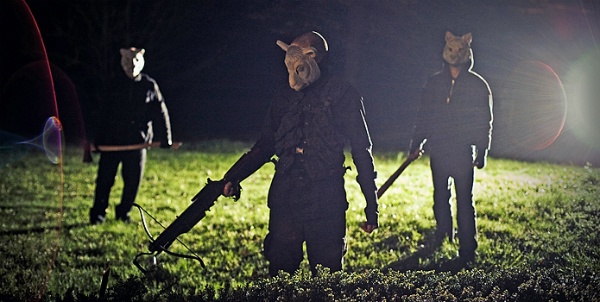
us.  Adam Wingard’s disturbing new film
makes the most of such fears by taking up the popular thriller scenario of the
home invasion.  And while You’re Next is genuinely frightening,
ranking right up there with other recent films that excel in this mode, such as
The Strangers and Them, it also offers a sharply satirical
take on a distinctively American sense of privilege and entitlement.  Embedding his fairly traditional sequential
homicide plot in a dysfunctional family drama, Wingard gives us a taste of what
Last House on the Left might have
looked like if it were directed by Luis Bunuel instead of Wes Craven, and in
the process re-politicizes a genre too often exploited for mindless thrills.

The film concerns itself with the reunion of a very wealthy family
celebrating the parents’ anniversary.  But the darker underpinnings are
set by its alarming introduction. The wealth of the Davison family is in inverse proportion to its
sense of community and compassion, as we see when mom and
dad pass a neighbor’s home not far from their own country estate. Noticing a car in the driveway, they remark
that no one has occupied it in quite a while, and Paul (Rob Moran) remarks,
“It’ll be kind of nice having neighbors – we’re so isolated out here.” Struck
by the peculiar novelty of actually living near someone else, wife Aubrey
(Barbara Crampton) eyes him uncertainly and replies, “Um, maybe.”

This sense of narcissistic detachment permeates the family,
and as their reunion gets underway a palpable chill settles on their enormous
country estate that has little to do with the weather. Beyond the usual sibling rivalry, family
relations are strained by a father who seems bored even by his children’s
achievements, while at the same time straining after an illusion of family
warmth and camaraderie. As the house
fills with guests, Aubrey seems increasingly out to lunch, a classic portrayal of a trophy
wife who has ceded her status as an individual. The significant others of the younger family
members are regarded as somewhat annoying curiosities by the other Davisons, as
if they were stray pets who haven’t been entirely housebroken. Significantly, the daughter’s partner is an
underground documentary filmmaker played by one of independent horror’s leading
figures, Ti West. The family is deeply
perplexed by the question of what would motivate anyone to direct low-budget
films, and the oldest brother encourages him instead to direct advertisements,
which he deems the twenty-first century’s premier art form.

Suffice it to say that by the time the masked invaders begin to pile up bodies,
no tears will be shed (at least by the audience). Wingard demonstrates his mastery of the genre
by knocking his annoying characters off in a disturbing, and often amusing,
variety of ways. Many of the murder
scenes verge on elaborate slapstick routines, at times suggestive of Rube
Goldberg stunts designed for the Marquis de Sade. Critics have praised the film’s deft
management of the fine line between horror and humor, and while it’s true that
this series of killings is a genuinely funny and frightening tour de force, the
film’s real appeal is in the pointed nature of its satire.

Early in the film, as Crispian Davison (A.J Bowen) and his
girlfriend Erin (Sharni Vinson) are driving up to the reunion, she asks him how
his family became so wealthy. When he
answers that his father used to work for a Halliburton-like firm of defense
contractors, he jokingly asks, “Are you sure you’re okay having dinner with
fascists?” Military concessions aren’t
the only thing the Davison paterfamilias has been contracting out: as the
siblings discuss the slow progress of their family estate’s restoration, they
note that dad bought the place as a kind of retirement project, but has lazily hired
other people to work on it rather than restore it himself. As the film progresses, certain members of
the family are shown to have a surprising connection with their killers, and
the film comes to serve as an extended meditation on the connections that exist
between members of an economic and social community, and the impossibility of
compartmentalizing them. The Davisons
would like to believe that they have achieved a pristine sense of isolation from the society they profit from, but their financial ties bind them to a
population on whom they would prefer to turn their backs.

At the other end of the social spectrum is the family
background of Crispian’s girlfriend, Erin. As the dwindling family members hunker down in their embattled home, she
reveals a surprising efficiency at defense tactics, which she confesses having
learned during a peculiar childhood raised in a militia compound in the
Australian outback. Her father was a
survivalist who believed the world’s problems of overpopulation, food and water
shortages would result in global anarchy, and devoted his life to ensuring his
and his family’s continuation. Yet while
Erin’s and Crispian’s families may come from different sides of the class
divide, their social values are surprisingly similar, and reflect some of the
dominant tendencies in American culture. Gun-toting survivalists in their militia compounds and retired
millionaires sequestered behind their capital gains share a common vision of
freedom and independence at any cost, and Wingard’s film effectively shows what
happens when this twisted version of the American dream goes horribly wrong.

While Erin is certainly the film’s most dynamic character
and the closest thing the film has to a heroine, she differs from the
familiar “last girl” figure of traditional horror films.  Unlike the resourceful Jamie Lee Curtis in Halloween or Texas Chainsaw Massacre survivor Sally Hardesty, Erin goes beyond
merely getting out of the nightmare in which she finds herself: she becomes an
essential part of that nightmare, engaging in brutal overkills that constitute some
of the film’s most uncomfortable viewing. 
In one especially complicated encounter she hesitates before the kill,
before dismissively asking, “Why the fuck not?” as she finishes the bloody
deed. Survivalist Erin is no worse than
the selfish Davisons and their ruthless assailants, but it would be quite a
stretch to suggest that she offers an alternative moral center to the violent
maelstrom in which she finds herself.

In its by turns disturbing and hilarious portrayal of a
privileged family’s reunion gone horribly wrong, You’re Next gives us what is perhaps this year’s most trenchant commentary
on an America increasingly riddled by narcissism and greed.  That it chooses to center its satire on a
family gathering points up its difference from the summer’s other major horror
offerings, The Conjuring and Insidious 2, both directed by James Wan. Where Wan gives us a disappointingly
traditional vision of the home as locus of love and solidarity, Wingard reminds
us that houses are designed as much to keep others out as to shelter those
within. Wingard’s film takes its title
from the bloody words scrawled on the walls of the Davison’s home by its
invaders, and these words might be taken as a dark reminder of our common
lot. You might think you’ve landed
yourself a comfortable position and a secure future, but as horror films remind
us, it may be only a matter of time until you’re next.

Jed Mayer is an Associate Professor of English at the State University of New York, New Paltz.

Quid Pro Quo: How THE SILENCE OF THE LAMBS Has Informed Our Attitude Towards Chelsea Manning

How THE SILENCE OF THE LAMBS Has Informed Our Attitude Towards Chelsea Manning

null

There’s no precedent for
what we’re supposed to think about the story of Chelsea Manning. In the absence
of an easy answer, our response resembles a replay of Jonathan Demme’s The Silence Of
The Lambs.
The facts run as follows: In February 2009, an army intelligence analyst named
Bradley Manning turned a vast amount of damning classified documents over to
Wikileaks, including a video of a Baghdad airstrike that killed two unarmed war
correspondents, as well as a video of an even more grotesque Afghan airstrike
that killed between 86 and 147 civilians, mostly children. After spending more
than 1200 days in several solitary confinement facilities—including a cell
in Quantico where he saw the sun for 20 minutes a day and was forced to sleep
naked because of potential self-harm concerns—his case went to trial, he was found guilty,
sentenced, and then  the condemned
soldier turned whistleblower (or traitor) turned icon announced to the world,
“I am Chelsea Manning. I am a female.”

The media can’t get a
handle on what feels like double treachery on Manning’s part: just when justice
closes in on a traitor, the traitor changes shape. America is choking on
Manning’s metamorphosis just like the moth chrysalis shoved deep into the
throat of Buffalo Bill’s victims in Silence—another narrative about
secrets, justice, and perverse transformations. To really understand Manning’s
story requires subtlety and nuance: a deeply unhappy and conflicted young
soldier, motivated equally by moral imperative, deep personal dissatisfaction,
and a profound identity crisis, laid bare our military’s most brutal failings.
But why strive for a true understanding of reality when our pop mythologies
will address our unease?

It’s not an unthinkable
parallel. The Silence Of The Lambs, made in 1991 at the advent of the
first Gulf War, is a movie full of American flags—some where they’re
expected, like courthouses and government buildings and on the uniforms of law
enforcement personnel, but many more in unexpected places. Flags manifest in
violence and cloak its aftermath: peeling back a gigantic flag draped over a
car in a storage unit belonging to Hannibal Lecter reveals a decapitated
mannequin and a head in a jar. A pool of blood left after one of Lecter’s
killing sprees reflects the light glinting off prison bars, cutting the gory
puddle into red and white stripes. Bright muzzle flare from Starling’s gun
reveals how Buffalo Bill’s underground lair is full of stars and stripes,
including a tiny flag at a jaunty angle that suggests the raising at Iwo Jima.
(A vintage poster on a door nearby reads “America—Open Your
Eyes.”)

The first Buffalo Bill was
an American hero, too: Medal of Honor recipient William Frederick Cody, hunter,
showman, slaughterer of buffalo. Not the villain of our movie, the monster we
meet first in a bold headline (“BILL SKINS FIFTH”), then as a stranger ensnaring
a young woman (she’s listening to Tom Petty’s “American Girl” on her
headphones), and then, in all his perverse, naked glory, croaking “I’d fuck
me” while swooning over his own castration. This is what many shamed
transgendered people recall from childhood as their first vision of
“someone like me”: It rubs the lotion on its skin or it gets the hose
again. The script makes clear Buffalo Bill isn’t a transsexual (“his pathology is a thousand times more savage and more
terrifying,” assures Lecter), but this is an empty reassurance that one
forgets with a nauseous shudder after hearing the first bars of Q Lazzarus’s
“Goodbye Horses.”

Buffalo Bill wants to
become a woman by donning a home-sewn “woman suit,” but he’s not the
only yearning butterfly (or death’s head moth) in a movie full of
transformations.  Starling sheds her
trainee sweatpants to become a full-fledged FBI agent. Lecter teases Starling
with clues tucked inside anagrams, the verbal equivalent of a caterpillar
inside a cocoon, and flays impostors attempting the same masquerade (his catty
rejoinder to the mother-turned-senator: “Love your suit”), but
he too escapes from his own prison by skinning a man’s face and wearing it as a
mask.

Did Manning think about
this when she borrowed another face to try and escape from a military tour of
duty full of harassment and abuse? Sending a photo of herself in a blonde wig
and makeup to her master sergeant in an email entitled “My Problem” is a
desperate act. It’s true, she was disturbed. There’s no shortage of documented
violent incidents spanning her troubled life, including one in which she was
found curled up on the floor of a storage room, a knife at her feet, the words “I want” carved into a nearby chair.
(“What do we covet, Clarice? That which we see every day.”) The desire to correct one’s gender—or to take a stand
against unjust military secrecy—isn’t stimulated by something as simple as
knowing about a fictional character. But if the virulent legacy of Buffalo Bill
still floats through our culture, making life hard for transgendered people,
maybe it also keeps the unusual, positive example of Starling’s feminine
heroism fresh in our collective mind.

The Silence
Of The Lambs
is ultimately
the story of a woman who penetrates a world of underground chambers—basements, storage units, detention blocks behind endless locked doors, wells
dug into dirt floors—because  that is
where the secrets are kept.
Manning is tiny, elfin, 5
foot 2 and 105 pounds: birdlike, a Starling. She knew how it felt to be crowded
in rooms full of uniformed men towering over her, harassing, bullying,
badgering. Her fragile mental state notwithstanding, she felt the same dogged
imperative to expose secrets in the name of justice, after finding out American
soldiers were killing noncombatants with the same breezy impunity (“Oh yeah, look at those dead bastards . . .,”
“Good shot,” “Thank you.”) with
which William Cody killed buffalo on the American plains. And she, too, knows
what it’s like to be imprisoned in small, dark spaces. Turning documents over
to Wikileaks was the end of one cluster of secrecy, but unlocking Chelsea from
the prison of Bradley—a transformation that was much longer in the works
than its sudden public manifestation would suggest—was really the
penultimate secret she needed to set free.

The media
could have seen this parallel and cast her as a Clarice Starling.  But that didn’t happen. The aftershocks of a
character as powerful as Buffalo Bill means her male-to-female transformation
is met with exceptional revulsion. She is a turncoat monster, a shapeshifter so
dangerous she must sleep, like Lecter, in solitary confinement, not even
allowed flip flops or underwear because she could turn them into lethal
weapons. Even when she refused to testify against Wikileaks in exchange for a
plea deal, rather than honoring her courage the headlines essentially screamed
BRAD PLEADS FIFTH.

To her credit
she’s not accepting this narrative. She issued a graceful public statement: “I hope that you will support me in this transition . . . I look
forward to receiving letters from supporters and having the opportunity to
write back.” She seeks a dialogue, not the recursive, narcissistic
“I’d fuck me” of Buffalo Bill. William Cody was a hero in his time,
but now we lament the slaughter of the buffalo. It’s funny how our heroes rise
and fall as our perspective changes. Manning got 35 years, but there’s hope
she’ll be the hero whose pop culture example can replace the anti-transgender
legacy of The Silence Of The Lambs. Buffalo Bill’s defunct. How do you
like your blue eyed girl?

Violet LeVoit is a video producer and editor, film critic, and
media educator whose film writing has appeared in many publications in
the US and UK. She is the author of the short story collection
I Am Genghis Cum (Fungasm Press). She lives in Philadelphia.

John Luther and the New Face of Evil

John Luther and the New Face of Evil

Those
with only a passing interest in the BBC detective drama Luther, or
who’ve watched the program only half-heartedly, will wrongly say that this is a
show about a dirty cop. In fact, what it is is a program about a man trying to
be heroic in all the wrong ways. The show’s title character, John Luther (Idris
Elba), is a Detective Chief Inspector working for London’s Serious Crime Unit;
while Luther has a set of skills that come in handy in homicide investigations,
this by no means confirms his career choice as a wise one. The show seems to
intimate that this is often the way with heroes: They misidentify the optimal
utilities of their skill-sets, blinded by the clarity of their ambitions. As a
former cop turned murderous flunky says of Luther at one point, “He’s not
a dirty cop. He’s a man over a barrel. There’s a difference.” 

While
I’ve never myself been a police officer, I have been a public defender, and
public defenders are known for having an even more complex and self-destructive
Jesus Complex than do patrolmen and detectives. For the seven years I defended
children and adults in criminal cases ranging from marijuana possession to
first-degree murder, I had nightmares almost every night. But they weren’t
nightmares about my clients, or about the things my clients may or may not have
done—as 99.8% of alleged crimes are of the most banal sort—they were nightmares
about failure. About letting down those I’d sworn to protect. And those
nightmares made me work even harder during my waking hours, or, when too
exhausted to work harder, caused me the worst sort of guilt about not being at
my best. That sort of internal struggle is slowly but surely destructive, which
is why I ultimately left the law, and why it’s particularly wrenching for me to
see John Luther so tied to a job that’s slowly killing him. Indeed, it’s not too
much to say that Luther is a documentary of suicide-by-profession.
The lead is always intimating he’s about to leave the force—a strange conceit,
for a detective drama—but the viewer never quite believes it. Luther without a
badge is merely a broken man without a purpose, not because his skills aren’t
transferable but because he lacks the imagination to conceive of such a
transference.

In
the second season of Luther, a teenage porn actress who claims to
enjoy her job—a job that entails being gang-raped while unconscious—is
admonished by Luther to call her mother. Her response: “It’s not my voice
she wants to hear. She’s no different from the freaks who get off on these
films. It’s not who I actually am that matters, it’s who they wish I was.”
Throughout the three seasons of Luther that have aired on the BBC
so far, the show’s lead is constantly being given hints like these—by porn
stars, actresses, even sociopaths he’d once hoped to arrest and prosecute—that
he himself is the one most in need of self-knowledge and salvation. Indeed, even
those who’ve never worked in the public service sector can see in Luther a
series of traits readily recognizable to anyone who’s ever wanted to be a hero,
or who’s ever relied overmuch on someone else who wanted to be a hero, or who’s
ever had the misfortune of being the spouse or child of someone who wants to be
a hero. In short, Luther sacrifices his mental health to be very, very good at
what he does, and he does so because he places a higher premium on the well-being
of others than on his own. The readily predictable result: Those he loves get
hurt, and he himself begins a slow descent into despair.

For
all its quirks, Luther does have many of the usual trappings of a
detective show: a smart and strangely charismatic leading man whose weaknesses
undermine his professional life and ensure persistent chaos in his personal
life; a cast of loyal compatriots, sprinkled with the occasional two-faced
villain in policeman’s gear; a series of brutal crimes that can only be solved
by a man nearly as troubled as the perpetrators themselves. What’s unusual
about Luther, apart from the stunning brutality of some of the
crimes it depicts—viewer discretion ought be repeatedly and urgently advised—is
the sense it provokes that it’s always mere seconds from going off the rails
completely. It’s not that John Luther is unpredictable, though he is; or that
he’s perpetually surrounded by intrigues of the most scandalous and destructive
sort, though that’s also true; it’s that Luther is a psychological drama
disguised as a detective show, not, like Monk
or another recent BBC hit, Sherlock
Holmes
, a detective show masquerading as a character portrait. So the
inherent instability of Luther’s circumstances indeed cuts at the very structure
of the series itself.

null

Rarely
have I been so repeatedly surprised by a television program. Issues which seem
likely to linger for several episodes are neatly resolved in minutes, only to
reappear much later as significantly more complicated destructive mechanisms.
Wise decisions made by characters are shortly reversed, with disastrous
consequences. Natural allies, including most of Luther’s administrative
superiors, become enemies under circumstances in which neither party is truly
to blame. Minor characters who’ve been minor for some time suddenly receive
promotions to “major” status. Killers are not always caught; in fact,
they don’t always remain villains, as one of the show’s primary characters, Alice
Morgan, is a known killer Luther now uses as a clandestine advisor on other
investigations. The genre of the show oscillates between police procedural and
horror flick, as undoubtedly the crimes portrayed on Luther are
some of the most heinous ever to appear on television. The show’s habitually
tight shots, particularly of victims at crime scenes, create a sense of
claustrophobia mediated only by an occasional wide shot of sterling beauty.
Ultimately the very structure of the show, as to both its plot and its
cinematography, is every bit as chaotic as the life and times of Luther
himself. As Luther unravels, so do (and so must) our expectations for what his
world should and will look like.

What’s
superlative about Luther is that it draws no attention whatsoever
to its oddities. The show’s lead plays Russian roulette with himself while
sitting alone in a room, but it’s merely one scene among many with more bells
and whistles; he assaults a suspect while in disguise to capture a DNA sample,
and it seems strangely apropos rather than creepy and illicit; Alice Morgan turns from a villain into Luther’s ally by a process of osmosis so slow it’s
almost imperceptible; the basis for a shifting allegiance five
episodes down the line is put repeatedly under your nose, only you don’t
realize it until you’re trying to put together the pieces later on. One can
only conclude, from all this, that Luther is seeking to normalize
that which cannot be normalized, in much the same way that Luther himself—who
wants very much to be a hero, however understated his body language is—must
normalize his psychic degeneration in order to keep doing the job he loves so
much.

Luther
poses for the attentive viewer an important question about the daily
manifestations of evil, and our own complicity in their devastations. How many
of us make erroneous assessments of what we do or don’t need in our lives? Or
of what we are or are not called upon to do, or who we are or are not capable
of being good to, or of what we can or cannot withstand? Luther is
a show about the crime of having both too much and too little self-knowledge,
not the harrowing and intricate gorefests staged by the show’s murderous
rogues’ gallery. It’s a show worth watching because it’s a cautionary tale, not
because we feel the vindication of justice served or heroic instincts validated
by merely watching it. Such instincts aren’t validated; in fact, they’re
revealed as poisonous, and in time we see them cause as much injustice to the
innocent as to the guilty. 

Luther—the
man as much as the show—is an emotional train-wreck it’s impossible to look
away from. The series is so cunningly disguised as entertainment that we can almost
(but not quite) forget how many of our own errors in judgment it reflects back
at us. Evil at its most pure, as Luther says in Season 2, quoting verbatim
(ironically) an unrepentant murderer, is a “black hole”—anything that
“drags you in and crushes you to nothing.” Earlier, another
unrepentant murderer is heard distinguishing between the banality of evil,
which he considers rightly taken for granted, and the much less feared but
considerably more insidious “evil of banality.” Detective work is a
civic function—a workaday banality—John Luther feels compelled to
execute, but which he cannot participate in without self-harm;
it’s just the sort of black hole that slowly and almost invisibly crushes
a man into nothingness. Like many detective shows, Luther is
finally about the insidious mechanisms of evil: it’s just not the sort of evil
you’d ever expect, nor the sort of self-destruction you’d ever see coming.

Seth Abramson is the author of three collections of poetry, most recently Thievery (University of Akron Press, 2013). He has published work in numerous magazines and anthologies, including Best New Poets, American Poetry Review, Boston Review, New American Writing, Colorado Review, Denver Quarterly, and The Southern Review.
A graduate of Dartmouth College, Harvard Law School, and the Iowa
Writers’ Workshop, he was a public defender from 2001 to 2007 and is
presently a doctoral candidate in English Literature at University of
Wisconsin-Madison. He runs a contemporary poetry review series for
The Huffington Post and has covered graduate creative writing programs for Poets & Writers magazine since 2008.

The Summer of the Sharknado

The Summer of the Sharknado

null

Remember when summer blockbusters used to be fun? When Arnold Schwarzenegger absurdly
swaggered through explosions in his shades and leather jacket? When Michael J.
Fox implausibly spun through time in his souped-up Delorean? When Michael
Keaton’s Batman actually spoke like he came out of a comic book rather than a
Dostoevsky novel? Whatever happened to such irreverent, charismatic figures and
the movies that brought them to momentary, flickering life? This year we were subjected to one bloated
action film after another, all of which treated their subject matter, however
ridiculous—whether zombie apocalypse, giant robots defending the earth against
inter-dimensional monsters, or a post-apocalyptic world exploited and abandoned
by the super-rich—with the kind of ponderous gravitas usually accorded to
European art films. Who can save our
popcorn fare from this inflated sense of self-importance?  Forget Wolverine, Iron Man, and Thor: this is
a job for Sharknado!

In early July, when the heat wave was hitting its peak in
many parts of the country, and even the air-conditioned Cineplex failed to
provide an escape from the enervating fug of 2013, the Syfy network broke a
years-long record of consistently bad entertainment with a deliciously absurd
ninety-minute escapade with the most irresistible title in recent memory. While
the network has tried several times to present campy, so-bad-they’re-good B-movies
for a contemporary mass audience (Dinocroc,
Sharktopus, Frankenfish), none of them has managed to find that essential
balance between naïve earnestness and shameless exploitation that made those
grindhouse classics of the 70s so bloody wonderful. As Nigel Tuffnel said, there’s such a fine
line between stupid and clever.  But
somehow Sharknado happened to find
this line and balance on it, precariously and hilariously. After airing to luke-warm ratings on July 11,
the movie sparked off a flurry of Twitter activity, generating smirking but
admiring tweets from such surprising celebrities as Mia Farrow, Wil Wheaton,
and Corey Monteith (some of the last he posted before passing away). Syfy aired it twice more in July, nearly
doubling the number of viewers of its original airing each time, and produced a
limited theatrical release, which sold out seats in the select cities where it
showed. Other than a great title, what
could make such an inauspicious production into such a phenomenon?

First of all, it’s actually really funny, but not only in
the ways one might expect. Sharknado offers horror-comedy lovers a
grand guignol of gore as herds of sharks are summarily blown up, gunned down,
stabbed with pool cues, hit with bar stools, and chain-sawed from the inside
out. This should come as no surprise, even if it is fun to see how they’re
going to top themselves in violent absurdity. What did surprise me is that I actually started to care about these
ridiculous stock characters, just a tiny bit. Not enough that I’d give up my
place in the check out line to one of them if they had only a few groceries and
I had a full cart, but, if I found myself stuck next to one of them on an
airplane, I might actually listen to that person with more than mere
politeness. This is how the story gets
us to let our guard down long enough to get taken in by the punch-lines. In an absurd
reprise of Quint’s speech in Jaws, as
he recounts the disaster of the S.S. Indianapolis, waitress Nova tells young
pilot Matt Shepherd about how she got the scar on her leg, a mystery apparently
too painful to reveal to the other characters who’d asked about it. During a childhood fishing expedition that
ended in disaster, she says, “Six people went into the water, and one little
girl came out. They took my
grandfather. That’s why I hate sharks.”
Though this last line has been often quoted and Tweeted, my favorite comes
after, when Matt eagerly says: “Now I really hate sharks too!”

Beyond these obviously appealing qualities, however, Sharknado has somehow managed to capture
the mood of the moment by presenting us with a disaster we don’t really have to
care about. In a summer of unprecedented
heat, and the by-now-anticipated escalating number of wildfires, droughts, and floods,
as we anticipate what is expected to be a horrendous hurricane season, the new
normal has become just that, and talking about the climatic apocalypse has
become about as boring as, well, talking about the weather.  In his big speech on climate change,
President Obama made the rather banal observation that “all weather events are
affected by it—more extreme droughts, floods, wildfires and hurricanes,” adding
that “the question is not whether we need to act. The question is whether we
will have the courage to act before it’s too late.” The president in The Day After Tomorrow said the same thing about a decade ago. And even such an inauspicious B-movie as Soylent Green offered a more urgent
warning about climate change, and that was forty years ago! I’m not saying it’s
too late to act, but it’s certainly too late to raise the question of whether
we will have the courage to act. Thankfully, Sharknado dispenses
with such platitudes by presenting us with a world surprisingly like our own,
one in which absurdly bad things happen, a lot of guns are fired, and beautiful
people find true love and hug. 

This isn’t to say that Sharknado
is cynical, certainly not as cynical as, say, Elysium, a film that presents a stark vision of a ruined world
abandoned to the 99% only to conclude by suggesting we could right the world’s
wrongs with better health care for everyone. Sharknado doesn’t pretend to
offer solutions, but it does manage to capture, or at least reflect, the
weirdness and stupidity of the new millennium better than anything else I’ve
seen this summer. Some of the most effective scenes are those set in Beverly
Hills, where we see torrents of water flooding into wealthy homes and
inundating the manicured landscapes of the affluent. Adding shark fins to such familiar disaster
scenarios seems less gratuitousness than commentary. And while it’s glorious, gory fun watching
the heroes and heroines of the film blow away these sharks with their arsenals,
Sharknado never demeans its viewers
by implying that natural disasters can be overcome with “courage.” The news commentators reporting on the
hurricane and waterspouts threatening California don’t hesitate to state
clearly that this extreme weather is a direct result of global warming, showing
a responsibility in reporting that may be the film’s most implausible element.

And for the record, Sharknado
does take the time to address an issue that has otherwise been given little
attention in the mainstream media. The
opening scene depicts an unscrupulous dealer in shark fins selling his wares to
an Asian buyer to use in shark fin soup. As the camera surveys heaps of dead sharks on the deck of the ship where
the deal is taking place, the foreman barks out “toss ‘em and bag ‘em!,” an
honest reflection of how this horrific practice is carried out. It’s hard to imagine an industry more
wasteful or cruel than the shark fin trade, in which these amazing animals are
caught for only one small part of their anatomy. After the fin is cut off, the shark is tossed
out of the boat to slowly bleed to death as it sinks to the bottom of the
ocean. Despite protests, the trade is so
widespread that last year over one hundred million sharks were killed in this
way (that’s over eleven thousand an hour). Number of humans killed by sharks? 12. The shark dealer in Sharknado enunciates
what might well count as the film’s hidden moral: “You don’t have to be afraid
of the sharks. They are the ones who
should be afraid of us.” You won’t hear
this on Shark Week. 

Sometimes the only reliable measure of the absurdity of our
times comes from absurd films. This is a
quality that the earliest spin-offs of Jaws
had in abundance. Piranha (1978) is about a
military-testing operation gone horribly wrong, when a super-breed of killer
fish designed for use against the North Vietnamese is set loose in domestic
waters. Barracuda (1978) and Prophecy
(1979) are about animals made into monsters by toxic chemical being dumped
in the water. Tentacles (1978) is about a giant octopus driven to a killer
rampage by intrusive underwater experiments carried out by a local developer;
one of the characters describes the eight-armed antagonist in terms applicable
to all these silly but socially-conscious B-movies: “It’s an animal, disturbed
by man’s stupidity.” Not a bad tag-line
for the Sharknado sequel.

Jed Mayer is an Associate Professor of English at the State University of New York, New Paltz.

BLUE JASMINE’s Complex Interior(s)

BLUE JASMINE’s Complex Interior(s)

nullnull

Warning: This review contains mild spoilers.

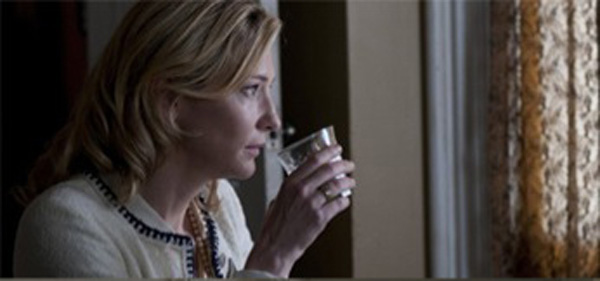
Critics have widely noted that the scenario of Woody Allen’s
latest feature, Blue Jasmine (2013),
is indebted to A Streetcar Named Desire
(1947). However, cinematically, the film owes just as much—if not more—to an
earlier Allen film: the obscure Interiors (1978).

Blue Jasmine’s indebtedness to Streetcar is fairly obvious. The movie depicts what happens when the blustery socialite
Jasmine (Cate Blanchett), having fallen on hard times, moves in with her
working class sister Ginger (Sally Hawkins), initiating a series of class
conflicts. What’s more, Blanchett came to the project after a tenure as Blanche
in a Broadway adaptation of Tennessee Williams’s famed drama.

The
connections with Interiors, however, should
be just as apparent. What obscures them is the fact that Interiors was little-seen in its time, and is today
little-remembered. To be fair, it’s a fairly bleak drama that presumably startled
and confused audiences more accustomed to Woody Allen’s nebbish comedy—indeed,
the film was how Allen chose to follow Annie Hall (1977),
after that film’s success afforded him carte blanche.

Interiors certainly has its problems
(which I’ll get to below), but it remains fascinating if for no other reason
than it was Allen’s first attempt at serious drama. We’re more familiar with
that side of Woody today; since then, he’s also made September
(1987), Another Woman (1988),
Crimes and Misdemeanors
(1989), Match Point (2005)—and
now Blue Jasmine. And so it’s high
time to revisit Interiors, and note
the ways in which Blue Jasmine is beholden
to it.

Some of the
broad similarities between Interiors
and Blue Jasmine include:

  • Both films
    are straight dramas, and fairly sober. (There’s no comedic plotline, like
    in Crimes and Misdemeanors.)
  • Allen
    doesn’t appear in either film.
  • Both films
    depict the mental deterioration of their respective protagonists.
  • In Interiors, Eve (Geraldine Page)
    suffers a breakdown after her longtime husband announces his desire for a
    trial separation; she clings to the futile hope that they will reconcile.
    In Blue Jasmine, Jasmine’s collapse
    follows the downfall of her deceitful husband Hal (Alec Baldwin), to whom
    she periodically continues speaking, despite his having hung himself in
    prison.
  • Eve is
    an interior decorator, a job Jasmine aspires to—going so far as to pretend
    to her suitor Dwight (Peter Sarsgaard) that she already is one.
  • Both
    films alternate fluidly between past and present action.
  • The overall
    editing styles of both films are similar, as Allen employs many abrupt
    cuts between scenes. Both films, for instance, tend to cut hard on the heels
    of the last line in a scene, often using this as an opportunity to switch
    between the timelines. (Allen first started matching on dialogue like this
    in Annie Hall.)

Additionally, Blue
Jasmine
includes other signs that the ever-introspective Allen is now remembering
his previous work. The amorous dentist for whom Jasmine briefly becomes a receptionist,
Dr. Flicker (Michael Stuhlbarg), bears the same name as the Brooklyn psychologist
in Annie Hall who assures a young
Alvy Singer that there’s no reason to fear an expanding universe. And the
mentally unstable Jasmine is another variation on a familiar Allen archetype
that includes not only Interiors’s
Eve but also Radha Mitchell’s Melinda in Melinda and Melinda
(2004), Christina Ricci’s Amanda in Anything Else
(2003), Mia Farrow’s turns as Hope and Lane in Another Woman and September,
respectively, Dianne Wiest’s Holly in Hannah and Her Sisters
(1986), and, arguably, Diane Keaton’s Annie Hall.

A
willingness to rework “whatever works” is not new in Allen’s cinema; the man
has long been in the habit of basing his films on preexisting material.
Sometimes the influence is explicit: Stardust Memories (1981)
clearly revises Federico Fellini’s (1963), and neither
Match Point nor Crimes and Misdemeanors disguises its debt to Dostoyevsky’s novel Crime and Punishment (1866). Similarly, Sweet and Lowdown (1999)
cribs a fair amount from Fellini’s La Strada (1954), Husbands and Wives (1992)
steals from Bergman’s TV miniseries Scenes from a Marriage
(1973), and September would be
unimaginable without Chekhov’s play Uncle
Vanya
(1897/9). At other times, the inspiration is subtler: Deconstructing Harry
(1997) borrows a portion of its central scenario from Bergman’s Wild Strawberries
(1957), a fact that might be overlooked due to the film’s wealth of material
and concern with metatextuality. (Both films are picaresques in which an older
man travels to receive an award from his former university; furthermore, the
scenes depicting Harry’s fictions are arguably equivalent to Wild Strawberries’s dream sequences.) And
To Rome with Love (2012)
is only loosely inspired by Boccaccio’s 14th-century classic collection
of tales The Decameron. (Its’ working
title was “Bop Decameron.”) Melinda and Melinda
pays homage to My Dinner with Andre
(1981) by including Wallace Shawn among the dinner companions, and takes its
central conceit from Alain Resnais’s 1993 experiment Smoking/No
Smoking
(1993) (or perhaps Krzysztof Kieslowski and Krzysztof
Piesiewicz’s The Double Life of
Veronique
, 1991).

Given this,
it’s worth remembering a fascinating argument made by Brad Stevens in a feature
article in the April 2011 Sight &
Sound
(“In Defence of Woody Allen”). There, Stevens claims that all of
Allen’s recent films (those since 2000) are to some extent variations on one
another:

“When viewed as a group, films
that—taken individually—could hardly seem any clearer or less ambiguous in
their intentions begin to feel mysterious and fragmented, diverse parts of a
whole whose contours can be glimpsed only as the various pieces of the puzzle
fall into place.”

In other words, Allen has spent the past ten years basing
his films . . . on his own previous work. Stevens notes that both Small Time Crooks (2000)
and The Curse of the Jade
Scorpion
(2001) feature jewel thefts, while both Vicky Christina
Barcelona
(2008) and Whatever Works (2009)
feature “women who realize they are gifted photographers as soon as they become
part of a ménage à troi.” Even more
compellingly, Stevens reads Scoop (2006) as a comedic reworking of the material that Match Point presents as tragedy: “both
deal explicitly with the class system and involve males who murder women in
order to preserve privileged positions within that system.” Along these lines, Stevens
notes how the seemingly innocuous Melinda
and Melinda
serves as something of a “guide” to reading Allen’s recent
work, serving up tragic and comedic variations of the same story.

All of this
having been said, I wouldn’t want to overlook the substantial differences
between Blue Jasmine and Interiors. Most importantly, Interiors, despite being a beautiful and
intriguing film (especially in the context of Allen’s filmography and career),
is hardly a successful feature. It is for one thing much too derivative of Ingmar
Bergman, especially Persona (1966) and Cries & Whispers
(1972)—the final shot, for instance, feels especially contrived, a blatant copy
of cinematographer Sven Nykvist’s work.

Blue Jasmine wears
its influences more lightly: while the film begins with a scenario taken from
Tennessee Williams, Allen quickly puts his own stamp on the material, and quickly
sets out in his own direction: there is no Stanley Kowalski, no “Stella!”, and both
sisters soon get caught up in romances with other men. Blue Jasmine is also the more successful film in terms of its characterization
and tone. Jasmine and Ginger, et al., are far more complex creations than the
caricatures inhabiting the chilly corridors of Interiors. (The exception of course is Eve; Geraldine Page’s
performance is nuanced and powerful). Moreover, whereas Interiors is marred by the same clunkiness that sometimes haunts Allen’s
dramas (see also September), Blue Jasmine’s dialogue and plotting
recall the subtler scripting on display in Crimes
and Misdemeanors
and Match Point.

For
instance, consider the question of Jasmine’s culpability. She gives the impression
that she never had any knowledge of Hal’s criminal endeavors, or even the capacity
to understand them. Indeed, she routinely protests that when she encouraged Ginger
and Augie (Andrew Dice Clay) to invest with Hal, she was simply trying to help
them out. However, after Hal confesses to Jasmine that he has been serially
unfaithful, and what’s more that he intends to marry the French au pair he is
currently seeing, we see Jasmine make a phone call to the FBI, which leads to
his arrest. We might presume that Jasmine offered to testify against her
husband, and therefore knew more than she later lets on. The point is not elaborated
upon, and only Jasmine’s adopted son Danny (Alden Ehrenreich) seems to know
this fact, explaining his desire to have no further contact with the woman.

Thus,
Allen’s filmmaking is more subtle than critics commonly recognize— perhaps
distracted by the broad strokes?—as well as more introspective. Above all else,
Allen recognizes that psychological insight is not threatened by artifice. He has
always been comfortable allowing his fictions to be fictions—always fake, and always based on other works, his own and
others. Part of Allen’s value as a writer and as a filmmaker (and I personally
consider him among the highest ranks in both categories) has always stemmed
from his simultaneous pursuit of psychological insight by means of inherited material. Cate Blanchett’s Jasmine is in many
ways a stereotype, a shallow socialite decked out in Chanel belts and Louis
Vuitton bags; her costuming is anything but subtle. But Allen’s broad signaling
in this regard does not diminish the power of the portrayal. By the end of the
film, Allen and Blanchett & company have constructed a complex character whose
psychological suffering is palpable and unsettling.

Take for
instance the final scene, which is as neat and poetic an ending as could be
hoped for. Throughout the film, Jasmine’s been haunted by strains of “Blue Moon,”
the song that was playing when she first met Hal, who became the source of her
highest highs and her lowest lows. Each time we are given only an instrumental
version. At the end, the song returns, and as Jasmine sits and mumbles to
herself, alone on a park bench, she admits that the words have become “a jumble”
(the film’s last line). But Allen trusts us to remember them:

Blue moon

You saw me standing alone

Without a dream in my heart

Without a love of my own

This is the height of Allen’s artistry on display. Watch how
it happens. The song is redemptive, but we see Jasmine solitary and hopeless,
her last chance at redemption blown. Arguably, she deserves her comeuppance.
But who will be the first among us to insist upon that? Allen, meanwhile, hangs
back and quietly observes. Jasmine sits there and he watches her sitting there,
and as the song continues playing we realize the gentle irony of the movie’s title:
“Blue Jasmine.” This is a very sad ending for such a creature, monstrous though
she may be.

But Jasmine
isn’t a monster, which is precisely
Allen’s point: she’s utterly complex, and none the less so for having been
stitched together out of pieces taken from countless prior protagonists. Woody
Allen both inherited her and made her—that’s the real irony. And he keeps on shooting, and dares us to risk caring.


A.D Jameson is the author
of the prose collection
Amazing
Adult Fantasy
(Mutable Sound, 2011), in
which he tries to come to terms with having been raised on ’80s pop culture, and the novel
Giant
Slugs
(Lawrence
and Gibson
, 2011), an absurdist retelling of the Epic of
Gilgamesh. He’s taught
classes at the School of the Art Institute of Chicago, Lake Forest College,
DePaul University, Facets Multimedia, and
StoryStudio Chicago. He’s also the
nonfiction / reviews editor of the online journal
Requited. He recently
started the PhD program in Creative Writing at the University of Illinois at
Chicago. In his spare
time, he contributes to the group blogs
Big
Other
and HTMLGIANT. Follow him on Twitter at @adjameson.

VIDEO ESSAY: Gliding Over All: The Cinematography of BREAKING BAD, Season 1

VIDEO ESSAY: Gliding Over All: The Cinematography of BREAKING BAD, Season 1

This video essay is a co-production of Press Play and RogerEbert.com.

What is it about the desert?

Put more simply, what is it about the desert that simplifies
human conflicts, desires, and fears as represented in film and literature?

Think of Kobo Abe’s Woman
in the Dunes
, Paul Bowles’ The
Sheltering Sky
, Sam Shepard’s True
West
. Terrence Malick’s Badlands. Sergio Leone‘s Once Upon a TIme in the West.

Or, more relevantly to this discussion, Breaking Bad.

Put more specifically, what is it about the desert that, in
early episodes of this show, threatens to topple the narrative with the
sparseness of its scenery, with shots so dry you can practically taste the
sand?

It’s the emptiness.

The sense that there is nothing but the air between a
character and his problems, and that air is so thin it might as well not be
there.

The sense that a man, when faced with a problem, be it the
legality of his enterprise, death, the ineptitude of other humans, or all
three, might flail in the desert air, and find nothing giving resistance,
moving him forward.

The tedium of all of it. The difficulty.

But, at the same time, the profound importance of it.

There is also the way conversation sounds in the desert: the
way each sentence falls into silence, like a coin falling into a dry well.

We don’t hear the clink of the coin at the bottom of the
well, because it doesn’t have a bottom. Not on this show.

Another thing about the desert, particularly the New Mexico
desert, is that it dehydrates you. It sucks everything out of you. You come to
it with a set of complications, a set of morals, a set of daily worries, and
you find, in almost no time, that they’re all gone, lost in the cold night wind.

All that’s left is you, and the matter that brought you
here.

Another thing about the desert is that it’s where we all
started. (Depending on who you ask.)

Not in the desert, literally—but in the semblance of desert.
With nothing.

Nothing except, of course, that 800-pound elephant,
shimmering in the heat in front of you.

You can either stay where you are, and hope, until the sun
goes down, that the elephant goes away.

Or you can do something. And walk towards it.

And that moment, right there, that first step, is where your
troubles begin.

You think, If I can
just kill that elephant, all my problems will go away. I can leave. I can step
over its corpse, and head back to what I was doing before this.
 

But sadly,

and truthfully,

and unavoidably,

you think you’re walking out, but in reality, you’re just
walking farther in.–Max Winter

For a terrific essay by Nick Schager on the cinematography of Breaking Bad’s inaugural season, go here:

http://www.rogerebert.com/balder-and-dash/cinematography-of-breaking-bad-season-1

To watch the video essay on Season 2, along with an interview with director of photography Michael Slovis, go here:

http://www.rogerebert.com/balder-and-dash/gliding-over-all-the-cinematography-of-breaking-bad-season…

To watch the entire series on Press Play, go here:

http://blogs.indiewire.com/pressplay/tag/dave-bunting-jr

Dave Bunting, Jr. is the co-owner (with his sister and fellow Press Play contributor, Sarah D. Bunting) of King Killer Studios, a popular music rehearsal and performance space in Gowanus, Brooklyn.  He plays guitar and sings in his band, The Stink,
and dabbles in photography, video editing, french press coffee, and
real estate.  Dave lives in Brooklyn with his wife, son, and sister.

Max Winter is the Editor-in-Chief of Press Play.