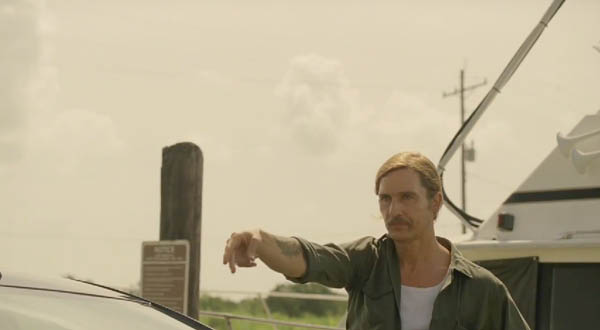
13 Ways in Which RED RIDING Can Satisfy Your Jones for TRUE DETECTIVE

13 Ways in Which RED RIDING Can Satisfy Your Jones for TRUE DETECTIVE

null

The stars of last night’s finale of True Detective were Errol Childress’
Cary Grant accent, his mentally challenged stepsister, his creepy labyrinth,
and Rust’s epiphany about love in the universe—which sucked up air time at the
expense of about 90% of the case details—details that, for my money, were far
more interesting than Rust’s epiphany.  Will
Rust exact revenge on the Tuttle family? Will Marty and Rust continue to fight crime
together as private dicks? Why was Billy’s mouth sewn shut? If he was dead, why
was he so well-preserved? Will we ever find out why Errol had those burn marks
on his face? What was the song Errol was whistling? While
speculative pairings for Season 2 abound on Twitter
, actor Matthew McConaughey
recently told a reporter, “We won’t be back for season two…Season one was
finite. Eight episodes, that’s the [end of conversation].”

So how are you
going to quench that thirst for a tall glass of hardboiled noir topped with a
side order of pedophile rings, smothered in police corruption until season 2—if
there is one? Try Red Riding, based on David Peace’s books, The Red-Riding Quartet. Set against a
backdrop of the Yorkshire Ripper murders, Red Riding’s narrative
complexity combined with grizzly brutality gave birth to a new subset of hardboiled
crime dubbed “Yorkshire Noir.” Three of Peace’s books were made into episodes
for Britain’s Channel 4, which ran in 2009 and were released theatrically in the states in
2010.

null

True
Detective
stole big from Red Riding. It’s a far more savage depiction of
police corruption and poverty with fewer allusions to the occult and philosophy.
The three episodes run from 1.5-1.75 hours each. With all the rewinding you’ll
do to make sure you caught the dialogue, your total viewing time will be about
the same as True Detective—though Red Riding can’t compete with the time
suck of poking around Reddit for Yellow King theories or Googling “capuchon
Mardi Gras
.” Sorry. Nothing will fill that hole.

Warning:
Spoilers abound below, but with Red Riding’s thick-as-Hasty-pudding accents, it
helps to have a leg up. You can read the books first, watch with subtitles,
precede/follow your viewing with episode synopses, or all of the above—the way
some people do with Game of Thrones. It’s worth it.


1. Three Is A Magic Number

Both True
Detective
and Red Riding jump through three different time periods. In True
Detective
: 1995, 2002, and 2012; in Red Riding: 1976, 1980, and 1983. The time
jumps and fractured narrative throughout True Detective, and in the second
two episodes of Red Riding allow us to witness the evolution of the characters—as
well as their cognitive dissonance. We see the mistakes they’re making as they
make them—and that they’re telling lies as they tell them. We watch Marty give the
court reporter a rim job in the past, while his voice over in the present lectures,
“A man without a family can be a bad thing.” But as Rust will tell you,
linear time’s for squares.

Time jumps give
the storylines more ambiguity and slipperiness. In both, every crucial,
case-breaking detail has been reported to, and ignored by, the cops. Files and
evidence have been lost, hidden, and destroyed. But because we’re time jumping,
if it’s an important detail, we’ll touch on it again and again. Most detective
stories trot out their flashbacks at the end, like Murder She Wrote, which
always made clues found in the linear present glint and yell, “Look at me! I’m
a broken fireplace poker!”

2. Location, Location, Location

Place is as
crucial in both True Detective and Red Riding as any of the stories’ characters.
For True Detective, the hurricane-ravaged bayou landscape of Louisiana
reminds us all that men and their machinations inevitably fall victim to nature’s
insatiable maw. Think of all those long aerial shots of the water slicing the
land to lace. If you stand still long enough, kudzu’s gonna choke you out. 

Red
Riding
takes place in the green-grey drizzle of Yorkshire. Historically, the land’s
awash in blood. One long shot of a doomed little girl wandering home along Yorkshire’s
ancient, narrow streets—flanked by dilapidated shacks that look like Charlie
Bucket’s house in Willie Wonka and the
Chocolate Factory,
from which a rheumy set of eyes peers out a toaster-sized
window—says it all: these angelic little moppets have been fodder for the grinding
stone from time immemorial.

3. Cops Gone Wild

When Rust
says, “I’m police. I can do terrible things to people with impunity,” it
means he’s capable of doing bad
things. When a bunch of cops boisterously toast, “To the North! Where we do
what we bloody want!” we know they are
doing bad things.

4. Smokestacks
In both shows, the gray concrete towers and power lines of factories and plants
loom in the background, reminding us that police and pedophiles aren’t the only
ones killing off the residents. The poor are prey; cops, religious jerkoffs,
and corporations are hunting them for sport. No one’s watching. No one cares. Bludgeoned
on the ground, choked by the air.

5. Thick Regional Accents

null

Certainly, “With
all the dick swagger you roll you can’t spot crazy pussy?” was one of True
Detective’
s shiniest gems, but if Rianne Olivier’s
crab trappin granddad’s “Ehbuhdy dink
dey gone beh sometin
dey nat” made you swoon, Red Riding is for you. These
lads are not only slogging through Yorkshirese, they’re hardcore mumblers and
furtive whisperers to boot. Subtitles help, but David Morrissey (the Governor
for The Walking Dead and Time Lord Jason Lake on Doctor Who) is especially
incomprehensible—yet one of the most compelling characters in the series. You
just gotta sit back and let his deee-licious chocolate-colored corduroy suit
and tan tie do the talking.

6. ‘Staches Make the Men

As do
sideburns, beards, mutton chops, bugger grips, mouth mirkens, and chin
chocolate. In Red Riding and True Detective’s sea of face pubes, it’s the clean-shaven
characters who seem out-of-step with the world and estranged from their own consciences.
As 2010 Rust gets in the Gregg Allman face lace race , his perceptions of the
case and himself grow clearer (“I know who I am. And after all these years,
there’s a victory in that”) whereas clean-cut Marty doesn’t know who he really
is until he cries in his hospital bed. In Red Riding, the squeaky-cleanest
character, Assistant Chief Constable Peter Hunter, is thoroughly despised
by everyone, including the woman he had an affair with and wants to have an
affair with again (she really doesn’t
want to).

7. Animals

In True Detective, bodies are adorned with deer antlers; in Red Riding, severed swan wings are sewn
onto a young victims’ back—and wolves, pigs, and rats figure prominently.

8. Ritualistic Abuse & Murder

null

I was glad the glimpse we saw of the
video tape recording of Marie Fontenot’s murder was mostly blocked by
Marty’s back—and the grainy black and white snippet we could see looked like an
early episode of Dark Shadows. Most of the violence on True Detective was “witnessed” through
the retelling of people’s stories. We weren’t forced to watch violence
happen—except for shooting Reggie LeDoux—and damn, that felt good. We saw the crime scenes and the
survivors—not the act of violence, but the aftermath. While Red Riding
normally excels in the violence department, it turns the camera away in a similar
scene to the one where Marty discovering the kidnapped children in the storage
shed* at Reggie LeDoux’s cook house. Red
Riding
skips the gory visuals on that one, too. The violence perpetuated
against children in Red Riding is seen only in one dimly lit flashback**,
which is as haunting as that scene from The
Shining
with the man in the tuxedo and the person (?) in the bear suit.

9. Transsexual Prostitute Survivors of Ritualistic Abuse & Murder

BJ and Johnny Joanie: the boys who
got away grew up very, very gay (and one of them lives in a storage shed*). Just
once, I’d like to see a show in which the boy who survives ritualistic abuse
grows up to be Dale Earnhardt Jr. or Guy Fieri or someone like that.

10. *Storage Sheds & Garages (pronounced gairijiz)

When you need to lay low. How low?
Like Jim Nabors singing “The Impossible Dream” low.

11. Ludicrously One-Dimensional Female Characters
Red Riding and True Detective are both Bechdel Bombs.
Aside from the trailer park madam, (“
Girls
walk this earth all the time screwing for free. Why is it you add business to
the mix and boys like you can’t stand the
thought? I’ll tell you: It’s ‘cause suddenly you don’t own it, the way you thought you
did.”), the women
characters in True Detective are
fairly brainless: they’re dead, sluts, dead sluts, guileless children, nagging
wives, or old, sick women.

null

When Maggie tries to break out of her
dutifully duped wife role by having an affair with Rust, he gives her a taste
of some Real Man Lovin’—without all that fairy tale frosting on top that
Marty’s been keeping her down with. And how does that Real Man Lovin’ taste to
Maggie? Like licking a Port Authority payphone: totally scary and gross. So she
pulls her little pink panties back on and high tails it home—implying good
women can’t handle real male sexuality: it’s too gross. Eeeeeew! Which reminds
me of that Louis CK bit about men being naturally besieged by disgusting sexual
thoughts:

“Women try to compete. [in a woman’s
voice] ‘Well, I’m a pervert. You don’t know. I have really sick sexual
thoughts.’ No, you have no idea. You
have no idea. See, you get to have those thoughts. I have to have them. You’re a tourist in
sexual perversion. I’m a prisoner there. You’re Jane Fonda on a tank. I’m John
McCain in the hut. It’s a nightmare. I can’t lift my arms.”

The most developed female character in Red Riding is the stunned
mother of one of victims who’s playing both sides of the fence and leaking information
to her daughter’s wealthy killer. She’s a blond, breathy, sad, soft-focus
nitwit. The other is a medium who wails a lot. I like her, but she does indeed
wail a lot.

Is it possible to create a similar police
corruption/pedophile ring premise with a female protagonist? Sure. Jane Campion
did it in Top of the Lake, along with bringing other very unique female characters to the story (Holly Hunter plays a
character I’ve never seen anywhere) and lots of unexpected twists. It’s another
great show to alleviate True
Detective
withdraw, but Top of the Lake becomes much more about its
cop protagonist (Elisabeth Moss)—and her intimate relationships—than the
criminals she’s chasing. And it lacks the estrangement of noir.

True
Detective
and Red Riding are pure noir—which the
Oxford Dictionary defines as fiction characterized by cynicism, fatalism, and
moral ambiguity. It’s a genre in which women, historically, have been double-D wooden
window dressing. There’s such a complete absence of actualized female
characters in both
True
Detective

and Red Riding—in the midst of
such intelligent writing—it’s beyond oversight. It’s a kind of willful
blindness: because Marty (and most of the other men on the show) can’t see
women as three-dimensional characters, let’s not have any. But then again, how
many evolved women would be caught dead in the storyline of
True
Detective
or
Red Riding? There’s a reason why smart
women do not attend dog fights.
True
Detective
might have a season
2, and a chance to redeem itself. I
could easily see the cast of American Horror Story: Coven eatin’ them Tuttle
boys alive. Throw Patricia Arquette in there, and cue a Cajun rendition of the theme
from Cops.

12. Mentally Challenged Men with Physically-challenged Testicles

If you think women get the short end of the stick in True Detective and Red Riding, try being a mentally
challenged man.
True
Detective
’s
Burt with his bowl cut and Red Riding’s
Michael Mishkin with his finger twisting twitch share 1) a childlike inability
to withstand the violence of poverty, and 2) nonfunctional testicles. They’ve
been unburdened with all that scary sexuality simmering under Cole’s surface
and right on top of Marty’s. I
n True
Detective
Burt has been maimed by criminals, whereas
in Red Riding, Michael’s disfigurement is congenital, but that doesn’t
mean he hasn’t suffered at the hands of cops.

This is a key difference in the shows: when Marty’s beating
the snot out of the skate punks, you can kind
of
understand why. They did
double-team his daughter, after all. But in
Red Riding, the violence is incomprehensible. No one beats Yorkshire cops
at beating the shit out of people; they’re sadists, and the greatest source of the
city’s pain—if not at their own hands, then by omission, by allowing
others—through their wealth or influence—to inflict pain on the little people.
As Sonchai, the Buddhist cop in Bangkok 8,
tells us, cops are merely a few incarnations away from being criminals.
Red Riding’s got a lot
more bad cops on the payroll. Even the good ones are shits.

13. Kings & Crowns
Red Riding
’s labyrinth can’t hold a
candle to the Yellow King’s, but we learn that the same kind of games have been
played there for many years. **“Mr.
Piggott is king today. You be nice to Mr. Piggott.”

Jennifer
L. Knox 
is
the author of three books of poems,
The Mystery of the Hidden Driveway, Drunk by
Noon, and A Gringo Like Me—all available from Bloof
Books—and
Holliday, a chapbook of
poems written in the voice of Doc Holliday. Her writing has appeared in 
The
New Yorker, The New York Times, and four
times in the Best American Poetry series. She is at work on
her first novel.
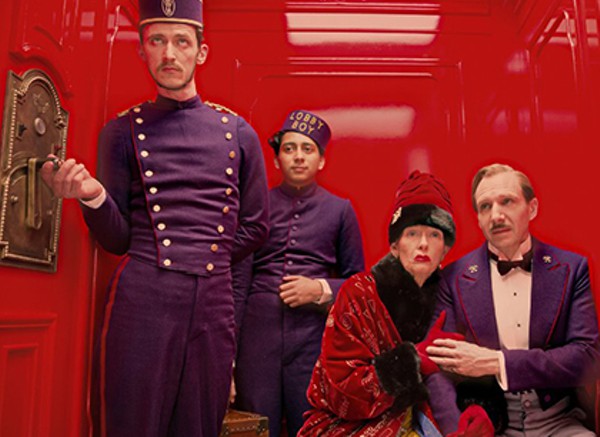
Wes Anderson’s THE GRAND BUDAPEST HOTEL: A Vivid Self-Portrait

Wes Anderson’s THE GRAND BUDAPEST HOTEL: A Vivid Self-Portrait

null

Last week, as I watched director
Wes Anderson take the stage at Lincoln Center to introduce the premiere of The Grand Budapest Hotel, I was struck
by the unusual deep-purple color of his suit. I almost wrote this off as an
inconsequential choice by the famously quirky director. But once the film began
rolling, I realized that Anderson’s colorful attire was actually his subtle
synchronization with the film’s leading character, Monsieur Gustave H. This
character dons the same shade of plum throughout the entire film, and soon I
couldn’t help but see that the similarities between the two went far beyond
their purple garb. The fascinating parallels between Anderson and his leading
man make this film his most soulful and self-reflective work to date.

Anderson’s exploration of this
delightful character gives us a rare glimpse into how the director views his
own world. Gustave (luminously played
by Ralph Fiennes) is the owner of the titular hotel, and his mission is not
unlike Anderson’s as he strives to preserve the particular charms of a world
that is slipping away. Both the director and his fictive concierge create
intricate but impossible worlds in The
Grand Budapest Hotel
. Set in the fictional Eastern European state of Zubrowka,
this pink wedding cake of a hotel is at its peak of grandeur. Gustave directs
the Grand Budapest so that it runs like clockwork, working to maintain its
splendor before it fades and falls with the oncoming war.

With idiosyncratic fervor, Gustave—like Anderson—tries to preserve his whimsical tastes despite the realities
around him. We watch Gustave speed through the halls, fastidious in his duties,
upholding comically high standards. One can imagine a similar eccentricity in
Anderson’s creative work, requiring exquisite attention to detail and
everything just so. Indeed, actors from
Anderson’s veteran cast have described the director’s meticulous production
methods as genius, beginning with his own detailed sketches, animations, and even
a suggested reading list for the cast.

It is hard not to see Anderson as a
sort of innkeeper himself, directing life on and off the set with the same
spirit and extravagant standards as Monsieur Gustave H. In a recent interview, cast
member Jeff Goldblum explained how Anderson’s visionary style pervades the
entire production experience. The director, Goldblum said, “wants to make the
shooting an art project of itself.” He described how the entire cast lived
together in the same hotel during shooting and sat down each night for group
dinners, elaborately arranged by Anderson. This custom aligns so perfectly with
the ethos of The Grand Budapest Hotel,
and seems to be a striking union of character and creator for Anderson.

There is a similarity between the two,
as both Gustave and Anderson hold tightly to their peculiar visions of the
world. For Gustave, this vision is the strange splendor of the Budapest in the
face of an oncoming war. And for Anderson, it is the intricate styling of his
own filmmaking, which stands alone in cinema today. Critics often accuse
Anderson of prioritizing his stylized design over substance, but this film is a
sweet exception to this charge. Visually, The
Grand Budapest Hotel
is as fantastical and charming as ever. But the story
also reaches new depths, with Anderson articulating themes that are richer and
more complex than his earlier works.

Some of that added complexity comes
from the darker and more realistic forces at work in The Grand Budapest Hotel. In past works such as Rushmore and Moonrise Kingdom, the opposing powers take the form of adult
authorities. These professors, parents, and scout leaders may clash with the
protagonists, but they are hardly villainous. This latest film, however, deals
with war, brutality, and a fictional “ZZ” unit that unsubtly recalls Nazi
Germany’s SS. The violence is harsher and the darkness comes closer than usual
for Anderson.

The effect of these forces’ encroachment
on the playful world of the Budapest is a richer story—still the fanciful
world of Wes Anderson, but one that occasionally snaps the characters back into
a meaningful reality. In the same vein, the character of Gustave is not simply
a caricature. He too comes to life with moments of unfeigned grace. We learn
that Gustave is more genuine and deeply relatable than the shiny purple tuxedo
would initially let on.  

One of these endearing traits is
his habit of reciting romantic poetry at length. This meaningful quirk turns
out to be representative of Gustave’s character and, more significantly, of
Anderson’s entire method. As it happens, Gustave consistently chooses the wrong
moment to pause for poetry. He begins forty-stanza poem before dinner, a
dramatic ode while escaping a maximum-security prison, never able to finish his
verses. It is a comical pattern throughout the film, and a fitting one: art
interrupted by a more urgent reality. Anderson portrays exactly this—a world
where there is less and less time for romance, beauty, and whimsy. In spite of
this reality, one man—be it Gustave or Anderson himself—works tirelessly to
uphold the old elegance.

We cannot know how much of himself
Anderson projected onto his leading man, but the resulting film is a triumph.
Anderson is true to his own narrative techniques, and the purple threads that
tie him to Gustave only enrich this: he delves deeper yet into style and
substance, putting a little more of himself into his film.

Kayleigh Butera is
a writer from Philadephia, PA. She is a recent graduate of Brown University,
where she studied American Studies and French language. She worked as the
programming coordinator of Brown’s Ivy Film Festival, the world’s largest
student-run film fest. Kayleigh is currently living in Brooklyn. She can be reached at
kayleigh.butera@gmail.com.

What Jared Leto Brought to His Role in DALLAS BUYERS CLUB

What Jared Leto Brought to His Role in DALLAS BUYERS CLUB

null

In a red carpet interview on Oscar night, Jared Leto mentioned that, prior to his winning
role in Dallas Buyers Club, he hadn’t been in a
movie in six years. He
started his cinematic exodus after Chapter 27 (January 2007), the
Mark David Chapman biopic for which he put 67 pounds on his lithe frame, an act
of near-superhuman binge eating that gave him gout, skyrocketed his cholesterol
so high that his alarmed doctors wanted to put him on Lipitor, and confined him
to a wheelchair during the last days of the shoot. Old acquaintances he
encountered during the shoot regarded him with pity, the looks on their faces
telegraphing loud and clear that, in their eyes, he’d finally let himself go.
It took him a year to “get back to a place that felt semi-normal,” as
he recalled in one print interview, and you can almost hear the shudder in his
voice as he declares  “I’d never do
it again.”

In the almost two decades Leto’s been making movies, his roles
have unavoidably been about the celebration and desecration of his unearthly
prettiness. Jordan Catalano, the crush “so beautiful it hurts to look at
you” in the TV show My So-Called Life (1994-95) got off scot-free
compared to the disfigurement and debasement that befell his other characters,
like the necrotizing heroin addict in Requiem For A Dream (2000) or
“Angel Face,” the pugilist who gets his face pummeled into hamburger
in Fight Club (1999), an act of brutality the nihilistic narrator shrugs
off by saying “I felt like destroying something beautiful.” Leto’s androgynous
pulchritude—and precedent of cinematic self-destruction—made him an obvious
choice to play
Rayon, the glamorous trans woman, drug addict
and AIDS patient who helps the
equally ill Ron Woodroof (Matthew McConaughey) run a guerrilla treatment clinic
in 1980s Dallas.

But no matter
how lovely his sapphire eyes look framed by false eyelashes—and despite
accusations of “transmisogyny” from activists angered by the casting
of a man as a trans woman—Leto didn’t win his Oscar for Successful Wearing Of A Dress. Consider the harrowing scene where
Rayon, gaunt and naked and
terminally ill, begs her ghoulish reflection “God, when I meet you, I’ll be pretty if it’s the last thing I do.” Critics have dismissed this clinging to beauty as a
caricature of trans women, portraying them as petty and narcissistic (Steve
Friess of Time Magazine warns that
“sad-sack, clothes-obsessed” Rayon will be seen as cringingly stereotypical
decades from now, in the same way Hattie McDaniel’s bravura performance in Gone
With The Wind
(1939) is similarly tainted), but I see it differently.
“Beauty” here is shorthand for “value,” for “power,”
for “dignity,” for all the other vaporous externals that we grasp
tightly and futilely in the face of death, and Rayon’s pain in this indelible
scene transcends all other externals like “race,” “class,”
or “gender” that also don’t outlive our bones.

As tartly satirized in Tropic Thunder (2008) with the adage
“You never go full retard,” Oscars for acting can be cynically considered
to be handed out for parlor tricks and impersonations—deaf, blind, autistic,
spastic, retarded, insane—as long as the actor is recognizable inside the role.
Gaining weight within reason for verisimilitude (as DeNiro did for Raging
Bull
[1980] or Charlize Theron did for Monster [2003]), is
appreciated, but it gets nowhere near the monomaniacal applause reserved for
losing weight. Christian Bale, Matt Damon, Leto’s co-star McConaughey, and, it
can be tacitly assumed, almost every actress currently working in Hollywood,
get accolades for the self-control and devotion to craft evinced by their
gauntness.

But fat is the worst thing you can be in Hollywood. And it can’t
be completely unconnected that Leto’s shocking fall from Botticelli pinup into
everyman loser for Chapter 27 has nothing to do with being box office
poison for six years hence. (It’s not like Leto had nothing to do in the
meantime—he toured with his band 30 Seconds To Mars during those off years—but
I can’t imagine any actor getting through half a decade of unemployment without
becoming a little nervous.)

Only an actor who’s experienced the ego whiplash of being valued
and devalued for your looks (as specifically connected to your weight), can
competently play a woman. And only an actor who understands how survival, not
just popularity, is on the line with those good looks can play a trans woman.
Leto may have lost, not gained, weight, to play Rayon, but the power of his
performance in Dallas Buyer’s Club is still informed by his previous
weight gain experience for Chapter 27. There’s still much more to be
said about the practice of cisgendered actors playing transgendered parts—and
the “parlor trick” novelty of same—but this woman says Leto
understands enough about the female relationship to beauty, weight and power to
take on roles like this with dignity and meaning.

Violet LeVoit is a video producer and editor, film critic, and
media educator whose film writing has appeared in many publications in
the US and UK. She is the author of the short story collection
I Am Genghis Cum (Fungasm Press). She lives in Philadelphia.

Academy Award Nominated Screenwriter Craig Borten on DALLAS BUYERS CLUB

Academy Award Nominated Screenwriter Craig Borten on DALLAS BUYERS CLUB

null

One of the most
talked about films of the season is Dallas
Buyers Club.
This film has been in development for over a decade, as
star names have come and gone, and directors have been attached and then detached. But as
screenwriter Craig Borten puts it, “The film had so many champions along the
way.”

Writing duo
Borten and Melisa Wallack helmed the script based on real-life AIDS victim Ron
Woodroof, whom Matthew McConaughey plays superbly. In 1985 Texas, Woodroof
begins a grueling battle with the FDA to get the drugs patients need. At the
heart of the story is Ron’s relationship with a victim named Rayon,
played by Jared Leto. The two create their own business, the Dallas Buyers Club,
in order to distribute medication to others who suffer from the epidemic. Jennifer
Garner also stars as Eve, a supportive doctor.

The film has
garnered 6 Academy Award nominations including Best Picture, Best Actor,
Supporting Actor and Best Original Screenplay.

I had a chance
to chat with Borten this week in LA. We discussed the inception of the project and the passion that kept it alive.

Meredith Alloway: The first time you met Matthew he
invited you over for lunch. Tell me about the salmon experience.
 

Craig Borten: You know it
was just a little meet and greet. But when we went outside to have lunch it was just a tiny
little piece of salmon and a plate of greens and some water.

MA: He was already dieting?

CB: He was
already thin and in it. But for the next 6 hours we went through the screenplay. He had
notes from the cover page to the end page. He asked incredible questions about
the FDA and about AZT and AIDS . . . and he just was so invested and such a
passionate person. I didn’t feel like I was meeting with an actor, I was
meeting with a filmmaker. We had just lost all our money. He said, ‘We’re gonna
get ‘er done.’ I’m driving back on the PCH and the sun’s going down and I was
like I think he’s going to get it done. It
was a great moment, a great day.

MA: It sounds like the meeting you had
with Matthew mirrored the meeting you had in 1992 with Ron Woodroof. You saw
this passion. Did you find that those two were parallel?

CB: I think
there’s something incredible about people who have passion and they’re like, I’m going to do this. This is important to
me.
It becomes a self-fulfilling prophecy not only for them, but also for
those around them. Leading by example in a sense. With Ron’s passion to live, the
endgame was awareness more than anything else, more than a cure or even drugs that
worked. For Matthew, it was I’m
going to get this film made.
By virtue of losing the weight, it became Oh, he’s losing it for this film—this
film that has no money right now.
But the perception is that it’s
already happening. His passion affected all of us to go out and make sure we got
this money. I think it was a pervasive feeling for everyone.

MA: A lot of your passion to write about
this comes from your dad surviving cancer. How did that fuel the project?

CB: One part of it is that I had two fathers, actually:
a father and a stepfather who both succumbed to cancer. Suppose someone says to you, ‘You’re
going to die. You have this long to live.’ What does that do to you? You go
through all these stages. That’s how I personally came up with this idea for the
beginning of the movie. I watched these two men go through it, and it’s a pretty
powerful thing to observe. As they were going through it and got more into
their acceptance stage, they became extremely reflective. What it could have been,
what they’d like it to be, and what they hope for. When I met with Ron Woodroof,
those same things came out of him. That was one part. The other part was
some of the ineffectiveness of the doctors in my own experience with
cancer.   Given the drugs available and
their pervasive attitude of this is it,
everyone gets a standard of you have 6 months to live
, there was something
cold about it. There was a lack of self-empowerment: This
is our protocol, you can go by it, and that’s it.
You feel helpless.

MA: Given that you were writing about
the pharmaceutical industry, which is a touchy subject, how was the research process? Were there any roadblocks, anyone that gave you resistance?

CB: As the years
went on, the landscape changed. AIDS changed, the drugs changed, along with the attitude
towards the disease. There were no roadblocks. We didn’t try to meet with any of the
more controversial figures. We didn’t need to. It was all in the public domain. Also, we weren’t doing a documentary.  

MA: I think the film blossoms into
something more than what you think it’s about. Ultimately it’s a friendship
story between Ron and Rayon. How did you cultivate that relationship?

CB: Rayon’s not
real. Eve is not real. They’re created to tell a point of view. We didn’t
even follow traditional three-act structure. Jean-Marc really wanted to
keep it a small movie about this unlikely friendship. The only thing that we
tried to stay true to was the personality of Ron Woodroof for those three
days. It’s based on stories that we heard. But the relationship itself we
created to make an emotional core, a journey that ultimately draws
people into the movie.

MA: You and Melisa went through therapy in
the process of writing this!

CB: I think that
writing partnerships are extremely challenging and incredibly intimate. You’re
spending large amounts of time with someone in a room. It’s gets heated, it’s
passionate. I always say this as a joke, and people think it’s funny, but it’s literally
like being in a relationship with a woman or a man but without sex. So it’s
even harder! There are, in fact, a lot of writing partners who
end up in therapy. If it’s worth it, you want to work through it. 

MA: You really fought for this script
for a long period of time and it’s comparable to the story you’re telling. In
the process of making the film what were the moments of hope that kept you
going?

CB: The film had
so many champions along the way. Robbie Brenner read the script 18 years ago
and she said this is an incredible
story. This would make an incredible character. This is a really great film.
The
remaining people along the way said the same.

MA: So it was the people surrounding you.

CB: Yes, the
people who were moved by the film and the people who supported me as a writer,
and supported Melisa.  The incredible producers Robbie
Brenner, Rachel Winter, Jean-Marc Vallée… and Matthew. They helped pick each other
up as human beings. It’s such a beautiful thing.

MA: Melisa has said, ‘Ron’s unwillingness
to listen and follow protocol literally kept him alive.’  In what ways did your team’s unwillingness to
follow protocol keep the film and script alive?

CB: Hollywood means
going to war. You grow a backbone and you fight your battles, the important
ones. You just learn to be a fighter; I shouldn’t even just say Hollywood, I
just think in life. It’s not kids’ play, it’s business. Business is shrewd.
So you learn and you grow and fight for what’s important. Everyone in the film
is a fighter, very strong passionate people. I think our strength held it
together. Everyone. Matthew, Jared, Jennifer, Jean-Marc. I think you just fight
for your beliefs.

MA: Your next project is also about someone
who is a fighter: [Titan: The Life of] John D. Rockefeller.

CB: He’s an
anti-hero as well. People hated him, but people didn’t really know him. Nobody
can really say who he is. This story will let you inside this man who I
think was an incredible person. Possibly through his need for his father’s
validation, he learned to divide and conquer and to create wealth. It’s character driven, and Lasse Hallström, who’s one of my favorite directors,
is really interested in making a character driven film.

MA: He, like Ron, is a questionable hero, which fascinates our culture right now, as with Walter White. Do you think we relate more to Macbeths and Iagos more than
Othellos?

CB: Human beings are flawed, we’re not perfect people, and I
think that’s what makes us interesting. Really we’re flawed and we have many sides and
shades …and so in cable or smaller movies we’re able to really show those
sides. I think that’s why people are drawn to it. Walter White: look at this
journey, but it started because he was dying and he wanted to help his family.
For that, we’ll forgive him for everything and it’s relate-able.

MA: Oscar day! Is
there anyone you want to meet?

CB: I swear it’s not like that for me! At all these events
I’m meeting these people and it’s almost effortless! It’s really fluid. It’s
just been wonderful. But only because
you ask, I’d love to talk to Bono. He’s a humanitarian ultimately and their
music I’ve loved since I was a teenager and also he’s a big supporter of AIDS research.

Meredith Alloway is a LA local and Texas native. She is currently Senior
Editor at TheScriptLab.com where she focuses on screenwriting education
and entertainment resources. She also launched her own interview showm
“All the Way with Alloway,” where she scoops the latest up and coming
industry insiders. She received her Playwriting and Theatre degree from
Southern Methodist University and continues to pursue her own writing
for film and stage.

METAMERICANA: Paolo Sorrentino’s THE GREAT BEAUTY Is Exactly That

METAMERICANA: Paolo Sorrentino’s THE GREAT BEAUTY Is Exactly That

null

This biweekly column
looks at instances of film, television, drama, and comedy that
are in some way self-referential—”art about art.” Also discussed is metamodernism, a cultural paradigm that uses both fragmentary
and contradictory data to produce new forms of coherence.

The first scene of The Great Beauty
documents an interminably long outdoor rave on a scenic balcony owned
by Italian novelist-turned-journalist Jep Gambardella. It takes some
time for the camera to locate the film’s star, as for many minutes it
rests its gaze instead on a cacophony of delirious partygoers, many of
whom are so enmeshed in riotous frivolity they seem creepily
otherworldly–entirely removed from the space-time continuum the rest of
us live in. As we soon
learn, that’s exactly the point: Gambardella, who decades earlier gave
up a once-promising literary career after his first love inexplicably
abandoned him, has spent most of his life living in Rome amid precisely
this sort of rootless inanity. In one early voiceover, he tells us that
the aim of his life so far has been not merely to be the life of every
party, but to be so central to Rome’s dissolute nightlife that he can,
by word or deed, single-handedly ruin
any party he attends. This destructive instinct presages the thematic
arc of the film, which sees Gambardella vainly seeking meaning in the
meaninglessness of his milieu. It seems a paradox, but the resultant act
of witnessing the film permits is as meaning-laden an existential
adventure as I’ve
had the pleasure to experience in a very long time.

As
the theme of this essay series has thus far been metamodernism in the
arts–that is, the rapid oscillation between (and ultimately the
transcendence of) conventional poles of affect like sincerity and irony,
optimism and cynicism, knowledge and doubt–it’ll seem convenient for
me to say now that The Great Beauty is preoccupied, first and foremost, with exactly this sort of oscillation. But it’s true; Gambardella lives in one of the
world’s most venerable cultures, yet traipses voluntarily through
its dankest ephemera; his amorality mandates that he live in the
present, but his mind turns relentlessly to a tragedy in his past; he
repeatedly encounters objects and scenes of obvious moment, yet he
always slips off, thereafter, into a cesspool of artifice, as if by
rote. All in all, it’s impossible to tell what portion of Gambardella’s
life is real and what portion is fantasy, a state of affairs nearly all
of us can relate to in the Digital Age.
What’s most remarkable about The Great Beauty isn’t the concept behind the work, however, but director Sorrentino’s uncanny visualizations of its particulars. The Great Beauty is
not only one of the most visually arresting films in years,
but also one of its most eclectic: each scene develops a distinct
internal atmosphere through the auteur’s selection of color palette,
stage direction, and (most notably) musical score, giving the moviegoer
everything from a sprightly neo-Surrealist scene of couples dancing at
an outdoor wedding to an almost apocalyptic encounter
between Gambardella, a lost child, and a sewer-grate in a crypt. The
film, in other words, follows in its form the pattern of its hero’s
thoughts: it doesn’t cohere so much as wend through marvels of every
mood and description. The poles of reality and unreality, profundity and
banality, sincerity and artifice alternate so rapidly between
prominence and disappearance that the result is a state of suspended
sublimity. If we define the sublime as anything that inspires awe in us
because of its supernaturally elevated quality, The Great Beauty is exactly that.
Several scenes in The Great Beauty encapsulate this sense that it’s possible to occupy the space between realities—that place where all is neither entirely real nor entirely unreal. In one such scene, the sixty-five year-old Gambardella has
just slept with Ramona, the 42-year-old daughter of an old
friend, and the two have awakened the next morning with plans of taking a
day trip to the ocean. The scene begins with a shot of Ramona’s arm
hanging limply over the side of a bed; the way her arm hangs, one
suspects that the body to which it
attaches is now deceased. But then we hear Gambardella lazily coaxing
Ramona to wake, and we realize that she’s merely sleeping. Yet she
doesn’t stir, so Gambardella calls her name a second time, now with a
note of worry, causing us (once again) to suspect Ramona is dead.
But after several pregnant moments—during which the camera
explores Ramona’s entirely still face and upper body—the
forty-something beauty opens her eyes. We relax; she’s alive. But in the
next scene Ramona’s father is being consoled by a male customer at the
strip-club he manages; “I’m so sorry about your daughter,” says the
customer. So is Ramona dead or alive? We never find out: she’s not seen
or spoken of on-screen again.
A
second such scene is the funeral of a socialite’s son. Prior to the
funeral, Jep and Ramona (still alive) are seen preparing for the event
at a local dress shop. Jep patiently, and not a little conceitedly,
explains to Ramona that there’s an art to acting properly at a funeral.
The art, he says, demands two things above all: That the mourner not
cry, and that he position himself in such a way as to be seen mourning
(but not to seem to want to be seen mourning) by all those in attendance. He finishes his lecture by quoting for Ramona the sort of empty but seemingly meaning-laden platitude one might whisper in the ear of a
bereaved mother. 
Later,
during a silent moment in the church where the funeral is being held,
Jep suddenly stands up among the assembled crowd of mourners. His decision
to
stand at such an inopportune moment suggests that the entire scene is a
fantasy, much like the fugue state Jep experiences when he looks up at
the ceiling of his bedroom to see, instead of white plaster, the very
waters in which he nearly lost his life as a teen. But when the much
older Gambardella begins to walk toward the front of the church, we
change our assumption: all right, we think, he must have been asked to
give a eulogy. But when Jep arrives at the front of the crowd, his
silence, and then his awkward statements about the deceased, are so
surreal that we suspect, once again, that the entire event is imagined.
Yet the way the deceased’s mother arises, walks toward Gambardella, and
kisses him normalizes the moment so quickly that we return, once again,
to an acceptance of “reality.” That Gambardella
then whispers in the woman’s ear exactly the absurd
phrase he’d earlier, half-jokingly, told Ramona one might say to a
bereaved family member; that these ingratiating words are accepted by
their recipient as authentic; that Jep then agrees (with some others) to
carry the casket out the front doors of the church; that Jep weeps
uncontrollably as he’s
carrying the casket—all of these subsequent reversals generate the
same sort of reality-to-unreality whiplash of the moments preceding.
There
are other instances of such ambiguity in the film—for instance, an
unforgettable scene in which a giraffe may or may not be present, made
all the more “meta” by the fact that the scene’s dialogue relates to the
difference between trickery and genuine magic—but hopefully the above
elaborations suffice to make the point.
It is often said, of the very best lyric poetry, that much of it is not
factually true, but nearly all of it is emotionally true.
This notion that there are different breeds of truth, and therefore
different planes of reality that are equally true, is endemic to verse
but less well-known in other circles. Certainly, it takes a mind
uncannily willing to juxtapose Art and Life to see no qualitative
difference between the two. Since the nineteenth century, poets have
called this sort of willingness “negative capability”—a suspension not
of disbelief but of belief, a state in which a man or woman exposed to a
sufficiently complex artwork can permit the ignorance of awe to be an
inspiring rather than debilitating experience. Few can achieve this
state of suspended belief, for much the
same reason that few people have ever been exposed to a moment they
could honestly describe as sublime: It’s frightening not to be anchored
by the poles of thought and emotion we know so well, whether they be
reality and unreality, beauty and ugliness, or hope and despair. 
The great beauty to be found in The Great Beauty
is the acknowledgment that in fact most of our lives are
lived in this middle (in ancient Greek,
“meta”) state, and that much of the pain and doubt we experience is
caused not by inhabiting such a space but by insisting we don’t. We’re
comfortable saying that we know something, or that we don’t; we’re less
comfortable saying that we do not know what we know. We’re comfortable
being able to ascribe simple adjectives to our mood—words like
“optimistic” or “pessimistic”—but feel dangerously unanchored when we
cannot honestly say exactly how or even what we feel, or what that
should or shouldn’t mean to us, or what it does or doesn’t say about who
and what we are.
Metamodernists
(not coincidentally, much like Buddhists) know that the middle space
between certainties is not a place of weakness and self-destruction, but
of the kind of transcendence no other abstracted space can offer. Nor
is ceasing to tell the story of oneself in terms of polar extremes
disempowering; just as Jep begins his second novel after he realizes he
can no more understand his own mortality as understand why his
now-deceased first love abandoned him, one imagines The Great Beauty to be a screenwriter and director’s acceptance of this
same sublime ignorance. If, several days after seeing it, I still don’t
know exactly what I think The Great Beauty has
done to or for me—except to know that seeing it was an experience I’ll
never forget—that’s due not to ambivalence on my part, or to any
infirmity in the film, but to my recognition that the film delivered on
what at first had seemed like an undeliverable promise: to provide a
glimpse of genuine and permanent transcendence.
The final shot of The Great Beauty is
its most
striking; oddly, or perhaps not so oddly, it’s also its most
understated. The camera, placed on the bow of a small riverboat, tracks
what a person sitting in that spot might see—and might choose to look
at—during a continuous, ten-minute slice of life that’s at once almost
entirely silent and almost inconceivably profound. What Paolo Sorrentino
shows us here is how dramatically his film has changed its viewer;
having experienced first-hand Gambardella’s transformation from amoral
playboy to spiritually awakened artist, we’re now able to calmly see the
world the way it was meant to be seen. My girlfriend and I sat
transfixed as the closing credits rolled over this final shot, and I suspect many reading this essay will do the same if and when they see The Great Beauty.
The sublimity
of unknowing as a pathway to internal quiet and a form of transcendence
may sound like New Age nonsense, but as I’m neither a religious person
nor a devout spiritualist of any kind, I certainly hope it isn’t. What I
know for certain is that the 142 minutes I sat watching The Great Beauty were the most Real—capital-r “Real”—moments I’ve enjoyed in a movie theater. And that’s good enough for me.

Seth Abramson is the author of three collections of poetry, most recently Thievery (University of Akron Press, 2013). He has published work in numerous magazines and anthologies, including Best New Poets, American Poetry Review, Boston Review, New American Writing, Colorado Review, Denver Quarterly, and The Southern Review.
A graduate of Dartmouth College, Harvard Law School, and the Iowa
Writers’ Workshop, he was a public defender from 2001 to 2007 and is
presently a doctoral candidate in English Literature at University of
Wisconsin-Madison. He runs a contemporary poetry review series for
The Huffington Post and has covered graduate creative writing programs for Poets & Writers magazine since 2008.

ARIELLE BERNSTEIN: Childhood from ADAPTATION to MAD MEN to MOONRISE KINGDOM

ARIELLE BERNSTEIN: Childhood from ADAPTATION to MAD MEN to MOONRISE KINGDOM

nullFor adults, childhood is
perceived as a time of full potential. At the end of the film Adaptation, Susan Orlean, awash in a druggy
love affair with her subject, John Laroche, calls out that what she
wants most is to start over, before things got all messed up. “I want to be a
baby again,” she whimpers, “I want to be new.”

It’s a seductive fantasy,
one less about childhood itself than about our adult ideas of what childhood
represents. In a 2005 Pitchfork review of Neutral Milk Hotel’s album, “In the
Aeroplane Over the Sea,” Mark Richardson commended Neutral Milk Hotel
for capturing how “dark surrealism is the language of childhood”: the newly
developing body, newly awakened stretches of feeling, the inherent strangeness
of sex. Childhood is the time when everything in us cracks open, when we see
the world as it really is for the very first time.

Directors like Wes Anderson,
Noah Baumbach and Spike Jonze often obsessively highlight the combination of
tenderness and terror that comes from being a small, new person in the world.
In The Royal Tenenbaums, the child versions of Chaz,
Richie and Margot are wide-eyed and solemn, wiser than their parents and wiser
still than the grown-ups they end up becoming. In The Squid and the Whale,
the kind of childish acting out that Walt and Frank demonstrate seems like
merely gentle thrashing in response to a grown up world that is not necessarily
beautiful or true. In Where The Wild Things Are, Max’s
wildly yearning heart is consistently coming up against giant monsters
manifesting adult suffering. And in Moonrise Kingdom Sam
and Suzy’s love for each other is steadfast and true, a kind of love that the
adults surrounding them have a terribly hard time replicating in terms of
either intensity or purity of heart.

If childhood is presented as a
time of great potential, it is also presented as a time of incredible loss. Female
children in particular are poised to lose something—their innocence, their
virginity, their baby-faced youth. To my mind, the most touching moments in
Mad Men occur when Sally makes tentative
steps towards adulthood. Betty’s icy maternal speeches highlight how
restrictive the adult world ultimately is, how full of suffering by comparison.
After Sally kisses a boy for the first time, Betty warns her, “The first kiss
is very special.” “But I already did it,” Sally tells her matter-of-factly.
“It’s over.”

It’s unclear whether Sally
feels the kind of sadness an adult viewer experiences when hearing those words.
Children learn that first times are important primarily because adults tell
them they are. Our sense of nostalgia for our childhood comes less from the
knowledge that our experiences of the world were more fulfilling when we were
young than from the acknowledgment that these moments were the only chance we
ever had to experience something new for the first time.

*******

Recently I assigned a
personal narrative assignment to my college writing students, most of who are
between 18 and 20. They all wrote about things that 18 to 20 year olds normally
do—first kisses, first deaths, first loves. I was surprised at how many wrote
about nostalgia for their childhoods, since for me, 18 is far enough away to
feel like a piece of my childhood. It’s far enough away that the pain I felt
during the time period doesn’t feel all that painful anymore, and the joys I
felt feel stronger. I don’t remember the eating disorder. I can laugh at the
heartache. But the concerts, the parties, the music, the classes, the first
moments of falling in love: everything is swaddled in nostalgic hues.

I turned 30 this year,
and my therapist, who is probably my mother’s age,
just smiled at me every time I mentioned how afraid I was to hit this year. I
know that my older friends and teachers probably view me with the same sort of
mild amusement I feel when my students tell me similar fears about turning 20.
“I feel so old,” one tells me. “I haven’t figured anything out yet.” “You have
plenty of time,” I reply.

Of course we only have as
much time as we think we do. The inevitable aging process is exacerbated by a
kind of media that is constantly trying to sell us a version of ourselves we
can never entirely attain. My students want to be older and more respected, to be
seen as adults with real feelings
and ideas. They long to be respected and heard, to prove they are actually people, walking through the world.
I felt that way forever too, but somewhere around your late twenties you get a
memo that tells you that you will never be as sexy or wonderful or perfect or
free as when you were young.

When Betty tells Sally that
every kiss she is going to experience from here on out is a shadow of her first
kiss, poor Sally is afraid she already let it slip away. Consumer culture, of
course, is not just about capturing that shadow, but also actively creating it.
This is happiness, we are
told.
This is freedom. This is love. We bought it since the
inception of television and we buy it even more today. Activists don’t even try
to tell us to turn off our televisions and to unplug from the Internet. Today we
know what other generations didn’t- that the media world is the real world and, just like in childhood,
our very identity still hinges on someone more powerful than we are, telling us
how we ought to think and feel.

“What I came to understand
is that change is not a choice,” Susan Orlean says in Adaptation, shortly after seeing the elusive
ghost orchid in person and realizing the quest was more exciting than finding
the actual plant itself. “It’s just a flower,” she tells John Laroche flatly.
Our greatest fear is always that the things we love are merely illusions,
smaller and less important than we imagine them to be. Every time I’ve felt
anything that mattered I thought I would never feel anything that strongly ever
again. But I did. I did and I did and I did. And each time wasn’t some shadow
of something I felt before. Each time something new woke inside me, something I
hadn’t experienced yet and something I wouldn’t ever experience ever again.

We are built for
transformation, even though we have a culture that doesn’t encourage us to live
that way, a social media-infused landscape where identity is seen as something
fixed, where our very identity is a brand.

In Moonrise Kingdom, when Sam and Suzy run away
together, Sam asks Suzy what she wants to be when she grows up. “I don’t know,”
Suzy replies. “I want to go on adventures, I think. Not get stuck in one place.”
Escape is, of course, the heart of any love story, because when we fall in love
we live the best parts of childhood, with every atom in us open and alive.

Arielle Bernstein is
a writer living in Washington, DC. She teaches writing at American
University and also freelances. Her work has been published in
The
Millions, The Rumpus, St. Petersburg Review and The Ilanot Review. She
has been listed four times as a finalist in
Glimmer Train short story
contests
. She is currently writing her first book.

On Harold Ramis, 1944-2014

On Harold Ramis, 1944-2014

null

I’ll miss Harold Ramis’s presence in the world because no
one in my generation is getting any younger. Before you dismiss that sentence
as a tautology, I should explain. My generation can be roughly defined as those
born in or near 1970, growing up watching (read: worshiping) Saturday Night Live, SCTV, and other shows like them, and then finding
that comedies such as Caddyshack, Animal
House,
and Ghostbusters are part
of their culture, their lives, and their minds, regardless of what supposed
intelligence they may, as viewers, presumably bring to the table—and then,
beyond that, finding that they are quite grateful to have Groundhog Day as part of their culture, and then, going even
farther, finding that they loved all of those films, and can’t conceive of replacements
for them, and can’t, as adults, readily explain why. But there is, in fact, a
reason: these movies, with which Harold Ramis was inextricably associated, in
either a large or small degree, stood for a set of comedic values which are no
longer with us.

What values? Well, these films had, as their calling card
and as a force which animated them, a sense of utter abandonment. To crassness.
To vulgarity. To spontaneity. To irreverence. Anything as openly vulgar and as
indulgent of objectification as Animal
House
made these days would either not be noticed or would be placed under
a microscope so intense as to render its integrity as a whole utterly
unrecognizable. No one would dream of making a film as over-the-top as Ghostbusters, with its marshmallow man walking through Manhattan, today—unless it were attached to a franchise, of some sort.
The makers of these films weren’t trying to market anything: they simply wanted
to create an absurd situation and see where it led, to open things up as wide
as they possibly could. Ramis is an indelible part of their success because, as
the most gawky character in the room, he reminded us most strongly of
ourselves, sitting in the dark, living vicariously through others’ adventures
either ghostbusting or being slimed.

And, above and beyond that, these films were successful
executions of outrageous ideas, a harder task to accomplish than one might
think. Groundhog Day is a perfect
example. The story Ramis tells with this movie, that of daily reincarnation, is
a sophisticated one, but he presented it to us with the open-hearted brio of an
everyman filmmaker. The actors he chose, as well, from Murray to MacDowell to
even Elliot or Tobolowsky, are actors it’s hard, in a sense, to dislike—none of
them carried, at the time of filming, any special baggage, any notably
distasteful films in their history, that would have distracted from the
miraculousness of the story—they are wholly participating in the prolonged joke
of this movie, this project, the one they’re in right at that moment. And the
mood Ramis maintained throughout was consistently light—a lightness that
results in a subtlety one doesn’t find that often, an ease of laughter that
recalls much earlier films, even silent films. Is there mean-spirited humor in Groundhog Day? Sure, but it’s comedic
mean-spiritedness. No one’s bones, hearts, or lives are ever at risk of being broken,
though it might look that way: philosophical exercise rendered as comedy.

The cultural influences that produced the sort of comedy
Ramis participated in, wrote, and ultimately directed were very different from
those driving today’s comedies. The cultural legacy Ramis and his
contemporaries had was that of the 1960s and 1970s, eras heralded for their
freedoms and excesses but rarely examined as recovery from the social,
economic, and historical traumas of the 1950s and 1940s. The comedic films made
today are made in the shadow of a technological advancement that has rendered
our culture dispersed and distracted to the point of soullessness. Ramis is, in
a sense, a symbol of certain kind of
comedy: a comedy with a beginning, a middle and an end, all equally ridiculous,
all equally enjoyable, and all developed with the intention of fulfilling a
film’s full potential. Those kinds of comedies—comedies with a soul that you
can practically see—simply don’t exist anymore. Rest in peace.

Max Winter is the Editor of Press Play.

“No redneck is this creative”: TRUE DETECTIVE and the Horror of Folk Art

“No redneck is this creative”: TRUE DETECTIVE and the Horror of Folk Art

null

Now and then a television series comes along that seems to
define its own, unique genre: think of Twin
Peaks, The X Files, The Singing Detective

Now think of True Detective,
which might be described as the first Cult Ritual Serial Killer Southern Gothic
Weird Procedural.  Which is not to say it
is without precedents: since its debut the series has spawned a plethora of online
discussions and commentaries tracing the show’s connections with, and
references to, a host of texts, from pulp fiction to true crime, nihilist
philosophy to urban myth.  Especially
fascinating in these discussions is the way in which a background of seemingly
unrelated stories and images magically click into place, as if they had been
waiting for a narrative that would connect them. 

One of the more distinctive and grimly fascinating elements
of True Detective is its preoccupation
with weird folk art, or what could be called outsider art.  Odd and intricate wooden sculptures are found
carefully arranged around the dead body of the series’ first victim, Dora
Lange.  The body itself is decked with
antlers and arranged against a tree in an elaborate display of sacrificial
obeisance, the victim’s back tattooed with a mysterious spiral symbol.  When Rust Cohle (Matthew McConaughey) returns to the scene years
later, this spiral seems to have taken wooden form, in an elaborately
sculptured circle, reminiscent of Andy Goldsworthy’s environmental art.  When clues lead to an abandoned religious
academy, Cohle finds a veritable forest of wooden sculptures inside the
derelict building.  The walls are also
decked with drawings of sinister angels, in a primitive style resembling a
painting discovered earlier in a burnt-out church depicting a horned being that
looks like Dora Lange’s dead body. 
Whatever might be said of the killer responsible for Lange’s death, he certainly
is prolific.  Had he found the right art dealer,
he might have become the next Henry Darger or Judith Scott.

The association of horror and folk art in True Detective, like its many other
thematic strands, has a rich and peculiar history, most notably in film.  Much has been written about folk elements in
British horror, as seen in such classics as Wicker
Man, Witchfinder General
, and Blood
on Satan’s Claw
, and more recently in a new wave of low-budget British
horror films, including The Fallow Field,
Overhill,
and A Field in England.  But relatively little has been said about the
parallel tradition in American horror, one that is every bit as rich, and which
True Detective helps us to see anew.

Folk art shouldn’t necessarily be equated with what is
called, alternately, outsider, visionary, or naïve art, but they do share a
quality that might be described as obsessiveness.  In folk art this is generally a healthy,
robust quality, reflecting as it does extreme care in the application of
time-honored traditions, while in outsider art this obessiveness imparts a
certain strangeness, perhaps from the fact that the artist is usually working
in isolation, outside of an enabling tradition. 
The similarity between the obsessiveness of artists and serial killers
may be an arbitrary one, but it is one that many filmmakers have
exploited.  Cohle explains why: when
his partner, Marty Hart (Woody Harrelson), compares their suspect to one in an earlier case,
Cohle replies, “That’s just drug insanity. That’s not this, this has
scope.”  A drugged-up killer is
frightening; one with scope is terrifying. 
This killer, says Cohle, “articulated a personal vision. Vision is
meaning. Meaning is historical.”  The
same might be said of folk art.

One of the most terrifying instances of folk art in American
horror is The Texas Chainsaw Massacre,
in which a family of demented slaughterhouse workers make grotesque sculptures
out of bones and skin.  When one of their
victims enters their house, she discovers a veritable art gallery of gore: rib-cages
and broken turtle shells hanging like mobiles; human and animal bones
intricately connected to form elaborate standing sculptures; teeth, feathers,
and other parts festooning a primitive gas generator; a perverse chaise longue
built of bones and skulls. 

Such images clearly derive from the loathsome objects d’art fashioned by notorious
serial killer Ted Gein from his victims’ remains, but director Tobe Hooper
brings to these objects a demented element of pure form that distinguishes this
sculptor as a kind of twisted visionary. 
Remembered largely for its gore and violence, Hooper’s film is as
remarkable for its almost mythic evocation of sadism joined to creativity.  If the meat sculptures of Texas Chainsaw Massacre convey a
particular zeitgeist, it is one best captured by Rust Cohle’s pessimistic view
of Homo sapiens: “I think human
consciousness is a tragic misstep in evolution. We became too self-aware.
Nature created an aspect of nature separate from itself – we are creatures that
should not exist by natural law.”

While Hooper took murder as folk art to a new extreme, his
imagery has precedents, most notably in Alfred Hitchcock’s Psycho.   Norman Bates was,
of course, a talented taxidermist, and his revivified birds loom over the
fateful conversation with the aptly named Marion Crane that precedes her murder.  His sculptural talents are shown in their
fullest expression later, when Marion’s sister, Lila, discovers the preserved
body of Norman’s mother sitting in the cellar. 
Such perverse craftsmanship suggests the kind of concentrated attention
Bates brings to all of his work, including murder.

In contrast, the sculptures of Texas Chainsaw Massacre derive much of their horror from their
association with folk art, an association seen in a film like Deliverance that plays upon the cultural
prejudice that connects backwoods folk culture with the sinister or malevolent.  The brilliance of John Boorman’s film (as with
the James Dickey novel on which it was based) is that it places much of this
associated horror in the eye of the beholders, those Atlanta businessmen who
use the remote Georgia wilderness as their playground.  In the famous “dueling banjos” scene, the
character of Drew is barely able to keep up with his accompanist, despite the latter’s
obvious disabilities, and the scene culminates with Drew prophetically shouting
“I’m lost” as he accepts defeat.  Though the backwoods banjo player’s birth defects mark him—and by extension his
music—as grotesque in the visitors’ eyes, the inability of the urbanite to master his arcane art
serves as a measure of folk music’s richness and complexity.

The association of rural culture and the macabre is further
explored in The Blair Witch Project,
where the hapless team of documentary filmmakers stumbles on a backwoods site
filled with primitive cairns and elaborate hanging stick sculptures, the clear
precedent for those that appear repeatedly in True Detective.  When Cohle
shows his drawings of these sculptures to a pastor, he says they look “like
something my old auntie taught us to make when I was a tyke . . . some folks call
them ‘bird traps.’ Old Auntie told us that they were ‘devil nets.’ You put them
around the bed, catch the devil before he gets too close.”  In such moments, the line between madness and
tradition becomes blurred, in a manner that reflects on True Detective’s compelling sense of place.  While the Gen-Xers in Blair Witch are horrified at what these sculptures portend, since
“No redneck is this creative,” True
Detective
is more intent on exploring the connection between rural culture
and the sinister in the popular imagination. 
Cohle’s fascination with the weird folk art he uncovers turns this
association back on the increasingly obsessive investigator himself, and, by
extension, the perversely fascinated viewer who follows his investigation, episode after episode.

Jed Mayer is an Associate Professor of English at the State University of New York, New Paltz.

In Memory: Sid Caesar and YOUR SHOW OF SHOWS

In Memory: Sid Caesar and YOUR SHOW OF SHOWS

null

“Your Show of Shows” was a 90-minute, comedy/variety program
that ran on NBC from 1950 to 1954 and featured Isaac Sidney Caesar—Sid, to
you and me—as its star. Caesar was an intimidating, strong-shouldered force
who could also be a face-contorting wiseass. He often barreled through sketches
with a bull-in-a-china-shop ferociousness. Working with invaluable co-stars and
comic supporting actors Imogene Coca and Howard Morris as well as an alpha team of
writers including future comedy legends Mel Brooks, Neil Simon and fellow
sketch player Carl Reiner (Larry Gelbart and a young, nebbishy fellow named
Woody Allen would later write for Caesar on the truncated “Caesar’s Hour”),
Caesar was the aggressively clownish captain of a usually madcap operation.

               
One of
my favorite sketches from “Shows” was a sketch I actually discovered when I was
nine. It was a parody of that old docu-series “This Is Your Life” called “This
Is Your Story.” Reiner played a host who approaches Caesar, sitting in the
audience as a man named Al, and tells him that’s it’s his life that the show
will be chronicling on this evening. At first, he passes out from shock. Then,
he tries to escape from Reiner’s grip when he attempts to get him onstage. Once
he escapes, he tries to make a run for the exit, only to be chased and tackled
by ushers and ultimately carried onto the stage.
It gets
only more hysterical from there. Morris shows up as his “Uncle Goopy,”
blubbering into Caesar’s arms as they both wail and refuse to let each other go
for several minutes. More family members appear and follow suit, all falling
over each other. Then, a beautiful blonde shows up. Who is she? Caesar doesn’t
know, but he’s gonna smother her with kisses anyway. (She’s supposed to do the
show next week.) Finally, Caesar’s old bandmates the New Jersey Drum and Bugle
Call start marching and blaring all around the stage, as an emotionally wrecked
Caesar is in the middle of it all. It’s still eleven minutes of the most
chaotic sketch comedy I’ve ever witnessed.

While
I’m too young to have seen Caesar in his “Shows” prime, watching old Kinescope clips of “Shows” and other programs of its ilk throughout the years reminds
me how television back then was, at times, entertainingly anarchic. It’s not
anarchic in the sense that these shows came up with their
material on the spot. (“Shows” producer Max Liebman was notorious for
reprimanding those who dared stray from the script and ad-libbed—“you would
have been drummed out of the corps,” Coca once said.) But there was this
feeling of unbridled unpredictability, as these shows constantly threw stuff
out there to see what stuck.

“Shows”
did that with aggression, mostly because the writers were all backstage stampeding
over each other in order to get their jokes and skits on the air. In his 1975
Playboy interview, Mel Brooks compared the writers’ room to “rats in a cage,”
filled with desperate, competitive jesters who lived only to appease the king.
“Everybody hated everybody,” Brooks said. “The pitch sessions were lethal. In
that room, you had to fight to stay alive.”
The
desperation also seeped its way on-screen, mostly through Caesar. In the same
Playboy interview, Brooks noted that his boss “had this terrific anger in him;
he was angry at the world.” Audiences at home could sense it too. Even when he
was being his most lovable and/or ridiculous, the fear that he might just blow
a gasket and go off always lingered. In the book of essays “Prime Times:
Writers on Their Favorite TV Shows,” the late novelist Barry Hannah recalled
his younger years watching “Shows” and seeing Caesar—“the clown so hard-put
in a gray flannel suit,” Hannah called him – put in serious work just to get a
laugh:
“I
recall Caesar sweating, cross-eyed, sputtering. He was a damned fool over and
over again, in any role—a pirate, a businessman, an emperor in the East with
a way big-assed sword. He was just not getting the hang of it.”
Nevertheless,
Hannah took a shine to Caesar, as he and Coca (whom Hannah praises for being
“perfect, drab and scrawny and simply overcome”) mugged and contorted for our
viewing pleasure. “The black and white of that show seemed so grainy and raw,”
Hannah wrote, “Caesar and Coca appeared to be wrestling with the medium
itself.”    
Decades
later, that insanity would be the inspiration behind the movie “My Favorite
Year,” where Peter O’Toole played a swashbuckling, alcoholic movie star who
inflicts madness on an already disorganized variety show (Joseph Bologna played
the Caesar stand-in as a blustery softie) and the play “Laughter on the 23rd
Floor” (written by former caged rat Neil Simon), whose original Broadway run
had Nathan Lane as a pill-popping TV star often going for the throats,
literally, of his neurotic writing staff.
Caesar’s
recent passing at the age of 91 only reminds us he’s the last of the damned
fools—Allen, Berle, Gleason, Kovacs—who became TV’s earliest innovators. These
go-for-broke funnymen made figuring out what would entertain TV audiences for
generations to come a weekly chore—televised trial by fire. “Shows,” a weekly
revue that was as manic and uproarious as it was smart and clever, quietly
invented the sketch-comedy show, leading the way for “Saturday Night Live” and
all its offspring.
However,
even after all these years, “Shows” and those variety shows of yesteryear still
exhibit a loose energy that “SNL” (and even most of television today) is often
too stiff and rigid to indulge in. Everything seems too prepared these days.
But as prepared as those shows might have been back in the day, there was still a
feeling of anything-goes anticipation. As these programs were broadcast live
from coast-to-coast, everybody involved, from the people watching the show to
the people putting on the show, were going on a ride. And there was Sid,
insuring us that the ride would be fun—and a little bit dangerous.

Craig D. Lindsey used to be somebody. Now, he’s a freelancer. You can read all his latest articles over at his blog. He also does a podcast called Muhf***as I Know.

By the way, if Helen Mirren or Christina Hendricks is reading this, get at me, ladies!

Small Things Writ Large: On OMAR

Small Things Writ Large: On OMAR

null

In large and small ways, the media confront us each day
with realities that are larger than we are, and yet rarely do these realities
touch us in any lasting way. Global warming, for example, is a crushing
problem, but most of us won’t be truly concerned about it until our homes are flooded
by overflowing oceans. War, and its daily presence in other cultures, most
certainly in the Middle East, is another one: we don’t think of what life
side-by-side with bombings, terrorism and other horrors must be like because we
never see the details of that life: the news, as reported, is an abstraction. Omar, the newest film from Hany Abu-Assad,
the director of the suicide-bomber story Paradise
Now
among other films, brings the concept of life in a war-addled clime to viewers as anything but
an abstraction. The film draws its greatest strength from its smallest touches:
the way someone smiles, the way a love letter is folded, the small habits and
quirks an otherwise brutal person might possess. We watch those details,
absorb them, are fascinated by them. Then, when the larger-than-life world
intrudes, we are all the more horrified because we feel as if, in the
flickering way we might “know” a character in a film, we know the people bearing the brunt of the intrusion. 

It doesn’t hurt that the characters here are so personable,
and distinct from one another. In fact it makes the central love triangle in
the film, which is intertwined with the story of three freedom fighters whose working
bond ultimately erodes because of mutual suspicion, all the more wrenching. In
the opening, we watch Omar (Adam Bakri) climbing a city wall in occupied Palestine to see his love, Nadia
(Leem Lubany), the sister of Tarek (Eyad Hourani), one of Omar’s fellow fighters;
Omar is shot at, just as he clears the top. Omar’s path through the film
remains like this: rife with danger and the threat of either death or
imprisonment. The three young men—Tarek, Omar, and Abjan (Samer Bisharat), the
clown of the trio (and also in love with Nadia)—interact with great ease. Their
banter is so spontaneous and funny at times, like electrified small talk, that
it rings Tarantino-esque, even as its backdrop is horrific. Not twenty minutes
into this film, Omar is arrested and imprisoned. His chief questioner, Agent
Rami, is a menace, though you wouldn’t think it. He’s full of humanizing little
gestures, like a nervous consumption of Tic-Tacs. Waleed Zuaiter’s performance
projects a relaxation hiding a more tense, complex spirit—and a deep desire to
get information out of Omar about his operations. Their dialogue has a mood
we’ve seen before, in other films, ranging from Pacino and DeNiro’s interchange
in Heat to Denzel Washington’s prison
interrogation room banter with Russell Crowe’s detective in American Criminal:
predator and prey, circling around each other, pretending otherwise. The
comparison to American suspense movies goes farther, indeed, as there is
something near-breathless about the film’s pace—Omar is a fast runner, but he
seems even faster here because you know what he’s running from. The torture
scenes are unmitigated, as are the scenes in Omar’s cell, where, again, details
take over. Lying still after a long beating, Omar sees a small bug crawling
across the floor. Suddenly he, and we, pay far more attention to that bug than
we might normally, as the camera moves in on it: the bug, in fact, becomes a
metaphor for any number of things. A feeling of humiliation. A sense of
powerlessness. A quality of innocence. At one point, Omar whispers to the
small, green bug: “It will be okay,” summoning hope from who knows what
quarter.

The love story between Omar and Nadia doesn’t really get
happier as it goes along. It starts so sweetly, with Nadia bringing the three
cohorts tea, slipping a note for Omar under his cup, and telling Abjan she
won’t serve him until he imitates Marlon Brando, in a small, Tarantino-esque
move. (Abjan only makes a few sounds, but he does a good job.) The notes Omar
and Nadia pass each other are, yes, an old-fashioned trope, but the clash of
the gesture’s innocence with a violence-drenched backdrop sends out static
sparks. They tell each other little stories in their notes, and speak lyrically
and expansively, the way people do when they first fall in love. Unfortunately,
when the “real world” crashes into their love, all innocence ends. Omar is
placed in prison several times over the course of the film; with each sentence,
his comrades’ suspicion increases that he is informing on them. Also, his love
becomes more complicated with each departure as Nadia’s interest shifts to
Abjan. The love triangle eventually collapses, as one would suspect it would,
and the film milks poignancy from that collapse. There’s no melodrama, here,
very little screaming or fighting. As with the rest of the film, what we notice
are the nuances, such as Nadia’s whispered “okay” when her father asks her if
she will accept her suitor’s hand in marriage, as if he were asking her to pass
a plate of food. The dissolution of love is not the only sad news this movie
brings us—although the other news is delivered with a similarly devastating
lack of fanfare.

It would be enough for Omar
to be a successful action film set in a politically fraught part of the world.
It would also suffice for it be a well-told and tastefully handled love story.
But this film manages to mix and blend the two with tremendous grace. And, more
importantly, it puts a human face on events which are perpetually changing
history but which remain un-absorbed until they are at our doorstep, knocking,
and then entering unasked.

Max Winter is the Editor of Press Play.