Richard Linklater’s BOYHOOD Recreates the Experience of Reading

Richard Linklater’s BOYHOOD Recreates the Experience of Reading

nullA large part of writing a review is telling what experiencing the work in question is like—the feeling one gets when reading, or watching, or listening,
or looking. This can be difficult, especially in works that reach deeply, that dig
into seldom explored territory. If I say that watching Richard
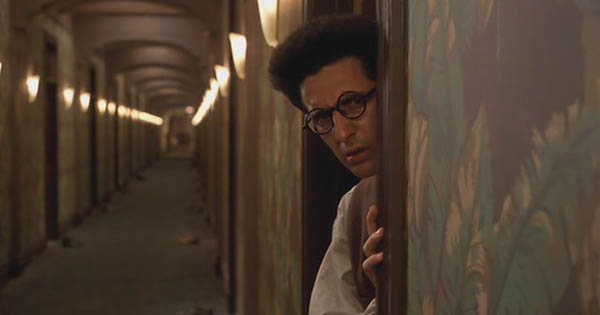
Linklater’s remarkable new film Boyhood,
which traces the life of a boy named Mason from age 6 to 18 in rapidly
changing segments, is like reading a
book, I need to clarify. The idea is not that the film could be “read” like a
book, each element analyzed to consider how it functions within the work as a whole; that goes without saying. The film, instead, acts on you the way a book
might act on you, which is to say, it doesn’t force itself on the viewer, and
in fact it asks the viewer to force itself on it, to make sense of it, to keep
going with it, and to sit with it, for a while, to see where it’s going. And the film does go somewhere which might remind viewers suspiciously of their own lives.

On the most basic level, we get to know, or at last
understand, Linklater’s characters in a gradual and highly relaxed fashion. In
many scenes, the characters, as they age together in different locations in
central to West Texas, simply sit and have conversations with each other. In so
doing, they teach us about themselves. We learn, through his introspection,
that Mason (Ellar Coltrane) is a thoughtful boy whose greatest spiritual investment will always
be in his own ruminations. His mother, played here with a great sense of regret by Patricia Arquette, reveals herself to be
caring but lacking in judgment, which will sadly shape her children’s lives,
causing them to move from house to house throughout their childhood, sometimes
suffering abuse from their mother’s poorly-chosen partners. In a very subtle
and moving performance, Ethan Hawke plays their father, likable on the
surface, but a near-archetype of a shady, untrustworthy dad. We notice all of
these things, and we pay attention to them, and we think about them, because
Linklater forces us to. There aren’t any exploding cars in the film. No one secretly
turns out to be a robot. There are no musical numbers. One is free, then, to
make observations, to interpret, and to absorb. One might find one’s self
making judgments, of a sort. Though the kids’ father is erstwhile in many respects, he
has far better chemistry with his children than either of the partners their mother
chooses after him.  We watch Mason’s sister Samantha (Lorelei Linklater) developing from a
mannered, funny child into a cool adult with odd phrasing (when it’s her turn
to make a speech at her brother’s graduation party, all she says is “Uh… good
luck.”), and the difference is noticeable. She’s lost the forwardness she
had as a child, but it’s metamorphosed into something more interesting, or more
deeply rooted within her. These are nuances that are not necessarily always
brought out in films, given so many films’ debt to drama itself, which demands a
structure, a pace, which does not encourage extensive lingering.
Linklater has achieved a strange marriage of two works: one film which tells the
story of a life, and one which tries to be interesting without telling any
story at all. The elements that might interest a viewer here—family dynamics,
the effect of aging, outer and inner growth—require meditation, and they don’t
require the framework of a plot to be meaningful. This is the kind of license taken frequently in literary works–writers from Chekhov to Ann Beattie to Karl Ove Knausgaard have availed themselves of it–but not seen as frequently in film.

The structure here is a very matter-of-fact one–you might miss it if you were weren’t looking, so seamless is Linklater’s deployment of it. As has
been widely discussed, Linklater made the film over a twelve-year period,
taking the actors aside for a couple of weeks each year to film a short segment, a
handful of minutes. The development in the film is based simply upon the
passage of time, a strong reminder that nothing the characters might do could
make the years move any more quickly, or slowly. Mason’s mother refers to this, at
the end, when she cries that she thought there would be “more” before her son
left for college—but as we know, nothing makes the days any shorter or longer.
The time Linklater allowed himself for the film seems to have tinged the entire
venture with a contemplative mood. The years pass without fanfare. The only way
we know the characters have aged, or that time has passed, is by the change in
their appearance. We are forced, then to look at these people, really look at them. We watch the mother
put on weight, slightly, as she gets older; she begins to look more settled, if
not complacent. We watch the childen’s father lose his youthful spark, fill out a bit,
mellow in his mood; his laughs don’t come as quickly, there’s not as much sense
of destructive mischief in his eyes. And Mason grows larger, more
stoop-shouldered, his features increase in size, he becomes less comfortable in
his skin, more self-conscious, his voice acquires the faint rasp of someone
who’s been shouting at a concert for the last several hours. These, then, are
the events we witness, and they become as interesting as an exploding
half-human car might be in another film. This sort of motion, in which inner
changes and developments loom largest, forming the topography of a work, is an example of something a book can do that a film, simply by virtue of the medium, might not do so easily. You sit with a book,
quietly, and read it, and things such as characterization, a description of
someone’s eyebrows, a well-placed phrase, become gigantic. They become large
enough to sustain the work, in some cases, and they may be the things you take
away most from the experience. But this viewer has found that, often, films must offer a slightly greater plenitude of elements to sustain themselves.

In a sense, saying that watching a certain film is like
reading a book might seem critically useless. How can one compare two
experiences that are so radically different, and that access such radically
different parts of the brain? You can’t hear a printed book any more than you
might read a montage out loud. Also, how can one make generalizations like this? And yet, and yet:
everyone approaches artistic experiences from a different starting point. For
this writer, reading is one of the most meaningful, important experiences he
might have—there’s competition for that spot, of course, but it ranks highly, up there with love and food. And so
there’s a little voice in this writer’s head, chattering away as the Linklater
film unfurls itself: Is this as good as….? Is it up to the experience of…? Yes,
I know you enjoy it, but is that enjoyment as great as the enjoyment of…? And if the answer to these questions is yes, the experience of watching Boyhood is equivalent to the satisfaction one has after reading a wonderful, spare piece of writing, which is to say one feels moved and quieted, given a fresh awareness of one’s place in the world, then that is the highest compliment this reviewer could pay the film.

Max Winter is the Editor of Press Play.

Apes vs. Zombies: New Skin for the Old Apocalypse in DAWN OF THE PLANET OF THE APES

Apes vs. Zombies: New Skin for the Old Apocalypse in DAWN OF THE PLANET OF THE APES

nullMatt Reeves’ Dawn of
the Planet of the Apes
echoes George Romero’s Dawn of the Dead in more than just its title. Both films are concerned
with the end times, and both films explore the nature of what it is to be human by
thinking about the nonhuman.  Both films
are also part of larger franchises, Apes being
the second installment of a reboot that is, astonishingly, superior to any of
its antecedents. Dead, likewise, is the
second installment of a series that would spawn countless imitators, most of them as
mindless as the zombies they portray. 
Like the fictional diseases that create them, zombie films are a virus,
and like a virus they need a powerful antibody to destroy them: Dawn of the Planet of the Apes might
just be that antibody.

Many theories have been advanced as to why zombies have
become such a cultural obsession. Though several theories are plausible, I would
suggest that their popularity is largely due to our abiding fear of nature. Not the nature of majestic trees, rolling
hills, and rippling streams, but the nature of
germs, bugs, and putrefaction. The nature we don’t like to think about but that increasingly rules our lives.  Zombie films are essentially about what
happens when the drugs don’t work, when we no longer have a means of controlling
these unmanageable mounds of flesh we call our bodies.  On those rare occasions when they focus in on
this weird biology (as in World War Z)
or on its larger societal impact (as in 28
Days Later
), the model of the zombie film can make for surprisingly thoughtful pieces of
horror.  More often, however, the zombie
premise serves as a cheap device that enables a select group of alpha males to act
out their survivalist fantasies.  A
potentially radical premise for exploring what we’re made out of, and what
bodies mean, generates instead an endless mashup of Soldier of Fortune with The
Book of Revelations
.

And this is why we need a new take on the old apocalypse.  Anyone who’s paying attention knows that the human species is well nigh fucked, and since our politicians are largely in denial
of this, we depend on artists like filmmakers to tell us stories about the
world we’re soon to be living in. 
Science fiction helps us think about the future, and hence it is always
political. You can either tell a story about how people work together to make a
bad situation better, or you can tell about how a few tough guys kick ass.  As the zombie genre seems to have devolved
into the latter, it’s time for a new way of talking about the end.  Enter the ape virus.

Rise of the Planet of
the Apes
ended with the spread of a virus that kills humans while making
apes smarter.  Remarkably, this felt less
like an apocalypse than a fresh start. 
Humans in that film, with the possible exception of James Franco, are portrayed as sadistic, slippery, and selfish, while apes are
compassionate, candid, and cooperative.  Humans
manipulate nature for their own ends, while apes live in harmony with it.  I can’t think of any other film where you feel like cheering when another species takes over the world.  By comparison with the famous conclusion of the
original Planet of the Apes, with
Charlton Heston venting his anger at the remains of the Statue of Liberty, the
ending of Rise is not so much “Damn
you!” as “Damn, you!” as the audience cheers on our successors to the top of
the food chain.

Dawn of the Planet of
the Apes
does its predecessor one better by asking us actually to think
through the moral and philosophical implications of a post-human world.  Rise
offers an escape valve for human excesses that evades broader questions of
culpability, while Dawn suggests that
our limitations as a species are not so easily evaded.  The central moral revelation of Dawn comes when Caesar realizes that his
former belief that apes were better than humans was false, and that the
similarities between the species are as important as the differences.  This revelation is actually a much deeper one
than the hackneyed “Can’t we all just get along” premise, since Dawn is honest enough to recognize that
mutual understanding will inevitably exist alongside mutual loathing.

So the conflict of Dawn
is less between apes and humans than between compassion and
intolerance.  While apes tend to exhibit
more compassion than humans, they hold no more of a monopoly on it than humans do on intolerance.  The good guys
of the picture are those who recognize kinship across the species barrier, the
bad guys those who want to exterminate the "other."  On the human side, the genocidal position is
embodied by Dreyfus (Gary Oldman), who rebuts pleas for mercy toward the apes
by saying “they’re only animals,” and who fights not so much for the survival
as for the supremacy of the human race. 
More complex is the character of Koba (Toby Kobbell), a bonobo tortured
for most of his life in a laboratory, and consequently a passionate hater of Homo sapiens.  While it might be argued that hatred is
effectually implanted into this otherwise peaceful creature by inhumane
science, it is also likely that as our nearest evolutionary relations, great apes will share
many of our worst, as well as our best, characteristics. 

Like the science of primatology, the rebooted Planet of the Apes franchise looks at
apes as a means to think through the nature of what it is to be human.  Apes tell us where we came from, and thus
they might provide us with some clues as to where we are going.  Judging by the conflicts that emerge in Dawn, the news isn’t good. However, unlike
most zombie films, this apocalypse does provide some meaningful solutions in response to
the humanity’s destructive tendencies. 
The most important of these is a message that film is uniquely suited to
delivering: look into the eyes of the other.

An inordinate amount of screen time is given over to
close-ups of Caesar, played with astonishing veracity by Andy Serkis.  What makes this performance so compelling is
that we are never allowed to forget that this is an ape, even as we see
aspects of ourselves in his troubled gaze. 
Philosopher and Holocaust survivor Emmanuel Levinas famously argued that
morality begins when we gaze into the face of the other.  For Levinas this meant recognizing the
radical difference of another being as well as the sense of kinship we are
capable of feeling for that being. 
Unfortunately, Levinas’ philosophy fell short of embracing other
creatures who might also be said to have faces, dismissing them with the same
disdain as Gary Oldman’s human-centric Dreyfus displays when he says, “They’re only
animals.”

The virtue of Dawn of
the Planet of the Apes
is that it gives us an apocalyptic narrative in
which we are asked to confront the other in ourselves, and ourselves in the
other, to look across the species barrier and see something more than just an
animal.  This is essentially what is
lacking in the old zombie apocalypse: when we look in the eyes of a zombie, we
see only decay, or a mockery of our meaty selves.  Gazing into Caesar’s eyes, we see difference
as well as well as kinship, and we realize that our relationship with other
creatures on our planet is a complicated one, and that we might better use our remaining
time in considering the other rather than indulging in fantasies of mutually
assured self-destruction.

And that’s why I say, long live the Ape, the Zombie is dead!

Jed Mayer is an Associate Professor of English at the State University of New York, New Paltz.

VIDEO ESSAY: The Coen Brothers: Men of Constant Sorrow

VIDEO ESSAY: The Coen Brothers: Men of Constant Sorrow

Woe be to you if you should be so unlucky as to be a male
character in a Coen Brothers film. You will be punched. You will be yanked off
moving trains. You will frequently be plagued either by melancholy or by
ethical torment. Things won’t go well for you. And often, you won’t be terribly
likable. Take the plight of Jerry Lundegaard in Fargo.
Could a terrible kidnapping plan have possibly gone any more poorly than this
one? But, at the same time, could there be a less amiable character? The
simpering, the crying, the sneakiness, the stammering–who could stand it? Or think of Tom Reagan of
Millers Crossing. He
perpetually tries to take control—of people, of his job, of his existence—and yet perpetually gets his
come-uppance, in grand style, sometimes quite bluntly. His moment of mercy
shown to Bernie Bernbaum in the forest, when he could take a shot, and doesn’t,
is repaid by punishment, like all the best good deeds. Does he invite this bad
luck? Sure, but don’t we all, sort of? Or consider Jeff Lebowski. Just consider
him, for a moment. The peeing on the rug? The ferret in the bathtub? The blow
to the head? All wholly unasked for, and yet delivered with a vengeance. But,
and this is the million-dollar (literally) question, by who? Or what? It’s been
tossed out that the Coen Brothers are, in some sense, religious—that,
especially as shown in A Serious Man, their films are about how we humans are,
in a sense, little more than plastic cowboy and soldier figurines being moved
around in someone or something’s deranged, Old-Testament-Style shadowbox, open to whatever hurricane or other unexpected blow from above might descend upon them. But
the opposite could also be asserted, that their films show what it is like to
live in a world without a G-d, without mercy—and that what might pass for
punishment in another view is simply the business of everyday life. How the men
of these films transact that business is entirely up to them. One would think
that Anton Chigurh of No Country for Old
Men
was wholly in control of his destiny, being as he is a reptilian
sociopath—but even he likes a coin toss every now and then. True Grit? Same
story, in a sense: though the men in this film have intentionality, they’re wandering
through a terrain—the West—which is famously unpredictable, famously wild. And
they’re being led by a young woman a quarter their age. And, beyond that, the
Coens have constructed the script in such a way, with such faith to the
original dialogue, that one sometimes feels the characters, male and female
both, are at the mercy of the words coming out of their mouths. Leigh Singer’s beautiful piece places us right in the middle of the Coen dilemma, in a form so exhilarating you might forget how much despair is being depicted.–Max Winter

Leigh Singer is a freelance film journalist, filmmaker and screenwriter.
Leigh studied Film and Literature at Warwick University, where he
directed and adapted the world stage premiere of Steven Soderbergh’s
‘sex, lies and videotape’. He has written or made video essays on fllm for The Guardian, The Independent, BBCi,
Dazed & Confused, Total Film, RogerEbert.com
and others, has appeared on TV and radio as a film critic and is a
programmer with the London Film Festival. You can reach him on Twitter
@Leigh_Singer.

The Value of Incoherency: Taking Michael Bay’s Transformers Films Seriously

The Value of Incoherency: Taking Michael Bay’s Transformers Films Seriously

nullMichael Bay’s Transformers
movies are incoherent. That is not a controversial claim; I doubt many would
argue otherwise. Yet two questions remain: How do they achieve their
incoherency? And is that incoherency of any value? In this article, I will try
to answer both questions.

Before I
begin, though, I should address one objection. No doubt some readers will think
this analysis unnecessary, even ill-founded. I can already hear the following
comments being typed below: “Bay’s Transformers
movies are stupid and not really even films”; “You’re just over-thinking things”;
“You’re putting more thought into his movies than he himself does.” These
potential objections—which are commonly applied to “dumb summer blockbusters”—are
at heart arguments meant to forestall critical consideration, and imply that
popular filmmaking is devoid of craft. This article is a refutation of those assumptions.

I. Why Are Michael Bay’s
Transformers Films Incoherent?

Perhaps the most common complaint about Michael Bay’s Transformers films is that they are
rapidly cut, a complaint commonly applied to other contemporary Hollywood
movies, as well. It’s certainly true that today’s movies are more rapidly cut
than the films made a generation ago—see Barry Salt’s Film Style and Technology for more on this topic, as well as this graph:

See also this video essay, where Matthias Stork documents the rise of what he calls "chaos cinema."

But since everyone is cutting more rapidly these days, can
rapid cutting explaing Bay’s Beyhem? After all, the films of Edgar
Wright
are, if anything, more rapidly cut than Bay’s, but are nowhere near as
disorienting as the Transformers quadrilogy.

Another problem
with looking solely at editing speed is that it doesn’t distinguish between
different types of cuts—the different
uses to which cutting can be applied. For instance, it doesn’t distinguish
between cuts that occur within scenes
(intra-scene cuts) and cuts between
scenes. Nor does it distinguish between crosscutting (when the film cuts
between two simultaneous scenes), elision (when a cut is used to omit an action
or the passage of time), jump cuts (when a shot cuts to a similar version of
itself), cuts between different angles or perspectives, cuts to close-ups or
long shots, or cuts to insert shots.

In order to
understand why Michael Bay’s Transformers
films give people headaches, we need to look more closely at what’s actually
happening in the shots themselves, as well as how he’s cutting between them.

Take, for
instance, the first six minutes or so of the second film, Revenge of the Fallen (2009). I analyzed the first 380 seconds, in
which a military strike team and some Autobots assault a Decepticon. We get 133
shots, yielding an Average Shot Length (ASL) of just under three seconds (2.9).
This is very rapid cutting. And in reality, the cutting is even faster, since one
shot is twenty-nine seconds long. (Taking that out yields a revised ASL of 2.7.)

What the
ASL doesn’t tell us, however, is that this opening sequence also features no
fewer than twenty-six scenes. In
other words, the scenes last, on average, just under fifteen seconds each.

We begin in
the Stone Age, in 17,000 B.C., as some early human hunters come across alien robots.
(Already this summary sounds like self-parody, but we really do begin there: a
title tells us so.) After eighty-five seconds of watching Transformers assault cavemen
, we cut (via the main title) to Shanghai, China, “22:14 HRS – TODAY,” where
some kind of industrial accident seems to be underway. We mostly see people
being evacuated by the police. That lasts nineteen seconds. We then cut to an
interior—“PENTAGON – NEST COMMAND”—where for twenty seconds we watch military
personnel watching the situation in Shanghai (on screens, just like us). We
then cut to thirteen seconds of an ice-cream truck ambling about somewhere in
China (it passes under a bright neon sign in Chinese) and making threatening announcements.
And so on.

Yes, these
scenes are rapidly cut (the ASL of the first 143 seconds is 3.8). But consider
what else is happening besides mere cutting. In these opening minutes, we’ve been
treated to scenes set on three different continents, occurring across two
millennia. In the present day alone, there have so far been four separate
locations (the factory, a nearby city, the NEST base, and wherever the
ice-cream truck is—it’s presumably near the factory, but it doesn’t look the
same). There have also been dozens of actors. And in the next few minutes,
rather than focusing on any of those locations or actors, the film will
introduce yet more characters—the NEST strike team, Sideswipe, other
Transformers, Decepticons—and stage action across yet more locations. (As it
turns out, the toxic spill is a cover so a secret US military strike team can
attack a hiding Decepticon. How the U.S. military has gotten permission to carry
out raids on Chinese soil is left unexplained.)

This style
is consistent across Michael Bay’s work. Bay is rarely content to allow one
storyline to play out with interruptions. Instead, his preferred method is to keep
scenes short, and to cut between simultaneous actions, which are usually taking
place in wildly different locales. His most recent Transformers film, Age of
Extinction
, recalls Revenge of the
Fallen
in that it presents, in short succession, an opening prehistoric
sequence (this time featuring dinosaurs), then contemporary action set in the
Arctic, Texas, a derelict cruise ship, and a secret CIA headquarters. We are thus
rapidly introduced to numerous characters (whose precise relationships with each
other are sketchy at best). Their scenes rarely play out to completion.
Instead, Bay starts the scenes only to interrupt them, cutting elsewhere, then
cutting elsewhere. The helpful titles that appear onscreen, informing us about new
locations (“THE ARCTIC”), are so cursory they might as well not exist. (One
doesn’t need a title to distinguish “THE ARCTIC” from “TEXAS”—but these titles
do announce that a new scene is starting, a fact that might otherwise be
unclear.)

Compounding
this interruptive storytelling further is Bay’s tendency to include multiple scenarios
in the same scene. In Age of Extinction,
we get an early scene where Mark Wahlberg’s conflict with his teenage daughter
is repeatedly interrupted by his assistant’s jokey attempts to get a robot
butler to deliver him a beer. A more sincere moment is thus juxtaposed with
more absurd humor. Similarly, the fight scene at the opening of Revenge of the Fallen is occasionally interrupted
by the comical antics of the two Autobots comprising the ice-cream truck, Mudflap
and Skids.

It would be
easy to describe Bay here as a frantic, hyperkinetic man-child with ADHD, and leave
it at that. But if we take these films seriously, and consider Bay’s direction
intentional—or “up to something”—then we have our first insight into his
aesthetic. He prizes juxtaposition, and his goal is to disorient the audience,
unable to tell where the action will jump to next, or whether it will be
dramatic or comical. The narrative, then, remains lurching, unpredictable. All
we can say with confidence is that whatever comes next, it will most likely be dramatically
different than what we’ve already seen. Bay’s cinema is one of constant
difference.


"Transformers 2"Even when we do settle on an action, it isn’t always a given
that we’ll understand it. As with narrative, Bay uses compositions
inconsistently. At times, his Transformers
films feature striking and indelible imagery. Age of Extinction is filled with shots that linger in the mind long
after the film has concluded: Mark Wahlberg and his daughter backlit by the
setting sun, the silhouette of an abandoned gas station, Wahlberg standing
beside a rusted train, vertiginous shots of a cramped apartment complex in Hong
Kong (actually Detroit—an impressive bit of production design). And there are
many others. Bay’s films are sometimes beautifully, even poetically shot.

But the
operative term is “sometimes.” Elsewhere, Bay seems entirely unconcerned with
clarity of image, and it can be difficult to discern what is happening
onscreen. For every crisp slow-motion shot of a helicopter whirling below us,
or a motorcycle leaning precariously to take a corner, or a bevy of sinister-looking
government agents exiting sinister-looking cars, there are just as many shots
in which the viewer doesn’t know where to look, or what they are even seeing.
This tends especially to be the case when the Transformers are transforming,
and fighting one another in their robot forms. (Critics have likened them to junkyards
either having sex or exploding.)
The Transformers robots, good and bad, tend to be uniform in color, made up of countless
moving parts, and not always that distinct from the backgrounds of their shots.
Compounding this further is the continuously moving camera, which constantly
alters the composition. See, for instance, the lengthy shot in Revenge of the Fallen where Ironhide initially
transforms. It’s  twenty-nine seconds
long, but the lack of cutting does not make the action any more coherent.

As always,
though, Bay proves inconsistent. In Age
of Extinction
, there is a long slow-motion shot wherein Bumblebee
transforms into his robot form while flying over a bridge. His three human
passengers fly out and tumble through the air, only to be caught by Optimus
Prime, who then crashes through a tractor trailer. All of the action in the
shot is completely discernible. The viewer is also given plenty of time to
study the image. Elsewhere, one can barely get a sense of the action, which
registers simply as—action. Throughout, the viewer can never predict when such
clarity will appear. Nor can they predict how Bay will shoot a scene: he
alternates freely between deep and shallow focus, and constantly varies his uses
of lighting, lenses, angles, and more—all without any apparent rhyme or reason.

Another
difficulty posed by Bay’s films is that one often gets the feeling that a scene
or shot is missing. Part of this is due to his tendency to delay exposition
(which is itself unusual in Hollywood filmmaking). As we’ve already seen in Revenge of the Fallen, we only gradually
learn what’s happening in terms of the overall action. We receive information
elliptically, and in fragments, and we often receive misinformation. Only gradually can we piece together the whole
picture, and then we might have to revise as we go: “OK, so there’s been a
toxic spill of some kind in Shanghai. Oh, no, that’s just a cover story—the
U.S. military is up to something. Oh, it’s actually a secret strike force. Oh,
and some Transformers are there—Ironhide, for instance. Oh, and Sideswipe is
also there. Have we met them yet? I can’t remember. Oh, there’s Optimus Prime!
As well as some other Autobots I don’t think have been properly introduced. I’m
not sure who the Decepticons are, though. Wait—didn’t this movie open in the
Stone Age?”

Similarly,
in Age of Extinction, there is a
scene involving a Transformer that disguises itself as an Oreos vending machine—at
least, I think that’s the case. I can’t claim to have noticed it when it was a
vending machine. But after it transformed, Oreo ads were still clearly visible
on its body. Mind you, I was watching the film pretty carefully, but I cannot
tell you who this Transformer is, why it transformed, or what subsequently happened
to it. I remember only that the film cut to it at some point, and then the
creature disappeared.

Another
strategy that makes actions difficult to follow is Bay’s tendency to portray complex
actions as montage sequences, which make heavy use of elision. This is hardly
uncommon in Hollywood cinema, but in the Transformers
films, one can rarely predict which sequences will receive this treatment.
Thus, Mark Wahlberg’s character’s effort to infiltrate Stanley Tucci’s research
facility is something of a blur. First, Cade Yeager (Wahlberg) uses a stolen
drone to scan a man’s ID badge. Then he has Bumblebee somehow create a replica.
All of this happens very quickly, in a flurry of shots presented with little
explanation. Then, Cade and his daughter’s boyfriend, Shane, drive Bumblebee to
the lab. (They bicker on the way, once again juxtaposing broad comedy with tense
action.) Spatially, it isn’t clear where they are, or why they are trying to
break in. Before, Tucci’s facility seemed to be in downtown Chicago; now it
seems to be in a more rural location. The discrepancy is never resolved.

Cade and
Shane manage to get inside the base. Some slapstick ensues as Bumblebee takes
offense at a sinister replica modeled on him. Then Cade and Shane get separated
somehow, Cade gets captured, and the other Autobots break in to rescue him. And
Kelsey Grammer’s evil CIA operative is there, for some reason. All of this transpires
with the logic of a dream, not unlike the scene in Inception where Dom Cobb explains to Ariadne that although one
might remember being somewhere while dreaming, one never remembers how they got
from point A to point B.

Even when the
viewer can discern the underlying plot logic—the character’s motivations, their
objectives, and their plans to achieve those objectives—it doesn’t always make sense.
Here Bay differs from most Hollywood cinema, which is typically founded on
carefully and repeatedly communicating such information to the viewer. (In Inception, for instance, it’s perfectly
clear that Dom Cobb is performing one last heist in order to be able to see his
children.) To this end, Hollywood films traditionally provide each character
with a clear role: they either aid the protagonist, or oppose them. For his
part, Bay often includes characters whose function is entirely unclear. While I
wasn’t unhappy to see Sophia Myles and Li Bingbing in Age of Extinction (they even get a scene that, while fleeting,
allows the film to pass the Bechdel Test), their presence is extraneous at best.
Their scenes could be cut, and the end result would hardly be any different.
But the same is true of many of the characters, including most of the
Transformers. Even Shane, once he rescues Cade and Tessa, does little more than
act as a thorn in Wahlberg’s side.

Although
what Wahlberg’s Cade is trying to accomplish is itself unclear. Also unclear is
whether he’s making progress toward his desired outcome. As viewers, we might
broadly understand that Cade wanted to infiltrate Stanley Tucci’s character’s company—but
why? He obtained information, but we could have been given that information by
Tucci and his assistants, who had already provided us with lots of information
regarding their enterprise. Finally, the Autobots come crashing through the
facility’s front wall, rendering Cade’s infiltration moot. All that really
happened was that we changed locations.


nullOverall, the Transformers
films give us the sense they’re being made up as they go along. (I’d say they
were like The Lego Movie in that
regard, but the plot of The Lego Movie
is actually more straightforward and coherent.) I frequently suspected that the
screenwriter of Age of Extinction, Ehren
Kruger, while writing the earlier scenes, had no idea what would later happen
in the film. When the later scenes arrive, it feels as though the screenwriter had
forgotten what occurred earlier on. The scripts come across as first drafts, hastily
scrawled out and never revised. What’s
lacking is a sense of the whole
. Time and again, priority is given to whatever
is happening at the current moment. While the scenes may be bound loosely by a narrative,
the films are collections of scenes, unpredictable and arbitrary. And I doubt
Bay wants it any other way. Kruger has claimed that “When
you’re talking about aliens, robotic machines which disguise themselves as
vehicles and animals, you start to make your peace with the idea that logical
sense doesn’t have to be the be-all, end-all. It needs to be amazing fun for
the audience. They need to be swept up, and be promised that they’re going to
see things that make it worth spending money on a ticket.” The film is pure spectacle,
constantly striving to outdo itself. That is to say, because making a movie
takes time, the Michael Bay on day 90 of the shoot is trying to outdo the
Michael Bay of day 20. Given this approach, it’s hardly surprising that Bay’s films
turn out to be constantly evolving animals.

It’s also
why character intentions tend not toward the subtle and complex, but toward the
broad and vague: so-and-so wants to stop something, or kill someone, or make
money. The characters also sometimes suddenly shift motivation without warning:
the Optimus Prime of Age of Extinction,
who earlier wanted to defend humans, now wants to kill them and flee planet
Earth. More than anything, the characters often give the impression that they
are children, acting entirely impulsively. They feel very strongly whatever
they are feeling at the moment. Even the Autobots tend to squabble with one
another.

On the rare
occasions that we do see long-term planning, it tends not to make sense. For
instance, Stanley Tucci’s scientist is a Steve Jobs parody. (The IMDb tells me
his name is Joshua Joyce, but I’ve blanked on whether the film ever conveys
that fact. Surely it must have? But I don’t remember it. It’s possible I was
too captivated by Tucci’s performance: he was a total delight to watch the
entire film, and I thoroughly enjoyed all the Jobs- and Apple-like imagery,
even if I didn’t understand what Bay was trying to communicate with it.)
Anyway, Joyce wants to design his own Transformers for the military (which he
and Grammer will be able to control). He attempts to replicate Optimus Prime
(for some reason), but his robot keeps shifting to look like Megatron. Joyce complains
loudly to his employees about this, wondering why it keeps happening. Later in
the film, it’s revealed that Joyce stole the technology at least partly from
Megatron’s head; after that, it’s revealed that the resulting robot, Galvatron,
is indeed Megatron in disguise. Well, Megatron hardly need be a “Decepticon” in
order to reactivate himself, given what a dunce Joyce is. The characters, to put
it simply, are buffoons.

But they are deliberately made buffoons.
I never get the impression that Michael Bay thinks his characters clever,
either. They are clowns, just clowning around. Even they seem to feel the need
to remind themselves of what it is they are doing—hence their tendency to
announce their intentions or goals very clearly. Their declamations, like
everything else, tend not to matter. At one point late in Age of Extinction, Optimus Prime commands some of the humans to
take a bomb over a bridge and out of the city (Hong Kong). Much action ensues,
but the characters never actually cross a bridge, or leave the city. Nor do
they seem to be trying to even do that—they’re just driving and running about. Elsewhere,
the villainous Lockdown, having learned that Optimus Prime has escaped his
capture, orders his robotic servants to return his spaceship to Earth. That
much they do. Lockdown then activates some kind of humongous magnet, which he hovers
over Hong Kong, sucking up all manner of metal objects, then dropping them. Why
does he do this? In Man of Steel,
when General Zod does something similar, we may be vague on the specifics, but
we understand that he’s trying to turn Earth into a New Krypton. Here, however,
Lockdown’s scheme is unclear. The viewer could be forgiven for thinking that Lockdown
is searching for the seed bomb, especially since a blue light on the bomb is
flashing, and Joshua Joyce has declared (somehow) that a homing mechanism has
been activated. Lockdown soon catches our heroes, and starts drawing the bomb
toward him. But Lockdown wasn’t concerned with the bomb—he was instead hunting
Optimus Prime. But the Autobot leader, all this time, is well outside the city,
subduing the Dinobots.

Well, the
characters are buffoons, not unlike the villains on children’s cartoon shows. People
can complain that Bay has not respected the original Transformers source material, but watching his films, I am often
reminded of screeching, didactic characters like Megatron and Starscream. (I’m
also reminded of Cobra Commander, Destro, and Serpentor. I loved these shows as
a child because I loved the way their villains bickered and sneered.)

At times, the
characters’ declamations stop being logical, and become farcical. For instance,
Hound tells his human friends (this is a paraphrase), “I’m going to cover you.
And if I stop covering you, that’s because I’m dead. But don’t worry, because
that won’t happen.” The dialogue is absurd in its unnaturalness, and in its commitment
to articulating exactly what Hound intends to do at the present moment. (Oddly,
Hound later gives up, having run out of ammo, and needs to be urged by Cade to
continue fighting. I guess he didn’t consider that contingency!)

Of course,
the Transformers’ voices are recorded by celebrities in sound booths somewhere—Hound
was voiced by John Goodman—and it’s all looped in later on, in editing. In this
regard, the Transformers films are no
different than any other CGI-laden blockbuster. But little effort seems to have
been taken to integrate the looped dialogue with the action. Instead, it frequently
sounds disconnected, even arbitrary. As Hound whirls around, firing his guns, John
Goodman declares, “I’m a fat ballerina who takes names and slits throats!” Elsewhere
he intones, “I’m a wicked warrior robot!” Why does he say either? Who knows?
The lines—many of the lines—are entirely arbitrary;
Hound could say anything, or nothing. Inconsistency and abstraction rule the
day.

Lest this
sound like I’m knocking Michael Bay’s sensibilities, I actually find myself in
awe of them. I’ve read enough about Bay to know he prizes improvisation and
impulsiveness and energy and action. Empire
Magazine
’s Age of Extinction set
visit report, for instance, stressed repeatedly that his working method is to
rip up whatever he’s planned and invent something new on any given day. The end
results certainly seem evidence of that.

All of the
elements that I’ve described contribute to the sense that these films exist only
in the present moment. Each scene lives and dies independently of every other
scene. (It should go without saying that there is little continuity between the
films themselves.) At times, it seems as though the characters themselves cannot remember anything that has
happened to them previously, as though they are living without memory. They
(and the viewer) are caught in an eternal present, in which they can neither remember
nor anticipate anything.

Any one of
these elements, taken on its own, would be disorienting. Taken collectively,
they represent nothing less than a furious attempt on Bay’s part to disorient
the audience, and to lay waste to the confines of reason, logic, coherency, and
continuity. He assails it on several fronts at once. Despite all the elements I
have described, I haven’t come close to exhausting Bay’s varied strategies. Age of Extinction, for instance,
includes a flashback at one point (narrated by a character who appears
precisely for that purpose, then disappears). Why? Why not? At other points,
actions are depicted first going one way, then another way, then another way
(e.g., left, right, left). The whiplash effects are not accidental: they are edited
together in flurries presumably designed to discombobulate viewers. I should
emphasize that this is not a failure to abide by the principles of standard
continuity editing: this is a direct refutation
of those principles.

“What’s
going on?” Cade Yeager shouts at one point, giving voice to what the audience
is undoubtedly thinking. We must conclude that the only person who really knows
is Michael Bay, who is essentially amusing himself. His aesthetic could be
described as “chaos reigns.” The most surprising moments in the film aren’t the
parts where things fail to make sense, but when the movie suddenly settles down,
and becomes like any other film—for instance, the odd scene where a White House
delegate visits Kelsey Grammer and his boss. For once, a whole, uninterrupted
scene plays out in steady, stable, clear shots. Bay even mostly keeps to one
side of the 180-degree line. Perhaps he threw the scene in for the sake of
contrast?


null
II. Is There Any
Value to Bay’s Incoherency?

It is often said that Bay’s films are an assault on the
viewer, and I agree. But they are also assaults on classical unity and formal
coherence. Bay proves entirely consistent in his inconsistencies, which can
hardly be accidental. It is to this end that he includes extraneous characters,
actions, settings, and scenes. It is to this end that he jumps rapidly across
time and space, and elides actions and explanations. It is to this end that he varies
his means of shooting shots and scenes. His desired goal is to produce
mishmash. His films are, in a word, anarchistic.

In this
regard, Bay seems unlike most Hollywood directors. But he reminds me of other
artists. Indeed, he reminds me of a pertinent debate in art, one that has
existed for nearly one hundred years, if not longer. That debate is: what role
should form play in art-making? Is it an aid? Or a hindrance?

Over the
past hundred years, many artists have come to distrust not only form, but the usefulness
of thinking and analysis in making art. Indeed, many have come to distrust
consciousness itself. According to this argument, art should be produced wildly,
impulsively, spontaneously, embracing immediacy and impact, and rejecting the
censoring effects of conscious deliberation. Art should be done, not thought about, and certainly not planned out. This
anti-rational impulse has become fundamental to much of what we call
avant-garde art, having been explored by traditions as varied as Dada, Futurism,
Surrealism, Viennese Aktionism, chance operations, happenings, conceptual art,
performance art, and more. Michael Bay is akin to those artists who believe the
function of art to overwhelm the audience, battering away at inhibition and the
tendency toward conscious rationality. Batter away, and then batter some more,
until the audience, exhausted, is left with nothing but his or her unguarded
emotional response. (This is why the films must be so interminably long.)

Here many
readers are no doubt scoffing and rolling their eyes at my daring to mention
Bay’s name amidst such august company, but I will stand by my argument: Bay’s
films make more sense when you consider his aims in this light, and his
strategies as attempts to struggle out of the grip of rational coherence. Mind
you, I’m hardly claiming that Bay is the equal
of, say, André Breton, John Cage, or Sol LeWitt; such a claim would, at any
rate, be impossible to prove or deny. Instead, I am arguing that, like many 20th
Century avant-gardists, Bay is antagonistic toward classical tradition, formal
unity, and rational sense-making, all of which he envisions as fetters on his creative
abilities. To restate this position very bluntly: thinking too much about art
harms the art. And like those artists, Bay prefers the ad-hoc, the incidental, the
capricious, the impulsive—the arbitrary. His artistic temperament is Protean,
and changes from moment to moment. If he remade any one of his films tomorrow,
it would turn out totally differently, depending on how he felt that day.

Because of
this, while it is possible to analyze Bay’s films objectively—we can examine
them, and state what he has done (as I’ve tried to do so here)—any attempt to objectively
evaluate them is, quite frankly, a waste of time. In the end, the films are
arbitrary, and any decision made is as good as any other. There is no whole
that the parts are looking to for guidance. Instead, they are fleeing from the whole.
Each part, each moment is an expression of how Michael Bay felt at a given point
in time. As such, it’s impossible to say how the films could be “improved.”
(Those who wish they were more coherent are entirely missing the point.) In the
end, all that matters is that they have a disconcerting effect on their audiences.
Was the viewer appalled? Excited? Battered beyond good sense and reasonable
manners? That is all that matters to Michael Bay. His opponents’ complaints—“I didn’t
understand it,” “I was exhausted.” “How the hell does this guy keep getting to
make movies?”—are, rather than valid criticisms, evidence of his success.

The question now becomes: What is the value of such an art? Which
is also to ask: What is art’s relationship with formal unity, rational thought,
and conventional notions of good or bad? As already stated, this question is at
least a century old. It will have to suffice for me to claim that, for good or
for ill, Michael Bay has aligned himself with the camp that argues against
form, against reason, against conscious control.

In this
regard, however, we should note that Michael Bay is a wholly remarkable
filmmaker, one who has succeeded in doing something that few other artists have
achieved: he has made blockbusters out of challenging films that arguably bear
more resemblance (and more kinship) to avant-garde art than they do to
traditional Hollywood fare. As the cliché goes, Hollywood movies are made by
committee, and are bland and predictable and safe, wholly familiar. They want
nothing more to be liked, and will never risk offending their audiences. But somehow,
and despite the modern studio system, Bay’s films are loud, obnoxious, violent,
crude, unpredictable, unbearable. They are experimental and impulsive. Whether
they are great works of cinema is not for me to say. But they are without doubt
the works of a true auteur.

Do people
like his movies? That is, do people like Michael Bay’s incoherencies? Certainly
they like them well enough that each film earns hundreds of millions, even billions,
at the box office—which suggests a final point.

It’s common
to hear educated filmgoers and critics complain about Bay’s Transformers films. Here is one
example
, and here
is another
. But I believe that those very viewers who complain the loudest are
enjoying Bay’s films the most. Indeed, I’m reminded of nothing so much as the
way certain filmgoers often revel in “bad” movies, works of z-grade cinema that
are, as the saying goes, “so bad they’re good.” The joy in watching those films
often amounts to seeing the normal, predictable, stale conventions of
filmmaking get turned on their heads. Why did Tommy Wiseau make The Room the way he did? Who can really say?
But obviously the man didn’t know how to make a film “the right way.” So does
that make The Room a great movie?
Hardly—but it is an immensely enjoyable film to watch, and to laugh about with
friends. Anyone who has seen The Room
knows that the pleasure lies wholly in sharing it with friends, all the while
commenting on how bizarre Wiseau’s filmmaking choices are.

Bay doesn’t
inspire laughter in quite the same way as Wiseau, but he does inspire incredulity. Like a lot of z-grade
filmmakers, Bay is making the movie up as he goes along. One can hardly believe
what results: “Is that a robot with giant testicles?”
So if you won’t buy my claim that Michael Bay is a kindred soul to the
avant-garde, perhaps you’ll find more tolerable my claim that Michael Bay is, effectively,
the highest profile z-grade filmmaker currently working. Indeed, he’s raised
z-grade cinema to the level of the commercial blockbuster.

Bay
presumably knows “the right way” to make a film, and his movies are hardly
incompetent. (Age of Extinction features
many marvelous moments, shots, and scenes.) Instead of making incoherent messes
because he knows no other way to make a film, Bay makes incoherent messes
because he can, and because he wants
to
. His incoherence, his unpredictability, is the very value of his films.
And I think that’s precisely what audiences are lining up to see, whether they
admit it or not.

A.D Jameson is the author
of three books:
  Amazing Adult Fantasy (Mutable Sound, 2011), Giant Slugs (Lawrence and Gibson, 2011), and 99 Things to Do When You Have the Time (Compendium Inc., 2013). Other
writing of his has appeared
at
Big
Other
and HTMLGIANT, as well as in dozens of literary journals. Since August 2011 he’s been a PhD student at the University of Illinois at
Chicago. He is currently writing a book on geek cinema. Follow him on Twitter at
@adjameson.

“Training, practice, letting go”: An interview with Paul Eenhorn of LAND HO!

“Training, practice, letting go”: An interview with Paul Eenhorn of LAND HO!

null

Australian-born,
Seattle-based actor Paul Eenhoorn has appeared in low-budget indie
films for years, but he came to national attention last year for his
performance in Chad Hartigan’s This Is Martin Bonner. As the
title character. Eenhoorn played a non-believer who works for a
faith-based charity that helps prisoners adjust to freedom upon release
from jail. The film has a low-key vibe reminiscent of ‘70s greats like
Monte Hellman and Jerry Schatzberg, more than contemporary indie films,
and Eenhoorn’s performance makes an impact without any showiness. He
makes an equally strong impression in Martha Stephens and Aaron Katz’s Land Ho!, a road movie about two sixtysomething friends who take a vacation in Iceland. Much lighter in tone than This Is Martin Bonner,
it contrasts the acting styles of Eenhoorn and Earl Lynn Nelson, a
real-life doctor who’s essentially playing his extroverted self.
Eenhoorn has had an unusual career trajectory, coming to prominence
only in his 60s after starting out as a musician in Perth, Australia. He discussed that path with me frankly. 
Steven Erickson: How did you meet Chad Hartigan and get cast in This Is Martin Bonner
Paul Eenhoorn:
I saw an ad on Actor’s Access. It’s a small casting site that runs
shoots going on in L.A. Vancouver and New York. I read a one-line
breakdown and flew down to L.A. to audition for him. I thought “This
sounds perfect.” It was my age group. I read for Chad, and then I went
down a second time and read with Richmond Arquette. It was serendipity,
being prepared. It was a nice confluence of events. It’s been a good two
years. 
SE: That was sort of your breakthrough in the U.S., I guess. 
PE:
At my age! Usually, breakout actors are 18. Actually, one of the
comments from Sundance was, “This guy is a very good actor and he’s in
his 60s.”
SE: How do you feel about that? 
PE:
I had all the talent when I was in my 20s. I didn’t have that many
opportunities, but I probably wasn’t the person I am now. I probably
would’ve ended up dying of a cocaine overdose or choking myself to death
in a hotel room. Everything comes in the right order in life, I think.
If you keep repeating the mistakes you’ve made…what’s the definition
of insanity? Doing the same things over and over again and expecting a
different result. I’ve always felt I had the talent. I’ve done a lot in
my life. I’ve written, been in bands, done live TV for a network in
Perth. I’m well-trained when it comes to being on a set, which gives you
freedom. 
SE: Did you start performing as a rock musician? 
PE
I did some stage when I was a kid, around 16 or so. I was living in
Melbourne and had a band. I was quite young. We weren’t very good. Then I
found a band in Perth. We played around for three years. We’re in the
“History of Rock’N’Roll,” a book about Perth music. It’s a thick
publication because Perth was a lot like Seattle. It kept producing
great musicians, but I missed the boat on that. It was fun. I still miss
music and singing. One day, I’m going to sing with a big band. My band
played covers and some originals. 
SE: Whose decision was it to use their music in This Is Martin Bonner
PE:
Chad. I had just got an MP3 off my old bassist. We just reconnected
after 30 years. He had an acetate, not even vinyl, track of a song we
recorded. Chad said, “Send it to me!” Sure enough, he put it in. It’s the
one scene I can’t watch. I don’t know why. Maybe because it’s 40 years
since it was recorded, and it fucks with my brain. 
SE: Do you still like the music you made then? 
PE:
Hell yeah! I know all the words still. I’ve been writing music since I
was a teenager. I play keyboards. I’m not much of a player, but I can
write. That will come along. I’d like to do a musical. 
SE: To write one? 
PE:
I’ve got 200 songs that I’ve written, although not all recorded, going
back to the ‘70s. I’ve kept them all. A lot of stuff. 
SE: Do you think living in Seattle gives you an advantage over living in New York or L.A.? 
PE:
New York is too big. L.A. is just not me. I need water around me.
Washington State is soft and green. L.A. is hard and brown. You know
what I mean? 
SE: I’ve actually never been there. 
PE:
When you fly out of L.A., it’s desert. When you fly into Seattle, it’s
water and forest. It’s a totally different environment. L.A., to me,
feels a lot like Reno. Whenever I talk to people in L.A., they’re all
looking for a dream and have given up on it because life takes you in
other directions. It’s not a good game trying to fit into this society,
especially if you’re a fruitcake. You’ve got to find your own space. If
you’re lucky, you can. 
SE: At what point did you emigrate to the U.S.? 
PE:
15 years ago. I met my wife in Sydney, before she was my wife. She was
flying for United. We had a relationship for about three years. Then I
came here and got my green card. That wasn’t as hard as people make out.
I had to get married within a certain time. 
SE: How did your short Room 13 come about? 
PE: I was shooting a pilot for The Divine Marigolds,
which was shot in Seattle. It never aired, like most pilots. I thought
“What if a soldier got caught up in a sting with an undercover cop? He
thinks he’s seeing a hooker, but they’re actually arresting johns
soliciting prostitution.” There’s 22 minutes. There’s actually another
few minutes I would like back in the film. I had some input from Will
Chase, who’s a line producer in Seattle. It’s not easy. I learned
everything from filmmaking, as a director/writer/part-producer. I can be
proud of it as a first film. I learned what not to do. 
SE: What was that? 
PE:
Don’t let your producer on the set. Apart from that, don’t have a
gambling habit while you’re trying to raise money. Those sorts of
things. 
SE: Was the gambling habit yours or your producer’s? 
PE:
It was mine. I was really hooked. It was like a drug. That was about
four years ago. I went and saw a counselor and sorted that mess out.
I’ve been to some dark places. 
SE: Both Martin Bonner and Land Ho! are buddy movies of a sort. Are you attracted to that kind of narrative? 
PE: Yes, in different ways. Love, Actually, Notting Hill, Field of Dreams, The Best Exotic Marigold Hotel. Marigold Hotel is
probably the closest. It’s about real people. They don’t blow things up
or have car chases. They actually sit  down and talk. The narrative is
there, and if it’s good enough, people don’t need all the extraneous
crap that the tentpoles include. I actually watched Wolverine the other night and I did enjoy it. But I don’t seek out action films. I seek out non-action  films. 
SE: I thought it was interesting that in Land Ho!, the characters have fairly mainstream taste in film. They would probably never go see a film like Land Ho!
PE: They might. I would see Philomena before I’d see the sixth version of Transformers, if that was my chance. Let’s see who wants to see Land Ho! I’ll be on-line checking. 
SE: You made the unusual step of prospecting for investors for new films starring yourself on Facebook. How did that work out? 
PE:
I got what I wanted in a week. I have not found a script. I was
disappointed in one script I received. I’ve got one person who’s writing
a script now. So I haven’t tapped that yet. When it’s time, I’ll set up
LLCs. It was not difficult at all. With Indieogogo, it took me a month
and a half to raise eight grand. Having a little bit of success helps
you raise money, but at the same time, I want something that’s got bona
fides and possible commercial success. I’m not an artist. You make
Kentucky Fried Chicken. You don’t go out and make something you don’t
want to, but you have to have a handle on the fact that you’re doing
this with other people’s money. 
SE: Well, This Is Martin Bonner was relatively marginal. I’ve seen Chad Hartigan’s tweet where he said he only made $1,500 from filmmaking. 
PE: Bonner got
distribution, so the executive producer got his money. It was a
critical success. The Cassavetes award at the Indie Spirits came with
some cash. I think he’s got a little bit more in his pocket since then.
I’ve seen the tweet you’re talking about, and I think it was posted
before then. 
SE: Did you have as much chemistry with Earl Lynn Nelson off-screen as your character did with him in Land Ho!
PE:
No. Because I needed alone time. I needed time to recuperate and get
back in my head. When I’m shooting, I’m not there to party. I’m there to
work. Part of that working is getting somewhere where it’s quiet and
where your distractions are just normal, everyday ones. Earl Lynn is
just that way all the time. I have a tendency to withdraw from everyone,
so I have time to recoup. We got to know each other better after the
film wrapped. 
SE:
I was curious about that, because other people have told me he’s pretty
much playing himself and his real-life personality is very similar to
what you see on-screen. 
PE:
It is.  The good thing with him is that if you put a camera on him, he
doesn’t change. A lot of people change when you do. I’m always reminded
of a scene in For the Love of the Game where Kevin Costner’s
pitching a perfect baseball game. There’s a scene where he shuts
everything out except the batter and the catcher. I tell people “When
you can shut everything out and the twenty people standing in the room
are no longer there, you will experience magic.” If you’re really there
as an actor, you know when you’ve got the scene down. You don’t need to
wait to hear “cut.” You have to forget that it’s cold and windy or that
you’re standing in Seattle for eight hours in the rain to get a scene.
Iceland is beautiful and rugged, but it’s better in the summer, and we
were there in the fall. 
SE: How has your minimalist approach to acting developed? 
PE:
Training, practice, letting go. You’ve seen selfies on Facebook. Your boobs are
in the profile, you’ve got a big smile. What
you’re trying to do as an actor is the opposite of that. Acting for film is not caring
that the camera’s there. You strip it down and go for truth and the
heart. You find that connection with the other people you’re working
with. Personally, I’m always where I need to be when I shoot film, so I
trust that. If I’m hyperactive and I’m in a great mood, then I trust
that, since the film obviously requires it. Colin [his character in Land Ho!] is rather subdued. You can’t have two Earl Lynns on one set, so you need a positive and negative interaction.

Steven Erickson is a writer and
filmmaker based in New York. He has published in newspapers and websites
across America, including
The Village Voice, Gay City News, The Atlantic, Salon, indieWIRE, The Nashville Scene, Studio Daily and many others. His most recent film is the 2009 short Squawk.

VIDEO ESSAY: In Memory of Paul Mazursky 1930–2014

VIDEO ESSAY: In Memory of Paul Mazursky 1930–2014


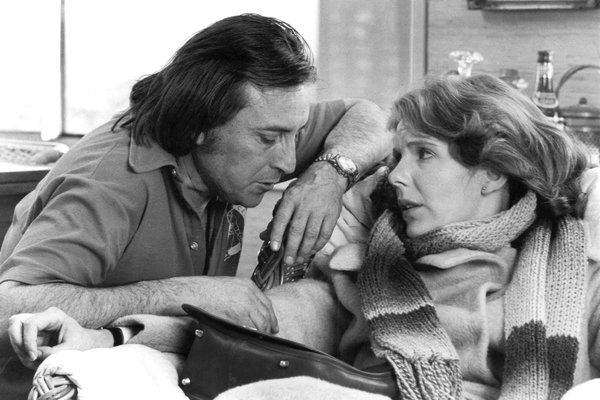
A Cinema of Real Feeling: Remembering Paul Mazursky 

Paul Mazursky made movies about what was happening around
him. Mazursky honed in on the cultural climates of the
eras during which his films were produced. Whether it was the strife of marital
discourse found in the 60s and 70s (from Bob
& Carol & Ted & Alice
’s freewheeling "free love" sentiment
to An Unmarried Woman’s study of sexual
liberation) or the timeless theme of searching for a renewed, meaningful
identity (Tempest, Moscow on the Hudson and, to some extent, Down and Out in Beverly Hills), Mazursky told stories of the
moment and more effectively, presented a cinema of palpable feelings.

Mazursky was, first, a prolific Hollywood
character actor; he even played Tinseltown types in several of his own films.
Perhaps it was this affinity, this affection for actors that lent gravitas to his directing of his own films. Many of his films were about the upper middle
class: people with careers, relationship problems, anxieties about the economy,
and the overwhelming dread of just being “ordinary.” And yet, Mazursky really
loved these characters. He watched them. He followed them. His camera
roved the interiors of homes and other locales with patient, observant contemplation.
Because of his delicate orchestration of writing, music, and themes, Mazursky’s work as a filmmaker set him apart from his
peers. In his time, nobody listened to or looked at this group of damaged souls with as
much bruising honesty and scathing humor as Mazursky did. In a 1978 interview
with Film Comment, Mazursky addressed this: “[Middle-class life
is] on the edge of soap opera and the edge of real; it’s alienated and
confused, almost tragic. It’s become popularized in one way or another, but I
haven’t seen it dealt with much in American cinema on a level which
communicates real feeling. I’ve seen it dealt with through humor, a bit. But
not with real feeling.” Thanks to Mazursky’s distinct body of work as director,
we all have the gift of seeing these cinematic works of “real feeling” again
and again.

Nelson Carvajal is an independent digital filmmaker, writer and content
creator based out of Chicago, Illinois. His digital short films usually
contain appropriated content and have screened at such venues as the
London Underground Film Festival. Carvajal runs a blog called FREE CINEMA NOW
which boasts the tagline: "Liberating Independent Film And Video From A
Prehistoric Value System." You can follow Nelson on Twitter
here.

Compassionate Release: The Agony and the Empathy in ORANGE IS THE NEW BLACK

Compassionate Release: The Agony and the Empathy in ORANGE IS THE NEW BLACK

null
[This essay contains mild spoilers for Season 2 of Orange Is the New
Black]

When US Weekly began its
photo-driven series “Stars—They’re Just
Like Us!
” it was a revelation in the art of Hollywood propaganda. The
magazine rolled up the red carpet and instead offered readers a rare view of
celebrities, not just in their own natural habitats, but in ours. “They recycle! They shop at
Wal-Mart! They sell 100% organic lemonade at a homespun
card-table stand outside their Brentwood mansions!
” The series fashioned a different illusion of us vs. them: a shared world in which we’re all essentially the same people,
but some of Us just happen to have a
few million more dollars in our bank accounts than others.

This is a kind of
reverse-empathy, a strange effort to level the playing field, to “humanize”
celebrities—arguably the most privileged people on the planet (at least the
true A-Listers), those for whom the odds are ever in their favor. It’s a compelling pitch—but it’s tough to ignore that many are
still on the outside, peering in through the pages of a magazine that they probably
didn’t even buy, shopping at the Dollar Store out of necessity in lieu of choice, grazing on photos that are glossy but not so
shiny that they can actually see their own reflections staring back.  

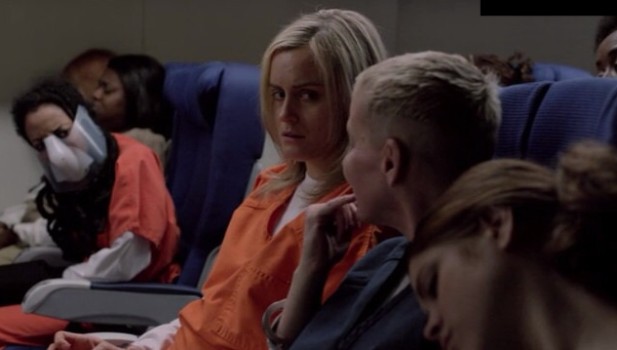
Now that Season One of
the Netflix Original series Orange Is the
New Black
is safely stitched into our pop culture quilt, the show has shed
its initial hesitation and has its crazy eyes on its viewers just as much as they
have theirs on it. Season Two feels emboldened by its newfound
responsibility—to its characters, to its audience, and to actual women in
actual prison. 

The show had its origin, of
course, with an actual woman in actual prison—Piper Kerman, who served a year
or so in federal prison for money laundering and drug trafficking, and then
wrote the memoir on which the show is based. Kerman, like her fictional
counterpart Piper Chapman, is white, blonde, a self-described WASP, educated at Smith, and born into wealth: the
celebrity who’s just like us, except behind bars. But through Orange Is the New Black, she’s also the
glossy magazine, our window into a world of women largely unseen, unexperienced
by most people—most people, that is, who can afford the time and money needed
to subscribe to and binge-watch Netflix.

Women not like us, except
for when they are. 

Showrunner Jenji Kohan first
described the character of Piper Chapman as her
“Trojan Horse,”
her spoonful-of-sugar
access point to be able to sell a show—and have it received successfully—that
is primarily about the lives of marginalized women: the elderly, women of
color, women of varying sexualities and gender identities, and—it’s actually
not an obvious point to make—women with criminal histories. Season One took a
deserved hit for falling short in shifting our gaze away from Piper’s story,
and while Season Two definitely improves upon the silence, it misses many
opportunities to change the conversation, most importantly from “Can you
believe this happens in prison?” to “You really need to know that this happens
in prison.” Put another way, it’s the difference between a tweet and the linked article a tweet lures
its reader into clicking.

Prison-themed shows and
movies often trade
in tropes
the way their characters barter with cigarettes: shower violence,
the uber-butch
lesbian who spends the majority of her time looking for a submissive sex
partner
, prison
breaks
. Kohan does take on the greater cultural mantle of her subject
matter—her indictment of the federal system and the prison industrial complex
is not insignificant, especially in the confines of a comedy. But she often
doesn’t let the punishment fit the crime: she exposes the issue of
guard-on-inmate sexual assault, but then throws a blanket of romance and
“consent” over it, derailing her focus on a
real problem

Tasha “Taystee”
Jefferson, for example, is a black woman essentially raised in the foster care
system before going into juvenile detention at the age of 16. In Season One,
she actually wins her release from a parole panel, but because of a wholly
inadequate re-entry plan, she quickly returns to prison—her only remaining
family—to finish out her sentence. We learn in Season Two that she spent much
of her time in foster care living in group homes. With just this handful of
facts, Kohan has the opportunity to tell a very real, very common, very
troublesome story: girls of color in foster care, especially those who live in
group homes rather than families, and especially those who move from home to
home, are
much more likely than their peers outside the child welfare system
to
experience school dropout, early pregnancy, poor health and—as
Taystee demonstrates—juvenile
delinquency
. Young people who go through both the foster care and juvenile justice systems (often called “crossover youth”) are most likely
to be African-American girls, and they accumulate even more
risk factors
: they are more
likely to be detained as a result of their court cases (rather than released
with community-based consequences or dismissed), and they’re more likely to be
given harsher sentences
than youth who aren’t involved in both systems.

Taystee tells us these
facts about her life, but we don’t grasp what makes her experience different or
important in the context of our non-fictional lives. Instead, we’re given a troubling
stereotype in Vee, the “evil foster mother” who intentionally takes on wards to
exploit them into her drug ring. Through flashback, we see Vee scouting 11-year-old
Taystee at a foster care/adoption ice cream social, knowing immediately that the
facts are stacked against the young girl: Taystee is not a baby, lives in a
group home, projects a self-assurance that reads as defiance, and tries too
hard to be loved—traits, we learn, as Taystee is told directly by Vee, that will
keep her from being any family’s choice. The nuance of Taystee’s struggles to
define who is and isn’t her family is a truly admirable aspect of her character,
but Kohan could have dug much deeper, given plot lines based on the actual, rich
stories all around us, and still introduced the villain she needed in Vee.

The problem is not so
much that OINTB’s back-stories are not to be believed; it’s more so that these
less-common stories reinforce the general public’s confirmation bias about
important social issues, and as such they betray the true widespread crises
within the criminal justice system and society at large. Suzanne “Crazy Eyes”
Warren is an entertaining, powerful, endearing character. But portraying her as
so physically violent belies the experience of the majority of people with
mental health issues: they are much more likely to be the victims of violence than to
perpetrate it
. To send the false
message isn’t just artistic license; it’s actually damaging
misinformation—especially in an era when nearly 45% of inmates in federal prison have symptoms of
serious mental illness
, such as
major depressive symptoms like attempted suicide, extreme loss of appetite and
extreme insomnia, and psychotic disorders that produce delusions or hallucinations,
among others. Crazy Eyes’s
suggestibility to violence, at the hands of Vee, becomes a much more
heavy-handed theme of Season Two than the notion that Suzanne is being victimized and likely not receiving proper mental
health treatment.

And don’t food stamps (the
colloquial name for the SNAP program) get a bad enough (false) rap already? Do
we need a character whose backstory rap sheet perpetuates the most overused, under-informed urban legend, that food stamp fraud is rampant, a story that
politicians so often use to fear-monger against the poor? Audiences need to
know that most people who depend on SNAP are children, the elderly, disabled
people and working adults who still fall below the poverty line. Smart people
who study these programs estimate that SNAP
lifted nearly 4 million people out of poverty in 2011
, all through a
federal safety net program with a fraud rate of only about
2%
. Storeowners like Gloria certainly exist, but Kohan should weigh the
consequences of using that as her defense. Truth does not always equal
responsibility, I s’pose.

This is not a call for Orange Is the New Black to function as
a documentary, or to make its audience eat broccoli when there’s cake to be shared. There are fine moments when Kohan allows an
important story to be told from the inside-out—as with Laverne Cox’s
outstanding portrayal of transgender inmate Sophia Burset (which
has led to more IRL advocacy opportunities for Cox
), and there are further
fine moments when Kohan does not equivocate. She makes no bones about her bold
indictment of inadequate prison health care throughout both seasons: from
Burset’s inability to receive proper hormone treatment and Tricia’s overdose in
Season One to Season Two’s hunger strike demands and—perhaps the most moving
subplot of all—Jimmy’s “compassionate release,” though she is
addled with dementia

And there are times Kohan
weaves policy and humor so effortlessly it’s dazzling. When the Latinas in the
kitchen serve “special trays” to the Black women filled with food wretched with
salt, Poussey, amongst the grumblings, snaps: “Man, they f*ckin’ us this way
’cause they know our people’s
predisposition for hypertension.”


And there are times Kohan’s
nuance is a deft jam: towards the end of Season Two, Piper—whether out of
boredom or cunning or a way for Kohan to further highlight Piper’s book-smarts
vs. her fellow inmates’ street-smarts—starts a prisoner-run newspaper. (+1 to
Kohan, as these enterprises have an important history and role in U.S. prisons.) The show pulls such a fun sleight-of-hand
in Caputo asking Piper to include a column featuring the guards.
“Guards—They’re Just Like Us!” she brightly suggests, though Caputo misses her
wink and edits it to “Guards—They’re People, Too.” The complexity is all the
richer for delivering so much insight so quickly—having the prison focus support
on a program designed to help inmates have empathy for their guards; the uneasy
lack of distinction between those who wear orange jumpsuits and those who wear
blue shirts; and even a sly gut-punch to our own ribs using the very same US
Weekly
shtick.  

nullPrisoners—They’re Just Like Us

It’s what Kohan wants us
to experience, even if it seems as unreal as Piper’s first day behind bars. She
succeeds in many ways: we have empathy for her characters, for these fictional
individuals we feel we’ve come to know, come to care for, despite their
faults—and in some cases, their incredibly violent crimes. We smile warmly when
Frieda, the gray-haired inmate with the octopus neck tattoo, helps Red regain
her confidence, but this is a woman (at least she claims) who severed her
husband’s penis. We know that calm Zen-master Yoga Jones was somehow
responsible for the death of a child. Morello has been called “the most heart-breaking character of Season Two,” and yet we know she stalked a man and his
girlfriend to the point of planting a bomb on their car. And if you looked at
Miss Claudette’s jacket, it would’ve said premeditated murder. In the kitchen.
With the butcher knife.

Are these women just like
us? If we read about them in the morning paper, would we call them heart-breaking,
or throw-away-the-key vicious and irredeemable? Advocates—those who fight
against poverty, over-incarceration, and solitary confinement—use
storytelling to create empathy
.
They use personal, lived stories that shake the status quo, challenge
assumptions and dispute stereotypes in order to effect change and create
connections between all members of a community. Recently, the
New York Times’ five-part series on
11-year-old Dasani
, a young girl experiencing homelessness in Brooklyn,
rattled the internet with its personal, unflinching detail of her family’s
struggle. The expose may not have radically changed the conversation around
homelessness, but it’s not insignificant that an internet search for “Dasani”
returns the article as its 5th result in a country where Coca-Cola
is a brand of patriotism
.

And yet, those with the
time and knowledge and resources to respond and help bring about that change seem
to display more empathy, more compassion for fictional characters than for their very real, real-life
counterparts. We adore Black Cindy for her humor and her charm, enough to laugh
at her penchant for felony theft. Google “Omar from The Wire” and
you get nearly five million results in 0.27 seconds. A shotgun-toting,
murderous, thieving, homeless black man. In the fictional world of The Wire, he’s a charismatic, quotable, beloved Robin
Hood—even President Obama calls him the best Wire character
of all time
.

Viewers watch portrayals
of characters like Taystee and Black Cindy and Omar Little and feel smart when they
call it “real.” They come up with answers the way you might have aced the
reading comprehension sections of the GRE or the LSAT. The theme of the story is how politics makes strange bedfellows, even
in prison
. The theme of the story is
enduring friendship, even in the harshest of conditions. The theme of the story
is that people are more alike than they are different.
We identify all the
right injustices, like circling in a seek-and-find puzzle: solitary confinement
is torture; black women receive longer sentences than white women; sexual
assault in prison is real. We know poverty because we know The Wire’s Baltimore.

It’s no small wonder,
then, that the death announcement of Donnie Andrews, the man who inspired Omar
Little, is paired with a photo of the actor Michael K.
Williams
. Andrews served 18 years
on a murder charge, then founded a youth outreach organization after his
release. He was only 58 years old when he died.

Watching television shows
like OITNB and The Wire has become a kind of compassionate release for our
collective conscience. But then what? What thoughts and words and deeds would we have for these characters
if we were sitting on their jury? What expression would be on our collective
faces if we passed them on a Baltimore corner?

Kohan’s two seasons so
far are hilarious, poignant, irreverent, weird, and ground-breaking for
television in their breadth of gender, race and identity. And worth watching. Season
Three has already begun filming. And it’s fair for us to ask for more from it.
But it’s entirely fair for the show to ask for even more from us, too.

Amy Woolard is a writer and child welfare/juvenile justice
policy attorney who lives in Charlottesville, Virginia. She is a graduate of
the Iowa Writers’ Workshop and the University of Virginia School of Law. Her
work has appeared or is forthcoming in the
Virginia Quarterly Review,
the Massachusetts Review, the Indiana Review, The Journal, Fence, and the Best
New Poets 2013 anthology, among others. You can find her at shift7.me, and on Twitter as @awoo_.

The Sobering, Beautiful Lessons of LIFE ITSELF

The Sobering, Beautiful Lessons of LIFE ITSELF

nullI almost didn’t write this review. This was not because I didn’t
appreciate the film at hand, but because a question was nagging at me. It’s a
question that I ask before I write any treatment of a book or a film, and it
runs something like, What can I bring to
this piece that will both serve the work and be memorable for its readers,
personal in some sense?
In the month leading up to the film’s release, an
intimidating number of reviews have appeared of it. In the most notable of those
reviews, the reviewer has a relationship with Roger Ebert, the film’s subject, either
by dint of personal acquaintance or lifelong worship, and so the reviews
express heartfelt respect mingled with critical assessment. He was a great
nurturer of film critics, around the world, in fact—and someone who maintained
contact with a vast network of people throughout his life, right up to its end.
And so I was wondering, what can I bring to this piece that hasn’t already been
brought? Where’s my 50 years of film criticism? 25? 10? 5? Who the heck am I to be
writing this? Put more gently, the question was: what in the
film would speak to me, trigger a response that might be
interesting to both me and to readers? I might like the film, but what in it
might flip the switch, give me an entry into it?

As it turns out, quite a bit. 

To begin, there’s the pure story of it. The film starts with intensely wrenching footage of
Ebert in the hospital. As most who know anything about his life already know,
by the end of his life, due to numerous complications that had begun in 2002 with cancer in his thyroid gland, he had no lower jaw, he couldn’t drink, he couldn’t eat, he couldn’t swallow, and he couldn’t speak. He was fed through a tube, and periodically he had to
undergo a painful process called “suction,” during which the look of pain in
his eyes is quite hard to watch. After this beginning, though, quite quickly,
we ease into a very different sort of film. A rolling, ambling melody on the soundtrack, with
pianos and horns and drums mingling in an easy way, pushes us forward, in a
slow and graceful manner. We’ve seen the end of his life, and now we’re seeing
the beginning. It’s a great story, told here by director Steve James at a reasonable, comfortable pace, as if to make sure he included every last correct detail–but at the same time it is never tedious or boring. As a young man, growing up in Chicago, Ebert
wanted to be a journalist, and so he become one, pursuing the career as
aggressively as he could. The earliest writings we sample are from the
newspaper of the University of Illinois, and they display the same
intensity and communicativeness that would serve him throughout his life, as he
chronicles such 1960s mileposts as the assassination of JFK and the infamous bombing of a church in
Birmingham, Alabama, among other events. Then we watch his rise to
prominence through his career as a film critic at the Chicago
Sun-Times,
lasting through different ownerships, always a stolid employee,
filing his reviews dutifully as the paper sorted and resorted itself, and then winning
the Pulitzer in 1983. Up until this point, Ebert has been a model of both focus
and of living with enthusiasm; his colleagues describe his ability to simply
conceptualize a review and write it down, often in half an hour’s time. We also
learn that, if not always a prince among men (due to heavy carousing, sleeping
with prostitutes, and other kinds of debauchery), he was someone who was always
lively, and a remarkable storyteller, not above swinging from a lamp at O’Rourke’s,
his favorite bar in Chicago. We learn, too, about his realization of his
significant drinking problem, and his subsequent abstinence after 1979.

The story shifts, then, bringing us to one of its most
poignant parts, the description of his relationship with Gene Siskel, his
longtime partner for the TV show, Siskel and Ebert at the Movies. One is Ivy-educated, the other not;
one hobnobs with Hugh Hefner, the other could never. The relationship is like
one you might find in a novel: multi-layered, storied, full of witty repartee,
theatrical, at its funniest during out-takes where Ebert mocks Siskel’s
delivery and Siskel mocks Ebert’s arrogance, at its saddest when we realize the two never fully expressed their respect for each other to each other. After many years of striving for
national broadcast, the show finally achieves it, and the two become the most
widely known film reviewers in American history. In a further personal ascent, indeed a milestone, Ebert
marries the charismatic, compassionate Chaz Ebert, at age 50. A life of hard work, then, leads to a very happy marriage. Next, though, tragedy strikes. In another kind of story,
this would be called a turning point, at which the protagonist must make a
decision which will affect the story’s outcome. Here, Ebert is given a tremendous
obstacle to handle, in the form of his thyroid cancer. Where most would buckle,
Ebert decides to take another course, one anyone could learn from.

Survival is difficult, either at the most basic level of
life or in a career of any sort. Several qualities are needed: aggression,
toughness, and patience are three of them. Also, though, one needs flexibility,
the ability to take things as they come, roll with the punches, and move
forward. Ebert certainly possessed that quality. As his sickness worsened, it’s
no secret to his fans that his review output grew, primarily through his
website. We learn that he was a huge advocate of social media, from its
earliest days forward, and that his Twitter feed was legendary; we can only
think that he understood his need to communicate, to interact, was part of his
life force, and that it fed him as he continued to work, and he used these avenues because they were readily available to him, and he recognized that he had no other choice. Even in his last hours,
he was emailing with the filmmaker; one of his last acts on the planet was a
blog post. James, throughout the film, does a wonderful job of showing the
difficulties of incapacity, both for Ebert and for those around him: the pain of
walking, after a hip injury; the awkwardness of having to write statements down
on paper, the urgency of expression sometimes making him near-frantic; and the
sadness of not being able to enjoy the things he might have once enjoyed. It’s
to James’ great credit, though, that these moments aren’t sentimental in the
least; James’ camera, indeed, his entire aesthetic skews away from sentiment.
What also helps to ward off sentimentality is a basic truth about Ebert himself,
which would make sentiment somewhat impossible: he was of a very particular
tribe, that of doers, of makers, people who put things into the world that
they’ve crafted, themselves. His illness didn’t remove him from that tribe.
Why? Because writing, projecting his thought outwards, seems to have been as natural to him as
breathing.

Here’s the thing: whether you’re a film reviewer, a painter, a poet, a
composer, a ceramicist, a filmmaker, or a painter of highway signs, these
things you’ve made last, after you’re dead. Ebert’s life is a testimony to the
importance, if you have such a talent, of exercising that privilege to the
greatest of your ability, regardless of adversity. This film has been called
many things: touching, moving, inspiring, saddening, fascinating, entertaining,
and heartbreaking, among others. And it is all of these things. Almost more
than these, though, it is sobering. At the time of this writing, this reviewer
is what many might call over-extended, numbering editorship of this
publication, co-editorship of a small press whose responsibilities grow by the
day, partial editorship of a literary magazine considered by many to be a
leader in its particular arena, not to mention daily deadlines as a freelance
editor and writer, and above and beyond those, continuing to write poems, among his daily preoccupations—and yet I would not give up
any one of these things for any other. And I would especially not give them up after watching
this film–if nothing else, the film shows that the rewards of doing, of striving, are far too great to forsake.

Max Winter is the Editor of Press Play.

CONCERNING VIOLENCE: An Interview with Goran Hugo Olsson

CONCERNING VIOLENCE: An Interview with Goran Olsson

null“You can keep saying that you want a really
cheap phone, or that you want to buy your fruit for almost no money, but to
then act surprised when Boko Haram is wreaking havoc is just… There are so many
people who have shown that this is the result of the current world order.”

Göran Hugo Olsson gesticulates impatiently,
seated at a lunch table in the offices of his production company Story. Sooty
glass walls facing a quiet Stockholm street are covered with posters from the
films they have produced, most notably the award-winning Black Power Mixtape, Olsson’s remarkable 2011 documentary about the
African-American freedom struggle between 1967 and 1975 as it was seen by
Swedish journalists. Thanks to footage from the vast Swedish public television
archives, the film featured a lot of material that had never before been shown
to an international audience, including an interview with Angela Davis in jail.
Contemporary cultural and political icons like Sonia Sanchez and Talib Kweli
commented on the events. Olsson now once again returns from the vaults with a
new documentary: Concerning Violence:
Nine Scenes from the Anti-Imperialistic Self-Defence
, portraying the
African fight for independence.

With two found-footage documentaries under
his belt, Olsson is increasingly establishing himself as a master of the
archives. But his interest in the past is not merely historical. Concerning Violence takes its title from
the first chapter of the anti-colonization bible The Wretched of the Earth, written by Frantz Fanon, the Martinique-born
psychiatrist and revolutionary, who died just months after the completion of
this his last work, only 36 years old and thus robbed of his chance to see the
end of the Algerian revolution he supported so fervently. Olsson has tried, he
says, to create a “Fanon for beginners,” a work he hopes will draw attention to
the parallels between the situation in the 1960’s and current oppressive
practices.

The result is a striking and surprisingly
accessible film in nine chapters that chart the evolution from colonialism’s
total destruction of the minds, bodies, and communities on which it descends,
to inevitable uprising, and ending, finally, in a call to reconstruction. I
sat down with Olsson and assistant director Sophie Vukovic to talk about violence,
the political responsibility of the artist, and how to turn a difficult book
into an arresting film.

OLSSON: After The Black Power Mixtape, I absolutely didn’t want to do another
archival film. But then I read Fanon’s book, and I was completely blown away.
It wasn’t a given that we would use found footage, but with contemporary images,
the film would have gotten dated much faster. And the discussions sparked by
the film would have become different, much more focused on whether
representations of current conflicts were accurate or not. With archive
material, it’s almost like a cartoon or an animation – the image of an oil rig,
for example, is just a symbol for raw material extraction. You can see that the
footage is old, but an oil rig still looks basically the same, which turns it
into something like animation. That makes it easier to get the message instead
of getting caught up in specifics.


There are other ways you anchor the images in a more general argument about
violence—obviously Fanon’s text, read in a voiceover by Lauryn Hill, is one way
of doing that. How did you get her on board?


VUKOVIC: Göran had heard that she was a fan of Fanon. She was in prison at the
time [for tax fraud], so we sent her a book with the manuscript and images from
the film. We couldn’t bind it, not even with strings, because that was
considered too dangerous. So we sent the loose pages in a package. And she was
really excited, she even wanted to do the music first but didn’t get out of
prison in time.


OLSSON: It worked out so well. It’s a difficult text, quite sprawling and
written in different narrative modes, so it’s hard to read – it took six
attempts before we got it right. First, she did an uptempo version, and it was
impossible to follow. She was like, “Göran, when I read this, it’s like a
revelation, it’s 400 years of oppression that are just swept away with these
words. And that gives me the same feeling that Charlie Parker and John Coltrane
had at the end of the 1950’s, when they found the African voices in music and
created bebop. It’s joyful, it’s festive, and that’s uptempo to me.” And I
said, that’s true, but people won’t follow. So finally she did a slower
version. I think she really adds authority to the text.

VUKOVIC: It also changes the way you think
of a voiceover in a documentary. In England for example, Kenneth Branagh is in
every documentary. But we are doing a number of different language versions,
and all are read by women.


OLSSON: It’s really easy to transpose Fanon’s argument onto other situations,
not just colonialism. But at the same time, it’s clearly written in a certain
time period, which you can see for example in the gender thing. Man is the
universal and Europe is “she”. We have tried to compensate for that in some
ways, but it’s built into his style of writing.


The problem with gender in Fanon is brought up in the foreword, written and
read by Gayatri Spivak…


OLSSON: Yes, that’s one of the reasons we brought her in, but her inclusion has
many functions. She’s a master of the preface, for example. And her reading
compensates for Sartre’s preface [to the first edition of The Wretched of the Earth, which has been criticized for
over-emphasizing the liberating aspects of violence]. She also criticizes the
text broadly, and the film itself. I don’t know a lot of other movies that
include this kind of explicit self-criticism… Haha. Of course it’s also a way
of defusing criticism, since you’re already doing it yourself.


Spivak mentions one scene that is particularly striking—a hospital scene,
where a young woman sits bare-chested atop an examination table, her right arm
completely blown off by a bomb. Her infant child is in the clip too, with his
leg cut off, and she is talking but there is no translation so we don’t know
what she is saying. It turns her into an anonymous symbol, which perhaps echoes
the way women are frequently turned into symbols for the motherland, for
example, in war. Spivak calls her the Black Madonna, which is in itself
universalizing…


OLSSON: That’s the only angst I have around this film. We tried so hard to find
out what she said but she speaks a very particular creole between a Guinean
dialect and Portuguese…


VUKOVIC: It took a really long time to find someone who could translate.


OLSSON: She’s talking about what happened, about the bomb. Had she protested
against being filmed we wouldn’t have included it. But I’ve had such horrible
angst over that clip. I can hardly even talk about it. It’s an awful image—you
can see that she was breastfeeding as the bomb went off, because her arm is cut
off right where the baby’s leg is cut off. You know, people might be upset that
we are showing this, and it is upsetting, it’s terrible. But on the other hand,
that’s what it’s like in war. It’s not a Western, it’s not Jean-Paul Belmondo
slowly collapsing on the street in Breathless.
It’s horrible. Horrible. But it’s just like when people are up in arms about
rape in war—rape is a part of war. There is no war without rape. And so, if
you’re going to show war, then you have to show rape.


VUKOVIC: We talked so much about this being a difficult and problematic image.
But like Göran says, it does show what war is like, and it also shows what war
is like for women, which is different than what it is like for men, of course.
But we also talked about how her gaze meets the camera head-on. And that makes
it really strong, because it turns the viewer’s attention back onto him or
herself.


OLSSON: It’s so fucking strong. It’s also that the child is completely silent.
They are both so calm. If the baby would have cried it would have been
difficult to watch, but now it’s unbearable.


Have audiences been upset?


OLSSON: I’m actually amazed by the positive response. For a film that doesn’t
just have a content that is politically and emotionally hardcore, but that also
has a form that is hardcore—people have been crying at screenings, and it’s
being showed in the cinema in 17 countries. I would never have imagined it.


VUKOVIC: Young people especially have been excited, because these things still
happen today, and there is a broad interest in being critical, and in thinking
about systemic oppression. Of course this film is about events that took place
in Africa in the 1960’s, but you can apply the same model of violence and
oppression on a huge number of different contexts.

Decolonization processes are, of course,
complicated affairs, something Fanon makes clear in his text. And it is not
necessarily clear that one should put one’s sympathies unequivocally on the side
of all the anti-colonialist movements portrayed in the film. The first chapter
shows the MPLA in Cabinda, 1974. Rifles slung across their shoulders, they
weave through a field of tall grass, leaves slapping across the camera lens
before the foliage closes behind the procession. The reporter says he’s never
seen a guerrilla movement that is so much like a fish in the water as this one.
The Portuguese pulled out of Angola that same year, but violence continued,
where the conflict was not between the colonized and the colonizers, but,
rather, between different anti-colonialist groups like the MPLA and FNLA.
Later, we see a young Robert Mugabe speaking about the future tolerance of his
party once independence has been reached. These examples can be read as a
testament to some of the finer points in Fanon’s text: first, that the
suppressed rage of the colonized can easily find an irrational outlet. Second,
that establishing a new regime is not necessarily going to change the
fundamental facts of the situation if the new government continues to be
extractive and violent. But, perhaps in a concession to the film medium, these
parts of the text are not included. What Olsson gives us is a clean outline of
the bare mechanics of oppression. Making the film has been an editing process
in multiple ways: not only in terms of the cutting and rearranging of the
archival film material, but also in working with the text. Olsson and Vukovic
have heavily reworked Fanon’s long and sprawling text, using a combination of
the French original, the two primary English translation, and one Swedish
version. Their edit ends with Fanon’s call for the African countries to choose
an alternative path—something better than the two options available in the Cold
War era. This includes a call for reparations to be paid by the colonizing
countries, which have built their wealth on the backs of Africans.


The discussion of reparations was recently sparked again in the U.S. with
Ta-Nehisi Coates’s article “The Case for Reparations.” The words in the film
are Fanon’s, of course, but is this something you agree with?


OLSSON: I think reparations are great, but I don’t think it’s the most
important issue. I mean, we could also just stop doing what we’re currently
doing before we give a compensation for what has been. The world needs to
decide: either we have a free trade system, where Lundin Oil [Swedish company
with the Swedish Foreign Minister on the Board of Directors] can own the
world’s largest copper mine in the Congo and bring in Sri Lankans as labourers.
But if we choose to operate on that system, we can’t have the only exception to
the rule be that people are not allowed to move from the south shore of the
Mediterranean Sea to the north. Either we close all borders completely, and
then we can’t extract the raw materials of the South. Or I can go there and
take whatever I can and they can come here and take whatever they want. But
that’s not the case today, it’s this weird mixed system that makes no sense.


Like The Black Power Mixtape, Concerning Violence is a highly
political film. Is it the role of the artist to be political?


OLSSON: We are filmmakers. What separates us from artists is that we have an
audience in mind all the time. We keep asking ourselves, is this boring? Do we
still have their attention? Artists don’t think that way. But fifty percent of
all of our decisions have their basis in things being too boring for the
viewer. That said, it’s not like someone calls you and asks whether you want to
start a debate. That’s something that just happens.


VUKOVIC: But we hope for this film to have a long life. We want it to exist in
schools, not just movie theatres.


OLSSON: Of course we want it to create a debate. I don’t have any illusions,
but if you live in this part of the world, the least you can do is to try to
understand what suffering and backlashes that come out of the current world
order. This film is part of that. We haven’t made it for those who live under
oppression, because of course they know what it’s like. We have made it for
people like ourselves. 

Kira Josefsson is a Swedish-born, New York-based writer and translator.

OUR SCARY SUMMER: OVER THE EDGE, PHANTASM, and Other Teen Nightmares

OUR SCARY SUMMER: OVER THE EDGE, PHANTASM, and Other Teen Nightmares

nullIn May of 1979, six-year-old Etan Patz went missing.  Soon after his disappearance, images of his
face began to appear on lamp posts, store windows, newspapers, and
television.  Later, his face became the first to appear on a milk carton, spearheading
a campaign by the National Child Safety Council which was to expand through the
following decade until leading psychologists discovered that the images were
causing children grave emotional distress. 
Anyone growing up at that time knows that there was something uniquely
haunting about those milk-carton photos: poorly reproduced images of smiling
faces that resembled a mockery of their likely fate, they stared at you from the
other side of your cereal bowl, as you began each day with an oblique warning
about the dangers lurking just outside the door. 

The 70s was a scary time for anyone—nuclear disasters,
political revolutions, oil conflicts—but it seemed a particularly disturbing
one for kids.  Besides being inundated
with images of violence and death—from Vietnam to Son of Sam to
Jonestown—children seemed particularly threatened.  The year that began with the highly publicized
disappearance of Etan Patz ended with the deaths of eleven concertgoers at a
Who concert in Cincinnati, crushed by a stampede of fans when the general
admission gate opened.  I remember it as
a time when subcultures began to separate teens from one another, creating
gulfs wider than those of race or class. 
I remember 1979 as the first year I was scared to leave the house.

By the 1980s the films of John Hughes, Amy Heckerling, and
Cameron Crowe would transform teen angst into popular entertainment.  As entertaining as these films were, they
didn’t come close to capturing the violence and anxiety of being a teen in
those years.  Although its gritty urban
setting was a far cry from the tree-lined, Midwestern suburban streets where I
grew up, Walter Hill’s The Warriors was
the first film I remember seeing that captured the sense of division among
young people at that time.  Although the
film became notorious for allegedly sparking acts of gang violence following
its 1979 debut, its narrative is positioned squarely from the
victims’ point of view. 

When the gangs of the five boroughs hold a summit in a
vaguely post-apocalyptic New York, their plan of uniting their forces against
The Man turns suddenly into a witch hunt in which the Coney Island gang called The
Warriors is singled out and pursued across the city.  Despite its sensationalistic, comic-book
trappings, what struck me most about the film was the way it captured the everyday,
matter-of-fact experience of scapegoating and persecution that are so much a
part of youth culture.  I believe it was
around this time that our junior high English teacher made us read William
Golding’s Lord of the Flies, but as
powerful as that book is, it somehow misses the banality of evil in children,
its atavistic narrative of tribal regression masking the effortlessness with
which young people can mark each other out for victimization.  I would argue that The Warriors became an instant cult classic not only for its
depiction of young people engaging in casual violence, but more for its
capturing of the experience of being at the wrong end of teens’ destructive
tendencies.

Closer to home (or my home, rather) in terms of setting and sensibility, Jonathan Kaplan’s Over the Edge sets its tale of teen
persecution and rebellion in a suburban community where the planners have ignored
the interests of their children, with disastrous results.  Set in the imaginary planned community of New
Granada, Colorado, no film more accurately captures the experience of growing
up bored in the 1970s.  The identical,
faux-rustic, board-sided ranch homes and artificial lakes looked exactly like
those of Croixwood, the planned community going up a few miles from our high
school, where my classmates and I would later skip classes, spending the
afternoons watching TV and getting high in a series of interchangeable sunken
living rooms. 

Over the Edge is
marvelously matter-of-fact in its depiction of teen drug use, sex, and
violence, especially refreshing during an era laden with “topical” made-for-TV movies and
after-school specials depicting kids jumping out of windows on angel dust or
clawing their faces off on bad acid trips. 
The kids in Over the Edge were
so familiar that it might have been cast from my high school.  Their soundtrack was our soundtrack: Cheap
Trick, the Cars, and Van Halen, rather than the canned nonsense typically
inserted into teen films; their parties were our parties, with joints being
passed and beer drunk by kids standing around and talking, not all that
differently from at our parents’ parties; their violence was our violence, with
a pair of kids jumping another kid on his way home at night and pummeling him, with
no further consequences, no counseling sessions, no anti-bullying campaigns;
their motto was our motto, which was any kid who tells on another kid’s a dead kid.

And that’s where fear enters into the life of a teen:
friends can become persecutors with little warning, and violence has to be
endured in silence.  In my high school,
where virtually everyone was white and comfortably middle class, there were few
markers of difference.  Once punk and new
wave broke, which for me happened with the release of The Clash’s London Calling in 1979, music and fashion
became a new way of defining ourselves, but also of marking us out.  My friends and I were routinely pushed
around—tripped in the hallways, lunch trays flipped, gym shorts pulled down—but
it rarely escalated to anything major. 
That is, until one night when my friend and I went to a party dressed in
our version of punk fashion, which for me meant ripped jeans, a Stranglers
t-shirt, and a loud tie worn around my bare neck.  Pretty tame, and pretty silly, but for the
Skynyrd and Zeppelin crowd at Stillwater High School, it was an outrageous act
of provocation.  On our way home my
friend Stu and I were jumped by half a dozen drunken music critics and pummeled
until we could no longer stand.  I am
simultaneously proud and ashamed of the fact that we never told who did it.

When Carl, the protagonist of Over the Edge, undergoes a similar experience, he makes light of
the incident, telling his mother to simply “dump a bottle of peroxide on my
head.”  Despite its unflinching realism,
the film is largely reticent about the inner lives of its characters, and we
get little sense of what they are actually thinking and feeling as the story
spirals towards its riotous conclusion, when the kids lock their parents in the
high school auditorium during a town meeting while they vandalize and set fire
to their cars.  The closest we get to
knowing what Carl is feeling after he gets beaten up is when he puts on his
headphones and cranks Cheap Trick’s anthemic “Surrender.” 

That brief moment of interiority, with a teenager lying on
his bed and brooding, is essentially the point of departure for the strangest
teen film of that era, Don Coscarelli’s Phantasm.  It’s protagonist, Mike, is shown in several
scenes lying in a state between sleeping and waking.  These scenes typically end with the walls of
his bedroom suddenly transformed into a graveyard scene, where corpses erupt on
either side of him and try to pull him underground.  While The
Warriors
and Over the Edge show
us the public side of teen life, Phantasm
depicts its dark unconscious.  The
streets where Mike spends his days and nights are strangely deserted,
fortune-tellers give him cryptic advice and offer strange tests of endurance,
and his parents are conveniently dead, replaced by the ominous patriarchal
figure of The Tall Man, who stalks the palatial funeral parlor overlooking the
town.

Phantasm’s
fragmented, dream-like narrative centers around a sinister plot that reads like
a bizarre metaphor for growing up.  Mike
and his brother Jody, along with a delightfully eccentric ice cream man named
Reggie, uncover a ghastly slave trade in which dead bodies are shrunk and sent
to another planet to become zombie laborers. 
While the teens seem to defeat the forces of evil, the plot’s
circularity and fragmentation leave this in doubt.  Like my own experience of being a teen, fears
can become realities, just as certainties can become illusions. 
The only thing I knew for sure was that those kids on the milk carton
were missing, and wherever they were, they certainly weren’t smiling.

Jed Mayer is an Associate Professor of English at the State University of New York, New Paltz.