Finding the Best in YOU’RE THE WORST

Finding the Best in YOU’RE THE WORST

nullMy generation was ruined by Friends. The popular ‘90s sitcom, which recently celebrated the
20th anniversary of its premiere, flaunted vicious lies. It told us that, despite
our being undereducated, underemployed, and underwhelmed, we could have
beautiful apartments, plentiful leisure time, and love. I’m just entering my
late 30s, the same age that Ross, Chandler, Joey, Monica, Rachel, and Phoebe
would have reached at the show’s end, and I have neither a beautiful apartment,
nor leisure time, nor love. And worse, my expectations of those things, whether
by osmosis or by syndication (or both), have been manipulated and tempered by
the false hope embodied by the Central Perk 6 and the endless stream of
imitative sitcoms and romcoms that followed in Friends’ wake. FX’s You’re
the Worst
is the antithesis of Friends,
an exploration of contemporary relationships that is fearless in its
dissemination of the futile and frustrating search for love.

The freshman sitcom from former Weeds and Orange is the New
Black
writer Stephen Falk finished its first season last week, and here’s
hoping for the sake of the impressionable, helpless, loveless, spoiled
millennials who may have found this gem of a program that FX renews it for many
seasons to come. While Friends
placated a greedy generation while pandering to its flawed aspirations, You’re the Worst celebrates the flawed,
and panders to no one. The show is fiercely loyal to its rhetoric, finding
truth and honesty in the day-to-day frailties of its characters. You’re the Worst is a brilliant
re-imagining of the romantic sitcom, an exercise in using dark humour and
cynicism to provide a realistic and surprisingly hopeful outlook on life, while
eschewing the tropes of the genre, which made my generation cynical and
hopeless in life and love.

You’re the Worst
revolves around Jimmy Shive-Overly (Chris Geere) and Gretchen Cutler (Aya Cash);
two deeply wounded late 20-somethings who hook up at a common friend’s wedding.
Their first night together establishes both their selfish individualism and
rabid idiosyncrasies: He’s a failed novelist with a foot fetish. She’s a
publicist who once burned down her high school to avoid a math test. They are certainly
not the milquetoast insights of typical sitcom fare. Their expectation is that
they are indulging in a one-night stand, which breeds honesty in their pillow
talk. Yet somewhere in the twisted marginalia of their liaison, they find their
flaws bring them closer, and a romantic sitcom is born. Where once Ross and
Rachel’s will they/won’t they tied a generation to the deceit of Thursday
nights, Jimmy and Gretchen begin You’re
the Worst
’s narrative arc by answering that question, and then they build a
show by endeavouring to sort through the painful minutiae involved in making a
relationship work.

The problem with the success of Friends (besides leading me to believe I could afford a Lower East
Side loft earning minimum wage) and the other seminal sitcoms of its era is
that it bred formulaic attempts at counterfeit programming. What resulted was
an endless supply of stock players who paled in comparison to the original
characters, and homogenized the medium. The wacky neighbour, the sarcastic best
friend, the couple with it all, the manic pixie dream girl. In a commentary on,
and indictment of, these archetypes, You’re
the Worst
manages to both include and defy these trope characters beyond
its leads. The wacky neighbour (Killian) is a lonely kid (Shane Francis Smith).
The sarcastic best friend (Edgar) is a war vet with PTSD (the excellent Desmin
Borges). The perfect couple (Lindsay and Paul) is anything but (the equally
excellent Kether Donohue and Allan McLeod). And the manic pixie dream girl
(Cash’s Gretchen) is… well, okay, some things never change. However, You’re the Worst dares its audience to
indulge not in laughing at the comically flawed as did its sitcom ancestors,
but the comedy of the flawed, which is far more honest and infinitely more
entertaining.

At the core of the show is the relationship between Jimmy
and Gretchen, and the brilliant twisted chemistry between Geere and Cash. While
sitcoms like Friends operate under
the false understanding that love and its consummation is impossible yet oddly
inevitable, You’re the Worst contends
that consummation and love are easy, but breakups and heartbreak are
inevitable. In the show’s first season’s finale, the two main paramours end up
moving in together. Not because they love each other, which they might. Not
because it makes sense financially, which it could. And not because the
audience demands it. Rather because Gretchen sets fire to her apartment with a
poorly maintained vibrator. That never happened to Rachel. But the truth
remains that life is more often dictated by happenstance that shapes important
decisions, as opposed to grandiose and theatrical declarations. In the pounding
rain. With Coldplay playing.

Beyond discussion of love and a distain for archetypes, You’re the Worst finds delight in the
notion that people are quite simply fucked up. Television typically treats us
to caricatures of the wounded, clowns for our amusement, monkeys who dance for
twenty-two minutes a week, twenty-six times a year, and infinitely into the
abyss of syndication.  For those of us
all too aware of our flaws, our struggles, our shortcomings, these characters
are insulting, because they demean our reality. You’re the Worst manages to gratify itself in the blemished
weaknesses of its characters, and in doing so satisfies the audience’s need for
empathy. Jimmy is a narcissist and coming to terms with the limitations of his talents.
Gretchen is a drug-addled slob, a barely competent adult. Lindsay is an
adulterer in a quietly broken marriage. Everybody is promiscuous. And in
contrast to the tired sitcom fare we’ve been drowned by, yet asked to aspire to
for twenty years, in truth many people are promiscuous, narcissistic,
drug-addled, barely competent adults coming to terms with the limits of our
talents. Yet in You’re the Worst, the
fucked-up are not exploited as caricatures, as television is wont to do. They’re
simply presented as average. And within the comfort of that acceptance, the
vindication of normality is the essence of the show’s ability to find humour in
our flaws.

As the finale makes its way to its conclusion, the central
couple are startled by the decision to cohabitate. Gretchen looks at Jimmy, and
with hesitatant affection, she says, “We’re gonna do this even though we know
there is only one way this ends. Whether in a week or twenty years there is
horrible sadness and pain coming and we’re inviting it.” There is a powerful
and beautiful honesty in that declaration, a vicious truth that is rarely found
in television, let alone a sitcom. And yet, they’re willing to try. The sad
inevitability of their end demands that the audience follows them to their
demise. But not with trepidation or worry, but with understanding and empathy.
Because for most of us, the inevitable end is the norm, whether in learned
truth or cynical expectation, and the route there is all we have. To find
humour in that commonality is comforting, and that is what makes You’re the Worst the most engaging
exploration of relationships within the sitcom genre in recent memory. In fact,
there may have never been a more honest examination of the history and mythology
of a relationship on television before.

For the first time in U.S. history, single people (16 and
over) are the majority, according to data used by the Bureau of Labor
Statistics. And while television loves to exploit the lives of the unattached,
it has always done so with the understanding that true love is an impending
determinant, that eccentricity is a phase, that the flawed can be fixed. You’re the Worst revels in the majesty
of eccentricity and flaw, and argues that heartbreak is inevitable, and yet
indulges wonderfully in the narrative of the attempt to settle that argument. Like
relationships, we never really know when a sitcom will end. As a result, the
norm has been to couple and uncouple characters until the audience, or the
network, has seen enough. In You’re the
Worst,
we’re being treated to a truly prodigious employment of the sitcom
and the device of love. I just hope FX allows us to continue to indulge in its
journey.

Mike Spry is a writer, editor, and columnist who has written for The
Toronto Star, Maisonneuve, and The Smoking Jacket, among
others, and contributes to MTV’s
 PLAY
with AJ
. He is the author of the poetry collection JACK (Snare
Books, 2008) and
Bourbon & Eventide (Invisible Publishing, 2014), the short story collection Distillery Songs (Insomniac Press,
2011), and the co-author of
Cheap Throat: The Diary of a Locked-Out
Hockey Player
(Found Press,
2013).
Follow him on Twitter @mdspry.
METAMERICANA: Why James Franco’s MAKING A SCENE Is Worth Your Patience

METAMERICANA: Why James Franco’s MAKING A SCENE Is Worth Your Patience

null

The
half century-long postmodern era—roughly, 1945 to 1995—gave us the
parody, in which an artwork comments on and finally trivializes its
source material by closely emulating it. Our present period in art has
given us something superficially similar but in fact quite different:
the remake, in which an artwork comments on art itself by differentially
reproducing an earlier work. In a remake, it may simply be that primary
elements in the source material are retooled (as with
James Franco and Seth Rogen’s shot-for-shot re-shoot of Kanye West’s "Bound 2" music video), or it may be that the concept of the original work is
maintained while all its constituent elements are refurbished (as with the new sequence of Spider-Man
movies). The purpose of the remake is not to deconstruct and critique
an original artifact, but to reconstruct, and thereby expand upon, an
idea that’s already implicitly been deconstructed by our earlier
consumption of it. Franco’s newest project,
the AOL On Originals television series "Making a Scene," deserves
credit for using dated but immediately recognizable source material to
create cinematic moments entirely of our time—and moments that are
remakes rather than parodies, for which reason alone they deserve more
attention than we might otherwise offer them.
Too
frequently, we confuse remakes
with parodies because we assume ironic intent on the part of a remake’s
author. In reality, remakes, however funny they may sometimes seem to
us, are merely opportunities for us to envision how an artistic idea
might otherwise have played out. This "re-visioning" has a significant
social function; in a time in which we are constantly erasing and
recreating, online, both ourselves and the texts and imagery we
associate with ourselves, remakes are an instrumental good. They confirm
for us our ability, even in the chaos of the Information Age, to
idiosyncratically process intensely personal data in a way we find
satisfying. Just as Franco’s "Bound 2"
paradoxically opted to remake rather than parody West as a way of
clearing space for its own artistic vision, Making a Scene is not
about looking for a cheap laugh. Rather it is concerned with—all the
show’s superficial trappings aside—promoting a lingering
self-contemplation.
Just
as we can and must distinguish between parodies and remakes, there’s a
difference between pastiche (a postmodern technique in which one artist
imitates the style of another) and intertextuality (a technique native
to the current era, in which a single artist uses multiple source
materials to construct an entirely new statement). Where pastiche calls
attention to the banality and of the past and the ease with which we can
commodify it in the present—thereby deconstructing both past and
present—intertextuality is entirely about the creation of the new. Making a Scene may use the remake and
the "mash-up" as its tactical components, but its strategic ambition is
an important statement on intertextuality. When Franco
"mashes up" two
movies (through a chaotic juxtaposition of characters and scenes), he
simultaneously honors and creates critical distance from the films he
exploits. 
Those
who see Franco’s Making a Scene as a thoroughly cynical enterprise
are seeing it through a lens it entirely rejects. Though it’s
especially hard to do with the work of James Franco, it’s important to
distinguish between how a work makes us feel (which is often a product
of our biases) and
what a work is capable of making
us feel. As with all Franco’s other recent projects, Making a Scene
offers little if you treat it as merely another basis for your ongoing
grievance against Franco—an imposition upon you personally that the
actor intends condescendingly—and seems a minor act of genius if you
consider how much it runs against the conventional wisdom of late
postmodernism. Franco’s aim in Making a Scene seems to be to play
"straight" a series of gestures his audience can’t possibly take
seriously, thereby challenging them to consider whether we still live in
the age of parody or, instead, the age of what cultural theorists call
"informed naivete."
The difference between pastiche and intertextuality has been recently discussed by Dutch cultural theorists Tim Vermeulen and Robin van den Akker in ArtPulse,
and the distinction is worth consideration by anyone who is sick of hipster
irony and poststructuralist moping. What we learn from Vermuelen and van
den Akker is that Franco is not actually asking to be taken
seriously—or, in the alternative, to be laughed at. All he’s doing is
enacting a series of data-processing
events that many people are always-already engaged in anyway. Do you
remember the movie Reservoir Dogs? Good. How about Dirty Dancing?
Okay. Do your memories of movies as distinct as these two sometimes run
together, so that you accidentally attribute actors and scenes and
one-liners to one movie that actually belong to another? If you’re
anything like me, the answer is sure—sometimes. And if you’re like me,
the sensation of feeling like you’re drowning in popular culture and
your own life experiences is not always, in fact is not often,
particularly unpleasant. Our experiences shape us, and our local and
national cultures often act as our psychic foundation, a fact that
contemporary art like Franco’s performs without judgment or irony. Thus
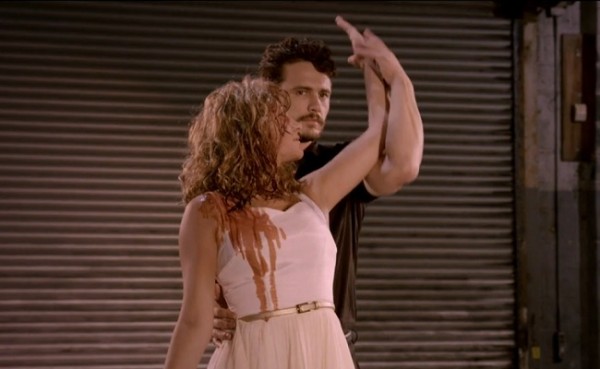
this mash-up of Reservoir Dogs and Dirty Dancing
from the first episode of Making a Scene, which shows Jennifer Grey’s
character superimposed over a (literally) tortured patrolman from
Tarantino’s smash hit, just as Tarantino’s Mr. Blonde is laid atop
Patrick Swayze’s ne’er-do-well dance instructor Johnny. 
Watching "Grey" dancing with "Johnny" while drenched in buckets of blood from the goriest scene in Reservoir Dogs
isn’t exactly entertaining, nor is it precisely funny or precisely
distressing. It’s something else entirely—a reenactment of the way
memory works that feels intuitively reasonable even as we don’t quite
know what to do with it emotionally or intellectually. In foregrounding
content like this via an original series, Franco is taking a significant
risk and placing significant faith in an audience base that, if we’re
honest, has never shown him much patience or grace. But it’s a risk
that’s entirely of our time, and perhaps more relevant to how we live
today—or might wish to live—than the despairing irony we were all
steeped in throughout the nineties. In other words, how about we just leave
Jimmy alone for a moment and see where he’s going with all this? We
might just find that, however
self-aggrandizing we sometimes assume Franco to be, this latest project
is much more about us than it is about him.

Seth Abramson is the author of three collections of poetry, most recently Thievery (University of Akron Press, 2013). He has published work in numerous magazines and anthologies, including Best New Poets, American Poetry Review, Boston Review, New American Writing, Colorado Review, Denver Quarterly, and The Southern Review.
A graduate of Dartmouth College, Harvard Law School, and the Iowa
Writers’ Workshop, he was a public defender from 2001 to 2007 and is
presently a doctoral candidate in English Literature at University of
Wisconsin-Madison. He runs a contemporary poetry review series for
The Huffington Post and has covered graduate creative writing programs for Poets & Writers magazine since 2008.

Of Scalpels and Synthesizers: The Music of THE KNICK

Of Scalpels and Synthesizers: The Music of THE KNICK

nullThe latest series from director Steven Soderbergh begins
jarringly, with an uncomfortably intimate, front-row seat view of a disastrous C-section
operation.  This widely discussed scene
set the tone for what has evolved into a consistently disconcerting and
uncompromising show, one that immerses viewers in the grimy, gory, greedy world of a
turn-of-the-century New York hospital. 
Soderbergh has said that he wanted to give a vision of the past that was anything but nostalgic, and in this he has certainly succeeded. 

One of the more jarring manifestations of this
anti-nostalgic vision is the show’s innovative synthesizer score, composed by
long-time Soderbergh collaborator, Cliff Martinez.  After a steady diet of Ken Burns
documentaries, one might have expected to hear the stately rhythms of ragtime
or perhaps the Irish folk music or Italian opera that one could reasonably have
expected to hear blaring from the New York bars and music halls of
yesteryear.  Instead, the images of
horse-drawn carriages and gaslit streets are accompanied by the kinds of sounds
we might associate with dystopian visions of the future.  The combination of old and new is both
unsettling and revelatory.

Martinez has worked with Soderbergh for some twenty-five
years, ever since he composed the score for the director’s explosive debut, Sex, Lies, and Videotape.  Since then he has continued to hone his
signature sound: a taut, tensile aural web where melody and rhythm are
inextricable.  Sequenced melody patterns
emerge and evolve slowly, like a Philip Glass symphony, adapting to the
changing dynamics of the film.  Martinez’
music does not so much accompany scenes as insinuate itself into them: what begins
as a barely heard rhythmic tapping may slowly blossom into vast, crystalline
sound structures, as in his mesmerizing soundtrack to Solaris; elsewhere, a subtle heart-beat will mount in tension along with
scraping industrial noises before fading to lurk in the background, as in Contagion.  His masterpiece may be the score for Nicholas Winding Refn’s Drive, where his brooding urban nocturne takes on a presence as substantial
as that of any of the film’s characters. 

The soundtrack for The
Knick
does not stand apart from Martinez’ previous work so much in its
sounds and melodies as in its relation to context.  We first hear it in the sequence leading up
to the disastrous C-section operation, where we see Dr. John Thackery waking in
an opium den, calling a horse-drawn cab, and surreptitiously shooting up in the
back seat before ascending the steps of Knickerbocker Hospital.  We’ve certainly seen similar seedy dealings
in previous portrayals of turn-of-the-century life but never with a soundtrack
so jarringly modern.  Combining elements
of house music and old-school German electronica, The Knick’s opening number wouldn’t sound out of place in a hipster
bar or a zombie film soundtrack; in the context of 1900s New York, it is so
blatantly anachronistic as to risk undermining any possible suspension of
disbelief the director might have achieved through the show’s painstaking set
design and costuming.  And this may well
be the point.

Consider The Knick’s
premise: a once state of the art but now struggling hospital finds itself in
thrall to its major donors, and unwittingly involved in a host of illegalities
thanks to its double-dealing financial manager. 
Head surgeon Thackery copes with the mounting pressures of his job
through chronic drug use.  In a bid for
racial progressiveness, the hospital’s chief benefactor pressures them into
hiring a black surgeon, who must struggle against the entrenched racism of the
medical institution.  In short, nothing
central to the show’s premise requires that it be set in the past: all of these
elements unfortunately remain part of American life in the twenty-first
century.  Indeed, one might even regard
the show as timely, given its depiction of the greed running through the
medical industry, and the reluctance of even its most enlightened members to go
against the status quo.  While the show’s
portrayal of race is necessarily one that involves more blatant forms of
oppression and disenfranchisement than we typically see now, to regard the
problems it portrays as a thing of the past would be disingenuous or naïve.

Given the show’s contemporary resonance, then, it is
somewhat baffling to hear director Soderbergh say, as he did in a recent Rolling Stone interview: “Your
overwhelming sense watching the show is one of happiness that you’re living in
2014. I wanted to make sure that’s what people were feeling.”  The overwhelming sense I get, which for me is
a central appeal of the show, is that not much has really changed since 1900,
and that the messed-up health care system we have is the product of decades of
greed and failed ambitions.  Ambulance
drivers in the show are paid a bounty according to the number of injured or
sick patients they are able to bring to the hospital.  Though presumably this doesn’t happen any
more, is it really any more shocking than doctors getting money from drug
companies for peddling their wares to patients, regardless of whether these
products are going to do them any good? 
Though doctors might not shoot cocaine with silver-handled needles
before going into surgery, some very possibly take painkillers pilfered from the
pharmacy’s stock before scrubbing up. 

What is most challenging about the series is the way it
makes us ponder the relationship between present and past; the soundtrack fosters
this.  The synthesizer itself is a
complex signifier: long used in film to conjure sounds and visions of the
future, it has also taken on a retro patina through its association with
nineteen-seventies progressive rock and disco. 
Martinez’ soundtrack exploits the disjunction, as he shifts from his signature minimalism
into more brazen territory, alternately evoking the soundscapes of 1970s Berlin
and 1990s British rave culture.  It is also
telling that one of Martinez’ signature instruments is an arcane construction
called a “baschet cristal” that makes sounds from vibrating rods and fiberglass
plates.  Used by mid-century avant garde
composers who saw it as an instrument of the future, now it sounds more like a
relic from some long-lost world’s fair exhibit. 
Martinez’ music occupies a similar aural twilight zone.

Notwithstanding Soderbergh’s own observations regarding the
distance between past and present, The
Knick
offers one of the freshest manifestations of what dramatist Bertolt
Brecht called “defamiliarization,” in which the audience is reminded that what they
are watching is a performance.  Brecht
achieved this effect through epic dramas, often set at epochal moments of the
past, which the audience gradually came to recognize as a defamiliarized
version of the world in which they were presently living.  The
Knick
also seems to traffic in what has been called “hauntology,” where
forgotten or unrealized visions of the past are felt to linger on, ghost-like,
into the present.  For Jacques Derrida,
the fall of the Soviet Union in 1989 left unrealized communist utopias to
wander like specters through the Wall Streets and shopping malls of
capitalism.  When we watch The Knick we might wonder whether black
doctors like Dr. Algernon Edwards really operated secret hospitals for black
patients in the bowels of white institutions, and whether these secret locations might have
offered a more positive model for health care than what we have now.  By scoring Soderbergh’s series with such a
rich array of musical anachronisms, Cliff Martinez helps to raise challenging
questions about present and past; a lesser composer might simply have
offered ragtime.

Jed Mayer is an Associate Professor of English at the State University of New York, New Paltz.

Joan Rivers: A Trailblazer Who Got Stuck in the Mud

Joan Rivers: A Trailblazer Who Got Stuck in the Mud

nullHumor can be the cut and the balm—sometimes
one-in-the-same, in the course of a single joke.  Sarah Silverman wryly laments: “I was raped
by a doctor, always a bittersweet experience for a Jewish girl.” Wanda Sykes riffs
on how “Black folks, we always have to be dignified, ‘cause if we fuck up, we
just set everybody else back a couple of years. We should have killed Flava
Flav like ten years ago!” A young Joan Rivers does a bit about her mother’s
desperation to marry her off: “Oh, Joan, there’s a man at the door with a mask
and a gun!”

Comedy can also be the hand on the backs of our
necks. Tracy Morgan tells his audience that, if his son came out to him, he’d
stab the boy to death. Daniel Tosh artlessly ponders the fate of a female
heckler: “Wouldn’t it be funny if that girl got raped by, like, five guys right
now? Like, right now?” Joan Rivers serves as the commissioner of the fashion
police: “I took Elizabeth Taylor to Sea World. It was so embarrassing. Shamu
the whale jumps out of the water; she asks ‘does he come with fries?’”

Rivers occupies a complex position in comedy. Her
early work is rightly lauded for its unflinching candor about women’s issues,
and for bringing those issues—the pressure to marry and the tedium of
housewifery, the joys and annoyances of sex, and even abortion—to a national
audience. She is celebrated for serving as the first woman to host her own late
night talk show, and venerated for her tenacity in the wake of tragedy (the
betrayal of her beloved mentor, Johnny Carson; the suicide of her husband and
producer). As a writer and a feminist, I should have called in my own tribute
on the switchboard of Facebook. And yet, I can’t. Rivers’ early work may have
been a slingshot lobbing stones against the powers-that-be, but, in her later years,
her cruelty became a cannon unloading upon the oppressed. She trafficked in
tired slut-shaming and fat jokes.

In perhaps the only way that I will ever be likened
to Elizabeth Taylor, I too have endured my fair share of comparisons to Shamu.
I was a fat girl who became a fat woman, even after dieting and exercising and
binging and purging and taking “nutritional supplements” more potent than 50’s
housewife’s physician-prescribed speed. My fat ass has been the butt of so many
jokes over so many years that I’ve become intimately acquainted with the ways
that “humor” can be used to enforce social codes. Before I was ever aware of
her history, Joan Rivers was that voice that came from the TV in my mother’s
bedroom, a voice that, despite its off-putting raspiness, affected a favorite
wicked aunt chumminess that drew me in until it spit me out: “If Kate Winslet
had dropped a couple of pounds, the Titanic never would have sunk.”

I wasn’t one of those high school girls whose
ticket sales bought James Cameron a summer home, still, I could look up to Kate
Winslet: I would never have her hourglass figure (or her gorgeous red curls),
but her body, and its emancipation from Paltrow thinness, was far closer to
mine than any other modern starlet’s. And there she was on the silver screen,
the real ship of dreams. Ravishing. Desired. So, when Joan Rivers let it rip
with that joke, she was issuing a warning to every fat girl (every girl,
really): There’s only one way to be a woman, and there’s a price to pay for not
looking the part.

This is why,
unlike so many of my peers, I come to bury Joan Rivers, not to praise her.
Rivers famously quipped that, upon her death, her body shouldn’t be donated to
science, but to Tupperware: In truth, all of that plastic has been melted down
and sculpted into an altar to St. Joan of Snark, the groundbreaking vulgarian
who spoke the brutal truths that nice girls were never supposed to say (let
alone in public). Rivers muscled her way to prominence in a male-dominated
field, and she worked steadily for fifty years. It’s no wonder, then, that an
armada of think pieces seeks to defend Rivers as a capital-F feminist (even if
she’d have been reluctant to claim the label for herself). In Time magazine,
Eliana Dockterman equates Rivers’ legendary work ethic and savvy for
self-promotion as an innately feminist endeavor: “Nothing was off-limits as Rivers
wise-cracked her way to the top. And it was this
undisguised and ‘unladylike’ desire for success that made Rivers a feminist
icon.”

Assessments like this
strike me as an uncomfortably corporatized definition of feminism: The will to
work alone does not a feminist make, especially if the work affirms the
structures and mentalities that shame women—for their bodies (though weight was
one of Rivers’ primary comic milieux, she was also free and easy with the word
tranny); their sexualities (and anyone who fell on either side of the
virgin/whore dichotomy was fair game, as evidenced by her cracks about Taylor
Swift’s knees being “together more than Melissa and I” and the Kardashian
sisters needing to find “true love standing up. They’ve had more men land on
them than we’d had in Afghanistan.”); and even for being the victims of
violence (she once said that “those women in Cleveland” had more space in the basement
where they’d been raped and tortured than she had in her daughter’s supposedly
cramped living room; she also joked about slapping Rihanna for possibly
reconciling with Chris Brown).

If her latter-day
humor was particularly vicious toward women, it certainly didn’t spare the
gents. In Rivers’ world, men are shallow dogs following the bone of lithe,
leggy female beauty. They are sexual bullies who don’t see women as people.
They are simultaneously the arbiters of a very specific standard of female attractiveness
and horny devils unable to get it in their pants: “I
said to my husband, ‘Why don’t you call out my name when we’re making love?’ He
said, ‘I don’t want to wake you up.’”  

Rivers’ full buy-in to the aesthetic standards that confine
women manifests in more than her stage act; she co-signed with a scalpel. Over
the years, her face attained a stretched-taut surrealness that turned her into
a breathing caricature. There is an unintended but undeniably apt symbolism in
the idea that her natural ability to register and express authentic feeling was
tombed under layers of scar tissue. Her self-loathing, and not her wit, became
her weapon.

As a thirtysomething, I have grown up with the Joan Rivers
who puffed out her cheeks and imitated (her version of) a fat woman’s waddle on
the Letterman Show when discussing Adele, remarking that the latter’s song
“Rolling in the Deep” (which should surely be etched in a Mount Rushmore of
number one pop songs of all time) should be called “Rolling in the Deep Fried Chicken”—diminishing
Adele’s accomplishments as a singer and songwriter by reducing her to a body.
Today’s “Rolling in the Deep Fried Chicken” is yesterday’s “Elizabeth Taylor is
so fat, she has Ragu in her veins.”

As I see these remarks
on list after list of “Joan Rivers’ Best Burns,” I think of Margaret Cho’s
appearance on Rivers’ online interview series In Bed with Joan, and how
their conversation turned to Cho’s body—specifically, how svelte she’d become.
Rivers recalls meeting Cho years prior, when Cho was the anointed It Girl with
a sitcom in the works: “You were a bit of a …” she says, and her pause is the
plank that Cho must walk down before jumping into the deep. A bit of a fat
girl, she admits. Never mind that Cho’s studio-mandated compulsion to lose
weight (and lose it fast) resulted in kidney failure.

Cho may be considered one of Rivers’ heirs apparent, but she
proves that there’s more than one way to be woman who brings a carefully
calibrated cruelty to comedy. Her stand-up is more akin to Rivers’ early work,
bringing a “and fuck you if you don’t like it” bravado to her real talk about
her real pain. Her filth and fury is deployed against the double standards and
the beauty standards that Rivers, in her later years, always endorsed. Cho’s
stand-up film I’m the One that I Want details—with naked rage and
unexpected pathos—her own private Hell-as-a-hamster-wheel of constant dieting:
“I knew I was crazy because I was watching Jesus Christ Superstar and the part where Jesus carries the
cross up the mountain, I actually said to myself, ‘Wow! That must be a really good workout! Yeah, because you’re
doing arms and cardio!’”

She roars and
rampages and names names (including the actual producer whose “concerns” set
Cho on that hamster wheel); still, she shows the kind of woundedness and
vulnerability typically denied to any “nice girl,” in any era, by recounting,
with a necessary explicitness, the physical ravages of all that dieting. She
describes being in the ER, broken and bleeding, and then vaults into an
impersonation of the aggressively earnest nurse who tends to her: “Hi, my name
is Gwen and I’m here to wash your vagina!” This
hyper-attentiveness to the body and its failings (in terms of true mechanical
break-down and in meeting cultural expectations) isn’t just the province of
women.

Much has been written about “And So Did the
Fat Lady,” the episode of Louie that deals earnestly (if not always
successfully) with the stigmatization of fat women; and most of that critique
has focused on the epic monologue delivered by Vanessa, the titular fat
lady—however, the episode also shows how Louie’s hesitance to date Vanessa
stems from his own poor body image and fear of guilt by association (something
that Vanessa even calls him on: “You know, if
you were standing over there looking at us, you know what you’d see? That we
totally match.”).  This episode
skewers the contradictions between America’s cult of thinness and the glut of
consumption that comes with a Starbucks on every corner. Louie and his brother
partake in a “bang bang,” a family tradition of going to two different
restaurants (in this case, an Indian place and a diner) and ordering
full-course meals.

Louis C.K. ribs
himself about his weight, but he still shows great tenderness toward his own
fat body. In the season four finale, he takes a romantic bath with his
long-time crush, Pamela; the camera lingers on Louie’s derriere and Pamela
cracks a joke, and yes, when Louie lowers himself into the tub, water sloshes
to the floor, snuffing some of the candles. However, this awkwardness somehow
makes that final moment between Louie and Pamela even sweeter.

Watching Cho and C.K. prompts the question of what
Rivers could’ve done if she’d applied the same tenacity she showed for Liz
Taylor’s waist line to a culture that expects women to be perpetually thin and
everlastingly young. There could be something undeniably powerful in Rivers’
self-abnegation. When so many of our stories about women still hinge on their
prettiness and their experience of being desired, being an outlier to those
desires creates a sense of obliterating isolation. Rivers’ barbs at her own
expense may have come dressed in the baubles and furs of vicious wit, but
underneath those pearls and those stoles there was a naked little heart beating
in sorrow and wrath—and its pulse became a siren song.

Rivers was canny enough to recognize that the
breadth and intensity of her cosmetic surgeries had become a key component of
her celebrity, at times eclipsing her actual body of work. She played herself on
an episode of Nip/Tuck where she implored the plastic surgeon
protagonists to undo all that she’d had done because she wanted her grandson to
see her natural face. She’s horrified by the computer simulation of that
natural face, with all of the lines and wrinkles that anyone lucky enough to
live into their seventies could expect, and she opts for another face lift. The
predictability of this reversal is supposed to be the punchline, but the fact
that a woman with Rivers’ history and influence still views her self-worth
through the prisms of youth and attractiveness is just plain sad. 

The difference between Rivers’ quip that her
husband killed himself because she removed the bag over her head during sex (or
that the only she conceived her daughter because her husband rolled over in his
sleep) and Cho’s riff on the producer’s comment about the roundness of her face
(“I had no idea that I was this giant face taking over America! Here comes the
face!”) is that Cho places the shame squarely where it belongs—on our culture,
and its militant insistence on one type of beauty.

null

Perhaps the most disheartening aspect of what some
could view as Rivers’ artistic decline is that she was once brilliantly,
blazingly capable of taking our culture to task. “I feel sorry for any single
girls today … the whole society is not for single girls,” she says, in a now
widely circulated clip from the Ed Sullivan show. The clip was filmed in 1967,
and Rivers—who looks shockingly girlish, unrecognizable from the woman she’ll
become—speaks directly to those single girls because she was one of them,
peppering her bit with “you know that!” and “isn’t that so? Yes! Yes!” and “it
just kills me!” She rips into the double standards around attractiveness: “a
boy on a date, all he has to be is clean and able to pick up the check … the
girl has to be well-dressed, her face has to look nice, the hair has to be in
shape …” Her take on the pressure to settle down and start a family young (too
young) belongs in a more caustic version of The Bell Jar: “The neighbors
would come over and ask ‘how’s Joan, still not married?’ and my mother would
say ‘if she were alive.’ Do you know how that hurts, when you’re sitting right
there?”

As I watched this clip, still in shock that this
scrappy young woman (the kind of girl I’d want to get drinks with) had ever
become the comic who told women in her audience that they were single because
they were over-educated (“no man will ever put his hand up your dress looking
for a library card”), I thought of how timeless her words remain, of how I
could see them being written in a monologue on Girls, one likely
delivered by Lena Dunham, architect of lines like “So any mean thing someone’s gonna
think of to say about me, I’ve already said to me, about me, probably in the
last half hour.”
 

I may never be equipped to fully appreciate Joan Rivers;
if, in order to be thankful for her work, I needed to experience a time when
Happy Homemaker was the only role for women and the word abortion was verboten
on TV. She may always be a trailblazer who got stuck in the mud. But I know
that humor can burn and soothe in the same beat: I remember calling a good
friend after I was rushed to the ER with chest pains and palpitations; I told
her that the attending physician warned me off the diet pills, purging, and
starvation unless I wanted “a more severe cardiac incident.” Without pausing,
my friend quipped, “So, you have to choose between your face or your ass or
your heart.” I laughed, and that laugh, however short, was a moment away from my
fear; that laugh acknowledged the untenable position I’d allowed myself to be
put in, because of the things I believed I needed to be.

Laura Bogart’s work has appeared on The Rumpus, Salon, Manifest-Station,
The Nervous Breakdown, RogerEbert.com and JMWW Journal, among other
publications. She is currently at work on a novel.

ARIELLE BERNSTEIN: Bloody Handprints: What Comes After Domestic Violence in Television and Life

ARIELLE BERNSTEIN: Bloody Handprints: What Comes After Domestic Violence in Television and Life

nullIn episode “Fifty-One” of Breaking
Bad,
Walter White buys Walt Jr. a
gorgeous, fast-moving and expensive red sports car, even though Skyler has expressly
asked him not to. It’s a subtle move of dominance. Walt has already made it
clear that he is the one who will be calling all the shots, and this is another
way to drive a wedge between Walt Jr. and Skyler by painting himself as the
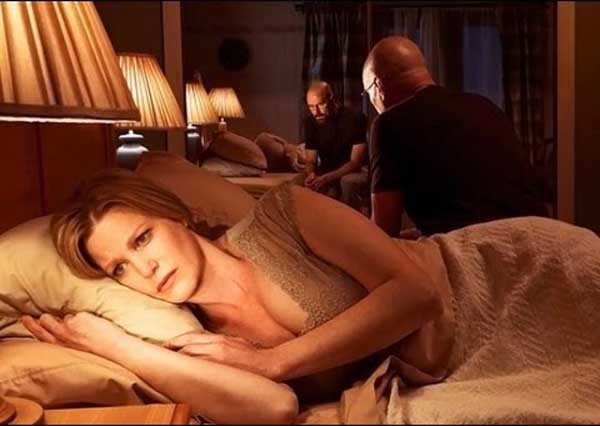
better, cooler parent. A few scenes
later we cut to Walt and Skyler in bed together, Skyler turned away from Walt
as they spoon; the camera affording us a view of a close up of Skyler’s face,
as Walt gently strokes her arm and tells her that everything is going to be
okay, putting in a coyly worded request for a chocolate cake to celebrate his
birthday. Throughout this monologue, Skyler’s eyes remain dead and far away.
She knows Walt’s gestures of affection are not meant to actually open a warm
dialogue about the future; they are about quietly asserting Walt’s dominance
and control. Skyler is no longer an equal partner to a man she loves; she is a
prisoner in her own home.

As TV dramas that focus on male antihero protagonists have
become increasingly in vogue over the last 10 years, the women who
bear the brunt of their specific brand of male entitlement and rage have become increasingly noticeable. Female
characters in shows ranging from Mad Men to Game of Thrones are constantly subjected to verbal, sexual and physical violence, sometimes from the
male characters we admire and love. Male-on-female violence is portrayed as
normal and is often sexualized or depicted as romantic or glamorous. While I’m
a fan of all three shows I just mentioned, I also worry about the ubiquity of the
victimized woman in many of these programs and how the attitudes towards women
presented in these otherwise nuanced, intelligent shows might bleed over into real
life.

I’ve been thinking recently of Breaking Bad in light of
the recently released footage showing Ray Rice punching his now wife, Janay
Rice, in the face. After all, at its heart, Breaking
Bad
is a story about family and
violence, the family that Walt continues to claim to love, even as he selfishly
destroys it in order to become a drug kingpin. Walt’s transformation from
gentle chemistry teacher to leader of a drug ring comes at the expense of his
wife and children. He goes from being a protector to being someone who controls
every aspect of his family’s small suburban life, continuously putting his
wife and children at immense risk. 

The fact that Walt wants to provide for his family is often
listed as the most sympathetic excuse for his actions. In reality, it is
probably his most evil trait. Walter White’s transformation into a formidable
antihero is complex and rife with important moral questions, but Walt’s bad
behavior is often presented as less menacing than edgy; the newly evolved
Heisenberg, after all, has his fast sports cars and pork pie hat, his pithy,
brilliant one-liners. While clearly Walt is intended to be a villain by the end
of the series, many people still view Walt as a sympathetic figure and, while
Walt’s actions are never forgiven, they often do seem to be lionized. By the
end of the series Walt is presented as a flawed and tragic hero who did what he
needed to do in order to save the person he loved most: himself.

Skyler, who goes from being a strong, smart and willful
protagonist to a kind of cowering shadow of her former self, is never portrayed
as a hero. Her story is swallowed up by Walt’s. Indeed, many viewers took
tremendous joy from her slow collapse under Walt’s thumb. Often feminists cite
hatred of female characters under the broad, nebulous heading of “misogyny,” but the specific reason that Skyler was such a maligned character may have less
to do with a general hatred of women than with a specific discomfort at seeing the
White household descend into domestic violence and not wanting to blame Walt
for the deterioration. Skyler’s defiant attitude towards Walt, her refusal to
be willed into submission and go along with his egomaniacal plans, were
initially what inspired fans rooting for Walt to hate her.
Others criticized her when she began to become more desperate, give in to
Walt’s demands and eventually align herself with him after being worn out,
terrorized, and brainwashed by a person who was once her loving partner.

We spend a lot of time criticizing victims of domestic violence,
but we also spend a lot of time talking about them as victims, rather than
seeing them as whole people who are forced, by circumstance, to make a series
of genuinely complex and heartbreaking decisions. When footage is released of
Ray Rice knocking out his fiancé, we rush to see the evidence but don’t really
know what to do with it. A few commentators have struggled to excuse or defend
Rice’s actions, while others have complained that we simply don’t have context
to understand why he would do such a thing. Most mainstream discussion has
rushed to Janay Rice’s defense by pointing out the ways that she was an
innocent victim of a horrible crime.

But when Janay Rice herself responded to the public distribution
of this footage, she was primarily angry that she had been directly embarrassed by the
sudden media exposure. And why wouldn’t she be? When discussing Janay Rice, many
commentators rushed to criticize her choices, or simply left her out of her own
story. While the term “victim” is meant to put the blame on the perpetrator, it
also serves to flatten the person who has been hurt. We may feel sympathy for
victims, but we don’t see them as full people, with rich life stories, with the
combination of triumphs and mistakes that comprises each of our lives. In the
case of Breaking Bad, the
audience often could only think of Skyler in absolutes: either a shrew or a
victim, a bitch or a victim, a ball-buster or a victim.

We have plenty of stories where male protagonists fight
adversity and triumph over it, with dedication, with fists, with spiritual and
intellectual epiphanies that nurture individual growth. For female survivors of
domestic violence, we don’t tend to offer a similar opportunity for triumph. I
admire the number of women who have come forward to share their own stories
about how they experienced partner violence, but I also resent the fact that the
media still often presents these stories like a series of broken sighs and
resignations, rather than a deeply heroic act.

Even when leaving is presented as strategic, it is still
presented as a victim’s last decision, the path of least resistance, the thing
the weaker animal does when it knows it lost. The Skyler at the end of Breaking Bad is a
shadow of her former self, forced to support herself off the ugly drug money
she swore she would never take. Walt meanwhile is given his swan song, his
bloody handprint a signature stamp on the top of his baby blue.

We forgive a lot of male bad behavior. We are primed to see male characters as awash in their own hero’s journeys,
where the choices they make fundamentally matter, where they are leading the
charge of their own destiny. When Walt bellows at Skyler, “I am the one who
knocks,” late in the series, audiences applaud how Walt has been utterly
transformed. We see him as both menacing and brave, badass and brutal. In
contrast, in the world of the antihero, women have never been the ones to knock. We’ve been the ones to respond to that
knocking, the girls who end up dead in bloody bags washed to the shore, the
women condemned to stand by their man, or the women finally saved by a good
man.

This isn’t necessarily true in all media representations of
women. One of the reasons Buffy the Vampire Slayer succeeded as a feminist T.V. series is that although Buffy was
sometimes victimized, she was never ultimately portrayed as a victim. Her
response to trauma was complex and multifaceted, but she was consistently
portrayed as someone who is a survivor, rather than a victim of circumstances
beyond her control. In the same way, The Hunger Games’ Katniss’s greatest asset was not simply her skill at using a
bow and arrow, but her sheer resilience in the face of evil. 

Of course both of these stories are the domain of fantasy,
rather than the gritty realism we are supposed to see on any number of
antihero-centered T.V. dramas, genuinely brilliant, riveting shows, where,
nonetheless, female characters are often created in order to be broken. It’s time for women (and men) to start pushing back harder against narratives
that flatten female characters into either villains or victims of circumstances
beyond their control, and demand that female characters
are afforded a chance at redemption. I want a story that doesn’t end with death or leaving,
a world where we expect female protagonists, even those who experience violence
and pain, to ultimately carve out a new future.

Arielle Bernstein is
a writer living in Washington, DC. She teaches writing at American
University and also freelances. Her work has been published in
The
Millions, The Rumpus, St. Petersburg Review and The Ilanot Review. She
has been listed four times as a finalist in
Glimmer Train short story
contests
. She is currently writing her first book.

Can We Be FRANK? What Semi-Fictional Band “The Soronprfbs” Means for Music

Can We Be FRANK? What Semi-Fictional Band “The Soronprfbs” Means for Music

The
drummer doesn’t speak. The lead guitarist speaks only French. The
theremin player is homicidal. The original keyboardist has been fired,
and now acts as roadie and manager. The replacement keyboardist has been
sectioned by local authorities after a suicide attempt. The replacement
for the replacement has never played in a band before. And the lead
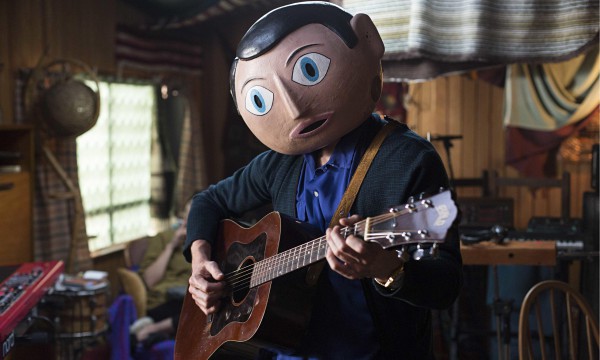
singer wears a giant Frank Sidebottom head
at all times; no one in the band knows his last name or has ever seen
his face. Nor has the band ever successfully completed a gig or recorded
a single track. 

  
This is the state of affairs for the unpronounceable and obscure band "The Soronprfbs"—the subject of Frank—as the film opens. What Frank asks
us to be most perplexed by, however, is not the set of personalities that
comprise the Soronprfbs but the music itself. Indeed, in play throughout
Frank is a question almost
always answered in the affirmative in music biopics, and in the negative
in mockumentaries: "Is the music any good?" Frank
not only straddles the biopic and mockumentary genres, but also answers
this question only ambiguously: "Maybe." (And adds, implicitly, "Does
it matter?")
At
the center of the Soronprfbs is "Frank," a mysterious former asylum
inmate from Kansas whose commitment to his obtuse but possibly brilliant
musical vision calls to mind the late Syd Barrett. When Jon, an
ambitious but not particularly talented keyboardist, is recruited into
the Soronprfbs on an emergency basis, an unstated tug of war between
Frank and his newest band member is initiated, with the soul of the
Soronprfbs in the balance. The allegory behind the film’s iconic
struggle is reasonably well-defined: how do artists balance their
materialist ambitions and popular sensibilities with the antisocial and
tormented genius of authentic inspiration? It’s a question easily
answered when and where ambition and inspiration conjoin to produce a
popular sound (cf. Taylor Swift) or one embraced by a small but
committed legion of fans (cf. Deafheaven), but what about when the
ambition and inspiration
are real, but the sound they produce lies well outside any listener’s
present interest or even understanding? 
It’s
telling that Jon helps the Soronprfbs gain a grassroots following not
so much through dissemination of the band’s songs, but by using social
media (Twitter, Tumblr, and YouTube) to draw attention to the band’s
compositional process and camera-ready idiosyncracies. When the band
finally shows up at SXSW, many have heard of them but almost no one
knows their music–a perfect statement on how
social media drives an interest in artists that’s independent from the
art they make. Does this discrepancy between social media buzz and
genuine appreciation suggest that the Soronprfbs are mere poseurs? Frank
asks us to consider that perhaps there’s no such thing as a poseur
anymore, as (a) even self-consciously idiosyncratic music can be entirely
earnest, and (b) ultimately the excitement a band generates in and
around the national music scene has a longer-lasting impact than the
music itself.
To be clear, though, the Soronprfbs—in the opinion of this writer—are pretty great. The Frank
OST is an album of music experiments that’s eminently listenable; cross
the Doors with the United States of America and a skin-of-their-teeth
sixties garage band like the Lemon Drops and you’ve got a good idea of
what the Soronprfbs sound like. It’s Grinderman meets the Hombres;
Phosphorescent meets Piper at the Gates of Dawn.
In other words, there’s a tripped-out, DIY sensibility behind the
Soronprfbs that’s mirrored in more contemporary acts like Neutral Milk
Hotel and the other members of the Elephant Six Collective. That the
Soronprfbs are only semi-fictional—adding to the "meta" quality of a film whose
OST includes the album whose creation it documents, the Soronprfbs have actually played some live shows—only adds to the sense that Frank is a movie about the artist’s ethos in both our own and previous eras.

While
Michael Fassbender’s voice won’t win any awards, there’s something
winning about the improvisational sound of the Soronprfbs. If the New
Sincerity’s self-consciously hip earnestness—equally aware of and
committed to its studied but joyful eccentricities—had a sound, it
might well be this. Frank
cautions us, however, that in this new age of post-deconstructive
reconstruction, a swing to either of the most eligible extremes set
before the artist (the self-consciousness of ambition or the
inspirations of eccentricity) can be destructive. In the end, it’s not
clear whether the Soronprfbs can survive as both a popular and
an organically inspired band without inhabiting—and inhabiting
only—the ambiguous middle spaces of social media and barely-heard first
albums. While in the real world the Soronprfbs, along with Fassbender,
may give a well-received concert or two, or even appear (as they did) on
The Colbert Report, in the film
both the Klieg lights of SXSW and the bohemian isolation of a recording
studio nestled deep in the English woods pose terminal dangers to the
group. Maybe, in the
Internet Age, the pressures of a stage "IRL" mark the beginning of the
end for certain forms of art, while situation in the midst of perpetual
buzz and an ever-elusive artistic vision allows artists the room they
require to explore new methods of creation.

Seth Abramson is the author of three collections of poetry, most recently Thievery (University of Akron Press, 2013). He has published work in numerous magazines and anthologies, including Best New Poets, American Poetry Review, Boston Review, New American Writing, Colorado Review, Denver Quarterly, and The Southern Review.
A graduate of Dartmouth College, Harvard Law School, and the Iowa
Writers’ Workshop, he was a public defender from 2001 to 2007 and is
presently a doctoral candidate in English Literature at University of
Wisconsin-Madison. He runs a contemporary poetry review series for
The Huffington Post and has covered graduate creative writing programs for Poets & Writers magazine since 2008.

The Silence at the Heart of a Family: The Most Offensive Thing about WETLANDS

The Silence at the Heart of a Family: The Most Offensive Thing about WETLANDS

nullWhat do you consider offensive? The dictionary definition of
the word suggests that to be offended is to be hurt, or angered, by something
one has seen, or experienced. Wetlands,
a new film from director David Wnendt, contains many scenes which might easily be
called, by this criterion, offensive. One probably wouldn’t normally want to watch them, and
certainly not in close-up, if one had a choice. You might wince. You might look away. You
might walk out. Or, perhaps, you might watch, out of curiosity. Wnendt takes us, with this
work, on a very bumpy tour of a young woman’s maturation, sparing nothing to
show us his narrator’s body, as well as her body’s functions, its wounds, and
its moments of ecstasy, all equally vivid, all equally exciting. It also shows
us the tormented relationships she has with her parents, with her family, with
men—and the sort of violence perpetrated in those spheres. The question the
film asks, quite profoundly and with such confidence that it’s hard to stay shocked
at its earthiness for too long, is: why are we so offended by bodily functions,
and perhaps less by the ills humans visit on each other?

About those bodily functions: As has been noted widely in
the film’s critical reception, it begins ear-catchingly, with Helen’s (Carla Juri)
announcement, a la Proust by way of Scorsese, that as long as she can remember,
she’s had hemorrhoids. In an instant, ointment is applied to her thumb, and her
thumb is inserted up her rectum, where the ointment is applied to a painful,
chronic, sore. Having completed this gesture, she rubs her vagina around the
toilet seat, just to test her vaginal health, and then she pauses for a reverie
inspired by a pubic hair stuck to the particularly filthy rim of the bowl;
we immediately shoot into a Delicatessen-style
journey deep into the roots of the hair (again a bit like Scorsese’s tour of
the Copa Cabana in Goodfellas); microscopic
creatures chomp and gnash; spores float like so many balloons; we see what may
be the encroachment of a virus but looks a little more like germ-on-cell rape.
It’s an appropriate beginning to the story; the film zips along with an almost
jazz-like energy, even as the soundtrack is generally gravelly
punk-inspired guitar mash. What we get here is partly a sexual history, partly a family history, and
partly the story of an anal injury incurred while shaving. Shaving has a
special meaning for Helen; in one of numerous jarringly sensual flashbacks, we
see her being shaved, naked, by a similarly naked coworker. The scene stands
out as one of the more gentle scenes in a film about different kinds of
violence, and their effects. After nicking herself in the anus, she bleeds, and
bleeds, and bleeds, and finally ends up in the hospital, under the care of
Robin (Christoph Letkowski), a male nurse with slightly shaky judgment. One would think the gore and
filth would stop here, but in fact it doesn’t. Though the hospital stay
provides the framework for the film, it serves here as a means to an end—the
end being Helen’s wrestling with her family history. We learn other things
about Helen here; for instance, she has an innocent friend, Corinna (Marlen Kruse) whom she corrupts,
takes drugs with, gets in trouble with—and, as friends do, Corinna departs. We also
learn small pieces of Helen’s daily life, get a sense of her musical taste, watch
her grow from a cleanliness-obsessed toddler into a much rougher young adult. And yet Helen’s family history looms larger and turns out to be far more offensive than any
of her displays in the film: more than her licking her vaginal fluids off her
fingers before a date, more than her leaving semen on her hands after giving a
friend a hand job, more than the sight of her own poop, all around her, when
she wakes up in the hospital the morning after surgery.

What do we know about the family? Plenty, and little. But we
find out enough to make the average viewer, as the dictionary requires, angry.
They appear, in this telling, to be willfully negligent, carrying their own
disturbance into their relationship with their child a certain degree of
immunity, at least in this telling. Karen’s parents are divorced. Her
biological father is a rough, arrogant sort who, when Helen is small,
accidentally slams the door of a car trunk on Helen’s hand. We don’t see him
apologize, or rush to her side, and we get the sense that no such reaction is
forthcoming; as an indicator of the general timbre of their relationship, the
moment is chilling. In another scene, when Helen is older, we see her father
dancing wildly by the family pool, his erection waving around so obviously in
his swim trunks that Helen makes a voiceover comment about it, and we focus on
it. And still later, when Helen is in the hospital, his recovery gift to her is
not so affectionate: a hemorrhoid cushion, which he doesn’t bother to
inflate for her. Helen’s mother doesn’t receive much better exposure here; when
Helen is very young, she does a trust exercise, asking Helen to jump into her
arms—only to back away as Helen jumps, warning her, as she lies on the ground,
not to trust anyone, even parents. Her mother’s rage manifests itself in
different ways: her adoption of religions ranging from Judaism to Buddhism to
Catholicism; her lifting her skirt and showing her crotch at a dinner party
when her drunk husband begins relating the surgical procedure necessary to
complete Helen’s delivery; and finally, a violent act which Helen stumbles on,
which has scarred the family, scarred Helen’s brother, and scarred Helen in
ways she doesn’t entirely understand.

Admittedly, because the film is a self-portrait, and because
its spirited approach animates it so much that you can almost forget the poop,
the semen and the lubricant, it would be tempting to think the portraits of
Helen’s parents presented here are biased, shaped, or even imagined—but the
real-time encounters we see, the matter-of-fact conversations in the hospital,
at home, are dry, and the outward manner each parent displays does not indicate
the capacity for remorse at dereliction, only weary tolerance of Helen’s antics;
the conversations intimate a long history of missed apologies. And so, the
final question is, is it more offensive, or shocking, to see two girls rubbing
menstrual blood on each others’ faces, or to see misguided parental behavior,
which silently presages the more outrageous aspects of the film? When the end
comes, and it is a happy one, as much as it could be during recovery from anal
fissures, one is relieved to see that it involves pushing away from her past, most specifically her family. When watching a film like this, which has banked on the shock value of its content, one wants, in a sense, to be impressed: Wow, that was really… gross. It is to the film’s credit that characters who exist primarily on the margins of the narrative provide its points of greatest offense, casting the humanity and curiosity of the film’s central figure into a curiously positive light.

Max Winter is the Editor of Press Play.

METAMERICANA: RICK & MORTY: The Ballad of Abradolf Lincler

METAMERICANA: RICK & MORTY: The Ballad of Abradolf Lincler

null

The Back to the Future films gave us Doc and Marty, the former a catchphrase-spouting, drunk-seeming, AARP-eligible scientist who was equal parts madman and genius, and the latter a high-voiced square with an alternately plucky and anxious disposition. Rick & Morty,
Dan Harmon’s and Justin Roiland’s new animated series on the Cartoon Network, deviates from
that formula by giving us Rick and
Morty: the former a catchphrase-spouting, drunk-seeming, AARP-eligible
scientist who’s equal parts madman and genius, and the latter
a high-voiced square with an alternately plucky and anxious disposition.
If there’s another similarity between Bob Zemeckis’ 80s cult-classic
film series and Harmon’s latest instant classic, it’s that both share
an interest in exploring the vagaries of transdimensional travel. That,
and physical comedy.

Apart from its resemblance to the Back to the Future franchise, Rick & Morty seems deliberately calibrated to defy analogy. Is it Futurama meets Harmon’s earlier hit, Community? Men in Black
meets Picket Fences? The X-Files meets Brazil? While Rick & Morty
is certainly another entry in a long line of genre- and reality-bending
TV programs, none of these analogies will finally do, largely
because the creators’ interest in Rick & Morty
is not in creating an identifiably parodic mish-mash of styles, but
juxtaposing opposing principles to the point of irresolvable paradox.
It’s not merely that most episodes of Rick & Morty
take place in the fifth and sixth dimensions—in the fifth dimension,
humans are able to perceive all possible futures stemming from their
present timeline; in the sixth dimension, we perceive alternate
timelines entirely
divorced from our own past, present, and future—it’s that even within
these dimensions the plot and characters oscillate between sense and
nonsense, unidirectional and spiraling narratives, optimism and cynicism
for humankind’s ability to create order from chaos.

In short,
Harmon and Roiland want to deny us all of our comfortable psychosocial
poles—excessive sentimentality and excessive cynicism, for instance—by
forcing us to reside, as viewers, in the same sort of ambiguous
head-space the Internet and popular culture forces us to reside in
anyway. If Rick at one point describes the transdimensional
Intergalactic Council of Ricks (it’s a long
story) as a "who’s who of who’s you and me," he could equally be
describing our own space-time continuum, in which we retain our sanity
not by establishing stable selves ever willing to betray their own prime
directives, but by
embracing plural selves who
exhibit an abiding fidelity to certain core principles. You and I are
always you and I, the transdimensional adventures of Rick & Morty imply, but surviving the Internet Age intact means knowing exactly which you and I we are at all times.

Rick & Morty
so defies generalization that one must resort to anecdotes and clips
from the show to even approach an understanding of the program’s
particulars. So, first, an anecdote: In the eighth episode of the first
season of Rick & Morty, Rick
chastises his daughter, son-in-law, and granddaughter for obsessing
over a pair of goggles that shows them their lives in alternate
dimensions rather than
watching Ball Fondlers, a
sixth-dimensional television program that has nothing to do with either
balls or fondling because those words mean something entirely different
in the sixth dimension. Seeing how miserable his relatives have been
made by visualizing how much better their lives would be in an alternate
reality, Rick says, "I don’t want to rub it in or anything, but you
guys clearly backed the wrong conceptual horse." What Rick means is
that, in the context of a workaday reality so nonsensically
contradictory that it requires highly conceptualized forms of resistance
to survive, the choice between fetishizing stable selves and a stable
reality and accepting the intertextuality (juxtaposition of
data-streams) and intersubjectivity (juxtaposition of consciousnesses)
of our daily experiences should be an easy one. If we treat realities as
multiple and elective instead of stable and imposed from
without, it enables us to better navigate an online cultural sphere in
which multiple and elective realities are already the order of the day.
Every day, in fact.

This, in a nutshell, is why Rick & Morty is like no other television program before it, and why even comparing it to alternate-reality cult hits like The X-Files or Brazil
is inadequate. In simple terms, the program’s plot and characters move
so seamlessly between opposing poles of thought and feeling that calling
it "sci-fi" does it a disservice. Instead of "sci-fi," Rick & Morty
is more appropriately termed "nonfi-fi": a subgenre in which the
boundaries between the things we can readily understand and those we
cannot possibly relate to our own experience is crossed so rapidly and
with such regularity that we enter an entirely new space (indeed an
entirely new dimension) simply by consuming it. We see this tendency in Nathan for You, a Comedy Central program which is ambiguously either an actual documentary or a mockumentary; in IFC’s Comedy Bang! Bang!,
which is ambiguously either an actual late night interview program or a
parody of a late night interview program; and–well, you get the
picture. These programs never give viewers the comfort of either earnest
immersion in a genre or ironic distance from any genre; instead,
viewers subsist in a central space between all possible received
expectations–a place in which the
normal rules of physics, individual morality, and collective culture
are intermittently suspended.

Yet Ricky & Morty
somehow takes even "nonfi-fi" to another level by being at once
meticulously written from a conceptual standpoint—its perspective on
the necessary flexibility of reality is unmistakable—and also
improvisational in its writing. Harmon’s and Roiland’s point, as seen in the episode "Rixty Minutes," seems to be that while we can
conceptualize approaches to reality, whatever our approach may be,
reality is simultaneously being improvised and solidified at every
moment. This, then, is the reason for its daily absurdity: we’re all
winging it all the time, but we all have to accept the aggregation of
all our improvisations to survive. As Morty observes when Rick upgrades the family’s cable package with programming from
every
conceivable reality, "Seems like TV from other dimensions has a
somewhat looser feel to it" (to which observation Rick responds, "Yeah,
it’s got an almost improvisational tone").

If there’s an iconic figure on Rick & Morty,
one whose composition best summarizes Harmon’s social and metaphysical
critique, it’s "Abradolf Lincler," a genetically engineered creation of
Rick’s who’s half Adolf Hitler and half Abraham Lincoln. Rick describes
him as "a crazed maniac—just a misguided effort of mine to create
a morally neutral super-leader . . . turns out it just adds up to a lame,
weird loser." Of course, that "lame, weird loser" is simply us—what
Lincler himself describes (in speaking of himself) as "an abomination,
tortured by the duality of its being"—and as much as the show may use
Lincler for comic relief, in fact his dilemma is our own. How do we
resolve our opposing inclinations without lapsing into a moral
neutrality that’s both uninteresting, perverse, and doomed to
self-destruction? In another several-minute stretch of Rick & Morty, its creators model for us how the fifth and sixth dimensions permit a
reconsideration of both the relationships between things and the
relationships between our selves and one another. In just a few minutes
of on-screen montage, we see all of the following
vignettes: (1) Two pizzas ordering humans on cell phones while sitting
on couches; (2) two cell phones
ordering couches on humans while sitting on pizzas; and (3) two couches
ordering cell phones on pizzas while sitting on humans.

In the
examples above, the point is not to create random permutations of
reality, but to render as equivalent all nouns (including pizzas,
humans, cell phones, and couches) in the fifth and sixth dimensions,
where the term "possible" is not limited by normative science or
psychology. Rick & Morty
doesn’t, however, contend that science is irrelevant, nor social
convention, nor human scruples—merely that all of these things are both
wholly integral and wholly context-dependent.

In parodies—a
postmodern art-form entirely divorced from Hamon’s twenty-first century
vision—we’re repeatedly reminded that certain social conventions are
integral to our lives by virtue of the fact that our lives
can’t function without them. In a show like Rick & Morty,
the takeaway is a very different one: that everything is always
integral within its own context. It’s for this reason that Rick’s
catchphrase in Season One of Rick & Morty
is a comically nonsensical string of syllables that’s only in the
season finale translated as "I am in great pain, please help me"; and
it’s for this reason that, at almost the same moment we discover this
translation, Rick switches his catchphrase to "I don’t give a f**k!" Of
course, Rick’s earlier pain is no less real because it’s completely
unintelligible to his family, nor is his subsequent happy-go-lucky
nihilism any less real because we find it sophomoric and banally
expressed.

By taking his "everyman" grandson Morty along on his
transdimensional adventures, Rick shows him
that anything which presently seems unreal or unintelligible either
can’t yet be translated or simply is not yet aligned with its proper
context. The lesson is an important one for all of us living in
twenty-first century America, where our reaction to online phenomena
that seem unreal or unintelligible is either to rail against them
ineffectually or to deconstruct them into tiny but largely irrelevant
parcels that briefly make sense to us but nevertheless leave us unhappy. The show’s creators would have us make neither of these mistakes: by forcing us to
watch the alternating harmony and disharmony of paradox, they ask us to
consider that paradox is our present state, and that our only remaining
action-step is to determine how we react to it. Perhaps the time for
microanalyzing the senselessness of popular culture is over, and the
time for somehow exploiting that senselessness to live better and richer
lives has begun. Rick and Morty are doing
it—and (spoiler alert) Abradolf Lincler dies doing it—so why can’t we?

Seth Abramson is the author of three collections of poetry, most recently Thievery (University of Akron Press, 2013). He has published work in numerous magazines and anthologies, including Best New Poets, American Poetry Review, Boston Review, New American Writing, Colorado Review, Denver Quarterly, and The Southern Review.
A graduate of Dartmouth College, Harvard Law School, and the Iowa
Writers’ Workshop, he was a public defender from 2001 to 2007 and is
presently a doctoral candidate in English Literature at University of
Wisconsin-Madison. He runs a contemporary poetry review series for
The Huffington Post and has covered graduate creative writing programs for Poets & Writers magazine since 2008.

VIDEO ESSAY: In Memory of Richard Attenborough (1923-2014)

VIDEO ESSAY: In Memory of Richard Attenborough (1923-2014)

The scary doll, or puppet, or dummy, is, by now, a cliché of horror: films from
the Chucky movies to Poltergeist have
availed themselves of it, to the increasingly begrudging fright of their
viewers. For many (though not as many as there should be), the scary puppet
motif began (and possibly ended) with the 1978 film Magic, directed by Richard Attenborough, who passed away in late
August. The actor and director whom most would know either for his turn in Jurassic Park or for directing vast
films like Gandhi or Chaplin had other exploits up his sleeve
as well: an early film role was Pinkie in Brighton Rock, a movie about violence and terror on the English seaside birthed from
the fog-swept, crime-obsessed mind of Graham Greene. What’s most evident, in
watching Attenborough’s films and considering his career, is a sense of embodiment, of
polymathy. On the most basic level, this could mean he was able to act and direct
with equal ability. To play Pinkie as a young man and then play Santa Claus (in Miracle on 34th Street)
or a deranged scientist late in life suggests, at the very least, range, but it
also indicates that he possessed the kind of intelligence invaluable to successful
actors: the ability to imagine someone you have never met, and then
someone else, and then someone else, and never let anyone see the workings of your imagination. Carvajal’s fluid, deft piece shows us both sides of
this man, the acting side and the directing side–and reminds us of the great consciousness Attenborough obviously had of his audience. It is strange to remind one’s
self, when witnessing the expansiveness of a film like A Chorus Line, in which the only way to tell the story is to go
large, as large as possible, that the maker of these films also made a movie as
creepy and all-out frightening as Magic,
which captured the flitting, nervous intensity of Anthony Hopkins in his younger
days and, as with many movies of this period, put very little between the viewer
and the events unfolding on screen: there was little subterfuge, little music,
even, just the pure fright of what was unfolding. The phenomenon of the
actor-director is an old one, going back to Charlie Chaplin himself, or farther. It’s rare, though,
that an individual pulls off great success in both in one lifetime. The
projects an actor directs might take on the sheen of a “private project,” like
the films of Tim Roth or Ethan Hawke, or they might assume a stature separate
from their director’s reputation, like those of Sean Penn, in recent times, or,
in a different sense, Woody Allen. Although these shape-shifters do something
slightly different things with what might call their powers, the source is
clear: immersion in a discipline, which is, in this case, film. RIP Richard
Attenborough.—Max Winter

Nelson Carvajal is an independent digital filmmaker, writer and content
creator based out of Chicago, Illinois. His digital short films usually
contain appropriated content and have screened at such venues as the
London Underground Film Festival. Carvajal runs a blog called FREE CINEMA NOW
which boasts the tagline: "Liberating Independent Film And Video From A
Prehistoric Value System." You can follow Nelson on Twitter
here.

Max Winter is the Editor of Press Play.

VIDEO ESSAY: What Is Composition?

VIDEO ESSAY: What Is Composition?

The idea of composition has a long history, one that gestures toward the very beginnings of visual art.

At
its most basic and dictionary definition, composition is about the
arrangement of elements, about combination, about parts joining into a
whole.

The
question for composition is not only the selection of elements, but
their arrangment. A major question for painters, for instance, became
that of the point of view of the image, the vantage point of the
spectator.

With
the arrival of photography in the 19th century, the question of point
of view and vantage point became more technical: Where do you place the
camera?

The first movies faced the same question.

At first, cinematic composition assumed the position of the onlooker or the audience member.

As
fictional narrative came to prominence, composition began to interact
with mise-en-scene. What the camera saw was no longer merely a matter of
selection, of where the camera stood. The world did not have to be
accepted as it was. Now, what the camera saw could be constructed, and
its point of view could be large or small, wide or narrow, deep or
shallow. Composition gained a new level of design.

Soon,
directors and cinematographers began to think more like photographers
and painters than like theatre directors limited by a proscenium. They
discovered the freedom to use composition to direct the viewer’s eye and
emotions.

A dominant style developed, but for any dominant style, there are variations, as well as challenges to its dominance.

Composition could even be a tool to overcome other limitations. Darkness, for instance, could be its own compositional element.

The
arrival of color added new considerations to composition and a new tool
for attracting the viewer’s eye and affecting their emotions.

The
shape of the picture matters, too, as anyone who has tried to watch a
widescreen movie on a small, square television screen knows.

With
the rise of computer generated effects, we may seem to be in a new era.
This is true in terms of the freedom to design almost anything
imaginable, but the fundamentals of composition remain mostly the same.
Line, shape, lightness and darkness, color, perspective, balance,
weight, height, depth . . . these remain the words people use to talk
about composition.

The
challenge of composition for narrative cinema remains what it was when
the first story was spliced together from different pieces of film:
where should the viewer look, and at what? What might the arrangement of
elements help the viewer understand or feel?

Matthew Cheney’s work has been published by English Journal, One Story, Web Conjunctions, Strange Horizons, Failbetter.com, Ideomancer, Pindeldyboz, Rain Taxi, Locus, The Internet Review of Science Fiction and SF Site, among other places, and he is the former series editor for Best American Fantasy. He is currently a student in the Ph.D. in Literature program at the University of New Hampshire.