FAST CLIPS: The Video for Roy Kafri’s “Mayokero” by Vania Heymann Is a Simple Nostalgic Pleasure

FAST CLIPS: The Video for Roy Kafri’s “Mayokero” by Vania Heymann Is a Simple Nostalgic Pleasure

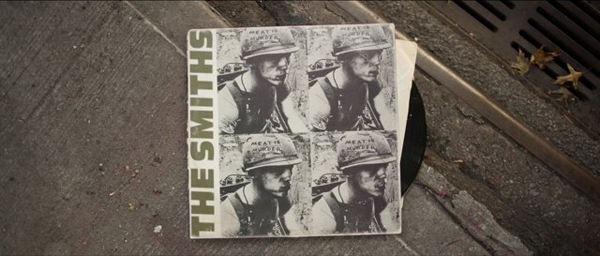
Vania Heymann’s video for Roy Kafri’s "Mayokero" is both spare and complex. It’s a pop cascade, in a sense, but what pop! Serge Gainsbourg, The Smiths, Prince, Madonna, Simon and Garfunkel, and many, many others show up on album covers tossed on an urban side street; their mouths move, singing the simple, catchy track for the video. The camera spins over these images, and then we see a homeless man going through the albums, and then we get the rest of the story: a reverse sequence showing the albums’ original purchase, a wistful look back at the days when you had to get up and drop a needle in a groove to listen to your favorite song–a needle which might skip sometimes, or might give away a scratch on the vinyl. There aren’t too many bells and whistles to Vania Heymann’s work here–in fact the camera work has a pointedly do-it-yourself feel, with one exception: the moving mouths. Even that gesture, though, is a recall of early TV comedy days, when a famous person’s picture, wth lips moving, might just make you laugh. We’re more sophisticated now–or are we? The video for "Mayokero" is proving remarkably popular, with 41,000 Vimeo plays in less than a week–it raises the question as to whether this sort of simplicity is just what video-watchers need right now.

Margaret Nagle’s Long Path to THE GOOD LIE

Margaret Nagle’s Long Path to THE GOOD LIE

nullWhether immersed in a discussion with Margaret Nagle or in her film The Good Lie, one seems to forget the
materialistic obsessions of our culture. Nagle is no stranger to the industry,
with Emmy and Golden Globe nominations for her work as well as multiple WGA
wins. She’s battled with studios, executives and all the other elements that a
female writer has to wrestle with in the business. Her career is expansive,
encompassing writing on Boardwalk Empire,
the critically praised TV Movie Warm
Springs
and recently creating Red
Band Society
on Fox. But within the spectrum of her work is a common
thread: humanity. Many of her stories, The
Good Lie
included, explore survival. Whether an audience is watching kids
cope with cancer in The Red Band Society or
Sudanese refugees wrestling with America in The
Good Lie,
it’s impossible not to put our culture’s trifles aside and focus
on a much more visceral exploration of humanity.

It’s not often a film breaks down humanity to the basics.  The Good
Lie
is not a story about selfies, iPhones or materialism. It’s about pure
survival. It makes you wonder, do we
really need all this crap to survive?
Nagle gets to the crux of this
question with her story about the Lost Boys of Sudan. The film centers on
Jeremiah, Mamere, Abital, and Paul, a close-knit group of friends who, after
fleeing their country, grow up in a Sudanese refugee camp. 13 years later,
they’re among the lucky few who are posted on a list in the camp, given the chance
to move to America and start a new life. They meet Carrie (Reese Witherspoon),
a woman in Kansas City who helps them get settled. She takes them around to
grocery stores and factories, introducing them to the managers and hoping to
find them employment. Eventually, with her encouragement and persistence, they
find jobs. But the more they become immersed in American culture, the harder
their battle is to preserve their past culture and morals. Jeremiah (Ger Duany)
is scolded for offering a homeless woman food from the grocery store where he
works, even though he’s headed to dump it in the trash. The wasteful nature of
Americans baffles him. Paul (Emmanuel Jal) is tempted with pot by his
co-workers and struggles to maintain his work ethic while building new
friendships. Each of the characters must decide what principles to preserve and
which to sacrifice in order to build their new life.

The film took 11 years to make, with Nagle being attached to
the project, then fired, then re-attached. She never, though, lost her
emotional connection to the film. Despite an apparent difference between Nagle,
a white woman from the US, and a group of Sudanese refugees, their childhoods
possess a similar sense of survival. Despite the public, presentational
environment of our interview (we’re sitting outside Arclight surrounded by
movie-goers) Nagle soon revealed some private, intimate facts. Not only does
she only have her own tale of endurance, taking care of her disabled brother
for years, she admits that writing the film has helped her see that there is
salvation for herself and others. Freedom from guilt and healing can begin,  the catalyst being the act of sharing. Lucky
for her, that’s the beauty of film.

“I was selling purses out the trunk of my car,” Nagle states
matter-of-factly, popping a fry in her mouth. She worked a number of odd jobs
but found time to do her own writing in-between gigs. Two of her purse suppliers
were guys from Senegal whose grandfathers were from Sudan. They were going
through an adjustment, learning American culture, and Nagle became close with
them. Around the same time, she heard about the open assignment at Paramount
about the Lost Boys. She’d never been paid as a writer and just had a spec
script. Nagle is a fighter. Her agent assured her that better known writers
were up for the open assignment and that she should pursue other options. But
after urging her agent countless times, she finally got a meeting.  Soon after, she got the job. Nagle and then-producer
Robert Newmyer traveled the country and pitched the story to The Lost Boys
themselves.  They went to Atlanta, Phoenix,
San Diego and Kansas City twice.  She
wanted to create a fund for their education and knew that making a film about their
community would raise awareness. Nagle, most importantly, also wanted the Lost
Boys to “sign off on the story.” When Newmyer died of a heart attack soon
after, the Lost Boys all drove across the nation to speak at his funeral. Nagle
recalls that they said, ““Bobbie Newmyer was a Lost Boy. He was one of us.”

Nagle spent the next few years trying to get the script
made, even being fired from the project at one point. The studio wanted a
bigger-named writer. But the script eventually landed in the lands of Molly
Smith. Smith’s father had adopted a Lost Boy and put him through college. Six
months after the movie was shot, the Lost Boys told Nagle they “prayed for
Molly.” She was the producer needed to get the project jump-started.

Nagle is adamant many times throughout our chat about how
much research she did, stating that it kept the project strong.  She does “immersion writing” where she learns multiple
levels of a story. She reads every article she can on a subject and is
enthusiastic when discussing her process, clearly passionate about getting into
the psyche and circumstances of her characters. Nagle doesn’t want to meet the
people she’s writing about until she’s made a lot of decisions. With The Good Lie, she used a number of videotapes
of documentarians who couldn’t finish shooting in Sudan. The environment is
extremely volatile and many filmmakers have had to choose their own safety over
the completion of their projects. But this movie is not a documentary. The more we talk, it’s clear that the
project’s continuation isn’t only due to Nagle’s work ethic. I ask her again
what about the story kept the project
going. “Because it’s about such courage. It’s about sacrifice and the ending is
a surprise.”

Although the film is distributed by Warner Brothers and
showing at Arclight, it’s still independent in spirit. The budget was 15
million (okay, so right at the ceiling of what’s considered an indie). All the
children in the film are children of Lost Boys. Even the main actors have
backgrounds that are shockingly similar to their characters’ backgrounds. Many
of them have lost family members and have had to flee their homes. Nagle speaks
warmly about each of them. Kuoth Wiel, who plays Abital, auditioned on her cell
phone “in the library at school. She was born in a refugee camp in Ethiopia.
She walked from Ethiopia to Sudan several times, back and forth.” Emmanuel Jal,
who plays Paul, has a big lion scar on his leg. In the film, Paul has a similar
wound on his arm. Nagle finds it coincidental. “Just so happened I had Paul
have it on his arm. He had a really, really bad life over there.” Ger Duany was
discovered by David O. Russell and appeared in I Heart Huckabees. He was
the first actor Nagle met for the film. Like his character Jeremiah, Duany is
writing his own book on transcendence. He has told Nagle that “religion can make
people do really bad things,” but that it’s how he survived. Arnold Oceng, who
plays Mamere, was raised in London after his father was killed. Nagle recalls
that he “never talked about it, ever” and “felt tremendous survival guilt.”

Up until this point in the conversation, Nagle has revealed
very little about her childhood. As we become more comfortable, she opens up,
admitting she’s often tentative about explaining her childhood to people. “I
grew up with older brothers and we were on our own.” Her parents weren’t
divorced but they were “out of commission” and “high-functioning alcoholics.” Nagle
and her brother took care of their other brother who was disabled through a car
accident, leaving him a quadriplegic, with brain damage. From a young
age, Nagle, too, was forced to learn to survive. The roots are coming together
now. Nagle is Mamere, but also Abital; she had two brothers were “allowed to be
very sexist” towards her. Her parents were in denial.

The parallels are becoming clear. The film’s main character,
Mamere, is fueled by guilt.  At the
beginning of the film, as a child, he lets his brother Theo (Femi Oguns) sacrifice
himself. As the children hide in the brush, Theo rises and tells approaching
soldiers that he is the only one around. He’s then taken away and the other
children are able to escape. I ask if Nagle has been driven by her guilt over
her brother as well. She admits, “I was so scared to live my own life and leave
him behind.” Finally in Chicago as a young adult, Nagle’s therapist put her in
a group with Holocaust survivors. Although she was initially reluctant, her
therapist urged that she, too, had been through a traumatic experience and that
she was “very self- destructive” in ways she couldn’t even understand. She
didn’t agree until the group finally called her out. “You’re full of shit! What
you’ve gone through is terrible!” Eventually, Nagle was able to accept that she
had survived something. Like Nagle,
her characters struggle to not only talk about their past, but accept it.

This film isn’t about wallowing in past trauma; it’s about
liberating oneself from it. We learn late in the film that Carrie lost a sister.  When she invites Abital to live with her, she
begins to discuss how it’s affected her. Through sharing their guilt, their
pain, the characters begin to reach healing. Nagle stops after we draw the
connection: “Oh my god! I can’t believe you’re pointing this out to me!” Her
time with the group validated her pain in the same way Abital validates Carrie.
At this point, Nagle reveals perhaps the most touching moment in our talk. In
the film Mamere and his brother have a game. They draw a square in the sand and
put their hands on top of each other. It’s one of those intimate idiosyncrasies
siblings share.  Nagle did the same with
her brother. “He’d put his hand on the bed and I’d make a line in the sheets.”

It’s Nagle’s personal connection to the film, on the deepest
levels, that makes it so raw. But Nagle has more goals than just personal
catharsis. There aren’t schools in the refugee camps and Nagle stresses, “We
can’t solve the war in Sudan, we can’t change the religious differences. We can
make these camps better for the people that are living in them.” The Good Lie has been screening every
night in Washington, D.C.  UNICEF, Oxfam,
and the Enough Project have all come on board. Nagle is adamant: “How do we
turn this into policy? How do you shift things? It’s so tragic that we’re
allowing these really minor things to divide us. Jeremiah has a last narration
in the film and talks about our common humanity. We share this big world we
call home. For the future of mankind, we’ve got to come together.”

Nagle is undeniably inspiring. Nagle’s passion has again
made me note my materialistic surroundings. Why is everyone around me jamming
in the parking lot with their gas-guzzling cars to flock to see Gone Girl, about bad people doing bad
things to each other? Nagle is clearly calling for the opposite.

“The film is going to be more than just a film. I’m so
proud. I get very choked up because it’s what I wanted.”

Meredith Alloway is a Texas native and a freelance contributor for CraveOnline, Paste, Flaunt, and Complex Magazine. She is also Senior Editor at The Script
Lab. She writes for both TV and film and will always be an unabashed
Shakespeare nerd. @atwwalloway

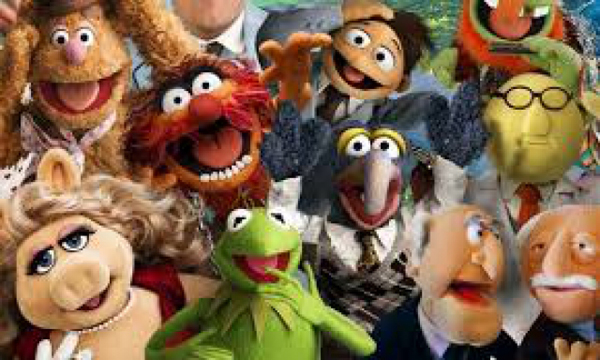
A NEW COLUMN BY MIKE SPRY: KICKING TELEVISION: It’s Time to Bring Back The Muppets. Again.

A NEW COLUMN BY MIKE SPRY: KICKING TELEVISION: It’s Time to Bring Back The Muppets. Again.

nullWhen I was a kid, there were few things I enjoyed as much
as the Muppets. The worlds created by Jim Henson dominated and cultivated my
childhood. Sesame Street, Fraggle Rock, and all things Muppet were
my earliest, fondest memories of entertainment. My mother had read an article
in the late ‘70s that claimed children should be limited to no more than an
hour-and-a-half of television per day–so most of the TV my sister and I were
allowed to consume involved Henson. Despite my parents’ insistence on the
dangers of television then, there has always been a virtue to Henson’s
productions. Sesame Street taught you
about the number 7, the letter M, what it was like to live on the Upper West
Side, and unrequited love. Fraggle Rock extended
one’s imagination, taught us about issues of class, and radishes, and
unrequited love. The Muppet Show brought
us into the realm of the subversive, prepared our young minds for Saturday Night Live, reveled happily in
absurdity and slapstick, and taught, of course, the lessons of unrequited love.
The Muppet Show was the star of them
all, the crown jewel of the Henson universe. And given the current sad
landscape of programming for kids, it’s
time to play the music, it’s time to light the lights, it’s time to meet the
Muppets on The Muppet Show tonight
. Again.

It’s time to reboot The
Muppet Show
.

For the most part I couldn’t give a flying fish about
television for kids. I don’t have kids, don’t really understand the desire to
have kids, doubt that unconditional love could be any more thrilling than clean
towels, and I think children should be unseen and unheard until they’re old
enough to watch and disseminate Breaking
Bad
. But my sister has two kids and offers a wealth of opportunities for
unpaid babysitting internships, and so I’ve found myself, over the past eight
years, confronted by what passes for televised entertainment for children. And
it’s god-awful. What the hell are Wiggles? Isn’t a sponge in someone’s pants
counterintuitive? Why does Lego suddenly talk? In an infinite channel universe,
there’s nothing on (except the timeless Sesame
Street
) that challenges, entertains and does not insult children, while
maintaining a subversive adult narrative and humor for Disney Channel-weary
parents and uncles.

What made, and makes, the Muppets such an enduring and
iconic part of the cultural landscape is their ability to treat children like
adults while allowing adults to be children. As a kid, “The Swedish Chef” is a
funny-looking mustachioed foreigner speaking gibberish and making a mess. It’s
hilarious. Pee-inducing. To an adult, the show is a perfect satire of the
cooking shows and inane cooking segments on The
Today Show
and its talk-formula brethren. Also pee-inducing. “Pigs in Space”
to a child’s eyes is a bunch of talking pigs being silly, superfluous, insane.
Those of us past our adolescence recognize it as a parody of Star Trek, Lost in Space, and early sci-fi. Kids don’t care that Dr. Julius
Strangepork is a reference to Dr. Strangelove, but its inclusion doesn’t
counter their enjoyment of the sketch, and provides safe passage for adult viewing.
The list of clever, funny, and remarkably well-written and well-crafted
sketches is endless. The intelligent and hilarious satire raised the level of
the show beyond the condescending time-filler programming that infects present
day children’s television, pandering nonsense which serves only as a virtual
babysitter, absent of form or substance.

Furthermore, The
Muppet Show
borrowed from variety shows of the era like SNL by having guest stars that were
unknown to children but comforting to adults, giving them permission to watch
the show even in the absence of children. And though kids didn’t know who
Johnny Cash or Elton John or John Cleese were, the guest stars’ participation
in the program slowly introduced youngsters to a grander cultural discourse.
The contemporary equivalent of this would be celebrities lending their voices
to animated TV shows or films. But in this manner they are rarely themselves,
and are included in order to increase ratings or box office revenues, not to
present a production that respects a cross-generational demographic.

The Muppets are the property of the Walt Disney Company,
currently charged with the task of reviving the Star Wars franchise. Their return to the big screen, successfully,
suggests that a revival of the seminal variety show is not without merit or
possibility. The Jason Segel-Nicholas Stoller-led The Muppets re-invigorated the franchise in 2011 (after a long
stretch of poorly conceived, straight-to-video releases) by employing the
elements of clever satire, well-placed cameos, and musical theatrics that made
the show (and films) so successful. The film commented on the folly of reality
TV, the economic disparities of the day, and the tropes of romantic comedies.
The soundtrack was playful and accomplished, and appealing to both children and
adults. Every generation can appreciate a puppet barber shop quartet covering
“Smells Like teen Spirit”. Its follow-up, the less successful commercially but
equally endearing Muppets Most Wanted,
solidified the Muppets as a viable entity for the studio in which to invest and
returned them with prominence to the cultural zeitgeist. So why not revisit the
production that started it all?

The Muppet Show was
revived briefly by ABC in 1996 as Muppets
Tonight
, but failed to attract enthusiastic audiences. My memory of the
show is that I have no memory of the show, which speaks volumes as to its
failure. But the landscape of television has changed drastically since then.
The medium is more intelligent, more ambitious, and has far more outlets than
ever before. A venue like Netflix, tailor-made for parents to provide viewing
entertainment and respite on their own schedules, would be perfect for a
rebooted Muppet Show. Two generations
have had to withstand the inanities of the Teletubbies,
Dora the Explorer, and Barney, programming that is nothing but
refined sugar and starch and shows contempt for tired adults. 

In one of my earliest experiences with my niece and nephew
left in my charge, we watched the 2011 The
Muppets
. Admittedly, I was rather nervous. What if they didn’t like it,
didn’t get it, didn’t want to finish watching it? Even worse, what if I didn’t like it? George Lucas had
broken my generation’s heart in 1999 with poorly conceived Star Wars Episode I: The Phantom Menace, and broke it two more
times over three summers. Lucas did it again when he produced the Indiana Jones
film whose name shall not be mentioned. There was reason for skepticism. But The Muppets exceeded my expectations,
and my niece and nephew and I have watched it together too many times to count,
singing along, reveling in the wonder of its genius and that of the Jim Henson
universe. Pretty soon they’ll be too old for the Muppets, having reached that
strange period known as adolescence, puberty, when you hate everything. The
promise of a rebooted Muppet Show
would extend this connection we have. Hell, it may even encourage me to have my
own kids.


Mike Spry is a writer, editor, and columnist who has written for The
Toronto Star, Maisonneuve, and The Smoking Jacket, among
others, and contributes to MTV’s
 PLAY
with AJ
. He is the author of the poetry collection JACK (Snare
Books, 2008) and
Bourbon & Eventide (Invisible Publishing, 2014), the short story collection Distillery Songs (Insomniac Press,
2011), and the co-author of
Cheap Throat: The Diary of a Locked-Out
Hockey Player
(Found Press,
2013).
Follow him on Twitter @mdspry.

VIDEO ESSAY: Godard VS Benny Hill

VIDEO ESSAY: Godard VS Benny Hill

For many people, watching Jean-Luc Godard’s Breathless is a rite of cultural passage; so, too, is watching The Benny Hill Show, though of a slightly different sort. One is a touchstone for knowledge of film history; the other is what many might call a "guilty pleasure." One is ideally watched on a large screen, in a dark theater; the other can only be watched on a small screen and most likely late at night, before one collapses to sleep exhausted. One is a mixture of love story, farce, and cultural commentary; the other is mostly farce, with some sexual humor thrown in, and negligible cultural commentary. One is a ground-breaking cinematic experiment; the other features a lot of things breaking (wind, glasses, windows, plates, chairs), but not much in the way of ground. Whatever the similarities or differences, Miklos Kiss has sped up the entirety of Breathless and compressed it into an 11-minute video essay, just long enough for the theme of The Benny Hill Show to play. And….. it works, kind of. The zippiness of the French film is there, at any speed, and the liveliness of the Hill theme is a nice match for it. What do you think?  

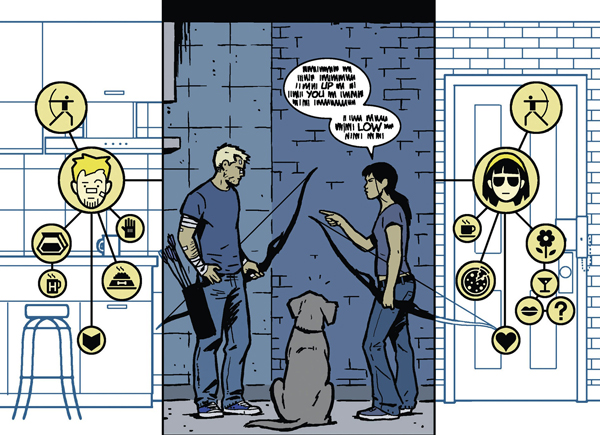
METAMERICANA: Hawkeye, Normcore Avenger: A (Mellow) Revolution from Marvel Comics’ Matt Fraction and David Aja

METAMERICANA: Hawkeye, Normcore Avenger: A (Mellow) Revolution from Marvel Comics

nullSo-called “normcore fashion,” a bizarre combination of countercultural
radicalism and bourgeois complacency, is the only way anyone has found thus far
to re-envision mainstream culture as avant-garde. In normcore culture,
twenty-something hipsters who have already established their countercultural
bona fides by dressing in the uniform of their kind for years (think
thick-rimmed glasses, skinny jeans, sportcoats, bow ties, and brogues) turn
these customs on their head by returning to the white, upper-middle class clothing
stores of their youth. Thus, a herd of excruciatingly self-aware young people seems
to dress like either their parents or their suburban peers, and outside
observers are none the wiser about their intentions. Normcore is ironic to
those who know it when they see it, and painfully earnest to those who see
someone wearing clothes from The Gap or Abercrombie & Fitch and assume it’s
the result of thoughtlessness rather than design. Of course, the more generous
view of normcore suggests that those who subscribe to its fashion wing simply
no longer wish to be distinguished from others on the basis of their attire.
Better, then, to say that the wearing of jeans and tee shirts by normcore
aficionados is merely a “detached and knowing” decision, and not necessarily an
“ironic” one. But what happens to our hipster calculus when normcore culture
goes supernatural?

Superheroes are the hipsters of English-language graphic novels: discernible
almost immediately by their accoutrements, superheros may want to be like you
and me (hence, secret identities) but before long are sure to do something—lift
a car, shoot an eye-beam—that places them outside mainstream culture. They can’t
help themselves. And millions of us read about their exploits in comic books
because we, too, can’t help ourselves. Following the adventures of costumed
counter-culturists is the nerdy equivalent of sitting on a park bench
people-watching in the Williamsburg section of Brooklyn. Which is why, when
comic book writer Matt Fraction and artist David Aja decided to portray the
least-popular Avenger, Hawkeye, not as a bow-wielding badass but an
unremarkable, hoodie-wearing bro hanging around his apartment, it felt—to those
of us who enjoy comic books but are tired of their poor writing, cinema-ready
plotlines, and cutout characters—like something of a revolution.

Fraction and Aja’s Hawkeye depicts its titular character in his
traditional (at least since the Avengers movie) purple and black get-up on the
cover of its first two paperback collected editions. In both cases, “Hawkeye”/Clint
Barton—Iowan; former carnie; superpower-less master archer—is carrying his
trademark bow. It’s an intentional misdirection, as in the pages of My Life
As a Weapon
(collecting Hawkeye #1-5 and Young Avengers Presents
#6) and Little Hits (collecting Hawkeye #6-11) Hawkeye rarely
uses his bow and is almost never in his Avengers uniform. Instead, he putters
about his Bed-Stuy apartment and does, well, not very much. A breakdown of the
early issues:

Hawkeye #1: Hawkeye recuperates in a hospital, adopts a dog, attends a
neighborhood barbecue, helps a single mom avoid eviction, and buys his
apartment building so he can become its landlord.

Hawkeye #2: Hawkeye practices shooting his bow, attends a gala event,
stops a gang of petty thieves (but in a tux), and has a long phone call with a
young female protégé who has a crush on him.

Hawkeye #3: Hawkeye organizes his arrows, buys a new car, sleeps with a
stranger, and fights off some heavies hired by a slumlord who wants Clint’s
apartment building back.

Hawkeye #4: Hawkeye attends a neighborhood barbecue, gets interviewed by
the Avengers, travels to the Middle East, has his wallet stolen in a taxi, and
attempts to buy at auction an item that could destroy his reputation if it
falls into the wrong hands.

And so on. Clint virtually never gets into uniform, virtually never faces a
super-villain, never uses any superpowers, and views any excitement he
experiences as a distraction from what he really wants to be doing: hanging out
with his neighbors at rooftop barbecues and petting his adopted dog (“Pizza
Dog,” so named because this iteration of Clint Barton isn’t very witty, either,
so he simply names his dog after the mutt’s favorite food). In Little Hits,
the second Hawkeye paperback collected, the low-key vibe continues, and
if anything is doubled down upon by Fraction and Aja:

Hawkeye #6: Hawkeye sets up his stereo system, saves the world from a
terrorist organization (presented, however, via just a two-page pictorial
summary), argues with the maintenance man at his apartment building, attends a
neighborhood barbecue, fights off some slumlord heavies, watches TV, and
considers going on vacation.

Hawkeye #7: Hawkeye helps a neighbor move during a hurricane, and later
rescues him from drowning in his new basement. Hawkeye’s protégé Kate Bishop
attends a wedding, goes to a pharmacy, and stops a robbery in progress.

Hawkeye #8: Hawkeye deals with a new (and crappy) romantic relationship,
tries to fight slumlord heavies but ends up in jail, and complains about his
new girlfriend messing up his comic book collection.

While the news recently came down that the Fraction/Aja Hawkeye series
will come to a close with issue #22, the fact remains that this writer-artist
duo has given us an entirely new way of thinking about not just comic books but
ourselves. There are a number of things Hawkeye does in this series that no one
without superlative archery skills could do. However, these acts of heroism are
overwhelmed in both number and vividness by the roster of things Clint Barton
does in Bed-Stuy that nearly any of us could do: make an effort to meet
and befriend our neighbors; help someone move or avoid eviction; finally unpack
our boxes and set up our new apartment; adopt a stray; or make a property
investment with an eye toward making the lives of others a little less bleak.
There’s nothing preachy about Hawkeye, however—it can’t be said that
Fraction and Aja have any evident interest in making us all better people. What
they want, I think, is no more than what Barton himself wants, and what, if we
go back into the annals of Western literature, David Copperfield once wanted:
to be the hero of our own life stories, whatever banalities and unremarkable
tribulations those stories will so often, inevitably, entail.
 

In other
words, Fraction and Aja have somehow captured the temperament of our Age:
neither naively fixated on the possibility of heroism nor (anymore) captivated
by anti-heroes. The earnestness of the conventional superhero has begun to irk
us, but so too, however slowly, has an unwilling and unlikely hero like
Deadpool, a mercenary whose running commentary on his own antics—droll,
fourth-wall-breaking—is steeped in petulant cynicism. In an ongoing tug-of-war
that mirrors what’s happening now in video games (cf. “#gamergate”), there’s a
divide between those who want a comic book that simply “plays well”—meaning, it
touches all the usual plot, tight-pant, and monologing-baddie bases—and one
that is reflexive enough about its aesthetics and ambitious enough about its
aims to qualify as Art. Fraction and Aja have given us a comic book series that’s
decidedly in the middle in all particulars—even its interior art is somehow,
despite its stylishness, understated—and in doing so find a sweet spot that’s
exactly where most of us already live. This new Clint Barton is neither a hero
nor an anti-hero, he’s simply . . . unremarkable. Which makes him as
remarkable a superhero as we’ve seen in a very, very long time.

Seth Abramson is the author of three collections of poetry, most recently Thievery (University of Akron Press, 2013). He has published work in numerous magazines and anthologies, including Best New Poets, American Poetry Review, Boston Review, New American Writing, Colorado Review, Denver Quarterly, and The Southern Review.
A graduate of Dartmouth College, Harvard Law School, and the Iowa
Writers’ Workshop, he was a public defender from 2001 to 2007 and is
presently a doctoral candidate in English Literature at University of
Wisconsin-Madison. He runs a contemporary poetry review series for
The Huffington Post and has covered graduate creative writing programs for Poets & Writers magazine since 2008.

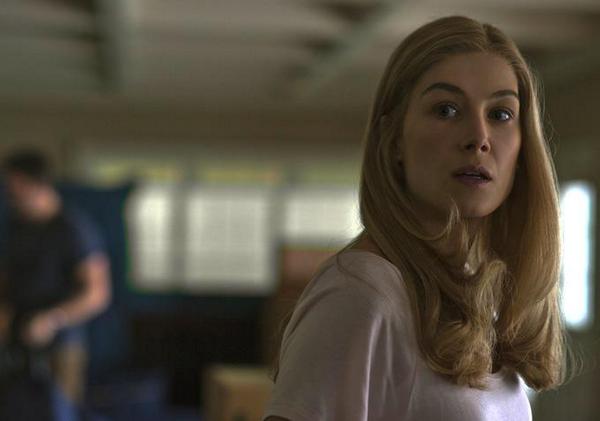
ARIELLE BERNSTEIN: Images and Illusions: On Aging, Beauty and Renée Zellweger’s “New” Face

ARIELLE BERNSTEIN: Images and Illusions: On Aging, Beauty and Renée Zellweger’s “New” Face

nullIt’s scary to see actors age.

In her essay, “The Theory of Receptivity and Some Thoughts
on Ethan Hawke’s Face
,” Michelle Orange reflects on watching Ethan Hawke’s face
grow older:

Life began to show itself as more than a series
of days, or movies, all in a row, which I might or might not attend. He was
gaunt and slightly stooped, but it was his face—rough skin and sunken cheeks,
with an angry, exclamatory furrow wedged like a hatchet blade between his
eyes—that transfixed me. Some said he’d come through a divorce, and it took its
toll; that that’s what life does to people. I’d heard about such things but
never really seen it in action on the face of someone only a few years older than
me. There was something awful and yet so marvelous, so real and poignant and
right, about Ethan Hawke’s face, and about getting to see it in this beautiful
meditation on what life does to people, a ten-years-in-the-making sequel to a
film about people too young and smitten to be too concerned about what life
might do to them.

The public response to actors’ aging is uncomfortable, but it is
also inevitable and it isn’t necessarily always about sexism. We comment on the
changing appearance of actors and musicians like Ethan Hawke, Jared Leto, Elvis
Presley, Christian Bale, and Marlon Brando, their bodies held to similar
scrutiny as new lines and wrinkles emerge and bodies grow fatter or more gaunt
with age or for deliberate movie roles.

Actresses are afforded a different type of pity than aging
male actors, one that lacks the same tenor of existential gravitas. While we worry
about a fading sense of self in men, we worry about fading beauty in women.
When Renee Zellweger attended Elle’s 21st Century Women in Hollywood
event recently, tabloids immediately started reporting on Zellweger’s “new”
face, which does look significantly different and probably is the result of
both natural aging—as well as a heck of a lot of plastic surgery.

In some ways it is easy to criticize Zellweger and other
women who have gone under the knife. We call them vain, or brainwashed, or stupid
for making these choices. It’s harder, for whatever reason, to assess a culture that is
unforgiving about every single body change that a woman will go through over the
course of her life from puberty to after menopause. We judge whether a women
weighs too much or too little. We judge whether women have children or don’t
have children. We judge whether or not they breastfeed. We judge whether women
dye their hair or still wear miniskirts past the age of 40.

As Anne Helen Peterson points out in her article, “What’s
Really Behind The Ridicule of Renee Zellweger’s Face?
”, Zellweger is
particularly vulnerable to this kind of treatment because she was sold to her
audience as a symbol of youth. Zellweger’s efforts to essentially retain her
trademark “look” by way of surgery is perceived by many as especially gauche since she
is meant to symbolize a type of effortless prettiness. We hate seeing bad
plastic surgery on aging female faces, because it represents an acknowledgement of how
much the Hollywood image is mere smoke and mirrors, how the bill of goods we
are sold is so often just a bag of lies.

In an age where selfies are a dime a dozen, and the past is
hidden under a barrage of newer and newer tweets, we are constantly in the
process of building our “brand,” of crafting our identity. In this kind of
culture, the worship of youth feels almost inevitable, but then again our
obsession with female beauty always began and ended with the ultimate Hollywood
image of soft, exquisite, female perfection. Think of Marilyn Monroe, a woman
whose outside effectively masked that which was inside from the dawn of her status
as an icon onwards, and whose early death ensured that, even after we’d learn about her
frustrations, heartache and unsung potential, we’d never see that gorgeous
façade crack.

Arielle Bernstein is
a writer living in Washington, DC. She teaches writing at American
University and also freelances. Her work has been published in
The
Millions, The Rumpus, St. Petersburg Review and The Ilanot Review. She
has been listed four times as a finalist in
Glimmer Train short story
contests
. She is currently writing her first book.

FAST CLIPS: How Arcade Fire’s Music Videos Show the Essence of Greta Gerwig and Andrew Garfield

FAST CLIPS: How Arcade Fire’s Music Videos Show the Essence of Greta Gerwig and Andrew Garfield

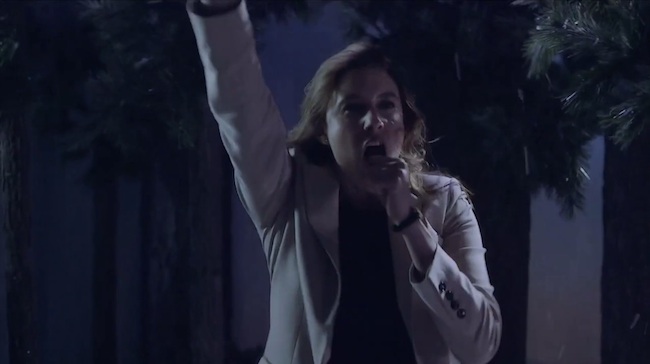
If you’re immune to Greta Gerwig’s charms, or skeptical of Andrew Garfield’s talent, or not sold on Arcade Fire, the band’s recent music videos might help you out a little. There’s only so much a music video can do, of course. It has a limited life span–limited by the length of the track it’s built around. If it strays too far from the song, it risks being derided as "weird" or "gratuitous." Indeed, either of these adjectives could be directed at the two videos the band put out in the last year or so, the former (for "Afterlife") featuring Greta Gerwig capering, post-breakup, through a forest, under the dreamlike direction of Spike Jonze, and the latter (For "We Exist") featuring Andrew Garfield, in drag, directed with a strong sense of narrative by David Wilson. But why do that? Neither piece calls out for censure—and in fact, both seem the result of careful thought. 

What’s this evaluation based on? Well, these two videos, at least, have a similar structure, one which works well for the story being told in each case. They begin in stark, dramatic situations–in the case of "Afterlife," a tearful conversation, a goodbye in a tastefully lit room; in the case of "We Exist," a man dressing up in drag and going out to a rough-ish bar–and build the drama outwards, both ending up on an actual stage, during an actual musical performance. (Which, to their credit, both videos present to us without Bruce-Springsteen-ing it too much, or going too hammy.) The former video was filmed live, at the 2013 YouTube Music Awards, as if to underscore a point. And what is that point? There’s one point, and then there’s another–which both pieces share. The most obvious message is one which this particular kind of film has been sending since the mid-1980s, which is that, simply put, freedom and triumph are both possible within the purview of fictional narratives, and possibly within life itself. This notion of cheaply-bought happiness, conveyed within the confines of a 5-minute song, provide a buoyance that is easily digested, like a package of energy-boosting supplements you might buy at a bodega. These two videos, though, torque this narrative, or rather, this idea just slightly.

In the first, Gerwig’s heroine swoops from deep sadness (convincingly brought off, for such an all-too-often comic actress) into profound relief. She does, in the course of the action, a lot of cheesy dance moves–but only cheesy if you were born after 1990. For anyone born slightly earlier than that, the fist pumping has a nostalgic twang to it–recalling everything from Saturday Night Fever to Dr. Pepper commercials. The sudden burst of happiness, too, is just abruptly timed enough to smack of looniness–indeed, the type of looniness we all carry within us, and which can be unleashed at vulnerable moments, the kind of energy we don’t see coming. The earmark sprinting cascades of sound that Arcade Fire issues add to the mix with aplomb, making the whole thing less of a breakup story than a hero saga, complete with a treacherous journey through sharply photographed dark woods. And Gerwig herself communicates less a sense of youngster awkwardness than unbridled aggression here–which may lie more at the heart of her comedy than a desire to be funny: the difference between expressing your anger or happiness and turning it into a verbal or physical pratfall.

There’s more than one would think at the heart of the "We Exist" video, as well, at least in terms of the shapes it takes. There’s something internecine about Andrew Garfield, always, despite the roles he plays–his aggression is always tempered by a slightly more sensitive, vulnerable undercurrent, which runs at full force through this short clip. We begin with a scene that’s one part Midnight Cowboy, one part Girls Don’t Cry, one part American Gigolo, as Garfield puts on dress, wig, fake bra, and make-up to head out to what looks to be a dive bar in a tiny town, in the middle of the heartland, where nonconformity is wholly absent. As one might suspect, Garfield’s naif gets into a fight after a false dance or two with a couple of rowdies, and then the scene becomes surreal, as we watch a group of rowdies, by turns, dancing in skirts and fighting with Garfield. There’s a happy ending here–Garfield escapes and joins the band on the stage, as in the earlier piece. Once again, Hollywood writ small: truth to one’s self wins out, despite adversity, being outnumbered, and being wildly out of place–all showcasing Garfield’s ability. One can only hope that at some point this actor decides to try Greek tragedy: his vision of performance is that huge, and that personal. At a longer length, the scenario played out here would be unbelievable: here, it comes across as a burst of soft-hued optimism, dramatized against lush farmland and shadowy, believably grungy interiors, a small film, if you’re willing to give it the label.  

Oh, what to do with the music video? For people who came of age in the 1980s, when cable television was a mark of privilege (or something you could only watch by swiveling your TV antenna in a hyper-sensitive manner), music videos had a near-mystical charm to them, somewhat like the earliest films, which presented mini-narratives, or half-narratives, in easily watchable form. They were dynamic, too–a way to assess a cultural zeitgeist rapidly and without too much intellectual effort. Chances could be taken, as well–I remember watching a gorgeous video for Tom Waits’s "In the Neighborhood" (from Swordfishtrombones), showing him leading a parade of side-show freaks down a suburban street, and marveling at its subtlety. This was the crucial ah-ha moment that most music videos want you to take away: you thought the song was about this, but it could just as easily be about this. These two videos are fairly straightforward in their approach, as befits Arcade Fire, who have achieved a supremely marketable mix of sincerity and hipness; in so being, they add substantially to a medium that, like ivy, continues to grow up the walls of the edifice of music, beautifying it as it creates its own undeniable kind of beauty.        

Max Winter is the Editor of Press Play.

GONE GIRL’s Cool Girl: Hero or Villain?

GONE GIRL’s Cool Girl: Hero or Villain?

nullSpoiler Alert: The following piece contains spoilers.

Gone Girl is a prickly, cerebral film, not unlike the dazzling villain who sets Gillian Flynn’s immaculately constructed
story into motion. It’s shot in bruised grays, with cold, antiseptic lighting;
the plot leads to a  dénouement that has sparked a thousand
thinkpieces and awkward dinner date conversations about gender and violence,
and the nature of marriage itself. However, I left the theater thrumming with
emotion: inchoate half-thoughts made more potent by their rawness. I couldn’t
articulate the power of what I’d seen until the following night, when I sat in
the back row of a burlesque show. One of the performers took the stage in a
gold sheath dress, fabric wings, and a dragon mask.  She whipped her lithe, muscular body around
the stage, shimmying out of her dress, down to g-string and pasties; towards
the end of the song—Lorde’s “Royals”—she removed her mask, revealing an
elaborate make-up of jewel-bright gold, blue, and green that made her face look
as if it were covered in scales. Underneath her dragon’s head was a female
body, pale and pliant. Woman as fantasy. Woman as monster. Object of desire.
Destroyer of worlds.

I
return to this image, and the awe it inspired in me, as I take stock of the
discussions buzzing around Gone Girl, film and novel alike: the importance of
likeability in male and female protagonists; the ethics of constructing a
central character like Amy Elliott Dunne, who falsely accuses men who’ve
angered her of rape and abuse; and feminist deconstructions of the Cool Girl.
Gone Girl is a sardonic horror story that upends the tired Primetime tropes of
the suburban hubby with a heart of darkness beating under his pastel polo
shirt and his angelic-looking blonde victim by repositioning that
angelic-looking blonde as the predator. The story has a chokehold on the zeitgeist because it offers something
exceedingly rare and unimpeachably vital: a protagonist who shows that women
don’t have to be the sheep fleeing as the winged shadow swoops down. We can, in
fact, be the beasts with the long teeth.

In an essay
excoriating our cultural scab-picking over “likeable” female characters, the novel’s author and the film’s screenwriter Gillian Flynn writes: “[Men] have
a vocabulary for sex and violence that women just don’t. And we still don’t
discuss our own violence … women have spent so many years girl-powering
ourselves—to the point of almost parodic encouragement—we’ve left no room
to acknowledge our dark side. Dark sides are important.” Most mentally healthy
women who settle down in the dark to watch Amy Elliott Dunne frame her
philandering husband, Nick, for her murder, and take a box-cutter to the throat
of her Nice GuyTM ex-boyfriend, the king of condescending micro-aggressions,
certainly wouldn’t follow suit or agree that her reactions were proportional to
the offenses against her. Similarly, most men who watch American Psycho don’t
get their jollies shooting homeless people with nail guns. And yet, any woman
who has ever been cast aside for “a younger, bouncier Cool Girl” or had a man
explain to her what her best interests are has burned with the incandescent
rage that lights Amy’s torch, that glints off the axe she grinds.

Gone
Girl
is the first film in recent memory, and, arguably, one of the few films,
period, to offer a female villain who isn’t just the token henchwoman to the
true nemesis—the figure who exists so that the hero, amidst the rock ‘em-sock
‘em violence, can demonstrate his fundamental goodness by agonizing over
whether he can hit a woman, as in Scott Pilgrim vs. The World; or so that
the hero’s love interest can prove her pluck (and be counted as a “strong
female character”) by relieving him of the burden and fighting the evil bitch
herself, as did Mariko in The Wolverine—but
a vicious mastermind out for her own ends. Her drive for power and control
doesn’t manifest in a rah-rah “girls run the world” way; it emerges with an
arctic darkness that aligns her with characters like Michael Corleone or
Patrick Bateman or Walter White. These men’s violence and cunning often
articulate—and complicate—particular modes of masculinity: the boss of all
bosses, the soulless executive, the one who knocks.

The novel winks
slyly at the conventions of the anti-hero, the man who transfixes us
despite—or, more likely, because of—his badness. Nick is a case study in
internalized misogyny: “… my father, a mid-level phone company manager who
treated my mother at best like an incompetent employee … his pure, inarticulate
fury would fill the house for days, weeks, at a time, making the air humid,
hard to breathe … He just didn’t like women. He thought they were stupid,
inconsequential, irritating.” At first, we think we’re reading yet another
account of another white man struggling with his savage nature; then Amy wrests
the narrative from him in ways that the Carmela Sopranos and Sklyer Whites, or
the countless movie femme fatales who need the love of a good man to get out
from under a bad man’s thumb, never do.

The
machinery of Amy’s plot whirls and grinds on the standards and ideals of
feminine identity: “Amazing Amy … Ultimate-Frisbee Granola and Blushing Ingénue
and Witty Hepburnian Sophisticate. Brainy Ironic Girl and Boho Babe … Cool Girl
and Loved Wife and Unloved Wife and Vengeful Scorned Wife.”  Her Lecter-like precision in orchestrating
Nick’s trip up the river; the machete-sharpness of her observations about
gender, power, and identity; and the tremulous divide between the Amy who
outlines her plan and her motives with a crisp alacrity and the Amy who churns
with a pure, inarticulate fury make her a more compelling, even charismatic
character and a more effective predator.

Amy shifts through
a Kaleidoscope of identities to court, hold, and ultimately destroy the man of
her dreams. More than that, she wants to thrive—to win—in a world that still
just doesn’t like women. She uses the tropes of female victimhood—“a wonderful
good-hearted woman—whole life ahead of her, everything going for her, whatever
else they say about women who die—[who] chooses the wrong mate and pays the
ultimate price”—as the scaffolding of her plan. She is Snidely Whiplash in
damsel’s clothing, and this feels like a liberating alternative when women’s
suffering is treated like the wallpaper decorating so much of our
entertainment.

The week before Gone
Girl
was released in theaters, I saw The Equalizer, an extravaganza of
slow-motioned, nü-metal soundtracked, fetishized violence; the scene in which
our hero, a former black ops assassin, drives a corkscrew into his mafioso
opponent’s throat is almost loving in its meticulousness. However, his
berserker fury is acceptable, even heroic, because he is taking on the Russian
mob to ostensibly save a teenager trafficked into sex work—a character that
only exists to sport mini-skirts and black eyes, to be beaten and degraded so
that our hero can be stirred into righteousness. By contrast, Amy is her own
avenger; she will play victim, but she will not be one.

Gone Girl has been
rightfully praised as a satire of our media’s bloodlust, especially for the
stories of violated women: kidnapped co-eds, teenage sex slaves, battered
wives, rape victims; stories that are intended, on the surface, to shock and
appall with the scope of women’s suffering but can, instead (and perhaps
deliberately) turn that suffering into something titillating. Amy weaponizes
this suffering. When she’s forced to turn to Desi, her controlling ex, for
shelter and support, she plies him with sob stories of being beaten into a
miscarriage, fearing for her life; to con him, she becomes a fusion of broken
girl and happy housewife. In a New York Times interview, Flynn says that, “She
embodies [these stereotypes] to get what she wants and then she detonates
them.” And after Amy murders Desi—slitting his throat mid-coitus in a moment of
Grand Guignol that rivals Hannibal Lecter’s face-eating or Patrick Bateman
shimmying to “It’s Hip to be Square” as he hacks a rival to death—she plays to
the chivalric impulses of the mostly male FBI team handling her case, spinning
a graphic yarn of rape, torture and debasement; the things that, on some level,
every woman fears when she walks through a parking garage with her keys between
her knuckles or leaves a Match.com date’s name, number, and photo with a good
friend. 

As she gives good
victim, Amy wears the blood of the man she fucked and killed, blood that mocks
the willful naiveté and complacency of the cops—who prove all of her theories
about how men regard complex, difficult women correct when they silence the
lone woman detective who dares to ask probing, potentially damning questions.
Home from the hospital, she strips down in front of her husband, and that blood
is war paint; her naked body isn’t an object to be punished or desired—it is a
threat. The remainder of the film is a sly inversion of the typical domestic
violence narrative: one shot of Nick locking himself in the spare bedroom,
pensively staring at the door as the monster-he-married sleeps one room over,
is a mirror image of “Diary Amy,” the persona Amy created to frame Nick,
cowering under the covers, confessing on the page that the man of her dreams
may truly kill her. That shot provoked a nervous twitter of laughter throughout
the theater I attended, a sign that we’re still so ill at ease with a woman
assuming the full potency of the villain archetype, an archetype that will keep
its hold on us as long as there are slasher flicks and crime dramas, action
blockbusters and gritty indies.

There’s been a lot
of editorial hand-wringing over whether Amy’s actions make her Bad For Women.TM
Yet, we don’t wonder whether Patrick Bateman, skinner of women, represents a
misandrist’s wet dream. We don’t insist that Hannibal Lecter or Alex De Large serve
as exemplars of masculinity, or Michael Corleone be led away in handcuffs for
ordering the hit on his brother—in fact, we don’t want to see him humbled or
reduced. We want the vicious, vicarious thrill of watching him get away with
it. Think of the fans who study that diner scene that ended The Sopranos as if
it were the Zapruder film, searching for proof that Tony lives to lie and
scheme and kill another day.  Male
characters don’t have to be moral in order to be complex or aggressive.

Novel Nick unwittingly
articulates how our culture’s supposedly full-throated endorsement of the
strong, independent woman is, in some ways, merely a hiccup: “I can celebrate
and support and praise—I can operate in sunlight, basically—but I can’t deal
with angry or tearful women. I feel my father’s rage rise up in me in the
ugliest way.” We embrace Katniss Everdeen and Danerys Targaryen and Michonne
because they are heroes (even if they don’t want to be). Though they can be
killers, their anger and tears are funneled into liberating innocents and
protecting the people they love. Each of these women is an important,
empowering figure; still, she is lethal, but not dangerous. And we need
dangerous women on-screen; women who can claw open and bite down into the scarred
center of any woman (every woman) who has suppressed an unfathomable anger, a
will-to-power that can’t be contained in a pin-stripe suit. We need women whose
talons break through skin and spread bones to rip out the great, thick
throbbing heart. We need women who breathe fire. 

Laura Bogart’s work has appeared on The Rumpus, Salon, Manifest-Station,
The Nervous Breakdown, RogerEbert.com and JMWW Journal, among other
publications. She is currently at work on a novel.

FAST CLIP: Watch MONSTER, Jennifer Kent’s Short Horror Film Made Before THE BABADOOK

FAST CLIP: Watch MONSTER, Jennifer Kent’s Short Horror Film Made Before THE BABADOOK

If you have 10 minutes—less, in fact—you should watch Monster, the short horror film Jennifer Kent made before directing The Babadook. The latter Australian film has received widespread kudos–and from the looks of its trailer, they are richly deserved. Nevertheless, if, in this month of All Hallow’s Eve, if you’d like a truly frightening experience with remarkable (and blessed) brevity, Monster is just that. The film creates a mood of fear by, in fact, not trying. It presents its story, with its mundanities and its horrors, nakedly and simply, with a minimum of fanfare–small details may either tell you a great deal about a character or scare the crap out of you. The story is a simple one: A woman lives alone with her son. The son is restless, because he thinks there is a monster in the house. Is there a monster? Oh yes. But, unlike other monsters, it is frightening simply by being frightening, and not because of the way it is presented to us. There are no jumps, no shadowy figures moving in the background, no gruesome faces popping up in the center of the screen; indeed, when the mother first sees the monster, thy make calm eye contact for few seconds, as if maybe the creature were a household pest. And then? Well, things get a little rough from that point forward. Kent films the story in a crisp, pristine black and white–the shadows that occur seem entirely in place, natural, not added for effect. The actors fit right into this schema; Susan Prior’s mother has a careworn appearance, and a relaxed way of speaking that will, ultimately, allow her to make peace in her home, a peace which would not be believable in other films but works quite nicely here. Luke Ikimis-Healey’s child of the house, similarly, manifests his fear believably and without too much over-acting. While none of thse characteristics would seem to be elements which make a horror film frightening, they do: in allowing us to feel comfortable inhabiting this world for a few minutes, we, as viewers, become more prey to its terrors.

Max Winter is the Editor of Press Play.

NYFF Documentaries: Political Cinema Horizons from RED ARMY to CITIZENFOUR

NYFF Documentaries: Political Cinema Horizons from RED ARMY to CITIZENFOUR

null

For
the first time in 52 years, the New York Film Festival has expanded to
include a 15-film documentary sidebar. This includes the expected
portraits of artists (Ethan Hawke’s Seymour: An Introduction, Albert Maysles’ Iris, Les Blank & Gina Leibrecht’s How to Smell a Rose: A Visit with Ricky Leacock in Normandy),
but it also encompasses films in which Americans gaze at other cultures
and even attempt to critique them (Joshua Oppenheimer’s The Look of Silence, J. P. Sniadecki’s The Iron Ministry, Gabe Polsky’s Red Army.) There’s another strain of documentary here, which might be called the national self-portrait. Arthur Jafa’s Dreams Are Colder Than Death attempts to take the pulse of black America. Ossama Mohammed & Wiam Simav Bedirxan’s Silvered Water, Syria Self-Portrait
shows the ravages of civil war in Syria. All these films suggest
different ways of making political cinema. Do any of them offer real
innovations or ways forward? 
It’s not exactly news that sports can be a realm where nationalism plays itself out in a more benign fashion than war, but Red Army
examines the last decade of the Cold War through the lens of hockey.
Relying heavily on a varied array on archival footage, as well as
present-day interviews, he centers on Soviet hockey great Slava Fetisov,
who came to prominence in the early ‘80s. Despite a few odd stylistic
tics, such as printing interview subjects’ names first in Cyrillic and
then in English, Polsky resists the urge to wallow in communist kitsch,
like the “North Korea is so cool” tone of several recent documentaries
about the hermit kingdom. He’s more concerned with illuminating the
differences between  the U.S. and U.S.S.R. Fetisov learned to play
hockey well, but his training came at the cost of a private life.
(Granted, this may be the universal price of fame and success.) When he
and his Russian peers were finally allowed to play in the NHL, Red Army
doesn’t present this as an unmitigated triumph. While acknowledging the
human cost of communism, it also depicts their culture
shock, being attacked by North American players and the media, and
having difficulty adjusting to a more individualistic playing style. I’m
not sure what Fetisov’s exact present-day politics are, but he accepted
a post from Putin as Minister of Sport. Now that American-Russian
tensions are flaring up again, this reminder of the last Cold War feels
more  contemporary—and painful—than it might have five years ago:
Russia is once again becoming the Other, a convenient source of villains
for action movies and TV shows.  
If Red Army offers a relatively mellow look at the damage wrought by the Cold War, the much-awaited The Look of Silence
serves up a full, unblinking look at the horrors committed in the name
of anti-communism. If it goes down somewhat easier than its abrasive and
deeply disturbing companion piece The Act of Killing, in which
Oppenheimer had  murderers reenact their crimes on film, that’s because
it adds some warmth and humanity to the mix—protagonist Adi, an
optician, is shown interacting with his family. However, Adi’s elder
bother was murdered in the 1965 massacre of a million Indonesian
“communists,” and Adi lives in a village alongside his killers, who were
never punished and in fact remain free today. The film’s methods are
deceptively simple: Oppenheimer shows Adi outtakes from The Act of Killing,
which gradually evolve into discussions of his brother’s death, on a
video monitor while he watches silently, and then  and goes about his
daily life, which includes making glasses for the surviving killers from
1965 and interviewing them about the bad old days. Adi seems to be the
only Indonesian who wants to remember this period in the country’s
history—or, at least, recall it accurately. In some respects, The Look of Silence feels like a response to the critics of The Act of Killing. Violence is never shown, just described, although its full awfulness may exceed what happens in The Act of Killing:
several killers describe drinking human blood. People who find
Oppenheimer’s films pornographic and exploitative may simply be
uncomfortable with an NC-17 reality. But unlike The Act of Killing, The Look of Silence depicts an inspiring level of resistance to historical oblivion. 
South Korean director Jung Yoon-suk’s Non-Fiction Diary revolves
around a group of serial killers called the Jijon Clan, but it takes in
a wide swath of ‘90s Korean history and politics. The Jijon Clan were a
gang of six youths who committed a series of horrific murders in 1993
and 1994; their crimes were so surreally awful that when one of their
victims described them  to the police, they thought she was high on
drugs. However, Non-Fiction Diary contrasts the Clan’s murders,
condemned by the whole of Korean society and quickly punished, with the
collapses of a bridge and a department store shortly afterwards due to
irresponsisble building methods, which actually killed far more people.
Relying on period news clips (especially a lengthy talk show debate
about the crisis in Korean morality) and interviews with cops,
professors and a nun, Jung also lends a stylish touch to the grim
proceedings. Non-Fiction Diary begins with still photos, and it
then goes into a split-screen montage of some of the images that will
follow. The Jijon Clan both hated and envied the wealthy; the first part
of their three-line manifesto read “the rich shall be loathed,” yet
they wanted to become millionaires. Non-Fiction Diary sees their
crimes as an extreme manifestation of the amorality implicit in
neo-liberal capitalism. At times, it comes dangerously close to making
excuses for them because they weren’t rich, unlike the head of the
Sampoong Department Store, whose fall killed more than 500 people. They
got capital punishment, he got a slap on the wrist, despite bearing
ultimate responsibility for his store’s collapse, as the film points
out. However, Jung ultimately offers a range of perspectives on issues
like the death penalty, told with a distanced touch, although he
sometimes seems to be chafing at the constraints of his film’s form. 
The Iron Ministry opens with extreme close-ups of trains as disorienting and immersive as anything in Leviathan, the film that put Harvard’s Sensory Ethnography Lab on the festival map. (Although Sniadecki is a graduate of the Lab, The Iron Ministry isn’t an official product of it.) Shot over three years on trains across China, The Iron Ministry
is an experience in flux. Its constant  change mirrors that of the
economic and social change sweeping the  nation it depicts. Sniadecki
initially opts for a purely sensual experience; 20 minutes pass before
the first subtitle appears. It’s not edited to look seamless—Sniadecki
clearly cut together numerous train rides and makes no attempt to
smooth over the vehicles’ different looks. Taking a train in China seems
a lot like riding on Amtrak 20 years ago, when they routinely
over-booked trains and cigarette smoking was still allowed. Yet for
every moment of filth Sniadecki shows, there’s an image of beauty or
grace to counter it. He also delves into Chinese politics, interviewing
passengers on  subjects like the role of Islam in Chinese life,
pollution and possible progress towards democracy. His presence is
subtly but definitely felt. Sniadecki has crafted a film that can stand
proudly along the best recent Chinese-made documentaries. 
CITIZENFOUR
director Laura Poitras was the first journalist to become Edward
Snowden’s regular correspondent. (Technically, her film is part of the
NYFF’s main slate, not its documentary sidebar.) As an opening card
reveals, she was also put on a U.S. government watch list after making
her first film and is subject to constant harassment at American
airports. I’m sure they’ll be thrilled by her respectful treatment of
Snowden here. While the film starts off as a wide-ranging depiction of
issues around privacy and surveillance, it settles into a Hong Kong
hotel room with Snowden and Glenn Greenwald (then a columnist for The Guardian)
for its central hour, which depicts the meeting that led to the public
revelations about the NSA’s out-of-control spying. At first, the film
seemed strangely impersonal. Poitras uses the first person in on-screen
text and reproduces E-mail and chat sessions with Snowden. Yet she never
appears in the image  herself for more than an instant. I initially
thought that a film which dealt more directly with her personal
struggles with the U.S. government would bring home the dangers of the
NSA’s activities more forcefully. But ultimately, the film she did make,
which often resembles an elegantly shot spy thriller, does deliver the
justified paranoia of Snowden and Greenwald’s message effectively. It
also does a lot to humanize a man who’s too often been demonized as a
traitor; the Snowden depicted in CITIZENFOUR is a likable,
friendly guy who tried to do the right thing, acted on the fly and  got
caught up in a world drama  that overtook him. Poitras is on his side,
certainly, but her depiction is believable. 
The relationship of form and content in political cinema has been debated since the late ‘60s, when Cahiers du Cinéma
declared all films more conventional than Jean-Luc Godard and
Jean-Marie Straub’s work reactionary. I don’t want to jump on that
bandwagon here, particularly when a film like Kirby Dick’s The Invisible War,
although stylistically bland, has managed to accomplish real political
goals in  changing the way the military prosecutes sexual assault.
Nevertheless, there’s something disheartening about the way Non-Fiction Diary
conveys an explicitly anti-capitalist message mostly through the usual
assemblage of interviews and archival footage, which threatens to
collapse into formula. 
However, documentaries like The Look of Silence and The Iron Ministry seem to point the way forward. Oppenheimer’s touch in The Look of Silence
is a subtle one; his voice is sometimes heard, and interview subjects
occasionally refer to him, often in an unflattering light. Adi is
definitely not just a stand-in for Oppenheimer, and he’s a strong enough
presence to remind one that The Look of Silence really is a collaboration with Indonesian filmmakers, including a co-director who can only be billed as “Anonymous.” The Iron Ministry
is less politically inflammatory than Oppenheimer’s films, but it
synthesizes several documentary traditions in an inventive manner. If
Americans continue to make films about other cultures – or our own, for
that matter – it seems best to  leave traces of our own subjectivity in
the frame, as The Look of Silence and The Iron Ministry do, and honestly acknowledge our own perspective’s role in shaping the films we make.

Steven Erickson is a writer and
filmmaker based in New York. He has published in newspapers and websites
across America, including
The Village Voice, Gay City News, The Atlantic, Salon, indieWIRE, The Nashville Scene, Studio Daily and many others. His most recent film is the 2009 short Squawk.