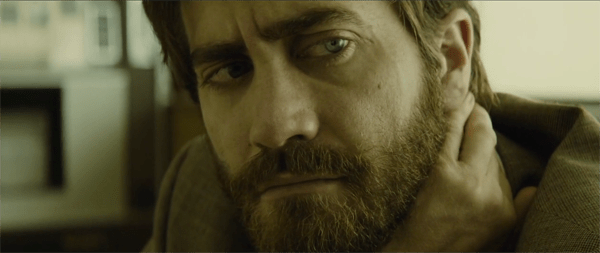
Watch: Denis Villeneuve’s Exploring, Intimate Camera
Watch: Michael Stuhlbarg? Michael Stuhlbarg Is Calling!
Watch: Martin Scorsese’s Career Highlights, Shown Through Close-Ups
Watch: Spike Jonze: Of Humans and Machines
The love between Joaquin Phoenix’s Theodore and Scarlet Johannson’s Samantha in Spike Jonze’s ‘Her’ was actually the culmination of a development that’s been in place since Jonze’s first film, ‘Being John Malkovich.’ Jonze suggests that the relationship between humans and robots can be a stage for the relationship between dreams and reality, i.e. between our best life and our real life. At least that’s what Chloé Galibert-Lainé indicates in this new video essay for Fandor. She makes a very strong case, too, tracing the progress from Craig Schwartz’s (John Cusack) follies with his puppets in the earlier film to the presence manifested by the later film’s living, breathing operating system.
Watch: The Books in Wes Anderson’s Films
Wes Anderson is the most bookish American filmmaker there is. You don’t watch his films, you read them, just as you might have done with Richard Linklater’s recent ‘Boyhood.’ There are no loud crashes, alarming close-ups, or slamming crescendos to grab your attention, nor is there any great rush through their narratives. They develop at a loping speed, at most, often more of a trot. It makes sense, then, that Anderson would feature books so prominently in his movies, given that if Anderson’s work has a spirit animal, it’s the hardcover child of Gutenberg. The A to Z Review has put together a gorgeous compendium of all the books (or the most notable ones) in Anderson’s films; watching it reminds us that the act of storytelling, less than that of creating suspense, developing characters, etc., is the foundation of Anderson’s work, from ‘Rushmore’ to ‘Moonrise Kingdom’ to ‘The Grand Budapest Hotel.’
Watch: Who Is Andrei Tarkovsky?
There is no one in the history of cinema who photographs the poetic beauty of nature quite like Andrei Tarkovsky. He made only seven feature films and yet, his impact on cinema remains one of the most substantial. Tarkovsky was born in the Soviet Union on April 4th, 1932— his mother, a literature scholar and proofreader, his father, a famous Soviet poet. Having a poet for a father obviously influenced his own work greatly. His style can be appropriately described as ‘visual poetry.’ His stylistic trademarks consist of long unbroken takes, beautiful contemplative scenes of nature, unconventional narrative structures, and surreal imagery.
In 1954, he went to a film school in Moscow called the State Institute of Cinematography where he made his first short film titledThe Killers—based on the short story by Earnest Hemingway. His start in film school was very well-timed. Prior to 1953, there was much censorship in the Soviet Union because of Joseph Stalin. But after Stalin’s death in 1953, Nikita Khrushchev took over and reversed many of the censorship laws as part of his “de-Stalinization” which came to be known as the “Khrushchev Thaw.” Because of this, film students like Tarkovsky were now allowed to view films from outside of Russia including the films of Kurosawa, Buñuel, Bergman, Bresson, the Italian neorealism movement, and the French New Wave movement. These films were a big influence on him—he especially loved Bergman and Bresson. Bergman eventually returned the affection saying, “Tarkovsky for me is the greatest, the one who invented a new language, true to the nature of film, as it captures life as a reflection, life as a dream.”
In 1959, Tarkovsky teamed up with a classmate to make The Steamroller and the Violin. They wrote the screenplay together and Tarkovsky directed it. The film was his senior project and went on to win the First Prize at the New York Student Film Festival in 1961. In 1962, Tarkovsky directed his first feature film titled Ivan’s Childhood about a 12 year old orphan boy named Ivan during World War II. It was the only film he directed that he did not write the screenplay for, but he was around the same age as Ivan during the war and drew from his own experience while making the film.
Every film he made was somewhat autobiographical, but none more so than The Mirror, which touches on his experiences during the war, his mother, and the absence of his father. In 1939, he fled Moscow with his mother and sister to live with his grandmother in the countryside, which is reflected in the film. The Mirror is a beautifully haunting piece of filmmaking that evokes a dreamlike atmosphere.
The beauty of the natural world is a major theme in all of Tarkovsky’s work, but almost the entirety of his most famous film doesn’t take place on Earth at all—rather it takes place on a space station orbiting a planet known as Solaris. It was a considerable departure from his comfort zone being so removed from the naturalistic setting found in all of his other films and yet, Tarkovsky’s unique perspective shines through.
When asked what advice he would give to young directors, he said, “It requires sacrificing of yourself. You should belong to it, it shouldn’t belong to you. Cinema uses your life, not vice versa.”
Clips used:
Solaris (1972 dir. Andrei Tarkovsky)
Stalker (1979 dir. Andrei Tarkovsky)
The Mirror (1975 dir. Andrei Tarkovsky)
The Sacrifice (1986 dir. Andrei Tarkovsky)
The Killers (1956 dir. Andrei Tarkovsky, Marika Beiku, Aleksandr Gordon)
Yojimbo (1961 dir. Akira Kurosawa)
Un Chien Andalou (1929 dir. Luis Buñuel)
The Seventh Seal (1957 dir. Ingmar Bergman)
Pickpocket (1959 dir. Robert Bresson)
Rome, Open City (1945 dir. Roberto Rossellini)
Breathless (1960 dir. Jean-Luc Godard)
Andrei Rublev (1966 dir. Andrei Tarkovsky)
The Steamroller and the Violin (1961 dir. Andrei Tarkovsky)
Ivan’s Childhood (1962 dir. Andrei Tarkovsky)
Nostalgia (1983 dir. Andrei Tarkovsky)
Tyler Knudsen, a San Francisco Bay Area native, has been a student of film for most of his life. Appearing in several television commercials as a child, Tyler was inspired to shift his focus from acting to directing after performing as a featured extra in Vincent Ward’s What Dreams May Come. He studied Film & Digital Media with an emphasis on production at the University of California, Santa Cruz and recently moved to New York City where he currently resides with his girlfriend.
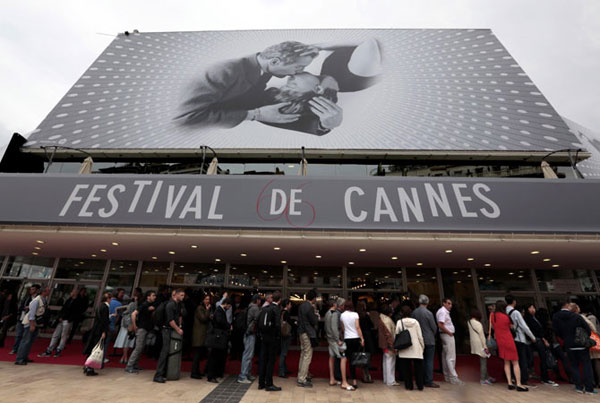
Watch: Want to request a Cannes-celation?
Sad you couldn’t go to the Cannes Film Festival this year? Tired of looking at pictures of people grinning gleefully as the southern French coastal sun beats down on them, while you’re huddled inside on a blustery, rainy day? Try a Cannes-celation! It’s a piece of software that… well, just try it and see.
Watch All Six ‘Star Wars’ Films at the Same Time. Literally.
Words to describe this film by ‘Archer’ animator Marcus Rosentrater, which superimposes all six ‘Star Wars’ movies, on top of each other, for a 2-hour 22-minute run time, could be: exhilarating. Exciting. Passionate. Detached. Confusing. Deranged. Brilliant. Turbulent. Regenerative. Transformative. Muddled. Cumulative. Or none of these, or maybe all of them at once, on top of each other. We’ve got R2D2 and C3PO melding into each other, sort of like Bergman’s ‘Persona,’ but different. Elsewhere, we’ve got Obi-Wan Kenobi having his head bisected by a large fighter plane. Anything you might imagine, in fact, you’ll find in here. So, watch it. You can focus on it, and slowly derange your senses. Or, you could use it as a backdrop, on a large-screen TV, as you do something mundane, like cleaning house or saving the galaxy.
Watch: ‘The Shining,’ The Twins, and You
There seem to be two general schools of thought on Stanley Kubrick’s timeless ‘The Shining.’ Either everything means something, or none of it means anything (and those who think otherwise are deluded). The two camps agree only on the fact that the film is terrifying. Rob Ager does a good job of straddling the two attitudes in his Collative Learning video essay on one of the oddest features of the film: the twins. Ager takes us through some details we may have missed (or may not have, if "we" are obsessive): the recurrence of the colors red and blue, the symmetrical relationship of the twins’ butchered bodies in one of Danny’s nightmares, a (possibly staged) making-of clip featuring two women who look quite a bit like the twins–as well as George Mason, of all people. (Not that surprising, given that Mason’s performance as Humber Humbert in Kubrick’s ‘Lolita’ was one of his greatest roles.) In any event, another thing all critical camps may agree on concerning ‘The Shining,’ and which this piece proves, is that you can never watch the film too much.
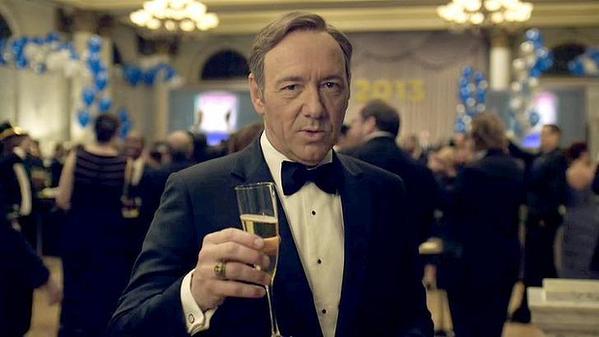
Watch: What Makes ‘House of Cards’ A Success?
As I’m fond of saying, nothing happens without a reason. That film you love, the one you can’t stop re-watching? That scene you discuss for hours? That dramatic climax that caps anything you’ve seen before? It’s the product of deliberation, planning, calculation: a director whose work is memorable becomes that way because he or she wants it to be that way–and to do that, layers of hard work have to be poured on, making what seems to you like an effortless product but is in fact anything but. In the case of David Fincher’s ‘House of Cards,’ the first series to make Netflix a credible location for entertainment, there are several factors in play, some we know and some we don’t, nicely enumerated in this brief but dense analysis by Elena Ishchuk: breaking the 4th wall, dynamic use of lights and darks, determined use of blues and yellows, centralized shots, and others. If you haven’t yet dipped into what many deem an addictive series, powered by Kevin Spacey’s demonic drawl, this piece might be a nice introduction for you.