Watch: Inarritu’s ‘Birdman’ Is a Collage of Edits, Not Just One Take

Watch: Inarritu’s ‘Birdman’ Is a Collage of Edits, Not Just One Take

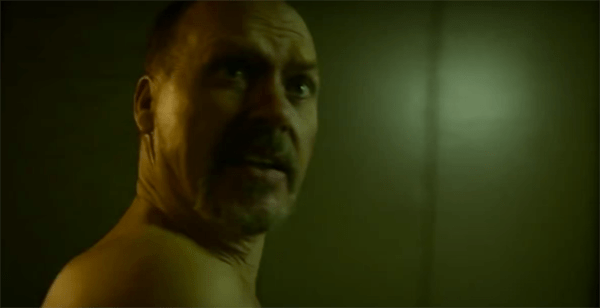
The kind souls at the YouTube channel The Film Theorists have served up a doozy with this piece on Alejandro González Iñárritu’s ‘Birdman," demonstrating not only that the film’s "single take" technique is actually the result of a myriad of takes, carefully spliced together and masked with the swerves of the camera–but also that this approach all started with Alfred Hitchcock’s 1948 film ‘Rope." Watch. Learn. Enjoy. Fly. 

Watch: What’s In a Film’s Setting? Plenty.

Watch: What’s In a Film’s Setting? Plenty.

If pressed, I would probably say that I respond more to films with a more attuned sense of setting. Part of the experience of moviegoing is tucking yourself into something–a director’s sensibility, a created world–and staying there for a while, and this tucking-in is made far more immediate if the physical setting makes a strong impression on you. In a new video essay, Now You See It swims through various setting-heavy films, ranging from ‘Citizen Kane’ to ‘About Schmidt’ to ‘The Life of Pi’ to ‘Fargo,’ and does a solid, old-fashioned analysis of the settings of those films, and why they’re important. The piece is particularly shrewd on ‘Little Miss Sunshine,’ with the socioeconomic transparency of the beauty pageant at the film’s end. So what’s in a film’s setting? The viewer, for the all-too-brief span of the film.

Watch: Guillermo del Toro Is a Master of Disobedience

Watch: Guillermo del Toro Is a Master of Disobedience

In disobedience lies Art. In disobedience lies Progress. From Aristophanes to Cervantes to The Beatles to Jackson Pollock to Jean-Luc Godard, we are taught, repeatedly, by example, that, to quote many a sports film, those who break the rules make the rules. In his latest virtuosic video essay, Evan Puschak, aka "NerdWriter," takes us inside the work of Guillermo del Toro, showing that in films such as ‘Pan’s Labyrinth‘ and beyond, the director breaks the rules of storytelling, violating the form that the Grimm’s Fairy Tales put before us, as his characters work against story paradigms to carve out spaces for themselves–and the results have been stupendous, making del Toro an idol for those who privilege the imagination over all that would conspire to crush it.

Watch: Stanley Kubrick Meets Alfred Hitchcock Meets Stanley Kubrick Meets…

Watch: Stanley Kubrick Meets Alfred Hitchcock Meets Stanley Kubrick Meets…

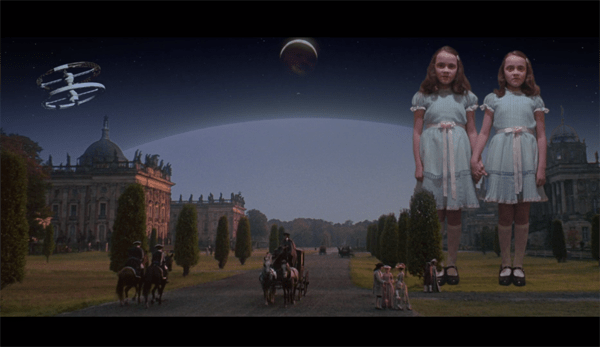
This is one of the more quietly bizarre, mind-altering films you’ll watch for a very long while. Building on the idea that all films talk to each other and that images and scenarios flow freely between them, the editors at Gump have taken several classic Alfred Hitchcock films and planted figures from classic Stanley Kubrick films within them. And vice versa. We have Jack Torrance from ‘The Shining’ staring across a courtyard at Jimmy Stewart’s wheelchair-bound voyeur from ‘Rear Window.’ We have Jimmy Stewart wandering into the orgy from ‘Eyes Wide Shut.’ And so on, increasingly intensely, until we really do begin to wonder if these two directors weren’t closer, even, than we might have thought previously. 

Watch: David Fincher and Niels Arden Oplev Take On The Revenge Scene in THE GIRL WITH THE DRAGON TATTOO

Watch: David Fincher & Niels Arden Oplev Direct The Revenge Scene in THE GIRL WITH THE DRAGON TATTOO

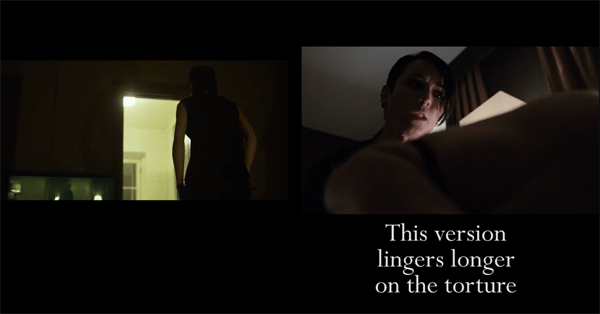
Anyone who likes Greek tragedy should, by rights, appreciate Stieg Larsson’s Millennium Trilogy, a series of books built on the power of revenge, and the catharsis that grows out of it, a catharsis so palpable it’s practically sexual. The revenge scene in The Girl with the Dragon Tattoo, the trilogy’s first volume, unfolds at a pace that is as scorching as it is satisfying, as Lisbeth Salander, the punkish information scientist thug genius, punishes her perverted legal guardian for his brutal molestation of her. When Niels Arden Oplev and David Fincher adapted the book for the screen, they took different approaches to this scene. While one version is not necessarily less fist-pump-worthy than the other, watching the scenes side by side points up crucial stylistic differences between the two directors. Here to walk us through these differences is Kevin B. Lee, for Fandor. It’s all spelled out for us here, with great care–and with huge captions! Enjoy! (If you have the stomach for it.)

Watch: Quentin Tarantino’s Shots from Above Put Him in the Center of the Frame

Watch: Quentin Tarantino’s Shots from Above Put Him in the Center of the Frame

Generally, shots from above serve to belittle the action taking place on screen; they remind us that, regardless of how involved we may be in the events unfolding there, we are all merely ants skittering across the surface of Earth, and the plot of the film is, really, just that. But in Quentin Tarantino’s case, the impact is slightly different. Emphasis is indeed taken off the action on-screen, but it is placed back on… the director. When we see an overhead shot in a Tarantino film, we are reminded that the film we are watching is personally crafted and bears the weight of significant personal investment–it’s somewhat of an auteur’s calling card. In Pablo Fernández Eyre’s latest piece, he takes us through shots in films ranging from Pulp Fiction to Jackie Brown to Kill Bill Vol. 2, to show us the director’s removed control at work.  

Watch: In Francis Ford Coppola’s ‘The Conversation,’ The Opening Sequence Foretells Our Future

Watch: In Francis Ford Coppola’s ‘The Conversation,’ The Opening Sequence Foretells Our Future

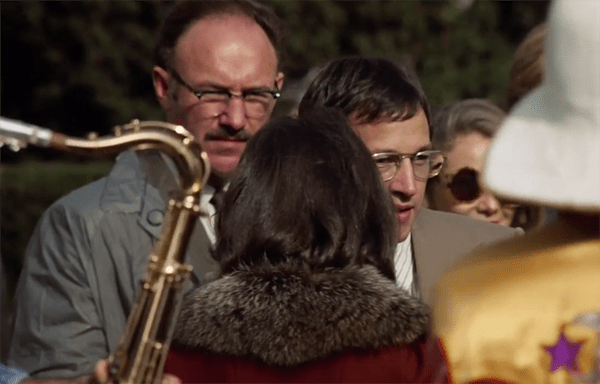
Do you think you have privacy? You don’t. Do you think no one saw? They did. You think that email is secure? It’s not. You think no one’s listening? They are. You think we’re "safe"? We probably aren’t. The intimate portrait of a surveillance professional painted in Francis Ford Coppola’s ‘The Conversation’ was, to put it mildly, ahead of its time in its suggestion of a culture in which privacy is violated all the time and in which, strangely enough, through social media and other similar outlets, we give up our privacy with alarming ease. The newest installment of "The Discarded Image" from Julian Palmer at 1848 Media examines the powerful opening sequence of Coppola’s film, linking it to its strongest influence, Michelangelo Antonioni’s ‘Blow-Up," as well as a number of contemporary films. 

KICKING TELEVISION: Reboot, Reuse, Recycle

KICKING TELEVISION: Reboot, Reuse, Recycle

nullThe other night I was watching ABC’s The Muppets with my wife, who is a bit younger than me, and doesn’t have the memories of The Muppet Show and Muppet movies of the ‘80s that I do. She laughed when it was funny and rolled her eyes when silent groans were required. And I suppose I did too, and I’ve enjoyed the show, three episodes in. But there’s also something very sad about this reboot of the franchise. Not for the show, or its production, which cleverly takes us behind the scenes of the Muppet universe in faux documentary style. But rather, the sadness was mine, because somewhere five-year-old me was aghast at the adult version of a children’s classic. Kermit was drinking. Fozzie was dating. Ms. Piggy was…ok, totally unchanged. And in an entertainment era where no franchise can escape a reboot pitch, the revisiting of memories past has altered our once-static television mythologies. Now a series finale is meaningless, and where narratives used to have definitive beginnings and endings, the contemporary TV landscape has made its canon malleable.

TV reboots are not new for an industry rich in talent but handcuffed by corporate ideology. How else can you explain Chicago FireChicago PD, and this season’s addition, Chicago DMV? Series need to guarantee, or at least give the illusion of a guarantee, that they will be successful and profitable. Typically, the industry has leaned towards recycling. Medical, legal, and forensic science serials are churned out every pilot season. Sitcoms still have wacky neighbors and hetero coupling, even if the studio audience and ratings have all but disappeared. Late night is full of penises, mostly white men telling the same jokes about being white men. Recycling is born of fear, because in TV ‘new and revolutionary’ doesn’t come along all that often and when it does it’s either by mistake (Empire) or on HBO. But while the idea is not new, the employment of their methodology has changed.

We’re used to remakes, and enduring Matthew Perry cringing for a paycheck on The Odd Couple. But revisiting a past series, and continuing its narrative, is a new premise, at least on a large scale. In recent memory, we have seen or will see The X-FilesMelrose PlaceBeverly Hills 90210, The Muppet ShowBoy Meets WorldFull HouseArrested DevelopmentSex and the City, HeroesCoachWet Hot American SummerTwin PeaksXena: Princess Warrior, and Cop Rock rebooted. Well, not Cop Rock. Not yet. Not until someone can find Steven Bochco.

No TV property can escape the greed for easy ratings. Even Fear of the Walking Dead is a reboot of sorts, reimagining the early days of The Walking Dead universe. And while season one is a mixed bag at best, it certainly lacks the bold vision and ambition of its parent series. Why be ambitious when you can be simple-minded? Which begs the further question: If The X-Files or Xena are successful, what does TV reanimate next? Do we return to Lost and find out what the afterlife is like on another island, say Fiji? Is House, M.D. addicted to Adderall and working as an on-campus physician at UMass-Amherst? Was Tommy Westphall’s dream in St. Elsewhere actually part of another kid’s dream? Are Ross and Rachel divorced? Is Jerry dead? Is Tony Soprano?

The trend of sequels, prequels, and reboots is not unique to TV. We’re about to endure the return of the Star Wars franchise. Harper Lee’s publishers saw an aging icon and dollar signs and brought back the seminal characters from Too Kill a Mockingbird back to life in the unfortunate Go Set a Watchman. Meat Loaf revisits Bat Out of Hell whenever he needs an infusion of nostalgia-driven cash. But while I can understand nostalgia, the genius and gift of art is that it’s always there for us to revisit on our own schedule and accord.

I’ve read Fear and Loathing in Las Vegas and Cat’s Cradle over and over so many times that I’ve worn out the pages. I’ve listened to the Silver Jews’ Bright Flight at least once a week for as long as I’ve owned the album. Once a year, I find a repertory cinema playing The Godfather or Pulp Fiction or Ferris Bueller’s Day Off, and revel in both the genius of the films and my memories of first watching them. And while revisiting television was once reserved for syndication—and then home video—digital technology has allowed me to rewatch my favourite series, like LostFriday Night Lights, or West Wing whenever I feel the need to immerse myself in their universes. To visit old friends. To be held safely in the nostalgic warmth of familiarity and television acumen. But to alter the anchored narratives of those series would mess with an already weary mind.

Unfortunately, TV doesn’t use the reboot trend to satiate the lingering the TV junkie’s appetite for series that died too soon. Seth Rogen, Linda Cardellini, Jason Segal, James Franco et al. will not suit up for Freaks and Geeks and Their Freak-Geek Kids. There will be no season two of Studio 60 on the Sunset Strip. The surf is not up for more John from Cincinnati. Instead, TV tests the reboot waters with mid-range nostalgia like Boy Meets World and cult hits like The X-Files, before venturing into more seminal TV fare. Somewhere Mark Linn-Baker and Bronson Pinchot are dusting off their "Dance of Joy" shoes. Somewhere, Jaleel White is hopeful. Make no mistake; the reboot is the new spin-off. And no TV series is safe. Except for Viva Laughlin. Probably. The spin-off had too many variables that could lead to failure. The reboot is a safer root, as it just offers what was previously successful with minor twists.

In the meantime, I won’t close myself off to these reboots. I’m as curious as anyone. Which is why networks will churn them out. Because even the most ardent fan of a series’ mythology can’t resist a dalliance with the unanswered, the unsaid, the unproduced. So I’ll watch The Muppets, even if it messes with my past, and answers questions no one asked like, What’s a Muppet prostitute look like? and Is Muppet-human sex bestiality? I’ll dig in. I’m a consumer. I’ll be the Statler to ABC’s Waldorf. But, in the meantime, I really have to know: Where the hell are “Pigs in Space”?

Mike Spry is a writer, editor, and columnist who has written for The Toronto Star, Maisonneuve, and The Smoking Jacket, among others, and contributes to MTV’s PLAY with AJHe is the author of the poetry collection JACK (Snare Books, 2008) and Bourbon & Eventide (Invisible Publishing, 2014), the short story collection Distillery Songs (Insomniac Press, 2011), and the co-author ofCheap Throat: The Diary of a Locked-Out Hockey Player (Found Press, 2013).Follow him on Twitter @mdspry.

Watch: Damien Chazelle’s ‘Whiplash’ and Darren Aronofsky’s ‘Black Swan’ Are the Same Film

Watch: Damien Chazelle’s ‘Whiplash’ and Darren Aronofsky’s ‘Black Swan’ Are the Same Film

It cannot be denied that Damien Chazelle’s ‘Whiplash‘ and Darren Aronofsky’s ‘Black Swan‘ are disarmingly similar. There’s the young naif at the heart of each film, Miles Teller’s Andrew Neimann vs. Natalie Portman’s Nina Sayers. There’s the overbearing instructor looming over each story: J.K. Simmons’ Terence Fletcher vs. Vincent Cassel’s Thomas Leroy. And there’s also the drive towards an artistic goal that ultimately leads a protagonist into the depths of his or her own creative self. And, as Fernando Andrés points out in this excellent video essay, which lays out considerable connections between the two films, both works focus on a particular body part that embodies the struggle at the story’s heart. In ‘Whiplash," it’s the hands; in "Black Swan,’ it’s the feet. Revisiting these two films in this form is edifying in and of itself, but the comparison so elegantly explored here also reminds us of something else behind all artistic endeavors: tenaciousness. Not quitting. Never thinking that one has done, to quote J.K Simmons’ sadistic but half-right teacher, a "good job." Suffering comes out of this kind of determination, and plenty of it. But that thing which we call, broadly, "art" comes out of it, too.

Watch: David Lynch’s Films Are All Chapters in One Story

Watch: David Lynch’s Films Are All Chapters in One Story

Try to imagine a universe in which one might have complaints about the films of David Lynch. I can’t, personally, but maybe you can. In this hypothetical, impossible-to-imagine universe, the closest thing I might possibly be able to conceive as a vague complaint–not a complaint, really, but a concern–is that sometimes his films lack–and this isn’t to say this is required, just that certain people require it, who knows why–narrative continuity. There might be all kinds of reasons for this characteristic–that is, if we’re actually saying it’s a quality of his films–and, if I had to produce a statement of "defense," I might offer the idea that the films are all meant to both talk to each other and to work together as a large assemblage, a story, if you wish. Joel Bocko asserts this idea, both directly and indirectly, in this brilliant video essay. He begins by noting points of correspondence between the creepy interiors of ‘Eraserhead‘ and those of ‘Twin Peaks: Fire Walk with Me,’ and then he goes to broaden his vision a little, making the work of Lynch resemble, more than anything else, a hall of mirrors. The difference between Lynch’s oeuvre and a side-show distraction, though, is that each mirror, each reflection, moves you forward; each repetition of a motif develops it, expands its girth. At this point in time, when we watch a new Lynch film, from ‘Blue Velvet’ to ‘Wild at Heart’ to ‘Inland Empire,’ we are truly watching it to see what happens next: not within the body of the film, but within the body of his work. How will the symbols change? What new side of the human face will he show us? Who will disappear next and the re-appear, magically transformed? Who will die? Who will triumph?