VIDEO – Motion Studies #1: The Substance of Style

VIDEO – Motion Studies #1: The Substance of Style

http://www.movingimagesource.us/flash/mediaplayer.swf?id=11/767

For the next seven weeks, the Oberhausen International Short Film Festival will present "Film Studies in Motion", a Web Series curated by Volker Pantenburg and Kevin B. Lee. This series, available on the festival's website and Facebook page, presents weekly selections of analytical video essays on the web, in preparation for Pantenberg and Lee's presentation  "Whatever happened to Bildungsauftrag? – Teaching cinema on TV and the Web", scheduled for April 28 at the festival.

Press Play will track the series, posting four or five of the selected videos each week as they also become available on the Oberhausen website.

The following introduction to the series is taken from the Oberhausen International Short Film Festival website:

Anyone who has an internet connection and wants to expand their understanding of cinema can behold the remarkable abundance of analytical video essays on the web. Proliferated in just the last five years, these meticulous readings of title sequences, thorough investigations of film style and montage decisions, dialogic inquiries of acting or mise en scene have created a genre in its own right. They can be found on websites like IndieWire's Press Play, Fandor, Moving Image Source and Audiovisualcy, on the last of which curator Catherine Grant has categorized these works under the term "videographic film studies." The essays are expressions of a cinephilia 2.0, fueled by weblogs, internet-journals and streaming platforms, produced from DVDs and digital media, laptops, and DIY editing software.

This week is an initial sampling of exemplary works from the emerging genre of online video essays on cinema. Combined they cover a wide range of subject matter (a genre, a sequence in a film, a cinematic motif, a director’s body of work). They demonstrate a variety of stylistic approaches to the video essay form, using an array of techniques: montage and rhythm, split screens, narration, creative use of on-screen text, etc. These works, some of them conceived as multi-part series, are made typically on computers with consumer-grade editing software, but they display an ingenuity that is comparable to that of the films they explore.

Today's selection:

The Substance of Style, Pt 5: The prologue to The Royal Tenenbaums, annotated
Matt Zoller Seitz (2009)

What better way to kick off the series than with an opening credit sequence, unpacked in such a way that can only be done via video essay?

Volker Pantenburg is assistant professor for Visual Media with the main focus “Research of the Moving Image” at the media faculty of the Bauhaus-Universität Weimar. 

Kevin B. Lee is Editor in Chief of IndieWire’s PressPlay Video Blog and contributor to Roger Ebert.com. Follow him on Twitter.

The Assassination of Sterling Hayden by the Auteur Francis Coppola

The Assassination of Sterling Hayden by the Auteur Francis Coppola

This morning, I was pondering the mini-movie-marathon TCM will be dedicating to one of my favorite actors, Sterling Hayden, on his birthday, March 26th. The tall, Nordic-looking blond was often relegated to heading up B-Westerns and crime stories in the 40s and 50s,  like Arrow in the Dust and Suddenly, before finding a fan in director Stanley Kubrick. Kubrick first used Hayden in just that type of film, 1956's The Killing, an early genre piece that really didn’t set the box office on fire. Hayden's reputation didn't really begin to attain a certain stature until a few years later. By then, Stanley Kubrick had become Kubrick™, the reclusive, one-named auteur who’d buck the Hollywood establishment and direct Hayden in the slightly bent role of Brigadier General Jack D. Ripper in Dr. Strangelove or: How I Learned to Stop Worrying and Love the Bomb (1964). This atypical, blackly comic role helped Hayden get darker, pivotal roles from many of the top auteurs who'd come after Kubrick, as they ascended in the New Hollywood's director-led artistic revolution, filmmakers like Robert Altman (The Long Goodbye), Bernardo Bertolucci (1900) and most notably, Francis Coppola. It was then, while thinking of Hayden’s role in Coppola’s The Godfather, that something wild occurred to me.

In 1972, The Godfather was something new to American cinema (the movie celebrated the 40th anniversary of its release on March 15th). It was a crime story that was also a prestige picture. No expense was spared in adapting the bestseller by Mario Puzo, mostly because the demanding Coppola resisted Paramount’s previous attempts to produce it quickly and cheaply, a la Martin Ritt's box office bomb, The Brotherhood. It's hard to imagine in retrospect, but actors lacking any trace of Italian ethnicity, like Ryan O'Neal and Robert Redford, were being considered to play The Godfather's protagonist, Michael Corleone, just like The Brotherhood had cast the lantern-jawed Kirk Douglas as its lead (for more on the ins and outs of The Godfather's production, read the indispensable The Godfather Companion by Peter Biskind). And why shouldn't the studio have done so? Up until then, heroes and antiheroes, regardless of intended ethnicity, were played by WASP (or in the case of Douglas, WASP-looking) actors like Hayden himself.

nullA lack of positive ethnic representation in cinema forced Cuban Americans like myself to adopt Scarface and its Cuban drug-lord Tony Montana into our cultural iconography (which I talk about at length here). One thing Cuban Americans do share with Montana is his immigrant experience. And one of the reasons Tony Montana in particular was so easily accepted by myself and others like me is because of the actor who played him. Al Pacino not only looked like one of us, he looked nothing like Sterling Hayden. You couldn't just stick Pacino in a Western without some kind of lengthy exposition to explain his presence in the film. But you could cast Pacino as the lead in a crime movie just like the ones Hayden starred in. And that's what Coppola did, casting Pacino as the star of The Godfather against the protests of studio executives, while assigning the aging Hayden a secondary role as a police chief. And not just any chief, but an utterly detestable, racist, and corrupt one.

Pacino's Michael Corleone was the first hero Cuban Americans had called their own, in a movie known to us as El Padrino. What Coppola did not just for Italians or Cuban Americans, but all ethnicities, was demonstrate that a prestige picture by a major studio could be carried by an Italian American, one who wasn't fair-skinned and blue-eyed like Frank Sinatra, but brown-eyed and of olive complexion and short stature like Al Pacino. Combined with the casting of character actors like Gene Hackman, Dustin Hoffman and Jack Nicholson or black actors like Richard Roundtree as leads in some of the most popular films of the era, it’s fairly simple to see why Pacino’s success in a movie of that scale opened doors for so many offbeat-looking characters that would follow. Coppola's The Godfather was not just a major release. It won the Best Picture Oscar, spawned another Oscar-winning sequel, and has become one of the most watched movies of all time. And despite the risk of being overshadowed by no less an actor than Marlon Brando, Pacino carried The Godfather simply by virtue of being in every scene.

Coppola, who based many of the cultural touchstones of the film on his own family's experience as first-generation Italian Americans, then did something remarkable when he cast Hayden as Captain McCluskey, the despicable police chief we rooted against. He had Michael shoot him in the head midway through the film. Al Pacino, New Hollywood icon and one of my cultural heroes, shot Sterling Hayden, Old Hollywood stalwart and one of my favorite actors. In the head. Francis Coppola assassinated Sterling Hayden, and American cinema would never be the same again.

Atlanta-based freelance writer Tony Dayoub writes about film and television for his blog, Cinema Viewfinder, and reviews DVDs and Blu-rays for Nomad Editions: Wide Screen, a digital weekly. His criticism has also been featured in Slant’s The House Next Door blog, Opposing Views and Blogcritics.org. Follow him on Twitter.

The Art of the March Madness Telecast

The Art of the March Madness Telecast

To celebrate the NCAA Men's Basketball Tournament, here is a phenomenal account of the storytelling skills and visual analysis that goes behind a March Madness telecast. Written by Andy Horbal, the piece examines the CBS sports telecast of his favorite college basketball game ever, the 2005 Elite Eight match-up between Kentucky and Michigan State that the Spartans eventually won 94-88 in double overtime. This version of the article was originally published on Andy's blog in 2010. An earlier, lengthier version of the post can be found here.

Every year narratives play out in NCAA tournament games that are as dramatic and sensational as those in the soap operas that they preempt, and the storytelling strategies used in the broadcasts themselves can be downright fascinating. This game is a perfect example of what I mean: the last few minutes of regulation unfold as if they’re part of a self-contained short film about heartache, redemption, and truth in photography made by a director inspired by movies like Blow-Up (1966)JFK (1991), and Ken Jacobs’s Tom, Tom, the Piper’s Son (1969). Call it The Passion of Patrick Sparks:

Back story: Patrick Sparks — a hometown hero who grew up dreaming of playing basketball for the University of Kentucky Wildcats — lit up Michigan State in the first half for four threes, but has since gone a bit cold. As our story begins with Kentucky down by four and just over one minute left in the game, he’s sitting on the bench:

We know that’s where he is because every time play stops either Jim Nantz or Billy Packer, the play-by-play announcers calling the game for CBS, mentions that he’s Kentucky’s best 3-point shooter, usually over a close-up like this one. For all their desire to see him enter the game, though, it isn’t until Sparks’s teammate Ramel Bradley takes a hard foul at center court with 27.1 seconds left that he checks in to shoot free throws with Kentucky down by one:

As the recipient of the foul, Bradley would normally go to the line in this situation, but because he’s injured any player on the bench can take his free throws. Sparks is, Jim Nantz tells us, “the Chosen One.” He’s a 71% free throw shooter and he’s clutch, so at least the front end of the one-and-one should be a gimme. But no: he misses. As we were told by a voiceover during the montage that began the broadcast, all of these players “have been working their entire lives to reach College Basketball’s ultimate destination.” Knowing that Sparks’s lifelong ambition has been to play for Kentucky, we wonder how many times he’s dreamed of this exact scenario: Down by one, with a chance to tie and then take the lead by making two free throws, Patrick Sparks steps up to the line. . . .

To miss that first shot must be devastating:

He will soon have a chance to redeem himself. Down by three with the clock winding down, Kentucky has the ball and one last chance to tie the game. Sparks gets the ball behind the arc with 8 seconds left:

He misses again! His teammate Kelenna Azubuike grabs the rebound, dribbles past the arc, and takes another shot with 4 seconds left:

The ball hits the front rim, but somehow it caroms right into Sparks’s hands. He dribbles back, takes one step forward, and with 1.1 seconds left gets a shot off:

The ball spends what seems like an eternity bouncing around the rim — once, twice, three times — before finally, at long last, dropping in for a made three. Tie game! Overtime! Patrick Sparks is a hero!

Or is he? This is where the game gets really interesting. Even as the Kentucky players and fans celebrate, the specter of a doubt rears its ugly head: was Sparks’s foot on the line, making the three a two and giving Michigan State a one-point win?

We see a replay:

Then a replay from another angle:

And then it’s back to the first angle, again and again. We see Sparks take off from the floor and shoot over, and over, and over: four, five, six times:

By now they’re no longer showing us the whole shot, just the few split seconds before and after the shot is released. The ball is stopping in mid-air and returning to Sparks’s hands: up, and to the line . . . up, and to the line. As the tension builds as we cut away to anxious Kentucky fans:

And to deliciously “meta” footage of the refs reviewing the replays:

We look at a blow-up (!) of the shot:

We move out again:

Then in, in, in:

More than five minutes have passed since Sparks’s shot, and as the fans grow tenser:

We’re treated to an “enhanced” blow-up:

Jim Nantz realizes the truth just as we do: “You still can’t tell!” he exclaims. And that’s exactly the moment that the refs announce that the three will stand. The crowd goes wild:

Huzzah for uncertainty!

Andy Horbal is a librarian and occasional film critic currently living in Westminster, Maryland. He roots for the Pitt Panthers, even when they're playing in something called the "College Basketball Invitational."

AUDIOVISUALCY: A New Press Play Column

AUDIOVISUALCY: A New Press Play Column

"I think … of the wonderful impression I received … when confronted with … quotations in which film was taken as the medium of its own criticism",

Raymond Bellour, "The Unattainable Text", Screen, (1975) 16 (3)

For the last five years I have been fascinated by the growing number of videos appearing online that use movie images and sounds as the medium of their own criticism, as the French film theorist Raymond Bellour put it.

In April 2011, I created an open group forum called Audiovisualcy at the Vimeo video hosting site in order to begin to form an online community around an ongoing, crowd-sourced, collection of ‘audiovisual film studies’ that people all around the world are making.Twitter and Facebook versions of Audiovisualcy have also been set up to publicise and discuss video essays published on other sites. 

Audiovisualcy aims to collect and share a broad range of videos that have an analytical, critical, reflexive or scholarly purpose behind their use of movie footage. The videos should fully attribute their sources, and be made according to other Fair Use (or Fair Dealing) principles as well.

The ethos of the group is one of enthusiastic openness to the possibilities of this online format at what is still a relatively early stage in its development. In gathering works of professional journalistic film criticism and academic film studies alongside sometimes very personal, even highly experimental videos, a cross fertilization is very much hoped for. The best essays that Audiovisualcy showcases, in my view, inventively cross over some of the boundaries between their different publishing contexts and original intended audiences.

The Audiovisualcy column on Press Play is a collaboration between Press Play's editors, myself, and a series of guest contributors who will take turns to pick particular video essays and to discuss what it is that we like and value about them.

The video that I've chosen to launch this new feature is one that I added very early on to the Audiovisualcy collection: Jefferson Robbins' iMacGuffin: Portable Infotech and Suspense Cinema.

Jefferson’s video was originally published with an accompanying written text in 2010 at the Film Freak Central website. What’s great about it is that it also works brilliantly as standalone, purely audiovisual, work. It is very entertaining, shot through at every turn with Jefferson’s (and also Hitchcock’s) appealing wit. But it also works well, at more than twenty minutes in length, as a very comprehensive video study of suspense-film MacGuffin devices in the age of information technology; it sets out valid categories for its survey and gives examples from all the key films you’d hope to see included.

Best of all, it wears its undoubted expertise very lightly. It uses minimal text, no voiceover, just wonderfully chosen and expertly edited excerpts from suspense movies as well as from instructional videos about the gadgets it discusses. The sound editing is excellent, too.

This video shows just how compelling studies made in this form can be, especially for the purposes of precise, concise, but also wide-ranging comparison. Exact examples can be juxtaposed, not only in order to quote from the films directly — the feature of such audiovisual studies that so impressed Bellour back in 1975 – but also to allow viewers to experience their comparison in real time, to feel as well as to know how the objects under investigation in the video are actually handled, both by the films and their technologically dazzled characters.

Catherine Grant teaches film studies at the University of Sussex, UK. You can watch her video essays on films and film theory at her Vimeo channel and read her discussion of 'audiovisual film studies' at the academic research websites Filmanalytical and Film Studies For Free. At a Society for Cinema and Media Studies Annual Conference workshop in Boston on March 22, she will discuss "Video Essays: Film Scholarship’s Emergent Form" with Christian Keathley (Middlebury College), Girish Shambu (Canisius College), Benjamin Sampson (UCLA), Richard Misek (University of Kent), Craig Cieslikowski (University of Florida), Matthias Stork (UCLA) and others.

VIDEO ESSAY: Kevin Brownlow, Film Essay Pioneer, on D.W. Griffith

VIDEO ESSAY: Kevin Brownlow, Film Essay Pioneer, on D.W. Griffith

Next week the San Francisco Silent Film Festival will present the complete 5 1/2 hour version of Abel Gance’s epic Napoleon. It is truly a singular event: Due to the expense, technical challenges, and complicated rights issues involved, no screenings are planned for any other American city. This monumental event is being presented by SFSFF in association with American Zoetrope, The Film Preserve, Photoplay Productions, and the British Film Institute.

This full version of Napoleon is restored by legendary film historian and filmmaker Kevin Brownlow, whose epic documentary D.W. Griffith: Father of Film (1993) is available on Fandor. Directed by Brownlow and David Gill, the film tells the story of one of cinema’s most monumental figures, D.W. Griffith. It shares Griffiths’ life and legacy through biographical narration, interviews, and behind-the-scenes looks at his movies.

Of the vast array of material presented in this film, most fascinating are the moments where they analyze Griffith’s filmmaking, revealing his innovative techniques and how he brought them into being. Here is an edited and recontextualized compilation of those sequences distilled from the longform biography of this legendary artist.

Originally published on Fandor.

VIDEO ESSAY: American Harmony

VIDEO ESSAY: American Harmony

null

Watch this video on Vimeo (optimized for mobile devices).

When moviegoers think of quintessential American cinema, the images and ideas that spring to mind are that of a passionate John Cusack holding up a boom box serenading his love in Say Anything or of Sylvester Stallone triumphantly running up the Philadelphia Art Museum's snowy steps in Rocky. In fact, if one looks at any "Best Of" list concerning American cinema, they are usually built around these iconic moments of heroic elevation. What else are the movies for, if not to transport us to moments of unbelievable success and joy? But most American people don't fit the titular roles of Rocky or Norma Rae or Erin Brockovich. The America of yesterday and today is still full of the occasionally inspired but mostly ordinary individual.  Perhaps that is why the recent works of Harmony Korine fall under the heading of being "uniquely American."

After exploding onto the American indie film scene at the early age of nineteen with his screenplay for Kids, Korine quickly churned out two of the 1990s most polarizing works: Gummo and Julien Donkey Boy. Both of those films challenged the conventional narrative and presented audiences with unnerving and unwelcome notions. Then Korine spirited overseas to film his strangely touching commune drama Mister Lonely. And since 2009, the filmography of Korine–Trash Humpers, Act Da Fool, Curb Dance and Snowballs–has morphed into a visual canon of the purest form. Korine's camera has become much more subjective and invasive. The cinematography has turned far grittier. The editing rhythm now depends on the individual pulse of an idea or image.

nullThe subjects and characters that Korine presents exist outside the mainstream frame of heroes or villains. The silver screen heroines of Hollywood are now replaced with the rebellious, foul-mouthed street teens in Act Da Fool. The team of charming casino robbers or frontier-bound cowboys is now replaced with the outcast garbage can fornicators in Trash Humpers. By stripping away any safe scenario that would be found in a typical "movie," Korine forces the audience to reevaluate their primal reactions to some of the most obtuse and harrowing images. Therefore, these films transcend the visual mechanics behind the “normal” American narrative. Added, the locations that Korine uses for these films–decrepit housing, low-income neighborhoods–represent an underexposed cross-section of very real America (when compared to popular Hollywood content).

It's easy to write off Korine’s visual works as misanthropic. It’s even easier to file them under the often-misused label of "Trash Cinema." Yet if one looks closely enough to actually discover the embedded ideas expressed in these works–work, love, tragedy, success, and failure–it's not hard to appreciate Korine's deconstruction of the strange symphony that is the day-to-day American life.

Nelson Carvajal is an independent digital filmmaker, writer and content creator based out of Chicago, Illinois. His digital short films usually contain appropriated content and have screened at such venues as the London Underground Film Festival. Carvajal runs a blog called FREE CINEMA NOW which boasts the tagline: "Liberating Independent Film And Video From A Prehistoric Value System." 

LUCK RECAP: A Herd of Two

LUCK RECAP: A Herd of Two

null

Episode seven of Luck at first feels like a placeholder, until you look back over it and realize that the universe is reordering itself beneath the surface of things. In the pilot, most of the characters seemed detached from life, or isolated; but now, with just two episodes left to go until the end of the season, they've formed or deepened relationships. More importantly, given the show's seeming belief in kindness as good karma, a lot of the characters have taken responsibility for another human being or fellow creature.

Horse trainer-owner Walter Smith seemed terrified and nearly paralyzed by that letter from the estate of the Colonel sticking him for a $140,000 bill, but now that he's got himself a lawyer (Bruce Davison) who seems serenely confident in what he's doing, Walter seems a bit more relaxed. The moment where Walter moves to pay the lawyer in cash and is politely refused is a wonderful example of how trust can make the more cynical social niceties unnecessary. (It also indicates that Walter has probably never had a lawyer before; he's used to the economy of the track, which seems to be based around paper money changing hands.) After being berated by Walter last week for taking an unauthorized crop to Gettin'-Up Morning, Rosie the aspiring jockey asks Joey Rathburn the agent to intercede on her behalf, and Joey counters by subtly indicating that if he's going to be acting as her agent, he should actually be her agent; Rosie agrees, and another formalized partnership is born.

Lonnie, arguably the least essential member of the Foray Stables, tries to expand their operation by claiming another horse, Niagara's Fall. The animal nearly wipes out during the race; Leon, who was kind of a disaster in earlier episodes, responds quick, preventing worse injury. But rather than earn the group's unabashed contempt (or at least Marcus's), the mishap seems to get written off as the sort of thing that happens when four guys go into business together. The group itself seems to be maturing in the way that an individual matures; its individual members are deepening and softening as well. Jerry, a genius-level race picker who has can't stop blowing his horse winnings on poker games, enters a high-stakes tournament, and does surprisingly well. He seems emboldened by his erstwhile poker partner, the ex-card dealer Naomi (Polish actress and model Weronika Rosati). They get it on in the parking lot, and later in the episode he returns with her to the hotel and interrupts a meal between the other three amigos with a wonderfully unconvincing "Hey, guys, what's up?" nonchalance. Anybody who's ever tried to introduce a new lover to a circle of friends while pretending that the aura of sex isn't hanging over everything can relate.

You can read the rest of Matt's recap here at New York Magazine.

Matt Zoller Seitz is co-founder and publisher of Press Play and TV critic for New York Magazine.

VIDEO: The Story of BREAKING BAD, As Told by The Cousins

VIDEO: The Story of BREAKING BAD, As Told by The Cousins

[Editor's note: Tuco Salamanca's twin cousins Marco and Leonel were among the most fascinating characters on Breaking Bad. Stoic, menacing and quietly murderous, they were quickly established as a force to be reckoned with. We wondered: If we were to reorder each of their scenes from Breaking Bad's third season into a chronology, would their story be as compelling? Would it be different entirely? Could we glean greater insight into these two men?

We asked Press Play contributor Dave Bunting, Jr. to edit these scenes together (in addition to the prologues of all four seasons to create two self-contained Breaking Bad episodes, one covering Seasons 1 and 2, the other covering Seasons 3 and 4.) He arranged all of The Cousins' material in chronological order except for a late-season flashback to their childhood, which he placed at the start. Then we asked another Press Play contributor, Sheila O'Malley — who has never seen a frame of the series — to watch the compilation and write down her impressions. Sheila was asked not to read any supplementary material before or during the experiment, and she agreed. Her written account of The Cousins is derived entirely from having watched Dave's compilations. Shorn of everything but its openings, was Breaking Bad still Breaking Bad? Read on and see.]

The two boys were inseparable growing up.  They were twins, and although they fought on occasion, there was a special unbreakable bond between them at all times.  Words were rarely necessary.  They would just look at each other and know what the other one was thinking.  It was a psychological and intellectual bond, bordering on the spiritual.  It is a profound thing to not need words.  Nobody else could enter their cyclical closed bond.  That was okay by them.  As long as they had each other, they didn't need anyone else.

There is always a moment in life when your character is determined.  It usually happens early.  And character can mean destiny.  All else follows from that one moment; it is as though it was written in the stars.

nullSomething happened when they were young that was crucial to the development of their characters as men.  They were about 10 years old, and playing in the yard, as their uncle looked on, talking on a giant phone the size of a computer modem.  Their uncle was a bigwig in the family drug cartel, a behemoth with many tentacles, reaching into the United States.  He was running his business from a lawn chair, as the boys played and taunted one another.  To the boys, their lives were normal, of course.  They didn't know that their lives were any different than anyone else's.  One boy takes the other's G.I. Joe doll and holds it just out of reach, taunting his brother until his brother breaks into tears, shouting, "I wish you were dead!"  This innocent comment gets the uncle's attention.  He calls both boys over, taking in the situation wordlessly and then asks the boy who had taunted his brother to get him a beer out of the bucket of melting ice beside his chair.  The little boy reaches in, grabs a beer and holds it out but the uncle rejects it, telling him to get him one that is really cold.  Leaning over the bucket, reaching in deeper, the little boy is caught unaware when the uncle swiftly pushes his head beneath the water.  A struggle ensues.  The uncle remains imperturbable, and asks the boy standing in front of him, "This is what you wanted, right?"  The panic of the boy being held under the water intensifies, and his brother, desperate, starts hitting his uncle ferociously.  Just before the submerged boy would have drowned, the uncle lets him go, and the boys huddle together by the bucket.  The uncle stares down at the boys and says, "Family is all."

In that moment is the destiny of these beautiful boys.  It would be a scar, of course.  Their uncle was willing to kill one of them to teach them both a lesson.  They would never feel the same way about him again.  However, the lesson was learned.  Family is all, and to wish death upon a family member is forbidden.  In the ensuing years, as they grew older, they mind-melded to such a degree that they became one larger impenetrable entity.  They were not two individuals.  They had coalesced into a terrifying Third.

nullAs teenagers, they began working for the family business.  While their uncle was a negotiator, the twins were the muscle.  They killed enemies of the family with a breathtaking swiftness.  They were perfectly suited, emotionally, for the job.  They didn't experience an adrenaline rush like normal people in the face of danger.  On the contrary, when faced with a dangerous situation, their blood pressure lowered.  They were able to be very still.  They had patience, they could wait.  They had a deep coiled core of rage inside them, but their faces remained placid and flat.  They liked to kill people with axes.  Sure, you could shoot someone, but it wasn't as satisfying.  They felt nothing as they chopped off the head of a man in the back room of a bar.  He screamed, of course, but that didn't matter.  They all scream.

Genetics had favored the boys with beautiful movie-star good looks.  They both shaved their heads.  They preferred to dress in silk suits, monochromatic and flashy. Maybe they had seen some <i>Miami Vice</i> episodes as kids.  They were vain.  They were constantly having to change clothes, due to the blood splatter of their victims, and they were always on the lookout for a clothesline.  They wore stunning custom-made cowboy boots, with an upturned lip featuring a leering skull.  It was their trademark.

By the time they reached adulthood, the boys had settled into a routine, and had no need for language at all anymore.  Their movements remained calculated and yet almost casual.  Normal people experience tension from time to time, especially in stressful situations.  The twins rarely betray tension.  Indeed, they rarely experience tension at all.  Instead, what they seem to experience, on almost a cellular level, is that there is unfinished business out there, and they will not rest until the scales have been righted.

nullAfter their cousin Tuco is betrayed by some meth guy in Albuquerque named "Walter White", the twins know what they have to do.  They move forward inexorably, getting closer and closer to their target.  In a makeshift shrine devoted to death and their enemies, they place a sketch of "Walter White" beside a skull.  Gleaming in their silver suits, they stare at the sketch, glance at one another, and then stare back.  They have him in their sights, like a hungry lion spotting a lame antelope, and waiting, patiently, until the time is right to pounce.

Occasionally, regular people have interactions with the twins.  And, without fail, the regular person will make eye contact, and immediately sense that something is "off", and draw back in confusion and revulsion.  The twins are used to social rejection on that level.  They know they aren't like other people.  They wouldn't want to be like other people, screaming and whining just before death, and laughing about stupid things, and talking about nothing.  Regular people are so undignified.  They are bored by everything.

Their difference is acknowledged by the cartel representative himself during a negotiating moment with a meth supplier in the Albuquerque area.  The cartel has come to the supplier to explain that the twins need to exact revenge for the betrayal of their cousin.  The supplier politely says that he needs Walter White alive, he is working with the man and White is crucial to his business.  Pulling the supplier aside, the cartel rep says, "I totally understand.  But you have to understand that the boys might not be able to wait."  He then says, pausing, as he tries to find the words, "These boys …. are not like you and I."

Even hardened criminals recognize that these boys are different.

In their pursuit of Walter White, they remain unflappable.  One day, they walk into White's house, holding their favorite axe, polished to a highly reflective gleam.  White is singing in the shower.  The boys, betraying no nervousness that they are in someone else's house, stroll casually through the rooms, checking out the pictures on the fridge, glancing at one another for eloquent moments of silent conversation.  They sit on the bed, waiting for Walter to come out.  Their faces are the blank faces of a cobra, just before it strikes.  All the energy and desire inside of them has poured itself into a tiny container, with no escape valve until the axe falls.  At the last minute, they are called off the job by an urgent text from the cartel, and, with White just emerging from the shower, the twins get up and leave the house.

They have been told that Walter White is off limits.  This is one of the only times that their beautiful faces betray any emotion.  They look stopped up with annoyance, but more than annoyance, they are truly baffled that someone has the balls to say "No" to them.  It does not compute.  Their brains are set up on a very simple wiring system, and their impulses flow naturally from thought and vice versa.  There is no need to analyze any of it.  When there is unfinished business, you handle it.

nullThe meth supplier, realizing that he is in a world of trouble by saying "No" to the twins, sets up a private meeting with them in a vacant field outside of town.  He acknowledges their family feeling and he acknowledges their need for revenge, but Walter White needs to stay alive.  However, he must remind the twins that Walter White did not actually pull the trigger on the gun that killed their cousin.  That job was done by White's brother-in-law, who was a DEA agent.  One of the twins says, "We were told the DEA was off-limits."  It is rare to hear either of them speak.  The meth supplier assures them that this is his territory, and he calls the shots here.  Go kill the DEA agent if that is what you need to do.

The scene ends with the supplier saying to them, realizing that he is in the presence of something completely "other" and not altogether human, "I hope his death will be satisfying to you."

In the shootout that follows, things do not go according to plan.  They stalk the DEA agent to his car in the parking lot of a mall.  The DEA agent has been tipped off by an anonymous phone call that two people are coming to kill him right now, he has 5 minutes left.  While the DEA agent looks around the parking lot, palpably terrified, he sees nothing.  Until, from out of nowhere, in gleaming silver and white suits, the twins appear.  One shoots through the window.  The DEA agent has been shot but still puts the car in reverse and slams on the gas, crushing one of the twins between his car and the one behind him.  The DEA agent crawls out of his vehicle, and the crushed twin is released, falling to the pavement.

Here we finally see how character is destiny.  The uninjured twin, thrown off his game for the first time, runs to his fallen brother.  It is already inconceivable to him how he will live without the other. It's not just that he is a half-person without his brother.  He is nothing at all, and will implode completely.  The fallen brother, in agony, says up to his twin, "Finish him."

It is the final request of the only person he has ever loved, and is the fulfillment of the prophecy of the uncle many years before when they were boys on that fateful day.  "Family is all."

And while he may finish off the DEA agent, for the first time he is rattled enough to make an error, a deadly mental error.  The person finished off here will be him.

Sheila O'Malley is a film critic for Capital New York. She blogs about film, television, theater, music, literature and pretty much everything else at The Sheila Variations.

Dave Bunting, Jr. is a writer, musician and audio engineer, and a frequent narrator of videos for Press Play, The L Magazine and TomatoNation.

BREAKING THE FEEDBACK LOOP: Looking Beyond “Kony 2012″and Its Critics

BREAKING THE FEEDBACK LOOP: Looking Beyond “Kony 2012″and Its Critics

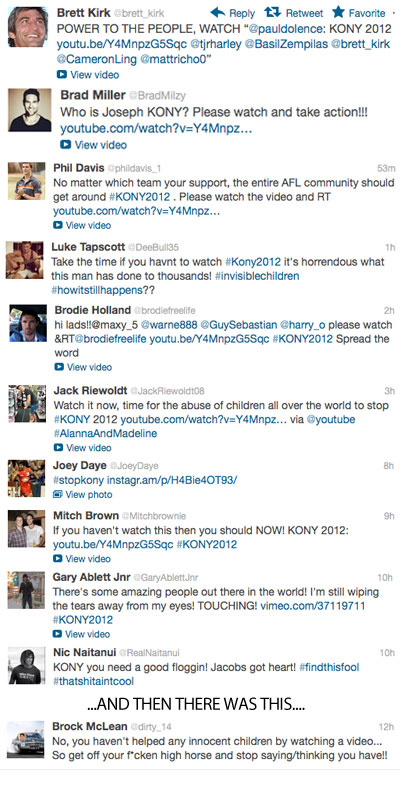
It’s easy to be cynical about the Kony 2012 video.  There is a painful lack of self-consciousness on the part of filmmaker and activist Jason Russell – a handsome white guy, culling together video he shot in Uganda in 2003 – as he uses his camera to preach the cause of ending African suffering, intercutting testimonials from escaped child soldiers with footage of his son Gavin.  The testimonials are blatantly manipulative, framed with swelling music and fancy editing tricks to underscore each child’s tears, particularly of a young boy named Jacob, he talks solemnly about his flight from being forced into combat by Joseph Kony and the Lord’s Resistence Army. 

nullThe video is a staggering viral sensation, at this point having been viewed over 70 million times on YouTube, but the conversation it has spurred has been, unsurprisingly, repetitive and stagnant.  Kony 2012 is the latest example of a public discourse caught in a cycle of perpetual feedback, from thesis to antithesis.  But rarely do we arrive at synthesis.  Rather arguments spur counter arguments, which only return to the same arguments, around and around, in what only looks like motion but is actually stasis.

Kony 2012 does little to explain the crimes of Joseph Kony.  The video, along with the NGO that produced it, Invisible Children, highlight the LRA’s use of child soldiers – between 30 and 60 thousand abducted and made to carry weapons since 1987 – a crime that still shocks despite our increased knowledge of it.  Beyond that though, the video does little but paint Kony as a Hitler-esque figure.  It notes his indictment by the International Criminal Court in 2005, but does little to explain the history and breadth of the LRA’s actions.  The group’s atrocities are well documented, and range from the ‘standard’ war crimes (mass murder, displacement, rape and sexual slavery) to more exotic charges, including cannibalism and hacking off the legs of those caught riding bicycles (which Kony, reportedly, believes to be the work of the devil).

nullThere is nothing particularly controversial about calling Joseph Kony a monster.  For 25 years, Kony and the LRA, a militant offshoot of other Acholi-nationalist movements in northern Uganda, have survived the tribal insurrections of the late 1980s due to the unwavering fanaticism of its leader and his willingness to commit the most brutal of atrocities. The LRA is sponsored by no government, and adheres to no pre-fab revolutionary ideology; its cult is strictly of Kony’s personality, which blends tribalism with a mystical Christianity (he believes in the literal protective power of crucifixes and holy water).  Joseph Kony is not a genocidal dictator, he is a fanatical strongman who has carved out his fiefdom the way fanatical strongmen always have, with unrelenting barbarism. 

The most the most glaring problem with Kony 2012 though, and Invisible Children as a whole, is that it equates awareness with action.  Invisible Children is dedicated to aiding in the arrest of Kony, a goal they hope to achieve this year by raising public awareness – turning him into a celebrity on par with IC backer George Clooney – to the point where we the people demand his capture.  Being aware of a problem does nothing directly to alleviate it.  It’s not as if the ignorance of Americans is the binding constraint on ending suffering in the world.

Invisible Children is sketchy when it comes to advocating further policy.  They clearly favor continuing the commitment of 100 American military advisors in Uganda to aid in hunting for Kony, but it is not clear if they favor further military intervention (which after the Iraq quagmire and our current military commitments is a non-starter).  IC wants Kony brought before the International Criminal Court, but the biggest constraint on that organization is the lack of US participation in it (does IC favor the US finally ratifying Rome Statute, or is that too partisan a demand?).  These would be concrete steps – incomplete, possibly problematic ones – but they would be action.  Making Kony famous is almost entirely passive beyond the clicking of the ‘share’ button.

null

Kony 2012 has, naturally, been met with a torrent of criticism.  Invisable Children has been accused of shady business practices, as they refuse to open their books to auditing.  At the Foreign Policy website, Michael Wilkerson points out that the LRA’s strength has been greatly diminished (it’s numbers are estimated in the hundreds), and that they are no longer operating in Uganda, but roaming between southern Sudan, the Democratic Republic of Congo, and the Central African Republic (where they do continue to commit atrocities).  Yale Law professor Chriss Blattman writes that “There’s something inherently misleading, naïve, maybe even dangerous, about the idea of rescuing children or saving of Africa.”  And Kate Cornin-Furman and Amanda Taub, writing for The Atlantic, decry the arrogance of Invisible Children thinking they “can solve war crimes with wristbands” (which come with Kony 2012 activist kit, available for the low, low price of $30).

But these criticisms also lack any solutions-based thinking.  (The closest they come is to point out the perils of US involvement with governments with spotty human rights records themselves, and that the best answer may be local.  But if the governments of Uganda, Sudan, DRC and CAR could apprehend Kony, they would; no government in that region has been able to claim full sway over their territory since the days of Idi Amin.)  Rather the criticisms are calls for acknowledging the complexity of the situation.  And surely the situation is complex, but acknowledging that is again not a form of action, but another attempt to raise awareness.  And while full consideration is never bad, complexity must also be understood as something of a construct placed on the situation.  For those forced to the ground, or faces slashed, or hands forced to carry weapons, the situation is fear and pain, and those feelings are quite basic.

****

On the same day that the Kony 2012 video was posted, March 5th, US Attorney General Eric Holder gave a speech at Northwestern Law School on the legal justification necessary for carrying out targeted killings.  “Some have argued that the President is required to get permission from a federal court before taking action against a US citizen who is a senior operational leader of al Qaeda or associated forces,” Holder said.  “This is simply not accurate. ‘Due process’ and ‘judicial process’ are not one and the same, particularly when it comes to national security.  The Constitution guarantees due process, not judicial process.”  That statement was meant to clarify the Obama Administration’s view on their legal power to use surgical drone strikes to eliminate non-military combatants.  Since drones were put into use in 2004, official numbers claim thousands of insurgent targets have been killed, along with between 400 and 800 civilians, at least 200 of which were children.  But the civilian toll could be much higher.  A 2009 Brookings Institute study estimated that for every 1 insurgent killed, 10 civilians were also killed.

If our idea of civilization can not tolerate the barbarism of Joseph Kony, can it tolerate other forms?   What exactly does it mean to not tolerate barbarism?    

nullAt its heart, the Kony 2012 is a naïve-yet-earnest plea for justice to be done, which accounts, at least in part, for its popularity, which is.  While that earnestness does not have to be shared, it should not be dismissed either. Justice is an abstract concept, and we should all want more concrete ways to measure it.  Kony seems like a clear-cut case where justice could be served by his capture and prosecution, but how can we be expected to have productive conversation about justice when our institutional instruments are being bent to justify acceptable body counts for extra-legal operations?  Our standards for justice in our discourse have been warped, stunting our ability to take meaningful actions based on what is right and wrong in the greater world.

If there is a single problem in our discourse, it lies in what J.M. Coetzee called the “economistic bent” of our political language.  When it comes to discussing human life, we invariably fallback on the word ‘value.’  Not just when we measure the worth of a life against other life’s and interests, but also when we utter platitudes about all lives being of equal worth (or even that they are ‘invaluable).  Such words equate all human experiences, and turn empathy from an act of feeling and communication into something resembling exchange and commerce.  In Kony 2012, Russell presents his son Gavin as being a child “just like” the Ugandan Jacob, a claim that is absurd beyond basic biology.  Gavin enjoys immense privileges that Jacob could not begin to fully imagine.

That cuts both ways.  As Susan Sontag wrote in Regarding The Pain Of Others, “We – this ‘we’ is everyone who has never experienced anything like what they went through – don’t understand.  We don’t get it.  We truly can’t imagine what it was like.  We can’t imagine how dreadful, how terrifying war is; and how normal it becomes.  Can’t imagine, can’t understand.”  Maybe meaningful action is rooted in greater awareness, but it has to be an awareness of just how unaware ‘we’ really are. 

Louis Godfrey currently lives in Chapel Hill, NC. He is originally from Salt Lake City, UT, where he spent five years reporting on politics and court cases, before turning to writing on film. He also likes cats.

VIDEO: The story of BREAKING BAD, as told by its opening scenes, seasons 3 & 4

VIDEO: The story of BREAKING BAD, as told by its opening scenes, seasons 3 & 4

[Editor's note: The Press Play Breaking Bad intro compilation for season 3 is here. The season 4 compilation can be found here. Each episode of AMC's drama Breaking Bad starts with a prologue or teaser. Some of these advance the season's ongoing plot. Others feel like self-contained, at times experimental short films. We wondered: If you strung all of the opening scenes from the various seasons together in chronological order, would the show's basic narrative make sense? And, if people who had never watched Breaking Bad watched only these curtain-raisers, would they come away with a more or less accurate impression of the show? Or would it seem like a different program entirely? We asked Press Play contributor Dave Bunting, Jr. to edit the prologues together in chronological order to create two self-contained Breaking Bad movies, one covering Seasons 1 and 2, the other covering Seasons 3 and 4. Then we asked another Press Play contributor, Sheila O'Malley — who has never seen a frame of the series — to watch the two compilations and write down her impressions. Sheila was asked not to read any supplementary material before or during the experiment, and she agreed. Her written account is derived entirely from having watched Dave's compilations. Shorn of everything but its openings, was Breaking Bad still Breaking Bad? Read on and see. If you want to see exactly what Sheila saw, the prologues for Season 3 and 4 are embedded above.]

nullSeason 3 opens with a surreal scene of a group of people crawling in the dirt through a rustic Mexican village.  It seems that some well-known ritual is taking place.  Nobody seems too surprised at the sight.  A gleaming car pulls up and two men get out.  They are bald, handsome, and dressed in immaculate suits.  They are also identical twins.  Without hesitation, they join the ritual, lying down in the dirt, despite their silk suits, and crawling along with the others.  The destination is a run-down shack which has been built into some kind of shrine.  Inside there are lit candles with dripping wax and bouquets and skulls draped in beads.  The men in suits pin a picture up on the wall.  It is a sketch of the chemistry teacher.  Wherever we are in this opening scene is far from the sun-blasted streets of Albuquerque (the stomping grounds of the chemistry teacher), but it is clear that his fearsome influence is spreading.

Delving more and more into the backend machinations on the Mexican side of the border, Seasons 3 and 4 feature Mexican drug dealers, drug lords and drug runners, all far removed from the American scene, and yet connected by an unbreakable thread.  The identical twins have targeted some of their main competition in New Mexico, and the shrine is devoted to keeping track of those targets.  Not only is a sketch of the chemistry teacher up on the wall, but a photograph of the chemistry teacher's brother-in-law (who also happens to be a DEA agent) is added to the mix.  Both characters experience attempts on their lives over the course of the two seasons.  The situation is no longer local.  Mexico is coming in, and hard, the tentacles of the drug war proliferating.

Jumping around in time, we see how the chemistry teacher got hooked up with the young man whom we have come to know as his partner in the first two seasons.  In his time teaching chemistry in high school, the young man was one of his students.  As they begin to set up their partnership, the chemistry teacher orders the kid to buy an RV, which will be essential to setting up a private meth lab, as well as transporting the drugs.  The young man, who is clearly undeveloped as an adult, promptly goes to a strip club and spends almost all of it on strippers and Dom Perignon.  A friend of his, the drug dealer in the white track suit whom we saw murdered by the child on the bicycle in an earlier season, hooks him up with an RV (illegally, of course).

nullThis young man lives in isolation in a ratty room, spending most of his time playing violent video games, imagining his real-life enemies before him.  He dates a pretty young woman, who takes him to a Georgia O'Keefe exhibit.  He is singularly unimpressed, staring at one of O'Keefe's famous flower paintings and declaring,  "That doesn't look like any vagina I ever saw." In the car afterwards, they talk about art, and repetition, and she tries to tell him what he is missing in his interpretaion of O'Keefe's work. In this scene he is almost fresh-faced.  He kisses her gently.  You really see how far this kid has fallen when you consider that in most other scenes he is either jacked up on meth, buying gas he can't pay for and then trading drugs with the cashier to pay for it, or beaten almost beyond recognition.  There is a slow steady progression into hell with this character, and leaping around in time nails that point home.

We see the frightening poker-faced identical twins in flashback, two little boys playing in the yard, while their uncle looks on.  In a terrifying scene, the uncle pushes one of the boy's heads underneath the water in a bucket of beer beside him.  It is to teach his nephews a lesson.  The little boy almost drowns.  As the two boys crouch together staring up at their uncle, it is clear why they would grow up to be the demonic straight-faced killers that they become.
Out in the desert, the twins commandeer an isolated house, murdering the resident, and setting up shop, casually hanging out their clothes to dry.  A cop shows up to check on the resident who hasn't been seen in a long time, and they murder him too, hacking him to death with an axe.  The twins are moving closer every day, closer to their targets on the shrine wall.
nullSeasons 3 and 4 also deal heavily with the chemistry aspect of meth production (which is a propos seeing as how the opening credits sequence features a periodic table), as well as the ins and outs of running a successful drug dealing business.  A local Mexican restaurant in Albuquerque called Los Pollos Hermanos is a front, and freezer trucks filled with crystals hurtle across the desert, with armed men crouched in the back, their breath showing in the cold darkness.  Often these trucks are stopped by rival drug-dealers.  Multiple shoot-outs occur.  We also see the creation of the meth itself, characters in white suits and gloves moving the gleaming blue crystals along, bagging them up.  Later, we learn that this particular brand of meth is 99% pure, and industry-standard appears to be around 96%.  Others wonder what the secret is, how this meth can be so pure, and how it is done.  That 3% gap in quality serves to "up" other people's games.

The chemistry teacher finds himself deeper and deeper in the netherworld of crime and danger, separating from his wife and child even further.  His brother-in-law is shot by one of the Mexican twins, fulfilling the prophecy on the shrine's wall.  Both twins are killed by police in the aftermath.  The DEA teams up with the FBI and local homicide detectives, and so the chemistry teacher knows that his time is nearly up.  He meets with a gun seller and buys a gun with the serial number scraped off.  He knows how bad it will be if he is caught with such an illegal weapon, but he needs the protection.  Alongside of these scenes, we see him in flashback househunting with his pregnant wife, looking forward to a better and more aspirational future, even though he already has the cancer that is slowly killing him.

nullBut the chemistry teacher has been living in two worlds for too long. As Season 4 progresses, that separation becomes harder and harder to maintain

Breaking Bad has multiple visual references to John Ford's The Searchers, with its famous opening and closing shots of dark interiors with doors opening onto colorful desert vistas.  This has to be a deliberate choice, since those shots are so famous, and they are used so often here.  The Searchers is a story not only about a man's desire for revenge, but also racism and the deadly culture clash that existed in the old frontier West.  We may think we have moved on past those days, we may pride ourselves on being more civilized and enlightened.  But Breaking Bad, with its consistent nod to The Searchers in those visual cues, is a reminder that the same tensions exist.  The frontier in America is as wild and lawless as ever, and there is the same stark separation between darkness and light.


Sheila O'Malley is a film critic for Capital New York. She blogs about film, television, theater, music, literature and pretty much everything else at The Sheila Variations.

Dave Bunting, Jr. is a writer, musician and audio engineer, and a frequent narrator of videos for Press Play, The L Magazine and TomatoNation.