VIDEO ESSAY – MAD MEN Moments: The Lawnmower

VIDEO ESSAY – MAD MEN Moments: The Lawnmower

Part of the Mad Men Moments Video Essay Series

Click here to watch this on your mobile device.

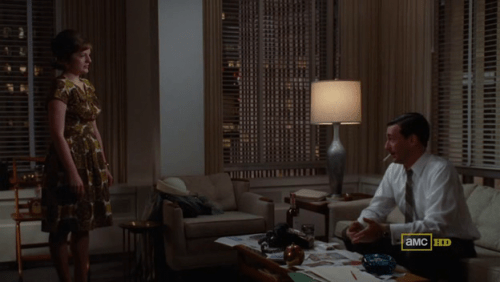
Our iconic moment of Mad Men season three easily ranks as one of the most shocking of the entire series to date. To explore it in depth, we adapted one of the best pieces we could find about the episode, written by Amanda Marcotte of Pandagon. This video is narrated by Roberta Lipp of Basket of Kisses and edited by Kevin B. Lee.
 

Amanda Marcotte is a Brooklyn writer who likes indie rock, quality television, and political blogging. She blogs at Pandagon. Follow her to Twitter

Kevin B. Lee is Editor in Chief of IndieWire’s PressPlay Video Blog and contributor to Roger Ebert.com. Follow him on Twitter.

VIDEO ESSAY – MAD MEN Moments: The Fight

VIDEO ESSAY – MAD MEN Moments: The Fight

Part of the Mad Men Moments Video Essay Series

Click here to watch this video on your mobile device.

There is near unanimous consensus that 4.07: "The Suitcase" is the standout episode of Season Four of Mad Men, so we knew that our video essay on a singular moment from that season had to come from that episode. But there are so many great moments in "The Suitcase:" Peggy's telephone breakup with her boyfriend (and her family), the scenes between Don and Peggy in the diner and the bar (where they express their mutual attraction as far as they allow themselves to); the confrontation with Duck Phillips back in the office; the early morning phone call; and of course the hand-holding. But for this video, we decided on the fight that erupts between Don and Peggy after she decides to devote her evening in the office with him on the Samsonite ad campaign. There is just so much to unpack in this swift, three minute scene, four seasons' worth of narrative and character subtext that has built up and finally explodes between them. What's also remarkable is how much of this is conveyed through subtle but effective choices in staging and direction, as we hope this video illustrates.

The script for this video essay is written by Serena Bramble, Deborah Lipp and Kevin B. Lee, based on "a kernel" of an idea by Serena Bramble. The video is edited by Kevin B. Lee and narrated by Roberta Lipp and Kevin B. Lee.

TRANSCRIPT

Don has received an ominous phone message about his dying friend Anna.

Telephone at his side, he is trying to bring himself to call.

Don is staged front and center, conveying a sense of isolation and confrontation with himself.

The framing of this wide shot emphasizes the distance between Don and Peggy.

The rest of scene goes back and forth between these two shots of Don seated on the couch and Peggy standing as if above him.

The staging highlights Peggy's newfound aggressiveness towards Don in this scene. She is emboldened by her breakup. He is weakened by Anna's imminent death.

The following dialogue plays like an exchange of blows that resonates with the episode's boxing subplot. It even lasts about the 3 minute length of a boxing round.

Don's response doesn't invite further conversation or empathy. It is action-based, in line with his past advice to Peggy.

Don’s smile betrays relief that he won’t be alone. He can put aside the call. But he conceals this by acting as if Peggy could easily have left.

The framing of Don on the couch has shifted left. A space has opened.

Peggy wants to finish the fight she started with Mark by taking on the man at the opposite end of what’s expected of her. Her insult of Don's personal life is as much towards herself as to him. The remark doesn't faze Don in the least.

Peggy's body now occupies the space to Don's left, further establishing her imposing presence.

Now it is Don who insults Peggy's personal life, patronizing her for being girlish. But Peggy, too, is unfazed. She jabs directly at what really bothers her.

Unlike with Peggy's insult of his personal life, Don takes this insult of his professional life as "personal" Don is ready to fight, if only to drown out the more painful feelings of grief. He can do it best where he feels most at home: the office.

The scene moves into tighter closeups of Don and Peggy as they exchange jabs with increased intensity

Like Cassius Clay in the prize fight going on that night, Peggy fights with sharp, rapid flurries. Like Clay’s opponent, Sonny Liston, Don is slower, methodical, and forceful.

Don's face is intensely red. He needs the emotional release of this fight as much as Peggy.

Peggy again seeks recognition, but now it’s not professional. It’s emotional. But showing emotions is unprofessional. She’s been caught with her gloves down. Don finally unleashes.

The knockout blow: one last insult encapsulating the conflicts running through the scene.

Serena Bramble is a film editor currently pursuing a Bachelor's degree in Teledramatic Arts and Technology from Cal State Monterey Bay. In addition to editing, she also writes on her blog Brief Encounters of the Cinematic Kind.

Deborah Lipp is the co-owner of Basket of Kisses, whose motto is "smart discussion about smart television." She is the author of six books, including "The Ultimate James Bond Fan Book."

Roberta Lipp is the co-owner of Basket of Kisses and is or has been a voiceover artist, improvisor, actor, singer/songwriter, blogger and Mad Men aficionado. She plans to produce a one-woman show.

Kevin B. Lee is Editor in Chief of IndieWire’s PressPlay Video Blog and contributor to Roger Ebert.com. Follow him on Twitter.

VIDEO – The Top Five Mad Men Moments

VIDEO – The Top Five Mad Men Moments

Part of the Mad Men Moments Video Essay Series

Click here to watch this video on your mobile device.

The Mad Men Moments video essay series is co-produced by Deborah Lipp, co-owner with Roberta Lipp of the popular Mad Men website Basket of Kisses. The site features a robust community of Mad Men fans, so we thought to poll them on their expert opinion on what the best moments of the series have been after four seasons.  Here are the results, with the selected scenes featured in the video above. Below are brief accounts of each scene written by several members of the Basket of Kisses community.
 

5. Peggy and Joan, (4.13: Tomorrowland)
This scene, full of small pleasures, takes off when Joan becomes Peggy's safe place on a bad day. “Whatever could be on your mind,” she purrs. – Anne B

4. Don and Peggy hold hands (4.07: The Suitcase)
If actions speak louder than words…if three years of previous build-up lead to one glorious culmination…that is the pinnacle of this episode's (and for that matter, this season's) denouement: never was a simple gesture so fraught with dimensionality of meaning as when Dick Whitman places his hand on top of Peggy Olson's. – Peg4Prez

3. "Open the drawer" (3.11: The Gypsy and the Hobo)
The Don/Betty game changer. Just when you think Don's about to run away with Suzanne, the woman of his dreams, Betty makes it crystal clear that he'll never outrun his past. It's shocking — in a good way — to see Don suddenly so helpless and small. – Andee Joyce, aka Meowser

2. "I Wanted Other Things" (2.13: Meditations in an Emergency) 
The writers’ words often carry several shades of meaning on Mad Men, and this is one instance. "Well, one day you're there, and then all of a sudden, there's less of you, and you wonder where that part went, if it's living somewhere outside of you, and you keep thinking maybe you'll get it back, and then you realize it's just gone." At first, we wonder if Peggy is talking about the baby, coming as it does on the heels of her confession. Then we understand she’s referring to her own feelings for Pete—she “wanted something different”. And then, a deeper echo of truth—there is a cost to moving forward, and it’s not just giving up a piece of the past. The weight of her words is crushing, almost cruelly made lighter by the tenderness of her touch across Pete’s shoulder as she leaves. – Mitch Virchick

1. Carousel (1.13: The Wheel)
Everybody loves this scene. Don’s pitch leaves the men from Kodak speechless. The scene serves the show, tapping into the right plot points, but what really makes it work isn’t on the screen. It’s our own set of life-shots, inserted into the projector’s circular slide tray, in our mind’s-eye. Brilliant! – SmilerG

Deborah Lipp is the co-owner of Basket of Kisses (hyperlink), whose motto is "smart discussion about smart television." She is the author of six books, including "The Ultimate James Bond Fan Book."

SIMON SAYS: Come Out to Pla-aaaaay: What Pop Culture Has Made of THE WARRIORS

SIMON SAYS: Come Out to Pla-aaaaay: What Pop Culture Has Made of THE WARRIORS

null
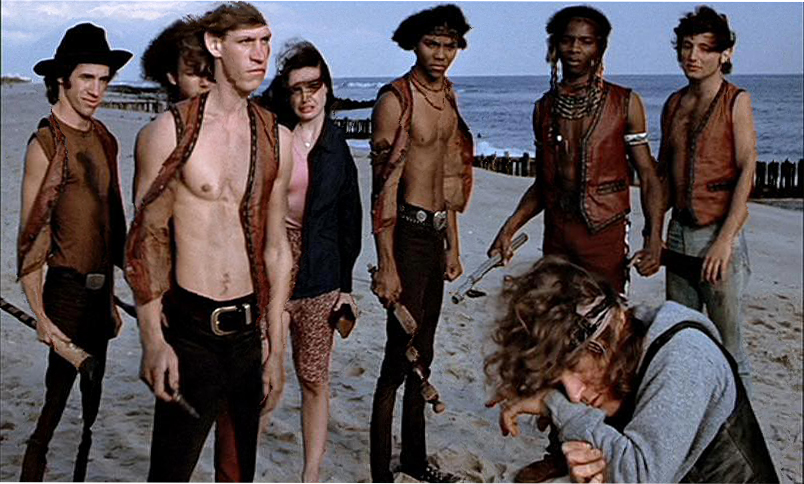
The pervasive influence of The Warriors on pop culture is pretty staggering. As an update of the Greek heroic epic Anabasis, Walter Hill’s movie strives for archetypal narrative simplicity. But like any good remake, The Warriors is also very much about its setting: a four-colored comic book caricature of crime-infested, Fun City-era ‘70s New York. The titular gang struggles to make its way back to Coney Island after an unprovoked attack suggests that they’re being stalked, but why is a mystery. The Warriors stalk through several of the city’s five boroughs, stopping over in the Bronx and Queens and then passing through Manhattan in order to finally end their long journey in South Brooklyn (Staten Island, as usual, stands alone).

So it’s interesting then to note that a new movie like The FP, an action pastiche directed by Brandon and Jason Trost that comes out this Friday. The FP, blatantly inspired by Hill’s movie, only selectively appropriates aspects of Hill’s film. The FP follows an escalating feud between two video game-obsessed gangs in Frazier Park, a small town in California. Both gangs claim to be the best at what they do and what they do is competitively dance against each other in a variation on Dance Dance Revolution. There’s no journey to get back home as in The Warriors however, in The FP, so the film’s colorful characters’ dispute is not the same as the turf-v-turf feuding at the heart of The Warriors. Because, really, The FP’s nerds are just fighting for control of a relatively homogeneous community.

But that lack of specific referentiality is pretty much par for the course, unfortunately. More often than not, references to The Warriors in pop culture, ranging from video games to rap songs, are more about the film’s costumes and catch phrases than they are about the milieu that gave birth to those costumes and catch phrases. I mean, granted, it’s a very quotable movie: iconic lines like “Can you dig it?” and “Oh, Waaaaaariors, come out and play-aaaaay,” have been sampled in everything from Wu Tang Clan’s “Shame on a Nigga” to the 1991 Sega fighting game Streets of Rage, the latter of which features a gang of baseball bat-wielding thugs who recall The Warriors’ Baseball Furies. Still, there’s something fundamentally off-putting about the way that many of these references reduce The Warriors to context-less sound bites. It’s almost as perverse as the way that Father Merrin’s ineffectual command, “The power of Christ compels you,” in The Exorcist has become a mantra for semi-jocular peer pressure. Um, you guys do remember that Max von Sydow’s character dies shortly after saying that line, right?

At the same time, there are some tributes to The Warriors that do get where their source of inspiration is coming from. I’m rather partial to the reverent set piece at the heart of actor/choreographer/director Seung-wan Ryoo’s 2006 actioner The City of Violence. Here’s a movie where a penitent gangster (Ryoo) and a police detective (Doo-hong Jung) reunite in their hometown of Onseong after a mutual friend dies at the hands of a big local gang. This gang is the crime world equivalent of an impersonal conglomerate, a point that’s driven home when their boss hires several smaller gangs to dispatch the film’s two resourceful protagonists.

This great fight scene, in a film full of great fight scenes, most successfully goes beyond the Tarantino-style of pastiche, where pop culture signifiers are divorced from their original context (The City of Violence’s last fight scene is, however, weirdly reminiscent of the orgiastic bloodbath at the end of  Kill Bill, Volume 1).

The street fight excerpted above is terrific, if only for the way it shows the various gangs—breakdancers, yo-yo slingers, field hockey players and more—converging on a single spot. Events only really come to a head in The City of Violence once all of these gangs converge on a single spot for a spectacular melee. So this scene is not the climax of the movie, but it is the plot’s critical tipping point. It’s fitting then that this scene also is the one where Ryoo pointedly and cleverly refers to The Warriors as a location-based action film. Everything comes back to Onseong, so naturally that’s where all the gangs converge.

But as long as I’m talking about The Warriors as a movie that makes burlesque out of New York City’s diverse, heterogeneous population, I should also give props to Fighting, Dito Montiel’s breezy 2009 modern-day-Rocky-in-New York. As a trenchantly New York-based filmmaker, Montiel is obsessed with self-mythologizing. For example, in A Guide to Recognizing Your Saints, Robert Downey Jr., who plays a version of Montiel, periodically interrupts the film’s story. In doing so, he both undermines and reinforces the veracity of Montiel’s autobiographical story of growing up in Astoria, Queens. So it stands to reason that Fighting, a movie about a young hustler (Channing Tatum) who participates in illegal street fights, should evoke The Warriors in its depiction of the colorfully partisan nature of New York’s various boroughs and neighborhoods.

To earn money, Tatum’s hero faces off with Latino gangs, Russian gangs and Asian gangs that are scattered throughout Montiel’s city. And as Tatum’s precocious meathead participates in more fights, it also becomes more apparent to viewers that these various race-based factions are united in their need to protect their respective territories. The Big Apple of Montiel’s movie has only cosmetically changed in the 30 years since The Warriors: it’s still very much a city defined by ethnic difference. Now if only we could get Spike Lee or Abel Ferrara to remake The Warriors….

Simon Abrams is a New York-based freelance arts critic. His film reviews and features have been featured in The Village Voice, Time Out New York, Slant Magazine, The L Magazine, The New York Press and Time Out Chicago. He currently writes TV criticism for The Onion AV Club and is a contributing writer at the Comics Journal. His writings on film are collected at the blog, Extended Cut.

VIDEO – Motion Studies #3: Falling: The Architecture of Gravity

VIDEO – Motion Studies #3: Falling: The Architecture of Gravity

For the next seven weeks, the Oberhausen International Short Film Festival will present "Film Studies in Motion", a Web Series curated by Volker Pantenburg and Kevin B. Lee. This series, available on the festival's website and Facebook page, presents weekly selections of analytical video essays on the web, in preparation for Pantenberg and Lee's presentation  "Whatever happened to Bildungsauftrag? – Teaching cinema on TV and the Web", scheduled for April 28 at the festival.

Press Play will track the series, posting four or five of the selected videos each week as they also become available on the Oberhausen Film Festival website.

This week is an initial sampling of exemplary works from the emerging genre of online video essays on cinema. Combined they cover a wide range of subject matter (a genre, a sequence in a film, a cinematic motif, a director’s body of work). They demonstrate a variety of stylistic approaches to the video essay form, using an array of techniques: montage and rhythm, split screens, narration, creative use of on-screen text, etc. These works, some of them conceived as multi-part series, are made typically on computers with consumer-grade editing software, but they display an ingenuity that is comparable to that of the films they explore.

Today's selection:

Falling. The Architecture of Gravity

Jim Emerson (2009)

The video essay at its most direct, eloquent and illuminating, by virtue of simple comparison and astute observation.

Volker Pantenburg is assistant professor for moving images at the media faculty of the Bauhaus-Universität Weimar. 

Kevin B. Lee is Editor in Chief of IndieWire’s PressPlay Video Blog and contributor to Roger Ebert.com. Follow him on Twitter.

GREY MATTERS: The Dark Turn of JUSTIFIED

GREY MATTERS: The Dark Turn of JUSTIFIED

null

Maybe I’m just touchy, or prone to over-reaction.  But I’m thinking there’s something about Quarles, Justified’s bleach-blond, Oxy-popping, batshit, gay-teen-torturing, Motor City gangster and all-around homosexual kill-freak that rubs me the wrong way.

Partially because he’s a huge step down from the peckerwood-noir magnificence of Margo Martindale as Harlan County’s crime matriarch, Mags Bennett.

But mainly because he’s a hateful creation that suggests the show’s creators trawled through all of American cinema and dredged up every repellant stereotype of queer mutation and threat and fused the results into one inarguably, impeccably well-dressed and well-coiffed sociopath named Quarles (Neal McDonough).

And as Quarles revealed himself, with bottomless self-pity, to be more queer-centrically worse than we’d ever imagined, with a  godawfulness that was a function of being queer, I realized that aghast was the only way to react to the new, suddenly appalling Justified.

The first question that comes to mind is why? Why did Justified’s staff need to dream up and feature this evil fuck-chop of regression?

My guess: Out of sheer, contemptuous, cynical utility. The season has been a listless bust.

Yes—the chewy nugget center of Justified, the it’s-so-wrong-it’s-right bromance between U.S. Marshal Raylan Givens (Timothy Olyphant) and jack-of-all-crimes Boyd Crowder (Walton Goggins) still sparked, but it sparked in something of a void.

Raylen’s life-love Winona (Natalie Zea) got pregnant, accepted him for who he was, and then dumped him. We learned that, without a woman to add vulnerability to his hard ass routine, Raylen often came off as distant, sour, or too cynical.

Elsewhere, we traveled to a trapped-in-time African American community called Nobble’s Holler where everyone dressed like Dexy’s Midnight Runners, run by a gnarly black godfather named Limehouse (Mykelti Williamson)who seemed perpetually on the verge of doing something epically badass . . . only to go back to cleaning pigs.  

A really promising plot strand involving black market organ harvesting from still-walking donors started, then petered out. The sole surviving Bennett, Dickie kept showing up like a persistant cough; I could never figure out why he was even in the show anymore.

And Quarles? He’s a Detroit mob enforcer who, while doing some Mob business, sees a way to cash in on the local Oxy trade. And to clarify: I was fine with Quarles for a while.

As played by McDonough, Quarles originally made an alternately terrifying and fun TV sociopath, Dexter in a Hugo Boss suit, another family man who switched between business, murder, and torturing people behind closed doors. He was fine as long as his monstrousness stayed behind those doors.

However, none of these things connected or built any narrative steam as the clock ticked on the basic Justified narrative: someone had to become sufficiently vile for Raylan to justifiably mete out frontier justice.

Thank god they had their own resident freakshow friend of Dorothy, someone to carry on the grand tradition of Peter Lorre as the barely human child killer in M,the queer-killing queer in Cruising, the incest-freak killer in Gladiator, the serial murderer of Silence of the Lambs, Big Love’s similarly impeccably dressed closet case.

One even imagines the head of the writers’ room assigning these films—and the hundreds more that came before them—as homework for the writers, inspiration for ways to make Quarles more terrifyingly gay.

Anyway, as the good ship Justified hit rough waters on the way towards its finale, the show pulled out its big gun.

One of Quarles’ victims grabbed and drew a gun on him. Quarles talked him down with a heartfelt, teary-eyed backstory of abuse, rape, and being forcibly whored out, and so on, all of it much worse because when all of that happens and it’s queer-based, well, man, that’s way worse. At least 65 per cent worse.

Of course, the boy ended up raped, tortured and dead at Quarles’ hands–Que sera—but now there’s no doubt what team Quarles plays for. Why do we need this detail? Because, once audiences know he’s a fairy on top of everything else, an alien, family-threatening, scary, seductive, anti-Leviticus queer, what else do we need to know? The writers count on audiences’ ticking the “no” box and move on.

Meanwhile, would the writing staff use a homo, boy-raping, whore-torturing, dope-fiend African American character?

No, that’s terrible. Plus, blacks have civil rights (technically). Gays, not so much, and if the election turns the wrong way . . .

Meanwhile, the writers’ choice betrays what’s really meant when the word “homophobia” is used. It’s what happens when what are probably entirely decent people try to concoct a TV bad guy and, when their imaginations are faced with an eternity of choices, the darkest, most horrible thing they can imagine is a homosexual.

Ian Grey has written, co-written or been a contributor to books on cinema, fine art, fashion, identity politics, music and tragedy. Magazines and newspapers that have his articles include Detroit Metro Times, gothic.net, Icon Magazine, International Musician and Recording World, Lacanian Ink, MusicFilmWeb, New York Post, The Perfect Sound, Salon, Smart Money Magazine, Teeth of the Divine, Venuszine, and Time Out/New York.

TRAILER MIX: A New Press Play Column

Trailer Mix: A New Press Play Column

These days, movie-trailer creation is largely a lost art, reduced to an easily-pegged formula akin to the one that gives us the John Carters of the world. But trailers and teasers remain key components of the way we consume cinema, and the rarity of true art among them makes it all the more necessary to scrutinize what these brief glimpses do—or don't do—to distinguish themselves. Trailer Mix will take a close look at a different film trailer every week, pointing out the highs and lows of its form and function. The shoddy will be skewered, the middling will be chewed over, and, hopefully, the transcendent will be praised.

            The latest U.S. trailer for Prometheus debuted on Saturday; however, as expected, it couldn't trump what's already been unfurled to promote this cryptic prequel to the Alien films. Though tonally similar to its ultra-savvy predecessors (a teaser and a TED Talk clip), the new clip seems comparatively diluted and compromised, inching, with every beat of its subbed-in, synth-rock soundtrack, toward convention that's otherwise been bucked.

            If you’re on the hunt for the finest trailers of recent years, your path will surely lead you to those that offer little narrative, splicing together scored imagery with minimal exposition (consider the previews for Little Children and Garden State). The initial, superior peek at Prometheus was cut from this cloth, and yet its impact was enhanced tenfold, for rarely have a popular film ad's briskly-edited shots been so stirringly evocative. Ridley Scott, the film’s director, promised that Prometheus would boast some Alien DNA, but more than mere strands showed up in the first teaser, and through glimpses of the original movie's iconography, legions of devotees were artfully enticed while newbies were roped in by a handsome enigma.

            Static appropriately opens this one-minute collage of ambiguity, but there's near-instant familiarity too: A spacecraft drifting into the frame is a signature shot of the Alien saga, and before one can even process that thought, the title starts materializing in telling, bone-fragment pieces. In tandem, dread and excitement are superbly mounted here, as what fans know and what they don't combine in pulse-thumping glimpses.

            The monolithic face (the movie's flagship image) remains unexplained, but this clip is otherwise flooded with elements first unveiled in 1979, including the horseshoe ship the Nostromo crew investigates, the telescope-like “Space Jockey” apparatus that's yielded decades of scratched heads, and of course, the nest-like tunnels and egg lair. That these visuals hold up, and fuse seamlessly with CG effects to be projected in 3D, is a testament to the enduring power of H.R. Giger's concept art and the original film's production design. In line with industry trends, Prometheus is partly driven by nostalgia, but there's an ageless aesthetic purity on display, made thrilling by its connection to franchise mysteries.

            It's not often that a film series can look to past breadcrumbs for whole new threads of plot. And if the aforementioned flashes aren't implication enough for how deep the movie goes into the Alien rabbit hole, look no further than the faux TED Talk clip that recently went viral, featuring a title-illuminating speech from Peter Weyland (Guy Pearce), the voracious bigwig behind Weyland Industries, which first sent Ripley and company off to LV-426. Weyland waxes egotistical about playing god, and without being explicit, peels back scads of narrative layers (shot independently of the film itself, the allusion-heavy scene serves as connective tissue between storylines). All the while, he stands in an arena that has the teaser's same throwback polish, the grayed vision of a commercial, screen-riddled space evoking Scott's Blade Runner.

            The newest trailer is another tool with which to sell Scott's return to sci-fi mastery, but with lack of novelty and diminished panache, it's missing its forebears' deft balance of new and old, which beckons while it bewilders. What the first clips offered, in stylish, first-rate fashion, was something both recognizable and very alien.

R. Kurt Osenlund is the Managing Editor of Slant Magazine's The House Next Door, as well as a film critic & contributor for Slant, South Philly Review, Film Experience, Cineaste, Fandor, ICON, and many other publications.

VIDEO – THREE REASONS: BATTLE ROYALE, a HUNGER GAMES for Grownups

VIDEO – THREE REASONS: BATTLE ROYALE, a HUNGER GAMES for Grownups

[EDITOR'S NOTE: Contributor Robert Nishimura's video series Three Reasons continues with Kinji Fukasaku's Battle Royale. He feels this film – a Hunger Games for Grownups – deserves release on the Criterion label.]

With Hollywood poised and ready to drop the next big book-to-screen adaptation on March 23, The Hunger Games will be the latest tween sci-fi/fantasy franchise to wipe moviegoer's minds of wand-waving witches and vapid vampires.  Frankly, if my editor hadn't informed me of this fact I would've been blissfully unaware of the whole thing.  I had no idea that Suzanne Collins had written a series of insanely successful young adult novels, thus dubbing her one of the most influential people of 2010.  I didn't know that Gary Ross had directed the film adaptation featuring a star-studded cast of younglings (plus Woody Harrelson, Stanley Tucci, and Donald Sutherland to make the film tolerable for parents). Fans of the novels had camped out hours before an early screening at LA Live, anxious to have the book retold to them. It has already broken records in advance ticket sales, beating out Twilight: Blah Blah Blah.  

I have no doubt that the movie franchise of The Hunger Games will be as insanely popular as the books. Whether we like it or not, the next three films are already in pre-production.  Lionsgate has tailor-made "youthful, edgy, exciting high quality entertainment," so it will be guaranteed to thrill and tantalize preteens across the globe.  Perhaps bows and arrows will come back into fashion.  Maybe the film will inspire some kids to kill each other, or in the very least grow wacky facial hair.  Now that I've been inundated with all the hype for The Hunger Games, I feel like I've already seen it, and not because the trailer spelled it out for me. 

The blogosphere was quick to point out the similarities between Collins' Hunger Games Trilogy with Koushun Takami's 1999 novel, Battle Royale, going so far as to call it a bold-faced ripoff.  Suzanne Collins admitted to never having heard of the book, nor has she read it since continuing the series.  So it goes without saying that Collins has never seen Kinji Fukusaku's film adaptation of Battle Royale, which will undoubtedly bare a striking resemblance to Gary Ross' The Hunger Games.  Both sources portray various degrees of a dystopian future, where teenagers are forced to fight to the death for the amusement of the government/home-viewing audience.  

Beyond that, it would be a waste of time to defend Battle Royale from plagiarism, since The Hunger Games has an entirely different set of cultural baggage, as well as being a disservice to countless other source material that deal with the exact same subject matter.  Collins just happened to tap in to the creative collective consciousness, drawing on ideas that have played out many times before, in addition to her intentional reference to Greek mythology.  There are elements of Orwell and Huxley at work here, but just enough to pander to its target audience.  The trailer for The Hunger Games focuses on defining the characters of Jennifer Lawrence, Josh Hutcherson, Liam Hemsworth, and the rest of the primped up cast, but showed me very little of what I'd really like to see: these pretty people killing each other.

Takami's Battle Royale is set in an alternative universe in which Japan was victorious in the Second World War, making it an authoritative world power.  It's the turn of the century, and society is falling apart with an economy on the brink of collapse, a rise in unemployment and in teen delinquency.  The government reacts by installing the Millennial Reform School Act (BR Act) as a means to thin out the numbers of juvenile delinquents.  Every year one 9th grade class is randomly chosen to compete in Battle Royale, forced into a game of survival in which there can only be one winner.  The unknowing selected class is then kidnapped, whisked away to a de-populated island, and each student is given a unique weapon, a map, and enough provisions to last three days.  Each participant is fitted with a metal necklace that monitors their whereabouts, exploding if they attempt an escape.  

As the game progresses, sections of the island become "forbidden zones," to keep the students moving closer to each other.  If you are caught in a forbidden zones your necklace explodes.  If there is more than a single survivor at the end of the three days, all the necklaces will explode and the game is forfeited.  If one person does survive he/she is allowed to return home, or in some cases, be allowed to play again.  To make things more interesting the BR Committee will plant "transfer students" in certain schools months before the class is selected.  Having these seasoned killers among the 40 student class helps speed the game along and forces the other students to play.  Takami's original novels reveals much more about this universe and the relationships of the students, whereas the film adaptation of Battle Royale very quickly establishes the setting and introduces this year's lucky participants, Shiroiwa Junior High School, Class B.

nullThe man responsible for selecting this year's class is Kitano (brilliantly cast with "Beat" Takeshi Kitano), who used to work at Shiroiwa Junior High School years before becoming the mouthpiece for the BR Committee.  His calm demeanor is especially off putting as he describes the rules to the game, pausing occasionally to kill a student to set an example for the rest of the class.  It's especially poignant to see Takeshi Kitano in this role since it would ultimately be Fukusaku's swan song.  Fukusaku had a long established career as a genre filmmaker, responsible for some of the most energetic and innovative yakuza exploitation films.  His crowning achievement could be the Battles Without Honor and Humanity series, known in the West as The Yakuza Papers.  

Takeshi Kitano's directorial debut, Violent Cop was originally intended for Fukusaku, who passed the film along to Kitano because he was too ill at the time.  A few years later, Kitano would (re)pay homage to Fukusaku's Sympathy for the Underdog (1971) with his film Sonatine (1993).  Kitano's films are largely indebted to Fukusaku and his generation of filmmakers.  Reaching the end of his career, Battle Royale brought Fukusaku back into the limelight, garnering several Japanese Academy Award nominations in addition to some well deserved controversy.  After 40 years in the business, Fukusaku still had the moxy of a young exploiter.  He managed to shoot only one scene for Battle Royale 2: Requiem (coincidentally, with Kitano) before passing away, leaving his son Kenta to complete the film in his father's memory.

In The Hunger Games contestants are chosen in pairs from various districts, some of whom seemingly have been training their whole lives to enter the game.  They are complete strangers to each other, the only attachment (as for the viewer) is purely physical.  The students in Battle Royale have known each other for years, and in some cases quite intimately.  This has a profound effect on the game and how it is played.  Some students try to form alliances to avoid any violence, while other students immediately start playing as soon as they leave the gate, desperate to to be the winner or seeking revenge for past grievances.  Most of the students are frightened beyond belief, questioning themselves and suspicious of even their closest friends.  The couple that we are meant to identify with are Shuya (Tatsuya Fujiwara) and Noriko (Aki Maeda), who now must confront their feelings for each other as well as frequent attacks from their fellow classmates.  

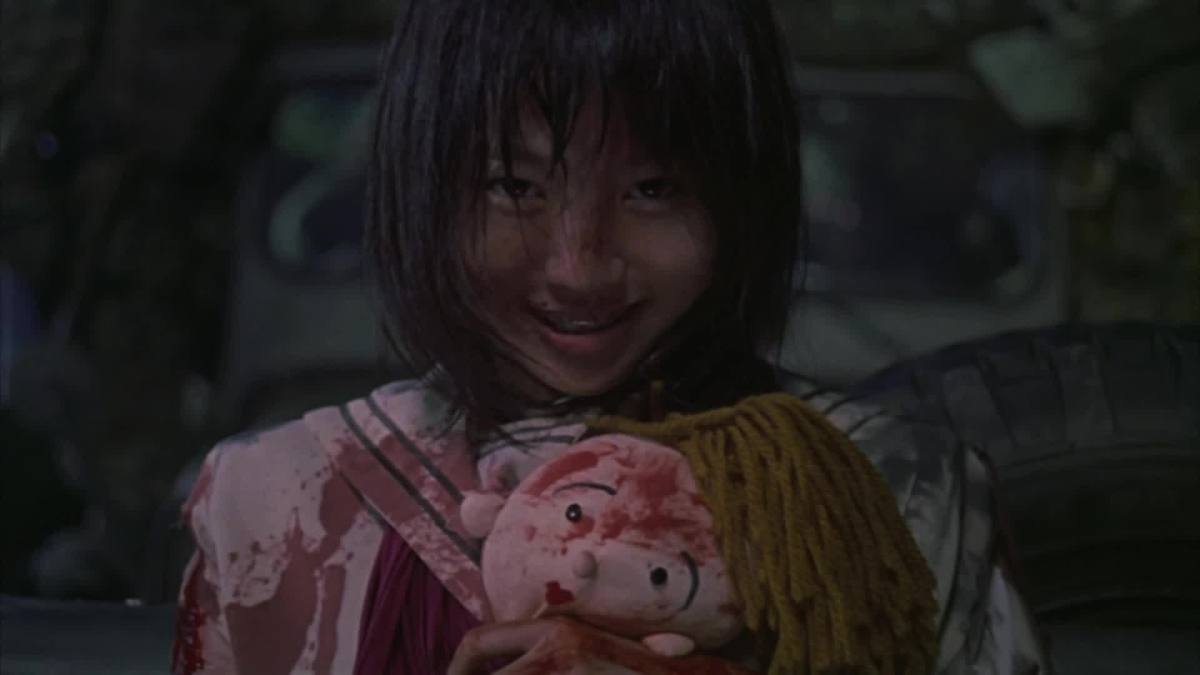
nullOne notable assailant is played by Chiaki Kuriyama, who basically reprises the the same role in Quentin Tarantino's love letter to J-sploitation, Kill Bill.  Fans of QT will recognize the tone that Fukusaku maintains throughout the film.  Realistic violence pushed to the point of absurdity, sometimes even cartoonish.  Shuya and Noriko witness all their friends (and enemies) unravel from fear and paranoia, either killing each other out of spite or suspicion.  As the student body dwindles away, they form an alliance with Shogo, one of the "transfer students" who had played the game before.  Together they devise a way to end the game and seek revenge on Kitano, who is surveilling them from the center of the island.

Contrary to popular belief, Battle Royale was never banned from US distribution.  The file was released soon after the Columbine incident, which wasn't the best time to be promoting a film that glorified killing your classmates.  Why the film hadn't be picked up since is the real mystery.  For years the film had garnered a cult following in the US, and still no distributor would touch it.  Even after Tarantino had given it his hipster seal-of-approval, he could have at least put it out under his Rolling Thunder label.  Criterion had already released David Lean's Lord of the Flies and Ernest B. Schoedsack's The Most Dangerous Game, so Battle Royale would have fit snugly betwixt those classics.  If only Criterion had picked up Battle Royale years ago it could've quite possibly saved us all from The Hunger Games.  

nullCriterion missed their chance to nab this title, and now that The Hunger Games have begun, another company has stepped up to finally bring Battle Royale to the US.  It would appear that my Three Reasons video is already an empty gesture since Anchor Bay is set to release the long-awaited special edition of Battle Royale 1 & 2 on DVD and Bluray, three days before The Hunger Games hits theaters.  It's loaded with features on Fukusaku's career and the impact Battle Royale had on cinema in Japan.  We can certainly trace the line from Battle Royale to The Hunger Games without too much difficulty, even though the film was never released in the US until now.  Its influence on Western cinema over the past decade has justified having our own kiddy-porn death-match. The level of violence in cinema has caught up to speed that we can now have our The Hunger Games, so it seems the US is finally ready for Battle Royale. For anyone who has not seen Battle Royale, it will not disappoint, but it may steal the "edge" that The Hunger Games is so desperately trying to project.
Robert Nishimura is a Japan-based filmmaker, artist, and freelance designer. His designs can be found at Primolandia Productions. His non-commercial video work is at For Criterion Consideration. You can follow him on Twitter here. To watch other videos in his "Three Reasons" series, click here.

VIDEO: Motion Studies #2: A Diary on David Holzman

VIDEO: Motion Studies #2: A Diary on David Holzman

For the next seven weeks, the Oberhausen International Short Film Festival will present "Film Studies in Motion", a Web Series curated by Volker Pantenburg and Kevin B. Lee. This series, available on the festival's website and Facebook page, presents weekly selections of analytical video essays on the web, in preparation for Pantenberg and Lee's presentation  "Whatever happened to Bildungsauftrag? – Teaching cinema on TV and the Web", scheduled for April 28 at the festival.

Press Play will track the series, posting four or five of the selected videos each week as they also become available on the Oberhausen website.

This week is an initial sampling of exemplary works from the emerging genre of online video essays on cinema. Combined they cover a wide range of subject matter (a genre, a sequence in a film, a cinematic motif, a director’s body of work). They demonstrate a variety of stylistic approaches to the video essay form, using an array of techniques: montage and rhythm, split screens, narration, creative use of on-screen text, etc. These works, some of them conceived as multi-part series, are made typically on computers with consumer-grade editing software, but they display an ingenuity that is comparable to that of the films they explore.

Today's selection:

Diary on David Holzman Part 1: The Sons and Daughters of David
Kevin B. Lee (2011)

This video essay links an under-seen 1967 American independent film with the current wave of reality TV and video blogs that pervade contemporary culture.

Volker Pantenburg is assistant professor for Visual Media with the main focus “Research of the Moving Image” at the media faculty of the Bauhaus-Universität Weimar. 

Kevin B. Lee is Editor in Chief of IndieWire’s PressPlay Video Blog and contributor to Roger Ebert.com. Follow him on Twitter.

Sculpting Away: An Interview with Willem Dafoe

Sculpting Away: An Interview with Willem Dafoe

null

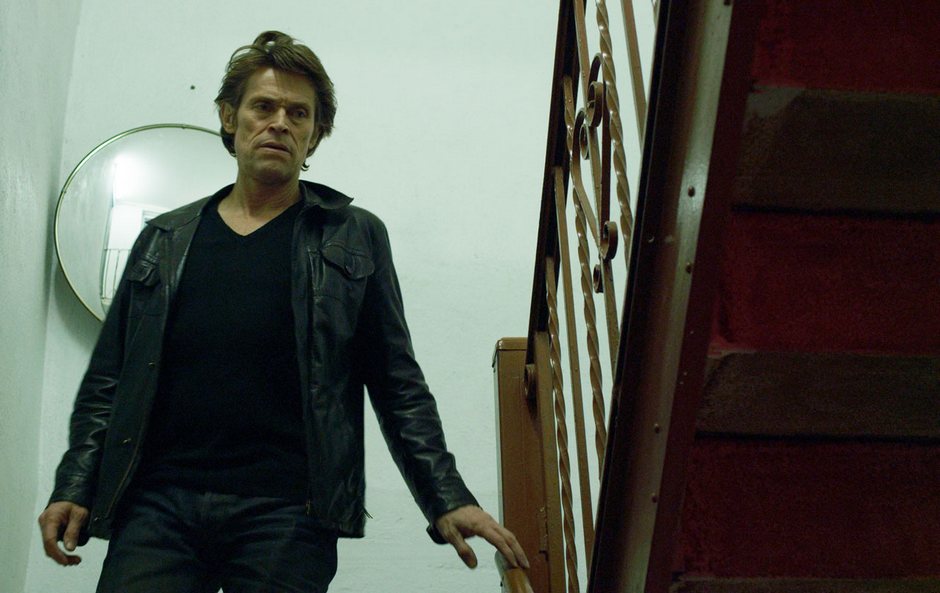
Willem Dafoe's versatility as an actor cannot be understated. His range as a performer is remarkable, and that comes across in a wide range of his performances, from his expressive turn as Jesus of Nazareth in The Last Temptation of Christ to his charmingly bombastic voice-acting performance in Fantastic Mr. Fox.

Dafoe is starring in a couple of new features now hitting theaters, like The Hunter, an upcoming eco-thriller, and 4:44: Last Day on Earth, a moving drama that will get a limited theatrical release starting Friday. In Last Day on Earth, Dafoe plays a man who has to come to terms with the fact that the world will end at exactly 4:44 a.m. I had the pleasure of talking with Dafoe at the 2011 Toronto International Film Festival about reacting to nature, and about how television is changing actors’ performance styles.

Which of the three films you have at the festival was the most rewarding to work on?

Oh, I never have favorites like that. It goes against my nature; even if I have favorites, I don’t admit them, to myself or to anyone else.

(laughs) Okay, let’s talk about The Hunter then. Had you read Julia Leigh’s novel before taking the title role?

I didn’t read it first. There was a script, and we had to get the script to a place where we wanted it. And I felt it was best to really identify the story we were trying to tell. Once that got to a place that felt good, then we could do the movie. They did an adaptation, cut out the story we were going to make.

Now you say “we,” I’m curious…

The [screenwriter], the director, and myself.

How did you refine the role? Did you do rehearsals or rewrites? What was your process?

In this case, all of those things. But certainly working with the dialogue, seeing what was necessary and what wasn’t. You sculpt away, because you tend to overwrite initially so you can identify what you’re interested in, but then cut it back to something more essential. Then, once you’re filming, that becomes your blueprint. And you make another draft during the filming.

Right. I’m curious because of the three films that I mentioned, The Hunter seems like the most intensive role. You’re not really consistently reacting to other actors; you’re mainly reacting to everything but other actors. You said you did research for the role. What kind of research did you do?

Well, first of all, I did have another actor to work with, and that was nature (laughs). I had to learn how to do all that stuff, bushcraft stuff, the law of survival and hunting. Also, in the script, there are things that I needed to learn how to do practically, so that when we were filming, I could do them gracefully and efficiently. But also, from the point of view of a character, it helps. Because when you learn something new, it always makes you adjust your point of view and your way of seeing things. That becomes the little crack through which you can enter the character sometimes. It’s really essential that I learn to do those things so that I have authority, and it’s fun, besides. I worked with old-fashioned trappers and kangaroo hunters and animals, and this very good survivalist who makes these beautiful snares. He taught me a lot about how to survive without anything but a knife and some string in the bush.

You don’t seem to be slowing down in the number of roles you take on. At all (laughs). I know you’ve said you don’t like to pick favorites when it comes to your roles, but do you have favorite collaborators?

I mean…(sighs audibly) My favorite collaborators are the ones that invite me to work with them over and over again. (pauses) I wouldn’t even say that, because there are some people that I’ve only worked with once that I’ve really enjoyed collaborating with.

Recently, this new movie of Abel’s [4:44: Last Day on Earth] is very good, I think. And that’s the third time I’ve worked with Abel, and each time, I think, it gets better.

I know you’ve also worked at least three times with Paul Schrader. What’s it like rewriting or going over your roles with him?

Well, it’s very specific to each film, but Paul is someone that works very efficiently. And because he started primarily as a critic and a writer, a lot is accomplished in the screenplay. He’s also usually working with a very tight budget so we tend to shoot quite efficiently. So the advantage of having worked with each other is that we have a understanding, and very little has to be explained or said. I remember the first film I worked with him on, Light Sleeper. Halfway through, he had barely talked to me. I remember we were starting up one day, and he came over and said, “Listen, you’re probably wondering why I haven’t said anything. It’s because you’re doing fine.” (laughs) He was right—if he was happy, I was happy.

Do you find the conversation that you have with more experienced or maybe even more established screenwriters or filmmakers is different than the one you have with new filmmakers?

Always, but I don’t categorically say one is better than the other because sometimes, people who have made films for a while start to get lazy, or get bad habits, or get stuck. And you can imagine with young filmmakers, some of the problems with them. They don’t, sometimes, have a history to hone their instincts. I think the more someone’s been working, the more they can skip to the chase. And there’s less talk, because they have a history of sensation. When someone is making something, they’re wide open. There’s a good part of that and a bad part of that. The good part of that is they’re usually passionate and really turned-on, but the bad part is that they don’t experience . . .

But I’m good with both. I remember Gene Hackman told me, when I was working on Mississippi Burning, “If you want a career, never work with a first-time director.” But I don’t follow his advice. (laughs)

Yeah, obviously! You’ve been working with a lot of first-time directors over the last couple of years, it seems. That’s a very trusting decision on your part.

It is, it is. But I think, as I’ve gotten older, I’ve been able to be more reckless with my choices, because practically speaking, you get less careful. Your choices become more instinctive, and you feel like if you make a mistake, it won’t destroy you. The irony is that, when you’re younger, you feel like if you do a bad movie, that’ll be the end. You never try to do a bad movie, of course, but if you’re worried about that, you can’t take the same kinds of risks or do things that are driven by your curiosity and passion.

You don’t seem to do a lot of comedic roles. I can’t recall one since Mr. Bean’s Vacation, at least.

Uh, Life Aquatic. There are elements of comedy in Spider-Man—huge elements of comedy. You know, that’s arguable. I think, generally speaking, no, I’m not a go-to comedy guy. But as I get older, more comedies are available. I’m not that attracted to comedies. I like seeing them, but a lot of comedies are broad, and they tend to cast comedians for them.

There’s a lot of broad comedy throughout your career, in films like Wild at Heart, which is just a spectacular performance and, as you mentioned, the Raimi films. And you have a real knack for it. Does it feel like a different experience when you go broad like that?

I don’t feel dimension (laughs). I’m not attracted to naturalism, I’m not attracted to behavior, I’m attracted to dance. I’m attracted to gesture, I’m attracted to singing with your voice, as opposed to having a natural manner. I’m a theater actor first, so that probably influences a lot of my approach. And I think in many ways, naturalism has ruined movies.

Could you expand on that a little?

I think film has taken a lot of cues from television over the years, although I often like understated performances where the actor disappears. I like that a lot. But this imitation-of-life stuff doesn’t always tap into what’s beautiful about the language and the poetry of film.

What kind of television do you feel is guiding the film industry?

I’m just saying that a certain acting style depends on close-ups and personality. Personality and psychology and literature, rather than poetry, space, light, dance. All the energy is going toward TV these days. It’ll shift back. TV is seductive but I don’t think it can do all of what film can do.

Simon Abrams is a New York-based freelance arts critic. His film reviews and features have been featured in The Village Voice, Time Out New York, Slant Magazine, The L Magazine, The New York Press and Time Out Chicago. He currently writes TV criticism for The Onion AV Club and is a contributing writer at the Comics Journal. His writings on film are collected at the blog, Extended Cut.