TRAILER MIX: SNOW WHITE AND THE HUNTSMAN

TRAILER MIX: SNOW WHITE AND THE HUNTSMAN

null

If Snow White and the Huntsman initially seemed like yet more fairy tale fodder (another film to push Hollywood's fantasy trend from comic books to storybooks), then the second trailer promotes the movie as a formidable CG spectacle, serving as a veritable effects reel for awards consideration. Given the sheer abundance of eye candy, it takes a moment to remember that this is not the Snow White film by wild visionary Tarsem Singh, but rather a Universal Pictures tentpole helmed by debut filmmaker Rupert Sanders. Epic battles, first-rate makeup, and a very nifty man in the mirror loudly convey that the studio spared no expense in the pursuit of visual pizzazz. Whether or not that will translate to actual quality is another story.

Unless you're considering a work by someone like David Cronenberg, an uncompromising filmmaker who cast Robert Pattinson in his latest effort, the trippy drama Cosmopolis, it's tough to regard films that headline Twilight stars as anything more than cash-hungry. While clearly committed to making the most of its budget, Snow White and the Huntsman waves a red flag, almost more so than Taylor Lautner's action mess Abduction. Kristen Stewart, who is confidently showcased as being “fairer” than great beauty (and wicked queen) Charlize Theron, is given nary a line in this extended clip, implying that the studio puts little stock in either her performance or her grasp of an English accent.

And it's probably best that the starlet largely remains silent, for what is heard here is a hokey string of catchy one-liners, an unfortunate staple of modern trailer creation. In general, Theron can’t do much wrong as an actress, but she's chewing the scenery like the Big Bad Wolf in this showy, nimble clip, calling to mind the histrionics of ABC's Once Upon a Time. “Let them come,” she growls as an on-screen battle starts to rage, her words implying that Universal doesn't much care about subtlety when it comes to courting audiences.

Perhaps the greatest concern introduced by the Snow White trailer is that the movie, at least as represented here, seems to lack an identity of its own. It may not resemble prior incarnations of the fairy tale, but its visuals appear derivative at nearly every turn. Theron's milky bath recalls the finale of the dreaded Queen of the Damned, her life-sucking powers mimic Bette Midler's in Disney's Hocus Pocus, and her bursting into blackbirds owes a serious debt to Madonna's “Frozen” video. It's evident that the film has polish to spare, but one would hope there's more up Sanders's sleeve than variations of established tricks.

Like most movie previews, what this glimpse does promise is that you'll get your money's worth at the multiplex, a notion supported by the expensive-looking shards that finally attack the sword-wielding do-gooders, in a scene that is most likely the film's climactic showdown (admittedly, this is the one effect that truly reads as innovative). But how many viewers are content with just getting the requisite bang for their buck? Surely they deserve more than one big pricey mirror, which looks to merely reflect extravagant magic that's come before.

R. Kurt Osenlund is the Managing Editor of Slant Magazine's The House Next Door, as well as a film critic & contributor for Slant, South Philly Review, Film Experience, Cineaste, Fandor, ICON, and many other publications.

VIDEO – Motion Studies #5: Variation on a Sunbeam

VIDEO – Motion Studies #5: Variation on a Sunbeam

From now through April, the Oberhausen International Short Film Festival will present "Film Studies in Motion", a Web Series curated by Volker Pantenburg and Kevin B. Lee. This series, available on the festival's website and Facebook page, presents weekly selections of analytical video essays on the web, in preparation for Pantenberg and Lee's presentation  "Whatever happened to Bildungsauftrag? – Teaching cinema on TV and the Web", scheduled for April 28 at the festival.

Week Two: Cinematic Techniques on Display

The video essay format has quickly shown its abilities to illuminate and critique the techniques of filmmakers in ways that surpass the reach of traditional text-based analysis. This selection of videos creatively engages with various films to reveal surprising insights into the many dimensions of cinema: cinematography, editing, sound, etc.

Today's selection:

Variation on the Sunbeam

Aitor Gametxo (2011)

A 12 minute D.W. Griffith short is dissected and rearranged into multiple spaces playing out in real time, providing a revelatory view of Griffith's approach to storytelling and space.

View all Motion Studies video selections.

Volker Pantenburg is assistant professor for moving images at the media faculty of the Bauhaus-Universität Weimar. 

Kevin B. Lee is Editor in Chief of IndieWire’s PressPlay Video Blog and contributor to Roger Ebert.com. Follow him on Twitter.

THE HUNGER GAMES: The Conversation

THE HUNGER GAMES: The Conversation

null

Now that The Hunger Games, the new film adaptation of the first book in Suzanne Collins's hyper-popular young adult book series, has raked in $68 million dollars on its opening day alone, it seems especially prudent to take a somewhat harder look at the film, both as a stand-alone work and as an adaptation. Below, Ian Grey and Simon Abrams discuss the film, which is set in a futuristic America comprised of twelve districts barely held together by a fascistic central Capitol. The Capitol residents hold an annual event called the Hunger Games, a gladiatorial contest where 24 contestants, 12 girls and 12 boys chosen at random from 12 districts, fight as a means of humiliating the residents of outlying districts. Katniss Everdeen (Jennifer Lawrence), a plucky fourteen year-old who's developed survival instincts by illegally foraging for food in the forests surrounding District 12, volunteers to take her younger sister Primrose's (Willow Shields) place in this year's Hunger Games. With the help of fellow contestant Peeta Mellark (Josh Hutcherson) and their hyper-cynical mentor Haymitch Abernathy (Woody Harrelson), Katniss fights for her life while everyone in the Capitol and the outlying 12 districts watches.

Ian Grey: I think The Hunger Games does something conceptually radical—it’s the first CG-lite blockbuster pastoral. Otherwise, I liked-not-loved this first table-setter. The set design was a fun mélange of Starship Troopers and American Idol. Capitol's people were a properly daft mix of Lady Gaga fans and Ziggy Stardust's band and Gaultier ala The Fifth Element. Lenny Kravitz makes an unexpectedly winning Cinna and Woody Harrelson's liquored up Haymitch is even better. And, you know, there’s Jennifer Lawrence.

A big critical complaint is being slapped at the hyper-editing style used during the opening scenes of District 12 as Walker Evans-style Appalachia. I'm fairly certain the style was used because it leaves you with no choice but to pay close attention.

Another problem I'm willing to forgive Ross has to do with some blurry action scenes. I assume this has to do with the MPAA, outed recently as morally insane for giving a life-saving film like Bully an R, and who no doubt gave Ross endless notes on how to more tastefully slaughter teens.

But every time Ross' action got wonky or his pace meandered, his character love sold me on the movie. There was Katniss tucking in Prim's clothes. The strange wound erotica when Katniss and Peeta attend to each other in the cave. Or Cinna's sole vanity, his lovely thin golden eye shadow. And those extreme close-ups to Lawrence's lips to show her controlling her breath/herself before shooting an arrow.

And please, T-Bone Burnett and James Newton Howard's soundtrack? The way it eased from full-blown Dvořák-like romantic cues to eerie Glass-ian arpeggios to rust-bucket

Americana? Amazing work. And there's that 2001-level jump-cut that's officially Occupy's first cinema moment.

And Jennifer Lawrence. As they say, out of the park. There's a scene where she thinks Peeta has betrayed her and her rage is so violent you don't only fear for the boy's physical well-being, you feel the accumulated rage beneath Katniss' 16 years of deprivation. Like Ripley in Alien, she represents an entirely new way of thinking about women in films. For that alone, The Hunger Games is an instant classic.

That duly noted, there were things I thought simply wrong, miffed or unrealized. But that's enough for me for now.

Your turn, kind sir!

Simon Abrams: Et tu, Ian? I was sure that if anyone would get why I intensely disliked the movie version of The Hunger Games, it'd be you. The critical tongue-bathing that this movie is getting is fairly intimidating, even downright disheartening. It's sort of like when Iron Man came out and was hailed for having a semi-distinct personality rather than for its quality, or lack thereof. I can't discredit director Gary Ross as the sole reason for this new adaptation's consistent mediocrity. Collins herself co-adapted the film's screenplay along with Billy Ray (Shattered Glass, Breach), a writer/director I quite admire. But honestly, while I agree that Lawrence did deliver the goods, I find most other aspects of The Hunger Games to be sorely lacking. And like you, I dig Collins's book! I wish I could say the same for this new adaptation.

Firstly, as you anticipated, the use of violently shaky handheld cameras really bugged me. I'm specifically talking about the establishing scenes in District 12 before the Reaping, the moment when Katniss takes her sister's place. In the scenes where we see the mine workers of district 12, their hard-working wives and, uh, soil-tilling children (?!), Ross's shaky cam-work violently makes us feel like looking at working class people is punishment. Once in the Capitol, protagonists are treated like hamburgers in McDonalds commercials: they're fetishized to the point where they look beautiful. There's lots of negative space behind them, they're shot in only the most flattering close-ups and they're just generally purty-looking. So in spite of the stupid and garish-for-garish's-sake costumes of your average Capitol resident (Versailles by way of Clown College), Ross tacitly accepts that people just look better in the Capitol. This is problematic, to say the least, because spectacle is supposed to be an inherently stigmatized aspect of The Hunger Games.

Then again, Ross makes the scenes of violence during the actual games so joyless and anti-spectacular that I also kind of hate him for doing what he was supposed to, albeit in a more a creative way. Ross goes so overboard in denying his audience the relatively simple pleasures and horrors of watching kids we care about die that he zealously cuts the legs out from under his own film.

But again, Ross isn't the only one to blame, really. Collins and Ray don't follow through on a number of crucial plot points. One of the reasons why the act of being watched is so crucial to The Hunger Games is that Katniss knows she's participating in a spectator sport and must win the crowd over in order to attract sponsors that can give her food, medical supplies, weapons, etc. This is most apparent in the scene where Haymitch (Woody Harrelson) sends Katniss a care package of soup with a note that says, "You call that a kiss?" The soup is Katniss's reward for giving the games' viewers a spectacle. She kissed Peeta, the boy that's already won viewers over with his earnest displays of affection for Katniss, and has been rewarded for it.

In the book, Katniss doesn't know whether Peeta is faking it or not, though, so she is constantly wary of his advances. That aspect of their romance is not in the movie. In fact, after Katniss smooches Peeta some more, it's just understood that their romance is genuine, even if it falls apart in the book. That real-or-fake aspect to Katniss's romance with Peeta isn’t followed through on in the movie, making it a fairly dismal and dimwitted entertainment.

Ian Grey: First, Katniss's ambivalence towards Peeta has not been exnayed for the movie version, even if it's not as agonizingly nuanced as in the book.

But still, what we get are one highly qualified kiss, and another to help save Peeta's life. And afterwards Katniss rolls away in the dark.

This is not exactly love's battle's won. As Ross has chosen not to do a voice-over, the only way we can see Katniss’s ambivalence is through actions. But even now, she remains true to the books' essence of Everdeen.

The essence, Simon, is still there. Love was nothing she looked for or wanted. After Peeta declared his affection, Katniss very nearly clocked him. That Katniss is still here and we'll be seeing her in the next film. Yes, she's holding his hand. But that parting overly-glow-y smile? I don’t buy it. She knows there are cameras everywhere and that Prim and her mother’s fate depend on her ‘performance’. The smile is for them.

As for the matter of critical reception, I shielded myself, so I was, for once, a virgin regarding something.

I'm confused about the problem you have with Ross' class system, in which "Ross tacitly accepts that people just look better in the Capitol."

Dude, they're RICH! And without taste. That's the entire point of them–and of Cinna.

Look at this in real world fashion terms. The Capitol citizens are like coked out 80s Upper East Siders  bonkers onmanhandled Mugler, Sproise and Johnson. Despicable but fun to watch, in a zoo-ish kind of way. Their couture trashiness establishes that it's money, not style, art or beauty, that drives the Capitol. (Alas, Ross completely omits Collins’ concurrent fashion fascism critique.)

Anyway—who are the ugly Citizens’ opposite number?

Cinna. With his understated elegant blouse, his gold flecked eyes, his hopeless adoration for an impossible charge. He literally—in the book and in the film—fights spiritual and material ugliness with material and spiritual beauty.

That black fire-retardant chic totally worked for me. Ross and his fashion and CG team totally pulled it off. Respect.

When you say "Ross makes the scenes of violence during the actual games so joyless and anti-spectacular," I have to stop you here. I know you know that Collins' Dad was a Vietnam war vet, that the books were written out of a seething hatred of war and everything it touches.

Ross worked hard to escape that war movie paradox, that even antiwar movies are so exciting they become recruitment pictures. Not here. Ross' war is ugly and pitiful..

Simon Abrams: Your argument about Katniss and Peeta is mostly reliant on the assumption that there's a subtle but visible intelligence motivating Ross's direction. To put it bluntly: I don't think he's that clever. And because neither Collins nor Ray works to explicitly suggest that there's a disingenuous element to Peeta and Katniss's relationship post-Hunger Games, I don't buy the whole "smile for the camera" argument either.

Also, the movie's presentation of Katniss and Peeta's relationship is more inconsistent than you've suggested. For instance, during pre-Games training, Peeta abruptly decides to train alone with Haymitch. This surprises Katniss in the movie, but in the book, she just assumes Peeta wants to work on a new strategy privately. He is an opponent, after all. But in the movie, we don't see Katniss even consider that maybe Peeta's just doing what she was doing a few days earlier: trusting nobody and scheming to stay alive. So in the movie, Katniss looks doe-eyed and confused when Haymitch announces Peeta's private final session. What happened to the independent, calculating and openly wary young heroine we saw a few scenes ago?

 And as for the inarguably stupid-looking costumes that the Capitol residents wear, it's too easy to go over-the-top with these characters. The film's righteous characters are always unadorned and simply dressed, whether they're Cinna or Katniss. I mean, Cinna only gets along with Katniss because he supposedly can judge her character based on her actions. But even that nonsensical cop-out logic doesn't apply to the Capitol residents. Consider the blunt contrast Ross, Collins and Ray draw between the film's simple/good characters and the more flamboyant/evil Capitol residents. The Capitol is represented by Caesar Flickerman (Stanley Tucci), the Games' announcer and the Capitol's hammy version of Bob Costas. The Capitol's absurdly decadent nature is driven home with all the grace of a sledgehammer by Caesar's hokey, theatrical commentary alone. So why then do we also need his hair to be made-up in that stupid blue bee-hive hairdo? That kind of camp may be intentional (it's in both the book and movie). But that doesn't mean I'm groaning with the moviemakers when I'm looking at it projected on the big screen.

The same goes for Ross's deadly earnest "war is hell so it should look like hell" ethos. The desperate hyper-realism inherent in that kind of violently shaking camerawork doesn't convince me that what I'm seeing is any more intense or violent. It's a textbook example of shortcut storytelling: Ross wanted to get a point across quickly and efficiently so he did it in the most direct way possible. The emotional stakes in this film don't really seem to matter, either. Even Katniss's interactions with Rue (Amanda Stenberg), the young Games contestant that she bonds with because Rue reminds Katniss of her sister, felt canned and lifeless. This movie’s three main architects all obviously know what they need to emphasize but are ultimately stumped as to how to do so.

Ian Grey: With all due respect for what you’re arguing about, regarding whether or not Ross has the skills to pull off the nuance of Katniss’ romance or lack of it with Peeta—forget the books. As much as you can, forget them.

It’s impossible, but especially now, I can’t do a book/movie battle. I could talk about how much richer Woody Harrelson’s Haymitch is than Collin’s broad comic relief confection. I could also talk about Kravitz’s gravity as Cinna (man-crush alert!) and I could complain about how they downsized the other Tributes to mere canon-fodder (at last a literal description).

Point is, I need to think about the film.

May I suggest we start with not agreeing about Ross’ war work?

What’s up with your sour grapes about the “deadly earnest "war is hell so it should look like hell" ethos”?”

I mean, is that unhip? Should war look groovy? What’s undesirable about a movie that thinks war is filthy, chaotic work done out of desperation at the bidding of morally insane monsters?

And your claim that “The emotional stakes in this film don't really seem to matter, either” is a real head-scratcher. Katniss’ entire universe circles around Prim—and so in what universe would she not transfer her feelings to a dear, small,Prim-like creature like Rue? “Canned and lifeless”? It takes two to tango.

And what follows Rue’s awful death, a death of two girls, by the way, to double Katniss’ reflecting agony, is for me, one of the greatest film experiences of my life, so when you trash it, respect that.

For me, this scene IS The Hunger Games, distilled. (It’s also Occupy’s National Banner, in images and sound.)

It’s where the film soars and Ross—who’s often all-thumbs—finds the place where subtext becomes syntax and then the only working currency in the frame.

Against Howard’s eerie Glass-on-Eno funereal thrum, Katniss prepares Rue’s body with flowers. The music and the low camera looking at Lawrence’s ruined-heart face…everything keeps building, the festering wound sun and inhumanity and that insistent music and then a jump cut to Rue’s District and the enraged crowds are tearing down the monitors that show the Hunger Games and they’re trashing barriers and attacking Peacekeepers and… Ross and Collins are saying, screaming, that a human life has worth. That sometimes one death can be one death too many. It’s what history is based on.

Simon Abrams: I wish I agreed with you, Ian. This movie fails as both an adaptation and a stand-alone film in general. You can forget the books all you want. I'm referring back to them for the sake of pointing out that Collins was more thoughtful there about themes and plot points. Even if the books didn't exist, there would still be crucial ideas that were misconceived in the movie. But the books do exist and I think that's a very good thing. Because I wouldn't care about The Hunger Games if its source material didn't exist.

With that in mind, let me address your dislike of my dislike of the abhorrent use of shaky cam. A visual aesthetic is not a mandate to replicate reality. People came to see The Hunger Games to be entertained, yes? But there are ways to get across a semi-complicated view of violence, one that reflects intensity in a visually exciting way, other than making it visually incoherent. I am not at war, I am in a movie theater. So unless Gary Ross has suddenly turned into Gaspar Noe, I don't think it's a good or especially interesting thing that The Hunger Games looks ugly. Again, the use of shaky hand-held camerawork is just a cheap means of making violence look immediately violent. It doesn't allow spectators the pleasure of realizing for themselves why the violence they're looking at is so deplorable. 

Which is why I brought up Rue. Yes, I know her death is supposed to mean something. But I felt nothing when it happened. Had Ross, Collins and Ray done their job well, I would have gasped when Rue died. 

You point to the moment where Katniss puts flowers on Rue's body as a moment of intense sadness but I could just as easily point to it as another shortcut. You want to show me Katniss mourning Rue's death? Show me her running and thinking about Rue. Show me her talking about Rue to Peeta. Earn my tears with something other than cheap flowers and a dopey riot.

Again, the Hunger Games's moviemakers just didn't grasp the power of symbolic representation in their movie. Their film is all thumbs because it's all chintz.

Ian Grey has written, co-written or been a contributor to books on cinema, fine art, fashion, identity politics, music and tragedy. Magazines and newspapers that have his articles include Detroit Metro Times, gothic.net, Icon Magazine, International Musician and Recording World, Lacanian Ink, MusicFilmWeb, New York Post, The Perfect Sound, Salon, Smart Money Magazine, Teeth of the Divine, Venuszine, and Time Out/New York.

Simon Abrams is a New York-based freelance arts critic. His film reviews and features have been featured in The Village Voice, Time Out New York, Slant Magazine, The L Magazine, The New York Press and Time Out Chicago. He currently writes TV criticism for The Onion AV Club and is a contributing writer at the Comics Journal.His writings on film are collected at the blog, Extended Cut.

MAD MEN RECAP 1: A LITTLE KISS

MAD MEN RECAP 1: A LITTLE KISS

Megan knows about Dick Whitman.

Say what you will about this episode, discuss the meaning and the symbolism and the complexity and whatever else you like, but it all boils down to just one thing.

Megan knows about Dick Whitman.

nullLeaping into Mad Men after a long delay is a thrill, and I'm as eager to gobble down this episode as anyone. It's been agony, but all is forgiven after these two amazing hours. At the end of Season 4, the Surprise Marriage Proposal prompted an awful lot of people to say that Don would never have married Faye, because Faye knew his secret. I may be the only writer on Mad Men in all of cyberspace who didn't say, when Don revealed Dick-in-a-Box to Faye, “Well, that's over.” Honestly, I felt kind of stupid, like all the other writers had more insight than me. But I still couldn't bring myself to say it. It felt too simple, too much of an equation: This, then that, and therefore… That's not Matt Weiner's style.
So just a wee little bit, I feel vindicated. (A wee bit? Like Pete looking out a big window!) 

In Episode 4.10, Don said to Faye, “I'm tired of running,” and told her his secret. Then he said, “Now I think that’s over.” And now? Now he's decided it was a good idea. He really was tired of running, really was relieved when he thought it was all over, and despite his terror that day, despite his hand being forced, it seems it has become a decision. Eight months later we see him living the results.

For those of you keeping score, A Little Kiss* takes place May 30 through June 6, 1966, seven months after the Season 4 finale, Tomorrowland.

About Megan, Don says to Peggy, “You don't know her at all.” It almost doesn't matter why he says it; what matters is that he really does know his second wife, as he never knew Betty. And Megan knows Dick Whitman. She has a lot to learn about her husband, and she made a real miscalculation with the party, but he's given her the means to know more: something he never gave to Betty until she forced his hand.

Looking at the broader themes of this episode, let's start with babies. There are an awful lot of babies in this episode: Tammy Campbell is just off-screen, Kevin Harris gets passed around, Gene Draper is with his siblings (I guess now that Don has a wife, he's not afraid of having the baby along with the older kids), and there's a hint that Megan is next (Joan says it outright, plus Megan feels inexplicably sick—maybe it's morning sickness, maybe it's foreshadowing, maybe it's just a hangover—we'll have to wait and see). Does it symbolize renewal? Rebirth? Is it Matt Weiner winking at the audience since his series is "reborn"? We'll have to wait and see, but the motif is plain enough.

Thematically, we're looking at the interplay of work and domesticity. Consider: The Drapers come to work together, leave together, and finally, the show ends with a discussion of that intersection. Joan, coming to work with a baby, also provides a clear illustration of home and work intermixed. The visual references (couples at work, babies at work) open the door for a wide-ranging exploration. Joan misses work, and she doesn't even have the language to express that. She tells her mother she wants to go back to work because “I don't want to break my promise.” Like Peggy, I'm inclined to say “bullshit.” She wants to go back to work because it's interesting, and diaper rash just isn't. I've been there, honey.

Don is happy at home and nice to clients, while Pete is frustrated at home and surly at work, even in response to success. Lane and Rebecca are unhappy at home, and Lane is lost at work, missing Joan (who is something like his “work wife,” in the most positive sense of that phrase), fantasizing about having something, or someone, different. He refuses to allow money to be spent on pranks at work (but is overruled) and refuses to allow his wife to write checks (and isn't). Roger is miserable at home and increasingly meaningless at work. He's trying to buy his way out of emptiness. (He should try actually working and see if that's satisfying, but I may be asking too much.)

Two quotes encapsulate this theme: Trudy says to Pete, “This becomes a home the minute you walk through that door.” Later, Lane says to Joan, “It's home but it's not everything.” In truth, both work and home need to be satisfying, and when one is broken, it drags down the other.

Matt Weiner likes to start us in the middle, and teasing the audience into catching up. By making the party the centerpiece of everything, the episode accomplishes so much. It plays on the theme, as coworkers interact in a home environment. It sets a lot of the conflicts of the era: It's 1966, Megan is in a mini-dress. Look around the party and you can see the beginning of the “Generation Gap;” more than in past decades, people are dividing into age-specific groups (“key demographics,” Harry might say), and you can see it in the clothes, makeup, and dance styles. And it re-introduces most of the key players and their current situations. We hit the ground running, which is fun, without the structural tedium a re-introduction could have in weaker hands.

Rebecca: “Don't forget to get the name of Megan's real estate agent.”
Lane: “Yes dear.”

Rebecca: “And her decorator.”

Because that's what makes a happy home. Rebecca wants a piece of that happy marriage and that exciting life, and she's hoping the surfaces will somehow provide it. Lane is going for the surface too, falling for a picture in a wallet. Do you think we ever meet Dolores? I bet we don't, but that Lane has an affair with someone else. Dolores is like the mechanic that Betty encounters at the beginning of Season 2; the beginning of a sexual experiment, not its culmination. (Infidelity of a different magnitude than what Lane did while his wife was out of the country and when he believed his marriage was over.)

I haven't even talked about Pete. He is an inflamed cyst of dissatisfaction right now, and is also Don Draper minus ten years (and a lot of charm). He doesn't like the suburbs, he doesn't like the way Trudy has changed post-baby, and nothing satisfies, not even winning. Pete gets the client, he gets the bigger office, he even gets to successfully prank Roger, but none of it is the same as feeling good.

By the end of Season 3, it was hard to remember that Pete was very much the villain of Season 1, but after A Little Kiss, I feel confident that Pete Campbell's Bitchface will have plenty of material. My goodness, what a petulant little brat. Talk about "love to hate"!

There are a lot more subjects worth exploring in these two hours. In a little over a thousand words, I feel like I've just scratched the surface, and I'll be writing a lot more about this episode on my own site.

The racial subplot is going to become very important. I predict a new cast member, hired as a result of this improbable prank. Tanner Colby wrote a recent article in Slate about race, Mad Men, and Madison Avenue. He got the year wrong, but I think he got the trajectory right. Predictions?

Speaking of getting the year wrong, most people did. I've been saying since Season 2 that things won't continue to skip too far ahead, because Matt Weiner loves the sixties and doesn't want to see their end too soon.

A lot of money changed hands in a lot of different ways, and serves as a secondary motif, after babies and domestic life.

At this moment, I have no idea what the title means. Thoughts?

Don Draper is so sexually complex. I can't even.

No Betty this week. Don't forget they were working around January Jones's pregnancy.

*For the sake of cohesiveness, I'm treating A Little Kiss Part 1 and A Little Kiss Part 2 as a single episode.

Deborah Lipp is the co-owner, with her sister Roberta, of Basket of Kisses, home of "Smart Discussion About Smart Television," and the premiere Mad Men blog. Deborah has written six books, including The Ultimate James Bond Fan Book. She lives in Rockland County, New York with her son, two cats, and an assortment of unfinished projects.

VIDEO – Motion Studies #4: Godardloop

VIDEO – Motion Studies #4: Godardloop

For the next seven weeks, the Oberhausen International Short Film Festival will present "Film Studies in Motion", a Web Series curated by Volker Pantenburg and Kevin B. Lee. This series, available on the festival's website and Facebook page, presents weekly selections of analytical video essays on the web, in preparation for Pantenberg and Lee's presentation  "Whatever happened to Bildungsauftrag? – Teaching cinema on TV and the Web", scheduled for April 28 at the festival.

Press Play will track the series, posting four or five of the selected videos each week as they also become available on the Oberhausen Film Festival website.

This week is an initial sampling of exemplary works from the emerging genre of online video essays on cinema. Combined they cover a wide range of subject matter (a genre, a sequence in a film, a cinematic motif, a director’s body of work). They demonstrate a variety of stylistic approaches to the video essay form, using an array of techniques: montage and rhythm, split screens, narration, creative use of on-screen text, etc. These works, some of them conceived as multi-part series, are made typically on computers with consumer-grade editing software, but they display an ingenuity that is comparable to that of the films they explore.

Today's selection:

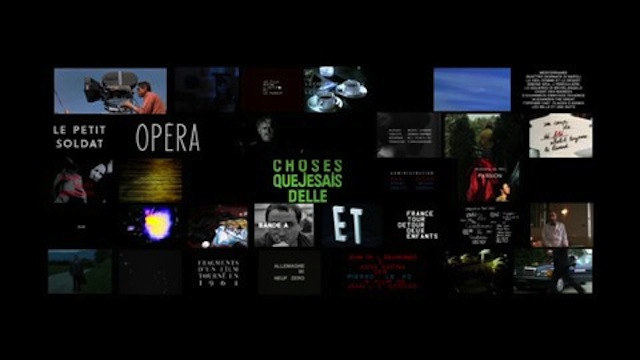
Godardloop


Michael Baute (2010)

47 films spanning 50 years of filmmaking are channeled into a stream of images that attest to an inimitable talent: an artist who transforms the world simply by how he looks at it through a camera.

Volker Pantenburg is assistant professor for moving images at the media faculty of the Bauhaus-Universität Weimar. 

Kevin B. Lee is Editor in Chief of IndieWire’s PressPlay Video Blog and contributor to Roger Ebert.com. Follow him on Twitter.

GREY MATTERS: A Defense of BATTLE: LOS ANGELES

GREY MATTERS: A Defense of BATTLE: LOS ANGELES

nullAfter the first time my interest felt forbidden, something to not share in smart company. But with my second viewing three months later, I realized my reaction wasn’t just a quirk of mood or contrarian impulse, or the film version of one of those inexplicable crushes that make your friends smile politely and count the days until sanity returns. 

No, I really, truly love the heck out of Battle: Los Angeles. And there are sound reasons powering my affection. For every knife the critics stabbed into the film–that it was a chaotic wreck of shakycam, Weed Whacker cutting, clichéd plotting, and even fascist subtext—I found an argument that not only answered these cavils but enriched my appreciation for South African director Jonathan Liebesman’s panoramic vision.

I don't expect to change minds or opinions—when was the last time that happened? But I know one thing and believe another.

I know that more than any film from 2011, Battle: Los Angeles barges through my defenses and just plain touches me in the same ways as Joss Whedon’s alternative family adventure, Firefly.

Meanwhile, I believe that all criticism is always filtered through, and colored by, the observer’s needs and desires. This is only an argument for aesthetic relativism insofar as it’s an argument from the gut that comes from living through the times when everyone agreed, no two ways about it, that Carpenter’s The Thing was an abject failure, that Mario Bava was a hack, and that Cronenberg was an artless freakshow dealer of literalized bio-erotic metaphors that just happened to happen at the peak of the AIDS epidemic.

And now we have Battle: Los Angeles, which is to Marines what Friday Night Lights was to football, and already I can see I have some ‘splainin’ to do, so here goes.

The POV character here is Staff Sergeant Michael Nantz (Aaron Eckhart). He’s about to quit active service as if in penance for a failed Iraq command where one bad decision led to the death of his entire, very young, squad.

While cable TV announces strange environmental irregularities, we meet a partying group of young Marines. They’re a racially mixed group, representative of LA’s Latino/black/white demographic. They all love the sense of belonging and service being a Marine provides.

Battle: Los Angeles (B: LA for short) offers a frighteningly pell-mell sort of invasion.

First, what look like canisters surrounded by smoke ring haloes fall on and obliterate a Navy destroyer. Liebesman sacrifices his own expensive/excellent beach-invasion effects so he can show a group of Marines watching and reacting to this on low res cable news broadcasts. Tokyo, not Manhattan, is the first city attacked. So much for American exceptionalism. The focus here is on the human reaction to the intrusion of wrongness into the everyday.

Nantz and a squad of freshmen Marines are given a mission: find whatever civilians you can before alien forces in LA are nuked in three hours.

What happens: Women and children are killed with no action-film taglines or Hollywood mercies in pitched battles with superior bio-mechanic alien forces.

By B: LA’s third reel, only an Air Force tech (Michelle Rodriguez), a veterinarian (Bridget Moynahan), a Latino named Joe (Michael Peña), and his small boy Hector (Bryce Cass) augment what’s left of the squad.

And as Joe dies of an alien-blast in Nantz’s arms, what “Marine” means—the simple notion of a branch of the US military united by Marine-specific, world-exclusive rituals–changes radically under the weight of Nantz’s guilt and the context of species extinction.

Nantz tells little Hector that his father loved him, that he has to be strong, that he needs him to be his Marine.

There’s no logical reason for this progression. But by now, we realize that “Marine” has already morphed from a traditional squad into a fluid Whedonesque alternative family group where a female Air Force tech with no field experience (Rodriguez’s character), a female veterinarian, a child, and a man (Joe)—the last three with no obvious military "worth" —now work as an effective combat unit according to their abilities and represent a stateless species patriotism. (I’m assuming the film’s lack of “USA! USA!”-style bellicosity helped with overseas box office.)

Eventually, our Marines manage to bring down a (not the) mother ship. Finally, they’re helicoptered to a functioning military base, are offered food and rest, and Nantz instead loads up on ammo. The others follow his lead. The war for the world continues.

It’s a realism-infused old school war story the critics largely hated because it was so old school. Never mind that nobody had seen this narrative style since Guadalcanal Diary, or that Drive’s hipster brand of ancient school noir-ness is celebrated (see: trend trumps quality). Or that the film plays with its own antecedents, as when a Marine jokes about one Marine’s brave actions, “That was some serious John Wayne shit!” which is followed by another’s meek question, “Who’s John Wayne?”

Otherwise, B: LA was universally and inaccurately despised for a shaky-cam style routinely compared to despicable, fun bloodbaths like  Gladiator, Black Hawk Down, and The Kingdom, where faux documentary shooting style comes off as the cinematic version of Tourette’s, meant to gin up verité on the creative cheap.

 B: LA has nothing to do with such low fare.  Liebesman’s mobile, subjective camera has the same intent as the Dardenne brothers following  Rosetta in the way his camera, once interested in a character, will not leave them, will stay with them like a guardian angel with OCD, or like Lukas Moodyson in Lilja 4-Ever, except with breaks where it pulls back to medium shot to observe the world around that character, to see what she’s up against. Or most specifically, Friday Night Lights

You can believe this last claim because B: LA begins with a hailstorm of FNL shout-outs.

Over Brian Tyler’s echoing guitar score theme, actionably similar (for three minutes) to W. G. Snuffy Walden’s FNL theme, we enjoy a FNL-like vibe of non-partisan Americana, even as the late-fortyish Nantz struggles to jog at his old pace on a setting-sun-lit beach. The camera mirrors his pains with a simultaneously rolling and halting gait.

Liebesmancuts to a young squad boasting and bullshitting, his camera excited, non-linear and lens-flared with youth, never just observing, always symmpathetic. (It’s around here that Liebesman stops with the FNL homage.)

When we meet a Marine (Jim Parrack) struggling with PTSD but trying to hide it from a shrink, Liebesman’s camera is discrete, occasionally showing clenched fists, or otherwise gently conveying tension. Even in the film’s most iconic, sci-fi-esque image, the slow, endlessly vast mother ship rising from the bowels of a ruined Earth, Liebesman keeps Nantz in the foreground, his focus on his men.

And so it goes. A director rewriting how you do this. Total character devotion. You’d think there’d be more love.

Meanwhile, here on Press Play, there a continuing discourse about “chaos cinema”, that frothy mixture of a shaky cam style B: LA doesn’t use, mixed with slapdash mise-en-scène and hyper-cutting meant to gin up excitement while disguising an ignorance of classic style.

This one is easy to disprove, courtesy of a sequence where Liebesman  does go full metal bedlam.  If what came before this sequence were nothing more than ‘chaos cinema’, this would be like adding more white to a paint mixture consisting of eggshell and ivory. Instead, it’s a gold standard nerve-wracker that shows Liebesman’s mastery in orchestrating multi-POV pandemonium and slowly restoring order.

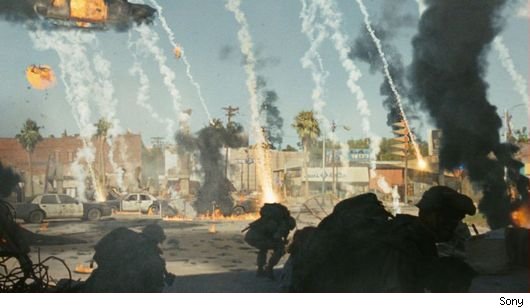
After investigating the smoky ruins of Santa Monica during a lull in the action, our Marines are attacked and Liebesman’s camera takes the role of battle victim, always falling, getting up, and tumbling, with no sense of left or right as alien energy weapons alight in the fog in flash frames, and the audio becomes a Murch-ian soundscape of ring-modulated screams and clatter, and we glimpse the occasional mecha-alien in chiaroscuro, before a Marine finds a safe house by sheer accident, and the film, by degrees, calms down.

Is this cut too quickly? Is Moulin Rouge? Within certain parameters, you just cannot quantity too fast or slow.

I loved Rouge. But I also loved the glacial non-pace of Nicolas Winding Refn’s Valhalla Rising. I’m also aware both spoke very directly to shadow parts of my own secret history, a thing defined by extremes of alcoholism-powered chaos and the bad quiet of madness. So are my assessments incorrect due to my biographical special needs? Or am I actually more attuned to certain velocities because of my history, and therefore a better judge?

What seldom gets questioned outside of academia is the fascism of Comic-Con-y action-hero cinema, the way we all bend over backwards for Iron Man, Batman, Superman. Part of the appeal is that we give it up to these, uh, men.

So it’s ironic that B: LA, the rare action film steeped in meritocracy, should be accused of fascist subtext.

The only explanation I have is that some Americans look at young people happily in uniform and fall into one of two traps, both occluding what’s on-screen.

It’s always been a Republican-pimped sell that liberals are anti-military pussies. This is bullshit except for the extremist fringes, where, especially during the lawless Cheney years, the creeps claimed soldiers were culpable.

But what also exists is the left’s dubious comfort with our Platoons and Full Metal Jackets. More on point, I think the way B: LA celebrates being happily in The Squad (oorah!) collides with the left’s greatest fetish–endless individuality (hence the old joke that getting Democrats to organize is like herding cats. Or getting Burning Man participants to dance in lockstep. You get the point). The same dynamic was at play with the contrast between being an individual and being on the Team in FNL.

But like FNL, B: LA strips away partisanship and finds people thrown together and struggling for one goal. Not much of a fascist vision.

Why this would attract me—well, you and I don’t know each other well enough.

But I have, in my articles here at Press Play, outed myself as a person dealing since the late 80s with the life-long effects of brain trauma, so it’s not surprising that, on some Pavlovian level, a film that limns an assaultive world would resonate with me.

Brain trauma, which at one point left me able to navigate Lacan and advanced audio engineering but unable to talk at a table full of people, renders fantasies of interconnectedness incredibly seductive.

So yeah, I’m pre-inclined towards this sort of narrative, where isolated people come together to create a family unrelated to the accident of birth. But that doesn’t make me more easily impressed.

No, because I desire or even need the real deal, whether it be Firefly, or SyFy’s Alphas or Battlestar Galactica, I’ll reject the bogus item—the list is too long–with great antipathy. But that’s just one angle. I could go on about Liebesman’s unique compression of depth, ‘grain’ and perspective (the upcoming Wrath of the Titansis instantly identifiable as a Liebesman film), his love of actors’ faces, and so on.

But what perhaps more delights me on a meta-but-real level is that almost everything about  B: LA probably has something connected to it that’s connected to something else beyond the film that resonates with me. Something from when I was a kid. Or from an unrecalled painting, comic, film, toy or dream I liked. People throw around the word "awesome" too much. But this really is.

Ian Grey has written, co-written or been a contributor to books on cinema, fine art, fashion, identity politics, music and tragedy. Magazines and newspapers that have his articles include Detroit Metro Times, gothic.net, Icon Magazine, International Musician and Recording World, Lacanian Ink, MusicFilmWeb, New York Post, The Perfect Sound, Salon, Smart Money Magazine, Teeth of the Divine, Venuszine, and Time Out/New York.

VIDEO SERIES – MAD MEN Moments

VIDEO SERIES – MAD MEN Moments

nullWith the long-awaited premiere to Season Five imminent, Mad Men is on many a person's mind. For the next thirteen weeks, some may revel in a neverland of glamorous mid-60s living fraught with social strife; others may wonder what jaw-dropping, life-changing events await their favorite characters. But for us here at Press Play, it's about the moments. Moments that have us instantly rewinding our DVRs as soon as an episode is over, or poring over blog recaps all Monday long while real work lies unattended. Mad Men has yielded four seasons stuffed with such moments. We decided to produce a series of videos dedicated to spotlighting some of the best.
This was no easy task and involved a fair amount of deliberation in selecting four iconic moments to produce the video essays that are our specialty here at Press Play. We decided to pick just one moment from each of the previous four seasons that lent itself best to video essay treatment. What surprised us was how each selected moment organically led to distinctly different approaches in our analysis. Watch each video and see what we mean. If anything they will have you salivating for more from Matt Weiner, Jon Hamm & company.

Press Play is especially fortunate to have as co-producer of the series Deborah Lipp of the popular Mad Men blog Basket of Kisses. Deborah co-runs the blog with her sister Roberta Lipp (who lent her estimable voice talents to three of these videos) and was an invaluable presence in bringing this series to fruition. Not only are we proud to co-present these videos with Basket of Kisses, we are doubly excited to announce that Deborah will serve as Press Play's very own Mad Men specialist, writing episode recaps throughout the season. Look for her first recap this Sunday IMMEDIATELY following the end of the two-hour season premiere, which starts at 9PM on AMC. For the next thirteen weeks, Press Play will be an essential destination for replaying another season's worth of Mad moments.

Index of "Mad Men Moments" Video Essays:

It's a Mad World: A video essay by Serena Bramble, essay by David Ehrenstein

Season One: The Carousel by Tommaso Tocci and Kevin B. Lee

Season Two: The Sad Clown Dress by Deborah Lipp, Roberta Lipp and Kevin B. Lee

Season Three: The Lawnmower by Amanda Marcotte, Roberta Lipp and Kevin B. Lee

Season Four: The Fight by Serena Bramble, Deborah Lipp, Roberta Lipp and Kevin B. Lee

Top Five Mad Men Moments, selected by the Mad Men blog Basket of Kisses

Deborah Lipp is the co-owner of Basket of Kisses, whose motto is "smart discussion about smart television." She is the author of six books, including "The Ultimate James Bond Fan Book."

Kevin B. Lee is Editor in Chief of IndieWire’s PressPlay Video Blog and contributor to Roger Ebert.com. Follow him on Twitter.

VIDEO ESSAY: It’s a MAD World – a MAD MEN Video Tribute

VIDEO ESSAY: It’s a MAD World – a MAD MEN Video Tribute

Part of the Mad Men Moments Video Essay Series

Serena Bramble, who has already created several dazzling montage tributes to film noir, Powell and Pressburger, and Steven Spielberg, among others, unveils her latest work, weaving dozens upon dozens of clips into a jazz-like succession of motifs, mapping out the resplendent world of Mad Men

Bramble's video includes an excerpt of Don Draper reading Frank O'Hara's poem "Mayakovsky" from the premiere episode of Season Two. Writer David Ehrenstein takes that scene as the starting point for the following meditation on the poem, its author the poet Frank O'Hara, and their significance to the series:

Don Draper reading Frank O’Hara’s poem "Mayakovsky" was one of the most startling yet oddly right cultural cross-references in all of Mad Men. Don is of course extremely intelligent and very much aware of the arts — but hardly what anyone would call an intellectual. His romantic exploits have brought him in passing contact with late 50’s /early 60’s New York bohemia (jazz clubs, loft parties) but he’s never evidenced a desire to be part of them. His chance encounter with an O’Hara poem is part and parcel of his magpie-like instinct to gather up information for possible future use. Had Don actually run into Frank O’Hara it’s doubtful he’d have anything to say to him. O’Hara, of course, would have been sure to put the make on a Total Babe like John Hamm.

Frank O’Hara (1926-1966) lived a life that in some ways mirrors that of the Mad Men characters. He went to Harvard (Edward Gorey was his roommate) studied music, but became profoundly interested in poetry — especially avant-garde French and Russian poets Stephane Mallarme, Arthur Rimbaud, Pierre Reverdy, Boris Pasternak and Vladimir Mayakovsky. He got a job working in the card shop at the Museum of Modern Art and in a very short space of time worked his way up to being one of the Museum’s most important curators. This Peggy-like rise was aided by the fact that he became personal friends with the Abstract Expressionists the Museum was collecting. His essays reveal him to be one of their most vocal and direct champions. It wasn’t lofty and “theoretical” with O’Hara at all. A prodigious imbiber, the fact that he could drink any abstract expressionist in the house under the table was why this very openly gay man with — in his words — “the voice of as sissy truck driver” doubtless impressed this decidedly straight and very macho crew. Here’s the greatest love poem ever written (IMO).

O’Hara wrote constantly. His powers of inspiration never waned. The poem he reads above is about Vincent Warren — a dancer in the chorus of the New York City Ballet. O’Hara had been invited by John Ashbery to accompany him on a State Department sponsored Cultural Tour of Europe (hence the cities listed in the poem). The minute he said “Yes” to the trip was the same minute he discovered that he was in love with Vincent Warren. O’Hara’s open celebration of joy in his sexual and romantic self is something Mad Men’s Sal couldn’t possibly bring himself to so much as dream of. 

Frank O’Hara died in 1966 as a result of injursies sustained when he was hit by a slow-moving dune buggy on Fire Island coming back in the wee smalls from a party. He was in mid-conversation with Babe du Jour J.J. Mitchell, when J.J. suddenly realized Frank had stopped talking. He looked back and there Frank was on the sand. He was flown back by helicopter to New York where he died in hospital while trying to comfort his distraught friends. His last words were to Willem de Kooning. “Oh Bill, you’ve come by. How nice.”

It would be nice if Mad Men makes mention of it when the time comes in the story arc.

Serena Bramble is a film editor currently pursuing a Bachelor's degree in Teledramatic Arts and Technology from Cal State Monterey Bay. In addition to editing, she also writes on her blog Brief Encounters of the Cinematic Kind.

David Ehrenstein is a film critic and writer whose books include Open Secret: Gay Hollywood 1928-2000 and The Scorsese Picture: The Art and Life of Martin Scorsese. He lives in Los Angeles.

VIDEO ESSAY – MAD MEN Moments: The Carousel

VIDEO ESSAY – MAD MEN Moments: The Carousel

Part of the Mad Men Moments Video Essay Series

Click here to watch this video on your mobile device.

This video is inspired by the famous "Carousel" presentation in the finale of season one of Mad Men. In this scene, Don Draper uses idyllic images of his family to sell Kodak's new slide projector as a "time machine" taking us from one perfect moment of our life to the next.  This video re-imagines the scene as a time machine journey through the life of Don Draper, with moments that are anything but picture-perfect. It asks the question that has run through the entire series: "Who Is Don Draper?" and explores the gaping chasm between the man he has been and the man he wishes to be.

The original sequence is embedded below, and is further explored by Tommaso Tocci in the following essay.

The 'carousel scene' was one of the moments that helped define the first season of Mad Men. The series had made a strong first impression on its 2007 debut and had consistently built on that over the course of the twelve episodes before 'The Wheel'. Many of the seasonal arcs had already reached their conclusion in the penultimate episode, 'Nixon vs. Kennedy', leaving this one as a sort of offbeat climax covering emotional grounds.

nullThe season finale finds creative director Don Draper in charge of a pitch to Kodak executives for the marketing of their new projector. The client request is to work the technology angle, emphasizing the automated capabilities of the device.

Except that Don Draper doesn't really trust technology, or even the future. Earlier in the season (ep. 1.2), he dismissed a space-themed campaign because 'some people think of the future and it upsets them'. As much as he doesn’t like thinking of himself – and his agency – as 'traditional' (ep. 1.6), he always goes searching for his ideas in the past, because that’s where the emotions he’s drawn to really are.

'Technology is a glittering lure, but there’s the rare occasion when the public can be engaged on a level beyond flash, if they have a sentimental bond with the product'.

When we met him in the pilot, we took his boyish smile at face value. We could believe his free-spirited nature, his philosophy that what we call love was invented by guys like him – to sell nylons. He lives like there’s no tomorrow because there isn’t one. It’s only at the end of the episode that we learn how heavily Don had invested on an idealized, prefabricated version of tomorrow (and love). We discover that there's very little we can take at face value in this show. After thirteen episodes spent trying to stabilize this fracture, it's clear that something has gone wrong in the process. By the time he gets to work on the Kodak pitch, Mr. Draper is no longer a happy customer.

The carefully crafted ‘love-doesn’t-exist’ fiction is consistent with the way he approached his first challenge of the series: the creation of a new slogan for Lucky Strike. Claiming that advertising is only based on 'happiness' ('a billboard screaming with reassurance that whatever you’re doing, it’s okay. You are okay' – it’s worth noting that Jon Hamm was instructed to say the line as if he was telling that to himself), in a fit of genius he abandons any thoughts of complexity and just focuses on immediate pleasure: 'It’s toasted'. Don’s discomfort throughout the episode is mirrored by the setting of the scene when he walks into the meeting. He sits alongside Roger in a fully lit, unforgiving room, desperately scrambling for inspiration. He’s just scratching the surface of himself, like a patient on the first session with his therapist.

null

Thirteen episodes later, with an extremely messier but more acute self-awareness, he owns the Kodak pitch. He's the man behind the curtain, now. He's getting closer to the darkness that's being eating at him while simultaneously distancing himself from it by literally projecting it on the wall. Look how he disappears in the dark background of the room, firmly in charge of the narrative. Confident, composed, assured while he exposes himself. He is a man with a plan, and his plan is so effective because it feeds off everything that’s happened to him in 13 episodes.

Over the course of the season, we’ve seen flashbacks of a forgotten childhood emerge through the cracks of a crumbling conscience. As in a twisted psychoanalytical process, Don refuses to acknowledge his past on a conscious level, but he allows it to re-surface in his work. Indeed, it’s the only place he ever goes to – his secret emotional goldmine.

'A deeper bond with the product. Nostalgia. It's delicate, but potent'.

The story he tells about his first job, 'in-house at a fur company' with 'this old pro copywriter' Teddy, is a convenient half-truth (we’ll find out only in episode 4.6), just like the Greek etymology of 'nostalgia' that he uses as a gateway for his carousel allegory: 'nostalgia' is not 'the pain from an old wound'; it’s actually the pain caused by the desire to return home. But for Don Draper, the thought of returning home IS an old wound, and a very painful one.

As the plastic of the projector rotates, echoing each of Don’s increasingly assertive statements, we go back and forth between full-frame family pictures and Don’s face. It’s almost shot-reverse-shot. Note how the pictures are kept in motion and in contact with the scene by the cigarette smoke blowing in front of the projector ('Smoke gets in your eyes') and how Don’s dark, austere frame is dynamically countered by the abstract painting in the background.

nullThe first slide with Don and Betty – playfully biting the same hot dog – is a recreation of an actual photo of series-creator Matthew Weiner’s parents on their first date. Beyond the autobiographical detail, this also reinforces the notion of Mad Men as a ‘time machine’ for the people who are now 40-to-50 years old. A way for that generation to come to terms with their parents’ time. This is interesting because every major character can be examined through the lens of its child issues (Don, Betty, who’s always been a child, Peggy, who must fight to no longer be considered one). Mad Men is full of irresolvable controversies and contradictions – simultaneously stigmatizing and fetishizing the customs of the 60s, hating and loving its anti-hero protagonist, believing in his emotions or regarding his whole identity as a ploy, and ultimately being in itself a meta-meta play on the ambivalence of advertising. It's epic turned parody turned irony turned postmodern epic. A rational centrifuge of polar opposites spinning faster and faster until you need a different set of eyes to make sense of it. Reconciling such opposites is the way in which we make peace with our parents, with their world. It’s how we put them to rest. It’s probably the only point of view from which Mad Men can be experienced as a whole – rather than as an eternal duality.

That’s why the carousel scene has made such an impression – it encapsulates not only the themes and storylines of every character in the first season, but also the different layers that the series has taught us to look out for. People ‘buy’ the scene for its straightforward, raw emotional power, or they choose to see it as the ultimate manipulation. It can be a psychoanalytic struggle or an historical rollercoaster. It can be earnest or cynical, cathartic or parodic.

The 'place where we ache to go again' also complements another etymological quirk that appears earlier in the season (1.6), when Rachel explains to Don that ‘Utopia’ means both ‘the good place’ and ‘the place that cannot be’. Another double definition perfectly fitting Don’s search for his past AND the time of Mad Men in its entirety. A magical Babylon. Has it ever really existed? Or did we collectively imagine it? Is it just some good memories of a child mixed with the rational judgment of a man? 'It was good, but it cannot be' would make a great caption for the show’s attitude towards the values and customs it depicts.

Tommaso Tocci is a freelance writer and translator currently based in Italy. Follow him on Twitter.

Kevin B. Lee is Editor in Chief of IndieWire’s PressPlay Video Blog and contributor to Roger Ebert.com. Follow him on Twitter.

VIDEO ESSAY – MAD MEN Moments: The Sad Clown Dress

VIDEO ESSAY – MAD MEN Moments: The Sad Clown Dress

Part of the Mad Men Moments Video Essay Series

Click here to watch this on your mobile device.

In selecting an iconic moment for Season Two of Mad Men, we wanted to shift the focus away from the storied office shenanigans of Sterling Cooper and spend time unpacking the domestic storyline that, while less sexy, imbues the world of Mad Men with added dimension and depth. By focusing on the idyllic domestic world of Betty Draper and how it all falls apart within a 24-hour span, this video serves as a complement to the Season One video portrait of Don Draper in "The Carousel." 

The script for this video essay is written by Deborah Lipp, narrated by Roberta Lipp, and edited by Kevin B. Lee.

TRANSCRIPT

Mad Men's Betty Draper is a master of surfaces.

A former model who is happiest when praised for her beauty.

She lives the life expected of her, but the suburbs bore her and she has no real interest in motherhood.

Her husband is a mystery…and a philanderer.

In episode 2.08, A Night to Remember, it all comes apart.

Betty intends to prove herself the perfect hostess and wife, throwing the perfect party.

She then discovers she's a pawn.

She spirals into a rage. Don has broken the pact to maintain a perfect surface. Now there is nothing for Betty to hide, and so much to expose. 

Betty spends the night with her daughter instead of Don, as if to seek solace in a childlike state.

Over the course of the next day , her flawless party look–which costume designer Janie Bryant calls her “Sad Clown Dress”– falls to ruin.

She no longer bothers putting on a show of perfection. It no longer exists.

And she won’t move beyond this moment, until she finds the proof she seeks: that this man, and the idyllic life they’ve created are built on a lie.

But she’s unable to expose Don. She can only hurt herself.

And yet, she knows what she knows. She can no longer trust appearances, since that’s all her husband has to offer. Don stays in the shadows, denying everything.

Betty’s hair is held back in a band so that we see the full effect of emotion on her face.

The surface of perfection is gone. She’s exposed and looks broken. But underneath is a new found conviction about herself.

Finally, she faces Don without makeup, without a hairdo, without even a color. The white robe accentuates the starkness of this moment.

Now it is Don who’s afraid of losing everything. And it’s his expression of fear that brings her back.

The next day, the house is filled with warm, renewing light. Betty is back to being an immaculate housewife, as if nothing happened.

But a TV commercial brings it all back.

It has all crumbled. Her perfect home, her handsome husband, they are empty surfaces that have all been sold to her.

Betty is no longer buying.

Deborah Lipp is the co-owner of Basket of Kisses, whose motto is "smart discussion about smart television." She is the author of six books, including "The Ultimate James Bond Fan Book."

Roberta Lipp is the co-owner of Basket of Kisses and is or has been a voiceover artist, improvisor, actor, singer/songwriter, blogger and Mad Men aficionado. She plans to produce a one-woman show.

Kevin B. Lee is Editor in Chief of IndieWire’s PressPlay Video Blog and contributor to Roger Ebert.com. Follow him on Twitter.